-
Recent Posts
- State barber board wins battle against “Barber Shop” bar
- compounding pharmacies lose a round with Lilly on personalized medicine and GLP-1 comparison claims
- Bayer can’t enjoin J&J’s cancer superiority claims by showing methodological disputes
- “higher standard of safety” is puffery even as to child car seats
- phthalates could be “ingredient” for purposes of falsifying “only natural ingredients”
Recent Comments
Archives
- April 2026
- March 2026
- February 2026
- January 2026
- December 2025
- November 2025
- October 2025
- September 2025
- August 2025
- July 2025
- June 2025
- May 2025
- April 2025
- March 2025
- February 2025
- January 2025
- December 2024
- November 2024
- October 2024
- September 2024
- August 2024
- July 2024
- June 2024
- May 2024
- April 2024
- March 2024
- February 2024
- January 2024
- December 2023
- November 2023
- October 2023
- September 2023
- August 2023
- July 2023
- June 2023
- May 2023
- April 2023
- March 2023
- February 2023
- November 2021
- October 2021
- September 2021
- August 2021
- July 2021
- June 2021
- May 2021
- April 2021
- March 2021
- February 2021
- January 2021
- December 2020
- November 2020
- October 2020
- September 2020
- August 2020
- July 2020
- June 2020
- May 2020
- April 2020
- March 2020
- February 2020
- January 2020
- December 2019
- November 2019
- October 2019
- September 2019
- August 2019
- July 2019
- June 2019
- May 2019
- April 2019
- March 2019
- February 2019
- January 2019
- December 2018
- November 2018
- October 2018
- September 2018
- August 2018
- July 2018
- June 2018
- May 2018
- April 2018
- March 2018
- February 2018
- January 2018
- December 2017
- November 2017
- October 2017
- September 2017
- August 2017
- July 2017
- June 2017
- May 2017
- April 2017
- March 2017
- February 2017
- January 2017
- December 2016
- November 2016
- October 2016
- September 2016
- August 2016
- July 2016
- June 2016
- May 2016
- April 2016
- March 2016
- February 2016
- January 2016
- December 2015
- November 2015
- October 2015
- September 2015
- August 2015
- July 2015
- June 2015
- May 2015
- April 2015
- March 2015
- February 2015
- January 2015
- December 2014
- November 2014
- October 2014
- September 2014
- August 2014
- July 2014
- June 2014
- May 2014
- April 2014
- March 2014
- February 2014
- January 2014
- December 2013
- November 2013
- October 2013
- June 2013
Categories
- 230
- acpa
- advertising
- antitrust
- art law
- attribution
- blogging
- california
- cfaa
- cfps
- class actions
- cmi
- comics
- commercial speech
- conferences
- consumer protection
- contracts
- copying
- copyright
- counterfeiting
- cultural property
- damages
- dastar
- defamation
- design patent
- dilution
- disclosures
- disparagement
- dmca
- drm
- fan fiction
- fanworks
- fda
- fees
- first amendment
- ftc
- geographic indications
- http://schemas.google.com/blogger/2008/kind#post
- insurance
- jurisdiction
- libraries
- misappropriation
- music
- my lawsuits
- my writings
- parody
- patent
- patents
- preemption
- presentations
- privacy
- procedure
- reading list
- remedies
- right of publicity
- secondary liability
- securities
- standing
- surveys
- teaching
- tortious interference
- trade secrets
- trademark
- traditional knowledge
- Uncategorized
- unconscionability
- unfairness
- warranties
Meta
terminated franchisee can sue UPS for false advertising by other franchisees
UPS Store, Inc. v. Hagan, No. 14cv1210, 2015 WL 1456654 (S.D.N.Y. Mar. 24, 2015)
I’m eliminating large chunks of this dispute involving a terminated UPS franchisee sued for trademark infringement and breach of contract. The Hagans operated UPS franchise stores in New York City, agreeing that they would not charge customers more than the UPS Retail Rate. A 2013 UPS investigation used undercover purchases at the Hagans’ stores and allegedly found a “widespread pattern of improper and dishonest conduct.” The Hagans agreed to focus on compliance and implement a “Transparency Sales Model,” but a few months later UPS sent notices of default for nine of the Hagans’ eleven stores.
Before those notices of default, the Hagans launched their own investigation into other franchisees’ pricing practices, hiring a licensed PI to make undercover buys at over 40 Manhattan UPS stores. That investigation allegedly found other franchisees “overcharging customers by, for example, overstating the dimensions and weights of packages to increase their billable weight, and by misleading customers into unnecessarily selecting more expensive shipment options by misrepresenting which services were ‘guaranteed.’” Because the Hagans had stopped these practices, their shipping rates and services differed from those of other stores. When customers noticed these discrepancies, they allegedly declined to do business with UPS altogether.
The Hagans reported their findings to UPS; UPS terminated the franchise agreements and sued. The Hagans counterclaimed, alleging various causes of action, including violation of New York’s consumer protection law. The Hagans argued that they were whistleblowers unfairly targeted by UPS.
First, standing: The Hagans would have standing to bring a claim under the consumer protection law as long as there was harm to the public at large. And the core of the claim here did involve harm to consumers, “even if that is not what concerns the Hagans the most” and wasn’t the source of their claimed damages.
A GBL §349 claim need not satisfy Rule 9(b), and does not require intent to defraud or mislead. Nor does it require proof of justifiable reliance. The conduct at issue here was consumer-oriented and potentially affected similarly situated consumers, who were allegedly overcharged at nearly every UPS store in Manhattan. The alleged practices of price inflation, altering weight or dimensions of packages, and misrepresenting the availability of guaranteed shipment options were all prohibited by §349 because they serve to “undermine a consumer’s ability to evaluate his or her market options and to make a free and intelligent choice.”
Finally, the Hagans needed to plead actual injury caused by the misleading or deceptive act or practice. Here, the alleged injury was that the Hagans lost business as a result of the continued deceptive practices of their peer franchisees, because customers stopped using UPS altogether when they were offered conflicting information about which UPS services were “guaranteed” at different stores. That was sufficient to plead injury, and therefore the claim as a whole was adequately pled.
The §349 claim alleged that UPS was culpable on an “aiding and abetting” theory. UPS argued that the statute didn’t allow for such liability. However, UPS allegedly uses a laser measurement system to find the actual weight and dimensions of packages, thus detecting and tracking overcharge. The overcharges allegedly stayed within the UPS network and were generally not refunded to customers. Thus, it was unnecessary to consider §349 coverage of aiders and abettors given the broad language: “Deceptive acts or practices in the conduct of any business, trade or commerce or in the furnishing of any service in this state….”
lack of injury dooms false advertising claim based on patent invalidity
Bern Unlimited, Inc. v. Burton Corp., No. 11–12278, 2015 WL 1442456 (D. Mass. Mar. 31, 2015)
Bern, which makes sports helmets, sued six competitors for trade dress infringement of its allegedly unique design, with a small visor and rounded shape. Defendants counterclaimed for false advertising of the Bern helmet as patented, when it knew the patent was invalid. The court here grants summary judgment to defendants based on lack of secondary meaning, and also summary judgment against defendants on the counterclaims.
Bern alleged that the “rounded profile of the helmet, which is designed to follow the shape of the wearer’s head,” and “the distinctive visor” were the elements of its trade dress. Bern allegedly launched this line with the goal of creating a distinctive trade dress, and it was the first line with a rounded profile and distinctive visor. “In January 2006, Seth Wescott of the United States won a gold medal in snowboarding at the Winter Olympics wearing a Bern Baker helmet. The day after Wescott’s performance, the number of visitors to Bern’s website was approximately 9,800, as compared to an average of 120 per day before.”
From 2006-2010, “Bern experienced compounded annual growth of approximately 45 [percent] in total revenues from all products, and approximately 46 [percent] compounded annual growth in revenues from brim-style helmets.” Bern’s sales-unit volume grew at a rate of 38% annually for brim-style helmets. Between its launch and March 2014, Bern sold over 700,000 brim-style helmets in 47 countries, for total revenues of $22 million. It spent more than $1 million on advertising, marketing, and promotion, including sponsoring at least 50 pro athletes who chose the helmets because of their distinctive style. Articles published in mainstream and sports-specific outlets have “profiled Bern’s helmets” (no pun intended?). Publicity also came from celebrities photographed using Bern helmets, use of the helmets in other companies’ promotional materials, and the helmets’ appearance in the film Premium Rush.
Bern submitted five customer declarations—three from retailers and two from consumers—in support of its claim that customers have come to associate the distinctive appearance of the brimmed helmets with Bern. It didn’t conduct a consumer survey. Bern also argued that evidence of copying by the defendants showed secondary meaning; the defendants’ internal documents generally indicated that they looked at Bern’s helmets (and others in the market) when designing their own, and wanted to compete in the same market niche as Bern.
![]() |
| Berton Mutiny helmet |
![]() |
| BRG Giro Surface helmet |
![]() |
| K2 Rant helmet |
![]() |
| Pro-tec Scandal helmet |
![]() |
| Salomon Patrol helmet |
![]() |
| Smith Gage helmet |
Defendants commissioned Dr. Itamar Simonson to conduct a secondary meaning survey of prospective helmet purchasers in shopping malls. The survey, conducted in 2014, showed participants either the Bern Baker helmet or the “control” Bern Brentwood helmet. In the test cell, 152 respondents were shown the Bern Baker helment, none of whom identified Bern as the source.
Defendants first moved to strike the five declarations as untimely. The court agreed. Bern knew that defendants had asserted a defense of lack of distinctiveness early on, and Bern always had the burden of showing secondary meaning because its claims were based on product design:
The witnesses in question are not percipient witnesses in the normal sense—there is no discrete event or activity that they perceived—nor are they expert witnesses. In theory, at least, anyone who ever saw or used a Bern helmet was a potential witness. But neither are those witnesses insignificant. Bern has had the burden of proving secondary meaning from the outset, and it has chosen not to rely on survey evidence. That means that Bern elected to rely on the evidence of testifying witnesses. It selected those five witnesses, and those witnesses alone, to give sworn statements in an effort to defeat summary judgment.
Nor did Bern show that admitting their testimony would be harmless. Bern submitted the declarations more than three months after the close of discovery; Bern chose not to use a survey and should have known that witnesses would be required; the weight of the evidence was limited, since the three retailers’ views weren’t probative of secondary meaning; and “evidence of two seemingly random (or, perhaps, not random) customers, without more, is very weak direct evidence.” Defendants’ ability to respond was limited at best. “Among other things, defendants have lost the opportunity to depose the witnesses, and to explore exactly how it was Bern came to select them as witnesses, and the factual basis of their statements.”
Bern moved to exclude the secondary meaning survey. Secondary meaning needs to be shown at the time of infringement, and survey evidence is the best evidence of same. Bern said the survey was irrelevant because it was taken in 2014. The court still admitted it: “Under Bern’s theory, a company would have to undertake a preemptive survey prior to the time they allegedly first infringe, or the survey evidence would not be admissible. Such a requirement would be absurd, and would make it nearly impossible for defendants ever to present the ‘preferred’ form of evidence.” So courts routinely admit evidence like this, using the timing to determine its strength.
Onto the secondary meaning issue itself: “As a general matter, trade-dress claims are difficult to establish.” Copying isn’t enough. Without secondary meaning, it doesn’t matter that competitors’ designs “were clearly efforts to mimic or follow the style set by the plaintiff.”
Bern lacked direct evidence of secondary meaning, since it had no survey evidence or admissibleevidence from individual consumers. Even if the court considered the excluded evidence, retailers’ views on distinctiveness weren’t probative of secondary meaning, and two consumers didn’t show that a significant portion of the consuming public connected the design exclusively with Bern. “The size of the helmet market is unclear from the record, but surely two individuals represent only a tiny fraction of that market, and there is nothing in the record to suggest that those two are in some way representative of the market as a whole.”
Bern also offered statements by two pro athletes who both declared: “I have chosen to wear Bern’s helmets because of their distinctive style, which is created by the profile of the helmet and the narrow visor or brim.” The declarations indicated a belief that the helmets had a distinctive style, but said nothing about connecting that style to the source of the product, which wasn’t enough under Wal-Mart. Plus, these declarations were dated 2012, and Bern needed to prove secondary meaning before defendants’ sales of similar products began—in 2007. And again, statements from two pro athletes didn’t show secondary meaning in a significant portion of the consuming public. (Though some defendants didn’t start selling similar products until later, Bern lost its exclusive hold on the market in 2007, and anyway Bern didn’t show secondary meaning in any potentially relevant year.) By contrast, Simonson’s 2014 survey, though not decisive, was probative of lack of secondary meaning.
As for circumstantial evidence, this could include [1] the length and manner of the use of the trade dress, [2] the nature and extent of advertising and promotion of the trade dress, [3] the efforts made to promote a conscious connection by the public between the trade dress and the product’s source, [4] the product’s ‘established place in the market’ and [5] proof of intentional copying.
Length and manner of exclusive use: Bern’s sales began in December 2005, and by January 2007, defendants K2 and Burton were selling similar helmets. This was barely more than a year, and didn’t favor Bern.
Advertising, marketing, and product success: Bern’s claimed $1 million on promotion described spending 2005-2012, but it spent $10,397 in 2005, $24,532 in 2006,and $96,369 in 2007—only 12% percent of that amount, about $131,000, had been spent before to the introduction of the first allegedly infringing products, and that doesn’t even show how much of Bern’s spending promoted the helmets embodying the claimed trade dress, or how much occurred after competition began in January 2007.
Bern argued that its ads focused on the distinctive profile of its helmets. Dates were missing from many submitted ads, though the ads did include pictures of the helmet. Still, relevant advertising “specifically directs a consumer’s attention to a particular aspect of the product…. Merely ‘featuring’ the relevant aspect of the product in advertising is no more probative of secondary meaning than are strong sales.” The ads didn’t call attention to the short brim or the rounded shape. Bern’s evidence that it sponsored pro athletes also didn’t indicate that this happened before 2007.
As for market success, sales alone aren’t as probative of secondary meaning in a product design case, since market success may be attributable to the desirable product configuration rather than distinctiveness. Less than 82,000 brim-style helmets, grossing less than $1.4 million, had been sold by the end of 2007. “[A]bsent evidence connecting it to the desirability of the alleged Bern trade dress, that evidence is not particularly probative of secondary meaning. Also, due to the short time of exclusivity, those numbers do not prove that the design achieved secondary meaning by the time of the first alleged infringement.”
The evidence of unsolicited publicity was also mostly after January 2007, and only one article was from before that; this article merely mentioned the brim “in passing.” The majority of articles Bern submitted focused on functional aspects or other features, and didn’t mention the allegedly distinctive features. Comments from on-line reviewers and retailers concerning Bern’s unique style and efforts of competitors to copy it were all dated 2012 or later.
Evidence of intentional copying: Intent plays a “particularly minor role” in product design cases, because copying may well be carried out to exploit a particularly desirable feature. Any negative inference is even weaker when the copier takes conspicuous steps, such as in packaging or word marks, to distinguish its products. The relevant intent is intent to pass off, not intent to copy. The evidence of intentional copying here showed “nothing more than typical—and legitimate—marketplace behavior. It is perfectly appropriate for companies to respond to competitive forces in the marketplace, including any sudden shifts in fashion triggered by a competitor’s introduction of a successful new product.” The court pointed out that “Bern itself analyzed a variety of sources when designing the Baker helmet, including other helmets in the market.”
There was no evidence of intentional copying, as opposed to consideration of Bern’s helmets as part of defendants’ design efforts. On this record, defendants always included their own marks or names on their helmets. Thus, the copying evidence was not probative of secondary meaning.
Weighing the factors, Bern failed to show sufficient evidence to allow a jury to conclude it had secondary meaning in 2007. The court therefore didn’t have to address functionality, likely confusion, or any issue on Bern’s federal dilution (!) claim. Though the Massachusetts anti-dilution statute was less stringent than the federal statute, it still required distinctiveness, so that claim failed too.
As for the counterclaims, Jonathan Baker designed the Baker helmet, and Bern began publicly soliciting sales for the Baker helmet in Sept. 2005, with first sales in December of that year. A design patent for the Baker helmet issued on July 8, 2008, from an application that was filed on January 19, 2007. Because of the then-applicable on-sale bar, the court said with some understatement, “the patent was not likely to withstand a legal challenge.” Bern was aware of this problem, according to internal correspondence, including an email from a sales rep/investor who asked whether there was “any way to ‘modify’ our shipping records for the Baker to earn the patent?” Jonathan Baker assigned the patent to Bern in April 2014, purporting to be retroactive to 2007 (Bern contended there was a previous assignment ,but anyway Baker had always understood that IP rights in his design belonged to Bern). Bern then filed a statutory disclaimer of the patent, which was accepted in May.
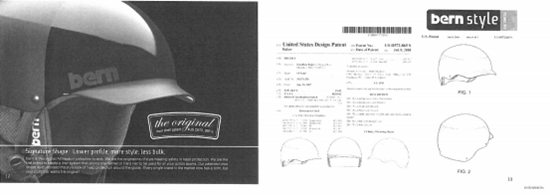
Bern referred to the patent in marketing materials and on its website and at trade shows many times. Catalogs included logos that stated “the original” above text that stated “visor shell patent # US D572,865S,” and one also included an actual excerpt from the patent. There were other claims, such as that Bern’s “patented hard visor shell shape has been imitated but never replicated. Almost every brand in the market now has a brim, but your customer wants the original.” Trade-show banners also included “the original” with the patent number below it. Bern’s strategy, as indicated by internal documents, included allegations that competitors have “knocked off” Bern and that retailers should avoid stocking knock-off brands.
![]() |
| Bern catalog using image from design patent |
![]() |
| Bern catalog using logo with design patent number |
So, though the design was patented, Bern learned that the patent was “probably” invalid. First, were the relevant claims made in advertising or promotion? The documents on marketing strategy were mostly internal, and there was no evidence that the ones that weren’t were targeted beyond certain individuals.
Were the actual ads literally false? They didn’t state outright that Bern owned the patent, but cited the patent number and used phrases such as “our patented hard visor shell shape,” “our patented visor shape,” “our patented integrated cap style visor and hard shell visor,” “the original visor patent,” or “the original visor shell patent.” One ad showed the actual patent, but indicated that the inventor was Jonathan Baker. There was an issue of actual, technical ownership, but Bern was undisputedly authorized to make products under the patent. “The word ‘our,’ in reference to property, can refer to ownership (for example, a homeowner referring to the property as ‘our house’) or a legal right to use it (for example, a renter referring to an apartment as ‘our apartment’).” Thus, the statements weren’t literally false.
However, if there was intentional deception, defendants still wouldn’t need evidence of actual consumer deception. Defendants argued that the deception was intentional because Bern knew its patent was invalid by February 2011 but continued touting it, e.g., the sales rep/investor’s statement that “I have had an uneasy feeling since Dennis explained to me that we did not file a patent in time for the Visor shape that we invented. Not sure how this happened but it is probably Bern’s biggest mistake to date.” This evidence was enough to create a genuine dispute of material fact on intentional deception leading to a presumption of consumer deception.
The court commented that a patent is presumed valid, and the design patent here was never formally challenged. “Nonetheless, it seems clear that a claim of intentional deception could be made out based on the unenforceability of the patent, under the unusual factual circumstances presented here.”
But what of materiality? That was independent of intent. (Though prominence in advertising might suggest that Bern believed that consumers would care.) Defendants argued that the statement related to an “inherent quality or characteristic” of the product, making it material. “Inherent” here means part of the “essential” character of a product. Defendants had no survey or other direct evidence of material, but Bern’s Rule 30(b)(6) deposition witness stated that “[t]he intention was to help educate retailers about our patent and to try to get them to place their buy for visor lids with us and not our competitors.” That was sufficient to “create the inference that Bern at least hoped and indeed intended that its advertising of the patent would affect purchasing decisions,” creating a genuine fact issue on materiality.
Then, injury. In literal falsity cases, “only a slight likelihood of injury need be shown to warrant injunctive relief.” But misleadingness requires more. Defendants had no evidence of actual or likely injury: no evidence of lost sales or consumer confusion, or harm to goodwill or reputation. A presumption of harm from direct competition wasn’t enough; that made sense in a two-competitor market, but not here. Even though defendants alleged that they comprised all the other major helmet manufacturers; defendants didn’t provide evidence that this was so and Bern disputed the issue. Nor was Bern’s fraudulent conduct enough to bypass the rule of actual harm. Such a presumption “should be reserved for extraordinary cases,” and there wasn’t enough evidence that this was such a case.
With “no evidence of literal falsity, minimal evidence of deception, minimal evidence of materiality, and no evidence of causation and injury,” summary judgment for Bern was appropriate. This disposed of coordinate state-law claims as well.
ANA conference: litigating Lanham Act damages
Litigating Damages Claims In Lanham Act False Advertising Cases
Alexander Kaplan, Partner, Proskauer Rose LLP: Case law on damages can be tricky/inconsistencies between circuits. What’s recoverable? 1117(a): D’s profits; damages sustained by P; costs of action. Statute doesn’t prevent recovering both profits and damages but getting both is rare. Ad context and market size matter. Comparative ads: advertising that names D’s prooduct and willful literal falsity: reuttable presumption of harm, odds of recovery improve.
TrafficSchool v. Edriver: reasonable to presume that every dollar D makes came from P’s pocket in a comparative ad context. Weight of case law: rebuttable presumption of causation and injury for willful literal falsity in a two-firm market for comparative statements. Second circuit: noncomparative ad but two party market, court allowed presumed damages. Showing injury is separate from showing damages, but you do see presumptions of injury for injunctive relief purposes—has to be considered separately, but some courts mix it up.
Damages calculation should be fair and reasonable approximation of lost profits, SDNY. Wrongdoer bears the risk of error, DC Circuit. P proved damages by showing own internal projections of sales in the DC Alpo case. Disgorgement: 2d Circuit requires willfulness. 9thCircuit does a totality of circumstances analysis; willfulness not required where disgorgement is proxy for P’s lost profits and where parties are direct competitors; it is required if the theory of recovery is unjust enrichment/deterrence. 1st: willfulness not required to get profits from direct competitor; it is from indirect competitor. 3d and 7th: willfulness is only one factor to be considered; disgorgement still available w/out it.
2d Circuit considers: degree of certainty that D benefited from the false advertising; availablilty and adequacy of other remedies; role of D in effectuating wrongdoing; P’s laches/unreasonable delay; P’s unclean hands. 3d: intent to confuse; sales diversion; adequacy of other remedies; unreasonable delay by P; public interest in making misconduct unprofitable.
Lanham Act allows treble damages, for any sum above the amount found as actual damages not exceeding three times; but enhanced damages must constitute compensation, not a penalty. But: Merck case: enhanced damages can serve compensatory purposes when harm difficult to quantify and deterrent purposes when violation was willful. Where appropriate? D received intangible benefits from advertising. P’s relative market loss isn’t accounted for under lost profits; D’s profits allowed it to gain market foothold; P’s lost profits don’t fully capture D’s profits.
Chances of getting attorneys’ fee award overturned on appeal are not good. Some require malice/bad faith for “exceptional” cases; other circuits allow award based on objective de/merits without showing bad faith.
Julia Reytblat, Associate General Counsel, Church & Dwight Co., Inc.
Inside look at damage: What are lost sales/damages? How long has the ad been running? What sales/market share can be quantified? Royalty loss? Brand damage? D’s hat: quite different—point out to court that lost sales may have resulted from a whole slew of factors, not the result of false advertising. Launches of product by P may have cannibalized sales; other competitive launches may have affected whole industry; quality issues with P’s product; has P changed its ad strategy? Has it spent less on ads? Are the products seasonal at all?
Start thinking about docs and witnesses early in the case. Plaintiff may want Nielsen/network data; frequency of bad ads; competitive price tracking; sales figures. Be aware of what’s in your client’s files. Witnesses: finance people: were we offering any discounts etc. that might affect sales?; marketing research: can testify to impact on purchase intent; sales: can give front line perspective—are we losing shelf space? Outside expert may sound more persuasive. Plaintiff may want sales/marketing expert demonstrating products are competitive, explaining impact of advertising, arguing that the falsity drove sales, connecting D’s ads to P’s drop in sales.
Defendant might consider market response model/regression model. This identifies performance drivers through regression. It’s expensive; requires expert with PhD in marketing/finance. Estimates importance of each factor and controls for non-advertising factors that could affect sales; allows isolation of variables. Expensive, but may be worth it if damages exposure is large. (P can use too.)
For disgorgement, P’s burden is quite low: D’s sales only. Every $ must be shown not to be the result of false advertising. Show production, distribution, indirect costs—physical plant, energy costs. D must be ready to allocate costs, produce supporting documents—can even deduct marketing cost of the false ads.
Q: have you seen arguments about sales not attributable to ads?
Reytblat: yes, definitely. Some products’ brand is so strong that people will buy regardless of ad content, repeat/loyal buyers, price. Some categories are very price sensitive.
Q: role of jury?
Kaplan: Expert can be good at persuading jurors of effects. Disgorgement is an equitable remedy so no jury right, though a court could give it to a jury for an advisory opinion/advice on the $ if the court decides disgorgement is appropriate.
Q: counter-advertising costs?
Kaplan: rectifying the false ad need not be the only purpose of counter-advertising, according to one court, so you can recover your counter-advertising costs as damages if rectifying the falsity is one of the main purposes.
Q: should P be forced to spend any award for counter-advertising oncounter-advertising?
Kaplan: has only seen it awarded for past corrective expenses. D should maybe pay for the future counter-advertising itself. (But see the ISO case from D. Mass, which indicates the risks of awarding P the $ but upholds a smallish award for that purpose.)
ANA conference: native advertising
The Natives Are Restless: Legal Perspectives On Native Advertising
John P. Feldman, Partner, Reed Smith LLP: ads have been considered deceptive for not disclosing they are ads/source. Native ads = sponsored content formatted to fit seamlessly into modern media. Extension of tradition of placing ads in most advantageous ways. Implications for line between editorial content, noncommercial speech and commercial speech. Does payment for content make otherwise noncommercial content into commercial speech? Also right of publicity implications.
What does FTC look at for native ads?
Laura M. Sullivan, Staff Attorney, Division of Advertising Practices, Federal Trade Commission: Concerned about ads designed to look independent/editorial/independently sourced information. Native ads don’t change that. At our recent native advertising workshop, we heard agreement around the need for transparency even apart from §5 concerns. Publishers want to protect the integrity of the brand. Different thoughts around implementation: we wanted to learn what was occurring in the marketplace. Will likely issue guidance this year.
Feldman: Testimonial/endorsement gudies: is native advertising the same issue with respect to disclosing material connection? Is there a distinction?
Sullivan: Different cotnexts. Native ads take various forms. We looked at a subset, where there’s a risk of misleading consumers into believing that it’s editorial/independently sourced. It’s the relationship between the advertiser and the content: are there traditional markers or signals of advertising? If not, consumers should still be able to identify it.
Feldman: but note that deceptive format isn’t necessarily the same thing as “failure to disclose material connection.”
Rebecca Tushnet, Professor of Law, Georgetown University Law Center: In First Amendment terms, I like Justice Stewart’s idea about regulating transactions versus regulating in service of some other social goal. If the government is regulating to protect the consumer in the transaction, then it has broad freedom to act. If it’s regulating for some other goal—decreased energy consumption, say—then it should face a high burden of justification. This approach makes the abstract question “is it commercial speech” much less significant. Money matters: if I can’t benefit from saying I love Diet Coke (which I do) then my speech isn’t commercial, but it’s less important how the monetary connection works.
Sullivan: we use the RJR factors: from a case about ads that discussed a study on the relative safety of RJR’s cigarettes. Is the content promoting a brand or product? Does the speaker have a commercial motivation? How did the content come to be published?
Feldman: example of do it yourself craft ideas, such as recycling crayons, sponsored by a craft store on Buzzfeed. Commercial?
Sullivan: payment alone isn’t determinative. We’d look at content. Is there a specific product or attributes being promoted?
Feldman: assume it’s written by an organization dedicated to getting kids away from TV screens.
Sullivan: FTC lacks jurisdiction over nonprofits. We’d look at the content, again. What would the commercial motivation be?
Feldman: written and paid for by manufacturer of crayons?
Sullivan: again, the connection/motivation matters. Does the speech advance their commercial interests and are they talking about specific attributes?
RT: Again, the Stewart approach makes this easy. Why are you trying to regulate?
Feldman: right of publicity: there may be reasons to disclose sponsorship in every instance regardless of legal mandate because doing so is cheaper, simpler, safer and also produces brand enhancement. Assume you say it’s sponsored: what happens from a right of publicity perspective?
Stewart v. Rolling Stone (weird reasoning for why Camel wasn’t liable for editorial in insert surrounded by Camel ads); Jewel v. Jordan. RT: some risk that sponsorship might be interpreted as right of publicity violation—though in that case disclosure might not matter.
Feldman: example of Chicago Tribune section “sponsored by Menards,” a home improvement store. There’s a disclosure that it’s not written by CT editorial staff and a “learn more” link. The link says the content is paid for by a third party and the newsroom isn’t involved. Articles are about crafts, gardening—informative.
RT: note the incentive to disclose regardless because the goal is branding. Potential issues: §230—CT is no longer responsible but advertiser is. Tort law: “DIY cool hot plates” are the example: what could possibly go wrong?
Sullivan: we’d ask whether knowing the source changes the credibility/weight. In terms of labeling, the question is whether consumers notice and whether it conveys an accurate relationship.
Feldman: another native CT ad: “something fresh sponsored by Jewel Osco.” Curated articles from the Village Voice, HuffPo, Food & Wine—all food related, but don’t mention Osco.
RT: §43(a) problem if no licensing relationship? There shouldn’t be, but courts have applied §43(a) widely. What if a celebrity chef is mentioned: right of publicity claim?
Feldman: suppose one of the articles makes factual claims about iron pans?
Sullivan: if Jewel Osco is distributing the article for commercial purposes (other than to improve its brand), we’d look at whether a consumer would take away a product claim. If it is deceptive, §5 liability coulud attach.
Feldman: implications of curated content? If advertiser specifically curated article about something they sell in the store, and that’s not substantiated, greater risk.
Sullivan: yes. Very context specific—is it gaining credibility for economic benefit. Even content that is protected by the First Amendment in one context can be changed into an ad in another context.
Feldman: Tom Brady’s best friend: Funny or Die video sponsored by Under Armour. Branding is all over the video. What would require the label “sponsored”?
Sullivan: what ordinarily a consumer would expect. But again, we’d ask whether there was any information/statements in this context that would cause consumers to give it more weight.
RT: The only claim the ad seems to me to make is that Tom Brady is hot. That doesn’t seem falsifiable to me. (NB: This joke killed in a room full of advertising lawyers.)
Feldman: Slate’s homepage says “sponsored content” but you don’t know who sponsored it until you click through—is that a problem? Especially if people are paid for clicks.
Sullivan: Sponsorship serves a purpose, but we’re assuming it’s an ad. In some contexts, sponsored may be enough. If there’s deception in the first interaction with the consumer, though, that can violate §5. In fake news context, banners led to a fake news site—the initial deception was enough to be a deceptive practice even with later corrections/qualifications.
Standard disclaimer: her statements are not official statements or views of the FTC.
Q: a lot of precedent for limiting regulation to that which is likely to influence purchasing decisions. Disclosing material information before purchasing decisions. Readers aren’t consumers. Disclosing that people are directing your attention is a material change in the standard. Probably insurmountable challenge to disclose all the people benefiting from your attention: there are 95 cookies on that webpage and no disclosure can cover all that.
Sullivan: we approach it traditionally—is information within that message deceptive? Not different.
RT: Agree—we don’t want different format to change things—if a celebrity goes on Oprah and talks about a great new drug that helped her health, we want to know if she’s been paid to say that. Q: So do you need a disclosure in the teaser for the show? RT: Depends: if the teaser is “Kim Kardashian explains how she cured her acne,” I’d say yes.
Sullivan: what statements are being made? Tantalizing pictures aren’t necessarily claims that benefit the advertiser. We also need to consider mechanisms of disclosure: people may encounter the content in many different contexts, including Facebook—if you need disclosure, you need it to travel and be mindful of contexts in which your content is encountered.
RT: final thoughts on §230. Suppose the advertiser does adopt claims in another article. Will courts let them off the hook? Possible theories: agency law could extend to grab the advertiser, depending on the relationship—courts have not been willing to say that §230 immunizes an employer for acts of an employee w/in the scope of employment, and agency law may go further. Or, §230 doesn’t bar liability if the defendant contributed to the illegality of the content. One could argue that, if it’s the advertiser’s involvement that makes the content an ad, and it’s the fact that it’s an ad and not noncommercial speech that makes it illegal, then §230 wouldn’t bar liability. But we don’t really know how courts will deal with this.
Even post-Lexmark, Lanham Act isn’t for garden variety defamation claims
Mitchell v. Sanchez, No. 14–0996–CV, 2015 WL 1393266 (W.D. Mo. Mar. 25, 2015)
Mitchell alleged that defendants incorrectly stated on various media broadcasts that she had AIDS/HIV. She sued for violation of the Lanham Act, invasion of privacy and intrusion into seclusion, false light invasion of privacy, and defamation per se.
Defendant Mediacom argued that Mitchell lacked Lanham Act standing, since she was a noncompetitor. Lexmarknixes that argument, requiring only that a plaintiff come within the zone of interests (an injury to a commercial interest in reputation or sales) and allege proximate causation in the form of economic or reputational injury “flowing directly from the deception wrought by the defendant’s advertising; and that that occurs when deception of consumers causes them to withhold trade from the plaintiff.”
The court found that Mitchell didn’t fall within the Lanham Act’s zone of interest, since “Congress did not intend to have every garden variety defamation claim transformed into a Lanham Act claim.” Also, there was no proximate causation because there was “a glaring absence of any actual advertising at issue,” since the defamatory statements occurred during media broadcasts. (I think the court misreads Lexmark’s language—the fact that it’s not advertising doesn’t mean that it didn’t proximately cause Mitchell’s harm; defamation generally does proximately cause reputational harm when it’s actionable. The problem is that it’s not “advertising or promotion,” an element of the underlying claim.)
Also there was no false endorsement claim. A false association with “having and spreading AIDS/HIV” can’t serve as the basis for a false endorsement claim under the Lanham Act.
The court asked for more information to figure out whether diversity jurisdiction remained.
Three’s fair use too: play is transformative work
Adjmi v. DLT Entertainment LTD., No. 14 Civ. 568 (S.D.N.Y. Mar. 31, 2015)
David Adjmi sued for a declaratory judgment that his play, 3C, based on Three’s Company, was a fair use, in order to be able to authorize publication and licensing for further production. DLT had sent a C&D when the play began its run Off Broadway.
This is a fair use finding on the pleadings, which include nine seasons of Three’s Company, along with the written play. (It’s not clear whether the court suffered through nine seasons; the parties explicitly referenced seven episodes, and its analysis focused on those episodes.) For those of you who don’t remember, “Three’s Company was one of the most popular television shows of the 1970’s.” According to the Season One DVD:
John Ritter stars as Jack Tripper… the everbumbling bachelor who shares an apartment with down-to-earth Janet Wood (Joyce DeWitt) and dim-bulb blonde Chrissy Snow (Suzanne Somers). Along with their sexually frustrated landlords the Ropers… and Jack’s fast-talking pal Larry… these three outrageous roommates tripped and jiggled through a world of slapstick pratfalls, sexy misunderstandings and some of the most scandalously titillating comedy America had ever seen.
Jack pretended to be gay, and the show “was considered daring for its time, in that it featured three single, opposite-sex adults platonically sharing an apartment in the late 1970s.” The court goes into great detail about several episodes, which made me recall Clay Shirky’s line in Cognitive Surplus: “Did you ever see that episode of Gilligan’s Island where they almost get off the island and then Gilligan messes up and they don’t? I saw that one a lot when I was growing up.” The credits feature a montage: “Jack rides his bicycle by the ocean before becoming distracted admiring a female passer-by and tumbling into the sand, grinning; Janet tends to her flowers then playfully pours water on a sun-bathing and scantily-clad Chrissy; all while the familiar chorus of Come and Knock on My Door‘ plays in the background.”
The show has a “happy-go-lucky, carefree feel,” complete (arguably overflowing) with a laugh track. The central plot theme is “an attractive, heterosexual man living with two attractive, heterosexual women in an entirely platonic—albeit innuendo-laden—manner.” Meanwhile, landlords “Mr. and Mrs. Roper play a familiar trope: curmudgeonly, stuck-in-his-ways old man and his sarcastic but ultimately loving wife.” They initially bar Jack from moving in with Chrissy and Janet, but accede when they believe he’s gay (because Janet told them that). In each episode, “everything ties together neatly and ends in laughter.”
One featured episode covers more “serious” subject matter, where Janet was passed over for a promotion for an inexperienced co-worker with big breasts, Chloe. “At different points in the episode, both Janet and Chloe express sincere plight.” However, the show “ultimately uses this issue to generate innuendo-fueled comedy.” Another episode involves a mistake about whether Chrissy’s head injury was life-threatening. “Chrissy’s bubble-headedness stands in sharp relief to Jack and Janet’s prayers for God to help Chrissy. As usual, everyone goes home happy—and to a blaring laugh track.”
3C is different. The parties agreed that the play copied “the plot premise, characters, sets, and certain scenes from Three’s Company.” More specifically: “3C’s lead male character is an aspiring chef; the blonde female lead is the daughter of a minister; and the brunette female lead is a florist.” The parties diverged in their characterizations of the rest of the comparisons. 3C begins with excerpts from William Shakespeare’s Romeo and Juliet (“These violent delights have violent ends,/And in their triumph die, like fire and powder,/Which as they kiss consume.”) and Genesis 3:17 (“Cursed is the ground for your sake; In toil you shall eat of it/All the days of your life.”). The court commented that these quotes formed an “apposite preamble” for the play, which has a “heavy tone” from the outset.
(Here I quote from the playscript because it is amazing, and probably gives a good idea of whether you would want to see this play. “A double slash (//) indicates either an overlap or jump… speech in parentheses indicates either a sidetracked thought or a footnote within a conversation, or shift in emphasis with NO transition… A STOP is a pause followed either by a marked shift in tone or tempo (like a cinematic jumpcut or a quantum leap) or no change in tempo whatsoever. These moments in the play are less psychological than energetic. They have a kind of focused yet unpredictable stillness, something akin to Martial Arts, where there is preparedness in the silence…”).
3C opens with a discussion of a woman disfigured in a fire she set to burn her bra; then roommates Connie and Linda discuss “money problems…; self-consciousness bordering on self-loathing …; references to sexual assault …; and Connie’s promiscuity.” “3C is not light fare….Suffice to say, the tone is not uplifting. And the roommates’ mood is further dampened by their landlord, Mr. Wicker, demanding rent they are unable to pay.” When they discover that Brad passed out naked at their party, “[t]he ensuing dialogue toggles between excitement and disarming seriousness.” The dialogue, “sometimes disjointed and rapidly shifting in tone and topic, is a hallmark of 3C.” Mrs. Wicker’s extreme anxiety makes her seem indifferent to Brad’s supposed sexuality (“MRS WICKER: (weirdly flirtatious) Don’t tease! and anyways, I plan on committing suicide in a few days, so I’ll be dead first. Ha ha ha. LADIES FIRST. No seriously, I want to die. NO I’M KIDDING. (her smile disintegrating here)”). Mr. Wicker makes anti-gay statements and jokes and sexually assaults Linda.
Brad’s friend Terry also “uses derogatory language for homosexuals and has an aggressive, abusive attitude toward women.” Brad is indeed gay and pines for Terry, but Terry believes the Wickers are under a falseimpression that he’s gay. “The play continues, building on established themes: Linda’s negative self-image; Brad’s closeted attraction to Terry, and Terry’s exacerbating that with his abrasive obliviousness; and Connie’s obviously complicated religious and familial history; and Connie’s promiscuity.” Even “relatively happier moments are accompanied by complicated, dark undertones.” Linda mistakenly thinks Connie and Terry are having sex, when he was actually forcing her to snort cocaine.
“Brad attempts to come out but Linda unknowingly rejects him.” Mr. Wicker says terrible things about gays, and “only relents after Brad begins telling jokes deriding homosexuals himself.” Eventually, “the play transitions into a series of disjointed non-sequiturs elaborating on themes described above.” Finally, Brad attempts to come out to Terry, with bad results, including Connie’s attempt to be funny by claiming “I’m a faggot too!” which leads Linda and Terry to say the same.
Eventually, Brad stops laughing. He pulls himself off the floor. The rest of them are still going. Brad, unsmiling, wipes the tears from his eyes. He sits on a chair. Removed, but not too deliberately. The laughter dies down.
As they recover a disquieting, awful dread creeps into the room.
Silence. Black.
Okay then! On to the legal analysis. The court noted that other decisions have granted motions to dismiss or summary judgment, based solely on a comparison of the works at issue, on fair use grounds. The court also cited two reviews of 3C, which were included in the complaint and thus properly within the scope of review, but noted that the reviews were unnecessary to its overall finding.
Adjmi sought to publish and license 3C, so its commercial nature weighed against fair use (because commercial doesn’t mean First Amendment commercial). But transformativeness trumped that. 3C copied the raw material of Three’s Company to create “new information, new aesthetics, new insights and understandings,” justifying its copying of the “plot premise, characters, sets, and certain scenes.” 3C turned Three’s Company’s “sunny 1970s Santa Monica into an upside-down, dark version of itself.” DLT cited Salinger v. Colting for the proposition that “[i]t is hardly parodic to repeat [the] same exercise in contrast, just because society and the characters have aged.” 641 F.Supp.2d 250 (S.D.N.Y. 2009), vacated on other grounds, 607 F.3d 68 (2d Cir. 2010). DLT claimed that “all of the allegedly critical elements in 3C were in Three’s Company,” including “sexual aggression, drug use, homophobia, self-consciousness and self-esteem issues.”
But 3C deconstructed rather than repeated the sitcom, turning it into “a nightmarish version of itself.” 3C used the “familiar Three’ s Company construct as a vehicle to criticize and comment on the original’s light-hearted, sometimes superficial, treatment of certain topics and phenomena.” For example, Jack’s false homosexuality became true for Brad; though that in itself might not have been transformative, Brad was “almost a reimagining of what Jack would have actually experienced if he were homosexual: the abusive, demeaning treatment from Mr. Wicker; constant homosexual slurs from Larry; and even rejection from his own family.” That was a “major departure from Mr. Roper’s innuendo-laden jokes.” Even setting aside the markedly different reactions of other characters to Brad/Jack, they also were in stark contrast. Though both were “tall, handsome men prone to occasional physical clumsiness, … in similar living situations,” Jack was mostly a source of comedy, while Brad spent most of 3C grappling with a painful secret he was trying to disclose. “Three’s Company may have been ground-breaking and heralded in retrospect for raising homosexuality as a theme, but 3C criticizes the happy-go-lucky treatment of that issue.”
The same was true for other topics DLT claimed were already present in Three’s Company:
Chrissy, Jack, and Janet’s unwittingly finding a plant they erroneously believe to be marijuana versus Larry’s forcing Connie to snort cocaine; Mrs. Roper’s sarcastic sexual frustration versus Mrs. Wicker’s near-psychotic break …; the laugh-track blaring because Janet’s classmates made fun of her flat-chestedness versus Linda’ s constant self-loathing; Chloe and Janet’s commentary about a handsy male boss versus Chrissy’s constant allusions to having been raped; and so forth. To the extent that homophobia, sexual aggression, drug use, self-consciousness, and self-esteem issues were present in Three’s Company—which the Court does not necessarily accept as fact—those themes were largely made light of and ultimately played for laughs.
In fact, actual homosexuality and drug use weren’t in Three’s Company, while 3C treated them as real and “criticize[d] and comment[ed] upon Three’s Company by reimagining a familiar setting in a darker, exceedingly vulgar manner.”
Further discovery was unnecessary “to evaluate stylistic factors like setting, costume, style, pace, and tone. Given the overwhelmingly transformative nature of the substance, the first factor would likely weigh in favor of a finding of fair use even if certain elements, like setting, costume, style, and pace, were exactly the same as in Three’s Company.” Anyway, that wasn’t true as to the most important factor: tone. There was ample proof that the tone of Three’s Company was “happy, light-hearted, run-of-the-mill, sometimes almost slapstick,” with one central “problem” per episode solved by the end, featuring regular communication by the characters and supplemented by a laugh track. 3C’s tone differed on even cursory inspection: from the dour opening quotes (contrasting with the cheerful Three’s Company montage), it proceeded “in a frenetic, disjointed, and sometimes philosophical tone, … often difficult to follow and unrelentingly vulgar.”
Thus, transformativeness weighed heavily in favor of fair use, and would regardless of what discovery might reveal. No intent evidence, as used in Blanch and Cariou, was required.
Nature of the work: highly creative, though “less in the creation of new elements than in mixing familiar tropes together in novel ways,” since the characters were basically stock characters. But anyway, the nature of the work is of little relevance to transformative uses.
Amount taken: extensive copying of “the original’s basic plotline, characters, and setting, and, to a lesser extent, its jokes and themes.” But a parodist is entitled to take the “heart”—“the roommates’ living arrangement, basic personalities, location, and the like.” DLT also argued that 3C copied many minor, unnecessary elements: “Chrissy/Connie being a minister’s daughter; Jack/Brad is a chef-in-training; Linda/Janet working in a flower shop,” and sequences from particular episodes, such as “the female roommates’ mixing together unfinished wine bottles the morning after their original roommate’s going-away party; Janet/Linda suggesting that Jack/Brad go see an ‘arthouse movie’; and various innuendo- laden dialogue between Jack/Brad and Chrissy/Connie which lead other characters to believe the two are sexually involved.” This constituted copying not just of Three’s Company’s heart, “but also its metaphorical appendages.” That weighed against fair use, but had to be evaluated in light of the first and fourth factors, and was comparatively less important.
Market effect: There’s no protectable market for criticism. DLT argued that 3C diminished “the novelty of, and the market for, a potential stage adaptation of Three’s Company,” and fulfilled the same demand. DLT cited a review of 3C specifically referring to the play as “three’s company, too-oo!” Nope. Salinger, cited by DLT, involved a work “meant to be a sequel of the original, which is not the case here.” And that very review referred to 3C as “deconstruction” of the popular television show. Another review was titled “2 gals, a guy and Chekhov in play ‘3C’,” and observed:
If a surreal, downbeat inversion of a cheery 1970’s sitcom sounds intriguing, then you and your therapist will probably want to see… “3C.” Adjmi has imagined how Chekhov (and maybe Wile E. Coyote) would handle a classic American television situation comedy, based on the lighthearted “Three’s Company.” He’s reworked the original fluffy good humor into deep dysthymia and near-suicidal depression, using absurdism and existentialism overdosed with Chekhovian angst.
“[T]he Court is quite sure that a viewing of Three’s Company does not require one’s therapist.” There was no potential market substitution.
The most important consideration was the “distinct” nature of the works, which was “patently obvious.” “The law is agnostic between creators and infringers, favoring only creativity and the harvest of knowledge.” That meant a fair use finding here.

ANA conference: Miss. AG Jim Hood
Keynote Address, Jim Hood, Attorney General, State of Mississippi, President, National Association of Attorneys General (NAAG)
Law enforcement has to be moving to the internet, where crime is going. Worked with ISPs on child porn/hash screening. We do hacking, extortion, data breach, IP theft. He fears in our lifetime a hacker will shut down our electric grids. Survived Katrina; carried a gun the first few weeks thereafter. Law-abiding people will steal water, gasoline, whatever they need to protect their families if the electrical grid is shut down.
AGs have multistate working groups. If you have a data breach, and call my office as GC, I have a direct link to that company. If you hire a large firm with a data breach practice, most AGs will think “this is the defense firm we have to deal with” and their eyes glaze over. Work with the AG instead. If you hire a defense firm, we assume you’re guilty, that’s our law enforcement action. BP oil spill: initially well handled, GC reached out; then they figured out they were really in trouble. If you have a small data breach, work with AG’s office. Hard to point a finger when we may not have protected our own gov’t systems as we should. Compare to your competitors—big box store may need different procedures than a bank. AGs are putting together a manual with suggestions; not necessarily best practices. Primarily for small businesses suffering a data breach.
Most AGs want federal legislation to be as stringent as the most stringent state legislation. Probably will see some movement in the next year or two. We fight federal preemption every day, Democrats and Republicans. There is a lot of overreach—federal district judges in particular haven’t respected state sovereignty as they should. (Heh.) CAFA: 49 AGs said “exempt AG actions from this act,” and Senators said they wouldn’t be covered, but the 5th Circuit said that AGs were covered anyway; SCt reversed 9-0. There’s a constant battle. But we’ll probably reach agreement on data breach.
We just appealed the Google decision. The Sony hack: I didn’t have a clue they knew Mississippi had an AG; I didn’t know anything about operation Goliath or any of this stuff. They acted like the movie theaters got an AG to go after them, but I’ve been doing it for 6-8 years. Motion picture industry has been involved since the 1920s when people stole film off trucks. Counterfeit items hurt our consumers. Drugs, etc.
After Google entered into a plea w/fed. gov’t, paid $500 million to avoid conviction, b/c DOJ found that marketing division was getting around their system to allow Canadian pharmacies to advertise—really dope dealers in South America and Russia. Google folded b/c DOJ got their emails. Complaints from parents: investigators made buys online, like oxycodone. Autocomplete used to complete “prescription” with “buy prescription drugs without prescription.” We bought from their ads. Monetizing the sale of illegal drugs is a problem. YouTube videos would say “here’s how to buy drugs w/o a prescription.” (§230?)
IP theft is important—Mississippi has an inordinate number of artists and writers—but the AGs weren’t badgering Google out of nowhere. We bought pain and birth control pills; often we got ripped off, or got counterfeits—during Google’s 2 year probationary period and we provided that information but the fed gov’t hasn’t done anything so far. Engaging on these tech issues is not new. 3-D printers are an emerging issue. Will change business more than the internet. Will be able to print a cellphone. Won’t need Chinese labor. Also IP theft. Guns, drugs.
Encryption: will you get sued if you don’t encrypt? You can’t encrypt w/in business, but if you send it to someone else, they need to decrypt. Apple iOS: Now we have digital info in almost every criminal case—texting, photos, emails. We rescue kids by working with Facebook: we find them if they’ve run away. FB works with us. Law enforcement access saves lives. Crooks want privacy protection—helps sell phones. (So much for data breach concerns.) If we can’t get cellphone companies to keep some code for us, we need a law to give us the best evidence. What if a guy gets shot and the video on the phone is the only evidence?
Q: in the past, NAG has cooperated w/FTC. What’s it like now, and how do you see it going forward? What are the priorities in consumer protection, and do they match those of the FTC?
A: have a good relationship w/FCC and FTC. Antitrust can be slow, but generally they deal with a bigger bureaucracy. Ads to kids: higher standards. Particularly online, all the apps targeted at kids.
Q: why aren’t you boycotting Indiana? Aren’t civil rights a critical issue as well?
A: Governor of Conn. banned state funds for travel there. They’re going to have to deal with their own problem.
Q: distinguishing between ads and content—are the AGs involved?
A: not as much, but in the area of Google ads/AdWords, when we see “how to murder your wife” for a YouTube video, we notice that. Have to disclose where you place ad. We will look at putting legit ads beside illegit ads.
Q: self-regulation, including on piracy: ecosystem challenge is where the liability should be put. There’s a challenge in putting liability on intermediaries. We’ve come out on having advertisers do contracts and push down limitations on ads delivered on pirate sites.
A: companies have a role here. Talk to the AGs but AGs can’t carry all your water. A lot of times competitors come to us. We try to stay out of individual class actions.
ANA conference: surveys
What Do Consumers Think? Using Online Surveys To Demonstrate Implied Claims
David G. Mallen, Co-Chair, Advertising Disputes, Loeb & Loeb LLP: NAD now forum of choice for many ad challenges, especially since the standard of proof is different for implied claims. Survey not required but may be useful.
Kelsey Joyce, Senior Director, Legal Affairs, T-Mobile USA
We deal with competitive ads all the time. Survey: in 43(a), very helpful; is it worth spending the money on survey for NAD? Discussed with marketing clients as well as external lawyers/survey expert. Timing: if this is an ad we really want out of the market—and they all are!—we might not want to take the time to do a survey in order to get the challenge started.
Hal L. Poret, Senior Vice President, ORC International: possible to put together a survey with 2 weeks’ notice, which can be important w/NAD. Difference between online and mall survey may allow you to supply a rebuttal survey in short time.
Mallen: what’s candidate for online survey and needs mall intercept?
Poret: what’s the ad and how is it being shown? Online survey may have very small screen. Could be desktop/laptop. Even tablet/mobile phone, though you want to stop that if you can. Can it be fairly presented on computer screen? TV ad w/small print, or graphics/charts that might be harder to read, think carefully about whether showing it on a computer screen would be challenged.
People also move quickly through unsupervised online surveys; want to get through it. Human interviewer: social pressure to respond; interviewer takes down answers for them = longer, more detailed, thorough answers. If you need people to speak in their own words, online may be more difficult.
You don’t always need a human interviewer—majority of NAD cases allow online; advertisers are often trying to go up to the line between true and false, and thus you almost always need a closed-ended question, and online surveys are ideal for closed-ended questions.
Q: “Nobody knows you’re a dog”—is that an issue?
Poret: it’s not to me; that’s how marketing research works these days. We work with large online panels that recruit lots of people and work to comply with standards. We have techniques to know who we’re inviting—DOB, gender, etc. to know who’s taking the survey.
Q: controls?
Poret: in some ways online surveys lend themselves to what you want as a control—often the most effective thing is altering the original ad to clarify something or make it true. Digital alteration is often most desirable, and presenting it online makes sense.
Joyce: NAD Case No. 5686, T-Mobile challenged Sprint’s campaign for Unlimited My Way monthly service plans. Challenges: Ads w/specific scenarios depicting how consumers can save money imply that consumers will save. Guaranteed Unlimited For Life confuses consumers about whether “for life” applied to the $80 monthly fee or the unlimited talk, text, and data. “Guaranteed for life and only from Sprint” implied that only Spring had unlimited talk, text, and data. Considered not doing a survey because it seemed misleading on its face. We thought consumers would take away message that the price was part of the fee. Decided to survey because (1) wanted backup, (2) were challenging another Sprint ad that they thought needed a survey, so taking the time was a nonissue.
Poret: control was clear cut because the issue was combination of “for life” with $80 in close proximity. Control: unlimited for life, eliminating $80. Challenge: didn’t show entire webpage, just ad banner. But NAD was satisfied with explanation that nothing else on the page clarified the offer and that this was a standalone ad.
Mallen: issue is net impression, but net impression of what? You may sometimes have to test an entire webpage. When would that be?
Poret: other content possibly right above or below that bears on that. Headline, graph, and then a paragraph of text.
Joyce: we captured the entire page so we could show how the test and control were displayed. Control: “only Sprint delivers unlimited for life,” without the $80. The control ad is an ad that we can live with in the marketplace at the end of the day. Create a blueprint for Sprint to fix what we think is the deception.
Poret: NAD skepticism about closed ended questions makes it really, really important to have a good control that shows that closed ended questions on the control didn’t produce the deceptive answer. “Based on the ad, what is guaranteed for life?” Please be as detailed and specific as possible.” After other filter questions, including whether the ad communicated anything about a guarantee for life. NAD will want that.
Test group: 34.5% said guaranteed $80/life when asked the intro broad questions “what did this ad communicate?” 5.5% in the control group said the same thing. Net 29%. Didn’t even need the closed-ended questions. If you did, 57%/9%, net 48%. NAD accepted the survey evidence.
Joyce: other challenged ads were tougher. $83/year offer depended on buying one particular phone, iPhone 4. Disclaimer was at the bottom but we thought it wasn’t clear; offer was “our most popular free smartphone”—but that wasn’t the most popular phone, smartphone, free phone, or iPhone even at Sprint: it was the most popular free smartphone at Sprint.
Poret: problem was not that something needed to be removed, but that something needed to be added: “when you choose an Apple iPhone 4” was control. Here we needed closed-ended questions much more because it wasn’t the kind of ambiguity people would resolve on their own. Online survey works well here because you need the closed-ended questions. 55% in test said that the savings would apply to any phone; went down to 18% with control ad—helped convince NAD that the survey was reliable.
Joyce: we’re more willing to run a pilot survey before the NAD, because that’s not discoverable. But we do think about discoverability even at the NAD; just because we’re not litigating now doesn’t mean we won’t be soon, especially when we’re an advertiser defending the claim. Follow-on consumer class action lawsuit is often an issue.
I need a control ad that we can live with if we won in the marketplace. We absolutely every time we challenge an ad, we think about how this will impact our own advertising.
Poret: Different perspective because it’s not his role to design Sprint’s advertising for them, and there’s no magic answer to the question of how it should be. I’m trying to create something that will allow me to test whether my questions are producing answer X when I know from this ad that they shouldn’t answer X. I have to be satisfied that a reasonable person shouldn’t come away from the control thinking the offer applies to any phone instead of a still confusing version, so I know what I see is just noise.
Q: what about TV ads?
Poret: that would go to what’s in the ad. I do such surveys frequently, mainly where there are strong takeaways. Sometimes important info is on the screen in the ad that I worry about someone seeing in an online survey. Maps/charts/graphs/legents/mouseprint. Don’t want to risk people can’t see that in certain scenarios.
Go to court: you don’t know what judge you’re getting, whereas NAD knows me and probably the other survey expert—familiar with expert battles.
Joyce: some judges will accept any survey, while others will never accept one.
ANA conference: keynotes
2015 ANA Conference
Keynote Address: Michael O’Rielly, Commissioner, FCC
Missed most of this due to transit, but he thanked advertisers for defending their interests before the FCC and said they should be involved before an issue reaches his desk. Not every call from a legitimate business is a form of harassment, so TCPA rules need to be relaxed.
Q: how will new rules affect the FTC?
A: trying to work together. Net neutrality: broadband = telecom provider and thus under FCC jurisdiction, extending into privacy area. Workshop exploring those issues later this month. Past experience in privacy has been rather narrow and restrictive/problematic than other agencies, including FTC’s approach to info sharing. Narrow compared to world of data available on internet.
Q: will there be regulatory forbearance?
A: have no faith in that. I call it faux-bearance. They pick and choose which provisions they keep. They have forborne from 56% of Title II, but that leaves 44%. Truth: number means nothing. Previous drafts: real heart of Title II is sec. 201, and you don’t need the other provisions to get the same results. All those forborne provisions are applicable under 201, “just and reasonable.” Very vague. Will be chipped away over time by substantive folks and enforcement bureau.
Q: what’s the basis for the claimed jurisdiction over privacy?
A: in declaring broadband a telecom provider, they’re subject to sec. 222 of Title II, dealing with security and privacy. Targeted towards customer proprietary network info like time, date, length of calls (CPNI). Not towards internet data. We’ve subsumed all that authority. My statement: not only because lines b/t broadband and edge are blurry, but also regulatory bodies don’t stop at the lines designed today. Will continue to extend until we get edge providers in FCC jurisdiction. This will make privacy very important.
Q: For marketing teams, what would you tell them?
A: Be very vigilant in examining what’s being done at FCC and in explaining how the products and services you represent are beneficial to consumers. Don’t wait until there’s a crisis. Staff may be focused on something else but they’ll appreciate that you came in before something bad happened. At that point, it’s very messy (data breach, etc.).
Q: You worried about global regulators adopting/expanding the plan—Euro carriers reportedly said that US uncertainty gives them an edge in the internet of things. Could you talk about int’l implications?
A: They see this as an opportunity to get ahead in an industry they’ve always lagged. Tickled pink that US may go down this path. (RT: what would getting ahead mean here? Charging more?) A number of nations look to US as telecom/tech policy leader and tend to adopt what we adopt. We fund a number of programs teaching int’l regulators. (I see a different kind of connection between those two sentences.) One teaching: independence of the regulator is important. We’ve had difficulty—this administration has bridged new era in involving itself in FCC activities, and worries that next admins will not put the genie back in the bottle. When you take that internationally, you’ll see breakdown of independence in other countries. South Korea ITU: African nations were appreciative of the time they’d spent learning the benefits of an independent regulator, but we’ve let an administration weigh in and that’s very problematic. It’s not a partisan issue. (Really.)
Q: Should we expect changes in sponsorship identification rules? Program-length commercials, particularly for kids?
A: Hasn’t heard anything about program-length commercials. We do have waiver petition before us on sponsor IDs, moving that info to the internet, contest rules, etc. No longer need to have them on radio & TV. I have looked favorably on that in the past. The place where the info is may change, but has heard nothing about examining content of info.
Q: can you elaborate on comment that net neutrality would prohibit sponsored data plans?
A: not “would,” but staff is examining various issues. Based on past experience, skeptical that FCC will view sponsored data plans/data caps favorably. It’s been beneficial in poor nations to bring tech to consumers; differentiates carriers in the US; can be beneficial for new tech.
Q: Given CPNI covers who you’re talking to and when you do it, and that info is captured by browsers and ad serving networks online, will we make ISP responsible for controlling that? Will we pull browser/website creators in on CPNI rules?
A: don’t know scope of issues, but wouldn’t be surprised if all were on the table. Complete panoply of info sharing will be examined. That’s why you should be vigilant.
Q: any further views on CPNI beyond the workshop coming up?
A: I have tried to be a public servant: examine all the issues, read all the record, do all the workshops. So doesn’t want to preclude what may happen.
Q: legislation?
A: when people think they’ve won, they don’t try to find common ground. If the courts change that, things may change.
Dan Jaffe, Group Executive Vice President, Government Relations, ANA
What The New Political Reality Means For Advertisers (AKA news for storage jars—I love this)
Radical political change. Congress was close to comatose; hard to take your own efforts seriously. Now we’ve moved from comatose to superheated. ANA favors lowering overall corporate tax, but traditional treatment of ads doesn’t have to be sacrificed—we must not be duped into thinking this is necessary.
(1) Rapid political change. Historical “Do-Nothing Congress” passed 273 bills, and this past did fewer than that, mostly naming post offices. Republicans are claiming they will push tax, privacy, data security, patent trolling legislation, all w/substantial impacts on ad industry.
New range of players on key committees, all w/activist agendas. But intra and interparty divisions persist. Boehner and Obama and McConnell all have trouble making their constituencies follow a leader. Reid is diminished by retirement. So serious questions about agenda implementation exist. Many divisive issues; bills containing poison pills are lined up to exacerbate these issues—e.g., human trafficking bill. Democrats still have leverage too: filibuster, veto pen. 2016 looms large: small window for action. Republicans will be driven by drive to create contrast w/Hillary Clinton.
(2) Increasing threats to ad tax treatment. (I’m pretty sure this is his perennial theme.) Draft ad amortization proposals for 2014—Senate Bill saying you can deduct only 50% of advertising and remaining should be written off over 5 years, House 10 years. Could cost over $169 billion in increased taxes over 10 years. (You mean some of these guys might owe Uncle Sam money?) Chairman Ryan of Ways & Means says he wants a major tax reform move this summer. Five different subgroups in the Finance Committee in the Senate studying the issues; we’re submitting comments against amortization.
Main arguments for amortization: (1) It would raise a lot of money. That’s not an argument at all. Claim: Everyone has to give blood so we can lower corporate tax rate. (2) An ad today creates lasting value in brand awareness and customer loyalty—generates ongoing revenues. It would be nice if that were true, but advertisers don’t advertise just every ten years. (3) Advertising as a whole creates longterm value that needs to be written off over time. But that doesn’t justify changing present treatment of ads; it’s the engine of our economy and drives 21 million jobs/$6.7 trillion of economic activity.
Life of an ad is getting shorter, not longer. Better consumer info, targeting, faster response time to market changes. If ads not performing, advertisers know about it almost immediately and change them. Competitors are also responding more rapidly. Many advertisers use ads w/an expiration date—coupons, sales.
Ads do build brands, but that only happens through constant reiteration/hammering. If you stop for a day, begins to erode. Famous companies have gone bankrupt: Borders, Circuit City, Radio Shack, Polaroid, Pets.com, Lehman Bros. Their ads are not effective today. (Not my field, but: Isn’t that true of a lot of their assets, though, inasmuch as they are bankrupt?) Are we really like an office building (40 years), laptop, car? Congress is not seeing the obvious. If you advertised a 2015 model car, you’d have to amortize 9 years past when the model was sold. Stigler & Arrow says it’s not reasonable/rational. None of the other major economic powers have needed to amortize advertising to lower corporate tax rates (China, Japan, Germany, France, UK). Every country w/lower tax rates than us has done this w/o burdening advertising—why are we the only country that needs to do so? (Oh, so many possible answers there.)
Tax threat isn’t just federal—Pa., Ill., Cal., and Puerto Rico are considering applying service taxes to advertising.
(3) Present status of privacy and data security/breach legislation. President’s Privacy Bill of Rights was DOA—business, consumer groups, FTC, Democrats and Republicans thought it was too weak or too strong. Major privacy legislation is unlikely this Congress. Though breach/security legislation is absolutely essential in response to major breaches in 2014-2015. If you haven’t had a breakin, you just haven’t realized you’ve had one. Result: reasonable consumer concern. Breach of security legislation is not separate from privacy legislation. If you can’t convince people their data is secure, they will resist agreeing to give you that data, and they’ll put more restrictions on its use. 47 inconsistent, conflicting state data breach laws across the US, plus Puerto Rico, V.I., D.C., and Guam. Laws are constantly being changed. Hard to stay on top even for large companies. Virtually impossible for everyone else.
Data breach legislation is moving, focused on federal preemption; material financial harm triggers to avoid meaningless breach notification; and expansion of FTC authority into new areas. Likely to expand to triggers for health info and geolocation info. Markup expected in full committee after Easter recess. Companies w/a POV should weigh in now.
(4) How the digital revolution is upending existing regulation. Regulatory world is developing away from clear divisions between media. Convergence is ever more rapid. Regulatory divisions may need to be recalibrated/drastically altered. Most pronounced between FTC/FCC but we’ll see it in other areas like CFPB. Need to avoid overlapping/inconsistent rules. House legislation looks to give FTC more authority, while FCC proposed to regulate more activities under Title II. FCC says “trust us” on forbearance over 30 statutes and 700 existing rules.
(5) Who if anyone will control the regulation of the internet? FCC’s net neutrality rules take authority from FTC; FTC data breach and security legislation takes authority from FCC. Delegation of root to ICANN—e.g., .SUCKS issues. EU’s right to be forgotten—attempting to extend it internationally, along with other types of privacy issues.
Q: with ads to millennials increasing, and millennials less concerned about privacy, how will that shift policy? (This is a great example of the rhetoric that danah boyd so incisively deconstructs, deployed for a specific purpose—loosening of scrutiny of what is done with data, as if posting selfies for friends were the same thing as sharing medical data with advertisers.)
A: As they start taking more control of legislatures and courts, that voice may be heard louder, but in the interim, old people run legislatures and courts and are unsophisticated about these issues. Politicians, often with good reason, are particularly sensitive about data. Less sophisticated and highly concerned—in the short run, even though millennials don’t care what they put on Facebook, that won’t drive policy.
Q: about harms of amortization.
A: would cost millions of jobs. If they can’t find the money for something, they will come looking for advertising—they haven’t mentioned ads for funding the Highway Trust Fund, but he fears it.
Q: realistically, what are the chances for patent reform or privacy legislation being signed?
A: High chance of legislation for tax reform—highest nominal corporate tax rate in developed world, resulting in inversions. Tax reform is going to happen; we need to be working right from the beginning or we will be lost at the end. Does not see privacy legislation going forward, but data security/breach legislation has a better chance than it’s had for many years. Wouldn’t bet anything for sure, but better than 50/50. Patent reform: better chance of moving forward—was moving quickly in last Congress.
Reading list: descriptive and suggestive TMs
Jake Linford, The False Dichotomy Between Suggestive and Descriptive Trademarks. Abstract:
Classifying a trademark as descriptive rather than suggestive fundamentally alters the scope of trademark protection. A descriptive mark, derived from a feature of the product or service sold, only qualifies for protection after the mark has acquired source significance, i.e., consumers see it as a trademark. A suggestive trademark, which indirectly invokes qualities of the product or service, is protected without evidence of source significance. Courts often struggle to distinguish between suggestive and descriptive marks. The effort would nevertheless be reasonable if the differences between suggestive and descriptive marks justified their disparate legal treatment. But in light of cognitive and historical research into language change, protecting a suggestive mark without evidence of source significance may not be warranted. In fact, trademark law erroneously inflates the difference between suggestive and descriptive marks. This mistake becomes apparent in light of theoretical, historical, and cognitive research into “semantic shift”: the process of words gaining and losing meaning over time. Linguistic analysis reveals an inconsistency between how trademark doctrine treats suggestive and descriptive trademarks and how consumers likely process them. Suggestive and descriptive marks are not so dissimilar as to justify different treatment. Instead, they likely influence consumers in similar ways. As a result, trademark law should reposition the line between descriptive and suggestive trademarks. A suggestive mark, like a descriptive mark, should be protected only upon a showing that the mark has developed source significance in the minds of consumers.
Very interesting and largely persuasive, though I think he misreads my Gone in 60 Milliseconds–he argues that quick mistakes are very hard to correct, but my points was that (accurate) recognition delays, allegedly produced by the presence of diluting marks, haven’t been shown to affect real purchases, for pretty much the reasons he offers to explain why descriptive and suggestive marks are more similar than different: context matters a lot.
Posted in reading list, trademark
Leave a comment