court declines to dismiss hashtag infringement claim

Fraternity Collection, LLC v. Fargnoli, 2015 WL 1486375, No. 3:13–CV–664 (S.D. Miss. Mar. 31, 2015)
 
Fraternity Collection designs and sells shirt, including the “Pocket Shirt,” a custom article of clothing in which customers pick a particular style of shirt and then select one of almost 200 designs to be the shirt pocket.  Fraternity Collection collaborated with Elise Fargnoli, a clothing designer who runs the “Francesca Joy” brand, to design two new series of Pocket Shirts: one called “Francesca Joy” and another containing sorority themes (using unlicensed sorority images). Fraternity Collection thought it would be the exclusive seller of these designs; the first line was sold beginning in 2012, while the second was only ever designed.  In 2013, Fraternity Collection learned that Fargnoli was selling her Francesca Joy designs to a competitor, despite promised exclusivity. While their business relationship was ongoing, Fraternity Collection got a license to sell products containing fraternity and sorority logos and hired a graphic artist to design sorority-themed Pocket Shirts. In June 2013, Fraternity Collection stopped doing business with Fargnoli and claimed to have paid her all her royalties.
 

By September 2013, Fargnoli returned to selling her clothing at Fraternity Collection’s competitor, Fashion Greek (finding these items sent me to a side of Tumblr I’d never seen). She used the terms “#fratcollection” and “#fraternitycollection” in her social media accounts to promote those designs.  She also sent Fraternity Collection a cease and desist letter demanding that it stop selling the Francesca Joy line of Pocket Shirts and Fraternity Collection’s new sorority-themed Pocket Shirts. Fraternity Collection responded with its own demand that Fargnoli stop implying a relationship with Fraternity Collection on social media. “Among other things, Fargnoli is mad about Fraternity Collection advertisements which contain the Francesca Joy line of Pocket Shirts, while Fraternity Collection is mad that Fargnoli’s ‘Francesca Joy’ Facebook page contains an album of models wearing Fraternity Collection merchandise.”
 
Fraternity Collection sued for a declaratory judgment that its advertisements can contain Fargnoli-designed Pocket Shirts since they were properly licensed at the time of their manufacture and are no longer for sale and that its own sorority-themed Pocket Shirts are not a knockoff of Fargnoli’s sorority-themed Pocket Shirts. Further, it sought damages for Fargnoli’s allegedly infringing use of the terms “#fratcollection” and “#fraternitycollection” on social media.
 
Fargnoli counterclaimed, alleging that Fraternity Collection’s advertising of the Francesca Joy line and use of its own sorority-themed designs on Pocket Shirts constituted reverse passing off, false advertising, false designation of origin, unfair competition, trademark infringement, copyright infringement, breach of contract, intentional interference with existing business relations, and breach of the covenant of good faith and fair dealing, as well as vicarious copyright infringement by Fraternity’s resellers.  (One gets the sense that the district court was not enthused about this hairball, and really, this does seem to be a failure on both sides to walk away tall.)
 
Fargnoli argued that the Lanham Act allegations failed to state a claim for false advertising, but it did.  “The Court accepts for present purposes the notion that hashtagging a competitor’s name or product in social media posts could, in certain circumstances, deceive consumers.”  General factual allegations of injury can suffice on a motion to dismiss. This also preserved state-law trademark infringement claims.
 
Meanwhile, the court did dismiss Fargnoli’s claims for reverse passing off, false advertising, false designation of origin, unfair competition, and trademark infringement, all of which relied on Fraternity Collection’s failure to attribute Fargnoli’s incorporated pocket designs to her.  Dastarcontrolled: Fargnoli did not produce the tangible goods offered for sale, and thus the Lanham Act didn’t permit her to sue Fraternity Collection for not attributing its incorporated designs to her. “Fraternity Collection’s descriptions were not false and did not cause consumer confusion because it was the producer of the goods in question.”  Moreover, she could not reframe a mere authorship claim as a §43(a)(1)(B) claim, because authorship isn’t a covered “nature, characteristic, or quality” under those sections. 
 
And here’s a wrinkle I’ve long wondered about, raised but not very well addressed: Fraternity Collection argued that this also required dismissal of equivalent state law claims. Fargnoli disagreed, but had no authority for her disagreement, so the court went ahead and dismissed the state law claims too.  For “authorship” claims in particular, copyright preemption (as informed by Dastar) seems to dictate this result, but why would the state courts necessarily change other aspects of their law as interpretations of the meaning of “origin” in the federal statute changed?
 
Copyright: Fraternity Collection argued that the copyright claims failed in part because she had no attribution right, the shirts were useful articles, and there could be no vicarious/contributory infringement under first sale.  To summarize, Fargnoli argued that Fraternity Collection made unauthorized reproductions, distributions, and public displays of her original designs, and that its sorority designs were unauthorized reproductions, derivative works, distributions, and public displays; she further alleged vicarious and contributory liability for ads from Fraternity Collection’s marketing and sales partners containing her original works and Fraternity Collection’s sorority line.
 
There’s no right of attribution in the Copyright Act, but that didn’t matter.  As for useful articles, 17 U.S.C. §113(c) provides that
 
In the case of a work lawfully reproduced in useful articles that have been offered for sale or other distribution to the public, copyright does not include any right to prevent the making, distribution, or display of pictures or photographs of such articles in connection with advertisements or commentaries related to the distribution or display of such articles, or in connection with news reports.
 
And here the court just struck out, conflating whether the designs here are separable and thus copyrightable (obviously yes) with whether §113(c)’s limits, which are only necessary once there is a separable copyrightable work embedded in the useful article, would apply (also obviously yes!).  The court observed that separabilitycan be a fact-intensive endeavor, and thus determined that the issue should wait until evidence has been gathered. But absolutely no evidence is required here as to the Francesca Joy designs: Fargnoli pled that the infringing acts were reproduction, distribution, and display of the copyrighted works as they were embodied in the clothing.  The whole point of §113(c) is to allow people dealing with lawfully made copies embodied in useful articles to take and use pictures of those useful articles, necessarily including the copyrighted work.  The claims about the allegedly infringing derivative work sorority designs do require more evidence, but not the Francesca Joy designs.
 
Also, the vicarious and contributory infringement claims were too fact-specific for a motion to dismiss. The breach of contract/duty of good faith and fair dealing claims also survived, but not intentional interference. There was no allegation about how Fraternity Collection interfered with other business relationships; questions about exclusivity would be dealt with in other counts.  Fargnoli’s complaints about “theft” of her intellectual property were copyright claims.
Posted in copyright, dastar, http://schemas.google.com/blogger/2008/kind#post, secondary liability, tortious interference, trademark | 1 Comment

Is nominative fair use an affirmative defense in the 9th Circuit?

Zest IP Holdings, LLC v. Implant Direct Mfg. LLC, No. 10cv541, 2015 WL 1510755 (S.D. Cal. Feb. 3, 2015)
 
As usual, I’m ignoring the patent parts of this patent/trademark/false advertising case.  Zest alleged that Implant Direct sold the “GoDirect” dental attachment product and the GoDirect Prosthetic System (“GPS”) in violation of Zest’s patents and falsely and unfairly used the ZEST® and LOCATOR® trademarks when marketing them. Zest and Implant Direct used to have a distributorship relationship, giving Implant Direct a nonexclusive right to sell Zest’s products.  Implant Direct then designed its GoDirect implant, copying the geometry of the Locator “abutment attachment surface”—the top part of the implant.  Implant Direct marketed the GoDirect implant as “compatible” with Zest’s Locator® attachment system: as usable in conjunction with Zest’s Locator® liner and cap, which are the other parts of the system. Litigation resulted.
 
Zest succeeded in its motion for spoliation and discovery abuse sanctions based on failure to implement a litigation hold, which will merit an adverse jury instruction at trial.
 
Implant Direct’s successor in interest IDSI argued that the trademark claims were barred by nominative fair use.  Under New Kids, we ask whether (1) the product was “readily identifiable” without use of the mark; (2) defendant used more of the mark than necessary; or (3) defendant falsely suggested he was sponsored or endorsed by the trademark holder. “If the nominative use does not satisfy all the New Kids factors, the district court may order defendants to modify their use of the mark so that all three factors are satisfied; it may not enjoin nominative use of the mark altogether.”
 
However, the court held that IDSI forfeited affirmative defenses that weren’t pled, and that nominative fair use was an unpled affirmative defense.  (This strikes me as obviously wrong.  The Ninth Circuit has been very, very clear that nominative fair use substitutes for the ordinary confusion test in cases in which its application is appropriate (D is using the mark to identify P’s goods/services).  I can’t see how it’s the defendant’s burden to plead which confusion test applies, when it is always the plaintiff’s burden to show confusion.  In copyright, would we require the defendant to plead that abstraction/filtration/comparison or the more discerning observer test applies in order to take advantage of those tests, assuming they were appropriate under circuit precedent?)  Thus, summary judgment on Zest’s trademark claims was denied. 
 
This seems to raise a real practical problem: how is one to instruct a jury to evaluate the trademark claims? Even courts that don’t use New Kids recognize that the standard multifactor test doesn’t work well when the defendant’s use identifies the plaintiff.  Similarity of marks and similarity of goods/services will not have the ordinary effect they have if the defendant was using the mark to identify its own goods/services.  I guess the ultimate lesson is: don’t aggravate the district court until it refuses to listen to your good arguments as well as your bad ones.
 
IDSI also argued that the false designation of origin/false advertising claims were subject to Rule 9(b), and the court agreed, but found the heightened pleading requirements satisfied. The following allegation pled the who, what, when, where, and how:
 
Implant Direct is using the ZEST and LOCATOR trademarks in a prominent manner in connection with the “GoDirect” product such that consumers are likely to be confused into believing that the “GoDirect” product is authorized, endorsed or sponsored by Zest. (A printout of this advertisement from the Implant Direct website is attached hereto as Exhibit H). Further, the words “Featuring ZEST LOCATOR Compatible Platform” are also likely to cause confusion, deception or mistake because the “GoDirect” product is not in fact “compatible” with the Zest LOCATOR attachment system, but is instead a copy of one or more of the components of the Zest LOCATOR attachment system. Furthermore, the use of the same words “Featuring Zest LOCATOR Compatible Platform” in describing the “Go Direct” and the Zest Locator is likely to cause confusion, deception or mistake among consumers.
 
(I’m tempted to describe the favorable treatment given to false association compared to false advertising in 9(b) jurisprudence as literally “special pleading,” but what jumps out at me more is that the contention that the IDSI implant isn’t “compatible” because it’s a “copy” makes the overall falsity claim laughable.  In what sense would a consumer ever expect that “compatible” didn’t include the possibility “it’s exactly the same, which is why it fits”?  In what way could this distinction ever be material?)  See above re: good/bad arguments.
Posted in http://schemas.google.com/blogger/2008/kind#post, patent, trademark | Leave a comment

former founder’s overclaiming not enough for likely success on false association

Infogroup, Inc. v. DatabaseLLC, — F.Supp.3d —-, 2015 WL 1499066, No. 8:14–CV–49 (D. Neb. Mar. 30, 2015)
 
The parties compete in the market for databases about consumers and businesses.  Individual defendants are all former employees of Infogroup, including Vinod Gupta, the founder of Infogroup and a former officer and shareholder. “Gupta founded DatabaseUSA after leaving Infogroup, and there is no love lost between them.”  Infogroup’s claims generally covered: (1) DatabaseUSA’s alleged acquisition of information from Infogroup’s proprietary database, (2) alleged false advertising regarding the extent to which DatabaseUSA’s information is “verified,” and (3) alleged false representations suggesting to potential customers that there is a corporate relationship between DatabaseUSA’s products and Infogroup.
 
Infogroup puts false “seed data” into its listings with fake combinations of name, address, and telephone number. In June 2013, Infogroup found its November 2011 seed data in DatabaseUSA’s products, and sued on the theory that the individual defendants had provided DatabaseUSA with misappropriated data.  However, some of Infogroup’s data is available through search services such as Google; its business database is available through a reference service provided to libraries; and it sells data sets to customers, though licensed customers are prohibited by licensing agreements from providing that data to DatabaseUSA. Moreover, third parties have been able to “scrape” database information from publicly-accessible sources and bundle it for resale; information from at least some of Infogroup’s seed files has turned up in other competitors’ data and on public search engines.  Infogroup also cast doubt on whether any of the individual defendants could’ve gotten the data at issue—three of the five were terminated before the November 2011 seed data was inserte, while another wasn’t hired by DatabaseUSA until after the June 2013 audit that discovered the seed data. None of them “(with the presumable exception of Gupta, who was out the door by 2008)” had the necessary access to Infogroup’s database to have “perpetrated a heist.”  None of that was conclusive proof of lack of involvement—there might have been further shenanigans, carried out by a traitor working with DatabaseUSA while employed by Infogroup or a person who exceeded authorized access. But there wasn’t evidence of any of that. “[I]t is certain that information from Infogroup’s proprietary database ended up in DatabaseUSA’s hands, and it is wholly uncertain how that happened.”
 
Separately, Infogroup argued that DatabaseUSA falsely represented its database entries as “verified” and “Triple-Verified.”  Infogroup uses “verified” when an Infogroup employee has confirmed that the information is accurate and current, while DatabaseUSA’s definition of “verified” was far less clear.  DatabaseUSA promotes its “verification process” as involving “original sources,” telephone verification, and Internet research. DatabaseUSA displayed some of Infogroup’s seed files as “verified” records. Infogroup’s argument was simple: “how could DatabaseUSA have ‘verified’ a fictitious entry?” Infogroup identified other inaccuracies in supposedly-“verified” entries in DatabaseUSA’s data.
 
However, DatabaseUSA argued that even the seed files contained some real information, such as a fictional business at a real address with a working phone number. Moreover, even “verified” listings will sometimes be incorrect because of day-to-day changes.  DatabaseUSA presented evidence of the process it used to verify the accuracy of its listings.
 
The final category of claims involved allegations that DatabaseUSA was making misleading statements about its relationship with Infogroup.  For example, a DatabaseUSA press release said that an employee had “spent eight years at InfoGroup, a similar reference company that shares the same Founder, Vin Gupta.”  There were multiple other references to Gupta as founder of Infogroup. DatabaseUSA also used AdWords and related programs to display ads when consumers searched for Infogroup marks.  One DatabaseUSA site posted a letter from Bill Clinton to Gupta, sent in 1998 and addressed to Gupta as the “Chairman and Chief Executive Officer” of infoUSA. DatabaseUSA ads described DatabaseUSA as “Serving the Database Industry Since 1972” or “Creators of the Finest Databases Since 1972,” while in fact Infogroupwas founded in 1972; DatabaseUSA was founded in 2009.  In addition, a 60 Minutes segment excerpted on a DatabaseUSA site and in ads showed Gupta, then CEO of infoUSA, describing the detailed data that infoUSA had compiled.  The clips played by DatabaseUSA didn’t identify the company, but its ads made repeated claims to the effect that its databases are “so good, they were featured on ‘60 Minutes.’”
 
As evidence of consumer confusion, Infogroup pointed to several incidents: one ad sent to an Infogroup customer caused the recipient to contact Infogroup asking if Infogroup and DatabaseUSA were the same company. Two consumers called Infogroup asking about an advertising special that was being offered by infofree.com, a DatabaseUSA site.  A customer question posted at infofree.com’s customer support portal asked, “You are not part of Sales Genie are you?” An agent replied, “Yes, that is correct. Vin Gupta was the founder of InfoUSA (Sales Genie), but sold it and is not the CEO of infofree.com which is a separate company.”  An Infogroup customer sent an email to an Infogroup account executive asking for a copy of a particular invoice, but when the account executive replied that no such invoice existed, the customer replied, “You are info free correct?” In a telephone call from a consumer to Infogroup, the consumer said that he had been told (by whom is unclear) that “the Database USA company was the one that has been around forever.” Another customer had been exchanging emails with a DatabaseUSA sales manager for several months regarding a purchase. When an email wasn’t replied to for a couple of days, the customer emailed an Infogroup employee he had apparently also been in contact with to ask about it, implying that he believed the two worked for the same company, though the DatabaseUSA sales manager promptly replied to the second email and explained that the two worked at separate companies.
 
First, the court found that Infogroup hadn’t shown likely success on the merits sufficient to get a preliminary injunction, due in part to Infogroup’s failure to show harm, much less irreparable harm.  As for the trade secret claim, Infogroup didn’t want DatabaseUSA to scrub its database of the existing seed files, but to refrain from obtaining its data going forward using webscraping. It wasn’t clear to the court that the identified conduct actually violated the Nebraska Trade Secrets Act, in that it wasn’t clear that the information at issue was a trade secret or that this conduct constituted misappropriation.
 
Second, on the false advertising claim, the court ran through the usual rules, pausing to note that it thought that materiality could not be presumed from literal falsity. “There is a difference between whether a consumer is likely to be deceived by a falsehood, and whether that deception makes a difference to the consumer. … [T]here is good reason to presume that a literally false statement has a tendency to deceive. That does not mean the deception made a difference, so there is no basis to also relieve the plaintiff of the materiality element of its prima facie case.”
 
First, the court found that “verified” wasn’t shown to be literally false, since DatabaseUSA produced substantially uncontested evidence that it did have a verification process.  Infogroup’s theory that DatabaseUSA’s process wasn’t good enough to warrant use of “verified,” or that DatabaseUSA described records as “verified” that haven’t been through its verification process, but the context indicated that there was no implication of perfect accuracy. One representative ad touted its “95% Accurate, Triple–Verified Database….” Thus, Infogroup’s limited evidence of inaccuracy didn’t do enough to prove that DatabaseUSA’s data wasn’t generally “verified.”
 
At worst, DatabaseUSA’s claims were puffery. “Whether a database entry is ‘verified’ is not (as the parties’ disagreements here demonstrate) a specific, measurable attribute.” Plus, the parties primarily marketed to other sales professionals, who were unlikely to be confused.  “No reasonable buyer of such services would expect verification to be foolproof.”
 
And even if the “verified” claim was misleading, there was no evidence that anyone was misled. There was no consumer reaction evidence or evidence of intentional deception.  Furthermore, Infogroup didn’t show injury from the “verified” claim.  Under Lexmark, this might even deprive it of standing. Without harm, there could of course be no irreparable harm.
 
Infogroup’s final claim for a preliminary injunction rested on its allegations that DatabaseUSA falsely described the relationship between the companies.  The court first analyzed this as a false association claim.  “[T]he degree of similarity is not a relevant criterion, because only Infogroup’s marks are at issue—Infogroup’s theory is that DatabaseUSA is using Infogroup’s marks in a manner that could confuse the public.” Thus, the facts didn’t fit neatly into the multifactor test; courts evaluating similar situations have used nominative fair use.  The court mistakenly treated the Ninth Circuit’s New Kidstest as being restated by the Third Circuit’s Century 21 test: “In other words, the defendant’s conduct or language must reflect the true and accurate relationship between plaintiff and defendant’s products or services.” Though the Eighth Circuit hasn’t formally adopted the test, “the broad parameters of the doctrine are consistent.”
 
Here, Gupta’s identification as being the founder of Infogroup and its associated entities was accurate. He was entitled to accurately describe his experience in the industry. Likewise, he was entitled to display the genuine letter from President Clinton, clearly dated 1998.  “The obvious purpose of publicizing it is to suggest that Gupta is an important person, not that he is still associated with Infogroup. It happened, and Gupta is entitled to say so.”
 
The court cautioned that “some of Gupta’s descriptions come very close to the line,” but they were sufficiently accurate to avoid a preliminary injunction, especially what Infogroup sought: a ban on any marketing materials “to the effect that Gupta founded InfoUSA, or any Infogroup company.”  Gupta should “strongly consider avoiding the word ‘proprietor,’ as opposed to ‘founder,’ and may want to think about confining himself to relatively unambiguous phrases such as ‘founder and former CEO.’ The fact that Infogroup’s motion for preliminary injunction is denied does not mean this case is over.”
 
Infogroup also failed to show sufficient actual confusion.  Its confusion evidence was “anecdotal at best,” and the best evidence of confusion tied to any of Gupta’s representations was the letter that led an Infogroup customer to call Infogroup and ask about the mailing. But the precise nature of the customer’s inquiry wasn’t reflected in the record, and the fact that the customer called to ask “indicates a distinction in the mind of the questioner, rather than confusion.”  
 
The court found the other evidence “to be de minimis and to show inattentiveness on the part of the caller or sender rather than actual confusion.” The businesses were similar, “and the prefixes ‘info-’ and ‘data-’ have similar connotations and can only be conjoined in so many ways.” The court somewhat acidly concluded:
 
To be candid, it would be surprising if someone hadn’t confused them at some point, particularly when at least some customers apparently use both businesses. Ask enough people and you could probably find someone who thought infofree.com and Infowars.com were somehow associated.
 
As for the keyword ads, nope.  “Although the use of such targeted advertising can be misused, it is generally understood that such tactics can be deployed consistently with the Lanham Act.” The ads at issue didn’t use Infogroup’s marks, and were either separated from search results or plainly labeled as sponsored ads.  Eric Goldman will be pleased to note that the court is quite brisk and matter-of-fact in dealing with this argument, supporting the idea that this kind of liability has been mostly put to rest.
 
As for the “60 Minutes” references and the “since 1972” claim, they didn’t make direct reference to Infogroup and thus couldn’t support a false association claim.  They could maybe be false ads, but Infogroup didn’t ask for an injunction on that ground. “That said, there’s an argument to be made that they’re misleading, so DatabaseUSA would be well advised to knock it off.”  (Yep, except I’d say “literally false” rather than “misleading.”)
 
Infogroup argued that implying a connection between the parties also constitued false advertising.  (Why anyone would subject themselves to the more stringent standards courts have made up for §43(a)(1)(B) over the relaxed requirements for §43(a)(1)(A) if they had a choice is a mystery to me.)  “But, although the factors are phrased differently, the Court’s reasoning with respect to Infogroup’s false association theory is equally dispositive of its false advertising theory.” Lack of likely confusion translates to lack of a tendency to deceive, and without evidence of confusion there was also no persuasive evidence of injury.
 
The court then rejected Infogroup’s motion to dismiss two of DatabaseUSA’s counterclaims, tortious interference and unjust enrichment. Infogroup argued that DatabaseUSA failed to identify any prospective customers who reviewed Infogroup’s allegedly false statements and declined to do business with DatabaseUSA.  DatabaseUSA did plead that agents of Infogroup left false reviews on DatabaseUSA’s Web sites for the purpose of harming its reputation. Many courts wouldn’t find that enough without identifying particular lost consumers who were reasonably likely to transact with DatabaseUSA, but this court did find the allegations sufficient because the case is at the pleading stage.
 
Likewise, Nebraska’s concept of unjust enrichment was flexible enough to cover situations in which the defendant’s wrongful gain wasn’t previously possessed by the plaintiff. Under the Restatement (Third), followed by Nebraska, “[a] person who obtains a benefit by conscious interference with a claimant’s legally protected interests (or in consequence of such interference by another) is liable in restitution as necessary to prevent unjust enrichment” and thus DatabaseUSA adequately stated a claim under Nebraska law.
 
Final note: The parties submitted a lot of their stuff under seal, and the court relied on it. Given the strong presumption of public access, the court determined to provisionally restrict access and then lift it on April 3 in the absence of a persuasive objection; none apparently having been received, the opinion was then released.
Posted in http://schemas.google.com/blogger/2008/kind#post, tortious interference, trade secrets, trademark | Leave a comment

I talk about defamation law

With a bit of background for a story on Rolling Stone’s UVa story (where recklessness may play a key role), and separately for a story on ALEC’s somewhat surprising threats that calling it a climate denialist is defamatory.

 
Posted in defamation | Leave a comment

Transformative use of the day, fair use for me but not for thee edition

At this link, the Graphic Artists Guild shares news about its opposition to fair use and to “piracy,” … and a remix video demonstrating what Hollywood thinks about graphic designers, taking clips from multiple movies and shows to make its points.  Particularly nice in juxtaposition with this article, for which the pull quote is “Degen summarized the importance of copyright to creative professionals as, ‘If you create it, you own it. If someone wants to use what you own, there needs to be a discussion.’”   Unless, of course, they’re portraying graphic designers.

Posted in http://schemas.google.com/blogger/2008/kind#post | Leave a comment

terminated franchisee can sue UPS for false advertising by other franchisees

UPS Store, Inc. v. Hagan, No. 14cv1210, 2015 WL 1456654 (S.D.N.Y. Mar. 24, 2015)
 
I’m eliminating large chunks of this dispute involving a terminated UPS franchisee sued for trademark infringement and breach of contract.  The Hagans operated UPS franchise stores in New York City, agreeing that they would not charge customers more than the UPS Retail Rate.  A 2013 UPS investigation used undercover purchases at the Hagans’ stores and allegedly found a “widespread pattern of improper and dishonest conduct.” The Hagans agreed to focus on compliance and implement a “Transparency Sales Model,”  but a few months later UPS sent notices of default for nine of the Hagans’ eleven stores.
 
Before those notices of default, the Hagans launched their own investigation into other franchisees’ pricing practices, hiring a licensed PI to make undercover buys at over 40 Manhattan UPS stores. That investigation allegedly found other franchisees “overcharging customers by, for example, overstating the dimensions and weights of packages to increase their billable weight, and by misleading customers into unnecessarily selecting more expensive shipment options by misrepresenting which services were ‘guaranteed.’” Because the Hagans had stopped these practices, their shipping rates and services differed from those of other stores. When customers noticed these discrepancies, they allegedly declined to do business with UPS altogether.
 
The Hagans reported their findings to UPS; UPS terminated the franchise agreements and sued.  The Hagans counterclaimed, alleging various causes of action, including violation of New York’s consumer protection law.  The Hagans argued that they were whistleblowers unfairly targeted by UPS.
 
First, standing: The Hagans would have standing to bring a claim under the consumer protection law as long as there was harm to the public at large.  And the core of the claim here did involve harm to consumers, “even if that is not what concerns the Hagans the most” and wasn’t the source of their claimed damages.
 
A GBL §349 claim need not satisfy Rule 9(b), and does not require intent to defraud or mislead. Nor does it require proof of justifiable reliance.  The conduct at issue here was consumer-oriented and potentially affected similarly situated consumers, who were allegedly overcharged at nearly every UPS store in Manhattan. The alleged practices of price inflation, altering weight or dimensions of packages, and misrepresenting the availability of guaranteed shipment options were all prohibited by §349 because they serve to “undermine a consumer’s ability to evaluate his or her market options and to make a free and intelligent choice.”
 
Finally, the Hagans needed to plead actual injury caused by the misleading or deceptive act or practice.  Here, the alleged injury was that the Hagans lost business as a result of the continued deceptive practices of their peer franchisees, because customers stopped using UPS altogether when they were offered conflicting information about which UPS services were “guaranteed” at different stores. That was sufficient to plead injury, and therefore the claim as a whole was adequately pled.
 
The §349 claim alleged that UPS was culpable on an “aiding and abetting” theory.  UPS argued that the statute didn’t allow for such liability.  However, UPS allegedly uses a laser measurement system to find the actual weight and dimensions of packages, thus detecting and tracking overcharge. The overcharges allegedly stayed within the UPS network and were generally not refunded to customers. Thus, it was unnecessary to consider §349 coverage of aiders and abettors given the broad language: “Deceptive acts or practices in the conduct of any business, trade or commerce or in the furnishing of any service in this state….”
Posted in consumer protection, http://schemas.google.com/blogger/2008/kind#post | Leave a comment

lack of injury dooms false advertising claim based on patent invalidity

Bern Unlimited, Inc. v. Burton Corp., No. 11–12278, 2015 WL 1442456 (D. Mass. Mar. 31, 2015)
Bern, which makes sports helmets, sued six competitors for trade dress infringement of its allegedly unique design, with a small visor and rounded shape.  Defendants counterclaimed for false advertising of the Bern helmet as patented, when it knew the patent was invalid. The court here grants summary judgment to defendants based on lack of secondary meaning, and also summary judgment against defendants on the counterclaims. 
 

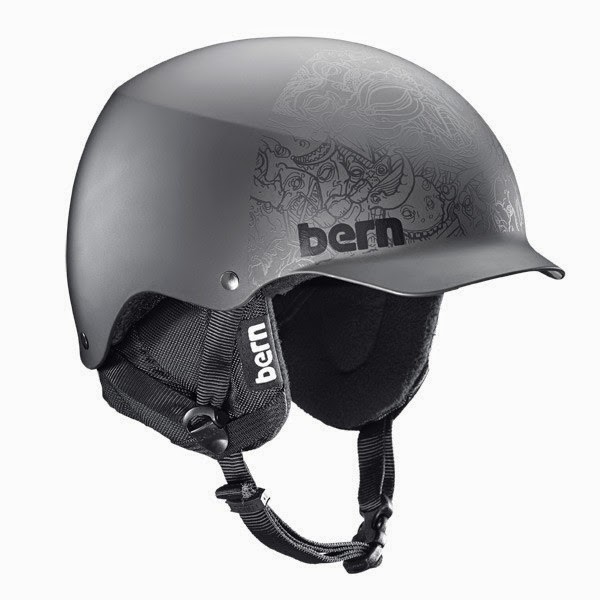
 Bern Baker helmet
Bern alleged that the “rounded profile of the helmet, which is designed to follow the shape of the wearer’s head,” and “the distinctive visor” were the elements of its trade dress.  Bern allegedly launched this line with the goal of creating a distinctive trade dress, and it was the first line with a rounded profile and distinctive visor.  “In January 2006, Seth Wescott of the United States won a gold medal in snowboarding at the Winter Olympics wearing a Bern Baker helmet. The day after Wescott’s performance, the number of visitors to Bern’s website was approximately 9,800, as compared to an average of 120 per day before.”
 
From 2006-2010, “Bern experienced compounded annual growth of approximately 45 [percent] in total revenues from all products, and approximately 46 [percent] compounded annual growth in revenues from brim-style helmets.” Bern’s sales-unit volume grew at a rate of 38% annually for brim-style helmets. Between its launch and March 2014, Bern sold over 700,000 brim-style helmets in 47 countries, for total revenues of $22 million. It spent more than $1 million on advertising, marketing, and promotion, including sponsoring at least 50 pro athletes who chose the helmets because of their distinctive style.  Articles published in mainstream and sports-specific outlets have “profiled Bern’s helmets” (no pun intended?).  Publicity also came from celebrities photographed using Bern helmets, use of the helmets in other companies’ promotional materials, and the helmets’ appearance in the film Premium Rush.
 
Bern submitted five customer declarations—three from retailers and two from consumers—in support of its claim that  customers have come to associate the distinctive appearance of the brimmed helmets with Bern.  It didn’t conduct a consumer survey.  Bern also argued that evidence of copying by the defendants showed secondary meaning; the defendants’ internal documents generally indicated that they looked at Bern’s helmets (and others in the market) when designing their own, and wanted to compete in the same market niche as Bern.
 

Berton Mutiny helmet

BRG Giro Surface helmet

K2 Rant helmet

Pro-tec Scandal helmet

Salomon Patrol helmet

Smith Gage helmet

Defendants commissioned Dr. Itamar Simonson to conduct a secondary meaning survey of prospective helmet purchasers in shopping malls.  The survey, conducted in 2014, showed participants either the Bern Baker helmet or the “control” Bern Brentwood helmet. In the test cell, 152 respondents were shown the Bern Baker helment, none of whom identified Bern as the source.
 
Defendants first moved to strike the five declarations as untimely.  The court agreed.  Bern knew that defendants had asserted a defense of lack of distinctiveness early on, and Bern always had the burden of showing secondary meaning because its claims were based on product design:
 
The witnesses in question are not percipient witnesses in the normal sense—there is no discrete event or activity that they perceived—nor are they expert witnesses. In theory, at least, anyone who ever saw or used a Bern helmet was a potential witness. But neither are those witnesses insignificant. Bern has had the burden of proving secondary meaning from the outset, and it has chosen not to rely on survey evidence. That means that Bern elected to rely on the evidence of testifying witnesses. It selected those five witnesses, and those witnesses alone, to give sworn statements in an effort to defeat summary judgment.
 
Nor did Bern show that admitting their testimony would be harmless. Bern submitted the declarations more than three months after the close of discovery; Bern chose not to use a survey and should have known that witnesses would be required; the weight of the evidence was limited, since the three retailers’ views weren’t probative of secondary meaning; and “evidence of two seemingly random (or, perhaps, not random) customers, without more, is very weak direct evidence.”  Defendants’ ability to respond was limited at best.  “Among other things, defendants have lost the opportunity to depose the witnesses, and to explore exactly how it was Bern came to select them as witnesses, and the factual basis of their statements.”
 
Bern moved to exclude the secondary meaning survey.  Secondary meaning needs to be shown at the time of infringement, and survey evidence is the best evidence of same. Bern said the survey was irrelevant because it was taken in 2014.  The court still admitted it: “Under Bern’s theory, a company would have to undertake a preemptive survey prior to the time they allegedly first infringe, or the survey evidence would not be admissible. Such a requirement would be absurd, and would make it nearly impossible for defendants ever to present the ‘preferred’ form of evidence.”  So courts routinely admit evidence like this, using the timing to determine its strength.
 
Onto the secondary meaning issue itself: “As a general matter, trade-dress claims are difficult to establish.”  Copying isn’t enough.  Without secondary meaning, it doesn’t matter that competitors’ designs “were clearly efforts to mimic or follow the style set by the plaintiff.”
 
Bern lacked direct evidence of secondary meaning, since it had no survey evidence or admissibleevidence from individual consumers.  Even if the court considered the excluded evidence, retailers’ views on distinctiveness weren’t probative of secondary meaning, and two consumers didn’t show that a significant portion of the consuming public connected the design exclusively with Bern. “The size of the helmet market is unclear from the record, but surely two individuals represent only a tiny fraction of that market, and there is nothing in the record to suggest that those two are in some way representative of the market as a whole.”
 
Bern also offered statements by two pro athletes who both declared: “I have chosen to wear Bern’s helmets because of their distinctive style, which is created by the profile of the helmet and the narrow visor or brim.” The declarations indicated a belief that the helmets had a distinctive style, but said nothing about connecting that style to the source of the product, which wasn’t enough under Wal-Mart.  Plus, these declarations were dated 2012, and Bern needed to prove secondary meaning before defendants’ sales of similar products began—in 2007.  And again, statements from two pro athletes didn’t show secondary meaning in a significant portion of the consuming public.  (Though some defendants didn’t start selling similar products until later, Bern lost its exclusive hold on the market in 2007, and anyway Bern didn’t show secondary meaning in any potentially relevant year.)  By contrast, Simonson’s 2014 survey, though not decisive, was probative of lack of secondary meaning.
 
As for circumstantial evidence, this could include [1] the length and manner of the use of the trade dress, [2] the nature and extent of advertising and promotion of the trade dress, [3] the efforts made to promote a conscious connection by the public between the trade dress and the product’s source, [4] the product’s ‘established place in the market’ and [5] proof of intentional copying.
 
Length and manner of exclusive use: Bern’s sales began in December 2005, and by January 2007, defendants K2 and Burton were selling similar helmets.  This was barely more than a year, and didn’t favor Bern.
 
Advertising, marketing, and product success: Bern’s claimed $1 million on promotion described spending 2005-2012, but it spent $10,397 in 2005, $24,532 in 2006,and  $96,369 in 2007—only 12% percent of that amount, about $131,000, had been spent before to the introduction of the first allegedly infringing products, and that doesn’t even show how much of Bern’s spending promoted the helmets embodying the claimed trade dress, or how much occurred after competition began in January 2007.
 
Bern argued that its ads focused on the distinctive profile of its helmets.  Dates were missing from many submitted ads, though the ads did include pictures of the helmet. Still, relevant advertising “specifically directs a consumer’s attention to a particular aspect of the product…. Merely ‘featuring’ the relevant aspect of the product in advertising is no more probative of secondary meaning than are strong sales.” The ads didn’t call attention to the short brim or the rounded shape.  Bern’s evidence that it sponsored pro athletes also didn’t indicate that this happened before 2007. 
 
As for market success, sales alone aren’t as probative of secondary meaning in a product design case, since market success may be attributable to the desirable product configuration rather than distinctiveness. Less than 82,000 brim-style helmets, grossing less than $1.4 million, had been sold by the end of 2007. “[A]bsent evidence connecting it to the desirability of the alleged Bern trade dress, that evidence is not particularly probative of secondary meaning. Also, due to the short time of exclusivity, those numbers do not prove that the design achieved secondary meaning by the time of the first alleged infringement.”
 
The evidence of unsolicited publicity was also mostly after January 2007, and only one article was from before that; this article merely mentioned the brim “in passing.”  The majority of articles Bern submitted focused on functional aspects or other features, and didn’t mention the allegedly distinctive features.  Comments from on-line reviewers and retailers concerning Bern’s unique style and efforts of competitors to copy it were all dated 2012 or later.
 
Evidence of intentional copying:  Intent plays a “particularly minor role” in product design cases, because copying may well be carried out to exploit a particularly desirable feature.  Any negative inference is even weaker when the copier takes conspicuous steps, such as in packaging or word marks, to distinguish its products. The relevant intent is intent to pass off, not intent to copy.  The evidence of intentional copying here showed “nothing more than typical—and legitimate—marketplace behavior. It is perfectly appropriate for companies to respond to competitive forces in the marketplace, including any sudden shifts in fashion triggered by a competitor’s introduction of a successful new product.” The court pointed out that “Bern itself analyzed a variety of sources when designing the Baker helmet, including other helmets in the market.”
 
There was no evidence of intentional copying, as opposed to consideration of Bern’s helmets as part of defendants’ design efforts.  On this record, defendants always included their own marks or names on their helmets. Thus, the copying evidence was not probative of secondary meaning.
 
Weighing the factors, Bern failed to show sufficient evidence to allow a jury to conclude it had secondary meaning in 2007. The court therefore didn’t have to address functionality, likely confusion, or any issue on Bern’s federal dilution (!) claim.  Though the Massachusetts anti-dilution statute was less stringent than the federal statute, it still required distinctiveness, so that claim failed too.
 
As for the counterclaims, Jonathan Baker designed the Baker helmet, and Bern began publicly soliciting sales for the Baker helmet in Sept. 2005, with first sales in December of that year. A design patent for the Baker helmet issued on July 8, 2008, from an application that was filed on January 19, 2007. Because of the then-applicable on-sale bar, the court said with some understatement, “the patent was not likely to withstand a legal challenge.”  Bern was aware of this problem, according to internal correspondence, including an email from a sales rep/investor who asked whether there was “any way to ‘modify’ our shipping records for the Baker to earn the patent?” Jonathan Baker assigned the patent to Bern in April 2014, purporting to be retroactive to 2007 (Bern contended there was a previous assignment ,but anyway Baker had always understood that IP rights in his design belonged to Bern). Bern then filed a statutory disclaimer of the patent, which was accepted in May.
 
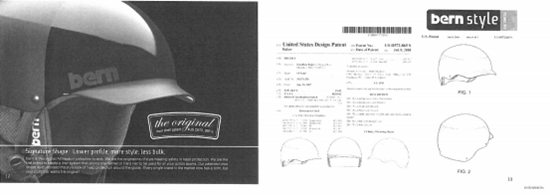
Bern referred to the patent in marketing materials and on its website and at trade shows many times.  Catalogs included logos that stated “the original” above text that stated “visor shell patent # US D572,865S,” and one also included an actual excerpt from the patent. There were other claims, such as that Bern’s “patented hard visor shell shape has been imitated but never replicated. Almost every brand in the market now has a brim, but your customer wants the original.” Trade-show banners also included “the original” with the patent number below it.  Bern’s strategy, as indicated by internal documents, included allegations that competitors have “knocked off” Bern and that retailers should avoid stocking knock-off brands.
 

Bern catalog using image from design patent

Bern catalog using logo with design patent number

So, though the design was patented, Bern learned that the patent was “probably” invalid. First, were the relevant claims made in advertising or promotion?  The documents on marketing strategy were mostly internal, and there was no evidence that the ones that weren’t were targeted beyond certain individuals.
 
Were the actual ads literally false? They didn’t state outright that Bern owned the patent, but cited the patent number and used phrases such as “our patented hard visor shell shape,” “our patented visor shape,” “our patented integrated cap style visor and hard shell visor,” “the original visor patent,” or “the original visor shell patent.” One ad showed the actual patent, but indicated that the inventor was Jonathan Baker.  There was an issue of actual, technical ownership, but Bern was undisputedly authorized to make products under the patent. “The word ‘our,’ in reference to property, can refer to ownership (for example, a homeowner referring to the property as ‘our house’) or a legal right to use it (for example, a renter referring to an apartment as ‘our apartment’).”  Thus, the statements weren’t literally false.
 
However, if there was intentional deception, defendants still wouldn’t need evidence of actual consumer deception.  Defendants argued that the deception was intentional because Bern knew its patent was invalid by February 2011 but continued touting it, e.g., the sales rep/investor’s statement that “I have had an uneasy feeling since Dennis explained to me that we did not file a patent in time for the Visor shape that we invented. Not sure how this happened but it is probably Bern’s biggest mistake to date.”  This evidence was enough to create a genuine dispute of material fact on intentional deception leading to a presumption of consumer deception.
 
The court commented that a patent is presumed valid, and the design patent here was never formally challenged.  “Nonetheless, it seems clear that a claim of intentional deception could be made out based on the unenforceability of the patent, under the unusual factual circumstances presented here.”
 
But what of materiality? That was independent of intent.  (Though prominence in advertising might suggest that Bern believed that consumers would care.)  Defendants argued that the statement related to an “inherent quality or characteristic” of the product, making it material.  “Inherent” here means part of the “essential” character of a product.  Defendants had no survey or other direct evidence of material, but Bern’s Rule 30(b)(6) deposition witness stated that “[t]he intention was to help educate retailers about our patent and to try to get them to place their buy for visor lids with us and not our competitors.”  That was sufficient to “create the inference that Bern at least hoped and indeed intended that its advertising of the patent would affect purchasing decisions,” creating a genuine fact issue on materiality.
 
Then, injury.  In literal falsity cases, “only a slight likelihood of injury need be shown to warrant injunctive relief.” But misleadingness requires more.  Defendants had no evidence of actual or likely injury: no evidence of lost sales or consumer confusion, or harm to goodwill or reputation.  A presumption of harm from direct competition wasn’t enough; that made sense in a two-competitor market, but not here.  Even though defendants alleged that they comprised all the other major helmet manufacturers; defendants didn’t provide evidence that this was so and Bern disputed the issue. Nor was Bern’s fraudulent conduct enough to bypass the rule of actual harm.  Such a presumption “should be reserved for extraordinary cases,” and there wasn’t enough evidence that this was such a case.
 
With “no evidence of literal falsity, minimal evidence of deception, minimal evidence of materiality, and no evidence of causation and injury,” summary judgment for Bern was appropriate.  This disposed of coordinate state-law claims as well.
Posted in design patent, http://schemas.google.com/blogger/2008/kind#post, trademark | Leave a comment

ANA conference: litigating Lanham Act damages

Litigating Damages Claims In Lanham Act False Advertising Cases
 
Alexander Kaplan, Partner, Proskauer Rose LLP: Case law on damages can be tricky/inconsistencies between circuits.  What’s recoverable?  1117(a): D’s profits; damages sustained by P; costs of action.  Statute doesn’t prevent recovering both profits and damages but getting both is rare.  Ad context and market size matter. Comparative ads: advertising that names D’s prooduct and willful literal falsity: reuttable presumption of harm, odds of recovery improve. 
 
TrafficSchool v. Edriver: reasonable to presume that every dollar D makes came from P’s pocket in a comparative ad context.  Weight of case law: rebuttable presumption of causation and injury for willful literal falsity in a two-firm market for comparative statements. Second circuit: noncomparative ad but two party market, court allowed presumed damages. Showing injury is separate from showing damages, but you do see presumptions of injury for injunctive relief purposes—has to be considered separately, but some courts mix it up.
 
Damages calculation should be fair and reasonable approximation of lost profits, SDNY. Wrongdoer bears the risk of error, DC Circuit. P proved damages by showing own internal projections of sales in the DC Alpo case. Disgorgement: 2d Circuit requires willfulness. 9thCircuit does a totality of circumstances analysis; willfulness not required where disgorgement is proxy for P’s lost profits and where parties are direct competitors; it is required if the theory of recovery is unjust enrichment/deterrence.  1st: willfulness not required to get profits from direct competitor; it is from indirect competitor. 3d and 7th: willfulness is only one factor to be considered; disgorgement still available w/out it.
 
2d Circuit considers: degree of certainty that D benefited from the false advertising; availablilty and adequacy of other remedies; role of D in effectuating wrongdoing; P’s laches/unreasonable delay; P’s unclean hands. 3d: intent to confuse; sales diversion; adequacy of other remedies; unreasonable delay by P; public interest in making misconduct unprofitable.
 
Lanham Act allows treble damages, for any sum above the amount found as actual damages not exceeding three times; but enhanced damages must constitute compensation, not a penalty. But: Merck case: enhanced damages can serve compensatory purposes when harm difficult to quantify and deterrent purposes when violation was willful.  Where appropriate?  D received intangible benefits from advertising. P’s relative market loss isn’t accounted for under lost profits; D’s profits allowed it to gain market foothold; P’s lost profits don’t fully capture D’s profits.
 
Chances of getting attorneys’ fee award overturned on appeal are not good.  Some require malice/bad faith for “exceptional” cases; other circuits allow award based on objective de/merits without showing bad faith.
 
Julia Reytblat, Associate General Counsel, Church & Dwight Co., Inc.
 
Inside look at damage: What are lost sales/damages?  How long has the ad been running?  What sales/market share can be quantified?  Royalty loss?  Brand damage?  D’s hat: quite different—point out to court that lost sales may have resulted from a whole slew of factors, not the result of false advertising.  Launches of product by P may have cannibalized sales; other competitive launches may have affected whole industry; quality issues with P’s product; has P changed its ad strategy?  Has it spent less on ads?  Are the products seasonal at all?
 
Start thinking about docs and witnesses early in the case.  Plaintiff may want Nielsen/network data; frequency of bad ads; competitive price tracking; sales figures. Be aware of what’s in your client’s files.  Witnesses: finance people: were we offering any discounts etc. that might affect sales?; marketing research: can testify to impact on purchase intent; sales: can give front line perspective—are we losing shelf space?  Outside expert may sound more persuasive.  Plaintiff may want sales/marketing expert demonstrating products are competitive, explaining impact of advertising, arguing that the falsity drove sales, connecting D’s ads to P’s drop in sales.
 
Defendant might consider market response model/regression model. This identifies performance drivers through regression. It’s expensive; requires expert with PhD in marketing/finance. Estimates importance of each factor and controls for non-advertising factors that could affect sales; allows isolation of variables.  Expensive, but may be worth it if damages exposure is large.  (P can use too.)
 
For disgorgement, P’s burden is quite low: D’s sales only. Every $ must be shown not to be the result of false advertising.  Show production, distribution, indirect costs—physical plant, energy costs.  D must be ready to allocate costs, produce supporting documents—can even deduct marketing cost of the false ads.
 
Q: have you seen arguments about sales not attributable to ads?
 
Reytblat: yes, definitely. Some products’ brand is so strong that people will buy regardless of ad content, repeat/loyal buyers, price. Some categories are very price sensitive.
 
Q: role of jury?
 
Kaplan: Expert can be good at persuading jurors of effects.  Disgorgement is an equitable remedy so no jury right, though a court could give it to a jury for an advisory opinion/advice on the $ if the court decides disgorgement is appropriate.
 
Q: counter-advertising costs?
 
Kaplan: rectifying the false ad need not be the only purpose of counter-advertising, according to one court, so you can recover your counter-advertising costs as damages if rectifying the falsity is one of the main purposes. 
 
Q: should P be forced to spend any award for counter-advertising oncounter-advertising?
 
Kaplan: has only seen it awarded for past corrective expenses.  D should maybe pay for the future counter-advertising itself.  (But see the ISO case from D. Mass, which indicates the risks of awarding P the $ but upholds a smallish award for that purpose.)
Posted in conferences, damages, http://schemas.google.com/blogger/2008/kind#post, remedies | Leave a comment

ANA conference: native advertising

The Natives Are Restless: Legal Perspectives On Native Advertising
 
John P. Feldman, Partner, Reed Smith LLP: ads have been considered deceptive for not disclosing they are ads/source.  Native ads = sponsored content formatted to fit seamlessly into modern media. Extension of tradition of placing ads in most advantageous ways.  Implications for line between editorial content, noncommercial speech and commercial speech.  Does payment for content make otherwise noncommercial content into commercial speech?  Also right of publicity implications. 
What does FTC look at for native ads?
 
Laura M. Sullivan, Staff Attorney, Division of Advertising Practices, Federal Trade Commission: Concerned about ads designed to look independent/editorial/independently sourced information.  Native ads don’t change that. At our recent native advertising workshop, we heard agreement around the need for transparency even apart from §5 concerns. Publishers want to protect the integrity of the brand.  Different thoughts around implementation: we wanted to learn what was occurring in the marketplace. Will likely issue guidance this year.
 
Feldman: Testimonial/endorsement gudies: is native advertising the same issue with respect to disclosing material connection? Is there a distinction?
 
Sullivan: Different cotnexts. Native ads take various forms. We looked at a subset, where there’s a risk of misleading consumers into believing that it’s editorial/independently sourced.  It’s the relationship between the advertiser and the content: are there traditional markers or signals of advertising? If not, consumers should still be able to identify it.
 
Feldman: but note that deceptive format isn’t necessarily the same thing as “failure to disclose material connection.”
 
Rebecca Tushnet, Professor of Law, Georgetown University Law Center: In First Amendment terms, I like Justice Stewart’s idea about regulating transactions versus regulating in service of some other social goal.  If the government is regulating to protect the consumer in the transaction, then it has broad freedom to act. If it’s regulating for some other goal—decreased energy consumption, say—then it should face a high burden of justification.  This approach makes the abstract question “is it commercial speech” much less significant.  Money matters: if I can’t benefit from saying I love Diet Coke (which I do) then my speech isn’t commercial, but it’s less important how the monetary connection works.
 
Sullivan: we use the RJR factors: from a case about ads that discussed a study on the relative safety of RJR’s cigarettes. Is the content promoting a brand or product? Does the speaker have a commercial motivation? How did the content come to be published?
 
Feldman: example of do it yourself craft ideas, such as recycling crayons, sponsored by a craft store on Buzzfeed.  Commercial?
 
Sullivan: payment alone isn’t determinative. We’d look at content. Is there a specific product or attributes being promoted?
 
Feldman: assume it’s written by an organization dedicated to getting kids away from TV screens.
 
Sullivan: FTC lacks jurisdiction over nonprofits. We’d look at the content, again.  What would the commercial motivation be?
 
Feldman: written and paid for by manufacturer of crayons?
 
Sullivan: again, the connection/motivation matters. Does the speech advance their commercial interests and are they talking about specific attributes?
 
RT: Again, the Stewart approach makes this easy.  Why are you trying to regulate?
 
Feldman: right of publicity: there may be reasons to disclose sponsorship in every instance regardless of legal mandate because doing so is cheaper, simpler, safer and also produces brand enhancement. Assume you say it’s sponsored: what happens from a right of publicity perspective?
 
Stewart v. Rolling Stone (weird reasoning for why Camel wasn’t liable for editorial in insert surrounded by Camel ads); Jewel v. Jordan.  RT: some risk that sponsorship might be interpreted as right of publicity violation—though in that case disclosure might not matter.
 
Feldman: example of Chicago Tribune section “sponsored by Menards,” a home improvement store. There’s a disclosure that it’s not written by CT editorial staff and a “learn more” link. The link says the content is paid for by a third party and the newsroom isn’t involved.  Articles are about crafts, gardening—informative. 
 
RT: note the incentive to disclose regardless because the goal is branding.  Potential issues: §230—CT is no longer responsible but advertiser is.  Tort law: “DIY cool hot plates” are the example: what could possibly go wrong?
 
Sullivan: we’d ask whether knowing the source changes the credibility/weight. In terms of labeling, the question is whether consumers notice and whether it conveys an accurate relationship.
 
Feldman: another native CT ad: “something fresh sponsored by Jewel Osco.”  Curated articles from the Village Voice, HuffPo, Food & Wine—all food related, but don’t mention Osco. 
 
RT: §43(a) problem if no licensing relationship?  There shouldn’t be, but courts have applied §43(a) widely. What if a celebrity chef is mentioned: right of publicity claim?
 
Feldman: suppose one of the articles makes factual claims about iron pans?
 
Sullivan: if Jewel Osco is distributing the article for commercial purposes (other than to improve its brand), we’d look at whether a consumer would take away a product claim. If it is deceptive, §5 liability coulud attach.
 
Feldman: implications of curated content? If advertiser specifically curated article about something they sell in the store, and that’s not substantiated, greater risk.
 
Sullivan: yes. Very context specific—is it gaining credibility for economic benefit.  Even content that is protected by the First Amendment in one context can be changed into an ad in another context.
 
Feldman: Tom Brady’s best friend: Funny or Die video sponsored by Under Armour.  Branding is all over the video. What would require the label “sponsored”?
 
Sullivan: what ordinarily a consumer would expect. But again, we’d ask whether there was any information/statements in this context that would cause consumers to give it more weight.
 
RT: The only claim the ad seems to me to make is that Tom Brady is hot.  That doesn’t seem falsifiable to me.  (NB: This joke killed in a room full of advertising lawyers.)
 
Feldman: Slate’s homepage says “sponsored content” but you don’t know who sponsored it until you click through—is that a problem? Especially if people are paid for clicks.
 
Sullivan: Sponsorship serves a purpose, but we’re assuming it’s an ad.  In some contexts, sponsored may be enough. If there’s deception in the first interaction with the consumer, though, that can violate §5.  In fake news context, banners led to a fake news site—the initial deception was enough to be a deceptive practice even with later corrections/qualifications.
 
Standard disclaimer: her statements are not official statements or views of the FTC.
 
Q: a lot of precedent for limiting regulation to that which is likely to influence purchasing decisions. Disclosing material information before purchasing decisions.  Readers aren’t consumers. Disclosing that people are directing your attention is a material change in the standard. Probably insurmountable challenge to disclose all the people benefiting from your attention: there are 95 cookies on that webpage and no disclosure can cover all that.
 
Sullivan: we approach it traditionally—is information within that message deceptive? Not different.
 
RT: Agree—we don’t want different format to change things—if a celebrity goes on Oprah and talks about a great new drug that helped her health, we want to know if she’s been paid to say that.  Q: So do you need a disclosure in the teaser for the show?  RT: Depends: if the teaser is “Kim Kardashian explains how she cured her acne,” I’d say yes. 
 
Sullivan: what statements are being made?  Tantalizing pictures aren’t necessarily claims that benefit the advertiser.  We also need to consider mechanisms of disclosure: people may encounter the content in many different contexts, including Facebook—if you need disclosure, you need it to travel and be mindful of contexts in which your content is encountered.
 
RT: final thoughts on §230.  Suppose the advertiser does adopt claims in another article.  Will courts let them off the hook?  Possible theories: agency law could extend to grab the advertiser, depending on the relationship—courts have not been willing to say that §230 immunizes an employer for acts of an employee w/in the scope of employment, and agency law may go further.  Or, §230 doesn’t bar liability if the defendant contributed to the illegality of the content.  One could argue that, if it’s the advertiser’s involvement that makes the content an ad, and it’s the fact that it’s an ad and not noncommercial speech that makes it illegal, then §230 wouldn’t bar liability. But we don’t really know how courts will deal with this.
Posted in advertising, commercial speech, conferences, disclosures, first amendment, ftc, http://schemas.google.com/blogger/2008/kind#post | Leave a comment

Even post-Lexmark, Lanham Act isn’t for garden variety defamation claims

Mitchell v. Sanchez, No. 14–0996–CV, 2015 WL 1393266 (W.D. Mo. Mar. 25, 2015)
 
Mitchell alleged that defendants incorrectly stated on various media broadcasts that she had AIDS/HIV. She sued for violation of the Lanham Act, invasion of privacy and intrusion into seclusion, false light invasion of privacy, and defamation per se.
 
Defendant Mediacom argued that Mitchell lacked Lanham Act standing, since she was a noncompetitor. Lexmarknixes that argument, requiring only that a plaintiff come within the zone of interests (an injury to a commercial interest in reputation or sales) and allege proximate causation in the form of economic or reputational injury “flowing directly from the deception wrought by the defendant’s advertising; and that that occurs when deception of consumers causes them to withhold trade from the plaintiff.”
 
The court found that Mitchell didn’t fall within the Lanham Act’s zone of interest, since “Congress did not intend to have every garden variety defamation claim transformed into a Lanham Act claim.” Also, there was no proximate causation because there was “a glaring absence of any actual advertising at issue,” since the defamatory statements occurred during media broadcasts. (I think the court misreads Lexmark’s language—the fact that it’s not advertising doesn’t mean that it didn’t proximately cause Mitchell’s harm; defamation generally does proximately cause reputational harm when it’s actionable.  The problem is that it’s not “advertising or promotion,” an element of the underlying claim.)
 
Also there was no false endorsement claim. A false association with “having and spreading AIDS/HIV” can’t serve as the basis for a false endorsement claim under the Lanham Act.
 
The court asked for more information to figure out whether diversity jurisdiction remained.
Posted in defamation, http://schemas.google.com/blogger/2008/kind#post, standing | Leave a comment