
Roundtable on Jessica Silbey’s The Eureka Myth

Roundtable on Jessica Silbey’s The Eureka Myth: Creators, Innovators, and Everyday Intellectual Property
University of Notre Dame Law School
[I was very sorry that I arrived late due to a missed connection the previous night]
Second Session: Distribution Models and Design Principles
John Golden: rule of law concerns: if there’s not a good fit between law’s underlying assumptions and what people think, they might lose respect for the law complicating legal compliance. Law & economics: if people do have different motivations not reflected in IP regime, we might redesign law and grab some low-hanging fruit. More protection for attribution, w/o restricting dissemination/exploitation by others.  Desire to curate/protect like children. Mixed motives: baseline interest in survival, income allowing them to continue doing the work they wanted to do.  Scientists/engineers often chose steady income of salaried employee instead of going on their own: moderates upside and downside. Honor/scientific reputations—seems to operate across the board in many creative areas.
How do we make systems approximate their models w/out resistance etc.?  The concepts of misfit and leakiness.  Leakiness is sometimes a good.  Attribution/credit protections are missing and people think they should be there.  There are also carveouts: swiss-cheese-like contributions to leakiness, such as fair use.  Even more rifle-shot carveouts like medical method patents & limits on liability for doctors performing the method.  Rules v. standards—some carveouts are one, some the other.  If we think leakiness is desirable, as the book suggests in some respects, we have design choices on how to achieve that.
Leakiness can also be created through counterbalancing policies.  Example of land/mineral rights where information sharing can be mandated, benefiting others, but returns can be received by exploiting the minerals.  Different actors can figure out what’s the most efficient way to move forward.
Lydia Loren: Problem finding is sometimes the inventive part; but the fact that copyrighted works are sometimes solutions to problems really comes out in these stories. 
Should we care about misalignments if they don’t affect behavior?  Venture capitalists also misunderstand IP; focused on firms that have patents that don’t really mean much in the end.
Silbey suggests that IP results in glorifying individual over collective, which is a distortion of the facts. But IP is an administrative mechanism for vesting rights, and if you vest it in too many it becomes hard for capital to organize around it. So it makes sense to identify an individual owner, because of the need to organize capital.  Needs of the firm: only part of those are made up of the needs of the creator.  The firm needs manufacturing, marketing, sales, distribution, employment to put the pieces together.  Many creators need and want the firm for the steady paycheck/freedom from managing the details.
Independent creators express a desire in these interviews for help: in marketing, in studio—to take over the parts they find yucky. And one source of help is the firm.  IP used to be taught as part of competition policy.  Now IP has become more personal.  IP is still part of the support—may not motivate, but it can enable. 
Book does good job acknowledging how IP shapes creative work into something recognizable in the business world: self-consciously pursued and woven into business strategy.  Move away from formalities in © has made it easier to defer that strategy to later date.  Becomes a latent asset.
Firms need to figure out how to provide the right conditions for innovation/creation. Need for rich creative environment to work on.  Weeds out pure rent-seekers w/exception of firms w/a back catalog. Increasingly getting a variety of firms.  Try new forms: B corporation (public interest as one goal) is a result of firms realizing there’s more to this than the bottom line.
Example of finding herself in the book: in the lawyer, in the author, but also in the firm: w/a colleague, wrote an IP book but couldn’t stomach the traditional distribution model, so created a pay-what-you-want model w/a suggested price.  Ton of work to write & keep up to date, so financial incentives matter and remuneration is justified.  Website, allowing others to distribute their work too: now have harnessed capital to provide authors freedom to create w/out having to deal w/business side. Students really appreciate the alternative.
Be careful in saying that contracting around IP defaults is reckless.  Shrinkwrap contracts may be wrong, but contracts that leverage IP into rights artists want, like attribution, may be justified.  Chits to be traded for something the creator values more.
Steve Yelderman: Some subjects struck him as taking IP core rights for granted, while at the same time saying that IP wasn’t important to them.  One example: textbook publisher talks about IP not being nearly as important as getting on an approved curricular list in a few big states.  But that presumes that competitors can’t just copy the textbook and sell perfect substitutes.  First-mover advantage might be some protection, and there’s no way that anyone needs a right to control the right to make a fourth-grade history textbook (that is, idea/expression), but the basic reproduction right seems important there.  Other interviewees seem to reason similarly.  Need for caution in terms of trying to draw conclusions.
Antitrust: customer reviews, asking whether a merger would be good or bad for customers’ business.  Customers are infamous for being unable to anticipate harm from merger of their suppliers.  Party documents say: we intend to raise prices 25%.  Customers will still say “they always take good care of us.”  This is a context where we’re asking them to imagine a world that’s not the world they live in; we all have these blind spots.
Mismatch between IP values and creative values: They don’t have rights they do want and do have rights they don’t want.  Benefits to recalibrating?  On the too strong front, the book uses “underenforcement,” implying departure from some optimal level of enforcement, but book doesn’t seem to mean that.  Forbearing on enforcement of privately held right—let neighbor walk across lawn—but that doesn’t mean we have real property law wrong.  Tax, criminal law have different undertones about optimality of high level of enforcement.  Framing matters.  Holder choosing to include/share w/others something w/in the core of what she could exclude, have to ask if that’s IP working or IP failing, and that will depend on circumstance.  In many cases, voluntary forbearance has inefficiencies: others can’t rely on it; operating in gray area and uncertainty may be needless.  But there are different implications depending on reasons for forbearance.  What might we permanently want to take away because forbearance is so uniform?  Hard to tell.
Also, different situation when there is provisionally tolerated infringement but rights held in reserve to discipline later uses.  Users bear the risk, but IP could be doing work underground.  Maybe it’s enabling certain kinds of disclosures/interactions w/works.  Publishers removing DRM, when books are sold for profit.  Boon for company; better for customers who hated DRM; but in a world w/o copyright, would they be taking DRM off?  Is that backstopped by other rights. Similarly w/ disclosure/enabling aspects of patent law in allowing more transparency and collaboration.  Couldn’t tell from interviews whether they thought DRM was w/in the penumbra of IP, or trade secrecy.
Core case: infringement is actually welcome but users have to take the risk. Ask why rightsholders haven’t given explicit permission: maybe they do want to hold rights in reserve; or they don’t know how to get it done.  Potential solution: make it easier/cheaper to modify rights in reliable way. Those concerns are real, but balance against unknowns in potentially productive conditional forbearance. How serious are these harms/how inefficient?
We’re moving to a world of collaborative creation: “users” are melding into creators. But not sure which way that cuts. Maybe makes middle category more important than it was.
Julie Cohen: Loren sees IP as administrative means of vesting asset, that’s functionally how it works, but then there’s a question of what IP is for.  Not only whether it is benefiting mainly firms but whether it should be doing that.  Risk of concluding that IP isn’t for creators at all and thus ignoring their interests still further.
Narratives we tell about IP influence the way people say they think about IP, so expressed motivations are very important but also may not rest on a completely firm foundation.
Clusters of problems/questions in need of unpacking: (1) relationships between creative employees and firms.  Silbey tries to defuse worry about IP mainly benefiting firms by talking about how corporate employees speak about corp. motivation; “we’re not just sharks” and we depend on the creativity of our employees.  More empirical study is warranted.  Companies harness employee innovations in particular ways/directions (Google and privacy-destructive technologies). 
(2) Managed performance, sharing, and other distribution strategies: Juxtaposition w/other literature on change in relation between corporation and individuals. Example: playbor: you get people to play & do unremunerated stuff and profit.  Screwed up deeply rooted assumptions about how labor and employment markets work.  These people aren’t employees and they aren’t even freelancers because they’re giving their work away.  How you get money? Self-promotion, apparently.  On one level we can tell a story about misalignment of IP, but also about the strategies of extraction of surplus in the digital economy; not all of the stories are happy stories.
Casebook Connect v. Cohen’s Aspen casebook—managed performance strategy in Silbey’s typology—tether the book, but you have to give back the physical copy at the end of the year.  You have permanent digital access unless/until they discontinue the platform. They do offer untethered hard copy at an extremely high price relative to the tethered product.  Managed performance is at one level not about IP, but at another level absolutely is—trying to make used book market go away/become only source for the product and tethered service.
(3) Discourse/framing.  There’s been some talk about getting out of the loop of the causal narrative of IP.  Trade associations have historically talked about the individual creator to bolster their own interests (though now they are more likely to abandon that and talk about trade deficits).  Discourse is constructed by people with interests and maintained for a purpose.
(4) “If we think a leaky regime is desirable” … for whom? In physics you design to get closer to the model; so much lobbying and rentseeking in IP is designed to do that—if your model is that everything should be licensed you design the derivative works right that way and maybe eventually you convince people to behave.  Merges & Nelson have long discussion of way patents can’t be expected to affect software industry because of the way the industry works (1990s article), and Lemley etc. talk about how the software industry responded to patenting in really significant ways—the industry responds to law. These are two different snapshots from when an institutional lever was used: now the industry looks very different.
If this is about relation between creative employees and firms, it can’t be good enough to say “that’s contracts” or “that’s employment.”
RT: Echoing Cohen.  Loren says firms have an incentive to create the right conditions for innovation: or you can try to free ride on your suppliers.  (American firms are not currently known for their long-termism.)  Kindle Worlds as an attempt to get rid of paying tie-in authors and Amazon’s broader attempt to get rid of legacy publishers, whose advances were the nearest thing to a regular salary a midlist author could hope for; crowdfunding; arguably these firms are eating not their but our seed corn. (It’s not accidental that this is marginal income for Loren & other law profs.)  Offloading promotion to individual authors even w/in traditional publishing houses—you have to hire your own press agent.  Artist as firm in herself: you hire the people to do the work; we do the distributing and take our share.  Compare to the model of treating employees as independent contractors, as w/UPS. Individualized risk, corporatized benefit.  We’re not just sharks says one interviewee, but that person is drawing a within-industry contrast.  Query: in a generation, who will Silbey be interviewing and who will be paying them? 
McKenna: one significant shortcoming of incentive-based theory is impoverished view of what it is we’re trying to incentivize.  “More” is not a thing. Whatever you design you get more of some things and less of others.  What “more” do we want?  Many of Silbey’s examples involved markets where, whatever the rule is, people can organize around it and find other ways to extract money like ancillary services. Law defines what that structure will look like—it’s how you’re going to make money, not whether.  Picking winners and losers; we should think more about the fact that IP doesn’t work well for creators—normative underlay is that it should.  But why?  Why are creators special?  If the answer isn’t “more,” why should our rules promote certain peoples’ interests?
Silbey: Howard Gardner talks about “aligning” interests of individuals and firms.  Organization is disembodied entity, but people can speak to you. 
Mark McKenna: notion that creators should be able to earn a living creating: but why?  I want to make a living playing football, but I’m not entitled to a set of rules that makes it possible for me to do so.   Thinks justification can be done but rarely is.
Cohen: IP people talk about “more” simplistically.  Churning out lots of work might not result in as good work as taking time.  Firms aren’t trying to maximize the production of IP; they’re trying to maximize production of value, and you can’t maximize for both.
Golden: Some creators’ interests might encourage overreaching in control. Maybe there’s a need for education.  Need to calibrate our arguments so we don’t encourage abandonment of creators if we think they’re valuable.
Barton Beebe: Process v. results in Silbey’s work: book emphasizes aesthetic process and not ends; unalienated labor is enjoyable even if in the end the resulting thing is not successful. People definitely reveal a preference for aesthetic process; should we work to maximize that? How would we do that? 
Said: it’s not a lack of a legal regime for subsidizing football that keeps McKenna from playing football, is it?  (He was a Notre Dame QB, by the way.)  But that analogy gets us to think about means-end relationship.  You could decide to stay home and play touch football, but football is collaborative.  Or any other example: writer could decide to stay home and write, but the practice is not just about that.  It’s also about engaging through the practice/work with an audience—dissemination is important in that conception.  [But cf. the interviewee who’s an unpublished novelist and doesn’t yet want to share her work.]  [I thought Said was going to talk about how you can’t get economic rewards just with exclusive rights; you have to convince other people that it is worth paying you to allow them access.  I guess talking about distribution is the same point seen from the creator’s POV.]
Silbey: the distribution chapter is most aligned with the IP system as it is. Managed performance and many/more (selling as many copies as possible) are standard IP stories.
Dan Kelly: Struck in the idea origination chapter—not about the incentive system, at least in the characterization that it’s all about money.  People care about many things; even though quotes were inconsistent w/ caricature of incentive theory, if you take a broader view of preferences there might be nothing inconsistent.
Different ways of setting up income: creators care about steady stream for survival and also b/c they are working constantly so they feel the work should be rewarded, not just the big payout at the end.  But creators sometimes don’t like to go to firms where there is drudgery. Are there other possibilities to bring capital to creators? Hard to identify who’ll be good.
On McKenna’s “more of what?” If you don’t subsidize IP, the idea is undersupply (McKenna: but of what? There will never be an undersupply of creativity, but types would differ) but we think your private incentive to become a QB is sufficient. 
Abraham Drassinower: Constitution does single out authors/inventors, not QBs.  Also suggests connection with progress, art, and science.  It’s plausible to say that in © the concept of process has a lot of attraction. © isn’t as concerned w/result as it appears to be economically—doctrine of independent creation for example.  We care that you create, not what.  Patents: invention seems to be about product, not result.
Posted in copyright, http://schemas.google.com/blogger/2008/kind#post, patent | Leave a comment

stricter California rule on Made in USA claims not preempted

Paz v. AG Adriano Goldschmeid, Inc., No. 14cv1372, 2014 WL 5561024 (S.D. Cal. Oct. 27, 2014)
Paz sued AG, alleging that its “The Protégé” brand jeans were misleadingly marked with a “Made in the U.S.A.” label; he allegedly relied on the label in the belief that he was “supporting U.S. jobs and the U.S. economy.” However, the jeans allegedly “actually contain[ ] component parts made outside of the United States”: fabric, thread, buttons, rivets, and/or certain subcomponents of the zipper assembly.  He alleged violation of the CLRA, UCL, and California Business and Professions Code § 17533.7, which makes it unlawful to sell “any merchandise on which merchandise or on its container there appears the words ‘Made in U.S.A.,’ ‘Made in America,’ ‘U.S.A.,’ or similar words when the merchandise or any article, unit, or part thereof, has been entirely or substantial) made manufactured, or produced outside of the United States.”
Here, the court denied AG’s motion to dismiss on the ground that the FTCA and the Textile Fiber Products Identification Act (TFPIA) preempted the claims.  AG relied on conflict preemption.  There’s a presumption against preemption where the states have traditionally regulated in an area (like consumer protection).
The FTCA, in 15 U.S.C. § 45a, says that “Made in the U.S.A.” or equivalent claims have to be consistent with FTC decisions and orders, and that “[n]othing in this section shall preclude the application of other provisions of law relating to labeling.”  The FTC duly issued an Enforcement Policy Statement “to give general guidance on making and substantiating U.S. origin claims.”  The FTC articulated a standard that requires that a product so labeled be “all or virtually all” made in the US, which means that all significant parts and processing that go into the product are of U.S. origin.  The FTC will consider “whether the final assembly or processing of the product took place in the United States; the portion of the total manufacturing cost of the product that is attributable to U.S. parts and processing; and how far removed from the finished product any foreign content is.”
The FTCA therefore allows for the use of a “Made in U.S.A.” label even if the product includes or contains material from a foreign country, but § 17533.7 requires that all parts of a product be “entirely or substantially made, manufactured, or produced” in the United States. These are different standards, but that doesn’t require conflict preemption. It would be possible to comply with both laws. “Outside California, Defendants could use the ‘Made in U.S.A.’ labels, but inside California, they could not. This may be burdensome for Defendants, but it is not impossible for them to do so.”
AG argued that California law created an obstacle to the accomplishment and execution of the FTCA, and that the FTCA was intended to give the FTC authority to determine when use of “Made in U.S.A.” would be misleading or not misleading.  But (1) there was no indication that field preemption was appropriate, and (2) both statutes had the same purpose, to allow consumersto know whether their purchases “support fellow Americans” or “harm the American manufacturing base.”  (Quoting the Federal Register—interesting that the recent country of origin labeling case involved a government far less willing to articulate this obvious fact.)  Given the California law’s purpose “to protect consumers from being misled when they purchase products in the belief that they are advancing the interests of the United States and its industries and workers,” compliance with one wouldn’t impede the other.  (This seems to finesse the question of whether high standards for “Made in the U.S.A.” encourage producers just to give up and go entirely offshore, whereas they could stay onshore if they could import zippers and still use the label to generate additional profits.)  Delegating authority to the FTC to regulate “Made in the U.S.A.” isn’t the same as preventing states from exercising that same authority; after all, the FTCA also delegates to the FTC the power to go after unfair methods of competition, while allowing the states to do likewise.
The court turned to the TFPIA, which provides that a textile fiber product will be misbranded if it lacks a label indicating origin; if it’s “processed or manufactured in the United States,” it has to be so identified.  AG argued that the TFPIA requires them to use a “Made in U.S.A.” label even if the garment includes foreign-made materials, but California law prohibited that unless the entire garment is made entirely or substantially in the U.S.A. Only the second part of that last sentence was true. Nothing in the TFPIA requires an unqualified “Made in the U.S.A.” label; the TFPIA actually requires that labels disclose, e.g., “Made in USA of imported fabric.” To comply with both laws, AG must merely accurately describe where the parts of the product and the product as a whole were sourced and made.
AG argued that California law prohibited even qualified “Made in U.S.A.” claims, and the law could be read that way.  (The court didn’t understand Paz to be challenging properly qualified claims, only unqualified or underqualified claims such as “Made in U.S.A. of imported fabric” when the products included parts, other than just the fabric, that were sourced or manufactured overseas.)  On its face, the statute outlawed “Made in U.S.A.” whenever parts were entirely or substantially made outside the US, and was silent on qualified labels.  But the lack of precedent didn’t preclude the court from using common sense.  The relevant provision was part of the FAL, governing false and misleading advertising in general.  A properly qualified label lacks falsity or misrepresentation and so wouldn’t violate the California law. Thus there was no preemption.

Posted in california, consumer protection, ftc, http://schemas.google.com/blogger/2008/kind#post, preemption | Leave a comment

Deadmau5 vs. Disney

I talk to American Public Media’s Stan Alcorn.

Posted in trademark | Leave a comment

Photoshopping competitor’s product as one’s own could be false advertising

Meggitt (Orange County), Inc. v. Nie, 2014 WL 5528546, No. SACV 13–0239 (C.D. Cal. Nov. 3, 2014)
Note: the caption lists the defendant as Nie Yongzhong, and I’m following the rule that Chinese family names go first since he appears in the case as Mr. Nie, but I don’t know how this will show up in dockets/reports.  Plaintiffs (Meggitt) make sensors and accelerometers to measure vibration, shock, and pressure.  A related company employed Nie as an engineer in China; he had access to Meggitt’s trade secrets and signed an agreement not to use them.  But then he founded defendant Xiamen Niell Electronics, which now manufactures and markets sensors and accelerometers that have nearly identical specifications as several Meggitt products.
Meggitt sued for trade secret misappropriation, unfair competition, conversion, and breach of duty of loyalty and received a preliminary injunction.  After more rounds, Meggitt added a Lanham Act false advertising claim.
First, the court ruled that the claim had to satisfy Rule 9(b) because, though one could allege negligent false advertising (comment: or for that matter faultless false advertising; that’s what strict liability means), if the plaintiff alleges a unified course of fraudulent conduct then Rule 9(b) applies.  (What really gets me about this rule is that nobody applies it to trademark claims.  How often does a trademark plaintiff allege exactly the same cursory statements about bad faith/intent to deceive that trigger 9(b) in the Ninth Circuit when they’re alleged in a §43(a)(1)(B) complaint?  Indeed, how many trademark complaints don’t allege intent to deceive?) 
Here, the complaint alleged an overall plan and scheme to misappropriate confidential information and misrepresent Xiamen Niell to the industry “as being a well-established, strong, reputable and reliable company with qualified engineers, and a wide range of product offerings, and from whom the customer can expect to obtain high-quality and reliable products and after-sale service.”  However, the complaint did satisfy Rule 9(b), even without factual allegations establishing when or where the “scheme and plan” was devised, or who devised it. The issue wasn’t the planning of the scheme, but its execution; also, planning was within the defendants’ knowledge, and for such matters Rule 9(b) may be relaxed.
Meggitt alleged that Nie and Xiamen Niell falsely advertised products through catalogues and data sheets at two trade shows.  The advertising was allegedly false because the catalogues and data sheets advertised products that did not exist and contained false product specifications.  Defendants admitted that they advertised some products that hadn’t been manufactured, but argued that they never represented that all their products were available off the shelf. Instead, the products could be made for customers, and predictions about future events are ordinarily non-actionable expressions of opinion. This, they argued, corresponded to industry practice, in which orders are normally “driven by customer specifications.”
The catalogues and data sheets attached to the complaint did have future-oriented aspirational language, such as, “Niell–Tech will provide the most excellent products and services for you,” which was non-actionable in itself.  But the data sheets also contained “detailed specifications for products for which neither prototypes nor samples were ever manufactured”; statements that some non-manufactured products had “proven use” under certain conditions; and statements that other products were “made by Xiamen Niell–Electronics Co., Ltd.” and operated at certain levels. In addition, the data sheets had photos of non-manufactured products, some of which were actually photographs of Meggitt products photoshopped to bear defendants’ marks and product numbers.  (Pro tip: don’t do this. Just don’t.)
It might turn out that customers in this industry wouldn’t be misled, but that possibility wasn’t a proper ground on which to dismiss the complaint.

Posted in http://schemas.google.com/blogger/2008/kind#post, procedure | Leave a comment

unauthorized photo use doesn’t create false advertising claim for photo owners

Avalos v. IAC/Interactive Corp., No. 13-CV-8351 (S.D.N.Y. Oct. 30, 2014)
Meltech, a web design and modeling company, sued defendants for allegedly unauthorized use of photos of models in fake online dating profiles on dating sites (e.g., Match.com, Chemistry.com, and OkCupid.com).  Many fraudulent profiles allegedly used photos of its model Harrington.  Using attractive images on fraudulent profiles allegedly enticed consumers “to join and pay subscription fees who would otherwise not” and generated “inflated advertising revenue.”  This conduct allegedly caused Meltech to receive “thousands of complaints from American romance scam victims,” caused Meltech’s owner to be “threatened and harassed,” and led to a reduction in value of Meltech’s “intellectual property” itself, as its “photographs have been associated with ‘dating scams’ on the internet and in the public eye, turning a multi-million dollar celebrity brand into a notorious and infamous figure with little commercial value.”
Meltech withdrew its copyright infringement claims, apparently because it didn’t have registrations (and couldn’t secure them? bizarre, except the DMCA likely doomed any such claims anyway).  And it withdrew its NY right of publicity claims, apparently because such claims are personal to the person holding the right.  The court here addressed the remaining claims.
Lanham Act: Defendants allegedly violated §43(a)(1)(A) by “using [Meltech’s] photographs in [its] web site profiles and advertisements,” thus engaging in “reverse passing or palming off” of Meltech’s photographs.  Nope.  “In attempting to plead a Lanham Act claim based on Defendants’ unauthorized use of its photographs, for which Meltech does not own copyrights, Meltech attempts to achieve precisely what Dastar prohibits: an end run around copyright law.”

The complaint could also be read to allege false endorsement on the theory that the photos created the impression that the model was a user of defendants’ dating websites and approved the websites.  This is an ok claim under the Lanham Act.  (Paging Mark McKenna.)  However, Meltech would have to own the model’s right of publicity, assuming it was transferable; Meltech didn’t claim to do so, and couldn’t if, as seemed from the allegations, its contract was governed by the laws of Nebraska, as Nebraska’s right of publicity is inalienable. 
False advertising: Under Lexmark, “a plaintiff must plead (and ultimately prove) an injury to a commercial interest in sales or business reputation proximately caused by the defendant’s misrepresentations.”  This requires “economic or reputational injury flowing directly from the deception wrought by the defendant’s advertising; and that that occurs when deception of consumers causes them to withhold trade from the plaintiff.”  Judge Furman clarified that this wasn’t a question of “standing,” though most courts don’t much care.
Even assuming that the fake profiles were “advertising or promotion”— “a premise that the Court highly doubts, but need not reach” — Meltech didn’t adequately plead harm to its commercial interests proximately caused by defendants’ alleged misrepresentations.  Meltech argued that defendants’ false designation of Harrington as a member of their sites resulted in the “devaluation” of Meltech’s IP.  But there was no factual support in the complaint for that conclusory allegation.  In fact, the alleged misrepresentations were more likely to harm defendants, not Meltech or Harrington.  The exhibits showed complaints warning other consumers to “NEVER SUBSCRIBE [to Match.com]!” and a website, ScamDigger.com, telling consumers that fraudulent photographs on dating websites, including Harrington’s, are “STOLEN FROM INNOCENT THIRD PARTIES” and that “[p]eople on the pictures are not associated with scammers in any way, they are just victims of identity theft.”  Even if Meltech could show harm, it failed to allege a plausible causal connection between the harm and defendants’ acts.  Meltech needed to allege that the deceit led consumers to “withhold trade” from Meltech “by, for example, visiting its websites less often.” Meltech didn’t plausibly so allege, and even under Famous Horse’s “even more lenient” test, its speculative allegations of harm wouldn’t be enough.
Civil RICO: No.
State law claims of unjust enrichment, conversion, and aiding and abetting fraud: The court exercised its pendent jurisdiction, even though this was an early stage, because of preemption issues and because the law was well-settled, so there was no point in allowing a fruitless refiling in state court.
Most of the claims were clearly preempted.  Photos are within the subject matter of copyright.  Unjust enrichment was plainly preempted, as it was based solely on defendants’ allegedly unauthorized commercial use of the photos.  So was the conversion claim, since Meltech was alleging unauthorized publication rather than physical appropriation.  As to aiding and abetting fraud, “intentional deception” could be a required extra element (nooooo!), but the complaint failed to state a claim because a required element is reasonable reliance on the defendant’s misrepresentations.  But Meltech didn’t rely on any misrepresentations, and third-party reliance isn’t sufficient for fraud.  Thus the court didn’t need to reach the (obviously applicable) §230 defense.

Posted in copyright, dastar, http://schemas.google.com/blogger/2008/kind#post, preemption, right of publicity, standing, trademark | Leave a comment

Reading list: irrationally sticky defaults

Robert Letzler, Ryan Sandler, Ania Jaroszewicz, Isaac Knowles, and Luke M. Olson, Knowing When to Quit: Default Choices, Demographics and Fraud, Oct. 8, 2014
Abstract:
A long literature in psychology and economics has shown that default options influence consumer choices, but it is often unclear whether individual consumers are nudged to choose optimally or simply nudged to a different choice. We study the effects of default options in a novel setting where the optimal choice is clear: the decision to escape from fraud. We employ data from one of the largest telemarketing fraud cases ever brought by the Federal Trade Commission (FTC). The telemarketer enrolled consumers into costly membership programs, which the vast majority of consumers never used. A court order issued during the FTC lawsuit created a natural experiment whereby some consumers were sent “opt-in” letters informing them they had to take action to remain enrolled while similarly situated consumers received “opt-out” letters that merely reminded them how to quit. We find that the “opt-in” letters increased cancellations by 63.4 percentage points, to essentially 100%. We then examine heterogeneity in the responses to the “opt-out” letters . We find that consumers residing in poorer, less educated Census blocks and those more likely to be minorities were more likely to cancel their subscriptions prior to the FTC lawsuit, but were relatively less likely to respond to an opt-out letter.
Conclusion, indicating that providing information isn’t enough when the default option is wrong, and that the information-only situation disproportionately harms poorer and minority consumers:
A large literature on the effects of default choice structures shows that agents are more likely to choose the default option, compared to other options. In this paper, we show that this is true even when the optimal decision is clear. Our results further indicate that informational interventions are not always an effective way of encouraging consumers to make those optimal decisions. Conversely, our results suggest that changing defaults is not a panacea when optimal choices are less clear. A standard model for a “nudge” policy involves enrolling consumers into a supposedly beneficial program and requiring them to actively opt out if they do not want to remain enrolled. It would not be surprising in a study of such a program to find only 30% or so of the target population opting out. However, in the case we study, it was likely optimal for every consumer to opt out, and relatively few did.
We also find evidence that the information intervention of the opt-out letter had heterogeneous effects across demographic characteristics, with consumers in low SES neighborhoods and those more likely to be minorities less likely to respond to the letters. Thus, the information provision policy disproportionately benefited consumers likely to be more well-off financially. Although the differences across demographic characteristics were smaller than the overall effect of the opt-out letter on cancellation, setting the correct default had bigger benefits for subscribers from lower SES neighborhoods than for subscribers from higher SES neighborhoods.

Posted in consumer protection, disclosures, ftc, reading list | Leave a comment

Time to make the DMCA exemptions

Requests will be collected here as the day continues.  The EFF and the OTW jointly requested a remix exemption for DVD,  Blu-Ray, and streaming video.

Posted in Uncategorized | Leave a comment

Why do competitors get to challenge claims that consumers don’t?

I have a political economy explanation for this, but I don’t think that’s good enough.  Challenging a “tests prove” claim—explicit or implicit—in Lanham Act cases means showing that the tests don’t prove the proposition for which they are cited.  This is a standard path to explicit falsity, requiring no further evidence of deceptiveness.  But consumer protection cases often seem to ignore the point made by Lanham Act courts: when the defendant’s claim is “tests prove X,” showing that “tests don’t prove X” has falsified the defendant’s factual claim—and one very likely to be material, even if X might still be true for some other reason.  Defendants have proved more successful calling this a mere lack of substantiation claim when consumers are the plaintiffs.  That should not be the case.
Kwan v. SanMedica International, LLC, No. 14-cv-03287, 2014 WL 5494681 (N.D. Cal. Oct. 30, 2014) (magistrate judge)
Kwan sued SanMedica for its marketing of SeroVital, an over-the-counter supplement marketed to boost human growth hormone (“HGH”). Kwan identified these claims: (1) that SeroVital provides a 682% mean increase in HGH levels; (2) that SeroVital is clinically tested; and (3) that “peak growth hormone levels” are associated with “youthful skin integrity, lean musculature, elevated energy production, [and] adipose tissue distribution.”  She alleged that she relied on them to buy,  and that they violated the UCL/CLRA because in fact the clinical evidence didn’t support SanMedica’s claims.
Lack of substantiation isn’t a sufficient basis for a private claim under the UCL/CLRA (nor, I should note, is it under the Lanham Act, with the exception announced in the Mylanta Night Time Strength case in the 3d Circuit).  A claim is false if it has “actually been disproved,” “that is, if the plaintiff can point to evidence that directly conflicts with the claim.”  Merely lacking evidentiary support just makes it unsubstantiated.
Kwan alleged that (1) the only study supporting SanMedica’s representations did not test for “youthful skin integrity, lean musculature, elevated energy production, [and] adipose tissue distribution,” and (2) that study is so deeply flawed that it cannot serve as a reliable basis for SanMedica’s representations.
For the first claim, the ad didn’t claim that the clinical testing showed effects on “youthful skin integrity, lean musculature, elevated energy production, [and] adipose tissue distribution,” but merely said that peak growth hormone levels are associated with those benefits. So the fact that the study relied on in the ad didn’t test for those benefits was irrelevant.  (To misleadingness?)  For the second, that was just a lack of substantiation claim.  Other cases allowing similar claims to proceed involved affirmative evidence of falsity. 
Did this complaint allege any evidence that SanMedica’s claims were false?  Kwan alleged that the FTC had stated that no reliable evidence supported claims that non-prescription products have the same effect as prescription HGH; that the New England Journal of Medicine warned about the potential for misleading consumers; and that the FDA has stated that “it is unaware of any reliable evidence to support anti-aging claims for over-the-counter pills and sprays that supposedly contain HGH.” But none of that alleged falsity, especially since none of the authorities cited actually referred to SanMedica’s product.  (Why is that important if no such product will work?)  Also, most of the statements were old, from 11-20 years, and the court couldn’t tell whether they were made before SanMedica’s product came on the market, in which case they couldn’t refer to it.  (So if I make a new brand of milk, statements about the effects of dairy from before I enter the market can’t apply to me?)
However, Kwan could amend the complaint if she could in good faith allege facts affirmatively disproving SanMedica’s claims.  For example: she could alleged that someone actually studied or tested SanMedica’s formula and found that it didn’t produce a 682% mean increase in HGH levels, or that she herself did not experience such an increase when using the product, or that a study exists somewhere demonstrating that a 682% increase is categorically impossible to achieve in an over-the-counter pill.

Posted in california, consumer protection, http://schemas.google.com/blogger/2008/kind#post | Leave a comment

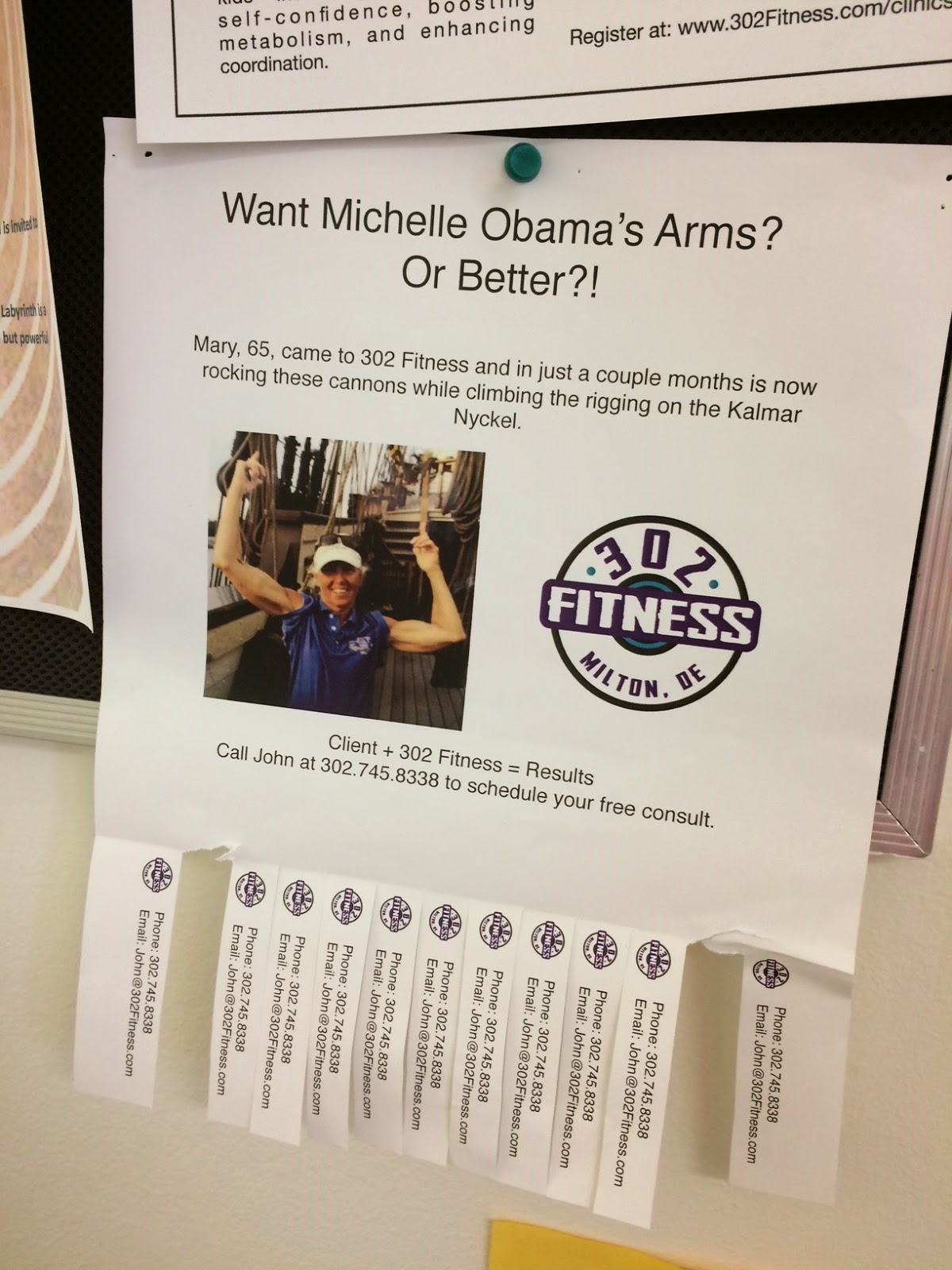
Might of publicity?

Using Michelle Obama’s arms to sell training services:

Want Michelle Obama’s Arms? Or Better?! training flyer

H/T and photo by Zach Schrag.

Posted in right of publicity | Leave a comment

"we can do anything" ToS might be unconscionable, providing remedy for loss of music

MacKinnon v. IMVU, Inc., No. H039236  (Cal. Ct. App. Oct. 30, 2014)
MacKinnon sued IMVU, which runs an entertainment service, the “instant messaging virtual universe,” alleging that IMVU deceived users about music purchases and wrongfully restricted users’ ability to play music after they bought it.  He alleged conversion, breach of contract, and negligent misrepresentation along with California statutory claims. The trial court dismissed all of his claims because IMVU’s contract said it could do whatever it wanted to its customers.  The court of appeals reversed.
To get the IMVU app, users have to provide information and click the “Create IMVU Account” button on IMVU’s website. Below that button is small print stating “[b]y clicking Create IMVU Account you are indicating that you have read and agree to the Terms of Service Agreement and Privacy Policy,” and a hyperlink to the Terms of Service Agreement and Privacy Policy.
IMVU users have avatars and can buy virtual products for them using real money.  They can also buy audio products, including “trigger music,” audio clips or songs users play by typing the appropriate trigger.  IMVU users create audio products and submit them to IMVU’s catalog; users can listen to the full product before buying it by clicking a “try” button.  After a purchase, a screen pops up displaying the product and the phrase “You own this.” IMVU’s site says that purchases are “available to be used whenever you like.”  The ToS, however, say that IMVU can do anything at any time, that users have no rights in anything they buy (called a “license” in the ToS, naturally), that purchases are nonrefundable.
In 2008, IMVU announced that, because of bandwidth issues, “new products submitted” to the virtual catalog would be “cut down to 20 seconds,” but that the restriction “will not affect products already in the catalog.”  In 2011, IMVU applied the 20 second limit to all audio products, including previously purchased ones, and said that refunds would be offered only for purchases made on or after December 1, 2010.  MacKinnon, however, had already spent hundreds of dollars on IMVU credits, and when he bought audio he sampled them using the “Try” button to make sure it was full length and not limited by the 20 second rule.
The court first found that the contract indeed said that IMVU could do whatever it wanted with respect to the files.  MacKinnon argued that this interpretation rendered the contract terms unconscionable.  Oppression and surprise are the relevant factors in procedural unconscionability.  As to oppression, the availability of alternative online social gaming platforms and the “nonessential nature” of the recreational activity made the degree of oppression low.  (This undercounts the stickiness of particular sites: the operator intends to become important to the consumer, and the consumer may find it very difficult to leave once s/he spends significant time on a platform because of the social connections there—given the relational nature of the service and the operator’s intent that the consumer become invested, this conclusion doesn’t make sense in the context of contracts that consumers just don’t read.)
As to surprise, the ToS was a 10-page, single-spaced document. The provision at issue appeared in the Terms and Conditions of Sale section, where the court said one would expect to find it (though note that it’s called “sale”), in the same typeface and font as most of the document.  So the agreement didn’t call special attention to the no-refund provision, but it wasn’t hidden in fine print. And length alone doesn’t establish surprise.  (In other words, we’re just going to pretend that consumers read these contracts; nothing to see here—literally nothing to see, since it was just a hyperlink.) Thus “we cannot say the element of surprise is present.”
As a result, the court of appeals concluded, there was a low degree of procedural unconscionability. Comment: Contrast empirical research on consumers’ practical ability to read and understand multiple pages of text, presented online, when they have to do that with every service they encounter.  See, e.g., Jeff Sovern  et al., “Whimsy Little Contracts” with Unexpected Consequences: An Empirical Analysis of Consumer Understanding of Arbitration Agreements. I’d say procedural unconscionability is routinely high.  That it might go higher in more concentrated markets doesn’t make it absolutely low. (Indeed, I’m not convinced consumers can figure out terms well enough to use differences to judge competitors and thus competitors will rarely if ever compete on contract terms and competitive markets will still be packed with unconscionable terms.)
Substantive unconscionability: contracts of adhesion are substnatively unconscionable when they’re overly harsh, unduly oppressive, so one-sided as to shock the conscience, or unfairly one-sided.  It’s not just a bad bargain, but a contract that’s unreasonably favorable to the more powerful party: there’s no justification for the contract’s one-sidedness, and the allocation of risks or costs is overly harsh given the circumstances. The court of appeals found that the record was insufficient to make that determination, which depends on a contract’s “commercial setting, purpose, and effect.”  Thus, the court of appeals considered whether the dismissal could be affirmed on other grounds.
CLRA: the complaint alleged that IMVU violated the CLRA by deceiving users into believing that full-length audio products would not be truncated and by including unconscionable provisions in the ToS.  MacKinnon pointed to (1) IMVU’s announcement that the 20-second restriction “will not affect products already in the catalog” and (2) the message “You own this” that users received after purchasing audio products. He alleged that these constituted representations that the goods at issue had characteristics or qualities they didn’t have; that IMVU had advertised goods/services with intent not to sell them as advertised; and that IMVU had represented “that a transaction confers or involves rights, remedies, or obligations which it does not have or involve,” as specifically barred by the CLRA.  (I like that last theory!  If online services insist that they aren’t making “sales,” they darn well ought to stop telling us that they are.)
A CLRA deceptive conduct claim requires conduct that was likely to mislead or deceive a reasonable consumer, which is usually a question of fact, and a causal connection between the defendant’s allegedly deceptive representation and the alleged harm—reliance.  IMVU argued that, in view of the ToS, no reasonable consumer was likely to be deceived.  But a factfinder could conclude otherwise based on the September 2008 announcement and the “You own this” representation.  Regardless of the ToS provision (which may or may not be enforceable), it was possible that reasonable consumers would be misled.  Even if the September 2008 announcement was true, true statements can be misleading.  “A reasonable consumer may have understood those representations to mean that IMVU would not exercise any contractual right to truncate certain audio products postpurchase.”  The CLRA makes consumer protection claims available when collateral representations differ from contractual language. 
And then the court of appeals muddies the waters by stating that “[w]hether a reasonable consumer who read the Terms of Service Agreement and the representations would have been misled by the latter is a question of fact.”  So reasonable consumers, as a matter of law, read the contract—and what is the level of understanding of such consumers?  Can they read at a twelfth-grade level?  Anyway, MacKinnon adequately alleged deceptive conduct. He also alleged reliance, at least as to the September 2008 announcement, which he alleged he reviewed; he never specifically alleged that the saw the “You own this” statement.  (Did he see the “buy” button?  Why wouldn’t “buy” indicate that he had “bought” the particular item he sought to buy?)  And MacKinnon didn’t show there was a reasonable possibility of curing the defect in the pleading by amendment.
The CLRA also allows unconscionability-based claims where an unconscionable provision in a contract is intended to result in or which does result in the sale or lease of goods or services to any consumer. MacKinnon couldn’t state a claim based on the class action waiver because IMVU hadn’t yet sought to enforce that term of the agreement against MacKinnon, so he hadn’t suffered any damage, but as to the unconscionability discussed above he did state a claim.
UCL fraud, FAL, and negligent misrepresentation claims also survived as to the September 2008 announcement.
Conversion: Conversion requires actual interference with ownership or right of possession.  IMVU argued that MacKinnon had no property rights in the audio products because of the ToS stating (1) “you acknowledge that you have no right, title or interest in or to this Site, any Products, Materials or Software”; and (2) “Credits” “can . . . be exchanged on this Site for limited license right(s) to use a feature of our Product or a virtual product when, as, and if allowed by IMVU and subject to the terms and conditions of these Terms.”
But the first provision was inapplicable, since IMVU carefully distinguished in the ToS between “Products” it offered and virtual products created by third party users (Submissions), which was what MacKinnon bought. And the second provision didn’t define the scope of the user’s license rights or whether they included any ownership interest. 
Breach of contract claims also survived based on MacKinnon’s acceptance of IMVU’s post-September 2008 offering of full-length audio products for purchase.  This claim wasn’t based on the ToS itself, but an alleged subsequent contract, so the claim was that the parties subsequently implicitly modified their integrated writing.
Also, a breach of the implied covenant of good faith and fair dealing was adequately pled, even though the ToS might expressly authorize truncating audio products. A discretionary power must still be exercised in good faith.  However, courts can’t imply a covenant directly at odds with a contract’s express grant of discretionary power “except in those relatively rare instances when reading the provision literally would, contrary to the parties’ clear intention, result in an unenforceable, illusory agreement.”  If the no-refund portion of the contract, which gives IMVU unfettered authority to truncate audio products without a refund, is enforceable, then no covenant of good faith and fair dealing could be implied; if it was unconscionable, then there was also a claim of a breach of the covenant.  (OK, I’m not a contracts person, but this seems … weird.  I thought the whole point of the covenant of good faith and fair dealing was to make contracting parties exercise their discretion within some boundaries, even when the contract provision at issue was valid.)
However, MacKinnon couldn’t bring a Song-Beverly Act breach of warranty claim because he didn’t buy the audio products in California, but rather in Utah where he resided.

Posted in california, consumer protection, contracts, http://schemas.google.com/blogger/2008/kind#post | Leave a comment