-
Recent Posts
- “toddler drink” plausibly misleads about suitability as next stage after infant formula
- “complete nutrition” claims for supplements are obviously untrue, but GLP-1 related claims could live again
- it doesn’t infringe to use a similar concept in ad photos
- State barber board wins battle against “Barber Shop” bar
- compounding pharmacies lose a round with Lilly on personalized medicine and GLP-1 comparison claims
Recent Comments
Archives
- May 2026
- April 2026
- March 2026
- February 2026
- January 2026
- December 2025
- November 2025
- October 2025
- September 2025
- August 2025
- July 2025
- June 2025
- May 2025
- April 2025
- March 2025
- February 2025
- January 2025
- December 2024
- November 2024
- October 2024
- September 2024
- August 2024
- July 2024
- June 2024
- May 2024
- April 2024
- March 2024
- February 2024
- January 2024
- December 2023
- November 2023
- October 2023
- September 2023
- August 2023
- July 2023
- June 2023
- May 2023
- April 2023
- March 2023
- February 2023
- November 2021
- October 2021
- September 2021
- August 2021
- July 2021
- June 2021
- May 2021
- April 2021
- March 2021
- February 2021
- January 2021
- December 2020
- November 2020
- October 2020
- September 2020
- August 2020
- July 2020
- June 2020
- May 2020
- April 2020
- March 2020
- February 2020
- January 2020
- December 2019
- November 2019
- October 2019
- September 2019
- August 2019
- July 2019
- June 2019
- May 2019
- April 2019
- March 2019
- February 2019
- January 2019
- December 2018
- November 2018
- October 2018
- September 2018
- August 2018
- July 2018
- June 2018
- May 2018
- April 2018
- March 2018
- February 2018
- January 2018
- December 2017
- November 2017
- October 2017
- September 2017
- August 2017
- July 2017
- June 2017
- May 2017
- April 2017
- March 2017
- February 2017
- January 2017
- December 2016
- November 2016
- October 2016
- September 2016
- August 2016
- July 2016
- June 2016
- May 2016
- April 2016
- March 2016
- February 2016
- January 2016
- December 2015
- November 2015
- October 2015
- September 2015
- August 2015
- July 2015
- June 2015
- May 2015
- April 2015
- March 2015
- February 2015
- January 2015
- December 2014
- November 2014
- October 2014
- September 2014
- August 2014
- July 2014
- June 2014
- May 2014
- April 2014
- March 2014
- February 2014
- January 2014
- December 2013
- November 2013
- October 2013
- June 2013
Categories
- 230
- acpa
- advertising
- antitrust
- art law
- attribution
- blogging
- california
- cfaa
- cfps
- class actions
- cmi
- comics
- commercial speech
- conferences
- consumer protection
- contracts
- copying
- copyright
- counterfeiting
- cultural property
- damages
- dastar
- defamation
- design patent
- dilution
- disclosures
- disparagement
- dmca
- drm
- fan fiction
- fanworks
- fda
- fees
- first amendment
- ftc
- geographic indications
- http://schemas.google.com/blogger/2008/kind#post
- insurance
- jurisdiction
- libraries
- misappropriation
- music
- my lawsuits
- my writings
- parody
- patent
- patents
- preemption
- presentations
- privacy
- procedure
- reading list
- remedies
- right of publicity
- secondary liability
- securities
- standing
- surveys
- teaching
- tortious interference
- trade secrets
- trademark
- traditional knowledge
- Uncategorized
- unconscionability
- unfairness
- warranties
Meta
NFL Films protected by First Amendment against players’ right of publicity claims
Dryer v. National Football League, No. 09-2182 (D. Minn. Oct. 10, 2014)
There are two alternatives when it comes to the right of publicity, it seems to me. Either we will limp along with a special rule for video games despite the Supreme Court’s holding in Brown, or the Court will have to take a right of publicity case and explain what it meant in Zacchini. Given the Court’s tendency to use the First Amendment like Lochner, I’m not confident I’d be happy with the outcome of the latter, but I still think a national rule would be a much better idea than what we have now.
The three plaintiffs are retired football players who opted out of the NFL’s global settlement of former players’ claims. They alleged that the NFL’s use of video footage of them playing football violated their publicity rights, confused consumers about endorsement under the Lanham Act, and unjustly enriched the NFL. (The unjust unrichment claims fall with the rest and I won’t discuss them.)
Footage of games in which Dryer played for the Giants and the Rams appears in 47 different NFL Films productions. Thirty-two NFL Films productions include game footage in which plaintiff Bethea appears as a player for the Oilers, and 91 include footage from games in which plaintiff White played for the Vikings and the Chargers. Dryer and White lived in California at litigation time; Bethea lived in Texas.
“NFL Films productions are essentially compilations of clips of game footage into theme-based programs describing a football game or series of games and the players on the field.” But they’re more than just highlight reels; they’re artistic. They don’t use the TV broadcast cameras, but rather NFL Films-dedicated cameras whose operators choose how to best tell the story of the game. Most of the films at issue described a single game or season in a 20- to 30-minute narrative including music, narration, and clips in real time and slow motion. Some included interviews with players, including the three plaintiffs, who all participated in interviews after they retired. Each knew that the interview would be incorporated into NFL Films productions, and at least sometimes they signed waivers. Plaintiffs didn’t challenge the use of these interviews, but rather the use of the video footage of them playing football.
Although plaintiffs challenged 155 separate films, the court focused on representative samples (though they weren’t representative in that they were the ones in which footage including each plaintiff made up the highest percentage of total run time). For Dryer, a 24- minute production, “Game of the Week 1969 Week #1 Vikings vs. Giants” featured Dryer playing in 10% of its run time. “Using game footage and dramatic narration and music, the production showcases pivotal plays in a game between the Minnesota Vikings, one of the NFL’s most powerful teams at that time, and the New York Giants, who were welcoming a new coach after a poor showing in the 1968 season.” Dryer’s name wasn’t mentioned until more than 5 minutes in and was spoken only twice; you’d already have to know that he wore number 89 to identify him in the footage. “Most of his appearances in the production are fleeting, for mere seconds or fractions of seconds at a time, and are accompanied by narration discussing other players involved in the featured play. The production never focuses only on Dryer or his image; rather, he is always shown with his teammates in the context of a football play.”
Bethea’s story was basically similar, though he was featured for about one minute, with the narrator summing up: “Without any doubt, he is the best.” Many of his teammates received a similar one-minute treatment of their individual performances. For White, the clips with the highest percentage of footage featuring him were short (2 minutes or under). Otherwise his story was similar, except that he also appeared in a 10-second interview clip filmed after the game, identified by name and position on screen.
Previously, the court found that plaintiffs stated a claim for violation of the right of publicity (etc.), but after discovery was over—and after the dismissal of the class claims—the court found that matters had changed. Its job was to balance plaintiffs’ “rights to profit from their own likenesses” with the NFL’s free speech rights. The court determined that the proper starting point was to determine whether the NFL films were commercial or noncommercial speech. Plaintiffs didn’t dispute that, if the films were noncommercial, their claims failed (interesting, given Zacchini, and also not entirely how the analysis proceeds).
Whether speech is commercial is a question of law. There’s no bright line, but key considerations include (1) whether the speech is an advertisement, (2) whether it refers to a specific product, and (3) the speaker’s economic motivation for the speech. None alone makes speech commercial, and not all three are necessary, but the combination is good evidence of commerciality.
Advertising: Plaintiffs argued that NFL admitted that its films were advertising by equating them to a $350 million or larger ad budget in two Powerpoints. “But the fact that NFL Films productions generate substantial goodwill for the NFL is not itself dispositive of the issue whether the productions themselves are advertising.” Still, speech need not explicitly propose a commercial transaction to be advertising. These films didn’t offer to sell anything or encourage viewers to buy anything, but they still enhanced the NFL’s brand. An ad can be commercial speech if it is just brand advertising. See Jordan v. Jewel.
But, while the brand-enhancement theory was attractive, it didn’t work in this context. While brand enhancement can be an element of advertising, brand enhancement alone isn’t enough to render a film advertising. This wasn’t like the ad in Jordan, which was an ad bought by the defendant appearing in a sports magazine and which was “easily distinguishable from the magazine’s editorial content.” Here, by contrast, the films don’t appear in other media as paid spots—they are the content. The NFL doesn’t pay TV networks to broadcast the films; the networks pay the NFL for the rights, and other advertisers pay to have their ads inserted.
Nor did the films “exploit players’ images for the singular purpose of brand enhancement or other commercial gain.” Instead, they tell a story about a game, a team, or even a player: they’re “a history lesson of NFL football.” And the only way to tell such stories is by showing footage of the game—“the players, the coaches, the referees, and even the fans.” The NFL was drawing benefit not from the likenesses of individual players but from “the drama of the game itself, something that the NFL is certainly entitled to do.” There was no way to visually retell these stories without the use of footage of NFL players playing. Thus, the use was not for commercial advantage, but “because the game cannot be described visually any other way.”
Despite brand enhancement, then, these films weren’t ads. Comment: This has to be the case if the New York Times is not to be a commercial speaker when it publishes its most important stories: Publishing the Pentagon Papers and portions of the Wikileaks documents, or Judith Miller’s Iraq reporting, undoubtedly was extremely important to the NYT’s brand, for good or ill. The NYT certainly takes into account the question of “what kind of stories do we publish as part of our mission to be the paper of record?” when it makes decisions at that level. That’s branding, among other things.
Product reference: Plaintiffs argued that the productions referred to the NFL as a product, as in Facenda v. NFL Films, Inc., 542 F.3d 1007 (3d Cir. 2008). But that involved a film the court determined to be an infomercial for a different creative work: it referenced an NFL videogame with a countdown clock until the game’s release, and it was broadcast only in the few days before the release, like a film trailer. Here, the films didn’t promote a product separate from themselves. And there was no other way to tell the story of NFL games and players without footage.
Economic motivation: Of course there was an economic motive, but that wasn’t dispositive in the absence of the other elements. Publishing expressive works for profit doesn’t take them out of full First Amendment protection. “This is not commercial speech; it is capitalism.”
Because the films were fully protected speech, plaintiffs’ claims failed.
The court proceeded, however, to do the more ad hoc balancing in other right of publicity cases, then an analysis of the relevant states’ rights of publicity, many of which incorporate at least some First Amendment-protective limits on their initial definitions. For balancing, the court focused on previous athlete right of publicity cases not involving video games, for obvious reasons: C.B.C. Distrib. & Mktg., Inc. v. Major League Baseball Advanced Media, L.P., 505 F.3d 818 (8th Cir. 2007) (fantasy baseball); CBS Interactive Inc. v. Nat’l Football League Players Ass’n, Inc., 259 F.R.D. 398 (D. Minn. 2009) (fantasy football with images); and Gionfriddo v. Major League Baseball, 114 Cal. Rptr. 2d 307 (Cal. Ct. App. 2001) (video clips of former players playing). All three cases found that the free speech interests of the respective speakers outweighed the athletes’ publicity rights, with Gionfriddo holding that it was permissible to use images of players playing to advertise the game of baseball; the line would be drawn if MLB tried to use the players’ images to sell an unrelated product.
The court previously denied a motion to dismiss based on these cases on the theory that the data and images in those cases were all in the “public domain,” unlike the NFL video footage, which the NFL protects vigorously. But plaintiffs, having had a chance to develop the record, didn’t show that the uses of which they complained were truly different from the uses in those cases. Specifically, plaintiffs didn’t explain how the NFL’s copyrights stripped protection from its films. (Note: this distinction was always nonsense on the facts as well as the law. CBS and Gionfriddo obviously involved footage/pictures still in copyright, even if those copyrights were not owned by the leagues at issue. Separately, I can’t imagine the Supreme Court distinguishing between an authorized use of copyrighted works and a use of public domain works for purposes of First Amendment protection of the use.)
Reviewing the films, it was clear that the challenged uses were akin to the use of footage in sports news broadcasts. Thus, balancing the news-like uses against the players’ publicity rights, the players’ economic interests weren’t strong and were outweighed by the public interest inf ree dissemination of information about sports history. After all, the right of publicity exists to provide incentives, and the players were already paid for their participation.
Anyway, even if the films were commercial speech, the plaintiffs failed on the merits of their claims. The court initially declined to apply New Jersey law just because NFL Films was headquartered there.
California has expansive statutory and common-law rights of publicity; Texas has only the common law; Minnesota has a common-law right that doesn’t require a commercial purpose or a pecuniary benefit (and is therefore super duper unconstitutional, but no worries!); and New York has only the statutory right, which requires written permission for advertising uses.
The NFL argued that each state recognized an exception for newsworthiness. E.g., Texas actually defines the right to be for uses that aren’t newsworthy or incidental. California excludes from its common-law protection the publication of matters in the public interest, and the statute exempts uses “in connection with any news, public affairs, or sports broadcast or account.” Newsworthiness is often determined as a matter of law.
California: it was clear that the films were “a means for obtaining information about real-world football games,” and are therefore “publishing or reporting factual data” within the meaning of the California newsworthiness defenses. The use of music, narration, and camera angles might “dramatize” the games, but they still conveyed true information about real-world games. This was of public interest and related to news—factual reports about pro athletes’ performance are of great interest to the public.
Texas: Texas newsworthiness is likewise broad “and extends beyond subjects of political or public affairs to all matters of the kind customarily regarded as ‘news’ and all matters giving information to the public for purposes of education, amusement or enlightenment, where the public may reasonably be expected to have a legitimate interest in what is published.” Plaintiffs argued that the defense was limited to uses that are “legitimately necessary,” but that didn’t matter, because using plaintiffs’ images was “the only way for the NFL to visually inform the public about historical football games. Thus, that use is ‘legitimately necessary’ to provide the public with a visual record of the NFL’s past.”
Minnesota: Plaintiffs argued that Minnesota didn’t recognize a newsworthiness defense, but the NFL argued that state courts applied a public-interest exception to similar privacy-related claims, and that the Minnesota Supreme Court’s reliance on the Restatement to formulate privacy claims meant that the Restatement news exceptions to the right of publicity ought to apply. Given that newsworthiness is a First Amendment-related privilege, the court found it credible that Minnesota courts would apply it to publicity claims.
New York: New York also limits its statutory right to non-newsworthy publications, and the newsworthiness exception “should be liberally applied.” The right is only triggered when there’s no real relationship between the plaintiff’s image and its use, or where the use is an ad in disguise. That wasn’t so here.
Separately, the NFL argued that plaintiffs explicitly or implicitly consented to the NFL’s use of game footage. While that doesn’t matter in New York, which requires writtenconsent, the other states make lack of consent an element of a claim; consent wouldn’t bar the claims but would prevent plaintiffs from recovering pre-suit damages. The record showed that the plaintiffs all knew that NFL Films “regularly captured game footage and used that game footage in subsequent productions.” Plus, each plaintiff voluntarily appeared in these films by giving interviews to NFL Films; though they didn’t challenge the use of the interviews, it was apparent that they consented to the use of the game footage too. For example, Dryer testified that he “never thought [the NFL was] wrong” in showing game footage in NFL Films productions, and believed that NFL Films had the right to show game footage, including images of him playing football: “It’s their company.” Bethea “just was glad to be interviewed.”
The court then put on suspenders that are more likely to be snapped then the belt to be unbuckled: it found copyright preemption under §301. (This should really be conflict preemption; courts’ insistence on using §301 has been the source of much incoherence.) Section 301 applies if (1) the disputed work is within the subject matter of copyright; and (2) the state-law-created right is equivalent to any of the exclusive rights within the general scope of the Act.
On the motion to dismiss, the court had ruled that plaintiffs plausibly alleged that the “work” at issue was their identities, and thus there was no preemption. But the full record didn’t show that. Instead, the “works” plaintiffs challenged were films featuring game footage of them playing football. Plaintiffs argued that athletic events aren’t copyrightable, making their appearances not within the subject matter of copyright. But the works here weren’t the games, but rather video recordings of games, which are beyond peradventure within the subject matter of copyright. Their likenesses can’t be detached from the copyrighted performances contained in the films.
In addition, the court took account of two intervening decisions on the issue of whether the right of publicity was equivalent to any exclusive copyright right. Ray v. ESPN, Inc., No. 13-1179, 2014 WL 2766187 (W.D. Mo. Apr. 8, 2014); Somerson v. McMahon, 956 F. Supp. 2d 1345 (N.D. Ga. 2012). Both cases involved pro wrestlers challenging the rebroadcast of their wrestling performances; both cases found preemption. A performance that’s fixed with the permission of the performer is copyrightable; later objection to the republication of that performance in a non-advertising use is a matter for copyright law, not the right of publicity. “In other words, a claim for a violation of the right to publicity against a copyrighted work will lie only if that work is used for advertising, not in an expressive work.”
Comment: This comes straight from McCarthy, and while I applaud the result I abhor the reasoning. (1) For copyright purposes, the athletes here weren’t performers/authors because the game itself wasn’t copyrightable; the authors were the ones making decisions about the footage, not about the plays; the court here even quotes language from the legislative history to that effect. The players consented to appear, but even under Garcia they’re probably not authors. (2) Where does that “non-advertising” limit come from? Certainly not from the work or from the copyright right, which is not limited to non-advertising uses. Drawing the line at advertising is conflict preemption reasoning and has nothing to do with §301. More on this in a forthcoming article.
Given that the films weren’t ads and the recordings were made with plaintiffs’ permission, the claims were preempted. Plaintiffs didn’t argue that the NFL couldn’t use the original game broadcast by showing it in full if it so chose. Instead, they argued that use in a new work violated the right of publicity. But the new work was likewise covered by copyright law. Plaintiffs’ likenesses couldn’t be detached from the copyrighted performance, which the NFL had the right to exploit in expressive works. (Also, since when is an ad not an expressive work? Poor conceptualization tends to build upon itself.)
Finally, §43(a) false endorsement: In the Eighth Circuit, the Lanham Act only applies to commercial speech, so we’re done here. The court declined to adopt Rogers v. Grimaldi. But it did say that, even if the films were commercial speech, there was nothing false or misleading in them: they showed plaintiffs playing football. “This use of game footage as game footage cannot, as a matter of law, cause confusion or mistake or deceive anyone as to Plaintiffs’ affiliation with the NFL.” They were affiliated with the NFL. Dryer was even filmed at the time of production of one film wearing his Giants jersey. “If Dryer was truly concerned about creating an impression that he endorses the NFL, he would not have agreed to be filmed wearing NFL trademarks in 2006, a mere three years before the filing of this lawsuit.”
And furthermore, the court found laches. Nearly all of the films at issue were made years or even decades before plaintiffs sued. A delay of more than six years raises a presumption of laches. Plaintiffs didn’t provide evidence excusing their delay. The fact that, until approached by counsel, they didn’t know they might have a claim was irrelevant—ignorance of the law was no excuse. The NFL didn’t need to show prejudice given the length of delay, but it did so: “Bethea’s deposition alone illustrates the harm the long delay caused to witnesses’ memories. Bethea testified that he could not remember details of an interview he gave to NFL Films in 2007. That memories of events stretching back to the late 1960s would similarly be affected seems self-evident.” Plaintiffs argued that the NFL’s intentional infringement precluded equitable defenses like laches. But the NFL was merely exploiting its copyrights, and “correctly cautioned others that the use of game footage for other purposes might impinge players’ publicity rights because commercial use of player identities is not within either the NFL’s copyright or the First Amendment.”
AU trademark works in progress day 2
Dan Hunter (with Irene Calboli), Trademark Proliferation
Concerns about too many marks. They’re extremely weak as a result. It’s easy to get a descriptive mark on the primary register w/o secondary meaning. Also: many “marks” don’t seem distinctive as to source. They’re recognizable, but not distinctive as to source; those aren’t the same thing. So how did they get on the register? Same proliferation in every country.
This is about distinctiveness. Much focus has been on infringement, but wanting to go back to the beginning and address proliferation of weak marks. Our characterizations of inherent distinctiveness are underexplained: whyis an arbitrary or fanciful word source-identifying rather than simply being unique within a symbolic system? The other part is secondary meaning, where it’s even worse. Types of marks have been expanded radically to include color, etc., and we accept that sound/touch/etc. can be distinctive with secondary meaning. Again, that doesn’t make a lot of sense. Recognizing something as a mark doesn’t mean we recognize it as source distinctive, especially for merchandising right—Yankees on hats.
Cognitive science literature: System 1 is immediate and not thoughtful; System 2 is thoughtful but lazy. Oftentimes we answer the System 1 question, is this thing recognizable, when we’re supposed to answer the System 2 question, is this thing identifying a source? Splitting those apart is the point of the paper.
Poor theory of distinctiveness + incredibly strong rights = trademark proliferation, land grab for expressive components of society b/c it’s in their interests to do so. What can we do to fix it? Not sure it’s fixable.
Irene Calboli: statutory definition requires merely difference from genericity and recognizability: that’s extremely broad. TTAB is reluctant to recognize aesthetic functionality. One possibility: nobody needs more than one name per product, not taglines/colors/etc.
Hinchcliffe: Breaking circularity: what is the motivating rationale of the article? What impact on the modern TM regime do you want?
Hunter: Fixing it is very hard, but we want to explore the idea of why there are so many things not functioning as trademarks that are legally recognized as trademarks. A reduced number of marks might make it easier to believe that things recognized as marks are marks—from the theoretical to the simplest (if unlikely).
Calboli: Judges could have some reason to say a mark isn’t distinctive. To try to raise the bar can be useful. We have lots of defenses, but they come in too late if at all. Too many people are grabbing aesthetics. Likes strong rights, but strong rights for limited numbers of marks.
Cathay Smith: would it help if all marks had to show secondary meaning regardless of Abercrombiecategorization?
Hunter: secondary meaning as to source distinctiveness, but he doesn’t know how to prove that. Doesn’t know how to demonstrate that when I recognize Exxon, that I’m identifying it with source as opposed to being able to pick it out of a lineup. If we could craft relevant instruments, then asking for secondary meaning would help.
Calboli: the nature of TM is to be subjective, but there are some instances where you could get rid of the protection. Should be more than aesthetic—TM is not the right law to use. Perhaps there should be case for sui generis protection to avoid land grab.
RT: Judge Leval’s claims in J&J v. P&G: an example of the problem? He thought that requiring secondary meaning evidence more often could help. But cf. Lisa Ramsey (making the argument that only arbitrary etc. marks should be protected, not descriptive marks at all). Bone/Wal-Mart on error costs: source identification is expensive to determine, which I think the paper is clear about in struggling w/solutions. Rock & Roll Hall of Fame case does try to split it apart for particular reasons having to do with protecting free expression.
But why aren’t consumers also likely to do the same cognitive processing when they encounter the mark and conflate the two, even when making a purchasing decision? Laziness is often a characterization of consumers relied on by trademark expansionists, see Ann Bartow on visions of the consumer in TM. Why aren’t good plaintiffs’ confusion surveys evidence that people are identifying a mark with a source, not just recognizing it? We are trained for recognition of marks and it’s hard to distinguish that from recognizing source: are you really just objecting to the merchandising right? I recognize Crest as a source for toothpaste and that’s why I buy, but that’s not true for all uses of marks. TTAB case on jean pockets where the applicant argues that pockets have become a place where consumers expect marks.
Can your claims be reconciled w/the statute and its claim about anonymous source? Cf. 4thcircuit’s AOL v. AT&T, where the court says the registration makes summary judgment impossible despite extensive evidence of descriptiveness. Design patents/design rights are the sui generis protection Calboli wants, aren’t they? Mark McKenna on channeling doctrines.
Hunter: why aren’t consumers doing the same sorts of things as the maximalists? That’s the key question. We do rely on Crest; it’s extremely well known. One thing you could say is that well-known marks that have in fact met people’s preferences will work as source identifiers. There must be some marks that are source identifying. But wants to contest the idea that just because we’re trained to recognize marks, we’re trained to recognize source for the ones at the middle/the ones at the bottom that are the starting point of our article. The reason the marks strike us as bizarre is that they’re overreaching; trying to protect too small a component or trying to protect aesthetic appeal. So consumers are lazy and we do recognize some things as delivering consistent quality; not all marks are problematic. Confusion surveys: what is the role of confusion? Also there are many issues with poorly drafted surveys. Look at the surveys that have been accepted as appropriate.
Calboli: Crest is a working mark. To her the problem is that the “mark” has to be distinctive—she has no problem w/anonymous source if it works. The problem is nontraditional trademarks and proliferation/extension into areas where no mark should exist. It’s possible because of the idea of distinctiveness from the broad wording of the statute, even when the thing is decorating/embellishing the product. The answer may be really expanding the functionality doctrine. Too hesitant
RT: Sounds to me like expanding the concept of de facto secondary meaning. De facto distinctiveness but not de jure distinctiveness? (Calling it secondary meaning already obscures what’s going on—it’s a disavowal of what we’re saying, which is that some symbol is functioning the way we ordinarily expect a mark to function, but we’re still not going to protect it for competitive reasons.)
Grinvald: David Barnes makes a similar argument from a marketing perspective. Add more on Beebe’s semiotic analysis.
Hunter: if what we’re saying is right, then semiotics doesn’t provide the answers Beebe wants to provide. The semiotic turn doesn’t provide us with analytical framework to make the sorting move we want to make. [Barton, feel free to call!]
Colman: not sure you need to reject Beebe to accomplish what you want. He talks about failure of Abercrombiescheme for not identifying what kindof distinctiveness a mark has come to represent: distinguishes source distinctiveness from differential distinctiveness. What you want beyond that is empirical data. [discussion of Louboutin]
Hunter: It’s not about a new normative foundation: something that is distinctive as to source should give entitlements to the rights we want TM to have. But right now we’re recognizing marks at too early in the process.
Colman: Calboli seems to say that people are grabbing aesthetic elements—even if people recognize the Bottega leather weave they shouldn’t have rights over it.
Calboli: these can coexist. We should exclude types from the register, and even within that some marks could fit within the proper definition of distinctiveness but aren’t. Most slogans aren’t serving a distinctive function—you might recognize them, but if I said “let’s go to [Home Depot’s slogan instead of Home Depot’s name]” you’d have no idea where I meant.
LaFrance: suggest ways of empirical testing the concept of source identification. SCt in Wal-Mart says consumers are trained to recognize words, not packages—that isn’t based on empirical evidence, but it has intuitive power. Plausible that some things, such as fanciful words, immediately lead to conclusion that these are marks. Testing that empirically should be impossible. One mark per product: sub-product lines are important in practice.
Farley: this isn’t really a paper about TM proliferation. It’s really about distinctiveness. That’s supposed to be the main function of trademarks, and you’re asking what it is. SCt punted on the applicability of Abercrombie to word marks even though courts were struggling with its application to trade dress. Landscape Forms: the parties go up and down the court system and the courts have a huge problem figuring out how to ask the question of distinctiveness—the test ends up avoiding any real issue of source identification. What does the consumer do with the information “Green Giant” on a can of peas? J. Friendly thinks that it doesn’t identify the content of the can, or the price of the product, and consumer then tries to make sense of it: it must be a brand.
TM proliferation takes us so far from that can of peas. Proliferation in itself could undermine consumers’ ability to understand the visual presentation they encounter. Wal-Mart also went in the same direction: how do consumers interpret what they encounter by default. But now we’re being so overwhelmed with sense/inputs that we couldn’t possibly regard them all as source identifiers. [Now I want to bring in Grice’s theory of implicature as an explanation of what consumers might take away from a symbol.] We need to give direction to judges about which survey questions are the right ones: not top of mind recall.
Colman: distinctiveness has gone from being necessary to being sufficient and you want to take it back. May be confusing to introduce the Louboutin red sole/Bottega weave which gets into aesthetic functionality—slogans or other examples might make your target clearer.
Mary LaFrance, False Advertising Claims against Product Names and Labels
Pom Wonderful as jumping off point: decided correctly, but opens the door to great uncertainty about what in the future will constitute sufficient accuracy in product names/labels to avoid liability for false advertising. FDA rules are a floor, not a ceiling. Most examples involve consumable goods—food, beverages, supplements, drugs.
State laws: preemption status isn’t clear for unfair competition, if a remedy would require inconsistency w/FDA labeling requirements, but Lanham Act false advertising claims aren’t precluded. Juicy Fruit gum: could that be misleading even though it doesn’t have juice or fruit? We don’t know what the standard is, which creates uncertainty. That may prompt more detailed disclosure. Also, since only competitors have standing and not consumers, they all live in glass houses, so they may be hesitant to sue because they live in glass houses. Consumer suits are already going on and won’t be affected much by Pom; the possibility of frivolous lawsuits like the one against Crunch Berries is already available. Greater risk of misleadingness by name versus label? Most people don’t look at the ingredients list. Williams v. Gerber, the court said: just because the FDA imposes regulations requiring listing ingredients shouldn’t give leeway to be misleading in the name of the product. Implies strict standards for names. Yet our experience w/product names like Juicy Fruit may make us inherently skeptical about product contents based on name versus other things on the label—but children may be relevant consumers.
Registration: deceptive marks are unregistrable, which is a disincentive. But deceptively misdescriptive marks are registrable, and could be misleading even if ruled not deceptive by PTO. Suggestive marks could also be deceptive to some consumers, yet we treat them as inherently distinctive.
Colman: care or sophistication of consumer may make a big difference with suggestive marks. Vulnerable/gullible consumers are protected under California state law. While federal judges are ad hoc about consumer competency, they are more regularized under California UCL. [I think everybody tends to think that the body of law they study is more incoherent/has more conflicting cases than other bodies of law—I know I’m not immune. Law is fractal!]
Broader question of interaction of Lanham Act with other federal laws—he thinks there should be a presumption of aesthetic functionality from the existence of a design patent, but courts don’t pay attention to that.
LaFrance: true that courts don’t think about interactions enough. Thus the possible preemptive effect of the FDA scheme over general state unfair competition laws is so unsettled right now.
Grinvald: Images are really problematic! Especially w/vulnerable populations or people who aren’t going to read the label. Uncertainty as a good thing: forces advertisers to take labeling seriously. “Made in USA” as another particularly hot area. Competitor lawsuits: is that a good thing that they’re just between competitors? In-house, we were willing to sue even though it was expensive and even though we could only get injunctive relief if the ad was bad enough for us. Not really on behalf of consumers. Why don’t consumers have standing?
LaFrance: companies should generally ensure they have their own houses in order before they sue.
Grinvald: depends on where the ad is. If other competitors were already looking at you and sending C&Ds, not much of a deterrent.
RT: (1) Doesn’t seem like a name-specific problem. Pom’s claim was also based on the fruit vignette. We do know what the standard is: don’t be false or misleading, which would be the same regardless of where the claim was made. You suggest there might be a consumer predisposition to discount names compared to other claims. There’s a huge amount of marketing literature on this; e.g., study about slogans’ directness versus brand names’, or images versus words.
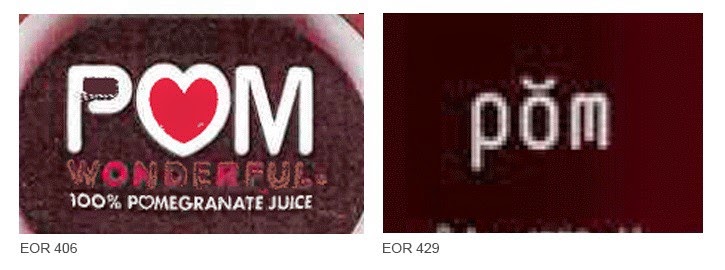
(2) I don’t think the Court was at all uncertain whether Pomegranate Blueberry was the name; it was uncertain about what other words were part of the name. (The briefs and the oral argument, I think, support this.) Relatedly: My advice is to include a picture where possible in your discussion. Note that Pom had issues w/its own Pomegranate Blueberry juice not being 100% those juices, though it was a lot closer.
(3) The effect of name/label being on package on class action standing/ascertainability/other issues. Makes a class action more plausible than other marketing elements, especially ads detached from the product itself.
(4) Boris v. Wal-Mart Stores, Inc., 2014 WL 1477404 (C.D. Cal. Apr. 9, 2014): Plaintiffs sued Wal-Mart for deceptively marketing Equate Migraine and Equate Extra Strength Headache Relief (Equate ES); the different names were a key part of the claim.
Smith: Should there be different standards for names versus other elements? May draw consumers in.
Hunter: Do you have a theory? What’s going on descriptively is of interest, but is there a normative or grand descriptive way of understanding what’s going on.
LaFrance: for now, it’s that uncertainty is not a bad thing, but we can’t have a standardless rule. We need a rule for testing names/labels, and should know whether the standards are different for names based on what our goals are.
More interaction between TM and false advertising: what do we mean by deceptive?
Hinchcliffe: connection to geographic indications as well. Wine law could benefit from this research. Address anticompetitive issues.
LaFrance: if companies feel they need more surveys to determine how name will be perceived, that’s expensive and may be difficult for new entrants. But you can save the money if your label is painfully honest. But maybe that puts you at a disadvantage to a company with survey evidence that consumers aren’t fooled.
Calboli: we tend to protect companies over their consumers once there’s distinctiveness. Stronger false advertising laws/labeling laws in Europe; class actions are different. We have cases like LOVEE LAMB (misleading), but otherwise we try to save the mark rather than consumers and use other tools than TM. Food regulations: what the consumer gets may diverge, since they think that “organic” means “free range” but it doesn’t.
Farley: interested in consumer skepticism. To what extent do these areas of law address that? BATF regulations of alcohol, different from TM standards.
[discussion of consumer skepticism and its malleability or lack thereof (my position: it’s not very malleable; general characteristics like age and education are far more important than any learning that goes on, but there are substantial individual differences that make it hard to figure out how that might apply to the law since both high-skepticism and low-skepticism people buy yogurt). If labeling something as cheaper makes it perform worse (as some research indicates), then one implication is that grey market goods correctly labeled as imported are always materially different because they’re likely to be perceived as performing differently. I’m cool with that because I don’t think material difference is an appropriate standard for liability as long as the consumer knows the truth.]
Sarah Hinchliffe, Scandalous Marks
Genesis of the project: Aust’l mark Nucking Futs for nuts. How did that happen? How well does the TM regime deal with scandalous marks? (Not at all well.) Relatively easy to register an offensive mark compared to the US, which seems more conservative. Unique cultural considerations. Courts often depart from the guidelines used by the TM Office.
European region has more coherent framework for denying “immoral” registrations, balancing moral considerations with the right to free expression. Harmonization in the internal market; right of the public not to be confronted with disturbing/threatening marks. More conservative than US. But still no clear tangible test for the application of the relevant ban. Seeks to fill this gap.
Ways to improve the system: Need compliance w/human rights rules; personal views of the tribunal ought to be irrelevant. The legality of the use of the mark is a relevant consideration. Need a generally morally accepted principle which the use of the mark would genuinely contravene. Mere offense should not be enough. Threat/attack is more likely to be scandalous than nonthreatening mark.
Hunter: always a risk in comparative law: pure descriptiveness. Differences may be attributed to culture. Different recommendations will be objectionable in different jurisdictions: why? What is the normative foundation you’re shooting for? If there is a problem—and maybe the problems differ by jurisdiction—what grand normative theory if any can apply?
Calboli: values of free speech are being exported; more attention to racial issues? Also, because of internationalization something that was offensive in one place might become offensive in other places. (Paper has example of Redskins raspberry candy in Austl.; used to have a caricature of an American Indian on the package, now just the name.) Could this be part of internationalization/drawing from other cases?
Smith: interesting that there’s no provision for disparaging marks separately.
Hinchcliffe: offending a segment of the community can be sufficient to reject. PHAT PHUK for a Thai restaurant. Maybe there’s so much difference in meaning that harmonization is impossible.
LaFrance: why even try for harmonization? Int’l marketing might require least common denominator; is that a problem.
RT: connection to territoriality. Graeme Dinwoodie’s work? Lionel Bently’s current work on internationalization of UK marks to India. Exceptionalism and exceptionability. The transmission of meaning across borders and its relationship to attempts to prevent the change of meaning within borders. Distinctively Australian culture? If we are committed to territoriality, then scandalousness actually fits well within that aspect of a TM system, whose commitments are orthogonal to consumer/producer protection.
Colman: any comparison to unrelated countries like Italy and China? Is there similarity, and if so why? (TM with Chinese characteristics?)
LaFrance: are there differences between registration-only and strong common-law systems? Is one more liberal than the other? If registration is very important to rights, the system might be more forgiving, while a common-law jurisdiction could say you can still use the mark.
Farley: international obligations: the prohibition on scandalousness is allowed as an exception to the general rule of registrability required by treaties, but compare 6terwhich is us all agreeing not to register flags and emblems—it’s not a flexibility. What’s going on there? Is there an issue of universality? Consider also creating categories instead of factors to consider. In the new gTLD program, there was a prohibition on morally offensive gTLDs. That’s a universal norm, so they tried to figure out what a universal, bare-bones standard was: the incitement to or promotion of violence, discrimination, or child pornography—this was categorical. In addition: equally generally accepted identified legal norms. That’s an interesting approach.
AU TM works in progress part 2
Cathay Smith, Immoral Trademarks
Abusive challenges: Dykes on Bikes, Squeezebloodfromturnips.com (opposer was angry because he was getting calls from the collection agency that was the applicant); Adultfriendfinder (opposer was a pastor who objected that the applicant was connecting men with loose women; seems sexist)—objecting to the nature of the service and not to the name. You’re supposed to examine the mark, not the commercial use of the mark. Objecting to the applicant’s business activities, political views, other activities.
Other types of cases: vulgar parodies, like SEX ROD, or the defecating greyhound. Those were the only two types of oppositions she found. Avoided disparaging TM cases: the standard for opposition is very different and the type of harm is very different; doesn’t see harm from immoral/scandalous marks.
Get rid of the bar entirely? Stop refusing through the examiners and only assess when there’s an opposition? Maybe it’s just a standing problem—who should have standing? Because of the problems w/the concepts, leaning towards taking it out.
Hinchcliffe: Literature on different terms we might use for the concept. Replace term? Define it? What are the benefits/flaws of current systems? Will procedural or substantive changes address those flaws?
Colman: do 1A issues differ depending on whether it’s the examiner or inter partes? Reminds him of racially restrictive covenants: the court’s determination of state action in enforcement of rights.
Smith: originally, saw it as more of an examiner issue. But not sure about it.
Hunter: what next? What is the grand claim? [Discussion of what law reviews are looking for.] Most obvious claim: where gov’t acts to grant or deny property interests there are constitutional implications. So how do we get through that minefield? Have others done that for immoral marks? [A fair amount, including Megan Carpenter and Christine Haight Farley.] Could say “dismantle everything in TM that doesn’t involve reputation or confusion, including registering name during life of president or his widow.” Either a grand constitutional leap, or say get the gov’t out of these particular things.
Grinvald: get the examiner out. Problems w/private actors are different. Stealth censorship.
LaFrance: some people are deeply offended by these symbols. To the extent that granting registrations encourages their adoption because of registration’s benefits, that’s relevant. Sure, the TM system’s purpose isn’t to protect morals, but any statutory scheme may aim to avoid promoting behavior that’s harmful to children (seeing stuff on billboards) or deeply offensive. Don’t undervalue notion of protecting morals.
RT: If you don’t want to deal w/disparaging marks, making claims about getting the gov’t out of the business of evaluating marks on a non-reputation-based metric is a difficult task. Underlying Q of what TM is for. Renna v. County of Union: TM is forcommercial activities, thus exclusion of state insignia is justified.
Underlying Q about role of variation in PTO proceedings. Black letter: can’t use results in other cases as factual support for results in your case. But is that rule justified? Do its cracks show especially when you get to 2(a) issues where the issues are both random and systematic (in that what is offensive tends to be related to sex, defecation, violence). Due process may be especially relevant in this circumstance. (Carol Rose on Shelly v. Kraemer has a lot to say about state enforcement of cultural beliefs; NYT v. Sullivan is a relevant 1A precedent: state enforcement of a state-granted right is state action.)
Farley: TTAB judge spoke on her own behalf and said that the PTO is absolutely consistent on “shit.” Can you explain why you’re separating morality from disparagement? That might reveal something useful. Your reasons for scrapping morality have been said before—there’s inconsistency everywhere; there are 1A problems in other provisions of law. More interesting, and what no one has done: think more about why we have this provision (and why the legislative history doesn’t reveal anything about what it means). Distinguishing disparagement could help. There might not be a clear line—without immoral/scandalous, a lot of cases might go down as disparagement cases (cases involving Christianity). SEX ROD claimed both scandalousness and disparagement.
Smith: sees the blurring too, but thinks disparaging is a subset of scandalousness. Disparaging marks are targeted and there’s actual injury to people. [Here’s where the paper could do some interesting work: why is it that we now see injury to a particularized identity as more injurious than injury to society? Dan Kahan/modes of thinking—cultural perceptions of harm are relevant and change over time. There once was a causal story about how offensive marks and the registration thereof did harm to society, as LaFrance pointed out may still be true for some people.] This provision invites abusive oppositions.
Colman: is lumping all gay men together ok? Opposer can’t speak for the entire group they purport to represent. [though probabalistic harm/far less than majority is usually acceptable in other TM areas, like confusion and secondary meaning] Relic of earlier thread that doesn’t belong in our largely economic system.
Farley: hard to argue it’s a relic when almost every other country has the same system. Other countries say offend morality or the public order.
Hunter: procedurally: why should one offended person be able to stop a registration? If people who aren’t offended had a mechanism to file in support, that might give more information about what percentages of people felt which way. This is consistent w/ other countries’ systems: makes clear that TM is gov’t information policy. Some of the policy is about confusion, but other parts are about other issues. Scandalousness is about avoiding gov’t imprimatur.
What is a theory of scandal? We should understand why defectation and sex of a certain sort is shameful? Lots of sociologists/psychoanalytic theory. If we had a theory of scandal we could figure out which cases were properly decided.
Colman: one of the few instances where IP admits to its political agenda; explore links to other areas where its agenda is less obvious.
Farley: one good empirical question is whether applicants respond to the rejection signal by ending the use of the mark. If so, then the gov’t is having the effect it wants to have (setting aside whether this is a constitutional means).
Preclusion lives even after Pom Wonderful
JHP Pharmaceuticals, LLC v. Hospira, Inc., 2014 WL 4988016, No. CV 13–07460 (C.D. Cal. Oct. 7, 2014)
Pom Wonderful had a lot of broad language in it, and there is a pattern in which lower courts interpret Supreme Court Lanham Act opinions to mandate a course correction, whether in the direction of expanding or constraining liability. Those of us who follow these things were deeply interested in how expansively they’d read Pom Wonderful. Here, the court largely adheres to the pre-Pomprecedent; while some claims related to marketing of FDA-unapproved drugs survive, many don’t.
Plaintiff (aka Par) sued defendants for false advertising (state and federal; the parties agreed that both claims should be analyzed similarly even though the preemption/preclusion issue differs). Par makes injectable epinephrine sold as ADRENALIN. (That’s a brand name? This might be the old “aspirin” situation, a trademark to druggists but not to consumers.) Defendants make other injectable epinephrine products.
In 2012, Par received FDA approval for its 1 mL version of Adrenalin. Defendants sell non-FDA-approved injectable epinephrine products. Par alleged that they represented to consumers, either expressly or by implication, that their products were FDA-approved, and misleadingly advertised them as “safe” or “effective.” Also, Par alleged that defendants advertised products that are illegal to sell while maintaining that they were law-abiding, misleading wholesalers and the public about the legality of their products. Finally, Par alleged that defendants omitted injection location and adverse reaction information Par’s product had to carry as part of its FDA-approved labeling, misleading the public into thinking Par’s product is more dangerous than the generics because it has more restrictions.
One defendant, American Regent, argued that Par failed to exhaust its administrative remedies by submitting a citizen petition to the FDA. But Par wasn’t arguing that the FDA had done anything wrong or failed to act where it was required to do so; exhaustion was irrelevant.
How about preclusion? The Lanham Act and the FDCA are “two discrete statutory schemes that can regulate the advertising, marketing, and labeling of food and drugs.” Neither precludes the application of the other, and the Lanham Act brings the market expertise of competitors to bear on advertising, serving a different function. However, Pom Wonderful did say that “Unlike other types of labels regulated by the FDA, such as drug labels, it would appear the FDA does not preapprove food and beverage labels under its regulations and instead relies on enforcement actions, warning letters, and other measures” (emphasis added). Thus, the Court suggested that it might find preclusion where a Lanham Act claim turns on the content of a drug label, especially if it were preapproved by the FDA. Also, a Lanham Act claim might be barred where “the agency enacted a regulation deliberately allowing manufacturers to choose between different options,” or where the plaintiff’s theory of liability otherwise conflicted with an “affirmative policy judgment” by the FDA.
Pre-Pom cases like PhotoMedex, Inc. v. Irwin, 601 F.3d 919 (9th Cir. 2010), might have limited precedential value, but even they recognized that claims weren’t barred if the law didn’t require the FDA’s expertise or rulemaking authority to interpret. PhotoMedex said that if it was clear that FDA approval was required and that no such approval had been granted, a competitor could recover for misrepresentations of approval. So, taking these decisions together, Lanham Act claims are not generally precluded by the FDCA, but some claims may require the FDA’s expertise to resolve.
The court then rejected defendants’ argument that Pom didn’t reach drug advertising. Though the Court made frequent mention of “food and drink,” “the arguments, logic, and holding of POM Wonderful are couched in much broader language and strongly suggest a more wide-ranging application.” The Court’s argument about competitors’ expertise, for example, wasn’t peculiar to food and beverages. Nor was its failure to find any preclusive language in the FDCA. “The logical building blocks of the Court’s specific holding with regard to food and beverage labeling would seem to be equally applicable to food and beverage advertising, drug marketing, medical device labeling, cosmetics branding, or any other kind of marking or representation which would fall under both the Lanham Act and the FDCA, unless preclusion is required for some specific reason.” (In a footnote, the court noted that specific reasons would involve affirmative FDA action such as preapproving labeling or explicitly allowing manufacturers a menu of lawful choices.) Thus, after Pom, the general presumption is that “Lanham Act claims with regard to FDCA-regulated products are permissible and, indeed, desirable.”
Given that presumption, Par’s claims mostly survived. Par’s fundamental argument was that FDA approval was a government imprimatur of quality, safety, and desirability. Though not all drugs must be approved, consumers take approval to mean assurance that a drug has been properly tested and meets minimum quality standards. Given the expense of FDA approval, a company that invests in such approval can be put at a competitive disadvantage if others can misrepresent their status.
The alleged misrepresentations came in several ways: First, Par alleged that Hospira advertised its drug as a New Drug Application (NDA) product without FDA approval. Second, Par alleged that Hospira (maybe others) advertised that Adrenalin was the “brand name equivalent” of its own product, and that it is a “generic” version of Par’s product. Third, more generally Par alleged that defendants encouraged purchasers to think of their products as “comparable to or interchangeable with” Par’s product. Finally, Par alleged that defendants advertised using certain industry lists, and that consumers expect the products on such lists to be “branded drugs or generic products,” even though defendants’ products weren’t “generics” as defined by the FDA.
Defendants cited Catheter Connections, Inc. v. Ivera Med. Corp., No. 2:14–CV–70–TC, 2014 WL 3536573 (D. Utah July 17, 2014), for the proposition that such claims are precluded post-Pom, but that case involved re-approval of a new model of an existing medical device, where the manufacturer gets to make the call about the need for new approval in the first instance, and thus the manufacturer there could “plausibly claim that its product was, in fact, approved, at least until the FDA determined otherwise.” This was very different from the case at bar, where the defendants have never had approval. No preclusion.
Defendants also argued for the application of the primary jurisdiction doctrine. Nope. No special expertise was required to determine whether the FDA had granted approval or not; there’s a comprehensive list of approved drugs and defendants didn’t contest that their drugs were unapproved. The same thing was true for “generic.” The FDA will only declare a drug “generic” if it goes through an approval process; it also maintains a list of approved generics. “If all that Par alleges is that Defendants are advertising their products as approved generics when they are not in fact approved, the Court need not refer the question to the FDA’s expertise to make factual determinations.”
But did Par state a claim? It didn’t allege specific affirmative representations of FDA approval. Defendants argued that under Mylan Labs., Inc. v. Matkari, 7 F.3d 1130 (4th Cir. 1993), there’s no cause of action for implying FDA approval by putting a product on the market. For Hospira, Par did allege a specific representation of having “an NDA product.” That could easily be construed as a representation of FDA approval, “who should not bear the burden of uncovering information that contradicts the impression given by misleading advertising” (citing Williams v. Gerber Products Co., 552 F.3d 934 (9th Cir. 2008)).
It wasn’t clear whether the other two defendants said similar stuff. “Mylan, though not binding on this Court, makes a compelling point: merely putting the product on the market is probably not a representation that the product is FDA-approved.” (Why not? There has to be a policy argument behind it: Congress deliberately allowed non-approved products to remain on the market. Thus, even if consumers are confused by the fact that the product is on the market, other considerations require us to allow it. However, we could require prominent disclosure of the non-approved status without conflicting with the congressional grandfathering decision.)
Par’s complaint was somewhere between “they put it on the market” and “they said it was FDA-approved.” Par argued that defendants did more than put their products on the market; they also put their products on industry “Price Lists,” and Par alleged that “buyers believe that all prescribed drugs identified on the Price Lists are … FDA-approved.” Further, it alleged that by listing their drugs as “generics,” they implied that their products are “equivalents” of Par’s FDA-approved product, misleading consumers.
Par’s problem was that misleadingness carries a high evidentiary bar: the plaintiff must show that the ads actually conveyed the implied message and deceived a significant portion of recipients. Par did allege actual confusion about what buyers believe. At the motion to dismiss stage, allegations sufficed without evidence of the alleged consumer beliefs.
Par also alleged misleading representations of safety and effectiveness, which might well fall within the FDA’s primary jurisdiction. But that didn’t matter because Par failed to allege facts showing that the products were unsafe or ineffective. Those claims were dismissed.
False representations of compliance with all applicable laws, including the FDCA: at least with respect to two defendants, the complaint alleged sufficient overt statements, such as Hospira’s alleged claim on its website that it complied with “applicable laws and other requirements.” But unlike a mere determination of FDA non-approval, the allegation that the drugs were being sold unlawfully would require a more “complex” finding from the FDA. What was needed was a “clear and absolute rule making it patently unlawful to market any drug without going through the FDA approval process.” Though the statute apparently provided such a clear rule for new drugs, many older drugs, even when updated, were exempt from this rule. “The determination of whether a drug is ‘new,’ and whether it can be lawfully marketed under the FDCA, involves complex issues of history, public safety, and administrative priorities that Congress has delegated exclusively to the FDA.” While an allegation of illegality under the FDCA could under some circumstances form the basis of a successful Lanham Act claim, for example if there were a clear statement from the FDA that defendants were selling their products illegally or otherwise breaking the law, the court wouldn’t proceed here withough a clear statement by the FDA. Whether the drugs here were “new” was an issue within the FDA’s primary jurisdiction and required the FDA’s expertise.
Misleading labeling from omitting the warnings required for Par’s product: This was allegedly misleading implication, and Par had to plead “at least some facts tending to show that the alleged implied message is actually transmitted to the consumer.” The pleadings were thin; the message conveyed by lack of labeling was “at least ambiguous: a savvy consumer of pharmaceuticals, used to many pages of dire warnings, might well be put on guard by the lack of similar warnings on the Defendants’ products.” Plus, Pom singled out drug labeling as an area where the FDA takes a particularly active role, and claims might be precluded. Par argued that the defendants’ products were unapproved and thus effectively unregulated by the FDA; the court wasn’t unsympathetic to this argument, since there was no pre-approval of the label here.
But the court didn’t need to resolve the question, because the court could not determine that Par’s Adrenalin was not less safe than defendants’ products, as required for the implied message to be false. Par didn’t allege any facts about comparative safety, and if it had done so “the safety determination would almost certainly require the scientific expertise of the FDA, and so would likely fall within the agency’s primary jurisdiction.” Claims dismissed.
3rd Annual Trademark Works in Progress event at AU
Charles Colman, Trademark Law and the Prickly Ambivalence of Post-Parodies: The way that people play with trademarks that companies have deliberately infused with atmospherics, per Jessica Litman, and to which people have predictable emotional responses. TM doesn’t have good ways to deal with these playful uses, especially with respect to images—have more precise rules for language (whether or not those rules are good) and the rules just don’t map—there’s no such thing as syntax/plain meaning (or, I’d say, the syntax of the image is different). His examples: used on apparel and thus not subject to Rogers or other First Amendment protections—infringing/dilutive but still expressive/satirical. These images don’t lend themselves to one definitive, articulable message as parody law demands, partly because of the nature of imagery. Even trained artists have trouble expressing abstract concepts in recognizable forms. Hyundai/LV example: the court didn’t find a coherent message. Won’t always have narrative, or indices of what images mean—it’s not manageable to have canons about what a triangle means or what it means when it’s next to a circle: artist intention/audience reception will be diverse.
Companion paper: possible avenues of approach. (1) Take author at their word. Creates problem w/authors who lie or don’t speak intelligibly. (2) have the jury interpret. Less productive even than confusion b/c of diversity of interpretations. (3) compulsory licensing? Something between all-out infringement and total freedom—like a cover song. Not a critique; not a market failure, but using the mark in a way that justifies some compensation. Hard to implement. (4) Allow all ornamental uses of TMs. There’s a major disconnect b/t the notion of a TM use in the courts and a notion of TM use in the PTO: examiners don’t allow specimens that are ornamental. Courts haven’t adopted this notion explicitly, though they sometimes do it through other means. Under this approach, these are all ornamental uses under the PTO’s interpretation. (5) disallow all these uses, but he thinks that’s unconstitutional because these are artistic uses.
Leah Chan Grinvald: RT’s idea of double identity would clash w/your proposal; that’s what the Arsenal football case was about.
Colman: true, these are artistic uses but they are uses on clothing. TM has been obsessed w/economics, efficiency, search costs but TMs serve a lot of noneconomic functions that the law hasn’t properly addressed. “Copyright” uses of TMs. The First Amendment should trump efficiency concerns. What Posner thinks of as waste, when consumers sort out things in their minds, is actually constructive—they have to think.
Mary LaFrance: why not just say these aren’t TM uses?
Colman: because that doctrine hasn’t been accepted. At least ornamentality is a doctrine that exists at the PTO. Other countries don’t belabor the issue as they do here.
LaFrance: if these things were on a wall, they’d be Rogers. Why not here?
Colman: still requires a TM use inquiry. Need to bypass that inquiry, as compulsory licensing does. Or maybe you only get injunctive relief. Images can’t be descriptive fair use because images don’t have clear descriptive meaning. Courts either pretend the meaning is obvious or say that any expression there doesn’t count for TM purposes.
LaFrance: is compulsory licensing a potential trap for the unwary? College kids doing fundraising?
Colman: possible; maybe an ASCAP like system where the university has a license.
LaFrance: concerns about that—not all naïve people w/messages are affiliated w/institutions.
Colman: preferable to being sued! (Can you stop TM owners from threatening suit even in a compulsory license situation? ASCAP threatens all the time.) Not inclined to compulsory licensing as a practical matter because of the TRIPS problem. Where TRIPS conflicts w/the 1A, though, domestic law controls.
Dan Hunter: praises thick description of what’s going on in fashion.
Colman: we need these studies; it’s also ignored because of devaluation of the feminine.
Hunter: too hard on Veblen.
Colman: his theory continues to dominate judicial thinking—post-sale confusion. Beebe points out issues w/his theory; Sheff’s article on Veblen Brands shows that it continues to wield influence. There are many other roles for fashion, but wasn’t trying to write a comprehensive account.
Hunter: he’s never interested in 1A law. Ornamental use is the flip side of the merchandising right. All our assumptions these days about merchandising on products in a non-source-identifying way are that this is ok. In looking at rise of merchandising right, could we say: we’ll give you that right, but in exchange, this sort of ornamental referential use to your merchandising is allowed.
Colman: yes, brands sort of got what they deserved in embuing these products with atmospherics. Hard to get too far based just on equity.
Hunter: not equity; why we’re ok w/merchandising right, which seems contrary to stated aims of TM law. We’ve just given in?
Colman: result of ambiguity of 43(a)’s language of source, affiliation, sponsorship. Would have to tackle irrelevant confusion. Not sure he has new things to say about that general topic.
Cathay Smith: In the ideal situation, would Rogers v. Grimaldi work?
![]() |
| Homies T-shirt in Hermes style font |
Colman: it’s a conceptual non sequitur. You can’t discuss whether Hermes has relevance to this shirt because it’s an image. Transformativeness has no meaning in TM law. Parody test in TM, because of Campbell, has gotten so narrow; it hasn’t benefited from concomitant expansions in fair use though so we’re left without First Amendment breathing room. Thought about © fair use, but if you can’t interpret the image then it comes down to how much is taken and how you determine whether it’s transformative other than the judge’s intuition. Market substitution: at least that’s somewhat empirical, unless you go down the licensing rabbit hole.
With parodies, the confusion test gets turned upside down. Use of the whole mark doesn’t matter; strength of the mark favors defendant; etc. Courts are pretending to apply confusion/are intuiting that this is free expression. Doesn’t want to draw distinctions about what’s art and what’s not. Larger percentage of viewers may be able to agree on Barbie messages than on these—visually simple/interpretable compared to his examples. (I really disagree.)
Sarah Hinchcliffe: how realistic is jury as proxy for image interpretation? Also, why not consider economic rights/property rights as a balance to expressive rights?
Colman: can’t put a price on 1A rights; Rogers avoids economic inquiry altogether. The definition of property is what’s up for debate. If TM is about efficiency of communication, then it’s often an efficient way to convey information for other speakers.
RT: There are other cases on confusion/parody where the defendant wins in circumstances where there’s no clear message: LV in the Fourth Circuit; Timmy Holedigger. Barbie: take a look at those photos and try to articulate their message. I have: it’s hard to do! Nonetheless both levels of courts recognized them as parodic even in the presence of a consumer survey. So there’s not consensus on the need for a particular type of humor. Go back to history when there wasn’t a parody/satire distinction. I do think Rogers can be applied meaningfully: Pig Pen case; Tiger Woods case: there’s artistic relevance because it’s about him. Why isn’t Hermes relevant because this is a riff on Hermes? Rogers might just always remove liability but that doesn’t make it incoherent. It just makes Rogers a strong protection: right of publicity cases. Check out Zahr Said on interpretivism, dealing w/similar problems in ©. (I think it’s not the ambiguity of the language of 43(a) that gave us the merchandising right; it’s the equation of recognition w/confusion in Boston Hockey + lack of a materiality requirement that used to be inherent in the statute.)
Court declines to apply Lexmark to TM
Peter Kiewit Sons’, Inc. v. Wall Street Equity Group, Inc., 2014 WL 4843674, No. 8:10–CV–365 (D. Neb. Sept. 29, 2014)
This is a default so it’s just what the court decided to examine with respect to the facts; nonetheless there are some points here worth noting about Lexmark and dilution.
Kiewit is a construction and mining company. The primary defendant is Steven West (apparently a name he uses for business) who was associated with various corporations, including the corporate defendants. The Wall Street entities claimed to help (relatively) small business owners sell their businesses to larger companies. Kiewit does from time to time acquire other companies, and in 2008 it acquired a business that had responded to an ad placed by one of West’s businesses and West’s company initiated contact with Kiewit. Kiewit concluded after speaking with them that West’s company did not have any actual expertise in business acquisition, so Kiewit worked directly with the other business to complete the sale. “West only appeared at the closing, apparently to collect his fee.” Then:
Later that year, a small business owner from Virginia contacted Kiewit and asked if Kiewit was interesting in buying his business. He explained to Schmidt that he’d been contacted by Mr. West and that he was told Mr. West performed valuations of companies and that his valuation was the only one that Kiewit would accept and that Mr. West had a Kiewit executive in his board room waiting to talk to [the small business owner] as soon as [he] signed an engagement letter to engage Mr. West’s firm to perform a valuation.
Wall Street Group sent a letter claiming to be the “leading private investment bank in America,” and mentioning “[b]ackground on the buyer, Kiewit.” The business would be expected to pay $20,000 to $30,000 to create an “appraisal and business profile” to assist with the sale. Kiewit sent a C&D, and received a letter denying that any affiliated entities had held themselves out as representing Kiewit. But in April 2010, the problem recurred with a small business in Wyoming.
Kiewit sued, resulting in a “protracted and ugly discovery process” involving defendants’ misbehavior. While defendants claimed to have no other documents showing use of Kiewit’s mark, they in fact did: “Kiewit eventually obtained a number of effectively-identical letters using the Kiewit mark to solicit different businesses, and client lists and records suggesting that more letters had been sent that remained undiscovered.” The use of the Kiewit mark, the court found, was widespread and “It involved dozens and perhaps hundreds of solicitations, and at least hundreds of thousands of dollars in fees paid by unsuspecting businesses.”
The court entered a finding of default as a sanction for the discovery abuses. On a default judgment, facts alleged in the complaint—except as to damages—may not be later contested. But the court has to determine whether the unchallenged facts constitute a legitimate cause of action, since a party in default does not admit conclusions of law. Also, the court can conduct a hearing to “establish the truth of any allegation by evidence” and “investigate any other matter.” Because the allegations of the complaint were relatively threadbare, the court did so; Kiewit was entitled to both the admitted allegations of the complaint and all reasonable inferences from the evidence admitted at the hearing.
Trademark infringement: yup.
False advertising: Kiewit proved that defendants made statements that conveyed a false impression that Kiewit was already an interested purchaser that had engaged the defendants to broker a sale. The court commented that “[t]he evidence suggests that in conversation, the defendants’ representatives were less ambiguous than the letters that are in the record,” but thought that private assurances wouldn’t be commercial advertising or promotion so limited its considerations to the letters. I think this is too limited a reading: once there is a coordinated campaign of advertising or promotion, statements made in furtherance of it, at least regularly so, ought to be considered part of that overall campaign.
The court found other problems, specificially the need for sufficient dissemination to the relevant purchasing public within an industry. “The speech must target a class or category of purchasers or potential purchasers, not merely particular individuals.” Section 43(a)(1)(B) doesn’t cover all commercial speech, only organized attempts to penetrate the relevant market. The court found defendants’ promotional efforts to be “extensive,” but insufficient to count as commercial advertising or promotion. Each letter referred to a previous telephone call, making them “individual follow-ups to previous contact with potential customers. … There may have been a lot of letters, and they may have been form letters, but they do not suggest a concerted effort to penetrate a marketplace.” Again, this seems to me an unduly narrow reading of the cases. What is a form letter, sent apparently hundreds of times, if not a “concerted” attempt to penetrate a market? Even if the form letter is the second contact, it’s still part of an organized campaign—and I imagine the phone calls had a script as well.
And also there was the issue of standing. When the case was filed, it was DOA on standing, but Lexmark might’ve revived it. Now the question is whether Kiewit is within the zone of interests protected by the Lanham Act, and whether its injuries were proximately caused by defendants’ false advertising. This requires economic or reputational injury flowing directly from the deception wrought by the defendant’s advertising, “and that that occurs when deception of consumers causes them to withhold trade from the plaintiff.” In a footnote, the court commented that it saw no reason to apply the same proximate cause standard to §43(a)(1)(A), even though the Court referred generally to §43(a), because the Court’s reasoning was particular to false advertising and because that standard would cause a “sea change” in trademark law. Well, yes, it would. So too has eBay (or, going back further, Wal-Martand Dastar). I myself don’t see a basis in Lexmark’s statutory interpretation—which includes the Court saying that proximate cause is always, always, always required unless Congress does something magical—for making this distinction.
Anyway, Kiewit was ultimately unaided by Lexmark. It was “arguably possible to get from the defendants’ false claim about an association with Kiewit to a reputational injury to Kiewit, by virtue of associating Kiewit with disreputable defendants.” But defendants’ customers weren’t likely to be Kiewit’s, “and it is difficult to imagine how the defendants’ false representations—even if they reflected poorly on Kiewit—could result in an actual commercial injury to Kiewit capable of clearing the bar set by the Supreme Court in Lexmark.” So here we have the payoff: the court wants to find trademark harm, but not false advertising harm. Proximate cause may be required, but proximate cause of what? Like eBay, Lexmark may force courts to confront the return of the repressed: the fact that about a hundred years ago courts accepted sketchy theories of trademark harm that don’t actually apply across the board and may rarely be true at all.
Surprisingly, after its extreme care with §43(a)(1)(A), the court proceeds to be extremely sloppy about federal trademark dilution. Kiewit’s evidence and allegations established a prima facie case of dilution by tarnishment, and “[t]he allegation that Kiewit’s mark is famous is admitted,” so that was it. Because actual economic injury isn’t required, the reputational injury of being seen as complicit in what defendants’ customers could fairly describe as a scam was sufficient for liability. But, as I noted in an earlier post, “famous” shouldn’t be treated as a factual allegation, and it defies credulity to claim that Kiewit is widely recognized by the general consuming public, as the statute requires.
State law claims: yep, liability, except for liability under Nebraska’s Consumer Protection Act, which requires that unfair or deceptive acts or practices affect the public interest/the people of Nebraska. There was no evidence that defendants solicited in Nebraska, at least on more than an isolated basis.
Damages: defendants’ conduct was willful, but there was little reason to conclude that Kiewit suffered actual damages, which also put treble damages off the table. However, the court could also look at awarding profits, including an award of an amount found to be “just” if profit-based recovery was inadequate or excessive to make violating the Lanham Act unprofitable. The court therefore enhanced the profit award, in part to avoid rewarding defendants for successfully concealing and destroying evidence. The court had no doubt that the actual profit from use of the Kiewit mark was “substantially greater” than that for which direct evidence was obtained. Kiewit was prejudiced by defendants’ spoliation; though this wasn’t a monetary sanction for spoliation, an adverse inference from the spoliation was justified.
There was direct evidence of $124,910 paid to the defendants based on solicitations known to have contained the Kiewit mark, plus payment of unknown amounts from four other businesses. Using the average from the known payments, that went up to $174,874. Tripling that amount was a conservative measure to recover amounts paid from unknown businesses. The incomplete records suggested that “at least dozens of businesses were contacted and paid the defendants,” which then got them on a do not call list for further solicitations. The court inferred from the type of businesses on the list and the consistency of the defendants’ solicitations that they used the Kiewit mark in many if not all of these sales. Thus, the court awarded $524,622 for disgorged profits as a remedy for the defendants’ willful trademark infringement—“and the Court stops there in no small part because Kiewit conservatively elected not to ask for more.”
No damages for dilution. Although defendants intended to take advantage of Kiewit’s reputation, there was nothing to suggest they “willfully intended to harm the reputation of the famous mark.”
Attorneys’ fees and injunctive relief were also awarded (the court using a presumption of irreparable harm), and the court pierced the corporate veil to get at West. No prejudgment interest, though, since that’s appropriate “when the amount of the underlying liability is reasonably capable of ascertainment and the relief granted would otherwise fall short of making the claimant whole because he or she has been denied the use of money which was legally due.” Given that the amount of the underlying liability was substantially questionable—even though that was defendants’ fault—and that the remedy here was disgorgement instead of compensation for injury, the court found prejudgment interest inappropriate.
Future of Music conference announcement w/scholarships
The Future of Music Coalition’s 14th annual Policy Summit ( http://futureofmusic.org/summit ) is October 27-28 in Washington, DC. It is offering scholarships for students and musicians starting at $25 for both days.
From FOMC:
Future of Music Coalition ( http://futureofmusic.org ) is a national education, research, and advocacy nonprofit for musicians based in Washington, D.C.
The goal of the Future of Music Policy Summit is bring together some of the smartest people to discuss some of the toughest issues facing music today. Gathering academics, attorneys, composers, entrepreneurs, managers, musicians, policy thought leaders, students, and technologists this year the Summit will tackle musician’s services, copyright, metadata, activism, transparency, monopolies, songwriting, a road plan for jazz, the rise of electronic dance music industry, and much, much more.
You can see video highlights from our 2013 Policy Summit at http://vimeo.com/album/2903526. The 2014 Summit will feature Keynote Addresses from:
· Mignon Clyburn, Commissioner, Federal Communications Commission
· Damian Kulash, OK Go
And feature more than 50 expert panelists including:
· Ceci Bastida, Musician
· Felix Contreras, Co-host, Alt.Latino, NPR
· Kiran Gandhi, Drummer/Percussionist
· Katie Alice Greer of Priests
· Jodie Griffin Senior Staff Attorney, Public Knowledge
· Shawn King, Musician, DeVotchKa
· Thomas Frank Columnist, Salon.com
· Tracy Maddux, CEO, CD Baby
· Martín Perna, Musician, Antibalas
· Tom Silverman, Executive Director, New Music Seminar
· Fox Stevenson, Singer, Songwriter and Producer
· Joe Torres, Senior External Affairs Director, Free Press
· Emily White, Co-founder, Whitesmith Entertainment
The Future of Music Policy Summit is two jam-packed days of discussion that go beyond the typical conference fare. The Summit is widely respected as a place where all perspectives can be heard in constructive dialogue, cutting through industry hype and overheated rhetoric to focus in on the real challenges and opportunities in today’s music space.
The full schedule with speakers and panelists can be found at http://futureofmusic.org/summit .
Students and musicians can apply for a scholarship to attend starting at $25 athttp://bit.ly/FMC2014.
How to analyze fame on the pleadings
Leapers, Inc. v. SMTS, LCC, 2014 WL 4964376, No. 14–CV–12290 (E.D. Mich. Oct. 3, 2014)
Leapers alleged trade dress rights “in the distinctive scalloping design applied to the adjustment knobs and bells of its rifle scopes and/or sights” which were allegedly both “distinctive and non-functional” as well as “famous and … widely recognized by the general consuming public of the United States as a designation for the source of the goods of Leapers.” Defendants allegedly infringed and diluted the mark.
The description of the alleged trade dress was sufficiently precise to sustain the infringement claims, and was identifiable in the photos attached to the complaint. Defendants argued that the grooves served a function, and that Leapers didn’t plead nonfunctionality with sufficient particularity. “Although the court will be keen to learn how Plaintiff’s ‘scalloping’ design is no more than decoration, that it is neither in any way ‘essential to the use or purpose of the article,’ nor a feature that significantly ‘affects the cost or quality of the article,’ at the pleadings stage a simple, and illustrated, assertion of non-functionality shall be sufficient.” Likewise, the complaint’s allegations about Leapers’ efforts over the past twenty years in advertising and otherwise developing its marks was enough to plead secondary meaning.
Not so fame. Under the case law, famous marks include Audi, Victoria’s Secret, Nissan, Nike, Rolex, Pepsi, and “the iconic … classic Hershey’s bar” design. Niche fame isn’t enough. Grease pumps, the Texas Longhorns logo, MENSA, Quicken Loans, and the red seal on Maker’s Mark whisky aren’t famous. Even assuming fame in the firearms community, “it is implausible that Leapers can support its conclusory assertion that Leapers’ ‘marks have become distinctive and famous and are widely recognized by the general consuming public of the United States.’” (Footnote: the court comments that Maker’s Mark didn’t appeal its loss on dilution, “which is fitting given that Maker’s Mark is best undiluted.” Cute—if not entirely logical.)
That’s the way to do a fame analysis on the pleadings. Later in the day I’ll have another case that, in evaluating a defendant’s default, wrongly accepts a ridiculous and similarly conclusory allegation of federal fame. “Famous” here is a legal conclusion, not a factual allegation, given that fame is defined using a multifactor test in the statute.
Posted in dilution, trademark
Leave a comment
The language of consumer reviews
Via Eric Goldman’s roundup, the best thing I’ve seen all day:
In a recent study we used computational linguistics to examine a million reviews on the web and found that when people write a 1-star review, they use the language of trauma: precisely the same words used by people writing about tragedies like the deaths of loved ones, for instance the pronoun “we” to emphasize a collective sense of grief and solidarity….Positive reviews of expensive restaurants use metaphors of sex and sensual pleasure, such as “orgasmic pastry” or “seductively seared foie gras”, demonstrating our sensuous, hedonistic nature. But positive reviews of cheap restaurants and foods instead employed metaphors of drugs or addiction: “these cupcakes are like crack,” and “the wings are addicting”.
Posted in advertising
Leave a comment
Phantom trademark of the Opera: Dastar bars Slep-Tone’s claim
(There are a lot of Slep-Tone cases floating out around there. I like this one.)
Slep-Tone Entertainment Corp. v. Canton Phoenix Inc., 3:14-cv-00764 (D. Or. Sept. 4, 2014) (magistrate judge)
Slep-Tone, a maker of karaoke CDs, alleged that defendants (a bar) possessed a hard drive storing over 24,000 unauthorized karaoke tracks “bearing Slep-Tone’s trademarks and distinctive trade dress,” and used those tracks to provide karaoke entertainment services to their customers without a license. The marks display as part of the audio-visual display of a karaoke track when it’s played. But Slep-Tone apparently won’t or can’t bring a copyright claim (indeed, elsewhere it’s being sued for infringing music companies’ copyrights in creating its karaoke CDs) so it brought trademark claims under state and federal law. Slep-Tone alleged that defendants’ customers were likely to be deceived by the graphical display of the marks during karaoke performances into believing that the tracks were properly licensed or legally purchased. (Query whether it’s plausible that reasonable bar consumers would have any belief at all about this unless prompted.)
Defendants argued that this was a job for copyright. The judge agreed that “not all potential consumer confusion involving commercial use of a product bearing an enforceable trademark (or bearing protectable trade dress) can give rise to a Lanham Act claim,” particularly when there was an overlap with copyright. Though Slep-Tone’s claims didn’t depend on Fox’s rejected theory of required attribution in Dastar, Dastar nonetheless provided guidance by reaffirming the rule that the Lanham Act doesn’t provide protections of the same nature as those provided by copyright or patent. In general, copying is allowed unless an IP right like copyright or patent protects it. (What about a disclaimer requirement to harmonize TM with copyright/patent? Since disclaimers often don’t work, especially when they’re about matters that are immaterial to most consumers, I’d suggest it doesn’t make sense to make protection from trademark claims based on copying an expressive work or functional item turn on whether or not there was some sort of disclaimer.)
So, in Dastar and Traffix, for example, the Court cautioned against “misuse or over-extension” of trademark and related protections into areas traditionally occupied by patent or copyright. Dastar rejected Fox’s theory because its interpretation of the Lanham Act “would permit trademark rights to be enforced to prohibit the public from copying and using intellectual property, which is beyond the scope of trademark law.” Dastar’s reasoning was not limited to cases in which the copyrights at issue were expired: “either in the absence of an enforceable copyright or where a copyright-holder elects not to invoke its copyright, under Dastar the protections of the Lanham Act cannot be construed as ‘dropping down’ to provide protection exclusively available under copyright law.”
Ninth Circuit cases similarly establish “a bright line between rights that may properly be enforced under copyright law and the protections available under the Lanham Act.” Smith v.
Chanel, Inc., 402 F.2d 562 (9th Cir. 1968), held that someone who’s copied an unpatented article sold under a trademark can use the mark in advertising to identify the copied product, absent misrepresentations or confusion about source or sponsorship. As Smith said, “it is difficult to see any other means that might be employed to inform the consuming public of the true origin of the design.” The alternative would be to convert a monopoly on a mark to a monopoly on a product. Lack of protection against deliberate copying is not the unintentional result of the current law but rather the product of a congressional decision, and the copyist is tolerated for the greater public good. “Viewed from the narrow perspective of trademark law, copying the intellectual proprty of another, even if for the purpose of commercial gain, is not wrongful (notwithstanding its potential wrongfulness relative to the metric of copyright or patent law).”
Nintendo v. Dragon Pac. Int’l, 40 F.3d 1007 (9th Cir. 1994), approved both copyright and trademark infringement damages against the argument that this was an inappropriate double recovery. But the Nintendo court “finely parsed the defendant’s complained-of conduct to detrmine which elements of the conduct specifically infringed the Lanham Act, and which the Copyright Act.” The defendant imported video game cartridges with unauthorized copies of Nintendo’s games; the cartridges “bore the plaintiff s trademarks, and indeed were represented as the plaintiff s products.” The Ninth Circuit found that there were separate wrongful acts, and that if the defendant had sold the cartridges without representing that they were Nintendo’s, it still would have infringed the copyright. If the defendant had represented that its cartridges were Nintendo’s without copying, it still would have infringed the trademark. (Note that the copyright infringement version would certainly still involve Nintendo’s marks appearing in the game itself.) Thus, separate damage awards were allowed.
Then there’s Comedy III Prods., Inc. v. New Line Cinema, 200 F.3d 593, 595 (9th Cir. 2000). The owner of the Three Stooges’ trademark rights sued New Line for using a public domain clip from a Three Stooges film in the background of a scene in a New Line film. The Ninth Circuit characterized the plaintiff’s argument as “fanciful,” and rejected it in “summary fashion,” stating that “the Lanham Act cannot be used to circumvent copyright law.” The court further noted that Comedy III’s argument was that the Stooges’ images could be protected by the Lanham Act “because it contains elements that in other contexts might serve as trademarks.” If New Line had used the Three Stooges’ likenesses on T-shirts, maybe there’d be an arguable trademark claim, but the claim at bar intruded “squarely into the dominion of copyright law,” by claiming trademark coverage of “a piece of footage taken directly from a film by The Three Stooges.”
This reasoning applied with equal force where the underlying material was not in the public domain. Comment: The way I’d put it for these purposes is that if the trademark claim stems solely from the copying of an expressive work, rather than from the separable packaging of that work (and images of/metadata about the expressive work should be considered inseparable), then copyright law must trump trademark law. In other words, an expressive work’s producer shouldn’t be able to create a trademark claim by embedding a network bug or other logo in its copyrighted work.
Though none of the cases was precisely on point, together they guided the judge to the conclusion that Slep-Tone’s claim was untenable. Slep-Tone alleged facts tending to establish that its tracks were derivative works created based on underlying works, and that defendants’ hard drive contained unlicensed, unauthorized copies thereof. The allegations, if true, established unauthorized reproduction and public performance; it was outside the scope of the pleadings to speculate about why Slep-Tone didn’t sue for copyright infringement.
The question was whether calling defendants’ conduct trademark infringement would “impermissibly intrude on the exclusive bailiwick of copyright law.” It would. Under Smith, the presence of Slep-Tone’s marks at the beginning of a track, and the display of its trade dress, “is not calculated to cause consumer confusion but rather performs the entirely appropriate function of conectly identifying the provenance of the tracks.” Under Dastarand Comedy III, it would infringe to sell CDs labeled with Slep-Tone’s marks or advertised Canton Phoenix as offering “Sound Choice” karaoke services. But copying or publicly performing the tracks doesn’t infringe.
In a footnote, the judge noted that other opinions had disagreed on the theory that Slep-Tone wasn’t seeking to protect its “intellectual content” but rather to prevent an unauthorized third party from using Slep-Tone’s marks to create the impression that it was Slep-Tone’s licensee. [The problem with that, of course, is that Slep-Tone has embedded its marks in expressive works. The “use” is the copying.]
Ultimately, “a trademark holder may not rely upon trademark law to safeguard rights available only under the Copyright Act.” And here the judge offers a fantastic example:
[B]ecause the 1925 silent film The Phantom of the Opera is in the public domain, it is uncontroversial that it may be performed publicly, including for the purpose of commercial gain, and that copies of the 1925 public-domain version of the film (as opposed to more recent re-edits which may be subject to copyright as derivative works) may be (and routinely are) packaged under a new label and sold to the public for commercial benefit. The fact that the public-domain film opens and closes with Universal Studios’ registered and stillenforceable trademarks is no obstacle to either public performance or sale of the public-domain film, so long as the packaging or labeling of the medium in which the copy is fixed does not bear the Universal Studios trademark or any information likely to confuse consumers as to whether the repackaged copy is a Universal Studios product.
Defendants’ alleged conduct was no different. Slep-Tone’s remedies would sound exclusively in copyright.
The judge also recommended dismissal of Slep-Tone’s state law claims on the merits, not just for lack of federal subject-matter jurisdiction. The state law claims would stand or fall with the Lanham Act claims. For state statutory trademark infringement, defendants’ use of the marks wasn’t “in connection with” sale, distribution, offer for sale or advertisement of goods or services, but rather was in connection with public performance of the karaoke tracks. [Use as a mark can be used as spackle to solve complicated trademark problems!] The fact that defendants allegedly derived economic benefit from the performance isn’t enough to create a sale, distribution, offer for sale, or advertisement. Likewise, Oregon common law requires competition, and defendants don’t compete with Slep-Tone in the production, marketing, or sale of karaoke CDs, nor would the presence of Slep-Tone’s marks suggest that the tracks were defendants’ products.