Stay away from Juliet: keyword infringement and dilution case continues

Romeo & Juliette Laser Hair Removal, Inc. v. Assara I, LLC, No. 08-CV-442, 2014 BL 263647 (S.D.N.Y. Sept. 23, 2014)
A keyword case gets past the pleading stage (though the worst part is the dilution ruling).  The parties compete in the hair removal business.  R&J, which operates in the NYC area, alleged that Assara used its marks, bought deceptive ads through Google, and posted fraudulent reviews to consumer websites to divert customers from R&J to Assara. 
In 2007, Assara allegedly bought “Romeo & Juliette” as a keyword, and also allegedly used “Romeo Juliette Laser” in “hidden links and text on its websites” to deceive the public about R&J’s source or sponsorship of Assara’s services.  Assara also allegedly published defamatory statements about R&J on consumer review sites such as Yelp.
Trademark infringement claims: R&J sufficiently alleged the validity of its mark and likely confusion by alleging that “whenever the public searched for plaintiff’s mark a sponsored link to defendants’ website would appear,” and that its name and marks were used on “hidden links” (hunh?) on Assara’s website.  This was allegedly likely to confuse the public about the connection between the parties, “because a person searching on the internet for hair-removal services using plaintiff’s marks stood a strong chance of being directed to defendants’ website.”  Not analyzed: whether this “direct[ion]” would be the result of confusion or interest in competing alternatives.
Plus, R&J sufficiently alleged willfulness/bad faith, required for NY unfair competition, because posting negative reviews to consumer websites would harm plaintiff’s business.
Dilution under the Lanham Act.  Incredibly, the court found that the complaint alleged the fame of the mark, because R&J alleged that “its marks were used widely in advertisements on the internet and that its services were readily searchable through internet search engines.” Of course, this does not allege facts making wide recognitionby the general consuming public of the United States plausible.  It alleges only that plaintiff ran ads and had a website that didn’t use robots.txt to exclude itself from search engines.  Even aside from that, the complaint alleges that plaintiff’s services are confined to the New York City area.  How could it be widely recognized by the general consuming public of the United States?  This claim shouldn’t pass the laugh test. Cf., e.g., TCPIP Holding v. Haar (2d Cir. 2001) (holding, before the TDRA increased the fame standard, that trademark holder’s annual sales of $280 million were not enough to constitute fame); Avery Dennison Corp. v. Sumpton, 189 F.3d 868, 879 (9th Cir. 1999) (marks used for decades and parent company had annual sales of $3 billion and annual advertising costs of over $5 million; no fame).
No matter.  R&J alleged confusing use and negative reviews, which sufficiently pled dilution through damaging its reputation and inappropriately associating it with Assara.  Also: disparaging the services identified by the mark is not the same as disparaging the mark.  Otherwise all the careful limitations on defamation and disparagement, mandated by the First Amendment I should emphasize, disappear for owners of famous marks.  This is neither sensible nor constitutional.  The plaintiff’s review-based allegations should fail for the additional reason that they plead disparagement of the services, not disparagement of the mark.
As for the deceptive business practices claim under NY GBL §349, when a competitor plaintiff brings a claim, its gravamen must be consumer injury or harm to the public interest.  Trademark infringement isn’t enough without “specific and substantial injury to the public interest over and above the ordinary trademark infringement,” including potential danger to the public health or safety.  While R&J alleged misleading consumer-oriented misconduct, it didn’t allege facts showing the public health or safety were threatened.  Claim dismissed.

Query: why not the obviously applicable Lanham Act false advertising claim based on the allegedly false reviews?  

Common law defamation and disparagement claims did survive.  Both require special damages or per se actionable statements.  A statement is defamatory per se if it impugns “the basic integrity” of a business. For product disparagement, “a plaintiff need not plead specific damages if the nature of the plaintiff’s business makes it difficult, if not impossible, to identify which customers have been lost.”  Allegedly disparaging and false reviews on consumer websites plausibly maligned the basic integrity of R&J’s business, and the fact that the misconduct occurred online made it impossible at this stage to determine actual lost customers. (Which is one reason the common law torts aren’t suited for mass advertising cases.)

Posted in defamation, dilution, http://schemas.google.com/blogger/2008/kind#post, trademark | Leave a comment

Reading list: is efficiency all there is in copyright?

Oren Bracha and Talha Syed, Beyond Efficiency: Consequence-Sensitive Theories of Copyright, 29 Berkeley Tech. L.J. (2014).
The article’s argument is complicated and I would disserve it by trying to summarize, but a core point is that, to the extent that cultural flourishing-type theories of copyright diverge from purely efficiency-based ones, that divergence needs to be explained. Even a cultural flourishing proponent should want to encourage the production of new works that could then be part of a cultural conversation, which means that incentive/access balancing in the efficiency vein will ordinarily produce the same answers as a cultural flourishing account. The authors then try to identify situations in which a proponent of a non-efficiency-based copyright theory would accept deviations from the “efficient” situation, and use fan fiction as one of their examples. (I’m chuffed that fan fiction is now a “familiar” issue in legal analysis, though I don’t think it’s as controversial as they do.) The authors go through the basic incentive arguments and agree that there’s very little reason to see a negative incentive effect of fan fiction, but then suggest that, from the conventional economic perspective
unrestricted production of fan fiction is likely to create high amounts of wasteful duplicative activity. The argument here is not that fan fiction is likely to be a good substitute for the original or for any official follow up. Rather, it is that much of the fan fiction produced constitutes a close substitute for other fan fiction, from the point of view of consumers. To be sure, readers of the genre have their preferences among writers or stories, and different variants are better tailored to some subset of preferences. Nevertheless, in a corpus of thousands of stories in the Star Wars universe there is likely to be a high degree of overlapping demand satisfaction, and thus the real efficiency problem with fan fiction may not be a jeopardizing of incentives as much as the waste of so much effort and cost expended in creating a multitude of works that are mostly close substitutes of one another.
As a result, they contend, cultural flourishing-type theories will accept fan fiction under a broader range of circumstances than efficiency accounts (I say broader range because, when you plug the numbers in, efficiency theories might well also often find fair use). That’s because “the creation of fan fiction is a prime example of meaningful human activity.” They point out that this perspective addresses the product differentiation theory directly: creation isn’t waste. Indeed, I was reminded of a fantastic comment on yet another bad story about fan fiction:
By this rationale [that most fan fiction writers won’t write professionally], it is a waste of time and effort to join your local pub football team and knock a ball around with your mates every weekend, because you’re never going to be headhunted for the Premier League; a waste of time and effort to experiment with delicious new recipes and feed them to your friends and family, because you’re never going to open a restaurant; a waste of time and effort to flirt with a pretty girl if you know you’re probably never going to see her again; a waste of time and effort to run a marathon if you’re not going to win any prize money; a waste of time and effort to take pictures of your child’s first faltering steps if you’re never planning to become a professional photographer; a waste of time and effort to join a choir or play the guitar on the beach if you’re never going to record a number one album; a waste of time and effort to learn how to thoroughly blow somebody’s mind in bed if you don’t plan to become a sex worker.
The point of such pursuits sir, is that, in and of themselves, THEY GIVE YOU JOY. They enrich your life.
From a cultural flourishing perspective, then, a utility calculus shouldn’t be treating the duplicative effort as cost, but rather as benefit. On the reader’s side, it can sometimes be wearying to search through all the different Smallville stories with similar plots—but then again, I really appreciate the ability to get new variations on a theme I already know I love. Perhaps I just have a higher-than-average tolerance for minimal differentiation, but since it’s not copyright law driving the creation of these fanworks, we’re already getting the differentiated works that don’t bear any resemblance to Smallville: everybody wins!
However, as the authors note, this just means the original utilitarian calculus got it wrong; this shift can occur inside efficiency analysis itself. And here’s the part of their argument I just can’t follow: they say that flourishing theory sometimes means valuing certain activities more “those who engage in” fan fiction do, “as revealed through their preferences” (emphasis added), in which case we could support freedom in fan fiction even if efficiency analysis didn’t. But, aside from the well-known problems of preference endogeneity, which they do mention, I don’t see why this is so. Distributionally, adding a marginal incentive for the large corporations whose works are most likely to inspire fan fiction would almost certainly harm the amateurs who presently produce and consume fan fiction more than it helps us by incentivizing additional marginal Marvel movies we can go watch. Valuing our preferences just as much as we do ourselves would suffice to show that this should not be done.

If the authors are just saying that fans don’t have enough money in their pockets to pay the corporations for this tradeoff, then they’ve sub rosa decided not to follow flourishing theory, which values things that people can’t pay for with cash.  One defining feature of cultural theories about copyright, it seems to me, is attention to distributional consequences and a Rawlsian willingness to accept lower total aggregate production for better treatment of those on the bottom.  (In a footnote, they say they bracket the question whether fans are disproportionately likely to be low on financial resources. I don’t think that can be bracketed in a cultural theory, and even if fans were wealthy, the difference between how people behave with free/communal resources and how they behave in markets persists through most situations, though not so much with economists.) Part of the problem is that I’m not sure how we “reveal” our preferences for particular configurations of, or potential changes to, copyright law. (Well, certain campaign donors do, but that’s not most of us.)  We reveal our preferences for particular works, but even a purely rational actor will have a hard time getting from there to overall copyright law’s scope.

The authors then suggest that the difference between efficiency and flourishing theories still matters because of the possibility of expanded licensing of fan fiction, which would allow production of fan fiction with money flowing to copyright owners. But their description of Kindle Worlds as the precursor of broader licensing is descriptively inaccurate (for reasons I detail elsewhere) and also undervalues the profound behavioral differences between free and paid access. A paid, walled garden will not “enable copyright owners to capture the demand for fan fiction at relatively low transaction costs, while still allowing much of this demand (by both producers and consumers) to be satisfied,” because much of the demand comes from fandom’s free and communal nature. Kindle Worlds doesn’t let you play for free. The authors recognize the role of commodification, and state that if my argument is right, then “commodification of fan fiction through copyright protection would defeat rather than serve the purpose of preference satisfaction.” In which case we’re back to the lack of divergence between efficiency properly understood and cultural flourishing.
One strength of the flourishing theories, which the authors mention in passing but don’t spend much time on, is that they enable us to structure law in a way that the utilitarian theories on their own don’t. Those theories fail to tell us what the law should be because we have absolutely no idea what numerical values to put on the variables even if we’re absolutely confident we’ve captured every variable that affects creativity and access. (My favorite example of this problem is Posner’s equation in Sex and Reason that can “determine” whether abortion ought to be banned, whose solution requires you to input v, the value of the fetus.) So utilitarians end up either indeterminate or guessing. Because flourishing theories give us strong defaults, they can say “protect critical uses” and “protect noncommercial uses” and move on.

Posted in http://schemas.google.com/blogger/2008/kind#post, reading list | Leave a comment

selling a book without authorization doesn’t violate Lanham Act

Smith v. BarnesandNoble.com, LLC, No. 1:12-cv-04374, 2014 BL 263099 (S.D.N.Y. Sept. 23, 2014)
Smith wrote a book, Hardscrabble. He contracted with Smashwords, an online ebook distributor, to sell his book. Smashwords distributed Smith’s book to its retail partners, including B&N, to list online for sale.  Smith ended his relationship with Smashwords in 2011, but nobody told B&N. Thus, five months after Smith terminated his contract with Smashwords, the book was still available for sale on B&N’s website. [It’s not clear from this description whether a sale could’ve been completed.]  As soon as Smith notified B&N of the problem, B&N took the listing down, but he demanded cash and B&N declined to pay, so he sued for infringement, contributory infringement, and unfair competition.
B&N didn’t sell any copies of Hardscrabble.  But B&N did provide access to portions of the book.  The various online “see inside” features B&N offered weren’t available for Hardscrabble. B&N’s “Read in Store” feature allows a customer to browse an eBook using the Nook for up to an hour while in a B&N retail store, but discovery revealed that no customer used it for Smith’s book during the relevant period. However, one customer did obtain a sample of the eBook in June 2010, which was stored in the customer’s digital locker on B&N’s servers and was accessed on at least 7 different occasions during the relevant period. [This is another casualty of the first sale doctrine: your backup is B&N’s, and if permission is withdrawn your authorized use disappears—note that the customer chose the sample at a time when its distribution was fully authorized.  In a nondigital space that would be the end of the matter.  And also note that the customer is now allegedly an infringer, liable for statutory damages, because they chose a sample of a book during the period that sample was fully authorized.  I would at least find an implied license for this use to continue post-termination.]
First, the court kicked out the Lanham Act claim.  Dastarteaches that “[t]he words of the Lanham Act should not be stretched to cover matters that are typically of no consequence to consumers.” Claims based on allegedly false representation of affiliation between an author and a distributor are therefore barred.  Smith argued that the continued listing of the book would cause confusion about the origin, sponsorship or approval of Smith’s goods or commercial activities (?).  The court wasn’t having it.  There wasn’t even an alleged misrepresentation of authorship.  The unauthorized use of his name, allegedly diverting traffic away from authorized sites (though not, apparently, sales), was “not one of consequence to consumers.”
However, the court refused to grant summary judgment on direct and contributory copyright infringement claims, which must be annoying to B&N; it said it’d explain later. 

Posted in dastar, http://schemas.google.com/blogger/2008/kind#post, secondary liability, trademark | Leave a comment

Allegedly false inventorship/ownership claim could be false advertising

Parallel Synthesis Technologies, Inc. v. DeRisi, 2014 WL 4748611, No. 5:13-cv-05968 (N.D. Cal. Sept. 23, 2014) (magistrate judge)
Plaintiff Parallel, allegedly “seduced by the potential for a long-term partnership,” shared its proprietary Parallume assay with DeRisi, a professor of biochemistry and biophysics at the University of California, San Francisco. DeRisi allegedly plotted with former Parallel employee Baxter simply to take Parallume.  Parallel sued DeRisi, Baxter, UCSF, the UC Board of Regents, individual members of the Board, and the interim Chancellor of UCSF.
According to the complaint: Parallume allegedly “enables researchers to identify the components of a particular mixture of nucleic acids and protein-antibody pairs,” allegedly saving costs and increasing speed over the alternatives.  Parallume includes both physical components and protocols, and Parallel has related patent applications pending. Baxter was a senior scientist with access to Parallume research and materials.  DeRisi allegedly contacted Parallel in 2008; he was an old friend of Baxter’s and he expressed interest in using Parallume in his own research.  He wanted to use Parallel as a subcontractor for a grant, and said he had a large financial backer and that he intended to work with Parallume to develop disease surveillance technology.  Parallel employees, including Baxter, met with DeRisi’s team multiple times.  Parallel provided Parallume beads for a grant “pre-proposal,” and DiRisi told Parallel that “this grant, if successful, will be mutually beneficial.” Parallel then supplied additional Parallume samples in confidence and a letter of reference to assist with the proposal.  Then DiRisi ended contact, submitted the proposal, and received a $1 million grant.
Meanwhile, Baxter gave notice of his intent to leave Parallel.  He became an independent contractor for Parallel and began conducting research in DeRisi’s UCSF lab. However, Baxter allegedly shared Parallel confidential information with DeRisi, plagiarized Parallel’s confidential work, and did not report DeRisi’s true intentions.  The plagiarism allegedly occurred in a journal article by Baxter and DeRisi, which “teaches the use of combinations of multiple rare earth downconverter emitter materials to spectrally encode beads in order to multiplex biological assays in a ratiometric manner.”  Those materials were the Parallume beads Parallel had supplied in confidence, but the article said that the underlying research was supported by the Keck Foundation.  Parallel offered to settle the resulting dispute if they retracted the paper, but UCSF refused.  DeRisi and UCSF began to offer commercial licenses to use Parallume-derived technology as described in the paper.
Parallel alleged breach of fiduciary duty, fraud, false advertising, misappropriation of trade secrets, and related claims.
The court found that the complaint stated a claim for breach of duty of loyalty as to Baxter stemming from the alleged collusion and plagiarism; both as an employee and as an independent contractor, Baxter owed a duty of loyalty to Parallel.  Likewise, the complaint stated a claim for aiding and abetting the breach by DeRisi, since it sufficiently alleged that DeRisi knew or had reason to know that Baxter was in breach of his duty of loyalty by sharing Parallel’s confidential information for the period when he was a Parallel employee, but not for the period when he was an independent contractor.  Fraud claims also survived as to the claim that Parallel wouldn’t have shared its materials if not for misrepresentations that it would be included in the grant and future projects, but not as to alleged misrepresentations about DeRisi’s large private financial backer.  And trade secret claims survived despite the allegations about Parallel’s pursuit of patents, which require disclosure.  Parallel alleged that its applications didn’t disclose the specific technology at issue here, which was enough at this stage.
Lanham Act false advertising: Baxter and DeRisi argued that they didn’t compete with Parallel. But they allegedly “advertise for and sell licenses for the same Parallume technology.”  That was sufficiently direct, as long as the complaint alleged commercial injury based upon a misrepresentation about a product.  Parallel adequately pled that this licensing of Parallume technology, and their claim that they and not Parallel are inventors and owners of the technology, harmed or likely would harm Parallel’s own sales by discrediting its claims.  (Note that this is exactly the false advertising claim that Dastar says should survive.) 

However, UCSF, the Board of Regents, the individual regents, and the interim chancellor were all entitled to sovereign immunity.  A Lanham Act false advertising claim doesn’t protect a property interest, the hallmark of which is a right to exclude, even if the claim is based on allegedly false statements about the plaintiff’s products.  (Funny, then, that trademark dilution is conceived of as a property right.)  In addition, injunctive relief might be available against the state official who authorized the licensing of Parallume technology, but not the named defendants under Ex Parte Young.

Parallel’s state law false advertising claim against Bater and DeRisi also survived.  Defendants argued that they weren’t in any position to provide relief, since UCSF and not Baxter and DeRisi controls the information posted on UCSF’s website including offers to license the technology.  But USCF allegedly posted these claims based on assertions made in the published paper, and so if Baxter and DeRisi could be enjoined from claiming ownership or inventorship of Parallume technology and compelled to retract the claims in their paper, Parallel might get relief. 

Posted in dastar, http://schemas.google.com/blogger/2008/kind#post, standing | Leave a comment

Count the circuit splits in this nonfamous foreign marks case

Paleteria La Michoacana, Inc. v. Productos Lacteos Tocumbo S.A. De C.V., 2014 WL 4759945,  No. 11–1623 (D.D.C. Sept. 25, 2014)
For different versions of the background story, you can see this Wharton article (which confuses trademark and copyright, and favors the US company in its take on the “orphan” status of the relevant marks in Mexico) and this reprint from the WSJ (which favors the foreign claimant, at least in its rhetoric).  Also for background: “Michoacán” is the name of a Mexican state, and home to many Purépecha Indian people, whose traditional dress for women commonly consists of hair braids on each side, a white blouse, a pink skirt, and sandals.
Paleteria La Michoacana (PLM) sued Productos Lacteos Tocumbo (PROLACTO), challenging a TTAB decision regarding various registered and unregistered trademarks used to sell “Mexican-style” ice cream bars, called paletas, and other frozen ice cream treats. PROLACTO counterclaimed for violation of the Lanham Act and DC law.
PROLACTO is a family-owned company founded in Mexico in 1992. The founding family had a long history of operating ice cream stores (“paleterias”) in cities and towns throughout Mexico since the 1940s. Its use and ownership of the marks in Mexico is hotly disputed (see first link above) and “mostly irrelevant to the legal issues at hand,” but starting in 1995 it did successfully register many marks in Mexico, including LA MICHOACANA NATURAL. A few years later, it began licensing close family members of the founding directors in the US to use some of the marks.  Its US use is only through licensing.
PROLACTO’s first license was in 1999, when Rigoberto Fernandez opened a paleteria called LA MICHOACANA in Homestead, Florida. “In April 2001, Fernandez and his sister, Mary Fernandez, opened a second paleteria under the same name in West Palm Beach, Florida, where they used PROLACTO’s Mexican marks for the sale of ice cream products.” In October 2002, Mary Fernandez opened a paleteria under the name Michoacana Natural Ice Cream in Rosenberg, Texas, a suburb of Houston. Mary Fernandez opened additional stores in Houston over the next few years.  And in July 2009, PROLACTO licensed a Michoacana Natural Ice Cream store in Sonoma, California.
PLM began in 1991 as an informal partnership between two brothers, an ice cream business called Paleteria Michoacana in Turlock (northern California); this eventually became PLM. PLM’s products are distributed throughout various parts of the country and sold in “large club stores like Costco, supermarkets like Wal–Mart, Hispanic grocery stores like El Super and Vallarta, drug stores like Walgreens, and a variety of other retail outlets.”  PLM hasn’t made direct sales in Florida. 
Neither party’s products are sold in DC.  The parties’ products (treating PROLACTO’s licensee like PROLACTO for these purposes) only cross paths in “limited geographical areas,” in Texas and northern California, where the parties’ goods are sold in the same general area and in at least one instance at the same store.  (Pause to note that “Texas and northern California” is an awful lot of America.)  The products are relatively inexpensive (from $0.89 to $2 each for a single serve bar) and typically bought on impulse.
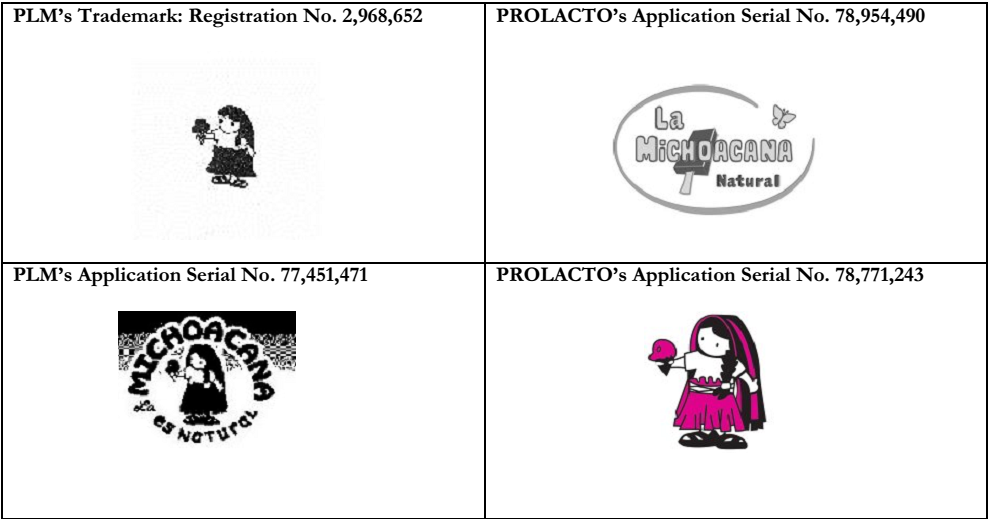
The central marks at issue were the “Indian Girl” design and marks using various forms of the word “Michoacán”:

PROLACTO filed a successful petition to cancel PLM’s mark No. 3,210,304 for LA INDITA MICHOACANA and design, shown above, for use on ice cream and fruit products.  PLM sought reversal of the TTAB decision; declaratory judgment of no likelihood of confusion between its mark and PROLACTO’s one registered mark; a finding of infringement against PROLACTO for its use of the Indian Girl design with LA INDITA MICHOACANA and separate use of the Indian Girl mark standing alone; and cancellation of PROLACTO’s registered mark No. 3,249,113.  PROLACTO understandably counterclaimed for violations of the Lanham Act (and DC common law) and further cancellations.
On summary judgment, the court resolved a number of issues in PLM’s favor, a few in PROLACTO’s, and found numerous other issues reamining for trial.
TTAB cancellation: A district court reviews the TTAB’s findings of fact deferentially under the substantial evidence standard, and also can consider new evidence.  To win, PLM had to raise a new issue or show that the TTAB’s findings were unsupported by substantial evidence or contrary to new evidence carrying “thorough conviction.” The TTAB found that PROLACTO had priority based on a number of marks.  PLM filed its registration application on June 28, 2005, claiming first use anywhere and in commerce as of February 21, 2005.  The TTAB determined that PROLACTO, through its licensees, began using the Indian Girl design in April 2001.  Then it determined that confusion between the parties’ marks was likely given the similarity of goods, marks, and channels of trade plus the low care exercised by consumers.
However, PLM presented new evidence that it used a version of the Indian Girl design since at least the mid-1990s, and argued that it should be allowed to tack those earlier uses to gain priority. Tacking requires that the earlier mark is “the legal equivalent of the mark in question or indistinguishable therefrom” such that consumers “consider both as the same mark.” Confusing similarity isn’t enough; the marks sought to be tacked must create the same continuing “commercial impression.” (1) Whether this is a question of law or of fact for a jury is the subject of a split (one that the Supreme Court is set to resolve).  Consumer opinion of the similarity of the prior and subsequent marks is the critical issue, and a court’s speculation about what consumers would think is both inappropriate and inconsistent with the likely confusion standard (a question of fact for the jury).  The evidence here created a genuine dispute of material fact over tacking; a jury could find prior use and a continued commercial impression, or it could go the other way.  Summary judgment denied.
Next issue: The TTAB ruled that PROLACTO’s mark No. 3,249,113 for the LA FLOR DE MICHOACAN and design wasn’t sufficiently similar to PLM’s registered mark No. 3,210,304 to cause consumer confusion and require cancellation. (2) PROLACTO wanted reversal on the likely confusion determination, thus triggering the second issue the Supreme Court is going to decide this term: the court would review the TTAB’s findings of fact under the substantial evidence standard, but the legal conclusions de novo.  The TTAB found that the parties’ marks were used on the same products in the normal channels of trade; that the products are impulse purchases and consumers don’t use much care before buying; that LA FLOR DE MICHOACAN translates to “the blossom of Michoacán,” while LA INDITA MICHOACANA translates to “the Indian girl or woman from Michoacán.” The TTAB concluded that PROLACTO’s mark created a different “commercial impression” than PLM’s mark which “outweigh[ed] any similarities caused by the inclusion of the word ‘Michoacán.’”  The district court agreed.

The TTAB didn’t use the same multifactor test as the district court, which would use the judicial standard (viewing the marks in the marketplace, not side by side in a vacuum).  Here, no reasonable jury could find likely confusion between the marks at issue.  Some of the factors weighed in favor of PROLACTO or were neutral (there’s some direct competition; these are impulse purchases, though PROLACTO offered expert testimony that quality differences existed, which would decrease the likelihood of confusion). But PROLACTO didn’t provide a survey or other evidence of actual confusion between the two specific marks at issue.
The court was most persuaded by the lack of visual resemblance between the marks.  The shared use of “Michoacán” wasn’t enough; other factors in the mark could distinguish the two. Here, the design elements were quite different: PROLACTO’s mark featured a swirl surrounding an orange popsicle, while PLM’s mark featured pink and black coloring with a drawing of a little girl holding an ice cream cone with words above and below her image. The different meanings of the phrases and the commercial impressions outweighed similarities in the word “Michoacán” and in the products.  No cancellation and no infringement.
Next counterclaim: PROLACTO alleged that PLM infringed on PROLACTO’s rights in its LA MICHOACANA and the Indian Girl design through its use of registered marks Nos. 3,210,304; 2,905,172; and 2,968,652.  PROLACTO sought to use the famous mark doctrine to establish nationwide priority. 
In the US, rights are established by use, and foreign use creates no rights within the US.  (3) “There is, however, a narrow yet divisive disturbance to the force of the territoriality principle,” aka the well-known marks/famous marks doctrine, where even in the absence of use “the territoriality principle is disregarded and priority is established through reputation rather than actual use in the United States.”  But this is only law in the Ninth Circuit, which based its ruling on fraud-prevention grounds.  The Second Circuit has rejected the doctrine as a matter of federal law.  The court here recognized powerful arguments on both sides, but didn’t have to resolve the issue because PROLACTO didn’t show the necessary fame in the US.  Fame in Mexico is irrelevent “except insofar as that familiarity actually permeates into the United States at such a critical level that it qualifies for legal protection.”  The Ninth Circuit’s Grupo Gigante decision says that such fame will exist when a “substantial percentage” of consumers recognize the foreign mark, but provides little guidance about what that is. The concurrence said it was 50% consumer awareness, but the majority didn’t use an explicit “majority” standard.  Nonetheless, to prevent the exception from swallowing the rule, the threshold should be “somewhere below, but still very close to, 50% of consumers in the relevant market.”  PROLACTO didn’t show that in any relevant US market, much less the entire country.  No reasonable jury could find nationwide fame, and there also wasn’t enough evidence for individual markets within the US.  Scattered media references to individual licensees’ stores weren’t enough.
As a result, PROLACTO’s rights were dependent on use, and without a registration, the rights were limited to the geographic areas where there was use (and a zone of “natural expansion”).  Here, only Sonoma, California; Houston, Texas; and Florida were potentially at issue, given PROLACTO’s limited commercial use of its marks.  There was also a genuine issue of whether PROLACTO abandoned its rights through naked licensing, particularly given that PROLACTO apparently relied only on oral licenses for many years.
There couldn’t be a fight in Florida, because PLM never sold or distributed its products there. PLM’s hosting of a booth at a trade convention in Florida was insufficient, because PLM didn’t sell its wares there; the convention was closed to the public; and most participants were not based in Florida.  As for northern California, PROLACTO licensed a store in Sonoma in July 2009, while PLM started a business in Turlock in 1991, and registered two Indian Girl marks in 2004-2005, with more thereafter.  Since federal registration provides nationwide priority except for §33(b) remote users, “the undisputed facts show that PLM has priority in the market.”  There was a genuine dispute of material fact about who got to Houston first.
PROLACTO argued that the court should deny PLM any rights because of its allegedly deliberate copying.  But awareness of foreign marks does not constitute bad faith in the US as a matter of law.  However, to the extent that PLM’s adoption of the marks in a given market was based on PROLACTO’s prior use elsewhere in the US, that might not be “good faith,” as the court interpreted the Theodore Rectanusline of cases to require for remote users.  In addition, there was a factual dispute over whether PLM intended to copy PROLACTO’s marks, or whether “PLM merely sought to associate its products with marks that it believed – rightly or wrongly –were used indiscriminately by a variety of companies without any one, recognized source.”  PLM argued that the marks in question were used by “countless companies” in Mexico and the US for paletas.  (In which case how are its “marks” valid?  Sufficient to the day …)  If that was true, PROLACTO might not have protectable rights in many of the marks at issue, which would be fatal to most if not all of its claims.  And finally, the exact contours of the Houston market had to be determined at trial.
Priority isn’t enough; distinctiveness is also required.  The parties apparently agreed that the marks were geographically descriptive.  There was also a factual question over PROLACTO had achieved secondary meaning.  The scale of ads in the US by its licensees wasn’t clear, but appeared to be “limited and sporadic at best.”  PROLACTO had some evidence, including consumer declarations, of consumer perception, as well as an expert report from Jacob Jacoby, but the court found this not probative of whether consumers thought there was a single source for the goods. The court declined to exclude Dr. Jacoby’s report about his confusion survey at this time, but commented that many of the questions were leading “and others demonstrated little more than respondents’ ability to read and comprehend the stimuli.”  A jury would have to rule on secondary meaning.
All this meant that there couldn’t be summary judgment on the related unfair competition etc. claims, with the only truly distinct one remaining being false advertising.  PROLACTO alleged that PLM made numerous false claims on its packaging and website, including using the name “LA INDITA MICHOACANA” and the Indian Girl design; using indicia of Mexico, including pictures of places in Mexico, a PROLACTO-affiliated store in Mexico, a statute in the town of Tocumbo, Mexico, and maps of Mexico in its websites and catalogs; claiming to share its name with, and otherwise implying that it is affiliated with, 15,000–20,000 stores in Mexico; and including on packaging pictures that don’t accurately represent the products inside.
PLM discontinued use of the claim: “La Indita Michoacana is a family company founded in Tocumbo Michoacán in the 1940’s. Since then we’ve continued to make premium ice cream, fruit bars and drinks that give the flavor and tradition of Mexico. Distinguish us by our logo.” Because PROLACTO didn’t submit evidence that would justify a damages award, the only possible relief would be moot as to that claim.
PLM argued that the false advertising claim was barred by laches. The court first found that DC’s three-year fraud statute applied to Lanham Act false advertising claims.  PLM didn’t indicate which ads appeared when, or when PROLACTO knew or should have known of them; thus the court couldn’t evaluate whether laches had been triggered, or whether there’d been prejudice to PLM because of the delay.
PLM also argued that PROLACTO lacked standing.  Under Lexmark, PROLACTO provided sufficient evidence of commercial injury.  Here, that was evidence that it “possesses a business reputation and goodwill within the United States that PLM allegedly attempts to usurp for its own benefit, as well as the possibility of lost sales and customers.” A reasonable jury could conclude that those injuries, if proven, were proximately caused by PLM’s ads.
In addition, PROLACTO won summary judgment on literal falsity and misleadingness of the statements, since PLM didn’t dispute that.  As for materiality, PLM argued that the statements on the packaging were on the back and consumers therefore didn’t read them before purchase.  Even if they did, PLM argued that there was insufficient evidence of an effect on decisions, given that these are inexpensive impulse buys.  But PROLACTO wasn’t required to prove actual influence, only likely effects.  ((4) The court declined to follow the courts that presume materiality from literal falsity.)  There was a genuine dispute of material fact, as materiality often is a question for the jury.  Even the statements on PLM’s website, though less likely to be material “given their attenuated position compared to being placed directly on the product itself,” might be.
The court also accepted PROLACTO’s theory of likely injury to its reputation or goodwill stemming from confusion due to PLM’s advertising.  The products are of different quality.  PROLACTO sells “a more traditional, handmade form of paletas” and PLM sells “a water-based product more similar to a Popsicle.” Given these difference, there was some reason to think that PROLACTO’s goodwill and potential sales could be harmed if consumers were misled by PLM into believing that they were buying PROLACTO’s fruit-based, handmade product.  However, PROLACTO largely relied on affidavits “describing” customers who were confused by and disappointed with PLM’s products.  The court found these to be mainly hearsay.  (To the extent that they report a consumer’s state of mind, they’re not really being submitted for their truth.)  The nonhearsay portions were at least probative of injury, though, by suggesting that consumers were conflating the brands, which could hurt PROLACTO.
PROLACTO’s trademark infringement claim under DC common law was dismissed because it doesn’t operate in DC and showed no plans to do so in the near future.  PROLACTO’s counterclaim for federal dilution was dismissed because, of course, it isn’t famous. In a footnote, the court commented that “the level of fame required for a dilution claim appears to be greater than that required to establish that a mark is sufficiently well-known for the famous mark doctrine to apply.”  Dilution requires nationwide fame, while the famous marks doctrine only looks to the relevant consumer market. McCarthy recommends 75% recognition for federal fame, but survey evidence isn’t the only relevant evidence; the amount of money spent on ads and length of use count too.
PROLACTO’s counterclaims for cancellation of PLM’s registrations based on fraud failed because PROLACTO couldn’t meet the clear and convincing standard for proving that PLM knowingly made false, material misrepresentations with intent to deceive the PTO.  Because use in Mexico confers no rights, even if PLM knew PROLACTO was using the designs in Mexico, its knowledge of commercial use in a foreign country was insufficient to establish fraud on the trademark office as a matter of law.  “Because foreign use cannot create priority – perhaps with exception of the narrow and largely unfollowed famous mark doctrine, which itself still requires meaningful reputational impact in the United States – the fact that a similar mark was used in another country is immaterial to the decision about whether to grant an application.”

Posted in dilution, http://schemas.google.com/blogger/2008/kind#post, trademark | Leave a comment

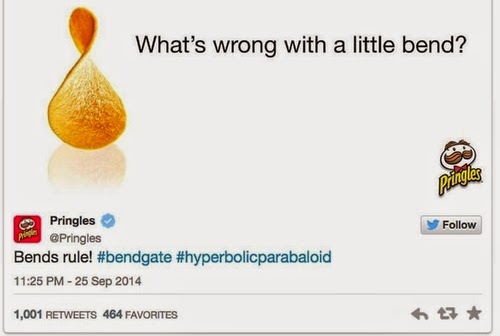
Bend it like Apple

Via firstmemes, consider the extent to which (1) a reference to a famous mark can be indirect and still trigger dilution law; (2) the tweets from competitors are explicitly protected by federal dilution law’s exemption for comparative advertising, but the tweets from noncompetitors might not be; (3) the tweets from competitors might be dilutive under state law, but the tweets from noncompetitors might not be (Deere v. MTD and Hormel v. Jim Henson Productions) (and remember, there’s no preemption because none of these folks have registered Apple or iPhone).

Posted in dilution, trademark | Leave a comment

litigation grab bag includes another nail in IIC coffin

EarthCam, Inc. v. OxBlue Corp., 2014 WL 4702200, No. 1:11–cv–02278 (N.D. Ga. Sept. 22, 2014)
Mostly a trade secret case where EarthCam alleged that every scrap of information about it was a trade secret.  The parties compete in the market for high-end web-based camera systems, though OxBlue’s primary client base is the construction industries.  One of EarthCam’s product technicians/camera installers, Hermann, departed to become an independent contractor for OxBlue.  Also, OxBlue’s chief technology officer wrote a script that collected information from EarthCam customers’ webpages.  The script used over 400,000 URL combinations to estimate the current URL combination and location of an EarthCam’s customer’s webpage.  EarthCam alleged that this gathered confidential information, including customer names, camera names, images from customer cameras, the URL to the image for each camera, and the date and time stamped on the last image taken from a camera. The script didn’t involve decrypting a password or otherwise breaking into any secure server.
OxBlue also received a username and password from an EarthCam client, FCR, which gave its login credentials to OxBlue to see if OxBlue could solve certain issues it had encountered with EarthCam’s cameras. FCR first provided a series of screenshots from FCR’s EarthCam, and a screenshot from one of FCR’s cameras, but that wasn’t enough, so it provided its credentials.  OxBlue offered three possible solutions, two of which didn’t involve using OxBlue’s services. FCR continued to do business with EarthCam.  After logging in, OxBlue took screenshots from FCR’s customer webpage; there was no evidence that these shots were used to develop product or market anything.
EarthCam’s EULA didn’t ban customers from sharing their passwords with a third party, and there was no evidence OxBlue knew of any EULA provisions when they logged in. EarthCam also didn’t require customers to make their pages private.  And it had a live demo on its website showing how cameras appear on a customer account.
EarthCam also alleged that Hermann provided OxBlue with detailed information about EarthCam’s cameras, customers, suppliers, and pricing information.
Separately, OxBlue created a construction specification “to assist individuals and organizations in the construction industry to prepare for use of OxBlue’s equipment on construction projects.”  Such specifications provide directions on the methods and materials to be used on a construction project, and OxBlue’s was “modeled” on the Construction Specification Institute’s MasterFormat, 2004 Edition. This is a standardized system of indexing and organizing construction specifications.  
OxBlue applied to register its specification in March 2012, and alleged that EarthCam infringed by copying the numerical code sequence (or title) for the OxBlue specification–013234.01–and by copying portions of the OxBlue specification.  For example, OxBlue’s specification states: “The indoor/outdoor camera system shall consist of a tamper and impact resistant, discreet, fixed [wall] [and][or] [pole] mount enclosure with integrated fixed camera, lens and controller,” while EarthCam’s states “The indoor/outdoor camera system shall consist of a tamper and impact resistant enclosure with integrated camera and heavy-duty robotic pedestal to be mounted as a fixed pole, wall, parapet or nonpenetrating roof mount.”  (The court doesn’t appear to resolve this part of the case on this motion, but given what it says about the other copyright infringement claim at issue I wouldn’t be optimistic.)
Wait, there’s more.  An EarthCam subsidiary bought search engine keywords including “earthcam,” “earth cam,” “webcam” and “oxblue.” Searching for “oxblue” would produce a link to the EarthCam subsidiary’s website in the “Sponsored Links” section, though it did not use the term “OxBlue” on its website, or in the metadata for its website, unless there was a news article that mentioned the subsidiary and OxBlue. Some years previously, OxBlue had bought “earthcam” as a Google keyword for its own ads.  OxBlue nonetheless argued that EarthCam’s subsidiary’s purchase infringed OxBlue trademark.
Also false advertising: OxBlue hired two people to call EarthCam pretending to be customers looking for a camera solution. They secretly recorded their conversations with an EarthCam sales representative. The rep told them that EarthCam’s competitors used experimental server technology, exposed their customers to copyright infringement lawsuits, and that EarthCam has more employees in its customer service department than its competitors have in their entire company.  Also, OxBlue sued over a comparative EarthCam chart, which stated that OxBlue’s cameras didn’t offer, on all camera systems, detailed archived weather data, in-house 24/7 monitoring of cameras and in-house technical support, and professionally designed and integrated surge protection. This was sent to one customer, but there was no evidence about further dissemination of the chart or of statements made in the chart.
OK: EarthCam’s trade secret claims failed because EarthCam failed to show that the matters at issue were trade secrets (for example, customers weren’t required to keep their websites secret), or that OxBlue misappropriated them.  Even the script that scraped the EarthCam site didn’t collect information that derived economic value from being a secret, since the information collected wasn’t a secret nor was it subject to reasonable efforts to protect it.  The court also emphasized that, under the relevant New Jersey law, trade secrets “cannot merely be the facility, skill or experience learned or developed during an employee’s tenure with an employer,” so Hermann’s switch didn’t reveal confidential information.
CFAA claims: The Eleventh Circuit hasn’t addressed whether using someone else’s login credentials can violate the CFAA, but other cases are instructive.  Secureinfo Corp. v. Telos Corp., 387 F. Supp. 2d 593 (E.D. Va. 2005), held that permission from an authorized licensee defeated a CFAA claim even if the defendants were provided with access in violation of a licensing agreement.  State Analysis Inc. v. American Fin. Serv. Assoc., 621 F. Supp. 2d 309 (E.D.Va. 2009), by contrast, allowed a similar claim to proceed where the defendant, who had previous ties to the plaintiff, “was presumably familiar with the terms of [plaintiff’s] agreement and with the scope of authority granted to licensees.”
The situation here differed from State Analysis because the relevant EULA didn’t bar sharing passwords with third parties. Also, there was no evidence OxBlue knew about EarthCam’s licensing terms. “State Analysis applies where the defendant uses subterfuge to gain access to a plaintiff’s website, computers, and servers, or otherwise engages in fraudulent conduct.” There was no evidence of subterfuge or fraud here.  Instead, OxBlue “received an unsolicited request from an EarthCam client that was unsatisfied with EarthCam’s services to provide a business solution, and the OxBlue Defendants accessed FCR’s account with FCR’s permission.”  The CFAA could not apply.
EarthCam alleged that OxBlue infringed its copyright in its software by capturing screenshots of FCR’s customer account.  The court, which seems to have been pretty annoyed by this litigation deathmatch, cited Sony Computer Entertainment America, Inc. v. Bleem, LLC, 214 F.3d 1022 (9th Cir. 2000), a fair use case, for the proposition that a screenshot is “merely an inanimate sliver of the [program] … of little substance to the overall copyrighted work.” Here, the use was de minimis, and EarthCam failed in its burden to show copying significant enough to constitute infringement.
As for OxBlue’s copyright infringement claim against EarthCam, the infringement occurred before the registration; OxBlue’s argument that it was entitled to statutory damages for infringement after the registration was obviously precluded by settled law.
OxBlue also argued that EarthCam infringed the OxBlue trademark through initial interest confusion.  And here this case perhaps justifies its existence, if not to the weary district judge then to us: the Eleventh Circuit doesn’t have any IIC cases, but other circuits have accepted an IIC theory in keyword search engine cases.  Still, the standard they’ve adopted has made liability essentially impossible even if available in theory.  Both the Ninth and Tenth Circuits have held that the labeling and appearance of the ads and the surrounding context of the screen displaying the results page are the most critical considerations.  OxBlue didn’t show any evidence about this, or about any other confusion factor.  Nor was there any record evidence of how often consumers were “lured” to EarthCam’s site when they searched for OxBlue, and under 1-800-Contacts, a low conversion rate shows that confusion is unlikely.  IIC claim dismissed.
False advertising: there was no evidence that EarthCam’s alleged misrepresentations had a material impact on a purchase decision, so EarthCam was entitled to summary judgment.  (Here the much-burdened court is a bit sloppy; actual deception isn’t required if a statement is false or likely to mislead.)  The sales rep’s allegedly false representations were isolated and not sufficiently disseminated to the relevant buying public.  EarthCam’s Vice President testified that he didn’t know how many times reps told potential customers these things.  He agreed with a leading question from counsel that asked “it could be one time, it could be hundreds of time, is that fair?” but that just meant he didn’t know.  The rest was just speculation. Likewise, the comparative chart was only shown to have been sent to one prospective customer. In a particularly small market, one customer might be enough, but OxBlue didn’t show the size of the market for high-end, megapixel construction cameras and webcams.  In the absence of such evidence, distribution to one customer wasn’t commercial advertising or promotion.

Posted in cfaa, copyright, http://schemas.google.com/blogger/2008/kind#post, trade secrets, trademark | Leave a comment

serial infringement may justify liability under Tiffany v. eBay

Mori Lee, LLC v. Sears Holdings Corp., 2014 WL 4680739, No. 13cv3656 (S.D.N.Y. Sept. 8, 2014)
Mori Lee, a dressmaker, sued Sears for trademark infringement and unfair competition.  In 2010, Sears opened an online marketplace at Sears.com where third-party merchants could sell directly to consumers.  Defendants UiMobile and Better Deals sold allegedly counterfeit goods on the marketplace. They allegedly used photographs of Mori Lee dresses, falsely associated Mori Lee’s name and marks with their dresses, and sold inferior imitations of Mori Lee attire.
On May 3, 2013, Sears got two emails charging that several of UiMobile’s counterfeit dresses infringed Mori Lee’s marks.  “Sears investigated those complaints promptly and banned the UiMobile listings identified in the emails, as well as all listings advertised by UiMobile that mentioned a Mori Lee product or dresses made by Siris.”  On May 31, Sears learned of this lawsuit, which listed UiMobile Marketplace advertisements as well as a Better Deals advertisement, though the dress in that ad was not identified as a Mori Lee.
Sears took no additional action against UiMobile because its ban on all UiMobile bridal dress-related listings continued in place. Sears investigated the allegations about Better Deals but didn’t find any Better Deals listings using the Mori Lee name; Better Deals primarily advertised electronic goods. On June 18, 2013, Sears discovered a Better Deals ad using a Mori Lee photograph, and Sears banned that ad, as well as any other Better Deals advertisements with “Mori Lee” or “Siris” in their product listing. Mori Lee identified an additional infringing Better Deals ad, which Sears took down promptly.
Contributory infringement required Mori Lee to show either intentional inducement to infringe or continuing supply of services “to one whom it knows or has reason to know is engaging in trademark infringement.” More than general knowledge or reason to know is required.  Under Tiffany v. eBay, “[s]ome contemporary knowledge of which particular listings are infringing or will infringe in the future is necessary.”  When a service provider reacts promptly to notice of infringing activity by a user, there’s no contributory liability.
Here, Sears got notice of UiMobile’s infringing activity in two emails.  It investigated, removed the ads promptly, and banned UiMobile from posting new ads for bridal dresses or using “Mori Lee.” It also promptly reacted to notice of Better Deals’ infringing ads.  Mori Lee argued that Sears’ policing was less sophisticated than eBay’s.  But Tiffanydidn’t impose an affirmative duty to investigate, and Sears didn’t turn a blind eye to infringement. 
“If that was all, then no contributory liability could be found.”  (Ruh-roh.)  Sears also “had specific information that UiMobile was a serial infringer of bridal dress’ copyrights before UiMobile infringed Mori Lee’s rights.” In March, a different company sent Sears a takedown notice identifying 32 infringing UiMobile advertisements, found under “wedding gowns” and “prom gowns.”  Sears then purported to ban the offending UiMobile ads and informed that company’s counsel that “[i]f you search the web site for ‘bridal gowns,’ you will see there are currently no bridal gowns being sold online by UiMobile.”  Then, that same month, another company sent a takedown notice identifying infringing UiMobile ads.  Whatever the scope of Sears’ ban, it was ineffective, because by May, UiMobile had switched to listing Mori Lee dresses. 
These events raised a genuine issue of fact as to whether “the notice” (unfortunately, it’s not clear whether this is a typo and the court meant to say “the notices” [from the other dressmakers]) “sufficiently informed Sears that UiMobile [was] engaged in trademark infringement.”  In addition, whether Sears was an innocent infringer also turned on these facts. “If Sears is an innocent infringer, Mori Lee is only entitled to injunctive relief—which would likely be moot since Sears has taken down the infringing advertisements.”
False advertising: “In various post-sale emails, Sears represented to purchasers that the dresses bought from the Marketplace were from, for example, the ‘OEM New MoriLee Design Hot Sell Evening Dresses.’”  Sears argued that these emails weren’t commercial advertising because they weren’t made for the purpose of influencing consumers to buy a particular product and they weren’t disseminated to the public, but only to buyers for post-sale shipping confirmation.  The court agreed with Gillette Co. v. Norelco Consumer Products Co., 946, F.Supp. 115 (D. Mass. 1996), which held that a packaging insert accompanying a product and available only after the purchase was made was not “commercial advertising or promotion” because it was inside the package and did not affect the purchase decision. So too here.  Summary judgment for Sears.
Mori Lee’s unfair competition claims were dismissed because they required likely confusion aobut origin or sponsorship.  First, Mori Lee failed to establish rights in  “OEM,” “ML,” and “Ml,” the former of which just means original equipment manufacturer and the latter two of which could refer to other haute couture manufacturers, such as Monique Lhuillier.  Sears did use Mori Lee’s “marks” in post-sale emails, e.g. a shipping confirmation of “OEM New MoriLee Design Hot Sell Evening Dresses BL357” and “OEM New Intricately Beaded Embroidery on Venice Lace Ivory Wedding Dress ML1911.” But this “merely aped” UiMobile’s use of the words in ads by reproducing the product name in the confirmation email.  (Why isn’t this just contributory liability too?)  Sears didn’t make any “independent representation that the product is an authentic Mori Lee dress.” Thus, these acts didn’t cause likely confusion.

Posted in http://schemas.google.com/blogger/2008/kind#post, secondary liability, trademark | Leave a comment

Advertising dysfunction: claim against male sexual enhancement pill proceeds

Dorsey v. Rockhard Laboratories, LLC, 2014 WL 4678969, No. CV 13–07557 (C.D. Cal. Sept. 19, 2014)
 
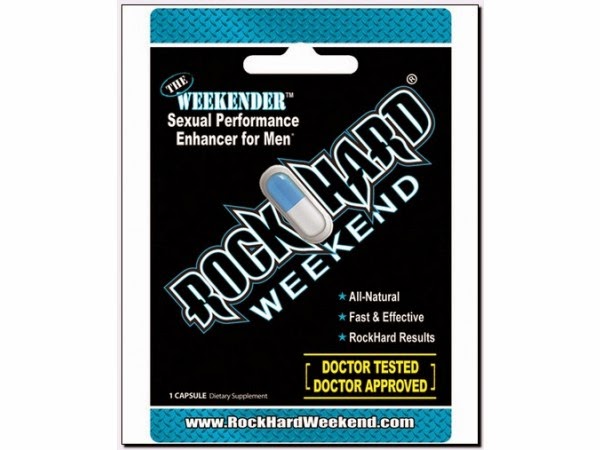
Dorsey sued over Rockhard Weekend (RHW), “a male sexual enhancement product,” primarily promoted by labeling on the packaging. The chemical formulation and packaging have changed several times over the years, but Dorsey alleged that the name, purported use, and overall message remained the same.  There are multiple packages (one-capsule retailing at around $5, 3-capsule around $15, and 8-capsule around $30).  RHW called itself a “sexual performance enhancer for men” or “the 72–hour sexual performance pill for men.” The packaging also promised “Doctor Tested,” “Doctor Approved,” “Fast & Effective,” and “Rockhard Results.”  Further, Rockhard advertised RHW as “All Natural,” even though some of the ingredients of RHW were allegedly “synthetic, chemically reduced and/or have carcinogenic properties.”  Dorsey alleged that he relied on these claims to his detriment, and that they were false because none of the ingredients in any version of RHW enhanced male sexual performance.  Also, he alleged that the labeling was unlawful because it is a “new drug” unapproved by the FDA in making claims to be an aphrodisiac.  The usual California claims resulted.
 

Rockhard Weekend package with challenged claims
Rockhard argued that Dorsey hadn’t pled reliance because he didn’t specify which iteration of RHW he bought, and the packaging changed over time.  However, “it is clear from looking at the packaging of various iterations of the product that the same messages were conveyed to all potential purchasers of RHW.”  Given that RHW was a single-use/limited-use product, it was unsurprising that Dorsey no longer had the packaging; given the similarities among the iterations, it was also unsurprising that he couldn’t differentiate among them.  The allegations sufficed to show his reliance.
 
Although Dorsey could have been more specific about how or why RHW didn’t perform as advertised, he still alleged that “[n]one of the ingredients in any iteration of RHW … will enhance male sexual performance.”  Even without “specifics regarding what happened when Plaintiff took RHW,” this demonstrated an injury in fact: the product allegedly contained no ingredient that had the effect that the packaging represented the product to have.  And he alleged that he wouldn’t have bought RHW but for the misrepresentations, a highly plausible allegation given that there’s really only one reason to buy a product that purports to enhance male sexual performance.
 
As for iterations he didn’t purchase, his ability to represent purchasers thereof would be better decided at the class certification stage. At this stage, Dorsey’s claims were sufficiently similar to those of putative class members who purchased a different iteration of the RHW product to potentially allow him to represent them in this class action.  The various versions of the packaging attached to the complaint showed very similar phrasing on every version and a consistent marketing scheme persisting through formula and packaging changes.  And the name never changed.
 
Then the court found that the complaint satsified Rule 9(b), alleging the specific language of the false statements (and attaching images of the packaging), when and where he bought RHW, and that the ingredients didn’t work; he alleged “what consumers would understand the statements to mean and how that understanding is misleading”  He made similar allegations about “All Natural” and “Doctor Tested, Doctor Approved”: he alleged that “a reasonable consumer would expect an ‘all-natural’ product to contain ingredients found in nature, derived from natural sources, absent of manmade processes, and which are wholesome and safe,” and that a reasonable consumer was likely to believe that RHW was “used, endorsed, or recommended by doctors practicing medicine in clinical settings.”
 
Rockhard argued that many of the representations on its packaging were mere puffery (no pun intended?), such as “Sexual Performance Enhancer for Men,” “Fast & Effective,” and “Rockhard Results.”  Taken as a whole and in context, these weren’t puffery, but instead specific claims about the benefits of taking RHW. “These statements create the impression that, by taking the product, a consumer will have enhanced sexual performance, that the effect will happen quickly, and that the consumer can expect to have a ‘Rockhard’ erection.”
 
Rockhard also argued that reasonable consumers wouldn’t be deceived by “All Natural.” Though some cases so conclude, each statement must be evaluated in context and consumers don’t need to search the ingredient list for disconfirming evidence.  Dorsey alleged a plausible interpretation of what the phrase would mean to a reasonable consumer, and identified the ingredients that didn’t fit this interpretation. Plus, nothing but the small type nutrition facts panel on the back would lead a consumer to question “All Natural,” and there was no indication that Dorsey would have had reason to read the nutrition facts. Under Williams, “[s]imply listing the actual ingredients of the product does not absolve Defendants of all potential liability for making false statements that contradict the ingredient list.”
 
Rockhard also argued that Dorsey’s claim against “Doctor Tested, Doctor Approved” was an improper lack of substantiation claim, based on Dorsey’s allegation that “Defendants have not and cannot cite any research studies or unsolicited endorsements of RHW by medical doctors, nor is RHW used in clinical settings for the treatment of male impotence or any other condition.”  The complaint sufficiently alleged false advertising, not just lack of substantiation.  Dorsey alleged what “Doctor Tested, Doctor Approved” would mean to a reasonable consumer, and then alleged that RHW wasn’t used in any clinical setting to treat any condition, which sufficiently alleged falsity.
 
The court did dismiss claims under the “unfair” prong of the UCL; the allegations went to “unlawful” and “fraudulent” conduct.
 
The “unlawful” claim was based, in part, on allegedly unlawful labels purportedly advertising RHW as an aphrodisiac in violation of the FDCA’s new drug rules.  Rockhard alleged that RHW was a dietary supplement, not a drug, and thus not required to seek preapproval.  Under the FDCA, a drug is an “article [ ] intended for use in the diagnosis, cure, mitigation, treatment, or prevention of disease in man or other animals.”A dietary supplement is “a product … intended to supplement the diet [that has certain ingredients].”  RHW’s label said it was a dietary supplement.  And, although the packaging as a whole might convey that RHW would improve male sexual performance, there was no statement that RHW was designed to cure erectile dysfunction, impotence, or any other “disease.” “Aphrodisiac” didn’t appear on any of the packaging. Thus, Dorsey didn’t plausibly allege that RHW was a “drug,” requiring prior approval of its labeling by the FDA.  Claims dismissed to the extent they were based on FDCA violations.
 
Warranty claims: Presuit notice isn’t required in California where the defendant is a manufacturer with whom the purchaser didn’t deal, as here.  Nor were the claims puffery—see above.  So express and implied warranty claims survived.
 
Magnuson-Moss Warranty Act (MMWA) claims: Under the MMWA, a warranty “relates to the nature of the material or workmanship and affirms or promises that such material or workmanship is defect free or will meet a specified level of performance over a specified period of time.” But a product description isn’t a warranty under the MMWA.  For “Sexual Performance Enhancer for Men” and “Fast & Effective,” Dorsey stated a plausible claim under the MMWA. These related to the nature of the product and weren’t mere product descriptions.  But “Doctor Tested, Doctor Approved” was; the statement contributed to the message that RHW contained an active, effective ingredient but didn’t relate directly to the “material or workmanship” of the RHW pill.
Posted in california, consumer protection, http://schemas.google.com/blogger/2008/kind#post | Leave a comment

Paid spokesperson engaged in "advertising or promotion" for Lanham Act purposes

Underground Solutions, Inc. v. Palermo, 2014 WL 4703925, No. 13 C 8407  (N.D. Ill. Sept. 22, 2014)
 
UGSI sued Palermo for trade libel, interference with prospective economic advantage, interference with contract, false advertising under the Lanham Act, and violation of the Illinois Uniform Deceptive Trade Practices Act (IUDTPA).  UGSI sells fusible polyvinyl chloride (PVC) pipe, which is used “in water and wastewater pipeline applications, as well as for conduit for electrical and fiber optic applications.” Indeed, it is “the sole supplier of thermally buttfused PVC pipe in the United States.”  Palermo was allegedly hired as a paid spokesperson for UGSI’s competitor, Performance Pipe, which makes high-density polyethylene (HDPE) pipe. (More on previous litigation between the parties.)
 
USGI alleged that, since October 2010, Palermo presented false and misleading information about USGI’s products (albeit without using USGI’s name) at multiple industry conferences and on his website.  He allegedly didn’t disclose his affiliation with Performance, which misled audiences into believing that his conclusions were “based on objective scientific evidence and valid third party investigation.”  UGSI also alleged that Palermo “contacted UGSI’s customers following pipeline incidents involving Fusible PVCTM pipe and told the customers that the Fusible PVCTM pipe and/or thermally butt fused PVC joints caused the incident, despite Palermo’s failure to conduct a thorough and complete investigation of the cause of such pipeline incidents.”
 
USGI alleged harm to existing and prospective business relations, including that its pipes were excluded from consideration by at least two consulting engineering firms that design systems for clients. The complaint quoted e-mails from two consulting engineers who expressed hesitation about using UGSI’s pipes after reading Palermo’s reports. As a result of Palermo’s misrepresentations, engineers and municipalities that “had previously specified Fusible PVCTM pipe as the only acceptable material for their projects changed the specifications to include an alternate product, such as HDPE.”
 
Palermo sought to have the complaint dismissed on the ground that the statute of limitations expired before UGSI sued on November 21, 2013.  A one-year limitations period applied to the trade libel claim, and three years to the Lanham Act and IUDTPA claims.  The court found that California’s two-year limitations period applied to the tortious interference claims.
 
The complaint didn’t plead facts sufficient to conclude that the claims were time-barred. The court assumed for these purposes that the single publication rule applied to Lanham Act claims as well as libel claims, but that only applies to copies of “any one presentation to an audience.” UGSI alleged that Palermo made multiple presentations and published “variations” of his slide show on his website.  Each new presentation could trigger liability, so USGI’s claims weren’t time barred as to Palermo’s live presentations within the limitations periods.  The limitations period begins to run when a website is first published, but the complaint alleged that different versions of the slideshow were posted online, including one during or after 2012, so the single publication rule didn’t bar the claim on the pleadings.  Nor could the court determine whether the discovery rule tolled the statute of limitations on the pleadings.  UGSI also argued that its trade libel action accrued only after it suffered special damages (making its cause of action complete); this too prevented dismissal.
 
As for the Lanham Act and IUDTPA claims, the majority of the accused presentations apparently took place after the November 21, 2010 accrual date.  Courts have applied “continuing wrong” principles to Lanham Act claims, allowing plaintiffs to pursue relief for time-barred acts linked to acts within the limitations period. This too might apply.
 
Palermo then argued that UGSI insufficiently alleged special damages for its trade libel claim.  To prevail, UGSI would have to identify specific lost sales, but on a motion to dismiss it was enough to identify a concrete loss.  Though the plaintiff must allege “some actual pecuniary loss,” “an estimation of final total dollar amounts lost is unnecessary.” UGSI’s allegations that it was “required to expend extensive time and effort to address customers’ and prospective customers’ questions about Fusible PVCTM pipe and assuage their concerns” and that it received e-mails from consulting engineers expressing concern about Palermo’s reports sufficiently alleged special damages.
 
Palermo then argued that there could be no trade libel because the allegedly defamatory statements were about fused PVC in general, not UGSI.  UGSI rejoined that it was the only seller of butt-fused PVC pipe in North America and thus identified by implication.  California cases suggested that the “of and concerning” requirement allowed a plaintiff to be identified by clear implication, so that theory survived a motion to dismiss.
 
Intentional interference with prospective economic advantage: Palermo argued that Noerr–Pennington immunized him because his statements were directed at municipal customers and non-profit associations that set pipe standards for municipalities.  Outside the antitrust context, Noerr-Pennington hasn’t been applied to fraud and misrepresentation claims.  Also, even in the absence of intentional falsity, it didn’t seem that Palermo directly petitioned any government official.  Statements in communications between private parties don’t have much to do with the right to petition the government.
 
As for harm, plaintiffs should allege a lost contract, failed negotiation, or ongoing business relationship to state a claim for intentional interference under California law.  UGSI’s allegations that its products “were being considered by several municipalities for upcoming projects” and that potential customers “were dissuaded” based on Palermo’s statements were insufficient.  Though engineers expressed concerns and UGSI’s pipes were allegedly excluded from consideration by at least two firms, that still didn’t identify any pending contract or negotiations that were ended by the alleged misrepresentations. Thus, the claim was dismissed with leave to amend.  Similarly for the tortious interference with contract claim.
 
Lanham Act false advertising: Lexmark undercut Palermo’s argument about lack of competition.  He argued, however, that he hadn’t engaged in “commercial advertising or promotion.” UGSI contended that Palermo engaged in promotion by giving speeches and posting reports as a paid spokesperson for Performance.  True, courts have refused to allow Lanham Act claims based on face-to-face meetings with a small number of people. But the distinction rests on whether a communication is a “generalized solicitation rather than an individualized communication.” Fortunately, the Seventh Circuit has “clarified” its previous exclusion of communications at trade shows from the Lanham Act, Sanderson v. Culligan International Co., 415 F.3d 620 (7th Cir. 2005), and has held that advertising or promotion need not be published or broadcast to the general public, Neuros Co. v. KTurbo, Inc., 698 F.3d 514 (7th Cir. 2012), where promotion in the relevant industry takes other forms.  Palermo’s presentations to a large group of industry members for the purpose of directing customers to select Performance Pipe’s products were “advertising or promotion,” as were material published online.
 
Illinois deceptive trade practices: Palermo argued that there wasn’t a sufficient nexus to Illinois. IUDTPA claims only apply “if the circumstances that relate to the disputed transaction occur primarily and substantially in Illinois.”  Factors that determine this include the plaintiff’s residence, where the deception occurred, where the damage to the plaintiff occurred, and whether the plaintiff communicated with the defendant or its agents in Illinois.  UGSI didn’t allege that Palermo’s misrepresentations “occurred primarily and substantially in Illinois.” All it alleged was that a Performance Pipe sales manager presented Palermo’s materials at an Illinois conference and that Palermo contacted an Illinois customer after a pipeline incident, and that two emails from Illinois engineers expressed concerns about his reports.  Claim dismissed with leave to amend if UGSI could show a better nexus to Illinois.
Posted in defamation, http://schemas.google.com/blogger/2008/kind#post, tortious interference | Leave a comment