Suchanek v. Sturm Foods, Inc., No. 13-3843, 2014 WL 4116493 (7th Cir. Aug. 22, 2014)
Sturm entered the market for Keurig-compatible individual coffee pods (K-Cups) once patent protection expired, but according to plaintiffs they jumped the gun. The Seventh Circuit reversed the district court’s denial of class certification as an abuse of discretion, reasoning that under its approach consumer class actions could never be certified. (This is a feature not a bug of the basid defense-side arguments, of course.)
Sturm’s own marketing studies indicated that users consider coffee brewed in Keurig machines to be high-quality, contributing to the high price of both the machine and the K-Cups. Until 2012, Keurig held a patent over the K-Cup filter technology, so Sturm turned to a substitute in 2010 that used the external K–Cup design “but whose innards were entirely different.” Among other things, it didn’t have a filter. Sturm, selling as Grove Square Coffee (GSC), intended to gain a first-mover advantage in the post-patent landscape.
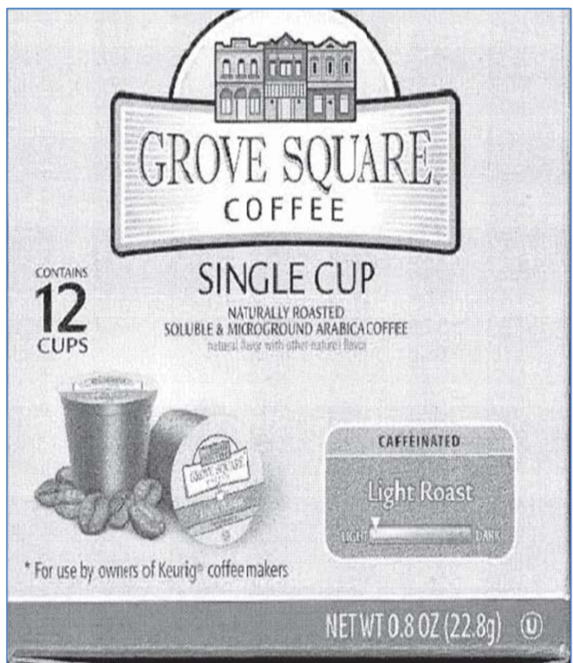
But without a filter, Sturm couldn’t use fresh coffee grounds, so it decided to use instant coffee instead. That’s “essentially, small chunks of freeze-dried brewed coffee that dissolve and are reconstituted when hot water is added to them.” Keurig customers didn’t expect instant coffee, and Sturm’s consultants warned that “use of the word ‘instant’ is a real nono” and should be avoided “if at all possible” in marketing the product to Keurig owners. The packaging stated in small font that it contained “naturally roasted soluble and microground Arabica coffee,” but did not use the better-known name for soluble coffee, instant coffee. The packaging didn’t say that the contents over 95% instant coffee with only a tiny bit of microground coffee mixed in.
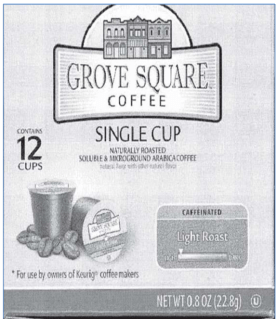 |
| Front of package: “Naturally roasted soluble & microground Arabica coffee” |
 |
| “Great Coffee. Plain and Simple.” with neighborhood coffee shop narrative |
 |
| Coffee Lover’s Bill of Rights/”highest quality Aribica beans, roasted and ground to ensure peak flavor” |
The packaging, as indicated by images included in the opinion (yay!), showed that “like many of the premium Keurig coffee products shelved nearby, the front of the GSC package contained an image of K–Cups with fresh roasted coffee beans and the admonition that the GSC product was intended ‘[f ]or use by owners of Keurig© coffee makers.’” Sturm’s objective was to make the product “look like the Keurig product in box style.” The package included a “quality promise” indicating that the coffee was “made with some of the world’s highest quality Arabica beans, roasted and ground to ensure peak flavor, then packaged to lock in optimum freshness.” But it didn’t disclose that, except for a trivial amount of microground coffee “dusting the instant chunks,” it was not ground beans. One version of the package stated that its contents “recaptured [the] rich, traditional cup” that is “savored … in neighborhood coffee shops.” At some point, Sturm added “instant” to the packaging, but the record didn’t clarify whether this new packaging was ever distributed or how widely. In addition, the package included a warning: “DO NOT REMOVE the foil seal as the cup will not work properly in the coffee maker and could result in hot water burns.” But this warning didn’t seem designed to protect consumers: “Except as a measure designed to ensure that the user did not view the true contents of the pod, this makes no sense: the presence or absence of a foil seal on top would have no effect on the risk of burns or the use of the cup.”
What result did this packaging have? “Numerous expert surveys in the record concluded that few consumers understood the true nature of the GSC product.” One survey showed participants photos of the GSC product on shelves near other Keurig-related products, then allowed them to look over images of the box for 30 seconds. Only 14% of participants said the product contained instant coffee. Sturm’s own expert using another methodology found that only one in 151 test participants equated the term “soluble and microground” with the term “instant and microground.” A third expert asked survey participants to score the product on a scale of 1 to 10 on various measures based on its packaging, with “1” being least likely and “10” being most likely. “When asked whether participants expected GSC to contain instant coffee, the mean answer was 1.61. Asked whether the GSC product filtered ground coffee just as other Keurig-compatible coffee products did, participants essentially said yes, recording an average score of 9.26.” And that didn’t even get to the percentageof instant in the blend. Comment: Basically, if this wasn’t deceptive, then nothing short of a black-is-white untruth—tea in there instead of coffee—would qualify.
Sturm was not casual in marketing GSC. It heeded its consultants’ warning not to use “instant,” and conducted focus group testing to see if participants would notice anything funny. One test reported that participants didn’t notice differences between Keurig-licensed K-Cups and GSC in terms of weight or the fact that the GSC cup “emitted a distinct rattle when shaken.” Even when these differences were pointed out, participants “did not equate [those differences] with quality.” Sturm sold GSC at “near-premium” prices, about 10% less than Keurig products. “This had the dual benefit of reaping a high profit and forestalling consumer suspicions. As one executive admitted candidly, ‘If you actually got the price too low, people would perceive it as poor quality.’” Comment: This is an excellent example of the misleading nature of the price signal in many circumstances! The GSC cup was 3-4x as expensive as typical instant coffee, which can just be spooned into hot water. Plaintiffs’ expert concluded that “only a very ‘price insensitive’ consumer, or one who was misled, would use a $100 brewer [the Keurig machine] to heat water to make instant coffee.”
The public reaction to GSC was “awful.” The day after the product launched in Wal-Mart, Sturm sent around an email directing that the legal department, not quality control or sales, be immediately informed about any complaints about it. More:
One retailer, Discount Coffee, informed Sturm that “[GSC] has been the poorest performing introductory product that we have had in our 12 year history.” Several purchasers brought their complaints to the Better Business Bureau. Although a few comments were favorable, the vast majority were negative and many “extremely negative,” according to [defendant] Treehouse’s general counsel…. To mitigate the negative reviews, Sturm encouraged employees to write fictitious favorable reviews online; the marketing department even offered to supply the language.
When customers—including one of the named plaintiffs—complained, Sturm told them that GSC wasn’t instant coffee, but rather “a high quality coffee bean pulverized into a powder so fine that [it] will dissolve.” This was false except for the “microground” coffee that constituted less than 5% of GSC. Plus, it falsely implied that coffee is made by dissolving ground beans in water, but actually coffee is made when hot water extracts oils and other solids from the ground coffee bean. (Given all this, you can see why, even setting aside the legal implications of the district court’s rulings, the court of appeals thought that, if any consumer protection class action could succeed, it would have to be this one. If not, fraud in general consumer goods has simply been legalized.)
All this resulted in four separate lawsuits consolidated into one, seeking classes covering a total of eight states. The district court was concerned that online purchasers wouldn’t be similarly situated to in-store purchasers; the plaintiffs offered to exclude online purchasers and the court proceeded on that assumption (but see below).
The district court erred in two primary ways: first, it failed to recognize that a common question was whether the GSC packaging was likely to mislead a reasonable consumer. Second, it applied too strict a test for predominance.
Commonality: a single common question will do, though a mere violation of the same provision of law at the defendant’s hands isn’t enough (Wal-Mart). Conduct common to members of the class is critical. Not every question must be common: “It is routine in class actions to have a final phase in which individualized proof must be submitted. … [I]f commonality of damages were also essential, ‘then class actions about consumer products are impossible.’” Here, the class claims derive from a single course of conduct by Sturm: GSC’s marketing and packaging. Also, the same legal standards governed every class member’s claim: the relevant state laws all require proof that a statement is either literally false or likely to mislead a reasonable consumer.
The district court, when it found that there were no common questions, “overlooked the fact that the question whether the GSC packaging was likely to deceive a reasonable consumer is common. The claims of every class member will rise or fall on the resolution of that question.” (Citing Amgen Inc. v. Conn. Ret. Plans & Trust Funds, ––– U.S. ––––, ––––, 133 S.Ct. 1184, 1191, 185 L.Ed.2d 308 (2013), in the continued saga of “securities cases affecting other class action law despite the big differences between them.”)
Some of the district court’s wrong turns included its holding that the class lacked commonality because some class members might have purchased the later package that used “instant.” Yet “many others purchased and allegedly were deceived by the old package. Tens (perhaps hundreds) of thousands of the original packaging units already had been distributed by the time the packaging was altered.” Plus, the record was unclear about how widely the new packaging was distributed. Minor overbreadth problems justify amending the class definition, not denying certification.
The district court also concluded, based on no cited evidence in the record, that the proposed class included a “great number of members who for some reason could not have been harmed by the defendant’s allegedly unlawful conduct.” Certification does not require proof that every class member has been harmed. If very few were harmed, that’s not an argument for refusing certification; it’s an argument for certifying the class and then entering a judgment exonerating Sturm. The cases on which the district court relied were different: they involved classes defined to include as members people who could not have been harmed, not weren’t harmed. For example, an antitrust plaintiff class can’t include people who bought the product at issue before the defendant possessed market power, because they couldn’t have been harmed by the alleged abuse of market power. Online purchasers might properly be excluded if they couldn’t have been deceived by the packaging—but the court noted that “[o]ften the online ‘store’ shows an image of the package that the customer can examine in detail; if that was done here, then the online group may be in essentially the same position as those who bought in physical stores.” (Indeed, often the online store doesn’t allow you to read words on the packaging very well; similarity to familiar K-Cups and their ground coffee might well have loomed even larger in consumers’ understanding of what was inside these pods.) Purchasers exposed to the allegedly deceptive packaging could have been injured by it, “even if it turns out later that a few were not.”
On the record, “it is apparent that this is not a case where few, if any, of the putative class members share the named representative’s grievance against the defendant. If it were, things would be different. A person whose claim is idiosyncratic or possibly unique is an unsuitable class representative.” But here, the named representatives suffered the same injury as members of the proposed class, given the evidence of the overwhelmingly negative response to the GSC pods, including complaints and surveys. Whether the packaging was likely to mislead a reasonable consumer is an objective question, and therefore a common one.
Rule 23(b)(3) also requires predominance and superiority; the court assessed those issues against the common question it identified (though there might be more, like Sturm’s scienter). The district court had concluded that individual issues predominated because each class member’s claim could require individualized inquiries on causation (or reliance). That was legal error:
Every consumer fraud case involves individual elements of reliance or causation. As we commented in IKO Roofing, a rule requiring 100% commonality would eviscerate consumer-fraud class actions. And because few if any injured parties would bring suit to recover the paltry individual damages available in most consumer fraud cases, such a rule would undermine enforcement against “tortious harms of enormous aggregate magnitude but so widely distributed as not to be remediable in individual suits,” in direct contradiction of Rule 23(b)(3)’s purpose. The importance of the class action device in vindicating the rights of consumers is one reason why the Supreme Court held that “[p]redominance is a test readily met in certain cases alleging consumer … fraud,” among others.
For consumer fraud class certification, a court should first rigorously analyze whether the plaintiffs’ damages can be measured across the entire class. Here, they can be: “for example, plaintiff’s damages might be computed by taking the difference between the actual value of the package she purchased (instant coffee) and the inflated price she paid (thinking the pods contained real coffee grounds).”
After damages, the court should turn to Rule 23(b)(3), which deals with class members’ interests in controlling individual litigations. The court should compare the difficulty and complexity of the class-wide issues to those of the individual issues. “The class issues often will be the most complex and costly to prove, while the individual issues and the information needed to prove them will be simpler and more accessible to individual litigants.” Where technical expertise and costly expert testimony, as well as extensive discovery, is important to the first stage of liability (whether a product was defective or a representation misleading), class treatment can be appropriate, with individual issues “readily determined” in individualized follow-on proceedings. On remand, the district court could find superiority “because no rational individual plaintiff would be willing to bear the costs of this lawsuit.” Given that reality, a class action has to be pretty bad before it can be inferior to no litigation at all. If the class prevails on the common issue, reliance and causation could be straightforwardly assessed for each purchaser—or more realistically, a settlement would quickly ensue.
After superiority, the court should assess whether the class allegations are “satisf[ied] through evidentiary proof.” This can include “survey or other evidence suggesting the relevant common traits of the class members, expert testimony supporting the classwide allegations, or analysis of the relative costs of prosecuting the class and individual issues in the case.” The ultimate issue is whether classwide resolution would substantially advance the case.
Here, the plaintiffs alleged that Sturm deceived consumers by telling them that the GSC pods contained freshly ground coffee, when at most 5% of the pod did so, and by concealing the fact that the product was overwhelmingly instant coffee. This was a lot like the facts of Pom Wonderful. However, the court of appeals wasn’t directing the district court to certify the class on remand; that decision was for the district court in the first instance. (But will the district court take the hint?)
Finally, the court of appeals reversed the district court’s grant of summary judgment against the eight putative class representatives. The district court found that the GSC packaging wasn’t likely to mislead a reasonable consumer and that none of the individual plaintiffs put forth evidence that he or she was deceived. The district court’s analysis of misleadingness was wanting. It said only: “The Court has seen the packaging at issue—Plaintiffs bring it to each hearing—and finds that it is not designed to mislead consumers. It says what it is.” That bare conclusion apparently assumed that only literal falsity can be misleading, which is not so (and, RT here, apparently assumed that intent is required to violate consumer protection law, also not so). “Moreover—ironically—it appears the district court itself was confused about the product: the court’s analysis reveals that it failed to understand that ‘soluble’ coffee and ‘microground’ coffee are not the same thing.”
There were genuine issues of material fact for each of the individual plaintiffs on whether the packaging was likely to mislead a reasonable consumer, given Sturm’s conscious avoidance of the word “instant” and package design resembling Keurig products; testimony from several plaintiffs that they were misled; many statements on the package implying that the product was premium fresh (unbrewed) coffee; failure to disclose that the product was little more than instant coffee; and at least three independent expert surveys, all employing different methodologies, that found consumer confusion. The district court also didn’t take each individual plaintiff’s claims seriously enough:
For example, the court emphasized that Suchanek admitted that she understood the word “soluble” to mean that something is capable of dissolving. But the fact that Suchanek correctly understood the definition of that English word is not enough to throw out her entire consumer-fraud claim. Did she know that soluble coffee is instant coffee? Did she understand that the GSC product was over 95% instant? Suchanek says not. As she stated, “Keurig brews coffee…. If I was going to buy a k-cup of instant coffee, I would have used my hot water tap that has boiling water at the sink instead of buying an expensive Keurig machine.” Taking all disputed facts in the light most favorable to Suchanek, a reasonable juror could conclude that Suchanek was deceived.
Other plaintiffs who shouldn’t have been tossed out included a plaintiff who admitted that she hadn’t read the text on the packages, but testified that she was misled because of the attractiveness of the package and the picture of a K-Cup on the box.
RT: It says a lot that a district court could toss out a case with this much evidence of deceptive conduct. I don’t think this signals an especially expansive view of class actions from the 7th Circuit; rather, as the court says, if this isn’t actionable then there is no such thing as a consumer class action.