
The Next Great Copyright Act Conference, part 3

Secondary Liability and Safe Harbors

Moderator: Andrew Bridges, Fenwick & West LLP

Shira Perlmutter, USPTO

§512 was intensively negotiated and complex; intended to be a very careful balancing act, so carefully balanced that the participants would’ve told you that every small twig was important to the entire edifice.  Protection against monetary remedies for those ISPs who acted responsibly.  Initially controversial, but did begin to function as alternative to litigation, and over the years exported widely as a model, including to the European Union, Japan, and China, and others primarily in Asia. 15 years later, strains inevitably began to appear (RT: which is of course why they called it the Digital Millennium Copyright Act) as flaws from real life application and technological evolution occurred.  Target in 1998 was websites hosting infringing content, but now we have P2P, cloud services/cyberlockers, and streaming services (some licensed and others not). The four covered activities still broadly cover ISP activities—transmitting, hosting, caching, and search. But the big question is whether the law is still fit for purpose.

Many issues have been or still are playing out in the courts. Among the questions: who qualifies as ISP?  How do safe harbors relate to inducement liability after Grokster?  What’s the meaning of red flag knowledge?  Settlement of Viacom v. Google makes that more elusive.  What kind of financial benefit is relevant? What are appropriate repeat infringer policies? What’s the scope of the subpoena process laid out in §512? 

What isn’t covered today and needs attention? What needs fixing in § 512? Those are the basic debates. Some things people complain about: P2P, though may be lessening in importance.  Addressed in voluntary copyright alert system.  Other area pointed to (RT: by whom?): foreign sites dedicated to infringement, SOPA/PIPA, spectacular failure.  Also some voluntary initiatives using the “follow the money” approach with advertisers and payment providers.

Operation of notice and takedown: 3 main issues.  (1) Inefficiencies in the system, including huge volume of notices, and phenomenon of rapid reappearance of content taken down.  (2) Misuse of notices for fair use, political campaigns, copyright trolls.  (3) Special difficulties for individuals and small and medium sized enterprises, whether rightholders or ISPs.

Initiatives on Capitol Hill: copyright review sparked by Pallante’s speech. Dep’t of Commerce Internet Policy Task Force—Green Paper.  All sectors perceived problems with the notice and takedown system, though some entities within each sector were ok.  Some entities wanted to see legislative change, but most of them strongly opposed reopening the statute. Given the nature of the problems identified and given problems of moving copyright legislation forward, especially in the online enforcement area (that is the most beautiful euphemism of the day), we decided to move forward with stakeholder talks to improve the situation.  Judiciary Committee held a hearing; similar concerns to what we heard were expressed, but House members were very interested in seeing what Commerce approach could accomplish on a voluntary basis before considering legislation.

Initial meeting of multistakeholder forum on notice and takedown has occurred—archived if you want to listen.  Clear messages to group: the topic before us was not legislative change, but improvement within context of current law. True multistakeholder driven process, not decided by USPTO. Inclusiveness and transparency are key goals. We want to see an outcome by the end of the year—best practices, memorandum of understanding. Success is (1) establishing a constructive process that enables real discussion among stakeholders and (2) making some improvement.  Initial meeting was setting agenda: consensus on a way forward.  Periodic public meetings every 6 weeks, alternating between DC and California.  Looking first at standardization of notices, delivery, and processing.  Next meeting, May 8. Focus on challenge of small/medium size enterprises; will establish a smaller working group involving self-selected representatives of different constituencies, looking for people with practical/technical operational expertise. Chatham House rules: no identification of who said what, but outcome publicly reported. Larger group will be empowered to take decisions. Nothing will be decided until everything is decided.

Mitch Singer, UltraViolet (I’m sure Singer’s an excellent lawyer, but I can’t see the name of his institution without also seeing red at my horrible Veronica Mars experience, in which the promised digital download on opening day turned out to be, after I finally, finally reached the overloaded website, a digital stream locked to the UV platform, which then didn’t work despite multiple tries.  I ended up with a refund and an increased contempt for anticircumvention measures that interfere more with legitimate, paid consumption than with people who want stuff for free.)

People who believe copyright bars innovation see it differently than the rightsholder who says copyright is a property right; all these views are legitimate. §512 struck a balance.  Disruption: new tech, new court cases. 

Paramount has sent out 75 million takedown notices in the last month; add up all the notices and ask whether it’s really impacted illegal hosting sites’ ability to deliver infringing content.  Notices are inefficient and insufficient.  Even in whack a mole sometimes there’s no mole, but in cyberlockers and P2P, content is often uploaded faster than we can send notices.  The question is: is this really working?  While it may be working here, it isn’t working in int’l territories that lack enforcement mechanisms.  EU doesn’t required actual knowledge.  Instead, reasonableness: ISP/cloud service is in the best position to protect against infringement, and reasonable measures are required. Much more flexible (for whom?) and tech neutral (for whom?) and makes a lot more sense given today’s filtering tech. Content ID: YT puts content in its database and stops uploads. That’s lots better than notice and takedown. It places some burden on a locker, but is much more efficient/less costly.

ECJ confirmed that blocking infringing sites is a balanced approach to protect consumers’ fundamental rights. Probably you don’t think that’s right for the US (SOPA/PIPA), even if the ISP isn’t perfect, if it seriously discourages access to illegal websites it’s the right balance.  Rightsholders like that, recognizes that ISP is in best position to stop the infringement (how do you know what’s infringing?); doesn’t allow ISP to turn a blind eye. 

Until 2012, we had difficulty getting red flag acknowledgement—courts shut the door with Perfect 10, YouTube, and Veoh.  Post-2012, he’s encouraged that the pendulum is swinging: MP3Tunes jury found that Michael Robertson was liable for copyright infringement, because he turned a blind eye to piracy—red flag knowledge. That changed the way we think about level of proof we need. Two other cases: Hotfile and Isohunt—focused on red flag knowledge. Maybe things are shifting. Even in Grokster Court had to reach to patent inducement to find liability against a bad actor.

What should we do in the digital age?  (Insert repeat snark about DMCA.)  If we knew then what we knew now about filtering, would we have required filtering?  Are we going to look at the EU approach and put a heavier burden on ISPs? Are we going to recognize that they’re in the best position to stop infringement? Are we going to require filtering like they do on iTunes and other UGC sites? Are we are going to look at blocking infringing sites?  What are we going to do about foreign infringement? What are we going to do about digital first sale?  Digital rights portability? 

If he had to guess about opening up safe harbors, it will sway in favor of rightsholders because of tech advantages today not present in 1998 (RT: if you have enough money/design capacity/don’t worry about infringing someone else’s filtering patent/etc.).

Michael Carroll, American University, Washington College of Law

Legal aesthetician in him would address: (1) identify theory of liability from which you’re given safe harbor protection; (2) verbs don’t align with exclusive rights—9th Circuit needed 5 pages to explain what rights “storage at the direction of the user” came up with. §512 hallmarks of last-minute legislative deal, but courts are accustomed to providing interpretation to that. What’s the proper allocation of jobs between Congress, courts, and Copyright Office?

Any revisiting could be worse than what we have; private dealmaking going on now may make revisions unneeded.  (They’re never going to stop complaining about foreign sites, though.)

“If we knew then what we know now, we’d do it differently.” Well, maybe, but Congress in the 1990s was all about highly detailed industry specific enforcement. How’s AHRA working for you now?  That’s what legislation often does. The courts felt the need to expand theories of indirect liability, such as in Napster. Control and supervision theory once based on respondeat superior expanded so that any terms of use might trigger it; plus aggregation of users with no business model could trigger the financial benefit concept.  People from 1998 still bear scars of the fight.

Theory of the framework, which was wrong: The deal was: we need to make the internet safe for content.  Rightsowners will sit on their content, won’t make it available digitally, unless/until internet is rendered safe. We’ll lock down the internet/have notice and takedown for leaks. But that’s the wrong measure of success. Do we see the progress of science & useful arts?  Do we see people creating and people distributing? That should be the measure of whether safe harbors are working.  And from that perspective the deal is working out pretty well.

Who knew in the 1990s? It depended on where you looked. §512(c) did in fact have the digital landlord in mind. But the idea that UGC business models weren’t contemplated comes from people who weren’t paying attention. GeoCities was on the radar, and GeoCities was YouTube: we give you space, we give you a template, and we run ads on your website. That’s YouTube. Litman’s Digital Copyright has more on the deal.

We just heard about takedowns being ineffective. Ex parte relief plus DRM was supposed to make content safe; Paramount can’t keep its movies offline. We can stipulate that’s true. But what we need to know is whether a legislative fix is needed. 75 million takedown notices: is that inefficient?  Prima facie too big an amount?  We now have robots sending notices and robots automatically taking content down. And we’ve heard the story of disproportionate effects on small authors.

Response: we’re in early days. (I’d also say that 75 million ought to be compared to the number of links Google indexes.)  Also we hear that takedowns are unfair because Google is making too much money. But: Would you have gotten Content ID if Congress had drafted the requirement for what Content ID should look like? He submits that you would not.

Others say: Maybe we should have a sunrise period for owners to inspect content before it goes online. Or maybe we should require filters. These are the sort of proposals. Or some sort of burden shifting on staydown/generalized notice. This shifts balance in favor of rightsholders and not public interest. We are seeing an explosion of creativity, even if certain highly capitalized business models are unable to adapt; progress is not under threat and there’s no reason to reopen this particular deal especially given the kind of institution that Congress is.

Real problem: failure to license. If more Paramount movies were on Netflix, they’d be sending fewer takedown notices. (I note he said nothing about more Paramount movies on UltraViolet.)  Netflix is not “unsafe,” but they can’t agree on the price of content on demand. Consumers are Roger Daltrey: “I want it.” Rightsholders are Pete Townsend: “You can’t have it.” Consumers should and ultimately will prevail.

Are we getting enough creativity?  Look at Frozen. We are getting smash hits; we are getting big investments.

What of small producers who find their works on YouTube? That’s a problem. Next YouTube startup is also a small producer, and shift in §512 penalizes them.  Small/independent authors are put up in the legislative conversation but they’re not the real drivers of reform. They’re better off with the battle of the titans, which will lead to a licensing scheme they can use too. 

If we did do something, we should address abusive takedown notices, giving users right to use lawful use/fair use flag constituting preemptive counternotice, requiring direct suit against the uploader and preventing suit against the ISP.  Not everyone will use, but will have powerful educational effect.

Brianna Schofield, UC Berkeley School of Law, Samuelson Law, Technology & Public Policy Clinic

Need for further research: difficult to know how §512 should change, if at all, if we don’t know how it’s actually working.  Takedownproject.org: go to our website.  A lot of hidden decisions on both sides: senders and recipients. Recent and growing automation has led to vast amounts of data.  We’ve begun collecting and coding.  Coding whether the notice requirements are met; who’s the owner; how many links per notice; how the allegedly infringing work is identified. Designed to tease out answers about validity, whether it’s targeting something that’s not a copyright claim but might be something else, like a privacy claim. Transparency has been an uphill battle; ISPs have been hesitant despite confidentiality promises because of fear of scorched earth litigation. Rights enforcement agencies sometimes use transparency as a portfolio of their work.

We have been asking ISPs about form notices. Some say this leads to a significant decrease in notices, while others say dramatic increase. Overall, form notices do seem to lead to greater compliance with statutory requirements, but not clear if that relates to underlying validity of claim.

Notice and staydown: Not practically/financially feasible for many ISPs.  Content ID took hundreds of engineers and $60 million to build; not all ISPs can afford that. Competitive disadvantage; effectively lock out new and innovative services. Filtering doesn’t account for things like fair use, licensed use, etc.

What about abusive notices?  Notices are used to target competitors’ content, critical speech, claims masquerading as copyright but really about TM or privacy. The counternotice provisions are ineffective.  Even problematic notices: the safest thing for an ISP to do is comply. Once they do that, they notify the users, but that’s super intimidating, especially for those who wish to engage in anonymous speech. Insufficient legal disincentives for senders. §512(f) is expensive, timeconsuming, with little prospect of damages.

ISPs still maintain that §512 is vital: woven into how the internet functions.  Reform must not disrupt benefits of system.

Bridges: from the trenches, the safe harbor is not safe once you get into litigation.  It’s great when the system works.  Perlmutter says designed as alternative to litigation; but if one has to litigate the safe harbor, life is hell. Even though you should advise an ISP to do it as the first thing, it should be the last thing litigated, because defending against every theory of copyright infringement is too hard. D can win sj by winning three issues: direct (no volition); contributory (no intent); right and ability to control (vicarious). If you win those you win the case without safe harbor. If you litigate the DMCA you have to win on eight issues, which is a ton more expensive. Many of the biggest cases have taken an extraordinary financial toll on defendants—Google is rumored to have spent over $100 million defending itself.  Veoh: the company that did it all right, complying with DMCA and signing voluntary MOU on UGC principles. The idea was a peace treaty. But Veoh got sued, and it won a significant flat-out victory on the DMCA, and went bankrupt winning the case despite starting with a lot of money.  If you talk about a voluntary system in which “stakeholders” agree, how will that protect anyone from expensive litigation by aggressive copyright owners?

Perlmutter: she doesn’t know much about Veoh and won’t express an opinion on the outcome, but voluntary agreements aren’t intended to be a shield against litigation, though if they can be that’s great.  (So what are they for?  Staving off legislation?) Only legislation is a shield, and even then there’s no guarantee, because there won’t be clear bright lines because it will always be a balance.  Best practices approach: meant to be a model. Courts might look at that, but no one will be bound. Or binding agreement between particular entities, such as the Copyright Alert System, which could include promises not to sue each other if there’s compliance.  Green Paper: stakeholders will decide what type of output there will be and whether it will be best practices or binding, but she’d guess it will end up closer to best practices given diversity.

Clarification: we are not in the Green Paper process endorsing a call for standardization, but asking whether it could be beneficial.

Bridges for Singer: you were concerned about actual knowledge as too lenient for ISPs.  Safe harbor comes in only in damages analysis—you’re still entitled to relief. If we take actual knowledge away, what is the remaining underlying standard for contributory infringement, where Sonysaid constructive knowledge wasn’t enough? Should Sony be overruled?  (Grokster may have changed the standard from knowledge to intent, but assuming knowledge is still in play, then what?)

Singer: He doesn’t know. He’s not making a particular proposal. There’s something broken with notice and takedown, and there’s a better way (that he doesn’t know). Not sympathetic when someone knows that the majority of content posted will be illegal and then says they have no obligation other than to respond to notices.  Can’t go into detail about requisite knowledge, but at some point when you receive notice after notice for the same movie that’s in theatrical release, there has to be something more. Tech exists to take reasonable measures.  Other panelists think notice is greatest thing in the world (not quite) but there has to be a better way.

Carroll is odd to say that because people are stealing your content and you can’t stop them, you need to change your business model. No one should change a business model because people are stealing their stuff. That’s not the right kind of disruption.  (Well, that depends on the alternatives, is I think the point.)  We wouldn’t get to show films in theaters if we had immediate online distribution.  The response should be “how can we work together to stop trafficking in stolen goods.”

Carroll: his point is descriptive. You can’t stop the internet, whether you like it or not. If you don’t shift the business model, you will get a higher level of unauthorized use than you would in a different model. I’m not telling you to change, I’m telling you about unsatisfied demand.

Bridges: SOPA was called “stop online piracy.” But there have been at least a dozen laws since 1982 whose purpose was to “stop” piracy. What was the metric for “stopping” piracy?  What is the acceptable level without collateral damage to the broader ecosystem of speech?  Microsoft’s goal: it should take more than 20 minutes to find an illegal copy.

Singer: we won’t stop online piracy. His metric is his son, who says he can watch a movie within seconds. That’s not the kind of metric he likes to hear. Difficulty! Accepting notice and takedown isn’t enough. Why not have a filtering standard, and if you filter you get better treatment?  The environment is different for us than for music, because we don’t release movies except in theaters for the first four months. The source of that content online is taken from a movie theater, not from someone’s personal copy. We can make progress just by focusing on that content.
Posted in copyright, dmca, http://schemas.google.com/blogger/2008/kind#post, secondary liability | Leave a comment

The Next Great Copyright Act Conference, part 2

Exclusive Rights and Infringement

Moderator: Kristen McCallion, Fish & Richardson

Gerard Lewis, Comcast

Courts have enshrined various business models—is that a good model going forward?  Public performance: relatively new right. History of figuring out whether communication to the public was a public performance.  Move of radio and then TV from foreground experience to background/pervasive. Change in technological limitations—innovation to improve the experience. Court initially said that cable TV wasn’t a public performance, just an enhancement of the transmission.  Congress acted: framed exclusive right broadly, definition of public performance broadly. Exemption for homestyle receivers in public places was framed very narrowly.  Made a number of assumptions about tech: tech available for private homes would remain distinct from that available to commercial establishments, an assumption no longer as valid now.  Technical and detailed factors—number of receivers, length of wires, money taken in by establishment; contrast to broad definition of exclusive rights.  Result: Fairness in Music Licensing Act, expanding the exemption, nearly 600 words.  Next copyright act: don’t want to count bytes or other technical factors; that doesn’t seem to work.

Predictability and certainty are desirable, but worry about purpose built and specific provisions, such as AHRA model, where tech quickly becomes obsolete and doesn’t provide guidance.

Felix Wu, Cardozo Law School

Judge Chin in Aereo: Courts should resist the temptation to look under the hood.  Aereo feels a lot like a cable system—functionally, is it the equivalent?  A different case: ReDigi: tried to create a market for digital first sale. SDNY said there was no digital first sale, because there was reproduction and not distribution. If you didn’t look under the hood, the result might have been different.   Not obviously a principle that favors owners/nonowners.

So what should we do going forward? Not clear that Congress has led/signalled at all. One key question to answer in the next formulation of exclusive rights: how much will we look under the hood and how much define in functional terms.  (Why not go all the way to making available?)

We need to know the underlying goals of © law to have a functional definition.  So his concept might be access. Reproduction might have been an attempt to mediate access to a work. Counting the number of books printed gave you some idea of how many would have access, though there’s not a pure 1-to-1 correspondence.  But access is now potentially on both sides of the equation, not just incentives v. access.  Consumptive/productive access. Is there a better way to split consumptive from productive uses? Though of course those categories are tied up.

Neil Netanel, UCLA Law School

Conducting empirical study of infringement/substantial similarity cases.  Trying to figure out what the tests are, whether there’s any correlation with outcomes, types of work, identity of parties, etc.  Paul Goldstein said the most important rule is that Disney never loses; wants to test that empirically (now that it has Lucasfilm, it at least inherited a loss or two!).  Do courts filter out unprotectable elements, and how do they define those? For which issues do they rely on expert testimony? How often do defendants admit copying or access? When there’s an exact copy, a prima facie case has been made: defenses will either be ownership, noncopyrightability, or another affirmative defense. Most interesting/troublesome cases involve comprehensive nonliteral similarity (like the recent Disney/Snowman case, which may also provide a data point).  Second Circuit and Ninth Circuit offer the major approaches. 9thCircuit’s extrinsic test seems to cover both “copying in fact” and “wrongful copying,” and then its intrinsic test seems similar to the 2d Circuit’s test.  There are lots of variations on these themes even within the circuit.  Students invariably ask whether the tests make a difference.  We don’t yet know, and that’s why we need a study.

Lots of criticisms of these tests; Pam Samuelson & Mark Lemley prominent among them.  Both argue for some version of inverting the stages, or bringing more objectivity from first stage to second.  Initial results suggests it’s even more a mess than we thought.  Initial survey was developed based in part on Second Circuit’s distinction between copying in fact and wrongful copying, and we asked if courts actually made that distinction, or applied the inverse ratio rule.  We found out in the pilot that our RAs had no idea what we were talking about because even in the 2d Circuit courts often make no distinction whatsoever between copying in fact and wrongful copying; they just talk about “copying” or “unauthorized copying” w/o making it clear whether that meant license or authorized by law, or “protectable expression” without saying how much or what that meant. Redesign: ask RAs to identify statements about what would support a finding of infringement, and then determine which statements go to copying in fact/wrongful copying.

What should be the locus of reform?  Preliminary experience suggests that some clear pronouncement of the test and the relevant factors is needed, whether from Congress or the SCt.

Christopher Sprigman, NYU Law School

To an antitrust lawyer, much about copyright seems odd, including the prima facie structure of a copyright case.  On one end of spectrum, massive commercial infringement—copies of recent blockbuster. At heart of copyright law: consumptive, compete with originals in market, displace demand otherwise satisfied by legitimate work.  At other end: parents post video of toddler dancing to a Prince song—not displacing, not a valid licensing market. Yet copyright law prescribes the same sort of prima facie case for either, despite the different effects on authors/markets.  For an antitrust lawyer, this seems odd.  Antitrust is based on the view that competition is efficient; copyright holds that unrestrained competition among copyists results in market failure. Sprigman has no quarrel with this more pessimistic account of competition in some ways, but different acts pose different risks, and the law should deal with it better.

Antitrust has the same problem and does deal with it better. Some conduct is highly likely to be harmful, like cartels. Exclusive deals may sometimes harm competition, sometimes be irrelevant, and sometimes help competition. Antitrust marks out a category for per se violation of the law: Ps need not prove market power or harm to competition; such harm is conclusively presumed. For all other conduct, antitrust uses a rule of reason. P is required to show market power and likely harm to competition. Makes sense: where we believe that conduct is very likely to do damage and very unlikely to produce benefit, we give P a cause of action that is essentially strict liability. For other conduct, we put P to the proof that the P ought to be in a position to produce.  What’s in the category changes over time—minimum resale price maintenance has been moved into rule of reason.

Contrast with ©, where no P is required to show harm as an element of the prima facie case, even when the conduct seems unlikely to cause harm.  Castle Rock: never showed that they wanted to enter the quiz book market, but court just hypothesized that they could and thus hypothesized harm. 

Could we import this mechanism into the next great copyright act? Yes, we could have a category of per se copyright infringement—current liability structure should be for this category. Everything else should be rule of reason and P should be required to show harm as part of the prima facie case.  He has suggestions, but they are a first cut—copyright litigation should be an engine of learning, which allows Ps to provide evidence about what causes harm (and what doesn’t), so the categories’ content can change over time.

(1)   Only registered works should be in the per se category. Registration is a signal about potential harm.  Registration should produce a bigger difference in treatment.

(2)   In addition, use of work must also be consumptive/likely to displace demand. Thus it must be exact or near exact copy/performance.

Everything else should be rule of reason: derivative works, unregistered works, licensing markets not involving exact copies.  Sprigman’s article on this proposal covers this in more detail.

Q: what about antitrust power of large aggregations of copyrights? ASCAP/BMI consent decrees ended up in pretty workable licensing scheme. Is there any point in looking at major film companies, etc. for something like that?

Sprigman: antitrust consent decrees are example of antitrust’s ability to learn. Price-fixing is possible, but blanket licenses also lower the cost of licensing, which requires ingathering copyrights. Blanket licenses are procompetitive, plus safeguards to prevent abuse. Safety valve: resort to court determination of rate; rules against exclusive licensing.  SESAC is now under antitrust attack from private plaintiffs, and got past the motion to dismiss case because SESAC has struck exclusive deals for what Ps say are must-have categories of music and raised prices substantially. Conduct comes in various forms—antitrust can look at this as copyright hasn’t except a bit in fair use analysis.  Need more because fair use is subject to a chilling effect.

Q: isn’t this too expensive to prove market harm, as in antitrust?

Sprigman: doesn’t think so, but we can learn over time.  Could have various presumptions to help Ps.  Antitrust has a sunny view of markets—tends to see them as resilient to anticompetitive conduct, while copyright doesn’t, and he thinks the empirics suggest copyright is wrong—markets adjust to piracy. May not adjust optimally, but we don’t actually know what the optimum is.

Q: could fair use get us to that world? How would a rule of reason reduce chilling effects more than fair use?

Sprigman: fair use has gotten more capacious relatively more recently. We’re seeing some market harm principles enter through the back door, but that’s not efficient. Channel litigation according to whether market harm can be shown.

Q: format shifting is becoming more relevant—backups, Kindle to hard drive, etc. Is there a way to bring this into formalization?  (Private copying exceptions that plenty of other countries have, maybe?) 

Wu: that’s an example of figuring out what we mean by access. Why would format shifting even be a problem? Because we’re focused on reproduction. If instead we focused on access, that would suggest that format shifting isn’t something we would care too much about.

Glynn Lunney: public performance right used to be against competitors; there used to be natural monopolies, with only one large theater in town, one or two TV stations. How should we structure public performance now that’s not true?

Lewis: transmit clause tries to deal with that, but doesn’t necessarily do it well. Physical natural monopolies are largely past (RT: um, at the content level maybe, not at the Comcast level!).  Cloud services—can rent space on Amazon and be as much of a cloud provider as Netflix or Dropbox.  Wu’s point about looking under the hood: we might not like what we see, or we might need to figure out what counts as a hood.  Need to know the problem we’re trying to solve.

Q: of the various tests for nonliteral infringement, do any adequately address software?

Netanel: Typically in software cases the test is much more abstraction and filtration based.  Merger, etc.

Sprigman: the way they vary it has to do with competition. Filtration is a decision about competition.
Posted in copyright, http://schemas.google.com/blogger/2008/kind#post | Leave a comment

The Next Great Copyright Act Conference, Berkeley: part 1

Copyright Subject Matter and Formalities

Moderator: Daralyn Durie, Durie Tangri

Tony Reese, UC Irvine Law School

Revising the © Act will require defining the scope of subject matter; not recently controversial but important threshold question—hard to evaluate rights and remedies w/o subject matter. Represents Congress’s decision about which types of authors’ creations need © protection. No major controversies now, as sound recordings were in the 70s, but wants to propose principles for drafting.

How we got here: gradual expansion of © subject matter over time.  1909 approach: “all the writings of an author,” plus a list of classes in which works can be registered—familiar list.  Courts/© Office generally treated the list as comprehensive.  1976: extends © to all “works of authorship,” expressly undefined, but another list of categories included. 1990: added architectural works.

(1)   Statute should expressly enumerate all of the categories of subject matter that Congress intends to protect. Current statute doesn’t do that.  Given the substantial, long-lasting exclusive rights given to anyone who fixes a minimally creative work of authorship, many people might want to claim statutory protection. Recent controversies: yoga poses; artistically planted flowerbeds.  Perfume/fragrance (controversy in Europe); culinary dishes; fireworks displays; typography; digitally recorded smells; golf course design; invented languages; tactile sensory enhancement for books. We should avoid these undefined, open-ended, residual claims. Whether we protect a work with © is a policy question Congress should answer: is protection needed for perfume to encourage sufficient production/dissemination, and do the benefits of protection outweigh the costs? Constitution commits the Q to Congress and is better positioned to answer in general rather than facing one copier and one copied claimant.  Restitutionary impulse of courts fights against the empirical/policy analysis needed for whether protection is generally justified. Congress can also tailor protection if/when necessary. Congress could choose sui generis regime for perfume if something is needed.  (E.g., no derivative work right for perfumes, as the rules differ for sound recordings/architectural works.) Otherwise, © will be binary: if perfume is protected, there is a derivative works right. If perfume is protected, anyone who’s copied w/in the statute of limitations is on the hook; but Congress typically adds subject matter on a forward-looking basis, and can deal better w/timing and retroactivity. Given all this, it’s unsurprising that courts and the © Office have generally declined to take up the statute’s invitation to discover new categories.  1960s: when Office registered computer programs, it did so as books (like how-to books).

(2)   Statute should protect compilations and derivative works only if they fall within one of the enumerated categories; current statute is ambiguous. Consider a zoo: current definition says the collection and assembling of preexisting materials. If it’s original and the collection is stable enough to count as fixed, then a zoo is a compilation even though it’s outside all the enumerated categories. A menu could be protectable; disc of digitally recorded smells.  No clear need to protect such compilations outside the categories; the Act should be clear. The Office so interprets the Act but it should be clearer.

(3)   Statute should define each enumerated category; currently define only 5 of 8, and definitions could help.  Choreographic work: would help know whether yoga, sports routines, bicycle ballet count as choreographic works. Definition of dramatic works might help in Garciawhether an actor’s individual performance counts as a dramatic work.

(4)   Congress shouldn’t just punt by going to the constitutional power. 

Wendy Gordon, Boston University Law School

Subject matter and exclusive rights can be reformulated so each means the other; useful articles are a good example.  Reese’s suggestion about compilations/collective works is great and should be adopted.

Problem: historic division between patent and copyright. Patent’s negative pregnant: things that aren’t patentable/patented but functional—therefore in the public domain, at least as far as in rem exclusive rights are concerned.  This preserves competition/incentive for people to pursue patents for patentable subject matter. Patent wants to secure progress; we don’t want © with its long term and broad scope to get in the way, but there are a lot of beautiful objects that aren’t functional.  So it feels wasteful to deny © to pretty things that aren’t inventive enough to patent.  However sad that fact might be, © isn’t the place for expansive protection, though she has no objection to a narrow sui generis design right (or design patent, which needs improvement but does exist).

Ok, so we have this bifurcation into © and patent subject matter.  Ordinarily, other IP laws defer to patent and its negative pregnant.  But there’s a struggle to keep finding some compromise to allow the aesthetic aspects to be sheltered by some sort of exclusive claim when no real harm to patent would occur.  Baker v. Selden was right to focus not on the intangible itself but the purpose it served.

What are the appropriate subjects of ©?  Educate, enthrall, allow us to dance—none of these belong in patent. When these functions are served, no special scrutiny need apply.  Current statute describes useful article for items whose creativity resides in shape and line: intrinsic utilitarian function not merely to portray appearance/convey information.  This works for visual works, but not for things like dance, music—need a slightly different definition. Drassinower: © is about communication and works that don’t communicate shouldn’t be protected, but CONTU turned its back on that some time ago. Whether or not we adopt © as communication or something more visual and shape oriented, some conception of object- or purpose-limited definitions of subject matter makes sense.

What of a musical tone that releases your phone messages? Vocalization that encodes an encrypted file that is unlocked by voiceprint?  Those are things we wouldn’t want copyright to protect: they are functional.  Visually pleasing pattern of notes made into wallpaper: likewise.

Separability has caused much heartburn, caused not just by inevitable differences in perspective but by awkward drafting of test: whether features can exist independently of utility has very little to do with the policy at issue, which is to keep things that help utilitarian progress stay public domain or governed by patent law. Test should be switched to make that point more clearly. Has statutory amendments to propose.  Copyright in a picture of a object doesn’t extend to any right to control making the object. And rights in the object don’t extend to rights that would impair the public’s ability to copy the utilitarian aspects.

Rob Kasunic, U.S. Copyright Office

Time for big revision instead of legislating on margins, according to Register Pallante. Hearings on copyright issues have begun.  Many roundtables at Office and PTO/NTIA have begun. Hearing on subject matter was an eclectic mix.

Encouraging provision of standardized unique identifiers of works/authors/owners could foster a more efficient market and reduce orphan works. Lots of recent press on UK’s Copyright Hub as central source for info collection/provision. We have 150 years of data on this through public registry/recorded documents.  That is our Copyright Hub, which we need to improve and modernize. This needs funding! Invest in unique attributes of public registry, which can then interact with private registries that serve specific communities/needs. We can be a model for the international community if we make it happen. 

Registration is the foundation of the Office and the national copyright system as a whole. We must teach people what registration is and does. Most © text books only spend a few pages on this, and most law profs don’t know just how great a role registration plays.  But enormous effect on litigation.  Practitioners are well aware of registration questions. On an average day a registration employee does the equivalent of 5-6 copyright final exams.  Issues w/useful articles and compilations are both significant questions for the Office. We are required to examine claims/deposits and issue or refuse certificates.  Has recommended creating a registry of refusals, which would be useful to the public. We also require claims to be amended/clarified/unsupported statements to be removed; we annotate certificates to clarify their scope.  Claims depicting useful articles will be annotated with §113 language; claims that seem to talk about an idea will be annotated with §102 language; we may register under a rule of doubt—expects rulemaking on computer programs/intersection of copyright and trade secret.  It’s troublesome if there’s an infringement action based on something no one at the Office ever reviewed/redaction for trade secret, and claims are on the rise.

We serve as a check on overreaching, and help courts when they give us a chance.  Kasunic drafted policy statement on compilations that don’t result in copyrightable subject matter—not just the Office’s whim, but following from legislative history. This allowed court to resolve a lawsuit on Bikram yoga that was pending for years; court quoted heavily from policy statement. Compilation authorship must be perceptible in the deposit, which matters for things like numbers, putting us at odds with two courts of appeals. We’ve defined choreography for rejecting social dance/end zone dances. We’ve rejected synthetic DNA claims. We’ve stuck to our useful articles/separability analysis, and the 9th Circuit has given us deference in the recent hookah case.

Registration system has had significant victories in the last years: Proline, court agreed it had no authority to order issuance of certifications of registration.  Court deferred on what info has to be in an application. Brownstein: 9thCircuit found no authority to order Office to cancel registration. We get deference if we are reasoned and logical and show our work.

Threats: private registries will not fulfill these goals; they may provide info, but they do not provide a filter.  Second threat: the application approach that some courts follow, allowing jurisdiction before issuance of registration; undermines registration/national copyright system.

Solidify and invest in this role through the revision process.

Carl Malamud, Public.resource.org

Public.resource.org puts public databases on the internet, when unavailable perhaps because of misguided fee structure or agency says it’s too hard to do or nobody cares about info (that’s what we heard from SEC and PTO, even though patent database is specifically called out on Constitution). We are suing IRS to get e-file data online. We put video online—14,000 hours of congressional hearings; 6000 videos on YouTube and Internet Archive, with 50 million views.

We do the law. All courts of appeals—many times retyped.  Court documents, with full privacy audit.  One of our most important tools is “government works” clause, which must be reaffirmed. Unique to US and very important tool for online info.

Another doctrine, not explicit in the law: “edicts of gov’t”—the law has no ©.  Wheaton v. Peters, reaffermed over and over, e.g. in Veeck. But: Mississippi AG has threatened us with $1000/day fine per law, claiming under state law.  In Georgia, the head of judiciary committee in Senate has sent us multiple takedowns for posting the only official code of Georgia—© is asserted by the state. Delaware Code: says that anyone who uses code w/out authority of secretary of state shall be fined or imprisoned.  Harvard law students sought a license to speak the law.

Half the cities in California asserted copyright, but we’ve found cities remarkably cooperative.  Volunteers have gone in and taken codes, and made dramatically better versions: dccode.org is a dramatically better product. It’s partly democracy and partly innovation: better tools for citizens and lawyers.

Legally mandated public safety codes and tech documents: building, fire, elevator, boiler, etc. codes. In some ways the most important laws, and when ignored you get a 1000 foot wall of flame in a gas refinery explosion. These laws are typically enacted at state level, but we also have many in the CFR—hazmat transfer, pipeline safety, workplace safety. We’ve begun posting these in 2008. We redraw graphics so that they can be resized; we recode the formulas so they can be read by accessible readers. 19,000 public safety codes for the country of India.  Train safety; food processing; water testing; toy safety; etc.

This isn’t a theoretical issue—we’re being sued in DC for having posted the national electrical code mandated in all 50 states. We’re being sued in Germany for having posted the standard of safety in Europe for baby pacifiers. We have 28,000 documents: theoretically could be billions in statutory damages. But the concept that the law is not copyrightable because it is owned by the people is crystal clear in the common law. Requiring a license to speak the law is fundamentally undemocratic, but this muddled state has a huge chilling effect on innovation. Codify “edicts of law” exclusion. Breyer: if the law isn’t public, it isn’t the law.

Durie: the world is changing; there will be new things we can’t imagine—why should we make an exclusive list?

Reese: there’s been no case made that any of the examples I mentioned are underproduced without copyright protection.  We certainly don’t want to exclude blog posts because they’re not books, but of course the broad interpretation of “book” in the 1909 act would have allowed that.  We have broad categories now, and they can take care of new technologies. To the extent really new tech comes along, like digitally recorded smells, or changing your heart rate with a character in a book as you read, it seems fine to say that judicial or administrative interpretation shouldn’t let that in and Congress should act.

Durie: should we reject copyright protection for unfixed performances, or rethink that?

Gordon: we don’t have constitutional freedom to do that. Main thing needing clarification: unfixed works look like they can be protected by state law, but the §301 kind of saving clause shouldn’t be read literally, and protection for unfixed works should be preempted when it would interfere with the objectives of federal copyright.

Kasunic: in many cases the question comes down to “what is the work?”  Fireworks, food on a plate—the images thereof could be a work, but sometimes people get confused about what’s protected. Portrayal of uncopyrightable subject matter can sometimes be copyrighted; this causes enormous problems in registration system, and we’re trying to at least separate the issues. People don’t send parks to us in the mail, or fireworks.  We get ID material, and that material is always some other kind of work, and getting clarity there is important.  Same with unfixed works. In order to talk about infringement, you have to fix the work!

Durie: magic tricks—Office’s view?

Kasunic: Teller’s magic trick was registered, very thorough description with step by step description and drawings. The question is the scope: §102(a)/§102(b)—at some point you always reach an idea, system or process.  We could ask Congress to resolve this, but Learned Hand said it well: nobody will ever fully define that line.

Reese: Congress could give some help by defining pantomime or dramatic work, but left us at sea.
Posted in copyright, http://schemas.google.com/blogger/2008/kind#post | Leave a comment

mandatory disclosure doesn’t have to correct deception

American Meat Institute v. United States Department of Agriculture, No. 13-5281 (D.C. Cir. Mar. 28, 2014)

The court rejects challenges to meat labeling rules that demonstrate once again that commercial speech regulation and the post-Lochner settlement are inextricably linked. Here, the Department of Agriculture’s Agricultural Marketing Service adopted a rule implementing Congress’s requirement of country of origin labeling (COOL) for meat. Under the relevant statute, a US label is reserved for animals exclusively born, raised, and slaughtered in the US, while animals from multiple countries have to be labeled with their countries of origin.  The rule requires retailers of “muscle cuts” (meat other than ground meat) to list the countries of origin in which the source animals were born, raised, and slaughtered, distinguishing among those acts where required. The previous rule merely required the phrase “Product of” followed by a list of the countries of origin, and allowed commingling (in which cuts from animals of different origins, but processed on the same day, could all bear identical labels).  Canada and Mexico filed a WTO complaint against the previous rule, and a panel found against the US, apparently based on “an objection to the relative imprecision of the information required by the 2009 rule.”

Under the new rule, acceptable labels (assuming the truth of the statements) are “Born, Raised, and Slaughtered in the United States,” “Born in X, Raised and Slaughtered in the United States,” “Born and Raised in X, Slaughtered in the United States,” etc.  There’s no longer an exception for commingling.  The court of appeals first affirmed the district court’s ruling that the regulation didn’t unlawfully ban commingling.  The rule doesn’t ban any element of the production process; it just requires accurate labeling.  Under current practices, meat packers can’t provide accurate labels if they are engaged in commingled production.  The necessary changes may be costly, but that doesn’t “force segregation” as the plaintiff complained, “except in the sense that compliance with any regulation may induce changes in unregulated production techniques that a profit-seeking producer would not otherwise make.”  Here, the objection isn’t a First Amendment objection—it’s more in the nature of substantive due process.

The court turned to the First Amendment argument.  First, the plaintiff argued that Central Hudson ought to apply, not Zauderer, because this wasn’t an anti-deception regulation.  The court held that the disclosure was “purely factual and non-controversial,” and, unlike the challengers in United States v. United Foods, Inc., 533 U.S. 405 (2001), or R.J. Reynolds Tobacco Co. v. FDA, 696 F.3d 1205, 1212, 1216-17 (D.C. Cir. 2012), the plaintiff didn’t object to the content of the mandatory message.  It objected to the term “slaughtered,” but retailers are allowed to substitute the euphemism “harvested.”  (Harrumph.  The court recognizes that this is a euphemism; slaughtered is the factual and noncontroversial term—the animals’ lives are deliberately ended in a systematic way.  Producers may fear that consumers will be squeamished if reminded in any way that their meal once had a face, but that just shows how misguided the idea that disclosures should be “noncontroversial” is.  It’s a manipulable and ultimately meaningless standard.)

The plaintiff relied on International Dairy Foods Association v. Amestoy, 92 F.3d 67 (2d Cir. 1996), which invalidated a Vermont law requiring dairy manufacturers to put a blue dot on milk products from cows treated with recombinant Bovine Somatotropin (rBST), which the FDA had found to have no significant effect on the milk.  The government disagreed with Amestoy(yes!) but also distinguished it since the dot might have been seen by consumers “as a concession that the treatment might affect the quality of the milk.”  And here we get some lovely casual empiricism based on the court’s guesses about what consumers are like:

Although the government later seeks to justify the COOL requirements as possibly reassuring consumers who are anxious about potentially lax foreign practices, it seems a good deal less likely that consumers would draw negative hints from COOL information than from the required declarations about use of rBST. Reference to an apparently novel additive on milk cartons might well lead to an inference that the additive might have a dangerous effect, whereas the appearance of countries of origin on packages of meat seems susceptible to quite benign inferences, including simply that the retailers take pride in identifying the source of their products.   

So, without agreeing or disagreeing with Amestoy, the court found it distinguishable. 

Under Zauderer, a commercial speaker has only a minimal First Amendment interest in not providing purely factual information with which it does not disagree, as long as disclosure is reasonably related to the state’s interest in preventing deception.  Plaintiff argued that this meant that non-deception-related interests weren’t subject to relaxed Zauderer scrutiny, but rather to Central Hudson. But the court found that Zauderer extended to factual disclosures that did something other than correcting deception.  Other circuits have similarly extended it to, for example, “government interests in telling buyers that mercury-containing light bulbs do contain mercury and may not be disposed of until steps have been taken to ‘ensure that [the mercury] does not become part of solid waste or wastewater,’ and in alerting health benefit providers of the background decisions made by pharmacy benefit managers in their sales to the providers.”  Zauderer’s characterization of the speaker’s minimal interest in avoiding disclosure was “inherently applicable beyond the problem of deception.” To the extent that previous DC Circuit decisions seemed to say otherwise, they didn’t because they didn’t involve purely factual and uncontroversial information, though the panel suggested that the court go en banc to provide a clear ruling on the issue.

So what are the government’s interest in COOL?  Plaintiff argued that, as in Amestoy, disclosure was just a matter of consumers’ curiousity.  But the court found non-frivolous values advanced by the disclosure: “Obviously it enables a consumer to apply patriotic or protectionist criteria in the choice of meat. And it enables one who believes that United States practices and regulation are better at assuring food safety than those of other countries, or indeed the reverse, to act on that premise.” These interests weren’t so trivial or misguided as to fall below the threshold that would sustain a minimal intrusion on commercial speakers’ First Amendment interests.

Without likely success on the merits, the rule couldn’t be enjoined.  “There is, moreover, a public interest factor that we did not consider in our constitutional analysis, that of allowing the United States’s effort to comply with the WTO ruling to take effect. We are clearly in a poor position to assess the effects of any noncompliance.”  (But does this really matter? If the First Amendment barred the law had Congress adopted it on its own, could WTO compliance change the calculus?)
Posted in commercial speech, disclosures, first amendment | Leave a comment

It’s an ex-competitor: plaintiff whose service shuffled off this mortal coil lacks standing

Think Computer Corp. v. Dwolla, Inc., No. 13–CV–02054, 2014 WL 1266213 (N.D. Cal. Mar. 24, 2014)

Think is a money service business (MSB) and developer of a mobile payment system platform called FaceCash, launched in April 2010.  Defendants were money transmitters (MSB defendants) and venture capital funds and individual investors (investor defendants). MSB defendants included Airbnb, ActBlue, Facebook, Square, and Stanford.  Think alleged that the MSB defendants hold and transmit funds on behalf of third parties and were its direct competitors.  Think alleged that they operated without required money transmitter licenses in violation of a California law that became effective in mid-2011 and that imposed various capital and other requirements on money transmitters. The investor defendants allegedly helped/directed the MSB defendants. 

Think didn’t acquire the necessary license and voluntarily stopped running FaceCash when the California law went into effect.  Think had no paying customers for payment services. It alleged violations of California Unfair Competition law, the Lanham Act, and unjust enrichment. The court only analyzed the federal claim, finding no Article III standing (this may be a misnomer, though the result seems foreordained to be the same under Lexmark).

Under now-probably-superseded 9th Circuit precedent, Lanham Act standing requires “(1) a commercial injury based upon a misrepresentation about a product; and (2) that the injury is ‘competitive,’ or harmful to the plaintiff’s ability to compete with the defendant.” This requires some kind of competition for the same dollars from the same consumer group.  Think shut down FaceCash, so it can’t have had diverted sales after the California law went into effect.  Plus, to the extent Think alleged that statements in certain defendants’ terms of service before mid-2011 were deceptive, Think didn’t allege that Think suffered commercial injury as a result. Once Think voluntarily shut down FaceCash, it couldn’t show that it competed or suffered commercial injury, so the complaint had to be dismissed.

A bit of a wrinkle: the UCL “unlawful” claims were based on both state and federal law. But the Ninth Circuit has held that, “where there is no federal private right of action, federal courts may not entertain a claim that depends on the presence of federal question jurisdiction under 28 U.S.C. § 1331.”  The alleged federal violations concerned laws criminalizing unlicensed money transmission businesses and mandating record-keeping, neither of which created a federal private right of action. As a result, the state law claims didn’t involve substantial questions of federal law, and the court declined to exercise supplemental jurisdiction.
Posted in california, http://schemas.google.com/blogger/2008/kind#post, standing | Leave a comment

Knockout (fruit) punch: Pom class decertified

In re Pom Wonderful LLC Marketing and Sales Practices Litigation, No. ML 10–02199, 2014 WL 1225184 (C.D. Cal. Mar. 25, 2014)

In what defendants doubtless hope is a winning trend, the court decertified a class on the ground that it’s impossible to prove that you bought a low-value general consumer product, which means that there will be no more consumer class actions for such products (the very products for which the class action mechanism is the only direct relief imaginable) and only competitors and government regulators will be able to take action against falsehoods used to sell such products. 

Plaintiffs brought the usual California claims against Pom’s marketing of its juice products, as challenged by the FTC.  The court initially certified a damages class of all buyers from Oct. 2005 to Sept. 2010.  Pom argued that Comcast Corp. v. Behrend, 133 S. Ct. 1426 (2013), changed the analysis.  In Comcast, the Court emphasized that certification requirements, especially predominance, require “rigorous analysis” that will often overlap with the merits.  It concluded that the Comcastplaintiffs’ damages model didn’t show a valid methodology suitable to class treatment, and that this prevented predominance.  The court didn’t adopt the very broad reading of Comcast urged by Pom (that the damages model must not only prove classwide damages but distinguish the injured from the uninjured and calculate the amount of individual damages).  But, applying rigorous analysis, “plaintiffs must be able to show that their damages stemmed from the defendant’s actions that created the legal liability.”

The model here fell short.  Plaintiffs’ expert used two alternatives. The first was the “Full Refund” model, assuming that consumers wouldn’t have bought Pom juices if not for the misrepresentations, resulting in a total of $450 million in spending during the class period. The court agreed that the Full Refund model was invalid because it didn’t account for any value consumers received, at least in the form of hydration, vitamins, and minerals, even if they didn’t receive health benefits.  Restitution is an available remedy, but it has to measure the difference between the value of what the plaintiff paid and what she received. Plaintiffs argued that if consumers wouldn’t have bought the juices absent the misrepresentations, a full refund would be appropriate, but that’s not how restitution is calculated. Thus, the Full Refund model couldn’t accurately measure classwide damages.

The alternative was a Price Premium model, looking for the premium over other refrigerated juices allowed by the alleged misrepresentations.  This yielded damages of about $290 million.  This model depended on a fraud on the market theory, analogizing from securities law.  “Frauds on the market are only possible in efficient markets, where the price of (in most cases) a stock is determined by openly disseminated information about a business.”  Fraud on the market affects price regardless of whether a particular investor is exposed to the misrepresentation. Plaintiffs argued that a presumption of reliance would show the existence of fraud on the market, causing damage to every consumer regardless of purchase motivation or satisfaction with the product because of the across-the-board higher price. 

The court held that the facts alleged here could support a presumption of reliance for liability purposes. But that didn’t make the damages model adequate.  A plaintiff alleging fraud on the market must show that the relevant market is efficient, but there wasn’t evidence that the market for Pom’s high-end refrigerated juice products operated efficiently.

Plaintiffs appear to suggest that, given a presumption of reliance, materiality of a misrepresentation is a substitute for market efficiency. This reasoning has some superficial appeal, as universal reliance upon a material fact might have some ultimate effect on demand and prices. If information had no effect on demand, the argument goes, it would not be material in the first instance. Efficiency, however, is not demonstrated simply by any change in price, but rather, in large part, by a change in price that has some empirically demonstrable relationship to a piece of information. In an inefficient market, in contrast, some information is not reflected in the price of an item. In such a market, even a material misrepresentation might not necessarily have any effect on prices. Absent such traceable market-wide influence, and where, as here, consumers buy a product for myriad reasons, damages resulting from the alleged misrepresentations will not possibly be uniform or amenable to class proof.

In a footnote, the court rejected the relevance of cy pres/fluid recovery; that’s a means of paying damages, not of determining the amount of damages.

Even if fraud on the market was relevant to consumer fraud claims, plaintiffs would still have to show “that their damages stemmed from the defendant’s actions that created the legal liability”: that the misrepresentations caused plaintiffs to pay a price premium.  “Without any survey or other evidence of what consumers’ behavior might otherwise have been, and after excluding a series of products for various reasons of varying persuasive power, the Price Premium model uses an average of refrigerated orange, grape, apple, and grapefruit juice prices as a benchmark.”  While the price premium might be caused by something, and health benefits could be logical, there was no survey addressing consumer motivations.  The court saw no basis to believe that fully informed consumers would choose these juices instead.  (After Pom’s FTC loss, was there any price change as the market absorbed—or didn’t absorb—the information? What’s the relevance of the fact that Pom vigorously contends even today that the FTC is wrong?) Without evidence of “the critical question why that price difference existed, or to what extent it was a result of Pom’s actions,” the expert’s reasoning was insufficient.  He couldn’t just assume that not a single consumer would still have chosen Pom over other juices if not for the deceptive ads. The court commented, though, that matters would be different for different products: “Single use products, such as, for example, an expensive pill claiming to cure baldness, likely require less rigorous methodologies and models than do consumables such as Defendant’s juices, which consumers presumably purchase for a wide variety of reasons.”  (Why expensive?  What’s expense got to do with single use?)

Separately, the court found the class not ascertainable.  Ascertainability rests on a number of factors, including the price of the product, the range of potential or intended uses of a product, and the availability of purchase records. “In situations where purported class members purchase an inexpensive product for a variety of reasons, and are unlikely to retain receipts or other transaction records, class actions may present such daunting administrative challenges that class treatment is not feasible.” So here.  Based on the volume sold, every adult is a potential class member—realistically, 10-15 million people, who probably purchased for a variety of reasons without keeping records, and the bottles/labels themselves didn’t contain the alleged misrepresentations.  “Here, at the close of discovery and despite Plaintiffs’ best efforts, there is no way to reliably determine who purchased Defendant’s products or when they did so.”
Posted in california, class actions, consumer protection, http://schemas.google.com/blogger/2008/kind#post | Leave a comment

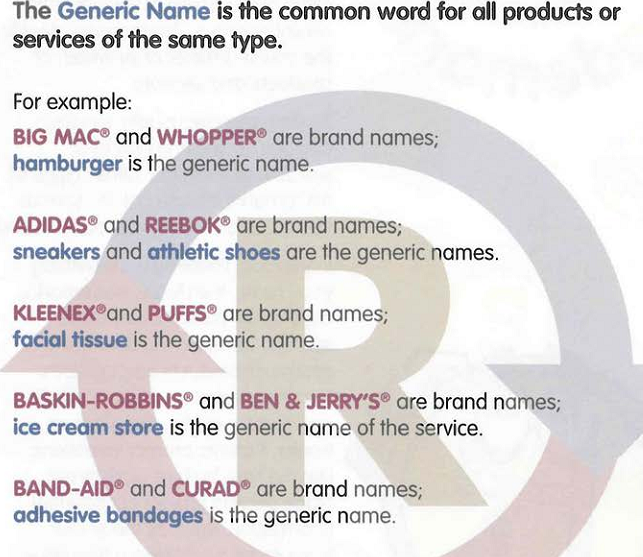
The PTO for children

I recently attended an event at which the PTO had a children’s booth.  Highlights from the Oct. 2012 Trademark Activity Book we received:

The PTO has Kleenex and Band-Aid’s back against the threat of genericity.

The PTO is not worried about self-dilution the way Sara Stadler is.  (See Sara K. Stadler, The Wages of Ubiquity in Trademark Law.)
Posted in trademark | Leave a comment

TM issues, you get what you pay for edition

Marty Schwimmer reports on the Orthodox Jewish Congregations’ lawsuit against Urban Tortilla for the latter’s new U-in-a-circle logo. Schwimmer continues that Urban Tortilla paid $299 for its logo, from a contest among designers.  (See also: continuing immiseration of many creative workers.)  Did Urban Tortilla do a trademark search?  How much in savings was un-saved from this lawsuit?

Posted in trademark | Leave a comment

tuna surprise: undisclosed slack fill was plausibly misleading

Hendricks v. StarKist Co., No. 13–cv–729, 2014 WL 1244770 (N.D. Cal. Mar. 25, 2014)

Hendricks brought the usual California claims against Starkist alleging that its canned tuna products were underfilled (anywhere from 1.1% to 17.3% less tuna than there was supposed to be), as confirmed by independent lab testing using the weighing methodology and standard of fill set forth in the referenced federal regulations. The FDA has the power to promulgate regulations establishing reasonable standards of container fill for any food, and the FDA has done so for canned tuna.  Filling a container in a manner that is misleading is considered “misbranding.”

Starkist argued preemption. The claims weren’t expressly preempted because they relied on FDA standards.  And they weren’t impliedly preempted because Hendricks wasn’t suing to enforce the FDCA directly (he can’t); he was suing to enforce identical state law, threading the “narrow” gap allowed. Pom Wonderful doesn’t change that; it was limited to the Lanham Act.  Though Starkist argued that it and other tuna manufacturers had petitioned the FDA to change the standard of fill, that wasn’t relevant to whether the claims here were preempted.

Starkist also argued that the claims should be dismissed/stayed based on primary jurisdiction.  “Given that the applicable FDA standard here is clear, detailed, and long-standing, the Court sees no reason to stay or dismiss the complaint pending any resolution of the issue before the FDA.” Though canned tuna manufacturers filed a citizen’s petition requesting that the FDA amend or suspend the regulation, the FDA hasn’t done anything.  “Unless and until there is some indication beyond mere speculation that the FDA may change the regulation, the Court sees no need to defer under the primary jurisdiction doctrine.”

Deception: StarKist argued that the FDA standard of fill didn’t require any information be communicated to consumers or that the products be labeled in any particular way. Starkist isn’t required to, and doesn’t, include pressed weight on the can, but rather says “NET WT 5 OZ (142g)” and “Serv[ing] Size: 2oz drained (56g—about 1/4 cup); Servings about 2.” Hendricks didn’t allege that these were false or how they misled him.  But that missed the point of the allegations: he alleged that the cans contained less tuna than would be expected from a 5-ounce can.  The reasons the feds regulate fill is so that tiny amounts don’t get misleadingly placed in large containers.  If fill is substandard, the label has to say so.  Starkist argued that injury wasn’t plausible; the court disagreed.

As a result, various warranty and consumer protection claims survived, though the unjust enrichment claim was dismissed as duplicative. Fraud was sufficiently pled with particularity, given the allegations above.

Starkist also sought to dismiss claims based on products Hendricks didn’t buy. He bought Chunk Light Tuna in Water, but not Solid White Albacore Tuna in Water, Solid White Albacore Tuna in Vegetable Oil, and Chunk Light Tuna in Vegetable Oil.  Whether these products should be included depends on whether common misrepresentations were the crux of his case and whether there was sufficient similarity between purchased and unpurchased products.  Starkist argued that solid tuna was governed by different pressed weight standards from the product Hendricks bought. The court disagreed that this mattered—there was sufficient similarity, given that he alleged the same misrepresentation as to all four varieties.
Posted in california, consumer protection, fda, http://schemas.google.com/blogger/2008/kind#post, preemption, standing | Leave a comment

"I wouldn’t have bought it if I’d known" is enough for standing, 9th Circuit says again

Galope v. Deutsche Bank National Trust Co., No. 12–56892, 2014 WL 1244279 (9th Cir. Mar. 27, 2014)

The court of appeals reversed a grant of summary judgment in favor of Deutsche Bank and other defendants.  Galope adequately alleged that she had standing to sue on her LIBOR-based consumer protection and related claims: she alleged that she wouldn’t have taken her loan had she known of defendants’ manipulation of LIBOR.  Her cognizable injury occurred when she bought the loan, not when she paid manipulation-affected interest.  The sale of her house was rescinded, but that didn’t moot her claims for damages.  (Certain defendants apparently sold her house in violation of the automatic stay in bankruptcy; Galope sufficiently alleged a violation of the covenant of good faith and fair dealing because there was sufficient evidence to support a reasonable inference that they had notice of the automatic stay when they executed the trustee’s sale of the home.)

Judge Nguyen dissented in part on standing grounds.  Galope didn’t allege loss from deceptive conduct because her payments were never affected—“she paid a fixed interest rate and defaulted before the allegedly manipulated LIBOR rate went into effect on her loan; she then was granted a loan modification with a (lower) fixed interest rate that likewise was unrelated to the LIBOR rate and defaulted again.”  She might have alleged but-for causation, but she didn’t allege loss from the manipulation, so her injury was too attenuated for Article III standing.
Posted in california, consumer protection, http://schemas.google.com/blogger/2008/kind#post, standing | Leave a comment