show me how you do that trick: magic performance copyrightable, infringed

Teller v. Dogge, No. 12-cv-00591 (D. Nev. Mar. 20, 2014)

Teller sued Dogge for infringement in two YouTube videos offering to sell the secret to a signature Teller illusion, Shadows.  This illusion

consists of a spotlight trained on a vase containing a single rose. The light falls in such a manner that the shadow of the rose is projected onto a white screen positioned some distance behind it. Teller then enters the otherwise still scene, picks up a large knife, and proceeds to use the knife to dramatically sever the leaves and petals of the rose’s shadow on the screen slowly, one-by-one, whereupon the corresponding leaves of the real rose sitting in the vase fall to the ground, breaking from the stem at the point where Teller cut the shadow. The scene closes with Teller pricking his thumb with the knife, and holding his hand in front of the canvas. A silhouette of a trail of blood appears, trickling down the canvas just below the shadow of Teller’s hand. Teller then wipes his hand across the “blood” shadow, leaving a crimson streak upon the canvas.

Shadows was registered as a dramatic work in 1983. The registration “describes the action of the performance down to its most subtle detail.”  Dogge’s YouTube videos showed a “strikingly similar illusion”:

His videos open with a spotlight trained on a glass bottle containing a single rose. The light falls in such a manner that the rose of the flower is projected onto a white screen positioned some distance behind it. Dogge then enters the otherwise still scene, picks up a large knife, and proceeds to use the knife to dramatically sever the leaves and petals of the rose’s shadow on the screen slowly, one-by-one, whereupon the corresponding leaves of the real rose sitting in the bottle fall to the ground, breaking from the stem at the point where Dogge cut the shadow. After all of the petals are severed from the rose, Dogge removes the stem from the bottle and pours the water from the bottle into a drinking glass.

Dogge’s keywords included Penn and Teller.  His caption stated “I’ve seen the great Penn & Teller performing a similar trick and now I’m very happy to share my version in a different and more impossible way with you.”

Though Teller didn’t register within five years of first publication (the court apparently considered his performances starting in 1976 constituted publication, not a foregone conclusion), the court found that he’d shown that he was the creator and owner of Shadows.

Though magic tricks aren’t copyrightable, dramatic works and pantomimes are; the mere fact that a dramatic work/pantomime centrally features a magic trick doesn’t destroy copyrightability.  (What is the underlying unprotectable “magic trick” that others are free to use?)

Nor did Teller abandon his rights by allegedly failing to take action against other infringers, or challenging others to copy him.  Even if that were a way to waive copyright protection, his partner Penn Jillette’s public statement “No one knows how ‘Shadows’ is done and no one will ever figure it out” “makes no indication that any other individual should publicly perform the work, and only demonstrates confidence that the illusion is so clever that its secret cannot be discovered.”  Copying the secret of the illusion wouldn’t necessarily entail publicly performing the work.

Dogge’s contradictory accounts of whether he copied were of no avail given his YouTube caption.

Substantial similarity: Ideas, concepts, themes and scenes a faire aren’t copyrightable. However, even overlooking their unprotectable elements (not specifically identified), the two works were “nearly identical twins.”  Each begins with a rose sitting on a table—one in an opaque vase, another in a transparent bottle. Each involves the projection of the rose’s shadow onto a screen behind the table.  Each has a lone performer who enters, “observes the rose, then takes hold of a knife sitting on the table and shows it to the audience.”

The performer proceeds to use the knife to cut the shadow of the rose: starting with the branch on the audience’s left, then branch on the right, and finally the flower on top. As the performer cuts the shadow of the rose, the corresponding parts of the real rose fall onto the table.

Teller’s performance ends in blood, while Dogge’s piece ends when he pours the water from the bottle into a glass, but the “events and dramatic progression” are nearly identical. Both had the same “mysterious mood” and a similar pace.  The only differences were “slight differences in props” and the variance in the performer’s actions in the final seconds. These minor differences were “inconsequential” compared to the “significant and subtle similarities.” Thus, they were substantially similar under the extrinsic test, and a reasonable audience would find them to have the same total concept and feel, being based on the “incredibly unique concept of a performer methodically cutting parts of a rose’s shadow, thereby severing the corresponding parts of a real rose.”  (What is the unprotectable magic trick, then? How could it be done without infringing?)  They’d be indistinguishable to an ordinary observer. 

Dogge argued that his method differed from Teller’s, but that’s not the performance perceivable by the audience—substantial similarity involves comparing observable elements.  Even if he used real magic, that would avail him not.

However, the court found material issues on damages.  Teller argued that the infringement was willful because Dogge was informed that he was infringing but didn’t take down one of the videos for seven more days.  Dogge claimed to have responded to the notification by requesting a copy of the copyright registration, and also claimed that the continuing availability was a mistake.  This created a genuine dispute of material fact.

Teller was entitled to attorneys’ fees, because he won; he had a proper motivation (protecting his exclusive rights); and a fee award “advances the public interest in promoting protection of creative works and deterring potential infringers.”

The court denied summary judgment on Teller’s unfair competition claim.  Though Teller submitted evidence that Shadows was his signature trick and widely associated with his celebrity persona, Dogge questioned the reliability of these claims.  “The testimony of Teller’s expert certainly serves as evidence from which a reasonable person could conclude that there is a likelihood of confusion as to Teller’s involvement with Dogge’s videos.” But the relevant question here was not similarity, but whether a reasonable consumer would likely think Teller endorsed the video’s content.  There wasn’t record evidence that any viewer was confused about endorsement, and Dogge’s caption, “I’ve seen the great Penn & Teller performing a similar trick and now I’m very happy to share my version in a different and more impossible way with you,” “potentially clarified that the videos were not supported by Teller.” The court also found it important that Dogge didn’t use an image or likeness of Teller in the video.
Posted in http://schemas.google.com/blogger/2008/kind#post, trademark | Leave a comment

Misleading health plan names

NYT on how health plan names confuse and deceive consumers.

Posted in advertising, http://schemas.google.com/blogger/2008/kind#post | Leave a comment

Consumer law and copyright conferences in April

Making the Fine Print Fair, Georgetown Law symposium, April 4

The Georgetown Consumer Law Society and Citizen Works are hosting a symposium, Making the Fine Print Fair, at Georgetown on April 4 from 8:30 a.m. to 6:30 p.m.  From the Consumer Law & Policy Blog: Speakers include FTC Chairwoman Edith Ramirez; Ralph Nader; Georgetown Dean William Treanor; Associate Dean Gregory Klass; Professors David Vladeck, Adam Levitin; CL&P bloggers Deepak Gupta, Scott Michaelman, and Jeff Sovern; NACA Executive Director Ira Rheingold; Citizen Works Executive Director Theresa Amato; Professors Nancy Kim, Omri Ben-Shahar, Margaret Jane Radin, Florencia Marotta-Wurgler, Michael Rustad, and Lauren Willis; former Illinois Attorney General and Justice Neil Hartigan; PIRG’s Ed Mierzwinski; Arent Fox’s Marc L. Fleischaker, ALICE’s Peter Bailon; Public Justice’s Matt Wessler; columnist Bob Sullivan; Consumers Untion’s George Slover and others.

And also:

18th Annual BCLT/BTLJ Symposium: The Next Great Copyright Act, held in Berkeley at the Claremont Hotel on April 3 and 4, 2014. In March of 2013 Maria Pallante, the Register of the U.S. Copyright Office, expressed her interest in working toward a comprehensive revision of U.S. copyright law, which she has optimistically called “the next great copyright act.”  Congressman Goodlatte, chair of the Subcommittee on Courts, Intellectual Property and the Internet of the House Judiciary Committee, has decided to explore this idea by holding a series of hearings about copyright reform issues.  The Department of Commerce has recently published a Green Paper about the need for some updates to U.S. copyright law.  Although the drafters of the Copyright Act of 1976 hoped that this legislation would prove to be flexible and forward-looking enough to serve the country well over time, consensus has been building in recent years that the current law needs an overhaul so that it is more comprehensible and provides a better framework for enabling copyright law to adapt to the challenges posed by emergent technologies.  This conference will bring together scholars, policymakers, and representatives of various stakeholder groups to consider what changes would make for a next great copyright act.

For more information, visit the website.

Posted in contracts, copyright, disclosures, http://schemas.google.com/blogger/2008/kind#post | Leave a comment

I *am* only cheerleading: uniforms not conceptually separable

Varsity Brands, Inc. v. Star Athletica, LLC, No. 10-cv-02508 (W.D. Tenn. Mar. 1, 2014)

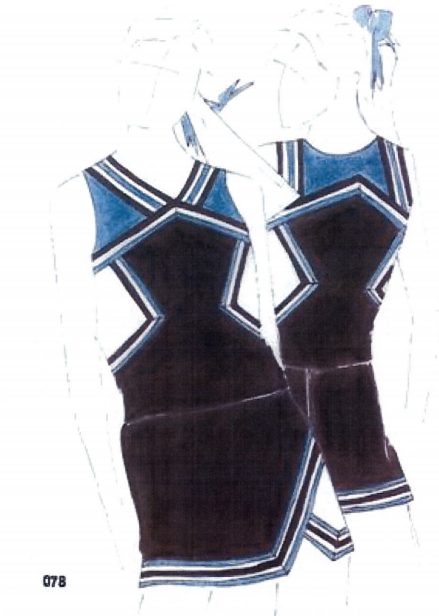
“Classical philosophy does not often come to play in the field of mundane legal analysis.” But here the court was called on to identify the essence of a “cheerleading uniform,” for purposes of conceptual separability.  Here, the court thoughtfully, and I hope with some enjoyment, considered the idea of garments without any of the designs and colors ordinarily printed on (or otherwise applied to) them that generally identify an “unavoidably imperfect reflection of the ideal” of a “cheerleading uniform.”  Because the absence of such designs and colors means that the garment doesn’t signal the presence of a cheerleading uniform, it follows that the presence of such designs and colors is at the core of cheerleading uniform-ness.  Thus, the colors and designs could not be conceptually separated from the utilitarian object themselves: the color and design components were therefore not copyrightable.

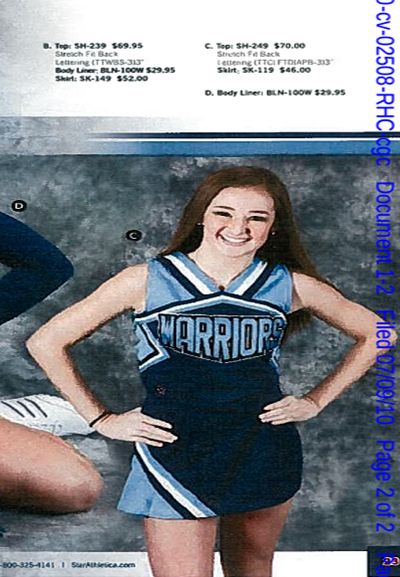
Star Athletica published a catalogue of cheerleading uniforms.  Varsity Brands sued for copyright infringement (and trademark infringement, which the court grants summary judgment on without discussion since Varsity apparently stopped fighting; other state law tort claims get dismissed because the court declines to exercise its jurisdiction).


One of plaintiff’s designs
Allegedly infringing design
 
Varsity uses two methods to incorporate a design into a uniform: cutting and sewing (more common) and sublimation, which involves printing the design onto a piece of paper, which is then heated and the ink infused into fabric by pressing paper and fabric together. Varsity uses designers to create new uniforms, sketching them over a model of a cheerleader; the designers are not instructed to adapt their designs to the realities of production. 

Varsity registered five uniform designs, using a sketch as deposit for three of them and the nature of the work/authorship listed as “2-dimensional artwork.” For the remaining two, Varsity submitted a photograph of a completed uniform incorporating the design as deposit material, the nature of the work is listed as “fabric design (artwork)” and the nature of authorship is listed as “2-dimensional artwork.” Varsity argued that it was entitled to a presumption of validity because it registered within five years of first publication of three of the works at issue, but this presumption is “fairly easy to rebut because the Copyright Office tends toward cursory issuance of registrations.” Because of the record evidence that the works at issue were non-copyrightable utilitarian articles, the presumption was “easily dispensed with.” The shape, style, cut, and dimensions for converting fabric into a finished garment are not copyrightable, but a pattern to be imprinted on a fabric, such as a flower, may be copyrightable if it’s conceptually separable.  Conceptual separability is a bear of an issue (RT: though maybe more important to actually litigated cases than we think).

The court canvassed the variety of judicial approaches to separability, though none from the Sixth Circuit.  The Seventh Circuit finds separability when “the artistic aspects of an article can be conceptualized as existing independently of their utilitarian function.” In Pivot Point, that court found separability in a mannequin head when the designer was simply told to create a model reflecting the “hungry-look” of high fashion, and was free to implement that concept as he wished without regard to specifications for how far the mannequin’s eyes needed to be apart, or how high the eyebrows should be. Because the mannequin’s creative aspects “were meant to be seen and admired,” its sculptural features existed independently from its utilitarian features.  Dissenting, Judge Kanne criticized the test because all functional items have aesthetic qualities, but Congress chose to give them less protection. 

The Fifth Circuit declined to apply the aesthetic influence test to garment design in Galiano, a case about casino uniforms.  Instead, for garment design only, the Fifth Circuit adopted the marketability test, as proposed by Nimmer: “[C]onceptual severability exists where there is any substantial likelihood that even if the article had no utilitarian use it would still be marketable to some significant segment of the community simply because of its aesthetic qualities.”  This, Nimmer says, harmonizes various holdings, but does have weaknesses (including restrictively favoring more conventional forms of art).  The Fifth Circuit reasoned that “all lawmaking with respect to PGS works is interstititial, and most of it [is] freewheeling,” and that the theoretical unfairness to some art forms was outweighed by the interest in having a clear rule, at least for garments if not for all applied art.

The Fourth Circuit found conceptual separability in two furniture collections with decorative carving.  The designs were “superfluous nonfunctional adornments for which the shape of the furniture (which is not copyrightable) serves as the vehicle. . . . the designs are ‘wholly unnecessary’ to the furniture’s utilitarian function.”  Though the designer was necessarily influenced by function, his judgment was sufficiently independent because his aim was not to improve utility but to make the pieces pretty.

The Second Circuit, meanwhile, found that elements of a plush sculpted animal costume could be separable from the overall design because they were physically separable.  By contrast, it found that a prom dress design was uncopyrightable: the arrangement of sequins and crystals on the bodice, ruching at the waist, and layers of tulle on the skirt were neither physically separable (the remaining dress wouldn’t function as well as a prom dress) nor conceptually separable, because “the artistic judgment exercised in applying sequins and crystals to the dress’s bodice and in using ruched satin at the waist and layers of tulle in the skirt does not invoke in the viewer a concept other than that of clothing.”  The decorative elements instead enhanced the dress’s functionality for a special occasion, merging aesthetics and functionality in an attractive way.  Though they were artistic, “the decorative choices . . . merge with those that decide how (and how much) to cover the body. Thus, a jeweled bodice covers the upper torso at the same time that it draws attention to it; a ruched waist covers the wearer’s midsection while giving it definition; and a short tulle skirt conceals the wearer’s legs while giving glimpses of them.” Because the aesthetic and functional effects were inseparable, the dress wasn’t copyrightable.

The court here recognized “considerable disagreement” on the standard. It determined to start with “just what Varsity has copyrighted, and how Star is claimed to have violated these copyrights.”  Varsity claimed copyright in five uniform designs; Star allegedly infringed by making similar uniforms, photographing models wearing those uniforms, and publishing photos of the uniforms in its catalog. The court turned to the language of the statute: “the design of a useful article, as defined in this section, shall be considered a [PGS] work only if, and only to the extent that, such design incorporates pictorial, graphic, or sculptural features that can be identified separately from, and are capable of existing independently of, the utilitarian aspects of the article.” The first clause implied conceptual separability, while the second implied physical separability. Though there’s considerable overlap, the court thought the two were separate.

Varsity argued that, because its designers sketched independent of functional influences, its designs were conceptually separable.  Varsity argued that “the outer edge of the garment merely operates as the edge of a canvas, with unlimited possibilities therein.”

The court was unpersuaded that Varsity had engaged with a key issue: “can a cheerleading uniform be conceived without any ornamentation or design, yet retain its utilitarian function as a cheerleading uniform?”  As with the Second Circuit’s prom dress case, “the combination of braids, chevrons, and stripes on the sketches does not invoke any concept other than that of clothing.” Those supposedly unconstrained sketches “are clearly of clothing, in that they depict cheerleading uniforms on young women who appear to be cheerleaders.” Like a prom dress, a cheerleading uniform is “a garment specifically meant to cover the body in an attractive way for a special occasion.”  The artistic judgment involved “does not invoke in the viewer a concept other than that of clothing,” and the designers always seemed to be thinking of cheerleading uniforms.  “Put another way, a cheerleading uniform loses its utilitarian function as a cheerleading uniform when it lacks all design and is merely a blank canvas.”  Without the familiar ornamentation, the silhouette no longer evoked the utilitarian concept of a cheerleading uniform. Though it might cover the body to the same degree and withstand the rigors of cheerleading, “the utilitarian function of a cheerleading uniform is not merely to clothe the body; it is to clothe the body in a way that evokes the concept of cheerleading.”  Artistic judgment was undeniably important here, but that didn’t make it separable. 

While a desk with carved designs on it is still a desk without those carvings, “a blank silhouette of a purported ‘cheerleading uniform’ without team colors, stripes, chevrons, and similar designs typically associated with sports in general, and cheerleading in particular, is not recognizable as a cheerleading uniform.”  Thus, the design merges with the utilitarian function here.

If the court were to apply the marketability test, the result would be the same: “it is unlikely that the designs in this case would be marketable outside of their utilitarian function as cheerleading uniforms.” The lack of physical separability also supported the court’s conclusion.  Even if you could metaphysically allow the designs to float free in space, or place them on a different “canvas,” they’d still look like cheerleading uniforms, as the sublimation process demonstrated: even physically separated from a uniform, the design “evokes the image and concept of a cheerleading uniform and proves the difficulty of removing the design from the utilitarian article. In short, the concept remains the same, even if the medium changes.”
Posted in http://schemas.google.com/blogger/2008/kind#post | Leave a comment

infringement can occur even if consumers don’t remember it

Beastie Boys v. Monster Energy Co., No. 12 Civ. 6065 (SDNY Mar. 18, 2014)

The Beastie Boys sued for copyright infringement and trademark infringement based on Monster’s allegedly unauthorized use of Beastie Boys music to accompany a video promoting a Monster-sponsored snowboarding competition. Here, the court takes care of some pretrial matters relating to both sets of claims.

First, the court excluded evidence of two videos/sets of videos that allegedly infringed Beastie Boys copyrights and for which Monster was allegedly responsible.  One instance involved videos posted by athletes sponsored by Monster to monsterarmy.com, a website Monster created to promote the athletes and Monster.  Monster encouraged sponsored athletes to post videos, but didn’t create or edit the videos.  Six videos allegedly synchronized Beastie Boys music to film of the athletes performing.  Another video using a Beastie Boys song was created in connection with a sporting event that Monster sponsored and promoted; the Beastie Boys alleged that Monster “was aware of the while it was being produced” and participated in its production.

The Beastie Boys sought to offer these to establish that Monster’s alleged infringement was willful and not negligence or based on a good faith but mistaken belief, “based on communications between Monster employee Nelson Phillips and disk jockey Z-Trip, that it had a valid license to make such use of the Beastie Boys’ music.” The court found that the probative value was outweighed by the prejudicial effect. The probative value of the other videos was limited; the Beastie Boys didn’t explain why those incidents shed light on Monster’s state of mind with respect to the video here.  Unlike the video in suit, these videos weren’t created by Monster, and there was no allegation that the Monster personnel at issue here played any role in the other incidents; that the unauthorized use resulted from similar control deficiencies internal to Monster; that Monster had a practice of using Beastie Boys or other music to promote its products without regard to legality; etc.  The episode at issue here “appears to be an idiosyncratic, singular event, as do, for that matter, the episodes leading to the creation and posting of the other two videos or sets of videos.”

The “faint” probative value here was dwarfed by the risk of unfair prejudice, confusion, and delay. To establish that the other videos infringed and that Monster could be tied to them in a way that would support a willfulness finding would require a mini-trial for each. “Presentation of the proof as to the other two episodes at trial could easily take much more time than the proof as to the , particularly insofar as the Monster Army Videos were made by six separate athletes. Under these circumstances, admission of evidence of these other videos would present a substantial risk of trial delay and confusion, and the jury could well lose focus on the distinct episode at issue in this case.”  The Beastie Boys had no demonstrated plans to “thoughtfully litigate” the facts and context of the other videos, such as calling the athletes who created the Monster Army videos as witnesses.  They apparently just wanted to introduce the “bare fact” of these other videos, then argue to the jury that the videos infringed and that Monster’s conduct was therefore willful.  This “clipped” presentation would limit the delay occasioned by the evidence, but only “at grave risk to the truthseeking process.”

The court did grant the Beastie Boys leave to add a claim of infringement of an additional, fifth song based on evidence found in discovery, almost 2 years after the case began.  Though the issue was close, the court found that the Beastie Boys acted with sufficient diligence in pursuing this claim, given that Monster suffered no prejudice from the timing.  Also, though the Beastie Boys acquired an interest in this sound recording only after they filed the complaint, they were assigned the right to sue for accrued infringement.

The court mostly denied the Beastie Boys’ motion to exclude the testimony of Monster’s marketing expert Erich Joachimsthaler, in the process reaffirming that infringement has been completely detached from harm.  Joachimsthaler’s testimony was about (1) “the likelihood of a consumer association between the Monster brand and the Beastie Boys as a result of watching” the Video; and (2) the impact on, and the value of the Video to, the Monster brand. Joachimsthaler opined that the video didn’t transfer any association between the parties into consumers’ long-term memory, because the video wasn’t itself memorable or part of a sustained ad campaign that would tend to associate them. The court found that this testimony rested on a reliable foundation—“academic research concerning the circumstances under which consumers remember advertisements.” While the Beastie Boys argued that this research was too general, that went beyond admissibility and could be tested by cross-examination and competing evidence.

The court found this testimony relevant to the issue of actual damages, and to recovery of Monster’s profits.  It could also be relevant to statutory damages to the extent they were measured based on Monster’s profits.

However, the court found that Joachimsthaler’s “likelihood of association” testimony, as formulated, might confuse or mislead the jury as to Lanham Act liability.  Likelihood of association was not likelihood of confusion (wait for it!).  “‘Confusion’ refers to a viewer’s reaction upon seeing an advertisement, while ‘association’ relates to the durability of that reaction. An advertisement can be confusing without being memorable; a defendant does not escape liability under the Lanham Act merely because his advertisement is not memorable.”  Sigh.  Once again, harm/materiality takes a hammering because the claim is §43(a)(1)(A) and not §43(a)(1)(B), for no good reason.  Anyhow, the court wouldn’t allow Joachimsthaler to testify about likelihood of confusion, and would instruct the jury that his testimony was relevant solely to damages.

Joachimsthaler also proposed to testify on the Video’s impact on and value to the Monster brand. This was plainly relevant to Monster’s profits, and thus to statutory damages.  The Beastie Boys objected that his methodology was “nonrandom” and “unscientific.”  The court mostly disagreed—his experience and research in marketing qualified him to opine on these matters, even without constructing a formal model.  “Technical . . . or other specialized knowledge,” may be relevant and reliable, and therefore admissible under Daubert, “even if the field of knowledge, be it marketing or plumbing, does not readily lend itself to a formal or quantitative methodology.” But one aspect of the testimony was “plainly unreliable.”  He stated that he obtained expertise about consumer perceptions of Monster’s brand by “ask[ing] people in my office . . . [who] have an age range from 18 to 55 . . . to help me understand the Monster Energy brand.”  This was “unreliable and blatantly non-rigorous,” and indeed didn’t pass the laugh test.  As he had been in a previous case, Joachimsthaler was precluded from offering expert testimony that recited or relied on his conversations with co-workers.

On to damages: In the Second Circuit, until 1999, the longstanding common law rule prevailed: to prove liability and obtain injunctive relief under the Lanham Act, a plaintiff need only show a likelihood of confusion, but to obtain monetary relief he or she was required to show either (1) actual confusion; or (2) bad faith, meaning intentional deception or willfulness.  In 1999, however, Congress amended 15 U.S.C. § 1117, the provision of the Lanham Act which provides for damages, to state that damages may be obtained for willful violations of § 1125(c) (dilution). Judges have disagreed about whether adding a specific reference to a willfulness requirement for dilution damages altered the common law rule that actual confusion or willfulness was required for confusion damages.  Some cases, including in the Third Circuit, have held that the plain language abrogated the prior rule, applying the canon that when Congress uses particular language in one section of a statute but omits it in another, it’s generally presumed that Congress acted intentionally. But a number of judges in the Second Circuit have disagreed: because Congress is assumed to have been aware of existing law when it passes or amends legislation, and because it did not expressly change the requirements for damages under § 1125(a), the old rule about confusion damages should stay the same.  Plus, the legislative history and headings of the dilution amendment indicate that Congress was only concerned about dilution, not §1125(a), when it added that language. The court here agreed with the latter view. Thus, to receive damages under the Lanham Act, the Beastie Boys would have to prove actual confusion or intentional deception.  For a profits award, the Beastie Boys would have to prove willful infringement.

Also, Monster argued that the Beastie Boys only owned 50% of each copyright and had to limit their recovery accordingly. The court agreed with the Beastie Boys that their 50% interest wasn’t relevant to the jury’s damages calculation.  Any award would simply have to be discounted, if not already reflected in the jury’s award.

The court also rejected Monster’s argument that the Beastie Boys were entitled to only one award of statutory damages per work, because “[w]here the same plaintiff owns both the musical composition copyright and the sound recording copyright, awarding damages on a per work—or per song—basis is appropriate.” The court found Monster’s factual predicate to be wrong: Monster hadn’t challenged the Beastie Boys’ assertion that the sound recording copyrights were owned by one entity but the musical composition copyrights were owned by another.  Monster could attempt to show that the parties were so closely affiliated as to be considered one company for statutory damages purposes. 

Note: I haven’t looked up the case law, but I don’t see why separate ownership matters: the statute says “the copyright owner may elect … an award of statutory damages for all infringements involved in the action, with respect to any one work …. For the purposes of this subsection, all the parts of a compilation or derivative work constitute one work” (emphasis added).  Since it’s common to have separate ownership for contributions to compilations and the compilations themselves, or for underlying works and derivative works, this last sentence seems clearly to contemplate that there will be multiple copyright owners whose rights are infringed, but only one award of statutory damages.  I imagine the argument to the contrary is predicated on the phrase “the copyright owner,” but singular usually means plural too in these situations.
Posted in damages, http://schemas.google.com/blogger/2008/kind#post, trademark | Leave a comment

Hockey fans sue over fake beer sizes because they’re false and deceptive

There, I fixed the headline of the original story.  If a small costs $4 and a large costs $7, there ought to be a difference in amount delivered.  Also, anyone who uses the McDonald’s hot coffee case to “prove” that Americans are unduly litigious has a moral obligation to look at the woman’s burns.  Scroll down.  I’ll wait. (You can also read about the multiple warnings of burns McDonald’s ignored.)

Posted in advertising, http://schemas.google.com/blogger/2008/kind#post | Leave a comment

Reliability, safety, and 1050-1150 RPM speed claims are puffery

Smith v. LG Electronics U.S.A., Inc., 2014 WL 989742, No. C 13-4361 (N.D. Cal. Mar. 11, 2014)

Smith sued LG over allegedly defective washing machines that shook and vibrated excessively during use.  In 2012, the CPSC recalled the machines due to risk of personal injury and property damage.  A free in-home repair involved a software upgrade that allegedly fixed the problem by capping the spin speed of the machines, so they weren’t capable of operating at their advertised extra high speed, which impaired their performance by increasing wash (and drying) time.

Smith brought various warranty and California consumer protection claims.  The court found no violation of express or implied warranties, which were limited to one year from the date of purchase.

Many of the challenged statements were puffery, not warranties.  “Vague statements regarding reliability, dependability, and safety are not actionable express warranties.”

Thus, statements that the machines were safe for residential use and fit for everyday laundering needs, that they would provide many years of reliable service, and that they were designed and manufactured for years of dependable service – are not statements of affirmation and promise, but rather non-actionable puffery. Such generalized advertisements say nothing about the specific characteristics or components of the machine, and include no guarantee, for example, that the machine will not require a repair within a specified period of time.

As for statements alleged to be express warranties, Smith didn’t allege facts showing that the machines didn’t have a high speed cycle (etc.) at the time of sale.  The lowered spin speed after the recall (and outside the one-year warranty period) didn’t render the statements at the time of sale false.

The consumer protection claims also failed.  Smith alleged that defendants’  statements that the washing machines would provide many years of reliable service;” were “designed and manufactured for years of dependable service;” were capable of operating “extra high” spin speed cycles, at 1050–1100 RPMs; were Energy Star@ and/or “HE” compliant; and were safe for residential use and fit for everyday laundering needs were false, but the complaint flunked Rule 9(b)’s particularity requirement.  These were the same “vague and generalized statements of opinion or sales puffery,” not statements on which a reasonable consumer would rely.  (Really? Capable of operating at a certain RPM seems plenty specific and testable, as does “Energy Star” compliant.) Plus, Smith didn’t adequately allege falsity/misleadingness; she didn’t allege that these features weren’t present during the one-year warranty period.  She couldn’t base claims on statements that weren’t untrue or misleading at the time they were made.  (But this slides over the question about misleadingness: isn’t it misleading to represent, albeit implicitly, that a product will continue to work in pretty much the same way over time? There’s a difference between being out of warranty and not providing a core benefit because of a deliberate design choice.) Plus, Smith didn’t allege facts indicating that defendants were aware of or had reason to know of the excessive noise and vibration at the time of sale, which the court says is a requirement (though I don’t think it is under all California’s consumer protection laws).
Posted in california, http://schemas.google.com/blogger/2008/kind#post | Leave a comment

Copyright infringement doesn’t violate the Lanham Act

Masck v. Sports Illustrated, No. 13-10226 (E.D. Mich. Mar. 10, 2014)

Previous discussion, in which I got exercised about the court’s misapplication of Dastar, herein corrected.  Masck took an “iconic” photo of defendant Desmond Howard, running for a touchdown during a Wolverine game, wherein he made the “Heisman” pose.  Masck alleged that he was the only photographer who got a good shot of that.  Sports Illustrated ran the photo in 1991, with a proper credit and payment, but didn’t return the negative.  Masck didn’t register until August 31, 2011.  At some point between 1992 and 1998, the slide ended up with Allsport, a photo agency to which Masck was a contributor, but Masck alleged he never gave it the photo.  Getty, which acquired Allsport in 1998, says that given the passage of time all the documents explaining how Allsport got the photo have been lost.

Getty informed Masck of its takeover and returned about 2500 photos.  Getty also asked Masck to tell it as soon as possible if he believed Allsport had any more of his images.  Masck never responded, but argued that the collection never should have included a copy of the photo at issue.  In 2005, Getty uploaded the Heisman photo to its digital asset management system without

crediting Masck, and then sold licenses of the photo to customers until September 2011.

Masck discovered several infringing uses of the photo, including a photo for sale in June 2010, and a full-page Nissan ad using the photo in Sports Illustrated in 2010, 2011, and 2012.  Champions Press used the photo in a book about Howard, and Howard’s website also had a copy of the photo.  Defendant Fathead produced a life-size adhesive photo, and several reproductions were for sale on Amazon.  Marck asked Amazon to stop selling unauthorized reproductions in September 2012, but Amazon continued to permit photo sales, and Walmart offered copies in stores and online.

Masck sued everyone.  This opinion finally kicked out the Lanham Act claims.  Dastarsays “origin of goods” means tangible goods, not communicative products. Before, the court was unready to conclude that the photo was an intangible item.  But on summary judgment, the court found that Masck was not arguing that the defendants misled the public as to the origin of tangible goods; instead he argued that they failed to credit him.  This time, the court recognized that even wholesale copying wasn’t actionable under the Lanham Act, following Dastar.  Belated whew.

This opinion also addressed laches.  Defendants argued that Masck should’ve been aware of Getty’s public posting of the photo on its website in 2005, since he knew about Getty and had received Getty’s letter, as well as royalties from Getty.  Defendants argued that this was unreasonable and that they were prejudiced by the delay, since relevant documents about Allsport’s possession of the photo have been lost.  Though they argued that he should have registered earlier, he relied on his lawyer’s (bad) advice that he didn’t need to.  Masck also alleged that he notified all infringers he discovered, but that most of the infringements occurred in 2010 or later.  He also argued that willfulness precluded laches. The court found that the issue was not appropriate for summary judgment.

Walmart’s vicarious/contributory liability: Masck didn’t claim direct infringement, but rather than Walmart allowed third parties to sell identical or substantially similar copies.  Defendants argued that a third party nondefendant, Pro Team, used Walmart’s retailer program to sell goods on Walmart’s website, and that Walmart didn’t deliver goods or take responsibility for fulfilling orders.  Previously, the court dismissed vicarious liability claims against Amazon because Masck didn’t allege that Amazon could verify the copyright status of every third-party piece of merchandise; Walmart argued that it was the same, and also that it was protected by the DMCA.

But the court found a “crucial difference”: Walmart also operates physical stores and controlled what was sold there.  (Shouldn’t the claims relating to online sales still be dismissed?)  Plus, Masck maintained that he sent notices to Walmart.  Thus, summary judgment was inappropriate. (Unfortunately, the court doesn’t discuss whether the notices were DMCA-compliant.)

Statutory damages: defendants noted that Masck needed to register before the infringement began to get statutory damages, and contended that their infringements began before he registered. Also, they challenged Masck’s evidence supporting an award of actual damages or profits, arguing that he never propounded timely discovery requests.  Masck also argued that Getty was responsible for all the damages because it provided the photo to all the other defendants. 

Masck sought a share of profits on Nissan’s vehicle sales, an argument that one would not expect to go well, but here too the court proves very willing to give him the benefit of the doubt.  Because Nissan was a “rational economic actor,” and paid $3 million to run the ads, plus $1 million to sponsor the “Heisman house tour,” with the infringing photo at the “heart” of the campaign, the court seemed to endorse (or at least leave open for later) Masck’s argument that the photo was worth over $5 million.  Also, Masck submitted the “average breakdown of Nissan car sales from the year the ads ran.”  Masck apparently suggested that he’d elect statutory damages for “each violation” by several of the defendants.  Willful violations were “likely only in the case of Amazon and Champions Press” (not entirely clear whether this was the court’s conclusion).  The court found a question of material fact existed as to what constituted the dates of infringement and whether or not the evidence Masck provided was enough to support awarding damages.
Posted in damages, dastar, dmca, http://schemas.google.com/blogger/2008/kind#post, trademark | Leave a comment

Today’s inducement question

#McConnelling: The Daily Show invites users to score footage of Mitch McConnell to as many songs as possible.  The idea is that it’s funny no matter what music you use.  So, inducement?  If it’s transformative (which I think it is), what are we to make of the idea that it’s transformative no matter what music you use?  This is the musical version of the Kuleshov effect: the video affects our perception of the music and vice versa.

Posted in copyright, http://schemas.google.com/blogger/2008/kind#post, secondary liability | Leave a comment

My long, sad Garcia v. Google post

You know, for a judge who loves the First Amendment and free speech so much when it comes to the right of publicity and nominative fair use, Judge Kozinski can seem oddly unconcerned about it in other areas of IP, like dilution, secondary liability, and, here, copyright.  It’s not just the substance of the decision—the injunction here came with a gag order preventing Google from disclosing the mandated takedown until the opinion issued.  The injunction was subsequently narrowed a bit, after it was made public; now anyone who edits Garcia out can post the video at issue.

Eric Goldman’s commentary is sharp but not unwarranted; the IP professors went at this case hammer and tongs for a while, with almost nobody happy with the injunctive remedy and most though not all displeased with the authorship analysis.  The real problem is that the 9thCircuit (like other circuits) screwed up joint authorship with weird intent requirements, themselves apparently motivated by the non-statutorily-required rule that all coauthors receive equal shares. This had the further result that when Kozinski encounters a situation where the actor seems to have some equitable claims, the only apparent solution seems to be to give her a separate right in a separate “work,” making the doctrine a ton worse off.

Garcia v. Google, Inc., No. 12-57302 (9th Cir. Feb. 26, 2014)

The facts are probably familiar: Garcia was tricked into appearing in a film that she thought was “Desert Warrior” but turned into “Innocence of Muslims,” and because of dubbing her character appeared to utter one of the more offensive lines.  Garcia was only given the four pages of the script in which her character appeared and paid approximately $500 for three and a half days of filming. As a result, Garcia started receiving death threats.  After filing futile, §230-barred state law claims against Google, she registered a copyright in her performance (or the AV work featuring her performance, as it says on the registration—the nature of the claim is really unclear, even though Kozinski mocks the district court for saying just that) and sued when Google refused to honor her takedown notices.

Kozinski defined Garcia’s claim as one to own a copyright in her performance within the film as independently copyrightable.  She’s not a joint author of the film under 9thCircuit precedent.  The dissent thinks this claim is best analyzed as a joint work claim and that Garcia isn’t a joint author; the majority disagrees because there was no intention to create a joint work.  But that doesn’t really get to the dissent’s point: if the work at issue is indeed one work rather than a bunch of subworks, then Garcia can only be an author if she’s an author of the work.  And the only way to do that is to be a joint author, which under 9th Circuit precedent (quite plausibly wrong, but this is not the way to fix it) she can’t be. (What is the right definition of the work? I think it’s the film, which shouldn’t be divided into a bunch of independent subworks for a lot of doctrinal reasons, e.g., fair use, termination of transfers, etc., a position with which the Copyright Office expressed agreement last week when it denied Garcia’s copyright registration application.)

So, the majority continues: if Garcia made an independently copyrightable contribution to a joint work (I think this must mean “work,” because it would seem to be true whether the work is single-authored, joint, or WFH), she can retain a copyright interest in that contribution even if she’s not a joint author.  All that’s required for copyright protection is a fixed, original work of authorship, and the “artistic contribution” here was fixed, so the only remaining question was whether it was sufficiently creative to be protectable.  (Court’s footnote: whether the author of a dramatic performance “must personally fix his work in a tangible medium” was not here at issue, but can be raised on remand.  “Personally” must be a reference to “by or under the authority of the author,” a requirement for a protectable fixation, and it is a rabbit hole I will not go down very far, except to say that the fraud claim and the “I authorized fixation” claim do not fit very well insofar as the fraud went to the sole reason Garcia authorized fixation.)

Google argued that Garcia’s contribution to the film wasn’t sufficient to make her an author, because Youssef wrote the dialogue she spoke, managed all aspects of the production and later dubbed over a portion of her scene. “But an actor does far more than speak words on a page; he must ‘live his part inwardly, and then . . . give to his experience an external embodiment.’” That embodiment (and thus, presumably, that authorship) “includes body language, facial expression and reactions to other actors and elements of a scene. Otherwise, ‘every shmuck . . . is an actor because everyone . . . knows how to read.’” (Hunh?  Given what Kozinksi’s about to say next about the minimal creativity standard, isn’t this a holding that every shmuck is an actor?)  A fixed performance is copyrightable if it evinces “some minimal degree of creativity . . . ‘no matter how crude, humble or obvious’ it might be,” per Feist.  This was true of Garcia’s dubbed-over performance.

Aalmuhammed didn’t control because it was only about joint authorship.  “It makes sense to impose heightened requirements on those who would leverage their individual contribution into ownership of a greater whole, but those requirements don’t apply to the copyrightability of all creative works, for which only a ‘minimal creative spark [is] required by the Copyright Act and the Constitution,’” Feist.  (So Jefri Aalmuhammed was just a poor pleader.  And now those who own a tiny bit can have more control than a joint author (who can’t prevent other joint authors from licensing/using the work.)  Note too here how the question of what a “creative work” is has been carefully elided.)  Contrary to the dissent, the majority continued, it wasn’t reading authorship out of the Copyright Act.  (Only “work.”)  The creator of copyrightable expression is an author, which is why Sinéad O’Connor has a copyright in her performance of “Nothing Compares 2 U” even though the song was written by Prince.

Now the majority turned to the right of publicity cases, which are a frolic and detour of their own: because courts have analyzed the right of publicity’s conflict with copyright as a question of §301 preemption rather than conflict preemption (which would be more sensible), and because the 9th Circuit (against Kozinski’s good advice) has expanded the right of publicity a ton, courts have previously drawn a rather evanescent distinction between an instance of singing (which can be fixed) and a voice (which, supposedly, cannot be fixed, even though that makes no sense whatsoever, and this distinction was unnecessary, but that’s a separate fight that nonetheless makes matters here even more complicated).  Kozinski says that the right of publicity cases weren’t copyright cases, which is not even true, since they were at least §301 cases, though they weren’t infringement cases.  Anyway, Kozinski continues, Midler v. Ford Motor Co., 849 F.2d 460 (9th Cir. 1988), was about the copyrightability of a performer’s voice—not her performance. “A performer’s voice is analogous to her image, which we’ve said ‘is not a work of authorship’ under the Copyright Act. Downing  v.  Abercrombie  & Fitch, 265 F.3d 994, 1004 (9th Cir. 2001).

But that doesn’t answer the question of whether the artist’s creativity, expressed through her voice or image, is protected by copyright. Just because someone’s voice—its particular timber and quality—can’t be copyrighted, doesn’t mean that a performance made using that voice can never be protected. In fact, many vocal performances are copyrighted.

True!  But, and this I think is at least consistent with Kozinski’s preferred position, this stance would seem to put §301 preemption back into play for many right of publicity cases involving, for example, pictures of celebrities used with the consent of the copyright owner/photographer: since an image made using a celebrity’s face can be copyrighted, that particular image is back within the subject matter of copyright, like the sound recording of a voice.  (Although under Garciaauthorship is now an unholy mess there, if the celebrity posed in any way.)

Setting that all aside: Garcia’s performance was a derivative work of the script, and one she had implicit permission to make because Youssef hired her, gave her the script, and turned the camera on her.  She doesn’t own an interest in the entire scene, only in her contribution. Even if that contribution is relatively minor, “it isn’t de minimis.” The majority declined to hold that every actor has a copyright in his/her performance in a movie (though of course, given the few seconds Garcia is on screen, it is in practice so holding).  “[W]hile the matter is fairly debatable, Garcia is likely to prevail.” (In its petition for rehearing on the stay, Google makes much of this statement—as a procedural matter, if it’s fairly debatable, a prohibitory injunction is an unusual outcome, especially one that reverses the district court.)

You might be worried that “the numerous creative contributions that make up a film can quickly become entangled in an impenetrable thicket of copyright.”  But don’t fret: contracts, work for hire, or implied licenses will make such problems “rare[].”  (I wonder how many studios have confidential memoranda in preparation about their ability to prove the existence of written contracts with every Tom, Dick and Harriet who ever showed up in a film, dressed a set, or otherwise contributed to the movie.)

Here, anyhow, there’s no work for hire issue because Garcia wasn’t Youssef’s employee, and she didn’t agree to a WFH arrangement (because she contended, without contradiction on this record, that the document purporting to allocate her copyright interests was a forgery).  An actor in a small role probably isn’t an employee, because she was hired for a specific task, worked for only three days, and received no health or other traditional employment benefits.  The dissent is wrong that Youssef’s control made him an employer, because there was no evidence that he directed the film or that he “controlled the manner in which any part of the film—much less Garcia’s scene—was shot. In fact, Youssef has claimed only that he wrote the screenplay.”  Also, there was nothing in the record to suggest that he was in the regular business of making films.

What about implied license? Nonexclusive licenses can be implied from conduct, specifically where a plaintiff creates a work at a defendant’s request and hands it over, and where a plaintiff’s contribution to a film or other work would otherwise be worthless or of “minimal value.”  That was true here.  Garcia did grant the filmmaker an implied license, and it must be construed broadly.  Failure to meet an actor’s expectations isn’t enough to exceed the license, or the copyright owner in the film could be unduly constrained in editing/creating derivative works or barred from distributing it entirely.  Broad licenses are necessary to avoid giving actors de facto authorial control over films.  (But: If Garcia were a real copyright owner, that wouldn’t be a weird result to be avoided.  See Stewart v. Abend.)  Also, these implied licenses should be interpreted broadly to protect joint authorship rules, since most actors don’t qualify as joint authors and shouldn’t have more control over a film than a joint author.

But a broad implied license isn’t unlimited.  “Garcia was told she’d be acting in an adventure film set in ancient Arabia. Were she now to complain that the film has a different title, that its historical depictions are inaccurate, that her scene is poorly edited or that the quality of the film isn’t as she’d imagined, she wouldn’t have a viable claim that her implied license had been exceeded. But the license Garcia granted Youssef wasn’t so broad as to cover the use of her performance in any project.”  The problem isn’t that Innocence of Muslimsisn’t an Arabian adventure movie; it’s not intended to entertain at all.  (The majority knows this … how?  It’s trolling, which many people find quite entertaining, and even if those people are awful, I do not get this distinction.) “The film differs so radically from anything Garcia could have imagined when she was cast that it can’t possibly be authorized by any implied license she granted Youssef.” 

We know this because he lied to Garcia, and she relied on this lie.  “Youssef’s fraud alone is likely enough to void any agreement he had with Garcia.” (In which case this holding is by no means narrow. If a performer alleges that part of the promise was the film’s name, or control over editing, or anything else, and then the agreement is therefore void, then the broad scope of the invalid license becomes irrelevant.)  Even if the lie didn’t invalidate the agreement, it was clear evidence that his use of her performance “exceeded the scope of the implied license and was, therefore, an unauthorized, infringing use.” (Ditto.)

Filmmakers will rarely exceed the bounds of actors’ broad implied licenses, but this was such a case.  (If these are truly implied licenses, then how do we know their terms?  Why wouldn’t their terms at least be deeply up for grabs?) Thus, Garcia was likely to succeed on the merits.

And she suffered irreparable harm.  Copyright infringement isn’t presumed irreparable, but the damage to her reputation and death threats are. Her delay in suing for several months wasn’t dispositive.  But she took legal action as soon as the film received worldwide attention and she began receiving death threats, which was enough.  The threats to her are ongoing and serious, and she has to take safety precautions when traveling and moved to a new home and business location.  Absent an injunction, she’d continue to suffer these security threats. 

Garcia also needed to show a causal connection between the harm and the conduct she sought to enjoin—the infringement of her copyright.  She did, because the unauthorized inclusion of her performance in Innocence of Muslims led to the threats.  Removing the film from YouTube would help disassociate her from the film’s anti-Islamic message.  (How?  How would it do so more than suing already did?)  Google didn’t show that the film was so widespread that its removal from YouTube would have no effect (plus the court sua sponte ordered removal from every Google property and “all reasonable steps” to prevent reuploads, beyond Garcia’s requested relief, so there!). “Taking down the film from YouTube will remove it from a prominent online platform—the platform on which it was first displayed—and will curb the harms of which Garcia complains.”  The publicity generated by the lawsuit was a necessary product of her attempt to protect herself, and not the source of harm to her. “To the extent the irreparable harm inquiry is at all a close question, we think it best to err on the side of life.”

The balance of equities also favored Garcia, because Youssef lied to her and Google has no equitable interest in preserving a use that she found abhorrent and that lead to death threats.  Google’s argument that there was a public interest in preserving a record of The Innocence of Muslimsfailed because the First Amendment doesn’t protect copyright infringement.  (I should note that Eldred and Harper & Rowdo presume that there is someone who wantsthe work to be disseminated, but to get paid for it; that seems to be an important difference.)  The public interest therefore favored Garcia.

Judge Smith dissented.

First, the dissent said, a mandatory injunction—one changing the status quo—should be subject to a higher degree of scrutiny, requiring extreme caution.  In combination with the standard of review, which is abuse of discretion, reversal was therefore not warranted.

Garcia didn’t have a copyright interest in her performance, because her performance was not a work, she was not an author, and her performance was too personal to be fixed.  Originality is not enough for copyrightability/authorship.

The list of exemplary works in the Copyright Act are significantly different from an actor’s individual performance in a film, which makes the claim start out dubiously.  (This list is nonexclusive, so the dissent rightly points to the dissimilarity, not just the failure to make the list.  Pam Samuelson has a great draft paper about how to judge copyright suitability for cases like this, or gardens, or DNA sequences.)  §101 also differentiates a work from the performance of the work.  “While Congress distinguishes the performance from the work itself, the majority blurs this line.” An acting performance more resembles a §102-excluded “procedure” or “process” by which an original work is performed.  “In sum, a motion picture is a work. A segment independently produced and then incorporated into a motion picture is also a work. However, the Copyright Act does not clearly place an acting performance within its sphere of copyrightable works.”

As for authorship, also a constitutional requirement, Aalmuhammed articulated general principles relevant to both single and joint authorship claims.  Garcia’s claimed interest is best analyzed as a joint work (a claim which then fails), because she relied on Youssef’s script, equipment, and direction, and thus had the intent to merge their contributions into inseparable or interdependent parts of a unitary whole. An “author” is the person with creative control, and authorship requires more than a minimal creative or original contribution to the work—a principle the majority disregards. Garcia’s contribution was a lot less than Aalmuhammed’s.  She “was not the originator of ideas or concepts. She simply acted out others’ ideas or script…. Indeed, it is difficult to understand how she can be considered an ‘inventive or master mind’ of her performance under these facts.”

Aalmuhammed is indeed relevant, because it articulated general principles of authorship, following Burrow-Giles, which isn’t a joint authorship case.  (This is actually a revisiting of the “what is a ‘work’?” debate under another name.)  The majority’s reliance on Feist was misplaced, because Feist was not about authorship.

The practical implications: Garcia’s minimal role in the film gave her a copyright, which will indeed create “an impenetrable thicket of copyright,” in contrast to Aalmuhammed, which, while debated in academic circles, “adopts a standard that promotes clarity in the motion picture industry.”

Fixation: if the relevant work is a “performance,” it’s not fixed. The right of publicity cases discuss “subject matter akin to an acting performance” and hold them to be unfixed.  These are indeed “copyright cases,” coming from the same judges interpreting the same Copyright Act. Midler, for example, held that a voice isn’t copyrightable because its sounds aren’t fixed, and was “more personal than any work of authorship.”  By contrast, other cases have found preemption where the defendant was using the actual copyrighted work in which the plaintiff had consented to perform. “Combined, these cases show that, just as the singing of a song is not copyrightable, while the entire song recording is copyrightable, the acting in a movie is not copyrightable, while the movie recording is copyrightable.”  (The dissent distinguished cases in which an “independently authored clip” is used in a film, as in Effects Associates; its analysis was specific to an actor “acting out a script she did not write under the direction of someone else who provides all of the instruments, tools, and leadership.”)

Ultimately, a sound recording “involves many moving parts, including the tune, lyrics, instrumental musicians, vocalists, and a production team that edits and prepares the final song.” The result is copyrightable and the vocalist’s contribution is creative, but the vocalist’s singing of the song is not independently copyrightable.  An acting performance is similar.

Separately, the dissent was also sympathetic to the WFH argument.  Under the multifactor test, none of the factors is determinative, but the hiring party’s control is the central inquiry.  Garcia conceded that Youssef “managed all aspects of production,” controlling both the manner and means of making the film, including the scenes featuring Garcia.  Youssef also “provided the instrumentalities and tools, dictated the filming location, decided when and how long Garcia worked, and was engaged in the business of film making at the time.”  “While the majority may dispute which person was actually directing the film, it cannot overcome Garcia’s own admissions in her complaint that substantiate these facts; she was not in control.”

The majority erred in failing to defer to the district court on likely success.  There was no abuse of discretion in finding that Garcia hadn’t clearly shown likely success on the merits.

On irreparable harm, too, the dissent would’ve found no abuse of discretion in holding that Garcia’s delay negated irreparable harm, even given Garcia’s explanation.  “Were Garcia really trying to protect her purported copyright interest in her acting performance, one would expect her to have brought this action immediately after learning of the alleged infringing behavior. Considering ‘[t]he relevant harm is the harm that . . . occurs to the parties’ legal interests,’ Garcia has failed to explain her delay in terms of harm to her alleged copyright interest.” Also, if she valued her acting performance to the extent she now claims, she could’ve protected it by contract.  Instead, she acted for three days for $500.

On the equities, the majority trashed Youssef, but Google wasn’t a party to that conduct and Youssef wasn’t a party to this appeal.  As for the public interest, there’s no First Amendment interest in infringing copyright (citing Eldred). But this isn’t “copyright infringement per se,” by which the court seems to mean “infringement of a freestanding work.” Instead, Garcia may have a copyright interest in her acting performance, but issuing a preliminary injunction (against the entire work) may be an invalid prior restraint.

There is obviously much more to come.  I will just address one issue raised by this holding: James Grimmelmann, as part of his deconstruction of the decision on Twitter, asked what would happen to statutory damages now.  17 USC § 504(c)(1) provides that “For the purposes of this subsection, all the parts of a compilation or derivative work constitute one work,” so I can’t see how you can get more than one award of statutory damages per film even if it’s now composed of a bunch of independently copyrightable performances, since the film is either a compilation or a derivative work of those performances (or they’re derivative works of the script, or something).  However! Precisely because of the one-statutory-damages-award-per-work rule, would anyone seeking statutory damages for infringing a film have to implead any actor with a potentially copyrightable interest, since his/her rights could be prejudiced by an award to the main copyright plaintiff? Or maybe most actors won’t have timely registered—do they have to, if the film copyright owner timely registered?  By analogy to newspaper articles, I would guess they have to register separately in order to be entitled to statutory damages.  So they’re probably not entitled to claim statutory damages in the ordinary case, whatever the “ordinary” case is here.  Ok, then, but what happens if the film copyright owner elects statutory damages?  Is the actor entitled to claim actual damages, even though that does violence to the idea that there is an election rather than a double recovery for an infringement of a single work as defined by § 504?  As Grimmelmann says, what this really shows is that inconsistencies reverberate throughout a system.

Final notes: best snark in Google’s brief:

Because of the panel’s take-down order, “Innocence of Muslims” is no longer on YouTube. However, if the Court wishes to view the film, it is available at many other sites on the Internet. Google will not list the URLs in this public document, but would be happy to file a representative list under seal at the Court’s request.

The Copyright Office also got in a whack at the 9thCircuit rule that application, not registration, is a prerequisite to suit: Citing 17 U.S.C. § 411(a), it wrote that “Congress expressly envisioned that registration decisions by the Register of Copyrights would precede adjudication in the courts” so that the Office can intervene to defend that decision. When a lawsuit comes first, “the Register’s statutory right to intervene in an action instituted pursuant to a refusal to register is nullified.”  Which raises the question: will the Register nonetheless (move to) intervene?

Posted in google, http://schemas.google.com/blogger/2008/kind#post | Leave a comment