Form v. content in DMCA notices

Still working on a long post on Garcia v. Google because ugh, but here I go on a side note: David Post has a post up, Why Google shouldn’t be the copyright court of last resort, which argues that Google shouldn’t screen for bogus copyright notices. While I agree with the title of the post, I’m not persuaded by the content. Post says Google should’ve just honored Cindy Garcia’s takedown request, because it had the proper form of a DMCA request. He argues that the result of Google’s refusal was a case in which the defendant, Google, didn’t have any access to the true facts, making for a bad contest on the question of infringement.

I think Post’s proposed solution—honor all takedowns that are properly formatted—is a pretty bad idea, despite the terrible opinion in Garcia.  (Also, what’s up with “last resort”?  As the 9th Circuit opinion demonstrates, Google is pretty clearly not the last resort, but rather the first screener.)  Post says that the proper response here was to wait for a counternotification, and the posters themselves could’ve fought about the underlying facts.  Except … I personally know plenty of people with valid fair use arguments who’ve decided not to take the very tiny but intimidating to nonlawyers risk of counternotifying; the research suggests that counternotification is vanishingly unlikely, even when (as is not uncommon) the notices appear to be invalid after minimal scrutiny; and the video here seems to have been reposted by many people who weren’t the copyright owner either in order to make some sort of point about Innocence of Muslims, making it even less likely that we’d get the “right” result through counternotification.

Percentagewise, most notices are valid—but, as Post points out, this is a mostly automated process; if even 1% of 100 million notices are invalid, the absolute number of bad claims is very high, something a free speech-sensitive analysis ought to be concerned with.  Automatic compliance with everything that looks like a DMCA notice would readily enable low-risk censorship and vitiate §230, which protects against such demands when the offensive subject matter isn’t infringing.  This isn’t hypothetical.  People send DMCA notices when they object to use of their trademarks (also here) or have other noncopyright claims, and I heard trademark counsel advising in favor of using copyright to enforce trademark claims at INTA.

Google is mitigating some of the damage by screening some notices that are problematic on their face (as Garcia’s reasonably could be seen to be, since she doesn’t even claim a copyright in the film and since the film was controversial for other reasons, making the “copyright as censorship” problem a real risk).  So, by the way, is Wikipedia, which also has a DMCA policy but does not automatically take down content without independent review.

Google shouldn’t haveto be a copyright court. But until people stop sending bogus DMCA notices, perhaps because they are required to stop doing so by more robust §512(f) enforcement, it’s better than the alternative.

Posted in 230, dmca, google, http://schemas.google.com/blogger/2008/kind#post, trademark | Leave a comment

Does a copyright notice serve as an endorsement?

Basquiat Estate v. Christie’s, via the Trademark Blog. Plaintiffs allege ownership of the mark BASQUIAT and copyrights in Jean-Michel Basquiat’s artwork. The Estate formed an Authentication Committee to opine on the authenticity of works attributed to him. A collector who claimed to have shared an apartment with Basquiat put up 50 works attributed to him. Only 7 had been submitted to the Authentication Committee, 6 of which were authenticated. Christie’s listed the 50 works in a catalog, Jean-Michel Basquiat: Works from the Collection of Alexis Adler. Though the estate denied permission to reproduce some of Basquiat’s works in the catalog, Christie’s put a notice in the catalog: “All artwork by Jean-Michel Basquiat: (c) 2014 the Estate of Jean-Michel Basquiat/ADAGP, Paris/ARS, New York.” The Estate alleged that Christie’s had reason to doubt the authenticity of the remaining items, though it doesn’t affirmatively allege inauthenticity.

I bet you’re expecting a copyright infringement complaint based on the use of authenticated Basquiat images (though not the 44 unauthenticated ones, of course!), but the Estate to its credit (no pun intended) did not bring a copyright infringement claim. However, and with some potential Dastar difficulty given that this is the district of Antidote Films, the Estate alleged false endorsement/false advertising under the Lanham Act, violation of NY GBL § 349, and unfair competition. The theory is that the copyright notice falsely implies that the works are authentic and that the Estate sanctioned the sale.

Were this litigated out, I’d expect, along with the Dastar issues (which would seem to me to preclude outright the false endorsement theory), questions about falsity: the Estate does not allege the inauthenticity of the 43 unevaluated pieces, and “reason to doubt” is not itself inauthenticity, so I can’t see how the complaint pleads falsity. There is that one piece the Estate’s Authentication Committee did not authenticate … but even there is wriggle room that the complaint might be carefully pleading around: if the Committee just said it couldn’t authenticate that piece, that too is not inauthenticity. As I understand it, at least some artists’ authenticating bodies have become hesitant about not authenticating in decisive language, worried about false advertising/slander of title issues of their own. (See this story about the Andy Warhol Art Authentication Board.)

Posted in dastar, http://schemas.google.com/blogger/2008/kind#post, trademark | Leave a comment

danah boyd has good news for Google

danah boyd, It’s Complicated: Boyd’s book recounts her ethnographic research on the internet lives of American teens of different races and classes.  She challenges many of the simple conclusions popular in the media.  Teens do value privacy—but they don’t often struggle through the difficulty of making their ordinary posts/tweets private, difficulty that’s been deliberately created by the corporations interested in having people expose themselves.  The result: their ephemeral interactions are “suddenly persistent, creating the impression that norms have radically changed even though they haven’t.”  Instead, teens are trying new ways to get privacy, for example by controlling access to meaning/using code words, as disempowered people have long done.

Boyd constantly emphasizes teens’ relative (pun intended) lack of power in their lives.  Teens use social media to hang out with their friends, when their parents often cut off other ways of socializing because of fear of public spaces.  Teens, she says, mostly aren’t addicted to social media; “if anything, they’re addicted to each other,” and it’s this desire for connection that’s misdiagnosed as antisocial texting.  Teens are excluded from many physical spaces/parts of public life, but they struggle against this, using social media and other networked technologies both socially and politically.

Adult fears and mis-fears are a big part of the book.  “American society despises any situation that requires addressing teen sexuality, let alone platforms that provide a conduit for teens to explore their desires.”  But adult attempts to isolate teens from risks are damaging, undermining teens’ trust and eroding social ties: “When  parents  create  cocoons  to  protect  their  children  from potential harms, their decision to separate themselves and their children from what’s happening outside their household can have serious consequences for other youth, especially those who lack strong support systems. Communities aren’t safe when everyone turns inward; they are only safe when people work collectively to help one another.”

Boyd also critiques the rhetoric of teens as “digital natives” who are more savvy than their elders.  First, she unpacks the term “native”: “throughout history, powerful immigrants have betrayed native populations while destroying their spiritual spaces and asserting power over them.”  Then, she points out that teens aren’t necessarily knowledgeable about digital spaces (many have the same difficulty controlling their Facebook settings that their elders do) or about digital sources (they’ve been taught to distrust Wikipedia, but that just means they go to the next search result down, which is often worse):

[m]any teens I met assumed that someone  verifies  every  link  that  Google  shares…. Everywhere  I  went,  I  heard  parents,  teachers,  and  teens  express reverence toward Google. They saw Google as a source of trusted information  in  a  digital  ecosystem  filled  with  content  of  dubious quality.  More  important,  many  of  the  people  I  met  believed  that Google was neutral, unlike traditional news sources such as Fox News or the New York Times.
Posted in google, privacy, reading list | Leave a comment

Comparisons and copying of business model aren’t infringement or false advertising

Garden Catering-Hamilton Avenue, LLC v. Wally’s Chicken Coop, LLC, 2014 WL 810821, No. 3:11cv1892 (D. Conn. Feb. 28, 2014)

Garden Catering alleged that its former employee, Michael Natale, prepared to open a rival restaurant, Wally’s, while employed by Garden Catering, and therefore defendants breached Natale’s fiduciary duty; violated the Lanham Act, Connecticut common law on unfair competition, and Connecticut’s Unfair Trade Practices Act; and were unjustly enriched.

Garden Catering is a restaurant chain with multiple locations in Connecticut and New York.  While he worked at Garden Catering on an occasional part-time basis as a cashier, Natale started making plans to open his own restaurant, which included communicating with another Garden Catering employee about his interest and with Garden Catering’s food supplier. In a meeting with the supplier, Natale’s brother (also an occasional Garden Catering worker) said that Wally’s, which was opening in Storrs, would be “just like” Garden Catering. 

Garden Catering’s head fry cook then unexpectedly announced his intention to resign, allegedly because Natale offered him a higher wage and room and board (in what seems to have been a three-person apartment share) as an enticement.  (You know, there’s a fascinating labor story going on here.  This company apparently expects a lot of loyalty from workers it employed “occasionally” and part-time, when even the head fry cook’s wages were apparently low enough that getting housing with two roommates was a big enticement.)  When Garden Catering confronted Natale about this, he denied plans to open a competing business.

Garden Catering alleged that Wally’s infringed a number of marks, claiming common law rights in “Bits” (for chicken nuggets), “Cones” (for battered and fried mashed potato balls), “the Hotsy” (for various sandwiches topped with chili), “the Special” (a combination meal with half a pound of chicken nuggets, one side, and a soda), “the Junior Special,” “the Boss Special,” and the “Homerun Special.”  Wally’s referred to its chicken nuggets as “bits,” offered “puds,” which are identical to Garden Catering’s “Cones,” and offered two “Topsy” sandwiches, both topped with chili. Also, Wally’s offered several “combo” meals that tracked the Garden Catering “specials,” under the names “The Wally,” “The Mini,” “The Mongo,” and “The Husky.”  Wall’s pricing tiers corresponded with Garden Catering, and it served some orders in insulated bags similar to those used by Garden Catering. 

Garden Catering alleged that this caused confusion, evidenced by postings from Wally’s Facebook page linking the two.  E.g.: “Anyone who likes Garden Catering, or who is looking to eat some great food for a great price needs to check out Wally’s Chicken Coop” and “Thank god someone has brought the joy of GC to Storrs.” Defendants conceded that some customers referred to “Garden Catering” while at Wally’s, and Wally’s employees have told customers that some of the food served by Wally’s is similar to that served at Garden Catering. Shortly after Wally’s opened, a former Garden Catering employee visited Wally’s, and the fry cook told him that Wally’s was “like Garden Catering, but we’re better” and that the “Wally’s Special” was the same as Garden Catering’s “The Special.” Natale also said that “we are kinda like” Garden Catering.

Defendants argued that, because Wally’s is about 104 miles away from Garden Catering, and because plaintiffs didn’t have any patents or similar protection for their menu items, they hadn’t engaged in unfair competition.

The court granted defendants summary judgment on the Lanham Act claim.  As for “Garden Catering” and “Cones,” defendants didn’t directly use the marks; Garden Catering claimed that the infringement consisted of “creating a restaurant with the same overall impression as Garden Catering” plus marketing and statements such as the claim that Wally’s was “like Garden Catering, but we’re better.”  This was an overly broad view of the Lanham Act.  The confusion alleged wasn’t that consumers might believe that Garden Catering was the source of Wally’s.  Rather, it was confusion allegedly resulting from oral statements about similarity to Garden Catering, not connected to any particular use of a mark.  Garden Catering’s claims were based on defendants’ business practices, not trademark infringement, and that’s not actionable under the Lanham Act.

Similarly, Garden Catering’s claim to “bits” was overbroad.  There was no evidence that Garden Catering used “Bits” other than a broad and conclusory assertion by one principal that the term was in use.  This assertion was refuted by Garden Catering’s menu, which called its chicken pieces “nuggets.” No use, no trademark. 

“The Special” was generic for a combination platter of food with a main course, side dish, and soda.  And Wally’s didn’t even use the term generally, using “combos” instead. Nor did Garden Catering show that appending variations to “the Special,” such as “Junior,” “Big Boy,” and “Boss” made the terms sufficiently distinctive to warrant protection.  Also, Wally’s “The Wally” etc. marks weren’t shown to be confusingly similar.

As for the “Hotsy,” the parties disputed whether it was suggestive or descriptive. That line was for a jury to draw, but there wasn’t enough evidence to get to a jury on confusion between the “Hotsy” and the “Topsy.”  Garden Catering argued that consumers would be confused into thinking that the parties were affiliated.  It relied on evidence of consumers connecting Wally’s and Garden Catering, but this didn’t show that use of “Hotsy” had anything to do with that.  Plus, the evidence of affiliation confusion was anectodal, such as customers coming into Garden Catering asking for a “Wally’s Special” or saying that “it is great to hear that Garden Catering is up at UCCON.” Facebook and Twitter posts also suggested that consumers incorrectly concluded that the two restaurants were associated, such as “there’s a garden catering at uconn” and “Wally’s chicken coop=garden catering.”  This was insufficient, especially since a number of postings demonstrated lack of confusion, such as “Wally’s stole [Garden Catering’s] recipe,” “Wally coops is a knock off from them,” and “go to garden catering, it’s the same thing, that’s where Wally’s got the idea from.”

Garden Catering argued that defendants’ intentional copying of its business model gave rise to a presumption of confusion.  But this was outweighed by absence of evidence on the other confusion factors, especially the proximity of the products, which cut strongly against Garden Catering given the over 100-mile distance between them and lack of evidence that Garden Catering’s marks were distinctive in the local Storrs market.

The court noted that, though the Lanham Act protects trade dress, courts have required plaintiffs to be very specific and detailed about the allegedly protected elements.  This Garden Catering did not do.

The false advertising claims also failed.  Statements to customers that Wally’s was “just like” or “similar to” Garden Catering hadn’t been shown to be in “advertising or promotion”; there was no evidence that these statements were widespread, instead of isolated.  Plus, the statements weren’t false or misleading, “as the restaurants were indisputably similar, and the question of which restaurant was “better” was a statement of opinion.”

The court held on to the remaining state law claims given the developed stage of the case; the need for the parties, two small businesses, to resolve their dispute; and the non-novel state law questions at issue.

Breach of fiduciary duty: an employee is entitled to make preparations to compete with her current employer even before she resigns, as long as actual competition hasn’t yet begun, so summary judgment was granted based on claims based solely on Natale’s preparations to compete. However, there was a genuine dispute of material fact about the extent to which Garden Catering’s food preparation and other business information were trade secrets and whether Natale wrongfully used this information in his new venture. (This factual dispute also preserved the unjust enrichment claim.)  Summary judgment was also denied on whether Natale recruited Garden Catering employees to leave while he was still employed by Garden Catering, which would’ve breached his duty of loyalty.

Unfair competition/CUTPA: An employee who acts outside the scope of her employment as a competitor can be subject to a CUTPA claim, so the conduct that could constitute a breach of fiduciary duty could also violate CUTPA’s ban on unfair methods of competition and unfair or deceptive acts or practices in the conduct of any trade or commerce.
Posted in http://schemas.google.com/blogger/2008/kind#post, trade secrets, trademark | Leave a comment

resort fees not included in "total" may violate consumer protection law

Soule v. Hilton Worldwide, Inc., 2014 WL 794801, No. 13-00652 (D. Hawai’i Feb. 26, 2014)

Soule sued Hilton for violation of Hawaii’s consumer protection law and for unjust enrichment based on an allegedly insufficiently disclosed resort fee charged on top of the “total” displayed by Hilton.com and other third-party websites.  This mandatory fee is charged at some of Hilton’s Hawaiian hotels, and Hilton says it represents “amenities” such as phone calls and internet access. (Not soap and conditioner?  Fresh towels?  Wake-up calls?)  At Hilton.com and elsewhere, booking pages display room options and prices, and Hilton typically sends consumers a confirmation email after they book breaking down the “Rate Per Night” to give a “Total for Stay.”

Soule made a reservation at a quoted rate of $237.15 per night, plus taxes of $66.21, for a total of $540.51, as stated in her confirmation email. (“Total for Stay: 540.51 USD Includes estimated taxes and service charges. (Gratuities not included.).” The email continued, breaking down the tax, then said that there was a “Daily Resort Charge of $25.00 plus tax per room per night that would be added to the room rate,” as well as parking fees.)  As stated in the email, the reservation was nonrefundable and her credit card was charged $540.41 immediately. 

And it’s this tiny detail that to me shows Hilton’s attempts to take advantage of ordinary consumer behavior—yes, the $25 + tax/night/room fee is mentioned, but it’s not included in the “Total” and, though it is mandatory, it’s not charged immediately like the other mandatory charges.  This prevents consumers from noticing—say, on their credit card statements—that they’ve been charged a not inconsiderable chunk of change more than the stated “Total,” until it’s too late.  Whether this is “deceptive” (and I think it is, because the disclosure is unlikely to work because of the more salient and understandable “Total” listed), it seems quite unfair.  Hilton imposed the fee when Soule checked out, and Soule sued.

In late 2012, the FTC sent a warning letter to 22 hotel operators warning that their sites might be violating the law by providing misleading estimates. The letter noted consumer complaints about mandatory resort fees.  As a result, the FTC cautioned, online hotel reservation sites should include in the quoted total price any mandatory resort fees. Though this wasn’t an agency decision or definitive statement of position, it did go to the plausibility of Soule’s claim that a reasonable consumer was likely to be misled.

Hilton argued that Soule’s consumer protection claim failed because Hilton explicitly disclosed the existence and amount of the resort fee before Soule’s stay.  Under Hawaii’s law, failure to disclose relevant information can be actionable if the failure to disclose is likely to mislead or deceive a reasonable consumer.  Soule didn’t plead unfair methods of competition, because that’s a competitive/antitrust issue and Soule didn’t plead enough to plausibly allege a negative effect on competition that harmed consumers like her.

But Hawaii also bars unfair or deceptive practices, and whether a practice is unfair or deceptive is generally a question of fact.  Because Soule couldn’t cancel her reservation after she provided her credit card info and Hilton charged her, any disclosure would have to have been made before or at the time of booking.

Hilton pointed to three purported disclosures: (1) its Global Terms and Conditions, set forth on a separate website.  These said, in part: “Unless otherwise stated, quoted rates are per room per night, based on double occupancy and do not include taxes, gratuities, resort fees or incidental charges.”  But there was nothing in the record that Soule was able to read the full terms or was otherwise directed to this website.  Though Hilton’s declarant asserted that the terms could be accessed via hyperlinks on various pages on Hilton.com, that wasn’t an appropriate consideration on a motion to dismiss.  (2) The email confirmation, but that came too late, after her credit card had been charged. (3) The bill at the time Soule checked out, which clearly listed the charges.  But that’s also too late. 

Hilton relied on similar cases about resort fee complaints: Ford v. Hotwire, 2007 WL 6235779 (S.D. Cal. Nov. 19, 2007), and Harris v. Las Vegas Sands L.L.C., 2013 WL 5291142 (C.D.Cal. Aug.16, 2013).  Ford granted a motion to dismiss because Hotwire adequately disclosed that resort fees might be imposed, using a similar hyperlink to the terms of service that generally disclosed that Hotwire’s rates didn’t include resort fees.  Las Vegas Sands was similar, though there before the plaintiff clicked his acceptance the fee was at least disclosed on the same page, though still not part of the asterisked “grand total.”

The court found these factually distinguishable, because the courts had complete records, while here Soule and Hilton still disputed what information Soule could access or did see on Hilton’s website when she booked her stay. Plus, the defendants in those cases “clearly disclosed the existence of mandatory resort fees to hotel guests prior to booking.”  (This is a silly thing to say about Hotwire’s vague and conditional disclosure in hyperlinked terms of service; reasonable consumers don’t read these, but whatever; the court says that Hotwire consumers were required to click a box agreeing to the terms of service before paying, as if that mattered to what they understood.)

Here, the allegations were that Hilton’s booking page didn’t include a clear statement that the resort fee wasn’t included in the total. That was enough.

Hilton argued that reasonable consumers read terms and conditions before making purchases.  (I would love to ask counsel for Hilton about their own personal compliance with this principle.) In Davis v. HSBC Bank Nevada, 691 F.3d 1152 (9th Cir. 2012), the court of appeals affirmed the dismissal of a fraudulent concealment claim because “the existence of the annual fee was within Plaintiff’s observation because he concedes that he was able to discover the annual fee when he revisited Best Buy’s website and scrolled through the Important Terms & Disclosure Statement.”  The relevant credit card ad contained a “legible disclaimer that other restrictions may apply” and, therefore, “no reasonable consumer could have believed that if an annual fee was not mentioned, it must not exist.” The advertisement’s disclaimer would thus “motivate[ ] a reasonable consumer to consult the terms and conditions.”

But Soule didn’t concede that she was ever notified of the existence of the terms and conditions or that the information was available through Hilton’s website.  (Plus, the existence of an annual fee when a fee isn’t mentioned at all in the ad, and thus no representation has been made about a fee or its absence, is noticeably different in its effects on a reasonable consumer’s perceived need to inquire further than the existence of an extra charge when a “total” has already been presented to the consumer.)

Hilton then argued that Soule failed to allege materiality. But $25 per night was “a significant amount that could affect a hotel guest’s purchasing decision.”

Finally, the court found that Soule adequately pled unfairness as well as deceptiveness.  She alleged that Hilton’s practices worked substantial injury on consumers, as required for unfairness.  However, her unjust enrichment failed because she had an adequate remedy at law under the Hawaii Unfair and Deceptive Trade Practices Act.

The court then rejected Hilton’s argument that Soule’s claims were barred by the voluntary payment rule, since she knew the facts when she paid.  This is an equitable estoppel-type doctrine, and it didn’t apply, because Soule didn’t support or endorse Hilton’s practice and then change her position.  Plus, this theory requires a showing that the plaintiff had full knowledge of the facts, which was precisely at issue. The court also had some doubt that the rule would even apply to a UDTPA claim, since that statute is remedial in nature and worded broadly “in order to constitute a flexible tool to stop and prevent fraudulent, unfair or deceptive business practices for the protection of both consumers and honest business persons.”  Several other jurisdictions have found that the voluntary payment rule doesn’t apply to similar statutes.
Posted in consumer protection, http://schemas.google.com/blogger/2008/kind#post | Leave a comment

Deference to the PTO’s acceptance of a specimen and tacking

Reynolds Consumer Products, Inc. v. Handi-Foil Corp., 2014 WL 794277, No. 13-cv-214 (E.D. Va. Feb. 27, 2014)

Reynolds sued Handi-Foil, its competitor in the market for aluminum foil, for trade dress infringement and false advertising.  Here, the court rejects Handi-Foil’s counterclaims seeking cancellation of Reynolds’ registrations for abandonment and for declaratory judgment of noninfringement. 

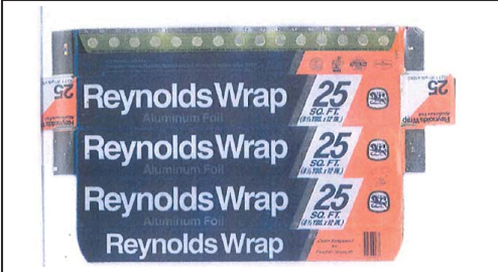
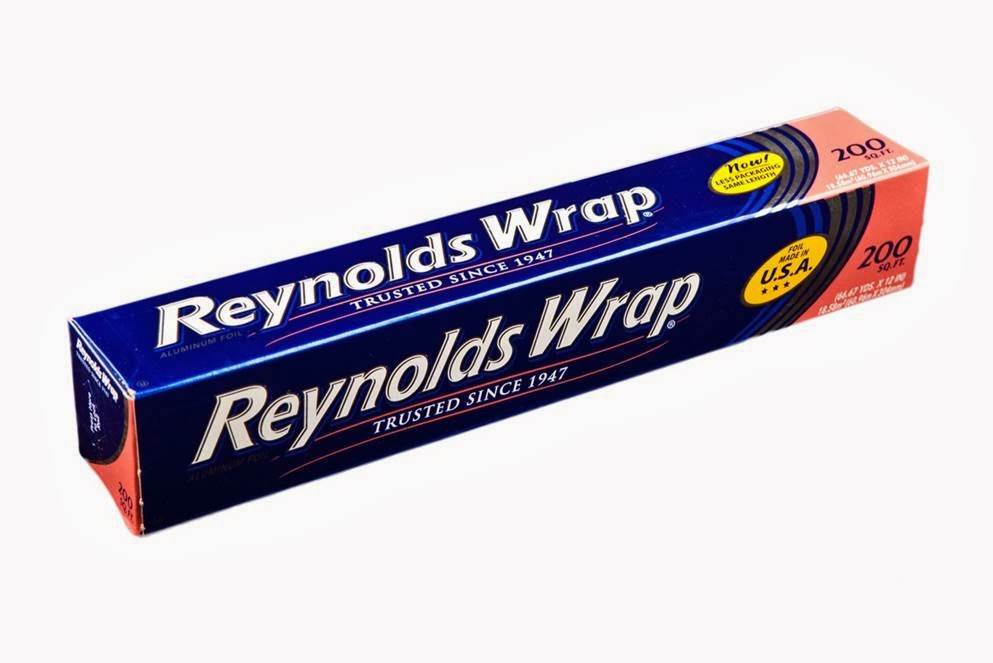
Reynolds owns two registrations for Reynolds Wrap packaging, filed in 1977 and amended in 1997.  Reynolds’ 1997 specimen showed a package that was majority metallic blue, with the far right end pink, separated by a series of sharp diagonal silver lines.  “Reynolds Wrap” is written on the blue area in bold silvery-white font and the square footage of the roll is in bold blue font on the pink area.

When Reynolds filed to renew both registrations in 2007, its specimen again differed.  It still had the blue, silver, and pink color-pattern and similar writing/font, but used a series of curved silver lines to separate the blue and pink areas. The PTO accepted the specimen and renewed the registrations.

In 2008, Reynolds changed the box again, altering the proportions of the blue and pink areas as well as the proportions of the writing in each area, and added the text “Trusted Since 1947” underneath the logo on the blue side of the box.

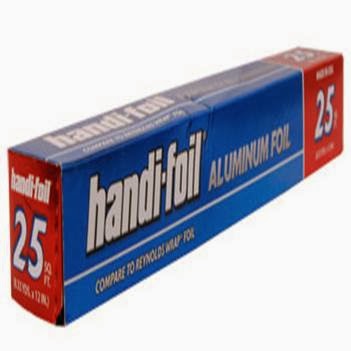
Here’s the Handi-Foil package:
 
When it entered the retail aluminum roll foil market, Handi-Foil representatives pitched Handi-Foil’s product as new and comparable to Reynolds Wrap, leading to Reynolds’ false advertising claim.

Abandonment: abandonment requires a use to be discontinued with no intent to resume such use.  The Reynolds Wrap box currently in use was concededly non-identical to the registered marks.  Reynolds argued that its changes were minor, and invoked tacking as a defense to the counterclaim.  Tacking requires a court to ask whether the marks in use are the legal equivalent of the earlier marks.  This is a more stringent standard than confusing similarity: it requires “the same, continuing commercial impression” and tacking is to be allowed “only in rare instances.”  However, courts are divided over whether tacking is a question of fact (9th Cir., W.D. Va.) or of law (Fed. Cir., 6th Cir.).  Given the Fourth Circuit’s previous reliance on Federal Circuit tacking precedent, the court here decided that tacking is a question of law, though this creates a “puzzling” disconnect with infringement (a question of fact).  Given that Reynolds admitted that the marks in use were different from the registered mark (a key element of an abandonment claim), and that tacking was Reynolds’ defense to the cancellation counterclaim, the court found that the burden of showing tacking rested with Reynolds.  The proper comparators were the current Reynolds box and the 2007 specimen accepted by the PTO.

Reynolds met its burden of showing that the current box created the same, continuing commercial impression as the 2007 specimen. “If Reynolds’ current box and the 2007 specimen cannot be said to create a continuing commercial impression … the Court cannot imagine any two non-identical marks that would.”  Why is the 2007 box the right comparator?  Because the PTO “analyzed Reynolds’ renewal application in light of the 2007 specimen,” so the court didn’t need to resolve the question of deference owed to the PTO.  Hunh?  The registered mark doesn’t look exactly like the 2007 specimen; starting the analysis from 2007 allows the PTO to determine the tacking issue until 2007, which is pretty much precisely the question before the court, so I would think the question of deference would need to be resolved.  Anyway, a reasonable juror couldn’t find the 2007 and 2008 marks failed to produce a continuing commercial impression, entitling Reynolds to summary judgment of non-abandonment.

Also, though side by side comparison was enough here, evidence of consumer impression and the markholder’s intent in modifying the designs also supported Reynolds.  A study commissioned by Reynolds found that “the vast majority of target buyers fail to recognize that Reynolds packaging has been modified.” The study was also evidence of Reynolds’ intention to not abandon its marks.

The court turned to Reynolds’ false advertising claim. Handi-Foil argued that its sales reps’ solicitations to retail stores weren’t “advertising or promotion.”  Using the standard test, the question was whether the statements were disseminated sufficiently to the relevant purchasing public.  Reading the facts most favorably to Reynolds, Handi-Foil contacted over a quarter of the relevant market, which created a genuine issue of material fact on advertising.

Handi-Foil also challenged falsity.  But questions of materiality and falsity are typically questions of fact. Plus, the court didn’t agree that professional retail buyers would find information about foil strength immaterial.  For purposes of denying summary judgment, “Handi-Foil’s clear focus on strength equivalency in its concerted sales pitches itself creates a genuine issue of fact as to whether strength equivalency was material.”  And the tests in the record created a genuine issue of material fact as to whether Handi-Foil was as strong as Reynolds Wrap.

Finally, Handi-Foil moved to strike Reynolds’ jury demand, which could happen only if the relief sought was entirely equitable. Reynolds asked for “damages to compensate it for lost sales and diminished goodwill in an amount to be proven at trial.” Handi-Foil argued that Reynolds’ damages expert spoke exclusively of unjust enrichment when deposed, thus only equitable remedies were at stake.  But a legal remedy isn’t unavailable just because the measure of damages may necessitate a look at the defendant’s business records. Reynolds was seeking “proxy damages”: quantifying its alleged damages for lost sales and goodwill by looking at Handi-Foil’s profits.  The use by a nonlawyer expert of the term “unjust enrichment” couldn’t vitiate Reynolds’ Seventh Amendment right to a jury.
Posted in damages, http://schemas.google.com/blogger/2008/kind#post, remedies, trademark | Leave a comment

What makes a fee-worthy dilution claim?

General Steel Domestic Sales, LLC v. Chumley, 2014 WL 793090,  No. 10-cv-01398 (D. Colo. Feb. 27, 2014)

Some of the more recent opinions from this hard-fought case in which plaintiff won its false advertising claims but lost trademark claims.  We can take as given that there’s some cross-contamination from the false advertising claims here, but still, fame is doing zero work as a constraint on filing bogus dilution claims. If an award of attorney’s fees on the dilution claim is inappropriate in this case, where the plaintiff fully lost the trademark aspects of its case and where it was laughable to allege federal dilution of the mark “General Steel,” when could it ever be?

General Steel moved for attorney’s fees on the false advertising aspects of the case.  An exceptional case is where the false advertising (or infringement, from whence the governing caselaw comes) is “malicious, fraudulent, deliberate, or willful.”  Absence of actual damages is also a factor, though such absence doesn’t preclude a fee award.  Here, though the court had found that the Lanham Act violations were willful, and though they continued even after the close of discovery, it declined to award fees.  The court had already ordered disgorgement of defendants’ profits even in the absence of evidence of lost sales.  Given that General Steel prevailed on only one of its claims, based on a “limited number” of false statements on defendants’ website, that it failed to show damages, and that it had already recovered defendants’ profits, the court declined to award fees as well.

Defendants sought fees on the federal dilution/false designation of origin claims (as well as the state law consumer protection claim).  For defendants, an infringement suit can be exceptional if it’s unfounded, brought in bad faith, or prosecuted in an unusually vexatious and oppressive manner.  Both objective merits and subjective motivations are relevant. 

The court found that General Steel had established two elements of its claim: that it had a protectable mark in “General Steel” and that defendants used the phrase in commerce without its permission.  In addition (and indeed, overlapping with these), the court found that four of the six relevant confusion factors favored General Steel, though none were dispositive.  The court ultimately found that the uses weren’t likely to confuse and that “many of the actual uses of the keywords ‘general steel’ in website text occurred either in the context of a clear comparison or in a context that, while puzzling, was unlikely to confuse consumers as to source.”  Under the circumstances, the court declined to find that the claim was maintained in bad faith or that its prosecution was so lacking as to be exceptional.

This seems right, but then, dilution: General Steel voluntarily dismissed its dilution claim after defendants’ motion to dismiss.  General Steel initially alleged that its mark was not merely descriptive or generic, that it had spent millions of dollars on advertising, that “General Steel is the third most searched term in the steel building industry,” that “[c]ustomers throughout the nation know the name General Steel” and that General Steel had “achieved a national reputation.”  It did not plead (nor could I imagine how it could ethically have done so) that its mark was “famous” or “widely recognized by the general consuming public.”  Nonetheless, the court concluded that given what General Steel did allege, the argument that the complaint was so lacking as to be exceptional failed.  Because the initial complaint contained factual allegations “regarding public awareness of General Steel’s mark,” it was not so defective as to evidence bad faith or improper purpose.  But federal dilution isn’t about “public awareness.”  It’s about fame. 

On the state law claims under the Colorado Consumer Protection Act, defendants argued that they were entitled to a fee award because of General Steel’s failure to show actual damages, and because General Steel used its CCPA claim to obtain documents from defendants in order to contact their customers and forward negative information about Armstrong to the Colorado Attorney General.  A CCPA action found by a court to be groundless and in bad faith, or brought for the purpose of harassment, requires a fee award.  A claim is groundless if “the allegations of the complaint, although sufficient to survive a motion to dismiss for failure to state a claim, are not supported by any credible evidence” or if the “proponent has a valid legal theory, but can offer little or no evidence to support the claim.”  Pursuing a claim despite knowing that it lacks admissible evidence can lead to a fee award.

While General Steel identified a theory of recovery (disgorgement), it didn’t show any credible evidence of actual harm, which was a key element of its CCPA claim, and thus the claim was groundless.  However, the court did not find bad faith or intent to harass, also a prerequisite.  Defendants submitted an email from a customer complaining about a telephone call purportedly from the Colorado Attorney General’s office disparaging defendants that the Assistant AG denied making, and a transcription of a voicemail message that the Assistant AG left for a defense attorney requesting the number of this case because he “got a call from [a General Steel attorney]” and “[b]oth sides have raised allegations.”

This evidence would only allow an inference that an entity other than the Colorado AG’s Office made at least one disparaging phone call to a customer, and that the AG’s Office was looking into the particulars of the instant case. But that didn’t support the conclusion that General Steel used its CCPA claim to get negative documents and send them to the AG or to contact defendants’ customers. Nor did the court find that General Steel’s “evidence and argument were so feckless or irrational that [the] continued pursuit of [its] CCPA claim must have been motivated by bad faith or a purpose to harass.”
Posted in consumer protection, dilution, fees, http://schemas.google.com/blogger/2008/kind#post, trademark | Leave a comment

Securities law and advertising law

Ann Lipton (Duke) has a post up on the import of Halliburton II, a securities case about the fraud on the market doctrine, with at least potential relevance to advertising law.   Another of her posts considers the securities law distinctions among facts, opinions, and puffery.   (Cert in the case she discusses was in fact granted.)   Lanham Act cases distinguish between fact and nonfact.  While opinions are actionable under securities law and Lanham Act cases generally put opinions on the nonactionable side of the line, the differences aren’t really as great as they might seem, as Lipton details, because courts call so much in securities an opinion.   Also, the FTC and state consumer protection laws are more willing to recognize liability for “opinions,” using reasoning similar to the defamation standard, which also allows liability when an opinion implies the existence of undisclosed defamatory facts.  The classic situation in advertising law is when the speaker claims special expertise in an area and the audience is not sophisticated in that area, and those mostly come up in FTC cases, or in state consumer protection law cases where a pitch is individualized and thus purportedly customized for the individual’s needs.

Posted in advertising, http://schemas.google.com/blogger/2008/kind#post, securities | Leave a comment

Glass houses: incidental use of sculpture in photo is fair

Neri v. Monroe, No. 11-cv-429 (W.D. Wis. Feb. 26, 2014) (magistrate judge), on remand from 726 F. 3d 989 (7th Cir. 2013)

From the outside, this doubtless expensive dispute looks like it resulted from an artist whose outrage over a (contested) failure of attribution converted to a doomed copyright fight, to no one’s benefit except that of the ever-growing law of fair use.  After a trip to the 7th Circuit finding plaintiffs’ copyright registration valid, the court on remand considered fair use and other defenses and found them dispositive.

Facts set out by the court: plaintiff Quincy Neri is a glassblowing artist who worked with another local artist (and defendant until he settled), Fritz Schomburg.  The other plaintiff co-owns the two copyrights at issue. Melinda Monroe and codefendant Steven Larson own Architectural Building Arts (ABA), a general contractor design/build firm. Defendant Leslie Sager is an interior designer who was employed by ABA during the condominium remodel at issue and is also an adjunct faculty member of the University of Wisconsin-Madison Design Studies program. Defendant Eric Ferguson is a professional photographer.

In 2008, Linda Hughes hired ABA to remodel her condo and remove a large mural from the dome of her entryway, replacing it with more modern artwork.  This required rebuilding the ceiling. Hughes hired an interior designer, Amy Radspinner, to assist with the remodeling and to handle decorating. Radspinner contacted Neri; Neri and Schomburg worked together to create a composition comprised of about 60 individual blown glass pieces that eventually were installed onto the remodeled ceiling of the entryway. 

There’s a factual dispute about Neri and Schomburg’s hiring that doesn’t matter to the outcome; in addition, the court mentions that the court of appeals rejected the argument that Schomburg was the true author; in what seems to have been a lightly-considered aside that has new resonance after Google v. Garcia, the court of appeals commented, “To the extent that Schomburg added features in the course of blowing the glass, he has a separate claim of intellectual property in a derivative work, but this does not detract from Neri’s rights.”

ABA hired a professional engineer to help design the ceiling and met several times with Schomburg (sometimes accompanied by Neri) about the design and construction of the ceiling in order to ensure it would support the weight of the glass and complement the artwork aesthetically.  Neri made suggestions about various materials that could support the weight, but she didn’t design, engineer, or build it.  ABA’s design team, including Sager, worked with Schomburg to find the best lighting for the artwork, which was ultimately installed in a custom-designed alcove.  When the pieces were mounted, the lighting cast spiral shadows onto the ceiling and walls.  Both Neri and Schomburg considered the spiral shadows to be an integral feature of the artwork. Neri testified that she could not reproduce the artwork without reproducing an exact copy of the ceiling. 

Consistent with industry practice, Monroe got Hughes’ permission to take photos of the remodeling project to document ABA’s work, to advertise ABA’s services and to apply for industry awards on ABA’s behalf. Ferguson took a series of photographs of the interior of Hughes’s condominium, including two photographs of the completed entryway and ceiling. Neither photograph depicts all of the glass pieces, although some pieces appear in both.  Ferguson’s goal was to showcase the design work and changes, and the photos show the glass pieces, the barrel-vault ceiling, a waterfall designed by ABA, the furniture, other art and decorative accessories.  ABA paid Ferguson for unlimited usage rights in the photos.

ABA posted some photos, including the two depicting the entryway, in a newsletter and on its website, and submitted them as part of its application for “Contractor of the Year” awards sponsored by the National Association of the Remodeling Industry.  These awards are what you probably think they are; they aren’t art awards.  ABA got two NARI Contractor of the Year awards for its interior design and its construction work at the Hughes’ condominium, including its reconstruction of the entryway’s ceiling and its fireplace redesign (and others for its work in the bathroom specifically).  ABA didn’t claim to have made or to own the glass in the photos, nor did it sell the photos.

With Ferguson’s permission, Sager posted a photo of the entryway ceiling on her own website, along with two “before” images showing the dome that had been replaced, with the text:

A LITTLE BIT OF GLASS

A large dome with a painting of the four seasons of Wisconsin by Richard Hass [sic] did  not appeal to the new residents of this condominium.  They were able to donate the painting and dome to the Madison Children’s museum for a tax deduction.  With the help of Amy Radspinner, I converted the dome into a smaller barrel vault with an integrated cover to conceal the LED spot lights. Local Glass blower Fritz Schomburg, designed a series of large aquatic glass pieces to hang from the vault in keeping with the lake view.

During a field trip to the Hughes residence with students from a class she was teaching at the University of Wisconsin, Sager took a photo of her students looking at the vault ceiling where the artwork was installed.

Again, the photo captured only a portion of the 60 glass pieces. She posted the photo on the University of Wisconsin’s Design Studies website “for the purpose of showing students engaged in an enrichment experience and not for any specific reason related to the glass artwork.

According to Neri, it was not until she found the photos on ABA’s website and discovered that the artwork had “won” NARI awards that she began to think of it as anything but “just another project.” (The court rejected her claim that the sculpture “won” an award for which she received no credit, since NARI awards are not art awards.)  After she sued, ABA and Sager removed the allegedly infringing photographs from their websites.

Fair use: first, the court noted that factor one is the “heart of the fair use inquiry,” citing Cariou. [Compare the later citation to Harper & Row saying that Factor 4 is the most important.]  Transformativeness requires change in the work or the context such that the plaintiff’s work is transformed into a new creation.  Ferguson’s photos were “highly transformative.” The sculpture was 3-D “art for art’s sake…. Its purpose, presumably, is to beautify the Hughes condominium and to provide visual and aesthetic pleasure to those who view it as they walk under it through the entryway.” The photos were 2-D, realistic photos of an interior with a “commercial aesthetic.” “Their purpose is not to beautify but to document (albeit to document the pleasing aesthetics and transformative power of the project as a whole) and to inform the public about the remodeling work performed by ABA on Hughes’s condominium, in order to showcase the firm’s design and construction work.”  Ferguson wasn’t trying to photograph the sculpture itself or to create an “artistic” photo that “capitalizes on the sculpture,” but rather he attmpted “to show as accurately and realistically as possible what the condominium’s entryway–the entire entryway–looked like after it was redesigned and rebuilt. Ferguson’s intended and actual photographic subject was the room, not the ceiling sculpture.”  (One way of reading this is that fair use is substituting or supplementing the incidental use exception for works caught in photos or video of a more general subject.)  The partial images of the sculpture were given a new purpose, meaning, or message in the photos, given that “the medium, composition, scale, character, expression and intended use of Ferguson’s photographs are completely different from those of the sculpture itself.”  This factor weighed heavily in defendants’ favor.

While the sculpture was creative, and that factor favored plaintiffs, it doesn’t help. 

Factor three: in evaluating the amount used, the court noted that the sculpture was mounted onto another work—the new barrel-vaulted ceiling—and that it was impossible to take pictures of the ceiling without also capturing images of the sculpture.  There’s no per se rule about the amount that may be copied if the amount is necessary to the purpose and character of the use. Given defendants’ proper aim to publish photos of their own work, and that neither picture shows all 60 glass pieces of the sculpture, but rather shows portions “along with other equally important features of the redone hallway, including the waterfall, furniture and decorative accessories,” the amount copied was reasonable. And here the court quotes the court of appeals, which agreed that the copying was “incidental” and necessary to show what ABA had done.  

Plaintiffs argued that ABA could’ve just had Ferguson take photos before the glass pieces were installed.  He could have done that, but ABA redesigned and rebuilt the ceiling and the lighting specifically to accommodate and illuminate the sculpture.  (Plus there’s a “persuasive argument that the ceiling design was so integral to the artwork that ABA is a joint author of the work,” but that’s unnecessary because of fair use—add another issue to the things fair use can avoid decisions on!)  As a result, “ABA was entitled to take photos of the ceiling depicting how the ceiling served the purpose for which ABA had designed and built it.”  A photo of the finished installation, with the entire entryway in place, was necessary for ABA to show its capabilities to potential clients and to apply for industry awards.

Also, the medium change was relevant to factor three, since it went to substitution (which seems like factor four, but ok): “no one interested in viewing or purchasing a glass sculpture … would be satisfied by mounting a copy of one of Ferguson’s photographs to his or her ceiling.”  Neri acknowledged that the photos didn’t accurately depict the color of the glass or the shadows cast by the special lighting.  This qualitative difference, plus the incidental status of the glass pieces to the true subject of the photo, the entryway, made factor three weigh in defendants’ favor.

Market effect: “the single most important element of fair use.”  (Except for transformativeness.  Amongst the important factors …)  Courts must consider substitution, including substitution for potential markets.  Here, there was no evidence of any harm to the market for the sculpture or other original Neri works.  There’s no market for the already-installed sculpture, which can’t be publicly displayed; and no one would consider a photo a substitute for the sculpture anyway.  Neri didn’t attempt to sell photos of her own work; she only charged an initial fee for the physical sculpture.  Without evidence that a market for the sculpture or derivative works thereof existed, defendants’ activities couldn’t have affected it, so factor four also weighed in defendant’s favor.

Since this was true of Ferguson’s photos, it was also true of Sager’s candid, posted on a university website for educational purposes. “On a common-sense level, it is difficult to find that the use is ‘unfair,’ where plaintiffs have not been deprived of any value in the sculpture and in fact, could only have benefitted by the publication of the photographs. Clearly, this is a case where the goals of copyright law are better served by permitting the use rather than denying it.”

The court also addressed damages, just in case.  Plaintiffs weren’t entitled to statutory damages, since the work was unpublished (it was located in a private residence, and the allegedly infringing acts, being unauthorized, couldn’t constitute publication) and registration did not take place until long after the photos went up on the respective websites.  Though they may have stayed up briefly after the registration issued, that doesn’t change statutory damages eligibility, which depends on when an infringement commenced.

As for actual damages, Neri proved none—neither a loss to her or a gain to defendants. “Although a plaintiff need not prove exactly the amount of damages from the infringement, the fact or existence of such damages must be shown with more than mere speculation.”  There was no evidence of any profit or other financial benefit to defendants attributable to the use of photos that contained incidental images of part of the sculpture, and no evidence of diverted sales.  Plaintiffs’ primary argument was they were deprived of the knowledge that ABA won a NARI award for its work, which thereby deprived them of an opportunity to market the sculpture.  But a NARI award isn’t an art award, and anyway there was no evidence that their ability to market the sculpture was in any way harmed. “Indeed, even if plaintiffs somehow could market the sculpture–which is not theirs to sell–or derivative works of some sort, there is no evidence that they have made any real attempt to do so.”

Plaintiffs argued that they were deprived of a licensing fee for the right to photograph the sculpture.  “This is unsupported conjecture.” The question isn’t what the owner would’ve charged, but what the fair market value was.  “Plaintiffs have never sold a license for anything related to this sculpture; Neri has never sold a license to utilize any rights to any of her artwork; and plaintiffs have adduced no evidence of any benchmark licenses, that is, what licensors have paid for use of similar work.” The only record evidence was that there was no such market; Ferguson testified “that he did not consider the incidental appearance of the glass pieces in the photographs to be of any value, and for that reason he would not have considered paying a licensing fee for the benefit of such use.” Monroe testified that “based on her knowledge and experience in the design/build remodeling industry, she is not aware of a single instance of licensing of a piece of art in a residence. On this record, plaintiffs’ claim for licensing fees is wishful thinking.” Damages “must be proved, and not just dreamed.”

Posted in damages, http://schemas.google.com/blogger/2008/kind#post | Leave a comment

Reading list: Copyright equality

Peter DiCola, Copyright Equality: Free Speech, Efficiency, and Regulatory Parity in Distribution. Abstract:

Copyright law treats webcasters like Pandora, on-demand streaming services like Spotify, the satellite radio company Sirius XM, and traditional radio broadcasters like Clear Channel in vastly different ways. The total royalties paid by each type of music distribution service to copyright owners can vary from five to seventy percent of revenue. This and other forms of differential treatment have slowed or deterred innovation while limiting consumer choice. The disparities have become a pressing problem for policymakers. Two recently proposed bills, the Internet Radio Fairness Act and the competing Interim FIRST Act, both address the disparate treatment across webcasters, satellite radio, and cable radio. But each bill contains only fragments of a real solution. Copyright law needs a new approach grounded in the reasons for equal treatment of different distribution technologies. This Article presents an equality principle based on both economic efficiency considerations and First Amendment principles. These two theories of copyright policy are often thought to conflict. But this Article shows that efficiency and free speech values can align and reinforce each other. The economic argument focuses on barriers to entry for new music distribution technologies and the distortions to consumer choice that result from unequal treatment. The First Amendment argument is both an extension and new application of longstanding jurisprudence that guards new communications media from discriminatory treatment, with an eye toward allowing the information environment to evolve to the public’s benefit. The Article closes with policy recommendations in line with the equality principle and specific proposals for implementation.

Interesting entrant into the genre of “if we were serious about applying even minimal First Amendment scrutiny to copyright, some things would have to change.”  (My entry.)  This one is notable because it gets into the grimy details of what is very clearly an economic regulatory/distributional policy, not a speech policy (to the extent those two can be distinguished), and hammers home that we have to pick whether our frame of reference will be the post-Lochner settlement or the First Amendment.  Of course the Court has already, in practice, picked, but the sections of the Copyright Act DiCola discusses make clear that its shallow analysis was inadequate.

Posted in copyright, http://schemas.google.com/blogger/2008/kind#post, reading list | Leave a comment