A consumer protection case for Fox Mulder?

Hey, I get to make an X-Files reference!

Lilly v. ConAgra Foods, Inc., — F.3d —-, 2014 WL 644706 (9th Cir. Feb. 20, 2014)

Lilly alleged that the tasty coating on sunflower seed shells is designed to be eaten, and is eaten, before the inedible shell is spat out and the kernel eaten.  The package instructions expressly tell consumers to put the shells in their mouths.  Therefore, she argued, the sodium content in a serving of sunflower seeds must include the sodium in the edible coating, but ConAgra didn’t disclose that additional sodium, or didn’t disclose it with equal prominence to the sodium in the kernels.  She brought the usual California claims.

The district court dismissed her claims as preempted; over a dissent, the court of appeals reversed.

The NLEA requires that a food’s label include the amount of sodium “in each serving size or other unit of measure.”  The FDA has regulations about how this is to be calculated.  First, “[n]utrition information relating to food shall be provided for all products intended for human consumption.” Second, the “declaration of nutrient and food component content shall be on the basis of the food as packaged or purchased.” Third, the amount of sodium in the food is “based on only the edible portion of food, and not bone, seed, shell, or other inedible components.”

But Lilly wasn’t trying to force ConAgra to include the sodium content of the shells.  She wanted ConAgra to disclose the sodium content of the coatings on top of the shells, which “most certainly are not inedible. To the contrary, the coatings impart flavor and are indisputably intended to be ingested as part of the sunflower seed eating experience. Indeed, these coatings come in flavors such as ‘Ranch’ and ‘Nacho Cheese’ precisely because they are to be consumed before the shell is discarded.”  Because federal law requires that sodium listings include the “edible portion” of the food, the portion of the edible coating on the shell “must be accounted for in the calculation of the sodium content.”  Lilly sought to enforce state requirements identical with federal law, and thus her claims were not preempted.

ConAgra argued that the Nutrition Facts Panel on the sunflower seeds references only the kernels, any reasonable consumer would understand that the sodium listing did not include the amount on the shells. (Comment: yeah, right.)  But that was a factual question, not for the panel.

Judge Vinson, sitting by designation, dissented. He would have found that the regulation naturally and plainly excluded the shell.  “Although we might prefer a regulation that includes the shell’s absorbed salt and to draw a distinction between an edible ‘coating’ and an inedible shell, we are nonetheless bound to apply this unambiguous regulation objectively as it has been written.”  Any revision should be left to the FDA.
Posted in california, consumer protection, fda, http://schemas.google.com/blogger/2008/kind#post, preemption | Leave a comment

British villains, by which we mean Marvel’s Loki etc.

So what are the trademark implications of the Jaguar ads starring three British actors who tout their credentials as film villains?  Any copyright implications, since they’re evoking some of their characters?  The disclaimers don’t say a word about the franchises that some viewers might be thinking of.

Posted in http://schemas.google.com/blogger/2008/kind#post, trademark | Leave a comment

FTC wins big in case against light bulb sellers

The FTC’s Business Center Blog has the details, which include a $21 million refund order representing the gross revenues from the advertised products, with no offsets for the benefit consumers actually received.  A very strong opinion for the FTC, requiring a high level of substantiation for specific claims and reiterating that substantiation is required for reasonable interpretations of ads, not just for explicit claims in ads.

Posted in consumer protection, ftc, http://schemas.google.com/blogger/2008/kind#post | Leave a comment

Image advertising is commercial speech

Jordan v. Jewel Food Stores, Inc. — F.3d —-, 2014 WL 627603 (7th Cir. Feb. 19)

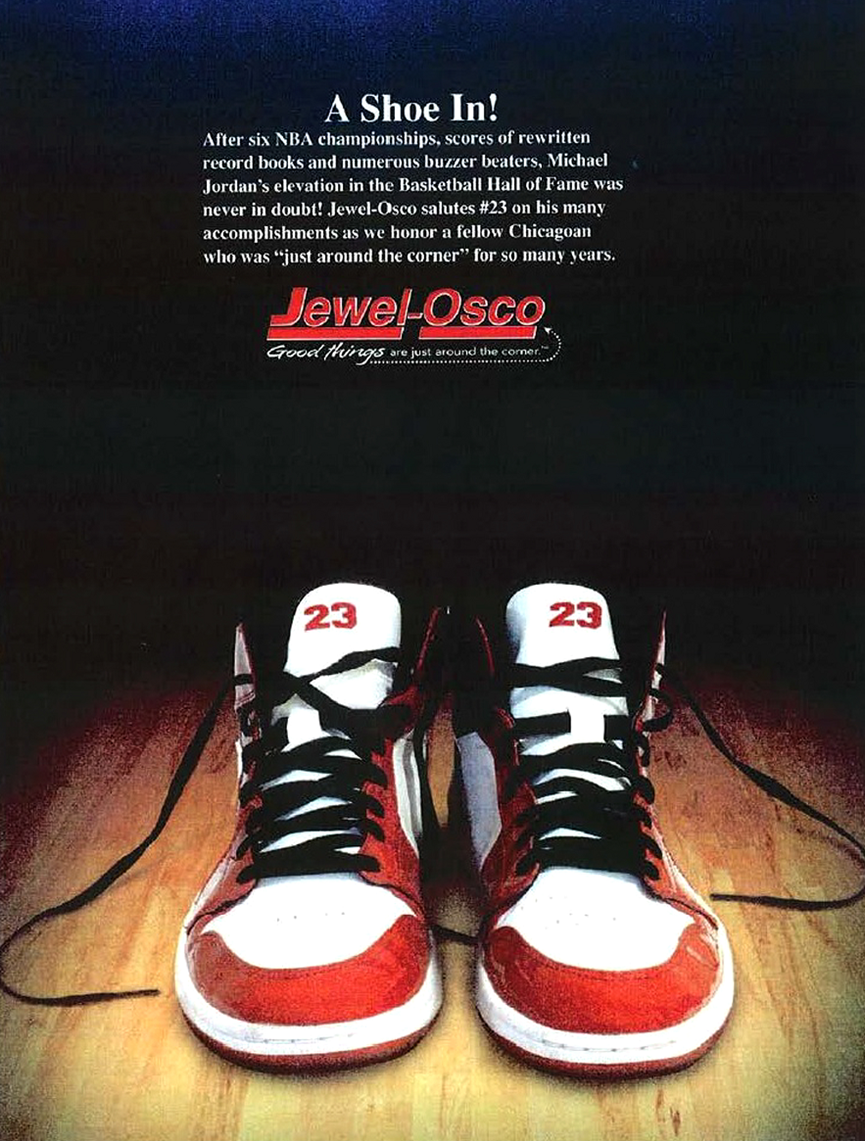
When a commemorative magazine issue celebrating Michael Jordan’s career carries ads referencing that career, how should right of publicity and Lanham Act claims, and related state law unfair competition/deceptive practices claims, against those ads be evaluated?  The district court found that a “congratulations”-style ad that identified the sponsor but didn’t tout its products was noncommercial speech, and thus outside the scope of both laws. The court of appeals reversed.

“On the occasion of Jordan’s induction into the Naismith Memorial Basketball Hall of Fame in September 2009, Time, Inc., the publisher of Sports Illustrated, produced a special commemorative issue of Sports Illustrated Presents devoted exclusively to Jordan’s remarkable career.”  Jewel was offered free ad space in exchange for stocking the magazine in its stores. 
 
The text:

A Shoe In!

After six NBA championships, scores of rewritten record books and numerous buzzer beaters, Michael Jordan’s elevation in the Basketball Hall of Fame was never in doubt! Jewel-Osco salutes # 23 on his many accomplishments as we honor a fellow Chicagoan who was “just around the corner” for so many years.

Jewel’s ad was commercial speech because it prominently featured Jewel’s logo and marketing slogan, “which are creatively and conspicuously linked to Jordan in the text of the ad’s congratulatory message. Based on its content and context, the ad is properly classified as a form of image advertising aimed at promoting the Jewel-Osco brand.”  Remand for consideration of the substance of the claims.

The court began by noting that Jordan conceded that, if the ad was noncommercial speech, his claims would fail.  But the law, it continued, was considerably more complex than the premise that the right of publicity and trademark can’t apply to speech that is noncommercial in the constitutional sense.  (Which is why the law is screwed up, sigh.)  Among other things, though each of the claims had a “commercial” element, it wasn’t clear that First Amendment commercial speech doctrine should be used to define that term for each cause of action.

Supreme Court jurisprudence generally comes from “public law” cases, where “the commercial/noncommercial classification determines the proper standard of scrutiny to apply to the law or regulation under review in the case.”  But this is a clash of private rights.  (Ooh, state action.  NYT v. Sullivan, anyone?)  So that means that even if the ad is noncommercial speech, the trademark and right of publicity claims might survive; according to McCarthy, there’s no consensus on how to resolve IP v. free speech claims, “and decisions from the lower courts are a conflicting mix of balancing tests and frameworks borrowed from other areas of free-speech doctrine.”

But Jordan’s concession allowed the court to skip further discussion.

The basic definition of commercial speech, “speech that proposes a commercial transaction,” is just a starting point—the core, but not the full extent of commercial speech.  Bolger, for example, involved speech with noncommercial and commercial elements; there, pamphlets providing general information about contraception, and specific information about the manufacturer’s products, were commercial speech because they had the form of an ad, referred to specific products, and were distributed by the manufacturer for economic purposes.  None of the three elements (form, specific product, economic motivation) is sufficient in itself, and not all are necessary.

Jewel argued that its ad didn’t propose a commercial transaction.  True, the literal words congratulated Jordan.  But context was also important, especially in identifying commercial speech, since “[m]odern commercial advertising is enormously varied in form and style.”

Image advertising is advertising:

We know from common experience that commercial advertising occupies diverse media, draws on a limitless array of imaginative techniques, and is often supported by sophisticated marketing research. It is highly creative, sometimes abstract, and frequently relies on subtle cues. The notion that an advertisement counts as “commercial” only if it makes an appeal to purchase a particular product makes no sense today, and we doubt that it ever did. An advertisement is no less “commercial” because it promotes brand awareness or loyalty rather than explicitly proposing a transaction in a specific product or service. Applying the “core” definition of commercial speech too rigidly ignores this reality. Very often the commercial message is general and implicit rather than specific and explicit.

Thus, Jewel’s ad did more than congratulate Jordan. It promoted Jewel’s supermarkets.  It wasn’t just civic boosterism, as congratulating a local community group might be.  “Jewel’s ad has an unmistakable commercial function: enhancing the Jewel-Osco brand in the minds of consumers. This commercial message is implicit but easily inferred, and is the dominant one…. [A]n ad congratulating a famous athlete can only be understood as a promotional device for the advertiser. Unlike a community group, the athlete needs no gratuitous promotion and his identity has commercial value. Jewel’s ad cannot be construed as a benevolent act of good corporate citizenship.”

The court noted that Jewel-Osco’s graphic logo and slogan appeared just below the textual salute to Jordan. The bold red logo was prominently featured in the center of the ad and in a font size larger than any other on the page.  They were set off from the congratulatory text, drawing attention to Jewel’s sponsorship.  And the congratulatory text incorporated Jewel’s slogan (“just around the corner”).  “The ad is plainly aimed at fostering goodwill for the Jewel brand among the targeted consumer group—‘fellow Chicagoans’ and fans of Michael Jordan—for the purpose of increasing patronage.”

The district court thought that there was no particular invitation to buy a product.  True, the ad didn’t showcase specific products, which was a relevant consideration, but far from dispositive, especially where image ads are concerned.  The ad invited readers to buy whatever they would buy at a grocery store.  “That it doesn’t mention a specific product means only that this is a different genre of advertising. It promotes brand loyalty rather than a specific product, but that doesn’t mean it’s ‘noncommercial.’”

The district court thought that the slogan and graphic logo just identified the speaker.  But that overlooked their value as advertising tools.  The repetition of the slogan in the congratulatory message “only makes sense if the aim is to promote shopping at Jewel-Osco stores.” The court pointed out that Jewel’s copywriter thought the repetition of the slogan was “too selly” and “hitting too over the head.”

The ad was commercial speech by necessary implication:

In short, the ad’s commercial nature is readily apparent. It may be generic and implicit, but it is nonetheless clear. The ad is a form of image advertising aimed at promoting goodwill for the Jewel-Osco brand by exploiting public affection for Jordan at an auspicious moment in his career.

Returning to Bolger, the ad had the form of an ad; it was easily distinguishable from the editorial content even though it followed the special issue’s theme; it promoted Jewel-Osco supermarkets.  It promoted patronage at Jewel-Osco stores, similar to promoting purchase of a product.  And it served an economic purpose: “to burnish the Jewel-Osco brand name and enhance consumer goodwill.”  The court noted that Jewel’s marketing representatives said it was a “great offer” and it “would be good for us to have our logo in Sports Illustrated ” because “having your logo in any location where people see it is going to help your company.” Further, Jewel gave Time valuable consideration—placement in its stores—in exchange for the ad, which suggested that “it expected valuable brand-enhancement benefit from it.”  Though Jewel’s tribute “was in a certain sense public-spirited, … Jewel had something to gain by conspicuously joining the chorus of congratulations on the much-anticipated occasion of Jordan’s induction into the Basketball Hall of Fame.”

A contrary holding would be troublesome for “athletes, actors, celebrities, and other trademark holders seeking to protect the use of their identities or marks.”  After all, image ads are common.  The court pointed to ads by Olympic sponsors, many of which consist of images of athletes coupled with the advertiser’s mark and expressions of support for the team, with nothing in particular offered for sale. “To say that the ad is noncommercial because it lacks an outright sales pitch is to artificially distinguish between product advertising and image advertising. Classifying this kind of advertising as constitutionally immune noncommercial speech would permit advertisers to misappropriate the identity of athletes and other celebrities with impunity.”

However, the court claimed that a company could use its logo or slogan “in an otherwise noncommercial way without thereby transforming the communication into commercial speech.”  The holding here was “tied to the particular content and context of Jewel’s ad as it appeared in the commemorative issue of Sport Illustrated Presents.”  Yes, but—after this, how should product placement be analyzed?  Maybe there’s not too much worry about trademark, but what if New Girl makes a joke about William Shatner in the same episode that features paid Subway sandwich placement—would Shatner have a right of publicity claim?

Finally, the court rejected the district court’s conclusion that the commercial and noncommercial elements of the ad were inextricably intertwined.  “[T]he inextricably intertwined doctrine applies only when it is legally or practically impossible for the speaker to separate out the commercial and noncommercial elements of his speech.… But simply combining commercial and noncommercial elements in a single presentation does not transform the whole into noncommercial speech.” 

The court of appeals disagreed with Hoffman v. Capital Cities/ABC, Inc., 255 F.3d 1180 (9th Cir. 2001), which held that a fashion article featuring altered movie stills was noncommercial speech because the editorial elements were inextricably intertwined with the commercial elements. When Dustin Hoffman sued over a photoshopped image of himself in his role in Tootsie, the 9th Circuit held that “the article as a whole is a combination of fashion photography, humor, and visual and verbal editorial comment on classic films and famous actors. Any commercial aspects are ‘inextricably entwined’ with expressive elements, and so they cannot be separated out ‘from the fully protected whole.’” This was wrong, since there was no legal or practical barrier to “publishing a fashion article without superimposing the latest fashion designs onto film stills of famous actors.” (This disagreement suggests that the holding isn’t exactly as limited as the court claims, though the court also says that it is not opining on whether the ultimate result in Hoffmanwas nonetheless correct.  Also, note the court’s use of generic “photoshopped,” which I have repeated.)  Here too, “[n]o law of man or nature compelled Jewel to combine commercial and noncommercial messages as it did here.”

Comment: Jewel endorsing Jordan isn’t the same thing as Jordan endorsing Jewel, though I doubt courts will recognize that; anyway, with the metastasizing right of publicity, confusion doesn’t really matter.  I agree that this is an ad.  But I’m distressed by the substantive claims.  And I do wonder about product placement.
Posted in commercial speech, first amendment, right of publicity, trademark | Leave a comment

Lanham Act 43(a) and Rule 9(b)

SKEDKO, Inc. v. ARC Products, LLC, 2014 WL 585379, No. 3:13–cv–00696 (D. Ore. Feb. 13, 2014)

Short opinion finding that Rule 9(b) applies to Lanham Act false advertising claims (here, counterclaims), because they sound in fraud.  Fraud might not be an essential element of the statutory violation, but if the claimant chooses to allege fraudulent conduct, then the claim sounds in fraud.  “By asserting that plaintiff unfairly obtained business by intentionally misleading customers about the characteristics of its product, defendant made allegations that reach beyond a mere unintentional misrepresentation. Instead, defendant asserted that plaintiff’s misrepresentations were made knowingly, satisfying the scienter element of fraud.” Thus, Rule 9(b) applied, and the counterclaims were dismissed because they failed to state when the alleged misrepresentations were made; where the misrepresentations were made; or who relied on them.  (Note: that last, actual reliance, is not required for literal falsity under §43(a), or for infringement for that matter.)

Comment: trademark plaintiffs almost universally allege intentional infringement.  How often do we see Rule 9(b) dismissals for this reason?  Trademark is literally special pleading!
Posted in http://schemas.google.com/blogger/2008/kind#post, procedure | Leave a comment

retail purchases mean class isn’t ascertainable

Sethavanish v. ZonePerfect Nutrition Co., 2014 WL 580696, No. 12-2907 (N.D. Cal. Feb. 13, 2014)

Another case finding that, because the product is cheap and people don’t keep purchase records, and because somebody might lie to get a piece of any ultimate settlement or award, no class action may be maintained.  Here the products are ZonePerfect nutrition bars, whose “all-natural” claim is allegedly false and misleading.  Plaintiff brought the usual California claims.

Plaintiff properly alleged standing by alleging her reliance on the misrepresentation for a purchase, even if the product in question is not “defective, overpriced, or of inferior quality,” and even if she didn’t pay a premium for the product. “She bargained for a nutrition bar that was all natural, and she allegedly received one that was not.”  Plus, though she testified that she sometimes buys all-natural products, that didn’t prevent her from also valuing all-natural products.

However, the class was not ascertainable.  ZonePerfect doesn’t have records of purchases, since it mostly sells to retailers.  Affidavits would be insufficient, because the defendant couldn’t challenge class membership that way, and fraudulent or inaccurate claims could dilute the recovery of absent class members, undermining the finality of any judgment with respect to them.  Plaintiff didn’t have any standard for determining class membership or weeding out inaccurate or fraudulent claims.

Though district courts in the 9th Circuit are split, the court found the rejectionist cases more persuasive.  In response to the more flexible courts’ point that this ascertainability standard precludes class actions involving low-value consumer products, the court noted that, while its standard “may restrict the types of consumer classes that can be certified, they do not bar certification in consumer class actions altogether.”  In some cases, retailer or bank records may allow determination of a class membership.  (Because consumers lie, but banks don’t.)  Anyway, the FDA could define “all natural” or the California AG could sue over these kinds of claims.  Just not the people actually harmed.
Posted in california, class actions, consumer protection, fda, http://schemas.google.com/blogger/2008/kind#post, standing | Leave a comment

Connecticut lawyer can’t bring unfair competition claim against California lawyer

Shehu, LLC v. Adams, 2014 WL 567832, CV136017710S (Conn. Super. Ct. Jan. 17, 2014)

Plaintiffs (a Connecticut lawyer and his firm) sued Adams and his firm, both located in California.  In 2012, Adams emailed Shehu, LLC and two employees of the Connecticut Bar Association, stating that the plaintiffs “commented on an article with a mass produced, mechanically generated, irrelevant comment,” “spammed [his] site with the message,” and “used a dishonest ruse.” The email claimed that the plaintiffs engaged in unethical conduct and violated the ABA rules of professional responsibility.  Shehu responded and Adams reiterated his allegations, with the subject line, “Your Spam is a professional ethics violation.” A third email to the bar employees pointed to comments in his previous emails and stated that he had “no evidence” that Mr. Shehu or anyone at the Shehu law firm “had personal knowledge of the comments.”

Plaintiffs alleged that the emails were libelous per se and constituted unfair trade practices; this opinion only dealt with the claims under the Connecticut Unfair Trade Practices Act.  Defendants challenged, essentially, standing. A CUTPA claim is available to [a]ny person who suffers any ascertainable loss of money or property, real or personal, as a result of the use or employment of a [prohibited] method, act or practice.”  As a remedial statute, the law is construed broadly.  The state supreme  court has held that “CUTPA is not limited to conduct involving consumer injury and … a competitor or other business person can maintain a CUTPA cause of action without showing consumer injury.”

Nonetheless, a plaintiff “must have at least some business relationship with the defendant in order to state a cause of action under CUTPA.” CUTPA was designed to protect two sets of people: consumers (from unfair or deceptive acts or practices) and other business people (from unfair competition), but “at the very least, other business people, who are not direct competitors, must have some type of commercial relationship with the alleged wrongdoer—commercial relationship not being so much a business relationship but some kind of relationship in the marketplace so that the particular acts of wrongdoing alleged will interfere with fair and open competition in that particular marketplace.”

Here, plaintiffs alleged that they were both attorneys, both engaged in internet marking efforts, and both use blogs to share information.  The cases require a “nexus” between the parties’ relationship and “an ascertainable loss caused by the defendant’s unfair or deceptive practices.” Here, the parties’ relationship wasn’t competitive in any ordinary sense, nor was it direct or “in a commercial marketplace.” Before the incident that sparked this conflict, the parties most likely didn’t know of the other’s existence.  It wasn’t enough that both practice law and use the internet to market/blog.  Adams was licensed exclusively in California and Shehu exclusively in Connecticut. 

Even if Shehu’s conduct, as alleged, “diminish[es] the number of websites competing for keywords desirable to the [d]efendants” such that it would result in less competition for the defendants’ websites “to appear at the top of search engine results for those desirable keywords,” that was still insufficient.  (I don’t even understand this allegation.)  The court noted that potential clients wouldn’t necessarily pick the first firm listed, and any decision they’d make between the parties would be more likely based on the location in which they desired to have the services performed.  This alleged commercial relationship was too tenuous to conclude that the “particular acts of wrongdoing alleged will interfere with fair and open competition in that particular marketplace.” Thus, the case was distinguishable from one in which an attorney who once worked for the defendants alleged that they made false statements that harmed her reputation; there, the parties were licensed to practice in the same state.
Posted in consumer protection, standing, unfairness | Leave a comment

HLR Free Speech Symposium: Jack Balkin, Old School/New School Speech Regulation

Speech presupposes an infrastructure. Sometimes obvious, sometimes not.  NYT isn’t simply the print on the page, it’s a staff and a building and printers and printers’ unions and delivery trucks and ad agencies and all the infrastructure that allows that to happen.  Public libraries; postage subsidies; many different things that make idea circulation possible. Many old chestnuts of 1A law are attacks on infrastructure: CIO v. Hague, attempt to deny CIO any place to meet in public.  Ban on handbills = attack on mode of expression. 

Distinction now between way in which speech was primarily regulated before the digital age and new ways of regulating.  Old school is still around; new school techniques are all aimed at digital infrastructure.  Hardware, institutions: payment systems, search engines.  Large set of practices and institutions. Old school target is speaker/publisher; new school target is elsewhere.  Old & new school supplement each other.  Edward Snowden: they bring down an airplane to try to catch his body; British version of NSA detains Glen Greenwald’s spouse as old-school courier; Chelsea Manning’s military imprisonment used to make an example. 

New school techniques: variations on the idea of prior restraints.  Collateral censorship.  When you have a few media companies, state can own them all; can license them; can use family/political ties to control them. Not that difficult for state to have continuous relationships with them—a global phenomenon. But what if you multiply the numbers? Traditional strategies of control have to be changed—so you go after platform/conduit instead.  Platform has different incentives and will overblock/censor the individual speaker.

Digital prior restraint. Not the Pentagon Papers, but prior restraint also covers licensing/control systems, many administrative.  Prior restraint is when the state restricts first, gives permission later. Deliberate overbreadth. Low visibility.  Shifts burden of inertia and action.  Force people to identify themselves, promoting self-surveillance.  Filtering: direct by gov’t or inducing private parties—deliberately overbroad, no hearing before the vact; very low visibility, shifts burden of inertia to you. Domain name seizure is the same way.

SOPA/PIPA were designed to reorient how IP rights were enforced online.  Ingenious new techniques for getting at pirates—many had digital prior restraint, such as AG’s ability to allege that a foreign infringing site (defined to include some nonforeign sites) exists and get an injunction.  AG could get ex parte order and go to search engines, advertisers, payment systems requiring them to block/not do business with the site.  Break the internet (don’t resolve the DNS): that’s a prior restraints. Private prior restraint: if someone alleged that a site was dedicated to the theft of IP, that private person could send a letter to advertisers and payment systems.  Ex parte and not even in front of a judge. 

McCarthyism: public/private cooperation to create blacklists. You can do this in the new school too. Your ISP/infrastructure provider can provide the gov’t with data access; gov’t can give them immunity for that.  Can give immunity for collateral censorship.  Can give immunity for blacklisting people w/whom you refuse to deal. 

New form of soft power, in which gov’t can’t actually go after Wikileaks for a number of reasons. But it can suggest to others that they not deal with Wikileaks.

Finally: national security letters.  Gov’t has to cooperate with/commandeer private structure of free speech to surveil—so infrastructure of free speech is merging with infrastructure of surveillance.  National security letter comes with a gag order. Not even before a judge ex parte: the gov’t just approves it through the FBI.

In the courts, it’s proven difficult to water this down. If you applied even Friedman v. Maryland(the rules for dirty pictures), it wouldn’t work because courts couldn’t handle the 1000s of NSLs each year. Most times Google and Yahoo don’t want you to know how many NSLs they receive, because that makes them look bad.  Also, NSLs largely affect overseas customers, which is bad business for them. 

Chilling effects: when you combine prior restraint with surveillance state, in most cases the gov’t would like its surveillance to be in the background; gov’t doesn’t want you to get anxious or stop talking or travelling with your GPS enabled phone.

Dawn Nunziato: Cooperation and informal controls are weakening traditional constraints.  Optimistic story to be told: Regarding prior restraints, 1A doctrine is still efficacious, esp. compared to Western democracies.  Our 1A precedent/values are increasingly informing int’l free speech protections and industry self-regulation—industry players are resisting some of the cooptation. Not focused on national security issues; more on content regulation.

CDT v. Pappert 2004: Penn. law requiring ISPs to block/take down content on/accessible through their servers, on receipt of ex parte judicial order on submissoin by AG of probable cause that content was child pornography, or on receipt of informal notice from AG that content was child porn without court order: if not taken down after court order, ISP could be held criminally liable. 

Danger of overblocking.  Despite informal nature of requests, despite illegality of child porn, despite role of private parties, despite probable cause and judicial determination, court found illegal prior restraint.  Ex parte/no requirement that publisher/distributor receive notice or have opportunity to be heard.

Informality of notice didn’t save the Act.  ISPs didn’t want a court order; would prefer informal notice, but those were still subject to constitutional scrutiny.  Earlier case: Bantam Books involved informal notices sent by admin agency to publishers with request for cooperation w/commission to protect use.  Still unconstitutional prior restraints if unaccompanied by requisite const’l safeguards.  Similar result where public library filtered to block access to child porn, porn, materials harmful to minors: Mainstream Loudon.  Even ALA v. US upholding mandatory filtering as condition for library funding rested on ability of adults to have filters removed, per Kennedy and Breyer (concurrence whose votes were necessary to result).

1A is still effective by comparison to other democracies. In UK, Internet Watch Foundation is private entity w/responsibility for maintaining blacklist of websites w/child porn, hard core/extreme porn; used to be responsible for racial hatred sites.  Since 1996; blacklists affect 99% of internet users, because ISPs are required to check against the blacklist. No judicial supervision, notice, or opportunity to be heard by affected websites or users.  David Cameron plans to impose mandatory nationwide family friendly filtering by default on all computers by end of 2014; Australia has also made efforts in this regard.  UK’s mandatory filtering blocked an award winning British sex education site, BishUK.com, as pornographic without notice.

US prior restraint law is influential—European Court of Human Rights is actively borrowing.  Yildirim v. Turkey, 2012: found violation of European Convention Art. 10 in Turkey’s blocking of Google Sites to block an anti-Turkish Google Sites page: borrowed Bantam Book’s language of prior restraints being presumptively invalid.  2011 report of UN Special Rapporteur on freedom of opinion and expression builds on key 1A elements.

Sullivan removes barriers that disproportionately discourage intermediaries from carrying others’ speech, but no ISP would risk Sullivan style liability–§230 was necessary.  Protects dontdatehimgirl.com, which allows critical statements about men; JuicyCampus.  Veseley v. Armslist, 2013: should protect arms sales, though several Congresspeople wrote that this wasn’t what they meant.  We don’t need to worry about this aspect of Sullivan’s legacy being underprotected or underenforced.

Private speech intermediaries are making efforts to resist cooptation and increase visibility and transparency.  E.g., Google’s resistance versus “Innocence of Muslims.” Industry group:  Commit to respect free expression.  Google’s Transparency Reports.  Microsoft and Yahoo have also begun to detail how they respond to gov’t requests to take down/censor content.  Twitter too publishes on Chilling Effects.

Yochai Benkler: Sullivanis a realist opinion. A venerable common law rule of private law is a rule that regulates speech.  Less virulent member of the line from the embarrassing Shelley v. Kraemer, which exploded state action.  (Carol Rose has a great article explaining why she thinks this isn’t accurate.) The thing we care about w/regard to speech isn’t just about gov’t officials deciding who should speak, but also about private law adjudication.  It’s that realism that suggests that the 1A may not be where the future of freedom of expression lies.

For example, there’s no prior restraint, but the single most linked-to post about the problems of SOPA/PIPA on the single most linked-to website (Techdirt) was unavailable for search on Google for a month because it was included on a list of 1000 links sent to Google as infringing under the DMCA.  Took weeks for Mike Masnick to figure this out.  That’s not about law and the 1A, just new school regulation.

All individual freedom can only take place in systems of affordances and constraint.  The phenomenon is ubiquitous.  If you read US v. Jones, you see that protection from state surveillance in the past is primarily cost/inefficiently in an environment not ubiquitously impregnated with sensors.  Both the new capabilities and the new constraints are functions of the disruption of the older model.

Crawford starts out by asking what the basis of free speech is. She focuses on the negative—use to constrain regulation—but underlying move is to retain architecture where bottleneck doesn’t have control. Common carriage becomes more important to free speech than the 1A, except insofar as 1A gets in the way.  Ammori: the source of freedom he describes is the organizational capacity of individuals acculturated in a certain mindset about the relationship between tech and freedom. This isn’t new: NYT and Wash. Post had the same model, allowing familes committed to model of professional journalism that couldn’t sustain the tyranny of the margin—used that model of journalism/professional norms/corporate law that allowed dual stock structure, not the 1A. 

US is influencing all the systems of public/private cooptation and collateral censorship through the USTR—trying to push them through in ACTA; requiring them in bilateral trade agreements.  SOPA/PIPA protest ripples through Europe/blocks ACTA.  Ammori played a central role in that network.  It’s that set of systems and their interaction that matters.

Rise of mobile communication as a risk to speech.  Speech isn’t protected so much as implemented these days. Open standards, open software, etc. Once you move to proprietary mobile handset, Apple can exclude a game that mocks its labor practices, an app for reading Wikileaks cables, etc.  Move from distributed storage to cloud = points of intervention and control for soft power.  This isn’t a self conscious gov’t move to change controls, though that exists too, but rather a change in the market dynamics of the tech that is shifting us for reasons of convenience and cost to an infrastructure that is vastly more regulable. That’s a central threat to freedom of expression without touching the 1A, and it’s more important as a threat than all the doctrinal questions, which are marginal.

A young woman who wants to express herself about sex through how she dresses: the threat of being killed is vastly more of a constraint on free speech than even an authoritarian gov’t, simply because of the closeness of surveillance. To say that there’s an improvement in free speech when the gov’t seems more isomorphic with the US seems to miss the point.

Theory of freedom generally, not just free speech. Overlapping systems of constraint and affordance that are necessary to allow us to act autonomously while also providing others with channels of power. Essence of freedom is capacity to read these systems and figure out how we can bob and weave between them.  That’s where freedom is. Any focus on one to exclusion of others risks blinding us.

Mark Tushnet: If this is about realism (Shelley v. Kraemer), many of these things seem doctrinally manageable. Getting back to Shelleyon state action isn’t easy, but might be done.

Post-New Deal vision was a vision of statism, which is fine for Crawford and problematic w/r/t the surveillance state, but the realist resolution of that tension was to say, yes we are statists; the location for the discussion of these conflicts is through ordinary politics, not constitutional ajudication, and that includes politics about the structure of politics itself.

Q: wouldn’t we need to move away both from state action and the model of an individual challenging a specific gov’t action.

Balkin: yes. Many of these things could be dealt with by adjusting the prior restraint doctrine. But many of today’s problems are either problems of regulatory structure (if designed a certain way, no 1A problems arise) or a deeper set about the way in which the tech develops (no 1A right to not move to cloud based computing; no 1A right not to develop smart phones).  Congress isn’t even the right venue for that latter discussion.

Benkler: we tried to force courts to consider copyright/DMCA in 1A terms. The refusal had massive implications for the architecture of free speech, but the courts didn’t realize that.  If we accepted that the province of law is much narrower than initially thought, and that interaction between 1A and people is always playing a chess game on multiple boards, that’s a different kind of lawyering but doesn’t make the 1A irrelevant.

Benjamin: if we’d never had a 1A, would we think about Balkin’s examples differently?  Would we see them as ordinary political problems? How do the British think about these?

Balkin: distinguish between a text of the 1A and the power of judges to create implementing doctrine. Modern 1A doctrine is a product of the second half of the 20th century, created in short bursts in the 1940s and around 1976. Before that, the 1A is mostly norm-based, common law understandings. Fights over the post office, labor unions, abortion, etc. were political fights. We could talk about free speech traditions, but done through politics.  British too had a principle against prior restraint. We are returning to an earlier q—how to build out an infrastructure (like railroads and telegraphs) that supports free speech, without the courts.  Irony: Sullivan represents the moment at which we hand the 1A to the courts but once again it looks like we will have to resolve it through politics.

Mark Tushnet: we know what the British would do.  The common law set of entitlements created by background rules of contract, property, and tort can be adjusted in the ordinary way by thinking about the purposes sought to be achieved, subject to legislative revision.  Common carrier idea is exactly that.  Direct consideration of the background rule.

Q: if action is moving in direction of private restraints on speech being more concrete than public restraints, then we might move to legislation to force open private channels. How well is 1A doctrine suited to evaluating those sorts of situations, where gov’t is operating on a private party w/overarching purpose of enhancing speech?  (I wrote an article about this.)

Nunziato: that’s the discussion we had with Crawford. 

Benkler: greater capacity of some private and some public actors to use this system in ways that may disturb us. 

Balkin: so much more likely that 1A will be used to prevent reform in the next 20 years.

Q: ECHR is active here—privacy in the cloud.  Member States must adopt legislation to protect data in the cloud.  Net neutrality exists in the Netherlands, and the main argument there was Art. 10 of the ECHR, with positive obligation to protect freedoms.  Do you ever envision a future in which the traditional negative freedoms, which are very much limiting, will transition into a mix of negative and positive obligations?

Balkin: guesses that it could only happen through the development of judicial restraint.  There are some exceptions—public forum doctrine as a doctrine of access; limited rights of access to traditional court proceedings. But US free speech tradition has protected positive access through custom, legislation, and institutional reform.

Ammori: would our answer be different if we thought we could win more cases in the courts? He’s all in favor of forum shopping.

Balkin: courts that were more sympathetic would dismiss various challenges. 

Ammori: what about surveillance?

Balkin: is it possible to use negative traditions to protect the environment of free expression? Yes, we missed an opportunity and went instead only to the 4th Amendment, but we could use freedom of association to protect against surveillance.

Benkler: Lost disastrously in copyright in the White House/Congress in 1998; lost disastrously in the courts; then moved to culture/technology. The answer is consistent with a multisystem view of a substantive commitment to freedom and a pragmatic catholicism about which system to work in given openness at particular historical moment.
Posted in first amendment, http://schemas.google.com/blogger/2008/kind#post | Leave a comment

HLR Free Speech Symposium: Rebecca Tushnet, More than a Feeling: Emotion and the First Amendment

My paper versus the other topics: One of these things is not like the others.  Regulation of non-press entities is also an important part of modern speech regulation, and I do think my topic is grounded in Sullivan, although not in Sullivan’s protection for the press as such.

One important aspect of Sullivan, especially as later elaborated, is its bar on liability for derogatory but nonfactual speech.  It’s not because such speech can’t do harm.  Everyone who survived an American high school knows that it’s the nonfactual statements that do the most damage.  Instead, the fact/nonfact distinction limits and channels defamation liability in a way that, first, we hope is objective and thus more protective of speech than a subjective standard, and second, we believe limits liability when factfinders would be inclined to protect powerful and respected figures over marginal characters—both when the marginal characters are plaintiffs and when they’re defendants.  You can do as much harm as you like to a person’s reputation as long as you do it with nonfacts—mockery, slurs, and the like.  Under modern defamation law, a particular mechanism—emotional manipulation—is fair game, or at least off limits for suppression by the government.

My paper contrasts two private causes of action and two government disclosure mandates. First, trademark law allows exactly the kind of control over nonfactual, emotional appeals that modern defamation law precludes.  Second, in compelled speech cases, courts have struck down mandatory smoking warnings in visual form, but have approved mandatory abortion disclosures and ultrasound requirements that operate in the same emotional register. 

I suggest that the contradictions of current doctrine could be ameliorated by less distrust of emotion and more acceptance that, where information is being conveyed, emotion will regularly follow.  Our focus then should not be on whether deployment of emotion is “manipulative” but whether it is part of a discriminatory or factually misleading regulation.  When the government regulates speech, the regulation will generally have an emotional component, because human thought is emotional.  Objections to emotion-based regulations should not be based on the obviousness of that component.  Rather, the acceptability of the government’s aim should be the guide, especially when nongovernmental speakers are free to use emotional appeals to press their own cases.  The government may be required to be neutral as between classes of private speakers, as Sullivan requires and as I will argue should be the case with respect to trademark law.  It is not required to be neutered.  When the government can otherwise constitutionally mandate disclosure, the fact that these disclosures have emotional resonance is not an independent constitutional barrier.

Trademark and defamation:

Trademark law presently authorizes the kind of private control over emotional meaning that defamation law’s limitation to facts precludes: The government provides a remedy as between two private parties when one interferes with the emotional valence of the other. 

Courts routinely protect the aura of distinction and uniqueness claimed by a trademark owner.  For example, the Second Circuit enjoined a copyist of Levi’s stitching, ostensibly on confusion grounds, because otherwise Levi’s sales would be “affected adversely by . . . buyers’ ultimate realization that the pattern is no longer exclusive.”   Trademark protection in the absence of consumer confusion at the point of sale is justified, at least in part, as a means of preserving the status of consumers of “true” luxury products, even if no one ever makes a mistaken purchase.  Trademark dilution is another doctrine that allows trademark owners to control emotional meaning: dilution prevents commercial actors from interfering with the singular meaning of a mark even if no one is ever mistaken about any fact at all.  For example, the Second Circuit found that a lawn tractor ad actionably diluted John Deere’s mark by featuring an animated Deere logo running away in terror from a small, yappy dog.

American regulators rarely try to suppress nonfactual commercial speech—adorable spokesbears and body-spray-using boys surrounded by inexplicably attracted women are safe devices to build consumer interest and loyalty.  Within this regime, trademark law creates systematic bias.  If nonfalsifiable speech about someone else’s trademark can be banned because it’s only used to get attention, build image, or amuse consumers, the result is special positional advantages given to now-dominant brands.   This discrimination in favor of the already powerful is what makes trademark law, in its role as emotional regulator, constitutionally problematic.

This power can’t be justified by trademark-specific concepts of economic harm or property, because those concepts can’t be made trademark-specific except by pure fiat.  Inconsistency isn’t itself a vice, but there’s a particular problem when the inconsistency favors the presently powerful and dominant, which is explicitly what trademark law does: it protects strong brands more than new or weak entrants, and dilution in particular only protects famous marks, which is to say household names.

So I’ve identified a tension in the treatment of private torts targeting emotional methods of persuasion.  This tension also exists in other areas.  Because the topic of government speech is so broad and unwieldy, I will focus on compelled speech rather than on claims like “this is your brain on drugs.”  Can the government mandate that a speaker disclose negative facts in a way that is likely to trigger emotional reactions? 

The answer presently is no and yes.  No when the speaker provides cigarettes.  Yes when the speaker provides abortions.

On tobacco, the DC Circuit upheld the invalidation of congressionally required graphic warnings on cigarette packages.  The main problem the R.J. Reynolds majority had was that the warnings were too emotional.   The graphic warnings were not “purely” factual because “they are primarily intended to evoke an emotional response, or, at most, shock the viewer into retaining the information in the text warning.”

The FDA defended the use of images by citing research showing that pictures are easier to remember than words, which meant that the images’ health messages—smoking is bad for you—would be better received. The majority interpreted this as the FDA’s desire to “shock[]” consumers, but it didn’t reject the FDA’s factual claims that memory is aided by emotional cues or that other alternatives had failed to make the risk message stick. The warnings were designed “to shame and repulse smokers and denigrate smoking as an antisocial act,” making the message “ideological and not informational.”

Under the majority’s reasoning, the government is apparently not allowed to mandate a warning that works through an emotional mechanism.  One immediate problem with that conclusion is that “purely” factual words also work that way.  For example, research shows that price signals trigger negative emotional reactions that mitigate consumers’ desires for the advertised products.   They cause consumers to feel bad about buying, mitigating positive emotions triggered by desire for the product.  Yet price disclosures have previously been upheld as acceptable regulations of commercial speech, obviously related to rational consumer decisionmaking.

Nonetheless, the Reynolds majority held that the graphic warnings were unacceptable because they didn’t provide “purely factual and uncontroversial” information.  By contrast, the majority was confident that mandatory price-related disclosures “were both indisputably accurate and not subject to misinterpretation by consumers.”  The majority constructed a false dichotomy between accurate statements and misinterpretation (which is connected to the false dichotomy between reason and emotion).  There is no such thing as a disclosure that is not subject to misinterpretation by consumers.   People are just too variable in their attention, prior beliefs, and other cognitive resources; someone always ends up reading “this claim has not been evaluated by the Food and Drug Administration” as “this claim has been evaluated by the Food and Drug Administration.”

Professor Caroline Mala Corbin’s careful analysis uses the social science evidence to contest this result.  Among other things, she points out that vivid images seem more personal, so that the viewer will imagine herself at risk rather than assuming herself immune.  Relatedly, salient images are more likely to be noticed and comprehended, unlike current textual warnings.  

However, Corbin considers one emotional pathway to be dangerous: mere association of smoking with negative affect—“the reverse process of what advertisers do when they link their product with something that triggers a positive emotional response.”  As long as the negative image is truly connected to smoking, though, she considers this reaction to be a legitimate transfer of affect, whereas Clockwork Orange-style aversive conditioning—exposing consumers to images of maggot-infested meat next to cigarettes, for example—would be illegitimate.   Corbin suggests that most of the FDA’s images were unproblematic in this regard, except for one of a woman “weeping uncontrollably,” which exploits cognitive shortcuts instead of relying on the merits. 

I think this reaction illustrates the difficulties of distinguishing shortcuts from merits.  Is it really tenuous to think that nonsmokers who contract fatal lung disease will be mourned?  Or even that smokers who discover that an intimate has fatal lung disease will feel guilt?  It is these rational but not perfectly correlated associations that government will most often want to make when it imposes disclosure requirements.  Unlike private advertisers using sex and pleasure to sell, government mandates aren’t likely to associate completely unrelated things.

But private advertisers’ willingness to sell products with positive imagery has to be considered as well in any full analysis of the constitutional issues.  Commercial sellers—including tobacco companies—routinely and even predominantly use images and nonfactual matter to make their products attractive—that’s the story of modern trademark law.  If imagery can distort rational judgment, Reynolds makes it impossible for the government to correct tobacco advertisers’ own distortions with a countervailing emotional appeal at the very point where that emotion is likely to have an influence: the time a decision is made to smoke. 

Now for the other side: While Reynolds invalidated visual tobacco warnings, courts have mainly upheld a different set of emotional interventions related to abortion.  I depart from many critics of mandatory abortion-related disclosures in accepting the idea that emotional government appeals are legitimate.  The real concerns—shared by critics of emotional appeals as well—relate to factual misleadingness, burdens on the practical ability to obtain an abortion, and misattribution of the government’s message to doctors.  

So, the Eighth Circuit upheld South Dakota’s requirement that physicians provide their patients with a written statement informing women contemplating an abortion that a “known medical risk[] of the [abortion] procedure” is an “[i]ncreased risk of suicide ideation and suicide,” even though the best available scientific studies suggest that abortion is “psychologically benign.”  The majority concluded that this statement didn’t suggest a causal relationship between abortion and an increased risk of suicide, and was therefore not false or misleading because of the possibility of causation.  By any normal standard, the required disclosure is clearly misleading.   Correlation may not be causation, but reasonable listeners would undeniably receive the message that having an abortion caused the increased risk, using the ordinary rules of implicature.  It would have been just as “true” to mandate a disclosure that people who take Advil have an increased risk of headaches.

Courts have also upheld various other statements about the whole, separate, unique life that will be destroyed by abortion and requirements forcing women to view fetal images and hear fetal heartbeats, by way of mandatory ultrasounds.

While courts have treated these abortion requirements as “truthful” and “nonmisleading,” there is no way that they’d satisfy the standard applied in the tobacco cases.  The aim here is really persuasion, not just information.  The state’s position is that a woman’s future self is sufficiently likely to have a different perspective on the present decision—much like a current smoker and that smoker’s future self—that providing her the information now will enhance her overall decisionmaking. We may disagree about the likelihood that these regrets will materialize, but the two situations can’t be separated on their logic, only on their facts.  And the state absent the constraints of Lochner often has a great deal of freedom to find facts.

Given this government aim, focusing on the emotionality of the government’s emotional appeal may divert us from the more basic question of whether the appeal ought to be allowed.  In this vein, the reasoning behind one common analogy deployed against abortion disclosures demonstrates how our underlying concepts about which choices are rational affect our conclusions about acceptable emotional appeals.  Critics of graphic abortion disclosures often make the point that graphic images of ordinary surgery aren’t considered necessary for informed consent to surgery.  Rationally, the argument goes, the fact that surgery is bloody and gross shouldn’t deter someone who needs it from having it. 

But imagine a state with a substantial population of Jehovah’s Witnesses and Christian Scientists.  Would they agree that the only rational, necessary choice is surgery?  Are we prepared to accept the existence of reasons to reject surgery that acknowledge its potential efficacy but value other considerations more?  To press further: consider that in many cases, surgery is not the only option—there may be other possible treatments, or a patient nearing the end of her life may choose not to attempt to extend it with surgery given the costs in pain and recovery time.  To the extent that graphic images make more salient the physical costs of surgery,  they could be justified in such situations.  Just as an image of a crying woman concretizes and stands for the many costs of tobacco use, or the image of a fetus stands for a human life, surgical images are directly related to considerations that a patient rationally could take into account. 

The surgical analogy does prove a somewhat different point: abortion disclosure mandates discriminate, in a constitutionally significant way, between a choice made uniquely by women and other medical choices, and this discrimination is likely to reflect sexist assumptions about women’s rational capacities.  To the extent that the state is deploying emotional appeals in a biased way—and especially to the extent that its is forcing doctors to represent the state’s emotional opinions as its own —arguments against forced disclosures are still available even if general appeals to emotions are constitutional. 

Indeed, it is now well-recognized that emotion is a crucial component of decisionmaking.   There is no weighing of alternatives, or judgment between them, without emotions guiding choices.   Some decisions don’t look like they’re emotionally influenced, often because the cultural definition of “emotional” decisions excludes those that make certain interactions flow smoothly.   But that just means the emotion is invisible, not that it’s absent.  

Advertising provides the most obvious examples.  People are regularly influenced by aspects of presentation that have no rational relationship to decisions.  In one especially striking study, a photo of a smiling, attractive woman in the bottom right-hand corner of a loan offer produced an increased response rate for men equivalent to dropping the monthly interest rate by 200 basis points, or approximately 25% of the total rate, a substantial percentage.  The recipients didn’t get any increased exposure to the woman by accepting the offer; even if they valued her smile at 200 basis points, taking the offer was irrational.   We’re regularly influenced in ways we’d be embarrassed to admit, if we even acknowledged that we’d been influenced.

So what can be done with this reality?  With respect to mediating private disputes, it’s desirable for the government to refuse to allow liability when a defendant’s nonfactual speech affects audiences’ evaluation of the plaintiff.  This is the rule of Sullivan and should be the rule in trademark law as well.  In that sense, it is possible for the government to be hands-off with respect to certain kinds of privately generated emotion, though emotion will necessarily remain one mechanism by which factually false claims can do harm.

However, the government may also wish to require certain disclosures from commercial speakers, and here disconnection from emotion is impossible.  Some have argued that the proper inquiry in evaluating required disclosures is whether the government has a purpose to change behavior along its preferred lines, or merely to inform.   But the government will always have both purposes when it requires disclosure.   Zauderer, the classic commercial speech disclosure case, found a lawyer’s failure to disclose that consumers would have to pay court costs even if they lost their cases to be deceptive because that liability would matter to a significant number of consumers.  If it would matter, it would change at least some behavior: that’s what it means for information to be material.

If the government does have a legitimate interest in having people become aware of certain information, then emotion has to enter into the calculation of how to deliver that information.  Humans are, as Dan Ariely says, predictably irrational.  We are and will remain poor decisionmakers who rely on salience over statistics.  Salience is produced by concrete, human examples that trigger emotional reactions.  Because emotion and reason are inextricable, emotional appeals should be fair game for the government as well as for private parties, unless the emotion is tied to factual deception.

Explicitly emotional government messages often make us uncomfortable because they seem unduly paternalist and judgmental—they put undue pressure on the citizen.  But, among other things, the government isn’t the only entity addressing the citizen.  If she’s vulnerable to emotional manipulation by the government, then she’s probably vulnerable to other kinds of emotional manipulation.   Other entities are already selecting what messages they want her to hear and pressing them on her.  Even accepting that deliberate appeals to emotion create autonomy problems, her autonomy is profoundly at risk already, and we might want the government to step in to help her restore that autonomy. 

Consider a hypothetical from David Strauss on the question of illegitimate manipulation:  He asks us to “Suppose that the government could manipulate people’s minds directly, by irradiating them in a way that changed their desires. No one would say that the power to ban an activity automatically included the ‘lesser’ power to irradiate people so that they no longer had the desire to engage in that activity.”  But that’s not really what many of these emotional appeals do.  Could the government ban private parties from irradiating people, on the ground that this harmed the victims’ autonomy?   Could it irradiate people to reverse the effects of that private irradiation?  To the extent that government argues that it is operating in an already emotion-saturated field such as that created by tobacco advertising, it becomes harder to identify illegitimate manipulation.

Ultimately, I would allow the government to express the preferences it can constitutionally have, and to express them in emotional terms, as long as it isn’t deceptive.  At least with respect to commercial speech, this should give it significant freedom to require disclosures, even ones that concededly rely on emotional appeals to communicate information.

Caroline Corbin

Agrees that emotion and reason are inextricably linked; compelled disclosures aren’t automatically suspect and Reynolds was wrong.  We also agree about factual errors and misleadingness, which means gov’t shouldn’t be able to force disclosures that abortions cause suicide/etc., since that’s false.  Gov’t may compel cigarette sellers to reveal gruesome facts, and compel doctors to reveal state’s view of abortion.

Limits of this approach: defines deception too narrowly.  Just as state can mislead with facts, it can mislead with emotion.  Plus, if deception is problematic because it fails to respect autonomy, then the goals of the compelled speech need to be considered as well. Also must consider autonomy of person forced to give gov’ts message.

Misleading: emotionally false/misleading—intentionally exploit cognitive shortcuts involving affect.  Make you like something not by virtue of its own merits but by association with something you like.  Sell toaster by draping beautiful woman over a toaster.  Response to tobacco disclosures is due to the merits—you reoil from smoking because of what smoking does, not because smoking has been associated with something else you don’t like.  It is hard to draw the line, but also hard to draw the line about what’s misleading.  Not comfortable having no line at all.  Gov’t might not be likely to associate smoking with maggot infested meat, but is not sure that she trusts the gov’t that much.  If the 1A allows gov’t to intentionally exploit affect heuristics, it can create negative associations with tobacco or with cigarettes.  Weeping regretful women could be used for both.  Intentionally exploiting affect heuristics is deceptive and manipulative. Lead audience to draw factual conclusions as well as emotional conclusions it wouldn’t have done. Decisional autonomy is at the heart of the 1A.

If autonomy is at stake, then goals of disclosure also matter.  Tushnet says autonomy is intact if you can still make a choice. But interference with the decisionmaking process also matters.  Very hard to distinguish between compelled disclosures meant to inform and those meant to persuade, but there is a difference in “smoking is harmful” and “abortion is murder.”  Less an insult to captive audience when the gov’t’s goal is one you’re likely to agree with—noncontroversial, well established fact v. controversial moral position.  Tushnet says everything’s controversial today, but Corbin disagrees.  (Heh.)  Smoking causes cancer—that’s a well-established fact.  Abortion is murder is not a fact, but an issue of deep division.

Autonomy and non-autonomy-enhancing are not clear lines, but can still be done.  Smoking is addictive and interferes with autonomy. Most women don’t regret abortion; availability of abortion enhances women’s autonomy. Abortion disclosure is based on gov’t viewpoint on controverted moral issue, and urge a course of conduct that’s not necessarily autonomy-enhancing.

Based on moral aims: raises free speech rights of compelled speakers. Insult to dignity/autonomy is worse if you’re forced to affirm a viewpoint you don’t share, not facts.

If free speech jurisprudence considers it anathema to force articulation of viewpoints, why is it ok to force audiences to hear it. 

RT: Breadth of definition of deception is a key issue: Difference between you’re making the wrong decision and you’re making an incorrectly informed decision is very difficult.  This is why Lochner is important: what facts can the state find?  This is why consumer protection rhetoric has become so important in abortion disclosures. Abortion is murder: That’s not what the gov’t is saying. Instead, it uses the language of information.  And though abortion is special, there are a bunch of disclosures that we mandate that wouldn’t satisfy these standards, which is why I don’t like it.

West: we do have some defenses to these messages.  Are there audiences without defenses? Children, people in a bad health situation. 

RT: we think we have defenses.  “Persuasion knowledge” varies a lot.  Real q for me is how to deal with private parties also using emotion to influence you.

Q: in an age of mind sciences, is decisional autonomy something that can survive?

RT: Yes; these are all probabilistic.  Even if there is determinism, we can’t get at it and must act as if there are degrees of freedom.

Posted in dilution, disclosures, first amendment, http://schemas.google.com/blogger/2008/kind#post, presentations, trademark | Leave a comment

HLR Free Speech Symposium: Marvin Ammori, Free Speech Lawyering in the Age of Google and Twitter

Ben Lee, as a second year, interned at the firm that represented the NYT in NYT v. Sullivan. Now a lawyer for Twitter: 50 years from now when we think of the major episodes in free expression law, we’ll remember the lawyers at Twitter, Google, Tumblr and WordPress.  Lee had just spent months negotiating with the French gov’t over names of people who tweeted hate speech.  Third highest trending hashtag in France at one point was unbonjuif, with a bunch of hateful additions (is dead; picture of ashes; etc.). 

Self-conception: new media, new place for free expression. Twitter’s GC describes Twitter as the free speech wing of the free speech party.  “The tweets must flow.”  (Perhaps unintended reference to “the spice must flow,” because that’s not actually a great comparison.)  The new town square.

Paper interviewed GC of Tumblr, WordPress, some lawyers at Twitter, Facebook, Pinterest, Yelp, etc.  Lots of litigation at Yelp over unmasking reviewers, which they treat like confidential sources; church/state divide between reviews and ads, influenced by newspaper history. 

Three influences today that SCt watching wouldn’t tell you about—regulation of speech outside courts. (1) Power of private gatekeepers. You can report any tweet for spam, violation of Twitter’s rules.  (2) International norms.  FB says there’s one FB globally.  80% of users are not American.  They think in terms of free expression generally, not the 1A.  (3) Congressional statutes: §230 and §512.  Tumblr: NYT v. Sullivan is hilariously irrelevant; to him §230 of the CDA is the greatest thing Congress has done in 2 decades, and is why internet companies can flourish. 

Not saying these lawyers are perfect.  In corporate interest to advocate for free speech in certain circumstances.  Isn’t saying that newspapers don’t matter, or that courts don’t matter. Self-concept as speech lawyers does matter, though.

NYT has 29 million views/month; Twitter has 200 million users; many NYT visits come from Google or FB.  WordPress has 70 million users and many more readers.  Tumblr, likewise.  Massive platforms.  NYT is $2 billion company, Google is $400 billion company.  Washington Post is 16,000x smaller than FB.  Free expression lawyers have markets in the new media.

Tend to be platforms for others’ speech, not the speech of their own.  (Interesting resonance with Crawford’s piece.)  Tend to see themselves as fighting for their users.  Google’s mission to organize world’s info, a speech based mission.  WordPress: mission is to democratize publishing.  Like NYT, have dual classes of stock; shareholders have to trust the owners.  Lawyers come from community of people who’ve thought about keeping the internet free (Larry Lessig, Yochai Benkler). 

Private power.  Terms of service give you idea of their control.  Tumblr’s ToS: CEO thinks that it’s vital; Dropbox’s privacy policy is one page, written in English—key part of the product.  FB has policies, then private policies to implement the public policies.  Every FB post and YouTube video and tweet has a “report this” button.  Trust & safety team, nonlawyers—40 at Twitter, several hundred at FB—look at your report and match your objection and the content with internal detailed guidelines and determine whether to take it down or keep it up.  Hate speech: can’t be prosecuted in US, but companies are free to kick your content off.  Companies differ in how they think about this.  There are anti-hate speech organizations that rate sites on how tolerant they are of hate speech; Twitter gets an F and FB gets an A-.

“Collateral censorship”: the idea that the gov’t can make a phone call and instead of getting a court order, get the content removed.  Wikileaks is the prime example.  PayPal, Amazon, and others received pressure to dissociate themselves.  Huge issue.  But there are folks at these companies who think more about free expression than PayPal or Amazon.

FB’s global platform: doesn’t believe that FB’s rules governing speech are that different from the rules in our daily lives—the US can’t throw you in jail for hate speech, but we have a lot of social pressures/ability to remove people from private property when they engage in hate speech.  People at a funeral might not even see the Westboro protesters, because they were so far away; the plaintiff father didn’t even see them.  So FB is much like the US in actuality—we don’t see very much hate speech in our daily lives.  (Um.  What do you mean we, white man?)  And it’s not that hard to find porn/hate speech online if you want it. 

Other countries regulate hate speech very differently, and lawyers have to find the right policy, including whether they even go into a particular country, e.g., Google in China.  Twitter is proud of policy: take down content of tweet only in the country in which there is a legal order.

Congressional power: importance of industry structure for free speech environment. #1 analogy to NYT v. Sullivan is rules that make ISPs not liable for the speech of their users. Sullivan is about NYT as intermediary: needed a standard to make intermediary unafraid to publish.  YouTube gets 100 hours of video/minute.  Can’t screen all for libel.  §230 is greatest thing since sliced bread to these lawyers. 

Marjorie Heins: Somewhat less sanguine view of FB’s power with its terms of service.  FB says you won’t post hate speech, threatening content, or pornographic; incites violence; contains nudity or graphic or gratuitous violence. Some of this is unprotected by the 1A, others not. Even within the unprotected categories, there’s no judicial determination, just a best guess.  We don’t have access to internal guidelines, which are interpreted by internal censors.  Appeals process?  Mysterious at best.  Controversy over a nude statue in a Kansas public park. ACLU posted a photo with an article about the controversy on its FB page. ACLU made many attempts to communicate with FB; its status allowed it to get the picture reinstated. But during period of newsworthiness, relevant information was not available, and many people can’t get appeals.  Nat’l Coalition Against Censorship: web archive, the File Room, of censorship around the world.  Here, photo by Nan Golden, prominent documentary photographer; domain name host for NCAC decided they didn’t like the picture and ejected it from the domain.  Were able to find another provider, but there’s no other FB now. Unpredictable censorship.

FB isn’t a common carrier and probably has its own 1A rights to censor whatever it wants.  Might say the same about search engines.  But people have to know what’s being censored/filtered from their search engines, and there is a distinction between social media and search engine that is basically a sophisticated mechanical tool.  UK customized Google search: you accept Google ads and have to comply with ToS, which means no content Google doesn’t like—porn, hate related, violent, or offensive content. Google also censors your general searches by default (SafeSearch).  Now Google makes it impossible/difficult to disable, though you can get around it by typing in sufficiently specific terms (e.g., “porn”); without such terms you won’t know what you’re missing.

Also, DMCA §512 is a big hole in §230.  While §230 is indeed wonderful, the IP hole is a problem. Congress’s gift to the IP industries; machine-generated takedowns by the 100s of thousands.  10-day period of suppression follows even if there’s a valid defense.  And non-copyright IP is not covered at all by §512.

What’s left of NYT v. Sullivan? There are other arbiters now.  The current generation of lawyers, whatever struggles they have in France or with their own ToS, they are inspired by the spirit of Sullivan. You should read these cases because they are part of a literature and part of our culture.  But it has its weaknesses, as Black and Douglas pointed out in concurrence: actual malice test invites inquiries.  Can honor spirit of Sullivan while improving on it—state legislatures can make liability for defamation of public officials harder; social media can make clear that they won’t censor criticism of gov’t even if potentially defamatory; even extend that to public figures.  Also need to know what our gov’t is doing to criticize it—secret gov’t torture, drone strikes, surveillance, etc.  Social media could play a positive role by trimming censorship and fostering robust access to necessary info.

Jonathan Zittrain: in 50 years we may still be getting our info from Twitter and Google, in which case what we venerate will be what they tell us to venerate.  Distance between Ammori and Hein is important.  Ammori mentioned ability to censor; Hein was more concerned.

Models for mass communication: apocryphal 1789 model, when public can communicate among itself in bulk with public square/commons/gov’t spaces where we’ve come to understand there are great restrictions on what gov’t can do to regulate speech.  Hyde Park model of unfettered speech.  1964 model: NYT as the speaker/source of news going out to public—directional arrow, and NYT reached more people than someone on a commons.  Occasionally, the public could use NYT as a megaphone if it could convince NYT it was worthy of inclusion as letter or op-ed, or could write them a check to run an ad.  But nobody doubted the kind of censorship/editing that the NYT would do, so it’s not really the gov’t space but a very different mode of broadcast. 

These differences help us understand today’s mode: public talking to the public w/out a trusted intermediary providing content, merely routing it.  No longer unidirectional.  Structural similarity to 1789, but in the middle is not the gov’t but a private entity entitled to censor whatever it likes.  Hein’s danger; Ammori’s answer may be that it’s not a real danger. Inability to be arrested for outlandish speech is interesting, but your ability to be exposed to that outlandish speech is more like 1964 than 1789.  Also, while Google, FB and Twitter retain censorship rights, the volume is so great and the self-concept is not as provider, they don’t censor that much.  (Note that NYT can also try to get your attention via Google, FB, and Twitter, which was what made Anderson unhappy.  Need for good and trusted sources answering to a muse other than Mammon or complete idiosyncrasy.) 

Twitter may be the least problematic for Hein because Twitter lets everything in—the tweets are what people I follow are saying.  At most, Twitter suggests people to follow. Antediluvian phase, with less SEO or twitterbombing than you might think when you search a term.  Geographical zoning with all of these intermediaries, but all different.  Twitter: tweet withheld in your country.  This is seen as better than deleting for all/for none. Only problem: Makes it so easy on countries to censor for themselves; replicates censorious structures around the world.  Plus, you can also change your country settings to read the tweet.  Total fig leaf.  Only functions as symbolism, which may be that all Europe wants for hate speech.  The other thing: small fences can keep in large mammals—may deter many from seeing the tweet.

The more this is abused, the more AI will help you filter.  And this is what FB does.  Secret sauce, unknown to us.  Opacity is very different from is it censored or is it not, but also just as powerful (and can be affected by commercial interests).  FB and others in the middle will want to exercise more control for your own good—FB apps end up asking for much more private data than they actually need.  He doesn’t want 1789 or 1964 to be the baseline; he wants the baseline to be our capacities now. Lock-in exercises a subtle power.

Also worth noting how ephemeral this speech is.  NYT in 1964 can be retrieved; Twitter keeps tweets for 7 days.  For public sphere purposes, that’s pretty bad.  There are other sites to search old tweets, contingent on access to Twitter API.  We’ve studied link rot in SCt opinions—50% of links from 1995 to present don’t work any more.  72% of links in Harvard Law Review don’t work any more.  Dead links are unlikely to resurrect, and live links may die, so that’s a problem.  Perma.cc—designed to create permanent citation link.  Built and run by libraries, according to noncommercial values—but needs to be defended against various kinds of attacks.  Ammori says: you shouldn’t need links, only Google.  He was surprised by that level of trust in one intermediary—not just preserved, but searchable/first result forever?  If enough people can downvote a tweet and get rid of it, the private organization seems worrisome.

Private repositories of content formerly held by public organizations: every single time the word “kindle” appears in War and Peace, “Nook” has been substituted in the Nook ebook.

Scary: 2011 study found that Zappos reviews weren’t persuasive without grammar and spelling, so Zappos just went in and fixed them using Mechanical Turk, and therefore improved demand for the product. That’s not usually how we think of improvement in quality.  The improvement makes the reviews less informative/less truthful, if you believe that the grammar does matter.

FB’s election experiment: randomly chose to insert in some people’s feed the fact that their friends had voted.  People whose friends said they voted were more likely to vote themselves.  Is there any problem with Mark Zuckerberg saying that he’ll do this only for Democrats?  Not censorship, but control over the conduit of user-generated speech made possible through a trade secret algorithm.  1A freedom of association?  All Z. can think of is to require honesty, but the contract will always reserve the right to do this kind of thing.  De facto, very different speech environment.

We’re not just talking about speakers and readers; the book reads you.  What happens when you can actually watch people watching movie/reading book; that data is now being gathered when you read a Kindle.  Textbooks are trying to watch students. Microsoft applied for patent to allow Xbox Kinect to watch how many people are in the room. New monitoring opportunities for flow of speech, allowing chilling effects.  Can tie your rants on FB to your ability to enter restaurants.

His charge to the lawyers at FB, Twitter, etc., and to us: look for ways to change how those services operate. Google News had a feature for a while that if you were quoted in a news story, you could write a comment about your quote and have it featured next to the story.  Could we implement tweet retraction, which is now impossible? 

Fred Friendly, president of CBS, said that television makes so much at its worst that it can’t afford to be its best.  Sometimes we need institutions that don’t exist for success/profit, not just a GC of a for-profit firm.

Ammori: we do need more institutions.  Why does he defend having no links in law reviews? They’re long, they’re ugly, they’re last checked years ago—Google/Bing would be better.

Will these companies get it wrong on what content to show you and what to censor?  There’s a flood of information; their argument is that they’re doing their best. Alternatives to improve the situation: lobby them to improve, but hard to figure gov’t intervention that would work better. Agree with Hein on §230’s IP loophole.  Companies are doing some litigation to improve the situation, but they see the problem, including the requirement to reveal identity in order to get content put back up.  Restaurant can send a takedown for a bad review that has a picture in it.  TM is another real loophole.

He likes SafeSearch. Tumblr without it is horrifying.

RT: drivers 2 and 3, international norms and the unique US §230, seem conceptually opposed, which is not a flaw in Ammori’s analysis but suggests something about the rhetoric of internet exceptionalism.  A sort of ISP forehand/backhand: not our problem and not our responsibility whether we take something down or keep it up.  Relatedly: “We rarely experience hate speech”: depends on the we, and this is connected to how the private policies are enforced (Ammori mentioned difficulties with FB’s handling of misogynist speech).

Ammori: both §230 and international norms influence companies’ response.  Rely heavily on US law, but when you expand into new countries, that’s when there’s a greater role for int’l norms. Maybe trying to have it both ways, but both influential. 

Twitter only blocks direct threats of its own volition; they think of what they do differently than FB.  FB’s response: People use FB for activism because they know real people are there: Twitter accepts lots of anon/pseudonymous activity.  (NB: FB’s real name policy is not a real name policy—danah boyd has said a lot about this.  It’s a “look like you have a standard Western name” policy, and it can easily be used against activists.)
Posted in first amendment, http://schemas.google.com/blogger/2008/kind#post | Leave a comment