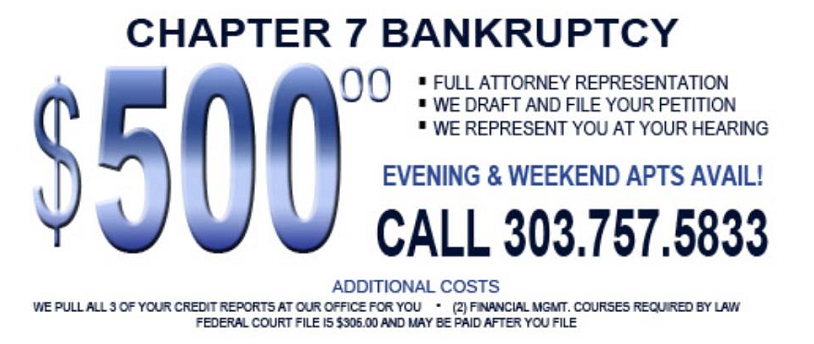
Hey Jude, WTH? Competitor plaintiff fails despite falsity and presumed harm

Berken v. Jude, No. 12–cv–02555, 2013 WL 6152347 (D. Colo. Nov. 22, 2013)

Berken alleged that Jude and his law firm, Jude Law, LLC (really?), falsely advertised in violation of the Lanham Act and the Colorado Consumer Protection Act (CCPA).  In a decision that seems to misconstrue the meaning of “presumption,” the court denied Berken any relief despite the apparently clear false advertising.

The parties compete as consumer bankruptcy attorneys in Denver.  Jude’s ads appeared “whenever someone googled information on Denver bankruptcy” (note use of “googled” as verb):

$500 Flat Fee Bankruptcy—No Hidden Fees—BBB Accredited

On the firm’s home page appeared this ad:

A similar ad ran in a local newspaper.

Berken lost several customers to Jude’s lower prices, though each testified by affidavit that they weren’t influenced by the pricing ad.  Berken established falsity and materiality, but the court held that he failed to show likely injury.  Recovering damages requires showing actual injury, and the consumer affidavits stated that the ads had nothing to do with their decision to defect from Berken, but rather they were dissatisfied with his rates and persuaded by Jude’s positive reviews.  So much for the damages claims.

But injunctive relief doesn’t require actual damages, only likely injury.  Courts may presume injury when the parties are “obvious competitors” with respect to the service being misrepresented.  Because they provided the same services in the same market, and because consumers use only one bankruptcy attorney at a time, Berken was entitled to a presumption of injury.  “However, Plaintiff has failed to support that presumption with any evidence of injury.”  He didn’t show that he lost specific clients or that he lost revenues generally, or show any consumer testimony, surveys, or market studies showing how Jude’s ads affect consumer behavior.  Thus, he failed to establish a reasonable basis for his claim of likely injury. This also killed the state-law false advertising claim.

Comment: buh?  I thought that those entitled to a presumption could rely on it, in the absence of rebuttal. Otherwise, what’s a presumption for?
Posted in http://schemas.google.com/blogger/2008/kind#post, procedure | Leave a comment

Right of publicity question of the day

Does this mortgage broker’s ad, quoting Mr. Rogers, violate any right?

Text: “If you could only sense how important you are to the lives of those you meet, how important you can be to the people you may never even dream of. There is something of yourself that you leave at every meeting with another person.–Fred Rogers.”  What that has to do with home loans is left as an exercise for the reader.

Posted in right of publicity | Leave a comment

ABA Journal Blawg 100

I’m on the ABA Journal’s Blawg 100, which is a real treat!  Check out the many worthy news sources there.

Posted in Uncategorized | Leave a comment

coincidental co-creation

Author’s note from William Pene du Bois, The Twenty-One Balloons (1947):

Just before publication of The Twenty-One Balloons, my publishers noted a strong resemblance between my book and a story by F. Scott Fitzgerald entitled “The Diamond as Big as the Ritz,” published by Charles Scribner’s Sons. I read this story immediately and discovered to my horror that it was not only quite similar as to general plot, but was also altogether a collection of very similar ideas. This was the first I had heard of the F. Scott Fitzgerald Story and I can only explain this embarrassing and, to me, maddening coincidence by a firm belief that the problem of making good use of the discovery of a fabulous amount of diamonds suggests but one obvious solution, which is secrecy. The fact that F. Scott Fitzgerald and I apparently would spend our billions in like ways right down to being dumped from bed into a bathtub is altogether, quite frankly, beyond my explanation.

Wikipedia notes that, as with many pairs of works with surprising similarities, there are also significant differences in tone, intended audience, and other events.
Posted in http://schemas.google.com/blogger/2008/kind#post | Leave a comment

transformative work of the day

I Ship It, by notliterally—a hilarious parody of Icona Pop’s song that is also a love letter to fandom.

Posted in fanworks, http://schemas.google.com/blogger/2008/kind#post | Leave a comment

Reply brief in Lexmark v. Static Control

Lexmark’s Reply Brief, to finish out the set.  Obviously I disagree, but I’ll limit myself here to one argument I think is disingenuous to the point of misleadingness: the equation of antitrust treble damages and fees, which are mandatory and punitive (“shall recover threefold the damages by him sustained, and the cost of suit, including a reasonable attorney’s fee,” 15 U.S.C. § 15) with Lanham Act damages and fees (which allow but do not require the court to increase a damage award up to three times over what the plaintiff proved as actual damages, as long as that’s reflecting the court’s assessment of the true damages and “not a penalty,” and only provide for a fee award in “exceptional” cases, 15 U.S.C. § 1117).

Posted in http://schemas.google.com/blogger/2008/kind#post, standing | Leave a comment

Retailer’s California claims against supplier proceed

TRC & Associates v. NuScience Corp., 2013 WL 6073004, No. 2:13–cv–6903 (C.D. Cal. Nov. 18, 2013)

TRC, a supplement retailer, sued NuScience and Lumina based on their sales to TRC of a dietary supplement, Cellfood.  TRC alleged that defendants misrepresented Cellfood’s ingredients, safety, and efficacy. Defendants allegedly actively concealed a key ingredient that poses a “severe health hazard” and misrepresented compliance with federal regulations.

The court found that TRC had Article III standing.  It allegedly bought more than $700,000 of Cellfood from Lumina (the distributor; NuScience is the manufacturer) in reliance on misrepresentations from both, leaving it with unsold product and potential liability for product already sold.  It also alleged damage to its reputation. 

The court declined to hold TRC’s claims barred by the FDCA at this point, despite Pom Wonderfuland even though allegations in the complaint referred to defendants’ violations of the FDCA and an FDA warning letter to Lumina.  Most of the cases barring enforcement of the FDCA under another cause of action are Lanham Act cases, not common-law fraud cases like this one; the complaint here was based on alleged affirmative misrepresentations—the alleged fraudulent conduct was not the violation of the FDCA but what defendants allegedly told or failed to tell TRC.  But the court expressed willingness to revisit the issue later.

Also, TRC’s UCL and FAL claims didn’t attempt to apply California law extraterritorially.  TRC is a Nevada corporation with a principal place of business in Ohio; Lumina is incorporated and headquartered in Florida.  But NuScience is a California corporation with its principal place of business in California.   State remedies can be invoked by out of state parties who are harmed by wrongful conduct occurring in California.  Here, the allegedly fraudulent conduct occurred in California—the material misrepresentations originated with NuScience in California, traveled through Florida, and ended up in Ohio.  Cellfood is made in California.  The ingredients of Cellfood and the representations about it were at issue in the case.  Given the complaint’s allegations, the relationship between the defendants allowed a reasonable inference that Lumina had some role in the alleged California misconduct.
Posted in california, fda, http://schemas.google.com/blogger/2008/kind#post, preemption, standing | Leave a comment

Posner likes trademarks, hates surveys

Kraft Foods Group Brands LLC v. Cracker Barrel Old Country Store, Inc., No. 13‐2559 (7th Cir. Nov. 14, 2013)

This is a classic Posner trademark opinion, with a combination of skepticism and credulity (about his favored theory of trademark) whose inconsistency even more than its self-confidence/arrogance shows why Posner can drive critics up the wall.

Kraft sued Cracker Barrel over Cracker Barrel’s introduction of food products to grocery stores.  The district court found that Cracker Barrel’s meat and other products would likely cause confusion with Kraft’s Cracker Barrel cheese brand if sold in grocery stores and granted an injunction. The court of appeals affirmed.

Identical marks can be nonconfusing if sold on different products through different sales channels; Kraft didn’t challenge Cracker Barrel’s right to sell food products under the name Cracker Barrel in its restaurants, the small “country stores” that adjoin the restaurants, or by mail order or on the web—only in grocery stores.

The court of appeals agreed that, even if the Kraft cheese and Cracker Barrel ham were displayed side by side, which would make consumers more likely to notice the differences, the use of the same words might lead them to think that both products came from Kraft.  “If on the other hand the Kraft cheeses and [Cracker Barrel] food products are at different locations in the store, some consumers might forget the difference between the logos and think all the products Kraft products. Even savvy consumers might be fooled, because they know that producers often vary the appearance of their trademarks.”  Name similarity and product similarity (low-cost packaged food) weren’t decisive, but those similarities coupled with the distribution channel and advertising channels were.  The court noted that, before the preliminary injunction was issued, “an online ad for Cracker Barrel Sliced Spiral Ham by a coupons firm provided a link to a coupon for Kraft’s Cracker Barrel cheeses.”  The products would likely appear in the same store ads, increasing the likelihood of consumer confusion “detrimental to Kraft.”  (Those three words are the key.) 

Plus, the products are inexpensive, increasing the likelihood of confusion.  “Generally only very cost‐conscious consumers are apt to scrutinize carefully the labels of the less expensive items sold in a grocery store. Familiarity is likely to have made the name Cracker Barrel salient to grocery shoppers, and so any product bearing that name might be attributed to Kraft even if close scrutiny of the label would suggest that the product might well have a different origin.”

Now here’s the part that is pure trademark religion: “If a significant number of consumers confused the names and thought [Cracker Barrel’s] products were made by Kraft, Kraft could be badly hurt.”  A trademark’s value comes from its effects on search costs; a good reputation leads to more sales.  But inconsistent quality teaches consumers that the trademark isn’t helpful, and they stop being willing to pay more for the branded good.  If Cracker Barrel’s products are “inferior in any respect to what the consumer expects—if a consumer has a bad experience with a [Cracker Barrel] product and blames Kraft, thinking it the producer—Kraft’s sales of Cracker Barrel cheeses are likely to decline; for a consumer who thinks Kraft makes bad hams may decide it probably makes bad cheeses as well.” 

Notice what’s missing here: any empirics at all in the causal chain.  Are Kraft’s products high quality?  Do Cracker Barrel’s products diverge in quality from them?  Is there any risk that Cracker Barrel’s products will deteriorate in quality during the pendency of the litigation (since it is a preliminary injunction with which we are concerned)?  Is there in fact any reason to think that a consumer would use a bad experience with ham to conclude that cheese from the same source is not worth buying?  (As Mark McKennaand I, among others, have explained in detail, marketers know that this is in fact highly unlikely even with actualbrand extensions, much less with confusion.)  Even Posner knows this is all “mays” and “mights,” but somehow this is “likely” harm.

Posner concedes there’s a countervailing consumer interest in product variety, but that’s super hard to weigh against confusion risks, especially at the preliminary injunction stage, and anyway Cracker Barrel has alternate routes to reach consumers, including the internet, “an alternative channel of ever greater significance in the electronic age.”  “The weighing and balancing of these competing interests with any precision are not feasible undertakings in a preliminary‐injunction proceeding, and probably not in a full trial either. Imponderables are likely to dominate.”

So we do what we can.  For a preliminary injunction, you also need irreparable harm, which was present here.  “The likelihood of confusion seems substantial and the risk to Kraft of the loss of valuable goodwill and control therefore palpable. … [I]rreparable harm is especially likely in a trademark case because of the difficulty of quantifying the likely effect on a brand of a nontrivial period of consumer confusion ….”  (Maybe it’s difficult to quantify because it rarely exists?)  Since Cracker Barrel wasn’t losing heavily as a result of not being able to sell through grocery stores, the preliminary injunction was justified.

However, “mainly for future reference we want to say something about the consumer survey that Kraft presented in support of its claim of confusion.”  Consumer surveys by parties’ expert witnesses are

prone to bias. There is such a wide choice of survey designs, none foolproof …. Among the problems identified by the academic literature are the following: when a consumer is a survey respondent, this changes the normal environment in which he or she encounters, compares, and reacts to trademarks; a survey that produces results contrary to the interest of the party that sponsored the survey may be suppressed and thus never become a part of the trial record; and the expert witnesses who conduct surveys in aid of litigation are likely to be biased in favor of the party that hired and is paying them, usually generously.

While judges and jurors “have their own biases and blind spots,” caution is required in screening “proposed experts.”  Here, Hal Poret emailed 300 consumers of whole-ham products photos of the Cracker Barrel ham and asked them whether the company that makes the ham also makes other products, and, if so, what products.  About 25% said cheese, but that didn’t necessarily mean much, since they may have “assumed that a company with a logo that does not specify a particular food product doesn’t make just sliced spiral ham,” then guessed.  A control group of 100 saw the same ham, labeled Smithfield, and none of them said cheese.  It was “plausible” that it was the name Cracker Barrel that made the difference, but Posner thought the relevance of that was “obscure,” because “Kraft’s concern is not that people will think that Cracker Barrel cheeses are made by [Cracker Barrel] but that they will think that [Cracker Barrel] ham is made by Kraft, in which event if they have a bad experience with the ham they’ll blame Kraft.”  (Hunh?  Why doesn’t the survey plausibly show that those 25% think that Cracker Barrel ham is made by Kraft, as the senior/familiar brand?)

Anyway, the context of a photo shown online in a survey is very different from actually choosing products in a grocery store, where the stakes are higher because real money is on the line.  Instead of surveys, maybe statistical data should be used, at least when the product is already on the market.  Some stores would carry both products and others wouldn’t.  “By examining the ‘lift’ (greater sales) if any that [Cracker Barrel] hams obtain by proximity to the Kraft Cracker Barrel label, an expert witness might be able to estimate the extent of consumer confusion. The greater the lift (and hence the greater the confusion) the greater the likelihood of a consumer’s blaming Kraft as the supposed maker of the [Cracker Barrel] hams if the consumer has a bad experience with the hams.”  (I don’t think Posner even realizes that he’s suggesting measuring something different.)  Here, of course, such a study wasn’t feasible because of the preliminary injunction, and anyway the court didn’t have enough confidence in the reliability of that kind of survey to deem it “an adequate basis for refusing to grant preliminary injunctions in trademark cases.”

Other types of expert testimony might help—“testimony by experts on retail food products about the buying habits and psychology of consumers of inexpensive food products.”  Courts haven’t made a real attempt to understand consumers’ mindsets, even though that’s supposedly central to trademark law.  Sometimes they describe consumers as smart, other times as dumb, but rarely do they look to any empirical evidence.  (Citing Thomas R. Lee, Glenn L. Christensen & Eric D. DeRosia, Trademarks, Consumer Psychology, and the Sophisticated Consumer, 57 Emory L.J. 575 (2008).)

In any event, the similarity of logos, products, channels of distribution, and advertising were enough to support the preliminary injunction even without the survey.
Posted in surveys, trademark | Leave a comment

Copyright talking points and the TPP

Mike Masnick has the story–which also qualifies for “transformative use of the day,” since it involves reproducing the talking points (likely an unpublished work no less!) in full in order to rebut them.  I particularly like his deconstruction of “nothing in this draft can be understood/but it doesn’t change US law for sure.”

Posted in copying, http://schemas.google.com/blogger/2008/kind#post | Leave a comment

Name your own price, then pay more: Court upholds Priceline’s model

Freeman v. Priceline.com, Inc., 2013 WL 5946069, B242653 (Cal. Ct. App. Nov. 7, 2013)

The court of appeals upheld a ruling getting Priceline off the hook for promising one price and delivering another, because the terms and conditions said that could happen. 

Freeman booked a hotel room at a Trump property and was charged a resort fee.  He sued over that, and over the service fee paid to Priceline.  Priceline allows customers to make travel arrangements through its website; it can’t require a hotel to make a room available at any particular rate.  Priceline’s Name Your Own Price service allows consumers to get deeply discounted rooms.  A NYOP booking starts when a customer selects dates of stay, general location, and quality/star rating of hotel, and names the price she’s willing to pay.  The resulting “Contract Page” displays the details of the request, with an amount designated as “Total Charges” at the bottom.  This is the offered price multiplied by the number of nights/rooms, plus “Taxes and Service Fees.”  The “Total Charges” are charged to the customer’s credit card if a hotel accepts the requested price. 

Directly below “Total Charges” is a large, bold, blue “Important Information.”  Five bullet points follow, of which the fourth is: “The reservation holder must present a valid photo ID and credit card at check-in. The credit card is required for any additional hotel specific service fees or incidental charges or fees that may be charged by the hotel to the customer at checkout. These charges may be mandatory (e.g., resort fees) or optional (parking, phone calls or minibar charges) and are not included in your offer price.”  In that bullet point, “charges” links to a page that reiterates: “Depending on the property you stay at, you may also be charged (i) certain mandatory hotel specific service fees, for example, resort fees (which typically apply to resort type destinations and, if applicable, may range from $10 to $40 per day), energy surcharges, newspaper delivery fees, in-room safe fees, tourism fees, or housekeeping fees and/or (ii) certain optional incidental fees  …. Please contact the hotel directly as to whether and which charges and service fees apply.”  Also, “Taxes and Service Fees” on the Contract Page leads to the same page, which also says that the credit card charge includes “an estimated amount to recover the amount we pay to the hotel in connection with your reservation for taxes owed by the hotel … The balance of the charge for Taxes and Fees is a fee we retain as part of the compensation for our services ….”  It specifies that the fees can vary by hotel—meaning what the consumer gains on the swings can be lost on the roundabouts.

Consumers have to initial a box on the Contract Page next to “I have read, accept and agree to abide by Priceline.com’s terms and conditions and privacy policy.” “[T]erms and conditions” also links to a page setting forth the same information.

Freeman made a reservation, reading the terms and conditions.  He offered $89 per night; the Trump Hotel accepted this price (standard room rate was $109 for the first night and $119 for the second).  He was charged a $15/night resort fee plus occupancy tax.

Freeman argued that Priceline’s TV ads were deceptive because they didn’t disclose that the price offered through NYOP wouldn’t be the total price for the room, and that the resort fee/service fee information was misleadingly buried deep in the process.  The trial court held that Priceline and Trump made sufficient disclosure that some hotel fees may be mandatory, with resort fees as just one example.  “It would be impossible for Priceline to notify a customer at the time of signing on whether a hotel will require any mandatory fee, including a resort fee, because neither Priceline, nor the customer, would know if any hotel meets the customer’s parameters until after the credit information is entered on the page following the Contract Page.”  (Ed. note: of course, with these charges, the hotel may well not meet the customer’s parameters.  How come Priceline couldn’t program its algorithm to include in the price used to assess NYOP compatibility any fees that are mandatory for every guest?  Priceline could certainly require hotels to provide this information in order to participate.  A mandatory “fee” is part of the price.)

Also, the Contract Page specifically included an estimate for Taxes and Service Fees, which disclosed that Priceline could charge an additional service fee.  These disclosures were clear and conspicuous as a matter of law, so there could be no deceptive omission.  The failure to disclose in the TV ads was immaterial given that “a Priceline customer would necessarily receive the multiple disclosures contained on Priceline’s Web site before making a reservation.” The TV ads, “each of which display scenarios that include elements of fantasy[,] contain limited information about Priceline’s services and in no way enable a customer to bypass or otherwise avoid the multiple disclosures on Priceline’s Web site.”  Also, the hyperlinks here conveyed adequate and unambiguous notice.  (This seems like a good candidate for regulatory action.  It may have been “unambiguous” that random fees could apply, but those fees could make the price promises illusory.)

Freeman argued that deceptiveness was a question of fact, but there was no triable issue here.

Nor was there unconscionability.  The disclosures were clear and conspicuous, and there was nothing substantively unconscionable.  Freeman could have avoided the problem by reserving a hotel room some other way, and nothing here shocked the conscience.

The same arguments that defeated the CLRA claim also doomed the UCL claim.  There was nothing unfair, judged by the standard: “(1) The consumer injury must be substantial; (2) the injury must not be outweighed by any countervailing benefits to consumers or competition; and (3) it must be an injury that consumers themselves could not reasonably have avoided.”  Freeman could have avoided his injury because of the conspicuous disclosure and other alternate means to book a hotel room with some hotel that didn’t charge a resort fee.
Posted in california, disclosures, http://schemas.google.com/blogger/2008/kind#post | Leave a comment