Peter Jaszi Lecture: Bernt Hugenholtz on Flexing Authors’ Rights

American University Washington College of Law
Program on Information Justice and Intellectual Property 
Presents
The 2nd Annual Peter Jaszi Distinguished Lecture:
Professor Bernt Hugenholtz – Flexing Authors’ Rights
 
November 7, 2013 | Room 603
5:30 Reception | 6:15 Lecture | 7:30 Dinner Reception
American University Washington College of Law
For registration, CLE and live/on-demand webcast:
http://www.pijip.org/events/2013jaszilecture/

 
Prof. Hugenholtz: Flexing Authors’ Rights
 
The global future of cultural institutions, information industries, and individual creative work hinges, in part, on present decisions about the scope and character of copyright exceptions and limitations. Almost everyone agrees that modern copyright law needs to be flexible in order to accommodate rapid technological change and evolving media uses. In the United States fair use is the flexible instrument of choice. Author’s rights systems in Europe are generally deemed to be less flexible and less tolerant to open-ended limitations and exceptions. But are they really? 
 
This lecture makes the case that (1) author’s rights systems can be made as flexible as common law copyright systems, and (2) that the existing EU legal framework does not preclude the development of flexible norms at the national level.

Professor Bernt Hugenholtz
 
Bernt Hugenholtz is Professor of law and Director of the Institute for Information Law (IViR) at the University of Amsterdam. He is also a professor at the University of Bergen (Norway), and regularly teaches at the Munich Intellectual Property Law Center (Munich), Monash University (Melbourne) and Charles University (Prague).
He is the co-author, with Prof. Paul Goldstein (Stanford University), of International Copyright. Principles, Law, and Practice (Oxford University Press, 3nd ed. 2012), and has written extensively on a range of copyright-related issues. He has acted as an advisor to the World Intellectual Property Organization, the European Commission, the European Parliament and the Netherlands Ministry of Justice.
Prof. Hugenholtz is widely regarded as the foremost expert on copyright in the EU. He was a member of the Drafting Committee of the Wittem Project, a collaboration between copyright scholars across Europe that produced the ground-breaking model “EuropeanCopyright Code” in 2010. With Ian Hargreaves, he authored the 2013 Lisbon Council policy brief on “Copyright Reform for Growth and Jobs: Modernising the European CopyrightFramework.”
Recent publications are available at http://www.ivir.nl/staff/hugenholtz.html.

 
The Peter Jaszi Distinguished Lecture in Intellectual Property
 
The Program on Information Justice and Intellectual Property’s Distinguished Lecture on Intellectual Property Law is named in recognition of the extraordinary ongoing contributions of Professor Peter Jaszi to the study of intellectual property at American University Washington College of Law and in the world at large, and in particular for his lasting contributions to the elevation of the public interest in intellectual property discourse.
 
Support the Lecture: Supporters may make a pledge at wcl.american.edu/go/give, and designate their gift to the lecture by using the “Other” field. Checks mailed to the Development Office should include “Peter Jaszi Lecture” in the memo line.
Posted in http://schemas.google.com/blogger/2008/kind#post | Leave a comment

Soul man is sad man

Moore v. Weinstein Co., LLC, No.12-5715 (6th Cir. Oct. 31, 2013)

Sam Moore, half of the music duo Sam & Dave sued a number of defendants related to the 2008 fim Soul Man and its accompanying soundtrack.  The court of appeals affirmed the district court’s rejection of all his trademark, right of publicity, and related claims.

Sam & Dave’s 1967 album, Sam & Dave Soul Men included the hit single “Soul Man,” for which Moore won a Grammy.  They broke up and reunited in the early 1980s; Prater passed away.  Moore continued performing using variations on “Sam Moore ‘The Legendary Soul Man,’” and his promoters now call him the “Legendary Soul Man.”  Sam & Dave were inducted into the Rock & Roll Hall of Fame in 1992.

In the movie Soul Man, the two main characters are 2/3 of a 1960s soul trio, Marcus Hooks and the Real Deal.  The third member leaves the group and has a solo career, while the two continue as a duo, then spit up, then reunite for a memorial for the third.  On a cross-country trip, they perform Sam & Dave’s song “Hold On, I’m Comin’.”  Moore argued that they portrayed Sam & Dave.  The soundtrack, “Soul Men The Original Motion Picture Soundtrack,” included no Sam & Dave songs.

Moore sued for infringement of his trademarks in “Soul Men,” “Soul Man,” “The Legendary Soul Man,” “The Original Soul Man,” and “The Original Soul Men,” the 1967 album “Sam & Dave Soul Men,” and  a 2008 documentary DVD, titled “The Original Soul Men Sam & Dave.”

The appellate court just adopted the district court’s reasoning granting summary judgment on Moore’s Lanham Act and state unfair competition claims, and only engaged in its own analysis of the publicity, state law trademark, and consumer protection claims.

Under the Restatement, the right of publicity doesn’t cover “use of a person’s identity in . . . entertainment, works of fiction or nonfiction, or in advertising that is incidental to such uses,” including “dissemination of an unauthorized print or broadcast biography,” or the “[u]se of another’s identity in a novel, play or motion picture.”  Also (and of course we’re not clear on how this relates to the Restatement), the First Amendment means we use transformative use as per Comedy III.  “[W]e weigh the appropriated likeness against the appropriating work’s expressiveness, evaluating ‘whether a product containing a celebrity’s likeness is so transformed that it has become primarily the defendant’s own expression rather than the celebrity’s likeness,’” which means “‘something other than the likeness of the celebrity.’”   Such “transformed” works (also?) lie beyond the right of publicity’s reach.  A successful publicity claim requires the challenged work to lack creative components of the defendant’s own.  Moore’s claim is weaker than Tiger Woods’ in ETW, given the general protection for movies, and the movie “[w]ithout a doubt” added significant expressive elements to any use of Moore’s identity.

Moore argued that there was no protection for the ad insert featuring his image packaged with the soundtrack’s CD and DVDs.  To promote other CDs and DVDs whose rights were owned by the company that produced the soundtrack, several pages of the insert—called “THE ORIGINAL SOUL MEN ARE AT STAX”—reprinted cover art from various Stax Records albums, including Otis Redding, Isaac Hayes and others.  Another insert page, “Essential Viewing for your Soul,” featured the images of three DVDs’ cover art, including “The Stax/Volt Revue Live in Norway 1967.” That displayed the names and images of the performers in that 1967 show, including “Double Dynamite!! Sam and Dave.”  However, Moore didn’t dispute that the company owned the (copy)rights to promote the video depicting a concert in which he performed.  Given this consent, there was no infringement of the right of publicity.  Plus, the insert title page “clearly refers to the numerous soul albums depicted therein,” of which the concert cover was but one. There was no evidence that the title page caused confusion, and “[r]ead in context” no reasonable juror would mistake this reference for Sam & Dave, or find Sam & Dave “reasonably identifiable” from the reference, even though the soundtrack was marketed to fans of a variety of soul artists.

Moore also sued for state trademark dilution.  Setting choice of law issues aside because the two relevant state laws were identical, both Tennessee and Arizona require famousness, and Moore couldn’t satisfy that element, given that he failed on his federal dilution claim.  Indeed, the only Tennessee factor not present in the Lanham Act was the nature and extent of use of same or similar mark by third parties, which weighed against Moore. The district court found at least 34 other albums currently available that either consist of or incorporate “soul men” or “soul man.”  Moore might be well-known, but the test considers the mark, not the person.

The state consumer protection claims also failed.  Moore alleged that defendants caused a likelihood of confusion about whether he sponsored the movie and soundtrack.  But the Lanham Act analysis covered this.  Under Rogers v. Grimaldi, the First Amendment precluded such a claim, and Moore’s “competing titles” claim also failed to show a likelihood of confusion.  He also alleged that defendants made false/misleading statements about his affiliation or association with the movie.  But he never provided evidence that Tennessee consumers were injured or deceived, as required.
Posted in dilution, first amendment, right of publicity, trademark | Leave a comment

Teaching children to see like a state

My second-grade son came home with the following schoolwork last week:

“Numbers that Name You: There are lots of numbers that label, count, measure, or order information just about you. For example, you have a birthday and an address. Do you have an ID number for a club you belong to? What’s your shoe size? Think about all the numbers that name you. Write these numbers in the person shape…. Find out what a social security number is. Do you have one? Why is this an important number?”

It’s easy to mock theory for having jargon.  But if this is anything other than interpellating the child as subject of the modern surveillance state in the form of data, let me know.

Posted in privacy | Leave a comment

Delay notifying insurer until after $13.5 million verdict probably harmless

National Union Fire Ins. Co. of Pittsburgh, Pa. v. Mead Johnson…, — F.3d —-, 2013 WL 5788652 (7th Cir. 2013)

An advertising injury case from Posner, with a bonus picture from the underlying dispute … and it’s not even my birthday.  Mead Johnson bought a CGL policy from National Union, with a $2 million limit for personal/advertising injury, and an excess liability policy from Lexington with a $25 million limit (both are subsidiaries of AIG).

PBM’s third lawsuit against Mead Johnson for false advertising resulted in a jury award of $13.5 million.  PBM Products, LLC v. Mead Johnson & Co., 639 F.3d 111 (4th Cir. 2011).  “Mead wants its insurers to pay that judgment, plus the $15 million settlement that it made to resolve the [resulting follow-on] class action suit.”  PBM’s suit claimed that Mead falsely disparaged PBM’s less expensive store brand by claiming that it lacked key lipids that promote brain and eye development.  Mead Johnson’s insurance policies expressly covered disparagement as advertising injury, but Mead Johnson didn’t notify its insurers until after the damages verdict was handed down.  (Why? Posner doesn’t know.  How about: companies, like Soylent Green, are made of people, and people forget relevant information all the time.)

Both policies required notice of any claim or occurrence “as soon as practicable”; the excess liability policy required notice only if a claim or suit was “reasonably likely” to trigger damages of more than $2 million.  The notice provisions entitle insurers to control the insured’s defense, subject to their fiduciary duty to the insured. 

Mead Johnson said that its Director of Risk Management didn’t learn of the PBM lawsuit until the trial ended, which would be required for its duty of providing notice to kick in for “occurrences,” per an amendment to the agreement. The court found it hard to believe that the Director of Risk Management didn’t know, and anyway a lawsuit was a suit, not an “occurrence.”  Posner understood why insureds wouldn’t want their duty of notice to kick in for any trivial “occurrence,” e.g., “baby cried after swallowing Enfamil; crack appeared in Enfamil container.”  “But it would be absurd to allow a company served with a summons and complaint or other legal claim to obtain an indefinite extension of its duty of notice simply by hiding the claim from its Director of Risk Management,” especially for a claim of this size (PBM asked for $500 million in damages) by a competitor who’d gotten more than $46 million from Mead Johnson in settling two previous similar suits.  Mead Johnson delayed inexcusably in informing both insurers.

However, this failure allowed the insurers to disclaim coverage only if they were prejudiced by the late notice.  Late notice creates a presumption of harm, shifting the burden to the insured to show some evidence, but probably doesn’t shift the burden of persuasion. 

The court found National Union unlikely to have incurred harm from late notice.  “Its policy limit was only $2 million, and we are hard pressed to understand how, had it conducted the defense of PBM’s suit, it could have obtained either a jury verdict or a settlement of less than $2 million.”  Not only were the damages much higher than that, but Mead Johnson used the same firm, and even the same lawyer, that National Union had hired to defend Mead Johnson in PBM’s previous lawsuits.  Had it defended Mead Johnson, National Union would also have had to pay the fees and expenses of the defense, but National Union didn’t argue it would have paid less, and had it skimped on legal expenses the ultimate jury verdict might have been higher, allowing Mead Johnson to claim a breach of fiduciary duty.  The court was tempted to direct entry of judgment for Mead on the National Union/PBM matter, but remanded for factual development on the issue of harm—at oral argument, National Union’s counsel essentially conceded she couldn’t show harm, “[b]ut we hesitate to base a decision on a concession made in the heat of oral argument under a barrage by the judges.”

Lexington’s situation differed: “Conceivably if placed in control of the defense it could have bargained to a settlement of less than $13.5 million or, failing that, have presented evidence or argument that would have convinced the jury to award PBM less.”  But the insurers’ joint defense made no real argument about this, treating Lexington “as the tail to National Union’s kite,” perhaps because of their shared parent.  So the insurers hadn’t shown that it would have made any difference if they, rather than Mead Johnson, had hired the same law firm, but also Mead Johnson had only offered the bare facts that the firm was the same and that $13.5 million was less than $41.5 million, one of the previous settlement amounts.  And the district court erred by holding that when untimely notice is given by an insured after trial in the underlying suit, the presumption of harm became irrebuttable.  The district court should have said that later notice makes it harder to rebut the presumption of harm, but the presumption is never irrebuttable.  So, remand.

Turning to the second question: was National Union entitled to decline coverage of Mead Johnson’s claims resulting from the consumer class action?  The advertising injury policy covered “oral or written publication, in any manner, of material that … disparages a person’s or organization’s goods, products or services.”  The policy required “pay[ment to the insured of] those sums that the insured becomes legally obligated to pay as damages because of … advertising injury.”

The class members were consumers who bought Enfamil in preference to cheaper brands of infant formula “on the basis of the same false representations by Mead Johnson that underlay PBM’s suit.” The court saw this as a consumer fraud claim, not a product disparagement claim, since no product sold by the class members was disparaged.  Instead, Mead Johnson’s disparagement induced consumers to buy Enfamil.  But Mead Johnson argued that the policy covered damages for an injury “arising out of” disparaging material.  The court disagreed: the policy said that damages must arise out of the “offense,” here product disparagement; damages merely having their origin in disparagement were insufficient.  A mere indirect causal link was insufficient.  “Such a chain of equations can’t be taken literally, for that would imply that the claims in the class ‘arise out of’ the invention of infant formula.”  (Hunh?  So what?  Is that covered by any policy?  Also, the disparagement sure seems like proximate cause to me, not just but for cause, but the court disagreed.)

Mead Johnson’s argument for “arising out of” went too far:

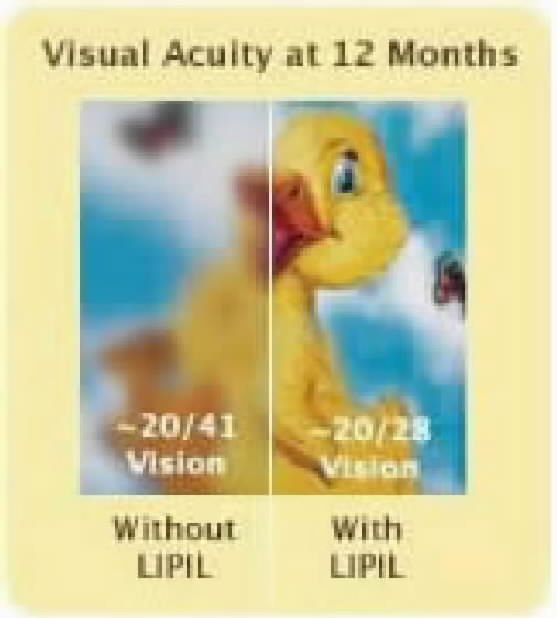
Suppose that a mother who has been feeding her baby a store-brand infant formula made by PBM reads Mead Johnson’s ad which states that “mothers who buy store brand infant formula to save baby expenses are cutting back on nutrition compared to Enfamil,” or, worse, sees Mead’s visual-acuity ad, reproduced below, that tells mom that if fed Enfamil her baby will see an adorable rubber ducky with butterflies, while if fed a store brand, baby will be able to make out only a blurry yellow monster chased by bats. Mom, fearing that she has done irrevocable harm to her precious child, has a nervous breakdown precipitated by Mead’s false, alarmist advertising. If she sues Mead Johnson for infliction of emotional distress, can Mead require National Union to defend and indemnify it on the ground that the mother’s nervous breakdown arose from product disparagement? An affirmative answer—the answer implied by Mead Johnson’s argument—would, by expanding coverage to remote consequences, make it very difficult for an insurer to estimate liability and thus fix a premium for injuries caused by product disparagement.

RT: Except that the consequences at issue in the actual consumer protection claim are not at all remote. They are, indeed, the very consequences that the disparagement aimed at: consumers would buy more from Mead Johnson and less from house brands like PBM, enriching Mead Johnson and causing damages to PBM.  If the damages to PBM were proximately caused by the disparagement, so too were the damages to consumers.

In conclusion, the court cautioned that the underlying tort claim didn’t need to use the magic word disparagement to trigger coverage, as long as the claim fit the legal definition thereof.

Posted in damages, disparagement, http://schemas.google.com/blogger/2008/kind#post, insurance | Leave a comment

Georgetown Law Journal technology symposium, Nov. 8

The Georgetown Law Journal cordially invites you to its Volume 102 Symposium, “Law in an Age of Disruptive Technology”
Featuring a Keynote Address by Professor Neal Katyal and panels on:

3-D Printing
Chaired by Professors Deven Desai and Gerard Magliocca

Driverless Cars & Tort Liability
Chaired by Professor Bryant Walker Smith

Mass Surveillance Technology
Chaired by Professor Christopher Slobogin

Friday, Nov. 8, 9 am
Gewirz Hall, 12th Floor
Georgetown University Law Center
600 New Jersey Avenue, Northwest
Washington, District of Columbia
Click here to RSVP
Facebook Page and Website
This event is sponsored in part by ACLU, NSLS, and the Federalist Society

Posted in copyright, http://schemas.google.com/blogger/2008/kind#post, patent, privacy | Leave a comment

Transformative work of the year

I know, we still have a couple of months, but I find it hard to imagine this being topped: the Golden Girls, reimagined as Cold War superspies/soldiers.

Posted in comics, fanworks, http://schemas.google.com/blogger/2008/kind#post | Leave a comment

9th Circuit requires arbitration for consumer protection claims

Ferguson v. Corinthian Colleges, Inc., — F.3d —-, No. 11–56965, 2013 WL 5779514 (9th Cir. 2013)

Plaintiffs were former students at for-profit schools owned by Corinthian and sued alleging that Corinthian used deceptive practices to get them to enroll.  The court of appeals, reversing the district court, compelled arbitration of the claims under the UCL, FAL and CLRA, holding that the California Supreme Court’s exemption of claims for “public injunctive relief” from arbitration was preempted by the Federal Arbitration Act. 

 
Posted in california, class actions, consumer protection, http://schemas.google.com/blogger/2008/kind#post | Leave a comment

Class ascertainability exists without purchase records

Thurston v. Bear Naked, Inc., No. 3:11–CV–02890, 2013 WL 5664985 (S.D. Cal. July 30, 2013)

The court certified a California class of purchasers of Bear Naked products marked as 100% natural that contained hexane-processed soy.  Of note, the court rejected Bear Naked’s argument that the class wasn’t ascertainable because nobody had purchase records.  The class definition wasn’t vague or confusing: it was purchasers of the products so labeled, and because the alleged misrepresentation was on the labels there was no issue of sweeping in people not exposed to the misrepresentation.  There’s no requirement that class members’ identity be known at the time of certification, and indeed that would destroy the class action mechanism.  As long as the definition is sufficiently definite to identify members, administrative challenges don’t defeat class certification.  Relatedly, the court rejected Bear Naked’s argument that the definition had to ensure that all class members had standing, and that some purchasers would have been unaffected by the misrepresentation and thus suffered no injury.  Standing of the named plaintiff was enough; causation on a classwide basis may be established by materiality.
Posted in california, class actions, http://schemas.google.com/blogger/2008/kind#post, standing | Leave a comment

"All Natural" too undefined to be the basis of a claim

Pelayo v. Nestle USA, Inc., 2013 WL 5764644, No. CV 13–5213 (C.D. Cal. Oct. 25, 2013)

Pelayo sued Nestle alleging claims about 13 Nestle stuffed pasta products using the term “All Natural” on the labeling while containing synthetic xanthan gum and soy lecithin. 

The court dismissed the claim because Pelayo failed to offer an objective or plausible definition of “All Natural.”  One possibility, “produced or existing in nature” and “not artificial or manufactured,” clearly wouldn’t apply to the manufactured pasta: the reasonable consumer is aware that Buitoni Pastas are not “springing fully-formed from Ravioli trees and Tortellini bushes.”  Nor were the other definitions Pelayo offered plausible.  She alleged that none of the ingredients in a “natural” product would be “artificial” under FDA definitions. But she failed to allege that any of the challenged ingredients were “artificial” as defined by the FDA; anyway, the cited definition only applied to flavor additives, and she didn’t allege that the challenged ingredients were added flavors.

Pelayo also alleged that none of the ingredients in a “natural” product are “synthetic” as that term is defined by the National Organic Program.  But the challenged products weren’t labeled as organic and the NOP didn’t apply. Plus, the challenged ingredients were expressly permitted in organic-labeled products (though they are defined as synthetic).  “Consumers generally conflate the notions of ‘natural’ and ‘organic,’ or hold products labeled ‘organic’ to a higher standard than products labeled “natural,” and, thus, it is implausible that a reasonable consumer would believe ingredients allowed in a product labeled ‘organic,’ such as the Challenged Ingredients, would not be allowed in a product labeled ‘all natural.’”

Then, Pelayo offered the FDA’s 1991 informal statement on “natural,” but that’s not a legal requirement.  The FDA/FTC declined to define natural because the term “may be used in numerous contexts and may convey different meanings depending on that context.”  Given that finding, it was implausible that a significant portion of the general consuming public or of targeted consumers would be deceived or mislead by the use of the term “All Natural” on the pastas.  Also, even the FDA’s informal policy would allow the use of some artificial and synthetic ingredients, such as the ones challenged here.

Finally, the ingredient list clarified any ambiguity about “All Natural,” and was consistent with the use of that term.  Thus, plaintiff failed to allege either a plausible objective definition or a subjective definition shared by the reasonable consumer.
Posted in california, fda, http://schemas.google.com/blogger/2008/kind#post | Leave a comment

Singaporean bank finds no relief from Lanham Act

Hong Leong Finance Limited (Singapore) v. Pinnacle Performance Ltd., 2013 WL 5746126, No. 12 Civ. 6010 (S.D.N.Y. Oct. 23, 2013)

My former classmate, the Honorable Jesse Furman, got this Lanham Act extraterritoriality case.

Plaintiff HLF sued Morgan Stanley and certain affiliates related to credit-linked notes issued by Morgan Stanley.  Morgan Stanley entered into a distribution agreement with HLF, and HLF then sold the notes to Singaporean investors.  Credit-linked notes shift credit risk associated with the “reference entities” from a “protection buyer” (the bank arranging the notes) to a “protection seller” (the note investors), which uses a special purpose vehicle to stand in the middle and engage in a credit default swap.  The principal received from the investors in the notes is used to buy highly-rated securities as collateral in the event that reference entities default.  Investors get interest in the form of credit protection payments from the sponsoring bank and any interest generated by the underlying assets.  The underlying assets are typically safe and liquid, but HLF alleged that Morgan Stanley selected very risky assets here—single-tranche synthetic CDOs (in other words, clusterbombs).  They weren’t just risky; they were allegedly designed to fail, because Morgan Stanley took a short position on those very same assets.

HLF alleged that Morgan Stanley persuaded HLF to sell the notes to its customers by emphasizing that they were “conservative” and “low-risk products” suitable for HLF’s customers: middleclass and working-class Singaporeans, and small—and medium-sized enterprises. HLF eventually sold its customers $72.4 million worth of notes.  When the notes failed, Singapore’s de facto central bank stepped in and mandated that HLF pay its investors over $32 million.

The Lanham Act claim, the sole basis of federal jurisdiction, was dismissed because it failed to allege facts supporting application of the statute extraterritorially.  The Lanham Act covers conduct outside the US when necessary to prevent harm to commerce in the US.  The Second Circuit looks at three factors: “(i) whether the defendant is a United States citizen; (ii) whether there exists a conflict between the defendant’s trademark rights under foreign law and the plaintiff’s trademark rights under domestic law; and (iii) whether the defendant’s conduct has a substantial effect on United States commerce.”  The first two factors are significant, but the third is “critical and often dispositive.”

Here, HLF failed to allege facts plausibly satisfying the third factor. There was no alleged consumer confusion or harm to HLF’s goodwill in the US, because HLF doesn’t exist in the US—indeed, it alleged that it had “no expertise in foreign markets”—and the customers Morgan Stanley screwed were middle-class and working-class Singaporeans.  HLF argued that Morgan Stanley’s scheme was executed largely in New York, but mere preparation of a scheme within US borders wasn’t enough.

In any event, HLF failed to allege domestic activity “sufficiently essential” to the allegedly unlawful activity abroad.  Morgan Stanley allegedly issued and structured the notes in and around NYC.  But the gravamen of the complaint was false advertising—whether Morgan Stanley made statements that were likely to deceive or confuse investors, not statements made to HLF.  And HLF didn’t allege that Morgan Stanley directed any false ads from the US to the Singaporean investors; there wasn’t even any allegation of contact with the investors, as opposed to contact with HLF.  There was therefore no nexus between US activities and the allegedly unlawful activities abroad.
Posted in http://schemas.google.com/blogger/2008/kind#post, jurisdiction | Leave a comment