Is a bigger sucker a protected consumer?

Securian Financial Group, Inc. v. Wells Fargo Bank, N.A., 2014 WL 6911100, No. 11–2957 (D. Minn. Dec. 8, 2014)
How sophisticated can you be and still be a consumer for the purpose of consumer protection law?  Pretty sophisticated, in some cases. 
The plaintiffs: Minnesota Life is an insurance, pension, and investment products firm that provides its services to individuals and families. Securian Financial, its parent, is an insurance and financial services firm with over 13 million clients, and Securian Holding is its parent.  Advantus Capital Management is a registered investment adviser wholly owned by Securian Financial.  Advantus provided asset management services to Minnesota Life and Securian Holding. Advantus has billions of dollars in assets under its management and its professionals have significant experience in the investment industry. Advantus advised and managed the Advantus Series Fund, whose investments backed some Minnesota Life products.
Wells Fargo is a bank offering a Securities Lending Program.  The SLP allows Wells Fargo to act as an agent lending its clients’ securities to brokers in return for collateral, usually cash. Wells Fargo then invests the collateral on behalf of its clients.
Plaintiffs were institutional investor clients of Wells Fargo’s SLP. They were experienced in a number of types of asset management, including “traditional asset management,” but they didn’t administer any SLPs. Wells Fargo marketed the SLP as involving investments in “short term money market instruments” that “maximize[d] earnings, while taking minimal risk.”  Plaintiffs alleged that the securities lending business was very complex and requires specialized knowledge and processes.  Plaintiffs and Wells Fargo entered into a number of securities lending agreements, and they paid Wells Fargo approximately $5 million for its services.  Further complexities ensued, involving structured investment vehicles and hedging activities; they went bad.  Plaintiffs sued for breach of contract (and ERISA violations), which I won’t discuss, and violation of Minnesota consumer protection statutes.
Wells Fargo sought summary judgment on the grounds that plaintiffs, as sophisticated merchants, were barred from bringing consumer protection claims.  Minnesota’s consumer protection/unfair trade practices laws are “generally very broadly construed to enhance consumer protection.”  The controlling state precedent didn’t bar “merchants” from bringing consumer fraud claims across the board.  “Instead, courts focus their analysis on whether a party can be considered a sophisticated merchant in the specific skills or goods at issue, and only those parties that are in fact deemed to be sophisticated merchants in the specific skills or goods at issue have been precluded from asserting Minnesota consumer claims.”  The court found that a jury could reasonably concluded that plaintiffs weren’t “merchants” for purposes of these transactions, based on disputed facts about their sophistication. 
Though it would be an uphill battle, there was enough evidence to go to a jury about whether they were sophisticated in matters of securities lending.  Plaintiffs offered evidence that they never held themselves out as having special skills or knowledge with respect to the securities lending business. To this they added an expert opinion that securities lending is a highly complex business that involves complex services, processes, and monitoring, and evidence that, “due to this complexity, they did not have the mechanisms for managing securities lending and also gave management discretion entirely to Wells Fargo for their investments.”  In addition, a jury could accept that Wells Fargo agreed that plaintiffs weren’t sophisticated in this area given the marketing materials Wells Fargo provided to them, which detailed the program and Wells Fargo’s risk safeguards.
The court also denied plaintiffs’ motion for summary judgment on their breach of contract claims.

Posted in consumer protection, http://schemas.google.com/blogger/2008/kind#post | Leave a comment

restrictions on lawyer ads touting past results unconstitutional

Rubenstein v. Florida Bar, No. 14–CIV–20786, 2014 WL 6979574 (S.D. Fla. Dec. 9, 2014)
Florida bars attorney advertising from referring to past results, which a Bar task force held in 1997 were inherently misleading to laypeople, because cases that appear similar to laypeople offer differ substantially to the law; past results don’t show competence or fitness on any particular matter; laypeople can’t judge well what counts as a good result versus a bad one—an apparent success might be a failure and vice versa; and success or failure don’t necessarily reflect on an attorney’s ability or performance.  Conclusion: “Only a person with legal training and experience in the particular field and a knowledge of all the facts would be in a position to accurately judge how a particular result reflects upon the lawyer.”  The rules applied to radio, billboards, and TV; most websites and email were separately regulated and didn’t have a blanket ban on using past results.  The Bar didn’t link its recommendations to any specific data or findings from surveys, focus groups or data analysis.
In 2007, the Bar was directed to study the issue again, and in 2013, the Supreme Court of Florida adopted a completely revised set of attorney advertising rules.  Now, advertising could refer to past results that were “objectively verifiable,” and the restrictions weren’t based on the advertising medium.
The Bar reasoned that “[t]he U.S. Supreme Court has generally struck down regulations restricting advertising truthful information;” that “[o]f those responding to the survey on public perception of lawyer advertising, 74% indicate that past results are an important attribute in choosing a lawyer[; i]t is clear that the public wants this information available to them;” and that “[m]ost of those Florida Bar members who provided written and oral comments also noted that the lawyer advertising rules should not prohibit truthful statements regarding past results.”
Rubenstein developed an ad campaign about past recoveries for clients.  The Bar issued opinion letters approving some and rejecting some, including some that could comply with appropriate disclaimers.  For example, Rubeinstein submitted a TV ad animated with a cartoon car accident, a courthouse and dollar signs drawn on a dry-erase board; using an attorney voice over; and depicting the words “COLLECTED OVER $50 MILLION FOR THEIR CLIENTS IN JUST THE LAST YEAR! Gross proceeds. Results in individual cases are based on the unique facts of each case.”
In 2014, the Bar issued new “Guidelines for Advertising Past Results.” The Guidelines advised that inclusion of past results “carries a particularly high risk of being misleading,” requiring more information than usual ads.  Display, radio, and TV ads couldn’t effectively communicate the necessary information and couldn’t comply with the rules.
The ABA’s Model Rules of Professional Conduct don’t have blanket bans on references of past results.  Most states follow the ABA approach, but 6 require references to past results to be accompanied by a disclaimer.  No other state barred past results entirely in any media form.
As a result of the Guidelines, the Bar withdrew some of its prior approvals of Rubenstein’s ads.  The Bar also told Rubenstein that certain ads also violated the rules by stating that the firm obtained a specific recovery and omitting facts necessary to avoid misleading consumers—in this case, they advertised gross recoveries, rather than the amount actually received by the client.  Rubenstein didn’t challenge the application of that rule.
The Bar also commissioned a survey, currently in progress, to determine whether ads containing references to large-dollar recoveries were misleading, and how well disclaimers worked. This research was in progress when the opinion issued.
Attorney advertising is commercial speech protected by the First Amendment. The court found that the challenge was quasi-facial, not just as-applied: plaintiffs were challenging the ban on TV and radio advertising of past results.  Attorney ads with past results statements were at most potentially misleading, not necessarily misleading.  Intermediate scrutiny applies to bans on commercial speech that isn’t false or inherently deceptive: Central Hudson asks whether the ban (1) promotes a substantial governmental interest; (2) directly advances the interest asserted; and (3) is not more extensive than necessary to serve that interest. 
Discussion: And here we get to the immense swamp of “inherent” misleadingness, a concept the Supreme Court has invoked but never defined, and certainly not with reference to ordinary legal concepts of misleadingness.  The Bar regulated this speech because it deemed past results claims to carry a high risk of misleading consumers.  The court in this case understood that claim to be a concession that such ads are only likely or potentially misleading.  But “actually” misleading ads never have to mislead everyone; usually likelihood of misleadingness establishes misleadingness for, just by way of example, the Lanham Act.  That is, a high risk of misleading reasonable consumers is misleadingness.  What else could “inherently” misleading be?  Even false ads won’t fool everyone.  Also, of course, this analysis has huge implications for the constitutionality of practically everything the FTC does, not just the endorsement and substantiation guidelines.
Anyhow, the Bar conceded that Central Hudson applied, and the court also noted that no other state had found this blanket media ban necessary.  Public Citizen, Inc. v. La. Attorney Disciplinary Bd., 632 F.3d at 219, like this case, struck down a rule barring attorney communications containing references to past successes or results except by client request.  It’s possible to present past results in a non-misleading way, as opposed to promising results.
The court found that the rule supported three substantial governmental interests. The record reflected that the rule was part of a scheme for protecting the public from false or misleading lawyer claims; promoting the provision of useful information; and preventing “advertising that contributes to disrespect for the judicial system” or that “causes the public to have an inaccurate view of the legal system,” all of which were substantial.
However, the Bar failed to show that the restrictions advanced the government’s interests in a direct and material way.  Mere speculation or conjecture is insufficient; the government needed to show that the harms at issue were real and that the restriction would in fact alleviate them materially.  The Bar failed to meet its burden of showing that restrictions on use of past results in attorney advertising supported its interests.
Instead, the record evidence showed that consumers wanted more “useful” and “factual” information to help them chose an attorney. Many consumers were interested in attorney “qualifications,” “experience,” “competence” and “professional record (i.e., wins/losses).” In addition, the Bar’s surveys showed that negative attitudes about legal system and lawyers consistently declined over the relevant survey period, despite the increase in quantity and breadth of attorney advertising.  The Bar’s blanket assertions that the use of past results was misleading to the untrained public and that past results are not informative about competence or fitness were not backed by evidence.  The Bar’s survey showed that 74% of consumers believed that past results were an important attribute in choosing a lawyer.  Also, the Bar’s prior report explained that there was no reason to distinguish among media. 
But the Bar didn’t provide any factual support when it reversed course in 2014. “In the absence of evidence—especially in light of the fact that the Bar continues to permit the widespread use of past results in other advertising media—[the Bar’s rationale] amounts to mere conjecture and speculation.” The pending survey wasn’t before the court, and the Bar didn’t ask the court to wait for the outcome.  It wasn’t enough to fear that people would get unrealistic expectations and make bad decisions with truthful information.  However, if the Bar developed sufficient evidence, the restriction wouldn’t necessarily be unconstitutional for all time.
The court continued that the rule wasn’t properly tailored to the asserted interests.  Central Hudson’s fit requirement doesn’t require perfection, but it does require reasonability—a restriction can’t be broader than reasonably necessary to prevent deception.  The Bar didn’t show that blanket bans on display ads, TV, and radio were necessary, or that lesser restrictions such as a disclaimer or required language wouldn’t suffice.
Thus, Rubenstein was entitled to injunctive relief; on this record, “there is no attorney subject to the Rules as to whom the Guidelines’ blanket prohibition on advertising using of past results in indoor and outdoor display, television and radio media could survive scrutiny under the Central Hudson standard.”

Posted in advertising, commercial speech, first amendment | Leave a comment

Consumer suit against juice name preempted

Bell v. Campbell Soup Co.,  No. 4:14cv291, 2014 WL 6997611 (N.D. Fla. Dec. 11, 2014)
The facts are essentially the same as in Pom Wonderful v. Coca-Cola, but the result is that only competitors, not consumers, can sue for false advertising of juices.  (I wonder if Campbell also received threats from Pom.)
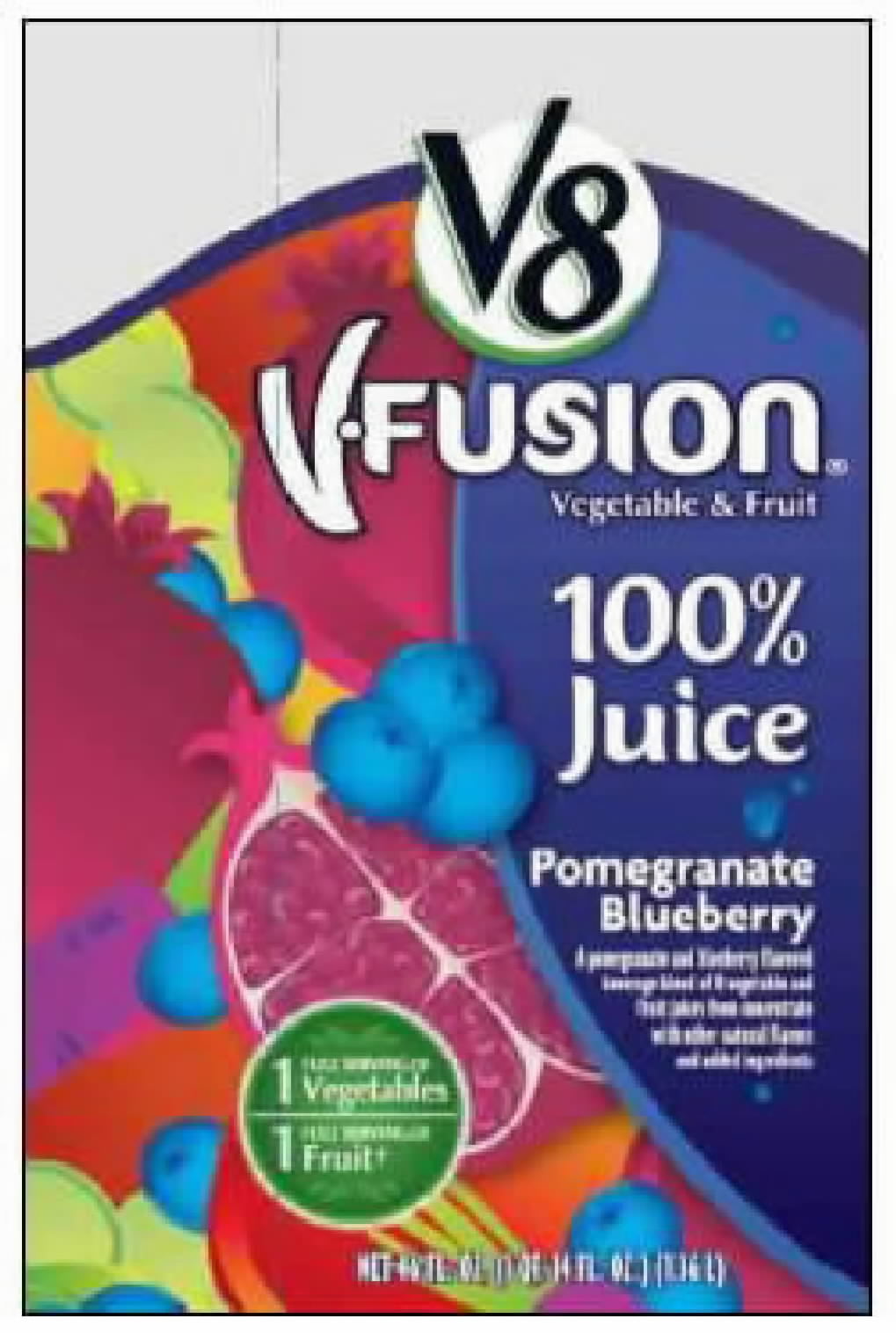
The court kicked out this Florida consumer protection case against two fruit and vegetable juices as preempted by the FDCA’s ban on non-identical state requirements.  The two V8 V-Fusion drinks at issue were pomegranate blueberry and açai mixed berry, but the analysis was the same.  The pomegranate blueberry juice contains only a tiny amount—less than 1%—of pomegranate and blueberry juice; the juice is predominantly from sweet potatoes and purple carrots. A “thorough reading” of the back information panel discloses that the largest portion of the juice comes from sweet potatoes, followed by purple carrots, then other fruits and vegetables, and finally pomegranates and blueberries.
Plaintiffs argued that the primary display panel was nonetheless misleading, suggesting that the product was 100% pomegranate and blueberry juice:

Even assuming that the jury could find this to be misleading, every statement on the primary display panel was “either unobjectionable or complies to the letter” with FDA rules.  The plaintiffs argued that the placement of “100% Juice” and its larger size was misleading, along with the vignette prominently depicting only pomegranates and blueberries.  The court expressed skepticism about misleadingness, since it thought that many consumers would understand that V8 was a blend of fruit and vegetable juices and would notice other statements on the primary display panel.  But regardless, the label complied with the FDA’s juice labeling requirements for indicating common names; names can include the flavoring juice so long as the label includes a statement “that the named juice is present as a flavoring.” So it was here.
The federal rules didn’t address where the statements should be placed, and a requirement to place them elsewhere, phrase them differently, or change the vignette would be a non-identical requirement.  The court rejected plaintiffs’ argument that preemption only barred a requirement that Campbell change the label, not damages; that made no sense.

Posted in consumer protection, fda, http://schemas.google.com/blogger/2008/kind#post, preemption | Leave a comment

Transformative use of the day, judicial edition

Judge uses cartoon in opinion to explain rebuke of lawyer.  Reporting on opinion includes separate reproduction of cartoon.  Two levels of transformation?  (Side note: the judge feels the need to explain the joke, which may say something about judicial humor generally.)

Posted in copying, http://schemas.google.com/blogger/2008/kind#post | Leave a comment

PTO roundtable on the accuracy and integrity of the TM register

USPTO Roundtable: Ensuring the Accuracy and Integrity of the Trademark Register
(Note: I wasn’t able to attend in person so I just didn’t get names)
Debbie Kahn, commissioner for TMs
Registration renewals: pilot requiring additional proof of use for 500 registrants submitting Section 8 affidavits of use.  Stemmed from Bose, where standard of fraud was raised quite a bit.  Is there a problem?  97% have completed the pilot. Of those, 51% were unable to verify previously claimed use for the additional requests for proof of use. Of those, 35% deleted goods or services queried under the pilot, and 16% failed to respond to the office actions, resulting in cancellation. Pretty big result—we weren’t sure of the magnitude, and that was more than we had anticipated.  Also a surprise: it spanned all bases of registration. Not just foreign registrants.
Section 1(a) registrants: 27% deleted goods or services queried under the pilot. 44(e): 58% deleted. 66(a): 59% vcombined 1(a) and 44(e), 63%. Overall acceptance rate was lower for pilot participants than for non-pilot, from 80-89% (1(a) and 44(e)).  Notices of cancellation: 1(a) 18%, 44(e) 7%, 66(a) 14%, combined 1(a) and 44(e) 13%.
Cancellation only occurred if they didn’t respond to the office action.  Acceptances included registrants who deleted goods and services.
Now what?  Possible next steps, no decisions today. 
Sharon Marsh: Options: (1) nonuse expungement procedure from Canada, streamlined method of removing deadwood, Section 45 of the Trade-marks Act.  Third parties could request PTO to require owner to prove use; if owner complies, procedure completed. If not, any goods/services for which not provided proof are deleted from the registration.
McKeon: proceedings are summary; don’t determine substantive rights in a TM.  Not intended to replace proceedings about ownership, distinctiveness, abandonment: just show mark in use and if it isn’t and there aren’t special circumstances it may be expunged. There’s a lot of case law—dedicated case officers, steady stream of decisions.  No standing requirement.  Lawyers can initiate—don’t have do disclose who their clients are.  Requesting party can’t file evidence or conduct cross-examination; limited to written argument/taking part in oral hearing.  Must show sufficient facts to demonstrate trademark use.  Use by licensee suffices, but there has to be control, which in Canada won’t be assumed b/c of shareholder interest.
Q: if at Sec. 8 time in the US, excusable nonuse is valid—also true in Canada?
A: Yes.  Has to be real evidence, not just a hope and a prayer. Cases can get fairly complex. 
Appeal as of right to federal court where one can file new evidence.  But there cross examination by requesting party is available.  Court can order costs against parties, so it’s a little more serious.
Janet Furor: Affidavit stage: no cross-examination; no new evidence on appeal = no cross-examination.
Kahn: speed is appealing.  Is this a good procedure?
Furor: I like it for clients: relatively quick even if contested; 18-24 months and relatively inexpensive. Dedicated to deadwood.
A: If it’s real deadwood, can be faster than that. You can also stay a confusion rejection based on a mark by filing a contest.  A little over 6 months is possible if you prompt the TM office.
A: in 2012, 644 pending cancellation proceedings; 446 that went through to cancellation for nonuse.  Only 81 were contested.  More or less consistent over time.
A: agree generally, though it can be abused.
Kahn: if we did it here, are there things we should change?
A: Procedure could be shorter. Automatic 3 month extension is available to registrant, so 3 months becomes 6.  Increases uncertainty. If you’re in a search process, you’re in trouble.  Also can be used tactically.  Used to get something from the registrant. That may be good or bad; just an observation.
A: sometimes it would be nice to have cross-ex, but given the numbers it might not be worth it compared to keeping the procedure simple.
A: very important to require use as to each of the goods.  Specificity really does keep registrants honest.
A: Not a requirement of overkill: generally need a label sample, explain channel of trade. If list of goods is modest, very low cost to registrant–$2500-$3000. In many cases, once the affidavit is filed, the requesting party gives up.  Filing fee for requesting party, $400.
Q: is it more common for an unrepresented party to default?
A: given the technical definitions, being unrepresented is risky.
Q: who would decide these in the US?
Kahn: informal, preliminary thoughts: might use petition route, administrative decision w/ appeal option.
AIPLA (not official position of organization, just reflective of certain comments): one consideration is confidentiality.  Business information that the concerned party might not want to have made public.  (RT: Hunh?  If you have to show evidence of use, that really does have to be public to be “use.”  Not clear what this concern is.)  Another comment: will this open the floodgates?  What if you had to have a 2(d) refusal before you could file a request to look into the use?  That would keep it timely.  (That seems like a real barrier to business plans that could legitimately be confidential.
A: not crazy about that—allowing counsel to be named party addresses confidentiality.  Also, in practice, Marriott has used section 45 proceeding. In one situation, we were trying to make a go/no-go decision in a multicountry situation.  If you have to have already filed and gotten something cited against you, it’s not very helpful.
A: In Canada, registrar has discretion to dismiss clearly frivolous filing.
A: In Canada, there’s no standing requirement.  The registrant is the one who has to put on evidence. Hard to get at bad motives.
A: Registrant can’t be subjected to multiple frequent requests. No more than one every 3 years.
A: Registrar can initiate proceedings itself, but that’s very rare.  May sometimes be used if there were exceptional circumstances and then a bunch of time has passed and the Office thinks that you should have been able to use the mark by now.
A: would have to have standing requirement in the US under the statute, unless we go to Congress. A less costly, relatively quick process would have a lot to commend it. Other suggestions use a sledgehammer to swat a fly.
Q: do they take into account differences in nature of use pertaining to industry?
A: if your business is selling nuclear reactors, the expectations are different than if your business is selling chewing gum.  “Normal course of trade” standard.
A: generally doesn’t take a brain surgeon to find who’s behind a sec. 45 request—if the lawyer is the same as the lawyer for an application for another similar mark, you know.  General practice for IP firms: until about 5-10 years ago, all the requests were made by firms. Now more common to make requests in name of interested party. 
Kahn: for a petition, the standing requirement wouldn’t necessarily apply v. cancellation.
A: philosophical Q: whose responsibility is it to maintain the quality of the register? Someone who is given the benefits of registration? Or someone else?
Kahn: another option: require specimens for all goods/services listed when the first Section 8 or 71 declaration is filed; require specimen to be a photo showing use of the mark in conjunction w/claimed goods/require ad for services.
A: participants seemed unhappy w/this.  INTA: unofficial view—not excited.  In theory you need to show entitlement to benefits of registration, but people don’t expect this—significant cost to client as well as counsel time in preparing filings.  While it’s fair to have a relatively summary proceeding in which registrant is called upon to make showing when there’s reason to do so, balance isn’t in the right place to have it as a matter of course.  (But the stats show that half the time there’s a problem.  That’s a lot of problems as a matter of course.)
Another suggestion: Increase solemnity of declaration, including statement that registrant understands the seriousness of the oath; require statements detailing steps taken to verify use with the goods/services in the registration.
A: (again unofficial, not ABA position) The ‘steps taken’ would be a sledgehammer when a flyswatter would do.  Going through a laundry list is the same thing as requiring a digital photo.  When you put a declaration in front of a client, unless the client is herself an atty, the client will ask if it’s ok to sign. Puts onus on atty again.  Increasing solemnity of declaration won’t do much more than the current version.
Agreement by others—client would just sign it; check box won’t make them take it more seriously.
A: might give counsel more ammunition to impress on clients the importance of what they’re signing. It might help if the form highlighted exactly what goods you’re attesting are still in use.  Might focus their attention on what it is they’re declaring.
Final suggestion: continue random audits. 
Some support for that as well.  Q of resources; comment that the registrant should have the evidence fairly easily at hand.
In the pilot, it was a group of senior attorneys. 
Followup question: should there be a stronger result for people who don’t show use—should they lose the whole registration?
A: that’s too much, but there should be a fee for the amendment.
A: Bose spoke to that—correction of the register should be to the realities of use, not the whole registration.
A: Pilot did disclose a deadwood issue, and if we’re going to have use based rights in this country we should take reasonable steps to address it.
A: random audit would be really useful for data; not clear it would help deter, except to the extent that it empowers counsel to put the fear of God into clients; they can delete now for free but would have to pay later.
A: problem is not deadwood so much but overbreadth: most people had to delete goods/services. Not fraud but unawareness, in part because overseas the practice is different/they’re permitted to have overbreadth.  Should offer a procedure that can happen early in the registration for when it’s perfectly obvious just from the list of goods and services that it’s overbroad.  Not just for renewals!
Kahn: that’s our concept if we move forward.  RFC will come out for any proposals we put forward.

Posted in trademark | Leave a comment

Dastar bars false advertising claim based on patent filing

Akzo Nobel Surface Chemistry LLC v. Stern, 2014 WL 6910212, No. 2:13–CV–00826 (S.D. Ohio Dec. 8, 2014)
Akzo makes specialty chemicals, including adjuvants, which are additives that modify the properties of the main ingredient in formulations.  Stern was formerly employed by Akzo as a research chemist with access to confidential information and is now emplyed by defendant Huntsman, a direct competitor of Akzo.  His agreement with Akzo provided that any “inventions, ideas or improvements” he made were the sole property of Akzo and that he agreed to not divulge confidential information.  Six years after he left Akzo, Huntsman filed a patent application whose subject matter, Akzo claims, infringes on (uses?) the specific adjuvants formulations that Stern developed and/or learned of while employed with Azko.  Azko sued.
One of Akzo’s claims was that defendants’ filing of the pending patent was a misappropriation and misrepresentation of Akzo’s trade secrets, in violation of 43(a)(1)(B) and the Ohio Deceptive Trade Practices Act.  Defendants argued that filing a patent application didn’t constitute making statements in commercial advertising or promotion.  Akzo alleged, however, that after seeing the pending patent, a potential customer inquired about Akzo’s ownership of the adjuvants. Thus, Akzo argued, it was reasonable to infer that the patent application constituted a statement of ownership to the relevant (sophisticated) purchasing public.  But Semco, Inc. v. Amcast, Inc., 52 F.3d 108 (6th Cir. 1995), held that a “detailed description and explanation of a new process” without advertising, is not commercial speech.  Akzo didn’t claim that “advertising language” was included in the application.
Moreover, defendants successfully contended that claims “related solely to the creation and ownership of intellectual property” weren’t actionable under the Lanham Act because they didn’t go to the “nature, characteristics, or qualities” of the adjuvants, even though Dastar(which was about the meaning of “origin”) didn’t really hold that. Cf. Romero v. Buhimschi, 396 Fed. Appx. 224 (6th Cir. 2010) (§ 43(a)(1)(B) does not refer to failure to provide “authorship designation”).  (Just to be clear, the real problem in most failure to credit false advertising claims is materiality, but they shouldn’t be entirely off the table, when the advertiser is trying to sell itself because it was the creative force behind something.)  Here, the court rejected the argument that filing a patent application was a misrepresentation about whether Akzo had the legal right to use its own IP.  (Is this even true given prior user rights under the AIA?)  The court was unpersuaded.  “To claim that information contained in a patent application equates to misrepresentation of the details underlying the goods or service is, at best, a stretch.”  Such claims are better the province of copyright or patent law; to hold otherwise would be to create a perpetual patent/copyright, which Congress can’t do.

Posted in dastar, http://schemas.google.com/blogger/2008/kind#post, patent | Leave a comment

Actual confusion irrelevant when Rogers v. Grimaldi applies

Mil-Spec Monkey, Inc. v. Activision Blizzard, Inc., No. 14-cv-02361 (N.D. Cal. Nov. 24, 2014) 
MSM alleged that the video game Call of Duty: Ghosts made infringing use of MSM’s “angry monkey” mark, “among the most popular morale patch designs” MSM sells.  (Morale patches are patches that military personnel can’t wear officially, but are allegedly frequently used in unofficial contexts.)  
 

Angry Monkey patch


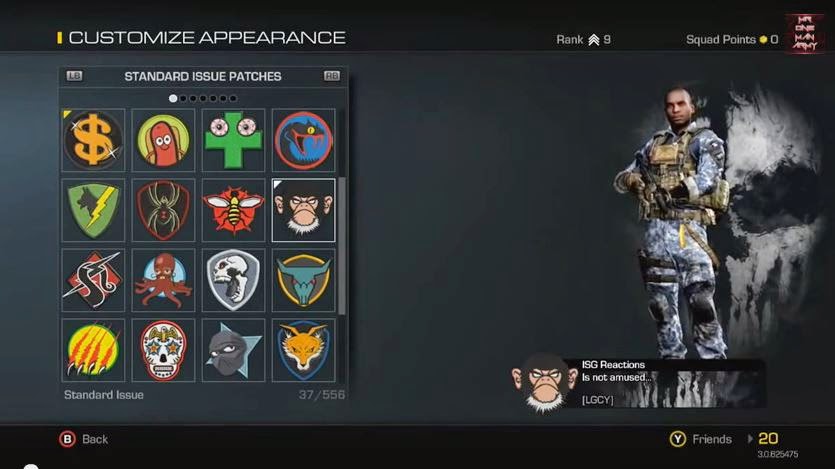
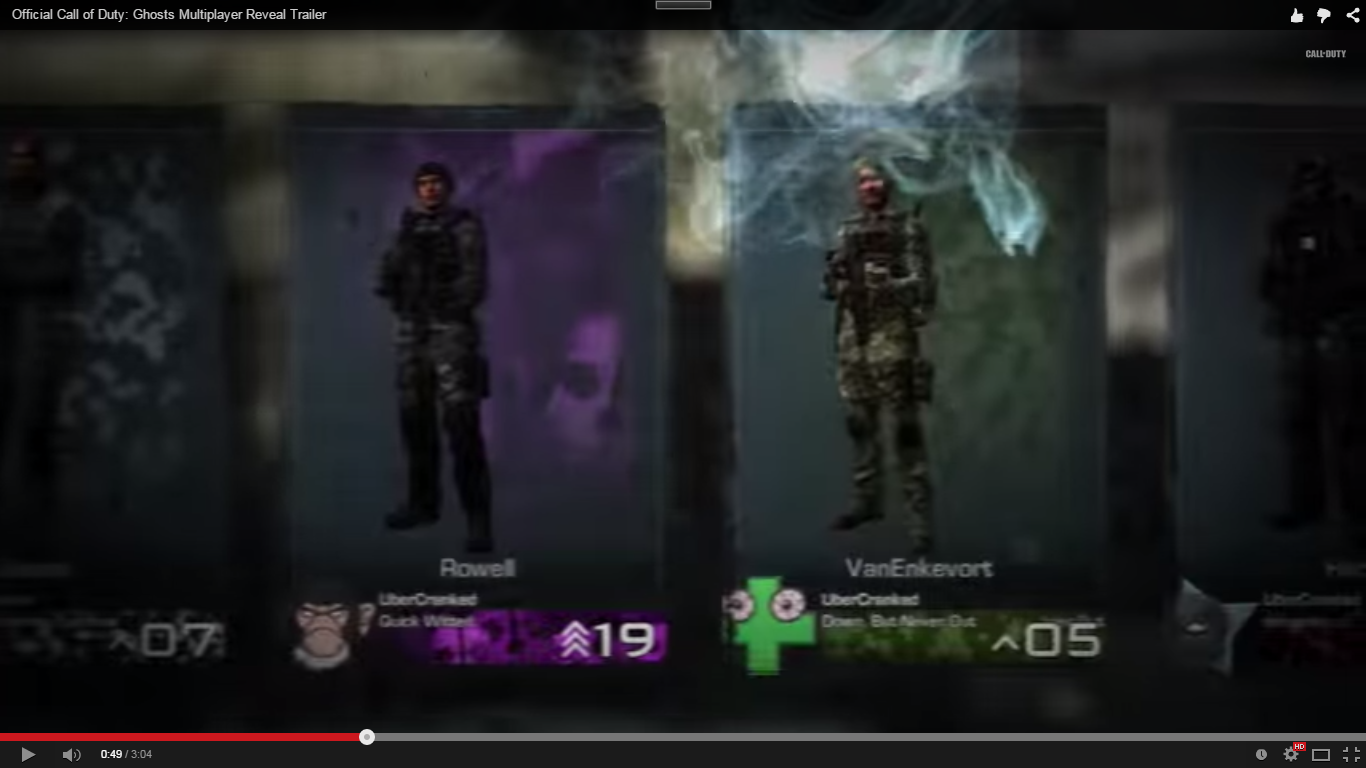
Ghosts includes an image visually similar to the angry monkey mark as a patch players can use on their avatars’ uniforms in multiplayer mode.  When selected, the patch appears at various points during play, and it also appeared in Activision’s pre-release promotional trailer for Ghosts’ multi-player edition.  MSM alleged copyright and trademark infringement and related claims.

Activision moved to dismiss the non-copyright claims based on the First Amendment, and won.  Ghosts’ use of the patch was artistically relevant and not explicitly misleading, thus passing Rogers v. Grimaldi.
Ghosts is the tenth installment in the Call of Dutyfranchise.  Ghosts “depicts highly realistic combat in a near-future, war-torn setting, featuring numerous characters, complex narratives, and advanced graphics. Its main protagonists are the Ghosts—a force of U.S. Special Operations personnel trained to conduct secret missions behind enemy lines.”  The game uses “dozens of contemporary weapons and vehicles that players can customize with modifications or attachments, and a variety of military equipment based on real-life counterparts or portrayals of future designs.”  It likewise uses “names and insignia of contemporary forces such as the National Security Agency, the United States Marine Corps, and the United States Air Force.”  A new feature allows players in multiplayer mode the option to customize their avatars, including gender, uniform style, gear, accessories, and over 600 patches. Thirty-two patches are available at the beginning, while more can be unlocked as rewards, and others are available for download; the angry monkey is one of the standard 32.

Patch selection screen
Closeup
The patches may appear onscreen during multiplayer matches “when a player may glimpse a patch on the uniform of another player, or alongside a flash of the name of an avatar wearing a patch who just performed a particular objective in the ongoing mission. The patches also appear alongside other player information in match summaries,” which are displayed at the end of play. Thus, patches serve to identify characters during play.  In the pre-release trailer, the design is visible for about 2 seconds at the bottom of the screen, associated with an avatar, along with other patches for other avatars.
Screenshot from trailer, monkey near bottom left
Ghosts is an expressive work entitled to First Amendment protection.  MSM argued that before applying Rogers to an expressive work, the Ninth Circuit requires a mark to be a cultural icon.  This argument was based on a misreading of Mattel v. MCA.  While it found support in “an outlier decision from this district,” Rebelution, LLC v. Perez, 732 F. Supp. 2d 883 (N.D. Cal. 2012), the court distinguished Rebelution even if it was consistent with governing law: That case favored a reggae band using the name Rebelution in a case against Pitbull’s album with the same name, but there Pitbull wasn’t referring to the band.  (If “Rebelution” was artistically relevant to Pitbull’s own message, for example through its slightly punny connotations, of course, that should count too, as the court here seems to signal with its skepticism.)  But Ghosts’ use of a patch drawing on a design that’s extremely popular in the military world was artistically relevant.
Mattel “stands for the proposition that a trademark owner may not control public discourse whenever the public ‘imbues his mark with a meaning beyond its source-identifying function’—a far more inclusive standard than the ‘cultural icon’ one MSM advocates.”  Plus, this rule wasn’t a threshold limitation, but just part of the first prong analysis.  ESS Entertainment 2000 v. Rock Star Videos didn’t require the Play Pen strip club to be a cultural icon; Rogers applies as long as the game is an artistic work.
Rogers provides that a use of a mark in an artistic work is not actionable unless (1) the use of the  mark has “no artistic relevance to the underlying work whatsoever,” or (2) it has some artistic  relevance, but “explicitly misleads as to the source or the content of the work.” This is a highly speech-protective standard.  Ghosts’ multiplayer mode was supposed to be a realistic combat experience, “the intensity of which is heightened by sophisticated features permitting players to customize their avatars’ identities and engage with other players in the virtual environment.”  The use of many real-world references creates a “critical mass” to achieve a “look and feel” consistent with the game creators’ vision. The angry monkey patch is a small part of this vision, helping to create “an authentic universe of morale patches, like those available in the real world.”  Thus, the inclusion of the patch had “some artistic relevance,” all that was required.  MSM argued that there was no artistic relevance because the armed forces ban morale patches on uniforms in the field.  “But MSM invokes no authority, nor is there any, for the proposition that use of a mark must sufficiently mimic reality to fall within the First Amendment’s safe haven.”
MSM argued that the use of the patch was commercial speech, but it wasn’t.  Its brief appearance in the pre-release trailer and in a menu that also allowed players to access additional patches for purchase didn’t change its artistic relevance in the game.  Creators of artistic works can market them, and can even choose to focus on trademarked products as a “crass marketing tool” as long as they’re also artistically relevant. Winchester Mystery House, LLC v. Global Asylum, Inc., 210 Cal. App. 4th 579 (2012).
Nor was the use explicitly misleading.  Explicit misleadingness requires “an affirmative and overt statement that indicates a relationship with or endorsement by the plaintiff.” Using the mark can’t itself be affirmatively misleading, or Rogers would be meaningless, and this rule extended to using the mark in promotional materials for the work (as is necessarily entailed by Rogers’ origin in a case against a movie title!). MSM didn’t show any way in which Activision affirmatively purported to “share a relationship” with MSM.  The packaging was very clear about origin and source.
MSM’s evidence of “actual confusion” from a blogger was irrelevant.  As the Ninth Circuit has already held in Brown v. EA, survey evidence can’t change mere use of a mark to “explicitly” misleading.  The only relevant evidence under Rogers relates to the nature of the behavior of the defendant, not the impact of the use.  Rogersitself disregarded a survey showing 38% confusion.  The risk of confusion was outweighed by the First Amendment interests at stake.

Posted in first amendment, trademark | Leave a comment

plaintiff must identify elements of trade dress, specific false claims

Homeland Housewares, LLC v. Euro-Pro Operating LLC, 2014 WL 6892141, No. CV 14–03954 (C.D. Cal. Nov. 5, 2014)
Previously, the court granted a preliminary injunction on certain false advertising claims and refused to stop the plaintiff from publicizing that.  Now it granted in part and denied in part a motion to dismiss.  The parties compete in the home blender market. Homeland sells the Nutribullet, Nutribullet Sport, and Nutribullet Pro, and allegedly spent several hundred million dollars in ads, including infomercials.  Euro-Pro’s Nutri Ninja allegedly copied “the color scheme, fonts, phraseology, and overall look and feel of Plaintiff’s NUTRIBULLET packaging trade dress.”  Also, the packaging compares the Nutri Ninja to the Nutribullet in a chart.  Homeland also alleged that Euro-Pro planted “false reviews on the Internet, making false claims of defects in NUTRIBULLET blenders and touting the NUTRI NINJA as a superior alternative.”
Euro-Pro didn’t move to dismiss false advertising claims based on the chart, but did as to the allegedly fake reviews.  Homeland didn’t sufficiently allege that part of the claim.  It didn’t specify what “false claims of defects” Euro-Pro allegedly made:

Without something more, the allegation is ambiguous. Do the reviews, for example, label Plaintiff’s products “poorly made” or “too small” or “ugly,” which would be statements of opinion? Or do they make falsifiable factual claims about Plaintiffs’ blenders? Secondarily, even if Defendant made statement of fact, were they material? These questions matter, because merely alleging that Defendant said negative things about one’s product is not stating a claim for false advertising. Plaintiffs must clarify its allegations to state a cognizable false advertising claim based on false reviews.

In addition, saying that false reviews were somewhere on the internet wasn’t enough, “as the internet is vast and contains multitudes.”  Without more, Homeland failed to allege likely deception or injury.  “Some indication of the nature and scope of the communication is required to successfully allege false advertising.”
The trade dress infringement claim was dismissed for failure to sufficiently specify the elements of the claimed trade dress.  A photo plus a written description wasn’t enough where the written description claimed “the color scheme, fonts, phraseology, and overall look and feel” of Homeland’s product packaging.
Trade libel: this requires pleading special damages, which Homeland didn’t do. Instead it just claimed “lost sales, disruption of business relationships, loss of market share and of customer goodwill” to the tune of $3 million.  Homeland needed to allege its established sales for a substantial period, sales after the allegedly libelous publication, and facts showing that loss was the natural and probable result of the publication.
California FAL and UCL claims: tracked the results above.

Posted in http://schemas.google.com/blogger/2008/kind#post, trademark | Leave a comment

It’s all about control: how to get a survey excluded

First Data Merchant Services Corp. v. SecurityMetrics, Inc., No. RDB–12–2568, 2014 WL 6871581 (D. Md. Dec. 3, 2014)
This is a motion to exclude in a false advertising/antitrust case. “This origins of this contentious case lie in a soured business relationship and the settlement of earlier litigation in the United States District Court for the District of Utah.”  Plaintiffs (First Data) sued SecurityMetrics over alleged post-settlement misconduct, and SecurityMetrics asserted 15 counterclaims.
PCI is an acronym for Payment Card Industry.  The PCI Security Standards Council (PCI Council) was formed in 2006 by the major credit card brands and developed the PCI Data Security Standard, which has been adopted by the major credit card brands as their data security compliance requirement for all merchants.  The PCI Standard’s requirements vary based on merchant size; at issue here are merchants with the lowest transaction volume (but because there are so many of them, they have the highest number of transactions collectively).  There are a number of different types of certified PCI standard compliance service vendors, with certifications recognized by the card brands; SecurityMetrics has a number of these PCI Council certifications while First Data allegedly does not.
First Data processes credit and debit card transactions for merchants and independent sales organizations. SecurityMetrics provided PCI compliance services to some merchants for whom First Data provides processing services.  The parties worked together until the relationship deteriorated, ending with SecurityMetrics’ allegation of a material breach of their contract by First Data.  SecurityMetrics also alleged that at that point First Data began offering a service called PCI Rapid Comply, which competes with the services offered by SecurityMetrics.  First Data allegedly allowed its fees for PCI Rapid Comply to count toward the required billing minimums for customers, but not fees paid to other PCI compliance services; and First Data allegedly told merchants they’d have to pay for PCI Rapid Comply even if they used a different security compliance vendor.  The parties settled their first suit, and then First Data sued.
I’m only going to discuss advertising-relevant issues.  One SecurityMetrics expert was a marketing professor at San Diego State, Michael Belch.  He surveyed consumer perceptions of the name PCI Rapid Comply, and opined that consumers would be deceived if the service wasn’t in fact approved or certified by the PCI Council. But his survey didn’t use a control to test for whether it was the name, PCI Rapid Comply, creating confusion.  SecurityMetrics didn’t adequately explain how Belch reached his conclusions linking confusion to the use of PCI in the name.  This was a “significant flaw,” and justified exclusion when combined with several other “troubling” aspects of the survey.  First, the survey tested the name alone, divorced from typical marketing materials.  Second, the original, online version of the survey was not preserved and was never turned over to First Data. Third, the survey questions repeatedly mentioned the name PCI Rapid Comply, creating a possible bias that wasn’t addressed because there was no control.  Thus, Belch’s testimony could confuse a jury.
SecurityMetrics’ proffered expert Clark Nelson was a CPA, CGMA, and CFF with an MBA from Wharton, who opined that First Data generated $190,951,243 in PCI-related revenues, which SecurityMetrics sought to disgorge under its two Lanham Act claims.  Challenges to Nelson’s calculations could be addressed on cross-examination.  Though First Data argued that he failed to consider alternative reasons for SecurityMetrics’ lost profits, his report “reflect[ed] a complex analysis that included calculation and consideration of SecurityMetrics’ natural attrition and penetration rates and a variety of other factors,” and wasn’t so methodologically flawed as to warrant exclusion.
SecurityMetrics, however, was bound by the fact that its Rule 30(b)(6) deponent was only able to identify a few specific instances of merchant customers lost due to First Data’s alleged conduct.  It later created a more detailed chart and argued that, since it had already disclosed the recordings on which the chart was based, the chart should come in.  Whether intentional or not, this reflected an end run around Rule 30(6)(b), so SecurityMetrics’ evidence of damages would have to be tied to specific testimony from the deposition or evidence in exhibits from that deposition.

Posted in damages, http://schemas.google.com/blogger/2008/kind#post, surveys | Leave a comment

Public Knowledge on the monkey selfie threat letter

Sherwin Siy, bringing just enough snark in reply to the camera-owner’s demand letter. 

Posted in http://schemas.google.com/blogger/2008/kind#post | Leave a comment