Failure to disclose potato variety isn’t misleading

Zuckerman Family Farms, Inc. v. Bidart Bros., No. 1:14–cv–01529, 2014 WL 7239423 (E.D. Cal. Dec. 17, 2014)
 
Plaintiffs sued for violation of the Plant Variety Protection Act (PVPA), the Lanham Act, and California Business Practices Code section 17200 et seq.  They alleged that Bidart imported, planted, and propagated Sifra, a PVPA-protected variety of potato, without authorization. The court denied a preliminary injunction and dismissed the complaint.
 
HZPC registered a new potato variety in the Netherlands in 2008, and was issued a PVPA certificate in 2012.  It entered into a Sifra production agreement with Zuckerman providing that Zuckerman was authorized to certify [Sifra] seed potatoes … for its own use and shall have the Priority Right for marketing and sales of seed potatoes of the [v]ariety in the States of California, Oregon, and Washington. Priority right is defined as the right of [Zuckerman] to first right of refusal to use or market seed of the [v]ariety in California, Oregon, and Washington.”
 
Bidart was allegedly selling Sifra potatoes from a source other than Zuckerman or HZPC, below the price offered by plaintiffs, which had affected the sale of as many as 280,000 fifty-pound units of plaintiffs’ Bella Blanca brand potatoes.
 
The court found that plaintiffs lacked standing to bring PVPA claims because they didn’t own any relevant exclusive right.  HZPC agreed not to appoint other marketing agents in the territory, but retained its own right to sell seed potatoes to other growers.  And while Zuckerman had the exclusive right to market Sifra to other growers (except for HZPC’s rights), and to propagate in order to market Sifra for non-table use, plaintiffs didn’t allege that Bidart propagated Sifra to market for growing purposes, so that exclusive right hadn’t been infringed.  Neither Zuckerman nor HZPC had the right to exclude others from table production of Sifra unless they both agreed. In order to exclude a potential grower from growing or selling Sifra for table use in the territory, first Zuckerman would have to decline to exercise its right of first refusal, then HZPC would have to refuse permission. Thus, they were best described as co-exclusive rightsholders, and Zuckerman alone didn’t have constitutional standing to bring its claim.  (It could amend to add HZPC, if that were possible.)
 
The complaint wasn’t clear about the nature of the Lanham Act claim.  It alleged that any sale of Sifra within the relevant territory impliedly represented that the potatoes came from plaintiffs, causing consumer deception about the affiliation between the parties or the origin, sponsorship or approval of Bidart’s sales.  But plaintiffs also alleged that Bidart’s conduct of “marketing the Sifra variety without representing its true nature and that it is subject to protection under the PVPA” harmed plaintiffs’ Bella Blanca brand and reputation.
 
The false association claim didn’t work because it was predicated on the assumption that plaintiffs had exclusive rights in the territory.  Plus, plaintiffs didn’t explain how the confusion would happen given that Bidart wasn’t alleged to have used any marks associated with plaintiffs.  In theory, plaintiffs could be arguing that Sifra potatoes are distinguishable enough from other white, round potatoes to have a protectable trade dress, but they didn’t plead any facts to this effect or any facts indicating nonfunctionality.  Plaintiffs wanted to stop Bidart from selling Sifra potatoes—a patent remedy, not a false association remedy. (There also seems to be a lurking Dastar issue here, as the court suggests when it notes that Bidart was the origin of the potatoes it sold.)
 
As for false advertising, that theory too was tied to nonexistent exclusivity.  Plaintiffs argued that Bidart’s sales deprived plaintiffs of their right to advertise that they were the exclusive source of Sifra potatoes, commanding a premium. Plus, even did exclusivity exist, mere failure to disclose that the potatoes were Sifra wasn’t itself false or misleading.  Bidart advertised the potatoes that it sold as “white, round potatoes.” This was literally true and plaintiffs didn’t explain why it was misleading.  There was no authority suggesting that a grower or seller needed to use the specific varietal in its advertising. 
 
The state-law unfair competition claims failed to justify a preliminary injunction too, for the same reasons.  Plus, the court concluded, a UCL claim couldn’t be founded on PVPA or Lanham Act violations to established predicate unlawful conduct—such a claim was preempted. (Citing patent law, but not Lanham Act cases, because the Lanham Act actually doesn’t preempt state law except for a few unusual situations not at issue here.)
 
The motion to dismiss was granted for the same reasons, with leave to amend for the PVPA to add HZPC.  It’s not clear that amendment could save the Lanham Act claims, and the court commented that “[e]ven assuming that a trade dress or other false association claim could be alleged in this case based solely on sale of Sifra, Defendant’s sale of Sifra could only imply that Zuckerman or HZPC has approved of the sale.”  The court didn’t elaborate, but it may be that unless the parties are sufficiently related, such probabalistic confusion can’t inflict an actionable injury on either one of them.  After all, in the unlikely event that a consumer really thought “either Zuckerman or HZPC approved this product,” the consumer doesn’t actually expect the product to come from Zuckerman; she just thinks it might or might not be the case.  (Another instance where materiality would be very useful in trademark.)
 
Then the court told plaintiffs to be clearer about their §43(a) claims, stating that the Ninth Circuit imposes different standing requirements on the different subsections (and quoting Ninth Circuit cases only even though the intro discussion mentioned Lexmark, which is a bit odd). For false advertising standing, the plaintiff needs to show (1) a commercial injury based upon a misrepresentation about a product; and (2) that the injury is “competitive.”  (Lower courts are largely ignoring Justice Scalia’s claim that Lexmark wasn’t a standing decision.)  For false association, standing comes from alleging commercial injury based upon the deceptive use of a trademark or its equivalent.  (Lexmarkdoesn’t make this distinction, but many courts apparently assume it was only a §43(a)(1)(B) case, despite Lexmark’s reliance on language that does not differ in its application to the subsections.)  To replead, plaintiffs would have to identify specific statements that caused false association or constituted false advertising.  Though plaintiffs pled lost sales through lower prices, they didn’t plead any facts indicating that Bidart’s advertising of Sifra as “white, round potatoes” or the omission of the name “Sifra” or any other alleged misrepresentation caused plaintiffs to lose sales to Bidart.
Posted in dastar, http://schemas.google.com/blogger/2008/kind#post, patent, trademark | Leave a comment

Seen at the Spy Museum

Matzohball, an Israel Bond thriller, a new adventure of Hebrew secret agent Oy-Oy-7, by Sol Weinstein, author of Loxfinger.

Posted in parody, trademark | Leave a comment

Rogers applies when film is simply named for character

Valencia v. Universal City Studios LLC, No. 1:14–CV–00528, 2014 WL 7240526 (N.D. Ga. Dec. 18, 2014)
 
Valencia, professionally known as Honey Rockwell, sued Universal for invasions of privacy; fraud, false advertising, and unfair competition; and trademark dilution.
 
Valencia alleged that she’s a hip hop dancer and dance teacher, performing under the stage name “Honey Rockwell” since 1994. Valencia, “a native of the Bronx and of Hispanic descent, performed and taught dance at various community dance centers and theaters in the Bronx.”  She also appeared in various dance productions and magazines, and created, produced, and released a music video. 
 
In 2003, Universal released Honey, a movie chronicling “the dreams and struggles of Honey Daniels, a native of the Bronx of Hispanic descent who performs and teaches hip hop dance in the Bronx.” In 2011, Universal released Honey 2, in which a hip hop dancer inspired by Honey Daniels achieves success and fame.  
 
Valencia alleged that this misappropriated her life story, including her teaching and music video appearances; that both she and the character were affiliated with dance studios the Bronx Dance Theater and Hunts Point; that a producer for the film was notified of the similarity; and that she’d been approached and identified as the dancer depicted in Honey, and on one occasion was contacted to appear at a movie release party as “the real [H]oney.”  Valencia alleged that this made her look like a copycat (reverse confusion), damaging her image.
 
The common-law privacy/right of publicity claims were time-barred, since she waited more than two years after the initial release.  Valencia’s unjust enrichment failed because it wasn’t an alternative theory of recovery for a failed contract, as required under Georgia law.
 
Her Lanham Act and Georgia trademark claims were subject to the same analysis, and failed because she didn’t sufficiently allege rights in the mark “Honey” as opposed to the mark “Honey Rockwell.”  Rights in the latter, which the court assumed she sufficiently pled, couldn’t be sufficient to generate secondary meaning in “Honey.”
 
However, the court found that Valencia’s Georgia Uniform Deceptive Trade Practices Act Claim did not fail for the same reason, since it provided a cause of action for conduct that caused “likelihood of confusion or of misunderstanding as to the source, sponsorship, [or] approval … of goods or services,” or “as to affiliation, connection, or association with … another,” or “[r]epresents that goods or services have sponsorship[ or] approval … that they do not have.” Given Valencia’s allegation that she’d been approached as “the real Honey,” this count couldn’t be dismissed as not plausibly alleged.
 
But then there’s Rogers.  Valencia’s argument that First Amendment protection for the movies was limited because they’re sold for profit was unavailing.  The Eleventh Circuit adopted Rogers in Univ. of Alabama Bd. of Trustees v. New Life Art, Inc., 683 F.3d 1266 (11th Cir. 2012). (Thank you, Mark McKenna!)  The title Honey was artistically relevant because it was the protagonist Honey Daniels’s first name.  Honey 2was artistically relevant because the protagonist of that movie drew inspiration from Honey Daniels.
 
Comment: without noting that it’s doing so, the court resolves a predicate question some courts have not properly understood.  The title is artistically relevant to the content of the film, even though it’s not necessarily a reference to Valencia.  That suffices, as it should.
Posted in right of publicity, trademark | Leave a comment

Sony in the Killzone: case over resolution continues

Ladore v. Sony Computer Entertainment America, LLC, 2014 WL 7187159, No. C–14–3530 (N.D. Cal. Dec. 16, 2014)
 
Ladore sued Sony for allegedly false advertising of its video game Killzone: Shadow Fall. Sony allegedly represented that Killzone’s “multiplayer” mode renders graphics in full (or “native”) 1080p resolution, when in fact Killzone’s multiplayer graphics are rendered with significantly less resolution than advertised.
 
The court largely refused to dismiss the complaint, except for the negligent misrepresentation claim.
 
Sony launched the PS4 in 2013, almost at the same time as the competing Xbox One.  The focus of the “console battle” allegedly was on performance, including resolution as a key indicator.  Resolution measures image clarity, and typically depends on the number of pixels.  A monitor that displays 1,920 lines of pixels in the vertical direction and 1,080 lines of pixels in the horizontal direction is called “1080p,” while 1,280 by 720 is “720p.” 1080p allegedly offers “double the graphical detail” as one displayed in 720p.
 
An image originally created or rendered at a lower resolution can be displayed at 1080p by using interpolation, a “common name for methods that attempt to fill in blank pixels that are created when an image is transformed from a lower resolution to a higher resolution.” Algorithms guess what pixels should look like by analyzing nearby pixels.  But some believe that using interpolation is a “horrible kludge that results in soft, slightly blurry images.”
 
Guerrilla Games, a Sony subsidiary, developed Killzone, released for sale along with the debut of the PS4. Marketing allegedly focused heavily on Killzone’s claimed ability to render the game in multiplayer mode at “native 1080p” resolution.  This was material because the PS4 was supposed to be “more powerful in graphical terms” than the competing Xbox One, and Sony allegedly wanted Killzone to be a “showcase for the PS4’s technical capabilities.”  
 
Ladore alleged that he read numerous internet accounts—many published by Sony or citing statements made by Sony employees—representing that Killzone’s multiplayer mode would render graphics in “native 1080p and 60 fps [i.e., frames per second].” For instance, a “Killzone director” reportedly told an “official” PlayStation news site that “the first thing that people notice is fidelity … Killzone is running in 1080p, whereas the last game was running in 720p.” Describing a demonstration/teaser version, Sony wrote on its website that “[a]s you can probably tell from the footage, Killzone Shadow Fall multiplayer outputs at a native 1080p, rendering uncapped but always targeting 60 [frames per second].”
 
Ladore allegedly relied on these reports, and also examined the packaging, which appeared to confirm the native 1080p misrepresentation:
 

He bought the game and opened the package, rendering it unreturnable, then realized that the multiplayer graphics were blurry and not native 1080p.  Others noticed the same problem, including video game critics.  Eventually, Eurogamer.net reported that Killzone used interpolation for the multiplayer mode, and a Killzone producer allegedly confirmed this, conceding that “[n]ative is often used to indicate images that are not scaled,” and “[i]f native means that every part of the pipeline is 1080p, then [interpolation] is not native.” The producer continued: “[w]e recognize the community’s degree of investment on this matter, and that the conventional terminology used before may be too vague to effectively convey what’s going on under the hood. As such we will do out best to be more precise with our language in the future,” though the producer contended that interpolation “gave substantially similar results” to rendering in full/native 1080p.
 
Ladore alleged that, had he known the truth, he wouldn’t have bought Killzone or would have paid substantially less for it.
 
Sony argued that there was no misrepresentation, in that Killzone output 1080p in multiplayer mode.  That misunderstood the gravamen of the complaint and ignored critical factual assertions that were properly alleged.  Ladore didn’t allege misrepresentations about final output resolution, but rather about the creation/rendering of the multiplayer graphics, represented to be 1080p when they weren’t.  Sony’s own words indicated that the method it used appeared “subjectively similar” to 1080p, though Ladore characterized the resulting images as subpar. The misrepresentation concerned native 1080p, contrasted to interpolation.  Indeed, arguably Killzone didn’t “output” video at all—the PS4 does.  Ladore’s allegations concerned the resolution of the images first rendered by the game software, not the ultimate resolution on his TV set.  Even if interpolation produces 1080p images, that doesn’t undercut claims that Sony affirmatively misled Ladore about the ultimate quality of the graphics Killzone offered.
 
In addition, the complaint adequately pled reliance, despite Sony’s argument that the statement on its box said nothing explicit about how Killzone’s graphics are rendered. Ladore pled that he examined several pre-release statements, including a statement attributed to Sony’s Social Media Manager that “competitive multiplayer mode … runs at native 1080p.” Ladore alleged that he read the packaging, which corroborated (or at least did not affirmatively correct) Sony’s earlier misrepresentations, and bought the game.  That was enough.
 
Plus, even if Ladore simply alleged reliance on the box, that likely would have been enough to survive a motion to dismiss. “Because the PS4 is capable of outputting all games at 1080p, a specific representation on a particular game that the output is 1080p would likely convey to the average consumer that the particular game’s graphics are, in fact, natively rendered at 1080p. A completely unqualified legend, like the one at issue here, would have no real meaning if it could be applied to all PlayStation games, including the substantial majority of games that do not natively render in 1080p.”  The complaint, in fact, alleged that Sony used a different on-box label for games that didn’t render natively in 1080p.
 
Sony also argued that it disclosed that Killzone used interpolation in multiplayer mode in at least two posts in March 2014, two months before Ladore’s purchase.  Sony’s act of “coming clean” didn’t make Ladore’s reliance unreasonable as a matter of law.  Ladore alleged that he read the misrepresenations, but not that he read or became aware of Sony’s corrections until he sued. Sony’s argument was inappropriate at the motion to dismiss stage.
 
The court also found Killzoneto be a “good” under the CLRA because it came on a physical disc.  Ladore didn’t simply buy or download intangible software or play an online game.  He went to a brick and mortar store and received the disc in a box, accompanied by tangible documentation.  Sony’s argument that the disc was nothing but a physical mechanism for delivering an intangible right to use software was wrong, because if it were accepted, many tangible commodities could be so recharacterized.  A book is a tangible chattel, even though the physical object is a “delivery mechanism” for information.  Insurance contracts and credit cards are by contrast not delivery mechanisms; they are physical representations of intangible agreements.  Discs and books don’t memorialize or prove the existence of an agreement; they are objects that can be possessed or used, and that’s why people buy them.

However, the economic loss rule barred Ladore’s negligent misrepresentation as presently pleaded.

Posted in california, consumer protection, http://schemas.google.com/blogger/2008/kind#post | Leave a comment

Do you have to buy the IP to buy the "company"?

A.Hak Industrial Services BV v. TechCorr USA, LLC, 2014 WL 7272796, No. 3:11–CV–74 (N.D. W. Va. Dec. 18, 2014)
 
Berkeley Springs Instruments (BSI) sold certain IP rights in robotic tank inspection and cleaning technology to A.Hak. TechCorr argued that the sale shouldn’t have occurred because TechCorr had a right of first refusal to the IP and a perpetual license to the associated trademarks; A.Hak counterclaimed for violations of the Lanham Act.
 
The relevant technology allows inspection of tanks in service, eliminating the need to drain them for inspection. Associated trademarks were InTANK, OTIS for the robot probe, and a non-robotic probecalled  SCAVENGER, owned in 2006 by Praxair/AST.  Praxair sought a buyer and negotated with TechCorr, resulting in a non-binding letter of intent to Praxair indicating TechCorr’s desire to buy “the physical assets for the above ground storage tank inspection business.”  In 2007, Praxair/AST and TechCorr entered into an asset sale and purchase agreement; Praxair/AST also entered into a transfer agreement with BSI, transferring the IP, including trademarks, to BSI.  TechCorr alleged that, as a precondition for the closing, BSI  gave TechCorr a right of first refusal in any future sale of the IP by BSI. BSI sent a letter indicating that BSI granted TechCorr “a perpetual right to use the Intellectual Property and registered brand name of ‘In–Tank®’ for the ‘In–Tank® Robotic Assets’ being acquired by TechCorr from AST Services, LLC.”  BSI also agreed to “support” the acquisition.  The parties disputed the license’s scope and relevance.
 
In 2010, TechCorr found that BSI was now competing in the tank inspection market under the name InTANK.  Internally, a TechCorr principal wrote that BSI “owns the patents and trademark but we have a separate letter agreement attached saying we have ‘… perpetual right to use the Intellectual Property and registered brand name of ‘In–Tank’ robotics assets …’ So we can not stop [BSI] from using the name to compete with us.” 
 
A.Hak then bought the IP, including the relevant marks, from BSI.  TechCorr objected, based on its alleged right of first refusal.
 
TechCorr argued that, because A.Hak admitted the existence of a license, it couldn’t state a claim for trademark infringement.  A.Hak argued that TechCorr exceeded the scope of the license by claiming to own the marks, by virtue of (1) references on TechCorr’s website to “the TechCorr inTANK® system,” “TechCorr’s Scavenger XT® 2000,” and OTIS®; a press release titled “TechCorr USA, LLC Announces Completion of Multi Tank In Service Inspection with New Robot Added to the Wholy [sic] Owned ‘In–Tank’ Inspection Robotics Program”; and (3) statements in a proposal issued to the TVA using terms such as “TechCorr’s InTANK In–Service Inspection services.”  In addition, statements such as “We acquired the company in 2007” and “[W]hat is the relation between ‘inTANK’ and ‘TechCorr’?”/“TechCorr purchased the In Tank company 3 or 4 years ago” allegedly suggested that TechCorr bought the marks.
 
TechCorr argued that (1) some of the statements weren’t actionable because they weren’t made to customers; (2) they were true, because TechCorr bought the InTank operations and assets and had a license to use the marks for those assets; (3) they were within the scope of the license; and (4) any difference in the scope of the purchase was immaterial.
 
The court denied A.Hak’s motion for summary judgment on the trademark/false designation of origin claims.  On summary judgment, TechCorr’s position that it could use its name as a possessive (“TechCorr’s”) in connection with the mark and that its reference to “wholly owned” referred to the physical assets was not unreasonable under the terms of the license agreement.
 
In addition, A.Hak argued that TechCorr’s claims that its OTIS® robot was “intrinsically safe” misled customers because it lacked the necessary third-party certification to call it “intrinsically safe,” as certain internal documents indicated.  TechCorr argued that it bought an intrinsically safe robot from AST.  It also restated its trademark claims as false advertising claims.
 
TechCorr argued that its statements via email weren’t made to customers and thus weren’t commercial advertising or promotion.  The court agreed with respect to one statement, made to a potential provider of services, not to a potential customer.  Another statement was made to a middleman vendor rather than an ultimate customer; this could support a false advertising claim because statements don’t have to reach the ultimate consumer to be actionable (though the court doesn’t address the question of whether one email is sufficient dissemination to the relevant purchasing public under Gordon & Breach).
 
The court then found a genuine issue of material fact as to whether statements that allegedly claimed ownership of the trademarks or “full” ownership of InTANK were literally false.  (I’m not a fan of the literal/implicit distinction, but I don’t get this.  If there are two reasonable meanings, one of which is concededly true, shouldn’t that be only potentially implicitly false?  I guess the theory is that claiming to have bought the “the whole InTANK operation” and “the In Tank company” could have only one reasonable meaning, thus literal falsity.)
 
On the “intrinsically safe” robot/associated claim to have “each component certified,” A.Hak argued that TechCorr never had an operational intrinsically safe OTIS robot, while TechCorr responded that it bought an intrinsically safe OTIS robot from AST.  These statements were arguably ambiguous about what “each component” and “certified” meant—if each separate component was separately certified as intrinsically safe, then this could be true.  Thus, summary judgment for A.Hak was inappropriate.
 
Other claims for breach of contract and tortious interference were trimmed down.
 
The court also rejected TechCorr’s false advertising counterclaim based on A.Hak’s statement that  “Our third-generation OTIS inspection robots can be found nowhere else in this world.” “Third-generation” was not shown to be a statement of fact capable of being falsified; I omit discussion of some other claims. 
Posted in http://schemas.google.com/blogger/2008/kind#post, trademark | Leave a comment

scientific claims in ordinary ads aren’t protected opinion

Eastman Chemical Co. v. Plastipure, Inc., 2014 WL 7271384, No. 13–51087 (5th Cir. Dec. 22, 2014)
A jury found that Plastipure (and defendant CertiChem) engaged in false advertising (discussed here).  The court of appeals affirmed the entry of an injunction.  Despite Plastipure’s reliance on the Second Circuit’s ONY decision to claim First Amendment protection for its speech, the court ruled, “the Lanham Act prohibits false commercial speech even when that speech makes scientific claims.”
Eastman makes a plastic resin, Tritan, and sells it to make water bottles, baby bottles, food containers, and other consumer products.  Consumers became concerned that polycarbonate, to which Tritan is an alternative, contained a chemical, bisphenol A (BPA), that could be harmful to humans.  These concerns were based on studies “purporting to show that BPA could activate estrogen receptors in the human body.”  Estrogenically active chemicals can trigger hormone-dependent cancers, reproductive abnormalities, and other negative health conditions.  Eastman conducted tests that, it contended, showed that Tritan was not estrogenically active.
Plastipure likewise “hoped to seize on the opportunity created by the public’s desire for BPA-free plastics” with its own competing plastic resin sold to manufacturers.  Plastipure and CertiChem were founded by Dr. George Bittner, a professor of neurobiology at the University of Texas at Austin.  While Plastipure sells the resin, “CertiChem’s primary focus is on testing materials for various sorts of hormonal activity.”  “In 2011, CertiChem published an article [in a peer-reviewed journal published by NIH] summarizing the results of its testing of more than 500 commercially available plastic products.” Tritan products were tested, but Tritan was not mentioned by name.
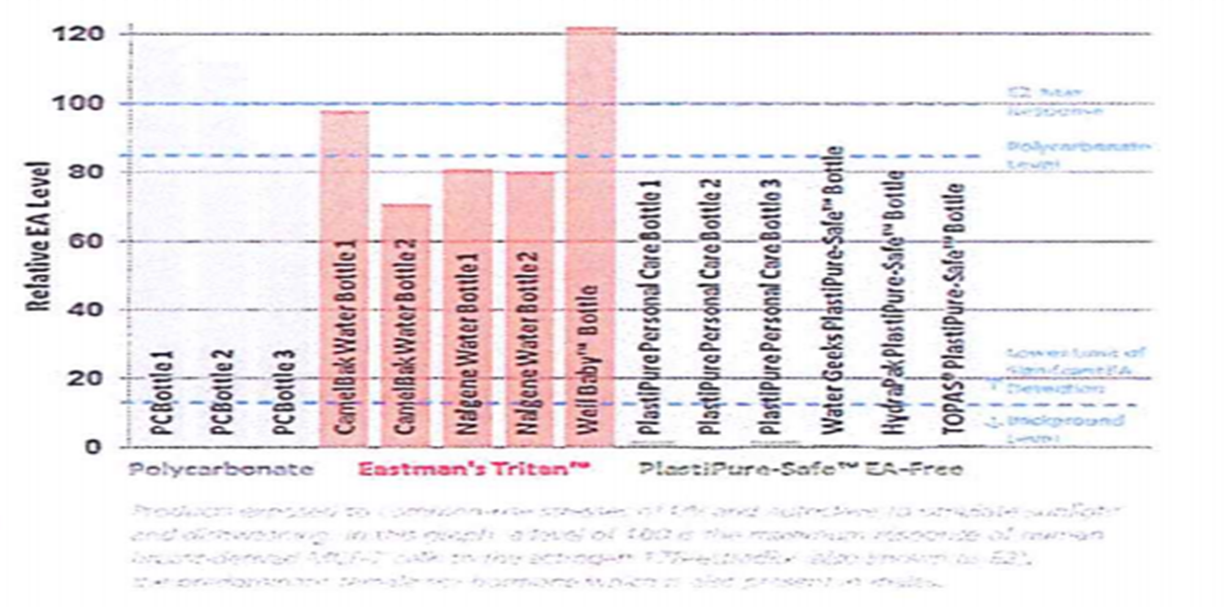
Before the article was published, Plastipure distributed a sales brochure, “EA [Estrogenic activity]–Free Plastic Products: Beyond BPA–Free.” The brochure contained a chart depicting products containing “Eastman’s Tritan” as having significant levels of EA. The caption stated: “Examples of test results of products claiming to be EA-free or made from materials claiming to be EA-free are given in the figure to the right. Most examples are made from Eastman’s Tritan resin.”  Eastman sued. 
Chart from Plastipure’s brochure
The parties offered competing scientific evidence at trial.  The jury ruled for Eastman, and the district court found a willful violation of §43(a), unfair competition under Texas common law, and conspiracy.  The district court enjoined Plastipure from distributing its sales brochure or claiming that “(1) Tritan resins and products leach chemicals having significant estrogenic activity; (2) Tritan, or products made with Tritan, are dangerous to human health because they exhibit estrogenic activity; or (3) Tritan resins and products leach chemicals having significant estrogenic activity after common-use stresses.”
On appeal, Plastipure claimed that its statements were scientific opinions, not factual claims.  A statement of fact can be judged true or false using empirical methods.  It must be a specific and measurable claim, “capable of being proved false or of being reasonably interpreted as a statement of objective fact.”  By contrast, bald assertions of superiority and exaggeration, bluster and boast are nonactionable opinions, as are predictions of future events.
Plastipure argued that “commercial statements relating to live scientific controversies should be treated as opinions for Lanham Act purposes,” in order to protect academic freedom and the free flow of scientific ideas.  It relied on ONY, Inc. v. Cornerstone Therapeutics, Inc., 720 F.3d 490 (2d Cir. 2013), which the court here characterized as concluding that “the First Amendment places scientific debates unfolding within the scientific community beyond the reach of the Lanham Act.”  Statements in scientific literature are, ONY reasoned, more like opinions than factual claims.
This case wasn’t governed by ONY, because the plaintiff there sought to enjoin statements “within the academic literature and directed at the scientific community.”  (Which just happened to be the consumer community, too.)  Here, Eastman didn’t sue Plastipure for publishing in a scientific journal, but for ads directed at nonscientist customers without the full scientific context, including a description of the data, the methodology, conflicts of interest, and divergences between raw data and the experimenter’s conclusions.  “In this commercial context, the First Amendment is no obstacle to enforcement of the Lanham Act.”
It didn’t matter that the commercial speech here concerned a topic of scientific debate:
Advertisements do not become immune from Lanham Act scrutiny simply because their claims are open to scientific or public debate. Otherwise, the Lanham Act would hardly ever be enforceable—“many, if not most, products may be tied to public concerns with the environment, energy, economic policy, or individual health and safety.” [Central Hudson.] The Supreme Court has “made clear that advertising which links a product to a current public debate is not thereby entitled to the constitutional protection afforded noncommercial speech.” [Bolger.] … The First Amendment ensures a robust discourse in the pages of academic journals, but it does not immunize false or misleading commercial claims.
True, ONY also rejected a tortious interference claim regarding the defendants’ “touting and distributing the article’s findings for promotional purposes.”  Even were that binding, it wouldn’t matter here.  First, that was a tortious interference claim, not a Lanham Act claim.  Second, the “nature” of the secondary distribution in ONY differed: there, it was limited to issuing a press release summarizing the article’s findings and disseminating the article itself.  By contrast, the conduct here didn’t include any dissemination of the article.  The sales brochure, distributed prior to the article’s publication, specifically highlighted Tritan’s alleged EA content, while the article never even mentioned Tritan by name.  This was the difference between presenting an article’s conclusions and “transform[ing] snippets of … a paper which never mentions Tritan or Eastman by name … into commercial advertisements claiming Tritan is harmful.”
The injunction only applied to statements made “in connection with any advertising, promotion, offering for sale, or sale of goods or services.” Plastipure could continue researching and publishing.  But it couldn’t push its product by making the claims the jury found to be false and misleading.
The injunction allowed Plastipure to seek relief if new research proved that the statements at issue were no longer false and misleading.  Plastipure argued that this provision showed that its statements weren’t statements of objective fact: a statement of historical fact such as “Tritan has EA” couldn’t be false one day and true the next.  That mistook the nature of the issue.  The fact that Plastipure might someday prove the truth of its statements didn’t make the injunction improper; “[i]f it did, companies could make all sorts of unsupported claims and then avoid liability by arguing that they might be able to prove the truth of the claims at some point in the future.”  Instead, an injunction could be modified or dissolved if the factual circumstances changed. 
Comment: I think Plastipure’s argument collapses the idea of truth with the idea of evidence.  Courts and juries use evidence to determine what is true.  They might be wrong; that’s implicit in the process.  But “wrong” means that there is a “right”—a verifiable, objective reality.  Compare: “not even wrong.”  The Lanham Act targets objective claims.  That we may revise our beliefs in what the objective truth isdoesn’t mean that it doesn’t exist, or that a decision was against the weight of the evidence at the time it was made.
Plastipure also challenged the sufficiency of the evidence, but a reasonable jury could have found falsity.  Eastman provided tests from four separate labs finding no estrogenic activity in Tritan; its expert witnesses testified that Tritan was EA-free and harmless, that most of Plastipure’s tests weren’t scientifically reliable, and that the few reliable tests actually showed no evidence of EA.  There was, naturally, contrary evidence, though no expert ever testified that Tritan was harmful to humans.  The jury was free to credit the evidence of literal falsity, and independently to find misleadingness (including deceptiveness and materiality), an independent basis for injunctive relief.

Posted in commercial speech, first amendment, http://schemas.google.com/blogger/2008/kind#post | Leave a comment

you can’t a accuse competitor of lawbreaking when courts have ruled against you

Paul Davis Restoration, Inc. v. Everett, No. 14–C–1534, 2014 WL 7140038 (E.D. Wis. Dec. 12, 2014)
Following a series of unsuccessful lawsuits with Paul Davis Restoration, Inc., Matthew Everett, a former franchisee, began running a radio ad:

This is a business advisory. Paul Davis Restoration, Inc., a national operator of fire and water restoration franchises, is seeking a judgment of 25 percent commission on certain prior sales, which constitutes an unenforceable penalty in violation of Wisconsin state statutes and case law governing such restrictions and practices. In addition, they are seeking to impose several other terminations and conditions that are in direct violation of Wisconsin’s Fair Dealership laws, those Wisconsin laws which are designed to protect all Wisconsinites. To learn more, please visit pdr-wi.com. This ad paid for by Paul Davis Restoration of NOWI.

The court enjoined Everett from using “Paul Davis Restoration” as a trade name; he was no longer a franchisee.  Although he agreed to remove that reference from the ad, given the litigation history between the parties, the court found that he hadn’t mooted the claim.
Paul Davis also argued that the rest of the ad was false and misleading; Everett argued that suppressing it would violate the First Amendment. Jordan v. Jewel Food Stores, Inc., 743 F.3d 509 (7th Cir. 2014), used a test for identifying commercial speech assessing whether (1) the speech is an advertisement; (2) the speech refers to a specific product; and (3) the speaker has an economic motivation for the speech.
The speech was undoubtedly in the form of an ad, and presumptively had an economic purpose: “advertising costs money, and most private citizens do not buy ad time merely to express their personal or political views.”  Also, Everett was a competitor of Paul Davis, and the content addressed topics of economic import.  And Everett’s own emails showed a purpose to divert business from Paul Davis to Everett: “This began running today in the markets we serve. It will begin running Statewide next week. …”  Running the ad in “the markets we serve” limited the ad to areas where Everett had an economic interest in driving business away from Paul Davis. “The threat implied by the ad is that Paul Davis’ business from the state and insurance carriers will dry up (and migrate to Everett’s business).” Also, the ad labeled itself a “business advisory,” which the court found to be “an effort to make the communication sound official, rather than something based on a citizen’s private views.” 
The ad didn’t refer to a specific product, but it did refer to a specific company and that company’s services. In context, it was clearly commercial speech.
In addition, the court found that the ad was false.  The ad claimed that Paul Davis was seeking “an unenforceable penalty in violation of Wisconsin state statutes and case law governing such restrictions and practices.” That is, the ad said that Paul Davis was breaking the law.  But it was merely seeking to enforce an arbitration award against Everett.  Even if the arbitrator got it wrong, “the fact that questions of law may be arguable does not mean a competitor can accuse a company of illegal conduct merely for seeking to enforce a lawfully obtained arbitration award. If Paul Davis’ CEO were tried and exonerated for a crime, a competitor would not be able to claim that the CEO committed criminal acts merely on the basis that it was the competitor’s opinion that the jury erred.”  (I should note that this rule must be limited to commercial speech.  If I, acting as a private citizen, opine that OJ Simpson is a murderer, the jury’s verdict of acquittal can’t be dispositive, and couldn’t be even before the civil verdict agreeing with me.)  There was no reasonable argument that Paul Davis was breaking any law by seeking to enforce an arbitration award, making the claim misleading and false.
The next statement, accusing Paul Davis of “direct violation of Wisconsin’s Fair Dealership laws,” also simply took issue with the rulings of the arbitration panel and the courts.  The claim of “direct violation” was not just an opinion but implied that the Paul Davis’s liability was clear, “when just the opposite is true.”  Accepting that many legal questions are arguable, and thus unfalsifiable, “would allow anyone’s subjective legal views to insulate them from liability simply on the basis that they disagreed (for whatever reason) with the rulings of a court.” Everett was free to run an ad expressing disagreement with the arbitration or the courts and arguing why he believed they erred.  “But here, the ad makes the preposterous claim that there is something illegal about attempting to enforce an arbitration award. The only conceivable purpose of such an assertion is to mislead consumers and others into thinking that the Plaintiff has engaged in illegal activity.”
Thus there was a strong likelihood of success on the merits. The parties didn’t much discuss the other factors, but “[g]iven the difficulty of calculating damages due to false accusations of illegal activity, the Plaintiff would suffer irreparable harm and would have no adequate remedy at law.”  So an injunction against the ad issued.

Posted in commercial speech, first amendment, http://schemas.google.com/blogger/2008/kind#post | Leave a comment

irreparable harm is permissible inference, Third Circuit rules

Groupe SEB USA, Inc. v. Euro-Pro Operating LLC., No. 14-2767 (3d Cir. Dec. 17, 2014)
District court opinion discussed here.  Euro-Pro appealed the preliminary injunction against it based on Lanham Act false advertising claims against its advertising for its steam irons.  The court of appeals treated this as primarily a case about “how courts should interpret an advertising claim when the packaging or label unambiguously defines a claim term.”  The court agreed with the district court that if a claim is false by the advertiser’s own definition, then consumer survey evidence can be disregarded and literal falsity is established.  In addition, while bound by the circuit’s earlier rejection of a presumption of irreparable harm, the court of appeals found that the evidence before the district court justified an inference of irreparable harm.
SEB’s Rowenta models 5080 and 9080 compete with Euro-Pro’s Shark 405 and 505.  The Shark 405 packaging claims that the Shark 405 offers “MORE POWERFUL STEAM vs. Rowenta®†† at half the price.” The “††” characters refer to a fine-print footnote on the bottom of the packaging, which states that the claim is “††[b]ased on independent comparative steam burst testing to Rowenta DW5080 (grams/shot).” The front of the packaging also says that the Shark 405 delivers “#1 MOST POWERFUL STEAM*.” The asterisk refers to another footnote on the bottom saying the Shark 405 “*[o]ffers more grams per minute (maximum steam setting while bursting before water spots appear) when compared to leading competition in the same price range, at time of printing.” The Shark 505 packaging makes substantially the same claims, except with a comparison to the Rowenta 9080.  Packaging hang tags claimed “MORE POWERFUL STEAM vs. Rowenta . . . at half the price,” with a reference claiming “[b]ased on independent comparative steam burst testing” to the respective Rowenta  steam irons in “(grams/shot).”
SEB ran tests to check these claims, and found that the Rowenta 9080 performed the same as the Shark 505 in grams per minute.  In grams per shot of steam, the Rowenta 9080 was superior.  SEB then commissioned an independent lab to do more tests, which found that the 5080 and 9080 outperformed the Shark 405 and 505, respectively, in grams per minute and grams per shot, on average.  (The district court made a calculation error that led it to conclude that the Shark 405’s average performance was slightly higher than the Rowenta DW5080’s average performance.)  
Euro-Pro introduced testimony and a study from its scientific expert, Dr. Abid Kemal, who calculated steam power based on the kinetic energy of a steam burst divided by the duration of the burst. Using this measurement, Kemal concluded that the Sharks outperformed the Rowentas on steam power, and that the grams per shot results were comparable between the products.  Euro-Pro also submitted a consumer survey from Dr. Gary Ford showing that consumers do not have a uniform understanding of the meaning of the phrase “more powerful steam.”
SEB’s marketing director, Scott Pollard, testified that “SEB had invested substantial resources to promote Rowenta as  the best brand of steam irons in  the eyes  of retailers and consumers. According to Pollard, the direct reference to Rowenta on the lower-priced Shark steam irons likely would erode the Rowenta brand’s reputation in the eyes of retailers, current consumers, and future consumers.”
The key dispute on appeal was whether the Shark claims were literally false.  Literal falsity analysis must consider the message in context.  The first interpretive step is figuring out whether the challenged claim conveys an unambiguous message, which is then evaluated for falsity.  Only unambiguous claims can be literally false.  The standard of review for a determination of ambiguity/unambiguity is clear error.
The district court found that the “more powerful than Rowenta” was unambiguous, given the footnote reference to grams per shot.  The “#1 most powerful” claim was also unambiguous by necessary implication because of the proximity to the other claim’s comparison to Rowenta.  This was false, given SEB’s evidence and the fact that the Kemal report didn’t measure steam power in grams/shot or grams/minute.
The court of appeals agreed that the “more powerful vs. Rowenta” claim was unambiguous.  “When a product’s packaging includes an advertising claim and unambiguously defines a claim term, the packaging’s definition of the claim term applies to the claim’s explicit message.”  (As we’ll see, there are some qualifications to come.  I don’t think this is license to advertise “$40/day every day*” and define “day” in a footnote as Monday-Friday.)
The court of appeals reasoned that “[t]o make something explicit is to state it clearly and precisely.”  So, when Euro-Pro “took the affirmative step to include a reference on the Shark packaging that clearly defined the key term in its claim—that steam power is measured in grams per shot—it made an explicit claim.”  This was also unambiguous because grams/shot was a unit of measurement used by the leading independent standard-setter for relevant technologies.  There was only one plausible meaning: “the claim means exactly what the reference on the packaging says it does.”
This conclusion was supported by the rule that courts must view claims in the context of the entire ad.  “[I]gnoring the reference in our analysis would be not only to read the claim out of  context, but also to ignore part of the claim itself denoted by the symbol.” 
This conclusion was also consistent with other areas of the law where courts engaging in interpretation must apply an author-provided definition, as in statutory interpretation, patent claim construction, insurance contracts, and other contracts.
What about the fact that the symbol referred to fine-print footnotes that consumers are “presumably” less likely to read?  “We understand that other courts have held that footnote disclaimers purporting to make a false or misleading claim literally true cannot cure the claim’s false or misleading message. We have not addressed this issue, and we do not decide it today.”  (Really?  I hope not, but I don’t see why the logic wouldn’t cross over to make a footnoted claim at least ambiguous, except for the fact that such a conclusion would be a terrible idea, which is why the court of appeals tries to dodge it.)  Instead, the court of appeals said, its holding was “analytically distinct” from such no-takebacks cases. Its holding was that “what a product’s packaging says a claim term means is in fact part of the claim’s explicit message.  If that explicit message is both unambiguous and false, the claim is literally false.”  (But what about my “day” example above?  Wouldn’t the footnote alone require a plaintiff to provide a consumer survey to show misleadingness by making the definition of “day” “ambiguous”?)
Furthermore, Euro-Pro’s consumer survey purporting to show alternative meanings for “steam power” wasn’t relevant.  Euro-Pro invoked Pernod Ricard USA, LLC v. Bacardi U.S.A., Inc., 653 F.3d 241 (3d Cir. 2011), for the proposition that courts had to consider consumer surveys in determining whether a message was unambiguous.  That case actually approved the use of the name “Havana Club” for rum despite consumer survey evidence indicating that many consumers thought the rum came from Cuba, even though the label stated “Puerto Rican Rum.”  There’s got to be a point at which we stop arguing over what a claim means and turn to the legal consequence of that meaning, and that point was reached with the label at issue.  But the Pernod Ricard court cautioned that judges should not “lightly disregard” consumer surveys because they  may reveal “potential ambiguities in an advertisement” that show reasonable consumers may in fact be misled by the advertisement. Plus, “a district court’s decision to disregard survey evidence is reviewable de novo, since it is founded on a legal conclusion based on underlying facts, that is that no reasonable consumer would be misled by an advertisement.”
However, this case, unlike Pernod, involved literal falsity, so evidence of actual consumer deception wasn’t required.  Consumer surveys don’t need to be used to define the meaning of words that are plain enough and have “baseline meanings such that consumer survey evidence is irrelevant.”  Here, Euro-Pro explained what it meant on the packaging; the court wasn’t substituting its own perception for consumer perceptions, but rather using the definition Euro-Pro provided. 
Likewise, the court of appeals agreed that the “most powerful steam” claim was unambigously comparative to Rowenta.  True, the relevant message wasn’t “explicit,” because the corresponding footnote referred to “leading competition in the same price range,” and the parties agreed that Rowenta steam irons are in a different price range.  But this was still false by necessary implication, because consumers would unavoidably receive a false message given that the “most powerful steam” claim appeared directly above the “more powerful vs. Rowenta” claim.  (Note that here we may have an answer to the question whether a footnote definition can convert a claim to ambiguous: at the very least, not in this instance, which means not all the time.  If the main holding is just a version of estoppel, it’s not that significant.)
Since there was no clear error in finding the messages unambiguous, the next question was falsity, and there was also no clear error in that determination.  The district court reasonably relied on SEB’s tests, which used the relevant measurements, and even the Kemal report didn’t find a grams/shot difference.  Euro-Pro argued that the district court improperly shifted the burden of proof to Euro-Pro.
But the Third Circuit held in Novartis that “a court may find that a completely unsubstantiated advertising claim by the defendant is per se false without additional evidence from the plaintiff to that effect.” Euro-Pro argued that this exception only applied when a defendant refused to present anyevidence, whereas it provided the Kemal report.  Novartis was not so narrow.  (This is probably the much bigger holding.)  The Kemal report was “mostly irrelevant” to the messages actually conveyed by the ads. Thus, Euro-Pro’s claims were entirely unsubstantiated.  Anyway, the district court also had affirmative evidence of falsity; it didn’t shift the burden of proof at all.
Now, irreparable harm: the district court didn’t have the benefit of Ferring Pharmaceuticals, Inc.  v. Watson Pharmaceuticals, Inc., 765 F.3d 205 (3d Cir. 2014), which applied eBay to Lanham Act cases and barred presumptions of irreparable harm in place of a “clear showing” thereof.  But it said it wasn’t applying a presumption, regardless.  Portions of the district court opinion do read that way, and the district court cited repeatedly to a case relying on the now-disallowed presumption.  Other parts are consistent with Ferring, so it was unclear whether the wrong standard affected its analysis.  But anyway, the district court could be affirmed if there was sufficient record evidence of irreparable harm.
The record here did contain such evidence of “likely harm to the Rowenta brand’s reputation and SEB’s goodwill. See S & R Corp. v. Jiffy Lube Int’l, Inc., 968 F.2d 371, 378 (3d Cir. 1992) (‘Grounds for irreparable injury include loss of control of reputation, loss of trade, and loss of goodwill.’).”  [Note that this too is pre-eBay.]  SEB’s marketing director testified to Rowenta’s strong reputation; the products compete side by side; and the marketing director testified that false comparative claims would likely harm Rowenta’s reputation, especially since the Sharks were lower-priced.
This was not a “veiled” presumption of irreparable harm.  Ferringdoes not bar drawing fair inferences from facts in the record. Indeed, a key lesson from Ferring is that courts considering whether to grant injunctive relief must exercise their equitable discretion in a case-by-case, fact-specific manner.”  The inference of likely irreparable harm to brand reputation and goodwill was supported “not by a general rule or presumption but by the literally false comparative advertising claims at issue, the competitive relationship between the parties and products, and the judgment of Pollard that the harm to SEB’s brand reputation and goodwill is impossible to quantify.”  
Chief Justice Roberts’ eBayconcurrence noted that the trend to grant injunctions in patent suits shouldn’t be forgotten entirely when applying the four-factor test—a page of history is worth a volume of logic; Justice Kennedy agreed.  (Compare actual results post-eBay in patent cases—a lot of injunctions, but a lot of denials too.)  The same was true here, for reasons particular to false advertising.  Ferring distilled two justifications for the traditional presumption:

(1) a misleading or false comparison to a specific competing product necessarily causes that product harm by diminishing its value in the mind of the consumer, similar to trademark infringement cases; and (2) the harm necessarily caused to reputation and goodwill is irreparable because it is virtually impossible to quantify in terms of monetary damages.

“Although we no longer apply a presumption, the logic underlying the presumption can, and does, inform how we exercise our equitable discretion in this particular case.”  So basically, it’s up to the district court: a permissible inference rather than a presumption. “Logic” seems to be another word for “no individualized evidence of harm required.” Thus, any error by the district court was harmless.
Finally, Euro-Pro challenged the scope of the injunction on First Amendment grounds.  Injunctions against false or misleading commercial speech must be narrowly tailored to cover only the speech most likely to deceive consumers and harm the plaintiff. The injunction here required Euro-Pro to put stickers over the two claims at issue and remove the hang tags.  Given that false commercial speech is unprotected, and that SEB showed likely success on the merits, the court of appeals saw no First Amendment problems. 
Euro-Pro argued that the injunction was overbroad because it required Euro-Pro to cover the ad claims rather than only the references, which were critical to the literal falsity analysis—without the references, the claims might be ambiguous.  No such luck.  The references plus the claims together comprised the literally false message; the injunction was properly limited to literally false claims.  And Euro-Pro’s reasoning would be unworkable: district courts can’t be expected to parse each part of a literally false claim “to see if the removal of a word or a portion here and there would render the remainder true.”  (Not to mention that the plaintiff would then have to be prepared to show falsity and deceptiveness for every imaginable redaction of the claim.)

Posted in http://schemas.google.com/blogger/2008/kind#post, remedies | Leave a comment

Soul survivor: publicity and TM claims against recorded performance fail

Cummings v. Soul Train Holdings LLC, 2014 WL 7008952, No. 14 Civ. 36 (S.D.N.Y. Dec. 12, 2014)
This right of publicity/trademark case based on use of recorded performances to which the plaintiff didn’t own the copyright could’ve gone a lot of ways—statutory exclusion, First Amendment/Rogers, copyright preemption, Dastar—the important thing is that it goes nowhere.
Jeremiah Cummings was a member of the rhythm and blues music group, Harold Melvin and the Blue Notes from 1973 to 1980.  On several occasions, the Blue Notes appeared on Soul Train, including an interview where group members were asked to introduce themselves by name.  Cummings alleged that he didn’t sign any release or grant of rights for future use of his performance.  (In the Ninth Circuit, he should’ve brought copyright claims!)  Footage from the Blue Notes’ performances has been used in (1) DVD compilations called “Best of Soul Train” and (2) TV ads and Internet videos marketing these DVDs. The trademarks Soul Train and Time Life (used under license) were prominently displayed on the DVD packaging and contents.  The complaint also alleged that certain defendants licensed stock footage of the Soul Train shows.  Cumming alleged that this violated Cummings’ rights of publicity and privacy, as well created a false assocation.
The NY right of publicity claim failed on choice of law grounds, since NY applies the law of the plaintiff’s domicile to such claims—here, that’s Illinois.  The materials in question were clearly exempt from Illinois law, given its explicit provision that the statutory right of publicity didn’t apply to “use of an individual’s identity in an attempt to portray … [an individual] in a live performance, … musical work, film, radio, television, or other audio, visual, or audio-visual work,” as long as the performance “does not constitute in and of itself a commercial advertisement for a product, merchandise, goods, or services.” Naturally, “promotional materials, advertisements, or commercial announcements” for such use are also exempt.  (And the statute supplanted any common law right, also explicitly.)  That’s that.
The claim was also independently preempted by copyright law:

[O]nce a performance is reduced to tangible form, there is no distinction between the performance and the recording of the performance for the purposes of preemption under § 301(a). Thus, if a baseball game were not broadcast or were telecast without being recorded, the Players’ performances similarly would not be fixed in tangible form and their rights of publicity would not be subject to preemption. By virtue of being videotaped, however, the Players’ performances are fixed in tangible form, and any rights of publicity in their performances that are equivalent to the rights contained in the copyright of the telecast are preempted.

Nat’l Basketball Ass’n v. Motorola, Inc., 105 F.3d 841, 849 (2d Cir. 1997).
Nor could Cummings bring a successful NY right of privacy claim, since his likeness wasn’t used for advertising or for purposes of trade, as required by N.Y. Civ. Rights Law § 50. (The court doesn’t make very clear what separate NY “right of publicity” claim it was dealing with above, since NY has no common law right of publicity.)  The New York Court of Appeals has “underscored that the statute is to be narrowly construed,” and excludes publications on newsworthy events or matters of public interest, which go well beyond “hard news.” Gautier v. Pro–Football, Inc., 304 N.Y. 354 (1952), involved an animal trainer who consented to perform during the halftime show of a pro football game.  Because he consented to perform in front of 35,000 spectators in a game attracting wide and legitimate public interest, he had no claim against having his performance televised.  Even without a release, he consented to perform live on national television; using the recordings of those performances doesn’t invade his right of privacy, even if he wasn’t paid.  And the promotional materials advertising the DVDs were protected by the doctrine of incidental use, allowing advertising of otherwise protected materials.
The Lanham Act claim was dismissed for failure to plead anything explicitly misleading, per Rogers v. Grimaldi.  The DVD sets were artistic works, “and the Complaint does not allege facts that could possibly show that consumers are likely to be confused about the source or ownership of those works because of the depiction of Plaintiff, among many other artists, in and on the DVD sets.”  The risk of confusion was outweighed by the First Amendment interests at stake, particularly given that Cummings was depicted along with many other artists and that the Soul Train and Time Life trademarks were prominently displayed.
Cummings’ state law deceptive business practices and common law trademark infringement claims suffered the same fate because Illinois courts apply the same analysis to Lanham Act claims as to coordinate state law claims.  (Interesting choice of law question: do they apply Rogers, after all a Second Circuit case?  The Fortres Grand district court used Rogers without discussion, and the Seventh Circuit has cited its First Amendment prioritization favorably; smart money says yes to Rogers, but it’s always possible that the iconoclasts on that court would make up their own test, which Illinois would then presumably follow.)  In addition, these claims were also preempted by §301 as not qualitatively different from copyright claims.

Posted in http://schemas.google.com/blogger/2008/kind#post, preemption, right of publicity, trademark | Leave a comment

the intersection of FTC US origin guidelines and the Lanham Act

A.P. Deauville, LLC v. Arion Perfume and Beauty, Inc., No. C14-03343, 2014 WL 7140041 (N.D. Cal. Dec. 12, 2014)
Deauville sued Arion for false advertising and unfair competition, and Arion counterclaimed.  This opinion granted in part Deauville’s motion to dismiss.
Deauville makes Power Stick deodorant, antiperspirant, body spray, and body wash through “value-priced retailers.”  Arion sells European American Design products that compete with Power Stick products.  Deauville alleged that EAD product labels “contain false and misleading statements or otherwise fail to meet the requirements for product labeling in the United States.”
Arion counterclaimed with similar allegations, arguing that the Power Stick product labels were misleading because the statement “Made in the U.S.A. of U.S. and/or imported ingredients” was ambiguous—because of the and/or, there was no guarantee that any ingredients would be domestic.  Deauville also advertises online with languages such as “Why we are made in America?” without clarifying whether the product ingredients are domestic or foreign.
Deauville argued that its products contained no more than a de minimis amount of foreign content (something Arion contested) and that its unqualified and qualified statements weren’t misleading.  Moreover, Deauville argued, whether it complied with the FTC’s guidelines wasn’t provably false and there was no private right of action under the FTCA.  Arion relied on the FTC’s analysis of US origin claims to show the element of deceptiveness, arguing that the FTC had conducted significant research on consumer understanding of such claims; Deauville didn’t disagree with that part of the argument, but did contend that only the FTC could evaluate compliance with its guidelines and resulting deception.
The FTC permits unqualified statements of U.S. origin only when “all or virtually all” of the ingredients are domestic.  The final assembly must take place in the US, but other factors also matter, including “the portion of the product’s total manufacturing costs that are attributable to U.S. parts and processing” and “how far removed from the finished product the foreign content is.” To the FTC, “there is no single ‘bright line’ to establish when a product is or is not ‘all or virtually all’ made in the United States.”  
Power Stick products used a qualified U.S. origin statement (“of U.S. and/or imported ingredients”) and its ads used unqualified statements (“manufactured in the USA”).  Arion didn’t contest that the products were manufactured domestically, but argued that the use of a qualified statement justified an inference that the products contained more than a de minimis amount of foreign content, requiring a better qualification to avoid confusion. 
The court disagreed: the FTC says there’s no bright line, and so even if Deauville was forced to provide all available information about Power Stick ingredients, “neither the parties nor the Court would be in a position to determine whether there was sufficient foreign content to satisfy the FTC’s standard.”  Thus, whether Deauville was in compliance with FTC policy was not provably false.  Query: Would it be provably false if the FTC relied on it in FTC-initiated proceedings?  That is, is this really a falsity holding, or a delegation of this particular question to the FTC even if private false advertising claims can proceed on other theories? Perhaps this sentence suggests an answer:  “The Court does not wish to become the handmaiden of the FTC, nor does it imagine that the FTC would welcome the help.”
The court further clarified that, although the use of both statement types and “and/or” language could be confusing, Arion made those arguments only in the context of FTC policy. The US origin statements could be misleading if the products indeed contained more than a de minimis amount of foreign content, but Arion need to allege some evidence suggesting that confusion could be proven.  It didn’t, other than by arguing about what the label implied about the ingredients, and therefore it failed to state a claim.  (Thus, presumably, if there were sufficient facts alleged, a jury could use the FTC findings as evidence that false statements about US origin were deceptive and material to consumers.  This is not a preclusion case but a pleading case.)
However, some counterclaims under California statutory law survived. Deauville argued that Arion lacked standing to claim that Deauville’s products violated FDA labeling requirements, because their products also violated those requirements.  At the pleading stage, general allegations of injury were sufficient.  Arion alleged that Power Stick Cool Blast violated numerous FDA requirements for over-the-counter drugs, in violation of California’s UCL.  Deauville was allegedly able to charge less than Arion for similar products by “skirting labeling requirements[,]” thus diverting consumers and retaining greater profit.  This was a plausible chain of injury, given Arion’s allegation of direct competition.
Deauville’s argument that Arion too violated FDA rules was essentially an unclean hands argument that the court couldn’t assume to be true for purposes of a motion to dismiss, as was its claim that the products didn’t really compete.

Posted in california, fda, ftc, http://schemas.google.com/blogger/2008/kind#post | Leave a comment