-
Recent Posts
- State barber board wins battle against “Barber Shop” bar
- compounding pharmacies lose a round with Lilly on personalized medicine and GLP-1 comparison claims
- Bayer can’t enjoin J&J’s cancer superiority claims by showing methodological disputes
- “higher standard of safety” is puffery even as to child car seats
- phthalates could be “ingredient” for purposes of falsifying “only natural ingredients”
Recent Comments
Archives
- April 2026
- March 2026
- February 2026
- January 2026
- December 2025
- November 2025
- October 2025
- September 2025
- August 2025
- July 2025
- June 2025
- May 2025
- April 2025
- March 2025
- February 2025
- January 2025
- December 2024
- November 2024
- October 2024
- September 2024
- August 2024
- July 2024
- June 2024
- May 2024
- April 2024
- March 2024
- February 2024
- January 2024
- December 2023
- November 2023
- October 2023
- September 2023
- August 2023
- July 2023
- June 2023
- May 2023
- April 2023
- March 2023
- February 2023
- November 2021
- October 2021
- September 2021
- August 2021
- July 2021
- June 2021
- May 2021
- April 2021
- March 2021
- February 2021
- January 2021
- December 2020
- November 2020
- October 2020
- September 2020
- August 2020
- July 2020
- June 2020
- May 2020
- April 2020
- March 2020
- February 2020
- January 2020
- December 2019
- November 2019
- October 2019
- September 2019
- August 2019
- July 2019
- June 2019
- May 2019
- April 2019
- March 2019
- February 2019
- January 2019
- December 2018
- November 2018
- October 2018
- September 2018
- August 2018
- July 2018
- June 2018
- May 2018
- April 2018
- March 2018
- February 2018
- January 2018
- December 2017
- November 2017
- October 2017
- September 2017
- August 2017
- July 2017
- June 2017
- May 2017
- April 2017
- March 2017
- February 2017
- January 2017
- December 2016
- November 2016
- October 2016
- September 2016
- August 2016
- July 2016
- June 2016
- May 2016
- April 2016
- March 2016
- February 2016
- January 2016
- December 2015
- November 2015
- October 2015
- September 2015
- August 2015
- July 2015
- June 2015
- May 2015
- April 2015
- March 2015
- February 2015
- January 2015
- December 2014
- November 2014
- October 2014
- September 2014
- August 2014
- July 2014
- June 2014
- May 2014
- April 2014
- March 2014
- February 2014
- January 2014
- December 2013
- November 2013
- October 2013
- June 2013
Categories
- 230
- acpa
- advertising
- antitrust
- art law
- attribution
- blogging
- california
- cfaa
- cfps
- class actions
- cmi
- comics
- commercial speech
- conferences
- consumer protection
- contracts
- copying
- copyright
- counterfeiting
- cultural property
- damages
- dastar
- defamation
- design patent
- dilution
- disclosures
- disparagement
- dmca
- drm
- fan fiction
- fanworks
- fda
- fees
- first amendment
- ftc
- geographic indications
- http://schemas.google.com/blogger/2008/kind#post
- insurance
- jurisdiction
- libraries
- misappropriation
- music
- my lawsuits
- my writings
- parody
- patent
- patents
- preemption
- presentations
- privacy
- procedure
- reading list
- remedies
- right of publicity
- secondary liability
- securities
- standing
- surveys
- teaching
- tortious interference
- trade secrets
- trademark
- traditional knowledge
- Uncategorized
- unconscionability
- unfairness
- warranties
Meta
False endorsement analyzed as explicit v. implicit falsity
First Data Merchant Services Corp. v. SecurityMetrics, Inc., 2014 WL 7409537, No. RDB–12–2568 (D. Md. Dec. 30, 2014)
Earlier ruling excluding false endorsement survey. Even earlier ruling allowing false endorsement theory to proceed.
This “contentious” case involved a soured business relationship and an earlier Utah settlement; this new filing alleged post-settlement misconduct by SecurityMetrics. After this decision, settlement-related claims and tortious interference claims remained, but the false advertising/trademark aspects were gone.
Background: issuers issue payment cards to consumers and collects from them. When a consumer uses a card to pay a merchant, an “acquirer” obtains authorization for the transaction from the consumer’s issuer and then clears and settles the transaction so that the merchant gets paid and the consumer’s account gets charged. Some payment cards have open networks that allow separate entities to operate as issuers and acquirers, in which case “processors” facilitate communication and settlement. First Data operates as an acquirer and payment processor. Sometimes First Data stands in the shoes of other acquirers and then deals with the acquirers’ merchants directly.
PCI is an acronym for “Payment Card Industry.” The PCI Security Standards Council was formed in 2006 by the major credit card brands and developed the PCI Data Security Standard, adopted by the major credit card brands as their data security compliance requirement for all merchants. While the PCI standard is universal, various payment card brands have different requirements for showing compliance. For the lower-volume merchants at issue here, they can use a self-assessment questionnaire, unless they sell over the internet, which requires vulnerability scans of their computer systems that must be approved by PCI Council-approved scanning vendors (ASV). SecurityMetrics is certified by the PCI Council as an ASV, but First Data is not.
First Data processed credit and debit card transactions for merchants and independent sales organizations (ISOs). SecurityMetrics provided compliance services to some merchants for whom First Data provides processing services. Where First Data provided acquirer services (~820,000 merchants), it instituted a PCI Standard compliance reporting program. The parties worked together for several years, with SecurityMetrics as First Data’s preferred vendor for validating compliance with PCI Standards. First Data then began offering PCI Rapid Comply, in competition with the services offered by SecurityMetrics. SecurityMetrics alleged various unfair practices in connection with First Data’s rollout of PCI Rapid Comply, including representations that First Data merchants who used other compliance verification vendors would have to pay for those services along with the cost of PCI Rapid Comply. Utah litigation resulted in a settlement; First Data then decided to wind down PCI Rapid Comply and partnered with Trustwave, a third-party PCI compliance vendor.
SecurityMetrics’ false advertising claims were based on First Data’s statements that if its clients used a third-party vendor for compliance services, they’d have to contract with and pay that vendor directly; that they’d still owe the Compliance Service Fee; and that if First Data’s PCI compliance services were contractually available to clients, they’d be charged for those services even if they used a third-party vendor. However, First Data allegedly actually provided refunds to merchants who used third-party vendors, covering the fee.
The court first determined that the statement at issue was not literally false. First Data charged a standard fee but in some cases provided a refund. Thus, the statements weren’t false, but omitted that a refund might be available. That was at best misleading, and there was no extrinsic evidence of actual consumer confusion. Thus, summary judgment for First Data was appropriate. The court commented that this same statement could go to a jury for a literal falsity determination in other circumstances: if First Data never charged the compliance fee, a jury would have to decide whether the statements were false. But no reasonable jury could conclude that the statement was false on its face given the actual facts.
False endorsement: SecurityMetrics argued that the name PCI Rapid Comply falsely suggested endorsement by the PCI Security Standards Council, and that First Data’s statement that “Claims that certain services offered by FDMS are not ‘approved’ by the PCI Security Council or that FDMS is selling PCI compliance products it is not authorized to sell are not true.” But without survey evidence about the name, there wasn’t enough evidence to proceed on that theory. The acronym alone didn’t unambiguously imply endorsement, so SecurityMetrics needed extrinsic evidence. (Note application of §43(a)(1)(B) standard to what’s generally a §43(a)(1)(A) theory, though this is arguably appropriate given that plaintiff isn’t claiming that the defendant is getting a false endorsement from the plaintiff, but rather from a third party.)
Likewise, SecurityMetrics argued that the “not true” statement was clearly false. First Data argued that the terms “approved” and “authorized” were ambiguous and there was no evidence that Rapid Comply was not “approved” or “authorized” by the PCI Council, especially given that the service operated for two years without any signs of disapproval from the PCI Council. The court found the statement “inherently ambiguous.” First, it referred to “certain services,” which lacked specificity, though presumably referred to Rapid Comply. (In context, that ambiguity seems to drop out.) Second, the statement could be interpreted in various ways. One meaning would be that the services are simply not authorized or approved because such authorizations and approvals are not made by the PCI Council. That wasn’t literally false and there was no extrinsic evidence of deception.
SecurityMetrics’ counterclaim for cancellation of First Data’s registered trademark in PCI Rapid Comply also failed for similar reasons, as did the Utah Truth in Advertising Claim.

Reading list: copyrightability of plastination
Via Larry Solum. I haven’t read this but I’ve been fascinated by plastination for years, and finally my interests unite. Kirill Ershov, A Macabre Fixation: Is Plastination Copyrightable?:
Abstract: Dr. Gunther von Hagens invented plastination as a process to preserve anatomical specimens. Plastination replaces water and fats in anatomical tissues with plastic polymers, allowing for indefinite preservation, ease of handling, and storage of the plastinated “objects.” …. Von Hagens claimed that his cadavers are unique in their manner of dissection and positioning and are entitled to copyright protection as original expressions of ideas fixed in tangible media …. This paper examines whether there is original expression in the type of plastinated exhibits presented by von Hagens, exploring in detail whether there is protected expression in the manner of dissection and the positioning of plastinated bodies.
claims about patent might be misleading if on-sale bar clearly applied
Bern Unlimited, Inc. v. Burton Corp., 25 F. Supp. 3d 170 (D. Mass. 2014)
Bern, which sells sports helmets, sued six competing helmet makers. It initially sued for design patent infringement, but dropped that claim and switched to trade dress infringement. In their answers to the third amended complaint, defendants brought counterclaims, which Bern moved to strike as too late and futile. The motion was granted in part and denied in part.
The complaint claimed the design elements the “rounded profile of the helmet, which is designed to follow the shape of the wearer’s head”; and “the distinctive visor.” Bern allegedly began selling the initial version in December 2005, followed in January 2007 by a design patent application, which became a registration in 2008. If you see an on-sale bar issue there, you’re not alone. Bern ultimately filed a statutory disclaimer of the patent.
In its marketing materials, Bern touted its patent protection, allegedly to discourage retailers from buying competitors’ helmets. The patent itself appears in many of Bern’s advertising catalogs. Ads also claim that Bern was the first to invent a helmet with a visor, and that its helmets were the “first visor helmet offering a protective visor cover in the front,” the “world’s first functionalvisor lid” (emphasis added because Bern probably now wishes it hadn’t said that), “the original,” and the “INDUSTRY’S FIRST VISOR.”
These statements were allegedly knowingly false and harmed competitors’ sales. [I wonder if there’s not a different theory of falsity: the reference to “functional” implies a utility patent; consumers might’ve thought there were functional benefits unique to Bern’s product.]
As to the alleged “first” and “original” claims, these were nonactionable puffery, rather than being specific and measurable. As to the allegedly false claims of patent coverage, however, defendants stated a counterclaim. Bern argued that its statements weren’t false or misleading because patent was in fact issued and patents are presumed to be valid, and it didn’t accuse defendants of infringing. But the presumption of validity can be overcome in a Lanham Act claim when the claimant shows objective and subjective bad faith. If the allegations in the counterclaims were true, Bern couldn’t have reasonably believed the patent was valid due to the on-sale bar, which would show objective bad faith.
Nor did statements have to refer directly to competitors to be actionable. The counterclaims alleged that Bern characterized competing helmets as imitations in the same marketing materials that included references to the patent. Defendants alleged that the combination of showing the first page of the patent with the statement, “Every single brand in the market now has a brim, but your customer wants the original!” would reasonably cause consumers to believe that competing helmets infringed.
The court characterized these allegations as “thin, at best.” (I think it depends on how savvy/patent-aware the relevant consumers—here, the retailers—are.) But they were sufficient to survive a motion to dismiss.
Bern also alleged that the counterclaims failed to allege injury/proximate cause under Lexmark. The court disagreed. Defendants alleged that Bern’s false advertising deceived customers, which resulted in increased sales for plaintiff and decreased sales for defendants. That’s harm directly caused by plaintiff’s false advertising.
Nor was there undue delay and unfair prejudice. Some additional discovery might be necessary. Even if literal falsity justifies a presumption of confusion, a claimant seeking damages needs to show actual harm. Plus, even with literal falsity, defendants would have to prove materiality with evidence. Thus, allowing the counterclaims would cause some prejudice, but much of the necessary discovery had already been done, and it would waste resources to require defendants to file a new action.
Affiliates are advertiser’s agents
American Bullion, Inc. v. Regal Assets, LLC, 2014 WL 7404597, No. CV 14–01873 (C.D. Cal. Dec. 30, 2014)
Regal sought reconsideration of the court’s grant of a preliminary injunction on false advertising claims, which was granted in part. American Bullion and Regal compete in selling gold and other precious metals for individual retirement accounts. AB argued that Regal’s affiliate marketers falsely disparaged AB, misdirected potential customers to Regal, and failed to disclose financial relationships between Regal and the affiliates. The court concluded that Regal’s affiliates were likely its agents, that the relevant acts fell within the scope of their agency, and that AB was entitled to a preliminary injunction.
Regal argued that Winter’s preliminary injunction standard was inappropriate for speech cases, and that the injunction was an unconstitutional prior restraint. The cases Regal cited didn’t stand for the proposition that courts couldn’t enjoin any commercialspeech; false and misleading commercial speech isn’t protected by the First Amendment, and preliminary injunctions regularly issue in false advertising cases even in the face of First Amendment arguments.
If Regal was arguing that there wasn’t yet evidence of falsity, the evidence before the court was otherwise; “there appeared to be little dispute that false statements were disseminated by some Regal affiliates.” Regal apparently acknowledged that “some Regal affiliate sites displayed images appropriated from obituaries as if to suggest that the deceased individual pictured endorsed Regal, contained completely fabricated personas and backgrounds of nonexistent endorsers, and explicitly and falsely stated that Plaintiff was found guilty in a fraud suit and was later sued by the U.S. Commodities Futures Trading Commission.” Even at the preliminary injunction stage, these statements were false and unprotected by the First Amendment.
However, the court modified the injunction in some respects to limit its burden and increase its clarity.
Regal also argued that the court wrongly entered a preliminary injunction based on a negligence theory, since AB argued only intentional acts. The court found this characterization questionable. Principals can be liable for their agents’ negligent actions within the scope of the agency, and also for other intentional acts, even those outside the scope of the agency, that are subsequently ratified by the principal. The court’s previous ruling focused on agency, and not negligent versus intentional acts, a distinction that wasn’t very important here.
Principal liability attaches where an intentional tort is a foreseeable “outgrowth” of the employment, “in the sense that the employment is such as predictably to create the risk employees will commit intentional torts of the type for which liability is sought.” Intentional acts outside the scope of agency create principal liability only if authorized or ratified; but even if ratification were required, Regal arguably ratified the acts “by paying affiliates for their lead and sales generating efforts, even when those efforts included dissemination of false and disparaging statements.”
Regal also argued that circumstances had changed. It retained an outside monitoring firm, hired a new, experienced General Counsel, and terminated 2100 affiliates. It also changed the provisions of the agreement between Regal and its affiliates. This last was the most significant, because the locked-in nature of Regal affiliates was a major factor in the court’s prior agency finding. Regal argued that it now encouraged affiliates to work for multiple companies, and that 12% did so. The court welcomed the changes, but found that the new agreement didn’t change the “fundamental nature” of the relationship between Regal and its affiliates. Regal affiliates were, “in essence, sales agents working on commission,” which was earned for generating sales and providing certain leads even if the leads didn’t result in sales. “No matter whether Regal has 2,000 affiliates or 200, so long as Regal pays affiliates to generate sales, it cannot avoid liability for affiliates’ actions in pursuit of that goal.”
Plus, if Regal allowed its agents to continue to disseminate false or misleading information, “such as by allowing agents who post to remain in the affiliate program and/or continuing to pay those agents for generating leads and sales for Regal,” Regal could be liable for punitive damages.
statements by competitors are not matters of public interest
Broadspring, Inc. v. Congoo, LLC, 2014 WL 7392905, No. 13–CV–1866 (S.D.N.Y. Dec. 29, 2014)
As part of resolving various evidentiary issues before trial between these online advertising service competitors, the court gave guidance on some more general false advertising principles. Broadspring’s defamation claim against Congoo, the court ruled, was not to be treated as a matter of public concern in this context. Congoo argued that the statements at issue related to matters of public concern because they implicated consumer protection. Courts applying California law in the defamation and anti-SLAPP context have repeatedly held that “statements warning consumers of fraudulent or deceptive business practices constitute a widespread public interest, so long as they are provided in the context of information helpful to consumers.”
But in circumstances like these—speech by a competitor about another competitor—other California courts have held that statements affecting consumers shouldn’t be treated as matters of public concern. Standard false advertising/trade libel suits between competitors shouldn’t be treated as SLAPP suits. The court found those cases persuasive, “at least where the company about whom the statements are made is not otherwise a public figure,” as the court had already found here. “The statements at issue here were said by a competitor of Broadspring’s, not only in public postings, but also in private e-mails; and Defendants’ primary motivation was not to protect consumers, but rather to improve Congoo’s bottom line.” Though they might have a tangential effect on consumers, the statements were primarily concerned with the speaker’s private commercial interest, not the public interest.
The defendants also sought to exclude evidence of Congoo’s gross revenues and profits from publishers other than those who Broadspring could prove saw the allegedly false advertising. This was admissible in light of Broadspring’s demand for punitive damages. But it could also matter for ordinary damages. The court discussed Burndy Corp. v. Teledyne Indus., Inc., 748 F.2d 767 (2d Cir. 1984), and Davis v. Gap, Inc., 246 F.3d 152 (2d Cir. 2001). Burndy involved false advertising; the court refused an accounting of profits, finding that “[u]njust enrichment warranting an accounting [of profits] exists when the defendant’s sales were attributable to its infringing use of plaintiff’s trademark, and the burden of proving this connection is on the plaintiff.” But that was a matter of causation, as there was no evidence that any of the defendant’s sales would otherwise have gone to the plaintiff. Where Congoo’s allegedly false statements specifically targeted Broadspring, causation wasn’t an issue.
Davis found that copyright infringement in an ad didn’t entitle the plaintiff to seek recovery from the parent company’s entire revenues. Because the ad only infringed with respect to Gap stores and eyewear, the plaintiff had the burden of showing the gross revenues of those stores, and perhaps just eyewear/accessories for those stores. “Davis stands for the proposition that a plaintiff is entitled to recover the profits earned only from an infringing or falsely advertised product, not from other products that happen to be manufactured or sold by the same defendants, let alone other divisions of the defendants’ business.” (NB: For some reason, IP lawyers have decided that the name of this case is On Davis, perhaps because they don’t realize that “On” is plaintiff’s first name. I believe the proper short form is Davis, so I’ll use that.)
Here, Broadspring wasn’t seeking to recover profits Congoo earned from selling unrelated products or services, and its gross revenue and profit evidence was limited to Congoo’s online advertising business. “[W]hile some of that gross revenue may well have been earned from customers that were not exposed to Congoo’s allegedly false statements, the [Davis] decision appears to place the burden on Defendants to prove that—not on Plaintiff to prove the opposite.” It’s not the plaintiff’s burden in the first instance to prove that particular customers saw the ads at issue. The non-Second Circuit case apparently requiring this, Nat’l Prods., Inc. v. Gamber–Johnson LLC, 734 F. Supp. 2d 1160 (W.D.Wash. 2010), so ruled at least in part based on “equitable considerations,” and the weight of authority was that the burden of apportionment is on the defendant.
Broadspring’s entitlement to profits, if any, would be profits attributable to the false advertising. But Broadspring’s initial burden was merely to present evidence of gross revenues and profits for Congoo’s online advertising business, at which point the burden would shift to Congoo to show whether and to what extent ‘“the infringement had no relationship’ to those earnings.” And any profit award would ultimately be subject to the principles of equity to ensure than any award was compensation, and not a penalty. Even if Congoo couldn’t apportion profits, then, Broadspring wouldn’t necessarily be entitled to all Congoo’s online ad profits during the relevant period.
The court also denied Congoo’s motion to preclude the jury from considering implied falsity, even though Broadspring didn’t have a consumer survey. No survey is needed in cases of intentional deception and egregious conduct, which was one of Broadspring’s theories. Plus, a survey isn’t an absolute requirement in an implicit falsity case. The plaintiff’s burden is simply to show that a substantial number of consumers were in fact confused, using available evidence, which can include deposition testimony, particularly where “the number of potential direct consumers is arguably fairly small.”
Is "following" on Twitter endorsement?
If William Shatner is right, does Twitter have a false endorsement/right of publicity problem when it puts sponsored accounts into celebrities’ “following” lists, even with a disclaimer? Does Twitter’s ToS do enough to insulate it from such claims? Via +truthinadvertising.org
Posted in right of publicity, trademark
Leave a comment
I’m stuck on Choc-Aid
Posted in dilution, trademark
Leave a comment
Accusation of "instability" actionable but use of generic term isn’t confusing
EndoSurg Medical, Inc. v. EndoMaster Medical, Inc., No. GJH–14–2827, 2014 WL 7336691 (D. Md. Dec. 19, 2014)
Plaintiff EndoSurg makes endoscope replacement components, and plaintiff EndoCure makes custom rigid and small diameter flexible endoscopes. (Endoscopic surgery requires inserting an imaging instrument into a human body.)
Defendant Leung was formerly the chief technology officer at plaintiff MedServ, owner of the other two. He resigned, started a competing business, EndoMaster, that provides the same repair services as EndoSurg, and hired several of plaintiffs’ employees.
Plaintiffs sued, bringing a variety of claims. At the preliminary injunction hearing, it could not produce noncompete agreements for defendants/ex-employees. Plaintiffs’ motion for preliminary injunction on breach of contract claims was denied, and the count was dismissed for failure to properly allege an agreement. Similar results obtained for tortious interference with employment relations. The court found that there was no cause of action for “employee piracy and corporate raiding.” Plaintiffs’ fraud claim was also dismissed for failure to allege that plaintiffs relied on defendants’ alleged misrepresentations; claims for breach of the duty of loyalty survived.
The court also denied a preliminary injunction on tortious interference with actual and prospective business relations, but denied defendants’ motion to dismiss. Allegedly contacting one of plaintiffs’ clients and telling it that MedServ was “unstable” could constitute tortious interference.
Trade secrets: the alleged trade secret was plaintiffs’ customer list (along with repair methods and training processes), but defendants testified that they didn’t use it and the court didn’t think it was likely that plaintiffs would prove to the contrary, though discovery might paint a different picture. No preliminary injunction, but motion to dismiss denied.
Trademark: The court found the marks EndoSurg Medical, Inc. and EndoCure Technologies, Inc. to be suggestive “because they stand for ideas—endoscopes, surgery, curing, medical, and technologies—that require a consumer’s imagination to connect them with the making and repairing of endoscopes used in surgery.” Comment: what is it with this idea of suggestiveness, that a mark is “suggestive” if you can’t divine the goods or services only from knowing the mark? Am I just yelling in the wilderness, wrongly wanting courts to apply the same definition that the PTO does? Because they sure say they do, even when they then do what this court does. If this is really the definition, why isn’t “Acme” suggestive?
It gets weirder: the court agreed that “endo” and “endoscopes” are “likely” generic. Thus, a business named “Endo” would likely be generic. “Endoscope Manufacture and Repair” would likely be descriptive. But EndoSurg and EndoCure “provide the consumer with ‘no way of knowing what is being sold without using their imagination or taking further steps to investigate the products and services,’” making them suggestive. (Nope, sorry, my skin still crawls. I do not think that word means what you think it means.)
However, suggestive marks can still be weak (when they’re descriptive). “The combination of two generic or descriptive terms typically results in a relatively weak mark.” Plus, frequent use in the market weakens a mark, and defendants provided a list of 17 businesses with names beginning with “Endo” registered in Maryland. Because plaintiffs’ marks combined two generic words and Endo was in common use, their marks were weak.
Similarity weighed heavily against plaintiffs. The similarity in sight, sound, and meaning all came from the generic portion of the name, which can’t be appropriated by one trademark owner. Medical, Inc. was the final phrase in both EndoSurg Medical, Inc. and EndoMaster Medical, Inc., but the suffixes “Surg,” “Cure,” and “Medical,” weren’t similar in sight or sound and have different meanings.
The logos were also dissimilar. EndoSurg’s logo had three small gray and light blue circles next to the words ENDOSURG MEDICAL in gray. EndoMaster’s logos were “visually very different”: one was just the words against a gray background and the other had a picture of what appeared to be an endoscope on a dark blue background with the words underneath.
The key was that plaintiffs couldn’t appropriate the generic term “endo” for their exclusive use. Plaintiff MedServ’s president even noted that one of its customers used the name EndoSolutions. “Without endo, the marks are not similar enough for the Court to determine that the Plaintiffs have shown that they are likely to succeed in proving a likelihood of confusion among customers.”
Similarity of goods weighed in favor of plaintiffs, and one of plaintiffs’ businesses was on the same block as defendants’ brick and mortar location. The court had no examples of ads to compare, and considered the similarity of advertising factor to weigh against plaintiffs.
Despite its conclusion about the genericity of “endo,” the court nonetheless weighed intent slightly against defendants because newcomers are supposed to stay away from existing competitors. “EndoMaster was the new comer and would have been wise to choose a completely different name and a different location.” But defendants did distinguish themselves from plaintiffs in emails to potential customers.
Actual confusion: A representative of ConMed Canada sent an email attaching an EndoMaster price list and wrote, “[h]ere is some intelligence info on a call I got this morning from a lab in Baltimore … not yours is it?” MedServ’s president also testified that three other customers reached out to him: (1) EndoSolutions asked him if his company had changed its name; (2) MedEquip called him to say that EndoMaster had contacted MedEquip and had said that MedServ was unstable; (3) a representative of MedServ’s single largest account contacted him to inform MedServ that EndoMaster had contacted the company. In addition, MedServ’s accountant and mail carriers were confused over the name.
Accountants and mail carriers weren’t relevant consumers. “The two customers who simply informed MedServ of EndoMaster’s existence certainly do not believe the entities are affiliated.” And the question “not yours is it?” indicated lack of confusion, making one instance at most. But most of the client statements indicated understanding of the difference. This was “nominal” evidence of actual confusion.
Defendants argued that sophisticated consumers wouldn’t be confused by use of a generic term; plaintiffs didn’t argue that customers were confused by EndoSolutions, another endoscope repair company. The testimony was that the customer base was relatively small and the products being sold were sophisticated and innovative, “thus making it likely that customers would recognize EndoMaster as a new player in the field.”
As a whole, the court wasn’t convinced of likely success on the merits, though the claim was not dismissed.
False advertising: defendants argued that an accusation of instability was not a statement of fact but a general and subjective term. “However, the stability of a company can be verified through empirical data.” In addition, plaintiffs alleged that defendants highlighted plaintiffs’ former employees in marketing materials, creating an impression of affiliation. (Nominative fair use?) Implying authorization or approval can be a form of false advertising; even if true, it could be misleading. Thus, the claims would not be dismissed.
The court cautioned that, though it allowed certain claims to proceed, “the evidence adduced at the hearing gives the Court serious concern about their merits.” Discovery might help, but so far the evidence appeared at odds with the complaints’ allegations. Thus, the court reminded plaintiffs of their Rule 11 obligation and noted that it would look with disfavor on “frivolous litigation designed solely to squelch competition.”
Pom Wonderful’s happy new year on likely confusion
Pom Wonderful LLC v. Hubbard, No. 14-55253 (9th Cir. Dec. 30, 2014)
The Ninth Circuit is the source of some of IP’s highest highs and its lowest lows. The reader is invited to consider where this decision fits. The district court found that Pom was unlikely to succeed on the merits of its trademark infringement claim against defendant (d/b/a Pur) for Pur’s “pŏm” pomegranate-flavored energy drink. The court of appeals found an abuse of discretion and therefore reversed and remanded, leaving Pom only with the Herb Reed hurdle. (Query: what effect will the delay caused by the appeal have on Pom’s burden of showing irreparable harm under Herb Reed? Even though the delay wasn’t Pom’s fault, it would arguably provide an opportunity to develop evidence of irreparable harm that is often unavailable in a preliminary injunction context.)
Pom owns a number of POM registrations, used with various goods including pomegranate juice beverages. POM also occasionally licenses the use of POM marks to other companies. Before 2002, when Pom first began using the POM marks for beverages, no one in the industry used “pom.” Since then, Pom has sold more than 190 million bottles of pomegranate juice. It’s the leading seller 100% pomegranate juice in US supermarkets, with sales over $60 million. It spent $24 million in 2011 and 2012 on promoting its juices (not clear whether this is yearly or aggregate).
Pom discovered that Pur was selling a pomegranate-flavored energy drink, “pŏm,” sued, and moved for a preliminary injunction, which was denied. The court of appeals declined to exercise de novo review. “Although legal standards certainly inform a district court’s application of the Sleekcraft factors, Ninth Circuit precedent requires us to review the district court’s Sleekcraft-factor findings for clear error.” Nonetheless, clear error there was.
Pom showed an ownership interest in the standard character mark POM for fruit juices. This established “Pom Wonderful’s exclusive right to use the mark in connection with fruit juices.” And, because it was a standard character mark, it covered all design variations. (Citing only Federal Circuit/registration precedents.) “Therefore, Pom Wonderful’s exclusive right to use its ‘POM’ standard character mark is extremely broad, covering the word in all types of depictions.”
OK, this sounds like a troubling mingling of the registration/infringement inquiries, but then the court takes it back by saying that ownership is only part one of the inquiry; the rest is confusion.
Sleekcraft is a “fluid” test, and a plaintiff doesn’t need to satisfy every factor if there are strong showings on some. It’s always the totality of facts that matters. Here, though the district court correctly weighed mark strength, relatedness of goods, and consumer care in favor of Pom, it incorrectly weighed mark similarity, marketing channels, actual confusion, intent, and product expansion against Pom. Absent that error, likely confusion was clear.
The district court was right to weigh mark strength in Pom’s favor. The mark was merely suggestive, because “pom” “is not ascribed independent pomegranate-related meaning by conventional dictionaries” and “requires customers to use some additional imagination and perception to decipher the nature of Pom Wonderful’s goods.” (Aaaaaaargh. That’s not what “suggestive” is supposed to mean. “Quik” for a print shop doesn’t tell you the nature of the shop’s goods. The question is, once you know the mark and the goods, is imagination required to understand their relationship? Here, the answer is plainly “no.”) Suggestive marks are “presumptively weak” (which at least undoes the damage caused by the initial mistake). However, Pom showed substantial market strength, making it strong.
Juice beverages were also related to energy drinks. “Both beverages are pomegranate-based or pomegranate-flavored, single-serve, and marketed for their healthful properties.” And consumer care was likely to be low, given that the beverages at issue cost between $1.99 and $2.49.
The district court clearly erred in weighing the similarity of the marks against Pom. This factor is always important because when “marks are entirely dissimilar, there is no likelihood of confusion,” while “as the similarities between two marks increase, so too does the likelihood of confusion.” Basic rules: evaluate similarity by sight, sound, and meaning; evaluate similarity as it appears in the marketplace; and similarities weigh more heavily than differences.
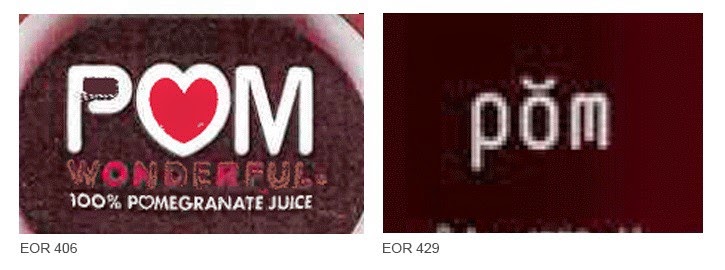
Pom argued that the trade dress should be ignored in assessing mark similarity. The court of appeals disagreed. Marks aren’t considered in the abstract (as they are in the registration context) but rather as they’re encountered in the marketplace. Moreover, although Pom’s mark is registered in standard character form without design elements, the court considered the Pom design’s heart-shaped “O” in evaluating the visual similarities because “the only images of Pom Wonderful’s products included in the preliminary injunction record [show that] the ‘O’ in ‘POM’ is in the shape of a heart.” (Again, correcting much of the potential mischief from the holding on what it is that Pom owns, as long as other courts notice this.)
The marks’ many visual similarities were obvious:
Most significantly, each mark is comprised of the same three letters. These three letters are presented in the same order, with a stylized second letter (i.e., the “o” in “POM” is heart-shaped, and the “o” in “pŏm” has a breve over it). In addition, the letters in both marks are uniformly cased (i.e., they are either all uppercase, or all lowercase) and presented in a simplistic, white front that is offset by a dark maroon background.
There were also some visual dissimilarities in terms of prominence on the package, font, size, and capitalization, and the middle letter was stylized differently in each:
![]() |
| Pom Wonderful bottle, Pur bottle with pŏm at the bottom, Pur label with pŏm at the top |
But sound and meaning were identical. Semantic similarity was particularly noteworthy because meaning can itself substantiate similarity. Moreover, nonvisual similarities were particularly important where, as here, there was no evidence that consumers encountered the marks side by side in the marketplace. If you asked a friend to buy you a ‘POM’ drink, unless your friend already knew your preferences, she could easily return with Pur’s pŏm.
Considering the “many visual similarities, perfect aural similarity, and perfect semantic similarity more heavily than the marks’ visual dissimilarities,” similarity weighed “heavily” in Pom’s favor. Moreover, a lesser degree of similarity is required when the accusing mark is strong. This made the district court’s holding clear error.
There was also clear error in the district court’s finding that marketing channel convergence weighed against Pom. Both companies used parallel market channels: supermarkets across the country. “In addition to selling their products in at least one overlapping state (Texas), both companies sell their products in an overlapping supermarket chain (Albertson’s).” It wasn’t clear whether they were sold in the same Albertson’s stores, “a channel of trade is not limited to identical stores or agents.” Plus, the products were highly similar. “Although Pom Wonderful advertises its products using a much broader range of outlets than Pur uses, the similarities between the products suggest an overlapping general class of consumers.” The district court mistakenly required Pom to prove that its drinks were sold in the very same brick and mortar stores as Pur’s. “Although such proof would surely increase the likelihood of consumer confusion, the absence of identical channels does not, by itself, undermine Pom Wonderful’s likelihood of proving that the marketing channels converge.”
As for the absence of actual confusion evidence, lack of evidence of bad intent, and lack of evidence of Pom’s intent to expand product lines, the district court erroneously weighed these against Pom rather than treating them as neutral, as it properly should have done in this case. Difficulty in gathering evidence of actual confusion makes its absence generally unsurprising, especially at the preliminary injunction stage. Nor is bad intent or product expansion required; Pom’s failure to present evidence on these “neither undermines nor advances its ability to prove likelihood of confusion.”
Five factors weighed in favor of Pom and none weighed in favor of Pur. Sleekcraft isn’t a counting exercise, though. In this case, the district court clearly erred by (1) mistakenly weighing differences in the marks more than similarities, (2) requiring Pom to prove too much in terms of convergent marketing channels, and (3) weighing three neutral factors against Pom. Thus, the district court’s likelihood-of-confusion holding left the court of appeals with the “definite and firm conviction that a mistake has been committed.”
On remand, the district court could allow more evidence on the Herb Reed factors.
Posted in trademark
Leave a comment