When should TM claimants use the Madrid system?

Also via Lexology, Baker & McKenzie has an article setting out the pros and cons.  Highlights include the information that central attack leads to 2% of international registrations being withdrawn, and a handy checklist to determine whether Madrid is a good option (for marks central to a business or new marks not variants on old one, they recommend no).

Posted in trademark | Leave a comment

News for storage jars, Thai military coup edition

Via Lexology, Rouse Legal penned The IP Upside of Thailand’s Military Coup.  Law enforcement priorities!

Posted in trademark | Leave a comment

Dastar and karaoke

Slep-Tone Entertainment Corp. v. America’s Bar & Grill, LLC, No. 13 C 8526, 2014 WL 4057442 (N.D. Ill. Aug. 15, 2014)
Slep-Tone sued defendants for violations of the Lanham Act.  Slep-Tone makes karaoke accompaniment tracks sold under the trademark “SOUND CHOICE.” It also alleged a distinctive and protectable trade dress, which includes (a) the use of a particular typeface, style, and visual arrangement in displaying lyrics; (b) the Sound Choice marks; and (c) the use of particular styles in displaying entry cues for singers, namely a series of vanishing rectangles to indicate the cue. [As an aside, I would be interested to see the proof of these allegations with respect to karaoke audiences, as opposed to operators of establishments that host karaoke, who are the alleged wrongdoers in these cases and thus presumably unconfused.]
Slep-Tone originally released CDs encoded in a special format known as “CD+G” (“compact disc plus graphics”) allowing for synchronized playback of audio and video suitable for prompting singers with lyrics cues. These tracks can now easily be ripped to a computer hard drive and format-shifted to MP3+G or WAV+G.  Slep-Tone’s media-shifting policy attempts to impose rules on media-shifting karaoke operators.
Defendants provide  karaoke services through karaoke accompaniment tracks, stored on hard drives.  Slep-Tone alleged that they used “counterfeit” tracks displaying the Sound Choice marks and trade dress without authorization, likely causing users [who?] to believe that Slep-Tone created the tracks or authorized the services.  [We’ll hear more about Dastarbelow, but since our focus has to be on physical origin, I wonder whether consumers would have any opinion at all about physical origin here.]
Defendants argued that Dastarbarred these claims, since Slep-Tone’s marks and trade dress were inherent, indivisible parts of its copyrightable karaoke tracks.  Thus, allowing Slep-Tone’s claims would improperly create a “species of mutant copyright law.”  Slep-Tone alleged that the marks and trade dress were completely separable from the copyrightable content.  A prior case, Zuffa v. Justin.tv, rejected a trademark claim by an organizer of pay-per-view MMA fighting against a website that allowed users to upload and share video streams.  The trademark claim was based on the defendant’s display of trademarks, including the eightsided ring where championship bouts took place, when the video was streamed from defendant’s site.  Zuffa held that extending protection over marks inherent to the video, such as the ring, would prevent display of the video even after the copyright expired.  However, the court didn’t dismiss claims relating to the display of trademarks which were not an inherent part of the video broadcast.
At this stage, the court found that Slep-Tone adequately alleged that it was not impossible to display the copyrightable material without the mark.  [I think this is an interesting attempt to make Dastar work, but I’m not sure it succeeds.  Much depends on the facts; arguably this is just the “Scylla and Charybdis” problem discussed in Dastar, where the Supreme Court attempted to solve the problem by removing Scylla (no liability for nonattribution) but not necessarily removing Charybdis (possible liability for attribution, where attribution consists of something more than copying the expressive work).  Consider: the title of a work alone is uncopyrightable.  That implies that work-title = work for copyright purposes. But it must be the case that a trademark claimant can’t require a copier of a public domain work to use a different title for it.  Is the work separable from its title for Dastar purposes?  An additional wrinkle is that Slep-Tone isn’t claiming copyright infringement because, as I understand it, it doesn’t have the rights to do so; under other circumstances, its selection, coordination, and arrangement of the visuals might well themselves qualify as a copyrightable derivative work of the lyrics.  The Dastar problem, then, could be much deeper.]
Defendants also argued that first sale protected them because media-shifted tracks weren’t materially different from the original.  This is a version of my question about what consumers would think about source, though I wouldn’t frame it as first sale—and neither would this court.  While defendants argued that there was “no discernable difference in the bar patron’s experience in seeing, hearing, and perhaps singing along to a media-shifted karaoke track within the bar’s premises,” Slep-Tone alleged that the media-shifted tracks were unlawful counterfeit copies.  First sale doesn’t include copied items “merely because they may ‘pass’ for the original item,” and Slep-Tone alleged more than resale of original goods.

Posted in dastar, trademark | Leave a comment

Trademark question of the day

Timesify makes any website look like the New York Times, so that your neighbors don’t know you’re reading something junky.  “In a matter of seconds, the article on how ‘Miley Cyrus Peed on a Tree’ will appear on a page that looks like The New York Times — and with a headline and photo from a bonafide, recent New York Times piece, like ‘Iraqi Relief Flights Rescue Dozens, but Leave Thousands Behind.’” What are the trademark implications?  Dilution?  There’s no sale, so can there be post-sale confusion?  Post-browse confusion?  Or should that be Times-browse confusion?  (I couldn’t help myself.)  There are even internet classic copyright issues: the pictures on the original site are swapped out for Times pictures—it’s not clear whether this is done through direct image linking or some other way.

Posted in dilution, http://schemas.google.com/blogger/2008/kind#post, trademark | Leave a comment

Is porn generic for pornography?

Hey, it’s a porn case and not a Pom case!

Calista Enterprises Ltd. v. Tenza Trading Ltd., — F.Supp.2d —-, No. 3:13–cv–01045, 2014 WL 3896076 (D. Ore. Aug. 8, 2014)
Calista and Tenza (porntube.com) compete in the adult entertainment industry to stream videos.  This case involves trademark claims and counterclaims, including counterfeiting (more evidence for Mark McKenna’s concerns that infringement is collapsing into counterfeiting).
Porntube.com is operated by non-party DreamStar, which is managed by a person who is also a shareholder of a company (FUX) that is a shareholder of Tenza.  Content producers upload content to Porntube.com; Tenza makes its money through (1) third-party ads on Porntube.com and (2) payments from content producers when visitors click through and make a purchase.  Tenza uses “search engine placement services” to promote its content, but its primary marketing tool is its affiliate program.  Operators of other adult sites include links to Porntube.com, and Tenza compensates affiliates on a per-clickthrough basis.  Tenza has registered PORNTUBE for its services.
Calista, working with several other corporations, runs websites that that “categorize” and link to third-party websites that stream pornographic videos.  In 2009, DreamStar invited Calista to participate in an affiliate program for an adult site, 4tube.com, and then invited it to join a similar program for fux.com.  In 2011, DreamStar asked Calista to join the affiliate program for Porntube.com, and was one of the most productive affiliates in the Tenza affiliate program. Calista registered a number of domains containing the words “porn,” “tube,” or “porn” and “tube” in various combinations. Some were used as part of Calista’s participation in these affiliate programs.
Calista’s first registration of a domain name including “porntube,”freshporntube.com, was in 2009. After that until January 2011, Calista had 15 websites with domain names containing both “porn” and “tube” in various combinations. After that August of 2013, Calista used at least an additional 17 domain names containing some permutation of “porntube.”  There were at least 14 domain names including “porntube” verbatim, also including goldporntube.com, bookporntube.com (my personal favorite), and cubeporntube.com.
In 2013, Tenza used the UDRP to challenge 13 Calista domain names; a panel ruled in Tenza’s favor, triggering this suit by Calista.
The court denied summary judgment to both parties on whether Porntube was a valid mark.  Calista argued that “porn” and “tube” are both generic, making “porntube” generic.  Calista’s expert stated that “What most consumers refer to categorically as ‘tube sites’ represents the largest segment (by popularity and traffic counts) of all known adult entertainment streaming video web sites online.”  Tube sites, he said, are video aggregation sites. 
Tenza argued that “tube” alone wasn’t generic, and that “porn” was merely suggestive because one expert called “porn” a term that was “a fun word” and “a bit tongue in cheek” compared to “pornography.”  (“Mommy” is a bit tongue in cheek for a child who’s reached a certain age, but it’s still generic for mother.) Calista’s expert Marc Randazza also said that “porn” is used in phrases such as “food porn and nature porn,” phrases that have “nothing to do with sexuality,” indicating that “porn” is a more socially acceptable term than pornography.  (“Brain food” isn’t food; I don’t see how that’s relevant to whether porn is generic for porn, nor do I think the existence of casual and more formal words for the same thing means that either word is non-generic—compare “pub” and “restaurant” and “eatery” or “refrigerator” and “fridge”; not to mention the fact that casualness could be a big part of why a term might be competitively necessary, a key justification for genericness doctrine.  None of this is to say I think “Porntube” is obviously generic, but “porn” plainly is.)  But the court concluded that the parties’ “conflicting explanations of the meaning of the words ‘porn’ and ‘tube’” prevented it from finding the composite term generic on the ground that both components were generic.
More generally, “generic individual terms can be combined to form valid composite marks.”  Dictionary definitions aren’t determinative of public understanding.  The key inquiry is whether there is evidence that to the consuming public the primary significance of the term is to identify the service or product and not its source.  There was a genuine dispute of material fact about whether the terms “tube” and “porn” are, in isolation, generic terms, and an additional question about their composite use.
On the composite question in particular, Calista pointed to over 3200 registered domain names uisng “porntube,” with more using the variant “porn-tube” and “tubeporn.”  Tenza’s own expert explained his “conservative” belief that one-quarter to one-third of all free adult-entertainment websites describe themselves as being a “porn tube.”  Tenza argued that there was no evidence of use of these domain names.  Of the “porntube”-using domain names listed by Calista in response to an interrogatory, there were at most 45 unique registrants. Tenza’s argument that this potential use was de minimis presented a question of fact, as did Tenza’s criticism of using Google search as a mechanism of determining use.
Calista argued that Tenza itself used “porn tube” generically to describe a type of video. Tenza’s website title description says: “Watch FREE porn videos at PornTube.com with new porn tube videos added daily.” Tenza also used “porn tube” in various captions of videos, though it wasn’t clear whether the references were to material on the website or external material.  Tenza’s expert described this as an attempt to describe the content of videos, “written with the widest variety of high traffic catch phrase and search terms.”  Tenza argued that although these references should have been capitalized, used as one word, and followed by ®, these small errors do not mean that Tenza meant to use the phrase “porn tube” to indicate the type of product rather than the source.  The court found this to be a jury question.
Dictionary definitions were also not dispositive, as the parties disagreed about which dictionaries to use, and Tenza maintained that Webster’s Third was more appropriate; it didn’t mention “television” as a definition for “tube.”  (Really?)  Again, there was a genuine dispute of material fact.
Generic use in media:  Calista argued that it identified several dozen generic uses of the phrase “porn tube” in adult-entertainment news sources and magazines, television news shows, and academic journals. Tenza’s expert conceded that with some media sources, the phrases “tube site” and “porn tube” were used interchangeably.  Tenza argued that these references were “hearsay” (no, they weren’t, because they weren’t offered for the truth of the matter asserted), and offered articles that didn’t use “porn tube” generically but instead used “tube site.” This question was again better left for a factfinder, which could use the media evidence to find either for or against genericity.  Likewise with testimony about the opinions of people in the trade.
Consumer surveys: The court first resolved some evidentiary disputes: consumer surveys were relevant here because the legal standard required the court to look at the composite mark as a whole; combinations of old words to create new phrases can be nongeneric.  Tenza’s survey might be excludable because the expert defined “adult streaming video” wrongly (he thought it meant live interaction), but that didn’t matter because even if the survey were excluded summary judgment for Calista would be inappropriate.  Other weaknesses in the survey universe (e.g., failure to exclude respondents who were part of the adult entertainment industry) went only to weight, not admissibility. 
Calista also challenged the survey’s reliability because, immediately after asking, “Would you say PORNTUBE is a brand name or a common name,” the survey asked “Which of the following are names of adult entertainment streaming video websites of which you have heard?”  While Calista argued that this would inflate the number of respondents claiming to recognize Porntube, the court didn’t find it enough to doom the survey.  The survey first asked about several different names or terms, with “Porntube” the fifth listed. Then the survey listed ten adult-entertainment streaming websites, including listing “porntube” last.  Calista’s criticisms might carry weight, but the survey questionnaire didn’t suggest its own answer.  “[T]he first question, about recognizing certain words as brand names or common names, is not directly related to the next question, which asks survey participants if they are aware of certain adult-entertainment streaming video websites.” Thus, Calista’s objections went to weight and not admissibility at this stage.
Tenza argued that its survey plus that of Calista’s expert proved nongenericity.  Calista’s expert surveyed 247 qualified respondents and found that 49% of the respondents recognized “porn tube” as a brand name, while the remainder called it common or weren’t sure. Tenza’s expert by contrast found that 79% of the 840 qualified respondents identified “PORNTUBE” as a brand name, and 51% said yes when asked if “PORNTUBE” was as an adult-entertainment website they had heard of.
Ultimately, the overall question of genericity was for a finder of fact.
So too with infringement. Although Calista used “porntube,” it also added arbitrary and suggestive words, which might or might not be enough to change the sight and sound of the domain names enough to distinguish its use.  The difference between the parties’ services—an affiliate site that categorizes videos and directs viewers to other sites, versus a destination site that provides content—also might or might not matter.  For actual confusion, Tenza’s survey found that “for Calista’s prefixed websites using the phrase ‘PORNTUBE,’ between 24 and 34 percent of the consumers believed that the sites were associated with ‘the PORNTUBE brand.’” Tenza was also served with a DMCA takedown for largeporntube.com, owned by Calista.  Again, this wasn’t enough—a jury could find it more than de minimis, but the court wasn’t going to do so at this stage.  Marketing channels were the same, but that doesn’t matter because everyone uses the internet, per Network Automation.
On consumer care, blessedly the court didn’t treat Playboy’s assertions about the easy divertability of adult entertainment consumers as binding, deeming it “dicta.”  Neither party presented evidence on “the psychology or ‘divertability’ of a consumer of adult-entertainment streaming videos on the Internet, thus Playboyis not particularly helpful to either party on this issue.”  However, since the content on both parties’ sites was free, that tipped in favor of finding likely confusion.
Intent: because of the debate over genericity, Calista’s intent was also ambiguous.  As for likely expansion into other markets, “[t]he Court finds, and both parties agree, that given the identity of the parties’ respective services, this factor is unimportant,” which seems to contradict the court’s earlier, more uncertain holding on the relatedness of the services (not to mention its counterfeiting reasoning, up next).  Regardless, there was a genuine dispute of fact on likely confusion as a whole.
Counterfeiting: A counterfeit is “a spurious designation that is identical with, or substantially indistinguishable from,” a registered mark and that is applied to the goods (or services) covered by the registration.  The court found a genuine dispute about whether Calista’s domain names were “identical with” or “substantially indistinguishable from” the registration, given the dispute over the validity and strength of Tenza’s mark.  A mere “colorable imitation” is not counterfeiting. 
Plus, it was disputed whether PORNTUBE “was registered for use on the same goods to which the infringer applied the mark,” since proximity of the goods was in dispute.  The parties disagreed about the relationship of an affiliate website to a destination site.  “Although both websites offer clips of adult-entertainment streaming videos, there may be a meaningful distinction between the way in which these clips are offered to consumers.”  Summary judgment denied to both sides.
Comment: Missing here is any discussion of what the registration says, which ought to be dispositive, but may have been overlooked because of the increasing identity between infringement (which supposedly just looks at consumer confusion) and counterfeiting.  FYI: “Entertainment services, namely, providing a website featuring adult entertainment; Entertainment services, namely, providing a website featuring photographs, videos, related film clips, and other multimedia materials in the field of adult entertainment.”  I don’t see a limitation to destination sites.
Cybersquatting:  Again, there was a genuine dispute on whether Calista’s domain names were “confusingly similar” to Porntube.  Some of the statutory bad faith factors were also debatable, especially given the genericity dispute.
Calista argued laches.  The Lanham Act has no explicit statute of limitations, so the court borrowed—here from fraud, which it thought was the most analogous state claim (2 years); going past the limitations period would trigger a presumption of laches.  Calista argued that Tenza’s principle knew of Calista’s tubepornmix.com website as early as October 2009 and knew about Calista’s goldporntube.com in June 2010, while he was working with Calista through the 4tube.com and fux.com affiliate programs.  He sent Calista an error log report that referenced goldporntube.com in March 2011, and Calista was one of Tenza’s top affiliates for more than two years, so Calista argued that Tenza should’ve known about the domain names.
Tenza argued that it didn’t have constructive knowledge, because the early communications occurred before its principal actually became involved with Tenza.  It also argued that the error log wasn’t sufficient notice, and that even assuming it was on notice then, it filed its UDRP action on March 25, 2013, only 17 days past the two-year laches time period. This created a genuine dispute of material fact on when Tenza knew or should have known.
Laches also requires prejudice.  Calista argued that it expanded its business during the time Tenza should have acted to protect the mark, and that Tenza’s delay caused Calista prejudice because it was building a valuable business around the disputed domains.  This would depend on when Tenza was on constructive knowledge, so it didn’t allow summary judgment for Tenza.
Tenza did win summary judgment on Calista’s claim for damages for loss of revenue it otherwise would’ve received for being a Tenza affiliate, legal fees, and lost domain name value. Calista didn’t identify evidence in response to Tenza’s motion for summary judgment. As a matter of law, Calista wasn’t entitled to money damages, though if it ultimately prevailed on its Lanham Act claims it could still move for an attorney’s fees award.

Posted in trademark | Leave a comment

Gripe sites protected despite use of URL and "Official" language

Board of Directors of Sapphire Bay Condominiums West v. Simpson, 2014 WL 4067175, No. 04–62 (D.V.I. Aug. 13, 2014)
The board is a condo association using  the name Sapphire Bay Condominiums West.  Simpson bought a condo at Sapphire Bay in 2003, and, following a dispute with the Board, created a number of gripe sites criticizing the Board, its members, and its lawyers.  In 2004, the Board sued for violations of the Lanham Act and analogous state claims, seeking an injunction and damages.  Nope.  The websites were noncommercial, the mark wasn’t famous, and the websites weren’t likely to confuse.
Some notable facts: Simpson registered “sapphirebaycondos.com” under his own name and operated a website purporting to be “The Official Website of Sapphire Bay Condominiums West – St Thomas, VI.”  However, directly beneath the site’s slogan was “‘I don’t give a damn’ management,” and the home page linked to subpages with language such as “Lawyer Lies and Five Board Members Commit a Crime.”  After the Board’s C&D, Simpson rebranded the website as “The Owners Official Website For the Elimination of Dishonesty on the Board of Directors of Sapphire Bay Condominiums West, St Thomas, VI.” 
Simpson also denied affiliation with the entity to which he transferred the domain name, but the court found that he operated and directed it.  Simpson also registered a bunch of trade names similar to the Board’s: “Sapphire Bay West,” “Sapphire Bay West Condos,” “Sapphire Bay Condos West,” “Sapphire Bay Condominiums West,” “Sapphire Beach Condominiums West,” and “Sapphire Beach West” with the Corporations and Trademark Division of the V.I., registrations that were revoked because they were already registered or were similar to trade names already registered to Bay Resorts, Inc.
In 2004, the district court preliminarily enjoined Simpson from using sapphirebaycondos.com, or any derivative thereof, as a domain name for any website under his ownership or substantial control. It also ordered him to cancel the domain name sapphirebaycondos.com (which seems like a mistake for a preliminary injunction, since it may be irreversable), and to stop representing himself using the names above.  The preliminary injunction was affirmed on appeal without opinion.  (Among other things, the district court found the Board’s mark to be “famous,” and found the websites to be commercial speech because Simpson intended to harm the Board financially.  Whatever we think of trademark law’s expansiveness today—and I have a lot of thoughts—we may ultimately look at the early 2000s as peak indifference to free speech in trademark law.)
He complied, but erected virtually the same website under the domain name “usvicondos.com,” which has been operating continuously ever since.  Simpson, not giving up, admitted he contributed content to the website, but claimed that a man named “Randolph Lindsay” operated and controlled the website.  The court found that, in fact, Simpson and Lindsay were one and the same, though it didn’t matter to the outcome.  (It’s notable how little Simpson’s denials mattered here, because liability simply wasn’t supported by the other facts.  Some courts might’ve stretched the Lanham Act out of distaste for a defendant who wouldn’t admit he was responsible for the websites.)
The Board sought a permanent injunction and damages based both on sapphirebaycondos.com and usvicondos.com.  The Board didn’t clarify whether it was seeking Lanham Act liability under §43(a)(1)(A) or (B), so the court analyzed both. A threshold issue was whether the websites were commercial, “because the Lanham Act only regulates commercial speech.”  (Note the burbling circuit conflict here.)  Making that determination requires considering (1) whether the speech is an advertisement; (2) whether the speech refers to a specific product or service; and (3) whether the speaker has an economic motivation for the speech.
The Board didn’t allege that Simpson sold goods or services, but claimed that his websites were commercial because they caused economic injury.  That didn’t make them commercial speech.  The websites didn’t advertise goods or services; they didn’t refer to a specific product or service provided by Simpson, but instead alleged, among other things, corruption by Board members.  There was no showing that Simpson’s speech was economically motivated.  The purpose was of course to attack the Board, but there was no evidence of motive to benefit Simpson, or a competitor of the Board’s, economically.  The district court concluded that the speech was commercial for purposes of a preliminary injunction, but that wasn’t on a full, formal record. 
Also, as the court sort of adverted to in a footnote, the law of gripe sites has changed a lot in ten years.  (Ten years!)  The preliminary injunction relied in part on Jews For Jesus v. Brodsky, 993 F.Supp. 282 (D.N.J. 1998), aff’d, 159 F.3d 1351 (3d Cir. 1998), in which the court found commercial use where the defendant used the domain name jewsforjesus.com to host a website critical of the Jews for Jesus religious organization.  “However, key to the court’s reasoning was that the website contained a hyperlink diverting visitors to an organization offering competing goods and services.”  (Note of course that the organization was not a “commercial” one in the ordinary sense.)  Simpson’s site contained links, but not links that “divert[ed]” visitors to “any website connected with goods or services.”  Likewise, Planned Parenthood Federation of America, Inc. v. Bucci, No. 97–0629, 1997 WL 133313 (S.D.N.Y. Mar. 24, 1997), aff’d, 152 F.3d 920 (2d Cir. 1998), found plannedparenthood.com infringing for a site that promoted (but did not sell) an antiabortion book, served a commercial purpose “similar to a publisher’s publicity kit.”  That didn’t describe Simpson’s sites.
Once you discount the appeal in this case and Jews for Jesus, “[t]he Third Circuit has not decided whether the use of another’s trademark in connection with a noncommercial gripe site violates the Lanham Act.”  But several other circuits have protected such sites in similar circumstances (all since 2004).  Because Simpson’s websites were noncommercial, the Lanham Act claims failed. 
However, even if the sites counted as commercial, the Board would still lose under the multifactor confusion test. The court went through each version of the websites—the “Official”sapphirebaycondos.com site; the same URL using the slogan “The Owners Official Website For the Elimination of Dishonesty …”; and the usvicondos.com site.  Most of the factors could be applied to all three.
The Board had a descriptive mark and submitted no evidence on market recognition, money spent on advertising, or anything else other than use for over forty years: a weak mark.  Condo purchases require sophistication and attention.  There was no evidence of actual confusion over ten years, only that the websites made some potential purchasers reluctant to buy and that some renters asked about the sites. 
Potentially interesting bit about marketing and advertising channels: the court appealed to the paucity of search results to find that this factor favored Simpson even though Simpson’s site was the top Google result:
While the Board argues a Google search of the trade name “Sapphire Bay Condominiums West” first returns Simpson’s Website Three, the Board failed to mention only thirty-three results are generated from searching this term. Of those thirty-three results, over half are related either to this litigation or websites operated by Simpson. The Board does not allege (and did not prove) it has a website or any commercial advertisements on the Internet. Many, if not all, of the remaining Google search results direct users to third-party generated content providing information about Sapphire Bay Condominiums West.
[Obligatory note about Google personalization here.  For me, I got about 23,100 results for the search, with quotes, and Simpson’s site was indeed the top result, followed by two sites discussing earlier rounds in this case, followed by a review of the actual condos.]
Because Simpson didn’t sell anything, the “extent to which the targets of the parties’ sales efforts are the same” factor was “inapplicable.”  As for the relationship of the parties’ goods/services, the court noted that the Board was involved in real estate and maintenance services.  Simpson criticized the Board. There was no evidence that consumers would likely think that any of the websites, “whether characterized as ‘Official’ or not,” provide condominium rental, real estate, or maintenance services, so this factor also weighed against  confusion. The plausibility of the plaintiff entering the defendant’s market was “inapplicable,” since there was no reason the consuming public might expect the Board to offer a service critical of itself or that it would be likely to do so.
Now we get to the similarity of the marks and defendant’s intent, which the court analyzed separately for each website.  For the “Official Website” version, similarity weighed in favor of likely confusion.  The “Elimination of Dishonesty” version of sapphirebaycondos.com was “vastly dissimilar” to the Board’s mark.  The slogan contained the Board’s trade name, but “the phrase read in its entirety denotes an entity or organization diametrically opposed to the Board,” and similarity weighed against likely confusion.  Even more so for the usvicondos.com version, which didn’t use a similar URL and did use the “Elimination of Dishonesty” slogan.
Intent: “there is no question [Simpson] erected the websites with the intent to attack the Board.”  Plus, the “Official Website” version with the initial domain name showed an intent “to use the Board’s mark as if it were his own,” which favored a finding of likely confusion as to that first version.  For the second version, he “still used an intentionally confusing domain name to draw what would presumably be the Board’s customers.”  But the changed slogan made clear that the second version wasn’t officially sanctioned.  In its full context, intent didn’t weigh for or against anyone as to this version.  (Not even a mention of initial interest confusion!  More evidence for Eric Goldman that IIC is dead.)  And for the usvicondos.com version, intent weighed against finding likely confusion.
Weighing all the factors, none of the sites were likely to cause confusion.  “No consumer could reasonably believe the Board is promoting rental or real estate services through self-effacing websites.”  And this was true even with the “Official Website” version, which described the Board as providing “‘I don’t give a damn’ management” and featured a prominent picture of what presumably was the Board’s flooded parking lot.  Version one contained text links such as “SBCW Board Members … Could Go to Jail for Obstruction of Justice …” “No reasonable consumer would believe the Board operated a website for the purpose of promoting its own malfeasance and criminal conduct.”
Now, to false advertising: The Board didn’t specifically identify what allegedly false statements Simpson made, but the first website version did contain the literally false statement “The Official Website of Sapphire Bay Condominiums West – St Thomas, VI.”  Still, analyzing the website in its full context, “it contained many statements and photographs which are ambiguous or possibly literally true.”  This included the photo of the flooded parking lot, as well as a photo of garbage “piled on what appears to be the Board’s premises.”  Construing the website as an ad, these were ambiguous or literally true.  (That doesn’t make the “Official” statement anything other than literally false—however, that would qualify as unbelievable in context and therefore puffery/immaterial.)  The subsequent versions had nothing that was literally false, only the ambigous statement “The Owners Official Website For the Elimination of Dishonesty on the Board of Directors of Sapphire Bay Condominiums West, St Thomas, VI.”  It wasn’t clear whether this was the official website of all condo owners, or the official website of particular owners who want to eliminate dishonesty.  If you add in punctuation (“Owner’s”), then it’s literally true: it’s Simpson’s official website for eliminating dishonesty.  Since the Board didn’t provide evidence of actual deceptiveness, the claim failed.
The Board didn’t specifically allege a federal dilution claim in its amended complaint, but because the preliminary injunction was based in part on that claim, the court here addressed it.  (We owe thanks to this judge for fixing a terrible-all-the-way-through opinion in the politest possible fashion, and thoroughly to boot.)  Of course, noncommercial uses are specifically excluded under §43(c)(3)(C).  Even if Simpson’s use had been commercial, the Board would still lose because the mark isn’t famous.
Coordinate state-law claims, and tortious interference claims, failed for similar reasons.  (I’m omitting, among other things, the discussion of the Virgin Islands’ general adherence to the Restatement of Unfair Competition, though the court specifically notes that “misappropriation” can’t be used to get around the requirement of likely confusion when it comes to trademarks.)

Posted in commercial speech, dilution, http://schemas.google.com/blogger/2008/kind#post, trademark | Leave a comment

Personal liability for corporate scheme appropriate for repeat offender

Federal Trade Comm’n v. Grant Connect, LLC, No. 11–18023, 2014 WL 3973402 (9th Cit. Aug. 15, 2014)
Individual defendant Kyle Kimoto appealed from the district court’s grant of summary judgment to the FTC and its permanent injunction against a variety of marketing tactics and award of restitution.  Kimoto wholly controlled a company, Vertek, that had committed multiple violations of the FTCA.  The district court found that Kimoto was both personally involved in the practices and knew that the advertising was misleading or was recklessly indifferent as to that possibility.  The court of appeals upheld most of the district court’s rulings, except on restitution for one type of marketing.
Kimoto’s been in the FTC’s sights for over a decade, resulting in three different enforcement efforts against him.  All his schemes had some similar features: he “lured consumers with a deceptively advertised headline product, and then enrolled them in ‘upsells,’ or negative-option ‘free trials’ that required consumers to undergo a burdensome cancellation process in order to avoid inadequately disclosed recurring monthly fees.”  A previous case against Kimoto and one of his companies, alleged that Kimoto misleadingly marketed preapproved MasterCards, but provided instead applications for cash-secured debit cards or unusable plastic cards bearing an unauthorized reproduction of the MasterCard logo, and then enrolled them in additional negative-option plans with recurring fees both for the “credit cards” and for the “free trials,” with a variety of barriers to effective cancellation.  The Fifth Circuit found that Kimoto, through his company “committed multiple, egregious violations of the [FTC Act].”  He was permanently enjoined from telemarketing and ordered to pay $106 million in restitution. The FTC initiated criminal charges against Kimoto for his role here.
“Apparently undeterred,” Kimoto formed a corporate entity that eventually became Vertek. Vertek engaged in Internet marketing schemes and was legally owned by Kimoto’s then-wife to avoid regulatory scrutiny.  (Relationship tip: don’t let your then-spouse do this.)  As she testified, “this structure had the added—and intended—benefit of permitting her to profit from the company in the event that Kimoto was incarcerated.”  Kimoto actually organized and ran the company, hiring many of the employees involved in the previous scheme.
Kimoto directed and participated in a number of schemes, including marketing a “guaranteed” unsecured credit line.  The ads didn’t mention that consumers could only use the “line of credit” to make purchases from an affiliated online store, and this fact was “[h]idden deep in the fine print” of the terms and conditions.  In small print below the “submit” button, the signup page stated that consumers would be charged a $39.95 monthly fee and would be automatically signed up for additional programs with recurring monthly charges.  Consumers complained, but the site made cancellation “exceedingly difficult, needlessly transferring customers to different websites or phone numbers, even though all of the calls ended up in the same service center.” The scheme ran for nearly two years, during which time, “after considerable effort on their parts, approximately 94 percent of subscribers cancelled their subscriptions.” 
There were other similar schemes, such as one promising “grants” and using pictures either of President Obama and Vice President Biden, or of a scantily clad female model holding cash, along with phony testimonials from alleged grant recipients.  (There’s some A/B testing for you.)  False representations included claims that users could find government grants for personal expenses; 91% managed to cancel their memberships after considerable effort before the FTC shut this scheme down.  Lather, rinse, repeat with a “work from home” scheme.
Kimoto was convicted in early 2008 of conspiracy, mail fraud, and wire fraud.  During his trial and subsequent incarceration, he ceased to actively participate in Vertek’s daily activities.
The final Vertek scheme involved unsubstantiated claims that a supplement, Acai Total Burn, would help consumers build muscle, increase their metabolism, lose weight, gain energy, reduce fatigue, and retard the aging process.  This scheme used the same deceptive ordering process, tiny disclosures, and automatic enrollment in additional negative-option trials.  It was available only for two months in 2009, during which time it enrolled 670 customers, 159 of whom had already cancelled when the FTC took over the site.
Kimoto didn’t challenge the district court’s findings that the schemes were deceptively marketed; that the negative options were inadequately disclosed; that the testimonials were false; and that defendants violated the Electronic Funds Transfer Act (EFTA) by debiting consumers’ accounts without written authorization. The district court also found that the corporate defendants operated as a common enterprise: “[a]ll the various offers were run by the same individuals using different company names,” the defendants “swapped and shared personnel,” as well as “blurred the lines of corporate separateness in their activities,” and “engaged in concerted and coordinated action across campaigns, and [making] their profits interdependent.”
Kimoto argued that there was insufficient evidence of his personal involvement in many of the schemes, and that his liability ended when he left the company to prepare for his criminal trial.  Individuals may be personally enjoined based on a corporate entity’s violation of the FTCA if (1) the corporation committed misrepresentations of a kind usually relied on by a reasonably prudent person and resulted in consumer injury, and (2) individuals participated directly in the violations or had authority to control the entities.  Restitution additionally requires the FTC to show that the individual “had knowledge that the corporation or one of its agents engaged in dishonest or fraudulent conduct, that the misrepresentations were the type upon which a reasonable and prudent person would rely, and that consumer injury resulted.” Actual knowledge, reckless indifference, or awareness of a high probability of fraud along with intentional avoidance of the truth will satisfy the knowledge requirement, though intent to defraud is not required for personal liability.  Sufficient involvement in a fraudulent scheme may itself establish the requisite knowledge.
Under this standard, the district court properly held Kimoto liable for both injunctive relief and restitution, except for the Acai Total Burn scheme.  For the line of credit scheme, “Kimoto arranged Vertek’s entire operation. He organized the companies, recruited personnel who had been involved in his prior deceptive marketing schemes, and directed Vertek’s activities. This alone is enough to conclude that he had knowledge sufficient to support personal liability for restitution damages.”  He also declared that he believed it was “important for [him] to understand and know [the language on the deceptive landing pages], because that was [his] job to take it out to the affiliate marketer.”  “In light of Kimoto’s prior troubles with the FTC, which also involved inadequately disclosed ‘upsells,’ his level of participation in the scheme and knowledge of deceptive web pages shows that he knew about, or was recklessly indifferent as to Vertek’s deceptive practices.”
Neither Kimoto’s resort to advice of counsel nor the fact that he was imprisoned at the time Vertek received many of the consumer complaints and chargebacks changed matters.  Reliance on advice of counsel isn’t a valid defense on the question of knowledge, and Kimoto was well aware of the fraudulent nature of the schemes before he was imprisoned even without additional complaints from consumers (which can also constitute evidence of knowledge). 
Similar analysis applied to the grant scheme.  Kimoto controlled Vertek when the scheme was organized; continued that control for more than a year during which time Vertek began drafting its deceptive terms, landing pages, and ads; and directly participated in establishing the scheme, for example by telling team members about their responsibilities and personally receiving misleading ad materials.  He assembled the team of “con artists.”  Although the grant scheme wasn’t marketed to consumers until after his imprisonment, he still participated directly in the FTCA violation—the deceptive marketing that underlay the scheme.  There was no allegation that the marketing materials materially changed after he ceased active participation.  He also had the requisite scienter for personal liability for restitution because he reviewed “program specifics” and fake testimonials months before the product launched, when clearly the testimonials couldn’t have been legitimate.
As for the work from home scheme, Kimoto wrote the deceptive text for the landing pages associated with one of the variants and had other information about it.  He either knew about or was recklessly indifferent to the deceptive advertising given his history of trouble with the FTC; his coordinating role in the scheme; and the “clearly overstated incomes” in the draft product description that he received.
However, as to Acai Total Burn, the evidence didn’t show he directly participated in the scheme or controlled Vertek when the scheme was developed, at which point the other con artists had apparently learned enough to run on their own.  He was incarcerated in April 2008, and work on Acai Total Burn began in February 2009. Thus, he couldn’t be held liable for injunctive relief or restitution with respect to that scheme.
The court of appeals also ruled that individual liability was available for corporate violations of EFTA, which provides that “a violation of any requirement imposed under [the EFTA] shall be deemed a violation [of the FTC Act]” and provides that all the FTC’s powers are available to enforce EFTA.  It follows that individual liability is also available.
Finally, Kimoto challenged the scope of the district court’s injunction, including its ban on all use of testimonials and on preauthorized electronic fund transfers.  (The other restrictions banned him from negative-option marketing, continuity programs, and marketing or selling products related to grants, credit, business opportunities, diet supplements, or nutraceuticals.) No dice. An injunction’s breadth is assessed in relation to “(1) the seriousness and deliberateness of the violation; (2) [the] ease with which the violative claim may be transferred to other products; and (3) whether the respondent has a history of prior violations.”  The FTC doesn’t have to play whack-a-mole; adjudicated lawbreakers must expect some fencing in.  An injunction must merely bear a “reasonable relation to the unlawful practices found to exist.”
Kimoto could be held liable for the acts of Vertek and other companies in a common enterprise. “Kimoto has also consistently engaged in variations on the same deceptive marketing scheme, which, in its latest iteration alone, has defrauded consumers of more than $29 million.”  The common elements of his frauds, as the record showed, were easily transferable to new product lines and to new modes of communication.  Thus, the injunction was reasonably tailored to prevent him from engaging in similarly illegal practices in future ads.  You’ll note that the injunction thus prevents him from engaging in Acai Total Burn-type marketing, even though he was too causally distant from that particular scheme to be liable for restitution here.
Posted in ftc, http://schemas.google.com/blogger/2008/kind#post, remedies | Leave a comment

As pure as New York snow: Bette Davis as icon and as mark

Erickson Beamon Ltd. v. CMG Worldwide, Inc., No. 12 Civ. 5105, 2014 WL 3950897 (S.D.N.Y. Aug. 13, 2014)
EB sought a declaratory judgment of non-infringement of trademark and rights of publicity based on its “Bette Davis Eyes” jewelry collection, launched in 2010.  CMG and the Bette Davis Estate counterclaimed for infringement of those rights.  EB argued that the jewelry was a reference to the 1974 song well-known for the Kim Carnes recording of 1981, while CMG argued that consumers would mistakenly believe that the jewelry was affiliated with the actress.
Erickson Beamon Bette Davis Eyes ring at Barneys
Addressing EB’s motion to strike affirmative defenses, the court first determined that Twiqbal’s plausibility standard need not be satisfied by the defenses.  This is a question that has divided district courts—even district courts trying to count which is the more common approach.  Textually, all that’s required is notice pleading, and equitably it would be unfair to hold a defendant to the same pleading standard, given the defendant’s limited time to respond.  Nonetheless, some of the affirmative defenses went away because they didn’t provide proper notice or were otherwise inappropriate.
The “bad faith” affirmative defense survived because the answer sufficiently claimed bad faith in EB’s alleged misappropriation of “Bette Davis.”  Bad faith is “very fact intensive.”
Turning to the counterclaims, CMG sufficiently pled trademark infringement under the Lanham Act.  If they/their licensees didn’t actually use the claimed mark in commerce, that would “undermine” their Lanham Act claims.  (There’s an interesting “Stealth” type issue here: suppose CMG only got people to take licenses by threatening them with infringement claims.  How should that count as “use”?)  But that was a question of fact, as was consumer confusion.
And here we take our first detour from the unremarkable to the deeply misguided: “And finally, the name ‘Bette Davis’ is certainly distinctive with regard to its source—this was a woman, after all, whose eyes inspired a chart-topping song well after her popularity had peaked.”  No, that’s not “distinctive with regard to its source.”  Source has a particular meaning in trademark law. The song is evidence that Bette Davis herselfwas well-known at least as of 1981, but that doesn’t mean her name was or is recognized by consumers as a designation of the source of goods or services (cf. Dastar), any more than William Shakespeare’s is despite its high non-trademark level of distinctiveness. 
Naturally, NY common law unfair competition claims also survived, since they’re infringement plus bad faith, which we already know is fact-intensive even if the allegations of bad faith were “reasonably thin” at this stage.  Likewise with unjust enrichment.
Now the court repeats its initial error with the federal dilution claim.  EB argued that CMG merely made a “threadbare recital” of fame, but CMG pled that Bette Davis was “widely recognized” and that she had an “acclaimed career [with] the attendant fame and prominence.” She was renowned (and had a song written about her eyes), so it was plausible that “Bette Davis” was a famous mark.  This is an even more egregious mistake with dilution than it was with infringement.  Again: The Mona Lisa is famous; it is not famous as a mark for anything, and no MONA LISA trademark owner should be able to bring a federal dilution claim.  While this may be the wrong stage for full resolution of this issue, truly pleading—much less proving—dilution should have to involve the fame of the mark CMG claims to own, not the words comprising the alleged mark.
NY dilution was of course easier, since it just requires distinctiveness plus likely dilution, so that’s that.  (It also requires substantial similarity, but that was “obvious” here.)
NY deceptive business practices under GBL §349 requires (1) that the challenged act or practice was consumer-oriented; (2) that it was misleading in a material way; and (3) that the claimant suffered injury as a result of the deceptive act.  EB didn’t challenge (1), which is a bit surprising since there’s a fair amount of precedent that ordinary business harms aren’t consumer oriented just because consumer behavior changed, but the result on (2) suggests the court wasn’t going to make those distinctions anyway. 
EB argued that CMG didn’t plead materiality, but the court disagreed.  CMG alleged that “Bette Davis Eyes” was materially misleading as to the source of the merchandise, and the court saw it as a question of fact whether the name actually caused consumers to believe that the Estate endorsed the jewelry. Comment: Why would that belief in the Estate’s endorsement, even if it existed, be material?  Especially since Davis herself is dead, why would anyone care?  But I forgot, this is trademark land, not advertising land: “This prong is akin to the ‘likelihood of consumer confusion’ element of an unfair competition claim,” which must mean materiality doesn’t actually matter!  Also, it’s usually not resolvable on the pleadings.
However, intentional interference with prospective economic advantage failed—CMG alleged future harm to licensing opportunities, but no present relations with a third party that were harmed by EB’s conduct.

Posted in dastar, dilution, http://schemas.google.com/blogger/2008/kind#post, trademark | Leave a comment

Personalized sales pitches as "advertising"

Larocca v. Creig Northrop Team, P.C., 94 A.3d 197, No. 0766 (Md. Ct. Spec. App. June 25, 2014)
Plaintiffs alleged violations of Maryland’s Secondary Mortgage Loan Law, which governs certain types of mortgage-related false advertising.  The court had to interpret what the SMLL meant by “advertise.”  The general commercial law stated:
“Advertisement” means the publication, dissemination, or circulation of any oral or written matter, including labeling, which directly or indirectly tends to induce a person to enter into an obligation, sign a contract, or acquire title or interest in any merchandise, real property, intangibles, or service.
Advertising, the court concluded, involved “some method of communication to the public,” but wasn’t strictly limited to widespread communications.  Dissemination of information to smaller groups could still suffice, which would include the allegations of two plaintiffs that they first met one of the individual defendants at an open house.  Personalized sales pitches, the court specifically ruled, could be covered.
Indirect ads are also covered—ads not carried out by the defendant, but intentionally caused by it.  In a similar case, plaintiff-homeowners alleged that manufacturers of allegedly defective plywood falsely advertised it as suitable for roofs.  Though the manufacturers advertised to homebuilders, not to homebuyers, and though the consumer protection statute was intended to apply to consumers and not commercial buyers, Maryland’s highest court ruled that “[i]t is quite possible that a deceptive trade practice committed by someone who is not the seller would so infect the sale or offer for sale to a consumer that the law would deem the practice to have been committed ‘in’ the sale or offer for sale.”  However, where the manufacturers had no influence over or other involvement in the sale, they weren’t liable.  Applied here, the question was whether any defendant entity indirectly advertised by, through “some arrangement,” having another defendant actively advertise on its behalf. This was a question of fact.

Posted in advertising, http://schemas.google.com/blogger/2008/kind#post | Leave a comment

safe distance rule allows contempt after injunction without full infringement hearing

Innovation Ventures, LLC v. N2G Distributing, Inc., Nos. 12–1635, 13–1817, 2014 WL 3953734 (6th Cir. Aug. 14, 2014)
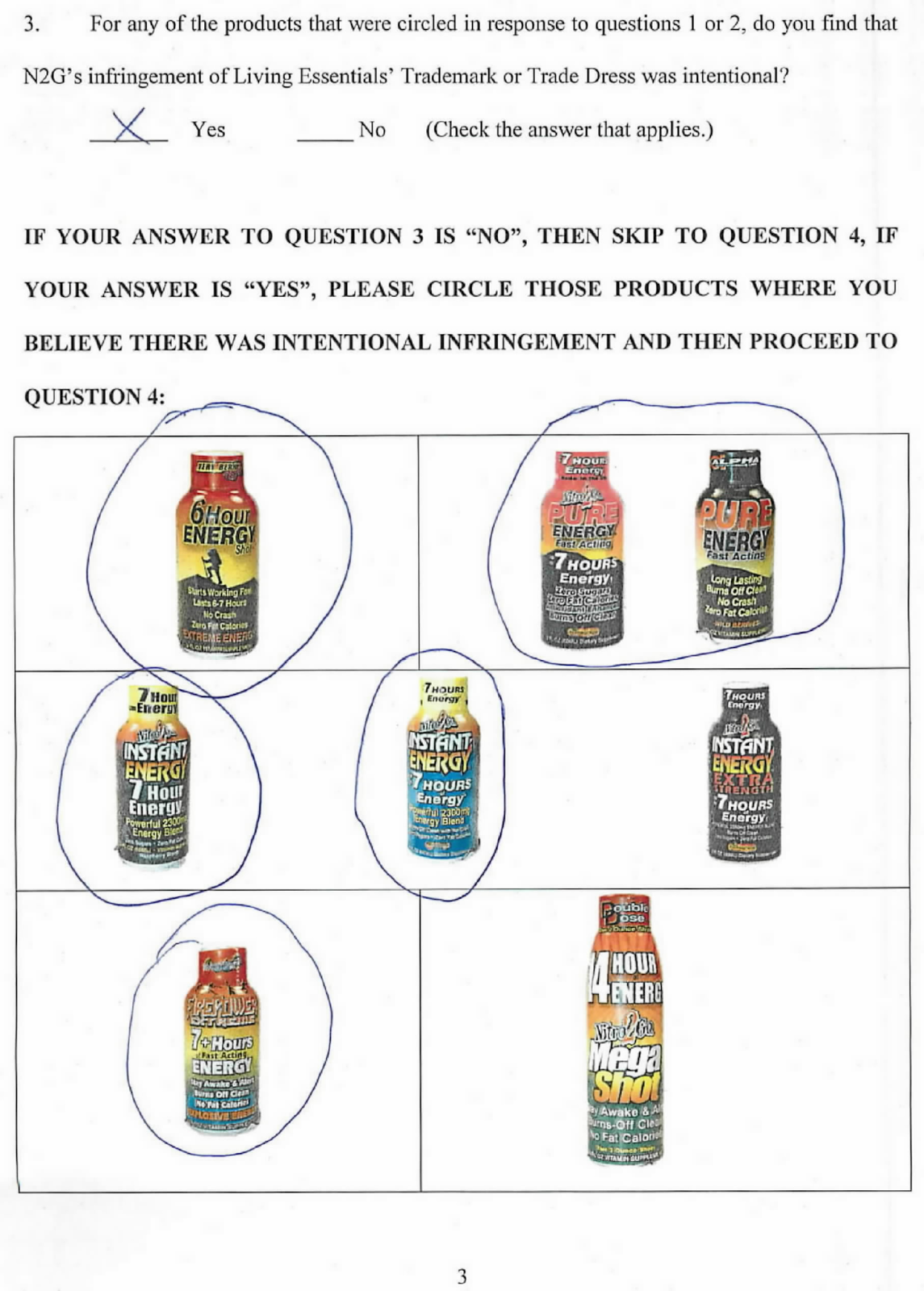
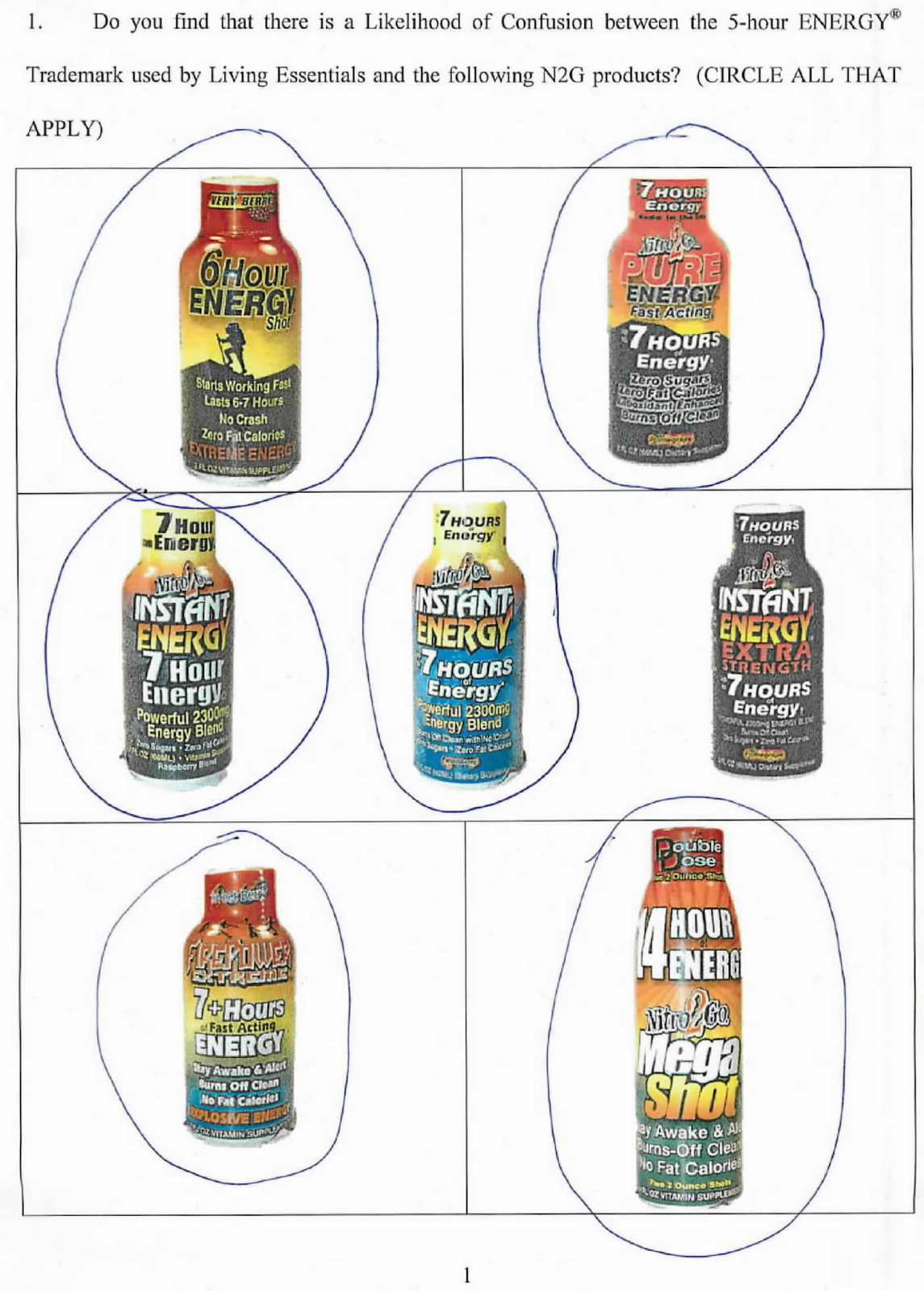
The Sixth Circuit continues to help trademark lawyers and scholars out by including pictures of the products at issue.  There are a lot of 5-hour Energy cases.  This one involves a trial that found N2G and another defendant to have infringed the trademark and trade dress of 5-hour Energy (5HE), an energy shot.  The district court held defendants, and their common owner Diehl, in contempt for violating the permanent injunction after trial.  The court of appeals affirmed everything.
FHE’s sales spiked in 2005 and increased “astronomically” from there.  By March 2009, FHE had nearly 70% of the market for energy shots, and spent about 25% of its gross sales for advertising (on $620 million of revenue for 2011).  While the mark was rejected as descriptive in 2005, and went on the Supplemental Register late that year, FHE was ultimately registered in August 2011, shortly before this case was tried.  FHE also used litigation to protect its “mark and market position,” suing many alleged infringers, including defendants.
In 2008, defendants began to sell “6 Hour Energy Shot,” “Nitro2Go Instant Energy,” and “Extreme Monster Energy Shot.”  The first of these bore a resemblance to FHE.  Diehl testified that the similarities were due to other factors, not copying, though the warning labels were word for word copies of the one on FHE’s bottle.  FHE sued, and the district court preliminarily enjoined 6 Hour Energy and ordered a recall, which resulted in the return of almost half of the 77,000 bottles defendants had sold, causing a huge loss.  Defendants also had to take their Extreme Monster Energy Shot off the market after complaints of trademark and trade dress infringement Monster, “one of the largest players in the energy drink market.”
5-hour Energy and 6 Hour Energy Shot

The court noted the size disparity, which isn’t present in the photos: the Extreme Monster energy shot is small while the Monster energy drink is large
Defendants (after consulting with counsel) then came out with what eventually were seven variations of energy shots about which FHE amended its complaint to allege that these infringed too.  Ultimately, a jury found that six of defendants’ products infringed the 5 Hour Energy mark, that two infringed FHE’s trade dress, that the infringement was intentional except for one product, and that two of the products were falsely advertised.  The jury awarded $1.75 million in damages.
jury verdict form

The district court permanently enjoined defendants from selling the six products found to infringe, and from using marks confusingly similar to FHE’s mark and trade dress.  Defendants were also ordered to surrender all products subject to the injunction and file a compliance report.  Diehl, who was not personally enjoined, signed the report under penalty of perjury, stating that he’d long ago stopped selling 6 Hour Energy and Pure Energy (the first variant he tried); that he had changed the labels for all the other infringing products; and that he had instructed the enjoined products not be sold on the N2G website. In 2012, both defendants declared bankruptcy. 
However, in July 2012, FHE had three orders placed on the N2G website, and each order contained enjoined products as well as the modified-label products advertised on the website.  The modified products were marketed by a new company and the orders were filled by another new company, both of which were created by Diehl, whose various entities “commingle assets essentially based on Diehl’s whims.”  The presence of the old products was attributed to a new employee acting without higher-ups’ knowledge.  But in April 2013, more than six months after FHE filed a motion for contempt, enjoined products were still being advertised on Groupon and an inspection of a warehouse showed that “scores” of enjoined bottles were still in stock, despite Diehl’s assurances that the products had been destroyed.  The district court found defendants and Diehl in contempt. 
modified products

The court of appeals first rejected defendants’ motion for a new trial.  “[T]he likelihood-of-confusion factors can rarely be applied with mathematical precision—this is a holistic endeavor.”  Here, the jury heard ample evidence to support its likely confusion findings.  “First—and most importantly—the jury could use their eyes and see that Defendants’ products use similar marks.”  The differences in numbers, use of the plural “hours,” and small “+” or other signs “should not be considered in isolation—we ‘view marks in their entirety and focus on their overall impressions, not individual features.’”  
The jury also heard a lot of testimony on the strength of the FHE mark.  Relatedness of the goods obviously favored FHE, and the parties used similar marketing channels.  “One exhibit even showed the parties’ display boxes side-by-side next to a convenience store cash register.” And the jury heard testimony that the products were impulse purchases and consumers just bought what was prominently displayed to them (which would go to materiality, if we cared about materiality), so they weren’t tremendously careful and could easily be confused by proximate placements.
Defendants’ arguments about lack of actual confusion and lack of bad intent were unavailing.  FHE didn’t need to show actual confusion, but there was testimony from an FHE ad purchaser about a representative from the Discovery Channel who told her that he loved FHE, and even said he had one in his pocket, when the bottle in his pocket was actually a 6 Hour Energy.  Diehl’s testimony didn’t absolve FHE of bad intent; the jury could have disregard it, and there was circumstantial evidence of copying (the warning label). In any event, intent isn’t required.
A similar analysis applied to the trade dress claim.  FHE didn’t introduce evidence about the strength of its trade dress, but it did introduce several TV ads that emphasized the bottle’s look and size.  The relatedness of the goods, actual confusion, marketing channels, low degree of purchaser care, and defendants’ intent supported the jury’s trade dress verdict, along with “a brief glance at the parties’ competing products.”  Though defendants’ products omitted blue, a color featured prominently on FHE’s bottle, trade dress is total image and overall appearance, so “parsing minute differences between products” wasn’t right.  The court didn’t abuse its discretion in denying a new trial.
What about descriptive fair use?  The jury heard evidence that defendants’ use wasn’t descriptive.  The first version used a symbol after the term “6 Hour Energy,” which would allow the jury to infer that defendants weren’t simply describing the product but trying to lay claim to a mark.  Also, Diehl testified that he didn’t have a basis to claim that his products gave 7 (or more) hours of energy, so the jury could infer that defendants “did not intend to describe what their products did when Defendants weren’t sure of that themselves.”  Plus, the evidence on intent also would support a finding of bad faith: “circumstantial evidence suggesting that Defendants knew of Plaintiff’s protected mark and proceeded to copy it.”
It was also ok to deny defendants discovery about FHE’s formula.  Discovery about defendants’ formula was relevant to FHE’s false advertising claim, but reciprocal discovery about FHE’s formula was only tangentially relevant—if the formulas had been similar, they could’ve extrapolated from evidence that allegedly existed about FHE’s effectiveness.  But they had a far easier method to evaluate their own products—they could’ve tested them.
And it was ok to exclude the text of a different FHE case rejecting a trade dress claim on dissimilarity grounds.  Defendants were able to introduce Diehl’s testimony that his experience with the case taught him that he wasn’t infringing as long as there were slight differences between packages.  The text of the opinion, from another circuit, “might well have confused the issues at trial or misled the jury.”
The judge likewise allowed photos of defendants’ Extreme Monster Energy shot contrasted with Hansen’s Monster energy drink, but did not allow the jury to be shown Hansen’s actual complaint (as FHE had asked for).  FHE argued that this was probative of defendants’ motive/intent.  Defendants argued that the photos weren’t relevant, but that was “clearly wrong,” for example as related to the descriptive fair use defense.  “The picture of the Monster can side-by-side with Defendants’ product shows that at the same time Defendants were conceiving 6 Hour Energy, they were also imitating the trade dress of another major player in the energy drink market. A jury could use this evidence to infer that Defendants’ choice of trade dress was not a mistake.”  Other evidentiary objections were also resolved against defendants.
On the contempt ruling, defendants appealed the portion relating to the modified products.  The district court didn’t find that the modified products themselves violated the Lanham Act, but instead used the “safe distance rule” to find that the modified products were confusingly similar to FHE’s trademark and trade dress.  This was not clear error/an abuse of discretion.  “Equity allows courts, faced with recalcitrant parties who repeatedly violate the law, to craft permanent injunctions which ‘proscribe activities that, standing alone, would have been unassailable.’”   In IP, this means the safe distance rule: barring known infringers from using marks whose use by noninfringers wouldn’t necessarily be actionable.
This is justified because once infringement has occurred, “the confusion sowed ‘is not magically remedied’ by de minimis fixes.”  Confusion lingers, justifying a requirement that the infringer move so far from the plaintiff’s mark that the public is on notice that they’re unrelated.  A court need not retry confusion for each small variation a defendant makes.  Nothing in the Lanham Act indicated a congressional intent to curb the traditional equitable powers of the courts, including the safe distance rule. That rule was “particularly apt in this case—where a serial infringer has tinkered with products to skirt a permanent injunction for commercial gain.”  The court also rejected the idea that the safe distance rule wasn’t appropriate for trade dress claims because they were too subjective.  (In a footnote, the court of appeals said that it wasn’t addressing whether it would’ve been an abuse of discretion to require a full likely confusion analysis from FHE—hinting perhaps that it would’ve been.)
Using the safe distance rule, the district court didn’t abuse its discretion in finding the modified products confusingly similar.  Another “glance” showed that the factual findings of similarity (“a black bottom with a yellow sunrise fading to red”) weren’t clearly erroneous.  Defendants argued that they were attempting to make their products look more like Nitro2Go Instant Energy Extra Strength, which the jury found not to infringe FHE’s mark, but the jury didn’t make any finding about that product’s trade dress.  The district court heard all the trial evidence and could visually compare the products; that was fine.

Posted in trademark | Leave a comment