-
Recent Posts
- State barber board wins battle against “Barber Shop” bar
- compounding pharmacies lose a round with Lilly on personalized medicine and GLP-1 comparison claims
- Bayer can’t enjoin J&J’s cancer superiority claims by showing methodological disputes
- “higher standard of safety” is puffery even as to child car seats
- phthalates could be “ingredient” for purposes of falsifying “only natural ingredients”
Recent Comments
Archives
- April 2026
- March 2026
- February 2026
- January 2026
- December 2025
- November 2025
- October 2025
- September 2025
- August 2025
- July 2025
- June 2025
- May 2025
- April 2025
- March 2025
- February 2025
- January 2025
- December 2024
- November 2024
- October 2024
- September 2024
- August 2024
- July 2024
- June 2024
- May 2024
- April 2024
- March 2024
- February 2024
- January 2024
- December 2023
- November 2023
- October 2023
- September 2023
- August 2023
- July 2023
- June 2023
- May 2023
- April 2023
- March 2023
- February 2023
- November 2021
- October 2021
- September 2021
- August 2021
- July 2021
- June 2021
- May 2021
- April 2021
- March 2021
- February 2021
- January 2021
- December 2020
- November 2020
- October 2020
- September 2020
- August 2020
- July 2020
- June 2020
- May 2020
- April 2020
- March 2020
- February 2020
- January 2020
- December 2019
- November 2019
- October 2019
- September 2019
- August 2019
- July 2019
- June 2019
- May 2019
- April 2019
- March 2019
- February 2019
- January 2019
- December 2018
- November 2018
- October 2018
- September 2018
- August 2018
- July 2018
- June 2018
- May 2018
- April 2018
- March 2018
- February 2018
- January 2018
- December 2017
- November 2017
- October 2017
- September 2017
- August 2017
- July 2017
- June 2017
- May 2017
- April 2017
- March 2017
- February 2017
- January 2017
- December 2016
- November 2016
- October 2016
- September 2016
- August 2016
- July 2016
- June 2016
- May 2016
- April 2016
- March 2016
- February 2016
- January 2016
- December 2015
- November 2015
- October 2015
- September 2015
- August 2015
- July 2015
- June 2015
- May 2015
- April 2015
- March 2015
- February 2015
- January 2015
- December 2014
- November 2014
- October 2014
- September 2014
- August 2014
- July 2014
- June 2014
- May 2014
- April 2014
- March 2014
- February 2014
- January 2014
- December 2013
- November 2013
- October 2013
- June 2013
Categories
- 230
- acpa
- advertising
- antitrust
- art law
- attribution
- blogging
- california
- cfaa
- cfps
- class actions
- cmi
- comics
- commercial speech
- conferences
- consumer protection
- contracts
- copying
- copyright
- counterfeiting
- cultural property
- damages
- dastar
- defamation
- design patent
- dilution
- disclosures
- disparagement
- dmca
- drm
- fan fiction
- fanworks
- fda
- fees
- first amendment
- ftc
- geographic indications
- http://schemas.google.com/blogger/2008/kind#post
- insurance
- jurisdiction
- libraries
- misappropriation
- music
- my lawsuits
- my writings
- parody
- patent
- patents
- preemption
- presentations
- privacy
- procedure
- reading list
- remedies
- right of publicity
- secondary liability
- securities
- standing
- surveys
- teaching
- tortious interference
- trade secrets
- trademark
- traditional knowledge
- Uncategorized
- unconscionability
- unfairness
- warranties
Meta
overstating competitor’s relationship with FTC target could be defamatory
Broadspring, Inc. v. Congoo, LLC, 2014 WL 4100615, No. 13–CV–1866 (S.D.N.Y. Aug. 20, 2014) (by my classmate, the Honorable Jesse Furman)
“This is a lawsuit between bitter rivals in the online advertising industry.” Broadspring sued Congoo and two of its executives, CEO Nashed and Senior VP of Business Development Cosentino, principally alleging a defamatory campaign against it. Congoo counterclaimed for false and misleading statements to Congoo’s clients. The court dismissed the counterclaims and a tortious interference claim against Nashed, but let other claims proceed.
The parties operate online ad networks that connect advertisers with websites (publishers). They put their advertisers’ ads on publishers’ websites, taking money from the advertisers and paying publishers for the space. The networks pay either on a CPM basis—a fixed amount for every thousand impressions an ad receives—or on a revenue share basis, giving the publisher a percentage of the network’s revenue.
Cosentino created a webpage in 2013 on squidoo.com, which allows users to create pages, aka “lenses,” on subjects of their choice. Using the pseudonym “Recruiterman,” and using personal details that didn’t match Cosentino’s actual details, he created a page about online advertising and marketing businesses. The page provided his commentary on 13 different ad networks, including Broadspring and Congoo, without disclosing his relationship to Congoo. Initially, the page stated that “many of [Broadspring’s] advertisers appear to be continuity programs (re-bill offers) where the advertiser gets the customer to enter their credit card for a free trial and the[n] makes it tough to cancel. I’d be careful here.”
Cosentino emailed Nashed a link to the page, generating Nashed’s response “Ingenious!” Later, Nashed sent another email with negative statements about Broadspring: “it looks like Broadspring was formerly Mindset Interactive, a notorious spyware company. Mindset was eventually shut down by the [FTC] and Sanford Wallace, their founder, known as ‘Spamford Wallace’ was banned from online activity for 5 years.” Nashed concluded that “[o]ur publishers should know about [Broadspring’s] background.” Cosentino performed some “Google searches of [his] own,” and then revised the Lens that same day, with text nearly identical to that of Nashed’s email:
A simple Google search shows that Broadspring was formerly Mindset Interactive, a notorious spyware company. Mindset was eventually shut down by the FTC in 2005 and Sanford Wallace, their founder, known as “Spamford Wallace” was banned from online activity for 5 years. In Nov 2006, Broadspring’s shareholders then launched the notorious ringtones company, New Motion, dba Atrinsic. Atrinsic had $17mm in financing (from various unknown investors), became public through a shady reverse-merger. They settled 3 years ago with 6 million users scammed: [link to FTC site no longer works; FTC proceeding here.]
Cosentino disseminated the page, and similar statements, in various ways: he posted links to it in discussion threads on other sites under false names; he emailed links directly to publishers, including Intermarkets.net, the New Hampshire Union Leader, the New York Daily News, and Geology.com; and he pseudonymously reposted many of the statements on the page in a discussion thread on another website (concluding that “Publishers who work with these guys simply have zero critical thinking or care[ ] about their audience”) even though Squidoo “locked” the page, making it inaccessible to the public.
Previously, Congoo and Geology.com had agreed that Congoo had the exclusive right to serve ads “with a thumbnail image and/or a title and/or a description and/or a call to action” on Geology.com, terminable on 90 days notice. But in early 2013, without either party terminating the agreement, Geology.com began to run Broadspring ads as well as the Congoo advertisements. Cosentino called Geology.com’s principal Hobart King and told him that he could “get in trouble running those ads,” that Broadspring had “gotten in trouble for spyware” and that it had been “in court over something.” Cosentino emailed King a link to the Squidoo page, which he told King he could read to “get a review on Broadspring ads and other ad networks.” Geology.com then terminated its dealings with Broadspring; King testified that this was “mainly” because he was “concerned about what he had read [on Squidoo, and [because he] was concerned about spyware.”
The court first found that, under relevant choice of law principles, California’s law supplied the rule of decision for Broadspring’s defamation claim, given Broadspring’s California domicile and New York’s relative lack of interest in the case; though NY has an interest in protecting its citizens’ First Amendment rights, no defendant was a citizen or resident of that state. (There was an actual conflict because NY protects opinions more strongly than California.)
Defendants argued that the Squidoo Lens was constitutionally protected opinion, and that they were protected by the “substantial truth” defense. This was not enough to merit summary judgment in their favor. For fact versus opinion, California courts ask “whether a reasonable fact finder could conclude the published statement declares or implies a provably false assertion of fact.” The court found no question that the statements at issue imply provable statements: “Broadspring was formerly Mindset Interactive,” which was “shut down by the FTC in 2005.” Prefacing this claim with a statement that this fact was revealed by “[a] simple Google search” did not render it constitutionally protected opinion. (The court doesn’t ask whether providing a citation matters, though other courts have suggested that links to sources can matter for defamation purposes.) Likewise, the statement that “Sanford Wallace, their founder, known as ‘Spamford Wallace’ was banned from online activity for 5 years,” implies the provable assertion that Wallace founded either Broadspring or Mindset Interactive. The Squidoo Lens was more than a non-actionable ranking.
The substantial truth defense fared no better. The burden of pleading and proving truth is on the defendant, and not changed on the theory that Broadspring was a limited purpose public figure—it didn’t become such merely because Congoo itself created a controversy about Broadspring. Congoo didn’t show truth; the evidence instead suggested falsity. Neither Broadspring nor Mindset was ever sued or “shut down” by the FTC; Wallace was investigated for his marketing and software distribution practices, and Wallace was a third-party software distributor of Mindset’s. The investigation resulted in a default judgment against Wallace and his corporation, but neither Broadspring nor Mindset was named as a defendant. Broadspring exited the software distribution business voluntarily, motivated by the difficulty of policing the behavior of third-party distributors such as Wallace. “Even further from the truth” was the claim that Wallace was the “founder” of Broadspring or Mindset. Defendants argued that they were “connected” as “business partners.” But the difference between that and being a founder is far greater than the slight inaccuracy in details permitted by California law.
Though Nashed and Congoo didn’t author the Squidoo Lens, a reasonable jury could conclude that Nashed took a “responsible part” in the Lens’s publication based on the e-mail exchange between Cosentino and Nashed and the updated version of the Lens. And “given the nature of the statements, Cosentino’s and Nashed’s senior roles at Congoo, and the fact that the two communicated about the Lens using their company e-mail addresses, a reasonable jury could hold Congoo liable for the allegedly defamatory statements on a respondeat superior theory.”
On to the Lanham Act claim: Is this “commercial advertising or promotion”? The court used a formulation of the Gordon & Breach test that, consistent with Lexmark, didn’t require competition, but only “(1) commercial speech, (2) made for the purpose of influencing consumers to buy defendant’s goods or services, and (3) … disseminated sufficiently to the relevant purchasing public.” Defendants contested (3), but the court disagreed. The key to sufficient dissemination is whether the challenged representations “are part of an organized campaign to penetrate the relevant market.” Isolated disparaging statements aren’t enough, but the breadth of dissemination isn’t dispositive; “the primary focus is the degree to which the representations in question explicitly target relevant consumers.” Cosentino admitted that he emailed links to the Lens to four publishers, and he continued to send those and other publishers links to similar statements even after the Lens was locked. Based on that, plus Nashed’s statement that “[o]ur publishers should know about [Broadspring’s] background,” a reasonable jury could conclude that the challenged statements were part of an organized campaign to penetrate the market.
The court also declined to find a failure to show causation or damages. At a minimum, there was a factual issue on Geology.com’s termination of its relationship with Broadspring. Plus, Broadspring doesn’t have to prove actual sales diversion in order to obtain injunctive relief. (Citing Johnson & Johnson v. Carter–Wallace, Inc., 631 F.2d 186, 191 (2d Cir.1980) (“Likelihood of competitive injury sufficient to warrant a § 43(a) injunction has been found in the absence of proof of actual sales diversion in numerous cases.”). How does that work with irreparable harm, these days?)
Tortious interference: There wasn’t evidence that Nashed had any contact with Geology.com, so he was kicked out of that claim. But a reasonable jury could find Cosentino and Congoo liable for using wrongful means (defamation) to interfere with the relationship. What about defendants’ legitimate economic interest, given Congoo’s exclusive contract with Geology.com? “The means with which Congoo was permitted to protect its economic interest … were limited to those not otherwise illegal, and here a reasonable jury could conclude that Defendants’ authorship and dissemination of the Lens—the very acts that allegedly caused Geology.com to terminate its relationship with Broadspring—constituted defamation and Lanham Act false advertising.”
Congoo’s counterclaims for tortious interference and unfair competition alleged that Broadspring made false and misleading statements to Reader’s Digest and Geology.com. Broadspring allegedly told these publishers that its ads (“creatives”) were much “cleaner” than Congoo’s, and failed to disclose—as required by FTC guidelines—that they were ads, and thus no “cleaner.” It also allegedly told the publishers that Broadspring offered a higher CPM than Congoo, when it often didn’t. As a result, the publishers allegedly sold Broadspring space on their sites, breaching Congoo’s exclusivity agreements.
The court ruled that Congoo failed to offer evidence that Broadspring’s conduct was “improper,” as required for tortious interference, or that it acted in “bad faith,” as required for unfair competition. The phrase “cleaner creatives” has a broad definition that could mean many things, including lack of visual clutter or respectability of advertisers, and there was no evidence that the publishers understood it as Congoo interpreted it. Broadspring’s statements about CPM were “at most, non-specific, boastful statements regarding the superiority of its product, statements that are non-actionable under unfair competition law.”
Presumed irreparable: 3d Circuit applies eBay to all Lanham Act claims
Ferring Pharmaceuticals, Inc. v. Watson Pharmaceuticals, Inc., — F.3d —-, 2014 WL 4194094, No. 13–2290 (3d Cir. Aug. 26, 2014)
This case had an INTA amicus brief making the trademark bar’s strongest arguments for Lanham Act exceptionalism, which here means not applying eBay/Winter to Lanham Act cases and presuming irreparable harm upon a showing of likely success on the merits. The Third Circuit here rejects that position, entrenching the lack of a circuit split—though there’s still a cert petition pending in Herb Reed (the INTA amicus here is similar in its argument). I’m inclined to think trademark expansionists are hoist on their own petard here (dragging false advertising along with)—having emptied the concept of “goodwill” of any meaning other than “I own it,” the story that likely harm to goodwill is inherently irreparable/unmeasurable makes much less intuitive sense. You have to know what goodwill really is before you can see irreparable harm to it.
Ferring appealed from the denial of a preliminary injunction against Watson, with whom it competes in the market for prescription progesterone, a hormone that helps women become pregnant and maintain pregnancies and that is useful in assisted reproduction (ART). Historically, progesterone is injected intramuscularly, which is painful and not FDA-approved. (Actually the court says “patients consider [the shot] painful”—really? Shouldn’t we take their word for it?) Ferring and Watson developed vaginal inserts to deliver progesterone. Ferring’s Endrometrin is in capsule form, applied 2 or 3 times a day. Watson’s Crinone is a gel delivered by an applicator, applied once daily. They’re the only vaginal progesterone inserts for ART that are currently FDA-approved.
Ferring sued Watson based on two presentations made by Watson in September 2012. Watson hosted presentations about Crinone by Dr. Silverberg, a paid consultant. The presentations were streamed online. Ferring objected to (1) Silverberg’s reference to a “Black Box” warning on Endometrin’s package insert (“a black box warning showing the efficacy has not been demonstrated with … patients 35 years of age and older”); (2) his discussion of a patient preference survey comparing Crinone and Endometrin; and (3) his alleged mischaracterization of the results of certain studies of Endometrin’s effectiveness in women over the age of thirty-five.
Black box: A black box warning is “of special note in the medical community, as it signifies that medical studies indicate that the drug carries a significant risk of serious or life-threatening effects.” While Endrometrin’s package insert states that “[e]fficacy in women 35 years of age and older has not been clearly established,” it’s not a black box warning. Dr. Silverberg was alerted to the error after the first webcast, and didn’t say it again in the second (and certified to Ferring and the district court that he wouldn’t repeat it).
Patient preference: Dr. Silverberg told the audience that “94 percent of patients thought that Crinone was easier to incorporate into their daily lifestyle, probably because it’s given once a day compared to three times a day for Endometrin, 82 percent thought that it was more convenient, or I’m sorry, that may be 88 percent, 94 percent thought that it was more comfortable to use Crinone than the Endometrin.” (During the second webcast that last 94% on comfort became 84%.) However, the study was not head to head; as the slide Silverberg used stated, these results were derived from a “tally of yes/no questions about whether CRINONE was easy to incorporate into a daily lifestyle, was convenient, and was comfortable to use.” Thus the women were not actually comparing the products. Again, Dr. Silverberg certified that he wouldn’t repeat this mistake.
Effectiveness in women over 35: Dr. Silverberg said that “efficacy has not been demonstrated with … Endometrin for patients 35 years of age and older,” but Endometrin’s package insert actually states that “[e]fficacy in women 35 years of age and older has not been clearly established.” Dr. Silverberg also discussed two studies on the use of the two drugs in women over 35, and said “We know that efficacy has been established for Crinone in patients under the age of 35 as well as over the age of 35. Schoolcraft’s analysis of the Doody study and also our study found the exact same thing.” (The language in the second webcast was different but to the same effect, and also said that the Schoolcraft study “show[ed]” that Endrometrin was “not found to be efficacious for women over the age of 35.”)
The Schoolcraft study actually concluded that “Endometrin was well tolerated and provided successful luteal support in poor prognosis patients” such as “those older than 35”; however, it also included a comparison chart indicating that Crinone had higher pregnancy rates than Endometrin for participants over 35. The Doody study was a comparison study and found that “[n]o clinically meaningful differences were observed across the three treatment groups in pregnancy rates or live birth rates,” and that “Endometrin provides a safe, well tolerated, and effective method for providing luteal phase support in women undergoing IVF.” Dr. Silverberg certified that, in future presentations, he will limit his statements on the efficacy of Endometrin for women over 35 in accordance with the package insert.
Because the district court found that Ferring wasn’t entitled to a presumption of irreparable harm and didn’t present sufficient evidence to show likely irreparable harm, it found that Ferring was not entitled to a preliminary injunction. The district court also addressed Ferring’s likely success on the merits, stating that it wasn’t clear that Watson’s allegedly false statements were “completely unsubstantiated” because Watson demonstrated that at least some support did exist, but the court didn’t find it necessary to make a ruling on that.
Preliminary injunctions require showing (1) likely success on the merits, (2) irreparable harm, (3) a balance of equities favoring the plaintiff, and (4) that an injunction is in the public interest. The absence of any element makes a preliminary injunction inappropriate. Ferring argued that irreparable harm could be presumed in Lanham Act comparative false advertising cases. Although the Third Circuit had never applied such a presumption, several other circuits had. (Citing a 9th Circuit case presuming actual deception and harm from deliberate falsity, not irreparableharm; this will bring trouble. There are many reasons a court might believe that harm at some level was going to occur if consumers were confused; that it could not yet quantify that harm at an early stage of the case; and also that this harm could ultimately be measured in money damages—or, if not, a permanent injunction could be appropriate once all the evidence was in. Thus, a presumption of harm should be distinguished from a presumption of irreparable harm; one goes to the nature of the party’s claim and its ultimate burden of proof while the other is about procedure in advance of a final disposition.)
The court of appeals began with the Second Circuit’s reasoning, which was that:
A misleading comparison to a specific competing product necessarily diminishes that product’s value in the minds of the consumer. By falsely implying that Advil is as safe as Tylenol in all respects, AHP deprived McNeil of a legitimate competitive advantage and reduced consumers’ incentive to select Tylenol rather than Advil. This is analogous to a Lanham Act trademark dispute. An infringing mark, by its nature, detracts from the value of the mark with which it is confused.
The court of appeals also cited the related rationale from the Seventh Circuit that “it is virtually impossible to ascertain the precise economic consequences of intangible harms, such as damage to reputation and loss of goodwill, caused by such violations.” So: (1) the harm is inherent in the false comparison, as in trademark cases; and (2) the harm is irreparable because it’s virtually impossible to quantify in money damages. The Third Circuit, before eBay and Winter, repeatedly applied a presumption of irreparable harm in trademark cases, on the same rationale (which then reduces to difficulty quantifying damages).
But then the Supreme Court spoke. Courts of appeals have followed by rejecting the presumption of irreparable harm in copyright and patent cases, even though eBay didn’t expressly reject that particular part of the Federal Circuit’s approach. eBaymade clear that “broad classifications” and “categorical rules” were inappropriate, and that courts should use traditional principles of equity. As the Second Circuit held, “eBay strongly indicates that the traditional principles of equity it employed are the presumptive standard for injunctions in any context.”
What does this mean for the Lanham Act? Well, the injunctive relief provision of the statute “is premised upon traditional principles of equity, like the Patent Act’s. Accordingly, we should interpret this nearly identical wording in the same way.” There’s no evidence from the language that Congress intended a major departure from the long tradition of equity practice. And eBay’s reasoning doesn’t seem limited to patent cases.
Ferring argued that eBaywas different because patents are property and the Lanham Act does not create property rights, especially with respect to false advertising. Relatedly, as David Bernstein and AndrewGilden have argued, patent/copyright injury can generally be measured in monetary terms by looking at usurpation of a market, injury to goodwill and reputation “is real but difficult to measure in dollars and cents,” per McCarthy.
Nope. eBay did not reason that patent cases were somehow unique, but rather that equity has rules. “It follows that a court is not free to depart from traditional principles of equity merely because it believes such a departure would further a statute’s policy goals, such as, in the case of Lanham Act claims, compensating plaintiffs for harms that may be difficult to quantify.” Given the language of the Lanham Act, there was clear congressional intent to require courts to grant or deny injunctions according to traditional principles of equity. (I find it interesting that the court of appeals doesn’t engage directly with this property v. goodwill argument; although scholars have been investigating this topic for a while, courts are poor in language explaining what goodwill might be.)
Winter further supported this conclusion. Winter rejected the Ninth Circuit’s possibility of harm standard; if a possibility of irreparable harm is too lenient, then a presumption of irreparable harm without any showing at all is also too lenient. We need to remember that injunctive relief is an “extraordinary remedy” requiring a “clear showing” of entitlement to such relief. (Random thought: this change in procedure, which is across the board and highly defendant-friendly, has the practical result of coming close to the proposals copyright/trademark restrictionists were making around fifteen years ago,when expansion looked completely unchecked, that liability should be limited to damages in many infringement cases, allowing the defendant’s speech to continue. Politics being what it is, it turns out that it’s not speech but a general skepticism of claims brought against businesses that has done the job.)
Ultimately, “[a] presumption of irreparable harm that functions as an automatic or general grant of an injunction is inconsistent with [traditional] principles of equity”: likelihood of irreparable injury, competing claims of injury, and the public consequences of this extraordinary remedy.
The court of appeals then affirmed the district court’s finding that Ferring failed to show irreparable harm. Dr. Silverberg promised not to make the challenged statements again, and they’ve been removed from the web. Ferring argued that it offered a declaration from a licensed reproductive endocrinologist stating that doctors would be less likely to prescribe a drug if they believed Dr. Silverberg’s statements, and that Watson was still making claims for the superiority of Crinone over Endrometrin in patient preference surveys.
The court of appeals found no clear error. Although only Dr. Silverberg, not Watson, promised not to repeat the offending statements, “Ferring has adduced no evidence that there is any risk that any Watson representative will make such statements, especially in light of the fact that Watson has conceded that certain of these statements were inaccurate, and that all of the statements at issue here were made by Dr. Silverberg.” Ferring’s declaration was speculative and didn’t assert that the endocrinologist or other doctors had actually prescribed Endrometrin less frequently as a result of Dr. Silverberg’s allegedly false statements.
Ferring argued that a defendant can’t moot a case simply by ending its violative conduct, but must bear the heavy burden of showing its conduct has been totally reformed. But mootness and irreparable harm are different questions.
I’ll give you four factors, and the last three don’t count: Lovelace film is fair use
Arrow Productions, LTD. v. Weinstein Company LLC, No. 13 Civ. 5488 (S.D.N.Y. Aug. 25, 2014)
Someday I might stop blogging copyright fair use and trademark defendant wins on the pleadings, but today is not that day. Also, I appreciate the court’s avoidance of smutty puns; given the topic, not all judges would have remembered to respect the person whose story this case is ultimately about.
Arrow, which owns the copyright to Deep Throat and marks for DEEP THROAT and LINDA LOVELACE, sued Weinstein for copyright and trademark infringement based on the movie Lovelace, a biography of Linda Lovelace, Deep Throat’s star. The court characterized Deep Throat as a “famous pornographic film replete with explicit sexual scenes and sophomoric humor.” The plot features a woman who can’t achieve orgasm until a doctor tells her that she can only achieve orgasm by performing oral sex because her clitoris is in her throat.
Lovelace, by contrast, is a biographical film that “provides a two-pronged look at the tragic life of Linda Lovelace.” It documents her marriage to Chuck Traynor, her decision to enter the pornography business, and her development into a cultural icon. “Then, the film provides a behind-the-scenes depiction of Lovelace’s life that focuses on the physical and emotional abuse that Traynor inflicted upon her, and the manner in which he coerced her into participating in Deep Throat and its subsequent marketing.” The film shows how Lovelace, once the most famous pornography star in the business, became an outspoken critic of pornography. It has no pornographic scenes or even nudity.
Arrow identified three scenes in Lovelace copied from Deep Throat. Deep Throat “opens with Lovelace driving down the road in a blue Cadillac” while the credits roll. This scene has music but no dialogue. Lovelace provides “a behind-the-scenes depiction of the filming of this scene,” roughly thirty minutes into the film. The Cadillac is red; the film depicts Lovelace struggling with nerves and uncertainty while the director tells her to “Just drive and pretend we’re not here,” which she ultimately does.
The second scene was Deep Throat’s second scene (and first pornographic scene). Lovelace arrives at home to find a man performing oral sex on her housemate, Helen, in the kitchen. Lovelace says to Helen, “that’s a pretty sight. I hope that I’m not interrupting anything,” then when says she’s not, begins to put away some groceries. Helen asks Lovelace for a cigarette and asks the man, “mind if I smoke while you’re eating?” In Lovelace, this scene is recreated about halfway through and shown during a red-carpet screening of Deep Throat. Lovelace sits with Hugh Hefner, watching the film and discussing her future, intercut with shots of the recreated scene. There are no groceries in the recreated scene, and Lovelace is complaining to Helen about her inability to achieve orgasm, saying “there’s got to be more to sex than a lot of little tingles. There’s got to be bells ringing, dams bursting, or bombs going off.” Helen asks, “you want to get off or wreck a city,” causing the screening audience to erupt in laughter. Later in the film, during the behind-the-scenes part of the story focusing on Lovelace’s suffering, this scene returns, with the detail that during the screening, Hefner asks Lovelace to perform oral sex on him in an apparent quid pro quo.
The third scene was the pivotal diagnosis scene. In Deep Throat, Lovelace meets with Dr. Young, “an eccentric and quirky man [who provides] no evidence that he is an actual doctor apart from his title. His office is in his home and he is assisted by a young nurse, who also doubles as his sexual companion.” He starts the consultation blowing bubbles with a children’s toy. Lovelace tells Dr. Young that there must be more to sex than “little tingles” and that she wants “to hear bells, bombs, and dams bursting.” Dr. Young performs a vaginal exam, using a telescope and his fingers. He then determines that her clitoris is actually in her throat. This diagnosis makes Lovelace cry; Dr. Young consoles her and encourages her to try deep throating him with the encouragement, “try it. You’ll like it.” “A pornographic scene ensues and Lovelace is finally able to achieve an orgasm.”
In Lovelace, this scene appears in a behind-the-scenes account of its filming. The first half (diagnosis) is filmed one day, and the second (sexual content) is filmed on the next. Lovelaceshows the performers as well as the directors and producers in the frame. Dr. Young doesn’t conduct a full physical exam, though the bubbles, key dialogue, and Lovelace crying are the same as in Deep Throat. When the first day of filming ends, Traynor is aggravated and intimidates Lovelace; the producers decide to get him out of the way for filming the pornographic parts of the scene. Lovelaceshows the directors and producers in the frame for that second half as well. One of the producers jokes, “we’re all gonna win Oscars.” Dr. Young ejaculates prematurely in what’s clearly the first take; the surprised producers mock him. Lovelace sheepishly asks, “I’m really sorry, did I do something wrong?” The producers and director reply, “no…no…no.”
To the defense: fair use is a mixed question of law and fact, but fair use can be determined on the pleadings despite the requisite caution. The factual record here was “complete” and discovery wouldn’t help. (This is because the only issue for which extrinsic evidence might be developed would go to a market for copyright-owner-licensed biographies; because such a market is legally irrelevant, nobody cares.) “All that is necessary for the court to make a determination as to fair use are the two films at issue—Deep Throat and Lovelace.”
Purpose and character of the use: A use listed in the preamble to §107 is presumptively fair. Bill Graham explained that “[b]iographies in general and critical biographies in particular, fit comfortably within these statutory categories of uses illustrative of uses that can be fair.” Thus, Lovelace, a critical biographical work, was entitled to a presumption of fair use. Lovelace’s use or recreation of three scenes from Deep Throat was transformative, “adding a new, critical perspective on the life of Linda Lovelace and the production of Deep Throat.” (Note the implicit, and entirely correct, rejection of the folly and detour of Salinger v. Colting’s suggestion that criticism of an author wasn’t transformative of a work; providing insight on Linda Lovelace and providing insight on Deep Throat are linked and neither can nor should be distinguished for purposes of fair use analysis.)
The three scenes were recreated to focus on a defining part of Lovelace’s life: her starring role in Deep Throat. Two of the scenes provided a behind-the-scenes perspective to show Lovelace’s apprehension and unfamiliarity during filming. The scenes were “markedly different from the originals—they include actors playing the parts of the director, producers, sound directors, and videographers as well as entirely new dialogue surrounding the filming of the shots.” But, “most importantly,” Lovelace portrayed Lovelace as a vulnerable amateur. Whereas the driving scene in Deep Throat doesn’t meaningfully advance the plot but just allows the display of the credits, Lovelace makes the driving scene important to establish the theme of Lovelace’s anxiety and amateurism.
Likewise, the infamous Dr. Young scene was split in two and became “a behind-the-scenes account of its young, inexperienced, and susceptible star,” stripped of the sexually explicit part of Dr. Young’s physical exam as well as of the pornographic components of the scene. Dialogue was copied, but as Bill Graham said, “it is both reasonable and customary for biographers to refer to and utilize earlier works dealing with the subject of the work and occasionally to quote directly from such works.” Dividing the scene in two allowed Lovelace to highlight Lovelace and Traynor’s fraught relationship, furthering the most important plotline in the film—“Traynor’s control, abuse, and manipulation of Lovelace.”
As for the scene with Helen, it too had an “entirely different context.” The recreated scene appeared before a screening audience, with different dialogue and a different set, but more importantly “an entirely different purpose.” Lovelace removed the nudity and instead juxtaposed the positive response to the film with Lovelace’s suffering, a central theme of the film.
That Lovelace was made for profit was of little significance. Nor was the creative nature of the copied work, even though that favored Arrow. Factor three basically asks whether the defendant took no more than necessary given its purpose. The three scenes at issue last about four minutes, out of a 61-minute running time for Deep Throat; “each scene, as discussed above, serves a distinct and important purpose in telling the story of Linda Lovelace.” Thus Lovelace didn’t copy more than necessary. Nor did it copy the core of Deep Throat. The “heart” of Deep Throat was pornographic depiction of deep throating, while Lovelace was a critical biography. “[G]iven that the two films have entirely different purposes, it is impossible that defendants could have copied the core of Deep Throat.” Factor three favored fair use.
Factor four: Courts must consider harm to derivative markets, but only “if the market is traditional, reasonable, or likely to be developed and is not a protected transformative use.” A copyright owner’s willingness to license transformative uses can’t prevent others from entering fair use markets. “Lovelace could not supplant demand for Deep Throat, because the two films have entirely different subjects—one is a pornography and the other is a critical biography.” As for derivative markets, Arrow alleged that it licensed Deep Throat for Inferno, a film that was also to be a biography of Linda Lovelace, but that Infernolost funding when the press began to report on the production of Lovelace. That doesn’t matter because Lovelace was transformative. (RT: Indeed, the evidence of a lost market in Cariou was much more persuasive, and still didn’t count.) “[P]laintiff cannot prevent defendants from entering this fair use market.”
Fair use as a matter of law. (Sadly, though, the court declined to award attorneys’ fees to defendants, stating that the claims weren’t “so unreasonable” as to merit a fee award. I know this is a big production company and all, but until courts are willing to pull the trigger on fees for claims this obviously unwinnable, they’ll keep getting made.)
Now to trademark infringement and dilution. Rather than going the Rogers/noncommercial use absolute exemption route, the court chose an approach that is in some ways even stronger: it rejected the claims as insufficiently pled as a matter of law. For infringement, Arrow alleged that defendants infringed by “advertising and distributing Lovelace, a movie whose title infringes upon plaintiff’s Linda Lovelace mark, and advertising and promoting Lovelace by repeated mention of plaintiff’s ‘Deep Throat’ movies and mark.” Further, the complaint alleged that defendants’ “use of ‘Lovelace’ and ‘Deep Throat’ are false designations of origin which are likely to cause confusion, to cause mistake and to deceive as to the affiliation, connection or association with plaintiff as to the origin, sponsorship, or approval of Lovelace by plaintiff.”
But Arrow failed to plausibly allege that consumers were likely to be confused. These were mere conclusory labels. Arrow didn’t offer any reason that consumers would believe that Arrow was involved with Lovelace’s production.
So too with dilution (both blurring and tarnishment). Arrow alleged that Lovelace was “likely to cause dilution by blurring the distinctiveness of plaintiff’s famous marks Linda Lovelace and Deep Throat” and “likely to cause dilution by tarnishment by harming the reputation of Plaintiff’s famous marks Linda Lovelace and Deep Throat.” These conclusory allegations merely recited the elements of the cause of action, without any factual basis for a claim of impaired distinctiveness or tarnished reputation of the marks. (I remain interested to see how one could allege facts supporting a dilution claim, particularly blurring.)
Bring me my (bonded) leather: deceptiveness claims were just opinion
Design Resources, Inc. v. Leather Indus. Am., 2014 WL 4159991, No. 1:10CV157 (M.D.N.C. Aug. 19, 2014)
DRI sued defendants LIA and Ashley under the Lanham Act and the North Carolina Unfair and Deceptive Trade Practices Act. Dr. Nicholas Cory was a research scientist and the director of LIA, which was a trade association representing leather sellers in the US. Dr. Cory headed LIA’s research laboratory. The core of the case was statements Dr. Cory made to a trade magazine, Furniture Today, about “bonded leather.” (Previous discussion, with comment from someone who thinks LIA’s hands aren’t clean.)
“Leather” traditionally means upholstery derived entirely from the hide of an animal. There’s alsy a product called bycast/bicast, “generally lower quality leather coated with polyurethane and printed with a pattern to appear as it is genuine leather.” Bonded leather was originally a synthetic material with leather fibers glued together to form a complete layer. DRI created a new version by attaching leather fibers, not a complete layer, under/behind a synthetic furniture covering consisting of a polyurethane face. DRI sold this new product under the name NextLeather®. (Given the facts of this case, it seems to me that this registration is problematic.)
DRI contacted Dr. Cory in 2006 to ask if NextLeather could be labeled as leather in the US. Without a physical sample, Dr. Cory responded, “ABSOLUTELY NOT!” be labeled as leather and that it would have to be called “Bonded leather,” “Reconstituted leather,” or “Not leather” under the applicable FTC regulations. Dr. Cory offered to have his lab perform a chemical analysis to determine the percentage of leather fibers used in NextLeather, which was a requirement for labeling bonded leather under FTC regulations.
In 2006, defendant Ashley began running ads with the caption “Caveat Emptor.” One asked, “Is It REALLY LEATHER?” The said “[s]ome upholstery suppliers” were “using leather scraps that are mis-represented as leather; adding a denim barrier to this material and using it for bicast, and as corrected grain leather in locations where you would expect top grain.” The ad concludes: “Know What You Are Buying” and “REMEMBER … The Overseas Manufacturer Has NO Liability In The U.S.A. YOU DO!” Ashley contended that it wasn’t aware that DRI sold bonded leather until over two months after the first ad ran, and also argued that its ad was referring to a Chinese product consisting of “glued-together leather ‘scraps’ for backing material” as opposed to NextLeather’s “ground-up leather ‘shavings.’” DRI nonetheless argued that the ad specifically targeted it and accused it of violating the law, at a time coinciding with a criticial industry meeting where retailers make many purchasing decisions.
In 2007, Ashley asked Dr. Cory if it could market and label a bonded leather product similar to NextLeather as bonded leather. Dr. Cory responded it would be deceptive to label such a product as bonded leather. At Ashley’s request, Dr. Cory conducted an interview with Furniture Today to warn of the potential confusion from labeling these new products (consisting of leather scraps glued to the underside of a synthetic cover) as bonded leather.
DRI’s claims against LIA stemmed from two Furniture Today articles. One was by Joan Gunin, titled “Chemist fears confusion over imitators may hurt category.” The article states: “‘To call it “leather” is outright deception, outright fraud,’ said Cory, director of the Leather Research Laboratory at the University of Cincinnati, of bonded leather. ‘It’s not real leather…. It’s a synthetic that has leather fibers glued to the underside.’” The other was by Susan M. Andrews, titled “For consumers’ sake, let’s not call it ‘bonded leather.’” Dr. Cory is quoted as stating “calling these products bonded leather ‘is deceptive because it does not represent its true nature. It’s a vinyl, or a polyurethane laminate or a composite, but it’s not leather. If you tar and feather someone, does that make them a chicken?’” Dr. Cory didn’t refer to DRI or NextLeather by name, but one article mentioned an unaffiliated product, Oekopelle. Furniture Today published at least 13 other articles about bonded leather during this period, none quoting Dr. Cory but many focusing on the deceptive nature of the “bonded leather” label.
Meanwhile, in 2007, the FTC requested public comments on its Leather Guides, which provide that “[a] material in an industry product that contains … bonded leather and thus is not wholly the hide of an animal should not be represented, directly or by implication, as being leather.” LIA submitted comments seeking to clarify whether the practice of adhering leather fibers to the bottom of a synthetic product (as opposed to leather fibers glued together to form a continuous layer) could be marketed as bonded leather. In 2008, the FTC declined to change the Leather Guides, concluding that their provision requiring disclosure of the leather fiber content gave adequate information to consumers.
The court granted summary judgment to LIA because Dr. Cory’s statements weren’t false or misleading. First, as to the Gunin article with its “outright fraud”/“not real leather” statements, the court noted that the Leather Guides “unambiguously prohibit representing bonded leather as simply ‘leather,’” and DRI admitted that describing NextLeather by the unqualified term “leather” would be both false and misleading. “[I]n light of the governing FTC Leather Guides’ provisions, no reasonable juror could find the above quote literally false.”
DRI argued that the necessary implication of Dr. Cory’s statements was that it was deceptive and fraudulent to sell bonded leather as such because the phrase contains the word ‘leather.’” But this wasn’t a necessary implication.
DRI then argued misleadingness, claiming that “many [customers] refused to purchase bonded leather due to their perception that they could face legal liability for selling it.” But the evidence—two depositions—failed to show consumer confusion. One deponent, Silver, testified that consumers generally “weren’t confused about the product [bonded leather],” but “[retailers] got this controversy and stuff in the thing you’re being deceptive. They didn’t want to get involved in it.” His references to confusion about bonded leather didn’t link Dr. Cory’s statements to confusion. (As stated, that’s an error of law: the question of whether the statements were misleading concerns whether the statements would likely confuse a reasonable consumer. If similar statements elsewhere caused DRI’s harm, that’s a damages issue; it doesn’t make these statements not misleading.) Regardless, even testimony about one retailer, Macy’s, being confused wasn’t enough to show that Dr. Cory’s statement misled a “substantial portion of consumers.” The other deposition didn’t identify any potential customer who was confused by or based a purchasing decision on Dr. Cory’s statements. Summary judgment for LIA.
As for the Andrews article, which stated that “calling these products bonded leather ‘is deceptive because it does not represent its true nature,’” DRI argued that this was literally false because FTC regulations were clear and Dr. Cory knew that the labeling was lawful. The court found Dr. Cory’s statement to be nonactionable lay opinion. The article “clearly and accurately described the composition of bonded leather,” and wasn’t a discussion of legal standards generally or NextLeather specifically. Rather, the article stated that, “[t]he term ‘bonded leather’ is convenient shorthand within the industry, but it’s bound to confuse consumers who are likely to hear only the word ‘leather.’” “The disclosed facts and larger context of the article demonstrate that Dr. Cory was giving his opinion on how a customer would perceive the term bonded leather.” His claim that customers would be deceived wasn’t like a factual, falsifiable claim. (Hunh? I understand that, considered as legal opinion, the statement’s not actionable, but it is blatantly obvious how a claim about consumer understanding of a term could be tested and verified or falsified. A better understanding: in the context of the article, he’s clearly giving an opinion about deceptiveness to consumers rather than claiming that he’s verified this deceptiveness with empirical evidence, and the audience for Furniture Today would understand the nature of his claim.)
Again, there was no necessary implication that it was deceptive and fraudulent to sell bonded leather as such because the phrase contains the word ‘leather.’” Even assuming that Dr. Cory was offering a legal conclusion about NextLeather’s labeling under the FTC Guides, “[a]bsent a clear and unambiguous ruling from a court or agency of competent jurisdiction, statements by laypersons that purport to interpret the meaning of a statute or regulation are opinion statements, and not statements of fact.” Dr. Cory spoke while the FTC was considering the issue, so summary judgment was also appropriate with respect to this article.
Ashley’s Caveat Emptor ad: DRI again argued falsity by necessary implication because the ad warned potential purchasers of bonded leather to be aware of “leather scraps that are misrepresented as leather,” but DRI never labeled NextLeather as leather alone. But this argument rested on the unproven assumption that Ashley’s reference to bonded leather referred specifically and exclusively to NextLeather. To reach DRI’s conclusion, the reader would have to infer that the ad referred to “bonded leather” instead of bicast or similar products; a Furniture Today article so characterized Ashley’s ads (“Ashley is urging buyers to ‘be aware’ of bonded leather.”), and an expert report indicated that informed readers of the ads understood them to be about bonded leather, but the Furniture Today article explicitly mentioned a number of other companies making bonded leather. Given that explicit falsity requires that a reader “recognize the claim as readily as if it had been explicitly stated,” the leap to NextLeather was too far.
Nor could DRI prove implicit falsity. Deponent Greenfield said that Ashley’s ads “opened our eyes” and that “everyone was talking” about the ad/bonded leather, but he viewed the ad as Ashkey’s opinion. And he didn’t link bonded leather to NextLeather in a way that indicated consumers would perceive them as synonymous. Silver did testify that the ad was misleading and frightened people into not buying, but didn’t identify any specific potential customer who was deceived, and he admitted that he didn’t know about other furniture industry companies’ operations. Summary judgment for Ashley.
The state law claims similarly failed, whether analyzed under North Carolina or Washington law. Among other things, DRI didn’t show that the Ashley ads proximately caused a legally cognizable injury to DRI’s business.
DRI also alleged negligent misrepresentation on the theory that by providing advice via email to DRI, Dr. Cory owed DRI a duty of care in rendering such advice that Dr. Cory breached by: (1) “failing to disclose and concealing his allegiance to his other clients and the leather manufacturing industry members of LIA”; (2) taking a “public position contrary to the advice he had given to DRI”; and (3) “calling DRI a fraudster after it followed his advice.” But there was no authority for the proposition that “a testing facility owes a legal duty to refrain from expressing opinions (arguably) contradicting advice given to a prior client.” Without a legal duty owed, there could be no claim.
Consumers can’t be forced to use nonexistent arbitration proceeding
Jackson v. Payday Financial, LLC, No. 12-2617 (7th Cir. Aug. 22, 2014)
The Seventh Circuit reversed the district court’s holding that it could not hear consumer claims against payday lenders doing business from a tribal location.
Martin Webb was an enrolled member of the Cheyenne River Sioux Tribe and owned/did business with the other defendant entities. Defendants made short-term loans using the internet, allegedly in violation of Illinois civil and criminal statutes. The district court held that the loan agreements required that all disputes be resolved through arbitration conducted by the Cheyenne River Sioux Tribe on the Cheyenne River Sioux Tribe Reservation, located within the geographic boundaries of South Dakota.
After further proceedings, the district court concluded that, although written tribal law was available to the public and thus to the consumers if they investigated, the arbitral mechanism detailed in the agreements didn’t exist. Thus, the court of appeals held, plaintiffs’ action shouldn’t have been dismissed because the arbitral mechanism specified in the agreement was illusory. The court of appeals also rejected defendants’ alternative argument that the loan documents require that any litigation be conducted by a tribal court on the Cheyenne River Sioux Tribe Reservation. Tribal courts “have a unique, limited jurisdiction that does not extend generally to the regulation of nontribal members whose actions do not implicate the sovereignty of the tribe or the regulation of tribal lands.” Because there was no colorable claim of tribal jurisdiction, exhaustion in tribal courts wasn’t required.
The defendants charged approximately 139% in interest each year; the $2,525 loans received by plaintiffs cost approximately $8,392. The loan agreements recite that they are “governed by the Indian Commerce Clause of the Constitution of the United States of America and the laws of the Cheyenne River Sioux Tribe” and are not subject “to the laws of any state.” Unless the plaintiff opts out within sixty days, any disputes arising from the agreement “will be resolved by Arbitration, which shall be conducted by the Cheyenne River Sioux Tribal Nation by an authorized representative in accordance with its consumer dispute rules and the terms of this Agreement.” Arbitration would be conducted by either “(i) a Tribal Elder, or (ii) a panel of three (3) members of the Tribal Council.” The consumer doesn’t have to pay fees or travel to the reservation but may participate by phone or video.
To the court of appeals, the case turned on whether the Tribe had an authorized arbitration mechanism available to the parties and whether the arbitrator and method of arbitration required under the contract was actually available. As plaintiffs argued, “[t]ribal leadership … have virtually no experience in handling claims made against defendants through private arbitration.” The district court found that “[t]he intrusion of the Cheyenne River Sioux Tribal Nation into the contractual arbitration provision appear[ed] to be merely an attempt to escape otherwise applicable limits on interest charges. As such, the promise of a meaningful and fairly conducted arbitration [wa]s a sham and an illusion.” The district court referenced a similar case, Inetianbor v. CashCall, Inc., 962 F. Supp. 2d 1303 (S.D. Fla. 2013), where the arbitrator selected was a tribal elder who wasn’t a lawyer, had no training in arbitration, was a co-member with Webb, and was the father of an employee of one of Webb’s companies. Arbitrators should be free of bias and conflict of interest. As the district court concluded, “No arbitration award could ever stand in the instant case if an arbitrator was similarly selected, nor could it satisfy the concept of a ‘method of arbitration’ available to both parties.” This kind of selection wasn’t a “method” in any reasonable sense of the word.
The arbitration clause was a specialized forum selection clause whose validity had to be analyzed under some sovereign’s law. As a choice of law matter, the court of appeals looked to the choice of law clause in the loan agreements, which referred to the laws of the Tribe. Though there was no tribal precedent on forum selection clauses, tribal courts borrow from tribal law where necessary. So to federal law it was.
(In a footnote, the court noted a “more-than-colorable” argument that the choice of law clause shouldn’t be enforced and Illinois law ought to govern. According to the Illinois AG (amicus), the loan agreements violated Illinois public policy, which included a policy against “provisions requiring plaintiffs to adjudicate claims in a distant, inconvenient forum where, as in this case, the clause is embedded in contracts ‘involving unsophisticated consumers in small transactions in the marketplace without any real opportunity to consider [whether to accept the clause].’” Further, the plaintiffs noted that the contracts violated Illinois public policy against usury because they exceed the allowable interest rate under state law. Small consumer loans were exempted from this requirement if they complied with Illinois’s Consumer Installment Loan Act. But defendants weren’t entitled to this exemption because they weren’t licensed in the state and didn’t contend that they otherwise complied with the other consumer protections in the law, such as the protection against transfer of debt to an unlicensed owner. However, the court of appeals found it unnecessary to decide the issue, since the result was the same under anyone’s law.)
Under federal law, “[t]he presumptive validity of a forum selection clause can be overcome if the resisting party can show it is ‘unreasonable under the circumstances.’” This occurs if (1) the forum selection clause was the result of fraud, undue influence or overweening bargaining power; (2) if the selected forum is so “gravely difficult and inconvenient that [the complaining party] will for all practical purposes be deprived of its day in court[]”; or (3) if enforcement of the clauses would contravene a strong public policy of the forum in which the suit is brought, declared by statute or judicial decision.
Under this standard, enforcing the forum selection clause would be unreasonable. While the agreement provides for arbitration by “either (i) a Tribal Elder, or (ii) a panel of three (3) members of the Tribal Council,” the record clearly established that such a forum didn’t exist. The Tribe “does not authorize Arbitration,” it “does not involve itself in the hiring of … arbitrator[s],” and it does not have consumer dispute rules. “[A]n illusory forum is unreasonable.”
If the choice of law provision in the contract was invalid, Illinois law would then govern the validity of the choice of forum provision. Illinois also used the concept of reasonableness; the prima facie validity of a forum selection clause was defeated by the unreasonableness of this one. “[T]he clause was not the product of equal bargaining: It imposes on unsophisticated consumers a nonexistent forum for resolution of disputes in a location that is remote and inconvenient.” The usual criteria for evaluating a forum selection clause didn’t work well because they presupposed that the designated forum actually existed and was available to resolve the underlying dispute.
The related concept of unconscionability was helpful here: the choice of forum provision was both procedurally and substantively unconscionable, applying general law that was not preempted by the FAA. It was procedurally unconscionable because the Tribe lacked rules for conducting arbitrations or even for selecting arbitrators. Plus, the court of appeals agreed with amicus FTC that “[t]he inconsistent language in the loan contracts, specifying both exclusive Tribal Court jurisdiction and exclusive tribal arbitration without reconciling those provisions, also ma[de] it difficult for borrowers to understand exactly what form of dispute resolution they [we]re agreeing to.” Plus, defendants’ claims concerning the scope of tribal jurisdiction, as well as their invocation of an irrelevant constitutional provision, “may [have] induce[d] [the Plaintiffs] to believe, mistakenly, that they ha[d] no choice but to accede to resolution of their disputes on the Reservation.” Substantively, the dispute resolution mechanism set out in the loan agreements didn’t exist. “[T]here simply was no prospect ‘of a meaningful and fairly conducted arbitration’; instead, this aspect of the loan agreements ‘[wa]s a sham and an illusion.’”
The FAA didn’t preclude this conclusion. Defendants argued that the FAA preempted arbitrator bias arguments because arbitrator bias is a defense that applies only to arbitration. The court of appeals disagreed. “The arbitration clause here is void not simply because of a strong possibility of arbitrator bias, but because it provides that a decision is to be made under a process that is a sham from stem to stern.” The contract language indicated a process “conducted under the watchful eye of a legitimate governing tribal body,” but that was in fact impossible. “It hardly frustrates FAA provisions to void an arbitration clause on the ground that it contemplates a proceeding for which the entity responsible for conducting the proceeding has no rules, guidelines, or guarantees of fairness.” Likewise, there was no preemption of Illinois rules on unconscionability on the ground that they had a disproportionate impact on arbitration agreements; the court of appeals was just applying general forum selection rules.
The FAA also provides that a court can designate arbitrators if there’s a failure to name them, but that provision assumes that the only infirmity was the unavailability of a particular arbitrator or class of arbitrators. “Here, however, the likelihood of a biased arbitrator is but the tip of the iceberg.” The court couldn’t save the process by substituting an arbitrator in the absence of supervision by the Tribe or rules for arbitration. Substituting an arbitrator when the parties have agreed to arbitrate makes sense. But “[t]he contract at issue here contains a very atypical and carefully crafted arbitration clause designed to lull the loan consumer into believing that, although any dispute would be subject to an arbitration proceeding in a distant forum, that proceeding nevertheless would be under the aegis of a public body and conducted under procedural rules approved by that body.” (Atypical, really?) Parties can agree to arbitrate even if the initially designated arbitrator or the rules might change. The “auspices of a public entity of tribal governance” was a basic part of the bargain, for which there was no substitute. As a result of this unconscionability, the forum selection clause was unreasonable.
The court of appeals then rejected the defendants’ alternative argument that the forum selection clause required any litigation to be conducted in the courts of the Cheyenne River Sioux Tribe. I’m not going to go into detail on that part; here’s some interesting commentary from an Indian law perspective, focusing on the dangers the opinion poses for tribal sovereignty more generally.
Posted in consumer protection, unconscionability
Leave a comment
Reading list: music copyright and similarity judgments
Carys J. Craig & Guillaume Laroche, Out of Tune: Why Copyright Law Needs Music Lessons. Well worth reading in full. Here’s some choice bits:
[Lucy Pollard-Gott] found that, as listeners became more familiar with a given theme and listened to varied versions of that theme, both musicians and non-musicians were more able to identify elements of “theme structure” in variations. In plain language, the better someone knows a musical theme, and in a context where she is asked to compare that theme to another, the more likely it is she will draw a link between the two themes and deem them to be related, even when the two themes are somewhat dissimilar yet loosely share some common musical features.
This finding has tremendous implications for the lay listener test. First, it suggests that the recognition of similarity is an acquired skill, not a stable binary yes/no response. Rather, nocan become yes over time and repeated listenings, to a point where the two themes need not be particularly alike in order for connections to be drawn between them. Second, it suggests this process is unidirectional; while no can become yes over time, yes cannot become no. Once points of similarity are drawn, a listener cannot go back to a state of mind in which those connections do not exist. … It is all too simple to create the conditions that favour a finding of recognizable similarity.
Thus, the question of “recognizability” of one work in another is not has objective as the lay listener test purports to be; quite the contrary, one can train people to hear connections between melodies, given sufficient time. This does not bode well for composers falsely accused of infringement where there is merely coincidental similarity, even where there are notable differences in the musical themes or expressive details that the composer might point to as evidence of independent creation.
Coffee’s for classes: 7th Cir. reinstates class action over instant coffee
Suchanek v. Sturm Foods, Inc., No. 13-3843, 2014 WL 4116493 (7th Cir. Aug. 22, 2014)
Sturm entered the market for Keurig-compatible individual coffee pods (K-Cups) once patent protection expired, but according to plaintiffs they jumped the gun. The Seventh Circuit reversed the district court’s denial of class certification as an abuse of discretion, reasoning that under its approach consumer class actions could never be certified. (This is a feature not a bug of the basid defense-side arguments, of course.)
Sturm’s own marketing studies indicated that users consider coffee brewed in Keurig machines to be high-quality, contributing to the high price of both the machine and the K-Cups. Until 2012, Keurig held a patent over the K-Cup filter technology, so Sturm turned to a substitute in 2010 that used the external K–Cup design “but whose innards were entirely different.” Among other things, it didn’t have a filter. Sturm, selling as Grove Square Coffee (GSC), intended to gain a first-mover advantage in the post-patent landscape.
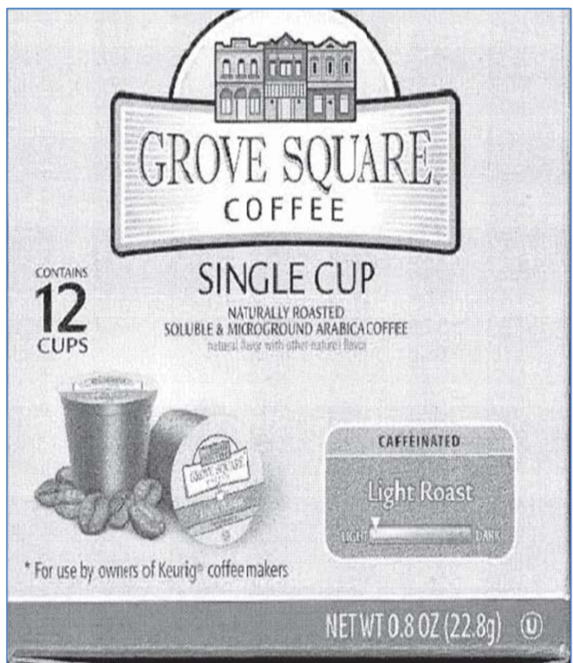
But without a filter, Sturm couldn’t use fresh coffee grounds, so it decided to use instant coffee instead. That’s “essentially, small chunks of freeze-dried brewed coffee that dissolve and are reconstituted when hot water is added to them.” Keurig customers didn’t expect instant coffee, and Sturm’s consultants warned that “use of the word ‘instant’ is a real nono” and should be avoided “if at all possible” in marketing the product to Keurig owners. The packaging stated in small font that it contained “naturally roasted soluble and microground Arabica coffee,” but did not use the better-known name for soluble coffee, instant coffee. The packaging didn’t say that the contents over 95% instant coffee with only a tiny bit of microground coffee mixed in.
![]() |
| Front of package: “Naturally roasted soluble & microground Arabica coffee” |
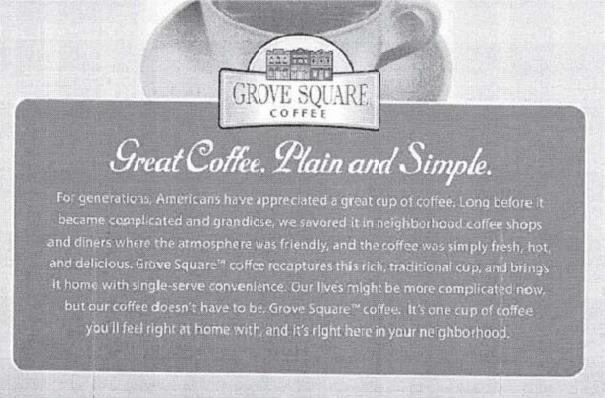
![]() |
| “Great Coffee. Plain and Simple.” with neighborhood coffee shop narrative |
![]() |
| Coffee Lover’s Bill of Rights/”highest quality Aribica beans, roasted and ground to ensure peak flavor” |
The packaging, as indicated by images included in the opinion (yay!), showed that “like many of the premium Keurig coffee products shelved nearby, the front of the GSC package contained an image of K–Cups with fresh roasted coffee beans and the admonition that the GSC product was intended ‘[f ]or use by owners of Keurig© coffee makers.’” Sturm’s objective was to make the product “look like the Keurig product in box style.” The package included a “quality promise” indicating that the coffee was “made with some of the world’s highest quality Arabica beans, roasted and ground to ensure peak flavor, then packaged to lock in optimum freshness.” But it didn’t disclose that, except for a trivial amount of microground coffee “dusting the instant chunks,” it was not ground beans. One version of the package stated that its contents “recaptured [the] rich, traditional cup” that is “savored … in neighborhood coffee shops.” At some point, Sturm added “instant” to the packaging, but the record didn’t clarify whether this new packaging was ever distributed or how widely. In addition, the package included a warning: “DO NOT REMOVE the foil seal as the cup will not work properly in the coffee maker and could result in hot water burns.” But this warning didn’t seem designed to protect consumers: “Except as a measure designed to ensure that the user did not view the true contents of the pod, this makes no sense: the presence or absence of a foil seal on top would have no effect on the risk of burns or the use of the cup.”
What result did this packaging have? “Numerous expert surveys in the record concluded that few consumers understood the true nature of the GSC product.” One survey showed participants photos of the GSC product on shelves near other Keurig-related products, then allowed them to look over images of the box for 30 seconds. Only 14% of participants said the product contained instant coffee. Sturm’s own expert using another methodology found that only one in 151 test participants equated the term “soluble and microground” with the term “instant and microground.” A third expert asked survey participants to score the product on a scale of 1 to 10 on various measures based on its packaging, with “1” being least likely and “10” being most likely. “When asked whether participants expected GSC to contain instant coffee, the mean answer was 1.61. Asked whether the GSC product filtered ground coffee just as other Keurig-compatible coffee products did, participants essentially said yes, recording an average score of 9.26.” And that didn’t even get to the percentageof instant in the blend. Comment: Basically, if this wasn’t deceptive, then nothing short of a black-is-white untruth—tea in there instead of coffee—would qualify.
Sturm was not casual in marketing GSC. It heeded its consultants’ warning not to use “instant,” and conducted focus group testing to see if participants would notice anything funny. One test reported that participants didn’t notice differences between Keurig-licensed K-Cups and GSC in terms of weight or the fact that the GSC cup “emitted a distinct rattle when shaken.” Even when these differences were pointed out, participants “did not equate [those differences] with quality.” Sturm sold GSC at “near-premium” prices, about 10% less than Keurig products. “This had the dual benefit of reaping a high profit and forestalling consumer suspicions. As one executive admitted candidly, ‘If you actually got the price too low, people would perceive it as poor quality.’” Comment: This is an excellent example of the misleading nature of the price signal in many circumstances! The GSC cup was 3-4x as expensive as typical instant coffee, which can just be spooned into hot water. Plaintiffs’ expert concluded that “only a very ‘price insensitive’ consumer, or one who was misled, would use a $100 brewer [the Keurig machine] to heat water to make instant coffee.”
The public reaction to GSC was “awful.” The day after the product launched in Wal-Mart, Sturm sent around an email directing that the legal department, not quality control or sales, be immediately informed about any complaints about it. More:
One retailer, Discount Coffee, informed Sturm that “[GSC] has been the poorest performing introductory product that we have had in our 12 year history.” Several purchasers brought their complaints to the Better Business Bureau. Although a few comments were favorable, the vast majority were negative and many “extremely negative,” according to [defendant] Treehouse’s general counsel…. To mitigate the negative reviews, Sturm encouraged employees to write fictitious favorable reviews online; the marketing department even offered to supply the language.
When customers—including one of the named plaintiffs—complained, Sturm told them that GSC wasn’t instant coffee, but rather “a high quality coffee bean pulverized into a powder so fine that [it] will dissolve.” This was false except for the “microground” coffee that constituted less than 5% of GSC. Plus, it falsely implied that coffee is made by dissolving ground beans in water, but actually coffee is made when hot water extracts oils and other solids from the ground coffee bean. (Given all this, you can see why, even setting aside the legal implications of the district court’s rulings, the court of appeals thought that, if any consumer protection class action could succeed, it would have to be this one. If not, fraud in general consumer goods has simply been legalized.)
All this resulted in four separate lawsuits consolidated into one, seeking classes covering a total of eight states. The district court was concerned that online purchasers wouldn’t be similarly situated to in-store purchasers; the plaintiffs offered to exclude online purchasers and the court proceeded on that assumption (but see below).
The district court erred in two primary ways: first, it failed to recognize that a common question was whether the GSC packaging was likely to mislead a reasonable consumer. Second, it applied too strict a test for predominance.
Commonality: a single common question will do, though a mere violation of the same provision of law at the defendant’s hands isn’t enough (Wal-Mart). Conduct common to members of the class is critical. Not every question must be common: “It is routine in class actions to have a final phase in which individualized proof must be submitted. … [I]f commonality of damages were also essential, ‘then class actions about consumer products are impossible.’” Here, the class claims derive from a single course of conduct by Sturm: GSC’s marketing and packaging. Also, the same legal standards governed every class member’s claim: the relevant state laws all require proof that a statement is either literally false or likely to mislead a reasonable consumer.
The district court, when it found that there were no common questions, “overlooked the fact that the question whether the GSC packaging was likely to deceive a reasonable consumer is common. The claims of every class member will rise or fall on the resolution of that question.” (Citing Amgen Inc. v. Conn. Ret. Plans & Trust Funds, ––– U.S. ––––, ––––, 133 S.Ct. 1184, 1191, 185 L.Ed.2d 308 (2013), in the continued saga of “securities cases affecting other class action law despite the big differences between them.”)
Some of the district court’s wrong turns included its holding that the class lacked commonality because some class members might have purchased the later package that used “instant.” Yet “many others purchased and allegedly were deceived by the old package. Tens (perhaps hundreds) of thousands of the original packaging units already had been distributed by the time the packaging was altered.” Plus, the record was unclear about how widely the new packaging was distributed. Minor overbreadth problems justify amending the class definition, not denying certification.
The district court also concluded, based on no cited evidence in the record, that the proposed class included a “great number of members who for some reason could not have been harmed by the defendant’s allegedly unlawful conduct.” Certification does not require proof that every class member has been harmed. If very few were harmed, that’s not an argument for refusing certification; it’s an argument for certifying the class and then entering a judgment exonerating Sturm. The cases on which the district court relied were different: they involved classes defined to include as members people who could not have been harmed, not weren’t harmed. For example, an antitrust plaintiff class can’t include people who bought the product at issue before the defendant possessed market power, because they couldn’t have been harmed by the alleged abuse of market power. Online purchasers might properly be excluded if they couldn’t have been deceived by the packaging—but the court noted that “[o]ften the online ‘store’ shows an image of the package that the customer can examine in detail; if that was done here, then the online group may be in essentially the same position as those who bought in physical stores.” (Indeed, often the online store doesn’t allow you to read words on the packaging very well; similarity to familiar K-Cups and their ground coffee might well have loomed even larger in consumers’ understanding of what was inside these pods.) Purchasers exposed to the allegedly deceptive packaging could have been injured by it, “even if it turns out later that a few were not.”
On the record, “it is apparent that this is not a case where few, if any, of the putative class members share the named representative’s grievance against the defendant. If it were, things would be different. A person whose claim is idiosyncratic or possibly unique is an unsuitable class representative.” But here, the named representatives suffered the same injury as members of the proposed class, given the evidence of the overwhelmingly negative response to the GSC pods, including complaints and surveys. Whether the packaging was likely to mislead a reasonable consumer is an objective question, and therefore a common one.
Rule 23(b)(3) also requires predominance and superiority; the court assessed those issues against the common question it identified (though there might be more, like Sturm’s scienter). The district court had concluded that individual issues predominated because each class member’s claim could require individualized inquiries on causation (or reliance). That was legal error:
Every consumer fraud case involves individual elements of reliance or causation. As we commented in IKO Roofing, a rule requiring 100% commonality would eviscerate consumer-fraud class actions. And because few if any injured parties would bring suit to recover the paltry individual damages available in most consumer fraud cases, such a rule would undermine enforcement against “tortious harms of enormous aggregate magnitude but so widely distributed as not to be remediable in individual suits,” in direct contradiction of Rule 23(b)(3)’s purpose. The importance of the class action device in vindicating the rights of consumers is one reason why the Supreme Court held that “[p]redominance is a test readily met in certain cases alleging consumer … fraud,” among others.
For consumer fraud class certification, a court should first rigorously analyze whether the plaintiffs’ damages can be measured across the entire class. Here, they can be: “for example, plaintiff’s damages might be computed by taking the difference between the actual value of the package she purchased (instant coffee) and the inflated price she paid (thinking the pods contained real coffee grounds).”
After damages, the court should turn to Rule 23(b)(3), which deals with class members’ interests in controlling individual litigations. The court should compare the difficulty and complexity of the class-wide issues to those of the individual issues. “The class issues often will be the most complex and costly to prove, while the individual issues and the information needed to prove them will be simpler and more accessible to individual litigants.” Where technical expertise and costly expert testimony, as well as extensive discovery, is important to the first stage of liability (whether a product was defective or a representation misleading), class treatment can be appropriate, with individual issues “readily determined” in individualized follow-on proceedings. On remand, the district court could find superiority “because no rational individual plaintiff would be willing to bear the costs of this lawsuit.” Given that reality, a class action has to be pretty bad before it can be inferior to no litigation at all. If the class prevails on the common issue, reliance and causation could be straightforwardly assessed for each purchaser—or more realistically, a settlement would quickly ensue.
After superiority, the court should assess whether the class allegations are “satisf[ied] through evidentiary proof.” This can include “survey or other evidence suggesting the relevant common traits of the class members, expert testimony supporting the classwide allegations, or analysis of the relative costs of prosecuting the class and individual issues in the case.” The ultimate issue is whether classwide resolution would substantially advance the case.
Here, the plaintiffs alleged that Sturm deceived consumers by telling them that the GSC pods contained freshly ground coffee, when at most 5% of the pod did so, and by concealing the fact that the product was overwhelmingly instant coffee. This was a lot like the facts of Pom Wonderful. However, the court of appeals wasn’t directing the district court to certify the class on remand; that decision was for the district court in the first instance. (But will the district court take the hint?)
Finally, the court of appeals reversed the district court’s grant of summary judgment against the eight putative class representatives. The district court found that the GSC packaging wasn’t likely to mislead a reasonable consumer and that none of the individual plaintiffs put forth evidence that he or she was deceived. The district court’s analysis of misleadingness was wanting. It said only: “The Court has seen the packaging at issue—Plaintiffs bring it to each hearing—and finds that it is not designed to mislead consumers. It says what it is.” That bare conclusion apparently assumed that only literal falsity can be misleading, which is not so (and, RT here, apparently assumed that intent is required to violate consumer protection law, also not so). “Moreover—ironically—it appears the district court itself was confused about the product: the court’s analysis reveals that it failed to understand that ‘soluble’ coffee and ‘microground’ coffee are not the same thing.”
There were genuine issues of material fact for each of the individual plaintiffs on whether the packaging was likely to mislead a reasonable consumer, given Sturm’s conscious avoidance of the word “instant” and package design resembling Keurig products; testimony from several plaintiffs that they were misled; many statements on the package implying that the product was premium fresh (unbrewed) coffee; failure to disclose that the product was little more than instant coffee; and at least three independent expert surveys, all employing different methodologies, that found consumer confusion. The district court also didn’t take each individual plaintiff’s claims seriously enough:
For example, the court emphasized that Suchanek admitted that she understood the word “soluble” to mean that something is capable of dissolving. But the fact that Suchanek correctly understood the definition of that English word is not enough to throw out her entire consumer-fraud claim. Did she know that soluble coffee is instant coffee? Did she understand that the GSC product was over 95% instant? Suchanek says not. As she stated, “Keurig brews coffee…. If I was going to buy a k-cup of instant coffee, I would have used my hot water tap that has boiling water at the sink instead of buying an expensive Keurig machine.” Taking all disputed facts in the light most favorable to Suchanek, a reasonable juror could conclude that Suchanek was deceived.
Other plaintiffs who shouldn’t have been tossed out included a plaintiff who admitted that she hadn’t read the text on the packages, but testified that she was misled because of the attractiveness of the package and the picture of a K-Cup on the box.
RT: It says a lot that a district court could toss out a case with this much evidence of deceptive conduct. I don’t think this signals an especially expansive view of class actions from the 7th Circuit; rather, as the court says, if this isn’t actionable then there is no such thing as a consumer class action.
Lexmark applied to false association claims under 43(a)(1)(A)
Lundgren v. Ameristar Credit Solutions, Inc., 2014 WL 4079962, No. 3:12–263 (W.D. Pa. Aug. 18, 2014)
Ameristar is a “debt settlement and tax resolution business,” while Lundgren “was previously in the mortgage service industry and began offering tax resolution services in July 2010.” (There is an untold story here about the economic crisis and eating all the parts of the pig up to and including the squeal.) Lundgren is an enrolled agent with the IRS, which makes him authorized to represent taxpayers before the IRS. Before his Ameristar employment, he was employed by another tax relief firm. He signed an at-will employment agreement and a covenant not to compete for or solicit any of Ameristar’s customers, clients, or accounts either dirctly or indirectly. Lundgren alleged that this wasn’t the entire agreement, because he had his own tax relief business with 6-8 clients before he joined; he maintained that Ameristar agreed that he could continue to serve these clients, though Ameristar disagreed and said he was just allowed to finish up a few clients.
When Lundgren began at Ameristar, he was the only enrolled agent, though others were then added, along with case workers. At one point he had responsibility for 183 case files; files were expected to close within 12 months though that could vary. Lundgren agreed to participate in Ameristar’s advertising and executed a “Talent Release Form” allowing Ameristar to use his name, title, likeness, image, and voice for a TV ad, though his ad was, according to Ameristar, not that successful.
Lundgren’s employment was terminated in 2012. He sued for violations of the Lanham Act, state law privacy rights, wrongful termination, and breach of an implied contract for employment. The court declined to exercise jurisdiction over the state law claims because it dismissed the Lanham Act claims.
Lundgren alleged both false association under §43(a)(1)(A) and false advertising: Ameristar allegedly misrepresented that he was an employee after he was terminated and used his name and likeness in an ad endorsing Ameristar’s services. Under Lexmark, “a plaintiff must plead (and ultimately prove) an injury to a commercial interest in sales or business reputation proximately caused by the defendant’s misrepresentations.” The court assumed, without deciding, that Lexmark stated the proper standard for both parts of §43(a), and that Lundgren’s claims failed. (I’m not a civil procedure expert, but how can this really be true? If Lexmark doesn’t provide the proper standard for false association claims, on what basis does the court kick Lundgren’s out? The court also noted that Conte Bros. said there was no difference between the two prongs for standing purposes, and that part of the Third Circuit’s holding wasn’t addressed by Lexmark.)
The only damages Lundgren alleged with any specificity related to his wrongful termination, not from a Lanham Act violation. In his deposition, he testified that his injury as the result of the ads was to “my reputation, particularly the guy here in Johnstown who saw me and was questioning me about that. Other people, colleagues who saw me. It just seems to … impede or whatever my image and who my alliance is with…. [It i]nfluences whether or not they can trust, I believe, what I say if they see me in other places, yet I’m practicing or trying to practice on my own.” The court found these claims for “damage to his reputation” and/or “lost reputation and goodwill” vague and conclusory. (And yet, how much do these statements differ from what courts routinely say about goodwill in trademark cases?) He also cited no evidence that the ads featuring him were successful or affected Ameristar’s receipts positively. Thus, at the summary judgment stage, he didn’t provide evidence raising a material issue of fact as to injury to a commercial interest in his reputation or sales.
Dastar-ing about architecture: 7th Circuit reverses dismissal of credit claim
M. Arthur Gensler Jr. & Associates, Inc. v. Strabala, No. 12-2256 (7th Cir. Aug. 21, 2014)
Previous coverage, wherein I was not enthusiastic about the district court decision finding that there couldn’t be a §43(a) claim based on an allegedly false claim to have designed a building. Here, the Seventh Circuit reverses in an opinion by Judge Easterbrook, but I’m not sure it gives us a better view of Dastar, because it avoids the head of liability the Supreme Court told everyone to use in such cases (that no one uses), §43(a)(1)(B) false advertising. The real issue I see in this case is Rule 9(b): is the application of Rule 9(b) to §43(a)(1)(A) claims supposed to be standard now? Most courts don’t do that, and it would be useful to be clear about the answer to this question.
Strabala left Gensler, where he’d been a Design Director, to open his own architectural firm, 2Define Architecture. He stated (either on the firm’s website or on his personal Flickr or both) that he’d designed five projects for which Gensler is the architect of record: Shanghai Tower, Hess Tower, Three Eldridge Place, the Houston Ballet Center for Dance, and the headquarters of Tesoro Corporation. Gensler alleged that this was reverse passing off, and the district court dismissed the complaint on the ground that Strabala didn’t claim to have provided the physical origin of the structures (Dastar).
The court of appeals characterized the district court’s opinion as limiting §43(a) to false designations of goods’ origin (which I think is an odd characterization), and thus as holding that Gensler couldn’t invoke the Lanham Act because its claim concerned services. This, Judge Easterbrook said, misread Dastar, which didn’t read “services” out of the Lanham Act. Nor did Dastar hold that false designation of origin is the only way to violate §43(a); if it had done so, Pom Wonderful would have come out the other way. (The weirdest thing about this statement about Pom is its complete failure to acknowledge §43(a)(1)(B), or the words (nature, qualities, characteristics) that are important in providing Pom’s claim but aren’t included in §43(a)(1)(A).)
In Dastar, the court of appeals continued, Fox didn’t contend that Dastar falsely identified itself as the videos’ creator “or made any other false claim.” (Actually, yes, that is exactly what Fox contended; the Supreme Court just determined that what Dastar said couldn’t count as false.) Here, by contrast, Gensler did assert there’d been a false claim of origin. (As did Fox.) But the claim here was for false designation of origin of services, not of goods. (This doesn’t seem to deal with Dastar’s definition of “origin” as physical origin—which for services would mean the physical provision of the services.) Gensler’s allegation was that Strabala falsely claimed to have been the creator of intellectual property: the building designs. “Architects’ success in winning clients depends on what they have accomplished; Gensler has a strong interest in defending its reputation for creativity and preventing a false claim that someone else did the design work.” (True. But also true of authors of other creative works, and the Court explicitly said that the materiality of authorship to audiences didn’t matter in Dastarbecause the statute didn’t cover this conduct in §43(a)(1)(A).)
So, the court of appeals concluded, “Gensler contends that Strabala made a ‘false or misleading representation of fact’ (his role in designing the five buildings) that is ‘likely to … deceive as to the … connection[] or association of such person [Strabala] with another person [Gensler]’ and to deceive clients about the ‘origin’ of the designs. Nothing in Dastar forecloses such a claim.” (Except for Dastar’s holding about what “origin” means. I don’t see why you can’t replace “role in designing” with “putting its name on the cassettes” and get [Dastar] and [Fox] exactly here. I think this failure of understanding might have something to do with the Seventh Circuit’s extremely confused understanding of what it means for something to be implicitly false.)
There was no copyright claim implicated here—Strabala didn’t make any copies of plans in which Gensler claimed copyright. “A false claim of authorship, without the making of copies (or some other act covered by 17 U.S.C. §106), is outside the scope of copyright law. Gensler’s only plausible federal claim rests on §43(a).” (We are in complete agreement here!)
Now, the court of appeals continued, the question was whether Gensler had a tenable claim:
It charges Strabala with a form of fraud, so we would expect its complaint to allege with particularity the nature of the grievance—what Strabala said and why it is false. See Fed. R. Civ. P. 9(b). Yet the complaint contains only a few quotations and does little to explain what part of each is false. For example, it quotes this from Strabala’s Flickr site: “Shanghai Tower was designed by American architect Marshall Strabala.” But it does not say why the statement that he “designed” the building is false.
For all that this case thinks it’s about Dastar, this is the most significant part of the holding. Because the court is writing about §43(a)(1)(A), the reference to Rule 9(b) is in fact extremely unusual, as most courts refuse to require trademark plaintiffs to plead with particularity. (They’re more willing to require it of false advertising plaintiffs, even though there’s no warrant in the statutory language for the difference; the problem is that most courts don’t even seem to realize that there is any question, whether they’re applying Rule 8 or Rule 9(b), and don’t cite contrary cases.)
Back to the specifics: the court of appeals could think of three ways in which an architect’s claim to have designed a building could be false: (1) the architect didn’t work on the project at all; (2) the architect worked on the project but overstated his/her role (designed the details, but not basic appearance or attributes); or (3) the architect “worked on the project and contributed some or even all important features, but the project was so complex that no one person bore full responsibility.” (Pause for obligatory acknowledgement that §43(a)(1)(B) jurisprudence has many cases dealing with similar questions as matters of puffery and materiality.) Gensler’s complaint didn’t allege (1) or (2), but apparently relied on (3): “that big buildings are team jobs that no one designs.” The complaint alleged, for example, that the Shanghai Tower team included approximately 100 people, and Strabala was only one of many members, making Gensler and not Strabala the source of the architectural and design services at issue.
The court of appeals wasn’t impressed. “It is as if Warner Bros. wanted Michael Curtiz, who directed Casablanca, to keep silent about his role because the film could not have succeeded without Humphrey Bogart’s and Ingrid Bergman’s acting, Max Steiner’s music, Arthur Edeson’s cinematography, Murray Burnett’s and Joan Alison’s play, Julius and Philip Epstein’s screenplay, and the contributions of a hundred others—or at least to append to any claim of directorship something along the lines of ‘many persons in addition to directors bear credit for a film’s success or blame for its failure.’” The court of appeals thought Gensler sought to make the auteur approach “legally impermissible” in architecture.
But if Gensler was really contending that “big projects require big teams, … where’s the falsity?” Maybe if Strabala designed houses for unsophisticated clients, there might be a problem, though Gensler would have trouble proving damages. But the parties’ websites and the complaint indicated that both parties specialized in large products with sophisticated clients. “People who pay millions for substantial projects (Shanghai Tower will cost more than $4 billion by the time it is finished in 2015) know full well that it takes an architectural team to design and execute the plans. They also know that teams have leaders—and Gensler has not alleged that Strabala said anything false by implying that he was the (or a) leader of the teams on these five projects.” (I suppose it’s futile to say anything about appellate factfinding in the Seventh or Ninth Circuits particularly; Twiqbal at least provides some cover for this kind of plausibility determination, as the court will suggest below.)
Indeed, if sophisticated clients wouldn’t be misled, then Gensler is not just wrong but in the wrong: attempting to conceal the fact that a designer of big projects has flown the coop. “[I]f Gensler wins this case other architects who leave will be required to keep mum about their accomplishments—and then it will be Gensler, not the departing architect, that is in a position to make a misleading presentation to a future client.” If no real person designs a building, then Gensler never loses from the departure of talented designers. The lawsuit could also be understood “as an effort to impair competition by imposing costs on a departing architect, even though setting up a new firm does not violate any contract (and the old employer does not allege a theft of trade secrets).” But competition by “people who leave large firms to set up small rivals” is good for consumers. (Given what the Seventh Circuit has said about awarding attorneys’ fees to defendants in cases brought for anticompetitive reasons, this commentary should make Gensler quite nervous.)
As a result, the court of appeals was tempted to affirm the district court on alternate grounds, but Strabala hadn’t argued Rule 9(b) or Twiqbal. “Nor does Gensler’s complaint rule out the possibility that it competes with Strabala to build some smaller projects with less sophisticated clients.” The possibility that a tenable legal theory might fail on the facts was for the parties to argue at the district court in the first instance.
Today in parody shirts
I just acquired the Black Labour, White Guilt T-shirt from the Laugh It Off case, and I’m taking the opportunity to share some other parody shirts as well.
![]() |
| Black Labour, White Guilt |
From my vacation:
![]() |
| Spider-Moose, New Hampshire |
Then, continuing the moose theme:
![]() |
| John Moose, Calgary Canada, with moose in John Deere pose |
Which let me, through a series of joke T-shirts, to:
![]() |
| “She wants the D” T-shirts with Disney D |
That’s probably the most offensive variant I saw; the others were all sports teams. My search also took me to:
| Just Shoot It shirt with Nike logo curving into duck head |
That one was, in my opinion, the most artistically successful of the Just Shoot It shirts, with the Nike logo curving nicely into the duck’s head.
Posted in dilution, parody, trademark
Leave a comment