-
Recent Posts
- candy buyers fail to allege difference between pumpkin & Jack-o’-lantern shape
- Amicus in section 230 false light case
- Amicus in Rise & Shine
- it’s hard to get rid of a foreign TM owner’s complaint at the motion to dismiss stage despite territoriality
- dct strikes down California’s new recyclability law on vagueness/1A grounds
Recent Comments
Archives
- September 2026
- August 2026
- July 2026
- June 2026
- May 2026
- April 2026
- March 2026
- February 2026
- January 2026
- December 2025
- November 2025
- October 2025
- September 2025
- August 2025
- July 2025
- June 2025
- May 2025
- April 2025
- March 2025
- February 2025
- January 2025
- December 2024
- November 2024
- October 2024
- September 2024
- August 2024
- July 2024
- June 2024
- May 2024
- April 2024
- March 2024
- February 2024
- January 2024
- December 2023
- November 2023
- October 2023
- September 2023
- August 2023
- July 2023
- June 2023
- May 2023
- April 2023
- March 2023
- February 2023
- November 2021
- October 2021
- September 2021
- August 2021
- July 2021
- June 2021
- May 2021
- April 2021
- March 2021
- February 2021
- January 2021
- December 2020
- November 2020
- October 2020
- September 2020
- August 2020
- July 2020
- June 2020
- May 2020
- April 2020
- March 2020
- February 2020
- January 2020
- December 2019
- November 2019
- October 2019
- September 2019
- August 2019
- July 2019
- June 2019
- May 2019
- April 2019
- March 2019
- February 2019
- January 2019
- December 2018
- November 2018
- October 2018
- September 2018
- August 2018
- July 2018
- June 2018
- May 2018
- April 2018
- March 2018
- February 2018
- January 2018
- December 2017
- November 2017
- October 2017
- September 2017
- August 2017
- July 2017
- June 2017
- May 2017
- April 2017
- March 2017
- February 2017
- January 2017
- December 2016
- November 2016
- October 2016
- September 2016
- August 2016
- July 2016
- June 2016
- May 2016
- April 2016
- March 2016
- February 2016
- January 2016
- December 2015
- November 2015
- October 2015
- September 2015
- August 2015
- July 2015
- June 2015
- May 2015
- April 2015
- March 2015
- February 2015
- January 2015
- December 2014
- November 2014
- October 2014
- September 2014
- August 2014
- July 2014
- June 2014
- May 2014
- April 2014
- March 2014
- February 2014
- January 2014
- December 2013
- November 2013
- October 2013
- June 2013
Categories
- 230
- acpa
- advertising
- antitrust
- art law
- attribution
- blogging
- california
- cfaa
- cfps
- class actions
- cmi
- comics
- commercial speech
- conferences
- consumer protection
- contracts
- copying
- copyright
- counterfeiting
- cultural property
- damages
- dastar
- defamation
- design patent
- dilution
- disclosures
- disparagement
- dmca
- drm
- fan fiction
- fanworks
- fda
- fees
- first amendment
- ftc
- geographic indications
- http://schemas.google.com/blogger/2008/kind#post
- insurance
- jurisdiction
- libraries
- misappropriation
- music
- my lawsuits
- my writings
- parody
- patent
- patents
- preemption
- presentations
- privacy
- procedure
- reading list
- remedies
- right of publicity
- secondary liability
- securities
- standing
- surveys
- teaching
- tortious interference
- trade secrets
- trademark
- traditional knowledge
- Uncategorized
- unconscionability
- unfairness
- warranties
Meta
Website statements aren’t trade dress for insurance purposes
Test Masters Educational Services, Inc. v. State Farm Lloyds, 2014 WL 2854536, No. H–13–1706 (S.D. Tex. June 23, 2014)
Test Masters offers test prep services. It was involved in a series of lawsuits by and against third party competitor Singh. In the underlying case here, Singh filed counterclaims alleging that Test Masters’ website purported to offer LSAT preparation courses across the country under the “Test Masters” name and mark, mimicked a map on Singh’s website, and made material misrepresentations in an effort to trick consumers into believing that Plaintiff’s services were associated with Singh’s. State Farm agreed to defend the counterclaims, but when Singh dropped the accusation that Test Masters mimicked Singh’s map, it ultimately withdrew its defense because the absence of a trade dress claim meant there was no potential coverage under the advertising injury policy it provided Test Masters. This suit followed.
Texas uses the “eight corners” rule, under which the duty to defend considers only the pleadings, liberally construed, and the policy language, focusing on the factual allegations in the pleading rather than the legal theories. Here, the only question for the court was whether the underlying complaint alleged infringement of “trade dress.”
Test Masters argued that Singh’s citation of §43(a) and allegations that Test Masters used a similar name, mark, and website constituted allegations of trade dress infringement. But §43(a) covers more than trade dress, and statutory citation isn’t enough to trigger coverage. The underlying complaint alleged that Test Masters “changed its website so that it was confusingly similar to Singh’s, purporting to offer LSAT preparation courses in every state,” and “represents on its website that it offers live LSAT classroom courses in 100 cities and in all 50 states,” and that its actions “as described above (in particular, [Plaintiff’s] use of the TESTMASTERS name and mark and testmasters.com domain name) are likely to cause confusion, mistake, or deception … and thus constitute trademark infringement and false designation of origin in violation of Section 43(a) of the Lanham Act.”
This wasn’t trade dress, which is a product’s total image and overall appearance. The complaint didn’t allege anything about any “look and feel” of the website. (The court mistakenly says “inherently distinctive” here but of course acquired distinctiveness can also—indeed only, in this case since website design would be product design—produce protectable trade dress.) “Absent some allegation of aesthetic similarity to another’s advertisement, a claim that defendant infringed a trademark does not itself comprise a claim for trade dress infringement.” Allegations that the website was “confusingly similar” to Singh’s because Test Masters copied some of Singh’s course locations and purported to have taught “thousands of LSAT students” said nothing about the distinctive aesthetics of Test Master’s website as compared to Singh’s. Advertisement of the locations in which one actually does business isn’t trade dress, so falsely advertising locations wouldn’t be copying trade dress. And even if a list of locations where courses are offered did constitute trade dress, the underlying counterclaims didn’t allege that the locations were copied—rather they alleged false advertising of Test Masters locations.
State Farm was entitled to summary judgment on Test Masters’ claim for breach of contract.
multiplicity of products and labels makes class unascertainable
Bruton v. Gerber Products Co., No. 12-CV-02412, 2014 WL 2860995 (N.D. Cal. June 23, 2014)
Bruton brought the usual California claims against Gerber for mislabeling certain food products intended for children under 2. She challenged Gerber’s nutrient content claims and failure to label certain products labeled with a “No Added Sugar” or “No Added Refined Sugar” with a disclosure statement warning of the high caloric value of the products. The court denied class certification on ascertainability grounds.
A class is ascertainable if it is defined by “objective criteria” and if it is “administratively feasible” to determine whether a particular individual is a member of the class. Bruton proposed to certify a class of buyers of foods within Gerber’s “2nd Foods” category. There were seven product sub-categories and multiple flavors within each sub-category. In total, of the 93 varieties of baby food available in the 2nd Foods product category, 69 products were part of the proposed class.
The court first rejected Gerber’s argument that the class was unascertainable because Gerber doesn’t track who buys its products. That may be the law of the Third Circuit, but not the Ninth. See Carrera v. Bayer Corp., 727 F.3d 300 (3d Cir. 2013) (rejecting affidavits from class members as means of identification where defendant kept no purchase records). “In this Circuit, it is enough that the class definition describes a set of common characteristics sufficient to allow a prospective plaintiff to identify himself or herself as having a right to recover based on the description.”
However, labeling variation proved a fatal flaw. Gerber sold multiple versions of the same products during the class period. Most, if not all, consumers likely discarded the product packaging, forcing them to rely on memory alone, and it was too much to ask them to remember not just whether they bought 2nd Foods products within the class period, but what the flavors and labels were.
Of the 69 products at issue, 66 were labeled both with and without challenged labels during the class period. Because of production and distribution realities, “a new label produced by Gerber may appear for sale on a store shelf anywhere between three and thirteen months after the new label is approved.” Gerber submitted evidence that at some times during the class period, there were two different labels simultaneously for sale in one store ,”such that on a given day one consumer may have purchased a product with a challenged label statement while another purchaser of the same product did not.” The court—Judge Koh—had recently certified other consumer classes, where all products in the class definition contained the allegedly problematic statements throughout the class period, but this was different.
While self-identification with affidavits can be enough for ascertainability, sometimes it isn’t. In a case seeking certification of a class of consumers who had smoked twenty “Pack–Years,” or at least 146,000, Marlboro cigarettes over the class period, which spanned several decades, the court reasoned that this asked too much of class members’ prospective members’ memories. “Swearing ‘I smoked 146,000 Marlboro cigarettes’ is categorically different from swearing ‘I have been to Paris, France,’ or ‘I am Jewish,’ or even ‘I was within ten miles of the toxic explosion on the day it happened.’” Likewise, another food case involving multiple products and labels was found unascertainable because the defendant “produced and sold multiple versions of each of the contested product labels during the class period, some bearing the allegedly misleading statements and others not.” Consumers would have difficulty remembering whether or not they bought a product with an allegedly misleading label statement.
So too here. Identifying class membership required consumers to remember whether they purchased a 2nd Foods product in a qualifying flavor; whether the product was in the appropriate packaging; and whether the product was labeled with a challenged label statement. But because Gerber sold more flavors of 2ndfoods than included in the class definition, and because Gerber’s flavors were very similar in name, it was likely that consumers would have difficulty remembering whether or not they purchased a qualifying product. (For example, Apples and Bananas with Mixed Cereal or Apples and Cherries flavors were included, but Apple Peach Squash, Apple Berry with Mixed Cereal, and Apples and Chicken flavors were not.)
The multiple different labels further complicated the issue. “Nearly all of the Gerber 2nd Foods products included in the class definition did not contain any challenged label statements during a portion of the class period.” Some of the labels were changed to remove challenged statements; some statements were moved from the front of the package to less prominent places. The Apples and Cherries flavor, for example, had six different labels during the class period, one with a challenged statement on the top, five with challenged statements on the top and front, and one with no challenged statements. That made accurate recall even less likely.
In sum: “[t]he number of products at issue in this case, the varieties included and not included in the class definition, the changes in product labeling throughout the class period, the varied and uncertain length of time it takes for products with new labels to appear on store shelves, and the fact that the same products were sold with and without the challenged label statements simultaneously make Plaintiff’s proposed class identification method administratively unfeasible.” Under these circumstances, affidavits would be unreliable, especially since Bruton sought money damages and the availability thereof might “encourage consumers to submit affidavits even though they cannot remember which products they purchased.”
Class can be certified when product is allegedly worthless
Ortega v. Natural Balance, Inc., 2014 WL 2782329, No. CV 13–5942 (C.D. Cal. June 19, 2014)
The court granted class certification for a California class of consumers of Cobra Sexual Energy, a dietary supplement containing various herbs, extracts, and other plant-based materials, which was allegedly falsely marketed as having beneficial health and aphrodisiac properties and being scientifically formulated to improve virility. Plaintiffs alleged the usual California claims.
The court found the class ascertainable by objective criteria: whether they purchased the products during the class period in California for personal use (and weren’t persons connected to Natural Balance). Only those who lost money buying Cobra were included, so the class was defined as people who’d have standing. The fact that there were no purchase records was irrelevant; “identifying individual class members is not germane to ascertainability.”
Typicality: Natural Balance argued that the class representatives’ claims weren’t typical because they had unrealistic expectations of the product and unreasonably interpreted the packaging. But the particulars of their understanding didn’t make them atypical: “even if each Plaintiff and class member had somewhat varying conceptions of the results he could expect from a product marketed as virility-enhancing, each had the same marketing-induced expectation that the product would be virility-enhancing.” Plaintiffs alleged that it wasn’t. That made their claims typical, except as to class members whose claims would be barred by the statute of limitations. They couldn’t add to the period by arguing delayed discovery that tolled the limitations period, because that would add “a significant dimension in which the named Plaintiffs have no personal interest.”
Common issues predominated: falsity/misleadingness of the packaging itself, which would be determined based on a reasonable consumer standard and not on an individual basis. “Plaintiffs’ other evidence—consumer surveys and expert testimony regarding the inefficacy of Cobra’s ingredients—is also applicable on a class-wide basis.”
Classwide causation could be presumed upon a showing of materiality. The allegedly misleading statements were nearly all of the statements on Cobra’s packaging, and it strained credulity to think that a manufacturer would put only immaterial statements on its packaging. Thus, if plaintiffs chould show misleadingness, they could likely show materiality as well; certainly this couldn’t be ruled out as a matter of law. It could be determined classwide because the packaging was uniform over the entire class period.
Natural Balance argues that individual questions predominated because plaintiffs couldn’t show that everyone was misled by the exact same statements—the named plaintiffs allegedly relied on the package’s image of a cobra snake and not on other statements. But both plaintiffs testified to other statements on which they relied. And the presumption of reliance and causation could moot any issue about which component any individual plaintiff read or remembered.
Nor did individualized damages defeat predominance. Even if that could, by itself, defeat certification—which it can’t—plaintiffs had a tenable theory of how to ascertain classwide monetary relief. What they spent on Cobra could be readily calculated using Defendant’s sales numbers and an average retail price. Natural Balance argued that this didn’t take into account the actual value of the product to each individual. But plaintiffs argued that the product was valueless because it provided none of the advertised benefits and was illegal, entitling them to recover the full price. Natural Balance’s “theoretically available defense” to this relief didn’t render damages an individualized issue that predominates over the common issues.
The challenge of identifying class members was also insufficient to make individual issues predominate. “[G]iven that one of the purposes of the class action procedure is to facilitate small claims, that it is likely Defendant’s aggregate liability could be reliably determined without imposing excess liability, and that all parties would be bound by the litigation, individual issues arising out of identifying class members do not predominate over common issues and the class procedure does not unfairly prejudice Defendant.”
Unsurprisingly, the court also found superiority. Small individual claims would be difficult, wasteful, and unlikely. Overall, certification was appropriate.
However, the court did reject two unusual features of the proposed notice—that Natural Balance be required to pay for it, and that it also be required to include the notice within Cobra’s packaging. Nothing justified departing from the ordinary plaintiff-pays rule, and requiring notice within Cobra’s packaging “would be akin to issuing a mandatory injunction, a drastic step not warranted by the record before the Court.”
UK ASA finds ad for journalistic Free Speech Network misleading
Tragedy or farce? I’ll take “couldn’t happen in the US” for $500, Alex.
Nonprofit’s former chapter has false advertising, not TM, claims against parent
Alzheimer’s Disease Resource Center, Inc. v. Alzheimer’s Disease and Related Disorders Association, Inc. 981 F. Supp. 2d 153 (E.D.N.Y. 2013)
Plaintiff ADRC is the former Long Island chapter of defendant Association, dedicated to fighting Alzheimer’s. In 1998, the parties entered into a “Statement of Relationship” (SOR) contemplating that they could part ways and providing that the distribution of chapter assets would be subject to binding arbitration in case of disagreement. ADRC alleged that, over time, the Association breached the SOR by, among other things, permitting the Association’s NYC chapter to fundraise on Long Island. They disaffiliated in 2012, and ADRC demanded arbitration, seeking to retain funds previously raised for the Association.
ADRC sued the Association for unfairly competing with ADRC by sending out 15 mass mailings under the name “Alzheimer’s Association—Long Island Chapter” (ADRC’s former operating name) and for breaching an agreement between the parties by using donor information it previously obtained from the ADRC prior to the disaffiliation. ADRC alleged that the Association lacked any presence on Long Island when the letters were sent, and that the Association forged the signature of ADRC’s leader in those mailings. Multiple donors allegedly mailed checks to the Association based on the mistaken belief that the donations were going to ADRC.
Lanham Act claim: the court dismissed the §43(a)(1)(A) aspect of the claim because ADRC conceded that it had no valid trademark in the name “Alzheimer’s Association—Long Island Chapter” or a related expression. However, §43(a)(1)(B) was still available. (This strikes me as an excellent use of channeling principles. It’s true that the name is part of the confusion, but ADRC abandoned the name.) The court found that ADRC plausibly alleged that the use of confusing addresses, coupled with the inclusion of ADRC’s leader’s name on the mailings, had the capacity to deceive a substantial portion of the intended audience about the recipient of their donations. ADRC alleged the identity of one such donor who was actually deceived. The Association argued that ADRC failed to allege materiality, but the identified donor indicated that she “felt deceived” by the mailings. Facts regarding the identity of other donors were peculiarly within the knowledge of the Association, meriting discovery.
The NY GBL §349 claim: ADRC successfully pled a claim for deceptive acts and practices. “Donors are the consuming public for charitable fundraising activities and are deceived, when a check intended for one charity is cashed by another.” There was a public interest in knowing who was receiving charitable donations. Punitive damages could be available on this claim, though not on the others.
There was no common law unfair competition claim, because there was no protectable mark at issue, nor was there misuse of a trade secret in using publicly available information like a name or ADRC’s address. “In the Court’s view, the name of an organization’s executive and address does not neatly fit within the categories typically associated with a common law claim for unfair competition.” A conversion claim failed because there was no specific identifiable fund to which ADRC was entitled. And tortious interference with prospective economic advantage failed because there was no sufficiently alleged “business injury,” as required. ADRC alleged injury in the form of lost donations, but didn’t particularize the damage to its relationships with its donors. And there was no fraud because ADRC didn’t reasonably rely on any misrepresentations; allegations of third party reliance were insufficient under New York law. The court also dismissed claims for breach of contract based on the Association’s continued use of donor information after disaffiliation. The Association’s contractual obligations under the SOR ceased after disaffiliation, and what counted as assets—including donor information—was expressly reserved for arbitration. Likewise, even if the donor lists constituted a trade secret, ADRC failed to allege that the information was used “in breach of an agreement, confidential relationship or duty, or as a result of discovery by improper means,” or in such a way as to constitute common law unfair competition.
An unjust enrichment claim, however, survived (based on the donations).
You have to laugh or you’ll cry: supplement regulation
John Oliver has yet another fantastic, and accurate, advertising law-related story, this time focusing on the deliberate unregulation of dietary supplements.
More pondering on the relationship between sec. 2 and sec. 43
One question from last week’s TTAB REDSKINS decision concerns the effect on §43 if the §2 cancellation is upheld. Mark McKenna has argued that, if we took history seriously, there should be no effect, because unfair competition historically covered lots of things that weren’t registrable. I’m not so sure that ought to make a difference today, because now that we register trade dress, surnames with secondary meaning, etc., I don’t think there is currently a coherent account of unregistrable matter that is nonetheless protectable. I don’t think it’s wrong to say that there ought to be such a set, but I don’t think there must be. For a student research paper concluding that unregistrable ought to mean unprotectable, see James C. Bartholomew, The Scope of Protection Under §§ 2 & 43 of the Lanham Act, though the paper acknowledges that nobody has much to go on here. (Professor McKenna notes that one reason to apply §43 is that if §2 and §43 go together, then the case that §2 violates the First Amendment gets a lot stronger. I’m also okay with that—I think the right result might be for parts of §2 to go, if we can figure out what the government interest in registration really is. Right now, we don’t have a good account of that.)
The exclusions in §2 that arguably don’t go to core trademark policy (though this too is debatable) are those for immoral, scandalous, or disparaging marks; flags/coats of arms; names/signatures/portraits of living persons/deceased presidents with living spouses without written consent; geographic indications (GIs) on wine or spirits identifying someplace other than their origin; and primarily geographically deceptively misdescriptive terms. Some of these exclusions are closer to source significance than others, and it might be worth noting that the “core” exclusions are pretty well mixed in with the non-core ones, so that “deceptive” is listed right in between “immoral” and “scandalous.” Arguably it’s all congressional policy about what ought to serve as a mark. (See the policy reasoning in Renna v. County of Union, arguing that governments ought not to have access to ordinary trademark remedies, given their First Amendment implications.)
But anyway, the NAFTA amendments might seem to be a really obvious place to look for congressional policy about the relationship between registration and protectability. Congress intended—before California Innovations gutted the change—to switch geographically deceptively misdescriptive marks from registrable to unregistrable. Did it also intend to make them unprotectable under §43? As my research assistant pointed out, in retrospect this seems like a really obvious question. And yet, as I confirmed with Professor McCarthy, there seems to have been no consideration of that question. Perhaps this is related to the fact that most of our treaty partners operate more registration-based systems, and weren’t attuned to the fact that the US now offers essentially the same protection to registered and unregistered marks.
Relatedly, our NAFTA commitment required us to provide a remedy to persons harmed by the use of primarily geographically deceptively misdescriptive terms: “Each party [United States, Mexico, Canada] shall provide, in respect of geographical indications, the legal means for interested persons to prevent: (a) the use of any means in the designation or presentation of a good that indicates or suggests that the good in question originates in a territory, region or locality other than the true place of origin, in a manner that misleads the public as to the geographical origin of the good….”
Congress did not amend the Lanham Act to implement this provision, while it amended §2 to deal with registration. Presumably, the assumption was that false advertising law covered the situation already. Did Congress just not notice that materiality is a requirement under §43(a)(1)(B) (as it should be under §43(a)(1)(A))? The use of geographically misleading terms is therefore not unlawful unless the misleadingness is material. That’s probably not what our trading partners wanted, but it’s what they got—both for §43(a)(1)(B) and for §2, after California Innovations. (I say that materiality was not supposed to be required because part of the theory behind protecting all GIs is that different places should be encouraged to develop reputations for specific qualities. Protection should enable such reputations to develop even if they don’t exist now and therefore aren’t material now. There’s other language that can be used to specify GIs with an existing reputation.)
The best that can be said, I think, is that Congress wasn’t really thinking that much about the details, and so the NAFTA amendments don’t help us much in figuring out how we should think about the modern relationship between §2 and §43.
Something fishy about this trademark claim?
GurglePot, Inc. v. New Shreve, Crump & Low LLC, 2014 WL 2744283, No. C13–6029 (W.D. Wash. June 17, 2014)
I’m not really interested in the law in this personal jurisdiction case, finding that there’s no personal jurisdiction in plaintiff’s home state over Massachusetts-based New SCL for this the declaratory judgment of non-infringement. I just really liked the accused trade dress (I think it’s nicer than New SCL’s), and also it reminds me of Justice Scalia’s “cocktail shaker shaped like a penguin.” Even if there is secondary meaning in the New SCL design, it seems to me that New SCL is asserting rights at the level of idea.
![]() |
| GurglePot |
![]() |
| New SCL Gurgling Cod |
Posted in trademark
Leave a comment
Apply fair use to burned area
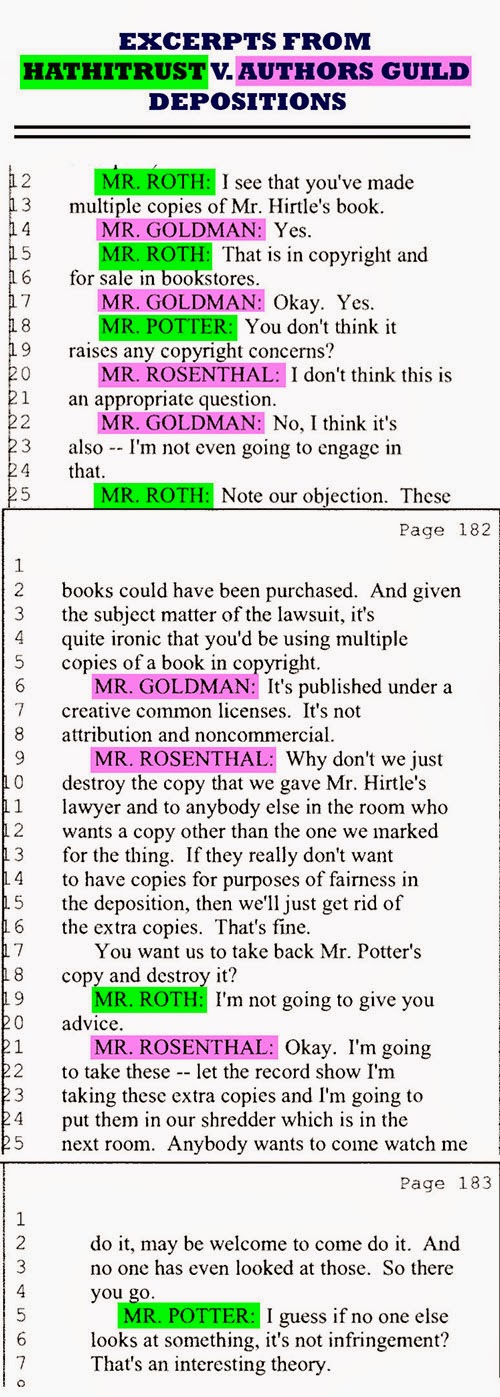
Via Five Useful Articles, this deposition excerpt from HathiTrust is nearly priceless–what takes it beyond the usual snark is the very last dig the HT lawyer gets in at the Authors Guild’s theory of the case.
So, HT’s lawyer snarks about multiple litigation copies of HT witness’s book the AG’s lawyer has made in preparation for the deposition; AG lawyer rises to the bait (even though the book is, according to another AG lawyer, CC/noncommercial licensed) and suggests he’ll destroy the extra copies before reading. HT’s lawyer: “I guess if no one else looks at something, it’s not infringement? That’s an interesting theory.”