A couple of Google v. Garcia amicus briefs

Int’l Documentary Ass’n brief, now with actual evidence on standard contracts! Makes a nice pair with Netflix’s brief, which cogently criticizes Kozinski’s entirely typical reliance on “facts” not in the record about what standard entertainment contracts are like.

Posted in google, http://schemas.google.com/blogger/2008/kind#post | Leave a comment

ordinary consumer goods jump on the lawsuit waiver bandwagon

We all knew it was only a matter of time.  Apparently not sure that merely buying a product with a lawsuit waiver on the wrapper would work, GM now seeks to bind consumers who visit its website or “like” its page.  Speaking of “unfairness,” FTC … I would hope the FTC will act on this. In the meantime, there’s Adam Levitin’s response.

Posted in advertising, contracts, http://schemas.google.com/blogger/2008/kind#post | Leave a comment

The ASA on insufficiently close comparisons

The ASA found Made.com’s ad misleading for claiming “FURNITURE DIRECT FROM THE MAKERS By the time the average sofa hits the high street it’s been marked up by 500%. Agents, importers and wholesalers all add a little extra along the way. Our unique and award-winning concept cuts out the middle steps and passes the savings on to you.” Though the ad explicitly stated the that the typical high street price was “based on closest equivalent products in design and functionality,” that wasn’t enough. Most consumers would understand that the “high street” prices were for equivalent, not identical, products, but consumers would expect the high street items to be “of a similar quality, in terms of finish, and the materials used, not just design.” Since they weren’t, the ad was misleading.

US advertisers don’t always know how good they have it.

Posted in advertising, http://schemas.google.com/blogger/2008/kind#post | Leave a comment

FDA has a standard, so no Lanham Act claim can be made

OraLabs, Inc. v. Kind Group LLC, 2014 WL 1395954, No. 13–cv–00170 (D. Colo. Apr. 10, 2014)

The court adopted the magistrate judge’s recommendation to deny Kind leave to amend its counterclaims to add a Lanham Act false advertising claim. OraLabs filed a declaratory judgment seeking a ruling that it wasn’t infringing Kind’s design patent and trade dress rights by selling certain lip balm products. Now that OraLabs has begun selling a particular product, Lip Revo, in the US, Kind alleged that the labeling was false and misleading: while OraLabs advertised a net weight of 7 grams, Kind’s test showed actual useable weight of less than 6 grams.

The magistrate found that amendment would be futile because the claim was preempted (precluded) by the FDCA. “When the Lanham Act and the FDCA overlap, any conduct that amounts to a violation of the FDCA is within the Food and Drug Administration’s jurisdiction.” (Noting cert. grant in Pom which may change this a bit.) In particular, claims that require interpretation and application of the FDCA can’t be recognized under the Lanham Act. Here, the FDCA requires that a product’s net weight must be accurately disclosed on the label. Thus, determining whether the 7g representation was false or misleading required interpreting “accurately” in the FDCA. (The “thus” is where all the action is, and it’s underanalyzed. Aren’t there independent standards for figuring out whether 7g is false or misleading?) To figure out whether the representation was accurate enough, the court would need to know how “accurate” the FDA expects net weight statements to be.

Absolute literalism shouldn’t be required; otherwise rounding to the nearest gram would violate the law. If the FDA requires accuracy within one tenth of a gram, the alleged difference could be false and misleading. But if the FDA requires only 1 1/2 grams, 1 gram of difference would be fine. Thus, resolving Kind’s claim would require interpretation and application of the FDA’s definition of “accuracy.” (Again, I don’t see it. Application and interpretation aren’t the same thing; if the FDA’s rule were really this clear, resolving this particular issue should require no interpretation at all and thus no interference with the FDA’s role, any more than a blatantly false claim of FDA approval when a product is in fact unapproved requires interpretation.) Because this was an attempt to enforce the FDCA’s net quantity accuracy requirement, it was preempted (precluded).

Kind argued that its false advertising claim wouldn’t require interpreting the FDCA, and that it could use surveys or other evidence. While surveys might aid in determining whether consumers “actually felt misled when purchasing 6g of Lip Revo while expecting 7g.” (“Felt”? How about “were”?) But that didn’t matter where a claim required direct interpretation and application of the FDCA. Thus, adding this claim would be futile.

Posted in fda, http://schemas.google.com/blogger/2008/kind#post, preemption | Leave a comment

conflict mineral disclosure unconstitutional, DC Circuit rules

National Association of Manufacturers v. Securities and Exchange Commission, No. 13-5252 (D.C. Cir. Apr. 14, 2014)

If we needed an example of how the First Amendment can reinstate Lochner, this would be a good one.  Here we have a regulation, whose merits are debatable, which easily survives APA challenges because Congress is allowed to make rules even if the rules are dumb and the SEC just did what Congress told it to do.  But then a substantial chunk of it founders because the output of the regulation is a disclosure.  Argh.
 
In response to horrific human rights violations in the Congo, where war is financed by selling several minerals, Congress enacted a law requiring the SEC to issue regulations requiring firms using “conflict minerals” to investigate and disclose the origin of those minerals.  The required annual report to the SEC needs to disclose whether conflict minerals originated in the Congo or an adjoining country, describe the due diligence measures taken to establish the source and chain of custody of conflict minerals, and list  “the products manufactured or contracted to be manufactured that are not DRC conflict free.” A product is “DRC conflict free” if its necessary conflict minerals did not “directly or indirectly finance or benefit armed groups” in the covered countries.   There’s no exception for de minimis uses, or for issuers who only contract for the manufacture of products made with conflict minerals.
 
The SEC estimated that the rule would be expensive–$3-4 billion to begin with, then roughly $200-600 million annually thereafter.  It was unable to quantify the benefits of reduced violence in the Congo, because it couldn’t assess how effective the rule would be. Instead, the SEC relied on Congress’s judgment that supply-chain transparency would promote peace and stability by reducing the flow of money to armed groups, a judgment that undergirded the SEC’s discretionary choices in favor of greater transparency.
 
The court rejected the APA-based claims.  E.g., the SEC had the authority to create an exception for de minimis uses of conflict minerals, but given that Congress knew that conflict minerals are often used in very small quantities, the SEC was not arbitrary and capricious in determining that such an exception would conflict with Congress’s purpose.
 
The plaintiffs alleged that the SEC failed adequately to analyze the benefits of the final rule by failing to determine whether the rule would achieve its intended purpose.  But the plaintiffs were objecting to Congress’s purpose, not to the SEC’s process:
[W]e find it difficult to see what the Commission could have done better. The Commission determined that Congress intended the rule to achieve “compelling social benefits,” but it was “unable to readily quantify” those benefits because it lacked data about the rule’s effects.
That determination was reasonable. An agency is not required “to measure the immeasurable,” and need not conduct a “rigorous, quantitative economic analysis” unless the statute explicitly directs it to do so. . Here, the rule’s benefits would occur half-a-world away in the midst of an opaque conflict about which little reliable information exists, and concern a subject about which the Commission has no particular expertise. Even if one could estimate how many lives are saved or rapes prevented as a direct result of the final rule, doing so would be pointless because the costs of the rule—measured in dollars—would create an apples-to-bricks comparison.
 
Congress told the SEC to make a rule despite the lack of data.  The SEC could rely on Congress’s determination that the costs were necessary and appropriate in light of the goals. “Congress did conclude, as a general matter, that transparency and disclosure would benefit the Congo. the Commission invoked that general principle to justify each of its discretionary  choices. What the Commission did not do, despite many comments suggesting it, was question the basic premise that a disclosure regime would help promote peace and stability in the Congo.” The SEC was not supposed to second-guess Congress on this point; if it had found that disclosure wouldn’t work, it couldn’t have adopted any rule, and that would’ve been contrary to Congress’s explicit direction.
 
But wait!  There’s also a First Amendment claim based on the requirement that an issuer must describe certain products as not “DRC conflict free” in the report it files with the SEC and on its website.  The majority agreed that this was unconstitutionally compelled speech under Central Hudson.  (The plaintiff didn’t challenge other disclosures required by the regulation.  What result if it did?)
 
The SEC argued that rational basis review was appropriate because the disclosure involved purely factual non-ideological information.  But Zaudereris limited to cases in which disclosure requirements are reasonably related to the prevention of deception, and this requirement isn’t.  (But see Am. Meat Inst. v. USDA, No. 13-5281, 2014 WL 1257959, at *4-7 (D.C. Cir. Mar. 28, 2014), vacated and en banc rehearing ordered, Order, No. 13-5281 (D.C. Cir. Apr. 4, 2014) (en banc).)
 
The factual nature of the disclosure is insufficient because speakers also have a right to avoid disclosing facts they don’t want to. Also, it was “far from clear” that “conflict free” was factual and non-ideological, since “[p]roducts and minerals do not fight conflicts.”  “Conflict free” was a “metaphor” that “conveys moral responsibility for the Congo war. It requires an issuer to tell consumers that its products are ethically tainted, even if they only indirectly finance armed groups.”   Issuers might disagree with that assessment of their moral responsibility, and convey that disagreement through silence.  “By compelling an issuer to confess blood on its hands, the statute interferes with that exercise of the freedom of speech under the First Amendment.”  (Compare the result in the tobacco RICO case, where statements that the defendants lied—something that is true, but that they don’t really want you to know—were upheld as reasonable corrective measures.  “Controversial” is not a good standard for disclosures, and this is why.)
 
Intervenor Amnesty International argued that SEC v. Wall Street Publishing Institute, Inc., 851 F.2d 365 (D.C. Cir. 1988), applied rational basis review to securities regulation.  That case allowed the SEC to seek an injunction requiring that a magazine disclose the consideration it received in exchange for stock recommendations, but the case didn’t hold that rational basis review governed securities regulation “as such,” but might be “roughly tantamount to the government’s more general power to regulate commercial speech.”  Anyway, that was a classic deception rationale governing inherently misleading speech.
To read Wall Street Publishing broadly would allow Congress to easily regulate otherwise protected speech using the guise of securities laws. Why, for example, could Congress not require issuers to disclose the labor conditions of their factories abroad or the political ideologies of their board members, as part of their annual reports? Those examples, obviously repugnant to the First Amendment, should not face relaxed review just because Congress used the “securities” label.
(WTF? Disclosure of labor conditions, at least, is the exact same thing as this regulation. Repeating it doesn’t make it more obvious.)
 
Once rational basis was out of the picture, the regulation flunked even Central Hudson, since “narrower restrictions on expression would serve [the government’s] interest as well.”  Plaintiff suggested that issuers could use their own language to describe their products, or the government could compile its own list of products that it believes are affiliated with the Congo war, based on information the issuers submit to the Commission.  The SEC didn’t show that this would be less effective.  “[I]f issuers can determine the conflict status of their products from due diligence, then surely the Commission can use the same information to make the same determination. And a centralized list compiled by the Commission in one place may even  be  more  convenient  or  trustworthy  to  investors  and consumers.” These “intuitive” alternatives were sufficient to invalidate the rule.
 
The SEC argued that the rule’s impact was minimal because issuers could explain what “conflict free” meant in their own terms, but almost all compelled speech offers the possibility of explanation, and that’s inadequate to cure a First Amendment violation. Thus, the rule (and the statute) was unconstitutional to the extent that it (they) required regulated entities to report to the Commission and to state on their website that any of their products have “not been found to be ‘DRC conflict free.’”
The concurrence would’ve waited for the en banc review of the COOL regulations raising this exact issue under Zauderer, and stayed just that part of the SEC’s rule while allowing the rest to go into effect.

Posted in commercial speech, first amendment, securities | Leave a comment

dig if you will the picture

Bold Rock bottle in green

Rolling Rock bottle

Rolling Rock and Bold Rock.  Too bold?
Posted in trademark | Leave a comment

Standard false advertising case doesn’t involve public benefit in Minn.

Select Comfort Corp. v. Tempur Sealy International, Inc., No. 13–2451, 2014 WL 1379082 (D. Minn. Apr. 8, 2014)

Select Comfort and Tempur Sealy compete to sell mattresses, with Select Comfort owning registered marks for Select Comfort and Sleep Number.  Defendant Mattress Firm is a large specialty retailer that sells a number of different brands, including Tempur-Pedic, though it no longer sells Select Comfort.  Select Comfort alleged that Mattress Firm engaged in false advertising about Select Comfort and trademark infringement through AdWords, manipulation of organic searches, and paid ads with third-party shopping sites.

Here, Mattress Firm sought to dismiss claims relating to violations of the Minnesota Unlawful Trade Practices Act (“MUTPA”), violations of the Minnesota False Statement in Advertising Act (“MFSAA”), and violations of the Minnesota Consumer Fraud Act (“MCFA”). Each requires that a private action have a public benefit. The court agreed that the claims should be dismissed.

While the public benefit requirement isn’t onerous, it is necessary.  Relevant factors: “the degree to which the defendants’ alleged misrepresentations affected the public; the form of the alleged misrepresentation; the kind of relief sought; and whether the alleged misrepresentations are ongoing.”  A public benefit is typically found when the primary relief sought by the plaintiff is aimed at altering the defendant’s conduct rather than at seeking remedies for past worngs.

Select Comfort argued that its claims addressed false advertising to the general public and thus stated a public benefit.  But while courts have found a public benefit in similar false advertising cases, they haven’t found that there’s a per se rule; something more is needed. Collins v. Minn. Sch. of Bus., Inc., 655 N.W.2d 320 (Minn. 2003), found a public benefit where the plaintiffs challenged alleged false advertising of a school’s sports medicine program.  The Minnesota Supreme Court held that when the defendant aired television advertisements and made a number of sales presentations, along with the high enrollment in the school and the number of people that could enroll, the defendant had “presented its program to the public at large” and the plaintiff’s claims established a public benefit. But Select Comfort failed to allege that the false advertising alleged here reached or affected the public to the same extent and in the same way as in Collins.

Select Comfort’s allegations of confusion/deception weren’t enough to show public harm: the harm was “the potential of ending up with a product that is not a Select Comfort product.” That alone was insufficient.  What about interference with the public’s ability to make accurate purchasing decisions?  That wasn’t enough—ensuring that consumers could make the most accurate buying decisions was merely an “attenuated collateral benefit.” “The real harm alleged here is Select Comfort’s loss of sales, goodwill, and reputation.”  That’s not what the consumer protection statutes contemplated; the harm to the general public was not the same as the harm to Select Comfort.
Posted in consumer protection, http://schemas.google.com/blogger/2008/kind#post | Leave a comment

Phone resale not infringing even when reseller defaults

T–Mobile USA, Inc. v. Chong, 2014 WL 1350896, No. C13–29 (W.D. Wash. Apr. 4, 2014)

T-Mobile moved for the second time for default judgment; the court only granted it in part, though giving T-Mobile what it wanted in the form of a permanent injunction. Chong sold T-Mobile branded prepaid cellphones and SIM cards without T-Mobile’s permission.

T-Mobile sought default judgment for breach of its service contract binding those who activate its phones, and for violation of the Lanham Act (and coordinate state-law claims).  The court found that T-Mobile should get judgment and nominal damages on its breach of contract claim, but not on the Lanham Act claim.

T-Mobile sells phones below cost, hoping that customers will eventually buy additional months of service/airtime.  The phones come with SIM cards preloaded with airtime minutes.  Phones must be activated, often with the assistance of the authorized retailer-seller and sometimes through a T-Mobile website.

Default meant that only T-Mobile’s version of the facts was available.  According to the complaint: Chong (and people acting at his direction) bought prepaid phones without activating them. He then resold them domestically and overseas by unlocking the phones (disabling/modifying software or hardware designed to ensure that they’re only used on T-Mobile’s network). Plus, Chong resold extracted SIM cards, sometimes by honestly stating the number of minutes on each card, and other times overstating the amount or falsely stating that the cards permitted unlimited minutes.  Sometimes he used T-Mobile activation codes, and since purchasers are inevitably T-Mobile customers, some blame T-Mobile when they discover that their cards provide less airtime than advertised and contact T–Mobile to complain. 

The only information provided to the court about Chong’s sales practices was “a collection of hundreds of pages of ads from the Craigslist website.” T–Mobile failed to present the ads “in a way that allows the court to draw meaningful conclusions about the way in which Mr. Chong advertises the T–Mobile phones he resells.”

T-Mobile’s contract applies to anyone who activates T-Mobile service after buying a prepaid phone. It bars “Misuse of Service or Device,” including “reselling or rebilling [T–Mobile] service,” “reselling T–Mobile devices for profit, or tampering with, reprogramming or altering T–Mobile Devices for the purpose of reselling the T–Mobile device,” and more. It concludes with a declaration that “[i]f you purchase a T–Mobile Device that is sold for use on T–Mobile Prepaid Service, you agree that you intend it to be activated on our Service, and do not intend to, and will not, resell, modify and/or export the T–Mobile devices, or assist someone in these activities.”  The court found that the complaint plausibly alleged that Mr. Chong both breached these provisions and assisted or directed others in their breaches of these provisions.

T-Mobile also sought default judgment on the §43(a)(1)(A) (not false advertising) claim. The court found that T-Mobile hadn’t alleged conduct that violates the Lanham Act.  Rather than falsely designating the origin of his products, he touted them as T-Mobile products, which is generally allowed by the first sale doctrine. T-Mobile argued that it could take advantage of an exception for goods that have been significantly altered.  “The problem is that T–Mobile’s complaint does not allege significant alterations. It alleges instead that Mr. Chong resells its phones and SIM cards out of their original packaging, stripped of manuals, warranty information, and the like.”  Even assuming that this voided the warranties, the Lanham Act doesn’t bar resale under these circumstances. Some courts are willing to consider requiring the reseller to include a repackaging notice, but barring resale entirely is different.  Maybe T-Mobile could prove a violation of the Lanham Act, but its allegations didn’t get the job done.  “With no adversary to challenge T–Mobile’s view of the Lanham Act, the court is reluctant to create precedent (even non-binding precedent) suggesting that the mere repackaging of goods is a violation of the Act.”

The court did not award damages for T-Mobile’s claimed $20,000 in investigative costs, and it didn’t show how much it lost when a subsidized phone left the T-Mobile network, so the court awarded nominal damages of $1, and no attorney’s fees since T-Mobile didn’t prevail on its Lanham Act claim.

T-Mobile did show irreparable harm; typically, monetary harm isn’t irreparable, but “[w]thout investing considerable resources in tracking Mr. Chong’s resale activity, T–Mobile has no way to assess the ongoing financial harm his continuing sales would cause. Financial harm that cannot practically be remedied is irreparable harm.”  Banning Chong from selling or activating T–Mobile cellular phones and SIM cards and from inducing/assisting others with the same was sufficient.
Posted in contracts, trademark | Leave a comment

Here to cheer on a mission from Garcia

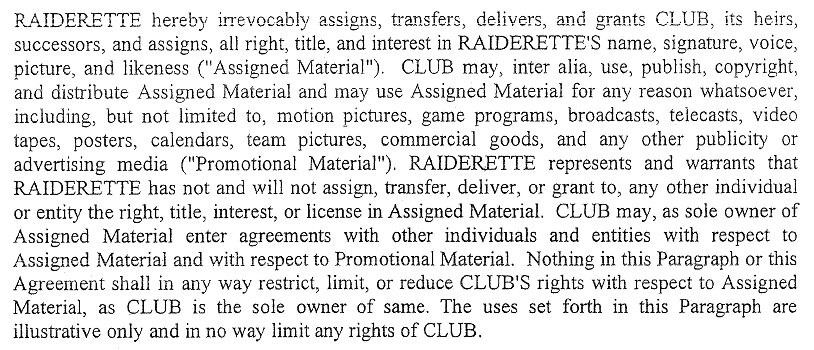
This story about a Raiderette’s lawsuit against the Raiders for violating employment law is interesting in itself, but an eagle-eyed correspondent points out that there is a very important word missing in the contract (attached to the complaint) post-Garcia.  Here is the relevant provision, “publicity”:

I am willing to bet that Raiderettes are, in many cases, onscreen for longer than Garcia was.  Discuss!

H/T ST.

Posted in http://schemas.google.com/blogger/2008/kind#post | Leave a comment

Uber alles except unfair competition

I predict that Mark Lemley will not like this decision but that Mark McKenna will.

Boston Cab Dispatch, Inc. v. Uber Technologies, Inc., 2014 WL 1338148 No. 13–10769 (D. Mass. Mar. 27, 2014)

Plaintiffs sued Uber for false advertising, unfair competition, and violation of Boston taxicab ordinances for “providing a private car service that allows users to call taxicabs associated with Boston Cab and other dispatch services without complying with Boston taxicab regulations.”  (There were also tortious interference/RICO claims, though those were kicked out.)

The core of the complaint is that Uber gained an unfair competitive advantage over traditional taxicab dispatch services and license-holders “because it avoids the costs and burdens of complying with extensive regulations designed to ensure that residents of Boston have access to fairly priced and safe transportation options throughout the city and yet reaps the benefits of others’ compliance with those regulations.” The Boston Police Commissioner requires all taxi drivers to have a medallion, maintain a properly equipped and functioning taxicab, refrain from cell phone use while operating a taxicab and belong to an approved dispatch service or “radio association.” Such associations must provide 24–hour dispatch capability, two-way radio service and discount reimbursements for the elderly; keep records; and use specific approved colors and markings. Plaintiffs each contract with several hundred medallion owners to manage them.

Uber allows users to request private vehicles for hire.  At the time of the motion to dismiss, Uber offered both unmarked vehicles and “Uber Taxis,” operated by Boston taxicab drivers. Uber-affiliated drivers can’t accept cash or non-Uber-associated credit cards.  Uber taxi drivers “have agreed to be available for hire through Uber while they are working shifts and subject to dispatch by their radio associations.” While their fees are calculated based on the flat rate applicable to all Boston taxicab drivers, Uber adds a $1 “fee” and a 20% ”gratuity” and therefore the final charge exceeds the maximum that taxicabs are permitted to charge under the Police Commissioner’s rule.  Though Uber says that 20% is “for the driver,” drivers only get 10% and Uber keeps the rest.  (Boo!)  Unmarked vehicles don’t comply with the rules about 1) membership in approved associations or dispatch services, 2) regular inspections, 3) partitions between drivers and passengers, 4) panic buttons and GPS tracking to allow customers to alert police when they are in danger, 5) criminal background checks of drivers, 6) non-discrimination with respect to passengers with handicaps or 7) use of mobile telephones. 

Somewhat puzzlingly, the court says there’s no evidence in the record (on this motion to dismiss) that Boston Cab suffered any harm due to members on the clock picking up passengers through Uber rather than through its dispatch services.  But plaintiffs argued that, by falsely portraying taxis as one choice Uber offers, “Uber diverts fares that would go to licensed Boston taxis if Uber did not falsely claim taxis were part of its affiliated businesses.” They contended that this diversion decreased demand for their cabs, smaller numbers of leased cabs, and lost revenue.

Plaintiffs alleged that Uber misrepresented that it was affiliated with Boston Cab.  The court found that, regardless, they failed to plead harm caused by the alleged misrepresentation—the “use” of Boston Cab colors and markings.  There was no connection between the allegedly poorer quality of the unmarked Uber cars and the use of Boston Cab colors/markings on Uber taxis.  No reasonable inference could be drawn that a consumer would hold the unmarked cars’ lack of safety features against plaintiffs.  (In other words, mere affiliation confusion does not plausibly harm goodwill or reputation!  Mark McKenna, take note.)

Second, the magistrate judge who recommended keeping this claim alive reasoned that plaintiffs could be harmed because the Police Commissioner’s rule forbids mobile phone use by drivers, but Uber drivers must use mobile phones.  Even if this use increases accident potential, it still wasn’t plausible that plaintiffs were harmed by that risk “as a result of consumers possibly mistaking the relationship between plaintiffs and Uber. Even if Uber’s service resulted in an increase in accidents involving taxis bearing the Boston Cab markings, any harm to Boston Cab’s reputation would not be the result of customer confusion about the relationship between Uber and Boston Cab.”

Plus, plaintiffs alleged that they were harmed by lost revenues from the unmarked cars, but that doesn’t have anything to do with confusion about the relationship between Uber and Boston Cab either.

Likewise, the Chapter 93A unfair competition by misrepresentation claims were also dismissed.  Uber’s alleged misrepresentations of affiliation with medallion owners/radio associations, and misrepresentations that Uber only collects $1 and pays the 20% gratuity to taxi drivers, lacked the requisite causal connection to plaintiffs’ harm, as described above.  As for alleged misrepresentations that Uber’s service was lawful under the Boston rules, and that the unmarked cars didn’t need to be licensed and regulated as taxis, plaintiff didn’t identify a representation by Uber that said these things either expressly or by necessary implication.  Uber’s just acting and leaving Boston to catch up, if it can.

However, plaintiffs also alleged that Uber violated Chapter 93A through unfairly competing by “operating” its service without incurring the expense of compliance with Massachusetts law and Boston ordinances. Uber argued that it couldn’t be violating the law because it doesn’t own any cars, medallions, or radio associations and does not employ drivers. This was based on an “unduly narrow conception” of the term “operating.” There was sufficient evidence that Uber exercised control over vehicles for hire that competed with plaintiffs.  Uber’s preclusion argument also failed; the regulations didn’t occupy the field to the exclusion of Chapter 93A.  Nor did Uber succeed in shifting all responsibility for unlawful conduct to drivers (like Airbnb and others of these types of services, Uber said it was the drivers’ responsibility to follow local law and not Uber’s fault if they didn’t; Uber drivers take note).  Uber sets policy for the drivers, such as requiring mobile phone use.

This also preserved the common-law unfair competition claim.
Posted in http://schemas.google.com/blogger/2008/kind#post, trademark, unfairness | Leave a comment