Neri v. Monroe, No. 11-cv-429 (W.D. Wis. Feb. 26, 2014) (magistrate judge), on remand from 726 F. 3d 989 (7th Cir. 2013)
From the outside, this doubtless expensive dispute looks like it resulted from an artist whose outrage over a (contested) failure of attribution converted to a doomed copyright fight, to no one’s benefit except that of the ever-growing law of fair use. After a trip to the 7th Circuit finding plaintiffs’ copyright registration valid, the court on remand considered fair use and other defenses and found them dispositive.
Facts set out by the court: plaintiff Quincy Neri is a glassblowing artist who worked with another local artist (and defendant until he settled), Fritz Schomburg. The other plaintiff co-owns the two copyrights at issue. Melinda Monroe and codefendant Steven Larson own Architectural Building Arts (ABA), a general contractor design/build firm. Defendant Leslie Sager is an interior designer who was employed by ABA during the condominium remodel at issue and is also an adjunct faculty member of the University of Wisconsin-Madison Design Studies program. Defendant Eric Ferguson is a professional photographer.
In 2008, Linda Hughes hired ABA to remodel her condo and remove a large mural from the dome of her entryway, replacing it with more modern artwork. This required rebuilding the ceiling. Hughes hired an interior designer, Amy Radspinner, to assist with the remodeling and to handle decorating. Radspinner contacted Neri; Neri and Schomburg worked together to create a composition comprised of about 60 individual blown glass pieces that eventually were installed onto the remodeled ceiling of the entryway.
There’s a factual dispute about Neri and Schomburg’s hiring that doesn’t matter to the outcome; in addition, the court mentions that the court of appeals rejected the argument that Schomburg was the true author; in what seems to have been a lightly-considered aside that has new resonance after Google v. Garcia, the court of appeals commented, “To the extent that Schomburg added features in the course of blowing the glass, he has a separate claim of intellectual property in a derivative work, but this does not detract from Neri’s rights.”
ABA hired a professional engineer to help design the ceiling and met several times with Schomburg (sometimes accompanied by Neri) about the design and construction of the ceiling in order to ensure it would support the weight of the glass and complement the artwork aesthetically. Neri made suggestions about various materials that could support the weight, but she didn’t design, engineer, or build it. ABA’s design team, including Sager, worked with Schomburg to find the best lighting for the artwork, which was ultimately installed in a custom-designed alcove. When the pieces were mounted, the lighting cast spiral shadows onto the ceiling and walls. Both Neri and Schomburg considered the spiral shadows to be an integral feature of the artwork. Neri testified that she could not reproduce the artwork without reproducing an exact copy of the ceiling.
Consistent with industry practice, Monroe got Hughes’ permission to take photos of the remodeling project to document ABA’s work, to advertise ABA’s services and to apply for industry awards on ABA’s behalf. Ferguson took a series of photographs of the interior of Hughes’s condominium, including two photographs of the completed entryway and ceiling. Neither photograph depicts all of the glass pieces, although some pieces appear in both. Ferguson’s goal was to showcase the design work and changes, and the photos show the glass pieces, the barrel-vault ceiling, a waterfall designed by ABA, the furniture, other art and decorative accessories. ABA paid Ferguson for unlimited usage rights in the photos.

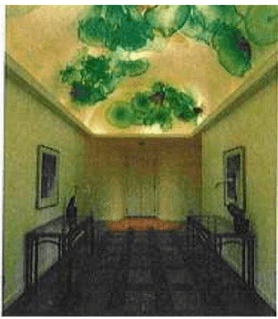
ABA posted some photos, including the two depicting the entryway, in a newsletter and on its website, and submitted them as part of its application for “Contractor of the Year” awards sponsored by the National Association of the Remodeling Industry. These awards are what you probably think they are; they aren’t art awards. ABA got two NARI Contractor of the Year awards for its interior design and its construction work at the Hughes’ condominium, including its reconstruction of the entryway’s ceiling and its fireplace redesign (and others for its work in the bathroom specifically). ABA didn’t claim to have made or to own the glass in the photos, nor did it sell the photos.
With Ferguson’s permission, Sager posted a photo of the entryway ceiling on her own website, along with two “before” images showing the dome that had been replaced, with the text:
A LITTLE BIT OF GLASS
A large dome with a painting of the four seasons of Wisconsin by Richard Hass [sic] did not appeal to the new residents of this condominium. They were able to donate the painting and dome to the Madison Children’s museum for a tax deduction. With the help of Amy Radspinner, I converted the dome into a smaller barrel vault with an integrated cover to conceal the LED spot lights. Local Glass blower Fritz Schomburg, designed a series of large aquatic glass pieces to hang from the vault in keeping with the lake view.
During a field trip to the Hughes residence with students from a class she was teaching at the University of Wisconsin, Sager took a photo of her students looking at the vault ceiling where the artwork was installed.
Again, the photo captured only a portion of the 60 glass pieces. She posted the photo on the University of Wisconsin’s Design Studies website “for the purpose of showing students engaged in an enrichment experience and not for any specific reason related to the glass artwork.
According to Neri, it was not until she found the photos on ABA’s website and discovered that the artwork had “won” NARI awards that she began to think of it as anything but “just another project.” (The court rejected her claim that the sculpture “won” an award for which she received no credit, since NARI awards are not art awards.) After she sued, ABA and Sager removed the allegedly infringing photographs from their websites.
Fair use: first, the court noted that factor one is the “heart of the fair use inquiry,” citing Cariou. [Compare the later citation to Harper & Row saying that Factor 4 is the most important.] Transformativeness requires change in the work or the context such that the plaintiff’s work is transformed into a new creation. Ferguson’s photos were “highly transformative.” The sculpture was 3-D “art for art’s sake…. Its purpose, presumably, is to beautify the Hughes condominium and to provide visual and aesthetic pleasure to those who view it as they walk under it through the entryway.” The photos were 2-D, realistic photos of an interior with a “commercial aesthetic.” “Their purpose is not to beautify but to document (albeit to document the pleasing aesthetics and transformative power of the project as a whole) and to inform the public about the remodeling work performed by ABA on Hughes’s condominium, in order to showcase the firm’s design and construction work.” Ferguson wasn’t trying to photograph the sculpture itself or to create an “artistic” photo that “capitalizes on the sculpture,” but rather he attmpted “to show as accurately and realistically as possible what the condominium’s entryway–the entire entryway–looked like after it was redesigned and rebuilt. Ferguson’s intended and actual photographic subject was the room, not the ceiling sculpture.” (One way of reading this is that fair use is substituting or supplementing the incidental use exception for works caught in photos or video of a more general subject.) The partial images of the sculpture were given a new purpose, meaning, or message in the photos, given that “the medium, composition, scale, character, expression and intended use of Ferguson’s photographs are completely different from those of the sculpture itself.” This factor weighed heavily in defendants’ favor.
While the sculpture was creative, and that factor favored plaintiffs, it doesn’t help.
Factor three: in evaluating the amount used, the court noted that the sculpture was mounted onto another work—the new barrel-vaulted ceiling—and that it was impossible to take pictures of the ceiling without also capturing images of the sculpture. There’s no per se rule about the amount that may be copied if the amount is necessary to the purpose and character of the use. Given defendants’ proper aim to publish photos of their own work, and that neither picture shows all 60 glass pieces of the sculpture, but rather shows portions “along with other equally important features of the redone hallway, including the waterfall, furniture and decorative accessories,” the amount copied was reasonable. And here the court quotes the court of appeals, which agreed that the copying was “incidental” and necessary to show what ABA had done.
Plaintiffs argued that ABA could’ve just had Ferguson take photos before the glass pieces were installed. He could have done that, but ABA redesigned and rebuilt the ceiling and the lighting specifically to accommodate and illuminate the sculpture. (Plus there’s a “persuasive argument that the ceiling design was so integral to the artwork that ABA is a joint author of the work,” but that’s unnecessary because of fair use—add another issue to the things fair use can avoid decisions on!) As a result, “ABA was entitled to take photos of the ceiling depicting how the ceiling served the purpose for which ABA had designed and built it.” A photo of the finished installation, with the entire entryway in place, was necessary for ABA to show its capabilities to potential clients and to apply for industry awards.
Also, the medium change was relevant to factor three, since it went to substitution (which seems like factor four, but ok): “no one interested in viewing or purchasing a glass sculpture … would be satisfied by mounting a copy of one of Ferguson’s photographs to his or her ceiling.” Neri acknowledged that the photos didn’t accurately depict the color of the glass or the shadows cast by the special lighting. This qualitative difference, plus the incidental status of the glass pieces to the true subject of the photo, the entryway, made factor three weigh in defendants’ favor.
Market effect: “the single most important element of fair use.”
(Except for transformativeness.
Amongst the important factors …)
Courts must consider substitution, including substitution for potential markets.
Here, there was no evidence of any harm to the market for the sculpture or other original Neri works.
There’s no market for the already-installed sculpture, which can’t be publicly displayed; and no one would consider a photo a substitute for the sculpture anyway.
Neri didn’t attempt to sell photos of her own work; she only charged an initial fee for the physical sculpture.
Without evidence that a market for the sculpture or derivative works thereof existed, defendants’ activities couldn’t have affected it, so factor four also weighed in defendant’s favor.
Since this was true of Ferguson’s photos, it was also true of Sager’s candid, posted on a university website for educational purposes. “On a common-sense level, it is difficult to find that the use is ‘unfair,’ where plaintiffs have not been deprived of any value in the sculpture and in fact, could only have benefitted by the publication of the photographs. Clearly, this is a case where the goals of copyright law are better served by permitting the use rather than denying it.”
The court also addressed damages, just in case. Plaintiffs weren’t entitled to statutory damages, since the work was unpublished (it was located in a private residence, and the allegedly infringing acts, being unauthorized, couldn’t constitute publication) and registration did not take place until long after the photos went up on the respective websites. Though they may have stayed up briefly after the registration issued, that doesn’t change statutory damages eligibility, which depends on when an infringement commenced.
As for actual damages, Neri proved none—neither a loss to her or a gain to defendants. “Although a plaintiff need not prove exactly the amount of damages from the infringement, the fact or existence of such damages must be shown with more than mere speculation.” There was no evidence of any profit or other financial benefit to defendants attributable to the use of photos that contained incidental images of part of the sculpture, and no evidence of diverted sales. Plaintiffs’ primary argument was they were deprived of the knowledge that ABA won a NARI award for its work, which thereby deprived them of an opportunity to market the sculpture. But a NARI award isn’t an art award, and anyway there was no evidence that their ability to market the sculpture was in any way harmed. “Indeed, even if plaintiffs somehow could market the sculpture–which is not theirs to sell–or derivative works of some sort, there is no evidence that they have made any real attempt to do so.”
Plaintiffs argued that they were deprived of a licensing fee for the right to photograph the sculpture. “This is unsupported conjecture.” The question isn’t what the owner would’ve charged, but what the fair market value was. “Plaintiffs have never sold a license for anything related to this sculpture; Neri has never sold a license to utilize any rights to any of her artwork; and plaintiffs have adduced no evidence of any benchmark licenses, that is, what licensors have paid for use of similar work.” The only record evidence was that there was no such market; Ferguson testified “that he did not consider the incidental appearance of the glass pieces in the photographs to be of any value, and for that reason he would not have considered paying a licensing fee for the benefit of such use.” Monroe testified that “based on her knowledge and experience in the design/build remodeling industry, she is not aware of a single instance of licensing of a piece of art in a residence. On this record, plaintiffs’ claim for licensing fees is wishful thinking.” Damages “must be proved, and not just dreamed.”