Dilution is more than association: but what more?

The ECJ recently ruled on dilution as a ground for refusing registration. Environmental Manufacturing LLP v Office for Harmonisation in the Internal Market (OHIM), November 14, 2013 (Case C-383/12 P).  If this is taken seriously, I can’t imagine how anyone could actually find dilution, since we don’t know how to measure it. 

Carried over from a previous case: the burden is on the senior user to provide “proof that the use of the later mark is or would be detrimental to the distinctive character of the earlier mark requires evidence of a change in the economic behaviour of the average consumer of the goods or services for which the earlier mark was registered consequent on the use of the later mark, or evidence of a serious likelihood that such a change will occur in the future.”  This proof has to come from objective elements and “cannot be deduced solely from subjective elements such as consumers’ perceptions.” Moreover, “the mere fact that consumers note the presence of a new sign similar to an earlier sign is not sufficient of itself to establish the existence of a detriment or a risk of detriment to the distinctive character of the earlier mark.”

Posted in dilution, trademark | Leave a comment

Blurred lines, part 3

Panel 3: The Way Forward on Transparency: A discussion of best practices

Moderator: Mary K. Engle, Associate Director, Division of Advertising Practices, FTC

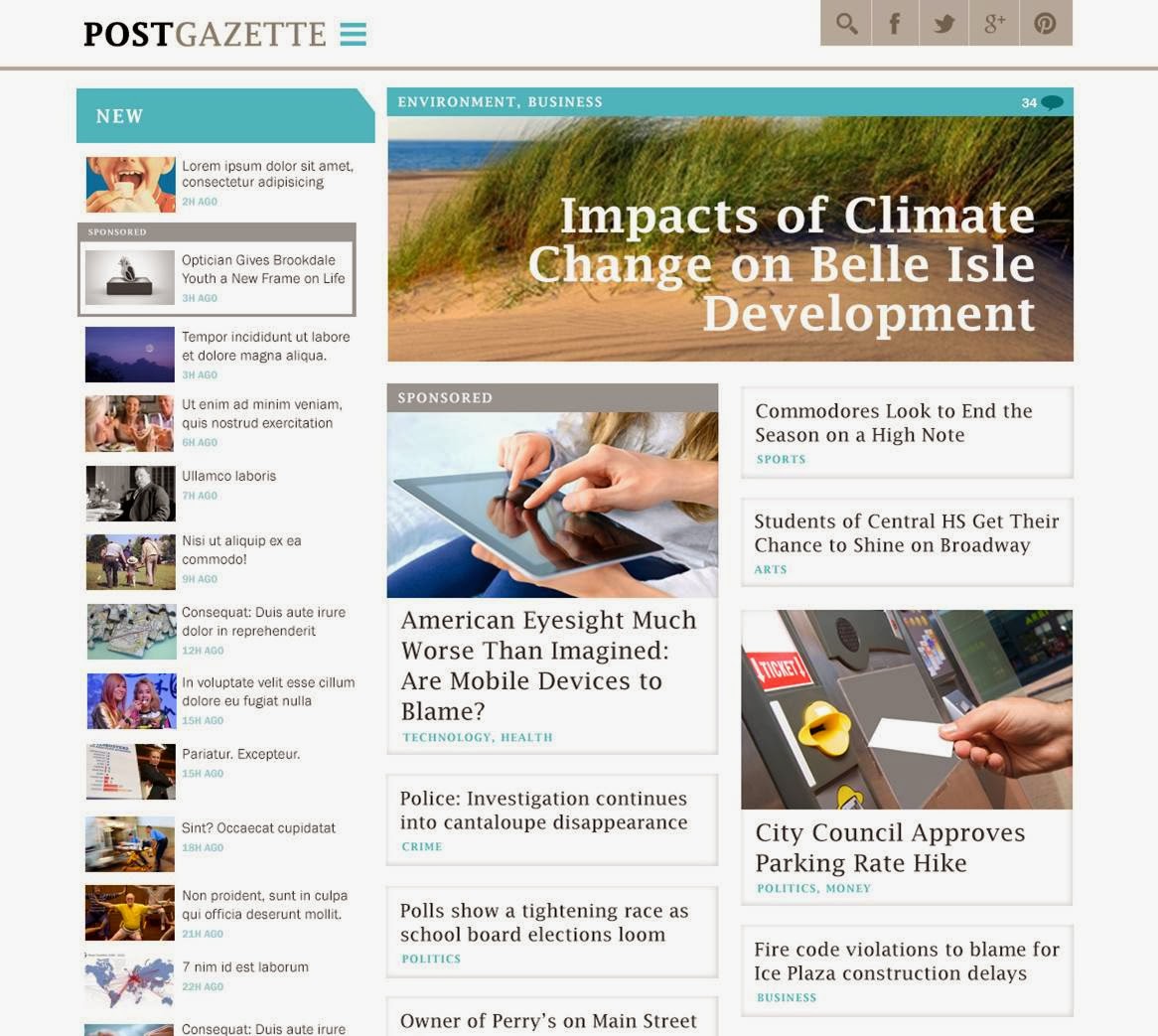
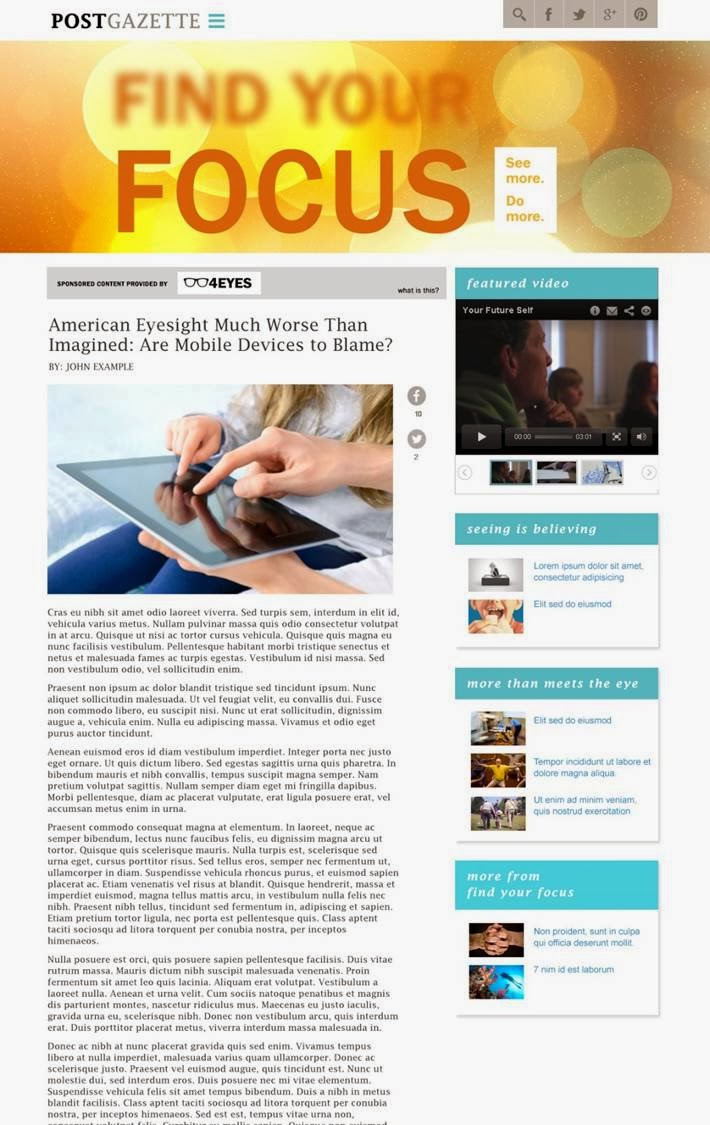
Examples of native ads: “sponsored” story, labeled as such in gray at the top of the headline, in the middle of news stories; story is that American eyesight is worse than you think; is it attributable to mobile devices?  Advertiser is FourEyes, eyewear provider.

When you click you get the story:

 
Panelists:

Sid Holt, Chief Executive, American Society of Magazine Editors

If it’s not from the publisher, it should be disclosed. Journalistic ethics: who’s talking here?  Good manners: someone talking to you should identify themselves before you buy.

Laura Brett,  Staff Attorney, National Advertising Division of the Council of Better Business Bureaus

Depends on whether it leaves you with any impression of advertiser’s products or services. Content determines whether it needs disclosure.

Amy Ralph Mudge, Partner, Venable LLP

Agrees: you have to look at whether it’s about a specific product, otherwise §5 isn’t implicated.

Engle: suppose the article had nothing to do with eyewear and was about the natural wonders of the world.  In that situation, would the eyewear manufacturer need to disclose?

Jon Steinberg, President and Chief Operating Officer, BuzzFeed Inc.

They wouldn’t get any benefit if they didn’t identify themselves. Brands can sometimes post content but they should ID themselves.  Wants more than that the placement is paid—wants disclosure of who’s behind the content.  There may not be a media relationship but there should be a statement of whose voice is being expressed.

Mike Zaneis, Senior Vice President, Public Policy and General Counsel, Interactive Advertising Bureau

Heart of FTC’s jurisdiction: this is a dynamic area. Is this an ad? That’s a legal issue, not a one size fits all notification requirement.  We can all agree that the disclosure on the first page is really good.  (We can’t.  Interested parties can consult the slides.)

Holt: I don’t think this is good at all.  I don’t know what sponsored means, who sponsored it, where it came from.  Needs to be clear it’s advertising, who created the content, who paid for it.

Mudge: if it’s not about a product characteristic, no §5 problem.

Robert Weissman, President, Public Citizen

The first thing that consumers need to know is who produced this? They should know it’s not there because of the independent editorial judgment of the publisher.

Robin Riddle, Global Publisher of WSJ Custom Content Studios, The Wall Street Journal

Consumers’ trust is from trust in our editorial decisions. Once you can buy a place in our environment, that’s a completely different decision, even if legally it’s not a requirement.  If you start asking “is it benefiting the brand?” that’s subjective. It’s there as the direct result of a commercial relationship.

Engle: suppose it doesn’t mention the brand but does advocate attention to eyewear?

Mudge: yes, that’s an ad.

Brett: NAD agrees. Even if it were fashion eyewear for fall, they’d need to disclose sponsorship.

Mudge: NAD said sponsorship disclosure was appropriate where advertiser was identifying other cool stuff like its product—she thinks that’s on the line. We’re here to talk about the FTC’s proper role—have to ask whether there’s a consumer protection harm in any of these scenarios.

Engle: publishers may have ethical reasons to disclose when the law doesn’t require.

What about when the publisher runs an article about problems with competitor’s technology?

Mudge: that’s an ad!

Steinberg: distinguish between an ad and where the content is from. Lots of places brands can post without paying—e.g., Tumblr.  Competitor should have a byline, but wouldn’t necessarily call that an ad because they may be doing that without paid media.  (Talking past each other just a tiny bit. Under the law, it’s still “advertising” because of the economic benefit to the speaker, but the website host isn’t responsible for it the way the NYT would be for stuff it published!)

Brett: if editor creates content without consultation then seeks sponsorship for it, that’s ordinary.

Weissman: if they wouldn’t run the article absent payment, then it’s an ad.

Brett: her view would change if they mentioned the sponsor of the article in the article—but if the article’s already written and they seek a sponsor.

Holt: very dangerous to suggest that there should be a market for specific articles to be run if paid for.

Brett: we look at it from consumer deception viewpoint: we’d look to whether consumers were confused about the independence of the article. 

Mudge: should come down to content of the article. Not necessarily dispositive how much/when advertiser participated—the question is whether consumers are deceived. Brand will want some control of editorial content; if the journalist gets it wrong, the brand wouldn’t want to be associated with that.

Weissman: if the advertiser has that kind of authority, shouldn’t consumers have reason to know about it?
Mudge: §5 disclosure obligation is different from whether consumers are interested.

Engle: suppose WP reviews a new car and the reviewer loves it. The manufacturer wants to disseminate that far and wide.

Steinberg: as long as the payment of the ad placement is disclosed, I think that’s fine.  This is an overarching question about labeling and whether or not the media is paid. You can sometimes see ads for products/movies where an actor/actress is interviewed in a subsequent TV segment. Why focus on online when this is a global labeling issue?

Zaneis: picks up on point that NYT reviewer doesn’t have to disclose that she gets books free, but blogger may have to.

Engle: defends FTC position.

Mudge: if 5 Guys wants to amplify a positive review that some random person gave them, doesn’t think they have to always disclose that it’s a 5 Guys ad—always have to disclose if there’s a material connection between them and the reviewer.

Weissman: but if it appears on the front page of the WSJ not because the WSJ decided to put it there, but because 5 Guys paid for it to be there, then you should know that someone paid to post it.

Riddle: that’s where the relationship changes and it becomes commercial.

Engle: how about best practices when disclosure is desired?

Brett: contextual. Thought that “sponsored by” denotes placement, though see last panel; “promoted by” or “you may also like” are less clear.

Zaneis: “promoted” works on Twitter; shading and other indications work. May not work on different platform.  (Okay, why are we asking these people, who while talented, intelligent and experienced clearly are not well positioned to answer “what actually works” as opposed to “what seems reasonable to me from my position”?)

Weissman: people in this room may know, but we are not a representative sample.

Steinberg: sometimes it’s not “sponsored”—they’re actually creating the content. There needs to be a statement, but sponsored is the wrong English word.

Riddle: sponsored is a term we reserve for when the brand hasn’t had editorial input—they just paid for it. Where they had input, we call it sponsor-generated, and we feel that more clearly represents that sponsor’s involvement.  Byline: WSJ Custom Content Studios for Brand [X].

Steinberg: we use brand logo, “presented by.”  We want people to know that it’s coming from the brand, create “lift” before they consume the content.

Engle: why not use the term “advertisement” or “commercial advertisement”?

Mudge: if it’s talking about the brand it’s an ad, but it’s not necessarily an ad—see the four wonders of the world isn’t an ad for FourEyes—struggled with this in the context of sponsored tweets.  Sometimes this is an ad, and sometimes it’s content.

Holt: look, if it’s paid media, it’s an ad. The key isn’t the language/nature of the label, though it would be great if all words meant the same thing across publications. But the key is special signalling. There are reasons why people don’t use ad/advertisement—disruptive to reader experience from marketer perspective. You can use any word you want as long as you explain it (e.g., roll over).

Weissman: Disruptive cuts both ways. Understands why advertiser doesn’t want that, but another way to understand that is that the consumer actually received the message “this is an ad.” Consumer interest in knowing that is the disruption.

Zaneis: one label assumes a well-curated site, which isn’t necessarily the case. One size fits all works really well for consumers, but then consumers grow blind to it.

Holt: my understanding of native ads is that the intention is to not disrupt the reader experience with ads.

Zaneis: it’s to be part of the experience—to engage the consumer as the content engages them.

Steinberg: these products arose because they create a better experience—consumers complain lots more about “welcome” screens than they do about other ads. When you have an ethical publisher, the consumer sees what it is, and if they like it they click and share. This works better for the advertiser and the consumer; needs to be clearly labeled, but solves a problem of a broken ad economy.

Engle: how important is ID at the headline level versus disclosure once you’ve already clicked?

Brett: deceptive door-opening. If you need to label, you need to tell consumers that they’re headed to ad content.

Riddle: if there as a result of commercial relationship, it should be called out.

Mudge: there’s a difference between clicking on something and having someone enter your home. The consumer harm is less.

Engle: If consumers don’t know it’s an ad they won’t necessarily look for the signals that it is an ad once they arrive.

Holt: we can only provide the information; we can’t make them consume it.

Brett: we need to safeguard that the disclosure is clear and conspicuous; not our issue if consumers disregard it or don’t care.

Steinberg: if a brand creates content that’s clearly labeled, and the consumer gets there through paid placement or whatever, and the consumer chooses to share that, that’s not a paid action so that shouldn’t need to be labeled paid.  Needs to be clear that Coca Cola is the creator, but it’s not a paid media relationship.  FB won’t allow publishers to put in the name of a brand when content is shared out; we would gladly do that with our content shared onto FB if that were allowed.

Riddle: I make an editorial decision when I share the Five Guys review.  We’re editors of our own social media channels.  We have to think about our own brands. If we care about people in our communities and want to remain credible, we think about what we want to share. Should we be paid?  Maybe, but in this instance it’s organic decision, so that doesn’t need to be disclosed.

Engle: suggests that’s important for original content to be labeled in a way that carries through.  So that recipients know the source.

Holt: all they need to know is that it came from their friend. 

Weissman: if it ultimately came from Coke, you should know that.

Engle: if the advertiser pays for placement in the Post Gazette, what should happen when it’s shared?

Zaneis: the original publisher doesn’t have control over how it’s shared; we all use link shorteners when we tweet. There’s no mechanism, and a different relationship with the consumer—probably comes from the friends.

Mudge: if my mom wants to share the article with me, when I go back to the article, I can see it comes from Four Eyes.  If it’s a dancing cat video holding a can of Coke, that’s product placement.  We have clear guidance on that: not all product placements require disclosure.

Holt: again, that’s something to take up with your friend sharing cat dancing videos.

Weissman: if Coke produced the dancing cat video, maybe the tweet doesn’t have to tell you, but when you get there you need to be told.

Mudge: but we don’t need to disclose product placement on TV.  (Again, a bit of talking past—might depend on whether it’s actually full-on paid for by Coke, or they just gave free product.)

Steinberg: if I get my ideas about what’s a good car from TV ads, I don’t have to disclose that when I tell my friends.

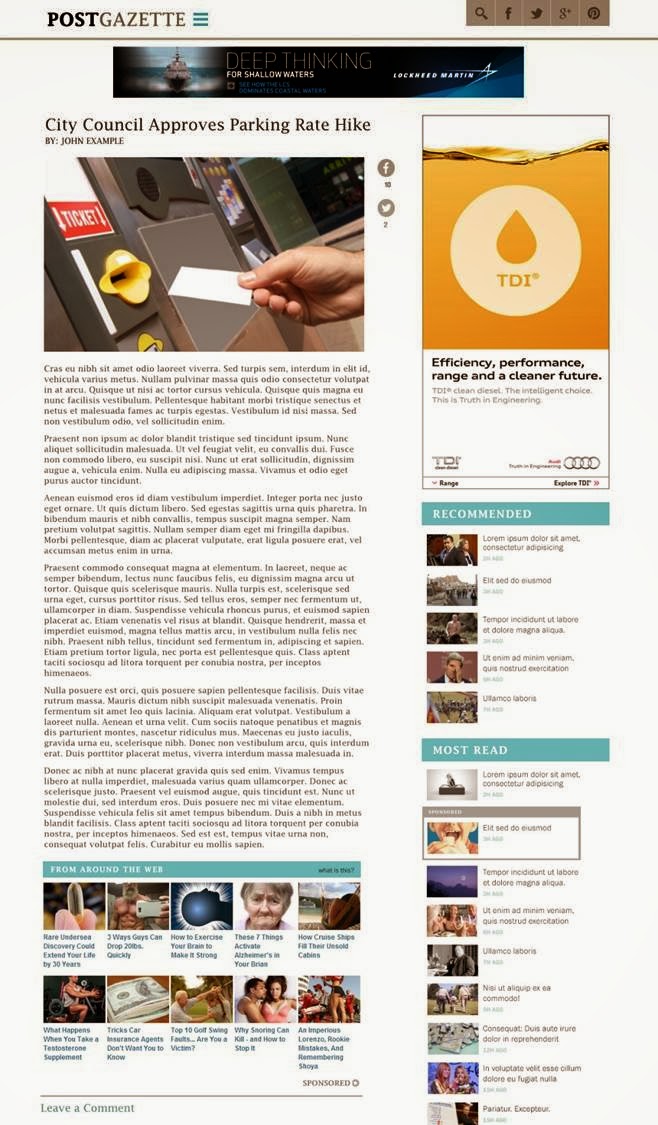
Engle: Another example: content from around the web:

Brett: disclosure that some content is sponsored is hard to read; placed in places consumers aren’t likely to look. Goes to clear and conspicuous.

Zaneis: looks fine to him! If there’s a sponsored link in the gray box that’s ok.

Weissman: those disclosures are awful, almost unidentifiable unless you’re in the business of knowing that these things are ads. The “what is this?” statement is unhelpful in the extreme.

Riddle: we look for graceful transparency—not telling people not to read it, but clearly calling it out.

Brett: if it’s on “most read” the question arises whether it’s actually there because it’s most read or because someone paid for it.

Holt: if it’s not really most read, then disclosure is substandard just from the consumer’s perspective. 

Engle: if it’s under the most read heading, it ought to be most read, agree?

Mudge: not going to disagree, but Bureau of Economics would say that the market will take care of this. Trust is important, and don’t want to make consumers suspicious.  This wouldn’t happen. (Buh? How are consumers supposed to verify whether that was really “most read”?)

Steinberg: sites that did popunders and installed toolbars are no longer around; the market worked.

Engle: please note that the FTC took action there as well, not just the market.

Mudge: keep eyes on the prize—can’t have too many disclosures.  If one of the pieces in a column will take me to sponsored content, I’ll find that out when I’m there; don’t muddle the page.

Weissman: then you’ve got too many ads on the page.  How does your responsibility change because you’ve got a lot of ads on the page?

Mudge: consider what you can do clearly and conspicuously.

Weissman: but if you need to disclose if you’re doing X, that’s a constraint.  If you say you’re recommending it but don’t disclose your paid relationship, that’s deceptive.

Mudge: not anti disclosure but we need to think clearly.  Too much disclosure can muddle. Balancing disclosure and native feel.  Users should be comfortable.

Zaneis: some content is labeled as advertising. If you have an unlabeled ad next to it, that’s not a hard question.

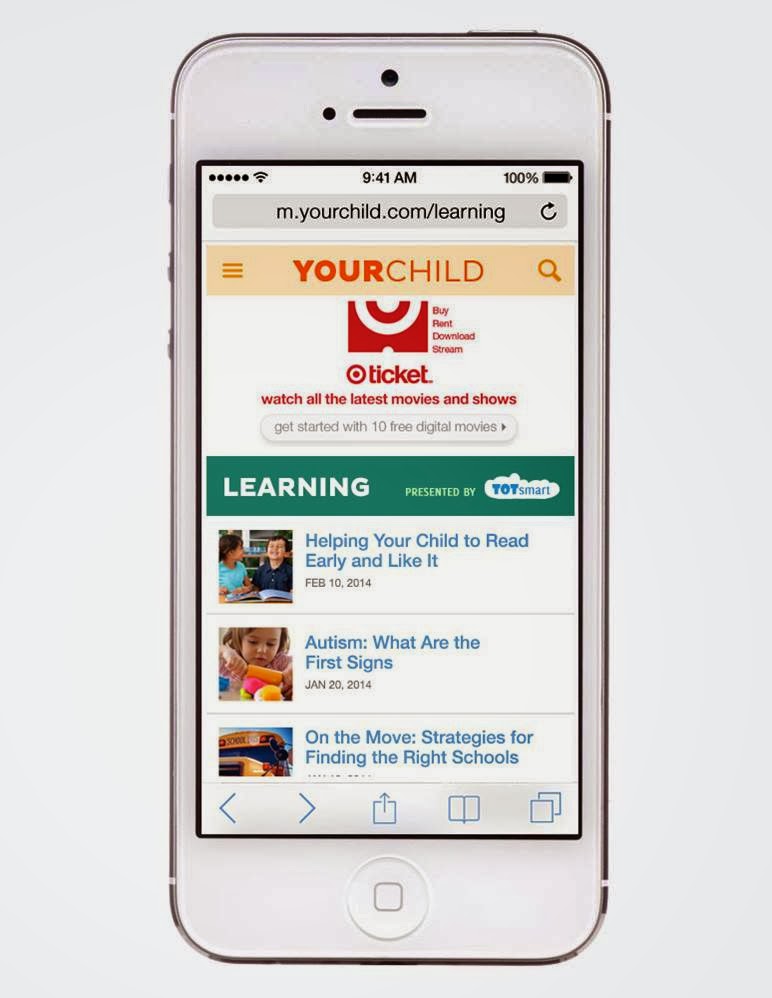
Engle: the question of mobile.  “Powered by TotSmart”—what does that banner mean?


Panelists thought that the links below that wouldn’t be TotSmart-paid/generated content. Confusing if it was.  What can be done?

If the article below the banner is custom content for TotSmart, but other articles aren’t: Riddle says put visual cues, clearly demarcated area; “sponsor-generated content”; byline should be clear that it’s written for TotSmart.

Steinberg: you really need two indications: disclosure that advertiser is behind the section on the website; they need a disclosure that the content in a specific article is sponsored by TotSmart

Engle: what about when some of the articles have nothing to do with TotSmart?

Steinberg: if TotSmart is sponsoring a section of the website, they should have to label the native ad—the part of the content they’re responsible for. Otherwise it’s just a sponsorship.  (Note here the use of “sponsor” in a way completely different than you see on many sites.)

Mudge: when it’s about their product.


Q: two separate discussions—whether something is advertising and who it’s from. In print media/TV, I know when something is advertising even if I don’t know who’s doing the advertising. Why should it be any different in the online space?

Brett: again, depends on what the content is. If it’s “help your child learn to read” and you’re recommending your own product, consumers need to know that to understand the context of the recommendation. Conflicts come because article may discuss more product attributes than a 15-second commercial.

Q: but is there an obligation, regardless of context, to disclose—why isn’t that just a business call?

[because you’re asking people to click, which is different than presenting them with the ad as they turn the page/change the channel.]

Steinberg: it’s a matter of where you are in the cycle. When you turn the TV on, are you watching an ad?  There is a type of ad campaign, the teaser, which doesn’t disclose its full source—you just see Tom Cruise twisting in space. We’d love to do those campaigns on Buzzfeed. We think they can be done ethically and legally, but there’s so much confusion now.  It’s a hot button for online.

Zaneis: but you can certainly tease out the message.

Steinberg: discussed using “this is a teaser campaign.”

Zaneis: legally speaking, it can’t be the standard that you must label it with the sponsor’s name.  (How would labeling it “Warner Bros.” interfere with the tease?  Just asking.)

Mudge: ask when the omission of the brand would be material to the consumer. Would be in a disparagement context. 

Brett: editorial/publisher’s perspective has an interest in protecting itself different from whether consumers are being misled.

Q from audience: is the publisher potentially liable if the content of the ad is misleading, like an ad agency can be?  FTC holds ad agencies liable if they participate in creating/disseminating and knew or should’ve known that it was misleading.

Riddle: we wouldn’t get into the level of detail of endorsing specific products. But we hold custom content to the same standard as news. Completely separate buildings, but we write to the same standard to maintain trust.

Brett: If publisher is acting like an advertiser, we’d want to hold them responsible, but we try not to get into First Amendment issues.

Mudge: the FTC will certainly attempt to hold you liable if the conduct is egregious enough—health claims, curing cancer.  Be careful.

Q from audience: where do we go from here? How is the FTC thinking about enforcement?

Engle: we have an open mind.

Closing Remarks

Jessica Rich, Director, Bureau of Consumer Protection, FTC

These issues aren’t new; the basic concepts have been addressed again and again over the years. But today the interest in native advertising is stronger than ever and we expect billions in revenue shortly. Offer more than traditional internet advertising models; reaches more targeted and tracked audience responses; offers possibilities of realtime interactions; can be shared and seen more places; it gets better real estate; could be more interesting for consumers.

Posted in advertising, disclosures, ftc | Leave a comment

Blurred lines: really part 2 this time

Sorry for earlier posting difficulties. 

The Lessons of Nauru
Bob Garfield, Co-host of On the Media and MediaPost columnist

Nauru: was wealthy; phosphate resource from centuries of built up guano was valuable, but only took 50 years to destroy, and now poverty is endemic.

[came in on the middle] The advertorial: “Borrowed interest”: most advertisers have been willing to label, relying on format and proximity to real ads.  Never a really big revenue generator or ethical problem in the newspaper days.

That was then.  Atlantic/Scientology: the most incriminating example of media prostitution.  Actually less worrisome than far less lurid publisher-advertiser dalliances, because this was so over the top that it was instantly pounced on. The real danger is what’s undetected.  The Atlantic also ran an IBM ad “Why Social Media Matters for Your Business,” but consumer wouldn’t be likely to recognize it as an ad. Doesn’t the reader have the right to know whose interests are being served by the content? Media means in between; the whole point is to have a third party at arm’s length. If IBM is such an authoritative source, why the charade? Why not proudly slap their authoritative logo over everything? Well, then it would be an ad that no one would read; that’s the central truth that can’t be rationalized away. It’s all based on consumer confusion. IPG MediaLab/Sharethrough study found that study subjects were 25% more likely to look at a native ad than a banner; they’re proud of this!  Native ad isn’t merely a deception, it’s a conspiracy. Even worse: the fake link/clickbait headlines as if editorially generated.  Wrappers for get rich quick schemes. 

Maybe you think these are suckers, or that an entire industry shouldn’t be condemned for a few bad apples. But the stakes are higher.  Native ad from Forbes, one of the most aggressive but also straightforward—type mimics rest of publication, but brand voice logo is prominent and at least there’s an explanation if you care to click through.  “The New ‘4Ps’ of Social Business Marketing.” That content migrates.  Within 8 hours of hosting, it had also shown up on 162 sites, and as far as those were concerned the source was simply Forbes.  The internet doesn’t know you’re a dog, and it doesn’t know you’re an ad. And here we are talking about this as if it were some sort of a savior. 73% of online publishers association already accept native ads, and 17% more to come soon!  Even though as currently deployed it violates the most basic publishing ethics.

Why? Existential crisis is always a bull market for noble ends invoked to justify dubious means. Save journalism from destruction!  If the police are underfunded, we do not think that a good idea is to sell badges and uniforms to whoever wants to buy them, on the theory that it will produce revenue and some of the ‘cops’ might deter crime by virtue of hanging around.  Trust is not meant to be a barter item. If trappings of trust can be purchased, public is exposed to deception. WGN’s “High Dividend Stocks of 2013” aren’t really from WGN.  We aren’t being saved.  To the contrary, Edward Wasserman, dean of Grad School of Journalism at Berkeley: accelerating towards more sponsored content will only deepen confusion and intensify mistrust.  Back to Nauru: Publishers are getting rid of their most valuable resource, one boatload of shit at a time.

Panel 2: Consumer Recognition and Understanding of  Native Advertisements

Moderator: Michael Ostheimer, Staff Attorney, Division of Advertising Practices, FTC

Panelists:

Chris Jay Hoofnagle, Lecturer in Residence and Director of Information Privacy Programs, Berkeley Law & Technology Center

We’re testing deceptiveness.  Advertorials can be understood as deception by omission/manipulation of schema.  Do native ads cause people to be confused about source of information?  Is lack of disclosure misleading? 

Methods: online survey, inherently not random.  Extrapolation is an issue.  Studying targeted advertising. Bought lists of consumers. One tranche: consumers vulnerable because of situational factors. Another: consumers who had some underlying condition. Another: subscribers to financial journals.  A control group of randomly selected internet users.

We put a native ad in context of a health blog.  Disclosure “sponsored report.”  Not clear who the speaker is. Manipulated background; lacked indicia of being health professional. Asked respondents was the material on diet pills written by journalists/editors, someone else, or didn’t know? 27% said journalists/editors, 43% someone else, 29% didn’t know; no significant differences between groups.

David J. Franklyn, Professor, Director of the McCarthy Institute for IP and Technology Law, University of San Francisco School of Law

Studied what people understand about paid/unpaid ads. Asked questions, showed screenshots of actual search results. Over 10,000 people in several countries. People often skip over labels without even noticing them; a majority didn’t know what “sponsored” meant.  Even when there’s a pop up. The notion that everyone knows, from this morning, is not true—we don’t have homogeneous consumers in terms of what they know or what they want. 60-66% people couldn’t identify paid and unpaid areas of the search results. People remember labels that have never been there. Highly conditioned to see what they’ve been conditioned to see through graphic context. Context matters more than labels. When it looks like a story, people think it’s a story. Context was a different matter online than offline, and it’s different mobile v. laptop.

1/3 of people say they don’t care; 1/3 say they’d click on something more readily if it was an ad. Protecting the consumer from what? If they want to be entertained by a paid placement and don’t care about differentiating—we found real differences in consumer preferences.

We also tested disclosures/disclaimers. They’re highly context specific and wording dependent.  As a general matter, initial attention is higher to labels at the top and left.  We continue to find consistently, in Europe and the US, deep confusion about paid and unpaid.

Jamie Cole, Creative Director, Red Barn Media Group

We do branded magazines for brands. Leverage content out to social media channels. Product is sometimes presented as solving problems but only when the brand owner wants it.  Magazine is presented as a benefit of being a customer, not a sales or promotion tool. Paper on audience reactions to brand journalism: looked at print journals only.  Looked at product involvement to make sure our variables weren’t affected by previous product involvement.  Four groups presented with four articles. Commercial frame with corporate source quoted, corporate name on magazine all the way to noncommercial. Least commercial frame with peer source quoted rated as the most credible; credibility decreased as commerciality increased. Product involvement was the biggest driving factor for any variable. Relevance: difficulty of recognition was one of the biggest issues in our research. Major limitation—how to make the cues clear enough so that participants understand commercial v. editorial. Only 2/3 recognized visual cues for commerciality despite lab setting and clear instruction. More were able to recognize corporate v. peer source but not near 100%. Likely that consumers can’t do it. Unless explicitly made aware of subtleties, weren’t aware of them at all.

Jeff Johnson, Principal Consultant, UI Wizards

Human visual perception and ad-spotting. High-res only in center 1% of visual field; perception is active, goal directed and attention limited; color discrimination is limited; visual hierarchy indicates connection; common vision problems can affect ad spotting.

Everywhere but center, eye has very low resolution: you are legally blind in the periphery.  Hold out your hand and hold up your thumb: that’s the area where you have high resolution.  At periphery, you perceive 3 dots per foot (compared to 300 dpi at center).  Our eyes jump; while they move, they see nothing; when they stop, they see mainly one word and nothing else.

Strongly goal oriented. Where our eyes move is strongly determined by what we’re trying to do. Things unrelated to goal may not be noticed, like labels on ads.

Optimized to see contrasts: edges and changes, not absolute levels. Content designers shouldn’t rely on color/shade. Use redundantly with other cues. 

Visual hierarchy segments page into different parts. Stronger hierarchy = easier to understand what goes with what. “Sponsored links” can look like a peer item and not an overarching label.

Many common vision problems hinder ability to spot ad.  Looking at mobile outside or high sensitivity to glare, ad markers can disappeared.  Buzzfeed: marks ads with color background/gray labels—but if we have yellowing in lens due to lifetime of exposure to UV (over 45) that may be very hard to see.

Dan Greenberg, Chief Executive Officer, Sharethrough, Co-Chair of Interactive Advertising Bureau’s Native Advertising Taskforce

Mostly people aren’t trying to trick you. Macro shift from obnoxious interruption to meaningful content.  (Can’t you be tricked with meaningful content? I thought that was really the point of the disclosure that it’s an ad.) Sponsored stories on FB, promoted Tweets, and everyone else is catching on.  Our ads always say “advertisement,” “sponsored,” or “promoted,” but we’re not wedded to those words. If research says more is needed we’ll find a way to get that into the placements.

Preliminary results from research: does language used in disclosure have an impact on whether or not consumer perceives a story as being paid for? Visuals and context will matter too but we looked at language. Preliminary data: statistical significance in the differences. One case showed a generalized website, some with no ad.  Even if nothing is paid for on the page, a significant percentage of users will say yes to “is there any item on this page that was paid for by a brand?” Sad state of editorial: people would say that a story about Miley Cyrus was “paid for.” People may not know what a brand was. 

Tested mobile and desktop.  Context has a major impact on perception.  Didn’t test demographics.  Can’t decouple from this data whether they didn’t notice something or whether they didn’t notice it was an ad.  Even when we tested “this is an ad paid for by a brand,” we only got up to 70% recognition that it was paid content—but other terms did a lot worse.  Even with just language there are a lot of questions about where to put it.

Michelle De Mooy, Senior Associate, National Priorities, Consumer Action 

Non-English speakers are rapidly growing US audience and especially vulnerable to things like ID theft. Trust is vital for consumers—source really matters.

Chris Pedigo, Vice President, Government Affairs, Online Publishers Association

Represent 60+ premium publishers, visited by 100% of online population each month. By the end of this year, 90% will offer some form of native advertising.  70% heard no complaints about their native advertising; 20% only had a few.  Our member companies go to great lengths to label/differentiate.  They look at native ads as another way to provide value to the consumer. They know the audience and work with advertiser to produce content that’s appealing.

Moderator: do consumers perceive ads differently?

Franklyn: there are pluralities. Some consumers say it doesn’t matter to them to know more about whether something is paid/unpaid in terms of trust, clicks. 40% say they want more clear and conspicuous differentiation and that they’d click on paid content less, or go back to it less if they knew the difference.  One takeaway: we now have immersed ourselves so much in this commercial world that many consumers don’t care and enjoy it. They (not all) enjoy the hyperstimulation of ads, want to sift through it.

Cole: we did see increased credibility from noncommerciality, but previous experience with brand influences that.  Atlantic/Scientology: credibility would be affected by previous notions about Scientology, and that would be important regardless of visual cues. Perceptions about brand are longlasting and stable; they don’t change much.  From where is consumer drawing this idea of credibility? Is it from the info itself—well-done, helpful? Is it from previous engagement of brand? Is it from mere appearance/look and feel? Is it from credibility of material around the content?

De Mooy: we don’t often talk about the content that’s missing. WebMD has traditionally been unbiased and has started to use native ads. In that case, along with other financial/health, that missing info has real costs.

Moderator: are there reasons to think some ways are more/less effective in distinguishing?

Greenberg: yes, it’s incredibly important to figure out which way to do it.  On FB, people know enough to be annoyed by Sponsored Stories.  Instagram—promoted photos.  Comment threads are all about the fact that these are ads (though many probably saw and didn’t react/didn’t know) but context matters.  Signals used on one site aren’t used on others.

Johnson: Strong visual hierarchies, like container widgets.  You have to show someone that there’s a scope in which the stuff inside is sponsored. Strong v. weak visual hierarchy as example.

Moderator: when an ad is designed to look editorial, are there reasons to believe even clear disclaimers won’t work?

Hoofnagle: even a disclosure in the title left 27% confused in our study. There are underlying issues: 27% is a sufficient number to be considered a reasonable consumer. Are these likely to mislead a reasonable consumer to her detriment? There are large gulfs between how publishers and advertisers are talking about consumers and how consumers perceive these disclosures. We heard publishers say their readers are smart. This is no doubt true but in some sense irrelevant because the question is whether some percentage of reasonable people are confused; even smart people may come to different conclusions about what “sponsored by” means. When he thinks of sponsorship, he thinks of PBS. He does not think that BP told the McNeil-Lehrer hour what stories to run; rather he thinks BP provided underwriting. But this morning he learned that advertisers say that stories should be compatible with their products. That’s a completely opposite mental model.  Finds that totally confusing—if the direction of the story comes from advertiser to publisher, rather than the other way around, that doesn’t seem like “sponsorship.”

Franklyn: there’s been an inversion in the relation between content and advertising; what people might have thought it meant before no longer does. We recently tested pop up disclosures by search engines. Roughly 44% of people thought “sponsored” made them more confused about relationship between paid and unpaid content on the page.

Pedigo: not an attempt to deceive consumers. Our audiences are engaged and will speak up about a change in font. In our survey, 71% of members haven’t heard any complaints because they’re doing a lot around transparency and because it’s attractive content.  (I can’t tell how deliberately he’s not listening to the evidence being presented.)

De Mooy: how do you complain about that? To whom?

Pedigo: Oh, they find a way.

De Mooy: Many lower-income people use low-bandwidth, small devices—perception difficulties are already inherent, then add in language difficulties—many disclosures will be useless.

Franklyn: the winner in terms of clarity was “commercial ads”; others grouped.  Had to be sufficiently large lettering, in the right place. Didn’t win by a ton—13% compared to 6%.  Native ads have come on a platform of monetization of search from ten blue links to up to 70-80% of the page ads, some of which say “ads” and some of which say “sponsored.” People have to find what they want in that soup. When you ask them to disaggregate which signals tell them what’s going on, it’s difficult because they’re already conditioned.

Trust isn’t that important practically/in a business way. What’s important is migration of consumers with the brand through new iterations—you can make a very successful business with very partial trust, and that truth needs to be told. You can’t rely on the promise we kept hearing this morning that “we have to be trustworthy or it would be bad for business.”

Johnson: In studies, many people just didn’t see the labels. Everyone here should sit through a usability study of people asked to do a specific task online. You will be amazed at what they don’t see when their brain is engaged in that task. That’s where a lot of the study noise comes from: people don’t see 90% of what’s on the pages they visit/click on.

Greenberg: historically advertising proclaims itself as advertising through interruption.  No choice but to realize it—if there’s a homepage takeover, or a preroll/interstitial (especially on mobile).  What happens when ads aren’t as obnoxious?

De Mooy: language is practically worthless; not even worth FTC’s time. It’s design, context, and straightforwardness of commercial advertising as interruption. That’s the way to move forward.

We’re used to advertisers paying for the shell; people can understand that they paid for the presentation of the content, but not for the subject matter/the content itself.

Franklyn: we will test if consumers understand/care about who wrote the content.  “Sponsored by,” he thinks, won’t materially increase that sort of awareness.

(someone) no silver bullet for different platforms, kinds of audiences.  Terms work differently for 16-year-old girl than for Home & Garden reader; publishers know their audiences, and can work with advertisers.

Hoofnagle: Many companies that used “sponsored by” used a grey color and a smaller font; this is important. Also think about how people think about “partnership.”  HuffPo Partner Studio: the claim is this clearly discloses to consumers that this is an ad. I wouldn’t think that at all!  Lawyers don’t think that. Partners aren’t at arm’s length, but we had one panelist this morning say “we worked with a partner at arm’s length.” Also, intent doesn’t matter. FTC doesn’t have to prove intent to deceive the public. So you may not be setting out to deceive; the question is whether you are misleading consumers to their detriment.

Franklyn: there is detriment to some people. Who will you choose to protect?

De Mooy: sometimes the issue is what content is missing.  Pharmacos pay for pills, but no one pays to educate consumers about holistic methods.

Q: Use of labels like “what’s this?” to ID native advertising.  Or ads only ID’d by Ad Choices logo—does that work?

Franklyn: only 11% are likely to roll over icon for explanation, and of those 44% were more confused when they did.  Icon rollover is a low baseline for getting attention.

Greenberg: think of conversion funnels. Traditionally 100% of people who saw an interruptive ad realized it because there was no conversion funnel. In a FB feed, you see the ad, then your brain recognizes the story before you recognize it’s an ad; disclosure is maybe needed before I decide to click.  Only 50% read the story they clicked on, if that.  Now you’re down to a much smaller percentage who sees the ad, much less realizes it’s an ad.

Johnson: the icon was never intended to convey meaning to those who didn’t know what it meant. Its intent was to remind you of the function that you already know about—like printing, deleting, whatever; it’s extremely difficult for any graphic artist, no matter how talented, to create an icon that conveys meaning without prior knowledge.

Q: what design techniques might make it more or less clear that something is an ad?

Johnson: strong visual hierarchy, boldness—all they can do is increase probabilities; they can’t guarantee anything. Eyes move semi-randomly according to people’s goals.  Movement will move eyes in the direction of movement (periphery needs to check for danger).

Cole: context—if you’re trying to make content look as much like the content around it, the less you disclose the more effective it will be.

De Mooy: doesn’t that mean you’ve effectively tricked people?

Cole: yep.

Franklyn: if you’re talking about internet search, we found that chopping up the page in a more clear way—ads are only going to be on the right side, algorithmic results only on the left—if you could have architecturally mandated segmentation, then people can learn what things are. How that applies to native advertising is unclear because it’s deliberately mashed together. Architecture is not a solution for that fully paid page.  Pop up warning you’re on a paid page? If the goal is clear differentiation/consumer understanding, that’s very hard because the market has overwhelmingly blurred lines and consumers have accepted it largely because search is free and it’s stimulating. 3- or 4- or 5-sided market; consumer acquiesces in use of personal info for targeted advertising, and as long as that bargain is on it will be very hard to regulate.

De Mooy: some analogy to Do Not Track: bring it out of the shadows.

Pedigo: consumers do have choice. If they feel they’re being duped by native ads, there are a million other websites for any other content. Our members are very sensitive to this. If they lose consumer trust, they lose out completely to Joe Blow blogger down the street.  (I’m with Franklyn on this one. Moralistic and convenient to say, hard to believe.)

Hoofnagle: Homo economicus does not surf the internet. Real people don’t have that perfect option weighing available to them.  There’s not a real market where they can understand the price and incorporate that into their decisions—cf. FTC guidelines on use of the word “free,” which discuss its powerful psychological effects on the listener.

Q: will certain populations have more trouble recognizing native ads?

Answers: seniors; lower socioeconomic status groups; varies based on race.

De Mooy: poorer people have smaller devices, slower download times; unfamiliar language. Spanish language sites are often aggregators of translated information; very unclear where information comes from. Hard to tell even how to figure out where it came from. We know that people in underserved communities are at more financial risk of fraud online. They deserve special consideration in regulation. Financial advice and health impact are special categories.
Posted in advertising, disclosures, ftc | Leave a comment

Blurred Lines: Advertising or Content? An FTC Workshop on Native Advertising

Blurred Lines: Advertising or Content? An FTC Workshop on Native Advertising

Welcoming Remarks:  Edith Ramirez, Chairwoman, FTC

Advertising integrated into digital content. Recent survey of online publishers: 73% offer native advertising opportunities and 17% considering. 41% of brands and many ad agencies currently use it and more hope to do so. Hope to capitalize on publishers’ reputations.  Critics argue this improperly exploits consumers’ trust or deceives them outright. Proper disclosures can manage this risk.

A Historical FTC Perspective: Advertorials, Infomercials, and Paid Endorsement

Lesley Fair,  Staff Attorney,  Bureau of Consumer Protection, FTC

Settlement: FTC settled with Munsen Specialty Co., in vol. 1 of FTC decisions, 1917—deceptively promoted high tech product through content that didn’t look like ads.  This is not a new phenomenon.

Act or practice is deceptive if it’s likely to mislead consumers acting reasonably under the circumstances and it would be material to a buy/use decision.  Deceptive door openers: salesmen literally got in the door by claiming to be surveyors, but were actually selling encyclopedias. This is an example given in the 1984 deception policy statement: when the first contact is made deceptively, this leads to a violation.  FTC 1968 advisory opinion on ads in news format: e.g., local restaurants with a promotion that interviewed the chef and discussed the specials/prices.  FTC concluded that where the column had the appearance of impartial, independent and unbiased view, but was in fact paid by advertiser, disclosure must be clear and conspicuous.  FTC considered not just what promotion said but impression conveyed to consumers by visuals: examines net impression.  Also deceptive mailings: “Prize Notification Bureau” with “State of California Commisioners of Registration” seal—FTC v. National Awards Service Advisory, 2012—tricked people into paying $20 to claim the alleged prize.  Yellow sticky note post-its that appeared to be handwritten and directed specifically at the recipient, but mailed to millions of consumers—again, FTC action. 

Infomercial formats too.  “Consumer Challenge” compared to 60 Minutes and 20/20; the pitch was given during snippets of the purported show with “investigative reporters” that claimed to investigate “popular” products. Commission did not challenge the underlying product claims, but the false representation of independent investigation when it was really just an ad.  FTC has challenged format as deceptive in both TV ads and alleged radio call-in shows.

Materially falsifying header information in spam email is illegal and even sometimes a crime.  Still fighting websites that appear to be news—“Health 5 beat” or “News 6 News Alert”—allegedly falsely claimed to be reports that appeared in ABC News or even Consumer Reports; reporter sometimes claims to have lost weight herself.  FTC has filed two dozen suits against people selling the pills, the people who put together the fake news sites, and the affiliate networks that use them.

Material connections between advertiser and endorser should be clearly and conspicuously disclosed where the audience wouldn’t expect it, as always. Thus, settlement from 2010 over PR firm that had people post reviews of a game on iTunes on behalf of the game company.

Staff letters sent to search engines on this issue.  Staff recommends sites ensure any paid ranking search results are distinguished from non-paid with clear and conspicuous disclosure; no affirmative statement is made that might mislead consumers about the basis on which the search result is generated.  Reiterated: 2013, paid search results have become less distinguishable, but consumers ordinarily expect that natural results appear from relevance, not based on payment—including a site in whole or in part because of payment is advertising; consumers should be able to distinguish paid and natural.  Specialized search should also be reviewed. Disclosure should keep pace with delivery of information.

The Wall Between Editorial and Advertising: Its Origins and Purpose

Nicholas Lemann, Professor of Journalism  Columbia University Graduate School  of Journalism

Street sales as a business model required timely and attention-getting content.  Advertising became important to revenue in late 19th century (after political sponsorship declined). Large audiences gave papers argument that they could help advertisers sell. As early as the 1870s there were discussions of distinguishing editorial from advertising content. Complaints about “puffs” touting advertisers’ products without revealing connections.  Colliersmagazine published expose about patent medicine industry, including advertising practices.  “The Patent Medicine Conspiracy Against Freedom of the Press”—the standard ad contract between patent medicine companies and newspapers declared it subject to cancellation if any material detrimental to company’s interests is permitted to appear anywhere in the paper. Helped lead to formation of FDA’s predecessor agency.

1912 Newspaper Publicity Act, still on books. Used threat of taking away lower postal rates as leverage, required newspapers and magazines to publish accurate information about ownership, management and circulation and to label ads designed to look like editorial matter. 1913 decision: upheld under First Amendment.  1914: FTC born.  Big publishers wanted to make advertising respectable, and saw advantage compared to small, less reputable local publishers.  Longterm subscriptions were beginning to replace single-copy sales as primary direct source of revenues, at least for affluent/educated audience. Sustained trust was the key to subscription revenue, which meant editorial sobriety and a potentially profitable ad strategy for prestigious brands. This required standards for content/general ickiness for ads. Partly professional pride/vanity and partly self-interest. The value proposition of the publication was trust in editorial content, and that was what they were selling to advertisers.  Vitiating that would hurt themselves.

Codes of Conduct exist against the relentless daily pressure to give advertisers something special for their business, and are generally only produced by established, big institutions, and there isn’t much like that online.  Newspapers/traditional news sources are seeing alarming declines in revenues—Newsweek was sold for $1, while the Washington Post was sold for $250 million, a fraction of former value; the WP building was worth nearly as much. Legacy organizations initially believed that established websites building on their brands would give them nearly as much revenue as before; that’s not true because advertisers can pay lower rates to reach more targeted groups of potential customers, often using sites like Facebook that have more users but produce no editorial content.

In the past, being close to WP editorial content could itself signal trustworthiness, but that world has been blown apart online.  WP thought it could go to the same advertisers with the same cost per thousand readers, but the horrible surprise has been advertisers refusing to do that online.  Why?  Don’t have to buy the whole audience; social media and search sites are competitors, offering very targeted audiences. Also, turns out WP readers online spend 10 seconds per visit as opposed to an hour with the paper; buying less attention.  This creates a sense bordering on desperation in people creating editorial news content. New publications aren’t socialized in church/state division, creating a chaotic situation similar to that when the FTC was created.

Online news organizations have begun a wide variety of advertising practices. Inventions mothered by necessity where fewer than half the entities are operating profitably online (at most).

Panel 1: Sponsored Content in Digital Publications: The forms it takes and how it operates

Moderator:  Laura M. Sullivan, Staff Attorney, Division of Advertising Practices, FTC

Panelists:

Adam Ostrow, Chief Strategy Officer, Mashable, Inc.: think of ourselves as most social media publisher; more than 1/3 of traffic comes from Pinterest, Twitter, etc. and average sharing of item is 2500.  Monetize the site by marrying themes/topics relevant to brands with editorial content that isn’t promotional but aligns with their themes.  AmEx wanted to reach female small business owners, so we created Female Founders series, profiling women in technology, presented by AmEx. Qualcomm makes chips for devices; made a series “What’s Inside,” looking at Nike Fuelband and Google Glass.  Marriott: didn’t write about why to stay at Marriott, but did a series on the future of travel—apps and devices.

Disclosure: branded content that has look and feel of standard Mashable article, but above the article, below the lead image, is the Lenovo logo and text “presented by Lenovo.”  Story stream: generally advertisers do five or more articles, and again there’s a disclosure. Display ads: banner ads for Lenovo surround the content—part of value to advertisers but he thinks it helps disclose further.  On right, below display ad, see “social widget”—promotion for Lenovo’s FB and Twitter accounts—also adds transparency.  On mobile devices, also see Lenovo logo below lead image of article, and bottom of article has display ad.

Tessa Gould, Director of HuffPost Partner Studio, Huffington Post

“Superviral” platform, most shared publisher on FB. Native ads since 2008. Sposnored listicle for Sony: article preview says it’s presented by Sony; article page says “presented by Sony” and explanation within article text.  (And at least three ad units from Sony.)  If you do social share, automatically identifies HuffPost Partner as author.

Another example: Brand blog for L’Oreal: brand/representative creates content, not HuffPost Partner Studio.  Article preview, “presented by L’Oreal.”  Original author (person) directly attributed through name and photo (though not ID’d as from L’Oreal) and we edited and published it.  Article page = “presented by L’Oreal.”  At least 3 L’Oreal ads on the page.

Another example: socialization/social promo.  Listicle for Netflix.  Dedicated HuffPost accounts on FB, Twitter, StumbleUpon, Pinterest: we identify the partner’s social media account/hashtag. When you click to share, the Netflix holiday hashtag appears.  Has to be retweeted so that it is clear that it comes from HuffPost Partner Studios.

Todd R. Haskell, Senior Vice President and Chief Revenue Officer, Hearst Magazines Digital Media, Hearst Corporation

20 magazine brands such as Popular Mechanics, all with a presence on the web. Brands built on reader trust. Harper’s Bazaar did partnership with Nordstrom, asking us to create original content on how to transition from city to country—Harper’s Bazaar widely followed on Pinterest, so we created custom Pinterest boards allowing them to explore Nordstrom/Uggs’ collection—readers could browse through shoes, share them through their own social media; click through to fully functional ecommerce experience. Our readers come to us for what to wear; how to be clear that this comes from advertiser but assist action?  Says Uggs/Nordstrom on every page.

Another advertiser wanted us to curate existing content—Tyson Nudges, a dog treat.  Took Country Living etc. which have high dog owner concentrations; clearly embedded advertising messages as part of the “best of” collection of content relating to dogs.  Same idea as Mashable/HuffPo of taking DNA of why people interact with our editorial but doing it in a way that’s transparent to readers.

Seventeen on mobile: underlying assumption is same, clarity for reader.  Keds: best kicks for back-to-school.  At the bottom, says take a look at new shoes for the season, presented by Keds. Always clearly labeled. Consistent with our values.  Reader feedback has been positive.

Jon Carmen,  Senior Vice President of Operations, Adiant

Native ads are a subset of content-style advertising. Our creation: Newsbullets: resemble a headline and displayed in the content well of news sites (hey, I learned a new term). Work with advertisers like LowerMyBills and AmEx.  Reach: approximately 80-90% of news sites in US.

Lisa LaCour, Vice President of Global Marketing, Outbrain Inc.

Content recommendation platform.  Presented mostly on the bottom of article pages of major web publishers.  “Recommended for you” for online audience—editorial or paid.  We only allow content in our network—strict editorial guidelines.  Reject about 50% of content that comes in. We don’t necessarily claim to do native advertising, but we are natively placed within the consumer environment, in the content well.  “Recommended for You:” Mix of editorial and sponsored content—when they link to the third party site, the site is listed in grey after the black headline.  “From Around the Web” has a mix of publisher and advertiser content, which discloses third-party advertiser.  Third component: “More from [X],” e.g., more from ABC News or whatever site you’re on.  On mobile very similar, same disclosures.

Chris Laird, Marketing Director, Brand Operations, The Procter & Gamble Company

Sponsored content at places like Buzzfeed—Secret Clinical, focused on people who may be overconfident. Brand travels with content through social channels—that’s why we do it. You see “confidence” in the headline.

Pantene partners with Studio One, content producer/distributor. Studio One produced the Style Glossy—associate Pantene with “style” and “getting the look you want.”  Studio One hires arms’-length writers to create and syndicate that content in other publications/media channels.  So the story shows up on Newschannel5.com and carries the bradn with it.  Native advertising is more shareable; huge percent of reach is not from direct access but sharing.

Tide: link branding to current event. Nascar race with an oil spill on track; Tide was used to clean up the oil spill, and we created content around that (15-second TV ad and long tail of content). Pushed that out through syndication.

Steve Rubel, Executive Vice President and Chief Content Strategist, Edelman

World’s largest PR firm.  How does this fit into PR? We now think of sponsored content as it relates to paid amplification. Used to amplify either earned messages we secured (pay for discovery) or to create or cocreate new content that would sit on media company channels.  We do not feel that sponsored content should trump “earned” media and journalists’ own voices; not a replacement. The two complement each other and make sure our clients’ messages/POV is communicated as broadly as possible around themes they want to be known for.

Sullivan: do traditional publishers see new opportunities in digital?

Haskell: we have the ability when we create an experience on behalf of an advertiser, we have much more ability to cross-promote it across multiple brands. Historically, Good Housekeeping couldn’t have traffic driven to it by Women’s Day. Ecosystem now allows cross-promotion into sponsored experiences—allows greater scale.  Partners like Outbrain: 3d parties can drive people from outside our own ecosystem into them. On the opposite side, when they’re created well, readers want to share them; our readers become more important as they share/give their own stamp of approval.

Gould: compared to traditional media, digital is unique around engagement: sharing sponsored content/advertorials was not easy in traditional magazines.  More eyeballs!  Increased sophistication that comes from tech—good idea who opens up your content and whether they really read it. Target to relevant demographic; track who viewed it. Timelines are shorter; brands can participate in more realtime environment.

Sullivan: concerns about transparency.  Why is or isn’t transparency important?

Ostrow: Mashable: transparency is front and center. Our readers are savvy. If we mislabeled we’d lose their trust.  Branded content is the most engaging content on the site. It’s more evergreen; we’re not creating news on behalf of the advertiser but are creating thematically related content.  The units on homepage get higher clickthroughs than display ads, 8-15x in some cases.  People are living in social streams on mobile devices, so clients come to us to be relevant there.

Sullivan: you mean that your readers understand the distinction between advertising and editorial?

Haskell: Incumbent on publisher is exercise of discretion and judgment in who we work with.  Salespeople aren’t known for this, which is why it’s important for organizations think about how to structure that into the sales process. Scientology kerfuffle with the Atlantic—Hearst wants to make sure we partner with the right brands, appropriate context. Ask will the reader feel exploited? Will it be jarring?

Laird: On risks of lack of transparency—if you lose trust with the reader/consumer, you’ll hurt your equity over time.  Transparency is brand building imperative. You want to link your brand to the content, all the way through every channel consumer might consume.  Dawn is a dish detergent, all about grease fighting. Also used to help save birds in oil spills to get grease out of feathers—great brand building because it communicates both efficacy and gentleness. Dawn has beautiful content around this concept, linked to the brand.  (This is an intriguing conflation of “linked to the brand” with “disclosed that it was placed by the brand.”)

Sullivan: what if you’re not as worried about brand equity?

Carmen: comes down to trust of reader, as well as financial aspect. We place our ads on publisher’s website and publisher gets a revenue share. If not stated as ad, clickthrough rates will be higher, but the result on the other end (he seems to mean post-click) is worse than when we do put “ad,” because the user knows they’re clicking on an ad.

LaCour: Outbrain: no links to ads, just links to content, which can be paid.  Audience within the content well is in content consumption mode. If they click on content, their mindset is that they want to read more content.  There are ads that we’ve seen that are not the same as paid content.  The difference between a landing page “buy something” v. another piece of content, whether sponsored or not, is real.  Audience and advertiser and publisher can all be happy. The industry isn’t the only one pushing for sponsored content.  Consumers are asking for it. Consumers want to engage w/brand, get more information—don’t just want brand to sell things to them.

Some discussion: display ads aren’t dead; they’re background/they work in conjunction with sponsored/branded content.  Ostrow says clickthrough on banners next to sponsored content is 2x as high as when it’s just on the site generally.

Rubel (I think, maybe wrong attribution): we think a lot about trust. Transparency plays a role. We hear a lot from publishers, marketers, and people who connect marketers to publishers. We’d like to see the audience have a voice.  They have a voice through clicks.  But less than 1/3 of US population is aware of media’s financial difficulties.  We’d like to see audience to have way to engage.

Haskell: Readers are not shy in reacting to innovation in no uncertain terms.  There has been debate about death of the banner ad; native will not kill display ads, but one supports the other/more complex ecosystem.  Readers who lose trust will move elsewhere, “vote with their fingertips.”  We go in with the idea that readers are smart and know what they’re doing.

Laird: what we love about this version of sponsored content is that we can immediately measure impact on our business result—we are on our owned asset; does she download a coupon, request a sample, post a review, place an order on Amazon.

Sullivan: ok, so you can measure this really well. But we were talking about transparency.  Are you also using that audience feedback to measure whether your readership understands how these new forms of ads work and whether they understand that they are ads?

Gould: we treat transparency as a given.  Our readers are smart and sophisticated and they’ll tell you what they don’t like.  Feedback is more a gauge of the quality of the content than the transparency, since transparency is a given.  (Or you have assumed that it worked …)

Sullivan: so what do you do to make ads transparent?

Haskell: it’s different on each one of our brands. Use advertiser’s logo everywhere. Type slug someplace can be background noise.

Carmen (I think): we have policies on asking to make sure it’s clear.

Sullivan: who makes the decision?

Gould: HuffPost has a one size fits all policy to make things as clear as possible. When we pitch ourselves to brands, we have a rigorous review process with client/team/legal review.

Ostrow: similar.  Stand firm with your policies. Advertisers always ask for exceptions.  Important that we treat branded content as editorial content—as with Qualcomm, where we talk about what’s inside, much of the content was written by our tech reporters.  Need editorial checks and balances.

Carmen: it’s a mix of publisher control—but we always insist that there be some labeling.  If nothing’s said, then we always put “advertisement” or “sponsored links” somewhere visible in the box to make clear it’s a paid ad.

Gould: we’ve been doing this for years but just now starting to talk about best practices. There are people who aren’t doing any disclosure—that’s more important than deciding what labels should be used by the disclosures.  Should distinguish news publishers from aggregators/recommenders—needs vary.

LaCour: we are a guest on a publisher’s site and want to accommodate their look and feel. We are in agreement that disclosure is required but we will talk to publisher about how it should be labeled and how it should look. 

Carmen: we have a self-service ad platform; we receive over 100 ads/day some days.  Wide variety of advertisers—small affiliates and large brands. We reject half of them. We make sure they aren’t trying to do something shady.  Our job as gatekeeper is to be hard-nosed. They can resubmit until it’s right. 

Sullivan: what about on the publisher website: if it has the same look and feel as editorial content, do you work with the publisher?

Carmen: depends on the publisher. Some say “you have to say advertisement,” while some say “don’t get us in trouble.” By default we say “advertisement” or “sponsored link.”

Rubel (I think): one way to look at it is that a common language would be clearest, and there’s a case for that. But competition is a click away. It’s better to have a more open marketplace where all different kinds of ideas around disclosure come to the forefront. Some will be exceedingly transparent.  HuffPo does a lot of testing with headlines.  In the end it’s possible that the most transparent, with the clearest language, will have a competitive advantage with the audience and therefore with the marketers.  Industry innovation/testing.  Good ideas will win out instead of having them all say the same thing. Internationally too, it varies country by country.

Sullivan: what tools are available to advertisers for transparency? Do you rely on publishers?

Laird: different review processes are available, depending on intermediary/publisher.  LaCour says that Outbrain offers publisher/advertiser control. Just like in Google, link copy is approved by brand.  Publisher then gets to determine formatting and what other words or formatting will be on the site to distinguish it as sponsored content.

LaCour: widget/container is up to publisher, then paid links within are controlled by advertiser.

Ostrow: publishers can only do so much to control tweet text, etc. So our main focus is transparency when the reader arrives.  PR agency/media agency/advertiser may buy Outbrain traffic to a Mashable article, but that’s outside our control.

Gould: we can’t control but can suggest/prepopulate tweet text.

The moderator asked a couple of times, but I didn’t hear an answer.  We have some empirical evidence about how users perceive sponsored ads on search engines and how they do or don’t understand the organic versus paid separation.  What evidence is there in publishers’/advertisers’ hands about how users perceive the kind of sponsored content they provide?  Do they know whether consumers know it’s advertising?
Posted in advertising, ftc | Leave a comment

perils of automated recommendation ads

A promotional e-mail from Spotify included the text “Have you heard this song by Lily Allen?  Give it a try.  Fuck You.”  The ASA upheld a complaint against the ad. Though consumers were targeted for the ad because of previous genres they’d listened to, they weren’t targeted because of similar titles, and recipients of email from a general online music service wouldn’t expect swearing.

Posted in advertising | Leave a comment

AU’s post-argument panel on Lexmark v. Static Control

Oral argument transcript here: Most of the questions seemed to me more favorable to Static Control, though Kennedy said almost nothing.

Steven B. Loy – Stoll Keenon Ogden PLLC, representing Lexmark

Lexmark makes printers and cartridges: position is that primary competitors are HP etc. Aftermarket developed for depleted cartridges, remanufactured/refilled with toner.  Lexmark does that too.  Static Control provides components to remanufacturers.  This case involved every potential IP claim: patent, patent misuse, antitrust, copyright.  Today was Lanham Act day: Lexmark allegedly made actionable statements: (1) told customers that refilling cartridges would infringe Lexmark’s rights; (2) told remanufacturers that refilling cartridges would infringe Lexmark’s rights and that using Static Control’s products would infringe.

First, Second, and Sixth Circuit used reasonable interest test for standing; categorical rule requiring competition in 7th, 9th, and 10th; AGC antitrust test, 3d Cir., 5th, 11th.  They advocated for AGC.

Seth Greenstein – Constantine Cannon LLC, representing Static Control Components, Inc.

Lexmark has a razors/razorblade model, making money off of supplies instead of printers.  Interested in finding different ways to restrict sources of cartridges for remanufacturers. Following patent exhaustion cases, Lexmark adopted “prebate”—advance discount on price, with a label with an alleged patent license/restriction saying that Lexmark could remanufacture it.  Lexmark adopted a technology—a chip with software that talked to printer—so that as the cartridge was used, the printer wrote data onto the chip. If remanufactured cartridge showed up with chip, printer would stop working.  Static Control’s chips mimicked Lexmark’s, allowing remanufactured cartridges to work.

Initial lawsuit: copyright infringement/DMCA violations.  Preliminary injunction against Static Control was reversed in 2004.  Also patent issues.  Static Control counterclaimed for state and federal false advertising/antitrust claims.  Static Control didn’t have antitrust standing federally, per 6th Cir.

Rebecca Tushnet – Georgetown University Law Center, representing amicus curiae, Law Professors

Why should people who are primarily interested in TM care?  Because the statutory language is the same/hard to distinguish.  Historical note: “unfair competition requires competition” and its disappearance from the case law in trademark.  Does trademark have a fundamentally different basis than false advertising law?  The statutory text is virtually identical, especially as to the relevant concepts.  Lurking issues: “commercial advertising or promotion” and its relationship to the standing arguments here.

Marc A. Goldman – Jenner & Block LLP, representing amicus curiae American Intellectual Property Law Association

AIPLA participates in almost every SCt IP case.  Supported a relatively broad test, given a membership that runs the gamut of positions.  Similar to Law Professors: congressional intent should be the key for assessing standing.  Existing tests are somewhat divorced from that. Language is very broad in the Lanham Act.  Don’t depart without really good reason.  At least congressional purpose.  Categorical test can’t explain prohibition on false association claims. AGC sometimes doesn’t even protect direct competitors. Given that, it’s the wrong test, especially the factors that look to speculativeness/duplicative potential for damages; antitrust is a very different kind of law.  Lanham Act provides injunctive relief, not just damages; factors aimed at damages therefore don’t make sense.  Antitrust is generally designed to protect consumers, while Lanham Act is also designed to protect competitors—antitrust is happy if someone sues, but Lanham Act specifically protects competitors who should get to sue.

Mary Massaron Ross – Immediate Past President of DRI – The Voice of the Defense Bar, representing amicus curiae, DRI

DRI has 22,000 members, representing businesses/individuals in civil litigation.  Experience of lawyers in trenches.  Practical approach.  Categorical test: most restrictive.  We believe a rule-like test is better in practice.  Easier to apply and outcome is more predictable and avoids ideological divergence.  (RT: 9th Circuit experience doesn’t really bear that out.)  Protects against unfair competition.  Narrower standing is good for federalism concerns.  Leave areas of state tort law unsubsumed into federal statutory scheme, which is a good thing.  Overenforcement of Lanham Act chills information available in the marketplace.  Reasonable interest isn’t enough for predictability.

Moderated by: Christine Farley – American University Washington College of Law

Farley: asked lawyers for parties to reflect on amici’s arguments.

Loy: DRI is closest to right.  A number of tests exist; AGC has worked well for 30 years in antitrust, and 15 years in the 3rd Circuit.  The alternative is not to go to a rudderless test, but a categorical test. Reasonable interest test is no more than Article III test, and obviously we need more than Article III standing.  Specific statute with specific statutory purpose: AGC test is specific to that.  Reasonable interest test couldn’t be taken at its word—added components to it that weren’t part of the test: purpose is to protect against unfair competition, but consumers universally don’t have standing.  The 2d Circuit adds a heightened showing if plaintiff is noncompetitor; we don’t know what that heightened showing is, but that’s beyond the test itself.  Zone of interest/reasonable interest requires more work, and AGC has already provided a framework, apart from determining any particular set of facts. 

Greenstein: practicing lawyers who specialized in Lanham Act lined up largely to support reasonable interest/commercial interest: false advertising distorts the marketplace, and the statute decided that private parties should vindicate that right.  Trends exist in case law applying the reasonable interest test that provide useful lessons: consumers don’t have standing, competitors do, and others with strong commercial interests can—not adding components, just jurisprudential development. Unfair competition as actual competition between parties: unfair competition is a rubric applied to various things, not just direct competition.  The language of the statute is “any person,” and Congress knows how to require competition if it wants to; it’s done so in other statutes. RT: on predictability of categorical test: 9th Circuit experience doesn’t really bear that out. Risk of overenforcement: direct competitors are the ones most likely to make chilling claims, because they have the most anticompetitive motives; if you’re concerned about overenforcement the standing test is the wrong place to look.  Claims that AGC is working well: Except where it hasn’t worked well at all, as I’ve detailed elsewhere (in the briefand Running the Gamut). AGC circuits are divided for example on how to evaluate duplicativeness of damages, and they deny standing to direct competitors. 2d Circuit is at least as active as the 3d, and no disaster/rudderlessness.  I’d have a harder time counseling someone in the 5th/11thcircuits about the law than the 2d.

Goldman: letting “any person” have standing would also be predictable. In a world where we’re departing from that, we should consider congressional purposes.  2d Circuit has focused on congressional intent, similar to the zone of interest tests as characterized by respondents.  AGC’s rudder doesn’t come from any source within the statute and produces wrong results.

Ross: Breyer asked whether consumers should be able to bring suit; should every other fast food restaurant be able to sue McDonald’s? What about the local health food burger joint?  (Wouldn’t they have standing under the categorical test?  If not, what’s so categorical?)  There’s a wide universe of potential suits and her sense of Justices’ questions was that it was untenable to let everyone in the universe, including consumers, sue; the question then is what’s the test to differentiate those who can sue from those who can’t. Using malleable words like reasonable works well in fact-based tests but that’s not good for a consistent legal determination made to treat similar cases similarly.  Static Control was urging a zone of interest test—even more fluid than many oral arguments in terms of options available to the Court.  Justices might be inclined to develop their own test as opposed to latching on to any one articulated below.

Farley: talk about the argument.

Loy: awe-inspiring. No substitute for preparation for answering questions.  The Justices are debating the issues and you’re there with them.

Greenstein: Surprising that this was the issue in this long-running case that got to the SCt, as opposed to the also interesting DMCA/patent issues.  Static Control argued for a fourth test, the test the Court applies more generally to standing where there’s no specific common law background or statutory standard—zone of interests; see who’s arguably within the zone intended to be protected by Congress. The SCt has the most experience with this, applying it in a number of settings from its birth under the Administrative Procedure Act.  Seemed logical for Lanham Act and potentially any statutory scheme. Wide-ranging conversation about different tests. There were questions about AGC’s flaws and also about the reasonable interest test.  Justice Kagan wanted to know why we didn’t just look at the statute.  Justice Scalia asked what the point of prudential standing was here.  Hypotheticals: any test will pose questions about who’s in and who’s out at the margins.

He thought the court accepted pretty clearly that Static Control had standing for claims made about Static Control’s products themselves, given the 1988 amendments.  But when defendant makes statements about its own products it gets more complicated.  Then-Judge Alito wrote Conte Bros., which should have the same result under reasonable interest test—a class of retailers who didn’t market defendants’ products but claimed injury from statements about defendants’ own products.  But retailers could have standing under some circumstances, he thinks, just as parts suppliers could under some circumstances. Depends on whether the falsity relates to the part supplier’s product.  Statements about Lexmark’s chip is within the zone of interests Static Control has, as chip maker, but not within the zone of interests for the maker of the box that the printer cartridge comes in.

Goldman: most interesting about argument: there were many questions about what prudential standing was doing as a concept.  Congressional intent as touchstone. There’s a real possibility that the Court will look at that. How does that play out?  They do seem to have various prudential concerns—they don’t want everybody to be able to sue, especially not consumers.  It’s fairly straightforward to exclude consumers, he thinks, despite the broad standing provision.

Ross: Justices had this notion about “why do we have the power to set these limits when Congress has spoken?”  Constitutional standing, Article III, is a set test, and it allows standing more readily at the constitutional level than at the prudential level.  When Congress uses broad phrases, it’s a signal but there are always plaintiffs who go too far, and that’s where prudential standing arose from.

RT: you know, why shouldn’t consumers have standing if the statutory language supports it?

Michael Carroll: when plaintiff falsely advertises about its own products, who should have standing, according to the various tests?  Justice Breyer used a hypo about a claim that the chocolate used at a particular shop was poisonous.  Should the shop have standing?

Loy: district courts will have to apply test to given set of facts.  AGC also supports standing for false endorsement cases.  Under reasonable interest test consumers couldhave standing!

Greenstein: ducking the hypothetical shows the flaws in AGC/categorical tests.  One ice cream maker saying a store’s sauce was poisonous—the entity attacked would lack standing even though it’s the most directly harmed. Even under AGC they should get standing when there’s a direct statement maligning their products.

RT: hypos about disparagement don’t really get to the “false advertising about one’s own products” issue.  Congressional purpose: protect consumers and commercial entities; those two aims don’t have to compete.

Goldman: direct competitors have the most plausible story about how false advertising about one’s own products harms the competitor; multiple people might also be harmed, and further down the line can they sue? These are harder questions even as a matter of background common law; there’s some point at which proximate cause is lacking but it may be several steps down the chain. None of the tests have a great way of answering that question in the abstract.

Ross: rules versus standards scholarship: both have benefits and costs.  How clear you want to be versus how much you want to take hypos into account.  Categorical test has the benefit of focusing Lanham Act on direct competition, as is the purpose thereof.  Sure that leaves some people out, but Lanham Act is directed at protecting competition against false statements.  (Except that “competition” hasn’t meant direct competition in the rest of the Lanham Act for 60 years.  If you give me “unfair competition requires competition” in trademark, I’ll accept it in false advertising.)  State tort causes of action remain available.
Posted in http://schemas.google.com/blogger/2008/kind#post, standing | Leave a comment

A song about big data

Vienna Teng’s Hymn of Acxiom (bonus trademark question included).

leave your life open. you don’t have to hide.
someone is gathering every crumb you drop, these
(mindless decisions and) moments you long forgot.
keep them all.
… is that wrong?
isn’t this what you want?

To go on the playlist with the Pet Shop Boys’ Integral.  If you’ve got nothing to hide, you’ve got nothing to fear.
Posted in privacy, trademark | Leave a comment

Eric Goldman previews Lexmark

At Forbes, here.  As is obvious, Eric and I part ways on several issues, but as always I respect his viewpoint.

Posted in http://schemas.google.com/blogger/2008/kind#post, standing | Leave a comment

eBay seller loses gray goods case

Bose Corporation v. Ejaz, No. 12-2403 (1st Cir. Oct. 4, 2013) 

Bose won summary judgment on its breach of contract and trademark claims against Ejaz, who sold home theater systems made by Bose for use in the US to other countries, to take advantage of higher retail prices abroad.  Ejaz sold American products in Australia even though he signed an agreement settling a UK case promising not to do so.  (Query why this is infringing conduct under US law.)  The district court found him liable under both claims and the court of appeals affirmed.  Ejaz argued that there was a genuine issue of material fact on likely confusion because differences between the products intended for particular countries were trivial, and his eBay customers would have been aware of them.  And here’s where I suspect the conflict of laws could come in, though I don’t know the relevant Australian law: In a gray market goods case, “a material difference between goods simultaneously sold in the same market under the same name creates a presumption of consumer confusion as a matter of law.”  Bose identified several material differences between its Australian and American products: region coding for DVDs; electrical power requirements; remote control capabilities; warranty durations; and design and functionality of the products’ radio tuners.

Though Ejaz argued that his actual consumers weren’t confused, the court didn’t consider that relevant, since the law requires only “likely” confusion.  Ejaz’s only evidence was his own affidavit asserting that based on his experience, eBay customers are “primarily bargain hunters, and understand that in exchange for significant price savings they are not purchasing from authorized re-sellers or distributors.”  But that just means they wouldn’t be confused about sellers’ identity. “[I]t gives no reason to believe that they would expect the products to function differently from products sold by authorized distributors.” Plus, Bose offered specific evidence of an email thread showing confusion by an actual eBay customer.  Given the presumption plus Bose’s evidence, no reasonable factfinder could conclude that Ejaz met his burden to show confusion unlikely.

Comment: the initial blurb I read about this made it sound like a much broader decision.  If Ejaz had shown that at all times his eBay descriptions clearly disclosed that these were American products and that they wouldn’t work like Australian products, would that be enough?  Would he have to have given every single detail? 
Posted in trademark | Leave a comment

lawyer who doesn’t mediate lacks standing against mediators

Stahl Law Firm v. Judicate West, 2013 WL 6200245, NO. C13-1668 (Nov. 27, 2013)

Previous ruling on plaintiff’s lack of Article III standing.  Here the court finds that the amended complaint does not address the deficiencies identified earlier, denies defendants’ motions for fees under California’s anti-SLAPP statute for want of jurisdiction, but says it will consider defendants’ Rule 11 motion later.

Stahl’s Lanham Act claim is that defendants misrepresented their qualifications, experience, and reputation as private dispute resolution service providers by failing to disclose a public admonishment of retired judge DiFiglia, one of Judicate West’s mediator/arbitrators.  But Stahl didn’t claim to be a provider of private dispute resolution or mediation services, which meant that there couldn’t be ordinary substitution (which would have been enough for Article III injury).

In this round, Stahl “acknowledged that he: has never sponsored another neutral, aside from himself; has not had any cases where he served as a mediator under the definition provided by the Court … ; and has only been involved in mediations where has represented a client as opposed to acting as a neutral. He represented that he advertises his services as a mediator to individuals over the phone or in person, but has not had any cases come in from the public in this manner.”  This was not enough for Article III injury.

Under TrafficSchool.com, “[i]n a false advertising suit, a plaintiff establishes Article III injury if some consumers who bought the defendant’s product under a mistaken belief fostered by the defendant would have otherwise bought the plaintiff’s product.”  Here, Stahl failed to allege facts to support “at least the inference of competition.”  (Whatever the Supreme Court decides in the Lexmark case next week will bear on this, but it’s not clear to me what Stahl’s injury story would be under any of the offered tests.)

In the Ninth Circuit, a plaintiff can prove injury through “actual market experience and probable market behavior.”  Evidence of direct competition is strong proof of injury.  Without lost sales, testimony and survey evidence could also establish a chain of inferences showing how defendant’s acts could harm plaintiff’s business.  At the motion to dismiss stage, a plaintiff isn’t necessarily expected to prove lost sales or present evidence, but still must allege facts “that plausibly show how he could be injured as a competitor, which might include allegations of injury through probable market behavior or by creating a chain of inferences that show how Defendants’ actions could injure Plaintiff’s business.”  Here, though, Stahl alleged only generally that the parties competed for legal services, that he offered mediation services, and that his ability to compete for mediation services was adversely impacted by defendants’ allegedly false advertising.  These were threadbare allegations, not enough to get beyond bare legal conclusions.  Stahl needed to allege some facts showing how he competed with them in their respective sub-specialties, especially given that he was previously unable or unwilling to give direct answers to the court’s questions about his exact services at a previous hearing.  “Plaintiff acknowledged that he has never sponsored another neutral and has never served as a neutral in a mediation where he did not represent an existing client.” 

Unlike the plaintiff with standing in ALDF, which found that a vegan pate producer had standing to sue a goose liver pate producer, Stahl didn’t allege that he competed with defendants for the specific services they provide; he didn’t present survey data describing the likely marketplace; and he didn’t allege facts sufficient to show that he might be competing for the same pool of potential customers.  He didn’t explain how defendants’ alleged false advertising might siphon customers away from him.  Although he could conceivably compete with defendants in the future, he didn’t allege facts relating to that in the complaint, and without more “such an assertion is the precise type of hypothetical or conjectural – rather than actual or imminent – injury that the standing doctrine seeks to constrain.”

Likewise, Stahl failed to plead a Lanham Act false advertising claim because he didn’t plead more than conclusory statements that he was likely to be injured, either by direct sales diversion or a lessening of goodwill.  Stahl alleged that they competed in the same California market, 20 miles apart, and that both offered mediation services.  But he didn’t allege facts supporting his assertions that he’d suffer sales diversion or lessened goodwill.  Formulaic recitation of the elements was insufficient.
Posted in http://schemas.google.com/blogger/2008/kind#post, standing | Leave a comment