distributor’s switch to direct sourcing leads to Lanham Act claim

Alpha Pro Tech, Inc. v. VWR Intern. LLC, No. 12–1615, 2013 WL 6179065 (E.D. Pa. Nov. 26, 2013)

One way to tell the story of this complaint: company decides to outsource production of a flagship product to China, gets burned when Chinese company appropriates its trade secrets, is now sad about that. Somehow I bet the Georgia workers who lost their work might have something to say about that.  I’ll skip the trade secret part of the case, but some of the trade secret-based claims do survive.

Plaintiff APT made Critical Cover protective apparel for use in scientific and medical settings; VWR was formerly its exclusive distributor.  Critical Cover’s protective coating was allegedly superior to competitors’, giving it a competitive advantage.  The distributorship agreement, among other things, licensed VWR to use the Critical Cover mark and bound it to identify APT as the manufacturer and warrantor of Critical Cover products.

In 2000, APT moved Critical Cover manufacturing from Georgia to China, where it entered into a relationship with another entity, XXPC, which became the manufacturer.  VWR allegedly induced XXPC to violate APT’s confidentiality restrictions and make similar coated products for VWR, at which point VWR terminated its relationship with APT.

VWR allegedly set out to market its new product lines as replacements for/continuations of Critical Cover product lines.  VWR allegedly got customers to believe that their well-liked Critical Cover products no longer existed and that they were “simply being transitioned into the same or similar products by another name.”  For example, VWR stated that “VWR Advanced and Maximum Protection apparel (the products formerly known under the VWR Critical Cover ComforTech™ and Microbreathe™ brands) will experience a change in raw materials,” but APT alleged that the products weren’t “formerly known” as Critical Cover, and also that this statement falsely led customers to believe that the products came from the same source.  The two types of false/misleading statements alleged were statements that caused consumers to believe that VWR’s products were Critical Cover products under another name (false because the manufacturer and the process had changed in that the process was no longer subject to APT’s quality control and warranties), and statements that misrepresented, at least by implication, that Critical Cover products had been discontinued.

The court first rejected VWR’s argument that APT wasn’t really the manufacturer of Critical Cover products; rather, XXPC was.  (You know what would really assist this discussion?  Dastar’s statement that “origin” can be stretched to the licensor.)  Just because APT partnered with XXPC didn’t mean that APT wasn’t also a manufacturer—the two weren’t mutually exclusive as manufacturers. 

Anyway, that argument missed the mark because APT also alleged that VWR’s statements caused consumers to believe that VWR’s products were Critical Cover products under another name.  Because Critical Cover is a valid mark, “any statements, even if true, that led customers to believe that VWR’s products were CRITICAL COVER® products would be actionable as false advertising.  Unless VWR were to concede it was infringing APT’s CRITICAL COVER® trademark—which, obviously, it does not do—the CRITICAL COVER® products are necessarily different from VWR’s own product line.”   

Also, APT alleged that the manufacturing process changed because APT’s quality controls and warranties were no longer present, and VWR’s trade secret argument seemed to suggest that VWR’s new line didn’t use the particulars of APT’s alleged trade secret.  VWR’s advertising allegedly convinced a substantial number of consumers that VWR’s products were Critical Cover products under a different brand name.  (Dastarprotects the right to copy, which means the right to offer the “same” product under a different brand name; the court is about to recognize this.)

However, the court pointed out, passing a motion to dismiss isn’t a guarantee of success.  “In fact, a large and potentially dispositive issue of fact may be whether VWR’s products were identical, or even superior, to APT’s CRITICAL COVER® products.”  If they were, then the false advertising claim would probably fail because, although VWR products wouldn’t “technically” be not Critical Cover products because APT owned the trademark, they’d in fact be identical.  Also, the difference would likely be immaterial, citing Pernod Ricard and McCarthy.  But for right now, the argument that customers wouldn’t pay APT’s higher prices for identical products and therefore there was no nexus between VWR’s ads and APT’s harm was not appropriate on a motion to dismiss.

For similar reasons, the false designation of origin claim survived, though it had different elements. (But why? This court, like others, says §43(a)(1)(A) and (B) are basically the same, then applies different standards: “Unlike a false advertising claim, a false designation of origin/passing off claim requires not proof of actual confusion, but rather proof of likely confusion,” even though the likelihood language of the statute is identical.)  Passing off can be either express or implied—implied is “when an enterprise uses a competitor’s advertising material, or a sample or photograph of the competitor’s product, to impliedly represent that the product it is selling was produced by the competitor.”  This can occur through initial interest confusion.  Anyway, §43(a) doesn’t have rigid boundaries and the liability test should be adapted to the circumstances at hand.

As a result, the court rejected VWR’s argument that it hadn’t used any designations falsely but rather fairly and referentially.  There was a potential false designation of origin based on the Critical Cover trademark, though that would fail if VWR’s product line was the same as or superior to Critical Cover.  But if the allegations were proven true, that would constitute false designation of origin by likely confusing consumers about whether VWR’s new products were simply Critical Cover products by another name.  Section 43(a) covers this conduct, “because otherwise a defendant could escape liability for passing off simply by using another’s mark—a false designation of origin—to establish the equivalency of the other’s mark and the defendant’s new mark, and then shift to using only its new mark.”  This couldn’t be resolved at the motion to dismiss stage, because the statements from VWR’s marketing materials could be read as misleading.  Likelihood of confusion would require using the multifactor infringement test.  Although APT’s allegations weren’t perfect, it did allege specific statements that could create confusion:

“It is also worth noting that we have not changed the manufacturer, manufacturing location, or the manufacturing process for 95% of the products in our new line. For the majority of the portfolio, only the brand name and part numbers will change, and we will continue to make available the previous line of VWR Critical Cover products for a minimum of 30 days during this transition.”

“VWR Advanced and Maximum Protection apparel (the products formerly known under the VWR Critical Cover ComforTech™ and Microbreathe™ brands) will experience a change in raw materials.”

“As you are aware, VWR is transitioning our VWR Critical Cover® apparel line to our new line of VWR Protection apparel…. [W]e are writing this letter to certify that for 95% of the products involved in this transition, there will be no change in the manufacturer, manufacturing location, or manufacturing process.” and

A table, preceded by the text, “In addition to the above certification, below is a list of VWR Protection apparel products that will not experience a change in raw materials,” in which “Old Brand Name” trademarks were aligned with “New Brand Name” product lines.

These are really interesting statements from a nominative fair use perspective given that VWR waslicensed to use the marks—apparently exclusively—but APT alleged that the products weren’t “formerly known” as Critical Cover.  Here’s an exercise: formulate statements that would be protected by nominative fair use in truthfully disclosing the situation.

VWR argued that buyer sophistication would preclude confusion, and that APT’s harm wasn’t related to the trademark but rather to its failure to retain other distributors.  Those might both be true, but not on a motion to dismiss, even though APT’s allegations seemed to establish that its customers were sophisticated, e.g., allegations that the process of qualifying protective apparel for use can take significant time and resources.  (From what I infer, then, VWR’s statements were designed to minimize any need for requalification.)
Posted in dastar, http://schemas.google.com/blogger/2008/kind#post, trade secrets, trademark | Leave a comment

Publisher can’t maintain Lanham Act claim against satirical blog post

Farah v. Esquire Magazine, No. 12–7055, 2013 WL 6169660, — F.3d – (D.C. Cir. Nov. 26, 2013)

Mark Warren wrote a blog post on Esquire Magazine’s Politics Blog.  The entry was posted one day after the release of Jerome Corsi’s book, Where’s the Birth Certificate? The Case that Barack Obama is not Eligible to Be President.  Corsi’s book was published by Joseph Farah’s WND Books.  Farah’s website, written by Jerome Corsi and published by Joseph Farah’s WND Books. Farah’s website, WorldNetDaily, announced the book launch with the headline, “It’s out! The book that proves Obama’s ineligible: Today’s the day Corsi is unleashed to tell all about that ‘birth certificate.’” However, about three weeks earlier, President Obama had released his long-form birth certificate.

Warren’s post was titled “BREAKING: Jerome Corsi’s Birther Book Pulled from Shelves!”  The contents included: “In a stunning development one day after the release of [the Corsi book], [Farah] has announced plans to recall and pulp the entire 200,000 first printing run of the book, as well as announcing an offer to refund the purchase price to anyone who has already bought … the book.” The post also referred to Corsi’s supposed previous best-sellers, one about John Kerry and one called Capricorn One: NASA, JFK, and the Great “Moon Landing” Cover-Up.  It included a purported quote from Farah:

“I believe with all my heart that Barack Obama is destroying this country, and I will continue to stand against his administration at every turn, but in light of recent events, this book has become problematic, and contains what I now believe to be factual inaccuracies,” he said this morning. “I cannot in good conscience publish it and expect anyone to believe it.”

[Insert requisite commentary about how terrible it is that this kind of quote can only be expected in a satire these days.]

The post also said:

A source at WND, who requested that his name be withheld, said that Farah was “rip-shit” when, on April 27, President Obama took the extraordinary step of personally releasing his “long-form” birth certificate, thus resolving the matter of Obama’s legitimacy for “anybody with a brain.” “He called up Corsi and really tore him a new one,” says the source. “I mean, we’ll do anything to hurt Obama, and erase his memory, but we don’t want to look like fucking idiots, you know? Look, at the end of the day, bullshit is bullshit.”

About an hour and a half later, Esquire published an “update” on its blog “for those who didn’t figure it out yet, and the many on Twitter for whom it took a while”:

We committed satire this morning to point out the problems with selling and marketing a book that has had its core premise and reason to exist gutted by the news cycle, several weeks in advance of publication. Are its author and publisher chastened? Well, no. They double down, and accuse the President of the United States of perpetrating a fraud on the world by having released a forged birth certificate. Not because this claim is in any way based on reality, but to hold their terribly gullible audience captive to their lies, and to sell books. This is despicable, and deserves only ridicule. … Some more serious reporting from us on this whole “birther” phenomenon here, here, and here.

Tags: birther book, jerome corsi, where’s the birth certificate, drudge without context, birthers, wingnuts, humor

That day, Farah called the blog post a “poorly executed parody,” and Warren told The Daily Callerthat he had no regrets about publishing the post and referred to Corsi as an “execrable piece of shit.”

Farah and Corsi then sued for defamation, false light, interference with business relations, invasion of privacy, and violation of the Lanham Act, seeking $120 million in damages.  The district court dismissed the complaint under DC’s anti-SLAPP law and for failure to state a claim.  Plaintiffs’ appeal focused on DC’s anti-SLAPP law.  The court of appeals affirmed for failure to state a claim: the blog post was “fully protected political satire” and the other statements at issue were opinion.

The complaint alleged that immediately after the blog posting, “news organizations, readers of WorldNetDaily, purchasers and distributors of WND Books and others began contacting [ ] Farah for confirmation of the story and comment.” “[C]onsumers began requesting refunds[,] … book supporters began attacking Farah and Corsi[,][and][b]ook stores … began pulling the book from their shelves, or not offering it for sale at all.”  Only after Farah said he was exploring legal options did Esquirepost the update.  Farah and Corsi alleged that they believed at all relevant times that the book was accurate and newsworthy, and never contemplated pulling it or refunding purchases. 

In support of its motions, “[t]o illustrate the political and social context in which its statements were made, Esquire attached to its motions the WorldNetDaily website’s complete archive of articles on President Obama’s ineligibility to serve, including articles by Farah published online from September 2009 through August 2011, as well as samples of Esquire’s satirical publications.”

On a motion to dismiss, the court must accept the complaint’s allegations about the falsity of factual statements and the publisher’s requisite state of mind.  It can also take judicial notice of “publicly available historical articles” such as those Esquire provided.  The First Amendment protects statements that can’t reasonably be interpreted as stating actual facts.  Whether the statements could reasonably be understood as stating or implying actual facts about Farah and Corsi must be assessed in light of the publication as a whole, and the sense in which its intended readers would understand it.  Context “includes not only the immediate context of the disputed statements, but also the type of publication, the genre of writing, and the publication’s history of similar works,” as well as the “broader social context.”  Some types of writing signal opinion, not fact.

As a result, despite its literal falsity, satirical speech is protected by the First Amendment.  What the plaintiff must prove false is not necessarily the literal published phrase, but rather what a reasonable reader would have understood.  And that understanding “is more informed by an assessment of her well-considered view than by her immediate yet transitory reaction,” in order to provide breathing room for imaginative expression and hyperbole. 

Plaintiffs pointed to the inquiries they received, as well as Esquire’s own “update,” as evidence that many actual readers were misled.  “But it is the nature of satire that not everyone ‘gets it’ immediately.  Both Daniel Defoe and Benjamin Franklin published satirical works initially treated as serious.  “Indeed, satire is effective as social commentary precisely because it is often grounded in truth.”  Satire works by distorting the familiar “with the pretense of reality in order to convey an underlying critical message.”  Esquire’s story “conveyed its message by layering fiction upon fact.”  The test isn’t whether actual readers were misled, “but whether the hypothetical reasonable reader could be (after time for reflection).”  (Why isn’t this the standard for trademark law?  Good question!)  Plaintiffs argued that Esquire’s update showed confusion, but “Esquire can hardly be penalized for attempting to set the record straight and avoid confusion by those readers who did not at first ‘get’ the satirical nature of Warren’s article.”  (Well, yes, Esquire can’t be penalized because the court says it can’t be penalized—this isn’t wrong, but that’s some serious disavowal working there.)

In context, a reasonable reader couldn’t understand the post to be “real news” about plaintiffs.  Its primary intended audience, readers of the Politics Blog, would have been familiar with Esquire’s history of publishing satirical stories: recent topics ranged from Osama Bin Laden’s television-watching habits to “Sex Tips from Donald Rumsfeld.”  Followers were also politically informed, and Esquire had previously featured several serious reports on birtherism.  Plaintiffs themselves alleged that they were well-known leaders of the birther movement and admitted that Esquire’s readers would have been familiar with WorldNetDaily and its positions. 

“With that baseline of knowledge, reasonable readers of ‘The Politics Blog’ would recognize the prominent indicia of satire in the Warren article. Most notably, the very substance of the story would alert the reasonable reader to the possibility that the post was satirical.”  It’s “inconceivable” that Farah suddenly and without warning decided to recall Corsi’s book, especially given that Obama released his long-form birth certificate three weeks before the book’s release. 

Also, humorous/outlandish details betrayed the post’s satirical nature, including the attribution to Corsi of an “obviously fictitious” book, Capricorn One: NASA, JFK, and the Great ‘Moon Landing’ Cover-Up. “Of all prominent cover-ups featured in the news in recent years, a moon cover-up—much less ‘the Great “Moon Landing” Cover-Up’—was not among them.”  And the supposed WND source gives quotes “that are highly unorthodox for a real news story, such as Farah was ‘rip-shit,’ ‘bullshit is bullshit,’ and ‘we don’t want to look like fucking idiots, you know?’”  (Although, in the age of The Daily Show and the quote Warren actually did give the Daily Caller, who can really tell?)  Other stylistic elements, such as the exclamatory headline and the post’s use of the “Drudge Siren” symbol “also would indicate to the reasonable reader that the story was not serious news.”  Just as Farah did, a reader familiar with WorldNetDaily would recognize the headline as a parody of WorldNetDaily’s and Drudge’s “sensationalistic” headlines, both sites at which Corsi’s book received substantial publicity, as readers familiar with birtherism would know.  The Drudge Siren symbol “would be understood as an ironic joke.”

Even if none of these factors alone would be enough, taken in context and together they were dispositive, as Farah immediately recognized.  Though the article didn’t generally use the “exaggerated mimicry” typical of parody, satire is a broader concept.  “And poorly executed or not, the reasonable reader would have to suspend virtually all that he or she knew to be true of Farah’s and Corsi’s views on the issue of President Obama’s eligibility to serve in order to conclude the story was reporting true facts.”

So, plaintiffs failed to state a claim based on the blog post.  The update and post-publication comments to the Daily Caller were protected opinion based on the well-known facts underlying the birthers’ claims:

The “update” statement that Farah and Corsi are spreading “lies” is protected opinion because it is based on Esquire’s revealed premise that Farah and Corsi have promoted the Corsi book notwithstanding evidence that its central claim is false. The “update” statement regarding Farah’s and Corsi’s “terribly gullible audience” is also protected opinion, premised on the fact that a sizeable minority of people—by Farah’s estimation, 25% of the American populace—believes in a position that Esquire considers absurd. The statement that Farah and Corsi are not motivated by genuine belief, but rather by a desire to hold their readers “captive” and “to sell books” cannot, in context, be reasonably read to imply special knowledge of their actual motives.

“Any reasonable reader of political blog commentary knows that it often contains conjecture and strong language, particularly where the discussion concerns such a polarizing topic as the President’s birth certificate.”  Reasonable readers would understand these statements as expressions of opinion, and his reference to Corsi as an “execrable piece of shit” didn’t convey any factual assertion at all.

Without defamation, the other tort claims based on the same allegedly defamatory speech, false light and tortious interference, also failed.

Lanham Act §43(a) only applies to commercial speech.  “Every circuit court of appeals to address the scope of these provisions has held that they apply only to commercial speech.”  (Um … okay, for certainvaluesof “address.”  Plaintiffs apparently only cited PAM Media, Inc. v. American Research Corp., 889 F.Supp. 1403 (D. Colo. 1995), involving the title of a talk radio news show.  Again, this result isn’t wrong, but the law isn’t really that consistent.)

The blog post couldn’t plausibly be viewed as commercial speech.  Plaintiffs didn’t allege that Esquire was promoting a competing book.  Instead they alleged that Esquire was “generally” a competitor on political issues surrounding birtherism.  “Of course, writers write and publishers publish political tracts for commercial purposes, and it is possible that the kinds of commercial methods made illegal by the Lanham Act could be applied to such tracts. The actions alleged, however, do not involve such methods.”  Competing in the marketplace of ideas wasn’t enough to trigger the Lanham Act; that kind of competition just reinforces the point that the blog post was political speech.  Trademark can’t be used to suppress uses of a mark to communicate ideas or express points of view.

All this mooted any anti-SLAPP issues.  (Really?  My understanding is that the DC statute allows a fee award, though it doesn’t require it—what happens if Esquire seeks fees?)
Posted in defamation, first amendment, http://schemas.google.com/blogger/2008/kind#post | Leave a comment

Lexmark post-argument panel at AU

American University Washington College of Law 
Program on Information Justice & Intellectual Property 
Presents
Supreme Court Series:
Lexmark International, Inc. v. 
Static Control Components, Inc.
Tuesday, December 3, 2013
4:00pm – 5:30pm
Reception to follow
 
Room 603
American University, Washington College of Law
4801 Massachusetts Ave NW Washington DC 20016 
 
For Registration, CLE info & Webcast (live and archived):
http://www.pijip.org/lexmark/
Issue: Whether the appropriate analytic framework for determining a party’s standing to maintain an action for false advertising under the Lanham Act is (1) the factors set forth in Associated General Contractors of California, Inc. v. California State Council of Carpenters as adopted by the Third, Fifth, Eighth, and Eleventh Circuits; (2) the categorical test, permitting suits only by an actual competitor, employed by the Seventh, Ninth, and Tenth Circuits; or (3) a version of the more expansive “reasonable interest” test, either as applied by the Sixth Circuit in the case or as applied by the Second Circuit in prior cases.
Speakers:
Steven B. Loy – Stoll Keenon Ogden PLLC, representing Lexmark
Seth Greenstein – Constantine Cannon LLC, representing Static Control Components, Inc.
Rebecca Tushnet – Georgetown University Law Center, representing amicus curiae, Law Professors
Marc A. Goldman – Jenner & Block LLP, representing amicus curiae American Intellectual Property Association
Mary Massaron Ross – Immediate Past President of DRI – The Voice of the Defense Bar, representing amicus curiae, DRI
Moderated by: Christine Farley – American University Washington College of Law
Posted in http://schemas.google.com/blogger/2008/kind#post, standing | Leave a comment

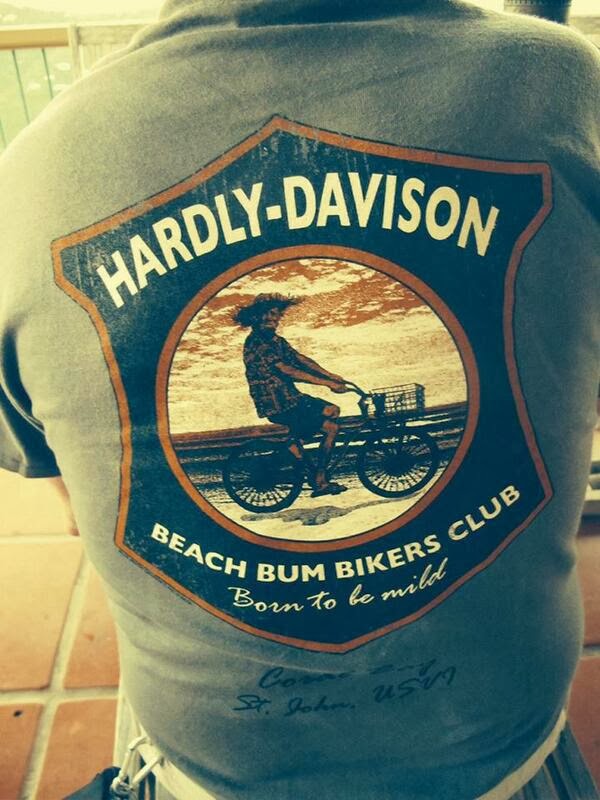
Bike humor

Via Bikearlington on Twitter.  Hardly-Davidson “Born to be Mild” strikes me as a pretty good parody.

Posted in dilution, parody, trademark | Leave a comment

The work of art in an age of mechanical demolition?

Cohen v. G&M Realty L.P., No. 13-cv-05612 (E.D.N.Y. Nov. 20, 2013)

This VARA dispute makes some interesting moves on irreparable harm—it’s hard to see why courts are still stuck in “copyright/TM harm is irreparable” given what they’re doing elsewhere.


Plaintiffs sought to prevent the destruction of their graffiti art on the exterior of defendants’ buildings, which are scheduled for demolition.  The art has now been painted over; the opinion explains the court’s decision to deny a preliminary injunction against the destruction.


Because of the art, the buildings became a significant tourist attraction known as 5Pointz.  One of the pieces in question:


VARA protects against the destruction of works of visual art, but only if they are works of “recognized stature.” To figure out whether plaintiffs’ work qualified, the court went through the history of the art.  Cohen and Wolkoff, the effective owner of the buildings comprising 5Pointz, agreed that the buildings had become a place for distasteful graffiti.  To control the problem, Cohen approached Wolkoff in 2002 to become the curator, and Wolkoff agreed; Cohen was one of the principal contributors to the art and Wolkoff liked his work, though nothing was put in writing.


Under Cohen’s supervision, the quality of the art improved and the site “evolved into a mecca for high-end works by internationally recognized aerosol artists” and a “New York must-see.”  But Wolkoff planned to knock down the buildings to make room for two apartment complexes.  The planning commission required that defendants include 75 affordable housing units and 3,300 square feet of exterior art panels “to be used to maintain artist street wall art in the area.” There was no feasible way to incorporate the existing art into the new buildings.


The parties’ experts understandably disagreed about whether the 24 works at issue were of “recognized stature,” as required by VARA.  Much of the plaintiffs’ testimony “did not differentiate between these discrete words, and by and large assumed that if the work had artistic merit it was ipso facto of recognized stature.”  Defendants’ expert took a restrictive view, opining that a work of recognized stature should be at a level where scholars agree that it is “changing the history of art.”  (OK, I know there’s not much help in the legislative history, but I can’t imagine that’s the standard!)  The art at 5Pointz was not recognized by scholarly works.  Although the expert acknowledged 5Pointz’s recognition as a tourist attraction, she believed that this wouldn’t satisfy VARA unless visitors came to see a particular work, in which case it would be a work of recognized stature even without scholarly recognition.


By contrast, plaintiff’s expert, whose testimony the court found credible, focused on the works’ quality.  She opined that “recognition” meant “there’s enough people that know what [the work] looks like, and feels like and what it’s trying to impart; that it would be, to me, if it was missing from the canon of art history, that it would be a loss.”  She testified that 5Pointz’s public exposure conferred the requisite stature, and pointed to a documentary he made featuring the site.  She also testified about the general reputation of the artists who contributed works, contending that their recognition conferred significance on any work they did.


The court then turned to the works’ ephemerality.  Wolkoff always told Cohen that he’d be knocking down the buildings, and there were numerous public statements by Cohen and other artists indicating that they knew the works were temporary.  Cohen allowed some works to be painted over; others he deemed “permanent,” meaning that they would last “[a]s long as [he was] there and the operation’s there.” He chose special places for them—mostly high up, and all around the building.  When a collapsed staircase was removed in 2009, the whole building was painted over with the exception of Lady Pink’s “Green Mother Earth.”  Since then, consistent with past years, about “1,000 new images” had been placed on the buildings each year.  At the preliminary injunction hearing, about 350 survived.


Cohen said in an interview: “Anyone can paint. But not everyone’s art stays up for long. Some works last 12 hours; other pieces remain for two years.” Another artist, Danielle Mastrion, painted a celebrated portrait in July 2013, even though she had “been hearing for years that there’s always a chance that the building can come down,” and was “aware that [the owners] were obtaining approval to knock down the building at the time [she] put the piece on the building.”  Eighteen of the 24 works for which VARA protection was claimed were painted after 2010, and 8 were painted in September, weeks after the planning commission approved the development plan. Thus, “Cohen and his fellow plaintiffs undoubtedly understood that the nature of the exterior aerosol art on Wolkoff’s buildings was transient, and that all of the works that he allowed to be painted on the buildings would last only until they would be demolished to make room for Wolkoff’s housing project.”


The court concluded that aerosol art can be visual art protected by VARA.  But VARA only protects a work.  There was no authority to preserve 5Pointz as a tourist site.  Thus, the court’s inquiry was limited to whether a particular work that was destroyed was one of “recognized stature.”  The court concluded that at least some of the 24 works, such as Lady Pink’s “Green Mother Earth,” could be shown to be of recognized stature, though that was for a full merits determination.


For preliminary injunctive relief, though, irreparable harm was required, including a showing that damages were inadequate.  And here the court gave short shrift to any nonmonetary interests, which might seem like an odd result in a moral rights case: “plaintiffs would be hard-pressed to contend that no amount of money would compensate them for their paintings; and VARA—which makes no distinction between temporary and permanent works of visual art—provides that significant monetary damages may be awarded for their wrongful destruction.”  Though the court emphasizes the temporary nature of this art, its reasons don’t seem so limited: “paintings generally are meant to be sold. Their value is invariably reflected in the money they command in the marketplace. Here, the works were painted for free, but surely the plaintiffs would gladly have accepted money from the defendants to acquire their works, albeit on a wall rather than on a canvas.”  In addition, the court found that “plaintiffs’ works can live on in other media,” specifically photography.  The works remained protected by copyright law “and could be marketed to the general public—even to those who had never been to 5Pointz.”


But, whether this was part of irreparable harm or of balancing hardships, “the ineluctable factor which precludes either preliminary or permanent injunctive relief was the transient nature of the plaintiffs’ works.”  Cohen always knew that the buildings were coming down “and that his paintings, as well as the others which he allowed to be placed on the walls, would be destroyed.”  The court was particularly distressed by the recent creation of many of the paintings, after the planning commission gave its final approval to the new construction.  “In a very real sense, plaintiffs have created their own hardships.”


Still, defendants shared some responsibility; Wolkoff “gave his blessings to Cohen and the aerosol artists to decorate the buildings, and he did not choose to protect himself from liability by requiring VARA waivers.”  Also, while he was a genuine art lover, he also benefited economically from all the attention to the site.  Since VARA protects even temporary works from discussion, the judge suggested that damages might ultimately be “significant” if a trial determined that the works were of recognized stature.


The public interest would be served by the new apartments, including affordable housing, and its aesthetic interests would be addressed by the new exterior surface available for art.  The court didn’t conceal its preference for defendants to do even more, presumably by way of settlement: “They can make much more space available, and give written permission to Cohen to continue to be the curator so that he may establish a large, permanent home for quality work by him and his acclaimed aerosol artists. For sure, the Court would look kindly on such largesse when it might be required to consider the issue of monetary damages; and 5Pointz, as reincarnated, would live.”
Posted in art law, http://schemas.google.com/blogger/2008/kind#post | Leave a comment

Hey Jude, WTH? Competitor plaintiff fails despite falsity and presumed harm

Berken v. Jude, No. 12–cv–02555, 2013 WL 6152347 (D. Colo. Nov. 22, 2013)

Berken alleged that Jude and his law firm, Jude Law, LLC (really?), falsely advertised in violation of the Lanham Act and the Colorado Consumer Protection Act (CCPA).  In a decision that seems to misconstrue the meaning of “presumption,” the court denied Berken any relief despite the apparently clear false advertising.

The parties compete as consumer bankruptcy attorneys in Denver.  Jude’s ads appeared “whenever someone googled information on Denver bankruptcy” (note use of “googled” as verb):

$500 Flat Fee Bankruptcy—No Hidden Fees—BBB Accredited

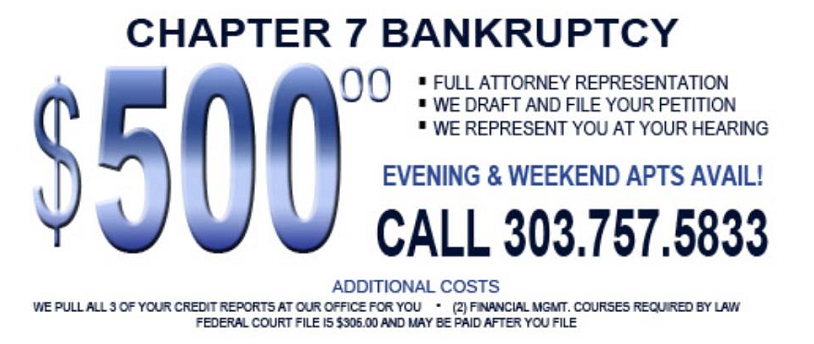
On the firm’s home page appeared this ad:

A similar ad ran in a local newspaper.

Berken lost several customers to Jude’s lower prices, though each testified by affidavit that they weren’t influenced by the pricing ad.  Berken established falsity and materiality, but the court held that he failed to show likely injury.  Recovering damages requires showing actual injury, and the consumer affidavits stated that the ads had nothing to do with their decision to defect from Berken, but rather they were dissatisfied with his rates and persuaded by Jude’s positive reviews.  So much for the damages claims.

But injunctive relief doesn’t require actual damages, only likely injury.  Courts may presume injury when the parties are “obvious competitors” with respect to the service being misrepresented.  Because they provided the same services in the same market, and because consumers use only one bankruptcy attorney at a time, Berken was entitled to a presumption of injury.  “However, Plaintiff has failed to support that presumption with any evidence of injury.”  He didn’t show that he lost specific clients or that he lost revenues generally, or show any consumer testimony, surveys, or market studies showing how Jude’s ads affect consumer behavior.  Thus, he failed to establish a reasonable basis for his claim of likely injury. This also killed the state-law false advertising claim.

Comment: buh?  I thought that those entitled to a presumption could rely on it, in the absence of rebuttal. Otherwise, what’s a presumption for?
Posted in http://schemas.google.com/blogger/2008/kind#post, procedure | Leave a comment

Right of publicity question of the day

Does this mortgage broker’s ad, quoting Mr. Rogers, violate any right?

Text: “If you could only sense how important you are to the lives of those you meet, how important you can be to the people you may never even dream of. There is something of yourself that you leave at every meeting with another person.–Fred Rogers.”  What that has to do with home loans is left as an exercise for the reader.

Posted in right of publicity | Leave a comment

ABA Journal Blawg 100

I’m on the ABA Journal’s Blawg 100, which is a real treat!  Check out the many worthy news sources there.

Posted in Uncategorized | Leave a comment

coincidental co-creation

Author’s note from William Pene du Bois, The Twenty-One Balloons (1947):

Just before publication of The Twenty-One Balloons, my publishers noted a strong resemblance between my book and a story by F. Scott Fitzgerald entitled “The Diamond as Big as the Ritz,” published by Charles Scribner’s Sons. I read this story immediately and discovered to my horror that it was not only quite similar as to general plot, but was also altogether a collection of very similar ideas. This was the first I had heard of the F. Scott Fitzgerald Story and I can only explain this embarrassing and, to me, maddening coincidence by a firm belief that the problem of making good use of the discovery of a fabulous amount of diamonds suggests but one obvious solution, which is secrecy. The fact that F. Scott Fitzgerald and I apparently would spend our billions in like ways right down to being dumped from bed into a bathtub is altogether, quite frankly, beyond my explanation.

Wikipedia notes that, as with many pairs of works with surprising similarities, there are also significant differences in tone, intended audience, and other events.
Posted in http://schemas.google.com/blogger/2008/kind#post | Leave a comment

transformative work of the day

I Ship It, by notliterally—a hilarious parody of Icona Pop’s song that is also a love letter to fandom.

Posted in fanworks, http://schemas.google.com/blogger/2008/kind#post | Leave a comment