
ISHTIP at Penn, part 8

Methodology: What should histories and theories of IP be
doing? What role should interdisciplinarity play? | Martha Woodmansee (Case
Western Reserve University), Moderator
 
Lionel Bently (Cambridge)
We tolerated the use of the term “IP” to discuss the field,
though we were aware of problems with it—not used in 19th c.; often
used for law, but we wanted to talk about other regimes; we were conscious of
the dangers of fetishization of law or its categories.  Methodological assumptions revealed in ISHTIP’s
website: sometimes we post the best papers
from each workshop as examples of good work: methodologically sound,
productive, insightful.  Also a bibliography
for people in the field. Also themes for conferences show concerns: a set of
methodological and disciplinary assumptions: themes like representation of the intangible;
IP as cultural technology; openness.
 
Work that disrupts evolutionary stories that make the
present seem inevitable and provides ways to think how it would be otherwise;
work that exposes ways of thinking we don’t readily see in our own practices:
e.g., use of visual and other forms of representation of intangible. Historical
work allows you to see things that are difficult to see in present environment.
 
Kathy Bowrey (New South Wales)
Law is an imperialist discipline: creates its own kinds of
truths through relation to power and authority. 
Claims about superiority of private property, freedom of contract,
freedom of expression. Law & humanities have worked to deconstruct some of
those normative elements.  Patent
scholarship has always been more empirical, but history has occurred w/o much
engagement w/legal scholars until recently. New empirics underlying ©
scholarship and to a lesser extent design and TMs.  Political ambition: contest claims to
naturalness of power and authority.
 
Law claims for itself the authority to define/decide what
the law is.  Interdisciplinary work
challenges that authority. Cultural studies, sociology, anthropology of
professions.  What it is we mean by law:
fight ongoing reproduction of this imperialism. Turn to archival work is really
interesting in this light.  Critical
lawyers need to help historians understand complexity of law as subject—we shorthand
it and are reluctant to unpack.
 
Adrian Johns (University of Chicago)
Identifying moments of change can be difficult in the
moment, as Madison says.  So what can we
imagine for succeeding in 25 years? Interdisciplinarity comes with an
association w/virtue, seemingly b/c in the mid 20th century it
developed as an alternative to entrenched and intellectually constraining
disciplines.  Ways of reconstituting a
liberal democratic order in the face of overweening claims by behaviorism/the
very idea of disciplines.  Risk of creating
authoritarian personality through too much immersion in rules of
disciplines.  Cognitive science took off
as a way to be disciplinary but also free by restoring mind to the center.  When interdisciplinarity worked, it worked by
making compromises: constricted what the disciplines were between which you
were inter.  Institutionally embedded in
gender studies/science studies.  Brought
in people from relatively closely aligned fields—anthropology, sociology. The
closer the disciplines are, the more they argued, and that was productive.
 
ISHTIP needed to be interprofessional: scientists,
filmmakers, musicians, composers, lawyers, and others. But that’s completely
impossible.  Playing the long game: there
are whole areas to be understood that had been systematically missed.  One of the most important: the realm of
technologies, practices, corporate endeavor between the legal world and the
everyday creative life. 
 
Madison: How would one define success in this context? No
need to have a single definition. Political ambitions are embedded in Johns’
narrative; intellectual, organizational, professional for individuals.  Academics often consider the work itself
evidence of its own impact.  Networking
is not a great mode of political organizing.
 
Woodmansee: change consciousness; some other organization
will become the activist avant-garde.
 
Madison: it doesn’t have to be that way, rigid distinction
b/t research and activism—crossover is possible rather than hoping for the rest
of the world to listen critically.
 
Woodmansee: ISHTIP was founded to be a scholarly society
which is not activist, unlike CC. Those things were going on at the same
time. 
 
Johns: ISHTIP ought to occupy not the space of a
policymaking body, but venue of critical understanding to change consciousness
in the end, and that’s success enough. 
ISHTIP participants will be working creatively and politically, but the
organization itself is not a failure if it doesn’t do that.
 
Bowrey: having director from humanities and one from law:
our aspiration is to have equality, though nonlawyers are regularly outnumbered
by lawyers. Want to be less Anglo, but higher education is under attack.  Participate/recruit fellow travelers.
 
Jaszi: Lawyers are likely to be with us for the foreseeable
future.  Consider what lawyers interested
but perhaps not skilled in other disciplines could do to become part of this
discussion.  We operate in a very narrow
channel; most of what we do is about the critique of doctrine. For people who
have come up in that tradition, what methodologies are available? One
possibility: learn to do other things—become better empiricists, ethnographers,
etc.  Another: encourage project based
collaboration.  ISHTIP as a space through
which lawyers who know there’s more but are clueless about how to get there
could identify collaborators and work actively on projects across disciplines.  Also: the kind of work that was
characteristic across a wide range of legal disciplines in the first flowering
of Critical Legal Studies: working w/doctrine, the thing we know how to do, but
w/specific emphasis not on finding its coherence as we are taught to do in law
school and not to propose the way in which doctrine can be made more coherent.
But look more attentively for incoherence. 
A great deal to learn from that.
 
Johns: Incoherence of a concept is not a fatal accusation in
his field.
 
Q: Note the difference between expectations in fields: law =
publish law review articles, especially early in career; other fields = publish
in other journals and also books.  How do
we deal w/that?

from Blogger http://ift.tt/1CVoBNg
Posted in Uncategorized | Tagged , | Leave a comment

ISHTIP at Penn, part 9

Session 6 | Josh Sarnoff (DePaul University), Moderator
 
In Search of a Trade Mark: Search practices and Bureaucratic Poetry
Jose Bellido and Hyo Yoon Kang (University of Kent, UK)
Commentator | Amanda Scardamaglia (Swinburne Law School)
 
Enhanced searching: bureaucratic poetry—early manual searches. TM office was tasked with organizing words and devices for the first time: a new commodity of commercial information in signs and words and the ability to find them on the register.  Needed a system of classification to register marks; classifications changed over time to reflect commercial change.  Patent system classified according to subject matter; a different endeavor.
 
TM clerk was very different from patent counterparts—technical expertise v. experts in delicate art of distinguishing and classifying signs and words.  TM agent emerged, esp. after 1883 amendments opening registration for invented words, leading to significant increase in number of applications. Agents were skilled in navigating and searching the register.  Profession attempted to limit access to registration data, as patent agents had before them; closing of profession was linked to increasing openness of TM registers.  Index clerks and TM abstractors: index w/range of general marks; divisional index of devices arranged according to things like birds, buildings, and beasts; index arranged alphabetically by prefixes and terminal endings/suffixes—third index was the most important. 
 
Significant impact on development of TM law—led to deconstruction of words and assisted w/creating new marks by creating comparisons.  Deconstruction of words was evident in TM infringement cases as well, which focused on comparing sequences of letters in the same way.  Indexes were strategic—could find out about what competitors were doing b/c they’d register preemptively. Initially available only to agents but eventually opened to public, though agents were still powerful actors who specialized in searching the register.
 
Index cards and punched cards; final phase of computerized searching and privatization of search services—entrusted to private services, with a direct and immediate impact on search.  Computerization affected registrations: TMs were redesigned for mechanical purposes; transformed the way search happened—algorithms made it possible to search across subjects & geography quickly. Removed obstacles to manual search.  Transformed registry from visual markers of ownership to a metalevel database.
 
Discussion points: evidence of how the processes impacted the legislation itself?  Registries internationally were introduced around the same time.  What indexes if any were used at that time? Did that impact others’ indexes?  Did others’ indexes affect Britain’s? What were the tradeoffs in moving from mechanical to digital?  Paper says openness increased, but was the info the same?
 
Bellido: we wanted to explore bureaucratic property. Were surprised that first TM clerks in UK were A.E. Housman, Griffin, and other poets and antiquaries.  Bureaucratic poetry: indexing techniques have something to say about how TMs were conceived and developed.
 
Kang: TM is more complicated than patent b/c of two different forms of numbering—application number, then publication/registration. Can be complicated to retrieve full info.  Shows how unstable the nature of property is in legal practice.
 
Bellido: the more open the register was, the more experts could claim to be able to navigate this massive endeavor.  Legal expertise is founded in the management of retrieval tools that may look more technical/less interesting to legal scholars, but it’s everyday routine that constitutes the subjectivity of the TM expert.
 
Kang: relates to issue of legal agency: what does TM law actually do?
 
Bellido: registration practice can make the TM a thing/object of law/property even before there is a product in the market.
 
Kang: complicate picture of TM as consumer-driven. 
 
Bellido: registering invented words: impact on the legal profession—agents could then sell the possibility of providing new words to companies. We haven’t touched colonial indexing.   
 
You sometimes see trolling behavior around descriptive words/changing descriptive words around to try to make them registrable.  Or an agent could identify marks that were not quite as good but were usable until the register relaxed its standards.
 
The Modern Expansion of Trademark Rights, and How One Forgotten Treaty Made It Possible
Christine Haight Farley (American University Washington)
Commentator | Dan Hunter (Swinburne Law School)
 
Big claim: a forgotten treaty did a lot more than we thought it did in creating TM rights.  Hunter is not sure that this treaty made expansion of rights possible.
 
Paper is a detective story.  Interamerican Convention on Trademark and Commercial Protection (IACTCP) (1929).  TM comes from one of two or maybe three/4 foundations: passing off, concerns over confusion, search costs.  Does this convention give us new insights into the foundations of TM law?  Offers unfair competition as a distinct foundation.  Can we tell that the convention is a contributor to the modern day understanding?  Even if we could, so what?  The lawyer’s question: what does that tell us? 
 
Why was the convention ignored?  The architect of both IACTCP and the modern Lanham Act (1946) was one man, Edward S. Rogers, founder of first specialized TM firm and lover of unfair competition. 
 
Significance of Inter-American TM Convention (1929)—self-executing, and yet completely forgotten.  Modest number of cases in TTAB and courts, startlingly small # of cases.  Yet this is law.  Why forgotten?  Or has it been?  Are Ps all just dumb?  That seems unlikely.  Eriesays there’s no general federal common law. Then there’s the Lanham Act §43(a), but also and especially 44(h) and (i).  The Lanham Act is, for all intents and purposes, federal common law, and the paper suggests that 44(h) and (i) need to be more talked about, b/c §44 is generally about recognizing TMs from outside the US; in fact Rogers included them largely to include unfair competition w/in the American system.
 
Questions: is the paper trying to get us to apply the Convention?  Are you arguing that unfair competition is foundational to the Lanham Act? Just b/c it’s in the Lanham Act doesn’t make it foundational.
 
Farley: A treaty still in force about TM—we don’t have many of those in the US.  Modern parallels were interesting about how the US makes the law of other countries and then has a strategy of making US law also through that undemocratic process.  Beyond that, this text is so interesting b/c of its novelties and timing, as well as the characters involved.  Inordinate influence of a couple of people has no modern analogue.  We can inadvertently make a mistake by privileging moments of development of IP; IP has not always had pride of place in law, society, or commerce.  Especially in TM law: early 20thc., it was a teeny field. TMs weren’t as valuable as they are; there was no TM bar, certainly not in Latin America, just a handful of people in US.  These particular people could have outsized influence.
 
The ground was shifting under their feet b/c the nature of marketing was changing, markets were changing, global markets were changing.  Amorphousness of IP and particularly TM.  Doing this history, evident how unsettled and indeterminate the foundations of TM are.  The story that we have an ancient idea of unfair competition, within it a new thing called TM law, isn’t right. These were simultaneously being developed and playing off one another.  Early development was a mess.  These guys are making up new law in this treaty.  Provisions don’t appear anywhere else.  Rights that suited US businesses at that moment for expansion into Latin America.
 
Then the Lanham Act comes along, and federal common law is pulled out.  Given the fact of the treaty, and their overlapping author, and that Rogers argues the first TM Supreme Court case after Erie, there was a unique opportunity to write a new chapter in TM as clean, settled, organized.  And we don’t get that. We get slivers of clarity, and then this space/haze around the rights. We focus on §43(a) as a site of expansion and a site for unfair competition, but these sections in 44 are what the drafters intended.
 
US corporations exercise their rights under the treaty in Latin America all the time; drafters expected that b/c of US dominance.  Lanham Act makes vague reference to the treaty (was explicit reference in first draft); Rogers argued that the treaty was self-executing and the SCt agreed.  Conclusion: give those rights to go after unfair competition to US citizens as well.  We didn’t get that. §43(a) was reaction of patent bar trying to put the brakes on what Rogers was trying to do in §44.  Rogers deals with this by taking §43(a), designed as substitute for 44, in the law too. 
 
RT: Another suspect: What is unfair competition that isn’t infringement?  Trade secret misappropriation was a possibility bruited about in the 1940s; maybe also antitrust violations.  But that kind of understanding seems impossible to recover now, especially given other laws—no court is going to find that there’s been a federal trade secret law for 70 years.  Trademark infringement-like activities that aren’t infringement but are still unfair competition?  US courts have no current understanding of what that gap might be: collapse b/t protection and registrability, absence of a passing off category in US law.
 
A: Many law review articles written at the time clearly stated that many things were under the umbrella of unfair competition but were nowhere collected; some understanding that it would be collected in Lanham Act: trade secret, tortious interference w/ business relations, antitrust.  Not so much interested in those things, but is interested in what the haze might be surrounding the concept.  (What might a clever P’s lawyer argue?)
 
Possible to bring something like a TM case w/o a possibility of confusion.  Rogers brought a case where there were nonproximate goods, a different name but phonetically similar, and no bad faith.  That was meant to be one of the §44 cases—not really a theory of confusing the public, but unfettered right to expand business.  Haze of rights as buffer around TM rights.  Rogers won, but we only talk about Frank Schecter, who lost; Rogers won by making subtle moves.
 
Q: compare to avoision in tax law: indeterminancy of whether someone is engaging in avoidance (ok) and evasion (not ok).  Infinite ingenuity of malefactors to get around intent of law w/o letter of law.
 
Madison: concepts in the law having agency v. the agency of individual humans like Rogers. Rhetorical constructs enabled by disciplinary angles. 
 
Q: role of timing?
 
A: may have been related to the Depression; also to Erie and resulting uncertainty for TM lawyers.  Treaty was a bit premature for the Latin American market.  Responding to a Europe in which the US lacked a big place, anticipating Americas as a market to dominate. WWII meant that vision didn’t come about as anticipated.  Not that many businesses were demanding these kinds of protections; just on the cusp.
 
Sarnoff: if the idea is to remember, do you expand rights in unpleasant ways?  Is this a comedy and not a mystery—a tale of laughter and forgetting?
Posted in http://schemas.google.com/blogger/2008/kind#post, trademark | Leave a comment

ISHTIP at Penn, part 8

Methodology: What should histories and theories of IP be doing? What role should interdisciplinarity play? | Martha Woodmansee (Case Western Reserve University), Moderator
 
Lionel Bently (Cambridge)
We tolerated the use of the term “IP” to discuss the field, though we were aware of problems with it—not used in 19th c.; often used for law, but we wanted to talk about other regimes; we were conscious of the dangers of fetishization of law or its categories.  Methodological assumptions revealed in ISHTIP’s website: sometimes we post the best papers from each workshop as examples of good work: methodologically sound, productive, insightful.  Also a bibliography for people in the field. Also themes for conferences show concerns: a set of methodological and disciplinary assumptions: themes like representation of the intangible; IP as cultural technology; openness.
 
Work that disrupts evolutionary stories that make the present seem inevitable and provides ways to think how it would be otherwise; work that exposes ways of thinking we don’t readily see in our own practices: e.g., use of visual and other forms of representation of intangible. Historical work allows you to see things that are difficult to see in present environment.
 
Kathy Bowrey (New South Wales)
Law is an imperialist discipline: creates its own kinds of truths through relation to power and authority.  Claims about superiority of private property, freedom of contract, freedom of expression. Law & humanities have worked to deconstruct some of those normative elements.  Patent scholarship has always been more empirical, but history has occurred w/o much engagement w/legal scholars until recently. New empirics underlying © scholarship and to a lesser extent design and TMs.  Political ambition: contest claims to naturalness of power and authority.
 
Law claims for itself the authority to define/decide what the law is.  Interdisciplinary work challenges that authority. Cultural studies, sociology, anthropology of professions.  What it is we mean by law: fight ongoing reproduction of this imperialism. Turn to archival work is really interesting in this light.  Critical lawyers need to help historians understand complexity of law as subject—we shorthand it and are reluctant to unpack.
 
Adrian Johns (University of Chicago)
Identifying moments of change can be difficult in the moment, as Madison says.  So what can we imagine for succeeding in 25 years? Interdisciplinarity comes with an association w/virtue, seemingly b/c in the mid 20th century it developed as an alternative to entrenched and intellectually constraining disciplines.  Ways of reconstituting a liberal democratic order in the face of overweening claims by behaviorism/the very idea of disciplines.  Risk of creating authoritarian personality through too much immersion in rules of disciplines.  Cognitive science took off as a way to be disciplinary but also free by restoring mind to the center.  When interdisciplinarity worked, it worked by making compromises: constricted what the disciplines were between which you were inter.  Institutionally embedded in gender studies/science studies.  Brought in people from relatively closely aligned fields—anthropology, sociology. The closer the disciplines are, the more they argued, and that was productive.
 
ISHTIP needed to be interprofessional: scientists, filmmakers, musicians, composers, lawyers, and others. But that’s completely impossible.  Playing the long game: there are whole areas to be understood that had been systematically missed.  One of the most important: the realm of technologies, practices, corporate endeavor between the legal world and the everyday creative life. 
 
Madison: How would one define success in this context? No need to have a single definition. Political ambitions are embedded in Johns’ narrative; intellectual, organizational, professional for individuals.  Academics often consider the work itself evidence of its own impact.  Networking is not a great mode of political organizing.
 
Woodmansee: change consciousness; some other organization will become the activist avant-garde.
 
Madison: it doesn’t have to be that way, rigid distinction b/t research and activism—crossover is possible rather than hoping for the rest of the world to listen critically.
 
Woodmansee: ISHTIP was founded to be a scholarly society which is not activist, unlike CC. Those things were going on at the same time. 
 
Johns: ISHTIP ought to occupy not the space of a policymaking body, but venue of critical understanding to change consciousness in the end, and that’s success enough.  ISHTIP participants will be working creatively and politically, but the organization itself is not a failure if it doesn’t do that.
 
Bowrey: having director from humanities and one from law: our aspiration is to have equality, though nonlawyers are regularly outnumbered by lawyers. Want to be less Anglo, but higher education is under attack.  Participate/recruit fellow travelers.
 
Jaszi: Lawyers are likely to be with us for the foreseeable future.  Consider what lawyers interested but perhaps not skilled in other disciplines could do to become part of this discussion.  We operate in a very narrow channel; most of what we do is about the critique of doctrine. For people who have come up in that tradition, what methodologies are available? One possibility: learn to do other things—become better empiricists, ethnographers, etc.  Another: encourage project based collaboration.  ISHTIP as a space through which lawyers who know there’s more but are clueless about how to get there could identify collaborators and work actively on projects across disciplines.  Also: the kind of work that was characteristic across a wide range of legal disciplines in the first flowering of Critical Legal Studies: working w/doctrine, the thing we know how to do, but w/specific emphasis not on finding its coherence as we are taught to do in law school and not to propose the way in which doctrine can be made more coherent. But look more attentively for incoherence.  A great deal to learn from that.
 
Johns: Incoherence of a concept is not a fatal accusation in his field.
 
Q: Note the difference between expectations in fields: law = publish law review articles, especially early in career; other fields = publish in other journals and also books.  How do we deal w/that?
Posted in http://schemas.google.com/blogger/2008/kind#post | Leave a comment

ISHTIP at Penn, Part 7

Session 5 | Martin Fredriksson (Linköping University,
Sweden), Moderator
 
Open Source Intelligence: Counterinsurgency, State Secrets,
and Small Novels
Joseph Slaughter (Columbia)
Commentator | Catherine Bond (University of New South Wales)
 
Operation of IP in the context of torture, undertaken as
part of the war on terror.  Stories in
which someone’s blood leaks through the lines. 
Justification for torture in logics of IP?   Torture forces person to narrate—victim is
compelled to become an author, and then ownership of their words is attributed
to them in order to be subjected to a penalty imposed by national security
law.  Law: but the fixation, if it exists
at all, exists under the authority of the state—so maybe not an author in ©
law.
 
Documents released as heavily redacted.  Jenny Holzer reproduced the documents in
silkscreen. The Redaction
Paintings
are subject to ©, so you can reproduce the redacted images but
not the Holzer images—a perverse use of ©; words generated by torture victim
are in the public domain.  Images
themselves do have some originality added by Holzer.
 
Counterinsurgency manual: released by gov’t as open source,
but gov’t appropriated a number of sources w/o attribution and credit.  Use of narrative w/in the manual itself, and
how narratives can be adopted in counterinsurgency; also issues of academic
appropriation/plagiarism. What’s taken is probably not substantial, so the
issue is not © but plagiarism/control of the narrative.
 
In Australia, a Guantanamo Bay detainee sought to tell his
story after release. Institutional response under nat’l security legislation—in
the US we said that was a matter of national security.  David Hicks: arrested in Afghanistan and held
for 6 years. Sleep deprived, medicated w/o consent, sexually assaulted, and
beaten while conscious and unconscious. In 2007 pled guilty to material support
for terrorism & returned to Australia where he served time in prison before
being released. Subject to control order by federal police that expired in
2008; in 2010 Random House published his autobiography, which Austl. prosecutors
then sought to suppress. Didn’t claim national security, but proceeded in NSW
against him under the Proceeds of Crimes Act to stop him from benefiting from
the profits of the book.  Torture victim
seeks to reclaim the narrative using © as a means to do that/rebuild life by
telling their story. State doesn’t seek to disrupt the edifice of ownership but
use a law designed to stop drug dealers (well, that does seem like disrupting
the edifice of ownership).  Proceedings
proved difficult b/c the plea may not have been lawful. In 2012 the prosecutor
dropped the case claiming “new evidence” which was not disclosed.
 
Cuts, seams, and stitches b/t traditional IP and national
security, both of which claim property rights over some of the same texts.
Conceptual baggace of IP and national security is not peculiar to the US. In
Australia, the documents Holzer used would be protected by Crown copyright, so
Holzer’s redaction paintings wouldn’t be allowed unless limited exceptions
applied for 50 years. Does that matter to the paper’s story of IP?
 
Slaughter: Torture memos—academic sources repurposed into
guidance for how to torture, but then the bibliography of openly available work
was redacted. Novel from Guatemala—incorporated counterinsurgency manual from
US that circulated freely in Central America. 
Manual instructs military that counterinsurgency is all about narrative:
narrative construct of truth, war, etc. 
Military moves all military tactics into other manuals; the
counterinsurgency manual is full of narrative strategies (and also full of
plagiarism). Presumptive classification: gov’t claimed that people who were
tortured therefore knew the sources and methods of CIA operation and could not
discuss their own torture or they’d reveal CIA secrets.
 
When you tell scholars who don’t believe in authorial intent
about an instance of plagiarism, those very scholars go straight to “what were
they thinking?”  Humanistic desires for
narrative at moments of crisis.
 
David Hicks: There are published US diaries that are
published with redactions.  Lawyers are
making a point about what you can’t say even in your own diary.  Jurisdiction of course makes a
difference. 
 
Q: Manuals seem to be uncopyrightable in the US.  But able to be copyrighted int’lly.  Has the US tried to get national treatment outside
the US?  How does lack of © affect their
creation? 
 
A: classified materials are commonly designated “no foreign
gov’ts” even when declassified.  Haven’t
thought about that Q outside the US. Maybe in a pre-internet era there could be
a legal strategy, but no examples now.
 
RT: (1) Common-law ©/fixation issues—if it’s not under the
victim’s authority then there’s still a common-law © that arises.  Cf. Garcia v. Google: story of the dupe/vulnerable
victim, another person connected to the war on terror who’s put at risk by
being fooled into creating a work.  If it’s
still the victim’s narrative—what counts as authority of the author?  (2) Go beyond © to IP? Orphan Black and “we’re
property.” Large sf literature on owning people: contrast to patent discourses
where it is almost taken for granted that you can’t own a person—v. prisoner as
the slave of the state.  The prisoner
creates a point of pressure for the liberal patent/non-ownership of persons story.
 
A: gov’t did claim to own these people—but the defense
distinction was that they couldn’t own these people’s memories and therefore
they could testify about torture/complain about torture. Torture isn’t just
forced confession, but forced confession that must be redescribed some way as a
voluntary act of will, according to the logic of torture. Thus the fixation is
considered by the gov’t to be under the victim’s authority.
 
Q: consider the exclusionary rule as a point of contrast.
 
A: Gov’t can also block introduction of testimony on nat’l
security grounds.
 
Q: is the liberal humanist subject at the core of your
project? If the state is the referent for power plays, who is power exercised
on?  Right to have stories told is not
just state exercising power, but a way to exercise power against the state—to refuse
to tell indigenous knowledge, for example. 
 
A: strategic revival by defense lawyers of liberal
individual who has rights to privacy/narrate when those are clearly not the
circumstances under which they’re being prosecuted.  Your use of “right” may be the liberal
subject sneaking back in; the lawyers all use rights talk b/c there’s almost no
other language to deal with this. 
 
From Intellectual Property to Openness? On the Potentials of
Literature in Printed Books and in Digital Media
Thomas Ernst (University of Duisburg-Essen, Germany)
Commentator | Michael Madison (University of Pittsburgh)
 
German discourses about literary authorship in the digital
world, destabilizing German © law. What is a work? The finished and final
output of an author, distinguished from the author and from the
recipient/reader. Different theories define and weigh the relations between
these three differently.  1800: era of
first implementation of © law in Germany. 2000: digital media changes started
to have sustained effects on literary production, distribution, and reception.
 
1765-1790: age of reprints. 
Since then, protection of IP established. German law focuses on
protection of individual acts of origination. 
Personal mental creations = works. Fichte: the difference b/t author and
reader, and book as a container of ideas. 
 
2000: nonlinearity, interactivity: allow experimentation w/
new forms of production, distribution, and reception. Undermines German ideas,
including the idea of the book as the salable container. Idea of clear gap b/t
author and reader also disappears: the “prosumer.” Changes the relationship to
the market: active participation in designing the products they want.
 
Phenomena include (1) “Twitterature”—short stories that fit
on Twitter.  Hybrid text: the hashtag
includes both the stories and the comments of readers/interactions w/author—new
space of interaction; lose the boundaries of the work.  Literature as communication network.  (2) Crowdfunding.  (3) Fan fiction: largest German archive
distinguishes between fan fiction and “free works”/Freie Arbeiten.  Community: you write the text to be commented
on.  Author-readership.  (4) Social reading.  Reading groups online.  Can pay a little more to get a digital
version with comments by certain other people.
 
2010: Axolotl Roadkill: author was hailed as a wunderkind,
until a plagiarism scandal erupted—unattributed quotations from blogs.  Internet, plagiarism, etc. are terms put in
contrast w/ authorship and originality. But the text is part of a digital remix
culture, not part of an established literary culture. Text tells story of
16-year-old girl’s attempts to give her life meaning through excessive
behavior/drinking/drugs/sex. Cites Kathy Acker, known for her intertextuality;
chapter titles are quotes from popular films etc. Character says: my work and
my theft become authentic as soon as something touches my soul. It doesn’t
matter where I get things from, it’s important where I take them—slightly older
male who inspires the narrator. Metafictional moment: mixed work becomes
authentic if assembled persuasively: declares its status clearly.
 
Some reactions were downright furious.  4th edition, resolved “legal
issues,” book appeared w/ appendix: sources & acknowledgements, listing 20
references to a blog; 22 unmarked quotations of other authors, even private
correspondence. Transforms them into references—from literary work to scholarly
work.  This interferes w/literary
poetics.
 
Madison: The ideas of authorship, work, reader even
historically has had more fluid meanings—Adrian Johns.  Swing of the pendulum rather than something
completely new.  Political framings of
the question can help as well as conceptual.
 
Paper relies heavily on the sense of German identity, and
book culture contributing substantially to that sense.  Very interesting observation worth pursuing
in greater depth: to what extent are Fichte’s concepts, and the debate even
today, the product of conditions in “Germany”—cultural and national identity.

Hypertext was made controversial in © about 20 years ago, so there was a flurry
of anxiety about the meaning for © protection, infringement, joint authorship,
contributory liability.  In general that
anxiety has passed. These Qs still have some problematics but people are no
longer freaking out or wondering what to make of the fundamental structure of ©
given the internet—more normal science these days.
 
Abstract/general question of aesthetics of literature may be
less interesting than pragmatics of these in particular institutional contexts.
The idea of a stable artifact is still meaningful to some authors, communities
of readers, institutions represented in the marketplace/culture. Other places,
stability is contested or abandoned entirely. 
Which are the circumstances in each category?
 
Everything is always changing: McLuhan said the same thing—changes
are not necessarily as discontinuous as they appear to people in the moment.
 
Axolotl Roadkill: (1) extremely rambunctious appropriation
seems problematic; (2) also failure to cite sources, leading to a shift in
genres in later edition; (3) accusation is accusing her of not having taken
responsibility for the work she produced—an inward directed critique.  Consider the quotation she gave in interviews
about her own process, which was it didn’t matter where people got their
process but only mattered where they take it—manipulating external referents to
advance her own project, rather than taking them inside herself. Thus the
critique is that what she’s doing doesn’t advance the understanding of
art.  A true artist is personally and
internally owning the work (that is, this critique is not a condemnation of all
“poaching”).  Traditionally minded, but
not necessarily about property or limited to digitization/processes of
collaboration.
 
Institutional focus might change analysis versus focus on
individual reactions.  Publishers’
reactions: a break w/tradition of literary studies, as well as break w/legal
system’s resolute commitment to individual liberal ideal of author and
reader.  How © system engages w/culture
using institutions as the primary tools of analysis.  (Julie Cohen, among others, has done work of
this sort.)
 
Ernst: Is this new? On the level of media theory/discourse
studies. There’s a way of performing authorship in different discourses/media
situations that can help us analyze what’s going on, e.g. interacting w/
readers on Twitter.
 
Q: Gender theory might help understand the situation of this
German wunderkind.
 
A: she was forced to apologize to other authors.  Male critic first lionized her, then another
male critic targeted her for takedown. 
 
Jaszi: consider authors coming together in organized groups
and attempting to use law to inhibit a wide range of digital possibilities—Authors’
Guild litigations against HathiTrust, Lexis, etc. Self-designated
representatives have things to say that sound a lot like the Leipzig
Declaration criticizing Axolotl Roadkill. 
Might map performance of authorship/collective performance of authorship
and get some interesting results.
 
A: many such examples—“we need a law against this” pops up
every few months.

from Blogger http://ift.tt/1TXdh7x

Posted in Uncategorized | Tagged , , | Leave a comment

ISHTIP at Penn, Part 7

Session 5 | Martin Fredriksson (Linköping University, Sweden), Moderator
 
Open Source Intelligence: Counterinsurgency, State Secrets, and Small Novels
Joseph Slaughter (Columbia)
Commentator | Catherine Bond (University of New South Wales)
 
Operation of IP in the context of torture, undertaken as part of the war on terror.  Stories in which someone’s blood leaks through the lines.  Justification for torture in logics of IP?   Torture forces person to narrate—victim is compelled to become an author, and then ownership of their words is attributed to them in order to be subjected to a penalty imposed by national security law.  Law: but the fixation, if it exists at all, exists under the authority of the state—so maybe not an author in © law.
 
Documents released as heavily redacted.  Jenny Holzer reproduced the documents in silkscreen. The Redaction Paintings are subject to ©, so you can reproduce the redacted images but not the Holzer images—a perverse use of ©; words generated by torture victim are in the public domain.  Images themselves do have some originality added by Holzer.
 
Counterinsurgency manual: released by gov’t as open source, but gov’t appropriated a number of sources w/o attribution and credit.  Use of narrative w/in the manual itself, and how narratives can be adopted in counterinsurgency; also issues of academic appropriation/plagiarism. What’s taken is probably not substantial, so the issue is not © but plagiarism/control of the narrative.
 
In Australia, a Guantanamo Bay detainee sought to tell his story after release. Institutional response under nat’l security legislation—in the US we said that was a matter of national security.  David Hicks: arrested in Afghanistan and held for 6 years. Sleep deprived, medicated w/o consent, sexually assaulted, and beaten while conscious and unconscious. In 2007 pled guilty to material support for terrorism & returned to Australia where he served time in prison before being released. Subject to control order by federal police that expired in 2008; in 2010 Random House published his autobiography, which Austl. prosecutors then sought to suppress. Didn’t claim national security, but proceeded in NSW against him under the Proceeds of Crimes Act to stop him from benefiting from the profits of the book.  Torture victim seeks to reclaim the narrative using © as a means to do that/rebuild life by telling their story. State doesn’t seek to disrupt the edifice of ownership but use a law designed to stop drug dealers (well, that does seem like disrupting the edifice of ownership).  Proceedings proved difficult b/c the plea may not have been lawful. In 2012 the prosecutor dropped the case claiming “new evidence” which was not disclosed.
 
Cuts, seams, and stitches b/t traditional IP and national security, both of which claim property rights over some of the same texts. Conceptual baggace of IP and national security is not peculiar to the US. In Australia, the documents Holzer used would be protected by Crown copyright, so Holzer’s redaction paintings wouldn’t be allowed unless limited exceptions applied for 50 years. Does that matter to the paper’s story of IP?
 
Slaughter: Torture memos—academic sources repurposed into guidance for how to torture, but then the bibliography of openly available work was redacted. Novel from Guatemala—incorporated counterinsurgency manual from US that circulated freely in Central America.  Manual instructs military that counterinsurgency is all about narrative: narrative construct of truth, war, etc.  Military moves all military tactics into other manuals; the counterinsurgency manual is full of narrative strategies (and also full of plagiarism). Presumptive classification: gov’t claimed that people who were tortured therefore knew the sources and methods of CIA operation and could not discuss their own torture or they’d reveal CIA secrets.
 
When you tell scholars who don’t believe in authorial intent about an instance of plagiarism, those very scholars go straight to “what were they thinking?”  Humanistic desires for narrative at moments of crisis.
 
David Hicks: There are published US diaries that are published with redactions.  Lawyers are making a point about what you can’t say even in your own diary.  Jurisdiction of course makes a difference. 
 
Q: Manuals seem to be uncopyrightable in the US.  But able to be copyrighted int’lly.  Has the US tried to get national treatment outside the US?  How does lack of © affect their creation? 
 
A: classified materials are commonly designated “no foreign gov’ts” even when declassified.  Haven’t thought about that Q outside the US. Maybe in a pre-internet era there could be a legal strategy, but no examples now.
 
RT: (1) Common-law ©/fixation issues—if it’s not under the victim’s authority then there’s still a common-law © that arises.  Cf. Garcia v. Google: story of the dupe/vulnerable victim, another person connected to the war on terror who’s put at risk by being fooled into creating a work.  If it’s still the victim’s narrative—what counts as authority of the author?  (2) Go beyond © to IP? Orphan Black and “we’re property.” Large sf literature on owning people: contrast to patent discourses where it is almost taken for granted that you can’t own a person—v. prisoner as the slave of the state.  The prisoner creates a point of pressure for the liberal patent/non-ownership of persons story.
 
A: gov’t did claim to own these people—but the defense distinction was that they couldn’t own these people’s memories and therefore they could testify about torture/complain about torture. Torture isn’t just forced confession, but forced confession that must be redescribed some way as a voluntary act of will, according to the logic of torture. Thus the fixation is considered by the gov’t to be under the victim’s authority.
 
Q: consider the exclusionary rule as a point of contrast.
 
A: Gov’t can also block introduction of testimony on nat’l security grounds.
 
Q: is the liberal humanist subject at the core of your project? If the state is the referent for power plays, who is power exercised on?  Right to have stories told is not just state exercising power, but a way to exercise power against the state—to refuse to tell indigenous knowledge, for example. 
 
A: strategic revival by defense lawyers of liberal individual who has rights to privacy/narrate when those are clearly not the circumstances under which they’re being prosecuted.  Your use of “right” may be the liberal subject sneaking back in; the lawyers all use rights talk b/c there’s almost no other language to deal with this. 
 
From Intellectual Property to Openness? On the Potentials of Literature in Printed Books and in Digital Media
Thomas Ernst (University of Duisburg-Essen, Germany)
Commentator | Michael Madison (University of Pittsburgh)
 
German discourses about literary authorship in the digital world, destabilizing German © law. What is a work? The finished and final output of an author, distinguished from the author and from the recipient/reader. Different theories define and weigh the relations between these three differently.  1800: era of first implementation of © law in Germany. 2000: digital media changes started to have sustained effects on literary production, distribution, and reception.
 
1765-1790: age of reprints.  Since then, protection of IP established. German law focuses on protection of individual acts of origination.  Personal mental creations = works. Fichte: the difference b/t author and reader, and book as a container of ideas. 
 
2000: nonlinearity, interactivity: allow experimentation w/ new forms of production, distribution, and reception. Undermines German ideas, including the idea of the book as the salable container. Idea of clear gap b/t author and reader also disappears: the “prosumer.” Changes the relationship to the market: active participation in designing the products they want.
 
Phenomena include (1) “Twitterature”—short stories that fit on Twitter.  Hybrid text: the hashtag includes both the stories and the comments of readers/interactions w/author—new space of interaction; lose the boundaries of the work.  Literature as communication network.  (2) Crowdfunding.  (3) Fan fiction: largest German archive distinguishes between fan fiction and “free works”/Freie Arbeiten.  Community: you write the text to be commented on.  Author-readership.  (4) Social reading.  Reading groups online.  Can pay a little more to get a digital version with comments by certain other people.
 
2010: Axolotl Roadkill: author was hailed as a wunderkind, until a plagiarism scandal erupted—unattributed quotations from blogs.  Internet, plagiarism, etc. are terms put in contrast w/ authorship and originality. But the text is part of a digital remix culture, not part of an established literary culture. Text tells story of 16-year-old girl’s attempts to give her life meaning through excessive behavior/drinking/drugs/sex. Cites Kathy Acker, known for her intertextuality; chapter titles are quotes from popular films etc. Character says: my work and my theft become authentic as soon as something touches my soul. It doesn’t matter where I get things from, it’s important where I take them—slightly older male who inspires the narrator. Metafictional moment: mixed work becomes authentic if assembled persuasively: declares its status clearly.
 
Some reactions were downright furious.  4th edition, resolved “legal issues,” book appeared w/ appendix: sources & acknowledgements, listing 20 references to a blog; 22 unmarked quotations of other authors, even private correspondence. Transforms them into references—from literary work to scholarly work.  This interferes w/literary poetics.
 
Madison: The ideas of authorship, work, reader even historically has had more fluid meanings—Adrian Johns.  Swing of the pendulum rather than something completely new.  Political framings of the question can help as well as conceptual.
 
Paper relies heavily on the sense of German identity, and book culture contributing substantially to that sense.  Very interesting observation worth pursuing in greater depth: to what extent are Fichte’s concepts, and the debate even today, the product of conditions in “Germany”—cultural and national identity.
Hypertext was made controversial in © about 20 years ago, so there was a flurry of anxiety about the meaning for © protection, infringement, joint authorship, contributory liability.  In general that anxiety has passed. These Qs still have some problematics but people are no longer freaking out or wondering what to make of the fundamental structure of © given the internet—more normal science these days.
 
Abstract/general question of aesthetics of literature may be less interesting than pragmatics of these in particular institutional contexts. The idea of a stable artifact is still meaningful to some authors, communities of readers, institutions represented in the marketplace/culture. Other places, stability is contested or abandoned entirely.  Which are the circumstances in each category?
 
Everything is always changing: McLuhan said the same thing—changes are not necessarily as discontinuous as they appear to people in the moment.
 
Axolotl Roadkill: (1) extremely rambunctious appropriation seems problematic; (2) also failure to cite sources, leading to a shift in genres in later edition; (3) accusation is accusing her of not having taken responsibility for the work she produced—an inward directed critique.  Consider the quotation she gave in interviews about her own process, which was it didn’t matter where people got their process but only mattered where they take it—manipulating external referents to advance her own project, rather than taking them inside herself. Thus the critique is that what she’s doing doesn’t advance the understanding of art.  A true artist is personally and internally owning the work (that is, this critique is not a condemnation of all “poaching”).  Traditionally minded, but not necessarily about property or limited to digitization/processes of collaboration.
 
Institutional focus might change analysis versus focus on individual reactions.  Publishers’ reactions: a break w/tradition of literary studies, as well as break w/legal system’s resolute commitment to individual liberal ideal of author and reader.  How © system engages w/culture using institutions as the primary tools of analysis.  (Julie Cohen, among others, has done work of this sort.)
 
Ernst: Is this new? On the level of media theory/discourse studies. There’s a way of performing authorship in different discourses/media situations that can help us analyze what’s going on, e.g. interacting w/ readers on Twitter.
 
Q: Gender theory might help understand the situation of this German wunderkind.
 
A: she was forced to apologize to other authors.  Male critic first lionized her, then another male critic targeted her for takedown. 
 
Jaszi: consider authors coming together in organized groups and attempting to use law to inhibit a wide range of digital possibilities—Authors’ Guild litigations against HathiTrust, Lexis, etc. Self-designated representatives have things to say that sound a lot like the Leipzig Declaration criticizing Axolotl Roadkill.  Might map performance of authorship/collective performance of authorship and get some interesting results.
 
A: many such examples—“we need a law against this” pops up every few months.
Posted in copyright, http://schemas.google.com/blogger/2008/kind#post | Leave a comment

ISHTIP at Penn, part 6

Session 4 | Traci Zimmerman (James Madison University),
Moderator
 
Confederate Copyright: The Role of Nationalism in Designing
a Copyright Regime
Shane Valenzi (Carmen D. Caruso Law Firm, Chicago)
Commentator | Shyam Balganesh (University of Pennsylvania)
 
In addition to examining the story of how the Confederates
made copyright law, draws normative lessons for law and policy. Using history
not just for its own sake. 
 
Rich paper (I very much agree), so broad summary only: 1790,
1831 federal copyright acts were fiercely protectionist, not extending protection
to foreign authors.  This was not
unnoticed—deeply contested, conscious choice, multiple failed reform efforts
over the years, esp. post-1830.  Senator
Henry Clay introduced multiple amendments in this area.  Tried to convince public that extension would
benefit US authors.  British
authors/supporters offered kitchen sink arguments: lack of protection allows
American booksellers to free ride on foreign authors’ efforts, an unjust
enrichment rationale; not protecting foreign authors results in mutilation and
alteration of works, a moral rights rationale; harm to US authors b/c
foreign-authored works were cheaper, an economic argument about indirect harm;
American public, not authors, was harmed b/c of the uncertainty of various
editions they received, a consumer protection argument (mirror image of moral
rights argument).  Doesn’t tell us what
they thought of purposes of copyright law; Britain didn’t have moral rights at
the time.
 
None of these arguments proved persuasive.  The only thing the Senate cared about was
protectionism/nationalism.  Primary
difference b/t US and Confederate copyright acts was extension of protection to
foreign authors—this was an issue of heightened salience at the time.
 
Civil War breaks out; 1861: enact an independent copyright
act as a piece of federal legislation. 
Why?  Driven almost entirely by
desire to make England an ally of the South. 
All the publishers the US sought to protect were located in the
North.  A few years later, extended the
Act retroactively to pre-1861 works.
 
Effect of Act was empirically minor: only 122 titles
registered in 4 years.  All,
intriguingly, focused on the preservation of Southern culture/distinctiveness
of Southern way of life.  Great Britain
never became an ally.
 
Qs: what other kinds of unified laws did the Confederacy pass?  How did they pick their subject areas? Why is
legislation useful as a signal? Are there additional sources sending a signal
of commitment to Britain?  If many laws
were signalling, that argument gets stronger. Also, why enactment instead of
enforcement as a credible signal?
 
Lessons: this part is provocative/controversial.  New intermediate variable: nationalism can be
a cloak for access, progress, and other rhetorical devices. Confederacy didn’t
seem interested in incentivizing access, furthering moral rights, spurring
creativity; moral rights rely on human rights framework—he says it’s hard to
reconcile w/slavery, but that’s not so much a problem b/c (a) slaveowners didn’t
care much about hypocrisy, and (b) moral rights are fundamentally based on
citizenship, so if you define that to exclude slaves you don’t have a problem.
 
Nationalist interests as step zero in the © debate: the
current state of IP output in the nation at issue, plus diplomatic interests.
Balganesh disagrees completely—collapses descriptive w/normative. This is
descriptively true: nationalism did the work of eliding the real balancing
exercise. But to claim that normatively as part of ideal structure is
unconvincing and problematic. What does national output mean? 
 
Internationally: US in mid-19th c,
w/underdeveloped authorship and sophisticated distribution systems, is not much
different than today’s BRICs, breeding ground for piracy. Lacked authorial
output to match capacity. Thinks that’s untrue. BRICs have significant amount
of authorial output; the question is what portion they seek to put in the
genuine/mainstream marketplace.  India
clearly has a lot of debate about optimal structure of IP policy. It’s not b/c
India is a pirate nation or a net importer. 
[And here an enormous bug distracted me, sorry.]
 
RT suggests possible further reading: Stephen M. Best, The
Fugitive’s Properties: Law and the Poetics of Possession (about copying and
race in the 19th century).
 
Valenzi: Haven’t convinced myself about the normative
conclusions.  When he discovered that
there was a Confederate Copyright
Act, his first question was why.  That has proven a difficult question to
answer, but good enough for law review if not history journal.  Legal scholarship often uses history
instrumentally.  No transcripts of floor
debates before legislation passed, requiring conjecture for rationale for most
Confederate legislation.
 
The legislature was quite active through the Confederacy—far
more than they probably wanted/intended to be. 
Not much passed in pursuit of creating int’l alliances, though.
President Davis was urged to pursue an alliance. King Cotton strategy failed,
as did their awful diplomats.
 
Research on patents was cursory so there may be more.  There were patents registered under the
Confederate © Act.  As far as
enforcement, there was almost none in district courts—only 1 case ever
litigated.  A book of military tactics
published in North, thus not eligible for protection in South, but Jefferson
Davis asked the author—a Southern supporter—to republish in South; protection
for earlier work was denied, and the result was amendment of law to make
retroactive and law protecting that specific book.
 
Kara Swanson: there is a patent story here too.  Publishers could publish newspapers,
pamphlets and books. Is this law designed to bring publishing to the
Confederacy/domestic purpose as well?
 
A: Haven’t looked at newspapers but this is a WIP.  There was some publishing industry, esp. in
Atlanta, and they did sometimes pay British publishers even before they were
required to do so. There was concern in the US that if © were granted to
British authors it would concentrate rights all in one NY publisher.
 
The first proposal for Confederate © Act was preceded by
resolution that the Confederate Congress needed to respond to Emancipation
Proclamation, and succeeded by compensation to a general whose horse died in
battle. That’s quite a range. 
 
Jaszi: think about this story as of competing nationalisms. 
Cultural and economic nationalisms are often in conflict. What do we
know about “piracy” in the South? To what extent were reproductions coming out
of Southern states, not just PA and NY? 
IP clause of the Confederate Constitution is identical to US
Constitution.  Southern diplomacy was not
quite as disastrous as you characterize it as being—high water mark in end of
1862 when Gladstone came out as a big fan and said they were bound to win the
war. 
 
RT: Descriptive, normative, pragmatic: third alternative
(what should we predict, what tools are likely to work and likely to fail to
lever changes).  Very clear that
international relations arguments are key components of IP policy right
now.  In fact arguably why they moved
into TPP and other trade agreements is that nationalist interests proved too
important to other nations; only when forced into some other deal would they
agree to serve US (or at least big corporate) interests in IP.  But it didn’t work to get British support for
the Confederates—analogies in 301 naughty lists; nothing China does is ever
enough—Peter Yu’s work?
 
Sharing in Spirit: Kopimism and the Digital Eucharist
Aram Sinnreich (American University)
Commentator | Kristofer Erickson (University of Glasgow)
 
Reminded him of the Hacker Ethic: Weber’s concept of
Protestant work ethic to try to understand hacker religiosity pervading the
business world.  This paper explores a
different religious group: Kopimists. 
Protagonists: Isak Gerson, founder. 
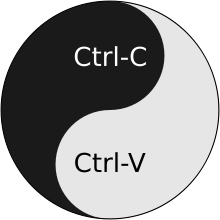
CTRL-C and CTRL-V are considered sacred symbols.  Kopimi symbol functions like a CC license.
Contrasts copyright regime w/today’s globalized digital culture; what does a
philosophy for/from the digital age tell us about the relation b/t philosophy
and material social conditions more generally?
 

Is it mere pranksterism, a piece of absurdist political
theater taken to its logical extremes? Originally a joke. Then someone got it
registered as an official religion. Is it a hoax or tactic to tweak media appetite
for spectacle or bypass © law?  And/or
can we understand it as an authentic belief system, w/ideological integrity and
consistency, ritualistic practices, and other hallmarks of religion?
 
Pranksterism: like/heir to Situationist detournement, which
already had some copyright-oppositional practices in it? Aims to expose © as
legally enforced ideological instrument by refuting it through a different
legally sanctioned ideology. Situationists also wanted to draw attn to presence
of ideology in the mass media image. 
Bricolage: already directly confronting © through cutting and
pasting. 

Why choose to perform an entire religion? 
Target is not absurdity of organized religion, but absurdity of ©, its
religious other.  Jedi-ism,
Pastafarianism: other invented religions—a suitable tactic to be adopted to
these aims?
 
Hoax: seeking legal protections to pirate w/impunity?  Again, Foucauldian tactic—maneuvering on a
network of relations of social power. 
Like medical marijuana advocacy in community of recreational users—by appropriating
rhetoric of science and economics, activists advocate for
decriminalization.  Normative political
claims about ©: to keep source code hidden is comparable to slavery; IP laws
are egregious violations of intellectual sovereignty and freedom.
 
Sacrament: Sacred valence of copying; similarity to monastic
Christian principles/devotional practices—sharing of private information is
detrimental, but sharing of public information is a sacrament. People decide
for themselves: distribution of responsibility, antireligious sentiment:
skepticism of moral authority is a core value. Suggests that monastic
Christianity, copyright, and Kopimism can all be understood as governing
information production during various periods related to technological
development and information scarcity. 
Monastic Christianity: sacred duty to spread the Word, which both
proselytizes and allows humans to act in God’s image by creating the world
through language.  Sharing the same bread
= all part of the same world/system—same with sharing information.
 
Conclusion: though Sweden is one of the most
agnostic/atheist nations in the world, Kopimism has attracted 1000s of active
members (also chapters in dozens of countries). Religious rituals provide a
benefit to people. Set of moral and ethical precepts and practices to navigage
complex questions of power and identity in postindustrial society.
 
Questions: practical/operational Qs—how much does Kopimi symbol
function as a license, like CC? How much is required for official recognition
as religion?  Adolescent fantasy of Liberland,
libertarian country at border of Croatia: declared itself a nation, but still
dependent on roads, electricity, internet from neighboring countries.  Can we draw links to other libertarian
politics, w/contradictory relationshps to state power/infrastructure?  Why chose religion rather than movement or
political party as self-description? What are the costs and benefits of
communicating politically in this way?
 
Sinnreich: relations to CC: not much.  CC is innovative, but this is not that.  Kopimism took advantage of new opening for
new religions—first three times they applied they were rejected. Needed to
demonstrate large base of members, religious texts, religious rituals: they
backfilled/there were no texts or rituals until the state asked. Which perhaps
supports the detournement/prank characterization. And maybe it did start that
way. They acknowledge the inherent absurdity, but indicated deepening moral
investment in belief system that seemed to surprise them more than anybody
else.
 
Relation to libertarian politics/state power and
infrastructure: great subject.  Unlike
Sealand or Liberland, it doesn’t require infrastructure from elsewhere. You
might say if Hollywood goes out of business they won’t have those films to
share, but there’s no inherent contradiction in desire to stake out
independence from copyright/postindustrial capitalism. The religion doesn’t
require the existence of those laws and economies to function. That’s why it’s
ultimately not a hoax or tactic.
 
That’s also why it’s a religion and not a political
movement. Born of moral impulse that exists in social theory and legal
argument: crossover w/Marxism, esp. libertarian Marxism: something inherently
rotten/dehumanizing in postindustrial capitalism.  Datalove: a fundamental concept for Kopimists—through
sharing information, you achieve empathy/Martin Buber-esque I-Thou relation
that has been severed through industrial models of dissemination/alienation.
Without living in a bunker, how do you reconnect w/other human beings when you’re
structurally excluded from knowing one another? Datalove through active
information sharing is an answer. Kopimism was an ethic before the religion
existed; Kopimism’s ethics will persist after the religion fades—search for
dignity in the networked society.
 
Q: what is the difference b/t ethical system and
religion?  Is calling it a religion just
another way to mediate culture through law? 
Just using law in a different way.
 
A: I’m not under the misapprehension that I’m qualified to
decide what counts as a religious order. 
I’ve done a lot of survey work internationally using qualitative
responses to examine ethical frameworks people employ to decide whether a reuse
of information is valid or not. We’ve identified 12 different ethical
frameworks: making money; homage or bastardization; etc.  By cross tabulating those frameworks w/more
empirical demographic information, we’ve discovered that nationality, race,
age, gender, income levels predict different ways of thinking, drawing on
predigital ethics imported into digital world. I think about very immediate
frameworks about judging permissible behavior. 
Those are the kinds of questions ethics are good at addressing. As I
understand it, what distinguishes a moral/religious system from an ethical one
is the broader framework that serves as a model for how the universe is
organized and what our place in it is and should be; ethics emerge from that
larger model. And I see that larger model in Kopimism.
 
The modern individual is a social conceit whose time has
basically expired. If all of our moral systems are rooted in the conception of the
modern individual, and our legal and economic systems are rooted in a
conception of a transactive relationship based on industrial capitalism, then
as those foundational precepts evaporate they have to be replaced by something
new. What is that? Kopimism is interesting b/c it’s not merely ethical but has
an integrated comprehensive view of the world that supersedes the centuries now
ending and offers opportunity to give us continuity w/human history even as we
let go of deeply held conceits underlying this era.
 
Q: are they seeking protection from the state apparatus?
 
A: no.  There is zero
chance anyone will get shielded from © through a religious exemption. This isn’t
Rastafarians asking to be able to smoke pot. 
More a statement of purpose. The act of registering Kopimism was more a
call to arms than tactical solution to a legal problem.
 
Q: Europe has tradition of state-funded religious
communities.  Creating a new one is kind
of a sport.  Check the relationship
between the state’s metaphysics and your own community.  Maybe they’ll get funding one day, or at least
infrastructure. 
 
A: Pastafarianism is done to make the point that religion is
bull, and the state has no business sanctioning religion as an institution or
religious exceptions as a category. I think that’s a great political exercise.
That’s not solely what Kopimism is. Kopimism could have done that much more
efficiently if that were its goal. Its moral resonances wouldn’t be the same—not
an integral quality from text to text. There is surely an intentional element
of situationism/critique of state’s role in Kopimism but it evolved into something
more than that, in part b/c of need to codify moral impulse of repulsion at
dehumanizing effects of postindustrial capitalism applied to information
exchange.  © maximalism’s approach to
communication and info sharing provokes a revulsion that finds a voice in
Kopimism that doesn’t appear in Jedi-ism or Pastafarianism.
 
One blogger on Patheos
blog had a very negative reaction to Kopism—consulted religious experts,
including a Patheos blogger/convert to Catholicism.  He felt very differently than the other
Patheos writer.  Was very interested in
resonance b/t logos theology and Kopimism. 
Diversity of viewpoint is justified. 
 
Madison: paper is framed as challenge to this set of
practices. IP law is default/norm and this is the exception in need of
exploration/explanation. You might reverse that set of questions: why isn’t
this the norm as an ethical system?  IP
as faith-based social practices—Mark Lemley’s
recent paper
.
 
A: that is the Kopimist approach to ©. I didn’t frame the
article that way b/c of my audience, which will be of skeptics who at least
reflexively support ©. But that’s exactly the point they want to make.
 
The people I talked to who were ordinary adherents thought
about an ethics of sharing—revenge porn, nuclear launch codes—they weren’t
absolutists. Sharing was about the social effects of regimes of sharing.
Seeking equalization in power relations through disrupting traditional regimes
of information sharing. Wikileaks, Hollywood = good sharing through evening
power relations. Sharing nude photos would be bad sharing—takes more power away
from powerless.
 
Q: this paper could be a chapter in a theology of Kopimism/a
sacred text.  Kopimism’s founder said he
started it b/c he thought it would lead to some interesting conversations—a lot
of contingency in founding. A small and diverse group.  Premature to reify the phenomenon.  Ability to get attention through grand
gesture matters in © activism. 
 
A: By calling something a religion, you make it a big deal
and that might just mean a big deal for attracting attention. But I thought he
also considered it a big deal in terms of the human condition; restricting to
legal argument would be inappropriate to the gravity of the crisis.  But that’s my read of it. I wouldn’t use the
mantle of religion b/c I lack the faith required. But the philosophy resonates
w/me.

from Blogger http://ift.tt/1JBzwsi

Posted in Uncategorized | Tagged , , | Leave a comment

ISHTIP at Penn, part 6

Session 4 | Traci Zimmerman (James Madison University), Moderator
 
Confederate Copyright: The Role of Nationalism in Designing a Copyright Regime
Shane Valenzi (Carmen D. Caruso Law Firm, Chicago)
Commentator | Shyam Balganesh (University of Pennsylvania)
 
In addition to examining the story of how the Confederates made copyright law, draws normative lessons for law and policy. Using history not just for its own sake. 
 
Rich paper (I very much agree), so broad summary only: 1790, 1831 federal copyright acts were fiercely protectionist, not extending protection to foreign authors.  This was not unnoticed—deeply contested, conscious choice, multiple failed reform efforts over the years, esp. post-1830.  Senator Henry Clay introduced multiple amendments in this area.  Tried to convince public that extension would benefit US authors.  British authors/supporters offered kitchen sink arguments: lack of protection allows American booksellers to free ride on foreign authors’ efforts, an unjust enrichment rationale; not protecting foreign authors results in mutilation and alteration of works, a moral rights rationale; harm to US authors b/c foreign-authored works were cheaper, an economic argument about indirect harm; American public, not authors, was harmed b/c of the uncertainty of various editions they received, a consumer protection argument (mirror image of moral rights argument).  Doesn’t tell us what they thought of purposes of copyright law; Britain didn’t have moral rights at the time.
 
None of these arguments proved persuasive.  The only thing the Senate cared about was protectionism/nationalism.  Primary difference b/t US and Confederate copyright acts was extension of protection to foreign authors—this was an issue of heightened salience at the time.
 
Civil War breaks out; 1861: enact an independent copyright act as a piece of federal legislation.  Why?  Driven almost entirely by desire to make England an ally of the South.  All the publishers the US sought to protect were located in the North.  A few years later, extended the Act retroactively to pre-1861 works.
 
Effect of Act was empirically minor: only 122 titles registered in 4 years.  All, intriguingly, focused on the preservation of Southern culture/distinctiveness of Southern way of life.  Great Britain never became an ally.
 
Qs: what other kinds of unified laws did the Confederacy pass?  How did they pick their subject areas? Why is legislation useful as a signal? Are there additional sources sending a signal of commitment to Britain?  If many laws were signalling, that argument gets stronger. Also, why enactment instead of enforcement as a credible signal?
 
Lessons: this part is provocative/controversial.  New intermediate variable: nationalism can be a cloak for access, progress, and other rhetorical devices. Confederacy didn’t seem interested in incentivizing access, furthering moral rights, spurring creativity; moral rights rely on human rights framework—he says it’s hard to reconcile w/slavery, but that’s not so much a problem b/c (a) slaveowners didn’t care much about hypocrisy, and (b) moral rights are fundamentally based on citizenship, so if you define that to exclude slaves you don’t have a problem.
 
Nationalist interests as step zero in the © debate: the current state of IP output in the nation at issue, plus diplomatic interests. Balganesh disagrees completely—collapses descriptive w/normative. This is descriptively true: nationalism did the work of eliding the real balancing exercise. But to claim that normatively as part of ideal structure is unconvincing and problematic. What does national output mean? 
 
Internationally: US in mid-19th c, w/underdeveloped authorship and sophisticated distribution systems, is not much different than today’s BRICs, breeding ground for piracy. Lacked authorial output to match capacity. Thinks that’s untrue. BRICs have significant amount of authorial output; the question is what portion they seek to put in the genuine/mainstream marketplace.  India clearly has a lot of debate about optimal structure of IP policy. It’s not b/c India is a pirate nation or a net importer.  [And here an enormous bug distracted me, sorry.]
 
RT suggests possible further reading: Stephen M. Best, The Fugitive’s Properties: Law and the Poetics of Possession (about copying and race in the 19th century).
 
Valenzi: Haven’t convinced myself about the normative conclusions.  When he discovered that there was a Confederate Copyright Act, his first question was why.  That has proven a difficult question to answer, but good enough for law review if not history journal.  Legal scholarship often uses history instrumentally.  No transcripts of floor debates before legislation passed, requiring conjecture for rationale for most Confederate legislation.
 
The legislature was quite active through the Confederacy—far more than they probably wanted/intended to be.  Not much passed in pursuit of creating int’l alliances, though. President Davis was urged to pursue an alliance. King Cotton strategy failed, as did their awful diplomats.
 
Research on patents was cursory so there may be more.  There were patents registered under the Confederate © Act.  As far as enforcement, there was almost none in district courts—only 1 case ever litigated.  A book of military tactics published in North, thus not eligible for protection in South, but Jefferson Davis asked the author—a Southern supporter—to republish in South; protection for earlier work was denied, and the result was amendment of law to make retroactive and law protecting that specific book.
 
Kara Swanson: there is a patent story here too.  Publishers could publish newspapers, pamphlets and books. Is this law designed to bring publishing to the Confederacy/domestic purpose as well?
 
A: Haven’t looked at newspapers but this is a WIP.  There was some publishing industry, esp. in Atlanta, and they did sometimes pay British publishers even before they were required to do so. There was concern in the US that if © were granted to British authors it would concentrate rights all in one NY publisher.
 
The first proposal for Confederate © Act was preceded by resolution that the Confederate Congress needed to respond to Emancipation Proclamation, and succeeded by compensation to a general whose horse died in battle. That’s quite a range. 
 
Jaszi: think about this story as of competing nationalisms.  Cultural and economic nationalisms are often in conflict. What do we know about “piracy” in the South? To what extent were reproductions coming out of Southern states, not just PA and NY?  IP clause of the Confederate Constitution is identical to US Constitution.  Southern diplomacy was not quite as disastrous as you characterize it as being—high water mark in end of 1862 when Gladstone came out as a big fan and said they were bound to win the war. 
 
RT: Descriptive, normative, pragmatic: third alternative (what should we predict, what tools are likely to work and likely to fail to lever changes).  Very clear that international relations arguments are key components of IP policy right now.  In fact arguably why they moved into TPP and other trade agreements is that nationalist interests proved too important to other nations; only when forced into some other deal would they agree to serve US (or at least big corporate) interests in IP.  But it didn’t work to get British support for the Confederates—analogies in 301 naughty lists; nothing China does is ever enough—Peter Yu’s work?
 
Sharing in Spirit: Kopimism and the Digital Eucharist
Aram Sinnreich (American University)
Commentator | Kristofer Erickson (University of Glasgow)
 
Reminded him of the Hacker Ethic: Weber’s concept of Protestant work ethic to try to understand hacker religiosity pervading the business world.  This paper explores a different religious group: Kopimists.  Protagonists: Isak Gerson, founder.  CTRL-C and CTRL-V are considered sacred symbols.  Kopimi symbol functions like a CC license. Contrasts copyright regime w/today’s globalized digital culture; what does a philosophy for/from the digital age tell us about the relation b/t philosophy and material social conditions more generally?
 

Is it mere pranksterism, a piece of absurdist political theater taken to its logical extremes? Originally a joke. Then someone got it registered as an official religion. Is it a hoax or tactic to tweak media appetite for spectacle or bypass © law?  And/or can we understand it as an authentic belief system, w/ideological integrity and consistency, ritualistic practices, and other hallmarks of religion?
 
Pranksterism: like/heir to Situationist detournement, which already had some copyright-oppositional practices in it? Aims to expose © as legally enforced ideological instrument by refuting it through a different legally sanctioned ideology. Situationists also wanted to draw attn to presence of ideology in the mass media image.  Bricolage: already directly confronting © through cutting and pasting. 
Why choose to perform an entire religion?  Target is not absurdity of organized religion, but absurdity of ©, its religious other.  Jedi-ism, Pastafarianism: other invented religions—a suitable tactic to be adopted to these aims?
 
Hoax: seeking legal protections to pirate w/impunity?  Again, Foucauldian tactic—maneuvering on a network of relations of social power.  Like medical marijuana advocacy in community of recreational users—by appropriating rhetoric of science and economics, activists advocate for decriminalization.  Normative political claims about ©: to keep source code hidden is comparable to slavery; IP laws are egregious violations of intellectual sovereignty and freedom.
 
Sacrament: Sacred valence of copying; similarity to monastic Christian principles/devotional practices—sharing of private information is detrimental, but sharing of public information is a sacrament. People decide for themselves: distribution of responsibility, antireligious sentiment: skepticism of moral authority is a core value. Suggests that monastic Christianity, copyright, and Kopimism can all be understood as governing information production during various periods related to technological development and information scarcity.  Monastic Christianity: sacred duty to spread the Word, which both proselytizes and allows humans to act in God’s image by creating the world through language.  Sharing the same bread = all part of the same world/system—same with sharing information.
 
Conclusion: though Sweden is one of the most agnostic/atheist nations in the world, Kopimism has attracted 1000s of active members (also chapters in dozens of countries). Religious rituals provide a benefit to people. Set of moral and ethical precepts and practices to navigage complex questions of power and identity in postindustrial society.
 
Questions: practical/operational Qs—how much does Kopimi symbol function as a license, like CC? How much is required for official recognition as religion?  Adolescent fantasy of Liberland, libertarian country at border of Croatia: declared itself a nation, but still dependent on roads, electricity, internet from neighboring countries.  Can we draw links to other libertarian politics, w/contradictory relationshps to state power/infrastructure?  Why chose religion rather than movement or political party as self-description? What are the costs and benefits of communicating politically in this way?
 
Sinnreich: relations to CC: not much.  CC is innovative, but this is not that.  Kopimism took advantage of new opening for new religions—first three times they applied they were rejected. Needed to demonstrate large base of members, religious texts, religious rituals: they backfilled/there were no texts or rituals until the state asked. Which perhaps supports the detournement/prank characterization. And maybe it did start that way. They acknowledge the inherent absurdity, but indicated deepening moral investment in belief system that seemed to surprise them more than anybody else.
 
Relation to libertarian politics/state power and infrastructure: great subject.  Unlike Sealand or Liberland, it doesn’t require infrastructure from elsewhere. You might say if Hollywood goes out of business they won’t have those films to share, but there’s no inherent contradiction in desire to stake out independence from copyright/postindustrial capitalism. The religion doesn’t require the existence of those laws and economies to function. That’s why it’s ultimately not a hoax or tactic.
 
That’s also why it’s a religion and not a political movement. Born of moral impulse that exists in social theory and legal argument: crossover w/Marxism, esp. libertarian Marxism: something inherently rotten/dehumanizing in postindustrial capitalism.  Datalove: a fundamental concept for Kopimists—through sharing information, you achieve empathy/Martin Buber-esque I-Thou relation that has been severed through industrial models of dissemination/alienation. Without living in a bunker, how do you reconnect w/other human beings when you’re structurally excluded from knowing one another? Datalove through active information sharing is an answer. Kopimism was an ethic before the religion existed; Kopimism’s ethics will persist after the religion fades—search for dignity in the networked society.
 
Q: what is the difference b/t ethical system and religion?  Is calling it a religion just another way to mediate culture through law?  Just using law in a different way.
 
A: I’m not under the misapprehension that I’m qualified to decide what counts as a religious order.  I’ve done a lot of survey work internationally using qualitative responses to examine ethical frameworks people employ to decide whether a reuse of information is valid or not. We’ve identified 12 different ethical frameworks: making money; homage or bastardization; etc.  By cross tabulating those frameworks w/more empirical demographic information, we’ve discovered that nationality, race, age, gender, income levels predict different ways of thinking, drawing on predigital ethics imported into digital world. I think about very immediate frameworks about judging permissible behavior.  Those are the kinds of questions ethics are good at addressing. As I understand it, what distinguishes a moral/religious system from an ethical one is the broader framework that serves as a model for how the universe is organized and what our place in it is and should be; ethics emerge from that larger model. And I see that larger model in Kopimism.
 
The modern individual is a social conceit whose time has basically expired. If all of our moral systems are rooted in the conception of the modern individual, and our legal and economic systems are rooted in a conception of a transactive relationship based on industrial capitalism, then as those foundational precepts evaporate they have to be replaced by something new. What is that? Kopimism is interesting b/c it’s not merely ethical but has an integrated comprehensive view of the world that supersedes the centuries now ending and offers opportunity to give us continuity w/human history even as we let go of deeply held conceits underlying this era.
 
Q: are they seeking protection from the state apparatus?
 
A: no.  There is zero chance anyone will get shielded from © through a religious exemption. This isn’t Rastafarians asking to be able to smoke pot.  More a statement of purpose. The act of registering Kopimism was more a call to arms than tactical solution to a legal problem.
 
Q: Europe has tradition of state-funded religious communities.  Creating a new one is kind of a sport.  Check the relationship between the state’s metaphysics and your own community.  Maybe they’ll get funding one day, or at least infrastructure. 
 
A: Pastafarianism is done to make the point that religion is bull, and the state has no business sanctioning religion as an institution or religious exceptions as a category. I think that’s a great political exercise. That’s not solely what Kopimism is. Kopimism could have done that much more efficiently if that were its goal. Its moral resonances wouldn’t be the same—not an integral quality from text to text. There is surely an intentional element of situationism/critique of state’s role in Kopimism but it evolved into something more than that, in part b/c of need to codify moral impulse of repulsion at dehumanizing effects of postindustrial capitalism applied to information exchange.  © maximalism’s approach to communication and info sharing provokes a revulsion that finds a voice in Kopimism that doesn’t appear in Jedi-ism or Pastafarianism.
 
One blogger on Patheosblog had a very negative reaction to Kopism—consulted religious experts, including a Patheos blogger/convert to Catholicism.  He felt very differently than the other Patheos writer.  Was very interested in resonance b/t logos theology and Kopimism.  Diversity of viewpoint is justified. 
 
Madison: paper is framed as challenge to this set of practices. IP law is default/norm and this is the exception in need of exploration/explanation. You might reverse that set of questions: why isn’t this the norm as an ethical system?  IP as faith-based social practices—Mark Lemley’s recent paper.
 
A: that is the Kopimist approach to ©. I didn’t frame the article that way b/c of my audience, which will be of skeptics who at least reflexively support ©. But that’s exactly the point they want to make.
 
The people I talked to who were ordinary adherents thought about an ethics of sharing—revenge porn, nuclear launch codes—they weren’t absolutists. Sharing was about the social effects of regimes of sharing. Seeking equalization in power relations through disrupting traditional regimes of information sharing. Wikileaks, Hollywood = good sharing through evening power relations. Sharing nude photos would be bad sharing—takes more power away from powerless.
 
Q: this paper could be a chapter in a theology of Kopimism/a sacred text.  Kopimism’s founder said he started it b/c he thought it would lead to some interesting conversations—a lot of contingency in founding. A small and diverse group.  Premature to reify the phenomenon.  Ability to get attention through grand gesture matters in © activism. 
 
A: By calling something a religion, you make it a big deal and that might just mean a big deal for attracting attention. But I thought he also considered it a big deal in terms of the human condition; restricting to legal argument would be inappropriate to the gravity of the crisis.  But that’s my read of it. I wouldn’t use the mantle of religion b/c I lack the faith required. But the philosophy resonates w/me.
Posted in copyright, http://schemas.google.com/blogger/2008/kind#post | Leave a comment

Washington Post explains how the DMCA will kill your family

Buries the lede a bit, but it gets there:

The industry says the law protects consumers by preventing cars from being hacked. But the main impact, say Rad and other security researchers, is to stem the tide of revelations embarrassing to carmakers — not to improve vehicle cybersecurity. “If the stuff is out there,” she said, “the bad guys already know about it.”

When you outlaw security research, only bad guys will do it.

HT and title Zach Schrag

from Blogger http://ift.tt/1fpJWTW

Posted in Uncategorized | Tagged , | Leave a comment

ISHTIP at Penn, Part 5

Session 3 | Marianne Dahlén (Uppsala University,
Sweden), Moderator
 
Design and Copyright: An Open Question?
Stina Teilmann-Lock (University of Southern Denmark)
Commentator | Jessica Silbey (Northeastern University)
 
Openness in the law for fair followers?  Design in law in Denmark from 1908: fair
followers can copy, despite existence of copyright protection—a balance b/t
copying to develop and proliferate design and control/remuneration for designers.  Balance is very hard to achieve; pendulum
swings between 1908 and 1960 due to categorical shifts in legal reasoning.  Rely on foundational assumptions about art,
purposes of ©, and people © is supposed to benefit.
 
One approach: deny © to industrial design of any kind.  Platonic idea of art. Other trend is protect original
ornamentation wherever found, but make it thin/identical copying only. Similar
trend in US/Bleistein’s anti-discrimination principle.  Danish SCt, 1908, ruled that coffee pot was
uncopyrightable—it was meant to proliferate in the market despite its
decorations/artistic qualities.  It had a
prototype. 
 
Modernist art: fashion and painting, font and furniture, art
and politics were all linked. When Demnark amends copyright act in 1908 to
cover prototypes for industrial art and handicrafts, whether or not
reproduction takes place w/purely artistic purpose or industrial purpose/practical
use: a kind of leveling, bringing more artists under the copyright tent.
Similar to US: the copy is an individual reaction to something in nature;
virtually any personal reaction will be copyrightable. Also comports
w/political movements of modernism/industrial capitalism. 
 
Kantian influence over Danish © was strong and resisted this
impulse. Talent or genius, used to reinforce hierarchy of fine art.  Not clear whether paper celebrates this
exclusion, though calls it a chance for “openness.” Clearly based on an
elitism/certain objects are only marginally protected, while jewelry and other
ornamental features were protected.
 
Bauhaus chairs from 1930s: experts found them worthy of
protection, but Danish courts didn’t—unique features came from style/particular
materials and thus not artistic worthy of protection.  Functionalist furniture + rhetoric of
modernist movement made applied art even more problematic in © terms—the binary
of fine art/craft is based on this fiction of individuality/common practice
also being a binary.  Mythology of
originality/genius that denies/suppresses evolutionary practices while
simultaneously denying to everyday creators the benefit of legal protection.
 
So broadening the categories of protection to add applied
art in 1961 didn’t flatten the hierarchy. 
What does this mean for industrial designs?  Simple/common forms could be copyrighted when
they existed in harmonious unity, selected by the designer.  Where then is the openness? Disappearance of
shared community, mutual following. Savior of openness in Denmark isn’t an
antidote to romance of individuality, but rather a doctrine of thin
copyright.  Low originality requirement
must have as its concomitant a narrow scope of protection.  But then does that perpetuate hierarchy of
copyright genres?
 
Should always ask who benefits from regimes and where the
harm is.  Openness allowed: benefits of
IP equality/leveling down extend beyond traditional authorship to audiences and
fair followers.  Progress comes through
copying; fair followers need as much openness as possible.  Category of design generally is a problem
across IP disciplines.  Whether design is
protected in © is also imported into TM and patent. It is a special category in
almost every statutory IP regime and its specialness is confusing—a sui generis
category w/o justification where there is so much overlap.
 
Teilmann-Lock: Double status of design comes from its basis
in engineering as well. We mean different things when we say design—technical and
artistic. See it too in the Berne Convention, where it’s left to individual
nations to deal.  Conceptions of design
have been very different across time/place. 
Actors w/the most to say in defining design in Denmark have been
graduates of Academy of Fine Arts—furniture architects, a very loaded term in
Danish b/c its connotation is a particular generation of designers who made
Danish Modern design globally known.
 
Ornament is a naughty word in the design world, which is
trained that form follows function.  It
means bad taste. Illusion that object can be stripped down to its
function. 
 
Farley: in terms of history, Danish design’s heyday was post
WWII to late 1960s.  Change in law of
1961, if consequential, comes at an interesting time.  Is there a consequence for design?  Danish courts became good at seeing the art
in functional design; not all courts did. 
American/individualistic approach—we don’t ask, can I see art in that
chair? We say instead: what were the alternative designs? Were artistic choices
made?  Danish ideal: reduce to its essence;
that would take the US choice approach off the table.  Danish court says artistic design is “naturally”
motivated where US court would see that as a reason not to grant protection.
When the Q is alternatives, there are almost always alternatives; but if ct is
forced to assess art, it may deny protection from fear of having to make
artistic judgments.
 
A: Court-appointed experts play a role in the Danish
cases.  Experts had managed to persuade
courts of their understanding of aesthetics. 
Almost lecturing the courts for the first half of the century about
modernist aesthetics and finally courts took it in.  (Similar thing arguably w/appropriation art
and the last 50 years of fair use in the US courts.) 

Danish designers always have their names on products: a French press is called
a Bonum (sp?) because of the name of the designer.  A TM too, of course.
 
Challenging The Black Box: On the Accountability of
Algorithmic Law Enforcement
Maayan Perel and Niva Elkin-Koren (University of Haifa)
Commentator | Maria Lillà Montagnani (Bocconi University,
Italy)
 
Algorithmic © enforcement by online intermediaries. How/are
they held accountable for what they do? 
Framework against which we can judge them.  Tech has always assisted legal enforcement;
not aware of it most of the time. 
Speeding cameras.  In traditional
enforcement situations, decisionmakers make a decision and the tech just helps
implement it.  But online, private
entities translate the law itself into an algorithm.  Functions that were actually discrete are now
carried out by the same entity: law enforcement & adjudication.  And the algorithm is unknown, black box. We
can’t know if the law is actually being complied with, esp. in situations of
fair use. Dangerous effects on public sphere.
 
Proposal: public scrutiny, not judicial scrutiny.  (Could in the alternative have an ASCAP-style
antitrust control.)  How to distinguish
from content management decisions made by intermediaries as part of their
business operations?  Does the public
have a sufficient opportunity to challenge decisions? Can they correct
erroneous decisions? 
 
Proxies for this: public literacy through transparency.  Due process—ability to challenge decision/have
a voice.  Public oversight: ability to
contest removal/restore content.
 
Regulated algorithmic © enforcement, as distinguished from
unregulated.  The DMCA doesn’t achieve
these goals.  DMCA: uploader is not
informed when link is removed. 
Counternotice doesn’t preserve due process b/c the content is
immediately removed: an extrajudicial TRO based only on © owner’s allegations.
If this is true of statutory © enforcement, it’s much worse with completely
unregulated/private/voluntary regimes—e.g., filtering that prevents publication
in the first place—no transparency; no notice; no due process; no
counternotice.
 
Google: ex post and ex ante measures, filtering as a
business model. Enables © owners to monetize other parties’ uploading. But that
doesn’t meet the framework for judging accountability.
 
Barriers to oversight: Technical barriers linked to
nontransparent algorithmic mechanisms as such. 
Legal barriers: bars on reverse engineering, research: anticircumvention
laws; requirement that you aver ownership in good faith (so you can’t test the
operation of the system); user-generated barriers b/c users tend not to send
the counternotices b/c the wording of a notice is so scary.
 
We know that these systems don’t work from an accountability
perspective.  Public oversight would be
better than nothing, but why not change the approach: if © and tech don’t work
together, start from scratch, and think of something that works.  Doesn’t make sense to try to make the tech
fit ©; make © that fits tech, like privacy by design.  More collaborative approach b/t regulators
and intermediaries.
 
Elkin-Koren: purpose was to map issues surrounding
algorithmic enforcement, and offer theoretical framework for thinking about it.
Not necessarily providing ready-made solutions. Context of a larger effort on
algorithmic enforcement. We have data for 3 years about enforcement by
algorithm and enforcement in court—Israel is a small environment that allows a
population study.  Software for example
operates only by notice and takedown, not in court; other types of works are in
court and not by takedown.  Most
interesting finding: algorithmic enforcement is 7000-8000 notices compared to 100
lawsuits over the same 6 months. We are also looking at the notices.  50% of notices are actually related to the
right to be forgotten, though filed under DMCA. 
Google’s Transparency Report doesn’t give this info—requires a lot of
analysis.  History can help understand
where we are.
 
Perel: Empirical study that spurred this paper: we tried to
learn systematically about how online platforms in Israel enforce ©; whether
they verify rights claims; whether they correctly remove only infringing
content. Tried to upload different materials, some clearly noninfringing and
some clearly infringing (like an episode of House),
and some fair use (baby dancing in Lenz-style
video).  Recorded results of sending
takedown notice.  Algorithmic enforcement
is chaotic in Israel: most platforms did nothing to verify rights; some took
down noninfringing content and some didn’t take down infringing content. Couldn’t
do this experiment in the US b/c of the DMCA legal barriers (anticircumvention
and oath requirement in takedown; CFAA). But anecdotal evidence of same errors
in the US.
 
Elkin-Koren: skeptical both about privacy by design and © by
design: doesn’t help us avoid the challenge. Don’t give priority to people who
design the wires. The community should decide, using an appropriate
decisionmaking process. Legislators would have difficulty designing the system
too.  Challenge: how to design legal
interventions that would be more appropriate for this dynamic environment. We
could set standards, but those are problematic as well—can create
distortions.  We are dealing with
continuously changing tech.  Ongoing
legal intervention is therefore required. 
Platform behavior is constantly changing.  Some of our data we’ve shown to Google; they
had no clue.
 
RT: I’m going to do the lawyer thing and ask for specific solutions.  So frustrating; we’ve been saying these
systems don’t work for years and now, instead of any proposals for improvement,
from © owners we get the Frank Luntz-style phrase “notice and staydown” as their
new euphemism for filtering.  What if
anything is the most effective way of making these concerns persuasive to
non-IP scholars?  Multistakeholder in my
experience means: we are going to wear you down with procedure and time, b/c
you aren’t getting paid by the hour to represent the public interest.  Experience of recent
DMCA best practices statement
“multistakeholder process” hosted by
PTO/NTIA: most anodyne results possible (only anodyne results were possible).  Multistakeholder process only works where
there is ground for compromise: what is that ground?
 
Elkin-Koren: Multistakeholder regimes are not what we’re
trying to advocate—there are indeed many problems.  © is just a test case for online
disputes/algorithms.  Maybe some
solutions can be achieved more broadly across regimes.
 
Q: FB algorithms that vote down stories that don’t help FB
financially—serve no purpose other than as a mask for unaccountable power/to
encourage brands to pay FB for access. 
Similar issues.
 
Q: YT’s US terms of use don’t cover reverse engineering of
takedown algorithm, but Israeli terms of use specifically say you agree not to
interfere w/© security or inspection mechanism. Another type of legal barrier.
Difference b/t jurisdictions is interesting. 
User-generated barriers: has been approached by musicians that received
takedowns after trying to monetize their channels.  They are very scared.  If you counternotify on grounds of fair use;
the algorithm shuts down; maybe that’s another way to challenge (this is not
universally true! I know people whose fair use counternotifications have simply
been ignored).
 
Jaszi: at least two black boxes. One is the algorithm. Another
Q is why the counternotice provisions are so dramatically underutilized.  You categorize some possibilities in the paper:
fear, risk of exposure, simple lack of information, lack of solidarity (people
feel like exposed isolates rather than part of a group), indifference (it was
one of many videos; it’s already up on other platforms). There is a practical
point of intervention: we need information about why people don’t counternotify;
we have wonderful hypotheses but need real empirical work. If enough made use
of it would throw system into disarray.
 
Perel: it’s impossible to send 1 million counternotices a
day.
 
Jaszi: but why are we sure that resistance would require
numerical proportion?  1000 might be
enough.
 
Elkin-Koren: there is no one you can deal with if you have a
FB problem in Israel.
 
Q: responses to EU consultation on ©: a lot of responses
from intermediaries on increasing responsibility for blocking infringing
content. Adopted discourse of economic transaction costs—burdensome introduction
of new requirements.  Intermediaries are
reticent to handle interactions w/public. Why won’t intermediaries reject
transparency on grounds of transaction/operating costs?
 
Q: © as test case for other areas of law—surveillance machinery
is the same.
 
Elkin-Koren: transparency is insufficient; comes with costs.
I wouldn’t require more reports/more information: intermediaries should allow
their systems to be more transparent, open to inspection/monitoring by
outsiders as we are being monitored by them. Not necessarily the same type of
cost.  Maybe the reason © disputes turned
into political disputes is the fact that © enforcement infrastructure is the
infrastructure for other types of surveillance and control.  When you want to remove a documentary on rape
in India, you convince BBC to file a takedown. 
That was the only way to remove it. 
It’s not b/c © fits but b/c © is perceived as neutral.

from Blogger http://ift.tt/1JhJm6P

Posted in Uncategorized | Tagged , , , | Leave a comment

Washington Post explains how the DMCA will kill your family

Buries the lede a bit, but it gets there:

The industry says the law protects consumers by preventing cars from being hacked. But the main impact, say Rad and other security researchers, is to stem the tide of revelations embarrassing to carmakers — not to improve vehicle cybersecurity. “If the stuff is out there,” she said, “the bad guys already know about it.”

When you outlaw security research, only bad guys will do it.

HT and title Zach Schrag

Posted in dmca, drm | Leave a comment