All that is solid melts into air: photog loses claim against Nike Jordan photo and logo

Rentmeester v. Nike, Inc., No. 3:15-cv-00113 (D. Ore. Jun.
15, 2015)
 
Rentmeester shot a photo of then-North Carolina student
Michael Jordan for a 1984 issue of LIFE magazine.  Instead of a conventional gym shot,
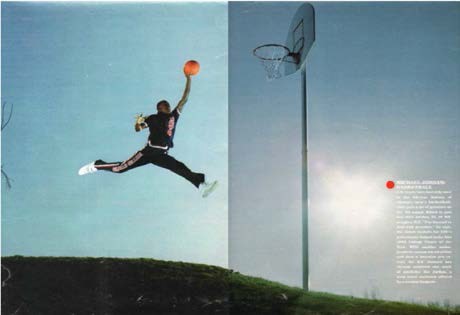
Rentmeester photographed Jordon outdoors, “on a relatively isolated grassy hill
with no visual distractions other than the setting sun and a basketball hoop he
had temporarily installed on the hill.” 
He wanted an untraditional pose, so he instructed Jordan “to jump
straight up and perform a grand jeté, a ballet leap, while holding a
basketball.”  Rentmeester argued that he
was the first person ever to photograph a basketball player in this specific
pose.  In his view, “the creative genius
of the pose, and the overall construction of the image, is to trick the viewer
into thinking that Mr. Jordan is actually performing a dunk when in fact he is
not.” To get this effect, Rentmeester put his camera approximately 90 degrees
to Jordan’s apparent trajectory and slightly below, creating an effect of
looking up at Jordan.  To get precise
detail, Rentmeester used a very rapid shutter speed and powerful synchronized
strobe lights.
 

Rentmeester photo in LIFE
LIFE published the photo just when Nike was preparing to
launch its endorsement relationship with Jordan, and Nike contacted Rentmeester
to request color transparencies of the photo.  He agreed to lend them to Nike for $150, “for
slide presentation only, no layout or any other duplication.” Nike created a
similar photograph and displayed it on billboards and posters.  Rentmeester objected, and the parties
negotiated a limited and temporary use of the Nike photo—Nike paid $15,000 for
a two-year license, but Nike continued to use the photo on a wide variety of
billboards, advertisements, and merchandise. In 1987, Nike began using the
Jumpman Logo on all of its Jordan Brand merchandise.
 

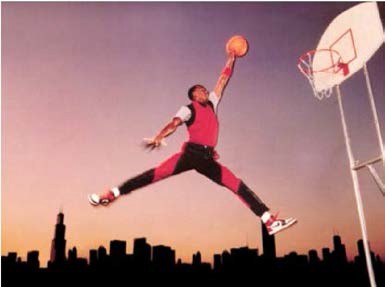
Nike’s Jordan photo

Nike’s Jumpman logo

Rentmeester sued for copyright infringement, and lost—finally,
a ruling that replicates what we should’ve gotten out of the Obama HOPE
litigation.
 
What qualifies as substantial similarity depends on the
underlying facts, and the Ninth Circuit uses a sliding scale depending on the
works at issue. From Mattel,
Inc. v. MGA Entertainment, Inc.
:
 
If there’s a wide range of
expression (for example, there are gazillions of ways to make an aliens-attack
movie), the copyright protection is “broad” and a work will infringe if it’s
“substantially similar” to the copyrighted work. If there’s only a narrow range
of expression (for example, there are only so many ways to paint a red bouncy
ball on blank canvas), the copyright protection is “thin” and a work must be
virtually identical to infringe.
 
(Based on the language of this excerpt, I’ll give you three
guesses who wrote the opinion, and the first two don’t count.)  So the key inquiry was whether Rentmeester’s
photo involved a wide or narrow range of expression.  The court rejected Nike’s claim that
virtually all photos had thin protection. 
Rather, to determine the breadth of copyright protection in a work, a
court must decide “what idea is being expressed by the artist,” and that idea
is unprotected. “The breadth of protection afforded to a particular expression
is determined by the number of possible expressions of the idea.”  The key question is always whether the works
are substantially similar beyond
depicting the same idea.  Substantial
similarity can’t be based on similarity in unprotectable elements.
 
What is the idea of the Rentmeester photo?  His counsel argued that it was “basically the
task that Mr. Rentmeester was charged with,” but the court disagreed; that
would let broad copyright protection be created out of thin air by broad
commissions.  Instead, the court went with
“what idea the creator of the work was trying to express when she created the
copyrighted work.”  That was, as Rentmeester’s
own claims made clear, that of,“Michael Jordan in a gravity- defying dunk, in a
pose inspired by ballet’s grand-jeté.”
 
The next step was to determine the range of possible ways to
express that idea.  There were more than
a few ways to do so, and less than a gazillion. 
There were technically an infinite number of perspectives from which the
photo could have been taken, but practically there were only “ten to fifteen” materially
different perspectives available.  Likewise,
there were only a handful of materially different lighting possibilities.  Photos involving a specific pose don’t
necessarily receive categorically thin protection, but the idea in this case
was closer to the “red bouncy ball on canvas” idea than “aliens-attack movie,”
and therefore the copyright was thin.
 
Then, the court filtered out the unprotected elements: the
basketball hoop, the basketball, a man jumping, Mr. Jordan’s skin color, and
his clothing.  Rentmeester argued that
his particular arrangement of these unprotected elements was protected, and
this is in general true.  However, given
the idea of “Michael Jordan in a gravity-defying dunk, in a pose inspired by
ballet’s grand-jeté,” there was “nothing original about the selection and
arrangement of having a Michael Jordan jump with a basketball in the vicinity
of a basketball hoop—that is all scenes a faire for the idea at issue.”  The only arguably original part was taking
the photo outside, but a lot of basketball is played outside.
 
Rentmeester also sought protection for the pose.  Even if the idea of the pose was original,
that doesn’t let him control it with copyright. 
“The law draws no distinction between original and unoriginal ideas.”  However, the actual expression of the idea in
a pose could be protected, but there were material differences between the two
photos in their expression of the pose. 
Rentmeester’s photo showed Jordan’s right arm bent at the elbow; Nike’s
showed his right arm extending straight down and away from the basket.  In the Rentmeester photo, Jordan’s arm was
bent slightly backwards while in the Nike photo it was fully extended and depicted
above the basket. In the Rentmeester photo, Jordan’s legs were positioned as if
he were jumping while running forward (a traditional grand-jeté). “His legs are
apart like a scissor split, nearly creating a straight line.” In Nike’s photo, Jordan’s
legs were positioned as if he had jumped up vertically and spread his legs wide
in a straddle position, creating a “V” as opposed to a straight line.  Given the thinness of the copyright at issue,
no reasonable jury could find substantial similarity between the two photos.
 
After the filtering was complete, all that was left was
either (1) “two photographs taken at a similar angle, one of a grassy hill with
a blue sky background and a setting sun, and the other of the skyline of
Chicago with a red and purple sky background”; or (2) that, plus Jordan in a
grand-jeté pose.  In the first view it
would be a stretch to find the photos similar at all; in the second, all that
was added was an element that was not itself substantially similar in the two
photos.  Adding in Jordan would also add
in other differences—Jordan’s scale and placement differed in the photos; also,
in the Rentmeester photo the viewer can clearly see the hill Jordan jumped
from, while in the Nike photo there was no depiction of where he jumped from, “but
rather he appears as though he is flying over the skyline of Chicago.” These
many differences overcame the similarity of the photos from similar angles.
 
Once that conclusion had been reached, the noninfringing
nature of the Jumpman logo followed as well. 
The only similarity with the Rentmeester photo was in the idea of a grand-jeté
pose—“the Jumpman Logo is nothing more than an expression of the pose.”  DMCA false copyright management information
claims under §1202 also failed because there was no infringement and Nike
couldn’t be faulted for claiming it owned the copyright in its works.

from Blogger http://ift.tt/1Bmm3ag
Posted in Uncategorized | Tagged | Leave a comment

All that is solid melts into air: photog loses claim against Nike Jordan photo and logo

Rentmeester v. Nike, Inc., No. 3:15-cv-00113 (D. Ore. Jun. 15, 2015)
 
Rentmeester shot a photo of then-North Carolina student Michael Jordan for a 1984 issue of LIFE magazine.  Instead of a conventional gym shot, Rentmeester photographed Jordon outdoors, “on a relatively isolated grassy hill with no visual distractions other than the setting sun and a basketball hoop he had temporarily installed on the hill.”  He wanted an untraditional pose, so he instructed Jordan “to jump straight up and perform a grand jeté, a ballet leap, while holding a basketball.”  Rentmeester argued that he was the first person ever to photograph a basketball player in this specific pose.  In his view, “the creative genius of the pose, and the overall construction of the image, is to trick the viewer into thinking that Mr. Jordan is actually performing a dunk when in fact he is not.” To get this effect, Rentmeester put his camera approximately 90 degrees to Jordan’s apparent trajectory and slightly below, creating an effect of looking up at Jordan.  To get precise detail, Rentmeester used a very rapid shutter speed and powerful synchronized strobe lights.
 

Rentmeester photo in LIFE
LIFE published the photo just when Nike was preparing to launch its endorsement relationship with Jordan, and Nike contacted Rentmeester to request color transparencies of the photo.  He agreed to lend them to Nike for $150, “for slide presentation only, no layout or any other duplication.” Nike created a similar photograph and displayed it on billboards and posters.  Rentmeester objected, and the parties negotiated a limited and temporary use of the Nike photo—Nike paid $15,000 for a two-year license, but Nike continued to use the photo on a wide variety of billboards, advertisements, and merchandise. In 1987, Nike began using the Jumpman Logo on all of its Jordan Brand merchandise.
 

Nike’s Jordan photo

Nike’s Jumpman logo

Rentmeester sued for copyright infringement, and lost—finally, a ruling that replicates what we should’ve gotten out of the Obama HOPE litigation.
 
What qualifies as substantial similarity depends on the underlying facts, and the Ninth Circuit uses a sliding scale depending on the works at issue. From Mattel, Inc. v. MGA Entertainment, Inc.:
 
If there’s a wide range of expression (for example, there are gazillions of ways to make an aliens-attack movie), the copyright protection is “broad” and a work will infringe if it’s “substantially similar” to the copyrighted work. If there’s only a narrow range of expression (for example, there are only so many ways to paint a red bouncy ball on blank canvas), the copyright protection is “thin” and a work must be virtually identical to infringe.
 
(Based on the language of this excerpt, I’ll give you three guesses who wrote the opinion, and the first two don’t count.)  So the key inquiry was whether Rentmeester’s photo involved a wide or narrow range of expression.  The court rejected Nike’s claim that virtually all photos had thin protection.  Rather, to determine the breadth of copyright protection in a work, a court must decide “what idea is being expressed by the artist,” and that idea is unprotected. “The breadth of protection afforded to a particular expression is determined by the number of possible expressions of the idea.”  The key question is always whether the works are substantially similar beyonddepicting the same idea.  Substantial similarity can’t be based on similarity in unprotectable elements.
 
What is the idea of the Rentmeester photo?  His counsel argued that it was “basically the task that Mr. Rentmeester was charged with,” but the court disagreed; that would let broad copyright protection be created out of thin air by broad commissions.  Instead, the court went with “what idea the creator of the work was trying to express when she created the copyrighted work.”  That was, as Rentmeester’s own claims made clear, that of,“Michael Jordan in a gravity- defying dunk, in a pose inspired by ballet’s grand-jeté.”
 
The next step was to determine the range of possible ways to express that idea.  There were more than a few ways to do so, and less than a gazillion.  There were technically an infinite number of perspectives from which the photo could have been taken, but practically there were only “ten to fifteen” materially different perspectives available.  Likewise, there were only a handful of materially different lighting possibilities.  Photos involving a specific pose don’t necessarily receive categorically thin protection, but the idea in this case was closer to the “red bouncy ball on canvas” idea than “aliens-attack movie,” and therefore the copyright was thin.
 
Then, the court filtered out the unprotected elements: the basketball hoop, the basketball, a man jumping, Mr. Jordan’s skin color, and his clothing.  Rentmeester argued that his particular arrangement of these unprotected elements was protected, and this is in general true.  However, given the idea of “Michael Jordan in a gravity-defying dunk, in a pose inspired by ballet’s grand-jeté,” there was “nothing original about the selection and arrangement of having a Michael Jordan jump with a basketball in the vicinity of a basketball hoop—that is all scenes a faire for the idea at issue.”  The only arguably original part was taking the photo outside, but a lot of basketball is played outside.
 
Rentmeester also sought protection for the pose.  Even if the idea of the pose was original, that doesn’t let him control it with copyright.  “The law draws no distinction between original and unoriginal ideas.”  However, the actual expression of the idea in a pose could be protected, but there were material differences between the two photos in their expression of the pose.  Rentmeester’s photo showed Jordan’s right arm bent at the elbow; Nike’s showed his right arm extending straight down and away from the basket.  In the Rentmeester photo, Jordan’s arm was bent slightly backwards while in the Nike photo it was fully extended and depicted above the basket. In the Rentmeester photo, Jordan’s legs were positioned as if he were jumping while running forward (a traditional grand-jeté). “His legs are apart like a scissor split, nearly creating a straight line.” In Nike’s photo, Jordan’s legs were positioned as if he had jumped up vertically and spread his legs wide in a straddle position, creating a “V” as opposed to a straight line.  Given the thinness of the copyright at issue, no reasonable jury could find substantial similarity between the two photos.
 
After the filtering was complete, all that was left was either (1) “two photographs taken at a similar angle, one of a grassy hill with a blue sky background and a setting sun, and the other of the skyline of Chicago with a red and purple sky background”; or (2) that, plus Jordan in a grand-jeté pose.  In the first view it would be a stretch to find the photos similar at all; in the second, all that was added was an element that was not itself substantially similar in the two photos.  Adding in Jordan would also add in other differences—Jordan’s scale and placement differed in the photos; also, in the Rentmeester photo the viewer can clearly see the hill Jordan jumped from, while in the Nike photo there was no depiction of where he jumped from, “but rather he appears as though he is flying over the skyline of Chicago.” These many differences overcame the similarity of the photos from similar angles.
 
Once that conclusion had been reached, the noninfringing nature of the Jumpman logo followed as well.  The only similarity with the Rentmeester photo was in the idea of a grand-jeté pose—“the Jumpman Logo is nothing more than an expression of the pose.”  DMCA false copyright management information claims under §1202 also failed because there was no infringement and Nike couldn’t be faulted for claiming it owned the copyright in its works.
Posted in http://schemas.google.com/blogger/2008/kind#post | Leave a comment

Amicus brief in Slep-Tone about scope of Dastar

Belatedly, I also participated in this amicus brief in Slep-Tone v. Canton Phoenix, now on appeal in the 9th Circuit, about an attempt to make an end run around lack of copyright ownership to assert trademark claims instead.  Thanks to Mark McKenna for doing the heavy lifting.

from Blogger http://ift.tt/1G7MzRc

Posted in Uncategorized | Tagged , , | Leave a comment

Amicus brief in Slep-Tone about scope of Dastar

Belatedly, I also participated in this amicus brief in Slep-Tone v. Canton Phoenix, now on appeal in the 9th Circuit, about an attempt to make an end run around lack of copyright ownership to assert trademark claims instead.  Thanks to Mark McKenna for doing the heavy lifting.

Posted in dastar, http://schemas.google.com/blogger/2008/kind#post, trademark | Leave a comment

Amicus brief in TVEyes fair use case

Chris Sprigman and I have written an amicus brief on behalf of certain IP professors in the Fox v. TVEyes case, in which the court is now considering several features of the TVEyes service as to which it reserved judgment in its initial ruling.  Unsurprisingly, we argue that–given the initial ruling that the TVEyes news database is a fair use–the remaining functionality TVEyes offers is noninfringing/fair.

from Blogger http://ift.tt/1ImE995

Posted in Uncategorized | Tagged | Leave a comment

Amicus brief in TVEyes fair use case

Chris Sprigman and I have written an amicus brief on behalf of certain IP professors in the Fox v. TVEyes case, in which the court is now considering several features of the TVEyes service as to which it reserved judgment in its initial ruling.  Unsurprisingly, we argue that–given the initial ruling that the TVEyes news database is a fair use–the remaining functionality TVEyes offers is noninfringing/fair.

Posted in http://schemas.google.com/blogger/2008/kind#post | Leave a comment

False patent marking not actionable under Lanham Act

Leisure Concepts, Inc. v. California Home Spas, Inc., 2015
WL 3658190, No. 14–CV–388 (E.D. Wash. June 12, 2015)
 
Leisure and CHS compete in spa products, including spa cover
lifters.  Leisure’s CoverMate I is
protected by a patent, which it claimed was infringed by CHS’s Cover EX.  CHS marketed the Cover EX with a sign
reading: “All Aluminum Design NO PLASTIC Compare to the Cover Mate I.” Ads for
the Cover EX also refer to a CHS patent, but Leisure claimed that the CHS
patent “claims a spa cover lifter utilizing support members comprising
telescoping gas struts, which are not an aspect of the [Cover EX.]” CHS sells
the Cover EX at a lower price than Leisure sells the CoverMate I, allegedly
harming Leisure’s sales.  Moreover,
Leisure asserted that the written and visual instructions provided with the
Cover EX were substantially similar to Leisure’s copyrighted manual for the
CoverMate I and that the instructions even contained verbatim text and diagrams
from the protected manual.
 
The court denied CHS’s motion to dismiss the patent
infringement and false patent marking claims.  In addition, the court found that Leisure
stated a plausible copyright infringement claim.  “Although some of Leisure’s manual consists
of mere lists of product parts and directions that may not be subject to
copyright, the manual also contains narrative instructions that may be
protected. This is especially true where some of the language from Leisure’s
manual is copied almost verbatim in CHS’s manual. While some similarity between
manuals for spa cover lifters is expected, ‘such obvious copying … is not to
be encouraged.’”
 
Comment: wow.  What an
anticompetitive claim.  These are the
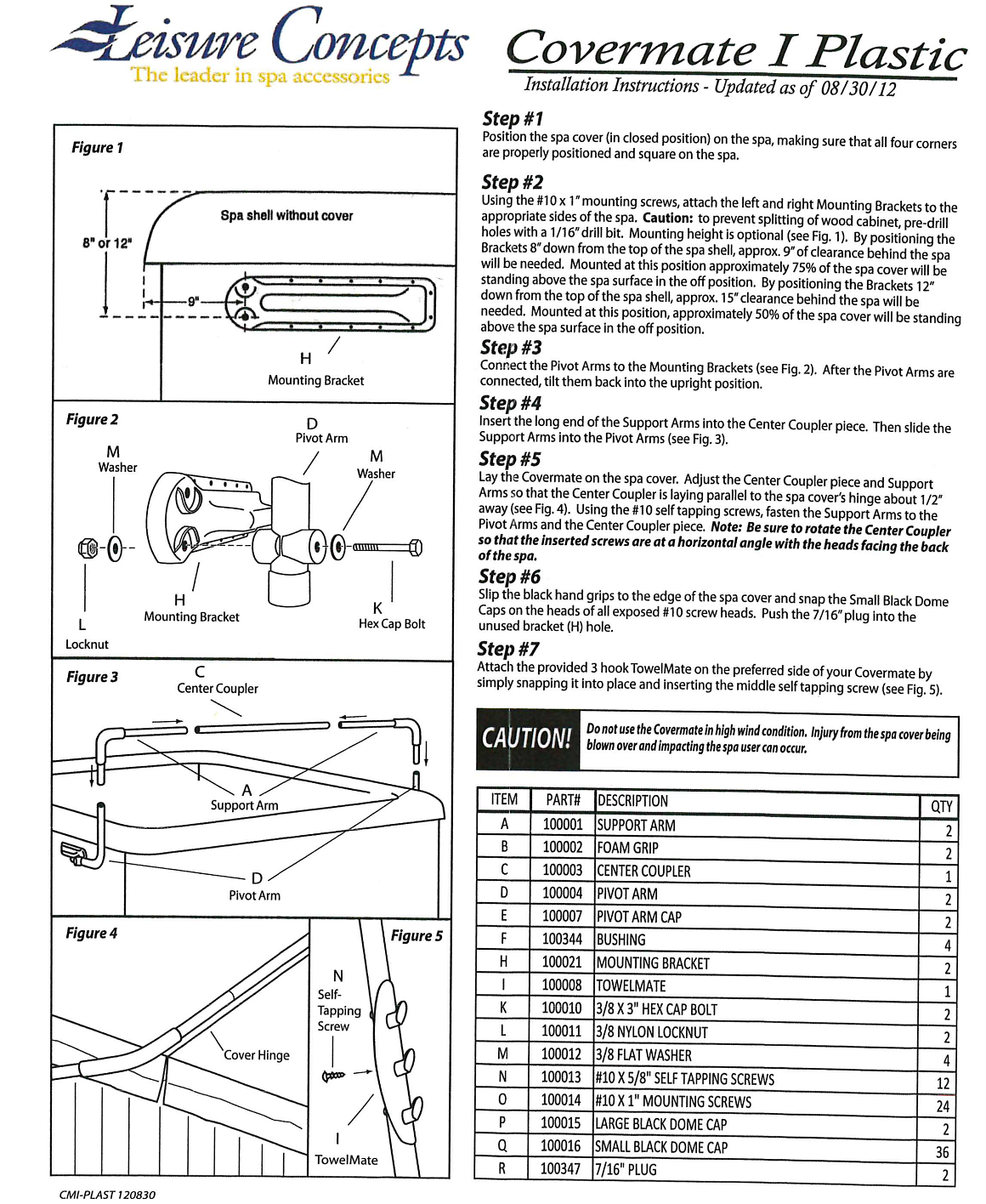
pages that the court used as comparators: 
Leisure Concepts instructions
CHS instruction (page 2 of 6)
 
I see one identical instruction, but I can’t imagine (1) that’s enough to
constitute substantial similarity, or (2) that’s even protectable; how many
ways are there to say that in an easily comprehensible way?
 
The court did dismiss the Lanham Act claim based on
allegedly false claims by CHS that the Cover EX was protected by the CHS patent
instead of embodying the Leisure patent. 
Leisure argued that “because spa dealers are more likely than general
consumers to be wary of potential patent infringement lawsuits,” CHS placed its
patent number on the advertising for the CoverEX to convince customers that
their product would not be subject to patent infringement lawsuits.  But under Sybersound Records, Inc. v. UAV
Corp., 517 F.3d 1137 (9th Cir. 2008), an alleged misrepresentation of patent
status isn’t covered by the Lanham Act.  To
avoid overlap between the Lanham and Patent acts, “nature, characteristics, and
qualities” should be construed to mean characteristics of a good itself, not
its patent status.  Leisure made no
allegations about the physical good; its patent-advertising arguments were more
properly considered under patent law. 
Leisure didn’t allege that CHS made false representations about the
exclusivity of its product, which would be actionable (a conclusion somewhat in
tension with the idea that the Lanham Act only covers misrepresentations about
the physical good). “Leisure has not alleged that CHS told customers that it
held exclusive patent rights to this class of spa cover lifters or that CHS
represented that the CoverMate I infringed on CHS’s patent.” Thus, this claim
was dismissed with prejudice.
 

from Blogger http://ift.tt/1JXWIoi

Posted in Uncategorized | Tagged , , | Leave a comment

False patent marking not actionable under Lanham Act

Leisure Concepts, Inc. v. California Home Spas, Inc., 2015 WL 3658190, No. 14–CV–388 (E.D. Wash. June 12, 2015)
 
Leisure and CHS compete in spa products, including spa cover lifters.  Leisure’s CoverMate I is protected by a patent, which it claimed was infringed by CHS’s Cover EX.  CHS marketed the Cover EX with a sign reading: “All Aluminum Design NO PLASTIC Compare to the Cover Mate I.” Ads for the Cover EX also refer to a CHS patent, but Leisure claimed that the CHS patent “claims a spa cover lifter utilizing support members comprising telescoping gas struts, which are not an aspect of the [Cover EX.]” CHS sells the Cover EX at a lower price than Leisure sells the CoverMate I, allegedly harming Leisure’s sales.  Moreover, Leisure asserted that the written and visual instructions provided with the Cover EX were substantially similar to Leisure’s copyrighted manual for the CoverMate I and that the instructions even contained verbatim text and diagrams from the protected manual.
 
The court denied CHS’s motion to dismiss the patent infringement and false patent marking claims.  In addition, the court found that Leisure stated a plausible copyright infringement claim.  “Although some of Leisure’s manual consists of mere lists of product parts and directions that may not be subject to copyright, the manual also contains narrative instructions that may be protected. This is especially true where some of the language from Leisure’s manual is copied almost verbatim in CHS’s manual. While some similarity between manuals for spa cover lifters is expected, ‘such obvious copying … is not to be encouraged.’”
 
Comment: wow.  What an anticompetitive claim.  These are the pages that the court used as comparators: 
Leisure Concepts instructions
CHS instruction (page 2 of 6)
 
I see one identical instruction, but I can’t imagine (1) that’s enough to constitute substantial similarity, or (2) that’s even protectable; how many ways are there to say that in an easily comprehensible way?
 
The court did dismiss the Lanham Act claim based on allegedly false claims by CHS that the Cover EX was protected by the CHS patent instead of embodying the Leisure patent.  Leisure argued that “because spa dealers are more likely than general consumers to be wary of potential patent infringement lawsuits,” CHS placed its patent number on the advertising for the CoverEX to convince customers that their product would not be subject to patent infringement lawsuits.  But under Sybersound Records, Inc. v. UAV Corp., 517 F.3d 1137 (9th Cir. 2008), an alleged misrepresentation of patent status isn’t covered by the Lanham Act.  To avoid overlap between the Lanham and Patent acts, “nature, characteristics, and qualities” should be construed to mean characteristics of a good itself, not its patent status.  Leisure made no allegations about the physical good; its patent-advertising arguments were more properly considered under patent law.  Leisure didn’t allege that CHS made false representations about the exclusivity of its product, which would be actionable (a conclusion somewhat in tension with the idea that the Lanham Act only covers misrepresentations about the physical good). “Leisure has not alleged that CHS told customers that it held exclusive patent rights to this class of spa cover lifters or that CHS represented that the CoverMate I infringed on CHS’s patent.” Thus, this claim was dismissed with prejudice.
 
Posted in copyright, http://schemas.google.com/blogger/2008/kind#post, patent | Leave a comment

“How can the academy best contribute to IP policy?”

Moderator:      F.
Scott Kieff, US International Trade Commission and George Washington University
 
Panelists:         Stephen
Haber, Hoover Institution and Stanford University: Good policy making starts
with good research. Literature on patenting lacks the serious empirical work
that exists in other fields; ratio of theory/broad claims to empirical evidence
is unlike other fields, particularly finance. 
Academics can broaden and deepen the quantity of research and its
quality.
 
Jay Kesan, University of Illinois: releasing the data is
important.  Nobody else can kick the
tires and look under the hood if you don’t. 
Be more skeptical/keep an open mind about other inferences from the same
data.
 
Alan Marco, USPTO: Help understand which inferences are
justified from the data. Policymakers see a lot of evidence; they agree
w/evidence based policy making, but they too frequently see policy based
evidence making where reports on one side say something completely different
from the other.  Need to know how to tell
the good from the bad.  Better
communication from academics: in understanding patents through the lens of
patent litigation—self-selected cases aren’t representative of the whole, and
we want to be careful about letting the tail wag the dog.
 
Joshua Wright, US Federal Trade Commission and George Mason
University: The principal problem is inadequate quality control leading to
overbroad claims.  Academy should take
quality control seriously, and limit claims. 
If you compare claims allowed to be taken seriously in antitrust, where
norms of scholarship are different—they’re more modest and more tethered to
actual inferences an economist would say are valid. That tethering is absent in
the IP scholarship world.
 
[Jessica Silbey, for good reason, will hate the implicit
definition of “empirical” at work here as “quantitative.”]
 
Haber: core problem is that there aren’t enough economists
around, many $20 bills on the ground for them to pick up.  (I thought the true economist wouldn’t do
that …)  Law faculty haven’t been trained
that way.  Economists have upped the game
in political science.
 
Kieff: has the IP/antitrust interface benefited from the
antitrust literature’s standards or suffered from the deficiencies in IP?
 
Wright: both are present. The same economists rationalizing
antitrust law are around.  Started with
big questions—it’s hard to measure innovation! But advance in industrial
economics has led to do smaller/narrower studies that can allow strong causal
inferences, even if on its own it wouldn’t justify legislation. A drip drip
drip of these can fill a bucket. You don’t believe papers, you believe
literatures. You get literatures by getting smaller projects.  Marginal approach was taken in antitrust, but
not enough in patent.  Sure, an economist
is likely to say the answer is more economists, but I believe that it’s true.
 
Haber: Causation is a big deal. One can look at data and
draw many inferences from it, some of them accurate and some spurious.  Data analysis w/o theory: perfect example of
this is claims about increased number of lawsuits. People like to draw the inference
is that contestability of patents has gone up and therefore the patent system
is broken. But another inference is that patents are more valuable and more
worth litigating. You can’t figure out which is true (or other explanations)
just with numbers. Unless you’re working from a well defined body of theory in
which case you have less causation to worry about, you need to worry about your
inferences.
 
Marco: one of the problems of many economists coming in is
that policymakers have high expectations. 
Economists tend to be more reserved in inferences, and so that doesn’t
get a lot of fanfare.  “How many jobs
does IP create?”—those are the questions that economists can’t really
answer.  Gap-filling: policymakers need
to be more patient/understanding: you can have good empirical research or you
can have fast.
 
Wright: another slam on law professors, sigh: law professors
can get tenure with big ridiculous claims, but economists can get tenure with a
good small contribution.  [You’re
all just jealous of my jetpack.
]
 
Kieff: So what are some of those $20 bills, tenure-worthy,
literature-contributing projects?
 
Haber: Patent trolls: what we know is miniscule compared to
the amount of noise about them. Look at the actual business, specifically: is a
patent troll a financial intermediary or a predator on the innovation
system?  Theory of finance would suggest
that intermediaries arise when there’s some market asymmetry creating a
return.  In patent space, the asymmetry
is between individual inventors and large firms implementing patents.  Is the behavior of patent trolls consistent
w/financial intermediaries, or consistent w/ the mafia?  (I’m not sure those are in any way exclusive,
actually, given accounts of how the mafia works—and how the big banks work.  I don’t see why an economist would start out
assuming these were distinct models.)
 
Kesan: that’s a project of mine: are there differences in
the way they settle or take cases to trial?
 
Marco: Identify the market failure we’re trying to solve
very clearly. A lot of times we take the system as a whole, but there are a lot
of component parts. One area to refine analysis quickly would be to ID
component parts: does patent examination/prosecution affect the way patents are
used later on?
 
Wright: the source for demand for such research has to be
the legal academy or the government.  The
gov’t is more likely to be the source of demand than the law schools.  The FTC has played a role in some areas. ID
research questions and testable hypotheses: a good role.  Do something modest and descriptive and
contribute knowledge to the world.
 
Josh Sarnoff: Rule 11 motions—would be important to know, hard
to collect data. We know almost nothing about licensing market, b/c of secrecy
issues—but there’s not a systematic requirement to collect all the data we want
to know; dramatic change at dramatic cost—only gov’t can do that.
 
Q: funders of research: what should they keep in mind?
 
Kesan: as quality of scholarship goes down, it’s seen as
more of a political football than normal science. Normal science gets more
funding/attention.  Convince funders that
there is normal science to be done.
 
Haber: innovation policy is vitally important to the US’s
future. Funding of studies of innovation policy by the gov’t relative to the
importance of the task is not commensurate, and thus either the gov’t will do
it or private entities w/vested interests will do it—or no one will do it.  Gov’t is better.  Federal Reserve funded most of the finance
literature.
 
Q: we don’t know prices or quantities in the private market
that is crucial here.  The influential
work on contracts has mostly been theory, unless there’s a large literature
using private data [Wright disagrees]. 
What is the policymaker’s role in interpreting academic evidence?  If we accept the premise that a lot of this
research is bad, if the policymaker knows it, what does the policymaker do with
that?  What’s the standard of disclosure
for the policymaker in relying on evidence?
 
Haber: ask the question—was this piece of evidence published
in a peer refereed journal or not? Simple metric, easily applied. Plus it’s
never the case that one study is dispositive. 
The Q for policymakers is whether there’s a literature whose weight
points to a conclusion.
 
Wright: there are now literature reviews, and literature
reviews of literature reviews. The difficulty is that most studies observe
either Price or Quantity.  Most of the
time here we’re less interested in P or Q and more interested in rate of
innovation or investments made in innovation, and the problem is that we don’t
agree on what a measurement is—harder than measuring prices. But there are some
papers that do this.  The observability
of underlying contracts can be difficult but there are many marginal gains to
be had.  I can count serious
peer-reviewed research designs in last 15 years on both hands. 
 
Kieff: what framing context would you give journalists or
staffers as background?  Sense of
diversity, contestation/testing in the literature.
 
Marco: also read How To Lie With Statistics—statistical inference
wouldn’t hurt.
 
Kesan: caution on both sides.  When I talk to staffers, I take extra trouble
to disclose the limitations of my studies. 
I’ve become sensitized to that after seeing the way my work has been
consumed.  If you are a
staffer/policymaker, it’s worth asking academics: what about the other
evidence?
 
Haber: two things that are low-cost: (1) learn that Google
Scholar exists.  Look for a review essay
about a literature that’s been published in a peer reviewed venue. Read the
first five pages, before it’s down in the weeds, and get a sense of the state
of a particular literature. (2) Academics need to meet staffers and journalists
on their turf, not the other way around. We should be better at making our work
more accessible and making our work more available.
 
Kieff: ideas for organizers of academic work to make their work
more impactful? Should they have a governance structure mindful of their source
of funds, fiduciary or other duties they might owe that might conflict with
independence in writing?
 
Marco: peer review is still there to correct apparent bias.  Economists are notoriously terrible at making
their results understood outside their narrow field.  NBER is getting good at putting out 2-page
summaries.  Still need to know how
policymakers should be using them. 
Incumbent on academics to improve their communication.
 
Wright: There are reputational sanctions in economics that
don’t exist or exist with less force in law. Everyone high-fives each other and
says the papers are brilliant. But less of a culture of saying a paper is bad
and shouldn’t influence policy.  (He does
not go to the conferences I go to.)  This
culture developed when law professors didn’t do empirical work.  Now, any law professor can run a regression
without a license, and that doesn’t serve academia well.  He is for more shaming of law professors.
 
Marco: who do bad research.
 
Wright: at least those. 
(Ha. Ha.  Though he is a very good
public speaker—quite charming.)  Need
research that can be replicated; that reduces fights over industry-funded or
gov’t-funded source. That tones down the criticism.  There’s a demand for objective interpretation
of results—meta-analysis of fields, similar to literature review. 
 
Kieff: do you think that policymakers should keep anything
in mind when an academic is writing as an academic but also has clients to
serve and owes duties to a client in other contexts? [Somehow I feel that there
is someone in particular being targeted.]
 
Wright: it happens. 
Some briefs are really good, and others aren’t.  If there’s empirical information, the
fundamental question is whether the thing is valid.  If I can’t see the data, it doesn’t get any
weight.
 
Kieff: should a reader keep in mind that a lawyer currently
representing a client, paid or unpaid, who has taken a position on the topic
being written about can’t advance to an academic audience a position
inconsistent with his or her client’s?
 
Wright: I don’t know the professional responsibility component.
I have a healthy skepticism for paid-for advocacy, but that’s a rebuttable
presumption.  I’d be willing to concede
that the skepticism meter goes up a notch or two.
 
Haber: from outside the legal academy, the presumption is
that the field is about getting to the truth. This requires both careful
scholarship and persuasion of others where you divulge your sources of funding,
make data available publicly, share requests for data, and practice open
science.  He is hearing that legal norms
are different. [Because he is hearing a weird subset of claims.]  Suggests a host of institutional problems in
the legal academy for playing an effective role in evidence based policymaking—seems
like conflicts of interest should be divulged. Legal academy was founded on
advocacy. That’s not about getting to the truth; it’s about serving the client.
That puts it in a difficult position for doing social science, about getting to
the truth.  How to draw some bright lines
about which enterprise people are engaged in.
 
Kieff: ITC docket generates economic studies.  If we were asked to study these issues, we’d
enjoy it.

from Blogger http://ift.tt/1SlYHps

Posted in Uncategorized | Tagged | Leave a comment

“How can the academy best contribute to IP policy?”

Moderator:      F. Scott Kieff, US International Trade Commission and George Washington University
 
Panelists:         Stephen Haber, Hoover Institution and Stanford University: Good policy making starts with good research. Literature on patenting lacks the serious empirical work that exists in other fields; ratio of theory/broad claims to empirical evidence is unlike other fields, particularly finance.  Academics can broaden and deepen the quantity of research and its quality.
 
Jay Kesan, University of Illinois: releasing the data is important.  Nobody else can kick the tires and look under the hood if you don’t.  Be more skeptical/keep an open mind about other inferences from the same data.
 
Alan Marco, USPTO: Help understand which inferences are justified from the data. Policymakers see a lot of evidence; they agree w/evidence based policy making, but they too frequently see policy based evidence making where reports on one side say something completely different from the other.  Need to know how to tell the good from the bad.  Better communication from academics: in understanding patents through the lens of patent litigation—self-selected cases aren’t representative of the whole, and we want to be careful about letting the tail wag the dog.
 
Joshua Wright, US Federal Trade Commission and George Mason University: The principal problem is inadequate quality control leading to overbroad claims.  Academy should take quality control seriously, and limit claims.  If you compare claims allowed to be taken seriously in antitrust, where norms of scholarship are different—they’re more modest and more tethered to actual inferences an economist would say are valid. That tethering is absent in the IP scholarship world.
 
[Jessica Silbey, for good reason, will hate the implicit definition of “empirical” at work here as “quantitative.”]
 
Haber: core problem is that there aren’t enough economists around, many $20 bills on the ground for them to pick up.  (I thought the true economist wouldn’t do that …)  Law faculty haven’t been trained that way.  Economists have upped the game in political science.
 
Kieff: has the IP/antitrust interface benefited from the antitrust literature’s standards or suffered from the deficiencies in IP?
 
Wright: both are present. The same economists rationalizing antitrust law are around.  Started with big questions—it’s hard to measure innovation! But advance in industrial economics has led to do smaller/narrower studies that can allow strong causal inferences, even if on its own it wouldn’t justify legislation. A drip drip drip of these can fill a bucket. You don’t believe papers, you believe literatures. You get literatures by getting smaller projects.  Marginal approach was taken in antitrust, but not enough in patent.  Sure, an economist is likely to say the answer is more economists, but I believe that it’s true.
 
Haber: Causation is a big deal. One can look at data and draw many inferences from it, some of them accurate and some spurious.  Data analysis w/o theory: perfect example of this is claims about increased number of lawsuits. People like to draw the inference is that contestability of patents has gone up and therefore the patent system is broken. But another inference is that patents are more valuable and more worth litigating. You can’t figure out which is true (or other explanations) just with numbers. Unless you’re working from a well defined body of theory in which case you have less causation to worry about, you need to worry about your inferences.
 
Marco: one of the problems of many economists coming in is that policymakers have high expectations.  Economists tend to be more reserved in inferences, and so that doesn’t get a lot of fanfare.  “How many jobs does IP create?”—those are the questions that economists can’t really answer.  Gap-filling: policymakers need to be more patient/understanding: you can have good empirical research or you can have fast.
 
Wright: another slam on law professors, sigh: law professors can get tenure with big ridiculous claims, but economists can get tenure with a good small contribution.  [You’re all just jealous of my jetpack.]
 
Kieff: So what are some of those $20 bills, tenure-worthy, literature-contributing projects?
 
Haber: Patent trolls: what we know is miniscule compared to the amount of noise about them. Look at the actual business, specifically: is a patent troll a financial intermediary or a predator on the innovation system?  Theory of finance would suggest that intermediaries arise when there’s some market asymmetry creating a return.  In patent space, the asymmetry is between individual inventors and large firms implementing patents.  Is the behavior of patent trolls consistent w/financial intermediaries, or consistent w/ the mafia?  (I’m not sure those are in any way exclusive, actually, given accounts of how the mafia works—and how the big banks work.  I don’t see why an economist would start out assuming these were distinct models.)
 
Kesan: that’s a project of mine: are there differences in the way they settle or take cases to trial?
 
Marco: Identify the market failure we’re trying to solve very clearly. A lot of times we take the system as a whole, but there are a lot of component parts. One area to refine analysis quickly would be to ID component parts: does patent examination/prosecution affect the way patents are used later on?
 
Wright: the source for demand for such research has to be the legal academy or the government.  The gov’t is more likely to be the source of demand than the law schools.  The FTC has played a role in some areas. ID research questions and testable hypotheses: a good role.  Do something modest and descriptive and contribute knowledge to the world.
 
Josh Sarnoff: Rule 11 motions—would be important to know, hard to collect data. We know almost nothing about licensing market, b/c of secrecy issues—but there’s not a systematic requirement to collect all the data we want to know; dramatic change at dramatic cost—only gov’t can do that.
 
Q: funders of research: what should they keep in mind?
 
Kesan: as quality of scholarship goes down, it’s seen as more of a political football than normal science. Normal science gets more funding/attention.  Convince funders that there is normal science to be done.
 
Haber: innovation policy is vitally important to the US’s future. Funding of studies of innovation policy by the gov’t relative to the importance of the task is not commensurate, and thus either the gov’t will do it or private entities w/vested interests will do it—or no one will do it.  Gov’t is better.  Federal Reserve funded most of the finance literature.
 
Q: we don’t know prices or quantities in the private market that is crucial here.  The influential work on contracts has mostly been theory, unless there’s a large literature using private data [Wright disagrees].  What is the policymaker’s role in interpreting academic evidence?  If we accept the premise that a lot of this research is bad, if the policymaker knows it, what does the policymaker do with that?  What’s the standard of disclosure for the policymaker in relying on evidence?
 
Haber: ask the question—was this piece of evidence published in a peer refereed journal or not? Simple metric, easily applied. Plus it’s never the case that one study is dispositive.  The Q for policymakers is whether there’s a literature whose weight points to a conclusion.
 
Wright: there are now literature reviews, and literature reviews of literature reviews. The difficulty is that most studies observe either Price or Quantity.  Most of the time here we’re less interested in P or Q and more interested in rate of innovation or investments made in innovation, and the problem is that we don’t agree on what a measurement is—harder than measuring prices. But there are some papers that do this.  The observability of underlying contracts can be difficult but there are many marginal gains to be had.  I can count serious peer-reviewed research designs in last 15 years on both hands. 
 
Kieff: what framing context would you give journalists or staffers as background?  Sense of diversity, contestation/testing in the literature.
 
Marco: also read How To Lie With Statistics—statistical inference wouldn’t hurt.
 
Kesan: caution on both sides.  When I talk to staffers, I take extra trouble to disclose the limitations of my studies.  I’ve become sensitized to that after seeing the way my work has been consumed.  If you are a staffer/policymaker, it’s worth asking academics: what about the other evidence?
 
Haber: two things that are low-cost: (1) learn that Google Scholar exists.  Look for a review essay about a literature that’s been published in a peer reviewed venue. Read the first five pages, before it’s down in the weeds, and get a sense of the state of a particular literature. (2) Academics need to meet staffers and journalists on their turf, not the other way around. We should be better at making our work more accessible and making our work more available.
 
Kieff: ideas for organizers of academic work to make their work more impactful? Should they have a governance structure mindful of their source of funds, fiduciary or other duties they might owe that might conflict with independence in writing?
 
Marco: peer review is still there to correct apparent bias.  Economists are notoriously terrible at making their results understood outside their narrow field.  NBER is getting good at putting out 2-page summaries.  Still need to know how policymakers should be using them.  Incumbent on academics to improve their communication.
 
Wright: There are reputational sanctions in economics that don’t exist or exist with less force in law. Everyone high-fives each other and says the papers are brilliant. But less of a culture of saying a paper is bad and shouldn’t influence policy.  (He does not go to the conferences I go to.)  This culture developed when law professors didn’t do empirical work.  Now, any law professor can run a regression without a license, and that doesn’t serve academia well.  He is for more shaming of law professors.
 
Marco: who do bad research.
 
Wright: at least those.  (Ha. Ha.  Though he is a very good public speaker—quite charming.)  Need research that can be replicated; that reduces fights over industry-funded or gov’t-funded source. That tones down the criticism.  There’s a demand for objective interpretation of results—meta-analysis of fields, similar to literature review. 
 
Kieff: do you think that policymakers should keep anything in mind when an academic is writing as an academic but also has clients to serve and owes duties to a client in other contexts? [Somehow I feel that there is someone in particular being targeted.]
 
Wright: it happens.  Some briefs are really good, and others aren’t.  If there’s empirical information, the fundamental question is whether the thing is valid.  If I can’t see the data, it doesn’t get any weight.
 
Kieff: should a reader keep in mind that a lawyer currently representing a client, paid or unpaid, who has taken a position on the topic being written about can’t advance to an academic audience a position inconsistent with his or her client’s?
 
Wright: I don’t know the professional responsibility component. I have a healthy skepticism for paid-for advocacy, but that’s a rebuttable presumption.  I’d be willing to concede that the skepticism meter goes up a notch or two.
 
Haber: from outside the legal academy, the presumption is that the field is about getting to the truth. This requires both careful scholarship and persuasion of others where you divulge your sources of funding, make data available publicly, share requests for data, and practice open science.  He is hearing that legal norms are different. [Because he is hearing a weird subset of claims.]  Suggests a host of institutional problems in the legal academy for playing an effective role in evidence based policymaking—seems like conflicts of interest should be divulged. Legal academy was founded on advocacy. That’s not about getting to the truth; it’s about serving the client. That puts it in a difficult position for doing social science, about getting to the truth.  How to draw some bright lines about which enterprise people are engaged in.
 
Kieff: ITC docket generates economic studies.  If we were asked to study these issues, we’d enjoy it.
Posted in patent | Leave a comment