Irreparable harm teleseminar: rescheduled for March 6

Via the ABA Antitrust Section: Please click on the link below to register for a timely lunchtime teleseminar where our panel of experts will address the status of “irreparable harm” in Lanham Act false advertising cases.
 
Recent cases have suggested that courts no longer will “presume” irreparable harm in Lanham Act false advertising cases (where a preliminary injunction is sought).
 
Will this trend hold? Is this trend appropriate?
If the trend holds, the next question is, how do plaintiffs show irreparable harm going forward?
 
This is an important issue in the Lanham Act false advertising practice, and the panel discussion is sure to be a lively one.
 
Here is your all-star panel:
 
Moderator
• Sherrie Schiavetti, Kelley Drye
 
Panelists
• David Bernstein, Debevoise & Plimpton LLP
• Roger Colaizzi, Venable LLP
• Rebecca Tushnet, Georgetown University
 
Please register at the link below – it’s free for ABA Antitrust Section Members! 
 
Posted in http://schemas.google.com/blogger/2008/kind#post, remedies | Leave a comment

kitsch doesn’t violate the right of publicity

Rosa and Raymond Parks Institute for Self Development v. Target Corp., No. 2:13-CV-817 (M.D. Ala. Feb. 9, 2015)
 
The Parks Institute, a 501(c)(3) corporation, “owns the name and likeness of the late Rosa Parks,” an icon of the civil rights movement. Target sold “a collage-styled plaque” created by Stephanie Workman Marrott:
 

The elements of the plaque were: (1) the phrase “Civil Rights”; (2) an illustrated exhibit submitted in Browder v. Gayle, 142 F. Supp. 707 (M.D. Ala. 1956), depicting where Rosa Parks was sitting on the bus prior to her arrest; (3) the word “Change”; (4) an illustration of the Cleveland Avenue bus; (5) Rosa Parks’s name and dates of birth and death; (6) a picture of Rosa Parks’s Congressional Gold Medal; (7) a photograph of Rosa Parks and Martin Luther King, Jr.; and (8) an inspirational statement made by Rosa Parks: “People always say that I didn’t give up my seat because I was tired, but that isn’t true. I was not tired physically. . . I was not old . . . I was forty two. No, the only tired I was, was tired of giving in.”
 
The Parks Institute sued over this and eight other items sold by Target: seven books about Rosa Parks using her name in the title (including, as if that weren’t incredible enough, Rosa Parks: My Story, by Rosa Parks and Jim Haskins), and the film The Rosa Parks Story, which is exactly what it sounds like (and directed by Julie Dash).  (The commentary at this link suggests that the judge wrongly contracted (one says “tore down all protection for”) the right of publicity in rejecting these claims, though perhaps the authors only mean as to the plaque.  My level of disagreement cannot be textually rendered.)
 
Anyhow, the judge applied Michigan law to the claims for infringement of the right of publicity, common-law misappropriation, and unjust enrichment, which all had the same key issues. (Note: the Parks Institute initially brought federal claims, but dismissed them, presumably to avoid any leakage of the entirely appropriate Rogers analysis that dooms any federal claims onto the state law publicity claims.)
 
Ruffin-Steinback v. dePasse, 82 F. Supp. 2d 723 (E.D. Mich. 2000), applied Michigan law to reject claims based on a two-night miniseries covering the story of the musical group The Temptations.  The court looked to the Restatement (Third) of Unfair Competition § 46 (1995), which provides for liability for appropriating the commercial value of a person’s identity “for the purpose of trade.”  The Restatement explains that the purpose of trade means advertising (or merchandising), but not “ordinarily … the use of a person’s identity in news reporting, commentary, entertainment, works of fiction or nonfiction, or in advertising that is incidental to such uses.”  Comment c to § 47 specifically states that “the right of publicity is not infringed by the dissemination of an unauthorized print or broadcast biography.” Ruffin-Steinback noted that courts across various jurisdictions treat unlicensed biography similarly. Thus, the court concluded, “Michigan courts would not extend [the] right of publicity tort” to prohibit biographical works and dismissed all of the derivative claims – unjust enrichment, conspiracy, and negligence – finding that they were dependent on the plaintiffs’ right of publicity claims.
 
The Parks Institute challenged the sale of eight biographical works, mostly books for children “written to educate children about the Civil Rights movement and to demonstrate how one courageous individual can bring about significant change.”  There’s nothing false or defamatory about them.  The Parks Institute was wrong to claim that the First Amendment didn’t protect the unapproved sale of items depicting “the name, likeness, story, or image of Rosa Parks.”  Parks was an iconic heroine of the civil rights movement; the parties agreed that one couldn’t talk about that movement without including Parks.  “The importance of her story serves as an apt reminder of why First Amendment protection for biographical works is so vital.”  Summary judgment for Target on the books and movie.
 
And the plaque?  This was “less of a biographical work and more akin to a work of art.”  (Which is why courts ought not to be in the business of judging art.  Why isn’t it biographical art?  Is an article depicting only key moments in Parks’ life not biographical?)  Under Michigan’s invasion of privacy tort, there is a cause of acttion for misappropriation of name or likeness. However, because “the tort has the potential to offer a troublingly broad swath of protection,” courts uniformly impose the First Amendment as a barrier to liability for the use of name or likeness in publications concerning matters that are “newsworthy or of legitimate public concern.”
 
Newsworthiness/public concern is ordinarily a question of law.  The difference is between “predominately commercial purpose” versus “a redeeming public interest, news, or historical value.” Target’s sale of the plaque “served a commercial purpose,” but even profit-seeking endeavors can have a legitimate public interest privilege.  For example, a fundraising letter may use quotes from a person without their consent when the quotes speak to important policy issues. 
 
Plus, reference to current events isn’t required, because “matters related to education and information are . . . within the scope of legitimate concern.” The Restatement (Second) of Torts says that the privilege extends to “giving information to the public for purposes of education, amusement or enlightenment, when the public may reasonably be expected to have a legitimate interest in what is published.”  Armstrong v. Eagle Rock Entm’t, Inc., 655 F. Supp. 2d 779 (E.D. Mich. 2009), applying Michigan law, held that the First Amendment privilege includes “‘all types of factual, educational, and historical data, or even entertainment and amusement, concerning interesting phases of human activity in general.’”  Armstrongheld that a picture of Louis Armstrong on the cover of a DVD depicting a historical jazz concert was protected by the First Amendment. “Michigan law and the First Amendment require a similar determination in this case.”
 
The plaque contained “several elements reminiscent of the historic Civil Rights movement.” The plaque’s creator stated that she sought to inspire viewers to “stand[ ] up for what [they] believe is right” while telling the important story of Rosa Parks’s courage during the Civil Rights movement. “There can be no doubt that Rosa Parks and her involvement in the Civil Rights movement are matters of utmost importance, both historically and educationally.” Thus, the use of her name and image was historically significant and protected by the First Amendment, entitling Target to summary judgment.
Posted in first amendment, right of publicity | Leave a comment

Transformative work of the day, Power Rangers edition

Words I never thought I’d type: Katee Sackhoff and James van der Beek star in a short fan film of the Mighty Morphin Power Rangers, all grown up, called Power/Rangers.  NB: the producer calls this his “Bootleg Series.”

Posted in http://schemas.google.com/blogger/2008/kind#post, trademark | Leave a comment

Fair Use Week!

The OTW supports Fair Use Week. And if you support fair use, why not support the OTW?

Also, I enjoyed Laura Quilter’s post on the uses of parody.

Posted in fanworks, http://schemas.google.com/blogger/2008/kind#post, parody | Leave a comment

Trademark/right of publicity questions of the day

Via Mycokerewards: Do the referenced bands have any claims against Coke, assuming this was done without permission?  Does New Kids apply to a promotional site like Mycokerewards?  Do the comparisons/food jokes suffice for transformativeness?

Coke’s “vote for your favorite food-inspired music band” page: Chili Peppers, Cranberries, Cake, Meatloaf

Posted in right of publicity, trademark | Leave a comment

False claims of third-party endorsement actionable as false advertising

Fringe Insurance Benefits, Inc. v. Beneco, Inc., No. A–13–CV–034, 2015 WL 631181 (W.D. Tex. Feb. 11, 2015) (magistrate judge)
 
The parties compete to provide employee benefit plans; FIBI and Beneco specialize in fringe benefit services to government contractors who must comply with prevailing wage laws.  Zane Smith, who worked for Beneco, copied significant portions of an article published by FIBI and used it in an email to potential Beneco customers, in an article for Construction Executive Magazine, and another article sent to over 200 prospective clients.  This was copyright infringement.  But the core of the case was Lanham Act false advertising; each of the challenged statements was made in commercial advertising, but only some were proven false. 
 
Of particular note, FIBI prevailed on its claim that Beneco falsely claimed to have Department of Labor approval and endorsements from the American Subcontractors Association and Associated Builders and Contractors. The court found these to be literally false claims: Beneco’s plan wasn’t approved or endorsed by any of these entities.  Beneco was endorsed by particular chapters of the two private organizations, but not by the national groups, which both sent it C&D letters demanding that Beneco stop using their logos in ads.  This result is notable because, as a traditional “false endorsement” §43(a)(1)(A) case, FIBI wouldn’t have had standing to object on these associations’ behalf. But that doesn’t mean that FIBI didn’t suffer injury of its own on a false advertising §43(a)(1)(B) theory.  (Compare this recent case, misunderstanding this distinction.)
 
Other claims: FIBI failed to produce sufficient evidence that Beneco’s claims that “we historically find that our … plan is typically 50% less in cost than [FIBI’s] plan” were literally false.  Though FIBI showed that several specific cost comparisons sent to potential customers were literally false, and though Beneco never identified the analysis or study backing up this claim, FIBI didn’t provide evidence that Beneco never did any analysis justifying its claim or otherwise more thoroughly compare the products.  Moreover, the claim was clearly misleading, but FIBI didn’t provide evidence that this particular statement confused customers.
 
By contrast, specific cost comparisons were false. For example, one communication claimed that a specific customer would save “an estimated $1,523” by staying with Beneco. This estimate came from an attached spreadsheet containing several errors—misplacing a decimal point, increasing FIBI’s cost by over $1,900; using an outdated service fee, inflating FIBI’s cost by $1,541; and misstating a record keeping fee by $1/participant, inflating the cost by $108. This was literally false. (But was it commercial advertising or promotion?)  Beneco also provided inaccurate savings estimates to other customers, inflating FIBI’s costs by thousands of dollars and undercalculating its own total costs.  These estimates, “rife with errors,” were literally false.
 
FIBI failed to show that Beneco’s claims about FIBI’s higher fees and status as a target of legal investigation were literally false.  Beneco told one potential customer that FIBI’s “internal fees and expenses are 3 times higher” than Beneco’s, and that FIBI would hide its fees.  Later, it said that “FIBI has been under investigation by the Federal DoL.”  FIBI didn’t meet its burden of showing literal falsity as to the internal fees—it just provided testimony from a VP that he’d never seen any documentation supporting the claim.  FIBI also impeached Beneco’s only evidence, which compared the plans applied to a parcticular customer, but it didn’t show that the “three times higher fees” claim was wrong in every case, or even in a majority of cases.  And again, FIBI failed to show actual deception, treating the statement as merely misleading.
 
But the statement that FIBI hid its fees was literally false.  FIBI disclosed all its fees in written agreements and marketing materials. So was Beneco’s claim that FIBI lacked third-party trustee protection, forcing customers to bear certain risks themselves.
 
By contrast, the “DoL investigation” claim wasn’t false or misleading—though FIBI itself hadn’t been investigated, its affiliate, Plan Benefit Services, had been successfully sued by the Department of Labor for ERISA violations. Plan Benefit Services and FIBI shared common ownership, common control, and functioned together in the same market.  Thus, while the claim wasn’t entirely accurate, it wasn’t “sufficiently misleading to trigger Lanham Act liability.”  And FIBI didn’t prove likely consumer deception.
 
Coordinate claims of unfair competition under Texas law also succeeded based on the same facts, but a tortious interference claim didn’t, for want of evidence of interference with particular business relationships.
 
FIBI sought only a permanent injunction.  The Fifth Circuit doesn’t presume irreparable harm from literal falsity. However, the court found irreparable harm here, given testimony from a FIBI VP noting the small size of the benefit plan market and stating that “when information is provided that’s incorrect in those small circles, it gets around pretty quickly and can be damaging,” as well as testimony that many customers are small, “family-run” businesses easily influenced by false endorsements. “That many of the statements were contained in emails sent directly to customers makes an injunction all the more appropriate: as FIBI correctly notes, such ‘difficult-to-monitor channels’ are the most likely source of future harm.”
 
Thus, Beneco was ordered to refrain from making the statements found to be literally false, and to post a copy of the court’s order on its website, including a link to the judgment on its corporate home page, to persist for 30 days.  The link had to be no smaller than 12 point type “and readily apparent to the site’s visitors with no other accompanying commentary or explanatory statement.”  Aside from the posting requirement, the part of the injunction with the most bite is probably the part that barred Beneco from making “inaccurate and/or incomplete customer-specific comparisons between the costs, fees, or expenses of FIBI and Beneco products.”
 
Somewhat surprisingly and formalistically, the court then used the pre-eBay rule that copyright infringement leads to a presumption of irreparable harm, and also enjoined defendants “from infringing FIBI’s copyrights to publications, articles, literature or marketing material.”  (Also a pretty broad scope.)
 
Posted in copyright, http://schemas.google.com/blogger/2008/kind#post, remedies | Leave a comment

Transformative work of the day, superhero edition

Superhero keyboard skin, via Deborah Gerhardt.  There’s only one problem with it (hint: check out the W). 

Posted in comics, http://schemas.google.com/blogger/2008/kind#post, trademark | Leave a comment

Allegations of fake independent reviews state false advertising claim

Swiss America Trading Corp. v. Regal Assets, LLC, 2015 WL 631569, No. CV 14–04960 (C.D. Cal. Feb. 13, 2015)
 
Swiss competes with Regal to sell precious metals.  The parties promote themselves online and rely on internet reviews and recommendations.  Swiss alleged that Regal’s affiliate marketing program/Regal’s own controlled websites included “ostensibly independent consumer reviews” that disparaged Swiss; made false statements, including completely fabricated reviewer identities and credentials; and recommended Regal over Swiss.
 
Regal moved to dismiss, arguing that the complaint failed to satisfy Rule 9(b).  The court didn’t need to decide whether Rule 9(b) or 8 applied, because the complaint sufficed either way.  It was enough to allege that (1) Regal’s websites falsely represented that they were independent of Regal, then criticized Swiss and recommended Regal; (2) the sites used false information to make reviews seem trustworthy, including fabricated reviewer identities and backgrounds, such as that of “Mark C. Turner”; and (3) Regal made false, disparaging statements about Swiss, including claims that Swiss has been accused of baiting and switching, “steering” customers away from worthwhile investments, and irrationally emphasizing coins over bullion.  That was enough to provide Regal with sufficient notice.
 
Nor were the alleged misrepresentations mere puffery. “Regal’s sites are alleged to falsely represent that they are independently operated, to put forth the fabricated opinions of purportedly knowledgeable professionals in the field who, in reality, do not exist, and to accuse Swiss of specific misdeeds such as baiting and switching. These statements are not vague, exaggerated, or subjective, and are precisely the type of representations upon which consumers might rely.”
 
The trade libel claims survived as well.  Regal argued that Swiss failed to plead special damages, but it was enough to plead that Swiss depended on word of mouth, particularly online reviews.  Swiss alleged that it lost market share to Regal and suffered continuing irreparable harm to reputation and goodwill, and that was enough.
 
The intentional interference with prospective economic advantage claim, however, was inadequately pled: Swiss failed to identify an economic relationship with any specific third party, or a probability that such a relationship would yield an economic benefit.  Dismissed with leave to amend.
 
Posted in defamation, http://schemas.google.com/blogger/2008/kind#post, procedure, tortious interference | Leave a comment

Misappropriating goodwill of abandoned mark is false advertising

ITEX Corp. v. Global Links Corp., No. 2:14–cv–00057, 2015 WL 557067 (D. Nev. Feb. 11, 2015)
 
A false advertising theory might not work in every case of a new entity adopting an abandoned mark, but it proved fruitful for the plaintiffs here. (Trademark portions of the case remain to be decided.)
 
ITEX is a barter and exchange company that provides a marketplace for commercial transactions, which enables member businesses to trade products and services without exchanging cash. ITEX trains and supports independent brokers who enroll new members, educate them in marketplace policies and procedures, and provide information about products and services available in the marketplace. ITEX’s revenue mainly comes from a percentage of each transaction that occurs within its marketplace.  ITEX is the product of mergers and acquisitions, including of BXI Trade Exchange, Inc./BX International, Inc., founded 1960, known as the original barter exchange company. With 20,000 members, it operated under the “BXI” word trademark and “BXI circular arrow” trademark as early as 1987. A company known as BXI Exchange, Inc. remains ITEX’s wholly-owned subsidiary.
Defendant Global Links is a real estate development company; defendant BXI Trade Exchange, Inc. (“BTE Nevada”) was formed in 2006 for the purpose of transferring pre-existing real estate assets between privately held corporations. In 2012, defendants discovered that the registration for the BXI mark had been cancelled in 2010. They then filed for “BXI Trade Exchange”; a registration issued in 2014.
 
In 2013, Global Links issued a press release titled “Global Links Corp. Acquires BXI Trade Exchange, Inc.—The Original Barter Company.” Among other things, the release stated:
 
BXI, formerly the world’s largest barter trade exchange, will soon be fully operational with plans to once again become the premier marketplace for the barter industry…. Saul Yarmak, the former Chairman and Principal Owner of BXI before taking a break from the industry, is committed to once again be a driving force in the day-to-day operations of the exchange. The company’s stated intention is to quickly make BXI the recognized “Gold–Standard” of the barter industry while maintaining the highest level of ethics and reputation it was previously known for. At its peak, prior to the widespread use of the Internet for online business communications and transactions, BXI had more than 100 offices and 22,000 business members.
 
(Yarmak was involved with a predecessor BXI entity to ITEX, but sold all his interest and ITEX owned all the goodwill.)  Subsequent statements were to similar effect, such as that BXI was “back in business with plans to again become the premier marketplace for the barter industry,”and “if you were a previous BXI member[,][w]e are anxious to welcome you back.”  Defendants posted a “Short History of BXI” claiming the history of the other BXI entities since 1960, including, “Because of its 36 years of solid service and proven record in the trade industry, BXI enjoys a prestigious position in barter circles and is well positioned to service the growing need for additional barter exchanges across the country. We continue our out of the box approach and look forward to 36 + more solid years.”
 
ITEX sued for false advertising and sought an injunction barring defendants from making any further statements that BTE Nevada was related in any way to the BXI exchange business that ITEX purchased in 1998 and then reacquired in 2005.
 
The court found that there was no material issue of fact about many of the statements at issue: they were clearly false, either facially or by necessary implication.  Equivocating about the meaning of “BXI” meant that the statements were literally false—the term either referred to the original BXI business (no legal relationship to defendants) or BTE Nevada’s exchange business, and either way there was falsity, since BTE Nevada was not the original barter company and Global Links did not acquire the original one. This was not puffery, but a claim about a specific entity that consumers would rely on due to the history of the BXI name.  “Back in business,” “re-opening” and the like were also false because BTE Nevada has never been in the exchange business, quit, and then reentered the market.
 
The court also found the statements misleading, since defendants were “adamant” that they established a new BXI, and even represented in regulatory filings that the “present BXI is in no way connected to the past BXI.”  But they presented their company as a continuation of the old one in their ads. 
 
While the validity of defendants’ mark wasn’t before the court at this time, it was clear that they were presenting BTE Nevada as the successor-in-interest of plaintiff’s BXI entities. Even assuming that the mark was valid and noninfringing, the mark wouldn’t allow them to misappropriate the goodwill of the original BXI exchange business. First, most of the statements at issue predated the registration date for the mark (though that really shouldn’t matter since trademark rights depend on use, not registration).  Second, the falsity here wasn’t problematic because of the BXI name; the statements were problematic “because they state that BXI is back, that it is re-opening, and that it will once again be the industry leader.” The necessary implication was a link between BTE Nevada and the earlier BXI.  Even assuming that ITEX abandoned the BXI mark, that didn’t make defendants’ statements any less false or misleading, “and regardless of whether ITEX uses the BXI name currently, it still owns what was the original BXI exchange business.”
 
Defendants’ statements were misleading “because a consumer in the industry would undoubtedly understand these statements to mean that BTE Nevada is the successor-in-interest to BX International.”  Defendants’ promotional claim that “the company has gained a tremendous amount of interest and outreach from former members” further solidified the misleadingness, since BTE Nevada had no former members. The context—press releases—showed a tendency to mislead by associating the two entities.
 
“[W]hile Defendants’ efforts to establish a competing barter and trade marketplace would alone not be actionable, their strategy in this case has been to usurp the goodwill of the original BXI business by relying on the reputation of BX International, BTE California, and BEI, which was accumulated over years of serving BXI members. This is something that Defendants cannot do, even if Yarmak contributed to those efforts.”  Yarmak sold his interest to ITEX, including BXI’s goodwill and reputation; part of ITEX’s acquisition was “the right to claim and utilize BXI’s past history.”
 
Defendants argued that they never claimed that BTE Nevada was the same legal entity as old BXI, and that “the same individual[ ] officers and principals who ran and operated the BXI Trade Exchange” through BX International “have reopened ‘BXI Trade Exchange’ under a valid federal trademark registration.” Nope.  Their press releases didn’t say anything about individuals “once affiliated” with BXI being back in business. And the participation of past BXI employees and affiliates in BTE Nevada’s new exchange enhanced misleadingness. For example, defendants posted photos on Facebook showing Yarmak and other former participants in the original BXI exchange business at BTE Nevada’s “Soft Launch & Training Session” accompanied by comments that “BXI has the management team to become number one again.” “A consumer in the industry familiar with the original BXI exchange business and its affiliates would surely be misled by these comments and photos into believing that BTE Nevada is related to the original BXI exchange business.”
 
Yarmak was free to “tout his experience, knowledge, and past involvement with BX International and the BXI exchange business as evidence that the new BTE Nevada exchange will become the modern ‘Gold-Standard’ in the barter industry.” But what he couldn’t do is imply that BTE Nevada was in any way affiliated with or related to the original BXI.
 
Finally, defendants argued that its statements related to a “company,” not to a “product.” But “a service-oriented company generates goodwill by efficiently and promptly performing the service for which it is hired. The company and its name, therefore, become synonymous with the quality of service it provides.” Thus, defendants’ references were the equivalent of product references (or, really, service references).
 
Literal falsity raises a presumption of deception, which defendants did not rebut. Plus, the record showed likely deception.  Defendants’ own statement about “a tremendous amount of interest and outreach from former members” demonstrated that at least some members of the original BXI exchange network believed and understood BTE Nevada to be affiliated with the BXI business that ITEX bought.
 
Literal falsity also allowed a presumption of materiality; materiality was also shown by the fact that  “the statements at issue here were made for the specific purpose of influencing consumers to join BTE Nevada’s new exchange network and pay the accompanying fees.”  The number of members in a barter exchange network was criticial to its success. “Prior to joining a particular network, it is common sense that potential brokers and members evaluate the exchange company’s operating history, market presence, size of its customer base, and reputation.”  And using the reputation of a previously operating network with a proven track record would obviously help.  “If the operating history of the original BXI exchange business was not material to consumers’ decision of which exchange network to join, Defendants would likely not have gone to so much effort to present BTE Nevada as a continuation of the original BXI.”
 
Defendants argued that ITEX didn’t show actual injury, but only likely injury was required for an injunction, as opposed to damages.  Without discussion of eBay or Winter, the court then quickly concluded that ITEX was entitled to a permanent injunction. The injunction covered “false or misleading statements that imply that BTE Nevada’s new exchange business is related to, affiliated with, or the successor-in-interest of the original BXI exchange.”
 
Defendants could claim that BTE Nevada was a new exchange business that would become the nation’s leader in the barter trade industry. Individuals previously involved with old BXI could truthfully represent their past experience, and defendants could claim that BTE Nevada would be successful because of its management team. They just couldn’t claim that, because those people were working with BTE Nevada, BTE Nevada was somehow a successor to old BXI.
 
BTE Nevada’s right to continue to use the BXI name and mark was still an issue to be decided; the injunction here would continue regardless of the outcome of the trademark infringement portion of the case.
 
The court found this to be an “exceptional” case deserving attorneys’ fees.  Exceptionality requires “fraudulent, deliberate, or willful” behavior.  (Is this still the standard after Icon Fitness?)  The court found willfulness to be an easy call.  Adopting such a similar name was “inherently confusing to consumers.”  Yarmak personally benefited from the sale of the original BXI business, when he parted with the right to use the name and benefit from its goodwill.
Yarmak seemed to want to “have his cake and eat it, too.” Plus, repeatedly claiming to be formerly the “largest” barter trade company, etc., “demonstrates a deliberate attempt to confuse consumers.” Defendants’ deliberate claim to BXI’s history showed an intent to benefit from old BXI’s goodwill. One BTE Nevada broker stated in promotional material that “[her] best years in barter were the 13 years [she] worked for this company starting in 1994, before they sold the membership in 2005.” (The court was unsure whether this showed willful deception by defendants or actual deception on the part of the broker—but either way, defendants’ use of the statement supported the finding of exceptionality.)  Likewise, defendants’ adoption of similar, if not identical, trademarks, also indicated a willful attempt to confuse, even if the marks were valid and non-infringing.  (Not sure how they could be, given this finding, but there’s no motion for summary judgment as to the marks.)

Posted in http://schemas.google.com/blogger/2008/kind#post, trademark | Leave a comment

Fox hurts America yet again, losing fair use sj motion

North Jersey Media Grp. Inc. v. Pirro, No. 13 Civ. 7153 (ER), 2015 BL 33458 (S.D.N.Y. Feb. 10, 2015)
 
Fair use should be nonpartisan; copyright restrictionists are generally liberal, but Fox deserves fair use too, even if it does dumb stuff. (Also Democrats are routinely terrible on copyright issues.)  Here, the district court denies summary judgment on a fair use defense, saying some understandable things and one very disturbing thing, along the way confirming some commentators’ suspicions about Cariou’s failure to explain what it meant about transformative purpose versus transformative content.
 
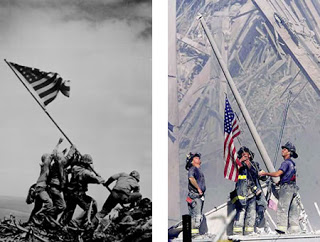
NJMG sued Fox (and individual defendant Jeanine Pirro) for infringing its copyright in an iconic photo of 9/11. On the Facebook page for Fox’s show Justice with Judge Jeanine, Fox posted an image juxtaposing the photo, featuring firefighters raising the American flag, with the classic photo of Marines raising the flag at Iwo Jima—a basic meme, in other words, something like this:
 
The photographer took the photo in the immediacy of the moment, not thinking much about it at the time given the events of the day.  The photo received numerous awards.  NJMG has made more than $1 million licensing the photo, mostly in 2002-2004.  Its gross revenue for editorial licensing was about $10,000 and for commercial licensing was about $4,700 from January 1, 2013 through June 3, 2014, though it has also granted a number of free licenses.  It didn’t file suit until 2012, though it occasionally sent a C&D; it might well have granted Fox a license for this post.
 
Though the PA in charge of the program and the associated Facebook page sought legal advice on fair use a few times a month for the program, she’d never consulted the legal department for the Facebook page.  She “Googled” 9/11 to find an appropriate commemorative image in 2013, and immediately recognized the juxtaposition.  She chose to use the combined image because of the parallel between the first responders and the Marines. The combined image uses a lower-resolution, cropped version of plaintiff’s photo. She added the hashtag #neverforget, and testified that she did so in order to convey Fox News’ participation in the global conversation taking place on social media that day. IHundreds of people commented on the image post.
 
The show didn’t discuss 9/11 on the editions immediately before and after the post, nor did the posting contain any information about the contents of the upcoming edition of the program, though NJMG claimed that a banner appearing across the top of the Facebook page provided that information.  Fox deleted the post after a takedown request.
 
Fox argued that its use was transformative commentary on the parallels between 9/11 and Iwo Jima, with its #neverforget hashtag expressing solemn remembrance and respect for heroism.  Although the work was somewhat altered in content, the court couldn’t find it sufficiently transformative as a matter of law.  The court found the alterations were “‘barely discernable; unless the viewer is specifically prompted to look for them,” with the photo the clearly predominant feature of the combined image.  Cariou suggested that more was required to transform an image, given the remand of five of the thirty images litigated in that case because they weren’t sufficiently transformed as a matter of law.  “Graduation,” for example, featured a black-and-white photo enlarged and tinted blue, with a diamond-like shape painted over the subject’s eyes and mouth, and enlarged hands and an electric guitar pasted onto the canvas.  By contrast, the work here was barely altered and immediately recognizable. The alteration here was “much less” than it was with the five remanded works in Cariou. It was also a “much closer call” than Blanch v. Koons.  The combined image “surely altered the content and message of the Work, but only minimally,” not enough to be transformative as a matter of law or give an “entirely different aesthetic.”  Fox’s purpose, then, was an issue of fact, not indisputably different as the publisher’s was in Bill Graham Archives.
 
This was a point made after Cariou by a number of commentators—the court, despite speaking of purpose, seemed to require transformation of content, contrary to the aims of much appropriation art.  But here’s where the district court adds a really troubling wrinkle: “there is also an issue as to whether the commentary Fox News wished to convey created anything new at all, much less anything transformative,” since it just reposted a meme (“a secondary use of a secondary use”): “some other person first thought to combine the two photographs, and the phrase ‘#neverforget’ was a ubiquitous presence on social media that day.”  All Fox did was say “Me too!”  And that’s not the creation of “new information, new aesthetics, new insights and understandings.” 
 
Importantly, the court notes that the parties didn’t discuss this issue.  If they had, I hope the court would have recognized several things: (1) By this reasoning, Prince’s catalog would be infringing even if his canvases weren’t, because they merely republished his canvases—saying “me too!”  The anti-abortion sites that reposted the anti-abortion video using excerpts from an abortion clinic in Northland Family Planning Clinic, Inc. v. Ctr. for Bio-Ethical Reform, 868 F. Supp. 2d 962 (C.D. Cal. 2012), wouldn’t have been saying anything other than “me too.” This can’t be the standard.  If something has been transformed enough to create a new meaning or message such that the initial speaker is making a fair use, then the transformativeness factor must weigh in exactly the same way for a publisher or republisher; the difference in entity status can be taken into account in the other elements, such as commerciality. 
 
(2) First Amendment doctrine in particular is super-clear about this: a publisher’s editorial judgment about which speech to select is entitled to the highest level of protection.  See, e.g., Hurley v. Irish-Am. Gay, Lesbian & Bisexual Group of Boston, 515 U.S. 557, 570 (1995) (“[T]he presentation of an edited compilation of speech generated by other persons is a staple of most newspapers’ opinion pages, which, of course, fall squarely within the core of First Amendment security ….” (citation omitted)); Turner I, 512 U.S. at 675 (O’Connor, J., concurring in part and dissenting in part) (“Selecting which speech to retransmit is, as we know from the example of publishing houses, movie theaters, bookstores, and Reader’s Digest, no less communication than is creating the speech in the first place.”); Miami Herald Publ’g. Co. v. Tornillo, 418 U.S. 241, 258 (1974). (Entity status may affect things like how reckless indifference plays out in the fault aspect of defamation, given the initial speaker’s access to truth v. the publisher’s, and media defendants may sometimes get stepped-up protection, but the baseline protection itself is the same.)  As a necessary implication, given the relationship between fair use and the First Amendment, the fact that speech was selected and not created in-house cannot affect the transformativeness element.
 
Transformativeness can only be properly measured by difference from the accusing work, not difference from all other speech out in the world.  That’s how the courts have always evaluated transformativeness until now, and nothing else makes sense. (Suppose this standard were applied to an initially transformative .gif on tumblr. I reblog the .gif.  If the post embeds the image, and thus doesn’t involve a new server copy of the image, is it more transformative than if there is a new server copy?  Or is my reblogging itself a nontransformative “me too” whether or not there’s a new server copy?)  Fox didn’t transform the (arguable) transformation, true.  But it didn’t need to do so to meet the relevant standard.
 
Moving on: Commercial use’s relevance depends on how transformative a use is; the Facebook page was designed to promote the Fox program (not for nothing, itself a First Amendment-protected work, but ok) and thus there was at least a question of material fact about whether Fox’s purpose was purely expressive or commercial/promotional, especially since the purposes were not mutually exclusive—by commenting on 9/11 and honoring first responders, “Fox News was also consciously associating itself with a view indisputably regarded favorably by most if not all of its target audience. Such uncontroversial commentary arguably generates goodwill for, and therefore serves to promote, the Program.”  This factor didn’t weigh in favor of either party as a matter of law.  [Is there much speech not designed to make the speaker look good to its target audience?]
 
The nature of the work was factual and created in the moment of recording history rather than staged; in addition, it had been published for a long time, and therefore factor two weighed in favor of Fox as a matter of law.  The third factor favored neither party, since if the purpose (commemorating 9/11) was acceptable, it wasn’t clear that Fox could have used any less.
 
The fourth factor was the most important (here citing cases that I don’t think survive Campbell, but arguably still correct if limited to nontransformative use).  Fox claimed there was no evidence of harm to a licensing market, and that NJMG allowed extensive unlicensed uses, showing that “stray internet uses” don’t substitute for or harm the market for the photo. However, the court found that this factor weighed against fair use. Without substantial transformativeness, the combined image evoked the historical meaning that allowed the photo to remain popular to this day. NJMG had an active licensing program, including licensing for editorial use—as allegedly intended here.  “Fox News’ interest in the Combined Image therefore poses a very real danger that other such media organizations will forego paying licensing fees for the Work and instead opt to use the Combined Image at no cost.” Thus, the danger was far more than a one-time lost fee. “[T]he continued demand for the Work for editorial use suggests that the purported use for commentary here was likewise paradigmatic of a primary market for the photograph.”  Even if NJMG hasn’t tried to get paid for many uses, it has the right to this market.
 
Summary judgment denied.
Posted in http://schemas.google.com/blogger/2008/kind#post | Leave a comment