
You have to laugh or you’ll cry: supplement regulation


John Oliver has yet another fantastic, and accurate, advertising law-related story, this time focusing on the deliberate unregulation of dietary supplements.
Posted in advertising, fda, http://schemas.google.com/blogger/2008/kind#post | Leave a comment

More pondering on the relationship between sec. 2 and sec. 43

One question from last week’s TTAB REDSKINS decision concerns the effect on §43 if the §2 cancellation is upheld.  Mark McKenna has argued that, if we took history seriously, there should be no effect, because unfair competition historically covered lots of things that weren’t registrable.  I’m not so sure that ought to make a difference today, because now that we register trade dress, surnames with secondary meaning, etc., I don’t think there is currently a coherent account of unregistrable matter that is nonetheless protectable.  I don’t think it’s wrong to say that there ought to be such a set, but I don’t think there must be.  For a student research paper concluding that unregistrable ought to mean unprotectable, see James C. Bartholomew, The Scope of Protection Under §§ 2 & 43 of the Lanham Act, though the paper acknowledges that nobody has much to go on here. (Professor McKenna notes that one reason to apply §43 is that if §2 and §43 go together, then the case that §2 violates the First Amendment gets a lot stronger.  I’m also okay with that—I think the right result might be for parts of §2 to go, if we can figure out what the government interest in registration really is.  Right now, we don’t have a good account of that.)

The exclusions in §2 that arguably don’t go to core trademark policy (though this too is debatable) are those for immoral, scandalous, or disparaging marks; flags/coats of arms; names/signatures/portraits of living persons/deceased presidents with living spouses without written consent; geographic indications (GIs) on wine or spirits identifying someplace other than their origin; and primarily geographically deceptively misdescriptive terms.  Some of these exclusions are closer to source significance than others, and it might be worth noting that the “core” exclusions are pretty well mixed in with the non-core ones, so that “deceptive” is listed right in between “immoral” and “scandalous.”  Arguably it’s all congressional policy about what ought to serve as a mark.  (See the policy reasoning in Renna v. County of Union, arguing that governments ought not to have access to ordinary trademark remedies, given their First Amendment implications.) 
But anyway, the NAFTA amendments might seem to be a really obvious place to look for congressional policy about the relationship between registration and protectability.  Congress intended—before California Innovations gutted the change—to switch geographically deceptively misdescriptive marks from registrable to unregistrable.  Did it also intend to make them unprotectable under §43?  As my research assistant pointed out, in retrospect this seems like a really obvious question.  And yet, as I confirmed with Professor McCarthy, there seems to have been no consideration of that question.  Perhaps this is related to the fact that most of our treaty partners operate more registration-based systems, and weren’t attuned to the fact that the US now offers essentially the same protection to registered and unregistered marks. 
Relatedly, our NAFTA commitment required us to provide a remedy to persons harmed by the use of primarily geographically deceptively misdescriptive terms: “Each party [United States, Mexico, Canada] shall provide, in respect of geographical indications, the legal means for interested persons to prevent: (a)  the use of any means in the designation or presentation of a good that indicates or suggests that the good in question originates in a territory, region or locality other than the true place of origin, in a manner that misleads the public as to the geographical origin of the good….”
Congress did not amend the Lanham Act to implement this provision, while it amended §2 to deal with registration.  Presumably, the assumption was that false advertising law covered the situation already.  Did Congress just not notice that materiality is a requirement under §43(a)(1)(B) (as it should be under §43(a)(1)(A))?  The use of geographically misleading terms is therefore not unlawful unless the misleadingness is material.  That’s probably not what our trading partners wanted, but it’s what they got—both for §43(a)(1)(B) and for §2, after California Innovations.  (I say that materiality was not supposed to be required because part of the theory behind protecting all GIs is that different places should be encouraged to develop reputations for specific qualities.  Protection should enable such reputations to develop even if they don’t exist now and therefore aren’t material now.  There’s other language that can be used to specify GIs with an existing reputation.)
The best that can be said, I think, is that Congress wasn’t really thinking that much about the details, and so the NAFTA amendments don’t help us much in figuring out how we should think about the modern relationship between §2 and §43.
Posted in geographic indications, http://schemas.google.com/blogger/2008/kind#post, trademark | Leave a comment

Is DRM the source of Hachette’s troubles?

So argues Cory Doctorow.  He makes a point that also came up at the 1201 exemption hearings: the copyright owner does not clearly have the right to authorize a user to strip DRM from a work, where the copyright owner isn’t the source of the DRM (and the major forms of DRM aren’t operated by individual copyright owners).  So Hachette can’t, without some serious work, release a “read your Kindle books on a Hachette app” app.  Obviously there are other issues, especially with the physical books, but it’s a point worth considering.

Also the note that removing DRM from Kindle books is “literally a three-word search,” despite over 15 years of the DMCA.  As I’ve said before, the DMCA harms people trying to do the right thing and is irrelevant to people trying to do the wrong thing.

Posted in copying, dmca, drm, http://schemas.google.com/blogger/2008/kind#post | Leave a comment

Something fishy about this trademark claim?

GurglePot, Inc. v. New Shreve, Crump & Low LLC, 2014 WL 2744283, No. C13–6029 (W.D. Wash. June 17, 2014)
I’m not really interested in the law in this personal jurisdiction case, finding that there’s no personal jurisdiction in plaintiff’s home state over Massachusetts-based New SCL for this the declaratory judgment of non-infringement. I just really liked the accused trade dress (I think it’s nicer than New SCL’s), and also it reminds me of Justice Scalia’s “cocktail shaker shaped like a penguin.”  Even if there is secondary meaning in the New SCL design, it seems to me that New SCL is asserting rights at the level of idea.

GurglePot

New SCL Gurgling Cod
Posted in trademark | Leave a comment

Apply fair use to burned area

Via Five Useful Articles, this deposition excerpt from HathiTrust is nearly priceless–what takes it beyond the usual snark is the very last dig the HT lawyer gets in at the Authors Guild’s theory of the case.
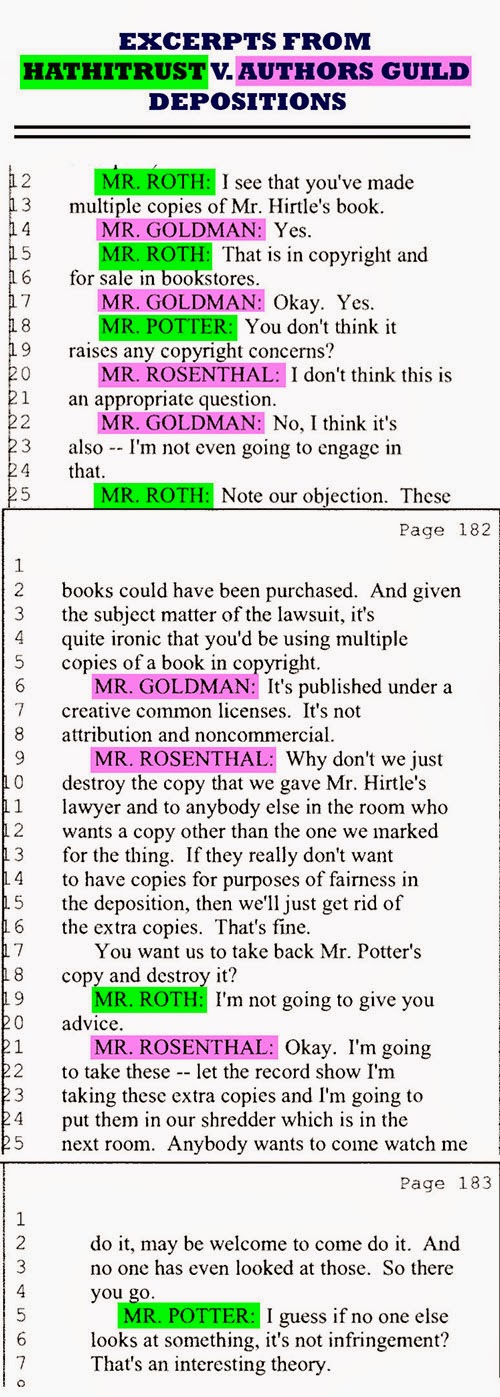
So, HT’s lawyer snarks about multiple litigation copies of HT witness’s book the AG’s lawyer has made in preparation for the deposition; AG lawyer rises to the bait (even though the book is, according to another AG lawyer, CC/noncommercial licensed) and suggests he’ll destroy the extra copies before reading.  HT’s lawyer: “I guess if no one else looks at something, it’s not infringement? That’s an interesting theory.”

Posted in http://schemas.google.com/blogger/2008/kind#post | Leave a comment

"original" and "first" are mere puffery


Bern Unlimited, Inc. v. Burton Corp., No. 11-12278, 2014 WL 2649006 (D. Mass. June 12, 2014)
Bern sued six of its competitors in the market for sports helmets, alleging trade dress infringement.  Answering Bern’s third amended complaint, defendants asserted false advertising counterclaims, which the court struck in part.
First, defendants alleged that Bern falsely advertised that its helmets were the “first visor helmet offering a protective visor cover in the front.” The court found this, and claims that the helmets were the “original” and the “first functional visor lid” to be puffery. They were not specific and measurable, and thus not actionable.  (No Dastar analysis required, then.)
Second, defendants alleged that Bern falsely advertised that its helmets were covered by a patent, implying that its competitors’ helmets were imitations.  Bern argued that there could be no falsity because the patent in fact issued and was presumed valid.  But the presumption can be overcome by showing objective and subjective bad faith.  What counts as bad faith is determined on a case by case basis; if the patentee knows of invalidity but represents that a competitor is infringing, that’s clearly bad faith.
The counterclaims alleged that Bern advertised and sold the helmet more than a year before the applicant applied for the patent, triggering the old on sale bar.  If the counterclaims were true, Bern’s statements that the patent covered the helmet were made in bad faith because it couldn’t reasonably have believed that the patent was valid.
Bern argued that statements could only be actionable if they directly referred to a competitor or its products, and that it didn’t explicitly claim that the defendants were infringing its patent.  But the counterclaims alleged that Bern characterized competing helmets as imitations, and did so in the same marketing materials that included references to the patent.  One ad included, on the same page, both a reproduction of the first page of the patent and the statement, “Every single brand in the market now has a brim, but your customer wants the original!”  While the argument that these statements in combination would reasonably cause consumers to believe that competing helmets were infringing was “thin, at best,” the allegations were sufficient to state a claim.
Bern also argued that defendants didn’t allege proximate cause, as required by Lexmark.  But Lexmark’s requirement of injury flowing directly from advertising is satisfied when “deception of consumers causes them to withhold trade from the [claimant].” The counterclaims properly alleged that scenario.
The court also rejected Bern’s argument that the counterclaims were added too late.  Defendants argued that they didn’t know until they received Bern’s document disclosure that Bern knew the patent was invalid from its inception, thus completing their counterclaim with the requisite bad faith.  The court had “doubts” about the timing and purpose of the counterclaims, but still declined to strike them on grounds of undue delay.  There would be some prejudice to Bern, because Bern would be entitled to discovery on deception and materiality (even though literal falsity creates a presumption of deception, that can be rebutted, and materiality has to be shown independently; thus discovery would be appropriate).  But that prejudice was not enough to overcome the interest in adjudicating related claims together; much relevant discovery was already completed, and it would be a waste to separate the claims.
Posted in http://schemas.google.com/blogger/2008/kind#post, patents | Leave a comment

Washington’s football team registrations cancelled

If you didn’t get the link from five other places, here it is.  (It turns out that today was a bad day to wear shorts to the office; it’s not the best outfit for being interviewed by a suited TV reporter.)

My contributions: a reminder that Renna v. County of Union has some very important things to say about the lack of protection for marks under sec. 43(a) when those marks are not registrable under sec. 2.

Also, a picture from my collection: I got this from a yard sale; the guy who made them was forced to discontinue them due to threats from the team.  (Object in center of card is an Indian-head nickel.)  You can see Bad Frog Beer hanging out behind the card.

Posted in trademark | Leave a comment

Grande deception?

Starbucks and the “free” college education for its workers: The reporting on Starbucks’ offer has gone beyond the headline—and if treated like ordinary advertising, that headline is misleading.  As it turns out, Starbucks will only pay in full for two years, not four; it’s negotiated a discount with ASU online for everyone.  And Starbucks does not pay up front.  Instead, the employee must go out of pocket, and get reimbursed only after sufficient credits have been completed.  I don’t think this meets the standard for “free” offers set forth by the FTC.  Although most of the Guide is directed at other situations, it’s pretty clear that material constraints on the “free” offer have to be disclosed, and the requirement that the employee pay up front is quite significant, financially.  This seems to me similar to the cases involving purported early tax refunds, which were instead tax refund anticipation loans, with very different potential economic consequences.  Calling them “rapid refunds” was false and misleading. 
Consider also that Starbucks is using this announcement to tout its own specialness and corporate social responsibility, as on The Daily Show.  So it’s commercial speech, certainly under Nike v. Kasky.  Just as dolphin-safe tuna is an intangible product attribute that convinces consumers to buy even though saving dolphins does nothing for them directly, so is “free” college tuition for employees, something Jon Stewart highlighted when he stated that because of Starbucks’ announcement he’d be buying from one of their stores.  Given all this, should Starbucks be worried about its PR moment turning into a moment in court?
Posted in advertising, commercial speech, consumer protection, http://schemas.google.com/blogger/2008/kind#post | Leave a comment

Fair use decisionmaking

Deconstructing arguments that treat fair use as a mysterious and dangerous concept: This detailed analysis of a flowchart is quite useful. And it cites the OTW’s Fair Use Test Suite!
Posted in copying, http://schemas.google.com/blogger/2008/kind#post | Leave a comment

reading list: marijuana advertising and lessons from tobacco

Kimber P. Richter, Ph.D., M.P.H. & Sharon Levy, M.D., M.P.H., Big Marijuana — Lessons from Big Tobacco, New England Journal of Medicine:

[T]obacco was not always as lethal or addictive as it is today. In the 1880s, few people used tobacco products, only 1% of tobacco was consumed in the form of manufactured cigarettes, and few deaths were attributed to tobacco use. By the 1950s, nearly half the population used tobacco, and 80% of tobacco use entailed cigarette smoking; several decades later, lung cancer became the top cause of cancer-related deaths. This transformation was achieved through tobacco-industry innovations in product development, marketing, and lobbying….

Marketing strategies go hand in hand with product innovation. The market for marijuana is currently small, amounting to 7% of Americans 12 years of age or older, just as the tobacco market was small in the early 20th century. Once machines began mass-producing cigarettes, marketing campaigns targeted women, children, and vulnerable groups by associating smoking with images of freedom, sex appeal, cartoon characters, and — in the early days — health benefits. There is reasonable evidence that marijuana reduces nausea and vomiting during cancer treatment, reverses AIDS-related wasting, and holds promise as an antispasmodic and analgesic agent. However, marijuana manufacturers and advocates are attributing numerous other health benefits to marijuana use — for example, effectiveness against anxiety — with no supporting evidence. Furthermore, the marijuana industry will have unprecedented opportunities for marketing on the Internet, where regulation is minimal and third-party tracking and direct-to-consumer marketing have become extremely lucrative. When applied to a harmful, addictive commodity, these marketing innovations could be disastrous. This strategy poses a particular threat to young people. Adolescents are more likely than adults to seek novelty and try new products.

Posted in advertising, reading list | Leave a comment