ALI CLE event on Lexmark, Pom, etc.

First, I apologize for the slew of RSS feed updates you may recently have received if you subscribe via an RSS reader like Feedly—the feed has apparently been broken since early May. I was still here though!  If you’re interested, you can browse the archives at tushnet.blogspot.com, or use any tags of interest to see what you missed.  I have taken measures so I’ll notice earlier next time.
Thursday July 10, 2014 1:00 – 2:00 pm Eastern
The law of false advertising has attracted national attention. Two recent Supreme Court decisions interpreting the Lanham Act will provide companies with more flexibility in policing their competitor’s product claims.
The Supreme Court recently issued Lanham Act opinions in Lexmark International v. Static Control Components and POM Wonderful v. Coca Cola, involving standing and preclusion, respectively. The Third Circuit will soon address whether a Lanham Act plaintiff who shows a likelihood of succeeding on its false advertising claim is entitled to a presumption that the defendant’s conduct causes irreparable harm.
What impact will these decisions have on future actions under the Lanham Act? Learn more at this CLE on the latest rulings on the Lanham Act.
What You Will Learn
Discussion will include:
analysis of Court’s decisions in Lexmark and POM Wonderful
standing to bring suit under Lanham Act
FDA preclusion and preemption
remedies: injunctive relief vs. damages
Who Should Attend
This continuing legal education program from American Law Institute CLE will benefit in-house counsel, IP and business attorneys, and other professionals involved in business marketing.
Planning Chair
Christopher M. Kindel, Member, Pirkey Barber PLLC, Austin, Texas
Mr. Kindel focuses his practice on intellectual property trademark and copyright. His experience crosses a wide range of industries including consumer and luxury goods, retail sales, hotel services, music and entertainment, pharmaceuticals, software, financial and consulting services and information technologies industries.
Saul H. Perloff, Member, Norton Rose Fulbright LLP, San Antonio, Texas
Mr. Perloff is a partner in the firm’s Intellectual Property Group and the head of the false advertising group where he represents domestic and international clients in a wide range of complex advertising and unfair competition disputes under the Lanham Act and state law. He also counsels and advises pharmaceutical, consumer product, biotechnology and other clients on advertising and brand protection strategies.
Adam L. Scoville, Vice President & Assistant General Counsel, RE/MAX, LLC, Denver, Colorado
Mr. Scoville leads a team of over a half dozen professionals charged with advertising substantiation, trademarks and brand protection, and other intellectual property issues at RE/MAX, LLC, which franchises real estate brokerage operations with over 90,000 sales associates, in over 6,000 franchised offices, in over 95 countries.
Rebecca L. Tushnet, Professor of Law , Georgetown Law, Washington, D.C.
Professor Tushnet is a professor of law at Georgetown specializing in intellectual property and is a frequent author and speaker on the topic. She also writes the widely-followed 43(B)log False Advertising and More which reports on current IP cases, issues, conferences, and debates.
Posted in http://schemas.google.com/blogger/2008/kind#post, presentations | Leave a comment

Such a lonely word: "honest" isn’t puffery

Salazar v. Honest Tea, Inc., 2014 WL 2593601, No. 2:13-cv-02318 (E.D. Cal. June 10, 2014)
Salazar alleged that HT’s Honey Green Tea bottles didn’t contain the amount of antioxidants represented on their labels, where independent lab testing determined that the bottles contained an average of 186.7 mg of flavonoids per bottle, or 24 percent below the “247 mg Antioxidants Green Tea Flavonoids Per Bottle” highlighted on the labels.  (Previous versions claimed “250mg EGCG2 Super Antioxidant,” though independent testing showed only 70 mg, and then “Antioxidants 190mg Tea Catechins/Bottle,” though independent testing showed only 119 mg.  Salazar alleged that HT changed its labels but not the formulation.)  Salazar alleged that HT’s “Refreshingly Honest” and “Brutally Honest,” and interactive campaigns centered on the word “honesty,” made this more deceptive.
Salazar brought the usual California claims.  HT argued express preemption, because her tests didn’t employ the FDA-mandated test protocol for nutrient content claims.  Salazar argued that the FDA requirements only apply to disclosures in the “Nutrition Facts,” and that HT’s alleged misrepresentations weren’t “nutrient content claims” subject to the FDA regulations.  The court disagreed.
Under FDA regulations, “compliance with requirements for nutrient content claims” must be determined by analyzing a sample consisting “of a composite of 12 subsamples (consumer units), taken 1 from each of 12 different randomly chosen shipping cases, to be representative of a lot.”  However, Salazar’s claims were based on (1) her own independent testing (finding, for example, an average of 70 mg of EGCG, less than a third of the claimed 250 mg amount, with similar lower-than-claimed results for catechins and bioflavonoids), (2) a report from ConsumerLab.com (finding 57.5 mg of EGCG, with similar lower-than-claimed results for catechins), (3) HT’s own marketing materials referring to supposed independent tests by Men’s Health Magazine(finding 71 mg).
The court found that the label statements were nutrient content claims even if not required to be in Nutrition Facts. Therefore, their accuracy had to be challenged under the 12-sample test method, which allowed for some variation in nutrient content of each individual product.  The complaint didn’t allege such testing. It was therefore dismissed with leave to amend.
However, the court did find that Salazar had standing, making the usual allegations of reliance.  But could she sue for the earlier labels, given that she began buying only in 2012?  At this stage, she’d alleged sufficient similarity between the Honey Green Tea products she bought and those she didn’t. The formulation was identical from 2008-2013, and all the variants related to the advertised antioxidant content.  Material differences, if any, were better addressed at the class certification stage.
HT argued that claims based on  the “Honest Tea” name; its “Refreshingly Honest” and “Brutally Honest” taglines; or its “just a tad sweet” and “a kiss of honey, but not enough to gross you out” statements should be dismissed because they are non-actionable puffery. Salazar argued that she believed them, as a reasonable consumer would.  While nonspecific, nonmeasurable assertions are puffery, some courts have found “honesty” to be actionable.  See, e.g., Richman v. Goldman Sachs Grp., Inc., 868 F.Supp.2d 261, 277 n. 8 (S.D.N.Y.2012) (“If Goldman’s claims of ‘honesty’ and ‘integrity’ are simply puffery, the world of finance may be in more trouble than we recognize.”).  The honey-related statements were more blatant puffery:
It is unclear how one could verify whether the level of honey in defendant’s product qualifies as a “kiss” and is “not enough to gross you out.” A “tad” and a “kiss” are vague and non-specific terms that lack any clear, objective indication of their levels. “Not enough to gross you out” is inherently subjective; two different consumers may have different tolerance levels to the honey.
Thus, the claims were dismissed with prejudice insofar as they relied on honey-related statements.
But “honesty” required more analysis.  The term’s frequent use in trademarks was “suggestive of its hyperbolic, generalized nature.”  HT’s use of “honest” was similar to non-actionable claims for “reliability” and “authentic[ity]” in other commercial product cases. “Adding the terms ‘refreshingly’ and ‘brutally’ to ‘honest’ in the tagline may appeal to consumers but may not substantively contribute to notions of honesty.”  On the other hand, “honest” might imply claims to provide only truthful information, and truthfulness can be measured. 
“Honest Tea” by itself also had a “concrete message.”  HT’s ad campaigns included a website posting, “Honest Tea: If it’s not real, it’s not Honest”; re-styling of the label to accentuate the word “Honest”; a billboard campaign of truths such as “YES, THAT DRESS DOES MAKE YOU LOOK FAT, BE REAL. GET HONEST” and “IT’S NOT ME IT’S YOU, BE REAL. GET HONEST”; and a National Honesty Index social experiment measuring compliance with an honor system across cities. As alleged, “defendant sets out to paint itself as honest and bases virtually its entire product image on that characteristic. These claims are not mere puffery.”
Posted in california, consumer protection, fda, http://schemas.google.com/blogger/2008/kind#post, preemption | Leave a comment

infringement isn’t disparagement for advertising injury purposes

Hartford Casualty Ins. Co. v. Swift Distribution, Inc., No. S207172, 2014 WL 2609753 (Cal. June 12, 2014)
The California Supreme Court here provides a relatively rare state court interpretation of the scope of an advertising-related insurance policy.  Hartford insured Swift (here, Ultimate) for claims arising from “[o]ral, written, or electronic publication of material that slanders or libels a person or organization or disparages a person’s or organization’s goods, products or services.”  A third party, Dahl, sued Ultimate, alleging patent and trademark infringement, false designation of origin, and damage to business, reputation, and goodwill based on Ultimate’s sale of a media cart.  Hartford denied coverage on the ground that the underlying suit didn’t allege disparagement.
The duty to defend is broad.  It can be triggered by the allegations of the complaint, or where extrinsic facts known to the insurer (whether disputed or undisputed) suggest that the claim may be covered. 
The court nonetheless held that a claim of disparagement “requires a plaintiff to show a false or misleading statement that (1) specifically refers to the plaintiff’s product or business and (2) clearly derogates that product or business. Each requirement must be satisfied by express mention or by clear implication.”  These limits derive from the common law tort of disparagement, which has been shaped by First Amendment considerations even as applied to nonmedia defendants. 
These specificity requirements “significantly limit the type of statements that may constitute disparagement, especially since advertisements and promotional materials often avoid express mention of competitors,” though the court noted that other courts “have found certain kinds of statements to specifically refer to and derogate a competitor’s product or business by clear implication.” This can occur when a false or misleading statement necessarilyrefers to and denigrates a competitor’s product.  A total superiority or uniqueness claim may clearly or necessarily disparage another party without expressly mentioning them. 
The underlying complaint here alleged infringement and dilution, and attached Ultimate’s ads, which didn’t name the Multi-Cart or any other competing product.  Ultimate offered two theories of disparagement: the first focused on Dahl’s claim that the products’ similarity in design and product name led to confusion, while the second involved false statements of superiority that allegedly implied the inferiority of Dahl’s product.
Even if the use of Ultimate’s “Ulti-Cart” could reasonably imply reference to Dahl’s “Multi-Cart,” there was no disparagement.  Consumer confusion does not by itself mean disparagement.  Intentional mimicry, without more, doesn’t derogate or malign the subject of copying.  Even assuming it’s true that confusing consumers into thinking that you offer a high-quality product and then offering them a cheap knock-off is derogatory to the trademark owner, because confused consumers will believe that the cheap knock-off represents the legitimate product’s actual quality, no such conduct was alleged here.  Instead, Dahl repeatedly asserted that the two products were “nearly identical, folding transport carts.” “A false or misleading statement that causes consumer confusion, but does not expressly assert or clearly imply the inferiority of the underlying plaintiff’s product, does not constitute disparagement.”
Ultimate argued that its 2010 product catalog disparaged the Multi-Cart by asserting the superiority of the Ulti-Cart: “Ultimate Support designs and builds innovative, superior products,” provides “unique support solutions that are crafted with unparalleled innovation and quality and accompanied by superior customer service,” and the Ulti-Cart has “patent-pending folding handles and levers.” The catalog was referenced in the complaint and should be considered, but were insufficient. Except for the patent-pending statement, the statements were general descriptions of the company.  And “superior” doesn’t necessarily imply a derogatory comparison; according to the dictionary, it may be used to describe something “[o]f great value or excellence; extraordinary” or “notably excellent of its kind: surpassingly good.”  Nor does “patent-pending” guarantee that a patent will be granted or that the product is of higher quality. These statements weren’t specific enough to call into question Dahl’s proprietary rights in his product or to suggest that the Ulti-Cart had any important, unique feature.  Instead, they were mere puffing.  “Were we to adopt Ultimate’s theory of disparagement, almost any advertisement extolling the superior quality of a company or its products would be fodder for litigation.”  That would be a free speech problem.
Posted in disparagement, insurance, trademark | Leave a comment

mortgages and the UCL: an occasional series

Pestana v. Bank of America, 2014 WL 2616840, No. A137566 (Cal. Ct. App. June 12, 2014)
Pestana sued his mortgage loan servicers (BoA) after BoA denied his application for a loan modification under the federal Home Affordable Mortgage Program (HAMP), and instead offered him an allegedly less favorable in-house modification, which he accepted. He alleged that BoA representatives made misrepresentations about the requirements and availability of a HAMP modification, breached promises to modify his loan, improperly stalled the modification review process, and incorrectly denied his application for a HAMP modification.  The trial court dismissed all his claims, but the court of appeals revived his UCL claim.
The breach of an oral agreement claim was dismissed because there was no writing signed by BoA, despite the alleged oral promise to review Pestana’s application/modify his loan.  The only letter he received just listed documents he should send in and didn’t make promises. 
The promissory estoppel claim relied on oral statements made by BoA representatives during three telephone conversations, but none of these was enough to make a clear and unambiguous promise supporting a claim for promissory estoppel.  Pestana first alleged that a BoA representative named Bob told him that, if he became delinquent on his mortgage payments, he would receive a loan modification. But he didn’t allege that Bob promised a HAMP modification, and he alleged that he only learned about HAMP later.  Offering an in-house modification fulfilled any general promise of a modification.  Then, Pestana alleged that a BoA rep named Denise told him he’d be evaluated for a HAMP modification if he returned the appropriate form and supporting documentation, and that this implied that BoA’s evaluation would be conducted in good faith.  But this too was not a clear and unambiguous promise that BoA would conduct its evaluation in a particular manner.  And BoA fulfilled its general promise to evaluate Pestana’s application, ultimately rejecting it.  Finally, Pestana alleged that a rep named Shawn told him that BoA had received all the required documentation and that the review process would begin immediately, which he alleged implied good faith review. The court found no express promise about how the review would be conducted.
Intentional misrepresentation claims were also dismissed.  They’re a variety of fraud claims.  The allegations didn’t establish that the reps made false promises or promises without any intention of performing them.  Requests by BoA for additional documentation and BoA’s denial of his application didn’t themselves involve false representations or false promises, except for (allegedly) BoA’s statement that Pestana didn’t qualify for a HAMP modification, and Pestana didn’t believe or rely on that.
However, the UCL claim was different.  BoA allegedly
(1) told borrowers, including Pestana, that, if (and only if) they stopped making mortgage payments, they could apply for loan modifications and Bank would review their applications in good faith, (2) promised Pestana he would be granted a modification, (3) stalled the review process for Pestana and other borrowers, including by requesting documents Bank had already received, and (4) falsely represented to qualified borrowers, including Pestana, that they did not qualify for HAMP modifications.
BoA argued that Pestana lacked standing.  But Pestana alleged that he incurred late fees and penalties after he stopped making (and continued to withhold) his mortgage payments in reliance on BoA’s representations about the availability and requirements of a loan modification.  That was enough to show economic injury and causation at this stage.  Pestana alleged that he stopped making mortgate payments “after (and in reliance on) representations in June 2009 by a [BoA] representative that (1) [BoA] could not help him with a loan modification as long as he was current on his payments, and (2) if he were to miss his payments, he would receive a modification.”  His default and late fees could thus be traced to BoA.
BoA argued that Pestana was contractually obligated to pay late fees if he missed mortgage payments and thus couldn’t count them as injury.  Even if the note so provided, that didn’t mean Pestana suffered no economic injury: he wouldn’t have become obligated to pay the late fees if he hadn’t stopped paying.  BoA also argued that Pestana ultimately received an in-house loan modification, but at the pleading stage the court wasn’t going to determine the factual question of whether this was enough benefit to match or outweigh his loss.
UCL “fraudulent” conduct: This doesn’t require the elements of the common-law tort of fraud, but rather only requires a showing that members of the public are likely to be deceived.  Pestana sufficiently alleged that BoA made untrue or misleading representations that were likely to deceive reasonable consumers, such as that modifications would only be possible if he stopped making mortgage payments.  Then BoA allegedly stalled the review process, racking up extra late fees and penalties that benefited BoA as servicer.  And BoA allegedly falsely told Pestana and other borrowers they did not meet the eligibility requirements for HAMP modifications.  At the demurrer stage, the court couldn’t determine that BoA’s statements were accurate and nonmisleading.
Clean-up: the absence of a federal right of action under HAMP didn’t bar the UCL claim. There was no indication that federal law displaced state remedies.
Posted in california, consumer protection, unfairness | Leave a comment

A little more than kin: prominent house mark overcomes weak evidence of confusion

KIND LLC v. Clif Bar & Co., 2014 WL 2619817, No. 14 Civ. 770 (S.D.N.Y. June 12, 2014)

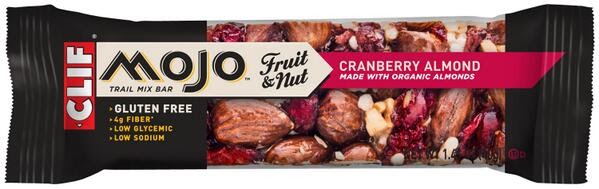
KIND sought a preliminary injunction against Clif Bar’s new trade dress for its MOJO bars; the court denied the motion.  KIND defines its trade dress as
(1) packaging with a transparent, rectangular front panel revealing a large portion of the bar itself; (2) a horizontal stripe bisecting the transparent front panel containing the flavor of the bar in text; (3) a text description of the product line (e.g. “Fruit & Nut,” “Plus,” or “Nuts & Spices”) in line with the horizontal stripe bisecting the transparent front panel; (4) a vertical black band, offset to the side of the package, containing a bulleted list of many of the bar’s key healthful attributes; (5) opaque vertical bands, or end caps, at either edge of the product package; and (6) a 40g size, in a slender shape.
KIND bar

KIND also sought to protect “the overall impression of the packaging,” not just those six specific elements, but the court wasn’t having it.  A clear definition of the protectable dress is necessary to allow courts and defendants to know what they’re supposed to be evaluating, and to avoid protecting a look at an improper level of generality.

First, the court determined that the trade dress was neither inherently distinctive nor generic.  Distinctiveness should be evaluated bearing in mind (1) the risk that overextension of trade dress protection could undermine limits on copyright and patent law, and (2) that trade dress doesn’t protect an idea, a concept, or a generalized type of appearance.  KIND understandably cited the old Landscapelanguage that “the varieties of labels and packaging available to wholesalers and manufacturers are virtually unlimited [so] a product’s trade dress typically will be arbitrary or fanciful and meet the inherently distinctive requirement for § 43(a) protection.”  But KIND’s own “very common packaging design” wasn’t inherently distinctive.  Nor was it generic—the combination of the six elements wasn’t a “singular custom in the industry.”
Running through the evidence, many food bars use one or more of the six elements KIND sought to protect: transparent packaging, horizontal banners with product/flavor descriptions, product attributes along one side of front panel, 40 gram size, and opaque end caps.  Many of these were also common in the food industry in general. Most of these elements also served functional purposes—the transparent window reveals the bar within; the text description informs consumers of the bar’s ingredients, etc.—and this also weighed against finding the trade dress protectable. These elements, either individually or together, just didn’t identify source.  The KIND logo wasn’t included in the claimed trade dress.  (And its two registrations for its packaging differed from that claimed here, most notably by including “KIND.”)  All the elements it sought to protect here instead described its product, particularly the most prominent feature: the transparent, rectangular front panel.  Likewise the text description and the 40g size in a “slender shape”; the horizontal stripe bisecting the transparent front panel contained the flavor, and the vertical black band contained “a bulleted list of many of the bar’s key healthful attributes.”  The opaque end caps might not seem descriptive at first, but they sometimes reflected the bar’s flavor or featured plus signs to show that the bar was part of KIND’s “Plus” line.
So, could KIND show secondary meaning?  Relevant factors: (1) advertising expenditures, (2) consumer studies linking the dress to the source, (3) unsolicited media coverage of the product, (4) sales success, (5) attempts to plagiarize the dress, and (6) length and exclusivity of the trade dress’s use.  KIND failed to meet its heavy burden of showing secondary meaning.
MOJO bar

The court found evidence that Clif Bar did deliberately copy elements of the KIND trade dress, making factor (5) favor KIND.  Sample statements: an email recapping a MOJO redesign meeting stated that “[e]veryone also agreed that Kind is a best in class packaging that we should learn from for MOJO,” with a “[l]arge product visual with clear window”; “[g]ood branding (KIND)” (although that wasn’t part of the trade dress at issue here); “[c]laims on front panel (not wrapped); and “[g]ood flavor communication claim.”  Another internal document said that KIND had an “advantage” in packaging because of its “large clear window” and because its “claims are clearly indicated on the front wrapper”; an email instructed a team member to “[b]ring multiple KIND bars” to a MOJO redesign meeting; a presentation indicated that one “packaging objective[ ]” was to “[c]ompete head-to-head with Kind” by incorporating a “[l]arger window to showcase bar with whole pieces of fruits & nuts,” a “[s]imilar window shape & coloring to Kind.”  At one point a brand manager said that the MOJO packaging was “now too close to KIND.”

That wasn’t enough to show secondary meaning, though.  Since launch, KIND had spent more than $100 million on marketing and advertising, had sold $600 million dollars’ worth of KIND bars, had received extensive unsolicited media coverage, and all KIND bars allegedly shared the six elements at issue.  However, KIND didn’t show that these sales/ads/etc. resulted in consumers associating these six elements with KIND, in the absence of the logo.  Even four ads featuring KIND bars without the logo displayed the logo elsewhere on the ad. Thus, the court couldn’t determine whether secondary meaning existed in these elements, or the logo, or the logo plus the six elements.
While “intentional copying constitutes persuasive evidence of consumer recognition, conscious replication alone does not establish secondary meaning.” (Otherwise competitors would hesitate to copy good, descriptive ideas.)
Though it wasn’t necessary, the court ran through the confusion factors as well. 
Strength of the trade dress: the court found it to be weak—descriptive, and without secondary meaning.  The commercial context also mattered: many food bars used the six elements, either individually or some in combination, which additionally undercut the strength of the trade dress and “indicate[d] that its claim is pitched at an improper level of generality.”  KIND’s CEO even testifed that the Think Thin Crunch bar “may arguably be infringing” as well, but most of the six elements at issue didn’t appear on its trade dress—the only similarities were the transparent window and the opaque end caps.  This was impermissibly seeking protection for “a generalized type of appearance.”
Similarity: Though the trade dresses shared some similar elements, the overall impression differed significantly, weighing against KIND.  KIND’s witness explained that packaging can be divided into two types, one that emphasizes straight lines and minimizes curvature, and the other that has or emphasizes curvature. Jargon ahoy: KIND’s trade dress is best described as “minimalist,” “simple,” “clean,” “modern,” and “sleek,” connecting with its brand concepts of integrity and simplicity.  It uses straight lines.  The MOJO trade dress has a different color scheme, fonts, and number and placement of design elements; it’s embellished rather than minimalist; and it uses curves in the large curved “J” of MOJO, the cursive font used to describe the product-line, and the mountain displayed along the bottom of the packaging.  Its movement/mountain imagery “connects with the core concepts” of the Clif Bar/MOJO brands.
Also, the prominent use of MOJO and the Clif Bar mark, which has 87% aided awareness, tended to dispel any confusion.  See Bristol-Myers Squibb Co. v. McNeil-P.P.C., Inc., 973 F.2d 1033, 1046 (2d Cir. 1992) (house brands can prevent confusion).  KIND argued that the Bristol-Myers rule didn’t apply because the Clif marks weren’t prominent enough and weren’t universally recognized, and because the KIND trade dress was remembered better than the name. The court disagreed: the marks didn’t have to be the most prominent part of the trade dress to dispel confusion, and anyway MOJO was the second most prominent feature after the transparent window.  Also, the evidence didn’t show general consumer recognition of KIND bars only through the six claimed elements.
Competitive proximity favored KIND; there was no gap to bridge.
Actual confusion evidence was weak; its absence wouldn’t weigh against KIND because the product was new to the market.  This factor weighed slightly in KIND’s favor:  There were dueling surveys and some anecdotal evidence.
KIND’s survey found 15% net confusion.  This was “on the lower end of rates that courts within this Circuit have found sufficient to show actual confusion.”  True, in the bad old days some courts accepted gross rates of 15% without control groups, but that was before courts understood consumer survey evidence. 
Plus, Clif Bars’ expert credibly testified that the KIND survey was flawed because it only measured whether there was confusion, not what caused it.  When there is a multi-element trade dress, it’s vital to understand what causes the problem.  But the control had none of the elements.  Thus, the survey may have underestimated noise/overestimated confusion.  The survey respondents were asked: “Do you think this brand of [snack bars] is or is not made by or made with the approval or sponsorship of the same company that makes the [corresponding type of product] you saw in the earlier photo?” Yes-sayers got follow-ups, and the verbatim responses to “What makes you say that?” and “Anything else?” questions proved Clif Bars’ point.  Some responses cited the similar packaging; other responses cited the similar flavors of the KIND and MOJO bars (e.g., “They have the same flavors, and are both healthy snack bars”; “Fruit and nut was on most of the packaging with the exception of the chocolate bar I believe. Looks like a higher quality of the same bars”; “They had the exact same titles for each of the different bars”); others cited both packaging and flavors; and others just completely whiffed (e.g., “These are very nice packages and I was looking for a special Valentine gift along these lines anyway, so it is exciting to encounter new products with better ingredients”; “I think this would be in every store and people would love to buy them.”).  Thus, the court gave little weight to the survey.
The anecdotal evidence of confusion involved one customer who thought the MOJO bar he’d selected was a KIND bar, but he had “no clue” about the bar he selected, and told the interviewer he was looking for a KIND bar because his daughter told him to buy it.  Since “the correct test is whether a consumer who is somewhat familiar with the plaintiff’s [dress] would likely be confused when presented with defendant’s [dress] alone,” this didn’t matter.  Another potential consumer who shared an apartment with a KIND employee, selected a MOJO bar, believing it to be a KIND bar, from a bowl of snacks in her apartment. But this confusion might have resulted from her expectation that she’d find KIND bars in her home because of her roommate’s employment. That wasn’t probative of the average consumer in marketplace conditions.
KIND also relied on social media post, but the court found them “mostly unhelpful.”  Comments on Clif Bar’s Facebook posts noted similarities between the bars, e.g., “I love all things Clif and I’m sure I’ll like these too, but don’t they kinda look like Kind bars?”  But assertions of similarity don’t establish confusion.  One tweet said, “I was about to pick up one of those [MOJO bars] because I thought it was a Kind Bar at the vitamin shop ….,” and that did suggest actionable initial interest confusion.  (Argh!  Confusion remedied before the consumer even takes physical action should not count.  That’s just initial attention. There are no sunk costs making this like bait and switch.)  But the overall evidence of actual confusion was weak.
Bad faith: the evidence didn’t show an intent to deceive consumers into believing that the MOJO bar was made or sponsored by KIND, and thus this factor weighed in favor of Clif Bar.  Intent to compete by imitating is vastly different from an intent to deceive.  The prominent display of the MOJO/Clif Bar marks and dissimilarity to KIND’s minimalist trade dress negated any inference of intent to deceive.
Quality: no evidence; no one cares.
Buyer sophistication: About half of retail outlets sell KIND bars in a “primarily impulse” setting, but over three-quarters of its sales volume comes from frequent purchasers who eat a bar several times a week or more.  Some buyers are casual and some careful. The court gave this factor little weight.
The court also identified other marketplace factors that favored Clif Bar.  Here, the “caddies” or “inner cases” in which these products are often sold, and the point of sale displays Clif Bar has provided retailers, all prominently bore the MOJO and Clif marks, thus dispelling confusion.  In addition, many MOJO and Clif bars are sold through mass market and grocery stores, where MOJO bars are often grouped with other Clif Bar products and KIND bars are often grouped with other KIND products.
Balancing the factors, no confusion was likely. Thus there was no irreparable harm. 
Under the alternate standard for preliminary relief (assuming it survives eBay), KIND also failed.  Clif Bar alleged sunk costs for the new MOJO products of $13.9 million, including inventory ready to ship and already shipped; “contracted ingredient and marketing commitments; R & D development costs; the cost of sales kits, merchandising shippers, plan-o-grams and reset work; and the forecasted loss of sales from Clif Bar products discontinued to make room for new CLIF MOJO products on the shelf.”  KIND’s proposal for a three-month sell-off period would reduce losses only as to the first category.  It would cost Clif Bar approximately $500,000 and take eight months to develop and manufacture new packaging, with a loss of $10 million in revenue during that period, with consequent harm to brand loyalty and reputation while it couldn’t fulfill its commitments.  While KIND argued that ingredients could be repurposed and that a new design would only take three months, KIND’s irreparable harm was premised on KIND’s alleged loss of goodwill and market share through confusion, which wasn’t sufficiently shown, so it couldn’t meet its burden of showing that the balance of harms tipped decidedly in its favor.
Posted in surveys, trademark | Leave a comment

POM Won: a summary of the ruling

POM Wonderful LLC v. Coca-Cola Co., No. 12–761, 573 U.S. — (June 12, 2014)
POM sued Coca-Cola for falsely advertising a “pomegranate blueberry” juice blend with 0.3% pomegranate juice and 0.2% blueberry juice. The Ninth Circuit found this claim precluded by the FDA’s extensive juice labeling regulations, and the Supreme Court reversed in a broad opinion that nonetheless leaves room for preclusion arguments, certainly in pharmaceutical cases. Examining text, history, and structure of both laws showed no congressional purpose to forbid private suits in cases of this type, but the Court left room to fight about just what POM’s “type” is. (E.g., does this ruling have any bearing at all on a case in which at least part of the plaintiff’s evidence of falsity is use of a term that is inconsistent with a FDA definition thereof, such as “generic”? Consider in this regard what the Court says below about the FDA’s area of expertise ….)
We know that Congress, in the Lanham Act, intended to protect competitors from deceptive advertising/unfair competition. (The Court uses “competitor” as a shorthand for people with standing under Lexmark.)
The FDCA “is designed primarily to protect the health and safety of the public at large.” It prohibits misbranding of food and drink, which includes false or misleading labeling. The FDA promulgated extensive regulations about juice labeling to implement this mandate. Under these regulations, “[i]f a juice blend does not name all the juices it contains and mentions only juices that are not predominant in the blend, then it must either declare the percentage content of the named juice or ‘[i]ndicate that the named juice is present as a flavor or flavoring,’ e.g., ‘raspberry and cranberry flavored juice drink.’” The FDA does not preapprove juice labels, unlike drug labels, “consistent with the less extensive role the FDA plays in the regulation of food than in the regulation of drugs.”  The FDCA may not be privately enforced, and the NLEA preempted many non-identical requirements from a state or political subdivision of a state.

Minute Maid Pomegranate Blueberry …

“Despite the minuscule amount of pomegranate and blueberry juices in the blend,” “pomegranate blueberry” is prominent and set-off on the label, with “flavored blend of 5 juices” in much smaller type, then “from concentrate with added ingredients,” in still smaller type, then “and other natural flavors.” There’s also a vignette of blueberries, grapes, and raspberries in front of a halved pomegranate and a halved apple. The Ninth Circuit held that the FDA’s extensive regulation precluded a Lanham Act claim against these elements.

The court began by distinguishing preemption, which involves a state-federal balance and a resulting presumption against preemption.  Nonetheless, preemption principles were instructive “insofar as they are designed to assess the interaction of laws that bear on the same subject.”
But at the core, this was a statutory interpretation case.  POM argued that two statutes must be given full effect unless they are in “irreconcilable conflict.” Coca-Cola argued that a more specific law, the FDCA, narrowed the scope of a more general law, the Lanham Act.  Even if the Court’s task were to reconcile the two laws, Coca-Cola was wrong that the best way to harmonize them was to bar the Lanham Act claim.
The Lanham Act, by its own terms, has a “comprehensive imposition of liability” extending to food and beverage labels.  And the FDCA, by its own terms, doesn’t bar Lanham Act suits. The absence of textual preclusion is especially significant because the Lanham Act and the FDCA have coexisted since the passage of the Lanham Act in 1946.  Congress has amended both during the last 70 years, and could’ve addressed interference by the Lanham Act with the FDA if it had concluded that there was any, for example when it enacted the express preemption provision in the NLEA.  “This is ‘powerful evidence that Congress did not intend FDA oversight to be the exclusive means’ of ensuring proper food and beverage labeling.”  If anything, applying expressio unis to the NLEA suggests that Lanham Act suits are not precluded:
It is significant that the complex pre-emption provision distinguishes among different FDCA requirements. It forbids state-law requirements that are of the type but not identical to only certain FDCA provisions with respect to food and beverage labeling. Just as significant, the provision does not refer to requirements imposed by other sources of law, such as federal statutes…. By taking care to mandate express pre-emption of some state laws, Congress if anything indicated it did not intend the FDCA to preclude requirements arising from other sources.
Structure reinforced text.  “When two statutes complement each other, it would show disregard for the congressional design to hold that Congress nonetheless intended one federal statute to preclude the operation of the other.”  So here: each statute has its own scope and purpose.  “[T]he Lanham Act protects commercial interests against unfair competition, while the FDCA protects public health and safety.”  They complement each other more fundamentally, in that the FDA is largely responsible for enforcing the FDCA, but it doesn’t have “the same perspective or expertise in assessing market dynamics that day-to-day competitors possess.”  Those competitors have detailed knowledge about consumer reaction to “certain sales and marketing strategies,” and “[t]heir awareness of unfair competition practices may be far more immediate and accurate than that of agency rulemakers and regulators.”  The Lanham Act allows this market expertise to be brought to bear on a case-by-case basis.  By providing compensation that may motivate injured parties to come forward, the Lanham Act provides additional incentives for manufacturers to behave well.  Allowing Lanham Act suits “takes advantage of synergies among multiple methods of regulation.”  Each statute thus has its own mechanisms to enhance the protection of competitors and consumers.
(As I wondered after oral argument, I wonder how this conclusion about competitor expertise plays out in First Amendment challenges to FDA regulations.  There’s room here, especially given the Court’s reference to “synergies,” to argue that the FDA may underidentify misleading behavior, but still has expertise to determine a minimum blanket rule for what’s false/misleading—but I worry the DC Circuit won’t go for that.) 
A preclusion finding for food and beverage labels would cut a hole in consumer protection.  The FDA doesn’t preapprove such labels, as it does for drugs, and the FDA acknowledges that it doesn’t pursue enforcement against all objectionable labels.  If Lanham Act claims weren’t allowed, then competitors, and indirectly the public, “could be left with less effective protection in the food and beverage labeling realm than in many other, less regulated industries. It is unlikely that Congress intended the FDCA’s protection of health and safety to result in less policing of misleading food and beverage labels than in competitive markets for other products.”
Coca-Cola argued that preclusion was appropriate because Congress wanted national uniformity in food and beverage labeling.  But that desire wasn’t enough.  Congress did delegate FDCA enforcement to the feds, but POM wasn’t trying to enforce the FDCA.  Preemption of a possible patchwork of state standards was different:
Although the application of a federal statute such as the Lanham Act by judges and juries in courts throughout the country may give rise to some variation in outcome, this is the means Congress chose to enforce a national policy to ensure fair competition. It is quite different from the disuniformity that would arise from the multitude of state laws, state regulations, state administrative agency rulings, and state-court decisions that are partially forbidden by the FDCA’s pre-emption provision.
Congress often allows variability “even in areas of law where national uniformity is important.”  (Citing Bonito Boats’ statement about the importance of national uniformity in IP, then noting the private right of action for patent infringement, and noting that the FDCA contemplates that federal juries will resolve most misbranding claims.)  The Lanham Act is uniform in the sense that it protects an entire class against unfair competition; it varies only in being enforced on a case-by-case basis.  That’s no different than the variability to which any industry is subject.
Coca-Cola argued that the FDCA regulations were much more specific than the Lanham Act.  That’s true.  But that specificity would matter “only if the Lanham Act and the FDCA cannot be implemented in full at the same time.”  However, there was no structural or empirical reason to see “any difficulty in fully enforcing each statute according to its terms.”
The Court then rejected the government’s confusing halfway approach, which wouldn’t have allowed POM to challenge the name but would have allowed other challenges to the configuration of the label.  The government wanted preclusion “to the extent the FDCA or FDA regulations specifically require or authorize the challenged aspects of [the] label.”  The Court was concerned about the practical difficulty of distinguishing between regulations that “specifically . . . authorize” a course of conduct and those that merely tolerate that course.  Also, this position had the same problem of treating the FDCA as a ceiling on regulation of food and beverage labeling, but that was inconsistent with the Lanham Act’s complementarity.  (It’s pretty clear that requirements would not be subject to this analysis—if someone challenged a label that said “zero fat” even though it had a tiny detectable amount of fat, the obvious defense is that the FDA requires the use of “zero fat” under such circumstances, and the Court doesn’t suggest that preclusion would be unavailable then.)
The FDA had not, despite what the government said, fully balanced the competing interests at issue. While the rule mentioned “provid[ing] manufacturers with flexibility for labeling products while providing consumers with information that they need,” it didn’t discuss or even cite the Lanham Act. Plus, the FDA explicitly encouraged manufacturers to include material on labels that wasn’t required by the regulations, which was inconsistent with the idea that the regulations were comprehensive.  “A single isolated reference to a desire for flexibility is not sufficient to transform a rulemaking that is otherwise at best inconclusive as to its interaction with other federal laws into one with preclusive force, even on the assumption that a federal regulation in some instances might preclude application of a federal statute.” 
This was distinguishable from Geier v. American Honda Motor Co., 529 U. S. 861 (2000), in which the agency’s regulation deliberately allowed manufacturers to choose between options to encourage diversity in the industry.  A subsequent lawsuit against one of the choices was barred because it directly conflicted with the agency’s policy choice.  But the FDA hadn’t made a policy judgment inconsistent with POM’s suit, “and in any event the FDA does not have authority to enforce the Lanham Act.” “Even if agency regulations with the force of law that purport to bar other legal remedies may do so, it is a bridge too far to accept an agency’s after-the-fact statement to justify that result here. An agency may not reorder federal statutory rights without congressional authorization.”
Reversed and remanded.
Final note: because the 9th Circuit’s ruling was so broad and ill-defined, and because the Court is careful to distinguish pharmaceutical regulation, it’s hard to say that this will directly affect many lawsuits, though plaintiffs may draw on the Court’s emphasis on the Lanham Act’s breadth.
Posted in fda, http://schemas.google.com/blogger/2008/kind#post | Leave a comment

The Pom Wonderful ruling has arrived

It is here.  Pom wins reversal. More to come.

Posted in fda, http://schemas.google.com/blogger/2008/kind#post | Leave a comment

selling to multiple hospitals isn’t "advertising or promotion" when total market is large

Synthes, Inc. v. Emerge Medical, Inc., 2014 WL 2579286, — F. Supp. 2d — (E.D. Pa. June 5, 2014)

This is a big case involving trade secrets/former employees who started a competing medical device firm. I’m just going to cover a few bits. The Lanham Act false advertising claim, which included challenges to Emerge’s comparative statements about the Synthes product, seem headed towards failure because the statements weren’t sufficiently disseminated to count as advertising or promotion.  (Post edited for clarity: Given the procedural posture–a denial of summary judgment for the plaintiffs on their Lanham Act claim–all that can be said right now is that the court didn’t need to resolve any other issue to deny summary judgment to Synthes.)

At one point, Emerge “would begin the sales process by approaching a hospital system directly—either by phone, email or in person, through corporate supply chain management. Emerge would then describe its method of not relying on sales reps and would make representations about the characteristics and performance of its products. These statements were made via phone calls, emails, in-person meetings, websites, printed materials, presentations, trade show displays, and social media.”

Even if the statements were literally false, discovery had shown only sporadic instances of dissemination. The identified recipients included 9 healthcare facilities/groups and several other hospitals in the Arizona, Texas, Massachusetts, Georgia, and California regions. However, the relevant device market was national since each hospital and orthopedic surgeon was a potential customer. Thus, this didn’t show wide dissemination throughout the relevant market. (How close does “sufficiently disseminated” have to be to “nationally/nearly comprehensively”?  A campaign that reaches 25% of a huge market can do a lot of harm, and the description of the conduct seems to me to cross over from sporadic to a significant component of a marketing strategy, even if not the only component.)

The CFAA claim was dismissed for failure to show sufficient harm. Synthes argued that it incurred sufficient expenses in investigating the data breach at issue to trigger the CFAA, but there’s a difference between the harm caused by the misappropriation of data/expenses incurred in litigating the issue and the requisite CFAA harm caused by investigating damage to the integrity of a computer system. Synthes’ evidence went to the former. Synthes only investigated damage to its systems once the litigation began, over a year after the alleged unlawful access.

Posted in cfaa, http://schemas.google.com/blogger/2008/kind#post | Leave a comment

animal rights organizations have standing to challenge bull run

Animal Legal Defense Fund v. Great Bull Run, LLC, 2014 WL 2568685, No. 14–cv–01171 (N.D. Cal. June 6, 2014)
ALDF and PETA sued defendants under California’s UCL to enjoin them from operating a bull run. The court denied the motion to dismiss for lack of standing.
Plaintiffs alleged that Great Bull Run organizes events in which “panicked and agitated bulls chase down fleeing runners,” while defendant Lone Star Rodeo supplies bulls and steers for the events, transporting them thousands of miles in trailers. According to plaintiffs, the events involve
people on horses using ropes as whips to scare as many as three dozen bulls—each of which weighs approximately 1,500 pounds—to charge towards as many as 1,000 people arrayed along a quarter-mile track. As the bulls approach at speeds faster than humans can run, the participants try to keep up while avoiding the stampede at their heels. Many runners intentionally run as close to the bulls as possible to provoke them. An eyewitness at the most recent bull run event in Florida reported that several runners taunted and punched the bulls as they ran by.
Plaintiffs alleged that these events subjected bulls to needless suffering, distress, and unnecessary cruelty. Bull runs are allegedy dangerous for the animals because bulls “may become entangled with other bulls or runners, causing them to slip and break their legs or get gored.” They are also inherently stressful to the bulls, “who find themselves in an unfamiliar location surrounded by loud noises, often after having travelled for days in cramped transport trailers.” GBR and Lone Star allegedly take advantage of this fear and confusion to motivate the animals to stampede.
Moreover, bull runs are allegedly dangerous for humans; three participants in prior events were trampled and hospitalized. GBR’s emergency plan still allegedly provides that if someone is injured on the track, the bulls will still be released and no medical personnel will be allowed to enter the course area. GBR requires contestants to sign a waiver form acknowledging that the event is hazardous and presents serious physical and mental dangers.
ALDF alleged that it has invested time and money to prevent these events, “committing staff time and resources to educating the public about the animal welfare concerns, mobilizing opposition such as petition drives, researching permitting requirements, submitting public records requests to local governments, reviewing responsive documents, and speaking with state agencies and local officials about the event.” PETA made similar allegations.
According to plaintiffs, defendants were unlawfully “‘promot[ing] [and] advertis[ing] [a] … bloodless bullfight contest or exhibition, or … similar contest or exhibition,’ in violation of section 597m of the California Penal Code. In addition, the bull run would violate 597b, which prohibits making bulls fight with humans, and section 597(b), which prohibits causing ‘needless suffering’ to animals.”
Defendants argued that plaintiffs lacked an injury in fact. But “[a]n organization suing on its own behalf can establish an injury when it suffered ‘both a diversion of its resources and a frustration of its mission.’” This was sufficiently alleged. Redirected resources/staff time investigating defendants’ practices wouldn’t be necessary but for defendants’ actions, and plaintiffs diverted these resources not just in response to defendants’ activities “but also to counteract the effect these events have on Plaintiffs’ own outreach and education efforts designed to prevent animal cruelty.” Taken as true, these allegations were enough to plead that defendants’ acts perceptibly impaired plaintiffs’ outreach and education efforts by diverting resources to fight defendants’ allegedly unlawful acts. Although this diversion resulted from a voluntary choice, that’s not dispositive. What matters is “whether they undertook the expenditures in response to, and to counteract, the effects of the defendants’ alleged [unlawful acts] rather than in anticipation of litigation.” Defendants argued that plaintiffs were just trying to set up this litigation, but that’s not what the complaint alleged.
What about UCL standing? Did plaintiffs lose money or property? They alleged that they spent money and organizational resources to send agents to witness and record the GBR in other states, and also spent staff time requesting and reviewing public records, incurring costs in both money and payroll expenses. This was enough: “Organizational plaintiffs have standing under the UCL where they divert resources as a result of a defendant’s alleged unlawful business practices.”
Did plaintiffs state a valid claim? Defendants argued that there was no private right of action to enforce the California Penal Code, and that it was improper to use the UCL to circumvent this restriction. The first part is true, but the second isn’t. The UCL provides for a private cause of action for “unlawful” acts, which is to say violations of other laws. It is a “sweeping,” “intentionally broad” borrowing provision. The limitation is that a plaintiff can’t plead around an absolute bar to relief, as when another rule or law provides immunity for particular conduct. (E.g., conduct subject to a litigation privilege.) But the animal cruelty laws don’t have any immunity or absolute privilege of that sort.
Posted in california, standing | Leave a comment

Success has many copies: HathiTrust


Authors Guild, Inc. v. HathiTrust, No. 124547 (2d Cir. June 10, 2014)
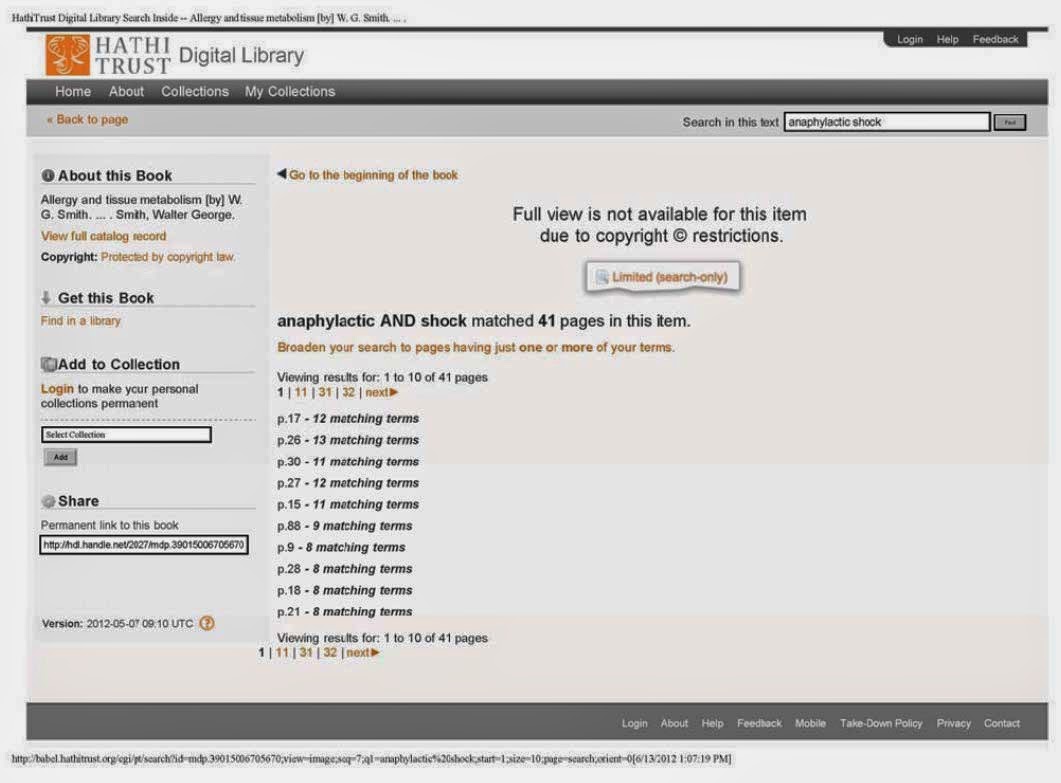
Several research universities allowed Google to scan their collections; then they created a repository for the digital copies, the HathiTrust Digital Library (HDL), which currently has 80 member institutions and over ten million works.  HathiTrust allows the public to search for particular terms.  Unless otherwise authorized, the search results show only page numbers and the number of times the term appears, with no snippets, like so:
HathiTrust also allows member libraries to provide patrons with certified print disabilities access to the full text of copyrighted works.  Print disabilities include blindness and disabilities that prevent a person from physically holding a book or turning pages. Printdisabled users can obtain access using adaptive technologies such as software that converts the text into spoken words, or that magnifies the text.  Michigan was the only member that permitted such access; others intended to provide it in the future, which, presumably, starts now.
Finally, by preserving the copyrighted books in digital form, the HDL plans to permit members to create a replacement copy of the work, if the member already owned an original copy, the member’s original copy is lost, destroyed, or stolen, and a replacement copy is unobtainable at a “fair” price elsewhere.  
Michigan also developed an Orphan Works Project that would attempt to identify out of print works, try to identify their copyright owners, and, if none could be found, publish a list of orphan works candidates.  If no owner still came forward, orphan works would be made accessible in digital format to library patrons, with simultaneous viewers limited to the number of hard copies owned by the library.  Michigan became concerned that its screening process wasn’t adequately distinguishing between orphans and non-orphans, and the project was indefinitely suspended.
The district court found that the three HDL uses were fair, and that the provision for print-disabled patrons was permitted by the Chafee Amendment, which allows “authorized entities” to reproduce or distribute copies of a previously published, nondramatic literary work in specialized formats exclusively for use by the blind or other persons with disabilities. The district court concluded libraries of educational institutions have “a primary mission” to provide specialized services to print-disabled individuals, as required for eligibility to take advantage of the Amendment.  The Authors Guild, for reasons that apparently seemed sufficient, appealed.
Initially, the court of appeals found that three authors’ associations (the Authors Guild, Australian Society of Authors Limited, and Writers’ Union of Canada) lacked standing to bring claims on behalf of their members.  Four foreign associations, however, asserted that foreign law conferred on them exclusive rights to enforce their foreign members’ copyrights, and the libraries didn’t contest that claim.  (Though I’ve got to wonder about that “exclusive.”)  Thus, they had standing. 
Fair use: Plaintiffs argued that §107 couldn’t apply because §108 governs reproduction by libraries.  But §108 says, “Nothing in this section in any way affects the right of fair use as provided by section 107,” so that’s that. 
The court went through a number of fair uses: book reviews with quotes “to illustrate a point and substantiate criticisms”; biographers quoting from unpublished works ditto; art “employ[ing]” photos “in a new work that uses a fundamentally different artistic approach, aesthetic, and character from the original”; low-resolution versions of images in search engines to direct users to the source website; newspaper use of a modeling photo to “inform and entertain” the readers for a news story; time-shifting of broadcast TV; and reverse engineering of software.
However, “[a] fair use must not excessively damage the market for the original by providing the public with a substitute for that original work.”  Thus, quoting extensively from the heart of a forthcoming memoir “in a manner that usurps the right of first publication and serves as a substitute for purchasing the memoir” is not fair use.
Transformativeness is an important focus of the first factor.  “A use is transformative if it does something more than repackage or republish the original copyrighted work.” However, “a use does not become transformative by making an ‘invaluable contribution to the progress of science and cultivation of the arts.’ Added value or utility is not the test: a transformative work is one that serves a new and different function from the original work and is not a substitute for it.”  Plus, the impact of the use on the traditional market for the copyrighted work is the “single most important element of fair use.” “To defeat a claim of fair use, the copyright holder must point to market harm that results because the secondary use serves as a substitute for the original work.”
Full-text search: the process of full-text search requires digital copies, but doesn’t show them to users.  The creation of a full-text searchable database is “a quintessentially transformative use.”  The result of a word search “is different in purpose, character, expression, meaning, and message from the page (and the book) from which it is drawn.”  There was “little or no resemblance between the original text and the results” of a search. 
Comment: Exactly because of that last point, I don’t see how the search results could be deemed infringing at all even if there were no such thing as a fair use doctrine.  Where’s the substantial similarity?  Note also that the court’s focus is now on the third-party use enabled by the database, although in this particular instance the label “transformative” applies better to the database itself, since at least with the latter the reproduction right has been implicated.  One way of parsing the court’s analysis would be to call the database copies intermediate copies, as in the reverse engineering cases; but the distinction is that the HDL does not perform the full-text searches, whereas reverse engineers themselves ultimately create a new work.  However, perhaps because the HDL’s copying is part of a system designed so that the only output can be noninfringing, and because the HDL’s copying itself is useless unless and until that output is created, the HDL gets to take advantage of its users’ entirely noninfringing uses. 
Anyhow: there was no evidence that the plaintiffs write “with the purpose of enabling text searches of their books.”  Thus, full-text search doesn’t supersede the objects or purposes of the original.  It wasn’t mere repackaging or republishing into a new mode of presentation.  “[B]y enabling fulltext search, the HDL adds to the original something new with a different purpose and a different character.”  Indeed, it adds “a great deal more to the copyrighted works at issue than did the transformative uses we approved in several other cases,” such as Cariou (same medium) or Bill Graham Archives (photos simply shrunk in size).  (Interesting collapse of artforms at work here in the creation of a different kind of distinction—the court lumps together photo and collage, print and photo—but that’s a tangent.)  Perfect 10 (thumbnails) and iParadigms(plagiarism detection) reinforced the court’s conclusion.
Dog that didn’t bark: no mention of commercialism.  The libraries can do this with one hand tied behind their backs!
Nature of the work: it doesn’t matter, because of transformativeness.
Amount of the work: the issue is whether the copying was excessive—whether no more was taken than necessary.  Here, the entire work was necessary for the purpose.  Plaintiffs’ argument that the copying was excessive because the HDL maintains copies at four different locations was not well founded. They were “reasonably necessary” to facilitate legitimate uses.  The two mirror sites allow for balancing user loads, and act as back-up in case of disaster.  The two encrypted backup tapes were also important to protect against large-scale data loss.  (The HDL also creates digital copies of images of each page; these aren’t retained for full-text search purposes and the court dealt with them under the head of print-disability access.)  There was no reason to think that these copies were excessive or unreasonable in relation to the purpose.
Factor four: We’re looking for whether a use “usurps the market of the original work.”  Plaintiffs could identify no harm to any “existing or potential traditional market.”  The only type of harm factor four considers is substitutionary harm.  “[A]ny economic ‘harm’ caused by transformative uses does not count because such uses, by definition, do not serve as substitutes for the original work.”  Book reviews with quotations can deter purchases, but that doesn’t matter because they’re transformative. 
Comment: it’s not hard to see how book reviews might differ from other uses that might qualify as the creation of derivative works, but a rule of this sort is necessary to avoid circularity/the collapse of fair use into a regime of universal licensing.  If the collapse of fair use is something you see as a harm, then willingness to license, even innovative new or nontraditional forms of licensing, can’t be weighed against the defendant whose use is otherwise nonsubstitutionary.  Also, it might be worth considering that offering a license to someone to make a new thing is not the same as having the ability to make that new thing oneself—that could be one possible boundary of “traditional markets.”
Plaintiffs offered a “lost sale” theory: a market for licensing digital search might develop in the future, but the HDL impairs its emergence.  “This theory of market harm does not work under Factor Four, because the fulltext search function does not serve as a substitute for the books that are being searched.”  It’s irrelevant that the libraries might be willing to purchase licenses, if their use were otherwise deemed unfair.  “Lost licensing revenue counts under Factor Four only when the use serves as a substitute for the original and the fulltextsearch use does not.”
The court also rejected plaintiffs’ other, less globally significant theory of market harm: the risk of a security breach that might put their works out in the open.  But the record showed extensive security measures to safeguard against that risk.  This was too speculative to count as harm, though the court cautioned that it wasn’t foreclosing “a future claim based on circumstances not now predictable, and based on a different record.”
Access for print-disabled patrons: Expanded access wasn’t transformative, since the authors write books to be read (or listened to), and the HDL simply enabled a larger audience to read the works, consistent with the author’s original purpose.
Weirdness alert: The HDL’s reformatting “appears, at first glance, to be creating derivative works over which the author ordinarily maintains control.”  Sure, this adaptation into a different medium is the only way the print-disabled audience can obtain access, but that’s also true for non-English speakers and books written in English.
Comment: Noooooo!  Formatting isn’t a derivative work because it doesn’t add new creativity.  Translation, as into ASL, would create a derivative work.  But unless I completely misapprehend the techniques used for print-disabled audiences, changing text into Braille, making its size larger, changing its color, etc. no more create a derivative work than the change of a print book into an ebook creates a derivative work, even though the ebook is now made of ones and zeroes.  Nor, I think, would using a substitution cipher on a book create a derivative work.  Unlike the British, we don’t have a quasi-copyright right protecting typographical arrangements.  Can we all agree to pretend that the court invoked the reproduction right instead?  Thanks.
Anyhow, transformative use isn’t absolutely necessary for fair use.  Providing access to the print-disabled is itself a valid purpose under factor one.  The Supreme Court said so in Sony: “Making a copy of a copyrighted work for the convenience of a blind person is expressly identified by the House Committee Report as an example of fair use, with no suggestion that anything more than a purpose to entertain or to inform need motivate the copying.”  The 1976 Act legislative history on which the Court relied expressly stated that making copies accessible “for the use of blind persons” posed a “special instance illustrating the application of the fair use doctrine . . . .”  That history noted that publishers don’t usually make accessible formats commercially available, and said that an individual who made a single copy, for free, for a blind person would be a fair use.  Since then, the ADA reaffirmed Congress’s commitment to “ameliorating the hardships faced by the blind and the print disabled,” as did the Chafee Amendment.
Factor two weighed against fair use, but didn’t matter.  Nor was retaining entire digital image files excessive.  While text files allowed text searching and text-to-speech, “the image files will provide an additional and often more useful method by which many disabled patrons, especially students and scholars, can obtain access to these works. These image files contain information, such as pictures, charts, diagrams, and the layout of the text on the printed page that cannot be converted to text or speech. None of this is captured by the HDL’s textonly copies.”  The court noted that many legally blind patrons could view these images with sufficient magnification or increased color contrast, and other patrons who couldn’t turn pages or hold books could use assistive devices to view all the content in image files.  For them, access to the image files was necessary to perceive the books fully, making the retention of copies reasonable.
Factor four: it was undisputed that the presentday market for books accessible to the print-disabled “is so insignificant that it is common practice in the publishing industry for authors to forgo royalties that are generated through the sale of books manufactured in specialized formats for the blind,’” according to the appellants themselves.  Comment: again, the mere desire to control something doesn’t confer a right to do so.  The number of accessible books currently available is a few hundred thousand, a minute percentage of the world’s books, versus the HDL’s over ten million.  Congress knew that publishers didn’t make their books available in 1976; this is still true.
Preservation copies: the HDL’s digital preservation copies ensure that books will still exist when their copyright terms lapse.  As for the HDL’s propsed use to make replacement copies for a member library if (1) the member already owned an original copy, (2) the member’s original copy is lost, destroyed, or stolen, and (3) a replacement copy is unobtainable at a fair price, this wasn’t obviously ripe for resolution.  The record didn’t show that the plaintiffs owned copyrights in any works that would be effectively irreplaceable at a fair price and thus would be potentially subject to being copied in case of loss or destruction of an original. Since the plaintiffs couldn’t assert the rights of others, there was no live controversy.  The district court’s finding of fair use on this point was vacated and remanded for resolution of the standing issue.

Likewise, the orphan works-related claims weren’t ripe.  There was no indication about whether the program will be revived or what it would look like.  The plaintiffs argued that the orphan works program’s legality wouldn’t depend on the specific procedures the libraries ultimately used to identify orphans, because any program resulting in the publication of complete copyrighted works would infringe.  The court wasn’t persuaded.  Even assuming for the sake of argument that the plaintiffs were right about infringement, it didn’t follow that any of theircopyrights would be infringed. Thus, there was no “certainly impending” harm, nor any hardship if decision were withheld. If Michigan or HathiTrust reinstitutes the program in a manner that would infringe the copyrights of any proper plaintiffs, they could return to court. The mere possibility of future injury isn’t hardship.

Posted in copying, http://schemas.google.com/blogger/2008/kind#post | Leave a comment