
More Kona coffee: false designation claims under 43(a)(1)(A), but not (B), can target retailers

Two more opinions here, one about the meaning of “origin” in 43(a)(1)(A) and one about the liability of retailers for false advertising and false designation of origin.

Corker v. Costco Wholesale Corp., No. C19-0290RSL, 2019 WL
5895430 (W.D. Wash. Nov. 12, 2019)

The difference in treatment of claims against retailers of third party products under trademark and false advertising (43(a)(1)(A) and (B), respectively) appears to have hardened: here, plaintifs get to use (A) to bring their false designation of geographic origin claim against the retailers, but not (B), although the opinion is less than clear about the interaction between working parts.

Plaintiffs, coffee farmers in the Kona District of the Big
Island of Hawaii, alleged that the moving defendants sell coffee products that
falsely designate the geographic origin of the coffee as “Kona.”
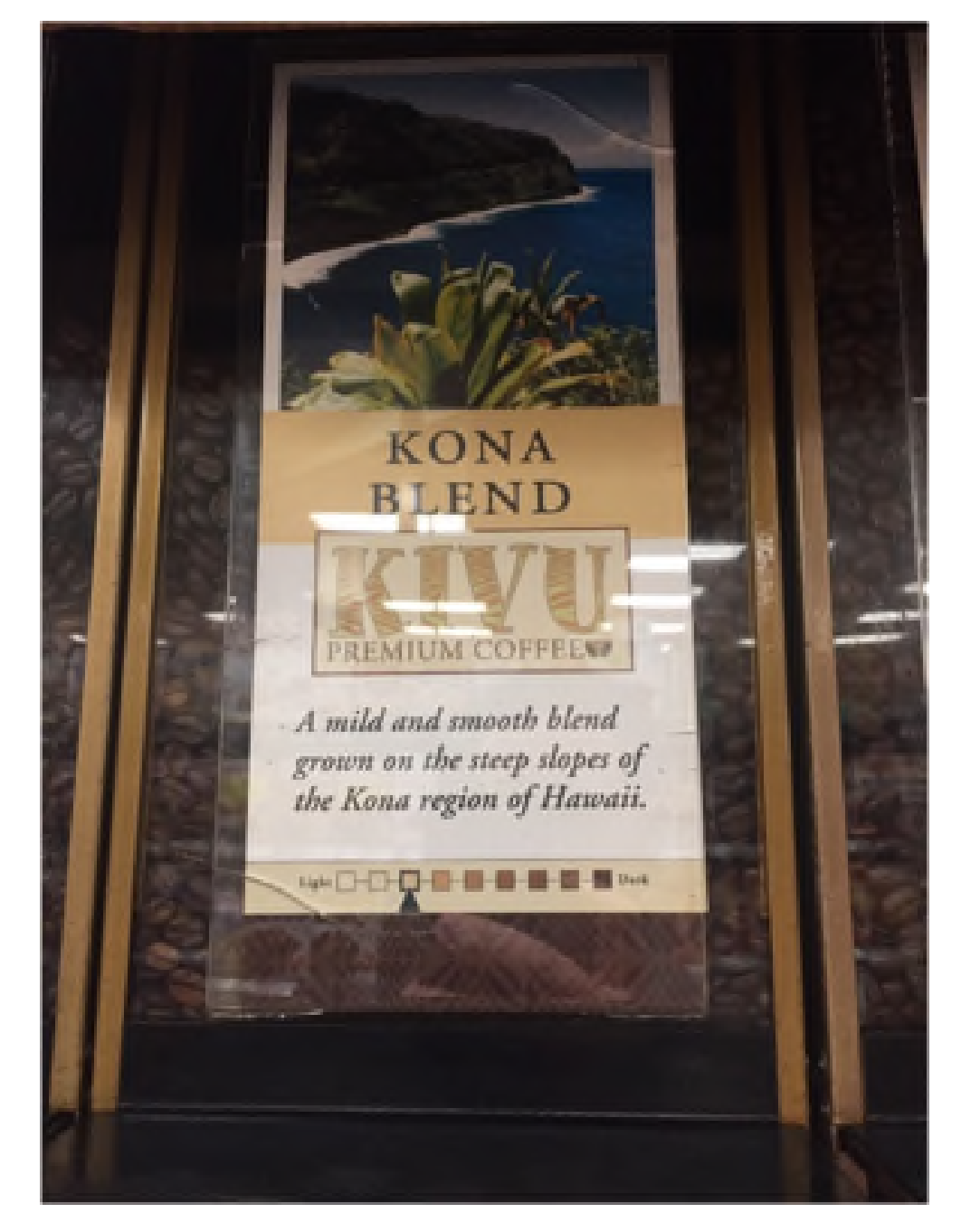
 

Kroger’s house blend

Magnum Exotics “Kona blend”

The retailer defendants challenged the plausibility of the
Lanham Act claims and argued that Section 230 precluded claims against
them.  
The retailers argued that it was the product producers who
made a false statement of fact, not them, and that putting the third-party
vendor’s product on their shelves or websites wasn’t a false statement of fact.
 The court agreed, finding that “the
policy implications of imposing liability for false advertising on all downstream
participants in a retail chain are troubling.” 
Quoting another court: “Defendants undoubtedly sell many products—should
they be responsible for scrutinizing and determining the veracity of every
claim on every product label in their stores simply because they sell the
product?” The answer is no, even though it’s yes for trademark and copyright
infringement, which are not obviously easier to detect–indeed, given the result on 43(a)(1)(A), it appears the very same claims get to proceed against the retailers as false association claims despite the policing difficulties thereby created.  
Without clarifying whether it was discussing direct or
secondary liability, the court suggested that retailers could be liable for
false advertising if they “control[] or participate[] in the creation of the
offending label or create[] additional marketing materials for a product that
amplify the manufacturer’s misrepresentations.” 
That sounds direct; what about contributory liability?  Regardless, “false advertising claims against
the retailer defendants, acting solely in their roles as retailers, may not
proceed.”  However, claims based on
private label coffees from Cost Plus and Kroger could continue.
False association: plausibly pled (apparently also against the retailers as retailers of third party products), because “origin” has
always been understood to include geographic origin, even if it also expanded
over time.  (The court rejected Sugai
Prods., Inc. v. Kona Kai Farms, Inc., 1997 WL 824022 (D. Haw. Nov. 19, 1997), to
the extent that it held that a false association of origin claim under 43(a)(1)(A)
protects only against misrepresentations as to the identify of a product’s manufacturer.)
No protectable ownership interest in a mark is required under §43(a)(1)(A) where
the claim was based in false designation of geographic origin.
The claims were pled with sufficient particularity. For
example, plaintiffs alleged that Costco “sells a variety of deceptive coffee
products, including but not limited to Magnum Exotics.” Magnum Exotics products
were marked with the word Kona on the front of the packaging and allegedly used
deceptive taglines, slogans, and imagery that imply, falsely, that the coffee
in its “Kona” products originated in the Kona District; the plaintiff provided
examples of the offending text and images. 
The use of exemplar products didn’t “invalidate or make unclear the
allegation that Magnum Exotics products marked with the word Kona and sold by
Costco contain a false designation of origin.” That was enough information for
Costco to defend itself.  At one point,
plaintiffs alleged that “[s]ampling has shown that nearly every product labeled
‘Kona’ in [the supplier defendants’] product lines misrepresents the origin of
the coffee beans contained in the package.”
Defendants argued that plaintiffs were therefore not
challenging every product labeled “Kona” and they had no way of knowing which
products were at issue. But the immediately following allegations clarified
that plaintiffs were alleging a consistent practice of false designation of
origin,
even if a few Kona beans made their
way into an individual package. Given the scarcity of authentic Kona coffee (…
Kona coffee represents on 0.01% of the worldwide supply of coffee) and the high
profitability of marketing commodity coffee as if it were Kona coffee, it is no
surprise that any defendant that is willing to engage in such deceptive
practices would consistently practice their deception across all product lines.
An unscrupulous merchant selling counterfeit Rolex watches on a street corner
tends not to mix a real Rolex into inventory every once in a while.
(Side note: Now that’s complaint drafting.)
CDA immunity: The relevance of CDA immunity was unclear. It
doesn’t apply to goods stocked and sold in a physical store, even though the
defendants have websites, and it also doesn’t apply to private label products
sold on those sites (as to which the retailers are the providers of the accused
content).  Plaintiffs also argued that,
once an online sale is made, physical-world acts to deliver the accused
products to the purchaser wouldn’t be covered by the CDA, and defendants didn’t
respond to that argument. The court was apparently willing to accept
plaintiffs’ argument, which should deeply worry many online retailers, but the court also said in its
concluding paragraph that the claim against the retailers was “barred by the
CDA to the extent their conduct is limited to making a product available for
sale on a website.” Because even the false designation claim under 43(a)(1)(A) isn’t an IP claim, I guess that means that sales of the non-house brand stuff on the websites are immunized.  (To the extent that
the retailer defendants are advertising the other products on their websites,
aren’t they doing more than making them available for sale? The other advertising content on the
page is separate from that which is on the physical products themselves, and
may or may not come from other sources—thus it could trigger secondary or even direct liability for false advertising, at least in the
absence of the CDA.)
  
Corker v. Costco Wholesale Corp., No. C19-0290RSL, 2019 WL
5893291 (W.D. Wash. Nov. 12, 2019)
Same facts. These supplier defendants argued that, whatever
the original interpretation of “origin” was, it no longer applies. Prior to
1989, Section 43(a) of the Lanham Act prohibited “false designation[s] of
origin” generally. In 1989, Congress split 43(a) into two separate subsections,
“the first of which covers false designations of origin that cause consumer
confusion and the second of which covers false designations of geographic
origin in advertising.” The suppliers argued that, because a misrepresentation
of “geographical origin” in advertising or promotion is specifically prohibited
by Section 43(a)(1)(B), a claim based on false designations of geographical
origin cannot be brought under Section 43(a)(1)(A) even there’s a likelihood of
consumer confusion.
The court disagreed. The more general term “origin” can
still cover claims based on geography. 
(Sure, but at heart this is a false advertising claim, and probably
should have the false advertising requirements—commercial advertising/promotion
and materiality.  That said, those seem easily
satisfied by the labels here, especially given the prominence of the “Kona”
claim.)  Subsequent cases have continued
to talk about “origin” as encompassing geographic origin. (Citing Dastar
and Two Pesos as well as Kehoe Component Sales, Inc. v. Best Lighting
Prods., Inc., 796 F.3d 576, 587 (6th Cir. 2015) (“As Dastar makes plain, an
entity makes a false designation of origin sufficient to support a reverse
passing off claim [under Section 43(a)(1)(A) ] only where it falsely represents
the product’s geographic origin or represents that it has manufactured the
tangible product that is sold in the marketplace when it did not in fact do
so.”).)   Sugai Prods., Inc. v. Kona Kai
Farms, Inc., 1997 WL 824022, at * 11 (D. Haw. Nov. 19, 1997), held that only
(a)(1)(B) applied to false designation of geographic origin, but the court here
disagrees.

from Blogger https://ift.tt/2Ky2cwF

Posted in Uncategorized | Tagged , , , , | Leave a comment

Pot site’s negative report on CBD from hops wasn’t commercial speech

Peak Health Center v. Dorfman, 2019 WL 5893188, No.
19-cv-04145-VKD (N.D. Cal. Nov. 12, 2019)
Peak allegedly sells plant-based pharmaceuticals and
supplements, including an exclusive strain of Humulus yunnanensis, a hops
plant, as a source of cannabidiol (CBD). This source of CBD is potentially
valuable given the constraints on hemp and cannabis, the typical sources. At
the time of the relevant events, Dorfman was the editor-in-chief and a writer
for PotNetwork, which distributes cannabis and hemp products, including CBD,
and also publishes industry news on its website.
In 2019, Dorfman contacted a Peak principal to ask questions
for an article he was writing; his attitude was allegedly disdainful. Peak
allegedly provided documents proving that Peak’s CBD came from the hops plants,
documents showing lab results supporting its claims, and patent filings for
related inventions.  Dorfman published an
article titled “A PotNetwork News investigative report: Bomi Joseph’s
‘hops-derived’ CBD was a world-changing cannabis alternative fought over by
Isodiol and Medical Marijuana, Inc. But he lied about his discovery—and his
identity.” The article asserts that Peak’s hops variant does not exist, that
the alleged discoverer’s research publications about Humulus kriya and CBD were
plagiarized from others’ legitimate peer-reviewed publications, that he is a
convicted felon who served prison time for defrauding various banks of $20
million in the early 2000s, and that he pled guilty in January 2019 to using a
false name on a passport application. It allegedly defamed him by stating that  “This time around [Mr. Joseph] may very well
have stolen from little old ladies, or the sick and injured—from anyone who
purchased ImmunAg or Real Scientific Humulus Oil or one of its derivatives in
hopes of curing some pain.” So too for quoting Dr. Volker Christoffel, one of
the people whose work Mr. Joseph allegedly plagiarized, e.g., “ ‘The whole
story with CBD from hop is insane,’ Dr. Christoffel told PotNetwork via email.
‘By the phylogenetic relatedness it MIGHT be possible, that some hop varieties
may have genes and express i.e., form cannabinoids—the biochemical pathways are
not so different and there is a theoretical possibility I would not exclude a
priori. BUT these are definitively only traces.’ ” This was allegedly reckless
because Christoffel never performed or reviewed chemical analysis of Peak’s
CBD. And the article failed to disclose that Christoffel was a managing
director of a competing cannabis pharmaco, not an independent expert.
Peak sued Dorfman for (1) trade libel; (2) intentional
interference with prospective economic advantage; (3) negligent interference
with prospective economic advantage; (4) unfair competition under the Lanham
Act; and (5) unfair competition under California Business and Professions Code
§ 17200 et seq.  It alleged harm to its
reputation and lost business opportunities worth at least $10 million.
Trade libel, intentional and negligent interference with
prospective economic advantage: These all require pleading special damages. A
plaintiff must “identify particular customers and transactions of which it was
deprived.” Peak did not.
Lanham Act: No false association claim, obviously, and this
wasn’t false advertising because the article wasn’t “commercial advertising or
promotion” because it wasn’t commercial speech. On its face, the article didn’t
look like an ad; it purported to be an “investigative report.”  It didn’t have anything that plausibly
promoted PotNetwork’s own products, or anyone else’s.  Allegations of a competitive relationship between
Peak and PotHealth weren’t sufficient.  I
am nervous about this result but see why the court here reached it; query
whether allegations that the news reported on defendant’s site was consistently
biased against competitors and thus worked as a disguised ad for defendant
would have changed anything.
First Amendment standards: The general tenor of the article
was fact-like: it described itself as an “investigative report” “based on an
in-depth review of Mr. Joseph’s research, a trove of confidential documents,
and interviews with people familiar with the events….” There was, however, figurative
or hyperbolic language throughout the article. Defendant described one of Mr.
Joseph’s purported collaborators, Donish Cushing, as “a ghost,” because he does
not appear in social media or Internet searches, and because “it’s hard to find
anyone who has met the man.” The Christoffel quotes also included colorful
language: “This is total bullshit”; “The whole story with CBD from hop is
insane”; etc.  Use of “figurative and
hyperbolic language” weighed in favor of First Amendment protection. 
Some of the statements in the article were susceptible of
factual proof: specifically, whether the CBD in Peak Health’s products comes
from a hops plant, or specifically a hops plant called Humulus kriya. Dorfman
argued that his statements were protected opinion based on fully disclosed
facts, but it was the truth of those facts that was at issue. “Dorfman
disclosed the facts on which he based his assertion that Peak Health’s hops-derived
CBD is a sham: Mr. Joseph’s history of plagiarism, attempts to assert new
identities, criminal fraud record, and purchases of large quantities of CBD
despite allegedly possessing the ability to produce that CBD from hops, as well
as statements from scientists concluding that hops-derived CBD is
unsubstantiated and not credible.” Nonetheless, his conclusion about the lack
of hops-derived CBD wasn’t a statement of subjective opinion or interpretation;
it was “an assertion of fact based on other asserted facts.”
In addition, the complaint flunked Rule 9(b) because it
failed to allege why the challenged statements were false.  With respect to the Christoffel statements,
Peak alleged only that the statements were unreliable because he didn’t test
Peak’s products himself and because he’s involved with a competing business,
but Peak didn’t plead facts from which it could be inferred that the CBD in its
products came from a specific hops plant. At most, it alleged that its public
relations agency provided “proof” of its CBD-related claims to Dorfman, but the
complaint didn’t explain why the statements were false.
Peak could, in theory, amend its complaint to remedy these
deficiencies as to the falsifiable statements, including the failure to plead
special damages and the failure to plead commercial advertising/promotion.
Anti-SLAPP motion: the Ninth Circuit has cautioned against
the application of procedural state laws if such application “would result in a
direct collision with a Federal Rule of Civil Procedure.” Thus, “granting a
defendant’s anti-SLAPP motion to strike a plaintiff’s initial complaint without
granting the plaintiff leave to amend would directly collide with Fed. R. Civ.
P. 15(a)’s policy favoring liberal amendment.” Dorfman could renew his motion
if Peak included amended state law claims in its second amended complaint (or,
apparently, if the time for pleadings passed or he otherwise prevailed).

from Blogger https://ift.tt/2CXnAas

Posted in Uncategorized | Tagged , , | Leave a comment

right of publicity question of the day, RBG edition

Right of publicity question of the day: leopard
print shirt made of Ruth Bader Ginsburg portraits
. Discuss.

from Blogger https://ift.tt/2XrPXHo

Posted in Uncategorized | Tagged , | Leave a comment

Colorado labeling doesn’t dispel potential falsity of “Kona” for coffee

Corker v. Costco Wholesale Corp., 2019 WL 5887340, No.
C19-0290RSL (W.D. Wash. Nov. 12, 2019)
Plaintiffs, coffee farmers in the Kona District of the Big
Island of Hawaii, alleged that defendant Boyer’s falsely designates the
geographic origin of its coffee products as “Kona,” prominently placing the
word Kona on the front of its packaging despite the fact that the product
contains little to no coffee from the Kona District. One of Boyer’s coffee
products is labeled “Café Kona” and another is labeled “Kona Blend.” In lab
tests, ratios of various metal (strontium to zinc, barium to nickel, cobalt to
zinc, and manganese to nickel) are allegedly well outside the range of that
which is found in authentic Kona coffee. Even if there were some Kona coffee in
Boyer’s products, it is allegedly not the meaningful percentage that a consumer
would expect based on the packaging.
Boyer’s argued that the Lanham Act false advertising claims should fail because
plaintiffs didn’t allege that that they, individually or as a group, have a
protectable trademark in the word Kona. But “false designation of origin,” even
before its expansion to cover unregistered trademarks, always covered geographic
origin.
Boyer’s then argued that the claims were implausible because
its packaging clearly showed that it was a Colorado company. But none of the
statements about the Colorado-ness of the company “dispels the notion that the
coffee roasted or crafted in Colorado was grown in the Kona district, a notion
that is arguably conveyed by the use of the otherwise gratuitous word ‘Kona’ in
the name of the product.” (Does anyone think, even with climate change, coffee roasted in Colorado is grown there?)
Finally, Boyer’s argued that the mere presence of a geographic
reference on its packaging cannot give rise to claim for false designation of
geographic origin. If, in context, the use of “Kona” was plausibly misleading, which
it was, the claim could proceed.  (Citing
Pernod Ricard USA, LLC v. Bacardi USA, Inc., 653 F.3d 241(3rd Cir. 2011)), which
rejected a claim based on “Havana Club” for rum that clearly, to the court,
also said it was from Puerto Rico).

from Blogger https://ift.tt/2pjAdcW

Posted in Uncategorized | Tagged , | Leave a comment

claims for ab exercise device going beyond FDA clearance are actionable

Loomis v. Slendertone Distrib., Inc., 2019 WL 5790136, No.
3:19-cv-854 – MMA (KSC) (S.D. Cal. Nov. 6, 2019)
Loomis brought the usual California claims based on ads for
the Flex Belt, a purported ab-exercise device. While denying standing for
injunctive relief and finding a bunch of the challenged claims to be puffery,
there was still enough to continue, and the court also rejected an FDA
preemption argument.
Preemption: Slendertone argued that the Flex Belt had been
FDA cleared [NB: not approved] “for Toning, Firming and Strengthening
the stomach muscles,” and thus the claims were preempted. States can adopt FDCA
rules for their own law, but parallel state “consumer protection laws, such as
the UCL, FAL, and CRLA, are nonetheless preempted if they seek to impose
requirements that contravene the requirements set forth by federal law.” But
Loomis didn’t challenge whether the FDA should have cleared the Flex Belt or
whether the specific FDA-cleared statement is misleading, and this was a case
involving a Class II medical device, not FDA approval.
Actionable statements: because the FDA cleared the Flex Belt
as an EMS device for toning, firming, and strengthening abdominal muscles, “such
representations cannot be deceptive to a reasonable person.” But it would be
deceptive to market an EMS device as cleared by the FDA “for weight loss, girth
reduction, or for obtaining ‘rock hard’ abs.” Much of the advertising Loomis
cited was puffery, such as the testimonials:
With my schedule I can’t do an ab
workout every day, but with The Flex Belt® I’ll put it on every day because I’m
doing things at the same time. So it’s really just being smart. It’s easy, I
wear it every day and my abs are there to show for it! My abs feel like I’ve
had the most amazing workout and I just wore The Flex Belt® around the house
for 30 minutes.
The Flex Belt® tightens, tones, and
strengthens my stomach without me even having to think about it. It has taken
my abs to a whole new level… it does all the work, and I get the results.
These statements were “highly subjective to the individuals
giving the statements,” although I think they’re misleading. There was nothing
actionable about the claims on Amazon to “stimulate all your major stomach
muscles at the same time providing you with the perfect abdominal contraction
….You don’t have to worry about your form or come up with the time to get it
done.” That didn’t claim that the Flex belt alone will result in weight loss,
girth reduction, or an attractive appearance. [I don’t think it’s “alone”
that’s the problem. I think the problem is that the Flex belt doesn’t produce a
marginal effect on any of these, and the implication is that it
does.]  “GREAT ABS START HERE,” “Maximum
Core Strength,” and “Ultimate Toning Technology” were also puffery.  [But if it doesn’t work at all, then it’s not
exaggeration, it’s just … not true.]
In the ads, “any reference to fat loss is accompanied by
disclaiming language that the Flex Belt is insufficient to achieve weight loss
and that a more attractive abdominal area requires proper diet and exercise,” e.g.,
the “Flex Belt does not remove inches of fat but it tones, tightens, and
strengthens your stomach muscles. Using The Flex Belt in conjunction with your
dedication to Diet, Nutrition and Exercise can help you achieve your goals of a
more attractive stomach as well!”
Still, there were specific statements, in context, that were
plausibly deceptive to a reasonable person. 
E.g., “Who Should Use the Flex Belt®?…Anyone that wants more
attractive abs, regardless of current fitness levels”; “With The Flex Belt®, it
doesn’t matter what your current exercise status is because there will always
be time to build firmer, stronger abs. This product is perfect for … anyone
that wants more attractive abs, regardless of current fitness levels”; and
touting the product “[f]or those looking for a convenient way to tone,
strengthen and flatten the abdominal area.”
These claims made it “probable that a significant portion of
the general consuming public or of targeted consumers, acting reasonably in the
circumstances, could be misled” to believe the Flex Belt could help consumers
achieve more attractive abdominal muscles. It was contradictory to make misleading
statements as to improved abdominal appearance while simultaneously disclaiming
that “The Flex Belt does not remove inches of fat.” In addition, although the
testimonials and pictures of six-pack abdominal muscles were puffery, they
“contribute[d] ‘to the deceptive context of the packaging as a whole.”
UCL unlawful and unfair claims also survived, as did claims
for breach of express warranty, despite a limited warranty addressing product
defects stating that “THIS LIMITED WARRANTY IS THE ONLY WARRANTY FOR THE
PRODUCT, AND THERE ARE NO OTHER EXPRESS WARRANTIES, ORAL OR WRITTEN, PROVIDED
BY [Slendertone].”
Under California law, “[w]ords or conduct relevant to the
creation of an express warranty and words or conduct tending to negate or limit
warranty shall be construed wherever reasonable as consistent with each other.”
Limitation of warranties are allowed “only by means of [w]ords that clearly
communicate that a particular risk falls on the buyer.” Further, disclaimers or
modifications “must be strictly construed against the seller.” “Noting the
presumption of construing warranties as consistent with one another, the burden
against the seller, and the fact the limited warranty was included in the
packaging for the Flex Belt after Plaintiff purchased it, the Court finds that
the limited warranty does not upset Plaintiff’s alleged express warranty cause
of action.”

from Blogger https://ift.tt/2Q6i79e

Posted in Uncategorized | Tagged , , , | Leave a comment

nontestifying students are entitled to relief from for-profit’s false advertising

State v. Minnesota School of Business, Inc., — N.W.2d
—-, 2019 WL 5778078, No. A17-1740 (Minn. Nov. 6, 2019)
How do you decide whether nontestifying members of a class
have been harmed? A majority here, over two dissenting Justices, finds that it
was appropriate to conclude that nontestifying victims of a fraudulent
educational scheme were
harmed.  If there are to be fraud class
actions at all, this is a necessary rule, and changing the common law rules
that prevented such inferences was the basic reason that states enacted
consumer protection laws in the first place. I have to admit, I find it depressing
that even AG-led efforts against frauds that left students with thousands of
dollars in debt for worthless credentials, diverting their life plans, couldn’t
convince an appellate court and a full slate of state supreme court justices to
infer that the natural consequence of the fraud occurred for each victim.  The dissenters also try to turn the recent
FTC losses on the scope of section 13 relief into reasons not to award relief under
state law; expect more of this, too.
Minnesota’s AG sued two for-profit universities, the
Minnesota School of Business, Inc. and Globe University, Inc., alleging that
they misled prospective students about the value of criminal justice degrees
offered by the schools in violation of the Minnesota Consumer Fraud Act (MCFA) and
the Uniform Deceptive Trade Practices Act (DTPA). Most prospective students who
signed up for such degrees wanted to be a probation or police officer.  The schools targeted people interested in
policing careers. As advertised, the curriculum focused on police work like
crime scene investigations and many classes were taught by former or current
police officers. “In marketing materials and through admissions practices, the
Schools made statements to prospective students that graduates of their
criminal justice program were qualified to become a police officer, or at least
qualified to enter programs providing the additional training required to
become a police officer.… The Schools also advertised that an associate’s
degree from their criminal justice program qualified a student for a career as
a probation or parole officer.” E.g., “…. And you can be sure, as a graduate
of a Globe University/Minnesota School of Business criminal justice program,
you will have those qualifications.” But that wasn’t true. The schools didn’t
provide the credentials necessary for police jobs in Minnesota, and their
credits didn’t transfer to any school that offered the relevant certification;
similarly, the associates’ degree in criminal justice didn’t provide the bachelor’s
degree required for probation officers.
To prevail, the AG had to establish a “causal nexus” between
the uncontested violations of the MCFA and the harm suffered by students.
Fifteen students testified, out of about 1200 affected. The trial court and the
Supreme Court majority agreed that was enough. “For example, one student
testified that he transferred into the criminal justice program because the
school ‘assured him that the program would allow him to become a Minnesota
police officer’ and that he would not have pursued that program had he known
the school was not [relevantly] certified.”
The district court found a knowing violation of the MCFA
both in affirmative misrepresentations and in failure to disclose material
facts. The economic harm inflicted on students “is an inevitable and
foreseeable consequence of the misrepresentations and obfuscations in [the
Schools’] marketing of the program.” Thus, the AG proved a causal nexus between
the Schools’ misrepresentations and the harm suffered by the criminal justice
program students, as required under the MCFA. “There can be no question that
[the Schools’] fraudulent practices caused significant public injury to any
students … who enrolled in the criminal justice program with the goal of
becoming a Minnesota police or probation officer.”  The court rejected the schools’ argument that
it could not consider the nontestifying students to be similarly situated to
the testifying students.
The court issued an injunction, imposed civil penalties, and
ordered equitable restitution requiring the schools to disgorge the tuition
collected from the criminal justice program students. Claimants who represented that they enrolled in
the program based on an understanding they could become a police officer in
Minnesota or a parole or probation officer in Minnesota with an associate’s
degree would be entitled to a rebuttable presumption of injury and causal
nexus. The restitution would cover tuition; payments to the schools for books,
enrollment or student expenses or fees; and any interest or finance charges
incurred by the claimant for student loans taken out to pay for tuition, expenses, or fees.
The court of appeals upheld the restitution order for the
students who testified at trial but reversed as to nontestifying students for
failure to prove a causal nexus to their harm. 
When the AG sought review, the schools argued that even the testifying
students didn’t deserve restitution.
The parties agreed that the schools made false claims, and
that “enrolling in, and paying tuition for, a degree that does not provide what
is promised is harm.” So was there a causal nexus between the falsity and the
harm? This is a factual question that a district court is best positioned to
assess. Causal nexus/reliance can be established by direct or circumstantial
evidence.
Consumer protection statutes “are remedial in nature and are
to be liberally construed in favor of protecting consumers.” E.g., State by
Humphrey v. Alpine Air Prods., Inc., 500 N.W.2d at 788, 790 (Minn. 1993) (“In
passing consumer fraud statutes, the legislature clearly intended to make it
easier to sue for consumer fraud than it had been to sue for fraud at common
law. The legislature’s intent is evidenced by the elimination of elements of
common law fraud, such as proof of damages or reliance on
misrepresentations.”). The MCFA “ ‘reflects a clear legislative policy
encouraging aggressive prosecution of statutory violations’ and thus should be
‘generally very broadly construed to enhance consumer protection.’ ” It allows
the AG to seek restitution.
Past precedent established that “proof of individual
reliance” is not needed to prevail under the MCFA “where a defendant’s
misrepresentations were directed at and affected a broad group of consumers.”  The nexus requirement “is a more relaxed
requirement than the strict showing of direct causation required at common law….
[T]here are times when the materiality and pervasiveness of consumer fraud is
relevant to support a court’s finding that a causal nexus exists between the
fraud and the consumer’s decision to purchase the product.” (This isn’t a fraud
on the market theory, the court said; fraud on the market is just another
example of where individual proof requirements are relaxed.)  Likewise, the seller’s own intent can be “decisive”
in substituting for proof of direct reliance by each individual purchaser.  If the defendant intends potential consumers
to rely on the representations, that is itself “important and relevant evidence
to establish a causal nexus.”  This is
especially true for AG-brought cases.
Similarly, the FTCA (a broad statute, even if it doesn’t
explicitly authorize restitution in section 13(b)), doesn’t require proof of
individual reliance by each consumer.  The
FTC presumes reliance “where the FTC has demonstrated that the defendant made
material misrepresentations, that they were widely disseminated, and that
consumers purchased the defendant’s product.” “The reason is plain: ‘requir[ing]
proof of each individual consumer’s reliance on a defendant’s
misrepresentations would be an onerous task with the potential to frustrate the
purpose of the FTC’s statutory mandate.’”  So too here.
Instead of directly proving reliance for each individual, “all
the facts surrounding the consumer fraud should be taken into account: Was the
fraud longstanding, pervasive, and widespread in communications directed to
consumers of the product? Did the seller intend and understand that consumers
would rely on the misrepresentations? Was the information of a kind on which
consumers would typically rely?”  This
wasn’t a matter of “judicial notice,” as the dissent accused. Instead, “a
district court sitting in equity and as a factfinder may broadly consider
several common-sense factors when assessing whether a causal nexus exists under
the MCFA.”
There was thus sufficient evidence of a causal nexus both
for the testifying students and for the non-testifying students.  The false advertising was widespread and
pervasive; the schools intended for students to rely on it and targeted prospective
students who wanted to be a police officer or a probation officer. “The Schools
would not have spent a total of $120 million in advertising and made law
enforcement marketing materials available where they did if they did not
believe that prospective students would rely on them.” The false advertising
was “precisely the type of information a reasonable prospective student would
rely on in deciding whether to pursue a criminal justice degree at the Schools.
And the evidence at trial showed that prospective students did so rely.”
Choosing a school is a serious decision:
We reasonably expect a person to
look at materials provided by a potential school to assess whether the
education program is consistent with his or her career objectives. It is
reasonable to conclude that a person who wants to become a police officer or a
probation officer will make such an investment of money and time only if the
person believes that the classes will provide the requisite qualifications for
that career. Moreover, the record shows that the Schools took advantage of the
“unwary”—nontraditional, first-generation college students who usually attend
for-profit schools.
The evidence established a causal nexus between the misleading
statements and the harm suffered by the nontestifying students. “The Schools
should not profit from fraudulently providing a useless degree to their
students.”
The majority also rejected challenges to the restitution
process established by the district court. There was no need for a “rebuttable
presumption” of reliance—the AG satisfied the causal nexus requirement without
the need for any presumption.  And the
district court had broad discretion to order equitable restitution and to
fashion the appropriate restitutionary remedy. The goal of such remedies is “to
force a wrongdoer to divest money improperly gained at the expense of another
party. It is aimed as much (or more) at preventing the wrongdoer from profiting
from its misdeeds as it is to make the injured party whole.”
Nor did the process violate due process. A special master
would oversee the determination of the overall amount of restitution, which
would be a product of the number of students who sought a criminal justice
degree and the total tuition, fees, and other costs they paid to the schools. There
were procedural safeguards, including requiring students to declare under
penalty of perjury “that they were enrolled in the Schools’ criminal justice
program based on an understanding that they could become (a) a police officer
in Minnesota or (b) a parole or probation officer in Minnesota with an
associate’s degree.” The schools could contest that. Disputes not resolved by
the parties would go to the special master and thence to the district court for
final decision.  That satisfied due process.
Justice Anderson dissented in relevant part (and the Chief
Justice agreed): It wasn’t right to conclude that the nontestifying students
had been harmed, despite the “appalling” conduct of the schools (at least as to
the testifying students):
The court implicitly adopts a
rebuttable presumption based on assumptions about intent, i.e., the existence
of pervasive fraud or an intent that consumers would rely on the
misrepresentations. Alternatively, the court appears to deploy a form of
judicial notice based on assumptions about what information consumers typically
rely on or the importance and cost of the purchase decision. Then, the court
endorses the use of “mini trials” to determine the amount of restitution, if
any, owed by the Schools to the nontestifying students. I cannot join this
decision because even defendants who engage in appalling behavior are entitled
to require the Attorney General to prove his claims. The Attorney General did
not do.
Note: rebuttable presumptions aren’t proof-less; they’re ways
of using probabilities to determine what is likely true in an individual
case.  That might be accurate or not, depending
on your other beliefs, but it’s not a wild innovation.
The dissent said that there wasn’t evidence that all
program participants saw the ads offered as evidence or that, even if they did
see them, the ads affected their decisions. “There is simply no basis to
presume that just because 15 individuals relied on deceptive practices, 1,200
other individuals also relied on the same practices and suffered injury
accordingly.”  (Other than the content of
the ads, the knowledge of the advertiser that the claims mattered to potential
students, and the usual reasons that people seek the relevant degrees.)
The FTCA also wasn’t helpful because the consumer protection
laws in Minnesota are different. Also, the FTCA comparison favors a reversal
because the Seventh Circuit has held that the FTC doesn’t allow restitutionary
relief under section 13(b).  The Lanham
Act is also different and anyway there was no evidence in the form of “actual
consumer testimony,” “other than for 15 former students” (!) [what does the
dissent think “actual consumer testimony” means?], and no consumer surveys, tests,
or market research. [Given that the claims here were literally false, if you
did apply the Lanham Act, no evidence of consumer reaction would be required.]
The majority wrongly assumed that no student would enroll in
the criminal justice program unless they wanted to become a Minnesota police or
probation officer.  This was essentially
to take judicial notice of the defendant’s liability. [Query how this standard
for what counts as factfinding would work in a standard trademark case. I do
think courts do a lot of ad hoc factfinding in Lanham Act cases, but here it
doesn’t seem like an assumption; it seems like a conclusion based on the evidence
of how the programs were marketed and how the students who did testify reasoned—if
they weren’t aberrations, then their experiences can be generalized, and I
think it is possible to determine that a witness isn’t aberrant.]
The dissent didn’t want to do “mini restitution trials” at
the restitution stage. There were legitimate due process concerns about the restitution
process.  But other courts routinely hold
that disputes about the amount of damages can be resolved individually after
class treatment on liability.

from Blogger https://ift.tt/36OcUsL

Posted in Uncategorized | Tagged , , | Leave a comment

pleading falsity can be done even with sophisticated consumers

10x Genomics, Inc. v. Celsee, Inc., 2019 WL 5595666, No.
19-862-CFC-SRF (D. Del. Oct. 30, 2019) (magistrate)
Skipping the patent parts. 
“10x is a life sciences technology company that markets and sells its
Chromium product line, which provides researchers with the ability to measure
gene activity on a cell-by-cell basis for large numbers of cells in a single
experiment.” Celsee’s Genesis System “is designed to capture and isolate single
cells, … allowing the user to track a molecule and the cell of origin for that
molecule.”
10x successfully alleged false advertising: Celsee
advertised a 70% cell capture rate. Unconvincingly, Celsee argued puffery. And
it argued that 10x failed to show an industry standard for making cell capture
rate calculations, and that it didn’t specify how the 70% figure was
calculated.  10x nonetheless sufficiently
alleged literal falsity by alleging that “market participants evaluate the
performance of single cell systems based on the cell capture rate, which the
complaint defines as ‘a measure of the percentage of input cells that are
assayed in each experimental run.’” 10x claimed to have a 65% capture rate.
Celsee advertised using the tagline “Because every cell matters,” and Celsee
ads and brochures claimed “[d]eep and accurate view of cell populations with
>70% capture of input cells.” This figure allegedly measured only the percentage
of cells caught in the teeny little wells it used that were actually analyzed,
while not counting the cells put into the system that never make their way into
the wells.   It was plausible that this was literally false
because the calculation failed to account for all the cells put into the
system, and that this was objectively inaccurate.
This was also plausibly misleading, since 10x alleged that
cell capture rate is “[a] key criterion on which market participants evaluate
the performance of single cell systems.” [Not to mention Celsee’s own tagline.]
It was plausible that targeted consumers would presume the parties’ advertised cell
capture rates were directly comparable, and that Celsee’s advertised 70% rate
was intended to make its product seem superior.
Celsee argued that 10x didn’t sufficienly plead materiality
“because researchers purchasing single cell technology would not plausibly base
their purchase decision on a non-specific statement of capture efficiency
without first understanding the method of calculation.” Nope. If (as alleged)
there was a superiority misrepresentation that confused consumers, and if cell
capture was a key criterion for customers, that was enough.

from Blogger https://ift.tt/2JUME5O

Posted in Uncategorized | Tagged | Leave a comment

multimillion-dollar verdict in false advertising case, but no fee shift

Boltex Manufacturing Co. v. Ulma Piping USA Corp., No.
17-CV-1400, 2019 WL 5684201 (S.D. Tex. Nov. 1, 2019)
Previous
coverage
. A jury found in favor of plaintiffs Boltex and Weldbend on their
flange-related false advertising claims. 
The court noted that the Lanham Act has no statute of limitations and so
borrows state law.  The majority of cases
in Texas borrow the four-year period for common law fraud, but, because “a very
credible argument could be made that the closest parallel in Texas law to a
Lanham Act unfair advertising claim is Texas’ common law cause of action for
unfair competition,” which has a two-year period, the jury verdict form asked the
jury to separate out the relevant periods for damages purposes.
The jury awarded damages for federal false advertising and
state unfair competition; the court required plaintiffs to elect (and based on
the numbers they’re going to choose federal). 
In addition, the jury findings supported disgorgement.  Ulma’s profits were found to be $26 million, but
the court wasn’t going to award that entire amount, since plaintiffs had less
than 25% of the flange market even after Ulma was hypothetically removed from
the market. Using plaintiffs’ own experts, their share of the flange market in
which they all competed was 11.6% for Boltex and 10.4% for Weldbend. Thus, the
court determined to award a bit over $3 million to Boltex and a bit over $2.7
million to Weldbend in addition to the Lanham Act damages if they opted for
Lanham Act damages.  The total was nearly
$3.7 million/a bit over $3 million for the Lanham Act respectively, or $1.2
million/$600,000 under Texas common law.
The court also found that the case wasn’t exceptional, even
though the falsity part of the case may have been easy, because the existence damages
was reasonably litigatable:
Defendants quite legitimately
argued and produced a fair amount of evidence that the Plaintiffs and
Defendants did not compete and consequently Plaintiffs were not damaged by any
actions of the Defendants and if damaged at a substantially lesser amount than
claimed. While the jury did not totally agree with Defendants’ position, it did
not completely agree with the amount of damages claimed by the Plaintiffs.
Defendants have the right to litigate liability and damages and it is not an
unreasonable litigation position—even in the face of what some might consider
overwhelming evidence of liability—to vehemently contest whether a plaintiff
has actually suffered any damages due to its alleged misconduct.

from Blogger https://ift.tt/33pSKTt

Posted in Uncategorized | Tagged , , | Leave a comment

multimillion-dollar verdict in false advertising case, but no fee shift

Boltex Manufacturing Co. v. Ulma Piping USA Corp., No.
17-CV-1400, 2019 WL 5684201 (S.D. Tex. Nov. 1, 2019)
Previous
coverage
. A jury found in favor of plaintiffs Boltex and Weldbend on their
flange-related false advertising claims. 
The court noted that the Lanham Act has no statute of limitations and so
borrows state law.  The majority of cases
in Texas borrow the four-year period for common law fraud, but, because “a very
credible argument could be made that the closest parallel in Texas law to a
Lanham Act unfair advertising claim is Texas’ common law cause of action for
unfair competition,” which has a two-year period, the jury verdict form asked the
jury to separate out the relevant periods for damages purposes.
The jury awarded damages for federal false advertising and
state unfair competition; the court required plaintiffs to elect (and based on
the numbers they’re going to choose federal). 
In addition, the jury findings supported disgorgement.  Ulma’s profits were found to be $26 million, but
the court wasn’t going to award that entire amount, since plaintiffs had less
than 25% of the flange market even after Ulma was hypothetically removed from
the market. Using plaintiffs’ own experts, their share of the flange market in
which they all competed was 11.6% for Boltex and 10.4% for Weldbend. Thus, the
court determined to award a bit over $3 million to Boltex and a bit over $2.7
million to Weldbend in addition to the Lanham Act damages if they opted for
Lanham Act damages.  The total was nearly
$3.7 million/a bit over $3 million for the Lanham Act respectively, or $1.2
million/$600,000 under Texas common law.
The court also found that the case wasn’t exceptional, even
though the falsity part of the case may have been easy, because the existence damages
was reasonably litigatable:
Defendants quite legitimately
argued and produced a fair amount of evidence that the Plaintiffs and
Defendants did not compete and consequently Plaintiffs were not damaged by any
actions of the Defendants and if damaged at a substantially lesser amount than
claimed. While the jury did not totally agree with Defendants’ position, it did
not completely agree with the amount of damages claimed by the Plaintiffs.
Defendants have the right to litigate liability and damages and it is not an
unreasonable litigation position—even in the face of what some might consider
overwhelming evidence of liability—to vehemently contest whether a plaintiff
has actually suffered any damages due to its alleged misconduct.

from Blogger https://ift.tt/33pSKTt

Posted in Uncategorized | Tagged , , | Leave a comment

Lack of personal jurisdiction leads to fee award in (c)/false advertising case

International Inst. of Management v. Organization for Econ.
Cooperation & Development, No. 2:18-cv-01748-JCM-GWF, 2019 WL 5578485 (D.
Nev. Oct. 29, 2019)
Not gonna lie, I’m here for the defendants, the OECD and Joseph
Stiglitz.   IIM, a small Nevada think tank, alleged that they
“stole credit” for IIM’s work on using non-GDP factors to measure the
well-being of countries. In 2005, IIM published a two-page paper titled “Gross
National Well-being (GNW) Index” that “generally discusses the idea of using
non-GDP factors to measure the well-being of countries and provides seven
factors that such an index might use,” but doesn’t show how to use them. A
second six-page paper in 2006, “The American Pursuit of Unhappiness,” is
similar.
The OECD’s Commission on the Measurement of Economic
Performance and Social Progress conducts research on measuring the well-being
of countries. Stiglitz, a resident of New York, is its chair and substantially
contributed to various reports and articles that the commission published. In
2009, it published a 291-page report titled “Report by the Commission on the
Measurement of Economic Performance and Social Progress,” “which discusses the
limits of GDP as an indicator of economic performance. The report also
extensively addresses problems with various measurement techniques and how to
improve upon existing methods to determine the well-being of countries.”  In 2011, the OECD created the Better Life Index, which uses non-GDP factors to
measure the well-being of countries, and published an interactive website that
millions of people have used to compare the well-being of countries. Stiglitz also
allegedly sells a book on Amazon.com which contains material from IIM’s works. IIM
sued for copyright infringement, vicarious/contributory copyright infringement,
unfair competition, and false advertising in violation of the Lanham Act (*cough*Dastar*cough*). 
Although this could’ve been a case testing what it means to
creatively compile facts, the court instead granted defendants’ motion to
dismiss for lack of personal jurisdiction. Defendants sought a fee award.
Defendants were prevailing parties under the Copyright Act even
though they didn’t get dismissal on the merits or dismissal with prejudice. The
relevant factors for whether there should be an award: objective
unreasonableness, degree of success obtained, absence of chilling effect, and
the need to advance considerations of compensation and deterrence. A claim is
objectively unreasonable where the party advancing it “should have known from
the outset that its chances of success in th[e] case were slim to none.”  Here, “IIM sought to hale a New York citizen
and a foreign organization into a Nevada federal court based on the bare
allegations that defendants operated the Better Life Index on a website, sold a
book with allegedly infringing materials on Amazon.com, and published the 2009
report online.” And, relying on “unambiguous Ninth Circuit authority,” the
court held that “merely uploading materials on a passive website and placing
products in the stream of commerce are not affirmative acts that directly
target Nevada.” Thus, the suit was objectively unreasonable.
Degree of success on the merits: “This dismissal does not
bar IIM from refiling in another jurisdiction, but it does terminate further
litigation in Nevada. While this is likely not defendants’ preferred outcome,
it is without question that they have obtained at least a modicum of success.”
Chilling effect: IIM didn’t argue that it lacked the
resources to pay an award or that it will be deterred from seeking to enforce
valid copyrights in the future. But IIM argued that an award would deter suits
against large-pocketed defendants. The court disagreed.  “That this case may have been brought in good
faith and was not dismissed on the merits has little bearing on whether victims
of copyright infringement will continue to bring suit. An award of attorney’s
fees here serves only to discourage suits without an objectively reasonable
basis for jurisdiction.”
Compensation and deterrence: “A successful defense furthers
the purposes of the Copyright Act just as much as a successful infringement
suit does.”
Overall, a fee award for the copyright claims was warranted.
Was this an exceptional Lanham Act case? Doesn’t matter,
because fees were warranted under the Copyright Act (and I infer that, because
the jurisdictional issue was the same for both, all work counts as work done on
the copyright claims).  But the court found
that fancy New York prices were unreasonable and instead used a lodestar of $400/hour
for counsel who charged more than that, and it also found that the total hours
billed were unreasonable for stating the hours of each individual in a single,
large increment of time, so it reduced the lodestar by 10%.  Total award for Stiglitz: a bit shy of $58,000
(plus costs).  For OECD: over $52,000
(plus costs).

from Blogger https://ift.tt/34ie9y3

Posted in Uncategorized | Tagged , , , | Leave a comment