Dastar bars Lanham Act claims against unauthorized copying of photo for album cover

Patterson v. Diggs, No. 18-CV-03142 (NSR), 2019 WL 3996493
(S.D.N.Y. Aug. 23, 2019)
Patterson is “an internationally known photographer” who
took photos of “a nickel-silver casing created by nonparty Moroccan company
Yahya Creation” without a written contract and without being paid, spending
over 80 hours doing so. The relevant photo was registered in 2017, though the
metadata referred to 2013.  This casing,
as far as I can tell, is the cover of the unique copy of the Wu-Tang Clan album
“Once Upon a Time in Shaolin,” although the complaint alleged that the album
uses Patterson’s work as cover art, so I’m a bit confused.  He
sued the Wu-Tang Clan and others for using the work as cover art, advertising
the album for sale [though the album is famously not available for ordinary
sale], and using the work to market and advertise musical concerts and tours.
The copyright claims survived, but not Lanham Act claims.  CMI removal claims also survived because
Patterson alleged that defendants, without authorization, “intentionally
remov[ed] and/or alter[ed] the copyright information, in the form of metadata,
on the copy of at least Plaintiff’s copyrighted photograph, and distribut[ed]
copyright management information with knowledge that the copyright management
information had been removed or altered … and distributed and publicly
displayed the material, knowing that copyright management information had been
removed or altered.” This was supported with an exhibit purporting to show the
alleged metadata included in one photograph, which lists Patterson as the
author of the photograph, marks the status of the photograph as “Copyrighted,”
contains a “Copyright Notice” that reads, “image © 2013 Warren Wesley Patterson,”
and includes a “Copyright Info URL” box listing Patterson’s website.  [If it’s metadata, how is it supposed to
persist in analog copies? I can also imagine some other courts being pickier
about alleging which defendants did what given 1202’s nested knowledge requirements. This issue may instead be the subject
of targeted summary judgment, if the case gets that far.]
Likewise, vicarious copyright infringement claims survived
because Patterson alleged the right and ability to supervise plus direct
financial benefit, “including without limitation [through] revenue sharing
and/or royalty payments for each infringing version [of the Album] sold.” It
was at least arguable that Patterson’s work, “which is prominently featured in
advertisements for the Album and in entertainment articles describing the
Album, has played a role in the Album’s marketability, reaping Defendants
direct financial benefits in the form of album sales.”  [Unless I misunderstand what’s going on with
the album entirely, this allegation seems misleading, since there’s only one
copy, now
in the hands of the government
, whose marketability is focused on its
uniqueness in an age of mechanical reproduction.] 
Contributory infringement claims were also sufficiently
pled. Defendants allegedly “induced, caused, and/or materially contributed to
the direct infringement of Plaintiffs’ [W]ork … by, among other things,
commissioning and/or licensing the electronic versions of the Plaintiff’s
photograph, and providing galley proofs or similar high-quality source material
for rendition into electronic format.” Though allegations of constructive or
actual knowledge were “a legal conclusion not entitled to a presumption of
truth,” there were sufficient allegations related to knowledge—Patterson
provided email exchanges between himself and one of the defendants related to
the work and referring to the Album. [Which sounds like there’s going to be a
strong implied license defense for at least some uses.]  “[D]rawing all reasonable inferences in
Plaintiff’s favor, it is plausible that the remaining Defendants, as the
recording artists and distributors of the Album, would have reason to know of
the infringing use of Plaintiff’s Work on the Album cover.”  [FWIW, many of the members of Wu-Tang  ultimately said, apparently even before this lawsuit, that they didn’t even know their contributions were going to be worked into an
album.  I also learned that at least one
of the 120 members of the venire who said they couldn’t give Martin Shkreli a
fair trial explained
that it was because  “He disrespected the
Wu-Tang.”
]
Lanham Act claims: Patterson alleged both source/endorsement
confusion and false advertising.  For the
former, Patterson alleged that using the cover misrepresented the origin of the
art.  “However, the author of a
photograph that is reproduced in tangible products or goods such as a musical
album cover is not the ‘origin of goods’ within the meaning of the Lanham Act.”
Shepard v. European Pressphoto Agency, 291 F. Supp. 3d 465 (S.D.N.Y. 2017), [wrongly]
held that the author of a “communicative product” such as a photograph who is
also the producer of tangible goods offered for sale may assert a Lanham Act
claim for false designation of origin. This case was distinguishable because
Patterson didn’t allege that he advertised or sold any of his photos, even
though he alleged that the parties’ “products and services” target the “exact
same consumers.” Anyway, the underlying theory was “meritless, as the Amended
Complaint clearly states that Defendants created the Album, and consumers who
purchased the Album were not falsely informed about the origins of the Album
because Defendants did in fact produce it.”
And you can’t restyle the exact same Dastar-barred
facts as false advertising to avoid Dastar. Allegations that
defendants gave the false impression that Patterson authorized the reproduction
and distribution of the work didn’t allege a misrepresentation of “the nature,
characteristics, qualities, or geographic origin” of defendants’ goods. “The
import of Dastar that an author’s recourse for unauthorized use is in copyright
cannot be avoided by shoe-horning a claim into section 43(a)(1)(B) rather than
43(a)(1)(A).”

from Blogger https://ift.tt/2La2JEJ

Posted in Uncategorized | Tagged , , , , | Leave a comment

conventional pharmacy achieves limited relief against marijuana dispensary

White Hall Pharmacy LLC v. Doctor’s Orders RX Inc, No.
19-cv-00366-KGB, 2019 WL 3939357 (E.D. Ark. Aug. 20, 2019)
In this cannabis case, the court granted a preliminary
injunction against a dispensary.  White
Hall operates two pharmacies under the trade names “Doctor’s Orders” or
“Doctor’s Orders Pharmacy” in the Pine Bluff area; the first has existed since
2009. It uses a red font, a red logo, and a white backsplash.  Its principal testified to efforts to become
known in Arkansas. It website has “over 40,000 hits, 45,000 plus hits on one
single ad that went out” and it has approximately 12,000 total patients It has
sent prescriptions to “[a] little over 130 cities total” and that “[a]bout 12
of those are out-of-state cities.” “Not many” customers who live in Little Rock
drive down to Pine Bluff to use the pharmacy, and “about 20 to 30” customers reside
in the Hot Springs, Arkansas, area, while approximately 150 customers have
second homes in the Hot Springs area.
 

plaintiff’s logo

Defendants run a medical marijuana dispensary in Garland
County, Arkansas, using the name “Doctors Orders,” “Doctor’s Orders Pharmacy,”
and “Doctors Orders RX,” “roughly one hour away” from White Hall’s
pharmacies.  White Hall’s principal
testified to “seeing posts on Facebook asking … kind of are we involved in
it, asking for directions to the store.” He denied affiliation Facebook around
“20 or 30 times” during the first day. He also said they’d received around 60
phone calls “[i]n the first few days” and that the pharmacies have received
“probably closer to a hundred phone calls … since then,” while they normally
receive “about a hundred phone calls per pharmacy” a day for the prescription
business. An affidavit from an employee also said they received 8-9 calls/day
about marijuana “for a while” after the dispensary opened. An employee also
asked him if he was in the medical marijuana business, as did employees at the
local hospital, a city councilman, a reporter, local news stations, multiple
physicians, his banker, and people at his country club. Three or four people
showed up at the pharmacies trying to buy marijuana, and one job seeker looking
for a job selling marijuana contacted White Hall.
 

defendant’s sign
He testified that he hadn’t seen an immediate change in
revenues, though he notes that revenue in the pharmacy business is “delayed 60
to 90 days ….” He also stated that “[n]o one said they were going to no
longer use my pharmacy once I clarified the issue they wanted to know.”
Defendants’ operation allegedly used signs and advertising
that contain red letters and a white backsplash similar in appearance to White
Hall Pharmacy’s signs and advertising. 
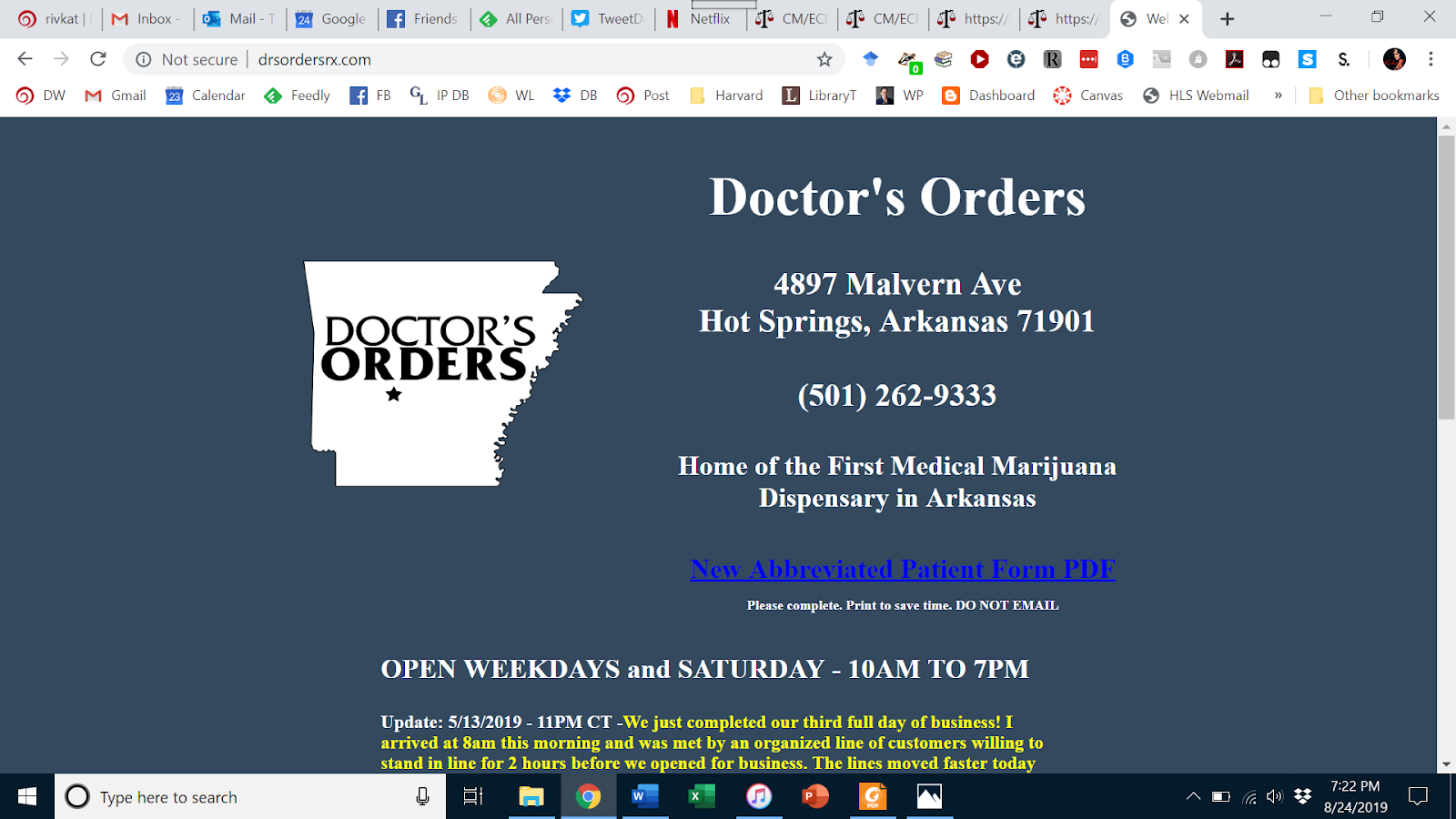
On defendant’s website, there was a logo in the shape of the state of
Arkansas in white, with the following script: “DOCTOR’S ORDERS.” The background
was dark green (though it looked blue to me when I checked).
 

my screenshot of defendant’s site
Defendant’s owner submitted an affidavit that, at the time
he filed his incorporation papers in 2017, he had “never heard of Doctor’s
Orders Pharmacy” and didn’t know about Doctor’s Orders Pharmacy before he got a
cease and desist letter on May 14, 2019.
White Hall presented the affidavit of Jeremy Lambert, a
customer who learned that a medical marijuana dispensary named “Doctor’s
Orders” was open in Hot Springs. At a hearing, he testified that learned about
the dispensary from a customer who was in his office, and he also explained
that he told the customer he “would assume it’s incorrect” that the dispensary
was affiliated with White Hall, then confirmed that was the case. However, his
affidavit averred that he was confused about the medical marijuana dispensary’s
affiliation with White Hall. He testified that he was asked about the medical
marijuana dispensary by three customers and “two to three employees” who worked
with him, as well as other business owners and customers in Pine Bluff. He
“truly believe[s] this has damaged the reputation of [ ] Doctor’s Orders
Pharmacy.” Another Pine Bluff resident submitted an affidavit from a
noncustomer who knew the pharmacy and who was confused, stating that “[i]t was
a common belief in Pine Bluff that this dispensary was somehow affiliated with
White[ ]Hall Pharmacy or [owner] Lelan Stice ….” There was other testimony in
the same vein.
Highlighting the different evolution of false advertising
and trademark doctrine, the court found no likelihood of success on the merits
on the false advertising claim because of lack of evidence of harm.  The theory was misleadingness; though a
full-blown consumer survey isn’t required at this stage of the proceedings,
some sort of extrinsic evidence of deception was. And the deception must be
shown to be likely to influence consumers’ purchasing decisions. There was
record evidence of confusion, but not sufficient evidence of effect on
purchase.  The parties don’t compete in
what they sell—one sells only medical marijuana and the other legally can’t—and
even if there was overlap, there was still no evidence of harm.  The argument that White Hall’s customers
might abandon it because of a perceived association with defendants wasn’t
supported by the record; discovery might be able to show such an impact, but it
wasn’t yet apparent.  And even if
marijuana is controversial, a majority of Arkansas voters voted to allow
medical marijuana, so the net association might even be positive.
Also, the false advertising claim was really a false
association trademark claim, to which the court turned.  White Hall relied on common-law rights, which
are limited by the territory in which a trademark claimant has operated. Under Tea
Rose/Rectanus
, “the first user of a common law trademark may not oust a
later user’s good faith use of an infringing mark in a market where the first
user’s products or services are not sold.” There was no evidence of bad faith
here.
Doctor’s Orders/Doctor’s Orders Pharmacy was
descriptive.  White Hall presented
evidence of continuous use since 2009 as well as of actual consumer confusion:
“multiple individuals immediately thought of White Hall Pharmacy when they
heard the name of defendants’ dispensary.” “Although this record evidence is
not overwhelming, … White Hall Pharmacy has a fair chance to prevail on its
argument that, due to its efforts and exclusive use, the phrases ‘Doctor’s
Orders,’ ‘Doctor’s Orders Pharmacy,’ and ‘Rx’ when used in conjunction with
“Doctor’s Orders” acquired secondary meaning by May 2019, at least for certain
customers in certain markets.”
Geographic scope: White Hall argued that its market “includes
the entire State of Arkansas and then some.” The record gave White Hall a fair
chance of showing some competition, even though the competition wasn’t for the
same goods. “[B]oth parties ostensibly offer medicinal services and products to
the public.”  [How that bears on
geographical scope is not super clear to me.] 
White Hall didn’t show rights outside of the Pine Bluff area on this
record. The court relied on the principle that, “[w]here the first user’s
activities in a remote area are ‘so small, sporadic, and inconsequential’ that
its market penetration is de minimis, the first user is not entitled to
protection against a later user’s good faith adoption of the mark in that
area.” About 20 to 30 patients living in Hot Springs (only five lived in Hot
Springs at the time they were White Hall customers), and 150 with second homes
there, out of 12,000 total wasn’t good enough, nor was having advertising and a
website and belonging to some statewide organizations (as well as some in Pine
Bluff, but not in Hot Springs).  There
wasn’t sufficient market penetration outside Pine Bluff; the “possibility of potential
sales” wasn’t enough on its own to establish rights. However, given that
defendants’ dispensary was one of only two in the state, and given the evidence
of confusion, it seemed likely that both parties served customers in the Pine
Bluff area.
LOC: White Hall’s mark was somewhat distinctive; the marks
were similar; the services were related enough to favor confusion; there was no
evidence of intent to pass off; and the evidence of actual confusion favored
White Hall. The amount of actual confusion has to be weighed against the number
of opportunities for confusion. There was evidence of a lot of inquiries,
though much of this evidence was “hearsay of a particularly unreliable nature
given the lack of an opportunity for cross-examination of the caller or sender
regarding the reason for the ‘confusion.’ ” The only evidence of marijuana
seekers actually showing up at White Hall was hearsay—someone saying they’d
heard of it happening.
Moreover, “many of the alleged incidents of actual confusion
may be interpreted as proof that consumers note a distinction between White
Hall Pharmacy and defendants’ dispensary”—the fact that the consumers knew they
needed to ask, because they didn’t have enough information to be sure, can
indicate lack of confusion rather than confusion. Some of the incidents
reported clearly had that character, such as the customer who “assume[d]” that
it was incorrect to associate the parties.
Still, there were “unambiguous incidents of actual confusion
documented in the record,” such as the message from the job seeker and an
instance in which someone “tagged” White Hall Pharmacy in a Facebook post
related to defendants’ dispensary. 
Considered in toto, actual confusion weighed in favor of White Hall.
Degree of care: it’s hard to buy medical marijuana in
Arkansas; it requires a registry identification card. Medical marijuana is also
not cheap. These aren’t impulse purchases, weighing against confusion.
Though it was a “difficult determination,” the court found
that the test favored White Hall at this stage.
White Hall failed to show it was likely to succeed on its
tortious interference claims.  The
C&D letter wasn’t enough to show that defendants knew about any particular
business expectancy of White Hall or that they intentionally sought to
interfere with it. Nor was there record evidence of any loss of sales, revenue,
or customers. Likewise, as to unjust enrichment claims, there was no record
evidence that defendants have benefitted from White Hall Pharmacy’s advertising
or customer goodwill.
Because it’s a trademark case, it’s not that surprising that
the court then found irreparable harm despite what it said about the absence of
harm above.  “Loss of intangible assets
such as reputation and goodwill can constitute irreparable injury.” And because
the Eighth Circuit hasn’t clearly abandoned the presumption of irreparable harm
in trademark cases post-eBay, the court applied that presumption here.
Without that presumption, the court noted, the case would be more difficult,
given the absence of record evidence of competition and the differences in the
parties’ geographic footprints. There was no record evidence of harm to
reputation or goodwill.
Scope of relief: 
White Hall was granted a preliminary injunction only in the Pine Bluff
area (Jefferson County). Defendants were enjoined from holding themselves out using
any combination of words that included “Doctor’s Orders” to the public within
Jefferson County, including any signage and “any advertising that can be viewed
by consumers within Jefferson County, Arkansas.” [Does this mean that they
can’t advertise online unless they can geoblock? That seems … extreme. The
court says the injunction shouldn’t interfere with other regulations on
defendants’ advertising, but that doesn’t really answer the “can they have a
website that doesn’t target Jefferson County but can be accessed from Jefferson
County” question.]

from Blogger https://ift.tt/2MGOc6J

Posted in Uncategorized | Tagged , | Leave a comment

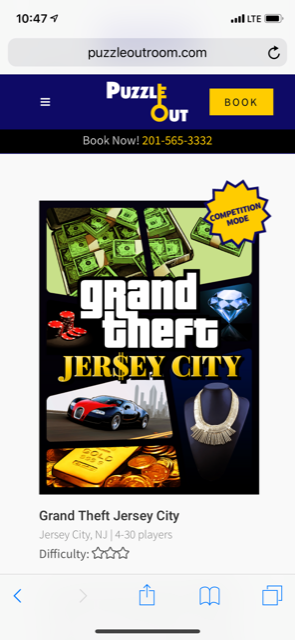
Rogers question of the day, Grand Theft edition

Is an escape room sufficiently like a video game that we would expect a finding of explicit misleadingness (assuming that an escape room is an expressive enough experience, like a play in which the audience is invited to participate, for Rogers to apply)?  My prediction is yes.

from Blogger https://ift.tt/2LdSoYi

Posted in Uncategorized | Tagged , | Leave a comment

first sale doesn’t cover hardware w/embedded licensed software, but maybe Cisco misrepresented whether a license existed

Cisco Systems, Inc. v. Beccela’s Etc., LLC, 2019 WL 3944986,
No. 18-cv-00477-BLF (N.D. Cal. Aug. 21, 2019)
Cisco offers various supports for its networking products,
including a warranty program (from 90 days to lifetime) and a “more
comprehensive suite of service and support offered to customers for a fee”
called SMARTnet Service. It relies on independent “Authorized Channel Partners”
or “Authorized Resellers” to distribute and sell its products. Authorized
Resellers agree to purchase Cisco products only from Cisco or authorized distributors
and to sell those products only to end users (not to other resellers).
BecTech sells Cisco products but is not a Cisco Authorized
Reseller. BecTech allegedly sells Cisco’s products without, among other things,
a manufacturer’s warranty or customer support, which would be material to a
customer’s purchasing decision. BecTech allegedly sold 37 Cisco products
advertised as “Brand New Factory Sealed” that were not in fact factory sealed,
as well as reselling stolen Cisco products. Likewise, Arbitech allegedly had a
history of selling counterfeit Cisco products. They allegedly sold a SMARTnet
contract to an end user without authorization, and thus must have induced a
Cisco Authorized Reseller to sell them the SMARTnet contract in violation of
the Reseller’s contract with Cisco.
Cisco sued for copyright infringement, trademark
infringement and counterfeiting, unfair competition under California law, and
other state law claims.
Defendants counterclaimed that they sell genuine Cisco
products on a lawful “secondary market” of resellers relying on first sale, and
that Cisco unfairly and anticompetitively attempts to control the secondary
market by attempting to shut down these lawful sales of its goods. Cisco allegedly
embeds its hardware with software that it licenses to consumers through its EULA,
so customers can’t actually use the hardware without complying with the
software EULA, which requires end users to purchase the software from an
“Approved Source” (i.e., not on the secondary market). Cisco allegedly “does
not require end users to acknowledge, read, or accept a license agreement
before using Cisco goods sold by [Defendants],” and that Cisco does not inform
customers of this limitation until “after their purchases.”
Cisco allegedly misrepresents to consumers that they cannot
use the software without a license, even though they have purchased the
hardware.  It also allegedly engages in
various other attempts to squash the secondary market, including by “selectively
classif[ing] genuine, lawfully obtained Cisco products as ‘used,’ ‘stolen,’
‘counterfeit’ or ‘scrapped,’ simply because these products were traded on the
secondary market.” It allegedly tells customers that products sold on the
secondary market are used, which it defines as “previously owned equipment that
is now owned by a party other than the original customer,” including both
“opened and unopened equipment,” misleading consumers into thinking that all
products sold on the secondary market have previously been opened and deterring
them from buying. It allegedly wrongfully denies warranty coverage for products
sold on the secondary market on grounds of deterring counterfeiting, knowing
that most of these products are genuine. Defendants sought a declaratory
judgment that they weren’t violating the Lanham Act; alleged false advertising
under the Lanham Act and violation of NY GBL § 369-b and California’s UCL; and
alleged that Cisco’s terms were unenforceable in New York.
NY GBL § 369-b states that “A warranty or guarantee of
merchandise may not be limited by a manufacturer doing business in this state
solely for the reason that such merchandise is sold by a particular dealer or
dealers….Any attempt to limit the manufacturer’s warranty or guarantee for
the aforesaid reason is void.” But it doesn’t create a private right of action,
so there was no declaratory judgment claim available.
As for the Lanham Act claim, it was “certainly not
unreasonable as a matter of law” that a consumer would believe the term “used” doesn’t
apply to unopened goods, and thus consumers could be misled by Cisco’s private
definition of the term.  As for the
alleged misrepresentation of the binding effect of the EULA, the court first
held that a copy of the software could just be licensed and thus not subject to
first sale even if it was embedded in hardware that was sold, which is not a
great rule.  However, there were questions
of fact regarding whether consumers of Cisco’s goods sufficiently agreed to the
software license, such that it would bind them. 
[And it’s not super clear whether the court thought there were also
factual issues about whether these copies had been sold or merely
licensed, though one would think that the fact that consumers don’t have to
agree to the “license” to buy the hardware with the software embedded would also bear on whether there was
really a license.] Though silence can be consent, an offeree’s silence does not
constitute acceptance “when the offeree reasonably did not know that an offer
had been made.” There was a question of fact whether consumers reasonably knew
of the EULA such that they could accept it (or return the product if they did
not accept). Defendants alleged that Cisco didn’t inform consumers until “after
their purchases” that they will have to license the embedded software and that
Cisco “does not require end users to acknowledge, read, or accept a license
agreement before using the Cisco goods sold by [Defendants].” Thus, first sale
might apply, and Cisco might therefore have misled consumers about it.
Defendants also sufficiently alleged
deceptiveness/materiality in that the misrepresentations “successfully deter
consumers from purchasing Cisco goods on the secondary market” and that defendants
“on information and belief…lost sales of products that would have been made but
for Cisco’s false representations to consumers.”  For the same reasons, they pled proximate
cause [which is often easier to do in cases of disparagement].
This also allowed UCL unlawfulness/fraudulent counterclaims
to continue, and also unfairness because Cisco’s conduct allegedly “unfairly
stifles competition by forcing consumers to purchase products from it and not
from resellers on the secondary market,” at least requiring further facts to
resolve.

from Blogger https://ift.tt/2L84ouA

Posted in Uncategorized | Tagged , , | Leave a comment

proof of lost market share needs something extra to be irreparable harm

BioTE Medical, LLC v. Jacobsen, 2019 WL 3943166, No.
18-cv-866 (E.D. Tex. Aug. 21, 2019)
“BioTE provides hormone replacement therapy … through a
method called Pellet Therapy,” using an allegedly custom and proprietary
formula using “bio-identical and natural ingredients that act to maintain a
patient’s hormone levels throughout the day.” It sued defendants, alleging that
they were unlawfully manufacturing and selling unapproved new drugs instead of lawful
“compounding” and were engaging in false advertising in violation of the Lanham
Act. (It also alleged RICO violations which we can ignore because they are RICO
allegations.)
Defendants allegedly misrepresented that defendant EvexiPEL
had developed an exclusive, proprietary hormone replacement pellet; that defendant
Terri DeNeui participated in the development of the allegedly proprietary
hormone pellet; that defendant Farmakeio had a federally required 503B
“registration pending,” when there is no such thing and no paperwork for any
such registration had been submitted; that their Pellet “has been shown to
produce better outcomes for patients too” and similar claims; that Farmakeio
was “a leading pharmacy in the U.S.” when it had just been formed and started
operating; etc.
BioTE failed to get a preliminary injunction for want of
irreparable injury.  Some courts have
held that false comparative ads can be presumed to cause injury and even
irreparable injury. Here, the court held that, even assuming false comparisons,
irreparable harm shouldn’t be presumed after eBay and Winter.  Anyway, cases presuming irreparable harm in
the Lanham Act context are mostly trademark cases, and trademark is special
because no proof of injury is required to succed in a trademark case.
[Sigh.] 
BioTE also argued that it lost market share to defendants;
lost market share due to false advertising can result in irreparable
harm, at least in an industry where consumers are brand loyal. But BioTE didn’t
provide evidence that its lost customers couldn’t be redressed with damages; it
provided no “affidavits, declarations, or any other support, that shows
imminent harm that is difficult to quantify.” Proof of lost market share and
lost sales alone didn’t show irreparable harm.

from Blogger https://ift.tt/2MF5Oj7

Posted in Uncategorized | Tagged , | Leave a comment

District court makes up a new, worse test for TM claims against noncommercial speech

Stouffer v. Nat’l Geographic Partners, LLC, 2019 WL 3935180,
No. 18-cv-3127-WJM-SKC (D. Colo. Aug. 20, 2019)
Stouffer, who (with his coplaintiff production company and
his brother, who is not a plaintiff) produced the Wild America nature
documentary series, sued National Geographic for trademark infringement,
copyright infringement, and unfair competition for its “Wild” productions. The
court developed a new test for evaluating the trademark claims and thus
denied NG’s motion to dismiss without prejudice to a new argument under the
court’s test; granted NG’s motion to dismiss with prejudice as to Stouffer’s
trade dress claim; and granted NG’s motion without prejudice as to Stouffer’s
copyright cause of action. On trademark, the court brilliantly diagnoses the
current cracks in Rogers and then comes up with a much worse
alternative, because it loses sight of the reason to have a First
Amendment-protective test for noncommercial speech in the first place: to
prevent unwarranted suppression of speech in the absence of very clear reasons
to expect consumer deception.
For 14 years starting in 1982, PBS regularly broadcast the
Wild America series. It was very popular for a PBS show.  The Stouffer brothers allegedly “developed a
unique filming style for the show, which utilized slow motion, close-ups, and
time lapses to give viewers a more immersive experience than other nature and
wildlife documentary programming.” The series also allegedly became known for
an image of two bighorn rams butting heads. After Wild America’s run ended on
PBS, the brothers continued to produce direct-to-video nature documentaries
under the “Wild America” mark and produced a feature film titled “Wild
America,” which depicted their childhood and the origins of their passion for
nature and filmmaking. The original episodes are still available on DVD,
streaming, and syndication on TV.  The
production company has a registered trademark for “Wild America.”
National Geographic has TV channels, Nat Geo TV and Nat Geo
WILD (the latter launched in 2010) that feature nature-oriented documentary
programming. Stouffer and National Geographic allegedly “engaged in numerous
discussions regarding [National Geographic] potentially licensing or
purchasing” Stouffer’s Wild America film library. In 2010, a Nat Geo TV
executive e-mailed Stouffer, asking permission to title an upcoming natural
history miniseries “Wild Americas” or “Wildest Americas.” Stouffer declined,
and National Geographic ended up airing the series in 2012 under the title
“Untamed Americas” within the United States, and “Wild America” outside of the
United States. Although the series “can be purchased under the title Wild
America and shipped into the United States,” Stouffer didn’t allege that
National Geographic had any control over such sales.

 

Stouffer version and foreign National Geographic version

In 2013, National Geographic released a television series
titled “America the Wild.” Stouffer alleged that America the Wild “replicat[es]
the most minute details of Wild America in its production,” as shown by “virtually
indistinguishable” titles; “several episodes” of both series in which the host
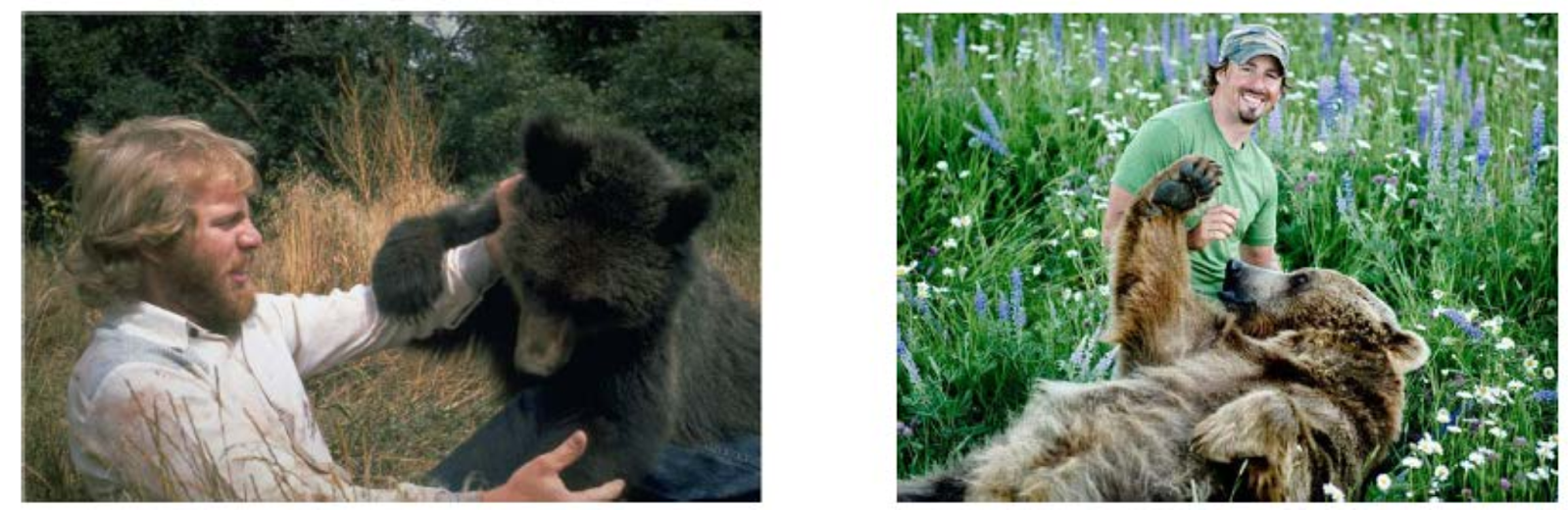
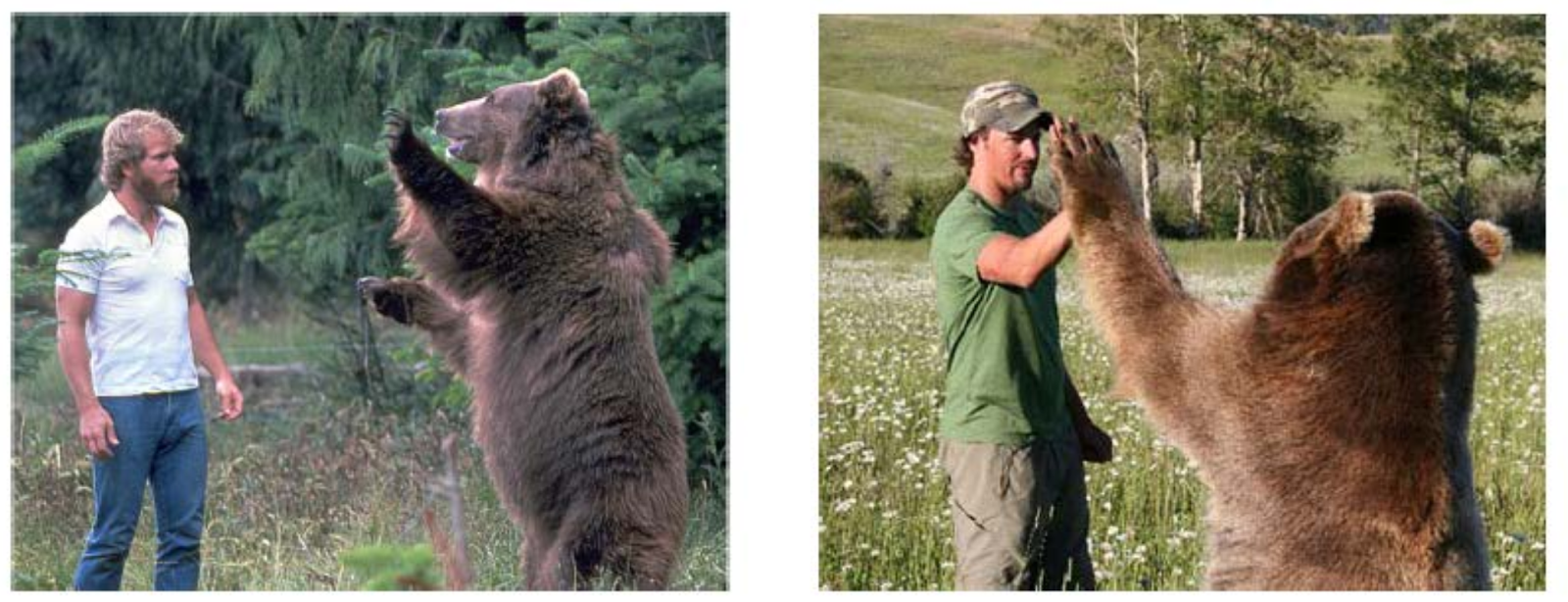
interacts with a grizzly bear that he raised from a cub (in the following still
shots, Marty Stouffer/Wild America is on the left and Casey Anderson/America
the Wild is on the right) [“interacts” is a word unambiguously signalling that
there will be no substantial similarity in expression]; 

Two interactions with bears, including a high five

interacting with rams,
supposedly “invoking the imagery from Wild America’s introductory scene, in
which two rams butt heads dramatically” (though the court noted that ram with
which Casey Anderson butts heads is stuffed); 

“interacts with rams”
actual “copy[ing]” of “many
iconic images from Wild America, including, among others, the image of two big
horn sheep head-butting one another”; a similar “structure” in “many” episodes,
namely, “introducing an animal, following said animal, recording footage of the
animal in conflict, and providing information about the animal” [you can guess
how well this allegation is going to go]; “elements” such as “animal point of
view camera shots, slow-motion action shots, anthropomorphized story-telling
and presentation; [wide-angle nature] transition scenes between segments; and
close-up shots of animals in their native habitats” [hoo boy]; the hosts
“pos[ing] for a photo shoot” in the middle of an episode in a similar way [as a viewer, I can confidently state that shirtless v. not shirtless is not similar]; 
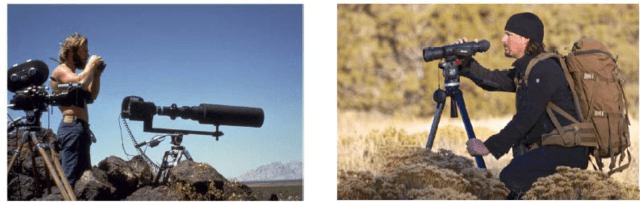
a shirtless man with camera equipment and a man in full gear with camera equipment
“an
uncanny similarity between each show’s host,” with Casey Anderson adopting an
“appearance and persona [that] closely resemble[s] the distinctive look and
style of Marty Stouffer” [oh my]; 
two white men with facial hair and backpacks
and “a similar mark and style for DVD
packaging” [I can’t decide whether this or the persona allegation is
the wildest, no pun intended, based on the images in the complaint].

 

they’re both boxes?

In 2014, National Geographic premiered “Surviving Wild
America,” featuring “two Australian hosts exploring the Okefenokee Swamp,
located in the Southeastern region of the United States.” In 2018, National
Geographic premiered another nature documentary series, “America’s Wild
Frontier.” The four series are the accused series.
I’m going to do the trade dress/copyright issues first,
because they are far more straightforward.
Trade dress: Stouffer also alleged infringement of “[s]ome
of Wild America’s most iconic imagery and branding, including but not limited
to, the image of two big-horn rams butting head[s] and host Marty Stouffer’s
on-screen persona” and the packaging of the DVDs. As to the packaging, Stouffer
didn’t clearly identify the elements of the trade dress that were allegedly
protectable. “Moreover, although he claims ‘a similar mark and style for DVD
packaging,’ his side-by-side comparison plainly shows otherwise.” Comparisons
to outside-the-US packaging were also irrelevant, since there was no allegation
that National Geographic could be liable for its actions outside of the United
States. “Indeed, inclusion of these particular side-by-side comparisons in the
complaint seems intentionally designed to mislead.” The relevant side-by-side comparison—“presumably
one of the most salient examples he could provide”—showed that he couldn’t.
As for the intangible elements, “the image of two big-horn
rams butting head[s],” “host Marty Stouffer’s on-screen persona,” and “the
overall atmosphere of [the Wild America] programming,” that also failed.  Stouffer seemed to be referring to the
allegedly “uncanny similarity” between himself and Casey Anderson, and/or in
his interactions with a grizzly bear he raised from a cub, as Casey Anderson
allegedly also did. As for “overall atmosphere,” the court considered that a
reference to elements such as “animal point of view camera shots, slow-motion
action shots, anthropomorphized story-telling and presentation; [wide-angle
nature] transition scenes between segments; and close-up shots of animals in
their native habitats.”
First, this wasn’t a clear and definite list, as
required.  Second, Stouffer just couldn’t
plausibly allege that “his entire style of documentary-making” was protectable
trade dress. “Stouffer is claiming a set of aesthetic choices with no obvious
source-identifying role.”  Relatedly, the
elements alleged seemed super functional, and Stouffer neglected to respond to
National Geographic’s arguments on that point.
Copyright: Stouffer’s claim focused on an Untamed Americas
episode titled “Mountains” and a Wild America episode titled “Bighorn!” The
alleged copying:
a. [T]he introduction to the
episode, where two rams head-butt one another as the introductory music
crescendos;
b. Voice-over narration of the
episode by an iconic individual [Marty Stouffer and actor Josh Brolin,
respectively]. The narration in both episodes begins immediately following the
introductory credits;
c. Segments focused on specific
animals. Bighorn! includes a segment about a mouse taking care of its young;
Mountains includes a segment about [a] beaver taking care of its young. Both
Bighorn! and Mountains include a segment on bighorn sheep mating season;
d. Both episodes use the iconic
nature slow-motion action shot popularized by Wild America, particularly during
the segments on bighorn sheep. During those segments, both episodes feature a
slow motion shot of two bighorn sheep ramming one another.
National Geographic successfully argued that these elements
were “merely ideas, non-protectable tropes, and scènes à faire common in nature
programs.” Stouffer argued that the court should watch the episodes, but that
was no substitute for pleading actionable similarities.
Stouffer argued that he adequately pleaded infringement
because an original selection and arrangement of unprotected elements is
protectable.  Though courts have
sometimes allowed claims to proceed based on “a significant number of
unprotectable elements” in “a particular sequence,” Stouffer didn’t allege as
much here. He only alleged a little bit about sequence, and “barely a handful”
of relevant comparisons, which were, “with the possible exception of an
introductory head-butting-with-musical-crescendo sequence element, …
qualitatively very weak even as compared to other unprotectable ideas.”
Voiceover narration by an iconic individual that begins immediately following
the credits, “[s]egments focused on specific animals,” segments about animals
taking care of their young, and “slow-motion action shot[s]” “are so standard
as to essentially define the nature documentary genre.”
Wild America might’ve made these elements standard, but even
so, they’re still unprotectable ideas or procedures under §102(b). He didn’t
plausibly allege that National Geographic’s selection and arrangement amounted
to copyright infringement.
National Geographic argued that the First Amendment
protected its titles against all trademark claims. The Tenth Circuit hasn’t
adopted Rogers, or rejected it, so the court went through an extensive
history of Rogers and its related offshoots.  “No party has cited a case in which a court
rejected the Rogers approach when presented with an artistic use of a
trademark. But see PAM Media, Inc. v. Am. Research Corp., 889 F. Supp. 1403,
1406 (D. Colo. 1995)” [rejecting Rogers in the context of a dispute over
the name of a radio talk show, because a talk show doesn’t have fixed content
(and thus is apparently not expressive in the same way as a movie)]. Cardtoons,
L.C. v. Major League Baseball Players Association, 95 F.3d 959 (10th Cir.
1996), didn’t reject Rogers, it just said that good parodies weren’t
confusing and cited Rogers “with approval (but without elaboration) for
the general notion that ‘the public’s interest in free expression’ needed
protection in the context presented.” Utah Lighthouse Ministry v. Foundation
for Apologetic Information & Research, 527 F.3d 1045 (10th Cir. 2008),
applied the traditional circuit LOC test to a parody website and found no
triable issue on confusion.  Stouffer
argued that the Tenth Circuit thus used the usual LOC test, rather than Rogers,
where artistic expression was at issue, but Utah Lighthouse was another
parody case, not an “artistic expression” case and had “nothing to say directly,
and barely anything to say indirectly, about the Rogers test.”
But what kind of Rogers test should the court
consider? It evaluated Parks v. LaFace (artistic relevance; hardly a
barrier here); Twentieth Century Fox Television v. Empire Distribution, Inc.,
875 F.3d 1192 (9th Cir. 2017) (Rogers applies to title v. title disputes
as to other artistic uses); Cliffs Notes, Inc. v. Bantam Doubleday Dell Pub.
Grp., Inc., 886 F.2d 490 (2d Cir. 1989) (Rogers doesn’t apply directly
to expressive work v. expressive work cases, but a First Amendment-sensitive
LOC test accommodating Rogers-type concerns should); and Gordon v. Drape
Creative, Inc., 909 F.3d 257 (9th Cir. 2018) (“explicitly misleading” doesn’t
mean “explicitly misleading”).  As the
court read Gordon, the Ninth Circuit no longer requires “an overt claim
or explicit reference.” Gordon announced that “[i]n some instances, the
use of a mark alone may explicitly mislead consumers about a product’s source
if consumers would ordinarily identify the source by the mark itself.” “This is
a significant innovation, given the Ninth Circuit’s previous statement that ‘the
mere use of a trademark alone cannot suffice to make such use explicitly
misleading.”” E.S.S. Entm’t 2000 v. Rock Star Videos, 547 F.3d 1095, 1100 (9th
Cir. 2008) (emphasis added). Gordon “narrowed that principle to its
factual context by saying that ‘it was clear [in E.S.S., which involved the use
of a mark on a building depicted in a videogame] that consumers would not view
the mark alone as identifying the source of the artistic work.’”
[Given the damage done by Gordon, which the court
here seems to understand, I am more convinced than when I started to think
about this that the §43(a)(1)(B) case law on literal versus implicit falsity
could do some good to explain what the hell is going on.  “Literal falsity by necessary implication” is
treated as explicit falsity where there is no ambiguity about the message being
conveyed—where every linguistically (etc.) competent consumer would understand
what claim is being made.  Gordon
can be made coherent, if not great, by reference to that idea, in contrast to
the idea of ambiguity.]
The court here also noted that Gordon said both that
“consumers ‘do not expect [titles] to identify’ the ‘origin’ of the work,” or
in other words, that titles are not among the uses of marks that can be
inherently “explicitly misleading” but also approvingly quoted Rogers
statement “that ‘misleading titles that are confusingly similar to other
titles’ can be explicitly misleading, regardless of artistic relevance.” Gordon
held that a “relevant consideration” in deciding whether the use of the
mark alone can be explicitly misleading “is the degree to which the junior user
uses the mark in the same way as the senior user.” Thus, a TV series “Law &
Order: Special Hip-Hop Unit” might be explicitly misleading. Another relevant
consideration is “the extent to which the junior user has added his or her own
expressive content to the work beyond the mark itself.” [That is,
transformativeness.] In Gordon, there was a triable issue of whether defendants
simply used Gordon’s mark with minimal artistic expression of their own, and
used it in the same way that Gordon was using it.
With that summary, the court began its analysis by agreeing
that the Lanham Act needs a limiting construction to protect First Amendment
interests. In addition, to avoid chilling effects, this test must be readily
applicable before trial and, ideally, before a full LOC multifactor analysis:
The First Amendment requires that
likelihood of confusion be tolerated in some circumstances, but if the test is
too simple and mechanical, it creates the risk that senior users of a mark end
up with essentially no protection every time the junior user claims an artistic
use. On the other hand, the traditional likelihood-of-confusion test often
creates a fact question that cannot be resolved without a trial. If a junior
user must wait that long to find out if the First Amendment protects his or her
use of the mark, it might unduly chill expression. It might also provide an
incentive for a senior user to bring a so-called “SLAPP,” or strategic lawsuit
against public participation, in the guise of a trademark dispute. Thus, the
First Amendment-based limiting construction on the Lanham Act should provide a
test that can be applied as early as possible in the lawsuit, to the extent
consistent with both parties’ interests.
Parks and Gordon, however, convinced the court
to avoid adopting Rogers in its exact formulation.  Parks, uniquely, treated artistic
relevance as a question of fact, rather than an objective question of law.  The court here pointed out that the holding
that “Rosa Parks” might not have artistic relevance to a song with the lyric
“move to the back of the bus” was dumb (except the court used much nicer
words).  Instead, the Sixth Circuit was
motivated by the suspicion that Outkast chose its title to grab attention
rather than from an “artistic motive” [which is not incompatible with attention
seeking in the slightest!]. But Rogers forced the Sixth Circuit to cram
that concern into artistic relevance. The court here agreed with “the Sixth
Circuit’s broader implicit point, namely, that there must be some way of
addressing instances where there appears to be a demonstrable lack of artistic
motive.”  [So far, this analysis has been
really careful, although I definitely don’t agree with all of it.  But the court here utterly fails to explain
why an artist can’t seek to gain attention through the use of an artistically
relevant symbol that is also a mark, whether or not the use is a reference to
the trademark owner (yes in Parks, no in Empire, not really in Gordon).  The First Amendment has long respected the
right of noncommercial speakers to choose their topics, even if they seek to
profit by their choices.]
Gordon was likewise “analytically messy and divorces ‘explicitly
misleading’ from its plain meaning— converting it into a mere label applied to
uses of a mark that satisfy the first Rogers inquiry but not the second.
But Gordon, like Parks, was constrained by precedent while trying
to prevent what it suspected to be an abuse of Rogers. Gordon
therefore makes its point through an awkward attempt to avoid looking like it
is overruling what it does not have the power to overrule.”  [Or, Gordon contradicts precedent
without going en banc to do so.]  But the
court here also agreed with Gordon’s motivation: “it seems intuitively
incorrect that the junior user may always lawfully use the senior user’s mark
where there is minimal artistic relevance, objectively speaking, and a lack of
any overtly misleading claim about source, sponsorship, etc. Gordon is also
correct at least to suspect non-artistic motives where the junior user uses the
mark in the same channels, and in basically the same way, as the senior user.” 
[This analysis highlights the problem with trying to use
scope to constrain rights granted to “trademarks” that are fundamentally just
ornamental/communicative.  Gordon
is a bad case at bottom because the defendant was using “honey badger don’t
care” as a punchline, which is a communicative use. The Gordon court
didn’t notice that the fact that the plaintiff was using it the same way was a
reason the plaintiff didn’t have a real mark/at best owned a mark whose scope
didn’t extend to the punchline of a greeting card, not a reason that the
defendant was a bad guy.  The facts of
the instant case likewise show the problem with suspecting “non-artistic
motives” on the defendant’s side when the parties’ uses are both
artistic/communicative uses: there’s self-evidently an artistic reason to call
nature documentaries about American animals some variant of “wild
America.”  The issue is that the term is
highly descriptive. And we might nonetheless want to provide Stouffer with
narrow rights—but it’s not because National Geographic lacks “artistic motives”
for its choice.  If anything, Gordon plus
this case suggest that the Second Circuit might’ve had the better idea in
carving out title-v-title disputes from Rogers coverage because of the
analytical difficulties presented.]
So the court here formulates its own test:
Did the junior user have a genuine
artistic motive for using the senior user’s mark or other Lanham Act-protected
property right? Among the relevant questions a court may ask when discerning
the junior user’s motives include the following:
• Do the senior and junior users
use the mark to identify the same kind, or a similar kind, of goods or
services?
• To what extent has the junior
user “added his or her own expressive content to the work beyond the mark itself”
[Citing Gordon and then Hart v. Elec. Arts, Inc., 717 F.3d 141 (3d Cir.
2013), making clear that the court here understood that Gordon wanted to
add transformative use to Rogers despite not using the term]?
• Does the timing of the junior
user’s use in any way suggest a motive to capitalize on popularity of the
senior user’s mark?
• In what way is the mark
artistically related to the underlying work, service, or product?
• Has the junior user made any
statement to the public, or engaged in any conduct known to the public, that
suggests a non-artistic motive? This would include “explicitly misleading”
statements, as defined before Gordon, but is not confined to that
definition.
• Has the junior user made any
statement in private, or engaged in any conduct in private, that suggests a
non-artistic motive?
Given the court’s incisive analysis of the precedents above,
this new test is profoundly misguided—it’s worded to require discovery and keep
cases going, even if the court here purports to want to apply it in a way that
doesn’t often require discovery and a full merits inquiry.  Among other things, the questions appear to require
the court to engage in art criticism to evaluate the quality of the artistic
reference.  As the court explains, “artistic
relevance to the underlying work, service, or product is only a factor to
consider here, not a threshold inquiry.” 
[Note the reference to services or products—by losing the connection to
noncommercial speech the court has wandered even further from the point of modifying
the infringement test.] 
The court then criticizes the “minimal artistic relevance” prong
in ways I find correct but deeply inconsistent with the test it came up with.  First, artistic relevance can disfavor
abstract works:
If a jazz trio writes a wordless
piece titled ‘Rosa Parks,’ how does one judge the artistic relevance of that
title? Is the title obviously irrelevant (because there are no words in which
to ground a finding of relevance) or is it at least arguably relevant (because
there are no words through which to confirm a finding of irrelevance)? If it is
arguably relevant, what do the arguments turn on? Is one style of jazz more
reminiscent of Rosa Parks than another? As these rhetorical questions
illustrate, “artistic relevance” sometimes raises more problems than it
resolves.
Second, incongruity, irrelevance,
and randomness can themselves be artistic choices. Imagine that the jazz trio
names a suite of new pieces after toothpaste brands that a member of the trio
encountered one day at the grocery store. It is difficult to say that the
trio’s choice to associate itself with the randomly mundane can never have
artistic or expressive value. Thus, “artistic relevance” is one factor to
consider when evaluating whether the junior user acted on a genuine artistic
motive or, in contrast, on a desire to profit from the senior user’s goodwill.
You might have noticed the sudden swerve into bad
intent!  The court did too, and it didn’t
really want to go there, at least where defendants were likely to have pure
hearts.  “[T]o adequately protect First
Amendment interests, the objective facts may sometimes excuse further inquiry
into the junior user’s subjective motives.” 
In Rogers, the obvious artistic relevance to the story of the
film, “which is almost entirely Fellini’s original expressive content,” combined
with lack of evidence of misleading marketing of the film, would be enough to
satisfy the court’s test.  Rogers
also didn’t involve a competing product or service with which the film might
conflict, “nor evidence that Fellini was attempting to ride any wave of
popularity.”  [I will note that Ginger
Rogers’s films were in fact competing products, but the court apparently didn’t
think of them as directly competing in the proper way.  So if you are persistently well-known like
Ginger Rogers, then there’s more scope for expressive uses about you than if
you’re a sudden success?  Seems weird and
fact-intensive in a way that is not likely to work out well for avoiding a full
merits inquiry.]  “[E]ven if it had been
proven that Fellini’s true motivation all along was a desire to tap into Ginger
Rogers’s fame, the title is protected by the First Amendment.” But then a
plaintiff should get discovery into the motives of the jazz trio because the
artistic relevance is less obvious?  That
seems bizarre and not helpful to abstract art in the way the court hopes.  Perhaps the court likewise assumes that the
lack of competition will make a difference in the toothpaste-jazz example, but
that just shows how multifactor balancing makes cases unpredictable in ways
counter to the First Amendment/anti-speech-chilling motivations for Rogers-like
tests.
A core problem with the distinction the court wants to make,
to find the black-hearted defendants, is that Fellini’s true motivation was to
make a film about two dancers who were called Fred and Ginger—and one sensible
way to characterize that motivation is that it at least includes “a
desire to tap into Ginger Rogers’s fame” to make the story intelligible.  If you slice artistic motivation into true
artistry and desire to get attention, you both misdescribe the world and bake
incoherence into the test.
Anyway, if the defendant passes this test, no liability; if
it fails, then we go on to the LOC test, with no additional weight to the
expressive use and no requirement that the likelihood of confusion be
“particuarly compelling” as in Twin Peaks, because that approach would
be “ultimately unworkable in practice.”
Because the parties couldn’t anticipate this new test, they
get another chance—Stouffer to amend the complaint and National Geographic to
move to dismiss under the new test. 
National Geographic might also win on descriptive fair use and similar
concepts (specifically the narrowness of Stouffer’s highly descriptive mark).

from Blogger https://ift.tt/2LeM8zs

Posted in Uncategorized | Tagged , , | Leave a comment

self-granted star ratings were textbook puffery where claimed features were general

Knowles v. Arris International PLC, No. 17-CV-01834-LHK, 2019
WL 3934781 (N.D. Cal. Aug. 20, 2019)
Plaintiffs brought a class action based on Arris’s alleged
failure to disclose defects with its SB6190 cable modem. After the court
certified a California class, Arris successfully won summary judgment.
First, latency defects didn’t make the modem unmerchantable
in violation of the Song-Beverly Act. “To be unmerchantable, a consumer good
must fail to possess even the most basic degree of fitness for ordinary use.” For
example, the California Court of Appeal has held that “[a] vehicle that smells,
lurches, clanks, and emits smoke over an extended period of time is not fit for
its intended purpose”; the Ninth Circuit read that to mean that complete
inoperability isn’t required if the defect “drastically undermined the ordinary
operation” of the product; a defect in a vehicle’s fuel system that required
more frequent refueling didn’t qualify.  Here,
although latency test results showed that the SB6190 Modem was milliseconds
slower than promised in laboratory test conditions, that didn’t show that the
model lacked a basic degree of fitness for ordinary use. The latency values
measured in the milliseconds and were at most barely perceptible, and there
were no safety concerns involved (in contrast to a car case in which a
reasonable juror “could conclude, for instance, that a rear-view camera whose
image spontaneously freezes without warning while a car is moving in
reverse…may present a hazardous or dangerous condition”).  For similar reasons, the failure to disclose
the latency issues didn’t violate consumer protection laws.
False advertising under the FAL, CLRA, and UCL: The
representations about the modem’s speed were either puffery or not false. The
relevant representations on the front of the box were “First Gigabit+ Cable
Modem” and “Speeds Up to 1.4 GBPS.” The back had a chart comparing the modem to
Arris’s other cable modem models, with five stars for features including “HD
Multimedia Streaming,” “Internet Browsing,” “Large file downloads –
music/videos,” and “High-Performance Online Gaming” compared to four and three
stars for other models.  The star
comparisons were “textbook” puffery. 
They were too laudatory and generalized to be falsified. Plaintiffs
didn’t explain how one would measure whether a given modem is “five stars” as opposed
to “four stars.”
As for “Speeds up to 1.4 Gbps,” that wasn’t a claim that the
modem “always” or “consistently” reaches speeds of 1.4 Gbps, and there was no
evidence that it couldn’t reach such speeds.  
And no reasonable consumer would understand Arris’s
statement on the box that the modem was “compatible” with Comcast to promise
that the consumer would receive 32 channels from Comcast; the box stated “32
Downstream Channels” and “Get what you pay for – supports Gigabit service
tiers.” The very bottom of the front of the box said: “Compatible with Major
U.S. Cable Providers, Including: Xfinity from Comcast / Time Warner / Cox.” That
didn’t promise 32 channels and resulting gigabit speeds on Comcast regardless
of a consumer’s Comcast service plan.  “Supports” Gigabit service tiers wasn’t a
guarantee, and the side of the box also stated that “Actual speeds will vary,
and are often less than the maximum possible. Upload and download speeds are
affected by several factors including, but not limited to: the capacity of, and
the services offered by your cable service provider or broadband service
provider ….”  No reasonable jury could
find a factual claim.

from Blogger https://ift.tt/2MBe8AJ

Posted in Uncategorized | Tagged , | Leave a comment

timeshare company adequately pleads case against timeshare exit promoter

Wyndham Vacation Ownership v. Reed Hein & Assoc., LLC, No.
18-cv-02171-GAP-DCI, 2019 WL 3934468 (M.D. Fla. Aug. 20, 2019)
This is another lawsuit over timeshare exit companies’
allegedly false advertising of the ease of exiting a timeshare. Defendant TET allegedly
published false and misleading advertisements to convince Wyndham timeshare owners
that it has a “safe,” “legitimate,” or “guaranteed” means of “exit[ing]” them
from their timeshare contracts; the ads were allegedly created, at least in
part, by defendant Happy Hour. TET would then allegedly instruct owners to stop
making payments on their timeshare contracts, without disclosing that the
results include breach of their contracts, foreclosure of their timeshare
interests, and other adverse consequences. The lawyer defendants would then allegedly
get a fixed fee from TET “to engage in fruitless negotiations with Wyndham,”
without speaking to any owner.  Wyndham
sued for false advertising and contributory false advertising under the Lanham
Act, tortious interference with contractual relations (and civil
conspiracy to do that), and violation of Florida’s Deceptive and Unfair Trade
Practices Act (FDUTPA).
Lanham Act: TET argued that Wyndham didn’t satisfy Lexmark’s
zone of interest/proximate cause requirement. Originally, Wyndham failed to
adequately “allege that [its] injury flow[ed] directly from TET’s advertising.”
But it fixed the pleading problem in this amended complaint.  “TET cites no authority to support its
contention that false advertisements must expressly tell viewers to withhold
trade from a plaintiff or that the false advertising must be the only reason
behind a consumer’s actions for a plaintiff to prevail on a false advertising
claim.”  Proximate causation is required,
not sole causation or predominant causation.
Wyndham’s alleged lost sales and injury to its reputation
were “precisely the sort of commercial interests that the Lanham Act seeks to
safeguard.” And it alleged proximate cause by alleging false and misleading advertising
statements concerning TET’s services and about Wyndham that deceived
identifiable Wyndham owners into retaining TET, who then instructed them to
stop satisfying their contractual obligations to Wyndham.  These ads also allegedly caused owners to believe
that Wyndham engaged in unlawful conduct and would not voluntarily release them
from their timeshare contracts. [That last part sounds … true, unless Wyndham
itself determines there’s no more money to be had by squeezing, based on
Wyndham’s own description of its conduct in these cases, but ok.] When “a
defendant harms a plaintiff’s reputation by casting aspersions on its business,
the plaintiff’s injury flows directly from the audience’s belief in the
disparaging statements.”
The court also rejected TET’s arguments that its ads were directed
at the “timeshare industry” as a whole and do “not expressly or implicitly
nam[e] any one timeshare company,” thus could not proximately cause Wyndham’s
injury. But “common sense dictates that an entity can plausibly be harmed by
disparaging statements directed at the industry it occupies.” Also, the amended
complaint alleged that TET made false statements specifically targeted at
Wyndham.
TET then argued that its ads didn’t constitute “commercial
advertising or promotion” under the Lanham Act because there is no “commercial
competition” between Wyndham and TET. Lexmark abrogated that prong of
the test for advertising or promotion.
Next, TET argued that its statements were nonactionable opinion.
 But whether the statements were false or
misleading was a fact-intensive inquiry not suitable for a motion to
dismiss.  [Note that many, many courts
would at least examine the statements to see if they plausibly conveyed
specific, falsifiable facts.] Here, the court accepted as true the factual
allegations that the ads were “either literally false or deceptively
misleading” and that those statements caused owners to (1) believe that Wyndham
engaged in unlawful activity and would not release them from their timeshares,
(2) hire TET, and (3) cease payment on their timeshare contracts.  [Note also that doctrinally speaking, (1)-(3)
don’t necessarily bear on whether the statements were specific enough to be falsifiable—the
genius of puffery (or opinion) is that it can both be persuasive enough to get
consumers to act and also not specific or falsifiable enough for a court to
deem it actionable.]
Contributory false advertising against other defendants:
This requires primary false advertising plus contribution to the primary
conduct. The plaintiff must allege that the defendant: (1) “had the necessary
state of mind — in other words that it ‘intended to participate in’ or actually
knew about’ the false advertising”; and (2) “actively and materially furthered
the unlawful conduct — either by inducing it, causing it, or in some other way
working to bring it about[,]” such as through the “provision of a necessary
product or service, without which the false advertising would not be possible.”
Courts should consider: (1) “the nature and extent of the communication between
the third party and the defendant regarding the false advertising;” (2)
“whether or not the [defendant] explicitly or implicitly encouraged the false
advertising;” (3) “whether the false advertising is serious and widespread,
making it more likely that the defendant kn[ew] about it and condoned the
acts;” and (4) “whether the defendant engaged in bad faith refusal to exercise
a clear contractual power to halt the false advertising.”
Wyndham adequately alleged that “the advertisements run by
TET were made and created, at least in part, by Happy Hour,” which was apparently
enough, even without more specifics about who was responsible for the falsity. Legal
services providers SGB and Privett were allegedly aware of TET’s false
advertising due to its widespread dissemination [standing alone, this just can’t
be right—they need to be aware of the falsity, not just of the
advertising], and it sufficed to allege that “SGB[ ] and Privett explicitly or
implicitly encourage the false advertising because they knowingly accept legal
representation of the consumers deceived by the false advertising” and “derive
much, if not all, of their revenue from the consumers solicited through TET’s
false advertising.” “Without … SGB[ ] and Privett’s willingness to accept
those consumers as clients,” Wyndham alleged, “TET could not advertise what
they do.”
In a sign of how things are going for defendants, the FDUTPA
claim survived too, despite defendants’ argument that the pleadings didn’t
survive Rule 9(b)—the court wasn’t even convinced the complaint was grounded in
fraud, which is somewhat surprising given how 9(b) analysis in similar cases usually
goes. But anyway, Wyndham sufficiently pled the who, what, when, why, and how.  

from Blogger https://ift.tt/2NuAd3d

Posted in Uncategorized | Tagged , | Leave a comment

failure to disprove other possible sources of sales defeats irreparable harm in false ad/patent case

Citrix Systems, Inc. v. Workspot, Inc., 2019 WL 3858602, No.
18-588-LPS (D. Del. Aug. 16, 2019)
Citrix sued Workspot for patent infringement as well as
false advertising/unfair competition under the Lanham Act, the Delaware
Deceptive Trade Practices Act, and common law. Here, the court denied a
preliminary injunction.
Lanham Act: Four of the challenged statements characterized
Workspot’s products as being significantly faster to “roll out” or having
significantly less “time to value” than Citrix’s products – minutes versus
months. Citrix argued that this was literally false because some Citrix
products can be rolled out in minutes or hours. The court found no literal
falsity; the statements “only vaguely refer to Citrix products (leaving it to
the audience to determine which products are comparable) and use terms like ‘time
to value’ and ‘roll-out’ that have no clear and unambiguous meaning (at least
on the record developed to this point).” Citrix even admitted that these terms were
“subjective and require the customer’s input, so there is no way to quantify
them.”
Other challenged statements characterized Workspot as having
a feature velocity (the pace of adding new features) of days, as against
Citrix’s feature velocity of months or more. Citrix again argued literal falsity
because some cloud-hosted Citrix products are updated on a daily to two-weekly
basis, but admitted that at least some of its products were undisputedly on a
12-month release cycle when the statements were made, and the Citrix comparison
didn’t specify, so there wasn’t literal falsity. [Note that if the statements had
remained in the market, they could have become false without further action on
Workspot’s part if Citrix had upped the feature velocity of all its products.]
There were similar disputes about when Citrix acquired “automatic scaling.”
Anyway, there was no irreparable harm, either for the patent
infringement or the false advertising. For patent, Citrix presented no evidence
directly tying  demand for Workspot
products to the allegedly infringing features. Citrix relied on Workspot marketing
materials, which promoted allegedly infringing features of Workspot’s product. “At
best, Citrix has demonstrated that Workspot considers the touted features
important to customers. This, by itself, does not satisfy Citrix’s burden on
the causal nexus requirement.”
For false advertising, too, Citrix failed to show a causal
nexus between the allegedly false statements and the purported harm, such as evidence
that a Citrix customer has or likely would switch to Workspot because of the
allegedly false statements. Direct competition + comparative advertising + the
fact that a majority of Workspot customers are Citrix customers +
evidence that “Workspot has successfully pursued ‘Citrix refugeees’ and [has]
taken ‘Citrix technology off the table’ through its use of ‘BS’ advertisements”
wasn’t enough. None of this showed that it was the false ads, “as opposed to,
for example, better prices or better non-patented technology,” that likely
caused Citrix customers to switch to Workspot. Workspot didn’t characterize its
own advertisements as “BS;” instead, the employee Citrix quoted stated that “no
one has called BS on our [total cost of ownership] slides.”
To me, disregarding companies’ own marketing materials and internal beliefs about what drives sales is pretty extreme–and note the contradiction with how it works in trademark, where bad faith (often quite broadly defined) will be presumed to have succeeded.

from Blogger https://ift.tt/2L9JTNQ

Posted in Uncategorized | Tagged , , | Leave a comment

Weight Watchers competitor wins dismissal of TM claims over “millennials are calling [it] Weight Watchers 2.0” ad

Weight Watchers Int’l, Inc. v. Noom, Inc., 2019 WL 3890139,
No. 18-cv-9637 (PKC) (S.D.N.Y. Aug. 19, 2019)
Noom markets “weight-loss services based on nutrition and
lifestyle advice dispensed through a mobile app.” It ran some ads that
mentioned Weight Watchers. “Broadly characterized, these advertisements
described Noom as offering effective, modern weight-loss services that compared
favorably to those of Weight Watchers.” 
WW sued for false advertising and trademark infringement.  Almost astoundingly for a court in the Second
Circuit, the court dismissed the trademark infringement claims
as nominative fair use. It also dismissed some of WW’s false advertising
theories but found that claims based on Noom’s statement that its service is
“backed by 8 years of research and proven to be effective by several medical
journals” were sufficiently pled.

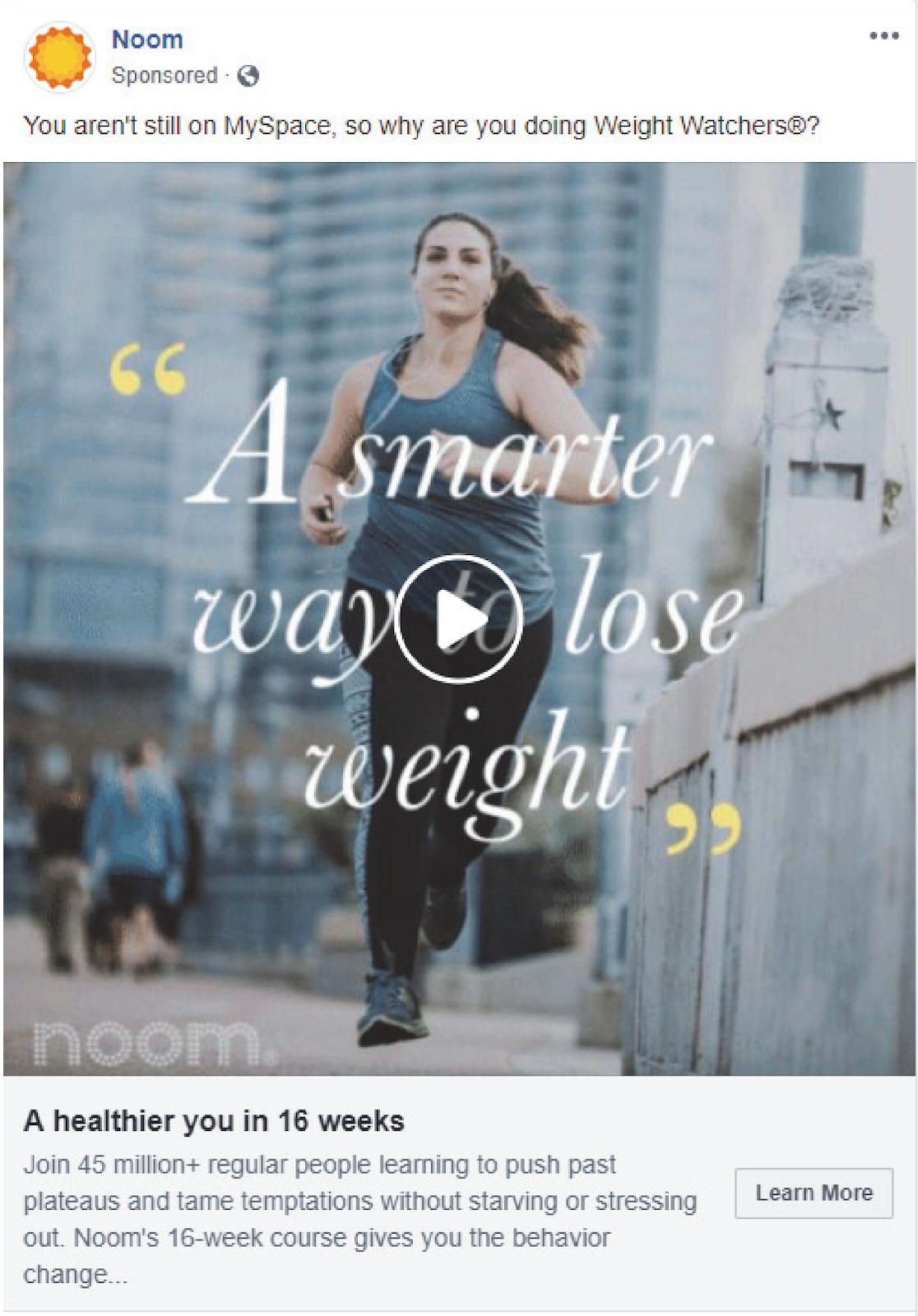
One Noom Facebook ad stated: “You aren’t still on MySpace,
so why are you doing Weight Watchers®?” and used the phrase, “A healthier you
in 16 weeks.” Another: “I’ve tried Weight Watchers and nothing has worked!”
Other Noom ads featured phrases like, “Lose weight for good,” and, “Most weight
loss programs are based on unsustainable dieting” and “crash dieting.” Some
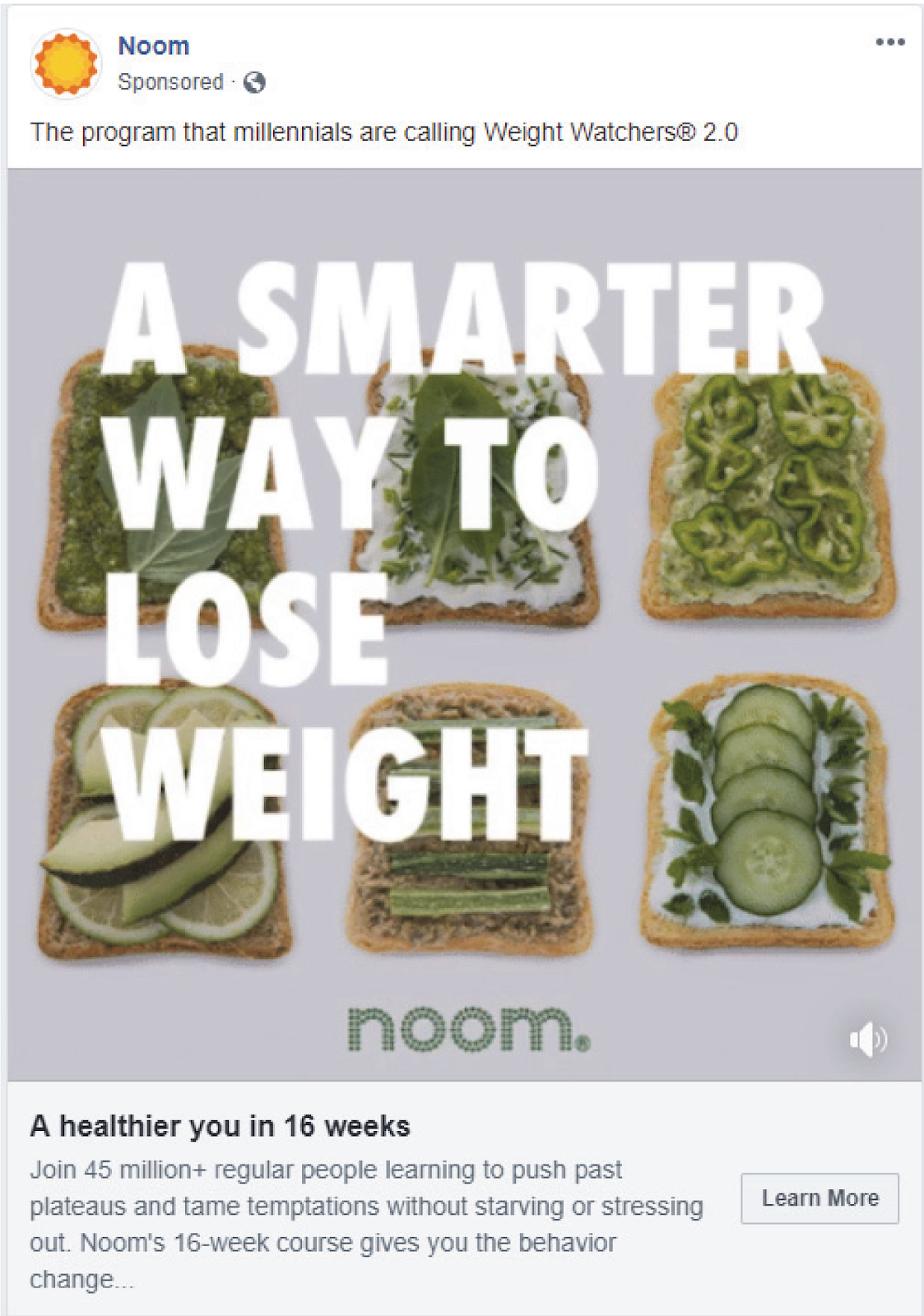
Facebook ads included the text, “The program that millennials are calling
Weight Watchers® 2.0” and “Millennials are calling it Weight Watchers® for the
21st century.”

False advertising: 
The “… so why are you doing Weight Watchers®?” ads allegedly implied
the false message that “consumers would lose more weight in 16 weeks using Noom
that they would using Weight Watchers, or, alternatively, that Weight Watchers
customers would lose no weight in 16 weeks.” The ads included the text, “A
healthier you in 16 weeks,” followed by, “Join 45 million+ regular people
learning to push past plateaus and tame temptation without starving or
stressing out. Noom’s 16-week course gives you the behavior change tools to
forgive, practice, and (finally) stick to a plan.” Additional phrases varied,
but included “A smarter way to lose weight,” “noom. Weight loss for
millennials” and “Lose Nothing But the Weight.”
The court found WW’s reading of the ads “strained.”  The challenged statements were puffery. They
mentioned WW only in the context of comparing it to MySpace’s obsolescence. The
ads didn’t imply that a Noom customer would lose more weight in 16 weeks than a
WW customer would. The analogy between WW and MySpace was simply a vague claim
of superiority.
“The Review of Sally W.” 
A Noom Facebook ad quoted “Sally W.,” stating “I have lost more weight
with Noom in 5 weeks than I lost in 10 months on Weight Watchers.” It
apparently used a stock photo and didn’t state an original source for the
review.  [The FTC would not be happy with
this ad.]  WW argued that the ad falsely
implied that Sally W.’s experience was typical. The court found this allegation
implausible. The court thought that a reasonable consumer would perceive this
as a review from a single customer with no special expertise in weight loss or
other relevant areas.  “The Court takes
judicial notice that customer reviews of businesses, products and services have
become common on many websites and mobile apps, including Google, Facebook and
Yelp. Reviewers frequently express their views in strong, personal terms.” 
The court reached this conclusion despite WW’s deployment of
the FTC’s Endorsement Guide, which itself was based on consumer research
indicating that a substantial percentage of consumers did receive
typicality messages from similar ads. 
[The court didn’t cite the FTC’s factual basis for its conclusions, just
the relevant what-to-do guidance.] While it’s true that “courts have held that
a ‘plaintiff may and should rely on FTC guidelines as a basis for asserting
false advertising under the Lanham Act,’ ” it’s also true that “there is no
private right of action under the FTC Act, and its disclosure obligations do
not apply to Lanham Act claims.”  Even
according “some weight” to the FTC’s guidance, it didn’t render the claim here
plausible because the FTC was concerned with disclosures and disclaimers, not
with the underlying ad statements themselves. 
[This reasoning is just wrong.  (1) The FTC disfavors “not typical”
disclosures for ads of this type because its research showed that ads of this
type are still misleading to many consumers, even with the disclosures,
and (2) even if the FTC Guide was “about” disclosures, the point of the FTC
guidance here is that, without sufficient disclosure to actually convey
atypicality to consumers, these kinds of ads are misleading.  The FTC is substantively concerned with
consumer deception under §5, not with disclosure in the abstract.  Given the evidence developed by the FTC—not
for nothing, much of it in the weight loss context—it is at least plausible
that the ad conveyed a typicality message. 
Even taking judicial notice of the prevalence of reviews shouldn’t
change that, especially since reviews are not the same thing as reviews
endorsed and disseminated by the advertiser, who consumers may indeed consider
to have (1) special expertise and (2) some constraints imposed by advertising
law against deceiving them, thus making the advertiser’s selection of a review
more trustworthy than a random review.]
“Lose Weight for Good” and “Permanent weight loss in the
palm of your hands.” The relevant ads included the line “Noom’s 16-week course
gives you the behavior change tools to forgive, practice, and (finally) stick
to a plan.” And some touted “life-changing results.” WW argued that these ads
conveyed a false message “that consumers will not regain the weight they lose by
using Defendant’s Program for only 16 weeks, even after they stop using it.” But
it wasn’t plausible that a reasonable consumer encountering the ads as a whole “would
conclude that Noom guarantees permanent, lifelong weight-loss simply by
subscribing to Noom.” This was just puffery.
The December 2018 Ads: These ads included the statements
that “Most weight loss programs are based on unsustainable dieting,” “Most
weight loss programs are based on crash dieting,” and a purported consumer
stating, “I’ve tried Weight Watchers and nothing has worked.” This allegedly
conveyed the false messages that WW used crash-dieting techniques and that the
customers of WW would regain any weight that they lost. Noom argued that there
was a 12-second gap between the “crash dieting” statements and a reference to
WW. The court agreed that the challenged statements were puffery: “I’ve tried
Weight Watchers and nothing has worked!” was too vague and broad to be
falsifiable, and its “hyperbolic” character was reinforced by the next
exaggerated statement: “Noom has literally been life-changing!”

Earlier references to “crash” or “unsustainable” dieting and results that
“DON’T last” didn’t change matters. They were references to “unnamed
weight-loss programs” but didn’t impute particular methods to WW, especially
given the accompanying images of a woman eating pasta and a multi-layer
chocolate cake being sliced and served, which served to make the claims more
exaggerated.
“I yoyo dieted for years ….” This ad continued: “I counted
the points. I followed the rules and it didn’t help me long term. I was just so
tired of losing the weight and gaining it all back. But I found something new.
It’s called Noom. It’s not a diet. It’s a totally different personalized
program that uses psychology and small goals to change your habits so that you
can lose the weight and keep it off for good.” WW argued that this ad impliedly
conveyed a false message that the WW program is based on diet alone. The court
disagreed; there was no express reference to WW, and even assuming that
points/rules identified WW, the ad still didn’t plausibly convey that WW
programs were “based on diet alone”; the relevant statements were about Noom
not being a diet, not WW.
The “Coach Heather” E-Mail. This email from Noom had the
subject line, “Why Weight Watchers failed you.” The email stated, “Weight
Watchers doesn’t have an app which means it’s not only more expensive, it costs
more time making room for it in your life.” The complaint alleged that this
statement was literally false (since 2009!). However, the ad didn’t
sufficiently allege that this email was commercial advertising or promotion, or
even identify to whom it was sent.
Finally, WW’s allegations about Noom’s claims about research
did survive. Noom’s website allegedly stated that its weight-loss program is
“backed by 8 years of research and proven to be effective by several medical
journals.” A Noom ad also stated: “Your course is backed by 8 years of research
and proven to be effective by several medical journals.” WW alleged
falsity/misleadingness because the Noom program has not been subject to
“randomized, controlled studies, and at least three of the studies relied upon
by [Noom] are preliminary or pilot studies involving only small groups of people,”
rendering the “proven effective” statement false and misleading.
For a “tests prove” claim, a plaintiff can show falsity by
showing the tests aren’t “sufficiently reliable to permit one to conclude with
reasonable certainty that they established the claim made.” By contrast, “[c]onclusions
drawn from non-fraudulent data about subjects of legitimate scientific
disagreement ‘are not grounds for a claim of false advertising under the Lanham
Act.’” Noom’s arguments that it should be protected by the latter principle
were more appropriate for summary judgment. 
[And those arguments expose the very shaky foundations of ONY,
the case cited by the court—deciding which science is more likely than not to
be a correct account of the world is a basic judicial function in the modern
age.  Among other things, ONY’s
scope is/should be limited by the fact that the case involved (1) full
disclosure of the underlying data and its limits (2) to doctors who understood
the import of that disclosure and thus could draw their own conclusions about
whether the results were real.  Previous
courts interpreting ONY have understood those limits and I hope that if
this case continues the court here does as well.] “The Court is unable to
resolve at the pleading stage whether the research submitted by Noom proves the
effectiveness of its weight-loss programs, whether that research is reliable,
or whether the journals publishing the research are considered credible.”
Trademark infringement: The challenged ads were one with the
text, “The program that millennials are calling Weight Watchers® 2.0” and a
second stating, “Millennials are calling it Weight Watchers® for the 21st
century.” Both ads were identified as “Sponsored” by Noom.  Noom argued nominative fair use.  In the Second Circuit, that’s evaluated by
using the multifactor LOC test plus the Third Circuit NFU test as additional
factors.  [Sigh.]
Strength and competitive proximity favored WW, but the other
usual factors weren’t alleged/were neutral, and the parties’ marks were dissimilar.
The alleged bad faith was only the prominence of the use of the WW mark, but
those ads also were identified as being from Noom and used the stylized “noom.”
logo.  As for the NFU factors, “Weight
Watchers” was necessary to identify Weight Watchers, weighing in favor of
nominative fair use.  [The court
implicitly treats the Second Circuit’s use of the Third Circuit factor one, “whether
the use of the plaintiff’s mark is necessary to describe both the plaintiff’s
product or service and the defendant’s product or service, that is, whether the
product or service is not readily identifiable without use of the mark,” as
more like the Ninth Circuit version focusing only on whether the use identifies
the plaintiff. Perhaps it would be even more likely to be NFU if Noom needed to
use Weight Watchers to explain what Noom was, but it is enough that Noom
needs to use the mark to identify Weight Watchers.  If NFU is going to be shoved into the
multifactor, balancing LOC test, then it makes some sense that, like the other
factors, this factor is a matter of degree.]
Next, “whether the defendant uses only so much of the
plaintiff’s mark as is necessary to identify the product or service.” “Courts
should consider whether the alleged infringer ‘stepped over the line into a
likelihood of confusion’ by using a mark ‘too prominently or too often, in
terms of size, emphasis or repetition.’” In these ads, the WW mark appeared
once, in a sentence that runs above an image, with no additional marks or
design elements owned by WW, and it included the “®” symbol, which the court
apparently thought of as good faith-y (although its effect on whether consumers
would think the ad came from WW is a bit ambiguous to me). “That the use of the
mark is limited to one mention of the company name weighs in favor of
nominative fair use.”
Finally, the court considered “whether the defendant did
anything that would, in conjunction with the mark, suggest sponsorship or endorsement
by the plaintiff holder, that is, whether the defendant’s conduct or language
reflects the true or accurate relationship between plaintiff’s and defendant’s
products or services,” giving weight not only to source confusion, but also to “confusion
regarding affiliation, sponsorship, or endorsement by the mark holder.” Here,
the ad text didn’t plausibly “suggest sponsorship or endorsement” of Noom by Weight
Watchers. It attributed an opinion to a consumer demographic, suggesting that
they “compared Noom to Weight Watchers” and perceived Noom to be “more
contemporary.” That didn’t suggest endorsement or sponsorship, but rather that “Noom
is a different and modern alternative to Weight Watchers.” Instead, this was “a
comparative claim” … Weight Watchers is invoked once in the text, with a
negative connotation that its services are outdated.  [Compare to the “if you like X, you’ll love Y”
cases—though those cases split in result, and favor X when there are other
indicators of similarity to X such as product trade dress; the court makes the point
here that there aren’t any such indicators in these ads and instead a clear use
of the Noom mark.]
TM claims dismissed. State law claims survived to the extent
they matched up with the analysis above. Also, the NY §349 claim based on infringement was dismissed
because it didn’t “plausibly allege a specific and substantial injury to the
consuming public, beyond the purported infringement of the Weight Watchers
mark.”

from Blogger https://ift.tt/2MAqatQ

Posted in Uncategorized | Tagged , | Leave a comment