Misleading advertising that’s already leaving the market can’t support finding irreparable harm

Danone, US, LLC v. Chobani, LLC, No. 18 Civ. 11702 (CM), 2019
WL 760040 (S.D.N.Y. Jan. 23, 2019)
Danone sued Chobani for advertising that Chobani’s kids’
drinkable yogurt product, Gimmies Milkshakes, contains “33% less sugar than the
leading kids’ drinkable yogurt” – which all agreed was a reference to Dannon’s
Danimals Smoothies.  Although Danone was
likely to succeed on the merits, it did not show irreparable harm and could not
secure a preliminary injunction.
Danimals are sold in 3.1 fluid ounce bottle serving sizes
which currently contain 9 grams of sugar per 3.1 oz. serving, although three of
them used to contain 10 grams of sugar. (Dannon reduced the sugar content in
those three flavors in mid-2018, but used up its old packaging for the new
products; this packaging was available at least through January 2019 in NYC.)
Chobani’s Gimmies are sold in packs of 6 4-ounce servings. Until early January
2019, each bottle of “Cookies & Cream Crush” and “Bizzy Buzzy Strawberry”
contained 9 grams of sugar (now 8), while the “Chillin’ Mint Chocolate” flavor
contained 7 grams of sugar. On a per ounce basis, Gimmies had less sugar (by a
gram or two) than did Danimals.
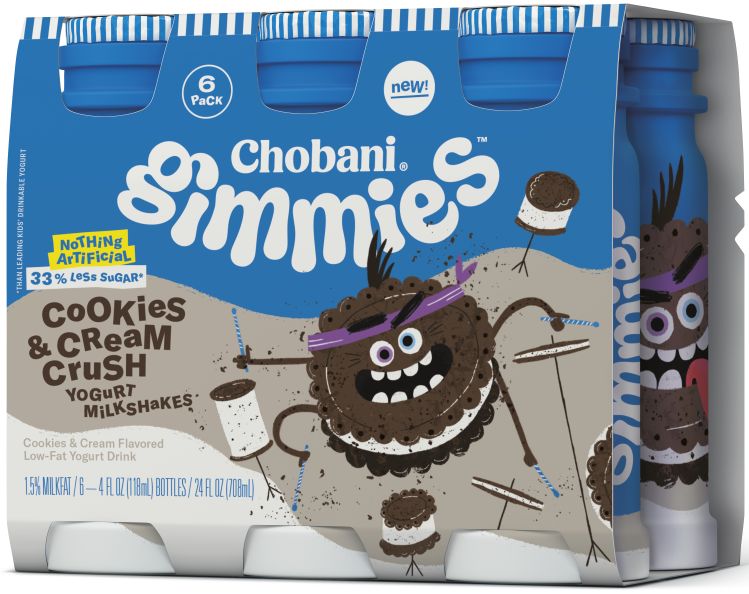
 

front with 33% less sugar claim

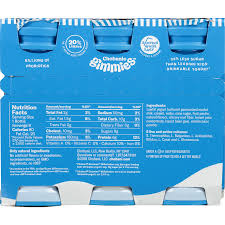
back with mouseprint

On the front, top, and back of the packaging, the Gimmies
packaging says that Gimmies contains “33% less sugar than the leading kids’
drinkable yogurt.” “On the front and top of the packaging, the claim appears in
reasonably readable typeface and is in no way qualified.” On the back, it’s
smaller and asterisked, referring the consumer to two footnotes that are found
below the nutrition facts panel, “in typeface so small that it is barely
legible.” Those footnotes read: “i. *chobani® Gimmies™ Milkshakes: avg. 8g
sugar; leading kids’ drinkable yogurt; avg. 12 g sugar, per 4 fl oz serving;
and ii. **Chobani® Gimmies™ Milkshakes: net 4 fl oz; leading kids’ drinkable
yogurt: net 3.1 fl oz.”
No matter what, 7 or 8 grams of sugar is not 33% less than 9
grams of sugar, or even than 10 grams of sugar. “Put otherwise, a single
serving of Gimmies does not have 33% less sugar than a single serving of
Danimals, no matter the flavor.” Chobani argued that its disclaimers disclosed
the necessary information, but doing so required—and the disclaimer didn’t
disclose that it required—a lot of math, including averaging all three flavors
of Chobani’s products (8.333) without knowing the grams of sugar in the flavors
other than those in the package the consumer was looking at, rounding that number to the nearest gram, then
comparing it to the sugar in Danimals, which is 9 grams per serving.  Additional calculations were required to
produce a hypothetical 4-ounce serving of Danimals (11.6 grams, which Chobani
rounds up to 12 grams). (“And as the Court noted at the TRO hearing, parents do
not ordinarily give a child 1.33 servings of yogurt anything.”)  At that point, the 33% less claim became “true.”
Chobani offered a simpler theory in litigation: dividing the
number of grams of sugar in a single serve bottle of each drink by the number
of ounces in the bottle yields 2 grams of sugar per ounce for Gimmies, and 3
grams of sugar per ounce of Danimals. “However, this rather more elegant and
easily comprehended ‘ounce for ounce’ comparison is not suggested by anything
on the packaging – especially not Chobani’s barely legible footnotes. And that
is not how Chobani calculated its claim.”
Dannon’s extrinsic evidence came from a marketing expert.  Based on his review of academic literature,
which the court considered an appropriate source, he concluded that consumers
were not likely to attend to Chobani’s disclaimers, primarily because of their
location on the packaging. He further opined that consumers would not likely
understand that Chobani’s “33% less sugar” claim required “an averaging of
Chobani’s three flavors, a scaling up of Dannon’s serving size, and a rounding
of fractional sugar contents to the nearest whole number[.]” He also conducted
an online consumer survey and concluded that significantly more consumers would
interpret Chobani’s “33% less sugar” claim as referring to the sugar content of
a bottle of Gimmies versus a bottle of Danimals – not to an ounce of Gimmies
versus an ounce of Danimals.
The online survey used a hypothetical involving two ice
cream brands with different single-serve sizes. Consumers were asked about
their understanding of a claim of “25% less fat” by the larger cup.
Specifically, the survey asked if they were more likely to assume that the
comparison above is made with respect to fat content per cup or per ounce; and
second, if they were more likely to assume that the comparison above is made
with respect to each flavor independently or the average of all three flavors. There
was a “don’t know/not sure” option. Forty-four percent of respondents thought
that the comparison statement “25 percent less fat than [hypo]” referred to the
fat content per mini cup of ice cream, while only 28% of respondents interpreted
it as a per-ounce claim. Similarly, 45% thought that the comparison statement
referred only to the specific flavor in question, while 27% of respondents chose
an average across flavors.  Only 10%
thought both that the comparison was per ounce and across flavors.  Chobani’s expert criticized the study, but conducted
none of her own.
The court found that Dannon’s evidence ruled out a literal
falsity claim but proved a misleadingness claim.  Dannon proved that multiple interpretations
were possible and that 10% of respondents would understand the claim completely
(which doesn’t seem like enough to me, but ok). 
Still, “read in the easiest and most straightforward way, the
advertising on the Gimmies package is not accurate. A bottle of Gimmies has
either 7 or 9 grams of sugar; a bottle of Danimials has either 9 or 10 grams of
sugar. Even taking the biggest difference (7 grams to 10 grams), without any
averaging, there is not 33% less sugar in a serving of Gimmies over a serving
of Danimals.”
Chobani offered no persuasive evidence of consumer
reception, and Dannon did. Indeed, the survey was actually favorable to Chobani
by offering respondents a menu suggesting per ounce and flavor averaging
options; “had the questions been open-ended, it is plausible that some
respondents would not have contemplated that interpretation.”  The questions were close-ended but not
therefore leading because they didn’t suggest a specific answer.  In this case, too, no control group was
necessary to guard against bias or pre-existing beliefs because it wasn’t that
kind of study.
Ultimately, reasonable purchasers who saw “33% less sugar
than the leading brand” on the front of the box “cannot be expected to study
the back of the packaging in the detail necessary to discover the cryptic,
microscopic footnoted disclosures … never mind figure out what needs to be ‘averaged’
with what and perform the multiple calculations needed to make sense of that
claim.” The court credited “numerous studies across different types of products
reveal[ing] that consumers are unlikely to notice or pay attention to Chobani’s
hard-to-find and hard-to-read ‘disclosure’ footnotes,” and these particular
disclosures were also incomprehensible. No yogurt-specific study was required
to show likely success on these points.
Chobani made a useless argument that it couldn’t be liable
because it complied with FTC/FDA rules. Multiple problems with that: (1) Pom Wonderful says the Lanham Act is
different. (2) Read carefully, the rules did not clearly authorize, much less
require, Chobani’s choices here. “The relevant FTC Guideline about ‘Comparative
Nutrient Content Claims’ states that comparative nutrient content claims must
not contain ‘misleading implications’ in order to survive FTC scrutiny” and
should also make clear the basis for the comparison, which Chobani didn’t do.
And the FDA regs cited by Chobani, to the extent they governed relative claims,
didn’t seem to allow Chobani to average the sugar content of its various
flavors.
Ultimately, though, the court was guided by common sense:
[A] parent walking down the dairy
aisle in a grocery store, possibly with a child or two in tow, is not likely to
study with great diligence the contents of a complicated product package,
searching for and making sense of fine-print disclosures in asterisked
footnotes, and looking for flavors other the one(s) s/he wishes to buy (which
may or may not be on the shelf) in order to perform multiple mathematical
calculations – all in order to confirm the truth or falsity of a claim that is
of dubious veracity, and that could easily have been replaced with the simple
and truthful statement, “My product has less sugar per ounce than his product.”
Nor does the law expect this of the reasonable consumer. With yogurt or any
other product, plain vanilla ads and labels tend to work best.
As a result, Dannon also showed a likelihood of success
under its NY GBL § 349(a) claims. Chobani argued that Dannon’s competitive
injury was insufficiently consumer-oriented, but that’s not true. Misleading
parents about the sugar content of a product intended for their children is a
consumer harm: the public “has a strong interest in receiving accurate
information, especially when it comes to products marketed specifically for
children.”
However, Dannon failed to show irreparable harm. Though some
courts have found irreparable harm with a showing of competition + “a logical
causal connection between the alleged false advertising and the plaintiff’s own
sales position,” that couldn’t happen here. The evidence indicates that, in the
month Gimmies launched, Dannimals’ share of the yogurt product market expanded.  This wasn’t an absolute increase—sales of kids’
drinkable yogurt were generally down during the holiday season—but it did
indicate lack of harm to Dannimals’ market position. “This data strongly suggests
that neither Danimals’ sales position nor its brand equity has suffered
irreparably.”  Danone also didn’t offer
any evidence that it lost sales, or that the lost sales were attributable to
the 33% less sugar claim versus the fact that Gimmies has somewhat less sugar
than Dannimals and a larger serving size. It was purely conjectural to say that
Danone lost sales as a result of the
misleading claim.
Anyway, lost sales would be remediable at law. Danone argued
that its injury was to its good reputation as a purveyor of healthy and
nutritious food for children.  But such
“purely conclusory testimony” proved nothing. 
“[T]here is no denying the fact that Danimals has more sugar per fluid
ounce than Gimmies does.”  Even if the
ads were misleading, there was no evidence or other reason to think that
Danone’s reputation would be more
injured by the misleadingness than by the truth, and Chobani had a right to
injure Danone with the truth. 
[There is an interesting set of ideas about but-for
causation and appropriate baselines in here; this issue comes up a lot in
various ways in advertising law, from whether a difference between the truth
and the ad claim is merely puffery or is potentially actionable to materiality
to harm causation, as here.  One can
imagine a different legal regime where the advertiser acts at its peril in
making false claims, even if it can show that the truth would also have worked.
Presumably the advertiser chose falsity over truth because it thought the
falsity would sell better, so we might rely on the advertiser’s own choices and
not its post-hoc defenses. But that’s not the legal regime we have.]
Even worse for Danone, it developed that it had been selling
Dannimals in old packaging that overstated the sugar content of its product. If
Danone was willing to tolerate that because of the expense of making new
packaging, it couldn’t turn around and accuse Chobani of irreparably harming it
on the same metric.
In addition, prompted by the lawsuit, Chobani changed
Gimmies, reducing the sugar in two flavors and changing the packaging. Flavor-specific
labels now advertise that they contain “30% less sugar*” “*than the leading
kids drinkable yogurt and disclose the comparison “Gimmies: 2g sugar per fl.
oz.; leading kids’ drinkable yogurt: 2.9g sugar per fl. oz.” This easy to
understand comparison will be on the front and the back.  The remaining old stuff will be sold or reach
its expiration date by the end of March. Thus, an injunction would have nothing
to redress. Although this will take a few weeks, Danone’s own use of stale
packaging made its irreparable harm claim unpersuasive.
Relatedly, the balance of hardships favored Chobani because of
the expense/difficulty of repackaging existing product (over 2.8 million
bottles would expire before they could be relabeled) and the special harm of
pulling a new product from the shelves before it’s fully established, which
would damage relations with retailers.
Nor would a preliminary injunction help vindicate the public
interest given the ongoing reformulation and repackaging.

from Blogger https://ift.tt/2BUXIMy

Posted in Uncategorized | Tagged , | Leave a comment

Selling copyright-infringing content isn’t trademark infringement or false advertising

Joint Stock Co.“Channel One Russia Worldwide” v. Russian TV
Co., 2019 WL 804506, No. 18 Civ. 2318 (LGS) (S.D.N.Y. Feb. 21, 2019)
Channel One produces and broadcasts TV programming in the
Russian Federation and its neighboring states, and granted third parties the
“exclusive right to broadcast and re-broadcast [its] Programming and other
copyrighted materials in the United States.” Russian TV allegedly runs a
website through which it provides unauthorized access to the programming in the
United States in exchange for a subscription fee, having decrypted or acquired
unencrypted signals carrying the programming. The Russian TV website also sells
set-top boxes (STBs) that facilitate unauthorized access to the Programming.  The website invites customers to “Watch
Russian TV online” and advertises over 200 television channels; the complaint
didn’t show use of Channel One’s marks on the website, but when unauthorized
users stream the programming using Russian TV’s services, Channel One’s marks
appear at the corner of the screen.
After dismissing a couple of defendants whose involvement
wasn’t sufficiently pled, the court easily found that the complaint stated
claims for direct copyright infringement and (in the alternative)
secondary/contributory liability. In terms of unauthorized reproduction, it was
reasonable to infer that the programming data remained on Russian TV’s US
equipment for “at least several minutes” as required under Cartoon Network because the complaint alleged that defendants
“store” Channel One’s programming signals “via equipment, including computer
servers, located in the United States.” For secondary liability, given the
allegations that Russian TV offered its streaming services “at far lower prices
than lawfully licensed services,” it was plausible that Russian TV knew or had
reason to know it was selling programming acquired through infringing activity
and materially contributed to the unauthorized reproduction “by creating demand
for it, advertising access to it on the Russian TV website and distributing it
to subscribers.”
Trademark and false advertising claims were, however,
dismissed. The complaint didn’t plausibly plead that Russian TV’s acts were
likely to confuse consumers as to whether Channel One originated or sponsored
Russian TV. Nor were facts alleged to show that consumers are likely to be
confused about whether Russian TV or Channel One was the source of the programming.
Instead, the allegation was merely that Russian TV displayed Channel One’s
marks. “[A]s a general rule, the Lanham Act does not impose liability for the
sale of genuine goods bearing a true mark even though the sale is not
authorized by the mark owner because such a sale does not inherently cause
confusion or dilution.”  
Comment: this analysis skips over a lot of detail that is
fought out in other cases, particularly the various Phoenix Entertainment cases, but it gets to the right result.  There’s no such thing as a “counterfeit”
digital signal in the way there can be a counterfeit purse, as long as the
signal contains the content that is promised (here Channel One content).  A deepfake might be a counterfeit in the
purse sense, but that’s not what’s alleged. The fact that the goods/services
are intangible shouldn’t change this result (especially since the pixels on
your screen don’t “come from” the broadcaster in any physical sense; the
directions for how to configure them ultimately have the content creator as
their source, but only through multiple intermediaries—and that’s true whether
or not there’s an unauthorized rebroadcaster in the middle).  Dastar
would be another way to get to this result, but it’s unnecessary where the
court can see clearly the core issue, which is copyright.
False advertising: the complaint failed to plead anything
that was false and advertising. Russian TV’s website states “Watch Russian TV
online[.] Over 200 … channels.” “Although this may be advertising, it is not
alleged to be false.” The actual broadcasts of Channel One content weren’t
“advertising or promotion” nor were they alleged to be false. Even the display
of Channel One trademarks at the corner of the screen when consumers streamed
the content wasn’t “commercial advertising or promotion” because that wasn’t an
organized campaign by defendants to penetrate the relevant market. To the
extent the false advertising claim was based on the theory that Russian TV
misled consumers by “making it appear that Defendants have the right to
rebroadcast [Channel One] Programming and Channels,” that didn’t work because
claims about licensing aren’t misrepresentations about “the nature,
characteristics, qualities, or geographic origin of … goods or services,” as
required by §43(a)(1)(B).
The DMCA anti-trafficking claim was also dismissed. The DMCA
relevantly bars people from providing or otherwise trafficking in any
“technology, product, service, device, component, or part thereof, that is …
designed or produced for the purpose of circumventing a technological measure.”
17 U.S.C. §§ 1201(a)(2), (b)(1). But the complaint carefully didn’t plead that
the STBs provided to customers themselves circumvented any encryption, as
opposed to receiving the results of prior circumvention. Accessing what’s
already been obtained is not circumvention.
State law claims for unfair competition and infringement
were, of course, preempted by the Copyright Act. Channel One tried to argue
that Russian TV was “passing off the Russian version of Channel One Programming
as the edited version of the Channel One Programming that is licensed to cable
companies and IPTV providers.” First, relevant underlying facts weren’t alleged
in the complaint, but more importantly, that wasn’t a passing off theory: “this
alleged misrepresentation does not deceive consumers into believing they are
watching Channel One programming when they are in fact watching Russian TV
content.” So this theory was still preempted.

from Blogger https://ift.tt/2U7Bmyp

Posted in Uncategorized | Tagged , , , , , | Leave a comment

Fair use amicus for Google/Oracle cert petition

Pam Samuelson’s amicus focusing on copyrightability was excellent and I hope it helps persuade the Court to finally take up this important issue in computer software.  I worked on a fair use amicus to point out that the Federal Circuit’s override of a jury verdict in favor of fair use was also a big problem.

from Blogger https://ift.tt/2BMq6QT

Posted in Uncategorized | Tagged | Leave a comment

Second Circuit summarily reverses bad Prevagen decision on statistical proof

FTC v. Quincy Bioscience Holding Co., 17-3745-cv(L) (2d.
Cir. Feb. 21, 2019)
Quincy sold Prevagen dietary supplements, claiming (1) that
the supplements improve memory and provide other cognitive benefits, (2) that
these effects are clinically proven, and (3) that the products’ active
ingredient “supplements” brain proteins that are lost with age. The FTC alleged
that Quincy conducted a randomized, double-blind, placebo-controlled study that
contradicted these representations and showed no statistically significant
improvement in the memory and cognition of participants taking Prevagen over
participants taking a placebo. Quincy subsequently “conducted more than 30 post
hoc analyses of the results” of the study, and “the vast majority of these post
hoc comparisons failed to show statistical significance.” While the study showed
a “few positive findings on isolated tasks for small groups of the study
population,” these findings allegedly did not “provide reliable evidence of a
treatment effect.” The district court, in a poorly reasoned opinion, dismissedthe complaint because the post hoc analyses must have shown something. The court
of appeals summarily reversed.
“The FTC has stated a plausible claim that Quincy’s
representations about Prevagen are contradicted by the results of Quincy’s
clinical trial and are thus materially deceptive in violation of the FTC Act
and New York General Business Law.” For example, Quincy claimed broadly that in
a clinical study “Prevagen improved memory for most subjects within 90 days,” yet
this wasn’t true: the study “failed to show a statistically significant improvement
in the treatment group over the placebo group on any of the nine computerized
cognitive tasks.” Not only did this make plausible that it was deceptive to claim
that “the majority of people” experience cognitive improvement from taking
Prevagen, but the FTC also stated a claim that Quincy’s representations that
this cognitive improvement is clinically supported are deceptive. Further, the
FTC alleges that Quincy’s claim that the active ingredient in Prevagen, apoaequorin,
“enters the human brain to supplement endogenous proteins that are lost during
the natural process of aging” was false. Quincy’s “safety studies show that
apoaequorin is rapidly digested in the stomach and broken down into amino acids
and small peptides like any other dietary protein.” “Drawing reasonable
inferences in favor of the FTC, as we must, the FTC plausibly alleged that
Quincy’s representations about Prevagen’s active ingredient entering the brain
are false.” The district court erred in dismissing the complaint and declining
to exercise supplemental jurisdiction over New York’s claims.
The court doesn’t go into detail on the bad statistical
understanding underlying the district court’s mistakes, but you can read
the amicus brief I signed
or let xkcd do it.

from Blogger https://ift.tt/2T8imSV

Posted in Uncategorized | Tagged , , | Leave a comment

Show me your teeth: dentist’s before-and-after closeups aren’t copyrightable for want of originality

Pohl v. MH Sub I, LLC, No. 4:17cv181-MW/CAS (N.D. Fla. Jun.
20, 2018)
H/T Daniel Kegan. Dr. Pohl took before-and-after photographs
of his cosmetic dental work for his Florida cosmetic dentistry practice’s
website. He took such photos of “Belinda” in 2004. “The photos consist of two
direct shots of the patient’s teeth—one before the dental work and the other
after the dental work. The patient is revealing her teeth and, in both shots,
the photo consists of her teeth, her lips, and a small area around the mouth.”  
the photos at issue
He sued defendants for designing/developing
seven websites on which the images appeared without his permission.  Although the deposit copy of the site he used
for his copyright registration wasn’t in the record, the jury could find that
it contained the images at issue.
The court then found that the before-and-after photos
weren’t copyrightable because no reasonable jury could find the photos were
sufficiently creative or original. Though the bar was low, the photos failed to
pass it.  Highly informative product
photos intended to sell the product through accurate depiction may lack
sufficient creativity to be protected, and that was what happened here. Such
photos “lack any creativity or originality primarily because they serve a
utilitarian end—to identify goods or services that a viewing customer can
expect from the business.”
Pohl argued that he was responsible for “selecting the
camera, posing the subject matter, and determining the lighting and photo angle
before taking the photographs.” But none of this involved creativity.  He didn’t remember what kind of camera he
used—even whether it was digital or film. 
He didn’t remember whether Belinda was sitting or standing for the
photos.  “To the extent he posed her for
the camera, it was to tilt her head, lift her chin up or down, instruct her to
smile, or to tell her to look at the camera. As for lighting, there is no
creativity in merely having sufficient lighting in the room ….” For the angle,
he testified that he moved “the camera in and out until I get it in focus,” which
the court deemed “the most rudimentary and basic task for photographers since
the era of the daguerreotype.” The entire process took no more than five
minutes.
If utilitarian photos of Chinese food in different patterns
are uncopyrightable, as a previous case held, then these photos are clearly
uncopyrightable; “directing a subject to smile and moving a camera to focus on
a portion of the subject’s face” has even less of a “creative spark.”  

from Blogger https://ift.tt/2IvEEKn

Posted in Uncategorized | Tagged | Leave a comment

Guitar design authorship blues: delay and consent defeat (c), ROP, other claims

Webster v. Abbott, 2018 WL 7352411, No.
8:17-cv-01795-T-02CPT (M.D. Fla. Nov. 30, 2018)
Webster is a luthier and guitar technician who goes by
“Buddy Blaze.” Around 1985, he modified a Dean ML guitar and had the guitar
painted blue with a lightning graphic. He gave the guitar to a friend, Darrell
Abbott, who called it “The Dean from Hell” (DFH) and then went on to become a
guitarist in the band Pantera known as “Dimebag Darrell.” In 2004, Abbott
signed an “endorsement-type” contract with Dean Guitars (and was then
murdered). Dean Guitars began to sell copies of the DFH. After Abbott’s funeral, the former owner of Dean Guitars contacted Abbott
about painting a copy of the DFH for release, but Webster explained that another person had painted the original version
at his direction. After he knew Dean Guitars was selling DFH replicas, Webster
also lent photographs to Dean Guitars for a display at the 2005 National
Association of Music Merchants tradeshow which linked Webster to Abbott and the
DFH. He testified, “I was okay with them displaying it at the booth during the
show.” 

The DFH/CFH

By 2006, Webster knew Dean Guitars was selling the DFH as a
“mass-market product” with several price points and versions. He was unhappy
that Dean Guitars was issuing a cheap, imported version of the DFH called
Cowboy From Hell or DFH/CFH. He told the then-CEO of Dean Guitars, “we’ve got
to work this out…. I’m not okay with what’s going on,” and “you can’t do that
without, you know, my blessing, without a release from me.” In 2007, the
then-CEO responded that “I have taken some time and spoken to several ‘people
in the know’ and the consensus concerning Dime’s graphic is that Dime’s estate
is the legal owner of it. With that said, I still would like to work with you
on a Dime project because I am not about making enemies but keeping friends.” Webster
objected; Dean Guitars told him to sue the estate as the owner/licensor of the
graphic. Webster continued to object.
In 2009, Webster worked on his own signature guitar, the
Buddy Blaze ML, produced and sold by Dean Guitars; he promoted the Buddy Blaze
ML alongside the then-CEO and provided a brief history of the DFH and compared
his model with the DFH. He’s appeared and been referenced in other videos
apparently produced by Dean Guitars, whose website at one time linked two
YouTube videos featuring interviews with Webster in which he gave the history
of DFH in front of the original DFH and promoted his own guitar and volunteered
information about Abbott and the DFH. Neither video made any mention of DFH
reissues.
 

Buddy Blaze ML

In 2016, he registered a copyright in the DFH lightning
graphic design and sued for copyright infringement, civil conspiracy and unfair
competition in 2017.
The court found the copyright infringement and civil
conspiracy claims time-barred. Though a copyright infringement claim separately
accrues with each infringing act, “[w]here the gravamen of a copyright
infringement suit is ownership, and a freestanding ownership claim would be
time-barred, any infringement claims are also barred.” Petrella v.
Metro-Goldwyn-Mayer, Inc., 572 U.S. 663 (2014) didn’t change the rule that the
an ownership claim accrues only once. In the Sixth and Ninth Circuits, such a
claim accrues “when plain and express repudiation of co-ownership is
communicated to the claimant.” In the First, Second, Fifth, and Seventh
Circuits, the clock starts “when the plaintiff learns, or should as a
reasonable person have learned, that the defendant was violating his rights.” Under
either test, the claim here was time-barred.
Dean Guitars’ “olive branch” offer of a separate relic DFH
with the possibility of royalties for Webster didn’t make its repudiation of Webster’s
claim to ownership any less express. The language was clear that any royalties
would have stemmed from Webster’s work with a possible future relic model, not from
the original DFH. Further, Dean Guitars told Webster to sue the estate.
Webster’s delay, allegedly out of respect for Abbott’s family following his
death and then because of Webster’s own family issues and the then-CEO’s
failing health, weren’t justifications that would pause the legal clock.
Although the unfair competition claims weren’t preempted
(they didn’t depend on ownership or infringement of the copyrighted design),
they also failed. Webster objected to the use image “for years in connection
with the historical fact of his creation of the Dean From Hell,” especially as
it relates to the reissues. As a result, he alleged, “people came to think that
[Plaintiff] was wealthy or had authorized these uses of his name and likeness”
and this association damaged his reputation. But his allegations and evidence
couldn’t support this claim.
Setting aside issues with proving
injury and a possible fair use defense, the most fundamental flaw in
Plaintiff’s argument is that Defendants’ statements were neither false nor
misleading. … Most of the statements at issue concerning the history of the DFH
and Plaintiff’s friendship with Mr. Abbott are made by Plaintiff himself.
Importantly, Defendants made no misleading statements with respect to any
endorsement or sponsorship of the DFH reissues, or even Dean Guitars itself. In
fact, there are no such statements or implicit suggestions linking Plaintiff to
the replicas at all.
A NAMM attendee also stated
in his declaration that “I heard Dean representatives using Buddy’s name when
selling the Dean From Hell copies. The gist of their statements was that Dean
was selling guitars like the one that Buddy Blaze re-built for Darrell.” But
there was nothing untrue or misleading about such statements.
“There is no suggestion in any material Plaintiff sets forth
that Defendants used Plaintiff’s name or likeness to sell or market the DFH
reissues, or any suggestion that Plaintiff endorsed or derives income from the
guitars.” Webster voluntarily participated in each video, and couldn’t identify
any harm therefrom.
Webster’s invasion of privacy by misappropriation claim (right
of publicity under Texas law) also failed. Texas requires that (1) the
defendant appropriated the plaintiff’s name or likeness for the value
associated with it; (2) the plaintiff can be identified from the publication;
and (3) there was some advantage or benefit to the defendant. Defendants
pointed out that Webster voluntarily participated in the videos, but Webster
argued that he permitted use as it related to the history of DFH, but not
reissues of the guitar. The court reasoned that Webster “certainly had some
idea of the extent of the publication of the interviews yet nonetheless
consented. Each video appears to have been filmed by Dean Guitars and,
moreover, at trade shows for music merchants. As for the reissues, Plaintiff no
doubt knew that the guitar Defendant Haney signed in one of the NAMM videos was
not the original DFH. Plaintiff nonetheless voluntarily related the history of
the DFH to the interviewer. Reissues do not appear and are not referenced in
any other video featuring Plaintiff.”
Ultimately, there was insufficient evidence that defendants
appropriated Webster’s name or likeness for the value associated with it. At
most, they used his name (when he wasn’t himself participating in a video) only to
provide historical background. In addition, the claims based on the videos were
“extracted from either an old Dean Guitars website, or from the vastness of the
internet” and there was no evidence that these old videos were even used as ads
to sell the reissues.

from Blogger https://ift.tt/2SgFw5p

Posted in Uncategorized | Tagged , , , , | Leave a comment

Guitar design authorship blues: delay and consent defeat (c), ROP, other claims

Webster v. Abbott, 2018 WL 7352411, No.
8:17-cv-01795-T-02CPT (M.D. Fla. Nov. 30, 2018)
Webster is a luthier and guitar technician who goes by
“Buddy Blaze.” Around 1985, he modified a Dean ML guitar and had the guitar
painted blue with a lightning graphic. He gave the guitar to a friend, Darrell
Abbott, who called it “The Dean from Hell” (DFH) and then went on to become a
guitarist in the band Pantera known as “Dimebag Darrell.” In 2004, Abbott
signed an “endorsement-type” contract with Dean Guitars (and was then
murdered). Dean Guitars began to sell copies of the DFH. After Abbott’s funeral, the former owner of Dean Guitars contacted Abbott
about painting a copy of the DFH for release, but Webster explained that another person had painted the original version
at his direction. After he knew Dean Guitars was selling DFH replicas, Webster
also lent photographs to Dean Guitars for a display at the 2005 National
Association of Music Merchants tradeshow which linked Webster to Abbott and the
DFH. He testified, “I was okay with them displaying it at the booth during the
show.” 

The DFH/CFH

By 2006, Webster knew Dean Guitars was selling the DFH as a
“mass-market product” with several price points and versions. He was unhappy
that Dean Guitars was issuing a cheap, imported version of the DFH called
Cowboy From Hell or DFH/CFH. He told the then-CEO of Dean Guitars, “we’ve got
to work this out…. I’m not okay with what’s going on,” and “you can’t do that
without, you know, my blessing, without a release from me.” In 2007, the
then-CEO responded that “I have taken some time and spoken to several ‘people
in the know’ and the consensus concerning Dime’s graphic is that Dime’s estate
is the legal owner of it. With that said, I still would like to work with you
on a Dime project because I am not about making enemies but keeping friends.” Webster
objected; Dean Guitars told him to sue the estate as the owner/licensor of the
graphic. Webster continued to object.
In 2009, Webster worked on his own signature guitar, the
Buddy Blaze ML, produced and sold by Dean Guitars; he promoted the Buddy Blaze
ML alongside the then-CEO and provided a brief history of the DFH and compared
his model with the DFH. He’s appeared and been referenced in other videos
apparently produced by Dean Guitars, whose website at one time linked two
YouTube videos featuring interviews with Webster in which he gave the history
of DFH in front of the original DFH and promoted his own guitar and volunteered
information about Abbott and the DFH. Neither video made any mention of DFH
reissues.
 

Buddy Blaze ML

In 2016, he registered a copyright in the DFH lightning
graphic design and sued for copyright infringement, civil conspiracy and unfair
competition in 2017.
The court found the copyright infringement and civil
conspiracy claims time-barred. Though a copyright infringement claim separately
accrues with each infringing act, “[w]here the gravamen of a copyright
infringement suit is ownership, and a freestanding ownership claim would be
time-barred, any infringement claims are also barred.” Petrella v.
Metro-Goldwyn-Mayer, Inc., 572 U.S. 663 (2014) didn’t change the rule that the
an ownership claim accrues only once. In the Sixth and Ninth Circuits, such a
claim accrues “when plain and express repudiation of co-ownership is
communicated to the claimant.” In the First, Second, Fifth, and Seventh
Circuits, the clock starts “when the plaintiff learns, or should as a
reasonable person have learned, that the defendant was violating his rights.” Under
either test, the claim here was time-barred.
Dean Guitars’ “olive branch” offer of a separate relic DFH
with the possibility of royalties for Webster didn’t make its repudiation of Webster’s
claim to ownership any less express. The language was clear that any royalties
would have stemmed from Webster’s work with a possible future relic model, not from
the original DFH. Further, Dean Guitars told Webster to sue the estate.
Webster’s delay, allegedly out of respect for Abbott’s family following his
death and then because of Webster’s own family issues and the then-CEO’s
failing health, weren’t justifications that would pause the legal clock.
Although the unfair competition claims weren’t preempted
(they didn’t depend on ownership or infringement of the copyrighted design),
they also failed. Webster objected to the use image “for years in connection
with the historical fact of his creation of the Dean From Hell,” especially as
it relates to the reissues. As a result, he alleged, “people came to think that
[Plaintiff] was wealthy or had authorized these uses of his name and likeness”
and this association damaged his reputation. But his allegations and evidence
couldn’t support this claim.
Setting aside issues with proving
injury and a possible fair use defense, the most fundamental flaw in
Plaintiff’s argument is that Defendants’ statements were neither false nor
misleading. … Most of the statements at issue concerning the history of the DFH
and Plaintiff’s friendship with Mr. Abbott are made by Plaintiff himself.
Importantly, Defendants made no misleading statements with respect to any
endorsement or sponsorship of the DFH reissues, or even Dean Guitars itself. In
fact, there are no such statements or implicit suggestions linking Plaintiff to
the replicas at all.
A NAMM attendee also stated
in his declaration that “I heard Dean representatives using Buddy’s name when
selling the Dean From Hell copies. The gist of their statements was that Dean
was selling guitars like the one that Buddy Blaze re-built for Darrell.” But
there was nothing untrue or misleading about such statements.
“There is no suggestion in any material Plaintiff sets forth
that Defendants used Plaintiff’s name or likeness to sell or market the DFH
reissues, or any suggestion that Plaintiff endorsed or derives income from the
guitars.” Webster voluntarily participated in each video, and couldn’t identify
any harm therefrom.
Webster’s invasion of privacy by misappropriation claim (right
of publicity under Texas law) also failed. Texas requires that (1) the
defendant appropriated the plaintiff’s name or likeness for the value
associated with it; (2) the plaintiff can be identified from the publication;
and (3) there was some advantage or benefit to the defendant. Defendants
pointed out that Webster voluntarily participated in the videos, but Webster
argued that he permitted use as it related to the history of DFH, but not
reissues of the guitar. The court reasoned that Webster “certainly had some
idea of the extent of the publication of the interviews yet nonetheless
consented. Each video appears to have been filmed by Dean Guitars and,
moreover, at trade shows for music merchants. As for the reissues, Plaintiff no
doubt knew that the guitar Defendant Haney signed in one of the NAMM videos was
not the original DFH. Plaintiff nonetheless voluntarily related the history of
the DFH to the interviewer. Reissues do not appear and are not referenced in
any other video featuring Plaintiff.”
Ultimately, there was insufficient evidence that defendants
appropriated Webster’s name or likeness for the value associated with it. At
most, they used his name (when he wasn’t himself participating in a video) only to
provide historical background. In addition, the claims based on the videos were
“extracted from either an old Dean Guitars website, or from the vastness of the
internet” and there was no evidence that these old videos were even used as ads
to sell the reissues.

from Blogger https://ift.tt/2SgFw5p

Posted in Uncategorized | Tagged , , , , | Leave a comment

Competitor can’t stop allegedly false promotion of unapproved substances bearing CYA “not for human use” warnings

Nutrition Distribution LLC v. Pep Research, LLC, 2019 WL
652391, No. 16cv2328-WQH-BLM (S.D. Cal. Feb. 15, 2019)
Nutrition Distribution sued Pep for false advertising under
the Lanham Act, alleging that its competitor, a supplement company, falsely
advertised certain prescription-only drugs and synthetic peptides as “research
peptides and chemicals” that are “not for human consumption” and “intended for
laboratory research only” while also marketing the products for personal use
and consumption by bodybuilders, which is misleading because Pep fails to
disclose that the [roducts are banned from sporting events and pose health and
safety risks. Pep’s website states, for example, that one product has
“undergone several recent studies … reveal[ing] rises in lean body mass and
decreases in body fat,” and “a considerable rise in strength, well being, along
with healing possibilities”; another product “enhance[s] bone toughness as well
as stop[s] weakening of bones”; and another product “decreases the risk and
severity of atherosclerosis.”
A page also states:
All customers represent and warrant
that through their own review and study that they are fully aware and
knowledgeable about the following:
The[] government regulations
regarding the importation, purchase, possession and use of research products
and other peptides.
The health and safety hazards
associated with the handling of our products in a research setting.
That our products are NOT intended
to be used as a food additive, drug, vitamin, supplement, cosmetic or any other
inappropriate application. Such a sale would be otherwise denied.
Other allegedly disingenuous pages state: “Safety
Information: For Research Use Only. Not Intended for Diagnostic or Human Use.
Information is for educational purposes and product is not intended to treat,
cure, or diagnose any condition or disease” and “All products are intended for
laboratory and research use only, unless otherwise explicitly stated. They are
not intended for human ingestion, use, or for use in products that may be
ingested.”
Somehow, however, ads for the products turned up on worldclassbodybuilding.com
and peakmuscle.com.  Moreover, the
products are allegedly intended for human consumption given that they’re “sold
in liquid form in dropper vials, for easy oral use, along with the amount of
liquid to take for an active oral dose.” Pep allegedly targets “bodybuilders,
athletes, and fitness enthusiasts,” using social media and terminology specific
to that audience. For example, an affiliate offered a free give away via social
media post, and one customer tagged an amateur bodybuilding competitor in the
post.
The court granted summary judgment to Pep for failure to
show literal falsity.  The problem here
seems to be a contradiction: the clear warnings against human consumption are
combined with marketing to human consumers, in a wink-wink-nudge-nudge fashion.
 Pep argued that failure to disclose safety
risks wasn’t false advertising (which is not the case, though it’s often harder
to show falsity by omission than to show affirmative falsity) and that use of a
particular advertising forum couldn’t constitute falsity (which I think is also
wrong as a blanket statement: use of a forum itself can make a representation
that the products advertised are appropriate for the target market).

The court seems to have answered a slightly different question, framing the issue
as whether the claims “for research purposes only” and “not for human
consumption” were literally false, and it then concluded that there was no
evidence that these statements were false. 
The fact that the products pose health risks to humans wasn’t
inconsistent with those statements. “To demonstrate falsity by necessary
implication, there must be evidence showing that a particular unambiguous
conclusion ‘necessarily flow[s]’ from the Representations in the context of the
Product marketing, and that the conclusion is false. There is no evidence in
the record demonstrating an unambiguous message necessarily implied by the
Representations in the context of the Product marketing.” There was also no
evidence submitted of a false implicit message. 
[It seems that one possibility here, other than consumer survey evidence,
would be expert evidence about how bodybuilders are induced to try unapproved
products.  Interesting question about how
to frame the survey: in some sense, you’re looking for bodybuilders/other
targets to explain how they’d react to seeing an ad for these products in a
bodybuilding context.  I am guessing they’d
infer that the products could be used by humans to improve performance, given
that the only point of advertising them to bodybuilders instead of to research
scientists is to suggest that bodybuilders try them.]
Without more, the record (viewed in the light most favorable
to plaintiff) showed only that defendants advertised to bodybuilders online,
described the products’ putative benefits, sold consumer-usable formulations,
and didn’t provide information about health risks or anti-doping bans.  That wasn’t enough to show falsity as a logically
necessary conclusion.  [I suspect a
government agency could get a different result on whether this combination
encourages unlawful use, if the use is in fact unlawful (those do sound like disease/drug
claims).]

from Blogger http://bit.ly/2GvlYsk

Posted in Uncategorized | Tagged | Leave a comment

ICANN and the New Top-Level Domains: Feb. 25 conference at AU-WCL

ICANN and the New Top-Level Domains
American
University Washington College of Law, Room NT01
Monday,
February 25, 2019
1:30-5:30pm
We are
in the midst of an historic expansion of internet domain names with more than
1200 new generic top-level domains (“gTLDs”) now competing with
<.com>. This 5000% increase in gTLDs is the biggest change to the
internet’s domain naming system in thirty years (and more are coming soon!). Accompanying
these new gTLDs, are new and innovative–but little known–IP rights protection
mechanisms. These developments could have a profound impact on the rights of IP
owners, domain name registrants, and the public, and on the architecture of the
internet.
1:30 Welcome, Christine Haight Farley,
American University Washington College of Law
1:40 Trademark Protections in the New
gTLDs
Brian Beckham, WIPO
(invited)
Michael Karanicolas,
University of Toronto
Brian King, MarkMonitor
(invited)
Rebecca Tushnet, Harvard Law
School
Brian Winterfeldt,
Winterfeldt IP Group (invited)
Mary Wong, ICANN (invited)
3:00 Break
3:15 “Walled Gardens:” Should gTLDs Become Private Platforms?
Becky Burr, ICANN Board
& Neustar
Sarah Deutsch, ICANN Board
Kathy Kleiman, Center for
Information Technology, Princeton University
Jeff Neuman,
Com Laude/Valideus
Mitch Stoltz, EFF
4:30 Closing, Patricia Aufderheide, American University, School of Communication
4:35-5:30 Reception
Sponsored by American
University Washington College of Law, American University School of
Communications, Program on Information Justice and Intellectual Property, and
Internet Governance Lab

from Blogger http://bit.ly/2SdwdCU

Posted in Uncategorized | Tagged , | Leave a comment

No Lanham Act liability for failure to correct another’s misstatement

GeoMetWatch Corp. v. Hall, No. 1:14-cv-60, 2019 WL 578917
(D. Utah Feb. 12, 2019)
Business dispute; of interest here, GeoMet asserted false
advertising against defendant AWSF because of two statements about Tempus, with
which it was working.  However, both
statements about Tempus were made by Tempus, and thus couldn’t be the basis of
Lanham Act liability for AWSF.  GeoMet
argued that “AWSF assisted Hall in making misleading statements about
Tempus[,]” and that “AWSF did not correct, and continued to promote, the Hall
Defendants’ misleading representations that they were replacing GeoMetWatch.” The
statements were made in emails sent by Tempus employees that AWSF
representatives received (and thus knew of). 
The court stated that it had seen “no authority for the novel
proposition that the Lanham Act imposes liability on an entity that has in some
way assisted another in making false or misleading statements of fact.”  Stated this way, it’s too broad: secondary
liability is definitely a thing in Lanham Act false advertising cases.  But it seems reasonable to doubt the idea
that the Lanham Act “imposes a duty on third parties to correct another’s false
or misleading representation of fact,” at least outside of cases in which the
third party itself makes some contribution to the misleadingness.  So, merely receiving the emails couldn’t
trigger Lanham Act liability.

from Blogger http://bit.ly/2Xe6RZE

Posted in Uncategorized | Tagged , | Leave a comment