Eyelash wars: court tosses counterfeiting claim, allows (c) claim to continue

Boost Beauty, LLC v. Woo Signatures, LLC, 2019 WL 560277, No.
2:18-cv-02960-CAS(Ex) (C.D. Cal. Feb. 11, 2019)
Mark Lemley says that many businesses think the term “unfair
competition” is redundant; many trademark plaintiffs likewise think that “infringement”
means “counterfeiting.” Here, though the court allows other claims to continue,
it shoots down that idea where the alleged counterfeiting is AdWords purchases.
Boost sued Woo for copyright infringement, trademark
infringement, and related claims. “In brief, plaintiff alleges that defendants
engaged in a scheme to gain access to plaintiff’s confidential information and
thereby replicate the beauty product that plaintiff produces, markets, and
sells. Specifically, plaintiff alleges that defendants copied its signature
eyelash enhancement product by using plaintiff’s manufacturer, by unlawfully
copying plaintiff’s copyrighted online advertisement, and by unlawfully using
variations of the term ‘BoostLash,’ plaintiff’s trademarked product name, as a
search engine adword.” [Hey, it’s a generic use of “adword.”]
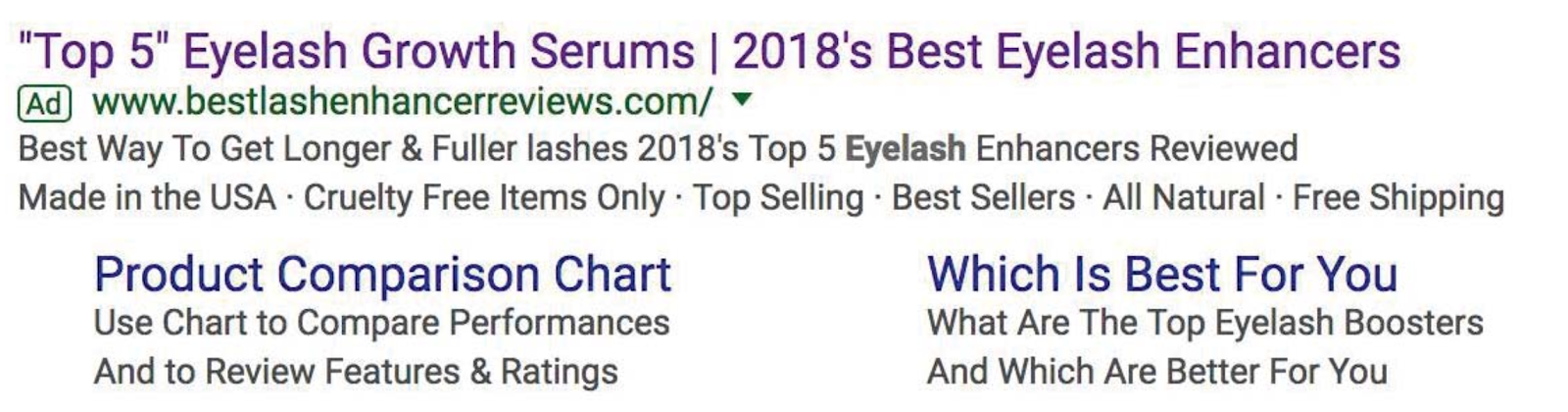
Plaintiff’s copyright registration application is pending.  Here’s the “work” at issue:

Boost alleged that defendants “word for word” “copied [ ]
plaintiff’s advertisement (but ran the advertisement only outside of California
in the hopes plaintiff would not become aware of it)” and that the ads “were
intentionally unlabeled and source-ambiguous in that an ordinary consumer of
the [p]roduct would not be able to tell, unless investigating closely, that the
advertisement did not belong to plaintiff.” 
[I can’t tell from the original
ad that the ad is from the plaintiff; this seems to be a self-generated problem.]

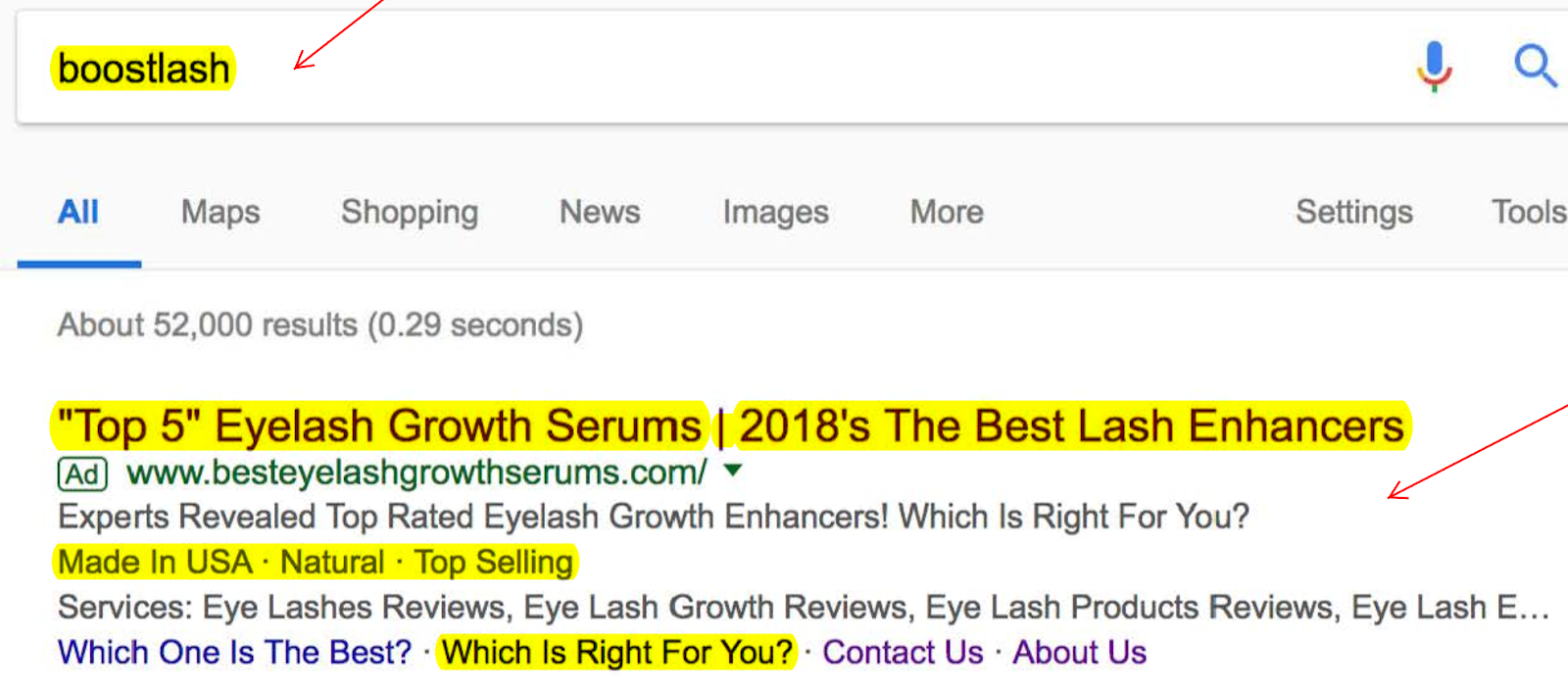
Defendants allegedly “purchased the Google AdWords ‘boost’
and ‘lash’ together in that order as a search engine advertisement to drive
traffic to their website,” constituting infringement, false advertising, and
counterfeiting.  [This nonsense is why
courts have ended up pretty aggressively protecting comparative keyword
advertising; even assuming that BoostLash crosses the threshold of protectability,
boost and lash should still be available to anyone to tout a product that improves
the appearance of eyelashes.]
Copyright: Boost sufficiently alleged that the copying was “word
for word.” Given how long it took Boost to provide the accused ad, the court
declined to address whether there was sufficient objective similarity under the
extrinsic test, reserving this for a motion for summary judgment.  Frankly, I hope the defendants get fees on this one.  Word for word?
Counterfeiting: Although the infringement claim survived a
motion to dismiss (which is sort of depressing in itself), the counterfeiting
claim didn’t.  Defendants pointed out
that the entire point of the claim is that defendants are selling their
differently named product, WooLash, using the accused ads.  Although a plaintiff may not need to allege
direct affixation to a product for counterfeiting, alleging AdWords use was
insufficient. “At the heart of counterfeiting … is a good that has been copied
and which has been sold, offered for sale, or distributed with a counterfeit
mark.” Here, there was no allegation that the BoostLash mark was displayed alongside
defendants’ product to trick consumers into believing they were getting
BoostLash instead of Woo’s product. Use of a mark as an internet search term
isn’t counterfeiting, as a matter of law. 
It is a use in commerce, but to extend counterfeiting this far would
risk turning all infringement claims into counterfeiting claims, with their
harsher penalties.

from Blogger http://bit.ly/2S5fH7X

Posted in Uncategorized | Tagged , , | Leave a comment

TM Reading list: Legal Realism: Unfinished Business by Ramsi A. Woodcock

Short and punchy:

For the realist, legal reasoning lacks the determinacy of mathematics because, looked at from the right angle, anything can be analogized to anything else. Trademarks are like easements in that they are both contingent on ownership of something else, but they are also like turtles in that they both start with the letter “T.” The only way to really win an argument through legal reasoning is therefore to assume your conclusion. Mossoff cannot argue that trademark is property because trademark rights happen to have a structure (existence contingent on ownership of a piece of property) that resembles the structure of some other rights that the law treats as genuine property rights. If the law does not actually say that trademark is property — and it cannot because Mossoff’s purpose is to fill that silence with his legal reasoning — then the fact that trademarks merely resemble rights that have been designated as property rights tells nothing about whether trademark rights should be treated as genuine property rights. The resemblance just poses the question whether there should be a rule saying that everything that resembles a property right is a property right. If the argument is that yes, there should be such a rule, then an argument must be made for why that rule should be adopted, returning the argument more or less to where it started, which was to find a way to argue from existing law to the need for recognition of a new rule of law that resolves the question whether trademark should be treated as property.

from Blogger http://bit.ly/2X75090

Posted in Uncategorized | Tagged , | Leave a comment

Influencer’s laundry list complaint against PopSugar survives motion to dismiss

Batra v. Popsugar, Inc., 2019 WL 482492, No. 18-cv-03752-HSG
(N.D. Cal. Feb. 7, 2018)
Batra sued Popsugar for removing the CMI of her photograph,
infringing her copyright, violating her right of publicity, intentionally
interfering with her contracts, engaging in false advertising, and violating California’s UCL. She alleged claims on behalf of a putative class of “persons with
large numbers of followers on social media,” also known as “influencers.” [That
ought to be a fun class definition.]  The
complaint alleged that Popsugar “copied thousands of influencers’ Instagram
images, removed the links in the original pages that allowed the influencers to
monetize their following, and reposted the images on its own website without
authorization with links that allowed POPSUGAR to profit when users clicked
through and purchased items.”
DMCA 1202(b): Popsugar alleged that Batra failed to plead
that Popsugar had the requisite mental state and that she failed to identify
the removed CMI. The court rejected both arguments. The 9th Circuit
has held that “the ‘induce, enable, facilitate or conceal’ requirement is
intended to limit liability in some fashion—specifically, to instances in which
the defendant knows or has a reasonable basis to know that the removal or
alteration of CMI or the distribution of works with CMI removed will aid
infringement.” Here, Batra alleged that Instagram posts show a photo on the
left and sidebar text on the right, with identifying information for the author
of the photo, including “his or her name and/or link(s) to personal website(s)
or other social media sites, such as a personal YouTube channel.” When Popsugar
copied the images, it omitted the sidebar, allegedly constituting the removal
or alteration of that CMI. This was sufficient, raising the plausible inference
that Popsugar knew that removing the CMI would help conceal the alleged
infringement. 
Lanham Act false endorsement/false advertising claim:
Popsugar argued that the only relevant goods or services were products bought
by users clicking on Popsugar links, and those weren’t falsely described/attributed
in any way. But Batra alleged that there was confusion over Popsugar’s own
service of posting “shoppable” images of influencers and products, which was
sufficient to state a claim.
Copyright Act preemption: Popsugar argued that copyright law
preempted the right of publicity, interference with contract, and UCL
claims.  For the right of publicity, this
argument failed because it was the use of the plaintiffs’ names, other identifying
information, and likenesses that was at issue, not the use of the photos as
such.  Contract:  The complaint alleges that, pursuant to a
contract between Batra and LIKEtoKNOW.it, Batra was “entitled to a portion of
the revenue that LIKEtoKNOW.it received from sales resulting from social media
users’ use of the app” in connection with her posts. The intentional removal of
these links allegedly interfered with her contract.  The court found that the allegation of
unauthorized removal of monetized links was an extra element that avoided
preemption.  This strikes me as a
mistaken extension of the law; it is playing with the definition of “removal”
to mean “not copying,” which means that what is alleged is really the
unauthorized copying + use of Popsugar’s own links.  But the use of Popsugar’s own links is the kind
of economic benefit that doesn’t constitute an extra element of the tort, which is what’s required to
avoid preemption. UCL: Not preempted for the same reasons.
Interference with contract: Batra alleged that Popsugar knew
of the contract between class members and LIKEtoKNOW.it and general knowledge
of the common industry practice of affiliate marketing, and that its removal of
links was intentional “in that Defendant intended to disrupt the performance of
the parties’ contract and/or knew that disruption of performance was certain or
substantially certain to occur.”  This
was enough to state a claim for intentional interference.  
The copyright infringement claim was also plausibly pled,
despite Popsugar’s argument that Batra didn’t identify the specific infringed
works or allege that she’d submitted a complete application for registration
before suing.  Batra didn’t plead herself
out of court; she alleged dates of infringement and that she had registrations/applications
(but not the dates thereof). To survive summary judgment on statutory damages/attorneys’
fees, she’d need the appropriate registration dates, but not yet.

from Blogger http://bit.ly/2S0n6FF

Posted in Uncategorized | Tagged , , , | Leave a comment

False advertising claim based on patent threats fails to overcome high hurdles for such a claim

Globe Cotyarn Pvt. Ltd. v. Next Creations Holdings LLC, 2019
WL 498303, No. 18 Civ. 04208 (ER) (S.D.N.Y. Feb. 8, 2019)
Globe, a fabric manufacturer, sued a fabric patent holder,
AAVN, and its subsidiary, Next Creations, for falsely claiming that Globe had
sold infringing products. The court dismissed the complaint without prejudice. 
AAVN owns patents for the manufacture of high thread count
cotton-polyester blend fabric. In 2015, AAVN filed an ITC complaint alleging
that certain imported textiles violated a portion of one of its patents; it
settled with one respondent.  Another company,
AQT, filed a 2017 petition with the PTO to review two patents, later adding
another after the PTAB found that a trial was justified on the first two. The parties
settled.  
Defendants allegedly contacted
a number of Globe’s customers and falsely accused Globe of selling infringing
materials. Globe alleged that this was done in bad faith: defendants allegedly never
inspected Globe’s product or its production facilities and thus could not have
known whether their patents were infringed.
Lanham Act claims: there wasn’t a sufficient allegation of
commercial advertising or promotion.
Globe didn’t identify the size of the relevant purchasing
public, but alleged only two messages to one customer and a third to another
customer, with even vaguer allegations about messages to other, unnamed, unnumbered
customers. “[T]hree messages sent to two customers in a marketplace of an
unidentified size are not sufficiently disseminated to the relevant purchasing
public to fall within the Lanham Act’s coverage.”
Separately, under Federal Circuit law, “[t]o prevail on an
unfair-competition claim under section 43(a) of the Lanham Act stemming from a
patentee’s marketplace activity in support of his patent, the claimant must
first establish that the activity was undertaken in bad faith.” This requires a
showing that the claims were “objectively baseless, meaning no reasonable
litigant could realistically expect to prevail in a dispute over infringement
of the patent” and that the claims were also subjectively made in bad
faith. 
The court didn’t think that alleging that defendants claimed
infringement without having any idea how the allegedly infringing product was
made could satisfy that standard; doing so might show subjective bad faith, but
not objective baselessness. [I dunno; it seems to me that “having no reason to
think that the products were infringing” is kind of the definition of “baseless,”
not just for subjectivity but for an objective analysis.]  Globe also argued that the defendants asserted
a patent they knew was invalid. This too couldn’t show bad faith. The validity
of the patents was never finally determined; as far as we know, they’re still
valid.
Unfair competition, tortious interference, and deceptive
acts: under Federal Circuit precedent, “federal patent law preempts state-law
tort liability for a patentholder’s good faith conduct in communications
asserting infringement of its patent and warning about potential litigation.” Even
applying NY law alone, the court would reject the claims.  NY’s unfair competition law “closely
resembles” §43(a)(1)(B), so the absence of commercial advertising or promotion
doomed that claim too, as well as NY’s requirement of bad faith.  Disparagement: Globe failed to plead special
damages; the one named customer didn’t ever agree to purchase its product
anyway. Tortious interference: Again, Globe failed to do more than make
conclusory assertions about specific customers, and it also didn’t sufficiently
allege wrongful means.
Deceptive acts under N.Y. Gen. Bus. Law § 349: This wasn’t
consumer-directed harm, just a private dispute.

from Blogger http://bit.ly/2X3rtnp

Posted in Uncategorized | Tagged , | Leave a comment

FTC standards for “made in the USA” support competitor’s literal falsity claim

BenShot, LLC v. Lucky Shot USA LLC, 2019 WL 527829, No.
18-C-1716 (E.D. Wis. Feb. 11, 2019)
“In 2015, BenShot began selling drinking
glasses with bullets embedded in the side via an insertion in the glass.”  In 2016, Lucky Shot followed suit; both parties
added more types of glasses over time. Lucky Shot’s logo contains the terms
“U.S.A.” and “HANDCRAFTED.”  [There are detailed allegations, but suffice it to say
that “Made in the USA” is allegedly a big part of the pitch on defendants’ own
websites and Instagram, on Amazon, in point-of-purchase displays, in Google ads, etc.]
On Alibaba.com, one defendant’s company profile states, “Our
products are designed and developed in the USA and contract manufactured in
China.” Lucky Shot’s manager allegedly admitted that the glass portions of at
least Lucky Shot USA’s shot and whiskey glasses were made in China. The bottom
of they whiskey glass packaging states, “Glass and packaging made in China.”
BenShot alleged federal and Wisconsin common law false
advertising claims. Lucky Shot argued that  BenShot failed to plead fraud with
particularity under Rule 9(b), because BenShot acknowledged that the packaging
says that the glass was made in China. The court disagreed.  The fact that one type of package says that
the glass and packaging is made in China doesn’t mean that the other
representations—including, crucially, the representations made in advertising for the glasses—were sufficiently
qualified.
BenShot also sufficiently alleged economic/reputational damages
by alleging direct competition + false advertising + BenShot’s own substantial
investment in making glasses in the US, which is important to customers +
resulting injury.
Defendants then argued that falsity wasn’t sufficiently alleged,
because they complied with FTC policy on “Made in USA” claims. See B. Sanfield,
Inc. v. Finlay Fine Jewelry Corp., 168 F.3d 967, 973 (7th Cir. 1999) (“[T]he
[FTC’s] assessment of what constitutes deceptive advertising commands deference
from the judiciary.”). The package claims “assembled in the USA,” and the FTC
says, “[t]o begin with, in order for a product to be considered ‘all or
virtually all’ made in the United States, the final assembly or processing of
the product must take place in the United States.”
That was a misreading of the FTC standard, which says, “when
a marketer makes an unqualified claim that a product is ‘Made in USA,’ it
should, at the time the representation is made, possess and rely upon a
reasonable basis that the product is in fact all or virtually all made in the
United States.” An unqualified “Made in USA” claim means that a product should “contain
only a de minimis, or negligible, amount of foreign content.” Final assembly/processing
in the US is necessary but not sufficient under the plain language of the FTC
statement.  In light of the FTC standard,
BenShot plausibly alleged literal falsity given that it alleged that the
defendants make the unqualified “Made in the USA” claim despite admitting that
this is not so. “While discovery is needed to better understand the defendants’
manufacturing process and costs, the allegations in the complaint do not
suggest that this is a case ‘[w]here the percentage of foreign content is very
low,’ or where ‘[f]oreign content … is incorporated further back in the
manufacturing process’ such that the foreign content does not constitute ‘a
direct input into the finished product’” (citing FTC standard).
Defendants argued that BenShot failed to allege
misleadingness, but literal falsity/misleadingness didn’t need to be sorted out
at this stage of the case.  Defendants
also argued that all of their statements had to be considered in the full
context of their offerings, including their qualified statement on the bottom
of their whiskey glass packaging.  The argument
that one disclosure cured all other falsehoods was, the court noted, “unconvincing.”
The common law claim for unfair competition also survived.

from Blogger http://bit.ly/2S0n5l5

Posted in Uncategorized | Tagged | Leave a comment

Amicus brief in Mongols TM forfeiture case

Stacey Dogan, Mark Lemley, Jessica Litman, Mark McKenna, Jennifer Rothman, Jessica Silbey, and I filed an amicus in the Mongols trademark forfeiture case.  We argue that, while trademark forfeiture is generally possible, any successful transfer would have to include goodwill. Even if the forfeited marks weren’t abandoned by nonuse or by transfer in gross, the current Mongols would retain substantial freedom to continue to identify themselves as Mongols.

Speaking only for myself, packing this all into 15 pages was a challenge, and sparked some questions about collective membership marks generally.  I think the strongest argument against the forfeiture is that it is inherently impossible to include the goodwill of a collective membership mark in a forced transfer, because the goodwill is tied to the membership itself.  I think a rational system could rule one way or another on this–in other areas, courts have been very forgiving about what counts as a transfer of goodwill.  A First Amendment claim to self-identification perhaps strengthens the argument against forced transfer, but then to me raises the question whether the government has any business registering/enforcing collective membership marks for social associations in the first place.  I am in full agreement with the underlying premise–Mongols shouldn’t be stopped from calling themselves Mongols just because they committed crimes–but I don’t actually see how the right to self-identify distinguishes these Mongols from a hypothetical breakaway group that thinks of itself as the true Mongols.  In the past few decades, courts have used trademark rights to suppress the self-identification of breakaway groups, both political and religious–but is trademark law really sufficiently tailored for this job?

from Blogger http://bit.ly/2RYlxbh

Posted in Uncategorized | Tagged , , | Leave a comment

Booking.com isn’t generic, but might find it hard to prove infringement

Booking.com B.V. v. U.S. Patent & Trademark Office, No.
17-2458 (4th Cir. Feb. 4, 2019)
In some ways, the biggest change in trademark law since the
Lanham Act was adopted was the shift of the courts from accepting prophylactic
rules to protect competition—limiting the registration/protection of trade
dress, territoriality, and numerous other rules—to prioritizing the idea that
all interests other than the protection against likely confusion should be
considered only in individualized circumstances.  Let putative owners claim a mark, the
reasoning goes, and any anticompetitive or speech-suppressing consequences can
be dealt with as defenses for individual defendants.  Wal-Mart
is the biggest counterforce, and it is about requiring a showing of secondary
meaning rather than a prophylactic exclusion from protection. This case about
genericity of top-level domains takes the same tack: the biggest reason not to
register BOOKING.COM is the power it gives the registrant to credibly threaten
competitors like hotelbooking.com even though its rights shouldn’t extend that
far.  The majority thinks that
case-by-case ajudication will protect potential competitors; the dissent thinks
forcing them to litigate is too dangerous. 
(It should also be noted that the disappearance of unfair competition as
a protection for unregistrable marks plays a role here—while the Fourth Circuit
previously recognized that unfair competition can fill in the gaps for marks
unregistrable due to lack of US use, the majority seems to think that
Booking.com’s only defense against truly deceptive imitation is the
protectability of BOOKING.COM as a mark, which is historically untrue.)
Booking.com lets customers book travel and hotel accommodations.
It applied for four registrations for the use of BOOKING.COM as a word mark and
for stylized versions of the mark with the USPTO. At issue here are Class 43
services, which include online hotel reservation services.  The TTAB affirmed the resulting refusals of
registration, concluding that BOOKING.COM was generic for the services because
“booking” generically refers to “a reservation or arrangement to buy a travel
ticket or stay in a hotel room” or “the act of reserving such travel or
accommodation”; “.com” indicates a commercial website; and “consumers would
understand the resulting composite BOOKING.COM to primarily refer to an online
reservation service for travel, tours, and lodging, which are the services
proposed in Booking.com’s applications.” In the alternative, the terms were
descriptive and lacked secondary meaning.
Booking.com appealed to the E.D. Va., which reversed and
ordered the registration of the marks, but also, following circuit precedent,
ordered Booking.com to pay the PTO’s expenses of over $74,000, including a
portion of lawyers’ salaries.  (At the
end of this opinion, the court expressed some doubt whether this precedent was
still good given a conflict with the Federal Circuit interpreting the same
language for patents and subsequent Supreme Court precedent on the necessity of
explicit statutory language to create departures from the American rule, but it
stuck with precedent.  If Booking.com wants
to roll the dice on en banc review or even Supreme Court review, it might do
well given that signal.)
The district court accepted Booking.com’s new evidence, a
Teflon survey indicating that 74.8% of consumers recognized BOOKING.COM as a
brand rather than a generic service. It further found that Booking.com
established secondary meaning, a ruling that the PTO did not challenge on
appeal. 
The court of appeals found that the PTO had the burden of
proving genericness, given the harsh consequences of unregistrability. (And a
generic term can’t become non-generic, even with subsequent secondary meaning.)  [Note that this creates a real opportunity for
arbitrage: if you attempt to register your borderline term, the PTO has to show
genericness so if the evidence is in equipoise you get your registration, and
then there’s a presumption of validity you can deploy against subsequent genericness
challenges, as there wouldn’t be if you didn’t register.  One might think this risk is minimal because
the burden of proof so rarely matters—but I think this case might be evidence
to the contrary.]
The key question is what booking.com primarily refers to,
which depends on public understanding, which can be determined by reference to
different sources, including “purchaser testimony, consumer surveys, listings
and dictionaries, trade journals, newspapers, and other publications.” The term
is considered as a whole, even when it’s a phrase: “the relevant inquiry is the
public’s understanding of the entire mark, not its understanding of the mark’s
separate components independently.”
Although the district court made several errors of law, it
ultimately didn’t err in finding that the PTO failed to meet its burden of
showing genericness.  (One such error:
the district court wrongly found trademark significance in the fact that a
domain name necessarily [in the current configuration of the internet] refers
only to a single source.) The key pieces of evidence were the absence of
evidence showing public use of “booking.com” as generic—the generic term is “booking
site”—and the Teflon survey. The court of appeals also rejected the PTO’s
argument that adding the TLD identifier .com to a generic term can never create
a non-generic term.
The PTO identified domain names containing booking.com, such
as “hotelbooking.com” and “ebooking.com,” as evidence of public understanding
of booking.com as a reference to online hotel booking services, but that wasn’t
good enough.  Although the inclusion of
the proposed mark in longer domain names was evidence, even strong evidence, of
genericness, consumer surveys also matter. Anyway, you can book a lot of things,
including theater and music tickets, so booking.com might not mean hotel reservation
services.  [This is trademark nonsense;
hotel booking is a subset of booking services, so it’s totally irrelevant that
there might be other things for which booking is also generic.]
“[T]he ultimate inquiry in determining whether a term is
generic is what the public understands the proposed mark to mean.” But the
survey was better evidence of that than the usage evidence. It’s true that
surveys aren’t relevant where a term was “commonly used prior to its association
with the products at issue,” in which case the survey can only demonstrate
legally useless de facto secondary meaning. But there’s no evidence here that
the term was commonly used, making survey evidence relevant.
The PTO argued that, like adding “company,” adding .com can
never convert a generic term to nongeneric. Goodyear’s Rubber Mfg. Co. v.
Goodyear Rubber Co., 128 U.S. 598 (1888), held that the addition of commercial
indicators such as “Company” to terms that merely describe classes of goods could
not be trademarked.  But Goodyear predated the Lanham Act by more
than half a century and didn’t apply the current primary significance test; the
court here declined to adopt a bright line rule. Nor was the mark nothing more
than the sum of its generic parts.  The
district court erred in finding that .com would itself usually bring source-identifying
significance (or at least descriptiveness) to a generic term.  “Such a rule would effectively make any
domain name distinctive, which oversteps the focus of our trademark
jurisprudence on a mark’s primary significance to the public.” But that primary
significance wasn’t necessarily derived by taking the separate dictionary
definitions for the component parts and adding them together. Where, as here,
the composite term was not previously commonly used, additional evidence like
consumer surveys was relevant.  Although
other cases have found generic.com terms to be generic (e.g., hotels.com), they’ve
considered consumer survey evidence in so doing and declined to create a bright
line rule.
The PTO argued that granting registration could prevent
other legitimate uses of marks incorporating BOOKING.  But trademark protection wouldn’t “necessarily preclude another company
from using, for example, carbooking.com or flightbooking.com.”  [Emphasis added. It just makes such use
risky, facilitating the plausible assertion of rights to deter potential
competitors or even noncompetitors.]  And
“the purported overbreadth of the mark can be addressed in proceedings
regarding the scope of the trademark’s protection,” since likely confusion must
be shown—“often,” indeed, plaintiffs must show actual confusion.  [News to me!] 
And here’s something that might be quoted in many other contexts: “Given
that domain names are unique by nature and that the public may understand a
domain name as indicating a single site, it may be more difficult for domain name
plaintiffs to demonstrate a likelihood of confusion.”  
[Should we be granting lots of registrations that are hard to infringe?  Is there a role for unfair competition instead?]
Judge Wynn’s partial dissent (he concurred on the attorneys’
fees part and much of the legal structure of the analysis) described this as “a
problem that Booking.com chose to bring upon itself.”  It chose to operate under a generic domain that
described the nature of its services, in order to “attract the wealth of
customers who simply search the web for that service.” But it should have had
to accept the tradeoff of foregoing “the ability to exclude competitors from
using close variants of its domain name.” The majority “allows Booking.com to
have its cake and eat it too.”  To Booking.com,
such a result was warranted to prevent “unscrupulous competitors [from]
prey[ing] on its millions of loyal consumers.” But if competitors were using
the terms “booking” and “.com” in ways that might confuse Booking.com’s customers,
“this is the peril of attempting to build a brand around a generic term.”
The dissent also wouldn’t have adopted a per se rule against
protecting generic.com. But such protections should be rare.  The dissent thought the district court’s
legal errors (finding that a TLD like .com “generally” has source significance)
infected its weighing of the evidence, leading it to adopt a mistaken
presumption of descriptiveness and to require less of Booking.com than the law
demanded.  The ultimate result “conflicts
with the determination that every other court has reached in cases, like the
instant case, involving the registration or enforcement of a proposed mark
composed of a generic Secondary Level Domain and a Top Level Domain.”  [So if the PTO wants to try its own luck with
cert, there’s that.  I’m not sure it gets
a different result at the Supreme Court, though there’s an outside chance of a
remand to the district court to do the analysis under the correct legal
standard.]
Until now, courts rejected the argument that “generic.com”
isn’t generic because consumers don’t explicitly call the relevant class of
websites “generic.com” websites.  Until
now, courts have indicated that the “rare” circumstances in which a generic TLD
will allow a generic term to become protectable involve things like double
entendres, e.g., tennis.net.  Rom.com for
romantic comedies might also work, but both those are “readily distinguishable
from the instant case.”  A correct legal
analysis would have focused on whether Booking.com was one of the rare outliers.  Instead, the district court’s faulty analysis
“upsets the careful balance the law has struck between assisting consumers to
identify the source of goods and preserving the linguistic commons.”
The real interest here is in preserving freedom against the
monopolization of language, even if a would-be monopolist briefly convinces
consumers that there’s secondary meaning in a generic term. “[N]o matter how
much money and effort the user of a generic term has poured into promoting the
sale of its merchandise and what success it has achieved in securing public
identification, it cannot deprive competing manufacturers of the product of the
right to call an article by its name.” Abercrombie & Fitch Co. v. Hunting
World, Inc., 537 F.2d 4, 9 (2d Cir. 1976).
The PTO correctly pointed out that no grocery business called
The Grocery Store could ever receive trademark protection because the name is generic,
regardless of secondary meaning. The majority, however, left in place the idea
that if consumers recognized an online grocery business called
“grocerystore.com,” that business would be entitled to trademark protection. “There
is no basis in law or policy for drawing such a distinction.” Online sellers
need freedom to use generic terms just as brick and mortar stores do.
The district court concluded that .com was different from
Company because only one entity can occupy a .com. But courts have long held
that “[t]he commercial impression created by ‘.com’ is similar to the
impression created by ‘Corp.’ and ‘Co.’, that is, the association of a
commercial entity with the mark.” Any difference came from functionality, and
functional features aren’t protectable even with secondary meaning.
Not correcting the district court’s legal errors “will
provide Booking.com with a weapon to freeze out potential competitors,” forcing
them to bear “the risk of a costly, protracted, and uncertain infringement
lawsuit.”  Descriptive fair use wasn’t
good enough for competitors using “booking” in their own domain names, given the
power to threaten provided by a registration. 
[Courts are very likely to accept the argument that use in a domain name
is “trademark use,” disqualifying the defendant from descriptive use as a
defense.]  Even if the defense remains
available, it’s a defense, not an immunity from suit, so not much help.  And the idea that car and flight booking sites
would be ok was “optimis[tic],” but even if true, not helpful to competitors
who want to use names like hotelbooking.com or ehotelbooking.com, “which
likewise describe such competitors’ services ‘as what they are.’” No class of services should be subjected
to this monopoly. 
As for the majority’s statement that infringement will be
hard to prove, maybe, but protecting booking.com would still chill competition
based on the expense and risk of defending a lawsuit.

from Blogger http://bit.ly/2WYFe6I

Posted in Uncategorized | Tagged , | Leave a comment

better bank battle: false use of (R) can’t support false advertising claim

San Diego County Credit Union v. Citizens Equity First
Credit Union, No. 18cv967-GPC(RBB), 2019 WL 446475 (S.D. Cal. Feb. 5, 2019)
SDCCU sued CEFCU, its competitor in the credit union market,
seeking a declaratory judgment of non-infringement and invalidity of the federally
registered mark CEFCU. NOT A BANK. BETTER. (issued 2011) and the asserted
common-law mark NOT A BANK. BETTER, as well as for false registration and
unfair competition.  SDCCU itself has a 2014
federal registration for IT’S NOT BIG BANK BANKING. IT’S BETTER. Several
third-party credit unions use similar trademarks such as “NOT A BANK –
BETTER!”, “BETTER THAN A BANK”, and “IT’S NOT A BANK.” [We
are running out of trademarks
.]
SDCCU’s customers are primarily located in Southern
California while CEFCU’s customers are primarily located in Peoria, Illinois
and Northern California. [CEFCU bought a credit union in Northern California in
2008, but didn’t start advertising its mark outside Illinois until 2011.]  In early 2016, a CEFCU employee saw the SDCCU
mark on a billboard in San Diego, and in May 2017, CEFCU filed a petition to
cancel the SDCCU registration based on its registered and claimed common-law
marks.
The complaint alleged that the CEFCU mark was more similar
to the third party marks than to the SDCCU mark, and that if CEFCU asserted
rights broad enough to encompass the SDCCU Mark, it therefore materially
misrepresented to the USPTO that the CEFCU Mark was not confusingly similar to
any of the third-party marks.  In the alternative,
its confusion claim was unjustified. 
Also, CEFCU allegedly uses ® on its common-law variant.
Under the Lanham Act, “Any person who shall procure
registration in the Patent and Trademark Office of a mark by a false or
fraudulent declaration or representation, oral or in writing, or by any false
means, shall be liable in a civil action by any person injured thereby for any
damages sustained in consequence thereof.” 15 U.S.C. § 1120. The alleged
falsities were (1) lack of use in interstate commerce, given that it wasn’t using
the mark outside Illinois when it declared the mark was being used in commerce
and (2) lack of confusion with preexisting marks such as the “IT’S NOT A BANK”
mark of Warren Federal Credit Union, “BETTER THAN A BANK” mark of ABNB Federal
Credit Union and “NOT A BANK-BETTER!” mark of United 1st Federal Credit Union.
This was sufficiently pled on a motion to dismiss—whether there
was actually use in commerce outside Illinois at the relevant time, or whether
use in Illinois by a federally regulated credit union was sufficient for “use
in commerce,” was not for the court to resolve on a motion to dismiss. Likewise,
though SDCCU can’t assert others’ rights, it sufficiently alleged that the
existence of those rights meant that CEFCU made a false statement in its registration
application.
SDCCU also alleged damages in the form of company resources
expended to fight the claim. The harm must be proximately caused by the
fraudulent registration; CEFCU argued that its rights were not dependent on the
date of the registration and that this dispute would be happening anyway, thus
there was no proximate causation.  That
again was a factual dispute not appropriate for a motion to dismiss.
The court also dismissed claims based on false use of ®.  As to the actually (but allegedly fraudulently)
registered mark, use of ® was literally true; SDCCU’s remedy was to be found in
§1120, not in a false advertising claim. 
As to the unregistered mark, the use might be literally false, but a ®
symbol didn’t relate to the “nature, characteristics, qualities or geographic
origin” of CEFCU’s services, as required.

from Blogger http://bit.ly/2RVn2XL

Posted in Uncategorized | Tagged , | Leave a comment

Allegedly rigged “review” site was commercial speech, but falsity still not pled

GOLO, LLC v. Higher Health Network, LLC, No. 18-cv-2434-GPC-MSB,
2019 WL 446251 (S.D. Cal. Feb. 5, 2019)
GOLO sells a weight loss program and a proprietary
supplement to help promote weight loss. HHN defendants published a review of this
supplement, allegedly with inaccuracies, misleading statements, and blatant
falsehoods, which led to this lawsuit. HHN moved to dismiss and moved to strike
the state law trade libel claim under California’s anti-SLAPP law. The court
granted the motion to dismiss but denied the special motion to strike because
HHN make a prima facie showing that GOLO’s claim arose from an act in
furtherance of HHN’s right of petition or free speech in connection with a
public issue.
HHN (and its founder Shanks) allegedly compete with GOLO in
the diet and weight-loss industry. Shanks specializes in SEO, and he and HHN
allegedly bought and created dozens of information websites that generate
revenue exclusively through advertising sales. One such website, SupplementPolice.com,
claims to be a “product review website” aiming to introduce “honesty and
transparency to the world of online reviews” through “detailed reviews of
popular products.” Supplement Police states that it “doesn’t currently accept
affiliate income from any company in exchange for favorable reviews – instead,
it makes it money exclusively from [Google] AdSense revenue.”
GOLO alleged that the reviews were “predominantly bogus,”
not based on any testing or analysis conducted by Supplement Police, biased,
and designed solely to benefit HHN rather than the public. Supplement Police
allegedly promotes and links to products the defendants are affiliated with,
manufacture, and/or sell. Specifically, Supplement Police positively reviewed SilaLive
Silica, giving it “an overall score of 4.6 out of 5” and said that it is “clearly
a product that works for a lot of people.” 
SP provided multiple links to the SilaLive website, which offers the
product for sale, but doesn’t disclose that Shanks and HHN are affiliated with,
and manufacture, distribute, and/or sell SilaLive, and own and/or operate the
SilaLive website. Further, the review allegedly contains false statements,
including that SilaLive is “formulated with the greatest quartz crystals” and
that its main ingredient will help fight common health problems “from the
inside,” giving a healthier more permanent solution that artificial cures
cannot promise.
SP’s GOLO review allegedly inaccurately describes how GOLO
was created, as well as what GOLO “promises,” and allegedly falsely states that
the supplement should be taken “30 minutes before a meal” in order to “enjoy
health benefits while also purportedly normalizing your insulin levels.” It
further says: “Out of all of the ingredients listed [in the Release Supplement],
only Salacia bark has been linked to reduced diabetes symptoms…Meanwhile,
none of the other ingredients in Release have been linked to weight loss or
normalized insulin levels.” And its bolded headlines allegedly “pose misleading
questions which would cause readers to doubt GOLO’s effectiveness and/or decide
not to purchase GOLO.”
Lanham Act claims: The specific falsities alleged were as
above—non-obviously, GOLO alleged that it was false to say GOLO made any “promises”
to consumers.  The court found that Rule
9(b) applied and that GOLO failed to plead why these statements were false and
misleading. GOLO didn’t explain how GOLO was actually created or why it was
false to say they made “promises,” nor about why it was false to make the
statements about recommended intake time or about the ingredients.  As for the bolded headlines, “GOLO – Insulin
Resistance for Weight Loss?” and “How Does GOLO Claim to Work?” the court found
it unlikely that a question could be an actionable “statement,” but even if it
could be, the complaint didn’t plead how those specific questions would mislead
or confuse consumers, rather than simply framing the review.
As for the SilaLive review, GOLO likewise didn’t adequately
allege the falsity of  “formulated with
the greatest quartz crystals” or “will help you fight [common health] problems
from the inside and thus give you a healthier, more permanent solution that
artificial cures cannot promise you.”
Standing: Under Lexmark,
“a plaintiff must allege an injury to a commercial interest in reputation or
sales” proximately caused by violations of the Lanham Act. HHN argued that this
claim failed because SilaLive is not a weight-loss product and does not compete
with GOLO; nor does the GOLO review mention SilaLive. But Lexmark makes direct competition unnecessary. The complaint alleged
competition between the parties in the diet & weight loss industry
generally, and alleged that SilaLive was promoted as a supplement that could “help
detox or kickstart[ ] a diet.” It also sufficiently alleged “economic or
reputational injury flowing directly from the deception wrought by the
defendant’s advertising” including foregone sales. Although the GOLO review, in
fact, called the GOLO diet a “cost-effective” program, the court nonetheless
accepted GOLO’s allegations of lost sales as factual for purposes of the motion
to dismiss—which is a take on plausibility that not every judge would have.
Was the GOLO review commercial speech?  HHN argued that the review didn’t mention
SilaLive or direct readers to the page hosting the SilaLive review.  So was it a consumer review or an ad? GOLO
alleged that the review was “surrounded by advertisements and links to products
and websites unrelated to but, in many cases, in direct competition with GOLO,”
and that Supplement Police was affiliated with and/or received compensation
from sales of “some or all” of the linked products.  Moreover, the positive review of SilaLive
also allegedly generated sales/diverted sales from GOLO.  Thus, GOLO successfully alleged that defendants’
speech was an ad for competing products, and that the review was meant to
discourage use of GOLO products and use products defendants promoted instead.
GOLO, LLC v. HighYa, LLC, 310 F. Supp. 3d 499 (E.D. Pa.
2018), dismissed a claim that GOLO reviews were commercial speech, but the
court here found HighYa
distinguishable. First, in that case, when the plaintiff objected to the
review, the defendants amended the review and advised its readers that changes
to the review were made based on additional information provided by GOLO. Under
those circumstances, the facts didn’t plausibly support an inference that the
review was meant to create an economic advantage for competing products.  Here, however, defendants removed the GOLO
review after receiving a C&D, without attempting to correct the alleged
misrepresentations. [Ugh. Talk about creating seriously bad incentives. Plus, I
just don’t see how this connects to commerciality. Why isn’t “wanted to avoid
the hassle of litigation”/ “had its speech chilled” at least as plausible as “wanted
not to say anything nice about the competition,” especially given that the
review doesn’t seem to have been particularly harsh in the first place?]
Also, “defendants disclosed a commercial relationship with
another fitness product negating any indication that it was engaged in covert
competition.”  But covertness has never been an element of the commercial speech
test.  A clear ad should not deceive
about whether it is an ad, and that’s
important (and indeed where the only alleged falsity is the appearance of lack
of financial interest, disclosure may be all that’s needed to avoid liability),
but we still need to know whether it is
an ad
.  Anyway, the court also found
it important that Supplement Police allegedly doesn’t disclose the identity of
its owners and actively hides its association with SilaLive. HighYa said that “liability can arise
under the Lanham Act if websites purporting to offer reviews are in reality
stealth operations intended to disparage a competitor’s product while posing as
a neutral third party.” This was sufficiently alleged.
The trade libel claim failed for want of sufficient
allegations of special damages, which usually requires identification of
specific lost sales/customers or (in Pennsylvania, whose law GOLO sought to use)
really clear evidence of a sales decline traceable only to the disparagement,
including allegations about sales for a substantial period before the
challenged publication and sales after. The same falsity problems as with the
Lanham Act claim also justified dismissal of this claim as well.
The anti-SLAPP laws of California differ from those of
Pennsylvania (transferring district) and Delaware (another potentially
interested state).  California’s law is
broader, and California has a strong interest in protecting its speakers. “ ‘California
would appear to object strongly to the absence of a robust anti-SLAPP regime.’ On
the other hand, Pennsylvania’s or Delaware’s interests would be less harmed by
the use of California law.” So the court applied California’s law, but it still
didn’t help HHN.
An “act in furtherance of a person’s right of petition or
free speech under the United States or California Constitution in connection
with a public issue” triggering anti-SLAPP protection includes “any written or
oral statement or writing made in a place open to the public or a public forum
in connection with an issue of public interest.” HHN argued that the reviews
were a matter of public interest because GOLO itself described its product as a
“leading weight loss and wellness program,” “the top-searched diet on Google in
2016,” and “endorsed, and even used by, multiple doctors.” In Wong v. Jing, 189
Cal. App. 4th 1354 (2010), the court reasoned that a negative review of a
dentist’s services on the rating website Yelp.com constituted an issue of
public interest because “consumer information that goes beyond a particular
interaction between the parties and implicates matters of public concern that
can affect many people is generally deemed to involve an issue of public
interest for purposes of the anti-SLAPP statute.”
The court distinguished Wong
because “it dealt with the more general issue of the effects of dentists’ use
of certain products, not just a highly critical opinion of a particular
dentist.” It implicitly dealt with the more general issues of whether it was ok
to use nitrous oxide and mercury in dental treatments for children, and wasn’t
just about one dentist.  Also, “[i]t is
well established that commercial speech that does nothing but promote a
commercial product or service is not speech protected under the anti-SLAPP
statute.” Consumer Justice Ctr. v. Trimedica Int’l, Inc., 107 Cal. App. 4th 595
(2003) concluded that “speech about a specific product was not a matter of
public interest because the speech was not about herbal dietary supplements in
general, but about the specific properties and efficacy of a particular
product.” So too here. Even if GOLO was popular, it’s not true that “simply
because a lawsuit affects a large number of consumers and involves a
life-threatening illness, it will satisfy the public interest requirement of
the statute.” Scott v. Metabolife Int’l, Inc., 115 Cal. App. 4th 404 (2004). HHN
thus failed to make a prima facie case that the GOLO’s suit arose from an act in
furtherance of its rights of petition or free speech.

from Blogger http://bit.ly/2SJSInC

Posted in Uncategorized | Tagged , , | Leave a comment

Allegedly rigged “review” site was commercial speech, but falsity still not pled

GOLO, LLC v. Higher Health Network, LLC, No. 18-cv-2434-GPC-MSB,
2019 WL 446251 (S.D. Cal. Feb. 5, 2019)
GOLO sells a weight loss program and a proprietary
supplement to help promote weight loss. HHN defendants published a review of this
supplement, allegedly with inaccuracies, misleading statements, and blatant
falsehoods, which led to this lawsuit. HHN moved to dismiss and moved to strike
the state law trade libel claim under California’s anti-SLAPP law. The court
granted the motion to dismiss but denied the special motion to strike because
HHN make a prima facie showing that GOLO’s claim arose from an act in
furtherance of HHN’s right of petition or free speech in connection with a
public issue.
HHN (and its founder Shanks) allegedly compete with GOLO in
the diet and weight-loss industry. Shanks specializes in SEO, and he and HHN
allegedly bought and created dozens of information websites that generate
revenue exclusively through advertising sales. One such website, SupplementPolice.com,
claims to be a “product review website” aiming to introduce “honesty and
transparency to the world of online reviews” through “detailed reviews of
popular products.” Supplement Police states that it “doesn’t currently accept
affiliate income from any company in exchange for favorable reviews – instead,
it makes it money exclusively from [Google] AdSense revenue.”
GOLO alleged that the reviews were “predominantly bogus,”
not based on any testing or analysis conducted by Supplement Police, biased,
and designed solely to benefit HHN rather than the public. Supplement Police
allegedly promotes and links to products the defendants are affiliated with,
manufacture, and/or sell. Specifically, Supplement Police positively reviewed SilaLive
Silica, giving it “an overall score of 4.6 out of 5” and said that it is “clearly
a product that works for a lot of people.” 
SP provided multiple links to the SilaLive website, which offers the
product for sale, but doesn’t disclose that Shanks and HHN are affiliated with,
and manufacture, distribute, and/or sell SilaLive, and own and/or operate the
SilaLive website. Further, the review allegedly contains false statements,
including that SilaLive is “formulated with the greatest quartz crystals” and
that its main ingredient will help fight common health problems “from the
inside,” giving a healthier more permanent solution that artificial cures
cannot promise.
SP’s GOLO review allegedly inaccurately describes how GOLO
was created, as well as what GOLO “promises,” and allegedly falsely states that
the supplement should be taken “30 minutes before a meal” in order to “enjoy
health benefits while also purportedly normalizing your insulin levels.” It
further says: “Out of all of the ingredients listed [in the Release Supplement],
only Salacia bark has been linked to reduced diabetes symptoms…Meanwhile,
none of the other ingredients in Release have been linked to weight loss or
normalized insulin levels.” And its bolded headlines allegedly “pose misleading
questions which would cause readers to doubt GOLO’s effectiveness and/or decide
not to purchase GOLO.”
Lanham Act claims: The specific falsities alleged were as
above—non-obviously, GOLO alleged that it was false to say GOLO made any “promises”
to consumers.  The court found that Rule
9(b) applied and that GOLO failed to plead why these statements were false and
misleading. GOLO didn’t explain how GOLO was actually created or why it was
false to say they made “promises,” nor about why it was false to make the
statements about recommended intake time or about the ingredients.  As for the bolded headlines, “GOLO – Insulin
Resistance for Weight Loss?” and “How Does GOLO Claim to Work?” the court found
it unlikely that a question could be an actionable “statement,” but even if it
could be, the complaint didn’t plead how those specific questions would mislead
or confuse consumers, rather than simply framing the review.
As for the SilaLive review, GOLO likewise didn’t adequately
allege the falsity of  “formulated with
the greatest quartz crystals” or “will help you fight [common health] problems
from the inside and thus give you a healthier, more permanent solution that
artificial cures cannot promise you.”
Standing: Under Lexmark,
“a plaintiff must allege an injury to a commercial interest in reputation or
sales” proximately caused by violations of the Lanham Act. HHN argued that this
claim failed because SilaLive is not a weight-loss product and does not compete
with GOLO; nor does the GOLO review mention SilaLive. But Lexmark makes direct competition unnecessary. The complaint alleged
competition between the parties in the diet & weight loss industry
generally, and alleged that SilaLive was promoted as a supplement that could “help
detox or kickstart[ ] a diet.” It also sufficiently alleged “economic or
reputational injury flowing directly from the deception wrought by the
defendant’s advertising” including foregone sales. Although the GOLO review, in
fact, called the GOLO diet a “cost-effective” program, the court nonetheless
accepted GOLO’s allegations of lost sales as factual for purposes of the motion
to dismiss—which is a take on plausibility that not every judge would have.
Was the GOLO review commercial speech?  HHN argued that the review didn’t mention
SilaLive or direct readers to the page hosting the SilaLive review.  So was it a consumer review or an ad? GOLO
alleged that the review was “surrounded by advertisements and links to products
and websites unrelated to but, in many cases, in direct competition with GOLO,”
and that Supplement Police was affiliated with and/or received compensation
from sales of “some or all” of the linked products.  Moreover, the positive review of SilaLive
also allegedly generated sales/diverted sales from GOLO.  Thus, GOLO successfully alleged that defendants’
speech was an ad for competing products, and that the review was meant to
discourage use of GOLO products and use products defendants promoted instead.
GOLO, LLC v. HighYa, LLC, 310 F. Supp. 3d 499 (E.D. Pa.
2018), dismissed a claim that GOLO reviews were commercial speech, but the
court here found HighYa
distinguishable. First, in that case, when the plaintiff objected to the
review, the defendants amended the review and advised its readers that changes
to the review were made based on additional information provided by GOLO. Under
those circumstances, the facts didn’t plausibly support an inference that the
review was meant to create an economic advantage for competing products.  Here, however, defendants removed the GOLO
review after receiving a C&D, without attempting to correct the alleged
misrepresentations. [Ugh. Talk about creating seriously bad incentives. Plus, I
just don’t see how this connects to commerciality. Why isn’t “wanted to avoid
the hassle of litigation”/ “had its speech chilled” at least as plausible as “wanted
not to say anything nice about the competition,” especially given that the
review doesn’t seem to have been particularly harsh in the first place?]
Also, “defendants disclosed a commercial relationship with
another fitness product negating any indication that it was engaged in covert
competition.”  But covertness has never been an element of the commercial speech
test.  A clear ad should not deceive
about whether it is an ad, and that’s
important (and indeed where the only alleged falsity is the appearance of lack
of financial interest, disclosure may be all that’s needed to avoid liability),
but we still need to know whether it is
an ad
.  Anyway, the court also found
it important that Supplement Police allegedly doesn’t disclose the identity of
its owners and actively hides its association with SilaLive. HighYa said that “liability can arise
under the Lanham Act if websites purporting to offer reviews are in reality
stealth operations intended to disparage a competitor’s product while posing as
a neutral third party.” This was sufficiently alleged.
The trade libel claim failed for want of sufficient
allegations of special damages, which usually requires identification of
specific lost sales/customers or (in Pennsylvania, whose law GOLO sought to use)
really clear evidence of a sales decline traceable only to the disparagement,
including allegations about sales for a substantial period before the
challenged publication and sales after. The same falsity problems as with the
Lanham Act claim also justified dismissal of this claim as well.
The anti-SLAPP laws of California differ from those of
Pennsylvania (transferring district) and Delaware (another potentially
interested state).  California’s law is
broader, and California has a strong interest in protecting its speakers. “ ‘California
would appear to object strongly to the absence of a robust anti-SLAPP regime.’ On
the other hand, Pennsylvania’s or Delaware’s interests would be less harmed by
the use of California law.” So the court applied California’s law, but it still
didn’t help HHN.
An “act in furtherance of a person’s right of petition or
free speech under the United States or California Constitution in connection
with a public issue” triggering anti-SLAPP protection includes “any written or
oral statement or writing made in a place open to the public or a public forum
in connection with an issue of public interest.” HHN argued that the reviews
were a matter of public interest because GOLO itself described its product as a
“leading weight loss and wellness program,” “the top-searched diet on Google in
2016,” and “endorsed, and even used by, multiple doctors.” In Wong v. Jing, 189
Cal. App. 4th 1354 (2010), the court reasoned that a negative review of a
dentist’s services on the rating website Yelp.com constituted an issue of
public interest because “consumer information that goes beyond a particular
interaction between the parties and implicates matters of public concern that
can affect many people is generally deemed to involve an issue of public
interest for purposes of the anti-SLAPP statute.”
The court distinguished Wong
because “it dealt with the more general issue of the effects of dentists’ use
of certain products, not just a highly critical opinion of a particular
dentist.” It implicitly dealt with the more general issues of whether it was ok
to use nitrous oxide and mercury in dental treatments for children, and wasn’t
just about one dentist.  Also, “[i]t is
well established that commercial speech that does nothing but promote a
commercial product or service is not speech protected under the anti-SLAPP
statute.” Consumer Justice Ctr. v. Trimedica Int’l, Inc., 107 Cal. App. 4th 595
(2003) concluded that “speech about a specific product was not a matter of
public interest because the speech was not about herbal dietary supplements in
general, but about the specific properties and efficacy of a particular
product.” So too here. Even if GOLO was popular, it’s not true that “simply
because a lawsuit affects a large number of consumers and involves a
life-threatening illness, it will satisfy the public interest requirement of
the statute.” Scott v. Metabolife Int’l, Inc., 115 Cal. App. 4th 404 (2004). HHN
thus failed to make a prima facie case that the GOLO’s suit arose from an act in
furtherance of its rights of petition or free speech.

from Blogger http://bit.ly/2SJSInC

Posted in Uncategorized | Tagged , , | Leave a comment