-
Recent Posts
- candy buyers fail to allege difference between pumpkin & Jack-o’-lantern shape
- Amicus in section 230 false light case
- Amicus in Rise & Shine
- it’s hard to get rid of a foreign TM owner’s complaint at the motion to dismiss stage despite territoriality
- dct strikes down California’s new recyclability law on vagueness/1A grounds
Recent Comments
Archives
- September 2026
- August 2026
- July 2026
- June 2026
- May 2026
- April 2026
- March 2026
- February 2026
- January 2026
- December 2025
- November 2025
- October 2025
- September 2025
- August 2025
- July 2025
- June 2025
- May 2025
- April 2025
- March 2025
- February 2025
- January 2025
- December 2024
- November 2024
- October 2024
- September 2024
- August 2024
- July 2024
- June 2024
- May 2024
- April 2024
- March 2024
- February 2024
- January 2024
- December 2023
- November 2023
- October 2023
- September 2023
- August 2023
- July 2023
- June 2023
- May 2023
- April 2023
- March 2023
- February 2023
- November 2021
- October 2021
- September 2021
- August 2021
- July 2021
- June 2021
- May 2021
- April 2021
- March 2021
- February 2021
- January 2021
- December 2020
- November 2020
- October 2020
- September 2020
- August 2020
- July 2020
- June 2020
- May 2020
- April 2020
- March 2020
- February 2020
- January 2020
- December 2019
- November 2019
- October 2019
- September 2019
- August 2019
- July 2019
- June 2019
- May 2019
- April 2019
- March 2019
- February 2019
- January 2019
- December 2018
- November 2018
- October 2018
- September 2018
- August 2018
- July 2018
- June 2018
- May 2018
- April 2018
- March 2018
- February 2018
- January 2018
- December 2017
- November 2017
- October 2017
- September 2017
- August 2017
- July 2017
- June 2017
- May 2017
- April 2017
- March 2017
- February 2017
- January 2017
- December 2016
- November 2016
- October 2016
- September 2016
- August 2016
- July 2016
- June 2016
- May 2016
- April 2016
- March 2016
- February 2016
- January 2016
- December 2015
- November 2015
- October 2015
- September 2015
- August 2015
- July 2015
- June 2015
- May 2015
- April 2015
- March 2015
- February 2015
- January 2015
- December 2014
- November 2014
- October 2014
- September 2014
- August 2014
- July 2014
- June 2014
- May 2014
- April 2014
- March 2014
- February 2014
- January 2014
- December 2013
- November 2013
- October 2013
- June 2013
Categories
- 230
- acpa
- advertising
- antitrust
- art law
- attribution
- blogging
- california
- cfaa
- cfps
- class actions
- cmi
- comics
- commercial speech
- conferences
- consumer protection
- contracts
- copying
- copyright
- counterfeiting
- cultural property
- damages
- dastar
- defamation
- design patent
- dilution
- disclosures
- disparagement
- dmca
- drm
- fan fiction
- fanworks
- fda
- fees
- first amendment
- ftc
- geographic indications
- http://schemas.google.com/blogger/2008/kind#post
- insurance
- jurisdiction
- libraries
- misappropriation
- music
- my lawsuits
- my writings
- parody
- patent
- patents
- preemption
- presentations
- privacy
- procedure
- reading list
- remedies
- right of publicity
- secondary liability
- securities
- standing
- surveys
- teaching
- tortious interference
- trade secrets
- trademark
- traditional knowledge
- Uncategorized
- unconscionability
- unfairness
- warranties
Meta
Next! Bonded leather maker loses false advertising claims against critics
Design Resources, Inc. v. Leather Industries of America, — F.3d —-, 2015 WL 3775712 (4th Cir. June 18, 2015)
The Fourth Circuit affirmed the district court’s summary judgment kicking out Lanham Act (and coordinate state) false advertising claims against defendants LIA and Ashley Furniture. Plaintiff DRI alleged that Ashley’s ad in a trade magazine, and two statements by Dr. Nicholas Cory, director of LIA’s research laboratory, which ran in articles in the same publication, were false and misleading. Ashley is a furniture maker and seller, and LIA is a leather industry trade association that owns (at least for purposes of this appeal) the Leather Research Laboratory. Cory is a leather chemist and the director of the Laboratory, which provides “labeling advice to companies who market leather and leather-look products, as well as testing services to determine such products’ leather content for purposes of federally mandated disclosure to consumers.”
DRI develops furniture coverings which hare sold to furniture manufacturers. DRI developed a “synthetic leather-look furniture covering product,” later renamed as NextLeather. NextLeather is “composed of 61% polyurethane, 22% poly/cotton, and 17% leather.” “[I]t has a polyurethane face on a fabric core and is backed with a thin layer of leather fibers adhered (i.e., bonded) to its base or underside.” This allegedly improved its mimicking of real leather by making the material more pliable and fluid in draping over furniture. DRI requested labeling advice and composition from Cory, who advised that the product could “ABSOLUTELY NOT!” be characterized or marketed as leather, citing the relevant FTC Guides, which specify that products containing ground or shredded leather, rather than comprising “wholly the hide of an animal[,] should not be represented, directly or by implication, as being leather.” Cory suggested that DRI could label NextLeather as “[n]ot leather,” “[r]econstituted leather,” or “[b]onded leather.”
DRI then began marketing NextLeather as bonded leather, disclosing the product’s composition on a label in compliance with the FTC Guides. “In preparation for the Spring High Point Market in North Carolina—an important, annual furniture industry event—DRI sold samples of NextLeather to 25 leading furniture manufacturers.” In the weeks leading up to and following the trade event, though, Ashley put a series of full-page ads in Furniture Today, “a widely read trade magazine.” DRI alleged that one of the ads falsely disparaged DRI and NextLeather with the text: “Is It REALLY LEATHER? … Some upholstery suppliers are using leather scraps that are mis-represented as leather …. Know What You Are Buying[.] REMEMBER … The Overseas Manufacturer Has NO Liability In The U.S.A. You Do!”
Furniture Todayalso published an article written by Joan Gunin, “Chemist fears confusion over imitators may hurt category.” The Gunin article quoted Cory: “To call [leather alternatives such as bonded leather] ‘leather’ is outright deception, outright fraud…. It’s not leather…. It’s a synthetic that has leather fibers glued to the underside.” A later article written by Susan Andrews was headlined, “For consumers’ sake, let’s not call it ‘bonded leather.’” The Andrews article referred to “[n]ew composite fabrics now called ‘bonded leather,’” which “have a surface layer of vinyl or polyurethane, a center layer of fabric, and a backing that contains some leather fibers … glued onto the fabric for a look that is similar to the back of a leather hide.” Andrews advocated against using the term “bonded leather” for these products, saying that the term was “bound to confuse consumers, who are likely to hear only the word ‘leather.’” The article then quoted Cory, who said that calling these products bonded leather “is deceptive because it does not represent its true nature. It’s a vinyl, or a polyurethane laminate or a composite, but it’s not leather. If you tar and feather someone, does that make them a chicken?”
The Fourth Circuit recognizes falsity by necessary implication as part of explicit falsity, as well as implicit falsity (proven by extrinsic evidence).
Here, the court of appeals agreed that DRI failed to show that the Ashley Ad was either literally false or impliedly false. DRI argued that the ad’s statement that “[s]ome upholstery suppliers are using leather scraps that are misrepresented as leather” was literally false by necessary implication, because the audience would recognize the reference to suppliers of bonded leather generally and to DRI. But the ad refers unmistakably to products marketed as leather, not to products marketed as bonded leather or NextLeather. The court was unwilling to accept that the ad meant the opposite of what it said. Where an ad only hints at or merely suggests inferences, it’s not literally false, though an acceptable false advertising claim can “depend on the consumer to draw conclusions that are logically necessary from an ad’s statements.”
DRI argued that the relevant audience would recognize the claim it identified because of: (1) another Furniture Today article, published between the first and second publications of the Ashley ad, said that “Ashley is urging buyers to ‘be aware’ of bonded leather,” (2) a survey by Ashley’s expert witness showing that viewers of the ad understood it to refer to bonded leather, (3) email exchanges between Ashley and Cory suggesting that Ashley sought to disparage bonded leather, and (4) testimony by DRI’s owner and president and by a furniture manufacturer to the effect that “DRI was the only company offering a product like NextLeather® and marketing it as ‘bonded leather.’” But all this was outside the face of the ad and deep into the context.
What about implied falsity? DRI pointed to the survey, but DRI needed to show that the Ashley ad confused consumers about NextLeather. The survey asked consumers who had attended the Spring High Point Market what message they thought the ad conveyed and to which specific suppliers they thought the ad referred. The results showed that “zero respondents gave an answer that could be interpreted as a belief that DRI or NextLeather were specifically mentioned as[,] … [or] implied or suggested to be[,] the supplier of the upholstery material described” in the ad.
Likewise, DRI failed to support its claim about Cory’s statement in the Gunin Article. DRI argued that Cory’s statement that “[t]o call [alternative leather products such as bonded leather] ‘leather’ is outright deception, outright fraud” was is literally false by necessary implication. DRI argued that any reasonable juror would conclude that Cory was calling DRI’s use of the term “bonded leather” fraudulent. But the statement unambiguously communicated a message about unqualified use of “leather,” not about the use of “bonded leather.” Moreover, DRI acknowledged that NextLeather was not leather, but a “synthetic leather-look furniture covering product.” Cory’s statement was true, not false or misleading.
Finally, the court of appeals agreed that Cory’s statement in the Andrews article hadn’t been shown to be false or misleading. The Andrews article did advocate against use of the term “bonded leather” as “bound to confuse consumers,” and it quoted Cory as saying that the term “is deceptive because it does not represent [the] true nature” of the products it is used to describe. Instead, Cory said, accurate descriptions would use “vinyl,” “polyurethane laminate,” or “composite,” rather than with a term that includes the word “leather.”
The district court found this to be merely Cory’s opinion on how consumers would react to the term. DRI cited Milkovich v. Lorain Journal Co., 497 U.S. 1 (1990), which held that opinion statements are not automatically protected against defamation claims if they imply knowledge of facts that underlie the opinion. Accepting this extrapolation of the defamation rule to the Lanham Act, DRI’s argument still didn’t work here. Cory’s statement didn’t imply a basis in facts leading to the conclusion that consumers were deceived by the term “bonded leather.” It communicated only his hypothesis of the potential for deception. Plus, Lanham Act cases have held that statements of general opinion aren’t actionable; actionable claims must be empirically disprovable. A prediction about the future is essentially opinion and not actionable. In context of an article claiming that a marketing term is “bound to confuse” consumers, “stating that the term is ‘deceptive’ is merely putting that point a different way.” A claim that the term had been shown to deceive consumers might be falsifiable, but “merely calling a term ‘deceptive’ suggests only that it is the speaker’s view that the term has the potential to deceive.” It was a prediction, not a representation of fact.
Thought for (pet) food: false advertising claims continue
Blue Buffalo Company Ltd. v. Nestlé Purina Petcare Co., No. 15
CV 384, 2015 WL 3645262 (E.D. Mo. June 10, 2015)
Blue Buffalo sued Purina for false advertising ten of its
pet food products under the Lanham Act, the Connecticut Unfair Trade Practices
Act (CUTPA), the Connecticut Unfair Sales Practices Act (CUSPA), and
Connecticut common law. Here, the court
granted in part and denied in part Purina’s motion to dismiss. Mostly, Blue Buffalo alleged that Purina
touted ingredients that were only a tiny fraction of the overall product.
pet food products under the Lanham Act, the Connecticut Unfair Trade Practices
Act (CUTPA), the Connecticut Unfair Sales Practices Act (CUSPA), and
Connecticut common law. Here, the court
granted in part and denied in part Purina’s motion to dismiss. Mostly, Blue Buffalo alleged that Purina
touted ingredients that were only a tiny fraction of the overall product.
Whether an advertisement is deceptive “is generally a
question of fact which requires consideration and weighing of evidence from
both sides and therefore usually cannot be resolved through a motion to
dismiss.” But false advertising claims
can still be dismissed where the challenged statements would not plausibly
deceive a reasonable consumer.
question of fact which requires consideration and weighing of evidence from
both sides and therefore usually cannot be resolved through a motion to
dismiss.” But false advertising claims
can still be dismissed where the challenged statements would not plausibly
deceive a reasonable consumer.
Purina first argued that, “as a matter of law, no reasonable
consumer could be confused by its advertising and product packaging because its
products all contain accurate ingredient statements.” But the mere presence of an ingredient
statement, while relevant, doesn’t eliminate the possibility of misleadingness.
A factual inquiry was necessary.
consumer could be confused by its advertising and product packaging because its
products all contain accurate ingredient statements.” But the mere presence of an ingredient
statement, while relevant, doesn’t eliminate the possibility of misleadingness.
A factual inquiry was necessary.
Next, Purina argued that its labels couldn’t plausibly be
false or misleading because it complied with FDA regulations and the pet food
labeling regulations of the Association of American Feed Control Officials,
which Connecticut has codified into state law.
Pom Wonderful is to the
contrary, though compliance with regulations might be relevant to Purina’s
defense.
false or misleading because it complied with FDA regulations and the pet food
labeling regulations of the Association of American Feed Control Officials,
which Connecticut has codified into state law.
Pom Wonderful is to the
contrary, though compliance with regulations might be relevant to Purina’s
defense.
Purina then argued that the challenged ads were
puffery. Since the challenges at issue
mainly went to images, the standard was whether the image was “an exaggerated,
blustering, and boasting statement upon which no reasonable buyer would be
justified in relying.” Under Second Circuit precedent, even when images can be
proven either true or false, “if a visual representation is so grossly
exaggerated that no reasonable buyer would take it at face value, there is no
danger of consumer deception and hence, no basis for a false advertising
claim.” Puffery is also usually a
factual issue inappropriate for resolution on a motion to dismiss.
puffery. Since the challenges at issue
mainly went to images, the standard was whether the image was “an exaggerated,
blustering, and boasting statement upon which no reasonable buyer would be
justified in relying.” Under Second Circuit precedent, even when images can be
proven either true or false, “if a visual representation is so grossly
exaggerated that no reasonable buyer would take it at face value, there is no
danger of consumer deception and hence, no basis for a false advertising
claim.” Puffery is also usually a
factual issue inappropriate for resolution on a motion to dismiss.
Beggin’ Strips: Blue Buffalo alleged that ads and packaging
for Purina’s Beggin’ Strips dog treats mislead consumers into thinking “that
the product is bacon” or that its main ingredient is bacon, when in fact bacon
is listed tenth on the ingredient list. Shots from the TV commercial:
for Purina’s Beggin’ Strips dog treats mislead consumers into thinking “that
the product is bacon” or that its main ingredient is bacon, when in fact bacon
is listed tenth on the ingredient list. Shots from the TV commercial:
| Beggin’ Strips ad |
The TV ad shows a thought bubble with a picture of bacon
appearing over a dog’s head when a human opens bag of the treats. The dog jumps
to its feet as a voiceover (the dog’s inner voice) says “Bacon!”
appearing over a dog’s head when a human opens bag of the treats. The dog jumps
to its feet as a voiceover (the dog’s inner voice) says “Bacon!”
The dog runs around the house
looking for the bacon, while the dog’s “voiceover” repeats the word “bacon”
over and over again. As the dog checks a pan on the stove to find it empty and
turns to find the owner with the bag of Beggin’ Strips, the voiceover says:
“yummy, crunchy bacon, bacon, bacon! There in that bag.” The word bacon is
repeated 10 times. It is referenced throughout the commercial, including when a
child’s blocks spin around to spell “BACON” as the dog rushes by.
looking for the bacon, while the dog’s “voiceover” repeats the word “bacon”
over and over again. As the dog checks a pan on the stove to find it empty and
turns to find the owner with the bag of Beggin’ Strips, the voiceover says:
“yummy, crunchy bacon, bacon, bacon! There in that bag.” The word bacon is
repeated 10 times. It is referenced throughout the commercial, including when a
child’s blocks spin around to spell “BACON” as the dog rushes by.
(I almost never watch ads, but even I remember this
campaign, though not this ad in particular.
Repetition works, even when we don’t want it to.) Blue Buffalo also alleged that the fact that
the treats were made to look like strips of bacon were misleading, and that the
package contributed to the misleadingness mostly by using the text “made with
real bacon.”
campaign, though not this ad in particular.
Repetition works, even when we don’t want it to.) Blue Buffalo also alleged that the fact that
the treats were made to look like strips of bacon were misleading, and that the
package contributed to the misleadingness mostly by using the text “made with
real bacon.”
Purina disagreed, noting that its ads used qualifiers such
as “made with real bacon” and “bacon flavored,” as confirmed by the ingredients. It argued that the ads were mere puffery and
that no reasonable consumer would take them at face value. The court found that Blue Buffalo stated a
plausible claim for false advertising; because these were misleadingness
claims, extrinsic evidence was needed to figure out whether a reasonable
consumer would be misled. Though the storyline of the ad was hyperbolic, “hyperbole
does not prevent an advertisement from being misleading.”
as “made with real bacon” and “bacon flavored,” as confirmed by the ingredients. It argued that the ads were mere puffery and
that no reasonable consumer would take them at face value. The court found that Blue Buffalo stated a
plausible claim for false advertising; because these were misleadingness
claims, extrinsic evidence was needed to figure out whether a reasonable
consumer would be misled. Though the storyline of the ad was hyperbolic, “hyperbole
does not prevent an advertisement from being misleading.”
Similarly, Blue Buffalo alleged that Purina falsely
advertised that the Beneful line of dog foods consists primarily of “Real Beef”
and “Real Chicken,” when in reality beef and chicken only make up a tiny
fraction of the product. TV ads for Beneful dog food “typically feature a
cascade of apparently human-grade meats, vegetables and grains falling through
the air,” allegedly conveying the false message that the dog food was comprised
primarily of high-quality, wholesome ingredients. Likewise, the packaging contained pictures of
high-quality meats and produce and describes the Beneful line as containing
“real” ingredients.
advertised that the Beneful line of dog foods consists primarily of “Real Beef”
and “Real Chicken,” when in reality beef and chicken only make up a tiny
fraction of the product. TV ads for Beneful dog food “typically feature a
cascade of apparently human-grade meats, vegetables and grains falling through
the air,” allegedly conveying the false message that the dog food was comprised
primarily of high-quality, wholesome ingredients. Likewise, the packaging contained pictures of
high-quality meats and produce and describes the Beneful line as containing
“real” ingredients.
| Screen shot from Beneful ad with chunk of meat |
| Beneful packaging “with real beef” |
Purina argued that it wasn’t plausible that the “small
photos of meat, alongside larger photos of corn, wheat and other ingredients
(all of which are in the product),” would deceive a reasonable consumer into
thinking that dry dog kibble was “primarily real beef.” Purina further argued
that its ads were mere puffery because it wasn’t realistic or reasonable for a
consumer to believe that dog food kibbles would feature pieces of fresh, human
grade food as main ingredients. Again,
Blue Buffalo plausibly alleged that repeated depictions of whole pieces of beef
and avocado would mislead a reasonable consumer into thinking that the Beneful
dog food contains greater amounts of those ingredients.
photos of meat, alongside larger photos of corn, wheat and other ingredients
(all of which are in the product),” would deceive a reasonable consumer into
thinking that dry dog kibble was “primarily real beef.” Purina further argued
that its ads were mere puffery because it wasn’t realistic or reasonable for a
consumer to believe that dog food kibbles would feature pieces of fresh, human
grade food as main ingredients. Again,
Blue Buffalo plausibly alleged that repeated depictions of whole pieces of beef
and avocado would mislead a reasonable consumer into thinking that the Beneful
dog food contains greater amounts of those ingredients.
Cat Chow: Blue Buffalo said the packaging and ads
misleadingly conveyed the message that salmon was one of the main ingredients,
when it’s only eighth on the ingredient list. The packaging features a picture
of a cutting board with a large cut of salmon filet, and one TV ad allegedly compared
the owner’s diet and the cat’s diet:
misleadingly conveyed the message that salmon was one of the main ingredients,
when it’s only eighth on the ingredient list. The packaging features a picture
of a cutting board with a large cut of salmon filet, and one TV ad allegedly compared
the owner’s diet and the cat’s diet:
In the commercial, the cat’s owner
says that both she and the cat have started eating healthier. A voiceover then
states, “in time you realize: the better you eat, the better you feel,” and
“these days we both eat smarter.” The advertisement shows the cat’s owner
taking a large filet of salmon out of the refrigerator just before feeding her
cat with Cat Chow Naturals, while a voiceover states that Cat Chow Naturals is
“made with real chicken and salmon.”
says that both she and the cat have started eating healthier. A voiceover then
states, “in time you realize: the better you eat, the better you feel,” and
“these days we both eat smarter.” The advertisement shows the cat’s owner
taking a large filet of salmon out of the refrigerator just before feeding her
cat with Cat Chow Naturals, while a voiceover states that Cat Chow Naturals is
“made with real chicken and salmon.”
| Cat Chow ad screenshot |
| Cat Naturals packaging |
Although the statements “in time you realize: the better you
eat, the better you feel,” and “these days we both eat smarter” were mere
puffery because they were simply subjective opinions that couldn’t be
falsified. But taken together with the
challenged images, it was plausible that a reasonable consumer would think that
salmon was a primary ingredient of the cat food; proof or disproof of that was
for further evidentiary development.
eat, the better you feel,” and “these days we both eat smarter” were mere
puffery because they were simply subjective opinions that couldn’t be
falsified. But taken together with the
challenged images, it was plausible that a reasonable consumer would think that
salmon was a primary ingredient of the cat food; proof or disproof of that was
for further evidentiary development.
Fancy Feast Filet Mignon Flavor with Real Seafood and Shrimp:
fish and shrimp are the eighth and ninth ingredients, but they’re minor
ingredients, and there’s no beef at all.
Blue Buffalo also argued that advertising the brand as “gourmet” on
Purina’s website, and including a gold seal with the words “100% Complete &
Balanced Nutrition” on the packaging, was false and misleading because this cat
food was made with inferior ingredients. The court determined that Blue Buffalo didn’t
plausibly allege that a reasonable consumer would believe that the product
contained the expensive ingredient filet mignon just because of the label
“filet mignon flavor.” Also, “gourmet”
and “100% Complete & Balanced Nutrition” were mere puffery. 100% might be quantifiable in other
circumstances, but whether nutrition is complete and balanced is a matter of
opinion. However, Blue Buffalo did
plausibly plead that a reasonable consumer could think that the product
contained at least some beef, or that seafood and salmon were primary
ingredients.
fish and shrimp are the eighth and ninth ingredients, but they’re minor
ingredients, and there’s no beef at all.
Blue Buffalo also argued that advertising the brand as “gourmet” on
Purina’s website, and including a gold seal with the words “100% Complete &
Balanced Nutrition” on the packaging, was false and misleading because this cat
food was made with inferior ingredients. The court determined that Blue Buffalo didn’t
plausibly allege that a reasonable consumer would believe that the product
contained the expensive ingredient filet mignon just because of the label
“filet mignon flavor.” Also, “gourmet”
and “100% Complete & Balanced Nutrition” were mere puffery. 100% might be quantifiable in other
circumstances, but whether nutrition is complete and balanced is a matter of
opinion. However, Blue Buffalo did
plausibly plead that a reasonable consumer could think that the product
contained at least some beef, or that seafood and salmon were primary
ingredients.
ONE SMARTBLEND dog food and Pro Plan dog and cat food:
Purina advertised these as containing rice and “Rice” is in the name of some
varieties, which allegedly conveyed the false message that those products were
made with a healthy and nutritious grain, when in fact those products were made
with brewers rice, a filler with little or no nutritional value. Blue Buffalo alleged that brewer’s rice was “part
of the fractionated debris left over from whole rice that has been milled, and
the saleable rice has been separated…. Brewers rice does not contain many of
the nutritional benefits of whole grain rice or even the lower nutritional
benefits of white rice sold for human consumption. Brewers rice therefore is
used primarily as cheap filler in animal feeds.” This made Blue Buffalo’s claims plausible.
Purina advertised these as containing rice and “Rice” is in the name of some
varieties, which allegedly conveyed the false message that those products were
made with a healthy and nutritious grain, when in fact those products were made
with brewers rice, a filler with little or no nutritional value. Blue Buffalo alleged that brewer’s rice was “part
of the fractionated debris left over from whole rice that has been milled, and
the saleable rice has been separated…. Brewers rice does not contain many of
the nutritional benefits of whole grain rice or even the lower nutritional
benefits of white rice sold for human consumption. Brewers rice therefore is
used primarily as cheap filler in animal feeds.” This made Blue Buffalo’s claims plausible.
Chef Michael’s dog food: Blue Buffalo alleged that the ads
and packaging falsely indicated that the dog food was made with quality pieces
of chicken and beef when it wasn’t. Instead of the “Tender Pieces” being whole
pieces of chicken, as allegedly conveyed, they included soy products and other
ingredients. Additionally, the website “It’s not just dog food. It’s Chef
Michael’s” allegedly falsely suggested that the product consisted of
high-quality, human grade beef and chicken as one would expect to be prepared
by a “Chef” rather than soy and other cheaper ingredients. The chef-related
allegation was conclusory, with no factual support, but the idea that images of
the “Tender Pieces” would mislead a reasonable consumer into thinking those
pieces were whole pieces of chicken was not implausible.
and packaging falsely indicated that the dog food was made with quality pieces
of chicken and beef when it wasn’t. Instead of the “Tender Pieces” being whole
pieces of chicken, as allegedly conveyed, they included soy products and other
ingredients. Additionally, the website “It’s not just dog food. It’s Chef
Michael’s” allegedly falsely suggested that the product consisted of
high-quality, human grade beef and chicken as one would expect to be prepared
by a “Chef” rather than soy and other cheaper ingredients. The chef-related
allegation was conclusory, with no factual support, but the idea that images of
the “Tender Pieces” would mislead a reasonable consumer into thinking those
pieces were whole pieces of chicken was not implausible.
Just Right dog food: Blue Buffalo alleged that Purina falsely
claimed that it would create and deliver a “unique blend” of ingredients to
each consumer. On theJustRightPetFood.com website, Purina offered “Food as
unique as your dog,” “Personalized nutrition for your dog,” “Unique Blends,”
“Tailored Nutrition” and “a personalized blend to match your dog’s nutritional
needs.” To buy the product, dog owners must fill out a “pet profile,” including
the dog’s breed, age, weight, level of activity, coat quality, and stool
consistency. Answering these questions produces “Your Blend,” which Blue
Buffalo alleged contributed to the false message that the ingredient blend is
personalized and unique to that specific owner’s dog. In fact, Blue Buffalo
alleged, Just Right dog food was made from only a limited set of basic
ingredient formulas, each of which is substantially similar to the others, with
variation only on the “protein preference” (lamb, chicken or salmon) and
whether to exclude soy or grains from the formula. In addition, Just Right ads
said “we believe the best nutrition is personalized,” which allegedly falsely
claimed superiority.
claimed that it would create and deliver a “unique blend” of ingredients to
each consumer. On theJustRightPetFood.com website, Purina offered “Food as
unique as your dog,” “Personalized nutrition for your dog,” “Unique Blends,”
“Tailored Nutrition” and “a personalized blend to match your dog’s nutritional
needs.” To buy the product, dog owners must fill out a “pet profile,” including
the dog’s breed, age, weight, level of activity, coat quality, and stool
consistency. Answering these questions produces “Your Blend,” which Blue
Buffalo alleged contributed to the false message that the ingredient blend is
personalized and unique to that specific owner’s dog. In fact, Blue Buffalo
alleged, Just Right dog food was made from only a limited set of basic
ingredient formulas, each of which is substantially similar to the others, with
variation only on the “protein preference” (lamb, chicken or salmon) and
whether to exclude soy or grains from the formula. In addition, Just Right ads
said “we believe the best nutrition is personalized,” which allegedly falsely
claimed superiority.
Purina replied that no reasonable consumer would expect a
completely unique formula, so “unique” was puffery, and so was “we believe the
best nutrition is personalized.” The
“best”/“best nutrition was personalized” claims were indeed puffery. But claims
about uniqueness and personalization couldn’t be deemed puffery as a matter of
law—claiming greater levels of personalization than actually provided could be
misleading. (See also United States v.
Strauss, 999 F.2d 720 (2d Cir. 1993) (finding falsity under Food, Drug, and
Cosmetic Act, where defendant repackaged a few types of dog kibble as twelve
“specially formulated” varieties, each targeted to a particular dog type; using
“ignorant, unthinking and credulous” standard); Porter & Dietsch v. Federal
Trade Comm’n, 605 F.2d 294, 303 (7th Cir. 1979) (upholding finding that
“special” and “unique” formula claims were false and deceptive where ingredient
was same as in many other products for same condition); Alpo Petfoods, Inc. v.
Ralston Purina Co., 720 F. Supp. 194, 200 (D.D.C. 1989) (“specifically
formulated” and “specially formulated” claims literally false where product did
not have stated “special” benefit and competing product had same formula),
aff’d in relevant part, 913 F.2d 958 (D.C. Cir. 1990).)
completely unique formula, so “unique” was puffery, and so was “we believe the
best nutrition is personalized.” The
“best”/“best nutrition was personalized” claims were indeed puffery. But claims
about uniqueness and personalization couldn’t be deemed puffery as a matter of
law—claiming greater levels of personalization than actually provided could be
misleading. (See also United States v.
Strauss, 999 F.2d 720 (2d Cir. 1993) (finding falsity under Food, Drug, and
Cosmetic Act, where defendant repackaged a few types of dog kibble as twelve
“specially formulated” varieties, each targeted to a particular dog type; using
“ignorant, unthinking and credulous” standard); Porter & Dietsch v. Federal
Trade Comm’n, 605 F.2d 294, 303 (7th Cir. 1979) (upholding finding that
“special” and “unique” formula claims were false and deceptive where ingredient
was same as in many other products for same condition); Alpo Petfoods, Inc. v.
Ralston Purina Co., 720 F. Supp. 194, 200 (D.D.C. 1989) (“specifically
formulated” and “specially formulated” claims literally false where product did
not have stated “special” benefit and competing product had same formula),
aff’d in relevant part, 913 F.2d 958 (D.C. Cir. 1990).)
Blue Buffalo also alleged that Purina intentionally misled
consumers by representing that its Wazzin’ Train and Canyon Creek Ranch chicken
and duck jerky treats were wholesome and suitable for consumption by dogs when
Purina knew that they caused sickness and death. Purina promoted these treats
as being “natural,” “wholesome,” “healthy” and made from “only the most simple
and pure ingredients.” In fact, Blue Buffalo alleged, the treats: “(i) had
proven poisonous to dogs, and were implicated in the illness and/or deaths of
hundreds of pets, (ii) were manufactured and processed in Chinese facilities
that were not subject to the same oversight as their counterparts in the United
States, and (iii) had been exposed to, or included, harmful ingredients,
including illegal antibiotics, diseased bird parts, and/or other toxic
ingredients.” Purina allegedly disregarded thousands of consumer complaints and
multiple warnings from the FDA, and instead continued to issue public
statements falsely claiming that the treats were manufactured under “the
highest quality and safety standards” and weren’t responsible for any illness …
up until it withdrew the jerky treats from the market in early 2013. Purina said these were merely conclusory
allegations. While these allegations weren’t supported with extrinsic evidence,
they weren’t merely conclusory, and so they were properly alleged.
consumers by representing that its Wazzin’ Train and Canyon Creek Ranch chicken
and duck jerky treats were wholesome and suitable for consumption by dogs when
Purina knew that they caused sickness and death. Purina promoted these treats
as being “natural,” “wholesome,” “healthy” and made from “only the most simple
and pure ingredients.” In fact, Blue Buffalo alleged, the treats: “(i) had
proven poisonous to dogs, and were implicated in the illness and/or deaths of
hundreds of pets, (ii) were manufactured and processed in Chinese facilities
that were not subject to the same oversight as their counterparts in the United
States, and (iii) had been exposed to, or included, harmful ingredients,
including illegal antibiotics, diseased bird parts, and/or other toxic
ingredients.” Purina allegedly disregarded thousands of consumer complaints and
multiple warnings from the FDA, and instead continued to issue public
statements falsely claiming that the treats were manufactured under “the
highest quality and safety standards” and weren’t responsible for any illness …
up until it withdrew the jerky treats from the market in early 2013. Purina said these were merely conclusory
allegations. While these allegations weren’t supported with extrinsic evidence,
they weren’t merely conclusory, and so they were properly alleged.
Thus, claims against each of the challenged products stayed
in, but some of Blue Buffalo’s claims were dismissed; the complaint would have
to be amended to fit the court’s ruling.
in, but some of Blue Buffalo’s claims were dismissed; the complaint would have
to be amended to fit the court’s ruling.
from Blogger http://ift.tt/1J7Me7a
Thought for (pet) food: false advertising claims continue
Blue Buffalo Company Ltd. v. Nestlé Purina Petcare Co., No. 15 CV 384, 2015 WL 3645262 (E.D. Mo. June 10, 2015)
Blue Buffalo sued Purina for false advertising ten of its pet food products under the Lanham Act, the Connecticut Unfair Trade Practices Act (CUTPA), the Connecticut Unfair Sales Practices Act (CUSPA), and Connecticut common law. Here, the court granted in part and denied in part Purina’s motion to dismiss. Mostly, Blue Buffalo alleged that Purina touted ingredients that were only a tiny fraction of the overall product.
Whether an advertisement is deceptive “is generally a question of fact which requires consideration and weighing of evidence from both sides and therefore usually cannot be resolved through a motion to dismiss.” But false advertising claims can still be dismissed where the challenged statements would not plausibly deceive a reasonable consumer.
Purina first argued that, “as a matter of law, no reasonable consumer could be confused by its advertising and product packaging because its products all contain accurate ingredient statements.” But the mere presence of an ingredient statement, while relevant, doesn’t eliminate the possibility of misleadingness. A factual inquiry was necessary.
Next, Purina argued that its labels couldn’t plausibly be false or misleading because it complied with FDA regulations and the pet food labeling regulations of the Association of American Feed Control Officials, which Connecticut has codified into state law. Pom Wonderful is to the contrary, though compliance with regulations might be relevant to Purina’s defense.
Purina then argued that the challenged ads were puffery. Since the challenges at issue mainly went to images, the standard was whether the image was “an exaggerated, blustering, and boasting statement upon which no reasonable buyer would be justified in relying.” Under Second Circuit precedent, even when images can be proven either true or false, “if a visual representation is so grossly exaggerated that no reasonable buyer would take it at face value, there is no danger of consumer deception and hence, no basis for a false advertising claim.” Puffery is also usually a factual issue inappropriate for resolution on a motion to dismiss.
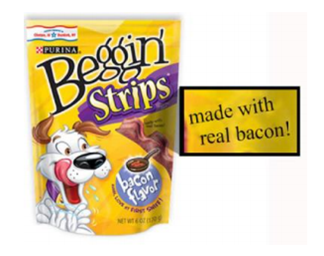
Beggin’ Strips: Blue Buffalo alleged that ads and packaging for Purina’s Beggin’ Strips dog treats mislead consumers into thinking “that the product is bacon” or that its main ingredient is bacon, when in fact bacon is listed tenth on the ingredient list. Shots from the TV commercial:
![]() |
| Beggin’ Strips ad |
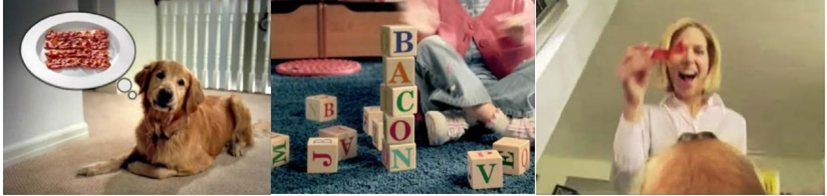
The TV ad shows a thought bubble with a picture of bacon appearing over a dog’s head when a human opens bag of the treats. The dog jumps to its feet as a voiceover (the dog’s inner voice) says “Bacon!”
The dog runs around the house looking for the bacon, while the dog’s “voiceover” repeats the word “bacon” over and over again. As the dog checks a pan on the stove to find it empty and turns to find the owner with the bag of Beggin’ Strips, the voiceover says: “yummy, crunchy bacon, bacon, bacon! There in that bag.” The word bacon is repeated 10 times. It is referenced throughout the commercial, including when a child’s blocks spin around to spell “BACON” as the dog rushes by.
(I almost never watch ads, but even I remember this campaign, though not this ad in particular. Repetition works, even when we don’t want it to.) Blue Buffalo also alleged that the fact that the treats were made to look like strips of bacon were misleading, and that the package contributed to the misleadingness mostly by using the text “made with real bacon.”
Purina disagreed, noting that its ads used qualifiers such as “made with real bacon” and “bacon flavored,” as confirmed by the ingredients. It argued that the ads were mere puffery and that no reasonable consumer would take them at face value. The court found that Blue Buffalo stated a plausible claim for false advertising; because these were misleadingness claims, extrinsic evidence was needed to figure out whether a reasonable consumer would be misled. Though the storyline of the ad was hyperbolic, “hyperbole does not prevent an advertisement from being misleading.”
Similarly, Blue Buffalo alleged that Purina falsely advertised that the Beneful line of dog foods consists primarily of “Real Beef” and “Real Chicken,” when in reality beef and chicken only make up a tiny fraction of the product. TV ads for Beneful dog food “typically feature a cascade of apparently human-grade meats, vegetables and grains falling through the air,” allegedly conveying the false message that the dog food was comprised primarily of high-quality, wholesome ingredients. Likewise, the packaging contained pictures of high-quality meats and produce and describes the Beneful line as containing “real” ingredients.
![]() |
| Screen shot from Beneful ad with chunk of meat |
![]() |
| Beneful packaging “with real beef” |
Purina argued that it wasn’t plausible that the “small photos of meat, alongside larger photos of corn, wheat and other ingredients (all of which are in the product),” would deceive a reasonable consumer into thinking that dry dog kibble was “primarily real beef.” Purina further argued that its ads were mere puffery because it wasn’t realistic or reasonable for a consumer to believe that dog food kibbles would feature pieces of fresh, human grade food as main ingredients. Again, Blue Buffalo plausibly alleged that repeated depictions of whole pieces of beef and avocado would mislead a reasonable consumer into thinking that the Beneful dog food contains greater amounts of those ingredients.
Cat Chow: Blue Buffalo said the packaging and ads misleadingly conveyed the message that salmon was one of the main ingredients, when it’s only eighth on the ingredient list. The packaging features a picture of a cutting board with a large cut of salmon filet, and one TV ad allegedly compared the owner’s diet and the cat’s diet:
In the commercial, the cat’s owner says that both she and the cat have started eating healthier. A voiceover then states, “in time you realize: the better you eat, the better you feel,” and “these days we both eat smarter.” The advertisement shows the cat’s owner taking a large filet of salmon out of the refrigerator just before feeding her cat with Cat Chow Naturals, while a voiceover states that Cat Chow Naturals is “made with real chicken and salmon.”
![]() |
| Cat Chow ad screenshot |
![]() |
| Cat Naturals packaging |
Although the statements “in time you realize: the better you eat, the better you feel,” and “these days we both eat smarter” were mere puffery because they were simply subjective opinions that couldn’t be falsified. But taken together with the challenged images, it was plausible that a reasonable consumer would think that salmon was a primary ingredient of the cat food; proof or disproof of that was for further evidentiary development.
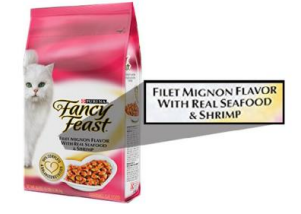
Fancy Feast Filet Mignon Flavor with Real Seafood and Shrimp: fish and shrimp are the eighth and ninth ingredients, but they’re minor ingredients, and there’s no beef at all. Blue Buffalo also argued that advertising the brand as “gourmet” on Purina’s website, and including a gold seal with the words “100% Complete & Balanced Nutrition” on the packaging, was false and misleading because this cat food was made with inferior ingredients. The court determined that Blue Buffalo didn’t plausibly allege that a reasonable consumer would believe that the product contained the expensive ingredient filet mignon just because of the label “filet mignon flavor.” Also, “gourmet” and “100% Complete & Balanced Nutrition” were mere puffery. 100% might be quantifiable in other circumstances, but whether nutrition is complete and balanced is a matter of opinion. However, Blue Buffalo did plausibly plead that a reasonable consumer could think that the product contained at least some beef, or that seafood and salmon were primary ingredients.
ONE SMARTBLEND dog food and Pro Plan dog and cat food: Purina advertised these as containing rice and “Rice” is in the name of some varieties, which allegedly conveyed the false message that those products were made with a healthy and nutritious grain, when in fact those products were made with brewers rice, a filler with little or no nutritional value. Blue Buffalo alleged that brewer’s rice was “part of the fractionated debris left over from whole rice that has been milled, and the saleable rice has been separated…. Brewers rice does not contain many of the nutritional benefits of whole grain rice or even the lower nutritional benefits of white rice sold for human consumption. Brewers rice therefore is used primarily as cheap filler in animal feeds.” This made Blue Buffalo’s claims plausible.
Chef Michael’s dog food: Blue Buffalo alleged that the ads and packaging falsely indicated that the dog food was made with quality pieces of chicken and beef when it wasn’t. Instead of the “Tender Pieces” being whole pieces of chicken, as allegedly conveyed, they included soy products and other ingredients. Additionally, the website “It’s not just dog food. It’s Chef Michael’s” allegedly falsely suggested that the product consisted of high-quality, human grade beef and chicken as one would expect to be prepared by a “Chef” rather than soy and other cheaper ingredients. The chef-related allegation was conclusory, with no factual support, but the idea that images of the “Tender Pieces” would mislead a reasonable consumer into thinking those pieces were whole pieces of chicken was not implausible.
Just Right dog food: Blue Buffalo alleged that Purina falsely claimed that it would create and deliver a “unique blend” of ingredients to each consumer. On theJustRightPetFood.com website, Purina offered “Food as unique as your dog,” “Personalized nutrition for your dog,” “Unique Blends,” “Tailored Nutrition” and “a personalized blend to match your dog’s nutritional needs.” To buy the product, dog owners must fill out a “pet profile,” including the dog’s breed, age, weight, level of activity, coat quality, and stool consistency. Answering these questions produces “Your Blend,” which Blue Buffalo alleged contributed to the false message that the ingredient blend is personalized and unique to that specific owner’s dog. In fact, Blue Buffalo alleged, Just Right dog food was made from only a limited set of basic ingredient formulas, each of which is substantially similar to the others, with variation only on the “protein preference” (lamb, chicken or salmon) and whether to exclude soy or grains from the formula. In addition, Just Right ads said “we believe the best nutrition is personalized,” which allegedly falsely claimed superiority.
Purina replied that no reasonable consumer would expect a completely unique formula, so “unique” was puffery, and so was “we believe the best nutrition is personalized.” The “best”/“best nutrition was personalized” claims were indeed puffery. But claims about uniqueness and personalization couldn’t be deemed puffery as a matter of law—claiming greater levels of personalization than actually provided could be misleading. (See also United States v. Strauss, 999 F.2d 720 (2d Cir. 1993) (finding falsity under Food, Drug, and Cosmetic Act, where defendant repackaged a few types of dog kibble as twelve “specially formulated” varieties, each targeted to a particular dog type; using “ignorant, unthinking and credulous” standard); Porter & Dietsch v. Federal Trade Comm’n, 605 F.2d 294, 303 (7th Cir. 1979) (upholding finding that “special” and “unique” formula claims were false and deceptive where ingredient was same as in many other products for same condition); Alpo Petfoods, Inc. v. Ralston Purina Co., 720 F. Supp. 194, 200 (D.D.C. 1989) (“specifically formulated” and “specially formulated” claims literally false where product did not have stated “special” benefit and competing product had same formula), aff’d in relevant part, 913 F.2d 958 (D.C. Cir. 1990).)
Blue Buffalo also alleged that Purina intentionally misled consumers by representing that its Wazzin’ Train and Canyon Creek Ranch chicken and duck jerky treats were wholesome and suitable for consumption by dogs when Purina knew that they caused sickness and death. Purina promoted these treats as being “natural,” “wholesome,” “healthy” and made from “only the most simple and pure ingredients.” In fact, Blue Buffalo alleged, the treats: “(i) had proven poisonous to dogs, and were implicated in the illness and/or deaths of hundreds of pets, (ii) were manufactured and processed in Chinese facilities that were not subject to the same oversight as their counterparts in the United States, and (iii) had been exposed to, or included, harmful ingredients, including illegal antibiotics, diseased bird parts, and/or other toxic ingredients.” Purina allegedly disregarded thousands of consumer complaints and multiple warnings from the FDA, and instead continued to issue public statements falsely claiming that the treats were manufactured under “the highest quality and safety standards” and weren’t responsible for any illness … up until it withdrew the jerky treats from the market in early 2013. Purina said these were merely conclusory allegations. While these allegations weren’t supported with extrinsic evidence, they weren’t merely conclusory, and so they were properly alleged.
Thus, claims against each of the challenged products stayed in, but some of Blue Buffalo’s claims were dismissed; the complaint would have to be amended to fit the court’s ruling.
Court throws shade on TM claimant’s naked licensing
Amscan Inc. v. Shutter Shades, Inc., No. 13-CV-1112
(S.D.N.Y. Apr. 30, 3015)
Plaintiff Party City is a party goods retailer, and plaintiff
Amscan makes party goods that it distributes to many retail outlets, including
Party City. Defendant Shutter Shades
sells eyewear and t-shirts on its website, shuttershadesonline.com, and
defendant Wilkerson is SSI’s principal.
Sunglasses with slats over the eyes (“slotted sunglasses”) made a comeback
in the summer of 2007 after Kanye West wore a pair in a music video and during
a concert performance. After seeing this, Wilkerson decided to make replicas of
them and filed an ITU for “Shutter Shades” for sunglasses. He also received a
design patent for “Sunglasses Without Lenses but Having Six Horizontal Slats
Crossing the Field of Vision of Each Eye.” (What is up in design patent land?)
Amscan makes party goods that it distributes to many retail outlets, including
Party City. Defendant Shutter Shades
sells eyewear and t-shirts on its website, shuttershadesonline.com, and
defendant Wilkerson is SSI’s principal.
Sunglasses with slats over the eyes (“slotted sunglasses”) made a comeback
in the summer of 2007 after Kanye West wore a pair in a music video and during
a concert performance. After seeing this, Wilkerson decided to make replicas of
them and filed an ITU for “Shutter Shades” for sunglasses. He also received a
design patent for “Sunglasses Without Lenses but Having Six Horizontal Slats
Crossing the Field of Vision of Each Eye.” (What is up in design patent land?)
| from the design patent |
CTS, an eyewear distributor, opposed Wilkerson’s ITU, arguing
that “shutter shades” was a generic term that had been used since as early as
1990 to refer to a particular type of sunglasses. In a 2009 settlement agreement,
CTS agreed to withdraw its opposition and refrain from filing any future
oppositions in exchange for a royalty-free license from Defendants to continue
using the “Shutter Shades” trademark. The registration issued in late 2010, but
Shutter Shades had already been sending demand letters to 25 companies selling
slotted glasses claiming patent infringement.
Instead of demanding a cessation of sales, Wilkerson offered a license in
many of these letters, and ended up with six agreements granting a license to
the design patents and the trademark in return for royalty payments.
that “shutter shades” was a generic term that had been used since as early as
1990 to refer to a particular type of sunglasses. In a 2009 settlement agreement,
CTS agreed to withdraw its opposition and refrain from filing any future
oppositions in exchange for a royalty-free license from Defendants to continue
using the “Shutter Shades” trademark. The registration issued in late 2010, but
Shutter Shades had already been sending demand letters to 25 companies selling
slotted glasses claiming patent infringement.
Instead of demanding a cessation of sales, Wilkerson offered a license in
many of these letters, and ended up with six agreements granting a license to
the design patents and the trademark in return for royalty payments.
Shutter Shades also sent demand letters to the plaintiffs
here, first in November 2010 and then in October 2012. Rather than licensing, plaintiffs sued for a
declaration of noninfringement and invalidity as to the design patent and a
declaration of noninfringement, invalidity, and cancellation as to the
trademark. Defendants counterclaimed for
trademark infringement. Here, plaintiffs
moved for and received summary judgment only on their trademark claims.
here, first in November 2010 and then in October 2012. Rather than licensing, plaintiffs sued for a
declaration of noninfringement and invalidity as to the design patent and a
declaration of noninfringement, invalidity, and cancellation as to the
trademark. Defendants counterclaimed for
trademark infringement. Here, plaintiffs
moved for and received summary judgment only on their trademark claims.
Shutter Shades abandoned its mark through naked licensing. Trademark owners have a duty to exercise
control and supervision over a licensee’s use of the mark. This protects the
public from inconsistent quality, and in addition naked licensing may cause the
mark to lose its source significance.
Because of the forfeiture of rights involved, showing naked licensing
requires a “high burden of proof,” though the court declined to say whether
that required clear and convincing evidence or merely a preponderance; the
difference didn’t matter here.
control and supervision over a licensee’s use of the mark. This protects the
public from inconsistent quality, and in addition naked licensing may cause the
mark to lose its source significance.
Because of the forfeiture of rights involved, showing naked licensing
requires a “high burden of proof,” though the court declined to say whether
that required clear and convincing evidence or merely a preponderance; the
difference didn’t matter here.
Avoiding abandonment requires a licensor to exercise a
“reasonable degree of supervision and control over licensees under the facts
and circumstances of the particular case.” Policing adequately to guarantee quality is
key—the sort of supervision required is that which produces consistent
quality. If a licensor doesn’t play a
“meaningful role” in holding its licensee’s products to a standard of quality,
it will be found to have abandoned its mark.
“reasonable degree of supervision and control over licensees under the facts
and circumstances of the particular case.” Policing adequately to guarantee quality is
key—the sort of supervision required is that which produces consistent
quality. If a licensor doesn’t play a
“meaningful role” in holding its licensee’s products to a standard of quality,
it will be found to have abandoned its mark.
Plaintiffs argued that defendants exercised no supervision
whatsoever; defendants argued that they didn’t have to do anything because the
products were so simple. There were only
six licensing agreements with formal terms, as well as the settlement with CTS.
Wilkerson testified that he “speak[s] with [the] licensees frequently,” and his
affidavit averred that the defendants “maintain contact with their licensees,
are familiar with their licensees’ products, . . . have no complaints about
their license[e]s’ product quality . . . [and] have indeed confirmed that their
licensees’ products meet Defendants’ standards.” No reasonable jury could find adequate
policing.
whatsoever; defendants argued that they didn’t have to do anything because the
products were so simple. There were only
six licensing agreements with formal terms, as well as the settlement with CTS.
Wilkerson testified that he “speak[s] with [the] licensees frequently,” and his
affidavit averred that the defendants “maintain contact with their licensees,
are familiar with their licensees’ products, . . . have no complaints about
their license[e]s’ product quality . . . [and] have indeed confirmed that their
licensees’ products meet Defendants’ standards.” No reasonable jury could find adequate
policing.
First, the licenses gave defendants nothing but money: the
agreements “do not permit them to dictate product specifications, monitor
manufacturing, inspect product samples or otherwise control any aspect of the
quality of the eyewear sold by their licensees under the ‘Shutter Shades’ mark.” There were no specific terms about quality
control. One provision stating that the
licensee shall “promote and sell the [glasses] in such a manner as it deems
fit, in the sole discretion of [the licensee],” for example, deprived defendants of control. Defendants also disclaimed liability for the
licensee’s products and the licensee agreed to indemnify Defendants for any
liabilities arising from the “workmanship or material.” This was a disclaimer,
not a quality control provision. The
settlement agreement with CTS was even more permissive. The other agreements licensed the trademark
for use with “patent-related products” only, but the settlement agreement
permitted CTS to use the mark with any type of product or service. The absence in
any license of an express contractual right to police the licensees’
operations, while “not conclusive evidence of lack of control,” supported a
finding of naked licensing.
agreements “do not permit them to dictate product specifications, monitor
manufacturing, inspect product samples or otherwise control any aspect of the
quality of the eyewear sold by their licensees under the ‘Shutter Shades’ mark.” There were no specific terms about quality
control. One provision stating that the
licensee shall “promote and sell the [glasses] in such a manner as it deems
fit, in the sole discretion of [the licensee],” for example, deprived defendants of control. Defendants also disclaimed liability for the
licensee’s products and the licensee agreed to indemnify Defendants for any
liabilities arising from the “workmanship or material.” This was a disclaimer,
not a quality control provision. The
settlement agreement with CTS was even more permissive. The other agreements licensed the trademark
for use with “patent-related products” only, but the settlement agreement
permitted CTS to use the mark with any type of product or service. The absence in
any license of an express contractual right to police the licensees’
operations, while “not conclusive evidence of lack of control,” supported a
finding of naked licensing.
Even without a contractual right to control quality, actual
control through inspection or supervision could avoid naked licensing. But on this record, defendants never supervised
licensees’ operations or inspected their products. A claim that Wilkerson spoke with licensees “frequently”
didn’t concern product quality, and his vague and conclusory statement in an
affidavit that Defendants have “confirmed that their licensees’ products meet
Defendants’ standards” couldn’t create a triable issue of fact as to whether
they ever ever inspected any of their licensees’ eyeglasses or supervised their
manufacture. “Even were one to interpret ‘confirmed’ to mean ‘inspected’ (which
I do not), a reasonable jury could still not find that Defendants played a ‘meaningful
role,’ in the supervision of their licensees where Mr. Wilkerson failed to
provide any details about the methods or frequency of such inspections.”
control through inspection or supervision could avoid naked licensing. But on this record, defendants never supervised
licensees’ operations or inspected their products. A claim that Wilkerson spoke with licensees “frequently”
didn’t concern product quality, and his vague and conclusory statement in an
affidavit that Defendants have “confirmed that their licensees’ products meet
Defendants’ standards” couldn’t create a triable issue of fact as to whether
they ever ever inspected any of their licensees’ eyeglasses or supervised their
manufacture. “Even were one to interpret ‘confirmed’ to mean ‘inspected’ (which
I do not), a reasonable jury could still not find that Defendants played a ‘meaningful
role,’ in the supervision of their licensees where Mr. Wilkerson failed to
provide any details about the methods or frequency of such inspections.”
There was no record evidence of any standards of product quality, let alone that defendants tried
to enforce those standards. Reliance on
licensees’ own quality control measures did not satisfy defendants’ duty of
supervision. Wilkerson stated that the
indemnification provision gave him confidence because that meant that
defendants “weren’t going to take on any claims that came from [the licensee’s]
customers.” Though licensees might have had an incentive to engage in quality
control to protect themselves from product liability, “Defendants could not
justifiably rely on those measures for a different purpose – to produce slotted
glasses of a quality consistent with their own (and those of the other
licensees).” Without “marching orders”
from the trademark owner, the licensees had no way of keeping glasses sold
under the mark consistent enough to protect the mark as a signifier of origin.
to enforce those standards. Reliance on
licensees’ own quality control measures did not satisfy defendants’ duty of
supervision. Wilkerson stated that the
indemnification provision gave him confidence because that meant that
defendants “weren’t going to take on any claims that came from [the licensee’s]
customers.” Though licensees might have had an incentive to engage in quality
control to protect themselves from product liability, “Defendants could not
justifiably rely on those measures for a different purpose – to produce slotted
glasses of a quality consistent with their own (and those of the other
licensees).” Without “marching orders”
from the trademark owner, the licensees had no way of keeping glasses sold
under the mark consistent enough to protect the mark as a signifier of origin.
Moreover, even if the indemnification provision/disclaimer
had something to do with product quality, it didn’t have anything to do with consistent quality, just minimum quality. “It is important to keep in mind that ‘quality
control’ does not necessarily mean that the licensed goods or services must be
of ‘high’ quality, but merely of equal quality, whether that quality is high,
low or middle.” There was no evidence that Wilkerson was familiar with and relied
upon the licensee’s own efforts to control quality, as had been the situation
in other cases that had declined to find naked licensing as long as there was
some sort of informal relationship. The
most that Wilkerson’s claims to be “familiar” with his licensees’ products did
was show that he knew they made slotted sunglasses, not that he was familiar
with their products’ quality or their quality control procedures. There was no evidence of a “close working
relationship” that might entitle them to rely on their licensees to produce
glasses of a quality consistent with their own. Instead, the record was one of minimal
contact, limited almost entirely to royalty collection.
had something to do with product quality, it didn’t have anything to do with consistent quality, just minimum quality. “It is important to keep in mind that ‘quality
control’ does not necessarily mean that the licensed goods or services must be
of ‘high’ quality, but merely of equal quality, whether that quality is high,
low or middle.” There was no evidence that Wilkerson was familiar with and relied
upon the licensee’s own efforts to control quality, as had been the situation
in other cases that had declined to find naked licensing as long as there was
some sort of informal relationship. The
most that Wilkerson’s claims to be “familiar” with his licensees’ products did
was show that he knew they made slotted sunglasses, not that he was familiar
with their products’ quality or their quality control procedures. There was no evidence of a “close working
relationship” that might entitle them to rely on their licensees to produce
glasses of a quality consistent with their own. Instead, the record was one of minimal
contact, limited almost entirely to royalty collection.
Finally, the court rejected defendants’ argument that they
satisfied their control duty based on the simplicity of their product. Defendants maintained that plastic novelty
sunglasses are simple products with no moving parts, electronics, or machinery.
While the extent of supervision required varies depending on “the facts and
circumstances of the particular case,” including the nature of the product,
there was still no supervision whatsoever.
Despite the simplicity of the product, there were still many relevant
factors that could influence whether consumers believed that all glasses sold
as “Shutter Shades” came from a single source, “including their exact design
(including the number of slats and their positioning), their sizing and
dimensions, the type of materials used (including their thickness, heft and ‘feel’),
the selection of colors and patterns available, the type of hinge mechanism
used and the appearance and placement of the trademark on the glasses.” Defendants never exercised control over these
or any other characteristics, so they couldn’t have participated in managing
consumer expectations.
satisfied their control duty based on the simplicity of their product. Defendants maintained that plastic novelty
sunglasses are simple products with no moving parts, electronics, or machinery.
While the extent of supervision required varies depending on “the facts and
circumstances of the particular case,” including the nature of the product,
there was still no supervision whatsoever.
Despite the simplicity of the product, there were still many relevant
factors that could influence whether consumers believed that all glasses sold
as “Shutter Shades” came from a single source, “including their exact design
(including the number of slats and their positioning), their sizing and
dimensions, the type of materials used (including their thickness, heft and ‘feel’),
the selection of colors and patterns available, the type of hinge mechanism
used and the appearance and placement of the trademark on the glasses.” Defendants never exercised control over these
or any other characteristics, so they couldn’t have participated in managing
consumer expectations.
Abandonment was grounds for cancellation as well as for a
declaration that plaintiffs didn’t infringe the mark. The mark had been abandoned since at least
2009, when defendants granted the naked licenses, and plaintiffs only began
selling their version in 2010.
declaration that plaintiffs didn’t infringe the mark. The mark had been abandoned since at least
2009, when defendants granted the naked licenses, and plaintiffs only began
selling their version in 2010.
from Blogger http://ift.tt/1IniJbP
Court throws shade on TM claimant’s naked licensing
Amscan Inc. v. Shutter Shades, Inc., No. 13-CV-1112 (S.D.N.Y. Apr. 30, 3015)
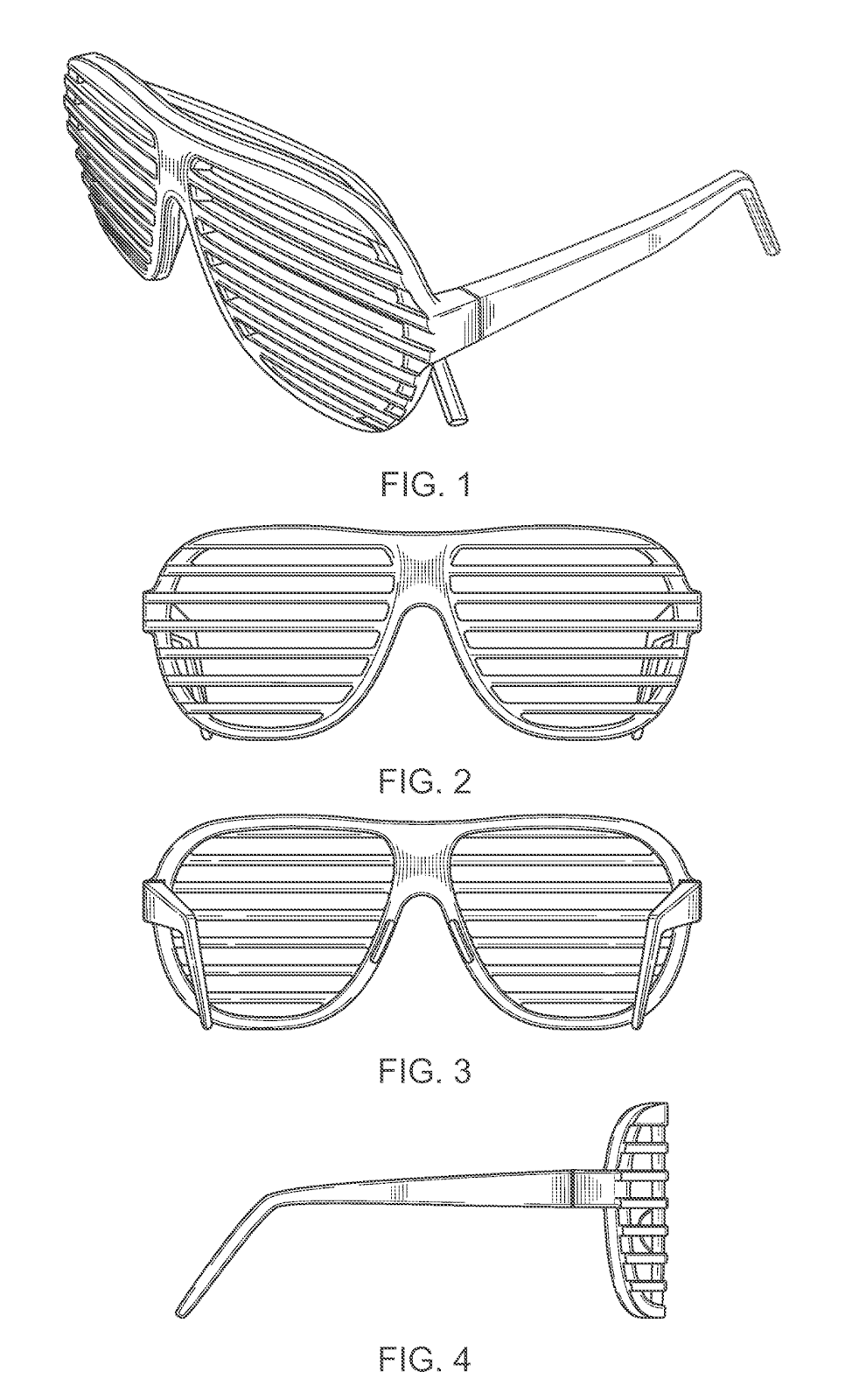
Plaintiff Party City is a party goods retailer, and plaintiff Amscan makes party goods that it distributes to many retail outlets, including Party City. Defendant Shutter Shades sells eyewear and t-shirts on its website, shuttershadesonline.com, and defendant Wilkerson is SSI’s principal. Sunglasses with slats over the eyes (“slotted sunglasses”) made a comeback in the summer of 2007 after Kanye West wore a pair in a music video and during a concert performance. After seeing this, Wilkerson decided to make replicas of them and filed an ITU for “Shutter Shades” for sunglasses. He also received a design patent for “Sunglasses Without Lenses but Having Six Horizontal Slats Crossing the Field of Vision of Each Eye.” (What is up in design patent land?)
![]() |
| from the design patent |
CTS, an eyewear distributor, opposed Wilkerson’s ITU, arguing that “shutter shades” was a generic term that had been used since as early as 1990 to refer to a particular type of sunglasses. In a 2009 settlement agreement, CTS agreed to withdraw its opposition and refrain from filing any future oppositions in exchange for a royalty-free license from Defendants to continue using the “Shutter Shades” trademark. The registration issued in late 2010, but Shutter Shades had already been sending demand letters to 25 companies selling slotted glasses claiming patent infringement. Instead of demanding a cessation of sales, Wilkerson offered a license in many of these letters, and ended up with six agreements granting a license to the design patents and the trademark in return for royalty payments.
Shutter Shades also sent demand letters to the plaintiffs here, first in November 2010 and then in October 2012. Rather than licensing, plaintiffs sued for a declaration of noninfringement and invalidity as to the design patent and a declaration of noninfringement, invalidity, and cancellation as to the trademark. Defendants counterclaimed for trademark infringement. Here, plaintiffs moved for and received summary judgment only on their trademark claims.
Shutter Shades abandoned its mark through naked licensing. Trademark owners have a duty to exercise control and supervision over a licensee’s use of the mark. This protects the public from inconsistent quality, and in addition naked licensing may cause the mark to lose its source significance. Because of the forfeiture of rights involved, showing naked licensing requires a “high burden of proof,” though the court declined to say whether that required clear and convincing evidence or merely a preponderance; the difference didn’t matter here.
Avoiding abandonment requires a licensor to exercise a “reasonable degree of supervision and control over licensees under the facts and circumstances of the particular case.” Policing adequately to guarantee quality is key—the sort of supervision required is that which produces consistent quality. If a licensor doesn’t play a “meaningful role” in holding its licensee’s products to a standard of quality, it will be found to have abandoned its mark.
Plaintiffs argued that defendants exercised no supervision whatsoever; defendants argued that they didn’t have to do anything because the products were so simple. There were only six licensing agreements with formal terms, as well as the settlement with CTS. Wilkerson testified that he “speak[s] with [the] licensees frequently,” and his affidavit averred that the defendants “maintain contact with their licensees, are familiar with their licensees’ products, . . . have no complaints about their license[e]s’ product quality . . . [and] have indeed confirmed that their licensees’ products meet Defendants’ standards.” No reasonable jury could find adequate policing.
First, the licenses gave defendants nothing but money: the agreements “do not permit them to dictate product specifications, monitor manufacturing, inspect product samples or otherwise control any aspect of the quality of the eyewear sold by their licensees under the ‘Shutter Shades’ mark.” There were no specific terms about quality control. One provision stating that the licensee shall “promote and sell the [glasses] in such a manner as it deems fit, in the sole discretion of [the licensee],” for example, deprived defendants of control. Defendants also disclaimed liability for the licensee’s products and the licensee agreed to indemnify Defendants for any liabilities arising from the “workmanship or material.” This was a disclaimer, not a quality control provision. The settlement agreement with CTS was even more permissive. The other agreements licensed the trademark for use with “patent-related products” only, but the settlement agreement permitted CTS to use the mark with any type of product or service. The absence in any license of an express contractual right to police the licensees’ operations, while “not conclusive evidence of lack of control,” supported a finding of naked licensing.
Even without a contractual right to control quality, actual control through inspection or supervision could avoid naked licensing. But on this record, defendants never supervised licensees’ operations or inspected their products. A claim that Wilkerson spoke with licensees “frequently” didn’t concern product quality, and his vague and conclusory statement in an affidavit that Defendants have “confirmed that their licensees’ products meet Defendants’ standards” couldn’t create a triable issue of fact as to whether they ever ever inspected any of their licensees’ eyeglasses or supervised their manufacture. “Even were one to interpret ‘confirmed’ to mean ‘inspected’ (which I do not), a reasonable jury could still not find that Defendants played a ‘meaningful role,’ in the supervision of their licensees where Mr. Wilkerson failed to provide any details about the methods or frequency of such inspections.”
There was no record evidence of any standards of product quality, let alone that defendants tried to enforce those standards. Reliance on licensees’ own quality control measures did not satisfy defendants’ duty of supervision. Wilkerson stated that the indemnification provision gave him confidence because that meant that defendants “weren’t going to take on any claims that came from [the licensee’s] customers.” Though licensees might have had an incentive to engage in quality control to protect themselves from product liability, “Defendants could not justifiably rely on those measures for a different purpose – to produce slotted glasses of a quality consistent with their own (and those of the other licensees).” Without “marching orders” from the trademark owner, the licensees had no way of keeping glasses sold under the mark consistent enough to protect the mark as a signifier of origin.
Moreover, even if the indemnification provision/disclaimer had something to do with product quality, it didn’t have anything to do with consistent quality, just minimum quality. “It is important to keep in mind that ‘quality control’ does not necessarily mean that the licensed goods or services must be of ‘high’ quality, but merely of equal quality, whether that quality is high, low or middle.” There was no evidence that Wilkerson was familiar with and relied upon the licensee’s own efforts to control quality, as had been the situation in other cases that had declined to find naked licensing as long as there was some sort of informal relationship. The most that Wilkerson’s claims to be “familiar” with his licensees’ products did was show that he knew they made slotted sunglasses, not that he was familiar with their products’ quality or their quality control procedures. There was no evidence of a “close working relationship” that might entitle them to rely on their licensees to produce glasses of a quality consistent with their own. Instead, the record was one of minimal contact, limited almost entirely to royalty collection.
Finally, the court rejected defendants’ argument that they satisfied their control duty based on the simplicity of their product. Defendants maintained that plastic novelty sunglasses are simple products with no moving parts, electronics, or machinery. While the extent of supervision required varies depending on “the facts and circumstances of the particular case,” including the nature of the product, there was still no supervision whatsoever. Despite the simplicity of the product, there were still many relevant factors that could influence whether consumers believed that all glasses sold as “Shutter Shades” came from a single source, “including their exact design (including the number of slats and their positioning), their sizing and dimensions, the type of materials used (including their thickness, heft and ‘feel’), the selection of colors and patterns available, the type of hinge mechanism used and the appearance and placement of the trademark on the glasses.” Defendants never exercised control over these or any other characteristics, so they couldn’t have participated in managing consumer expectations.
Abandonment was grounds for cancellation as well as for a declaration that plaintiffs didn’t infringe the mark. The mark had been abandoned since at least 2009, when defendants granted the naked licenses, and plaintiffs only began selling their version in 2010.
Posted in design patent, trademark
1 Comment
All that is solid melts into air: photog loses claim against Nike Jordan photo and logo
Rentmeester v. Nike, Inc., No. 3:15-cv-00113 (D. Ore. Jun.
15, 2015)
15, 2015)
Rentmeester shot a photo of then-North Carolina student
Michael Jordan for a 1984 issue of LIFE magazine. Instead of a conventional gym shot,
Rentmeester photographed Jordon outdoors, “on a relatively isolated grassy hill
with no visual distractions other than the setting sun and a basketball hoop he
had temporarily installed on the hill.”
He wanted an untraditional pose, so he instructed Jordan “to jump
straight up and perform a grand jeté, a ballet leap, while holding a
basketball.” Rentmeester argued that he
was the first person ever to photograph a basketball player in this specific
pose. In his view, “the creative genius
of the pose, and the overall construction of the image, is to trick the viewer
into thinking that Mr. Jordan is actually performing a dunk when in fact he is
not.” To get this effect, Rentmeester put his camera approximately 90 degrees
to Jordan’s apparent trajectory and slightly below, creating an effect of
looking up at Jordan. To get precise
detail, Rentmeester used a very rapid shutter speed and powerful synchronized
strobe lights.
Michael Jordan for a 1984 issue of LIFE magazine. Instead of a conventional gym shot,
Rentmeester photographed Jordon outdoors, “on a relatively isolated grassy hill
with no visual distractions other than the setting sun and a basketball hoop he
had temporarily installed on the hill.”
He wanted an untraditional pose, so he instructed Jordan “to jump
straight up and perform a grand jeté, a ballet leap, while holding a
basketball.” Rentmeester argued that he
was the first person ever to photograph a basketball player in this specific
pose. In his view, “the creative genius
of the pose, and the overall construction of the image, is to trick the viewer
into thinking that Mr. Jordan is actually performing a dunk when in fact he is
not.” To get this effect, Rentmeester put his camera approximately 90 degrees
to Jordan’s apparent trajectory and slightly below, creating an effect of
looking up at Jordan. To get precise
detail, Rentmeester used a very rapid shutter speed and powerful synchronized
strobe lights.
LIFE published the photo just when Nike was preparing to
launch its endorsement relationship with Jordan, and Nike contacted Rentmeester
to request color transparencies of the photo. He agreed to lend them to Nike for $150, “for
slide presentation only, no layout or any other duplication.” Nike created a
similar photograph and displayed it on billboards and posters. Rentmeester objected, and the parties
negotiated a limited and temporary use of the Nike photo—Nike paid $15,000 for
a two-year license, but Nike continued to use the photo on a wide variety of
billboards, advertisements, and merchandise. In 1987, Nike began using the
Jumpman Logo on all of its Jordan Brand merchandise.
launch its endorsement relationship with Jordan, and Nike contacted Rentmeester
to request color transparencies of the photo. He agreed to lend them to Nike for $150, “for
slide presentation only, no layout or any other duplication.” Nike created a
similar photograph and displayed it on billboards and posters. Rentmeester objected, and the parties
negotiated a limited and temporary use of the Nike photo—Nike paid $15,000 for
a two-year license, but Nike continued to use the photo on a wide variety of
billboards, advertisements, and merchandise. In 1987, Nike began using the
Jumpman Logo on all of its Jordan Brand merchandise.
| Nike’s Jordan photo |
| Nike’s Jumpman logo |
Rentmeester sued for copyright infringement, and lost—finally,
a ruling that replicates what we should’ve gotten out of the Obama HOPE
litigation.
a ruling that replicates what we should’ve gotten out of the Obama HOPE
litigation.
What qualifies as substantial similarity depends on the
underlying facts, and the Ninth Circuit uses a sliding scale depending on the
works at issue. From Mattel,
Inc. v. MGA Entertainment, Inc.:
underlying facts, and the Ninth Circuit uses a sliding scale depending on the
works at issue. From Mattel,
Inc. v. MGA Entertainment, Inc.:
If there’s a wide range of
expression (for example, there are gazillions of ways to make an aliens-attack
movie), the copyright protection is “broad” and a work will infringe if it’s
“substantially similar” to the copyrighted work. If there’s only a narrow range
of expression (for example, there are only so many ways to paint a red bouncy
ball on blank canvas), the copyright protection is “thin” and a work must be
virtually identical to infringe.
expression (for example, there are gazillions of ways to make an aliens-attack
movie), the copyright protection is “broad” and a work will infringe if it’s
“substantially similar” to the copyrighted work. If there’s only a narrow range
of expression (for example, there are only so many ways to paint a red bouncy
ball on blank canvas), the copyright protection is “thin” and a work must be
virtually identical to infringe.
(Based on the language of this excerpt, I’ll give you three
guesses who wrote the opinion, and the first two don’t count.) So the key inquiry was whether Rentmeester’s
photo involved a wide or narrow range of expression. The court rejected Nike’s claim that
virtually all photos had thin protection.
Rather, to determine the breadth of copyright protection in a work, a
court must decide “what idea is being expressed by the artist,” and that idea
is unprotected. “The breadth of protection afforded to a particular expression
is determined by the number of possible expressions of the idea.” The key question is always whether the works
are substantially similar beyond
depicting the same idea. Substantial
similarity can’t be based on similarity in unprotectable elements.
guesses who wrote the opinion, and the first two don’t count.) So the key inquiry was whether Rentmeester’s
photo involved a wide or narrow range of expression. The court rejected Nike’s claim that
virtually all photos had thin protection.
Rather, to determine the breadth of copyright protection in a work, a
court must decide “what idea is being expressed by the artist,” and that idea
is unprotected. “The breadth of protection afforded to a particular expression
is determined by the number of possible expressions of the idea.” The key question is always whether the works
are substantially similar beyond
depicting the same idea. Substantial
similarity can’t be based on similarity in unprotectable elements.
What is the idea of the Rentmeester photo? His counsel argued that it was “basically the
task that Mr. Rentmeester was charged with,” but the court disagreed; that
would let broad copyright protection be created out of thin air by broad
commissions. Instead, the court went with
“what idea the creator of the work was trying to express when she created the
copyrighted work.” That was, as Rentmeester’s
own claims made clear, that of,“Michael Jordan in a gravity- defying dunk, in a
pose inspired by ballet’s grand-jeté.”
task that Mr. Rentmeester was charged with,” but the court disagreed; that
would let broad copyright protection be created out of thin air by broad
commissions. Instead, the court went with
“what idea the creator of the work was trying to express when she created the
copyrighted work.” That was, as Rentmeester’s
own claims made clear, that of,“Michael Jordan in a gravity- defying dunk, in a
pose inspired by ballet’s grand-jeté.”
The next step was to determine the range of possible ways to
express that idea. There were more than
a few ways to do so, and less than a gazillion.
There were technically an infinite number of perspectives from which the
photo could have been taken, but practically there were only “ten to fifteen” materially
different perspectives available. Likewise,
there were only a handful of materially different lighting possibilities. Photos involving a specific pose don’t
necessarily receive categorically thin protection, but the idea in this case
was closer to the “red bouncy ball on canvas” idea than “aliens-attack movie,”
and therefore the copyright was thin.
express that idea. There were more than
a few ways to do so, and less than a gazillion.
There were technically an infinite number of perspectives from which the
photo could have been taken, but practically there were only “ten to fifteen” materially
different perspectives available. Likewise,
there were only a handful of materially different lighting possibilities. Photos involving a specific pose don’t
necessarily receive categorically thin protection, but the idea in this case
was closer to the “red bouncy ball on canvas” idea than “aliens-attack movie,”
and therefore the copyright was thin.
Then, the court filtered out the unprotected elements: the
basketball hoop, the basketball, a man jumping, Mr. Jordan’s skin color, and
his clothing. Rentmeester argued that
his particular arrangement of these unprotected elements was protected, and
this is in general true. However, given
the idea of “Michael Jordan in a gravity-defying dunk, in a pose inspired by
ballet’s grand-jeté,” there was “nothing original about the selection and
arrangement of having a Michael Jordan jump with a basketball in the vicinity
of a basketball hoop—that is all scenes a faire for the idea at issue.” The only arguably original part was taking
the photo outside, but a lot of basketball is played outside.
basketball hoop, the basketball, a man jumping, Mr. Jordan’s skin color, and
his clothing. Rentmeester argued that
his particular arrangement of these unprotected elements was protected, and
this is in general true. However, given
the idea of “Michael Jordan in a gravity-defying dunk, in a pose inspired by
ballet’s grand-jeté,” there was “nothing original about the selection and
arrangement of having a Michael Jordan jump with a basketball in the vicinity
of a basketball hoop—that is all scenes a faire for the idea at issue.” The only arguably original part was taking
the photo outside, but a lot of basketball is played outside.
Rentmeester also sought protection for the pose. Even if the idea of the pose was original,
that doesn’t let him control it with copyright.
“The law draws no distinction between original and unoriginal ideas.” However, the actual expression of the idea in
a pose could be protected, but there were material differences between the two
photos in their expression of the pose.
Rentmeester’s photo showed Jordan’s right arm bent at the elbow; Nike’s
showed his right arm extending straight down and away from the basket. In the Rentmeester photo, Jordan’s arm was
bent slightly backwards while in the Nike photo it was fully extended and depicted
above the basket. In the Rentmeester photo, Jordan’s legs were positioned as if
he were jumping while running forward (a traditional grand-jeté). “His legs are
apart like a scissor split, nearly creating a straight line.” In Nike’s photo, Jordan’s
legs were positioned as if he had jumped up vertically and spread his legs wide
in a straddle position, creating a “V” as opposed to a straight line. Given the thinness of the copyright at issue,
no reasonable jury could find substantial similarity between the two photos.
that doesn’t let him control it with copyright.
“The law draws no distinction between original and unoriginal ideas.” However, the actual expression of the idea in
a pose could be protected, but there were material differences between the two
photos in their expression of the pose.
Rentmeester’s photo showed Jordan’s right arm bent at the elbow; Nike’s
showed his right arm extending straight down and away from the basket. In the Rentmeester photo, Jordan’s arm was
bent slightly backwards while in the Nike photo it was fully extended and depicted
above the basket. In the Rentmeester photo, Jordan’s legs were positioned as if
he were jumping while running forward (a traditional grand-jeté). “His legs are
apart like a scissor split, nearly creating a straight line.” In Nike’s photo, Jordan’s
legs were positioned as if he had jumped up vertically and spread his legs wide
in a straddle position, creating a “V” as opposed to a straight line. Given the thinness of the copyright at issue,
no reasonable jury could find substantial similarity between the two photos.
After the filtering was complete, all that was left was
either (1) “two photographs taken at a similar angle, one of a grassy hill with
a blue sky background and a setting sun, and the other of the skyline of
Chicago with a red and purple sky background”; or (2) that, plus Jordan in a
grand-jeté pose. In the first view it
would be a stretch to find the photos similar at all; in the second, all that
was added was an element that was not itself substantially similar in the two
photos. Adding in Jordan would also add
in other differences—Jordan’s scale and placement differed in the photos; also,
in the Rentmeester photo the viewer can clearly see the hill Jordan jumped
from, while in the Nike photo there was no depiction of where he jumped from, “but
rather he appears as though he is flying over the skyline of Chicago.” These
many differences overcame the similarity of the photos from similar angles.
either (1) “two photographs taken at a similar angle, one of a grassy hill with
a blue sky background and a setting sun, and the other of the skyline of
Chicago with a red and purple sky background”; or (2) that, plus Jordan in a
grand-jeté pose. In the first view it
would be a stretch to find the photos similar at all; in the second, all that
was added was an element that was not itself substantially similar in the two
photos. Adding in Jordan would also add
in other differences—Jordan’s scale and placement differed in the photos; also,
in the Rentmeester photo the viewer can clearly see the hill Jordan jumped
from, while in the Nike photo there was no depiction of where he jumped from, “but
rather he appears as though he is flying over the skyline of Chicago.” These
many differences overcame the similarity of the photos from similar angles.
Once that conclusion had been reached, the noninfringing
nature of the Jumpman logo followed as well.
The only similarity with the Rentmeester photo was in the idea of a grand-jeté
pose—“the Jumpman Logo is nothing more than an expression of the pose.” DMCA false copyright management information
claims under §1202 also failed because there was no infringement and Nike
couldn’t be faulted for claiming it owned the copyright in its works.
nature of the Jumpman logo followed as well.
The only similarity with the Rentmeester photo was in the idea of a grand-jeté
pose—“the Jumpman Logo is nothing more than an expression of the pose.” DMCA false copyright management information
claims under §1202 also failed because there was no infringement and Nike
couldn’t be faulted for claiming it owned the copyright in its works.
from Blogger http://ift.tt/1Bmm3ag
All that is solid melts into air: photog loses claim against Nike Jordan photo and logo
Rentmeester v. Nike, Inc., No. 3:15-cv-00113 (D. Ore. Jun. 15, 2015)
Rentmeester shot a photo of then-North Carolina student Michael Jordan for a 1984 issue of LIFE magazine. Instead of a conventional gym shot, Rentmeester photographed Jordon outdoors, “on a relatively isolated grassy hill with no visual distractions other than the setting sun and a basketball hoop he had temporarily installed on the hill.” He wanted an untraditional pose, so he instructed Jordan “to jump straight up and perform a grand jeté, a ballet leap, while holding a basketball.” Rentmeester argued that he was the first person ever to photograph a basketball player in this specific pose. In his view, “the creative genius of the pose, and the overall construction of the image, is to trick the viewer into thinking that Mr. Jordan is actually performing a dunk when in fact he is not.” To get this effect, Rentmeester put his camera approximately 90 degrees to Jordan’s apparent trajectory and slightly below, creating an effect of looking up at Jordan. To get precise detail, Rentmeester used a very rapid shutter speed and powerful synchronized strobe lights.
LIFE published the photo just when Nike was preparing to launch its endorsement relationship with Jordan, and Nike contacted Rentmeester to request color transparencies of the photo. He agreed to lend them to Nike for $150, “for slide presentation only, no layout or any other duplication.” Nike created a similar photograph and displayed it on billboards and posters. Rentmeester objected, and the parties negotiated a limited and temporary use of the Nike photo—Nike paid $15,000 for a two-year license, but Nike continued to use the photo on a wide variety of billboards, advertisements, and merchandise. In 1987, Nike began using the Jumpman Logo on all of its Jordan Brand merchandise.
![]() |
| Nike’s Jordan photo |
![]() |
| Nike’s Jumpman logo |
Rentmeester sued for copyright infringement, and lost—finally, a ruling that replicates what we should’ve gotten out of the Obama HOPE litigation.
What qualifies as substantial similarity depends on the underlying facts, and the Ninth Circuit uses a sliding scale depending on the works at issue. From Mattel, Inc. v. MGA Entertainment, Inc.:
If there’s a wide range of expression (for example, there are gazillions of ways to make an aliens-attack movie), the copyright protection is “broad” and a work will infringe if it’s “substantially similar” to the copyrighted work. If there’s only a narrow range of expression (for example, there are only so many ways to paint a red bouncy ball on blank canvas), the copyright protection is “thin” and a work must be virtually identical to infringe.
(Based on the language of this excerpt, I’ll give you three guesses who wrote the opinion, and the first two don’t count.) So the key inquiry was whether Rentmeester’s photo involved a wide or narrow range of expression. The court rejected Nike’s claim that virtually all photos had thin protection. Rather, to determine the breadth of copyright protection in a work, a court must decide “what idea is being expressed by the artist,” and that idea is unprotected. “The breadth of protection afforded to a particular expression is determined by the number of possible expressions of the idea.” The key question is always whether the works are substantially similar beyonddepicting the same idea. Substantial similarity can’t be based on similarity in unprotectable elements.
What is the idea of the Rentmeester photo? His counsel argued that it was “basically the task that Mr. Rentmeester was charged with,” but the court disagreed; that would let broad copyright protection be created out of thin air by broad commissions. Instead, the court went with “what idea the creator of the work was trying to express when she created the copyrighted work.” That was, as Rentmeester’s own claims made clear, that of,“Michael Jordan in a gravity- defying dunk, in a pose inspired by ballet’s grand-jeté.”
The next step was to determine the range of possible ways to express that idea. There were more than a few ways to do so, and less than a gazillion. There were technically an infinite number of perspectives from which the photo could have been taken, but practically there were only “ten to fifteen” materially different perspectives available. Likewise, there were only a handful of materially different lighting possibilities. Photos involving a specific pose don’t necessarily receive categorically thin protection, but the idea in this case was closer to the “red bouncy ball on canvas” idea than “aliens-attack movie,” and therefore the copyright was thin.
Then, the court filtered out the unprotected elements: the basketball hoop, the basketball, a man jumping, Mr. Jordan’s skin color, and his clothing. Rentmeester argued that his particular arrangement of these unprotected elements was protected, and this is in general true. However, given the idea of “Michael Jordan in a gravity-defying dunk, in a pose inspired by ballet’s grand-jeté,” there was “nothing original about the selection and arrangement of having a Michael Jordan jump with a basketball in the vicinity of a basketball hoop—that is all scenes a faire for the idea at issue.” The only arguably original part was taking the photo outside, but a lot of basketball is played outside.
Rentmeester also sought protection for the pose. Even if the idea of the pose was original, that doesn’t let him control it with copyright. “The law draws no distinction between original and unoriginal ideas.” However, the actual expression of the idea in a pose could be protected, but there were material differences between the two photos in their expression of the pose. Rentmeester’s photo showed Jordan’s right arm bent at the elbow; Nike’s showed his right arm extending straight down and away from the basket. In the Rentmeester photo, Jordan’s arm was bent slightly backwards while in the Nike photo it was fully extended and depicted above the basket. In the Rentmeester photo, Jordan’s legs were positioned as if he were jumping while running forward (a traditional grand-jeté). “His legs are apart like a scissor split, nearly creating a straight line.” In Nike’s photo, Jordan’s legs were positioned as if he had jumped up vertically and spread his legs wide in a straddle position, creating a “V” as opposed to a straight line. Given the thinness of the copyright at issue, no reasonable jury could find substantial similarity between the two photos.
After the filtering was complete, all that was left was either (1) “two photographs taken at a similar angle, one of a grassy hill with a blue sky background and a setting sun, and the other of the skyline of Chicago with a red and purple sky background”; or (2) that, plus Jordan in a grand-jeté pose. In the first view it would be a stretch to find the photos similar at all; in the second, all that was added was an element that was not itself substantially similar in the two photos. Adding in Jordan would also add in other differences—Jordan’s scale and placement differed in the photos; also, in the Rentmeester photo the viewer can clearly see the hill Jordan jumped from, while in the Nike photo there was no depiction of where he jumped from, “but rather he appears as though he is flying over the skyline of Chicago.” These many differences overcame the similarity of the photos from similar angles.
Once that conclusion had been reached, the noninfringing nature of the Jumpman logo followed as well. The only similarity with the Rentmeester photo was in the idea of a grand-jeté pose—“the Jumpman Logo is nothing more than an expression of the pose.” DMCA false copyright management information claims under §1202 also failed because there was no infringement and Nike couldn’t be faulted for claiming it owned the copyright in its works.
Amicus brief in Slep-Tone about scope of Dastar
Belatedly, I also participated in this amicus brief in Slep-Tone v. Canton Phoenix, now on appeal in the 9th Circuit, about an attempt to make an end run around lack of copyright ownership to assert trademark claims instead. Thanks to Mark McKenna for doing the heavy lifting.
from Blogger http://ift.tt/1G7MzRc
Amicus brief in Slep-Tone about scope of Dastar
Belatedly, I also participated in this amicus brief in Slep-Tone v. Canton Phoenix, now on appeal in the 9th Circuit, about an attempt to make an end run around lack of copyright ownership to assert trademark claims instead. Thanks to Mark McKenna for doing the heavy lifting.
Amicus brief in TVEyes fair use case
Chris Sprigman and I have written an amicus brief on behalf of certain IP professors in the Fox v. TVEyes case, in which the court is now considering several features of the TVEyes service as to which it reserved judgment in its initial ruling. Unsurprisingly, we argue that–given the initial ruling that the TVEyes news database is a fair use–the remaining functionality TVEyes offers is noninfringing/fair.
from Blogger http://ift.tt/1ImE995