Amicus brief in TVEyes fair use case

Chris Sprigman and I have written an amicus brief on behalf of certain IP professors in the Fox v. TVEyes case, in which the court is now considering several features of the TVEyes service as to which it reserved judgment in its initial ruling.  Unsurprisingly, we argue that–given the initial ruling that the TVEyes news database is a fair use–the remaining functionality TVEyes offers is noninfringing/fair.

Posted in http://schemas.google.com/blogger/2008/kind#post | Leave a comment

False patent marking not actionable under Lanham Act

Leisure Concepts, Inc. v. California Home Spas, Inc., 2015
WL 3658190, No. 14–CV–388 (E.D. Wash. June 12, 2015)
 
Leisure and CHS compete in spa products, including spa cover
lifters.  Leisure’s CoverMate I is
protected by a patent, which it claimed was infringed by CHS’s Cover EX.  CHS marketed the Cover EX with a sign
reading: “All Aluminum Design NO PLASTIC Compare to the Cover Mate I.” Ads for
the Cover EX also refer to a CHS patent, but Leisure claimed that the CHS
patent “claims a spa cover lifter utilizing support members comprising
telescoping gas struts, which are not an aspect of the [Cover EX.]” CHS sells
the Cover EX at a lower price than Leisure sells the CoverMate I, allegedly
harming Leisure’s sales.  Moreover,
Leisure asserted that the written and visual instructions provided with the
Cover EX were substantially similar to Leisure’s copyrighted manual for the
CoverMate I and that the instructions even contained verbatim text and diagrams
from the protected manual.
 
The court denied CHS’s motion to dismiss the patent
infringement and false patent marking claims.  In addition, the court found that Leisure
stated a plausible copyright infringement claim.  “Although some of Leisure’s manual consists
of mere lists of product parts and directions that may not be subject to
copyright, the manual also contains narrative instructions that may be
protected. This is especially true where some of the language from Leisure’s
manual is copied almost verbatim in CHS’s manual. While some similarity between
manuals for spa cover lifters is expected, ‘such obvious copying … is not to
be encouraged.’”
 
Comment: wow.  What an
anticompetitive claim.  These are the
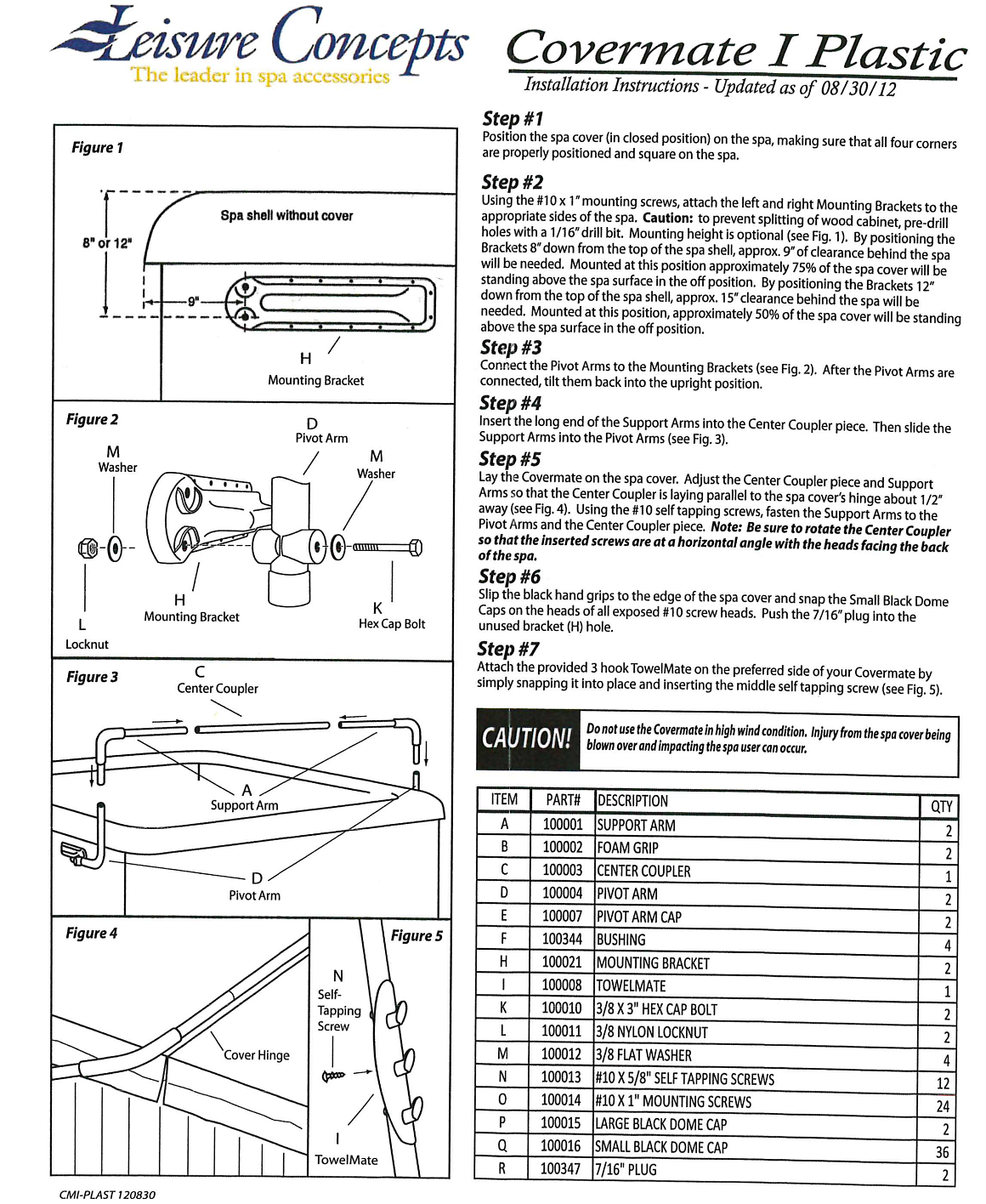
pages that the court used as comparators: 
Leisure Concepts instructions
CHS instruction (page 2 of 6)
 
I see one identical instruction, but I can’t imagine (1) that’s enough to
constitute substantial similarity, or (2) that’s even protectable; how many
ways are there to say that in an easily comprehensible way?
 
The court did dismiss the Lanham Act claim based on
allegedly false claims by CHS that the Cover EX was protected by the CHS patent
instead of embodying the Leisure patent. 
Leisure argued that “because spa dealers are more likely than general
consumers to be wary of potential patent infringement lawsuits,” CHS placed its
patent number on the advertising for the CoverEX to convince customers that
their product would not be subject to patent infringement lawsuits.  But under Sybersound Records, Inc. v. UAV
Corp., 517 F.3d 1137 (9th Cir. 2008), an alleged misrepresentation of patent
status isn’t covered by the Lanham Act.  To
avoid overlap between the Lanham and Patent acts, “nature, characteristics, and
qualities” should be construed to mean characteristics of a good itself, not
its patent status.  Leisure made no
allegations about the physical good; its patent-advertising arguments were more
properly considered under patent law. 
Leisure didn’t allege that CHS made false representations about the
exclusivity of its product, which would be actionable (a conclusion somewhat in
tension with the idea that the Lanham Act only covers misrepresentations about
the physical good). “Leisure has not alleged that CHS told customers that it
held exclusive patent rights to this class of spa cover lifters or that CHS
represented that the CoverMate I infringed on CHS’s patent.” Thus, this claim
was dismissed with prejudice.
 

from Blogger http://ift.tt/1JXWIoi

Posted in Uncategorized | Tagged , , | Leave a comment

False patent marking not actionable under Lanham Act

Leisure Concepts, Inc. v. California Home Spas, Inc., 2015 WL 3658190, No. 14–CV–388 (E.D. Wash. June 12, 2015)
 
Leisure and CHS compete in spa products, including spa cover lifters.  Leisure’s CoverMate I is protected by a patent, which it claimed was infringed by CHS’s Cover EX.  CHS marketed the Cover EX with a sign reading: “All Aluminum Design NO PLASTIC Compare to the Cover Mate I.” Ads for the Cover EX also refer to a CHS patent, but Leisure claimed that the CHS patent “claims a spa cover lifter utilizing support members comprising telescoping gas struts, which are not an aspect of the [Cover EX.]” CHS sells the Cover EX at a lower price than Leisure sells the CoverMate I, allegedly harming Leisure’s sales.  Moreover, Leisure asserted that the written and visual instructions provided with the Cover EX were substantially similar to Leisure’s copyrighted manual for the CoverMate I and that the instructions even contained verbatim text and diagrams from the protected manual.
 
The court denied CHS’s motion to dismiss the patent infringement and false patent marking claims.  In addition, the court found that Leisure stated a plausible copyright infringement claim.  “Although some of Leisure’s manual consists of mere lists of product parts and directions that may not be subject to copyright, the manual also contains narrative instructions that may be protected. This is especially true where some of the language from Leisure’s manual is copied almost verbatim in CHS’s manual. While some similarity between manuals for spa cover lifters is expected, ‘such obvious copying … is not to be encouraged.’”
 
Comment: wow.  What an anticompetitive claim.  These are the pages that the court used as comparators: 
Leisure Concepts instructions
CHS instruction (page 2 of 6)
 
I see one identical instruction, but I can’t imagine (1) that’s enough to constitute substantial similarity, or (2) that’s even protectable; how many ways are there to say that in an easily comprehensible way?
 
The court did dismiss the Lanham Act claim based on allegedly false claims by CHS that the Cover EX was protected by the CHS patent instead of embodying the Leisure patent.  Leisure argued that “because spa dealers are more likely than general consumers to be wary of potential patent infringement lawsuits,” CHS placed its patent number on the advertising for the CoverEX to convince customers that their product would not be subject to patent infringement lawsuits.  But under Sybersound Records, Inc. v. UAV Corp., 517 F.3d 1137 (9th Cir. 2008), an alleged misrepresentation of patent status isn’t covered by the Lanham Act.  To avoid overlap between the Lanham and Patent acts, “nature, characteristics, and qualities” should be construed to mean characteristics of a good itself, not its patent status.  Leisure made no allegations about the physical good; its patent-advertising arguments were more properly considered under patent law.  Leisure didn’t allege that CHS made false representations about the exclusivity of its product, which would be actionable (a conclusion somewhat in tension with the idea that the Lanham Act only covers misrepresentations about the physical good). “Leisure has not alleged that CHS told customers that it held exclusive patent rights to this class of spa cover lifters or that CHS represented that the CoverMate I infringed on CHS’s patent.” Thus, this claim was dismissed with prejudice.
 
Posted in copyright, http://schemas.google.com/blogger/2008/kind#post, patent | Leave a comment

“How can the academy best contribute to IP policy?”

Moderator:      F.
Scott Kieff, US International Trade Commission and George Washington University
 
Panelists:         Stephen
Haber, Hoover Institution and Stanford University: Good policy making starts
with good research. Literature on patenting lacks the serious empirical work
that exists in other fields; ratio of theory/broad claims to empirical evidence
is unlike other fields, particularly finance. 
Academics can broaden and deepen the quantity of research and its
quality.
 
Jay Kesan, University of Illinois: releasing the data is
important.  Nobody else can kick the
tires and look under the hood if you don’t. 
Be more skeptical/keep an open mind about other inferences from the same
data.
 
Alan Marco, USPTO: Help understand which inferences are
justified from the data. Policymakers see a lot of evidence; they agree
w/evidence based policy making, but they too frequently see policy based
evidence making where reports on one side say something completely different
from the other.  Need to know how to tell
the good from the bad.  Better
communication from academics: in understanding patents through the lens of
patent litigation—self-selected cases aren’t representative of the whole, and
we want to be careful about letting the tail wag the dog.
 
Joshua Wright, US Federal Trade Commission and George Mason
University: The principal problem is inadequate quality control leading to
overbroad claims.  Academy should take
quality control seriously, and limit claims. 
If you compare claims allowed to be taken seriously in antitrust, where
norms of scholarship are different—they’re more modest and more tethered to
actual inferences an economist would say are valid. That tethering is absent in
the IP scholarship world.
 
[Jessica Silbey, for good reason, will hate the implicit
definition of “empirical” at work here as “quantitative.”]
 
Haber: core problem is that there aren’t enough economists
around, many $20 bills on the ground for them to pick up.  (I thought the true economist wouldn’t do
that …)  Law faculty haven’t been trained
that way.  Economists have upped the game
in political science.
 
Kieff: has the IP/antitrust interface benefited from the
antitrust literature’s standards or suffered from the deficiencies in IP?
 
Wright: both are present. The same economists rationalizing
antitrust law are around.  Started with
big questions—it’s hard to measure innovation! But advance in industrial
economics has led to do smaller/narrower studies that can allow strong causal
inferences, even if on its own it wouldn’t justify legislation. A drip drip
drip of these can fill a bucket. You don’t believe papers, you believe
literatures. You get literatures by getting smaller projects.  Marginal approach was taken in antitrust, but
not enough in patent.  Sure, an economist
is likely to say the answer is more economists, but I believe that it’s true.
 
Haber: Causation is a big deal. One can look at data and
draw many inferences from it, some of them accurate and some spurious.  Data analysis w/o theory: perfect example of
this is claims about increased number of lawsuits. People like to draw the inference
is that contestability of patents has gone up and therefore the patent system
is broken. But another inference is that patents are more valuable and more
worth litigating. You can’t figure out which is true (or other explanations)
just with numbers. Unless you’re working from a well defined body of theory in
which case you have less causation to worry about, you need to worry about your
inferences.
 
Marco: one of the problems of many economists coming in is
that policymakers have high expectations. 
Economists tend to be more reserved in inferences, and so that doesn’t
get a lot of fanfare.  “How many jobs
does IP create?”—those are the questions that economists can’t really
answer.  Gap-filling: policymakers need
to be more patient/understanding: you can have good empirical research or you
can have fast.
 
Wright: another slam on law professors, sigh: law professors
can get tenure with big ridiculous claims, but economists can get tenure with a
good small contribution.  [You’re
all just jealous of my jetpack.
]
 
Kieff: So what are some of those $20 bills, tenure-worthy,
literature-contributing projects?
 
Haber: Patent trolls: what we know is miniscule compared to
the amount of noise about them. Look at the actual business, specifically: is a
patent troll a financial intermediary or a predator on the innovation
system?  Theory of finance would suggest
that intermediaries arise when there’s some market asymmetry creating a
return.  In patent space, the asymmetry
is between individual inventors and large firms implementing patents.  Is the behavior of patent trolls consistent
w/financial intermediaries, or consistent w/ the mafia?  (I’m not sure those are in any way exclusive,
actually, given accounts of how the mafia works—and how the big banks work.  I don’t see why an economist would start out
assuming these were distinct models.)
 
Kesan: that’s a project of mine: are there differences in
the way they settle or take cases to trial?
 
Marco: Identify the market failure we’re trying to solve
very clearly. A lot of times we take the system as a whole, but there are a lot
of component parts. One area to refine analysis quickly would be to ID
component parts: does patent examination/prosecution affect the way patents are
used later on?
 
Wright: the source for demand for such research has to be
the legal academy or the government.  The
gov’t is more likely to be the source of demand than the law schools.  The FTC has played a role in some areas. ID
research questions and testable hypotheses: a good role.  Do something modest and descriptive and
contribute knowledge to the world.
 
Josh Sarnoff: Rule 11 motions—would be important to know, hard
to collect data. We know almost nothing about licensing market, b/c of secrecy
issues—but there’s not a systematic requirement to collect all the data we want
to know; dramatic change at dramatic cost—only gov’t can do that.
 
Q: funders of research: what should they keep in mind?
 
Kesan: as quality of scholarship goes down, it’s seen as
more of a political football than normal science. Normal science gets more
funding/attention.  Convince funders that
there is normal science to be done.
 
Haber: innovation policy is vitally important to the US’s
future. Funding of studies of innovation policy by the gov’t relative to the
importance of the task is not commensurate, and thus either the gov’t will do
it or private entities w/vested interests will do it—or no one will do it.  Gov’t is better.  Federal Reserve funded most of the finance
literature.
 
Q: we don’t know prices or quantities in the private market
that is crucial here.  The influential
work on contracts has mostly been theory, unless there’s a large literature
using private data [Wright disagrees]. 
What is the policymaker’s role in interpreting academic evidence?  If we accept the premise that a lot of this
research is bad, if the policymaker knows it, what does the policymaker do with
that?  What’s the standard of disclosure
for the policymaker in relying on evidence?
 
Haber: ask the question—was this piece of evidence published
in a peer refereed journal or not? Simple metric, easily applied. Plus it’s
never the case that one study is dispositive. 
The Q for policymakers is whether there’s a literature whose weight
points to a conclusion.
 
Wright: there are now literature reviews, and literature
reviews of literature reviews. The difficulty is that most studies observe
either Price or Quantity.  Most of the
time here we’re less interested in P or Q and more interested in rate of
innovation or investments made in innovation, and the problem is that we don’t
agree on what a measurement is—harder than measuring prices. But there are some
papers that do this.  The observability
of underlying contracts can be difficult but there are many marginal gains to
be had.  I can count serious
peer-reviewed research designs in last 15 years on both hands. 
 
Kieff: what framing context would you give journalists or
staffers as background?  Sense of
diversity, contestation/testing in the literature.
 
Marco: also read How To Lie With Statistics—statistical inference
wouldn’t hurt.
 
Kesan: caution on both sides.  When I talk to staffers, I take extra trouble
to disclose the limitations of my studies. 
I’ve become sensitized to that after seeing the way my work has been
consumed.  If you are a
staffer/policymaker, it’s worth asking academics: what about the other
evidence?
 
Haber: two things that are low-cost: (1) learn that Google
Scholar exists.  Look for a review essay
about a literature that’s been published in a peer reviewed venue. Read the
first five pages, before it’s down in the weeds, and get a sense of the state
of a particular literature. (2) Academics need to meet staffers and journalists
on their turf, not the other way around. We should be better at making our work
more accessible and making our work more available.
 
Kieff: ideas for organizers of academic work to make their work
more impactful? Should they have a governance structure mindful of their source
of funds, fiduciary or other duties they might owe that might conflict with
independence in writing?
 
Marco: peer review is still there to correct apparent bias.  Economists are notoriously terrible at making
their results understood outside their narrow field.  NBER is getting good at putting out 2-page
summaries.  Still need to know how
policymakers should be using them. 
Incumbent on academics to improve their communication.
 
Wright: There are reputational sanctions in economics that
don’t exist or exist with less force in law. Everyone high-fives each other and
says the papers are brilliant. But less of a culture of saying a paper is bad
and shouldn’t influence policy.  (He does
not go to the conferences I go to.)  This
culture developed when law professors didn’t do empirical work.  Now, any law professor can run a regression
without a license, and that doesn’t serve academia well.  He is for more shaming of law professors.
 
Marco: who do bad research.
 
Wright: at least those. 
(Ha. Ha.  Though he is a very good
public speaker—quite charming.)  Need
research that can be replicated; that reduces fights over industry-funded or
gov’t-funded source. That tones down the criticism.  There’s a demand for objective interpretation
of results—meta-analysis of fields, similar to literature review. 
 
Kieff: do you think that policymakers should keep anything
in mind when an academic is writing as an academic but also has clients to
serve and owes duties to a client in other contexts? [Somehow I feel that there
is someone in particular being targeted.]
 
Wright: it happens. 
Some briefs are really good, and others aren’t.  If there’s empirical information, the
fundamental question is whether the thing is valid.  If I can’t see the data, it doesn’t get any
weight.
 
Kieff: should a reader keep in mind that a lawyer currently
representing a client, paid or unpaid, who has taken a position on the topic
being written about can’t advance to an academic audience a position
inconsistent with his or her client’s?
 
Wright: I don’t know the professional responsibility component.
I have a healthy skepticism for paid-for advocacy, but that’s a rebuttable
presumption.  I’d be willing to concede
that the skepticism meter goes up a notch or two.
 
Haber: from outside the legal academy, the presumption is
that the field is about getting to the truth. This requires both careful
scholarship and persuasion of others where you divulge your sources of funding,
make data available publicly, share requests for data, and practice open
science.  He is hearing that legal norms
are different. [Because he is hearing a weird subset of claims.]  Suggests a host of institutional problems in
the legal academy for playing an effective role in evidence based policymaking—seems
like conflicts of interest should be divulged. Legal academy was founded on
advocacy. That’s not about getting to the truth; it’s about serving the client.
That puts it in a difficult position for doing social science, about getting to
the truth.  How to draw some bright lines
about which enterprise people are engaged in.
 
Kieff: ITC docket generates economic studies.  If we were asked to study these issues, we’d
enjoy it.

from Blogger http://ift.tt/1SlYHps

Posted in Uncategorized | Tagged | Leave a comment

“How can the academy best contribute to IP policy?”

Moderator:      F. Scott Kieff, US International Trade Commission and George Washington University
 
Panelists:         Stephen Haber, Hoover Institution and Stanford University: Good policy making starts with good research. Literature on patenting lacks the serious empirical work that exists in other fields; ratio of theory/broad claims to empirical evidence is unlike other fields, particularly finance.  Academics can broaden and deepen the quantity of research and its quality.
 
Jay Kesan, University of Illinois: releasing the data is important.  Nobody else can kick the tires and look under the hood if you don’t.  Be more skeptical/keep an open mind about other inferences from the same data.
 
Alan Marco, USPTO: Help understand which inferences are justified from the data. Policymakers see a lot of evidence; they agree w/evidence based policy making, but they too frequently see policy based evidence making where reports on one side say something completely different from the other.  Need to know how to tell the good from the bad.  Better communication from academics: in understanding patents through the lens of patent litigation—self-selected cases aren’t representative of the whole, and we want to be careful about letting the tail wag the dog.
 
Joshua Wright, US Federal Trade Commission and George Mason University: The principal problem is inadequate quality control leading to overbroad claims.  Academy should take quality control seriously, and limit claims.  If you compare claims allowed to be taken seriously in antitrust, where norms of scholarship are different—they’re more modest and more tethered to actual inferences an economist would say are valid. That tethering is absent in the IP scholarship world.
 
[Jessica Silbey, for good reason, will hate the implicit definition of “empirical” at work here as “quantitative.”]
 
Haber: core problem is that there aren’t enough economists around, many $20 bills on the ground for them to pick up.  (I thought the true economist wouldn’t do that …)  Law faculty haven’t been trained that way.  Economists have upped the game in political science.
 
Kieff: has the IP/antitrust interface benefited from the antitrust literature’s standards or suffered from the deficiencies in IP?
 
Wright: both are present. The same economists rationalizing antitrust law are around.  Started with big questions—it’s hard to measure innovation! But advance in industrial economics has led to do smaller/narrower studies that can allow strong causal inferences, even if on its own it wouldn’t justify legislation. A drip drip drip of these can fill a bucket. You don’t believe papers, you believe literatures. You get literatures by getting smaller projects.  Marginal approach was taken in antitrust, but not enough in patent.  Sure, an economist is likely to say the answer is more economists, but I believe that it’s true.
 
Haber: Causation is a big deal. One can look at data and draw many inferences from it, some of them accurate and some spurious.  Data analysis w/o theory: perfect example of this is claims about increased number of lawsuits. People like to draw the inference is that contestability of patents has gone up and therefore the patent system is broken. But another inference is that patents are more valuable and more worth litigating. You can’t figure out which is true (or other explanations) just with numbers. Unless you’re working from a well defined body of theory in which case you have less causation to worry about, you need to worry about your inferences.
 
Marco: one of the problems of many economists coming in is that policymakers have high expectations.  Economists tend to be more reserved in inferences, and so that doesn’t get a lot of fanfare.  “How many jobs does IP create?”—those are the questions that economists can’t really answer.  Gap-filling: policymakers need to be more patient/understanding: you can have good empirical research or you can have fast.
 
Wright: another slam on law professors, sigh: law professors can get tenure with big ridiculous claims, but economists can get tenure with a good small contribution.  [You’re all just jealous of my jetpack.]
 
Kieff: So what are some of those $20 bills, tenure-worthy, literature-contributing projects?
 
Haber: Patent trolls: what we know is miniscule compared to the amount of noise about them. Look at the actual business, specifically: is a patent troll a financial intermediary or a predator on the innovation system?  Theory of finance would suggest that intermediaries arise when there’s some market asymmetry creating a return.  In patent space, the asymmetry is between individual inventors and large firms implementing patents.  Is the behavior of patent trolls consistent w/financial intermediaries, or consistent w/ the mafia?  (I’m not sure those are in any way exclusive, actually, given accounts of how the mafia works—and how the big banks work.  I don’t see why an economist would start out assuming these were distinct models.)
 
Kesan: that’s a project of mine: are there differences in the way they settle or take cases to trial?
 
Marco: Identify the market failure we’re trying to solve very clearly. A lot of times we take the system as a whole, but there are a lot of component parts. One area to refine analysis quickly would be to ID component parts: does patent examination/prosecution affect the way patents are used later on?
 
Wright: the source for demand for such research has to be the legal academy or the government.  The gov’t is more likely to be the source of demand than the law schools.  The FTC has played a role in some areas. ID research questions and testable hypotheses: a good role.  Do something modest and descriptive and contribute knowledge to the world.
 
Josh Sarnoff: Rule 11 motions—would be important to know, hard to collect data. We know almost nothing about licensing market, b/c of secrecy issues—but there’s not a systematic requirement to collect all the data we want to know; dramatic change at dramatic cost—only gov’t can do that.
 
Q: funders of research: what should they keep in mind?
 
Kesan: as quality of scholarship goes down, it’s seen as more of a political football than normal science. Normal science gets more funding/attention.  Convince funders that there is normal science to be done.
 
Haber: innovation policy is vitally important to the US’s future. Funding of studies of innovation policy by the gov’t relative to the importance of the task is not commensurate, and thus either the gov’t will do it or private entities w/vested interests will do it—or no one will do it.  Gov’t is better.  Federal Reserve funded most of the finance literature.
 
Q: we don’t know prices or quantities in the private market that is crucial here.  The influential work on contracts has mostly been theory, unless there’s a large literature using private data [Wright disagrees].  What is the policymaker’s role in interpreting academic evidence?  If we accept the premise that a lot of this research is bad, if the policymaker knows it, what does the policymaker do with that?  What’s the standard of disclosure for the policymaker in relying on evidence?
 
Haber: ask the question—was this piece of evidence published in a peer refereed journal or not? Simple metric, easily applied. Plus it’s never the case that one study is dispositive.  The Q for policymakers is whether there’s a literature whose weight points to a conclusion.
 
Wright: there are now literature reviews, and literature reviews of literature reviews. The difficulty is that most studies observe either Price or Quantity.  Most of the time here we’re less interested in P or Q and more interested in rate of innovation or investments made in innovation, and the problem is that we don’t agree on what a measurement is—harder than measuring prices. But there are some papers that do this.  The observability of underlying contracts can be difficult but there are many marginal gains to be had.  I can count serious peer-reviewed research designs in last 15 years on both hands. 
 
Kieff: what framing context would you give journalists or staffers as background?  Sense of diversity, contestation/testing in the literature.
 
Marco: also read How To Lie With Statistics—statistical inference wouldn’t hurt.
 
Kesan: caution on both sides.  When I talk to staffers, I take extra trouble to disclose the limitations of my studies.  I’ve become sensitized to that after seeing the way my work has been consumed.  If you are a staffer/policymaker, it’s worth asking academics: what about the other evidence?
 
Haber: two things that are low-cost: (1) learn that Google Scholar exists.  Look for a review essay about a literature that’s been published in a peer reviewed venue. Read the first five pages, before it’s down in the weeds, and get a sense of the state of a particular literature. (2) Academics need to meet staffers and journalists on their turf, not the other way around. We should be better at making our work more accessible and making our work more available.
 
Kieff: ideas for organizers of academic work to make their work more impactful? Should they have a governance structure mindful of their source of funds, fiduciary or other duties they might owe that might conflict with independence in writing?
 
Marco: peer review is still there to correct apparent bias.  Economists are notoriously terrible at making their results understood outside their narrow field.  NBER is getting good at putting out 2-page summaries.  Still need to know how policymakers should be using them.  Incumbent on academics to improve their communication.
 
Wright: There are reputational sanctions in economics that don’t exist or exist with less force in law. Everyone high-fives each other and says the papers are brilliant. But less of a culture of saying a paper is bad and shouldn’t influence policy.  (He does not go to the conferences I go to.)  This culture developed when law professors didn’t do empirical work.  Now, any law professor can run a regression without a license, and that doesn’t serve academia well.  He is for more shaming of law professors.
 
Marco: who do bad research.
 
Wright: at least those.  (Ha. Ha.  Though he is a very good public speaker—quite charming.)  Need research that can be replicated; that reduces fights over industry-funded or gov’t-funded source. That tones down the criticism.  There’s a demand for objective interpretation of results—meta-analysis of fields, similar to literature review. 
 
Kieff: do you think that policymakers should keep anything in mind when an academic is writing as an academic but also has clients to serve and owes duties to a client in other contexts? [Somehow I feel that there is someone in particular being targeted.]
 
Wright: it happens.  Some briefs are really good, and others aren’t.  If there’s empirical information, the fundamental question is whether the thing is valid.  If I can’t see the data, it doesn’t get any weight.
 
Kieff: should a reader keep in mind that a lawyer currently representing a client, paid or unpaid, who has taken a position on the topic being written about can’t advance to an academic audience a position inconsistent with his or her client’s?
 
Wright: I don’t know the professional responsibility component. I have a healthy skepticism for paid-for advocacy, but that’s a rebuttable presumption.  I’d be willing to concede that the skepticism meter goes up a notch or two.
 
Haber: from outside the legal academy, the presumption is that the field is about getting to the truth. This requires both careful scholarship and persuasion of others where you divulge your sources of funding, make data available publicly, share requests for data, and practice open science.  He is hearing that legal norms are different. [Because he is hearing a weird subset of claims.]  Suggests a host of institutional problems in the legal academy for playing an effective role in evidence based policymaking—seems like conflicts of interest should be divulged. Legal academy was founded on advocacy. That’s not about getting to the truth; it’s about serving the client. That puts it in a difficult position for doing social science, about getting to the truth.  How to draw some bright lines about which enterprise people are engaged in.
 
Kieff: ITC docket generates economic studies.  If we were asked to study these issues, we’d enjoy it.
Posted in patent | Leave a comment

What Is the Academy’s Role in Evidence-based Policy Making for Intellectual Property?

Hoover Institution & USPTO
 
Welcome:        Shira
Perlmutter, US Patent and Trademark Office
Initial Edison Scholars to help with evidence-based
policymaking—Peter Menell (claim construction) and Jay Thomas.  Jay Kesan: harmonization and cross-country
comparisons of patent examination.  In
2013, Congress and WH became interested in patent reform, and PTO expanded the
Edison program to study specific issues bearing on those topics—patent litigation
and potential abuse. Jonas Anderson: classifying and evaluating claim terms;
Joseph Bailey—refining prior art search through machine learning.  Deepak Hedge, to follow. We also brought in
Graeme Dinwoodie to look on whether TMs define rights to existing usage or to
economic expansions. Josh Sarnoff—continuation practice.
 
The Edison Scholar Program at the USPTO: Results and
Contributions
Moderator:      Tim
Simcoe, President’s Council of Economic Advisers and Boston University
 
Panelists: Joseph Bailey, University of Maryland
Spent 9 years as patent expert witness. Opportunity for understanding
office actions and what examiners are thinking from the inside out. His
research: how examiners can look at growing corpus of prior art through machine
learning.  Accelerating pace of
innovation.  Gone from patent no. 7
million to no. 9 million in 10 years—used to take 100 years. Number of
examiners hasn’t kept up.  Algorithms to
grow and learn from examiner activity. 
Examiners have become their own thesaurus—what other terms to search to
find relevant literature.  Can we imagine
algorithms working on behalf of examiners, or modifying algorithms taking best
practices into consideration? Able to get cooperation from examiners/union.
 
Examples of search strings used by examiners—truncating or
stemming words and synonyms: (website “web site” webpage “web page” internet
online) etc.  You may end up with
thousands of results even after a search that’s as refined as you think
possible.  By saving the search strings,
words used in applications can be stemmed and lemmatized, using examiners’
thesauri, to do that for them.  So then
we develop a nested thesaurus, where words have meaning w/in a particular
context and might differ in a different context.  (Folksonomy? I’m not enough of a librarian to
understand the relationships.)
 
Then, text mining of corpus of 400,000 granted patents from
2005-2014. By looking at use of words and # of instances of use, we can apply
thesauri, compare results, and filter for nearest neighbors.  Prior art may be far away or close, and we
need to decide how near it needs to be. We don’t want to present examiners with
all the best results, but rather a distribution of different results that come
from different clusters of the patents. 
Consider the closest but also these other clusters, which may lead to
different insights.
 
Supervised learning: the results are used or not used in
office actions by examiners.  Automated
pre-examination search?  Patent Office’s
March quality summit ended up with a proposal to investigate pre-examination
search to be sent to an examiner upon filing of an application.  [Relation to whether prior art is cited by
the applicant? I understand that examiners
don’t cite applicant-submitted prior art very much
.]
 
Deepak Hegde, New York University: Aim: Getting smaller
inventors to specialize in invention, which they can then sell to
commercializers.  But media coverage is
that patents are used by trolls.  Growth
rates for patent litigation higher than growth in # of patents.  Some experts lay part of the blame on the examination
system.
 
Goal:establish systematic facts about quality and speed of
examination.  We don’t know what the idea
grant rate is; depends on quality of applications. So looked at changing
trends.  Substantial variation in
allowance rates across times—high of 80% in 1998 to around 45% by 2010,
creeping back up.  Is this a function of
changing examination standards?  Patent
pendency more than doubled between 1991 and 2010, coinciding with decrease in
allowance rates. 
 
Used a smaller sample to create the models.  Several factors increase examination delays
and decrease allowance rates significantly. Most seem inversely related:
factors that depress allowance rates increase time taken to issue final
decision.  Proportion of senior examiners:
more senior examiners = allowance rates up but pendency rates down.  Stock of pending applications: as the burden
increases, increase pendency times and decrease allowance rates. Some factors
work together: applications filed by small entities are more likely to have
terminal decision more quickly, but lower rate of allowance. One reason: as you
delay application process, smaller entities are more likely to abandon. Number
of claims: increases grants and probability of delays. 
 
Covariates, over which PTO has no control, explain 70% of
the variance in allowance rates, while year effects explain an additional 10%
(could be changing examination standards). 
 
Measures of quality: if an examiner makes a decision, if
that decision is subjected to a second round of scrutiny, what is the
probability that the decision will be upheld? Type 1/Type 2 errors: patents
taken to court and invalidated; applications rejected but allowed by BPIA/PTAB.  Examination errors do not show an increasing
trend.  They seem to be going down/more
or less flat with time.
 
Increasing delays aren’t necessarily bad; gives time to
applicants to figure out whether patent is worth investing in for
themselves.  Calls for reform based on
allegations of rubberstamping aren’t accurate. Litigation is driven by value of
property rights but also by their contestability.  Litigation might be increasing because of
increasing value of property rights; not the contestability which isn’t
increasing. Limited resources: PTO might invest more in reducing errors than in
reducing time to final decision, because time helps applicants self-select.  Further research: examine effects of PTO
internal managerment; examine role of patent publication in reducing errors;
examine role of patents in securing investment capital.
 
Joshua Sarnoff, DePaul University: What happens to patent
scope during prosecution?   Test minimum
and average independent claim lengths, and independent claim counts, with idea
that length is a measure of how narrow the claim is, and so change in scope can
be measured by change during application pendency. Same w/claim numbers: more
claims, broader patents. Measured subgroups of technologies, and measured
against pendency.
 
Applications that are ultimately issued and applications
that are ultimately abandoned—number of words in smallest independent claim
shows that patents that go abandoned after publication tend to have more claims
that have fewer words. Broader claims/fewer words are less likely to get
granted.  Change length to grant—claims at
publication, for those claims that will ultimately get issued—as you go from
application to grant, entire distribution gets pushed out, suggesting that
prosecution is narrowing claims by expanding claim length.The tail spike of
very small claims gets completely eliminated in the grant lengths.
 
Claim count: claims before applications that are abandoned
tend to have fewer independent claims, particularly one independent claim. When
you move between publication and grant, you see a higher density of single
independent claims—dropping claims/narrowing scope as you go forward.  Doesn’t tell us much about continuation
practice though. 
 
Similar results broken up by type of industry.  Chemical/drugs/medical: you have many more
shorter claims than other fields b/c they often claim single chemicals.  Claim counts and continuations: claim counts
go down by about .5 each round. Makes some sense, though it doesn’t answer
ultimate question of validity. Continuation practice doesn’t let the exact same
claims survive multiple rounds.  Will
publish datasets and summary analysis; will be running further regressions and
hope to match against validity indicators.
 
Points out that it is difficult to record all this data—we’re
asking examiners to do a lot.
 
Q: what’s the overall state of the academic literature about
the patent system?
 
Bailey: there’s incredible talent at the PTO.
 
Sarnoff: fairly good doctrinal scholarship; law and
economics began penetration of empirical methods, increasing significantly.
Clamor for more empirical analysis that is very hard to do.  Part of the reason it’s hard to do is that we
need political decisions to collect the data, which has costs.  If the political will is there, you’ll see
even more empirical analysis—could be in courts too.
 
Simcoe: Where costs of data access are low, you’ll see a lot
of scholarship, most of it not great and some fantastic.  We’ve had a lot of studies over past 2
decades looking at existing patents changing the institutional regime—valid to
invalid, price to free.  Input demand
slopes down: when it becomes more available, it’s more likely to get built on.
We have much less info on up-front incentives—first invention in the chain and
whether/how patent stimulates that.  Even
with all the data we want that might be difficult.
 
Q: ex ante, how do you measure value of patent?
 
Hegde: more a mental model—litigation increases with
expected benefits, which are a product of value expected x chance you will win
if you litigate.  (x risk tolerance, for
example when someone adopts patent litigation as a business model.)  Increase in litigation could be driven by any
of these factors (or relative change in payoff from other forms of litigation!),
but no direct way in which he measured.
 
RT: For Prof. Bailey: are applicant citations incorporated
into the model in any way?  I know there’s
reason to think examiners don’t use applicant citations very much. Can you
perform any validity check by what an examiner ultimately might cite in a
rejection or limitation?
 
Bailey: doesn’t look at application citations; discussed
w/examiners and that’s a little too noisy to use.  Also, it would be great to include ultimate
citations but not in the model right now.
 
Q: what constraints did the PTO put on you?  Replicability—can it be repeated by those
outside the PTO, publication review?
 
Sarnoff: one of the premises of this research is to get the
entire dataset out for replication. These are limited resources; the PTO has
many demands on its time, so more access will be really helpful.
 
Bailey: 12,000 employees, 8600 examiners.  A lot of institutional inertia, not used to
academics floating around.  Biggest thing
for him: he was passionate about what he wanted to do, and eventually managed
to interest others.  Push to improve
patent quality = he was there at the right time.

from Blogger http://ift.tt/1JWmeu1

Posted in Uncategorized | Tagged | Leave a comment

What Is the Academy’s Role in Evidence-based Policy Making for Intellectual Property?

Hoover Institution & USPTO
 
Welcome:        Shira Perlmutter, US Patent and Trademark Office
Initial Edison Scholars to help with evidence-based policymaking—Peter Menell (claim construction) and Jay Thomas.  Jay Kesan: harmonization and cross-country comparisons of patent examination.  In 2013, Congress and WH became interested in patent reform, and PTO expanded the Edison program to study specific issues bearing on those topics—patent litigation and potential abuse. Jonas Anderson: classifying and evaluating claim terms; Joseph Bailey—refining prior art search through machine learning.  Deepak Hedge, to follow. We also brought in Graeme Dinwoodie to look on whether TMs define rights to existing usage or to economic expansions. Josh Sarnoff—continuation practice.
 
The Edison Scholar Program at the USPTO: Results and Contributions
Moderator:      Tim Simcoe, President’s Council of Economic Advisers and Boston University
 
Panelists: Joseph Bailey, University of Maryland
Spent 9 years as patent expert witness. Opportunity for understanding office actions and what examiners are thinking from the inside out. His research: how examiners can look at growing corpus of prior art through machine learning.  Accelerating pace of innovation.  Gone from patent no. 7 million to no. 9 million in 10 years—used to take 100 years. Number of examiners hasn’t kept up.  Algorithms to grow and learn from examiner activity.  Examiners have become their own thesaurus—what other terms to search to find relevant literature.  Can we imagine algorithms working on behalf of examiners, or modifying algorithms taking best practices into consideration? Able to get cooperation from examiners/union.
 
Examples of search strings used by examiners—truncating or stemming words and synonyms: (website “web site” webpage “web page” internet online) etc.  You may end up with thousands of results even after a search that’s as refined as you think possible.  By saving the search strings, words used in applications can be stemmed and lemmatized, using examiners’ thesauri, to do that for them.  So then we develop a nested thesaurus, where words have meaning w/in a particular context and might differ in a different context.  (Folksonomy? I’m not enough of a librarian to understand the relationships.)
 
Then, text mining of corpus of 400,000 granted patents from 2005-2014. By looking at use of words and # of instances of use, we can apply thesauri, compare results, and filter for nearest neighbors.  Prior art may be far away or close, and we need to decide how near it needs to be. We don’t want to present examiners with all the best results, but rather a distribution of different results that come from different clusters of the patents.  Consider the closest but also these other clusters, which may lead to different insights.
 
Supervised learning: the results are used or not used in office actions by examiners.  Automated pre-examination search?  Patent Office’s March quality summit ended up with a proposal to investigate pre-examination search to be sent to an examiner upon filing of an application.  [Relation to whether prior art is cited by the applicant? I understand that examiners don’t cite applicant-submitted prior art very much.]
 
Deepak Hegde, New York University: Aim: Getting smaller inventors to specialize in invention, which they can then sell to commercializers.  But media coverage is that patents are used by trolls.  Growth rates for patent litigation higher than growth in # of patents.  Some experts lay part of the blame on the examination system.
 
Goal:establish systematic facts about quality and speed of examination.  We don’t know what the idea grant rate is; depends on quality of applications. So looked at changing trends.  Substantial variation in allowance rates across times—high of 80% in 1998 to around 45% by 2010, creeping back up.  Is this a function of changing examination standards?  Patent pendency more than doubled between 1991 and 2010, coinciding with decrease in allowance rates. 
 
Used a smaller sample to create the models.  Several factors increase examination delays and decrease allowance rates significantly. Most seem inversely related: factors that depress allowance rates increase time taken to issue final decision.  Proportion of senior examiners: more senior examiners = allowance rates up but pendency rates down.  Stock of pending applications: as the burden increases, increase pendency times and decrease allowance rates. Some factors work together: applications filed by small entities are more likely to have terminal decision more quickly, but lower rate of allowance. One reason: as you delay application process, smaller entities are more likely to abandon. Number of claims: increases grants and probability of delays. 
 
Covariates, over which PTO has no control, explain 70% of the variance in allowance rates, while year effects explain an additional 10% (could be changing examination standards). 
 
Measures of quality: if an examiner makes a decision, if that decision is subjected to a second round of scrutiny, what is the probability that the decision will be upheld? Type 1/Type 2 errors: patents taken to court and invalidated; applications rejected but allowed by BPIA/PTAB.  Examination errors do not show an increasing trend.  They seem to be going down/more or less flat with time.
 
Increasing delays aren’t necessarily bad; gives time to applicants to figure out whether patent is worth investing in for themselves.  Calls for reform based on allegations of rubberstamping aren’t accurate. Litigation is driven by value of property rights but also by their contestability.  Litigation might be increasing because of increasing value of property rights; not the contestability which isn’t increasing. Limited resources: PTO might invest more in reducing errors than in reducing time to final decision, because time helps applicants self-select.  Further research: examine effects of PTO internal managerment; examine role of patent publication in reducing errors; examine role of patents in securing investment capital.
 
Joshua Sarnoff, DePaul University: What happens to patent scope during prosecution?   Test minimum and average independent claim lengths, and independent claim counts, with idea that length is a measure of how narrow the claim is, and so change in scope can be measured by change during application pendency. Same w/claim numbers: more claims, broader patents. Measured subgroups of technologies, and measured against pendency.
 
Applications that are ultimately issued and applications that are ultimately abandoned—number of words in smallest independent claim shows that patents that go abandoned after publication tend to have more claims that have fewer words. Broader claims/fewer words are less likely to get granted.  Change length to grant—claims at publication, for those claims that will ultimately get issued—as you go from application to grant, entire distribution gets pushed out, suggesting that prosecution is narrowing claims by expanding claim length.The tail spike of very small claims gets completely eliminated in the grant lengths.
 
Claim count: claims before applications that are abandoned tend to have fewer independent claims, particularly one independent claim. When you move between publication and grant, you see a higher density of single independent claims—dropping claims/narrowing scope as you go forward.  Doesn’t tell us much about continuation practice though. 
 
Similar results broken up by type of industry.  Chemical/drugs/medical: you have many more shorter claims than other fields b/c they often claim single chemicals.  Claim counts and continuations: claim counts go down by about .5 each round. Makes some sense, though it doesn’t answer ultimate question of validity. Continuation practice doesn’t let the exact same claims survive multiple rounds.  Will publish datasets and summary analysis; will be running further regressions and hope to match against validity indicators.
 
Points out that it is difficult to record all this data—we’re asking examiners to do a lot.
 
Q: what’s the overall state of the academic literature about the patent system?
 
Bailey: there’s incredible talent at the PTO.
 
Sarnoff: fairly good doctrinal scholarship; law and economics began penetration of empirical methods, increasing significantly. Clamor for more empirical analysis that is very hard to do.  Part of the reason it’s hard to do is that we need political decisions to collect the data, which has costs.  If the political will is there, you’ll see even more empirical analysis—could be in courts too.
 
Simcoe: Where costs of data access are low, you’ll see a lot of scholarship, most of it not great and some fantastic.  We’ve had a lot of studies over past 2 decades looking at existing patents changing the institutional regime—valid to invalid, price to free.  Input demand slopes down: when it becomes more available, it’s more likely to get built on. We have much less info on up-front incentives—first invention in the chain and whether/how patent stimulates that.  Even with all the data we want that might be difficult.
 
Q: ex ante, how do you measure value of patent?
 
Hegde: more a mental model—litigation increases with expected benefits, which are a product of value expected x chance you will win if you litigate.  (x risk tolerance, for example when someone adopts patent litigation as a business model.)  Increase in litigation could be driven by any of these factors (or relative change in payoff from other forms of litigation!), but no direct way in which he measured.
 
RT: For Prof. Bailey: are applicant citations incorporated into the model in any way?  I know there’s reason to think examiners don’t use applicant citations very much. Can you perform any validity check by what an examiner ultimately might cite in a rejection or limitation?
 
Bailey: doesn’t look at application citations; discussed w/examiners and that’s a little too noisy to use.  Also, it would be great to include ultimate citations but not in the model right now.
 
Q: what constraints did the PTO put on you?  Replicability—can it be repeated by those outside the PTO, publication review?
 
Sarnoff: one of the premises of this research is to get the entire dataset out for replication. These are limited resources; the PTO has many demands on its time, so more access will be really helpful.
 
Bailey: 12,000 employees, 8600 examiners.  A lot of institutional inertia, not used to academics floating around.  Biggest thing for him: he was passionate about what he wanted to do, and eventually managed to interest others.  Push to improve patent quality = he was there at the right time.
Posted in patent | Leave a comment

Apples-to-oranges comparison is literally false, justifies finding of irreparable harm

Market Track, LLC v. Efficient Collaborative Retail
Marketing, LLC, 2015 WL 3637740, No. 14 C 4957 (N.D. Ill. June 11, 2015)
 
Market Track provides business intelligence services,
principally tracking and analyzing information relating to consumer
advertising. ECRM is Market Track’s principal competitor in the ad tracking
business. After ECRM began competing directly with Market Track, some of Market
Track’s customers switched to ECRM’s ad tracking product, while others were
able to negotiate lower prices from Market Track’s products and services.
 
Market Track sued for patent infringement, tortious
interference, and false advertising.  The
court invalidated the patent, titled “Automatic Creation of Output Files from
Images in Database,” as too abstract under Alice/Mayo. 
The tortious interference with contract claims were preempted by the
Illinois Trade Secret Act, because they depended on allegations of
misappropriation, defined to include “breach or inducement of a breach of a
confidential relationship or other duty to maintain secrecy or limit use.”  Moreover, Market Track failed to show harm
from any breach. Its claimed loss of market share, price erosion, and loss of
customer goodwill couldn’t be causally linked to any contractual interference,
as opposed to alleged patent infringement or other factors.  For example, a 2014 Market Track study found
that, despite the fact that ECRM’s data was inferior to Market Track’s in terms
of coverage, granularity, and completeness, ECRM’s user interface was more appealing,
ECRM’s customer service satisfaction was higher, ECRM had a reputation of being
more innovative, and ECRM’s pricing was lower than Market Track’s.
 
Market Track also couldn’t get a preliminary injunction on
most of its Lanham Act/state law deceptive trade practices claims, but did win
on one.  Market Track challenged seven
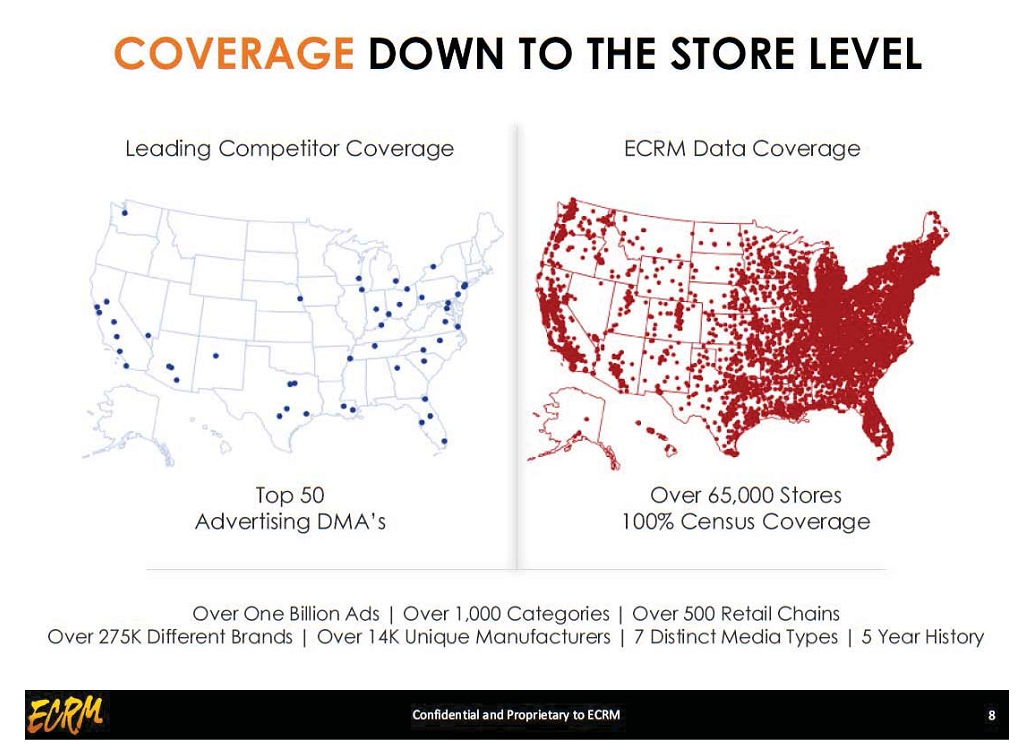
ECRM statements, particularly a slide featuring a side-by-side juxtaposition of
“Leading Competitor Coverage” of “Top 50 Advertising DMA’s” next to “ECRM Data
Coverage” of “Over 65,000 Stores” and “100% Census Coverage”:
 

ECRM didn’t dispute that this slide qualified as
advertising, but the other challenged statements were in emails to potential
customers: ECRM represented that Market Track double-counts ads in its own
data, and that ECRM has converted a high number of Market Track’s existing
customers to the ECRM service. Market Track said that these statements are
false, because it employs sophisticated techniques to avoid double counting ads
in its data, and because its own records show that fewer than 80 clients have
switched from Market Track to ECRM. However, the emails weren’t pervasive
enough to count as “commercial advertising or promotion” under the Lanham Act,
and the parties agreed that the Illinois Deceptive Trade Practices Act used the
same standards (though I would say that “commercial advertising or promotion”
is usually a point of departure for state statutes, which after all are usually
configured to allow individual consumers to sue for misrepresentations made to
them).  Under the Lanham Act, “private
one-to-one communications do not constitute ‘commercial advertising or promotion’
unless systematically communicated to a substantial portion of the relevant
market for a product, and Market Track’s 850 customers meant that two emails
that accuse Market Track of “double counting” and four emails that overstated
the number of clients who switched were more like isolated one-to-one
communications.
 
The slide remained. 
Market Track argued literal falsity, because its coverage area was
substantially larger than the graphic depicted. 
ECRM responded that the slide didn’t literally identify Market Track as
the “leading competitor” or literally say that Market Track only tracked 50
designated market areas (DMAs).  But the
other slides in the presentation did identify Market Track as the leading competitor,
and arguably the sole competitor.  Any
viewer would understand the reference to Market Track.  Moreover, the slide was literally false: the
standard is not a full statement of an untruth in words, but “a showing that
the challenged statement is unambiguous and could not reasonably be understood
to mean anything different.”  The graphic
offered a misleading juxtaposition, like other misleading comparisons found to
be literally false.  The side-by-side
maps “unambiguously communicate that the two maps are intended to be an
apples-to-apples comparison of objective fact.” 
The unavoidable conclusion was that ECRM’s coverage was complete, down
to individual stores, while Market Track’s coverage was far less complete. 
 
ECRM argued that it was just stating “that competitor
products generally collect only one sample retailer ad per DMA rather than many
ads from all stores over the entire area of a DMA.”  But that didn’t make sense. First, Market
Track’s map was arbitrarily capped at the “Top 50” DMAs, rather than the “more
than 200” DMAs tracked by Market Track.  Second, the Market Track data “inexplicably
consolidates all retailers (up to 1500) of any given DMA into a single dot on
the ‘competitor’ side but not the ECRM side.” 
Third, each “sample retailer ad” was represented by an identically sized
dot on the maps, “inviting the conclusion that the each dot represents an identical
geographical footprint.” As a result, rather than conveying a message of more
granular coverage, the slide misrepresented that ECRM’s data covered 1300 times
the geographic area as Market Track, and that Market Track didn’t offer
granularity at the retailer level.
 
Literal falsity allows deception to be presumed, and this
claim is obviously material.  Moreover, “disparaging
false statements about a competitor’s product, especially when the relevant
market is nearly entirely occupied by two competitors, harms the competitor’s
goodwill and competitive position.”  These are cognizable injuries under the Lanham
Act, “even absent a showing of business loss,” because “it is virtually
impossible to ascertain the precise economic consequences” of such harms.  Because plaintiffs need not show business
loss, the causation problems afflicting the tortious interference claim didn’t
apply here. “Market Track would be hard pressed to identify lost customers or
price erosion specifically attributable to false advertising, either, but
Market Track has identified separate injuries–to reputation and goodwill–which
naturally flow from false advertising and support the Lanham Act claim.”
 
Does eBay allow a
resulting presumption of irreparable harm? Cases in the Northern District of
Illinois continued to apply that presumption, but only one of them even cited eBay, without discussing its
implications for Lanham Act cases. Out of an abundance of caution, the court
didn’t apply a blanket presumption. 
Because the challenged conduct was “a literally false statement
disparaging the leading competitor in a market primarily shared by two
competitors,” about a material fact (coverage) which was precisely where Market
Track claimed a competitive advantage over ECRM, the court found irreparable
injury likely.
 
With that out of the way, the balance of hardships and the
public interest also weighed in favor of issuing an injunction against using
the slide or substantially similar graphics. ECRM’s voluntary cessation meant
an injunction wouldn’t burden it but didn’t moot the case.

from Blogger http://ift.tt/1CbhB97

Posted in Uncategorized | Tagged , , , , | Leave a comment

Apples-to-oranges comparison is literally false, justifies finding of irreparable harm

Market Track, LLC v. Efficient Collaborative Retail Marketing, LLC, 2015 WL 3637740, No. 14 C 4957 (N.D. Ill. June 11, 2015)
 
Market Track provides business intelligence services, principally tracking and analyzing information relating to consumer advertising. ECRM is Market Track’s principal competitor in the ad tracking business. After ECRM began competing directly with Market Track, some of Market Track’s customers switched to ECRM’s ad tracking product, while others were able to negotiate lower prices from Market Track’s products and services.
 
Market Track sued for patent infringement, tortious interference, and false advertising.  The court invalidated the patent, titled “Automatic Creation of Output Files from Images in Database,” as too abstract under Alice/Mayo.  The tortious interference with contract claims were preempted by the Illinois Trade Secret Act, because they depended on allegations of misappropriation, defined to include “breach or inducement of a breach of a confidential relationship or other duty to maintain secrecy or limit use.”  Moreover, Market Track failed to show harm from any breach. Its claimed loss of market share, price erosion, and loss of customer goodwill couldn’t be causally linked to any contractual interference, as opposed to alleged patent infringement or other factors.  For example, a 2014 Market Track study found that, despite the fact that ECRM’s data was inferior to Market Track’s in terms of coverage, granularity, and completeness, ECRM’s user interface was more appealing, ECRM’s customer service satisfaction was higher, ECRM had a reputation of being more innovative, and ECRM’s pricing was lower than Market Track’s.
 
Market Track also couldn’t get a preliminary injunction on most of its Lanham Act/state law deceptive trade practices claims, but did win on one.  Market Track challenged seven ECRM statements, particularly a slide featuring a side-by-side juxtaposition of “Leading Competitor Coverage” of “Top 50 Advertising DMA’s” next to “ECRM Data Coverage” of “Over 65,000 Stores” and “100% Census Coverage”:
 

ECRM didn’t dispute that this slide qualified as advertising, but the other challenged statements were in emails to potential customers: ECRM represented that Market Track double-counts ads in its own data, and that ECRM has converted a high number of Market Track’s existing customers to the ECRM service. Market Track said that these statements are false, because it employs sophisticated techniques to avoid double counting ads in its data, and because its own records show that fewer than 80 clients have switched from Market Track to ECRM. However, the emails weren’t pervasive enough to count as “commercial advertising or promotion” under the Lanham Act, and the parties agreed that the Illinois Deceptive Trade Practices Act used the same standards (though I would say that “commercial advertising or promotion” is usually a point of departure for state statutes, which after all are usually configured to allow individual consumers to sue for misrepresentations made to them).  Under the Lanham Act, “private one-to-one communications do not constitute ‘commercial advertising or promotion’ unless systematically communicated to a substantial portion of the relevant market for a product, and Market Track’s 850 customers meant that two emails that accuse Market Track of “double counting” and four emails that overstated the number of clients who switched were more like isolated one-to-one communications.
 
The slide remained.  Market Track argued literal falsity, because its coverage area was substantially larger than the graphic depicted.  ECRM responded that the slide didn’t literally identify Market Track as the “leading competitor” or literally say that Market Track only tracked 50 designated market areas (DMAs).  But the other slides in the presentation did identify Market Track as the leading competitor, and arguably the sole competitor.  Any viewer would understand the reference to Market Track.  Moreover, the slide was literally false: the standard is not a full statement of an untruth in words, but “a showing that the challenged statement is unambiguous and could not reasonably be understood to mean anything different.”  The graphic offered a misleading juxtaposition, like other misleading comparisons found to be literally false.  The side-by-side maps “unambiguously communicate that the two maps are intended to be an apples-to-apples comparison of objective fact.”  The unavoidable conclusion was that ECRM’s coverage was complete, down to individual stores, while Market Track’s coverage was far less complete. 
 
ECRM argued that it was just stating “that competitor products generally collect only one sample retailer ad per DMA rather than many ads from all stores over the entire area of a DMA.”  But that didn’t make sense. First, Market Track’s map was arbitrarily capped at the “Top 50” DMAs, rather than the “more than 200” DMAs tracked by Market Track.  Second, the Market Track data “inexplicably consolidates all retailers (up to 1500) of any given DMA into a single dot on the ‘competitor’ side but not the ECRM side.”  Third, each “sample retailer ad” was represented by an identically sized dot on the maps, “inviting the conclusion that the each dot represents an identical geographical footprint.” As a result, rather than conveying a message of more granular coverage, the slide misrepresented that ECRM’s data covered 1300 times the geographic area as Market Track, and that Market Track didn’t offer granularity at the retailer level.
 
Literal falsity allows deception to be presumed, and this claim is obviously material.  Moreover, “disparaging false statements about a competitor’s product, especially when the relevant market is nearly entirely occupied by two competitors, harms the competitor’s goodwill and competitive position.”  These are cognizable injuries under the Lanham Act, “even absent a showing of business loss,” because “it is virtually impossible to ascertain the precise economic consequences” of such harms.  Because plaintiffs need not show business loss, the causation problems afflicting the tortious interference claim didn’t apply here. “Market Track would be hard pressed to identify lost customers or price erosion specifically attributable to false advertising, either, but Market Track has identified separate injuries–to reputation and goodwill–which naturally flow from false advertising and support the Lanham Act claim.”
 
Does eBay allow a resulting presumption of irreparable harm? Cases in the Northern District of Illinois continued to apply that presumption, but only one of them even cited eBay, without discussing its implications for Lanham Act cases. Out of an abundance of caution, the court didn’t apply a blanket presumption.  Because the challenged conduct was “a literally false statement disparaging the leading competitor in a market primarily shared by two competitors,” about a material fact (coverage) which was precisely where Market Track claimed a competitive advantage over ECRM, the court found irreparable injury likely.
 
With that out of the way, the balance of hardships and the public interest also weighed in favor of issuing an injunction against using the slide or substantially similar graphics. ECRM’s voluntary cessation meant an injunction wouldn’t burden it but didn’t moot the case.
Posted in http://schemas.google.com/blogger/2008/kind#post, patent, remedies, tortious interference | Leave a comment

Seventh Circuit engages in target practice on descriptive fair use

Sorensen v. WD-40 Co., No. 14-3067, 2015 BL 184918 (7th Cir.
June 11, 2015)
 
The Seventh Circuit continues its pattern of telling
district judges just to eyeball cases in the expectation that they’ll be good
enough to get it right most of the time. Honestly, given how elaborate
trademark defenses have gotten, I’m not sure this is the wrong thing to do, but
it sure puts a premium on sharing common sense with federal judges.
 
Sorenson is the founder and CEO of Inhibitor Technology Corporation,
which produces a line of rust-inhibiting products containing a substance called
volatile corrosion inhibitor (VCI), sold under the incontestably registered
term THE INHIBITOR. Sorensen also claims common law trademark rights in an
orange-and-black crosshair.  Sorensen
sold a variety of products containing VCI, and generally targeted his sales at
firearm, fishing, and hunting enthusiasts, as well as members of the military.
 

WD-40 introduced a new product line, the WD-40 Specialist,
and one of its products—WD-40 Specialist Long-Term Corrosion Inhibitor, which
contains VCI and has a purpose similar to that of Sorensen’s products—contains on
its packaging both the word “inhibitor” and an orange crosshair. (WD-40
registered a simple black-and-white crosshair design, which appeared
differently on each product.)  WD-40
marketed its specialist products to tradesmen, industrial consumers, auto
consumers, construction workers, and maintenance workers, with the greatest
focus on the auto industry.  WD-40 denied
previous knowledge of Sorenson’s mark, though it did consider forming a
partnership with Sorenson’s former company and some documents indicated that
someone at the ad agency had identified Sorenson’s company.
 

Sorensen sued. The court of appeals affirmed a grant of
summary judgment in favor of WD-40.
 
The court found that WD-40’s use of “inhibitor” was descriptive
fair use.  The district court reasoned
that the word could not function as a source indicator because the Long-Term
Corrosion Inhibitor bottle also displays the famous WD-40 shield, serving as
the source indicator. The court of appeals disagreed, because products can
contain more than one indicator of source. 
Nor did WD-40’s omission of “the” matter, because, “[h]ad WD-40 called
its product ‘Inhibitor’ and placed that word in large, bold letters on its can,
we think it probable that a jury would find that to be trademark use, despite
the lack of the word ‘the.’” Nor did the presence on the market of other
products using the word “inhibitor” indicate lack of trademark use, because
that just shows descriptiveness, and descriptive terms can be used as
marks.  (One would think that widespread
use would nonetheless offer some evidence of how to bet in any given case, not
least because widespread use makes it harder for any given instance to acquire
trademark meaning.)  Moreover, it didn’t
matter that WD-40 used “inhibitor” on only one product, rather than every
product in the line.  The converse wasn’t
true: “Sorensen’s argument would be much stronger if ‘inhibitor’ appeared on
all of the products in the Specialist line.” But a mark can be a mark for just
one product in a larger line.
 
Nonetheless, the court of appeals agreed that WD-40 made
non-trademark use of the term, because look at it (interjectionary
complement because
):
 
Compared to other features in the
bottle’s design, the word “inhibitor” is much less prominent or noticeable. It
is much smaller than the bright and eye-catching WD-40 shield. It is also
smaller than the stylized and colored word “Specialist” and the colorful
crosshair mark. Finally, the word “inhibitor”—which is written in relatively
small, white type—is less attention-grabbing than even the word “Corrosion,”
which is larger and colored in orange. Due to the word’s small size, plain
color, and non-privileged placement on the bottle, we find that “inhibitor” is
not an “attention-getting symbol,” and does not function as a source indicator.
 
Although WD-40’s communications guide required that
employees and ads use the full name of the product, “WD-40 Specialist Long-Term
Corrosion Inhibitor,” that didn’t mean that each individual word in the name
served as a mark.
 
There was no doubt that “inhibitor” was descriptive of WD-40’s
product, as the multiple competing uses showed. Further, WD-40 used the word
multiple times on its bottle in a manner that was clearly non-source
identifying.  Even if “inhibitor”
required some imagination, the product was a “corrosion inhibitor,” which
required no imagination to understand. 
This wasn’t inconsistent with Fortune Dynamic, Inc. v. Victoria’s
Secret, 618 F.3d 1025 , 1035 (9th Cir. 2010), which sent the question of
whether the trademarked term DELICIOUS was being used in a descriptive sense to
a jury.  There, “delicious” was used as a
mark for women’s shoes (actually, that’s the plaintiff’s mark, not the
defendant’s use, which was on shirts), and not for a food or beverage. If “Corrosion
Inhibitor” appeared on a t-shirt, the court of appeals might’ve ruled
differently.  (Though it shouldn’t
have.  Suppose Sorenson distributes
promotional goods such as T-shirts for his products, and so does WD-40.  The result in this case should be no
different.)
 
Finally, no reasonable jury could find bad faith. There was
evidence that WD-40 had knowledge of Sorenson’s product; even though there was
no evidence that the marketing department, which decided on the name, had that
knowledge, a jury could infer that someone with decision-making authority did
know. But knowledge is insufficient to show bad faith—the plaintiff needed
something more suggesting subjective
bad faith. Failing to conduct an investigation can sometimes support an
inference of bad faith.  But if WD-40
believed that it wasn’t using the word “inhibitor” as a mark, it had no reason
to conduct a trademark search. Plus, a theory of failure to investigate is
inconsistent with Sorenson’s theory of guilty knowledge.
 
Turning to the crosshair: the analysis shouldn’t zoom in on
the crosshairs alone, but on the labeling as a whole.  Consumers looking at the entirety of the
labels wouldn’t be confused as to source. “The WD-40 bottles are primarily
black and silver, with a large yellow WD-40 shield and a bright yellow cap. The
packaging of Sorensen’s products, in contrast, is primarily orange,
yellow-orange, and black.” Even the crosshairs were quite different: “WD-40’s
silver and burnt orange crosshair, with silver symbols shaded to show depth,
creates a different impression than Sorensen’s bright orange-and-black
crosshair, which features two-dimensional symbols that are silhouettes.”  Their relative size and label placement were
different—usually the crosshair appeared as the “O” in Sorenson’s “Inhibitor,”
not as a free-standing mark near the bottom of the bottle, like on the
Specialist products. “Simply put, the overall commercial impression of the two
bottles is quite distinct.”
 
Further, the prominent display of WD-40’s own well-known
marks was a strong indication of lack of likely confusion.  Sorenson first argued that this gave owners
of strong marks carte blanche to infringe. 
But trademark law “exists primarily to protect consumers, not only the
holder of the trademark.”  And Sorenson
could have brought a reverse confusion claim, but didn’t.  Sorenson argued that consumers would think
the companies were co-branding, or that Sorenson had consented to the use.  But that theory makes more sense when the
senior user’s mark is much stronger than the junior user’s, “lending
credibility to the theory that the junior user was trying to feed off of the
senior user’s goodwill.”
 
The use of an especially strong house mark can “greatly
lessen the likelihood of confusion,” but “it may not wholly eliminate the
possibility that consumers will believe a product to be cross-branded.”  (Ahem. 
The standard, of course, is not possibility but likelihood.)  The strength of the senior user’s mark
relative to the junior user’s mark affects that possibility; the weakness of
Sorenson’s crosshair mark made it unlikely that consumers would think the
well-known WD-40 brand was cross-branding with Sorenson.  The other key consideration is the comparison
between the senior mark and the image on the junior user’s product.  “If cross-branding were indeed occurring, the
junior user would likely use an exact copy of the senior user’s mark, and probably
the name of the senior user’s product as well.” Not so here. “If cross-branding
were occurring, the junior user would seek to make it as clear as possible; it
would not use a significantly different form of a seldom-used logo.”
 
Similarity of the products: two of the products were
functionally identical, favoring Sorenson, and the court of appeals found that “consumers
might very well expect Sorensen, as the producer of rust-preventive products,
to expand his product line into the types of sprays included in the Specialist
line,” even sprays that don’t contain VCI. The fact that Sorensen’s current
products all contain VCI was “minimally relevant,” since WD-40’s own product
line showed that companies might make both VCI-containing and VCI-free
products.
 
However, the area and manner of concurrent use/channels of
commerce/targeted consumers didn’t help Sorenson much.  There was no evidence that the parties’
products had ever been sold side by side, targeted the same consumers,
advertised through the same channels, or shown at the same trade show in the
same year.  A jury could make limited
inferences in Sorenson’s favor, since both parties’ products were sold in one
store (albeit in different sections, and Sorenson’s VCI oils and sprays—the most
similar products—weren’t sold at that store). “And, though there is no evidence
that WD-40 specifically markets to Sorensen’s target audience—hunters and
fishermen—that is somewhat beside the point, as WD-40 effectively targets all
consumers.” A jury could also find that WD-40 specifically targets members of
the military by selling to companies that supply military commissaries.  Still, this only weakly supported Sorenson.
 
As for degree of care, the parties’ products were “quite
inexpensive (under $12), and could even be characterized as impulse purchases.”  Though WD-40 argued that its customers sought
out its famous brand, that didn’t matter to the relevant consumers—those who
sought to buy Sorenson’s products or would consider them, and who were misled
into buying a Specialist product.
 
Strength of the mark: Sorenson didn’t offer consumer surveys
or testimony about consumer awareness of the crosshair mark, or sales data “showing
that products bearing the mark are so widely sold that a jury could infer that
many consumers are aware of the mark.” Sorenson’s biggest problem was
inconsistent use of the mark, which makes a symbol less helpful as a source
indicator and therefore weaker.  The
crosshair had been in use since 1997, but “inconsistently—sometimes the
crosshair has symbols in each quadrant, sometimes the quadrants are empty, and
many times there is no crosshair at all, but rather a bull’s eye.” This factor
aided WD-40. 
 
There was no evidence of actual confusion, and no evidence
of a bad faith intent to pass off WD-40’s product as having come from Sorenson,
even though a jury could find that WD-40 knew of the crosshair. There was no
evidence that the design firm that first designed the WD-40 crosshair had any
knowledge of Sorensen’s mark, and the presence of the WD-40 shield on the
products suggested a lack of bad faith.
 
The factors that favored Sorenson were not enough to create
a material dispute of fact on the ultimate question of likely confusion.  The three most important factors—similarity of
the marks, bad faith intent, and actual confusion—pointed “decisively” in favor
of WD-40, especially dissimilarity of the marks. The “clear weakness” of
Sorenson’s marks was also “central” to the court’s conclusion.
 

from Blogger http://ift.tt/1MXpVzy

Posted in Uncategorized | Tagged | Leave a comment