-
Recent Posts
- State barber board wins battle against “Barber Shop” bar
- compounding pharmacies lose a round with Lilly on personalized medicine and GLP-1 comparison claims
- Bayer can’t enjoin J&J’s cancer superiority claims by showing methodological disputes
- “higher standard of safety” is puffery even as to child car seats
- phthalates could be “ingredient” for purposes of falsifying “only natural ingredients”
Recent Comments
Archives
- April 2026
- March 2026
- February 2026
- January 2026
- December 2025
- November 2025
- October 2025
- September 2025
- August 2025
- July 2025
- June 2025
- May 2025
- April 2025
- March 2025
- February 2025
- January 2025
- December 2024
- November 2024
- October 2024
- September 2024
- August 2024
- July 2024
- June 2024
- May 2024
- April 2024
- March 2024
- February 2024
- January 2024
- December 2023
- November 2023
- October 2023
- September 2023
- August 2023
- July 2023
- June 2023
- May 2023
- April 2023
- March 2023
- February 2023
- November 2021
- October 2021
- September 2021
- August 2021
- July 2021
- June 2021
- May 2021
- April 2021
- March 2021
- February 2021
- January 2021
- December 2020
- November 2020
- October 2020
- September 2020
- August 2020
- July 2020
- June 2020
- May 2020
- April 2020
- March 2020
- February 2020
- January 2020
- December 2019
- November 2019
- October 2019
- September 2019
- August 2019
- July 2019
- June 2019
- May 2019
- April 2019
- March 2019
- February 2019
- January 2019
- December 2018
- November 2018
- October 2018
- September 2018
- August 2018
- July 2018
- June 2018
- May 2018
- April 2018
- March 2018
- February 2018
- January 2018
- December 2017
- November 2017
- October 2017
- September 2017
- August 2017
- July 2017
- June 2017
- May 2017
- April 2017
- March 2017
- February 2017
- January 2017
- December 2016
- November 2016
- October 2016
- September 2016
- August 2016
- July 2016
- June 2016
- May 2016
- April 2016
- March 2016
- February 2016
- January 2016
- December 2015
- November 2015
- October 2015
- September 2015
- August 2015
- July 2015
- June 2015
- May 2015
- April 2015
- March 2015
- February 2015
- January 2015
- December 2014
- November 2014
- October 2014
- September 2014
- August 2014
- July 2014
- June 2014
- May 2014
- April 2014
- March 2014
- February 2014
- January 2014
- December 2013
- November 2013
- October 2013
- June 2013
Categories
- 230
- acpa
- advertising
- antitrust
- art law
- attribution
- blogging
- california
- cfaa
- cfps
- class actions
- cmi
- comics
- commercial speech
- conferences
- consumer protection
- contracts
- copying
- copyright
- counterfeiting
- cultural property
- damages
- dastar
- defamation
- design patent
- dilution
- disclosures
- disparagement
- dmca
- drm
- fan fiction
- fanworks
- fda
- fees
- first amendment
- ftc
- geographic indications
- http://schemas.google.com/blogger/2008/kind#post
- insurance
- jurisdiction
- libraries
- misappropriation
- music
- my lawsuits
- my writings
- parody
- patent
- patents
- preemption
- presentations
- privacy
- procedure
- reading list
- remedies
- right of publicity
- secondary liability
- securities
- standing
- surveys
- teaching
- tortious interference
- trade secrets
- trademark
- traditional knowledge
- Uncategorized
- unconscionability
- unfairness
- warranties
Meta
District court largely upholds mandatory GE disclosures
Grocery Manufacturers Assoc. v. Sorrell, 2015 WL 1931142, No. 5:14–cv–117 (D. Vt. Apr. 27, 2015)
Relax, we’ll be here for a while.
Vermont passed a law, Act 120, requiring that manufacturers and retailers identify whether raw and processed food sold in Vermont was produced in whole or in part through genetic engineering (GE), and banning manufacturers from labeling or advertising GE foods as “natural,” “naturally made,” “naturally grown,” “all natural,” or “any words of similar import.” The court largely got rid of the challenges to the GE disclosure rule, while finding likely success on the merits of GMA’s Commerce Clause and First Amendment challenges for the natural ban (though still refusing to grant a preliminary injunction).
Under Act 120, genetic engineering is defined as “a process by which a food is produced from an organism or organisms in which the genetic material has been changed” through the application of in vitro nucleic acid techniques, fusion of cells, or hybridization techniques that overcome natural barriers, “where the donor cells or protoplasts do not fall within the same taxonomic group, in a way that does not occur by natural multiplication or natural recombination.”
GE foods must be labeled clearly and conspicuously; if some of the ingredients of processed food are made with GE ingredients, the food must be labeled “partially produced with genetic engineering,” “may be produced with genetic engineering,” or “produced with genetic engineering.” However, Act 120 “shall not be construed to require” either “the listing or identification of any ingredient or ingredients that were genetically engineered” or “the placement of the term ‘genetically engineered’ immediately preceding any common name or primary product descriptor of a food.” Also, the law bans GE manufacturers from using labeling, advertising, or signage indicating that a GE food product is “‘natural,’ ‘naturally made,’ ‘naturally grown,’ ‘all natural,’ or any words of similar import that would have a tendency to mislead a consumer.”
Act 120 has a number of exemptions, including alcoholic beverages and food not packaged for retail sale and food “served, sold, or otherwise provided in any restaurant or other food establishment.”
The Vermont General Assembly made a number of findings as part of its enactment of Act 120. Among the findings: the FDA doesn’t independently test the safety of genetically engineered foods, and most tests are financed or run by manufacturers. “The FDA does not use meta-studies or other forms of statistical analysis to verify that the studies it reviews are not biased by financial or professional conflicts of interest.” There’s no consensus about the validity of this research; “there are peer-reviewed studies published in international scientific literature showing negative, neutral, and positive health results.” There are no long-term or epidemiologic studies in the US on the safety of human consumption of GE foods.
Moreover, the General Assembly declared that GE foods “potentially pose risks to health, safety, agriculture, and the environment.” It cited conflicting studies on their health consequences; the possibility of unintended consequences; the contribution of GE crops to genetic homogeneity, loss of biodiversity, and increased vulnerability of crops to pests, diseases, and variable climate conditions; the risks of cross-pollination or cross-contamination of organic crops, affecting their marketability; and the risks of cross-pollination for native flora and fauna.
Labeling, therefore, was justified as a way of letting consumers make decisions about their purchases, including letting people with anti-GE religious beliefs to avoid such food.
As for the “natural” restriction, the General Assembly found that GE “involves the direct injection of genes into cells, the fusion of cells, or the hybridization of genes that does not occur in nature,” so that labeling foods produced with genetic engineering as “natural,” “naturally made,” “naturally grown,” “all natural,” or other similar descriptors was “inherently misleading, poses a risk of confusing or deceiving consumers, and conflicts with the general perception that ‘natural’ foods are not genetically engineered.”
For the purpose of the motions before the court, the court did not decide whether the General Assembly erred in finding that GE foods posed potential risks to health, safety, agriculture, and the environment.
Plaintiffs claimed that compliance would be hugely costly; because non-GE foods are often hard to find, most of their products would have to be relabeled for sale in Vermont, and that creating a dual inventory with Vermont-specific labels and distribution channels would also be required. Smaller companies might not be able to compete, thus leading to reduced competition.
The state’s declarants disagreed, pointing out that using stickers, adding labels, or using separate packaging for products requiring a GE disclosure would be less costly and time-consuming. Changing labels is common, and the relabeling could be easily done in time: for example, Ben & Jerry’s estimated that the “entire process” of changing its packaging would cost $500 per SKU; that “a simple 4 to 6 word change to a label or package,” including the design, production, and delivery to its manufacturing facility, would be a “fairly easy” change that would take about six weeks; and that it would take six months from “package redesign to store shelf.”
The law also allows the AG to adopt rules for implementation. The rule adopted by the AG stated that “[n]atural or any words of similar import” means “the words nature, natural, or naturally.” It also limited Act 120’s “natural” restriction on advertising or signage to a “retail premises” in Vermont. It confirmed that Act 120 didn’t bar disclaimers that the FDA “does not consider food produced with genetic engineering to be materially different from other foods.” It provided that the law wouldn’t be construed to require the listing or identification of any GE ingredients; to require the placement of the term “genetically engineered” immediately preceding or following any common name or primary product descriptor of a food; or otherwise to require adding to or amending the information required by the FDA.
The court first turned to the dormant Commerce Clause challenge, as to which the plaintiffs didn’t seek a preliminary injunction. Act 120 was not facially discriminatory, and thus there couldn’t be a facial challenge. Nor did plaintiffs allege a discriminatory purpose of favoring Vermont products over the same or similar products from other states. Thus, the dormant Commerce Clause challenge depended on allegedly discriminatory effect.
Plaintiffs alleged that the “natural” restriction reached national and Internet communications that cannot lawfully be regulated by a single state. The law itself didn’t define “signage” or “advertising,” and applied to any non-exempt “[m]anufacturer” who produces, sells, distributes, or licenses GE products that are sold in or into Vermont, with no requirement that the signage and advertising occur in Vermont. The parties didn’t brief whether the AG’s final rule purporting to limit Act 120’s reach to “advertising at or in the retail premises” for food “offered for retail sale in Vermont” was lawful, so the court focused on the text of Act 120 itself.
“A state law may burden interstate commerce when it ‘has the practical effect of requiring out-of-state commerce to be conducted at the regulating state’s direction.’” Because the internet (currently) lacks boundaries, it’s difficult verging on impossible for a state to regulate internet activities without projecting its legislation into other states. “Without limitation and for no stated purpose, Act 120 purports to prohibit GE manufacturers’ use of ‘natural’ terminology in signage and advertising regardless of where or how those activities take place,” which was sufficient to state a plausible per se violation of the Commerce Clause based upon discriminatory effects.
However, the remaining Commerce Clause claims were dismissed. To run afoul of the Commerce Clause, a statute “must impose a burden on interstate commerce that is qualitatively or quantitatively different from that imposed on intrastate commerce.” Because Act 120 doesn’t “require manufacturers to label all [products] wherever distributed,” there was no Commerce Clause violation: “[t]he Vermont statute, by its terms, is indifferent to whether [products] sold anywhere else in the United States are labeled or not.” “To the extent the statute may be said to ‘require’ labels on [products] sold outside Vermont, then, it is only because the manufacturers are unwilling to modify their production and distribution systems to differentiate between Vermont-bound and non-Vermont-bound [products].” Even if the costs of compliance fell disproportionately on larger, out-of-state GE manufacturers, the regulation was evenhanded in that both in- and out-of-state producers had the same “putative need to develop separate production and distribution systems to accommodate simultaneously the Vermont market and other state markets.” They could pass costs on to Vermonters, and anyway the fact that the regulation might mean lower profits doesn’t make it violate the Commerce Clause. Further, the complaint alleged no actual conflict between Act 120 and any mandatory GE labeling law elsewhere, and “a potential statutory conflict will not suffice.”
The court likewise largely rejected plaintiffs’ preemption claims, based on the NLEA as well as the Federal Meat Inspection Act and the Poultry Products Inspection Act (for “natural”). The NLEA has express preemption provisions barring states from enacting food labeling requirements that are “not identical” to certain mandatory food labeling requirements set forth in the FDCA. To prevail, plaintiffs needed to plausibly allege that Act 120’s disclosure requirement was “not identical” to a mandatory requirement of the FDCA.
The FDA hasn’t promulgated any formal standards for GE labeling, but it provides guidance for the voluntary disclosure of GE ingredients. “This clearly implies that, at least from the FDA’s perspective, GE ingredient information may be provided without violating federal law or misbranding a food product.” There’s also pending federal legislation intended to expressly preempt state GE disclosure requirements, and the court noted that this fact suggested that no existing preemption applies. “It is in the midst of this unpromising environment that Plaintiffs claim they can overcome the presumption against preemption.”
Plaintiffs argued that the GE disclosure requirement would force them to modify the “standard of identity” for some products, “the common or usual name” for other products, and the “list of ingredients” for all products. In order to be “not identical,” plaintiffs argued, all that must happen is that the state law requires disclosure of additional or different labeling information from the FDCA. There is a federal regulation that appears to interpret “not identical” in this manner. But the courts “have rejected the proposition that a federal regulation may extend preemption beyond NLEA’s express preemption provisions.” Thus, not all state labeling requirements of more or different information are preempted. Instead, for preemption to apply, the FDCA must require the labeling at issue and Act 120’s disclosure requirement must govern the same information. (Citing POM Wonderful LLC v. Coca–Cola Co., 134 S.Ct. 2228, 2237 (2014) (“‘Congress did not intend FDA oversight to be the exclusive means’ of ensuring proper food and beverage labeling.”).)
The FDCA provides that where the FDA has established a “standard of identity” for a food, the food product’s label “must bear[ ] the name of the food specified in the definition.” Plaintiffs argued that, for example, enriched corn meal, a product for there is a standard of identity, must be labeled “enriched corn meal made from genetically engineered corn.” The plain language of the law rendered plaintiffs’ interpretation implausible. So too with plaintiffs’ argument about the impact of the law on a product’s list of ingredients, since the law specifically said it shouldn’t be construed to require “the listing or identification of any ingredient or ingredients that were genetically engineered.” The AG’s final rule clarified that the GE disclosure is also not required to be placed in a product’s “principal display panel” or “information panel.” Thus, plaintiffs failed to establish that the GE disclosure requirement was “not identical” to any mandatory labeling requirement of the FDCA.
Nor was there conflict preemption. Plaintiffs argued that they were required to label their products in a false and misleading manner by “convey[ing] an overall impression” that GE ingredients were materially different from non-GE ingredients and “not as safe as other foods” when the FDA refused to endorse this message. It certainly wasn’t impossible to comply with both state and federal law. The FDA allows voluntary GE disclosures, and Vermont pointed to what it said was a dual-compliant label voluntarily used by General Mills:
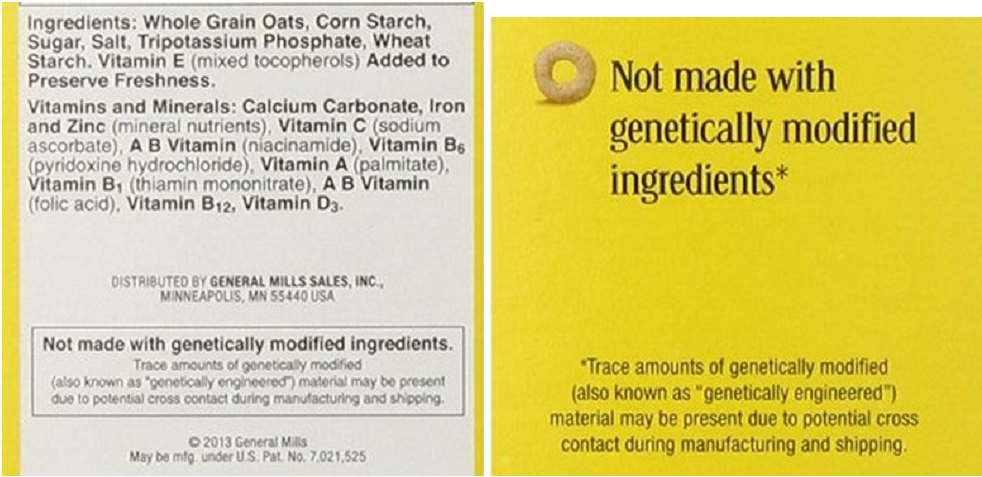
Nor did the law stand as an obstacle to Congress’s purposes. The allegedly false or misleading message of lack of safety wasn’t present on the face of the required disclosure, which made no statement about food safety. “[A]ny ‘overall impression’ that GE ingredients are ‘unsafe’ owes nothing to the purely factual information provided by it.” Further, since “genetically engineered” is not federally regulated or defined with respect to foods, “it can hardly be said that a state definition that differs from definitions used in federal policy and guidance statements is ‘false and misleading,’ or ‘stands as an obstacle to the accomplishment and execution of the full purposes and objectives of Congress.’”
Plaintiffs’ strongest argument was that the FDCA/NLEA were designed to promote national uniformity in food labeling, allowing efficient and cost-effective marketing in all 50 states. Though that makes economic sense, “it runs afoul of the presumption against preemption which ‘is particularly [strong] where Congress has indicated its awareness of the operation of state law in a field of federal interest, and has nonetheless decided to stand by both concepts and to tolerate whatever tension there [is] between them.’” And that’s the field of food and beverage regulation. So, the conflict preemption claims based on the FDCA/NLEA were dismissed.
Plaintiffs also alleged that the FMIA and PPIA “expressly preempt all state regulation of labeling of meat and poultry products, including products Act 120 does not exempt.” They argued that some GE food products that contain meat, poultry, and eggs didn’t fall within Act 120’s exemption for products “consisting entirely of or derived entirely from an animal,” are regulated for labeling purposes by the FMIA or the PPIA. However, they failed to identify even one of their members who produced a non-exempt GE food product covered by the FMIA or PPIA. Still, plaintiffs alleged sufficient facts to give them standing at the pleading stage. Both laws “contain substantially identical preemption language which permits some concurrent state enforcement but prohibits state ‘[m]arking, labeling, packaging, or ingredient requirements in addition to, or different than, those’ mandated by federal law.” Act 120 would clearly impose additional requirements, so was expressly preempted by the FMIA and PPIA for products subject to those laws. However, without more concrete evidence that plaintiffs’ members actually manufacture GE food products that are non-exempt under Act 120 and subject to the FMIA or PPIA, the court couldn’t find likely success on the merits. Moreover, the AG’s final rule purported to exempt FMIA and PPIA products from Act 120’s embrace, “and thus renders an enforcement action unlikely.” Thus, Vermont’s motion to dismiss the FMIA/PPIA related claims was denied without prejudice.
On to the First Amendment challenges! As above, the GE disclosure requirement fares well and the “natural” ban does not. Plaintiffs argued that the GE disclosure was inaccurate, confusing, and frightening: “Act 120 requires manufacturers to use their labels to convey an opinion with which they disagree, and that the State does not purport to endorse: namely, that consumers should assign significance to the fact that a product contains an ingredient derived from a genetically engineered plant.” Plaintiffs argued that strict scrutiny applied because the law compelled political speech and discriminated on the basis of viewpoint. Nope.
First, speech isn’t political just because it “emerged from an allegedly GE-hostile and politically-charged legislative environment.” Many, if not most, products can be tied to public issues about “the environment, energy, economic policy, or individual health and safety.” This was still a food labeling requirement. Plus, “objection and opposition, no matter however vehement, do not, without more, convert a disclosure requirement about a food product into a political statement.”
Nor was the regulation viewpoint discrimination just because it failed to require the disclosure of the absence of GE ingredients. There was no authority to support the proposition that, if presence of a substance is disclosed, its absence must also be disclosed to be “even-handed.” States don’t have to regulate for nonexistent problems. Nor did the mens rea requirement—exempting food produced “without the knowing or intentional use of” GE ingredients—constitute viewpoint discrimination. (Viewpoint and mental state are very different things, invoked for different purposes.)
Content-based regulations are an inherent part of acceptable speech regulations; the real question is whether the government has regulated speech because of disagreement with the message it conveys. But virtually all mandatory disclosure requirements force people to speak against their will based on the content of their speech (commercial speech) and the identity of the people speaking (commercial speakers). (Virtually?) As the Second Circuit previously wrote, “[i]nnumerable federal and state regulatory programs require the disclosure of product and other commercial information” and that subjecting each to “searching scrutiny” is “neither wise nor constitutionally required.”
Impermissible viewpoint discrimination is “based on hostility—or favoritism—towards the underlying message expressed,” and “the opinion or perspective,” or “the specific motivating ideology,” of the speaker. But GE disclosure mandates disclosure of a fact. It doesn’t require sellers to convey a “preferred message” about that fact, “and it applies regardless of a manufacturer’s or retailer’s own view of GE and GE foods.” It’s not viewpoint discrimination just because “it emerged from a contested legislative debate about the safety of GE foods” or because “it reflects the State’s preference for a legislative outcome.” The law allows sellers to add information to correct any negative connotation—“the ability to convey additional information reflecting the speaker’s own perspective and opinions renders it unlikely that a statute reflects impermissible viewpoint discrimination.”
Thus, strict scrutiny did not apply. On to intermediate scrutiny! Under Zauderer, intermediate scrutiny doesn’t apply to mandatory disclosures applied to commercial speech. Instead, “disclosure requirements [must be] reasonably related to the State’s interest in preventing deception of consumers,” or “promote informed consumer decision-making” in order to address a potential cause of harm. So did Zaudererapply?
First, the compelled speech was commercial in nature. It might not propose a commercial transaction on its own (how much does any one statement on the average package “propose” a commercial transaction?), and it might even discourage some people from engaging in commercial transactions with the seller, but it related to the economic interests of buyer and seller. “Product labeling requirements are traditionally regarded as commercial speech even if they effectively discourage the product’s consumption.”
The court then asked whether this was a factual or “controversial” disclosure. Plaintiffs argued that “[i]t would be difficult to point to a current consumer issue more controversial than genetic engineering,” and that Act 120’s definition of GE was erroneous, conflicted with other GE definitions used by the State, and conflicted with the FDA’s definition of GE. “Plaintiffs point to no authority for the proposition that speech is misleading when it fails to reflect a party’s preferred definition of a statutorily-defined term.” Though the disclosure requirement was enacted in the midst of controversy over the safety and benefits of GE foods, that’s not enough. Rather, the information that is compelled to be disclosed must itself be controversial. “[I]t is the nature of the regulation of compelled speech that controls, not the nature of the legislative debate that gave rise to its enactment.” Other courts have required that compelled disclosures must be “opinion-based” before they can be said to convey a “controversial” governmental message. “A factual disclosure does not reflect an opinion merely because it compels a speaker to convey information contrary to its interests.” Facts can be unpleasant or provoke emotions, but that doesn’t make facts into opinions. Plus, if plaintiffs believe the disclosure conveys a negative message, they can correct that message with their own disclosures, including a statement that the FDA does not consider GE food to be materially different from non-GE food.
The only remaining requirement came from the First Circuit’s Amestoy decision invalidating a disclosure requirement based only on satisfying consumer curiosity. However, Amestoy is basically limited to its facts, where the state conceded that its only interest was in satisfying curiosity. Vermont did not so concede this time. The findings and purpose extended beyond curiosity and documented the scientific debate about the safety of GE ingredients, their environmental impacts, and the state’s interest in accommodating religious beliefs about GE, “as well as its interest in providing factual information for purposes of informed consumer decision-making.” Though some of these interests “arguably border on the appeasement of consumer curiosity,” commercial disclosure requirements that enhance consumer decision-making further First Amendment interests by promoting the flow of truthful information.
However, the court declined to conclude definitively that intermediate scrutiny didn’t apply; the motion to dismiss the intermediate scrutiny challenge was denied without prejudice. (I don’t really understand this. If the level of scrutiny applied is a question of law, not a question of plausibility, why can’t the question of law be resolved now?) But there was no likely success on the merits.
We’re left now with Zauderer’s reasonable relationship test. Unsurprisingly, Act 120 passed. Because “First Amendment protection for commercial speech is justified in large part by the information’s value to consumers,” the “constitutionally protected interest in not providing the required factual information is ‘minimal.’” Zaudererapplies not just to disclosures intended to prevent deception but also to disclosures intended to better inform consumers. It wasn’t clear whether Zauderer requires a “substantial” government interest—the case itself rejected an argument that Ohio had to demonstrate its “disclosure requirement serves some substantial governmental interest” because this argument “overlooks material differences between disclosure requirements and outright prohibitions on speech.” Recent Second Circuit commercial disclosure cases did identify “substantial” interests, but did not explicitly require them. Anyway, as the D.C. Circuit observed, “the pedestrian nature of those interests affirmed as substantial calls into question whether any governmental interest—except those already found trivial by the Court—could fail to be substantial.” Assuming that a substantial interest was required, the purposes discussed above qualified; at this stage, the court viewed the legislature’s findings with deference. “The safety of food products, the protection of the environment, and the accommodation of religious beliefs and practices are all quintessential governmental interests, as is the State’s desire ‘to promote informed consumer decision-making.’” Its alleged political motivation was irrelevant; that’s the case with most legislation.
Plaintiffs argued that, nonetheless, “the harms recited in Act 120 are not real” because they “consist of speculation and conjecture about speculation and conjecture” based only on “risks,” or “mere potentiality.” But there were studies supporting both “sides” of the GE debate, so plaintiffs couldn’t plausibly allege that Vermont’s evidence wasn’t “real”—only that it wasn’t persuasive.
Finally, plaintiffs argued that there wasn’t a proper fit between the disclosure and the state’s interest, because a disclosure that a product “may” contain GE ingredients didn’t further the legislature’s purpose. But the disclosure satisfied the reasonable relationship standard. A state’s interest in “encouraging … changes in consumer behavior” through compelled disclosure is “rationally related” to a disclosure requirement even if it’s not the best means of furthering that goal. Nor is there a requirement that a disclosure law be comprehensive. The Vermont General Assembly was therefore entitled to “take one step at a time.”
Because the factual record was undeveloped, though, the court denied Vermont’s motion to dismiss this claim without prejudice. Still, there was no likely success on the merits.
Now to the “natural” restriction. None of plaintiffs’ members identified any specific products that contained GE ingredients but were nonetheless labeled “natural.” This didn’t deprive them of standing, but it did affect entitlement to injunctive relief.
First, Vermont failed to show that the use of “natural” was “inherently or actually” misleading. A state can’t completely ban statements that aren’t actually or inherently misleading, and the state has the burden of justifying its speech restriction. Because the law didn’t define “natural,” the state faced an “uphill battle” in showing actual/inherent misleadingness in the absence of a statutory or regulatory definition as a metric. Nor did the state show there was a single, accepted definition of the term, only that various definitions “share[d] commonalities.”
Vermont argued that, no matter how “natural” is defined, it couldn’t apply to GE foods because GE techniques were definitionally manmade, artificial, and not existing in nature. Both the World Health Organization and one of the members of plaintiff GMA, Monsanto, “define genetically modified organisms as those that have been altered from their ‘natural’ state.” But there are lots of purposeful interferences with plant production, from greenhouses and fertilizers to watering and weeding plants. “[A]ltering seeds and plants from their “natural” state has occurred for centuries through techniques such as selective breeding, hybridization, cross pollination, and grafting.” “Natural” was thus a standardless term “that virtually no food manufacturer could satisfy.”
The court also considered the General Assembly’s finding that “natural” was actually/inherently misleading as applied to GE foods with its further finding that the term “poses a risk of confusing or deceiving consumers,” because “[s]peech that is inherently misleading poses more than a risk of confusion or deception, and it is for this reason it receives no First Amendment protection.” I think the court is collapsing various kinds of probabilities—not everyone will be fooled even by the most blatant of falsehoods, or the most subtle. As the court notes below, fooling a substantial percentage of relevant consumers is enough to justify regulation, and we can conclusively presume that inherently misleading/false speech will do so. The reason false/inherently misleading/actually misleading speech receives no constitutional protection is that its benefits are substantially outweighed by its harms, which is a normative as well as an empirical judgment.
Plus, the law’s numerous exemptions undermined Vermont’s position on inherent misleadingness. Why would “natural” terms be inherently deceptive as applied to some foods and not others? The state’s evidence of actual misleadingness came from a 2010 survey conducted by The Hartman Group, purportedly showing that 61% of consumers “believed” that “natural” suggests or implies “the absence of genetically engineered food.” The Hartman report concluded that “natural” was increasingly meaningful to consumers desiring fresh, real foods, but that arguably conflicted with its further finding that “natural as a marketing term remains vague and unappealing to consumers.”
Anyway, “[a] survey asking whether certain consumers think GE is a ‘fundamentally unnatural’ process, is not the equivalent of actual and unsolicited citizen problems or complaints regarding GE manufacturers’ use of ‘natural’ terminology.” [How would the citizens know to complain in the absence of GE disclosures? Also, as stated, this conclusion is inconsistent with the court’s later invocation of the Lanham Act standard, since surveys are regularly accepted in Lanham Act cases. Perhaps the court means that this kind of survey—asking for whether something is misleading—is not probative, whereas a different kind of survey, asking consumers what they took away from the “natural” label, would be probative.] At most, Vermont had “some evidence that some consumers may find the use of ‘natural’ terminology in conjunction with GE food misleading depending on how ‘natural’ is defined.” That wasn’t enough to support an outright ban on commercial speech.
Because the speech was only potentially misleading, Act 120’s “natural” regulation had to survive Central Hudson. It didn’t. Where speech isn’t false or misleading (note how “potentially” misleading speech is treated here as not false or misleading; that didn’t have to be the case), the government’s interest must be substantial, the restriction must directly and materially advance the governmental interest, and the restriction must be no more extensive than necessary to serve that interest.
The court returned to falsity: “Whether Act 120 restricts false and misleading speech in anything other than a random and arbitrary manner turns on how ‘natural’ is defined.” If “natural” means occurring or existing “in nature,” then virtually no food products qualify, and GE manufacturers weren’t the only commercial speakers who should be restricted from its use. Likewise, if “natural” means “nothing artificial” or “less processed,” then products with preservatives, stabilizers, artificial colorings, or flavorings should also be covered. Vermont didn’t identify a substantial state interest that is served by restricting the use of undefined terms by some, but not all, similarly-situated commercial speakers.
Even potential misleadingness didn’t show a substantial state interest. (Note the tension with the Zauderer section, where the court pointed out that almost any interest is substantial if not trivial.) The Second Circuit has questioned whether there can ever be a substantial state interest in banning “potentially misleading” commercial speech: “If the protections afforded commercial speech are to retain their force, we cannot allow rote invocation of the words potentially misleading to supplant the State’s burden. Moreover, it is unclear what harm potentially misleading advertising creates, and the state bears the burden of proving that the harms it recites are real and that its restrictions will in fact alleviate them to a material degree.” But that’s not about the substantiality of the interest, it’s about the other elements of Central Hudson, though I guess that’s just quibbling.
Unsurprisingly, Vermont failed to show that the “natural” restriction “directly and materially advances” that state interest and was “no more extensive than necessary to serve that interest.” Without a definition of “natural,” the law swept either too broadly or too narrowly. The addition of “any words of similar import” “essentially leaves GE manufacturers guessing regarding which advertising terms are prohibited.” Plus, the exemptions showed that Vermont would tolerate continued use of “natural” for some GE foods and beverages, without explaining why that use is ok. Finally, Vermont’s consumer protection statutes could address misleading use of “natural,” and the GE disclosure requirement could let consumers make up their own minds about whether a GE food product is “natural.”
“[R]estrictions on commercial speech to prevent consumer deception should be limited to those instances when actual deception is likely, or when a reasonable consumer would be deceived.” Speculation or conjecture aren’t enough to satisfy the state’s burden. Here, whether the promised benefits materialized depended almost entirely on how “natural” was defined. Thus, plaintiffs showed likely success on the merits of their claim against the “natural” restrictions.
Further, they showed likely success on the facial invalidity of Act 120’s restriction of the use of “any words of similar import.” The law didn’t define that phrase, and the AG’s rule made the phrase surplusage by just repeating already-regulated words; that approach wasn’t supported by Vermont law. Though the law required that “any words of similar import” have “a tendency to mislead a consumer,” that wasn’t enough because the law didn’t include a limitation to reasonableconsumers, or to instances where the ad as a whole was misleading. This contrasted with Vermont law generally, which used an objective reasonable consumer standard. (Why that can’t be implied is unclear.) The Lanham Act cases on which Vermont relied were distinguishable, because they required proof of “extrinsic evidence [of consumer deception or confusion] to support a finding of an implicitly false message.” (Citing Tiffany (NJ) Inc. v. eBay Inc., 600 F.3d 93 (2d Cir. 2010).) Thus, the void for vagueness challenge was likely to succeed, though the phrase was severable.
Preliminary injunction: the Second Circuit doesn’t presume irreparable harm in cases involving allegations of the abridgement of First Amendment rights unless “the challenged government action directly limited speech.” Where the effect on speech is only potential the plaintiff must show a causal link between the injunction and its alleged injury. Plaintiffs’ arguments about irreparable harm were primarily directed to the burdens imposed by the GE disclosure requirements, which challenges were unlikely to succeed. They identified few burdens of complying with the “natural” and “any words of similar import” bans—other than unspecific allegations, they provided no evidence of any member’s actual use of the “natural” terminology or “any words of similar import” in conjunction with a GE product. They thus couldn’t show irreparable harm. Nor had they been threatened with any enforcement action.
Likewise, plaintiffs didn’t identify any of their members who currently produce non-exempt GE products that are governed by either the FMIA or the PPIA. Given the AG’s rule’s exemption from Act 120 for any “[p]ackaged, processed food containing meat or poultry” subject to the FMIA and PPIA, “an enforcement action against these GE manufacturers appears unlikely.”
Without irreparable harm, there could be no preliminary injunction.
Eco-friendliness is functional; so is rustic look of burlap
Farmgirl Flowers, Inc. v. Bloom That, Inc., No. 14-CV-05657, 2015 WL 1939424 (N.D. Cal. Apr. 28, 2015)
Farmgirl, a San Francisco-based florist selling locally farmed arrangements, sought a preliminary injunction against competitor Bloom That prohibiting it from using burlap sack material, or anything confusingly similar in appearance, in connection with the sale of flowers. The court denied the motion on utilitarian and aesthetic functionality grounds.
In 2010, Farmgirl began using a wrapping made out of recycled burlap sacks that were once used to hold coffee beans. Farmgirl argued that this wrapping had no utilitarian advantage t over traditional kraft paper or cellophane wrapping; in fact, there’s a paper underlayer because, Farmgirl argued, burlap “does not function as well as traditional cellophane or kraft paper wrapping.” Farmgirl’s revenues grew rapidly after it introduced the burlap wrap, and revenues for 2015 were expected to reach $2 million. Farmgirl claimed that customers and others in the industry associated it with its Coffee Sack Burlap Wrap, and that it received national media coverage featuring its trade dress.
Bloom That is an online flower delivery service that delivers bouquets of flowers in 90 minutes or less. Bloom That launched in San Francisco and set up shop within one mile of Farmgirl’s headquarters and in Farmgirl’s primary sales territory. It initially sold bouquets that had been wrapped in recycled burlap donated by local coffee roasters, then began wrapping its bouquets in new, rather than recycled, burlap. Bloom That also claims to source locally-grown flowers for use in its bouquets and delivers its bouquets via bicycle courier. It first wraps the flowers with a material designed to hydrate the flowers during delivery, than an outer layer of burlap plus its own branding of an orange and white striped ribbon and a paper “luggage” tag fastened with a wooden clothes pin. Bloom that claimed to use burlap because the “hydration pack” was neither aesthetically pleasing nor was it sufficient to hold the flowers together.
Bloom contended that (1) burlap holds up to repeated wet and dry cycles without losing its shape, durability, or function; (2) burlap is less expensive (at $.50—$.65 per unit) than similarly durable fabrics such as canvas (at $5 per unit); (3) burlap is more environmentally friendly than petroleum-based products and burlap can also be reused; and (4) it provides the “curated look” that Bloom That’s customers find popular. The functional properties of burlap allegedly made it an ideal wrapping for bouquets delivered using a bicycle courier because of its moisture absorption and water-resilient capabilities. According to Bloom That, it now uses new burlap because the recycled burlap was inconsistent in appearance and texture and sometimes smelled of coffee or mildew.
In September 2013, Farmgirl applied to register “three-dimensional product packaging composed of a burlap material.” It was approved for publication, and Bloom That has opposed. (And given B&B, presumably it would be bound by a PTO nonfunctionality finding if fully litigated at the PTO, absent this case. The PTO issued a conditional functionality refusal based on the initial inclusion of the shape of the wrapper in the applied-for mark, but withdrew it once the drawing included dotted lines for the shape.)
Because the registration hadn’t issued, Farmgirl had the burden of showing nonfunctionality. Along with the arguments above, Bloom That identified a utility patent claiming wrapping flower bouquets with burlap, and argued that, while burlap may be comparable in costs to paper or cellophane wraps, a material of similar strength and durability (canvas) would cost up to ten times more per unit.
The court agreed that on the present record burlap appeared functional, considering particularly its utilitarian advantages and cost. Farmgirl’s application was broad, claiming simply a burlap wrap for live flower arrangements. Using a specific material in product packaging may be protectable trade dress, but Bloom That showed many examples of the utilitarian use of burlam in transporting agricultural products and Farmgirl’s alleged trade dress wasn’t restricted by color, size, or shape. The evidence showed that “burlap has been in use for more than 150 years, and is known for its strength, water resilience, and versatility.” These properties, combined with its low cost, led to its use as packaging for many commodities, such as coffee, and for the transportation of live plants. That suggested a utilitarian advantage for wrapping live floral arrangements. Similarly, Bloom That contended that burlap was superior for bicycle delivery, which may expose bouquets to water from exterior sources such as rain. An alternative fabric with similar water-resilient properties, such as canvas or hemp, would be more expensive. Farmgirl did not show that burlap didn’t yield utilitarian benefits when used to wrap bouquets for delivery.
Bloom That additionally argued that burlap’s environmental benefits over plastic supported a functionality finding. Eco-friendliness may independently support a finding of functionality, especially where—as here—there was evidence that this feature was important to consumers—eco-friendliness was a benefit that consumers wished to purchase, which is one definition of a functional feature. Other materials may also be eco-friendly, but if burlap provides eco-friendliness than it is functional. (Cf. Traffix—if it’s the reason the product works, no other alternatives need by tried.)
As for the burlap-wrapping patent, it was strong evidence of functionality. Farmgirl didn’t meet its heavy burden of overcoming that evidence. Though the patent listed materials other than burlap as being suitable for wrapping bouquets using its method, two dependent claims specifically limited the claimed invention to burlap. Plus, the suitability of other materials was relevant to whether alternative designs were available, not to whether burlap had utilitarian advantages.
Independently, Farmgirl failed to carry its burden to show “that a burlap bouquet wrap likely does not result from a comparatively simple or inexpensive method of manufacture.” Farmgirl’s use of burlap decreased its costs because it got its burlap free from local coffee roasters. Bloom That also showed that burlap was less expensive than fabrics of similar durability. Effect on cost was strong evidence of functionality.
As for other factors in the functionality determination—advertising touting utilitarian advantages, and availability of alternative designs—these were neutral. The lack of ads touting burlap as functional was not relevant, and, since Farmgirl failed to show that the trade dress likely provided no utilitarian advantages, there was no need to speculate about other design possibilities.
Separately, Farmgirl failed to carry its burden of showing that its trade dress wasn’t aesthetically functional. According to Bloom That’s CEO, “[b]urlap is popular among Bloom That’s customers,” “[t]he appearance of a bouquet is one of the most important factors in its sale,” and burlap “provides a curated look.” Bloom That provided evidence that burlap began appearing as a trendy material in 2009 and was “commonly used to infuse a ‘rustic’ look in otherwise ordinary décor,” including examples of brides using burlap to wrap wedding bouquets.
While Farmgirl argued that using burlap served a source-identifying function for Farmgirl, Farmgirl failed to meet its burden of so showing. (Compare to the PTO’s process, which allowed the application to proceed to publication on a 2(f) basis.) “[T]he scope of trade dress protection sought by Farmgirl would foreclose any other florist from using burlap as a wrapping for a bouquet, even if the bouquet or burlap clearly identified the source of the bouquet by the use of the florist’s brand name or logo.” Its alleged trade dress wasn’t limited in color, shape, or size, even though its recycled burlap still bore the mark of the original coffee roaster. “Farmgirl has failed to carry its burden to establish that the consumer would associate any use of burlap as a wrapping material for a bouquet of flowers with a single florist, rather than improving the appeal of the bouquet.” Bloom That showed that “one of the essential selling features of a flower bouquet, if indeed not the primary feature, is its aesthetic appearance,” and that a burlap wrap for floral arrangements was aesthetically pleasing.
Posted in trademark
Leave a comment
DC Comics thinks derivative works are creator-less
According to this post by a DC Comics artist (who created Felicity Smoak!). This raises fascinating contract issues, as well as depressingly highlighting artists’ lack of bargaining power.
from Blogger http://ift.tt/1zqOnYb
DC Comics thinks derivative works are creator-less
According to this post by a DC Comics artist (who created Felicity Smoak!). This raises fascinating contract issues, as well as depressingly highlighting artists’ lack of bargaining power.
The dangers of only arguing one half of 43(a)
Diodato v. Wells Fargo Ins. Servs., USA, Inc., 44 F. Supp. 3d 541 (M.D. Pa. 2014)
Darrell Diodato was employed by Wells Fargo Insurance for thirty-six years as an insurance producer, servicing existing insurance business and originating new insurance business. He specialized in brokering insurance for bowling alleys and family entertainment centers, developing “numerous personal and business relationships with owners” and considering himself to be “the godfather” of the bowling alley insurance industry. Approximately 70% of the revenue he generated was derived from bowling center owners and operators. He signed a trade secret/nondisclosure/nonsolicitation agreement in 2009, allegedly at threat of losing his job.
Wells Fargo fired him in 2011; the parties’ accounts of why diverged drastically, with Wells Fargo claiming job-related misbehavior and Diodato claiming they wanted to get his book of business without having to pay him.After the termination, Wells Fargo distributed about 53 insurance-related documents which identified Diodato as the producer on their respective accounts. (Advertising or promotion?) Wells Fargo continued to run advertisements in Roller Skating Business using Diodato’s name until at least February of 2012 and continued to identify him as a producer on the Wells Fargo website months after his termination.
Diodato subsequently began working with Wells Fargo competitors. He denied that he solicited business from former Wells Fargo clients, but admitted that he maintained relationships with them and told them how to switch to his new business if they asked. Many of the clients he serviced at Wells Fargo indeed “left or removed their accounts from [Wells Fargo] in the period following [his] termination.” Wells Fargo sent cease and desist letters to the competitors, alleging Diodato’s breach of the nonsolicitation agreement and demanding that each ensure Diodato’s compliance with the agreement’s terms.
The court granted summary judgment on Diodato’s fraudulent inducement, breach of contract, and breach of the duty of good faith & fair dealing claims. The unjust enrichment claim also failed because Diodato failed to show that Wells Fargo received an uncompensated benefit from him.
Defamation/commercial disparagement: Diodato alleged three different types of defamation: that his superior informed a Wells Fargo business manager, that Diodato’s actions were “not in Wells Fargo’s best interests”; that the superior “painted a picture” to the head underwriter for an insurer that Diodato’s “business practices were suspect and that he was insubordinate”; and that Wells Fargo’s counsel advised the competitors that Diodato was in violation of the nonsolicitation agreement. The first statement was merely opinion: it was “ambiguous, obscure, and does not imply the existence of specific defamatory facts.” The “best interests” statement didn’t imply a violation of any particular duty or other responsibility as a Wells Fargo employee. However, Wells Fargo didn’t get rid of the “suspect/insubordinate” claim because its only argument was that Diodato failed to sufficiently identify an actual statement. The record showed that the challenged meeting occurred and that Diodato was explicitly described as “insubordinate” and his business practices as “suspect.” As for the C&Ds, Wells Fargo successfully asserted a “competitors privilege.” See Gresh v. Potter McCune Co., 235 Pa.Super. 537, 344 A.2d 540 (1975). In such circumstances, a conditional privilege applied, and Diodato failed to show abuse of the privilege, given Wells Fargo’s argument that it reasonably believed that its efforts were necessary to protect its legitimate and protectable interests as identified in the nonsolicitation agreement.
However, the agreement’s post-employment prohibition on “accepting the unsolicited business of former clients” was broader than necessary to protect against Wells Fargo’s legitimate concerns, and struck it as unenforceable as a matter of law.
Diodato’s claim for violation of §43(a)(1)(B) survived because Wells Fargo only made arguments about §43(a)(1)(A); his claims were based on Wells Fargo’s continued use of his name on its website for nearly seven months after Diodato’s termination and its continued use of his name as its representative in Roller Skating Business after his termination. The complaint clearly alleged a “false or misleading description of representation or fact,” and expressly stated the statutory requirements of both a false designation claim and a false advertising claim. While Diodato abandoned his §43(a)(1)(A) claim, Wells Fargo had notice of the false advertising claim and it therefore survived summary judgment. (It seems extremely unlikely that someone who can’t win a §43(a)(1)(A) claim could show the extra elements of commercial advertising or promotion plus materiality.) The Pennsylvania common law of unfair competition tracks the Lanham Act, so that survived too.
Diodato’s statutory claim for unauthorized use of his name, in violation of Pennsylvania’s Unauthorized Use of Name or Likeness statute survived. That law creates a cause of action for any “person whose name or likeness has commercial value and is used for any commercial or advertising purpose without written consent….” Diodato sufficiently established commercial value in his name. “The record reveals that Diodato has developed long-standing personal relationships with many of the clients he serviced while working for Wells Fargo, and he argues that, in the context of the roller skating and bowling alley insurance businesses, his name ‘has significant commercial value.’” He averred that, over the course of more than 30 years, (1) he spent his own money supporting various fundraising activities; (2) he entertained contacts at annual industry meetings; and (3) he paid $12,000 annually from his own commission revenue to account for costs relating to Wells Fargo’s endorsement of a bowling industry organization. This would allow a trier of fact to find that he expended time, effort, and money “in excess of what any salesperson does to generate customers.”
The court denied summary judgment on Wells Fargo’s breach of contract counterclaim; a jury had to decide exactly what role Diodato played in the transition of his former clients’ business. Wells Fargo lost its trade secret claim because it didn’t provide evidence showing exactly what information it believed Diodato misappropriated or the manner in which he did so. Finally, the gist of the action doctrine barred Wells Fargo’s remaining tort claims for unfair competition, conversion, and tortious interference with existing and prospective contractual relations, because these claims were derivative of its breach of contract claim.
from Blogger http://ift.tt/1zoY49p
The dangers of only arguing one half of 43(a)
Diodato v. Wells Fargo Ins. Servs., USA, Inc., 44 F. Supp. 3d 541 (M.D. Pa. 2014)
Darrell Diodato was employed by Wells Fargo Insurance for thirty-six years as an insurance producer, servicing existing insurance business and originating new insurance business. He specialized in brokering insurance for bowling alleys and family entertainment centers, developing “numerous personal and business relationships with owners” and considering himself to be “the godfather” of the bowling alley insurance industry. Approximately 70% of the revenue he generated was derived from bowling center owners and operators. He signed a trade secret/nondisclosure/nonsolicitation agreement in 2009, allegedly at threat of losing his job.
Wells Fargo fired him in 2011; the parties’ accounts of why diverged drastically, with Wells Fargo claiming job-related misbehavior and Diodato claiming they wanted to get his book of business without having to pay him.After the termination, Wells Fargo distributed about 53 insurance-related documents which identified Diodato as the producer on their respective accounts. (Advertising or promotion?) Wells Fargo continued to run advertisements in Roller Skating Business using Diodato’s name until at least February of 2012 and continued to identify him as a producer on the Wells Fargo website months after his termination.
Diodato subsequently began working with Wells Fargo competitors. He denied that he solicited business from former Wells Fargo clients, but admitted that he maintained relationships with them and told them how to switch to his new business if they asked. Many of the clients he serviced at Wells Fargo indeed “left or removed their accounts from [Wells Fargo] in the period following [his] termination.” Wells Fargo sent cease and desist letters to the competitors, alleging Diodato’s breach of the nonsolicitation agreement and demanding that each ensure Diodato’s compliance with the agreement’s terms.
The court granted summary judgment on Diodato’s fraudulent inducement, breach of contract, and breach of the duty of good faith & fair dealing claims. The unjust enrichment claim also failed because Diodato failed to show that Wells Fargo received an uncompensated benefit from him.
Defamation/commercial disparagement: Diodato alleged three different types of defamation: that his superior informed a Wells Fargo business manager, that Diodato’s actions were “not in Wells Fargo’s best interests”; that the superior “painted a picture” to the head underwriter for an insurer that Diodato’s “business practices were suspect and that he was insubordinate”; and that Wells Fargo’s counsel advised the competitors that Diodato was in violation of the nonsolicitation agreement. The first statement was merely opinion: it was “ambiguous, obscure, and does not imply the existence of specific defamatory facts.” The “best interests” statement didn’t imply a violation of any particular duty or other responsibility as a Wells Fargo employee. However, Wells Fargo didn’t get rid of the “suspect/insubordinate” claim because its only argument was that Diodato failed to sufficiently identify an actual statement. The record showed that the challenged meeting occurred and that Diodato was explicitly described as “insubordinate” and his business practices as “suspect.” As for the C&Ds, Wells Fargo successfully asserted a “competitors privilege.” See Gresh v. Potter McCune Co., 235 Pa.Super. 537, 344 A.2d 540 (1975). In such circumstances, a conditional privilege applied, and Diodato failed to show abuse of the privilege, given Wells Fargo’s argument that it reasonably believed that its efforts were necessary to protect its legitimate and protectable interests as identified in the nonsolicitation agreement.
However, the agreement’s post-employment prohibition on “accepting the unsolicited business of former clients” was broader than necessary to protect against Wells Fargo’s legitimate concerns, and struck it as unenforceable as a matter of law.
Diodato’s claim for violation of §43(a)(1)(B) survived because Wells Fargo only made arguments about §43(a)(1)(A); his claims were based on Wells Fargo’s continued use of his name on its website for nearly seven months after Diodato’s termination and its continued use of his name as its representative in Roller Skating Business after his termination. The complaint clearly alleged a “false or misleading description of representation or fact,” and expressly stated the statutory requirements of both a false designation claim and a false advertising claim. While Diodato abandoned his §43(a)(1)(A) claim, Wells Fargo had notice of the false advertising claim and it therefore survived summary judgment. (It seems extremely unlikely that someone who can’t win a §43(a)(1)(A) claim could show the extra elements of commercial advertising or promotion plus materiality.) The Pennsylvania common law of unfair competition tracks the Lanham Act, so that survived too.
Diodato’s statutory claim for unauthorized use of his name, in violation of Pennsylvania’s Unauthorized Use of Name or Likeness statute survived. That law creates a cause of action for any “person whose name or likeness has commercial value and is used for any commercial or advertising purpose without written consent….” Diodato sufficiently established commercial value in his name. “The record reveals that Diodato has developed long-standing personal relationships with many of the clients he serviced while working for Wells Fargo, and he argues that, in the context of the roller skating and bowling alley insurance businesses, his name ‘has significant commercial value.’” He averred that, over the course of more than 30 years, (1) he spent his own money supporting various fundraising activities; (2) he entertained contacts at annual industry meetings; and (3) he paid $12,000 annually from his own commission revenue to account for costs relating to Wells Fargo’s endorsement of a bowling industry organization. This would allow a trier of fact to find that he expended time, effort, and money “in excess of what any salesperson does to generate customers.”
The court denied summary judgment on Wells Fargo’s breach of contract counterclaim; a jury had to decide exactly what role Diodato played in the transition of his former clients’ business. Wells Fargo lost its trade secret claim because it didn’t provide evidence showing exactly what information it believed Diodato misappropriated or the manner in which he did so. Finally, the gist of the action doctrine barred Wells Fargo’s remaining tort claims for unfair competition, conversion, and tortious interference with existing and prospective contractual relations, because these claims were derivative of its breach of contract claim.
briefly noted: another court rejects proof of purchase requirement for class ascertainability
Really briefly! In re Scotts EZ Seed Litig. 304 F.R.D. 397 (S.D.N.Y. 2015). It would defeat the purpose of class actions. Also, though, there couldn’t be an injunctive relief class after the challenged statement was removed from packaging.
from Blogger http://ift.tt/1EdtOwU
Court makes the write choice on descriptive fair use
Marketquest Group, Inc. v. BIC Corp., No. 11-cv-618 BAS
(S.D. Cal. Apr. 17, 2015)
Marketquest sued BIC for infringing its registrations for ALL-IN-ONE
and THE WRITE CHOICE for, among other things, pens. BIC included “The Write Pen Choice” in online
advertising and displays for writing instruments, including its pens, in 2010. The
ads included BIC ® and ROUND STIC ® at the top of the page, followed by “The WRITE
Pen Choice for 30 years!,” unaccompanied by either TM or ®. A BIC subsidiary that sells promotional
products, Norwood, included the phrase “All in ONE” on its 2011
product catalogue. Norwood ® was printed in a larger font on the cover of the
catalogue, and “All in ONE” appeared below and to the right of it.
and THE WRITE CHOICE for, among other things, pens. BIC included “The Write Pen Choice” in online
advertising and displays for writing instruments, including its pens, in 2010. The
ads included BIC ® and ROUND STIC ® at the top of the page, followed by “The WRITE
Pen Choice for 30 years!,” unaccompanied by either TM or ®. A BIC subsidiary that sells promotional
products, Norwood, included the phrase “All in ONE” on its 2011
product catalogue. Norwood ® was printed in a larger font on the cover of the
catalogue, and “All in ONE” appeared below and to the right of it.
The court initially determined that these uses had “some
likelihood of confusion” and the “potential” for infringement and the case
proceeded to summary judgment, which BIC then won on fair use. Fair use requires descriptive use, other than
as a mark, fairly and in good faith only to describe the defendant’s goods or
services. Some possibility of confusion
is compatible with fair use, since the existence of the defense reflects “the
undesirability of allowing anyone to obtain a complete monopoly on use of a
descriptive term simply by grabbing it first.”
The Ninth Circuit has said that the degree of consumer confusion remains
a factor, along with “the strength of the trademark, the descriptive nature of
the term for the product or service being offered by [the plaintiff] and the
availability of alternate descriptive terms, the extent of the use of the term
prior to the registration of the trademark, and any differences among the times
and contexts in which [the plaintiff] has used the term.” (Follow along and see how many of these the
court considers—which says more about the undesirability of the Ninth Circuit’s
laundry list than the quality of the district court’s analysis here.)
likelihood of confusion” and the “potential” for infringement and the case
proceeded to summary judgment, which BIC then won on fair use. Fair use requires descriptive use, other than
as a mark, fairly and in good faith only to describe the defendant’s goods or
services. Some possibility of confusion
is compatible with fair use, since the existence of the defense reflects “the
undesirability of allowing anyone to obtain a complete monopoly on use of a
descriptive term simply by grabbing it first.”
The Ninth Circuit has said that the degree of consumer confusion remains
a factor, along with “the strength of the trademark, the descriptive nature of
the term for the product or service being offered by [the plaintiff] and the
availability of alternate descriptive terms, the extent of the use of the term
prior to the registration of the trademark, and any differences among the times
and contexts in which [the plaintiff] has used the term.” (Follow along and see how many of these the
court considers—which says more about the undesirability of the Ninth Circuit’s
laundry list than the quality of the district court’s analysis here.)
As for “All in ONE,” the court found that it had the meaning
“an entity or object which combines all the required or appropriate elements,
items, or functions in one” for over 130 years.
All didn’t mean “everything,” but “everything appropriate.” Marketquest
argued that “all in one” wasn’t descriptive because Norwood “produced other
catalogs in addition to their `all in ONE’ Catalog that year which featured
their housemarks and sub-brands.” So
what? “All in one” meant “appropriately
consolidated.” “Trademark fair use is designed to protect uses of the plain
meanings of common words, and semantic contortions cannot render Norwood’s
meaning or use uncommon.”
“an entity or object which combines all the required or appropriate elements,
items, or functions in one” for over 130 years.
All didn’t mean “everything,” but “everything appropriate.” Marketquest
argued that “all in one” wasn’t descriptive because Norwood “produced other
catalogs in addition to their `all in ONE’ Catalog that year which featured
their housemarks and sub-brands.” So
what? “All in one” meant “appropriately
consolidated.” “Trademark fair use is designed to protect uses of the plain
meanings of common words, and semantic contortions cannot render Norwood’s
meaning or use uncommon.”
When a trademark owner claims a descriptive phrase, it
accepts the risk that such marks are weak and that others will make descriptive
fair use of them. Norwood used the
common meaning of “all in one,” other than as a mark. The only remaining issue was BIC’s good
faith. Knowledge of the marks alone was
not enough. “While it is true that a
larger corporation may not roll over a small corporation’s mark, any
organization that imbues secondary meaning to common phrases assumes the risk
that another organization in the same business sphere will use that phrase for
its common meaning. Marketquest was on notice that its ALL-IN-ONE marks were,
by their very nature, susceptible to such confusion.” Marketquest also claimed that the use of both
marks in the same year demonstrated bad faith, but use of two common
descriptive phrases in “wide-ranging marketing materials” was also
insufficient.
accepts the risk that such marks are weak and that others will make descriptive
fair use of them. Norwood used the
common meaning of “all in one,” other than as a mark. The only remaining issue was BIC’s good
faith. Knowledge of the marks alone was
not enough. “While it is true that a
larger corporation may not roll over a small corporation’s mark, any
organization that imbues secondary meaning to common phrases assumes the risk
that another organization in the same business sphere will use that phrase for
its common meaning. Marketquest was on notice that its ALL-IN-ONE marks were,
by their very nature, susceptible to such confusion.” Marketquest also claimed that the use of both
marks in the same year demonstrated bad faith, but use of two common
descriptive phrases in “wide-ranging marketing materials” was also
insufficient.
Plus, Norwood “largely mitigated the risk of confusion” by
prominently printing its NORWOOD® mark in every location including the phrase. “Spatially,
there is no implied association between the Norwood mark and the All in ONE
descriptor. All in ONE is printed in a standard font, and it is followed by a
list of generic types of items included in the catalog.” Several places in the
catalog also explained the phrase’s context, including: “Our primary product
resource, featuring all product lines in ONE catalog.” Norwood did “everything
possible, short of an explicit disclaimer, to mitigate the risk of confusion,”
and disclaimers aren’t required.
prominently printing its NORWOOD® mark in every location including the phrase. “Spatially,
there is no implied association between the Norwood mark and the All in ONE
descriptor. All in ONE is printed in a standard font, and it is followed by a
list of generic types of items included in the catalog.” Several places in the
catalog also explained the phrase’s context, including: “Our primary product
resource, featuring all product lines in ONE catalog.” Norwood did “everything
possible, short of an explicit disclaimer, to mitigate the risk of confusion,”
and disclaimers aren’t required.
The “write pen choice” fared similarly. There was no evidence of actual or potential
confusion. Marketquest argued that BIC’s
use was suggestive, but “the ‘write choice’ is a trite pun, notable only for
its obviousness.” The words were used
with conventional spacing (rather than something like WriteChoice) and did not denote
a trademark use. The court cited
evidence that advertisers use puns in 10-40% of ads, because consumers feel
pleasure when they solve an easily solved riddle, and they may transfer this
positive affect to the product being advertised. “This simplistic pun is directly related to
BIC’s pen product, and ‘write’ is far more descriptive of a pen than of
Marketquest’s general promotional products business. To preclude BIC from
making this pun would effectively eliminate this avenue of commercial speech.”
confusion. Marketquest argued that BIC’s
use was suggestive, but “the ‘write choice’ is a trite pun, notable only for
its obviousness.” The words were used
with conventional spacing (rather than something like WriteChoice) and did not denote
a trademark use. The court cited
evidence that advertisers use puns in 10-40% of ads, because consumers feel
pleasure when they solve an easily solved riddle, and they may transfer this
positive affect to the product being advertised. “This simplistic pun is directly related to
BIC’s pen product, and ‘write’ is far more descriptive of a pen than of
Marketquest’s general promotional products business. To preclude BIC from
making this pun would effectively eliminate this avenue of commercial speech.”
BIC took similar measures to reduce the likelihood of
confusion here, including modifying its promotion from “The WRITE choice for
over 30 years!” to “The WRITE Pen Choice for 30 Years!” BIC also “rigorously”
labeled its marks with ® or TM, and used only its house font to write the
phrase. “While Marketquest often uses a nondescript cursive font for ‘the write
choice’ logo, its failure to make a more distinctive mark is again an assumed
risk.” This was undisputedly good faith.
confusion here, including modifying its promotion from “The WRITE choice for
over 30 years!” to “The WRITE Pen Choice for 30 Years!” BIC also “rigorously”
labeled its marks with ® or TM, and used only its house font to write the
phrase. “While Marketquest often uses a nondescript cursive font for ‘the write
choice’ logo, its failure to make a more distinctive mark is again an assumed
risk.” This was undisputedly good faith.
Marketquest also couldn’t suggest a viable alternative for
the phrase. Its suggestion of “the right
choice” “eliminates any pun and begs readers to ask: ‘Why not use the obvious
pun here?’” Its problem, if any, was of
its own making.
the phrase. Its suggestion of “the right
choice” “eliminates any pun and begs readers to ask: ‘Why not use the obvious
pun here?’” Its problem, if any, was of
its own making.
from Blogger http://ift.tt/1EJlUPa
briefly noted: another court rejects proof of purchase requirement for class ascertainability
Really briefly! In re Scotts EZ Seed Litig. 304 F.R.D. 397 (S.D.N.Y. 2015). It would defeat the purpose of class actions. Also, though, there couldn’t be an injunctive relief class after the challenged statement was removed from packaging.
Court makes the write choice on descriptive fair use
Marketquest Group, Inc. v. BIC Corp., No. 11-cv-618 BAS (S.D. Cal. Apr. 17, 2015)
Marketquest sued BIC for infringing its registrations for ALL-IN-ONE and THE WRITE CHOICE for, among other things, pens. BIC included “The Write Pen Choice” in online advertising and displays for writing instruments, including its pens, in 2010. The ads included BIC ® and ROUND STIC ® at the top of the page, followed by “The WRITE Pen Choice for 30 years!,” unaccompanied by either TM or ®. A BIC subsidiary that sells promotional products, Norwood, included the phrase “All in ONE” on its 2011 product catalogue. Norwood ® was printed in a larger font on the cover of the catalogue, and “All in ONE” appeared below and to the right of it.
The court initially determined that these uses had “some likelihood of confusion” and the “potential” for infringement and the case proceeded to summary judgment, which BIC then won on fair use. Fair use requires descriptive use, other than as a mark, fairly and in good faith only to describe the defendant’s goods or services. Some possibility of confusion is compatible with fair use, since the existence of the defense reflects “the undesirability of allowing anyone to obtain a complete monopoly on use of a descriptive term simply by grabbing it first.” The Ninth Circuit has said that the degree of consumer confusion remains a factor, along with “the strength of the trademark, the descriptive nature of the term for the product or service being offered by [the plaintiff] and the availability of alternate descriptive terms, the extent of the use of the term prior to the registration of the trademark, and any differences among the times and contexts in which [the plaintiff] has used the term.” (Follow along and see how many of these the court considers—which says more about the undesirability of the Ninth Circuit’s laundry list than the quality of the district court’s analysis here.)
As for “All in ONE,” the court found that it had the meaning “an entity or object which combines all the required or appropriate elements, items, or functions in one” for over 130 years. All didn’t mean “everything,” but “everything appropriate.” Marketquest argued that “all in one” wasn’t descriptive because Norwood “produced other catalogs in addition to their `all in ONE’ Catalog that year which featured their housemarks and sub-brands.” So what? “All in one” meant “appropriately consolidated.” “Trademark fair use is designed to protect uses of the plain meanings of common words, and semantic contortions cannot render Norwood’s meaning or use uncommon.”
When a trademark owner claims a descriptive phrase, it accepts the risk that such marks are weak and that others will make descriptive fair use of them. Norwood used the common meaning of “all in one,” other than as a mark. The only remaining issue was BIC’s good faith. Knowledge of the marks alone was not enough. “While it is true that a larger corporation may not roll over a small corporation’s mark, any organization that imbues secondary meaning to common phrases assumes the risk that another organization in the same business sphere will use that phrase for its common meaning. Marketquest was on notice that its ALL-IN-ONE marks were, by their very nature, susceptible to such confusion.” Marketquest also claimed that the use of both marks in the same year demonstrated bad faith, but use of two common descriptive phrases in “wide-ranging marketing materials” was also insufficient.
Plus, Norwood “largely mitigated the risk of confusion” by prominently printing its NORWOOD® mark in every location including the phrase. “Spatially, there is no implied association between the Norwood mark and the All in ONE descriptor. All in ONE is printed in a standard font, and it is followed by a list of generic types of items included in the catalog.” Several places in the catalog also explained the phrase’s context, including: “Our primary product resource, featuring all product lines in ONE catalog.” Norwood did “everything possible, short of an explicit disclaimer, to mitigate the risk of confusion,” and disclaimers aren’t required.
The “write pen choice” fared similarly. There was no evidence of actual or potential confusion. Marketquest argued that BIC’s use was suggestive, but “the ‘write choice’ is a trite pun, notable only for its obviousness.” The words were used with conventional spacing (rather than something like WriteChoice) and did not denote a trademark use. The court cited evidence that advertisers use puns in 10-40% of ads, because consumers feel pleasure when they solve an easily solved riddle, and they may transfer this positive affect to the product being advertised. “This simplistic pun is directly related to BIC’s pen product, and ‘write’ is far more descriptive of a pen than of Marketquest’s general promotional products business. To preclude BIC from making this pun would effectively eliminate this avenue of commercial speech.”
BIC took similar measures to reduce the likelihood of confusion here, including modifying its promotion from “The WRITE choice for over 30 years!” to “The WRITE Pen Choice for 30 Years!” BIC also “rigorously” labeled its marks with ® or TM, and used only its house font to write the phrase. “While Marketquest often uses a nondescript cursive font for ‘the write choice’ logo, its failure to make a more distinctive mark is again an assumed risk.” This was undisputedly good faith.
Marketquest also couldn’t suggest a viable alternative for the phrase. Its suggestion of “the right choice” “eliminates any pun and begs readers to ask: ‘Why not use the obvious pun here?’” Its problem, if any, was of its own making.
Posted in trademark
Leave a comment