2d Circuit: no irreparable injury where website tracks clicks to buy

Carson Optical, Inc.
v. Alista Corp., No. 19-2509, — Fed.Appx. —-, 2020 WL 1683460 (Mem) (2d
Cir. Apr. 7, 2020)
Interesting—the Second
Circuit approves the district
court’s reasoning
that online sales can be tracked perfectly, and thus financial
harm from false advertising is not irreparable. Carson sued to enjoin defendants
from advertising magnifying mirrors on Carson Optical’s product pages on
Amazon.com. The district court relied on a declaration that “Amazon’s tracking
of clicks on Defendants-Appellees’ advertisements on Carson Optical’s Amazon
webpage would provide a basis to estimate Carson Optical’s losses from the
purportedly false advertisements.”  This
was enough to show that the general proposition that “[i]t is virtually
impossible to prove that so much of one’s sales will be lost or that one’s
goodwill will be damaged as a direct result of a competitor’s advertisement.”
Coca-Cola Co. v. Tropicana Prods., Inc., 690 F.2d 312, 316 (2d Cir. 1982), was
in applicable. Carson “failed to show why the data referred to by the
declaration would not provide a reasonable starting point for a suitable
damages analysis.”  [Query whether under
the proposed reversal of eBay to restore a presumption of irreparable
injury in trademark cases, this declaration could have rebutted such a
presumption.]
The court of appeals
further noted that the challenged ads didn’t explicitly refer to Carson’s
mirrors, or compare defendants’ mirrors to Carson’s; they were just allegedly
false. The district court thus didn’t clearly err in finding no irreparable
injury.

from Blogger https://ift.tt/2KaEoOV

Posted in Uncategorized | Tagged , | Leave a comment

“Maximum Strength” is plausibly misleading when cheaper Regular Strength has more active ingredient by volume

Al Haj v. Pfizer
Inc., 2019 WL 3202807, No. 17 C 6730 (N.D. Ill. Jul. 16, 2019)
Al Haj alleged that
Pfizer deceived consumers by charging more for “Maximum Strength” Robitussin
cough syrup than for “Regular Strength” Robitussin even though the former had a
lower concentration of active ingredients than the latter. The court denied
Pfizer’s summary judgment motion and Al Haj’s motion for class certification,
without prejudice.
Al Haj switched from
Regular Strength to Maximum Strength; when she bought, Maximum Strength
Robitussin cost some two dollars more than Regular Strength Robitussin. Both
products contained  two active
ingredients: dextromethorphan hydrobromide (“DXM Hbr”), a cough suppressant,
and guaifenesin, an expectorant. 
Before June 2016,
the recommended dosage of Maximum Strength Robitussin was 10 ml, and each 10 ml
dose of Maximum Strength Robitussin contained the same amount of DXM Hbr (20
mg) but twice as much guaifenesin (400 mg) as the recommended 10 ml dose of Regular
Strength Robitussin. Pfizer then reformulated Maximum Strength Robitussin to
change the recommended dose from 10 ml to 20 ml while keeping Regular Strength
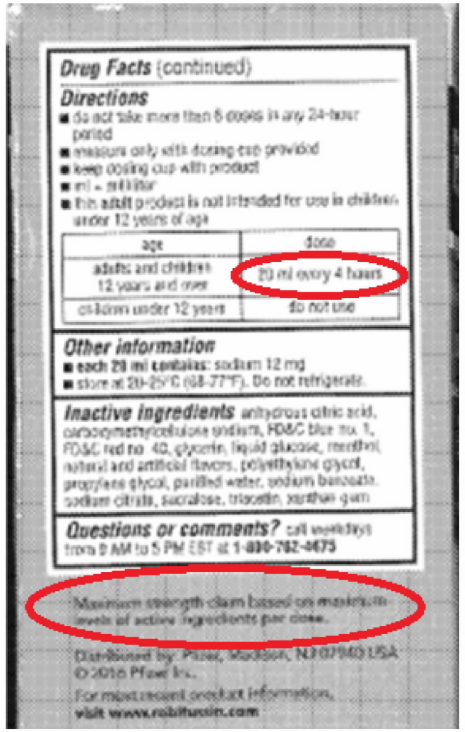
Robitussin’s recommended dose at 10 ml. Pfizer placed a “See New Dosing” alert
at the upper right corner of the product’s box.

The reformulation halved
the product’s concentration of active ingredients. Until Pfizer in mid-2018
similarly doubled Regular Strength Robitussin’s recommended dosage size from 10
ml to 20 ml and thereby halved its concentration of active ingredients, Maximum
Strength Robitussin had the same concentration of guaifenesin but only half the
concentration of DXM Hbr as Regular Strength Robitussin. Because both products
were sold in bottles of the same size, a bottle of Regular Strength Robitussin
had twice as many doses as a bottle of Maximum Strength Robitussin, which cost
more. Pfizer internally touted the reduced number of doses per bottle of
Maximum Strength Robitussin as a positive result of the reformulation.
Al Haj switched
after reading the “Maximum Strength” label and assuming that Maximum Strength
Robitussin would be more effective than Regular Strength Robitussin. Pfizer’s
own market research concluded that “quite a few” consumers would be willing to
spend more on maximum strength medication because they perceive it to “work
better and provide more value” than regular strength medication. Al Haj did not
compare in detail the Regular Strength and Maximum Strength packaging when she
decided to purchase Maximum Strength Robitussin. Even after learning that the
recommended dose was 20 ml, she purchased Maximum Strength Robitussin at least
two more times despite knowing that its 20 ml dose was twice the recommended
dose of Regular Strength Robitussin.
The Illinois Consumer
Fraud and Deceptive Business Practices Act bans “deceptive business practices”
as well as “business practices that, while not deceptive, are unfair.”  Pfizer argued that the packaging Al Haj saw
included a “See New Dosing” alert on the front of the box and an explanation of
“Maximum Strength” on the back. Pfizer argued that this cured any possible
ambiguity about the meaning of the ‘maximum strength’ claim” as a possible
comparison to regular strength. But, even if the alert would have led a
reasonable consumer to read the dosage information, the consumer wouldn’t have
known that Maximum Strength had a lower concentration of active ingredients
than Regular Strength unless she calculated and compared the products’
concentrations. “[I]t is not reasonable to expect a consumer to cross-check a
product’s ingredient list against another product’s list and then perform
arithmetic to make sure she is comparing equivalent dosage volumes, all to
ensure that the product she intends to purchase has the qualities it purports
to have.” Even though the label stated on the back “Maximum strength claim
based on maximum levels of active ingredients per dose,” “using fine-print text
to obliquely walk back a prominent claim on the front of the box—particularly
absent other product features that contextualize that claim—generally does not
preclude a jury finding that the frontside claim was deceptive.”
The court pointed
out that “by placing a prominent ‘Maximum Strength’ designation on what
otherwise was materially the same frontside packaging as Regular Strength
Robitussin, Pfizer invited consumers viewing both products to assume that a
more expensive bottle of Maximum Strength Robitussin had a greater
concentration of active ingredients than the bottle of Regular Strength
Robitussin.” Moreover, “a reasonable consumer would conclude that she was being
charged more for a bottle of Maximum Strength Robitussin than she would have
paid for a bottle of Regular Strength Robitussin because the former had more
potency per volume than the latter.” Pfizer couldn’t take that implication back
with disclaimers that were oblique at best.
Pfizer invoked the
(bad) decision
holding that 100% Grated Parmesan Cheese
doesn’t mean 100% grated parmesan cheese
where the label expressly disclosed the presence of cellulose. But “unlike
the cheese product in Parmesan, which remained ‘shelf-stable at room
temperature,’ there is no commonsense, ‘observable’ impediment to a consumer
concluding that a bottle of Maximum Strength Robitussin has a higher
concentration of active ingredients than Regular Strength Robitussin.” A jury
could conclude that the relative concentrations of active ingredients in
Regular Strength and Maximum Strength Robitussin were “non-obvious product
qualities that consumers may reasonably rely on packages to clearly disclose.”
Moreover, while “a quick skim of the ingredient label” on the backside of the
packaging of the cheese product showed that the product contained “something
other than cheese” and thereby cured any ambiguity, nothing on the backside of
the Maximum Strength package cured the “Maximum Strength” claim’s ambiguity;
cross-checking with another package and doing math would have been required.
Did Al Haj suffer
actual pecuniary damage? Al Haj ultimately switched to a more expensive Delsym
product, not the less expensive Regular Strength Robitussin. But a reasonable
jury still could find that she suffered “actual pecuniary loss” when she
switched from Regular Strength to Maximum Strength Robitussin and thereby paid
more for a product that had a lower concentration of active ingredients than
its packaging implied. Her injury was established at the time of purchase,
regardless of whether [s]he later was dissatisfied with” Robitussin “and
regardless of whether [s]he would have purchased a substitute product.”  Cases finding no actual damage involve prices
lower than the alternatives, but Al Haj had a cheaper alternative: Regular
Strength. Pfizer argued that the products weren’t comparable because they had
different amounts per dose of the same active ingredients, but a less expensive
alternative need only be “similar,” not identical, to serve as a comparator for
purposes of establishing actual damage under the ICFA. 
Proximate case:
Pfizer argued that Al Haj admitted that she did not purchase Maximum Strength
Robitussin under the “belief that the medication had a higher concentration of
active ingredients per volume” than Regular Strength Robitussin. But “the ICFA
does not require a plaintiff to show actual reliance or diligence in
ascertaining the accuracy of misstatements.” 
Deception was enough, and Al Haj testified that she thought Maximum
Strength would be more effective and thus a better value than Regular
Strength.  Even if she knew the
recommended doses (20 ml vs. 10ml) after her first Maximum Strength purchase, that
wasn’t enough to cure the alleged deception, as she still would need to
“perform arithmetic” and a “cross-check” based on each “product’s ingredient
list” to learn the concentration of active ingredients in each bottle.

from Blogger https://ift.tt/2USa1lc

Posted in Uncategorized | Tagged , | Leave a comment

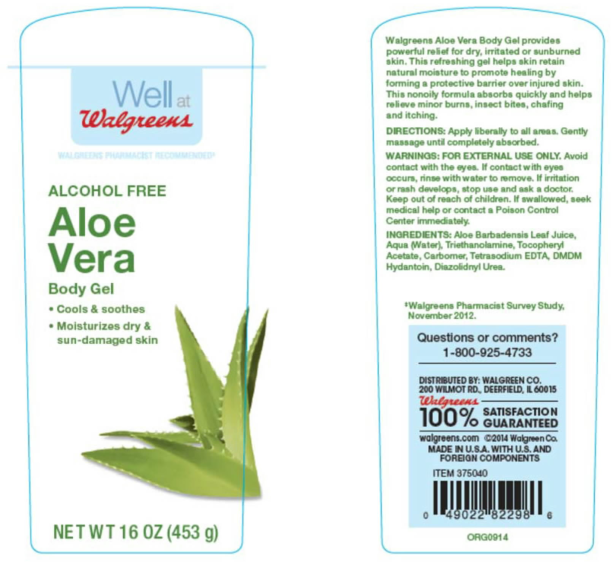
100% Pure Aloe can contain preservatives, stabilizers in the absence of evidence from consumers that they care

Beardsall v. CVS
Pharmacy, Inc., — F.3d —-, 2020 WL 1429214, No. 19-1850 (2d Cir. Mar. 24,
2020)

The court explains:
Plaintiffs brought state consumer deception claims [under 12 different
states’ laws] against defendant Fruit of the Earth and its retailer clients.
They alleged that defendants’ aloe vera products did not contain any aloe vera
and lacked acemannan, a compound that plaintiffs say is responsible for the
plant’s therapeutic qualities. But uncontested facts drawn from discovery
showed these allegations to be false: the products were made from aloe vera and
contained at least some acemannan.
To stave off summary judgment, plaintiffs changed their theory,
claiming that the products were degraded and did not contain enough acemannan.
Plaintiffs said that it was therefore misleading to call the products aloe vera
gel, to represent them as “100% Pure Aloe Vera Gel,” and to market them as
providing the therapeutic effects associated with aloe vera. Plaintiffs have
not, however, presented evidence that some concentration of acemannan is
necessary to call a product aloe or to produce a therapeutic effect. Nor have
they offered evidence that consumers care at all about acemannan concentration.
Whatever theoretical merit these claims might have had on a different record,
this record simply does not contain evidence that would allow a reasonable jury
to find in favor of plaintiffs. With this dearth of evidence, the district
court granted summary judgment in favor of defendants. We affirm.
The aloe vera gels
at issue are made by processing aloe vera plants, including the addition of stabilizers,
thickeners, and preservatives to make the final gel product shelf-stable. “The
parties agree that the products are 98% aloe gel (the reconstituted aloe vera
solids) and 2% other ingredients (stabilizers and preservatives).” The Fruit of
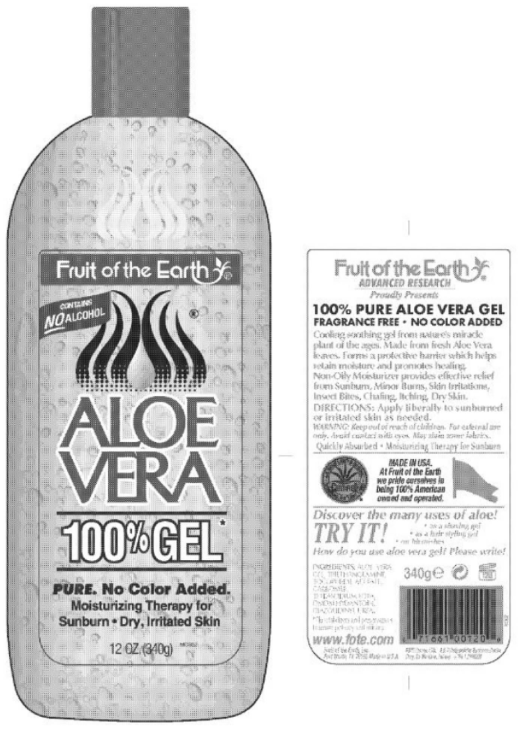
the Earth label calls the product “Aloe Vera 100% Gel” and “100% Pure Aloe Vera
Gel.” An asterisk after “100% Gel” refers to information on the back of the
label: “Plus stabilizers and preservatives to insure [sic] potency and
efficacy.” Each label’s ingredient list shows that the product contains aloe
juice and various other substances.
(1) Acemannan concentration.
“No reasonable consumer, plaintiffs argue, would purchase an aloe vera product
that contains low concentrations of what plaintiffs maintain is an important
therapeutic component.” This is a theoretically viable claim, but there was no
evidence of material misleadingness. Citing cases, including Lanham Act cases,
that asked for survey evidence, the court noted no evidence that consumers made
purchasing decisions based on ingredient content. Nor was there evidence that
some concentration of acemannan was necessary to render the product effective.
The plaintiff’s
expert testified that fresh aloe should contain at least 5% acemannan by dry weight,
pointing to a trade organization’s standards, while that used by defendants contained
1.01% acemannan by dry weight, and testing on the final product indicated
correspondingly lower concentrations of acemannan in the final product compared
to what the expert expected in an aloe product containing undiluted aloe juice.
In a footnote, the court noted that 45 mg/L and 65 mg/L, compared to the
expected 200–500 mg/L, did not count as “trace,” “infinitesimally small,”
“barely detectable,” and “nonexisten[t].” Anyway, there was no testimony that
lower acemannan concentration meant that the product couldn’t fairly be
described as aloe, and no expert opinion on the relationship between aloe
concentration and efficacy.  The named
plaintiffs’ testimony that they found the labeling misleading did not fill the
gap; “they all felt misled because they were incorrectly informed by their
lawyers that the products contain little or no aloe vera.”  Cases allowing claims to proceed have
involved extrinsic evidence to show how consumers were likely to be materially
misled, such as survey evidence that consumers did not expect “soluble and
microground” coffee in Keurig-compatible pods to be instant coffee, or survey
evidence going to materiality, or internal marketing documents about the value
of consumer perceptions of strength. “Plaintiffs here, in contrast, have
offered no evidence that the products fell short of consumers’ expectations in
any material way.”
The court qualified
its holding: “This is not to say that extrinsic evidence in the form of
consumer surveys or market research is always needed for a plaintiff to survive
summary judgment or judgment as a matter of law on a deceptive advertising
claim. But such evidence is necessary where the advertising is not clearly
misleading on its face and materiality is in doubt.” Without such evidence
here, there was not enough to go to a jury.
(2) Therapeutic
efficacy: again, failed for lack of evidence that the products were ineffective
or that they didn’t contain enough acemannan to achieve a therapeutic effect.
(3) “100% Pure.” First,
there wasn’t enough evidence that this was a misrepresentation that the product
was “high quality” or “especially effective” aloe; there was no evidence
indicating that consumers interpret these as statements of quality. Second, the
preservatives and stabilizers didn’t make the claim misleading. The district
court found the label ambiguous and clarified by the ingredients list.
Plaintiffs conceded in briefing and depositions that “the presence of
preservatives—in reasonably small amounts—was acceptable and something they
expected,” and that “[n]o [p]laintiff took the label to mean that there was
absolutely nothing other than aloe vera in the bottle.” So this theory didn’t
work on these facts, though the court pointedly announced its skepticism of
defendants’ position “that an asterisk pointing to an ingredient list in fine
print could save virtually any deceptive slogan claiming purity.”

from Blogger https://ift.tt/3bzBe31

Posted in Uncategorized | Tagged , , , | Leave a comment

antitrust claim based in part on false advertising in concentrated market survives

Chase Manufacturing, Inc. v. Johns Manville Corp., 2020 WL
1433504, No. 19-cv-00872-MEH (D. Colo. Mar. 23, 2020) (magistrate)
Chase sued JM for violations of the Lanham Act and the
Sherman Act for tying and monopolization. JM sells construction products,
including mechanical insulation products. Chase is a mechanical insulation
supplier; both parties sell calcium silicate thermal insulation, aka “calsil,”
which is designed to encapsulate pipes, tanks, and other equipment in
industrial facilities. JM has at least a 98% share of the domestic calsil
market, which is approximately $50 million in sales per year, though this is
only approximately 2% of JM’s $3 billion annual sales for all products.
Customers who buy calsil allegedly demand that the product
meet or exceed the requirements set forth in ASTM C533 Type I. Only three
factories in the world produce such calsil that fits North American sizing
norms: two in the United States owned and operated by JM, and one in Shanghai, which
previously produced calsil for JM but now sells its calsil in North America
exclusively through Chase.
Chase’s head-to-head testing indicated that its calsil met
or exceeded the requirements of ASTM C533 Type I, never contained asbestos, and
outperformed JM’s calsil in several categories.
There are five major mechanical insulation distributors that
dominate the country, accounting for approximately 85% of calsil sales; “approximately
ten or fewer” smaller, independent distributors account for the remaining 15%
of the calsil market. Customers require the distributors to carry other
construction products made by JM, including, as relevant to this case, Defendant’s
fiberglass pipe insulation and expanded perlite products. JM is one of only
three fiberglass pipe insulation manufacturers in the United States, with
allegedly at least a 60% share of that market. JM is also one of only two North
American suppliers of expanded perlite pipe and block insulation, and with
allegedly not less than a 50% share of that market.
JM allegedly threatened to cut off sales, extend lead times,
or alter rebate programs for fiberglass pipe insulation and/or expanded perlite
as punitive measures to both large and small distributors who buy calsil from Chase.
It has also threatened to refuse to supply its own calsil to both large and
small distributors who purchase calsil from Chase. JM’s sales managers
allegedly told customers that Plaintiff’s calsil was “poor quality” and “cannot
be trusted to meet ‘specifications,’ ” “ ‘may have asbestos,’ ” and was
“Chinese,” referring to where it was produced. The “Frequently Asked Questions”
page on Defendant’s website states, in part: “[Defendant] is the only
insulation manufacturer in North America to produce water resistant calcium
silicate. While we are aware of one other manufacturer in Asia that produces
[calsil], it is an expensive, custom-order product that is not readily
available.” This course of conduct allegedly choked off Chase’s growth. 
Chase’s per se tying Sherman Act claim was plausibly
alleged.  So was the monopolization
claim, based on tying, refusal to supply, exclusive dealing, and product
disparagement.
As to product disparagement, antitrust treats it weirdly
(watch this space for an article Mike Carrier and I have written on that). In
the Tenth Circuit, as in a number of other circuits, there’s an unwarranted
presumption that false advertising’s effect on competition is de minimis.  To rebut the de minimis presumption, a plaintiff
must plausibly allege the disparagement was “(1) clearly false, (2) clearly
material, (3) clearly likely to induce reasonable reliance, (4) made to buyers
without knowledge of the subject matter, (5) continued for prolonged periods,
and (6) not readily susceptible to neutralization or other offset by rivals.”  [For one thing, assume that the plaintiff
shows at trial that the false advertising kept it and other potential rivals
out of the market. Why should it have to show any of these subfactors? If it
shouldn’t have to show those subfactors then, why should it have to plead them?
Anyway.]
The disparagement claim was based on four statements
attributed to JM sales reps. (1) Chase’s calsil “may have asbestos and may put
your customers and employees at risk.” (2) Chase’s calsil was “poor quality and
cannot be trusted to meet ‘specifications.’ ” (3) Chase’s calsil was “Chinese.”
(4) The sales rep asked why a purchaser “would want to ‘risk buying an unproven
product that may not meet the specifications.’ ” Two of the five large
distributors, allegedly heard JM’s comments and “word gets around” a market
with such concentrated buyers.
The allegations plausibly overcame the de minimis presumption.
Likely to induce reasonable reliance: Chase alleged that JM “has a high degree
of credibility in the industry,” and has particular experience with asbestos
liability. It was reasonable that JM’s history with asbestos (it had to declare
bankruptcy) would give it credibility when discussing asbestos, products that
could put buyers “at risk,” or products fail to meet safety specifications. “Additionally,
and importantly, given the scope of potential liability related to asbestos,
buyers are very likely to rely on statements regarding its presence or related
safety concerns rather than make a potentially business-ending purchase.”
Knowledge of subject matter: JM allegedly targeted its
disparagement to distributors that are its existing customers, all of whom but
one have never purchased calsil from Chase. “Because the vast majority of the
audience were and are not present customers of Plaintiff, they do not have
firsthand knowledge of Plaintiff’s calsil. As alleged misrepresentations bear
on the quality and safety of Plaintiff’s goods, firsthand knowledge is
critical, particularly in a market where much of the sales and product
information are conveyed through individualized relationships with
distributors.” JM argued that Chase included test results as part of its
initial marketing materials, showing that buyers had knowledge of the subject
matter. But it wasn’t clear that the testing addressed asbestos or what
specific information from the test results were included in the marketing
materials, or how widely disseminated Plaintiff’s marketing launch was. It was
reasonable that the distributors that heard the disparaging remarks had no
knowledge of Chase’s safety or quality. [To a certain extent the court is
stretching what the relevant “subject matter” is, but it’s doing so because
this factor is not helpful. One can have knowledge of the subject matter and
still decide to trust someone else’s specific factual claims. If the deception
worked, the listeners’ expertise wasn’t enough to prevent it from working.
Duration: throughout 2018 was enough. Although there were
only a few specific examples, it was reasonable to infer, as plaintiff
specifically argued, that JM was making these disparaging remarks throughout
the launch.
Susceptible to neutralization by rivals: Chase alleged that
“[p]otential liability from possible asbestos exposure is so great that no
reasonable customer would buy a product where there was any question about the
presence of asbestos, no matter how much the seller assures them that the
product does not contain asbestos.” JM’s own bankruptcy trust for asbestos
victims and their families is currently valued at $2.5 billion. Chase alleged a
specific example of a “failed attempt” to assuage a potential buyer’s asbestos
concerns, that “[s]uch rumors, once started, are not easy to dispel,” and that
“it could take many years to do so.” The court found it “more than plausible”
that such statements are not readily susceptible to neutralization.
Antitrust injury/harm to competition: JM argued that the
alleged injury was merely Chase’s failure to gain market share quickly. But JM
alleged that Chase’s exclusionary and anticompetitive conduct caused limitation
of customer choice of suppliers, increased prices, and reduction in calsil
output. There was a plausible claim for monopolization.
Lanham Act false advertising: Originally, Chase didn’t
provide enough allegations that the disparagement amounted to commercial
advertising and promotion by being sufficiently disseminated in the relevant
market. In its amended complaint, it alleged that five major distributors
account for 85 percent of calsil sales, and estimates that “approximately ten
or fewer” smaller, independent distributors account for the remaining 15
percent. It identified two of the smaller distributors as the recipients of the
alleged misrepresentations, as well as two of the five larger distributors.  The allegations were those above, as well as
(1) an allegedly false statement to a smaller distributor that JM had never
sold calsil made in China, and (2) a website statement that “[w]hile we are
aware of one other manufacturer in Asia that produces water resistant calcium
silicate, it is an expensive, custom-order product that is not readily
available.”
Chase sufficiently alleged advertising/promotion because it
alleged that “informal” means of communication—like in-person meetings, social
gatherings, social media, and email—as opposed to traditional media are the
primary means of commercial promotion in the calsil market. Chase also alleged
that “other Gulf Coast contractors” have corroborated the suspicion “that these
statements were widely disseminated by Johns Manville salespeople.” This made
it plausible that the statements were part of an organized campaign by JM,
despite the statements’ informal or behind the scenes methods of communication.
As for the webpage, JM argued that it didn’t refer to Chase
by name; that it wasn’t adequately pled to be false/material; and that it
didn’t injure Chase. Although the no-identification point is silly—there’s only
the one and it’s Chase—Chase didn’t adequately allege injury from the page; it
didn’t even allege that customers or potential customers saw it or that it lost
sales because of it.

from Blogger https://ift.tt/2xExtdG

Posted in Uncategorized | Tagged , | Leave a comment

230 protects anti-malware vendor against noncompetitors

Asurvio LP v. Malwarebytes
Inc., No. 5:18-cv-05409-EJD, 2020 WL 1478345 (N.D. Cal. Mar. 26, 2020)
Despite unfavorable
precedent, Malwarebytes secures dismissal of this Lanham Act false advertising
(and common law disparagement/tortious interference/unfair competition/
violation of the Texas Theft Liability Act
(TTLA)) case against its designation of software as malware or as a
“potentially unwanted product” (PUP) on CDA §230 and other grounds.
According to the
complaint, “Asurvio provides premium full-service technical support services to
consumers.” Asurvio’s services include: “(i) software solutions that work in
real time in the background of the operating system to optimize processing and
locate and install all missing and outdated software drivers; and (ii)
technical support services for the removal of Spyware and Malware and all other
facets of personal computer use.” Asurvio’s software executes “fixes” including
driver updates and provides the consumer access to telephone-based human assisted
technical support.
In 2016,
Malwarebytes categorized Asurvio’s DRIVER SUPPORT and DRIVER DETECTIVE software
with a negative PUP rating and labeled it a security risk. “Asurvio’s customers
who also used Malwarebytes received regular warnings from Malwarebytes that all
folders of Asurvio’s software were ‘threats’ quarantined on their computers
that should be uninstalled.” Asurvio tried to convince Malwarebytes that it
complied with industry leading standards and requirements, including the Clean
Software Alliance Guidelines, Microsoft and Google’s standards and other
anti-malware vendor certifications by McAfee and Symantec, but Malwarebytes
refused to delist the software as a PUP and referred Asurvio to AppEsteem for
third party certification; when Asurvio secured that, Malwarebytes delisted its
products.
In 2017, Asurvio
began listing its technical support services in its boilerplate terms and
conditions, including technical support for removing Spyware/Malware. Id. In
2018, Asurvio learned that Malwarebytes had relisted Asurvio’s products as PUPs
and was barring customers from Asurvio’s websites.
Asurvio alleged that
a Malwarebytes staff member identified as “Metallica” posted “Removal
instructions for Driver Support” on Malwarebytes’ message board forum. The post
stated that Asurvio’s DRIVER SUPPORT product uses “intentional false positives”
and advised consumers that the best way to uninstall DRIVER SUPPORT is to use
Malwarebytes’ software. Malwarebytes blog “moderators” identified as “Porthos”
and “exile360” described DRIVER SUPPORT as “a bogus program” and “unnecessary
snake oil with no real utility” that typically does more harm than good. A Malwarebytes
blog “moderator” posted that “Driver Updates” (allegedly a generic term to
describe Asurvio’s services) are a “pure scam,” a “useless product” and “can
damage your system to the point where a reinstall of Windows will be needed.” Asurvio
alleged similar statements on a different website by a person who allegedly
received “monetary or in-kind benefits from Malwarebytes for each sales lead or
software download generated from his post.”
And Malwarebytes
allegedly wrongfully profited from the use of Asurvio’s products by redirecting
clicks from Asurvio’s website to Malwarebytes’ website. “When a Malwarebytes
free version software user opens a search engine in his own web browser and
searches for DRIVER SUPPORT or ACTIVE OPTIMIZATION, Asurvio’s ads or website
links will prominently appear in the search engine results. However, instead of
going directly to Asurvio’s official website when clicking these links, it
redirects consumers to the Malwarebytes website for the purpose of executing a
Malwarebytes sale.”  This was the
specific basis of the TTLA claim, which provides in pertinent part that an
actor commits “theft of service” when, “having control over the disposition of
services of another to which the actor is not entitled, the actor intentionally
or knowingly diverts the other’s services to the actor’s own benefit or to the benefit
of another not entitled to the services.”
  
§230(c)(2)(B)
immunity applied to most of the conduct, including the redirection of consumers
from Asurvio’s website.  (A previous
order in the case explained that the redirect page notifies the user that
Malwarebytes blocked driversupport.com “due to PUP.” It also informs the user: “Learn
about PUP. If you don’t want to block this website, you can exclude it from
website protection by accessing Exclusions.” This was a type of “action” that
enables or makes available to others the “technical means” to restrict access
to statutorily defined objectionable material. The court commented: “The
statute does not contain qualifiers, conditions, or exceptions for ‘actions’
that have the secondary effect of depriving PC Drivers of the benefits of the
page-click advertising it purchased from a third party.”)
Although Enigma
Software Group USA, LLC v. Malwarebytes, Inc., 946 F.3d 1040 (9th Cir. 2019),
held that (c)(2)(B) didn’t apply to “blocking a competitor’s program for
anticompetitive reasons,” the parties here aren’t direct competitors. Each software
security provider “generates its own criteria to determine what software might
threaten users.” Asurvio, by contrast, didn’t sell malware detection software
designed to scan a computer and report PUPs. Rather, Asurvio sells driver
update software that doesn’t provide provide any anti-spyware or anti-malware
functionality as Malwarebytes does. Its “technical support services for the
removal of Spyware and Malware,” disclosed only in fine print, was “a secondary
value added service … limited to removal of Spyware and Malware,” which was “significantly
dissimilar from computer security software like Malwarebytes’ that once
installed, automatically identifies and blocks Spyware and Malware.”  It was not direct competition merely because
both parties offer software services “to assist in the overall performance of
individual computers” and both sell to “self-help” computer users. Such a broad
reading of competition would “render the statutory immunity meaningless.” Thus,
all claims based on filtering were dismissed without leave to amend.

Comment: one of the original issues with the 9th Circuit’s opinion in Enigma is that the source of the “anticompetitive” exclusion is not evidently grounded in any principle of law. Neither antitrust nor false advertising–the two best candidates for such a principle I can see–limit their protections to direct competitors. This case highlights the fact that Enigma invented a new exclusion and now we have to figure out what that means.
As for the other
challenged statements, §230(c)(1) applied to the postings on its online forum.
Asurvio failed to plead facts showing that “Porthos” and “exile360” were forum
“moderators,” much less any facts showing they had any express or implied
authority to speak on Malwarebytes’ behalf. The fact that the forum identifies
“Porthos” as a “Trusted Advisor” and “exile360” as an “Expert” weren’t enough;
the mere possibility that Malwarebytes made these designations didn’t support a
plausible inference that Malwarebytes was responsible for the “Trusted Advisor”
and “Expert” designations, and further that Malwarebytes is responsible for the
content of the posts made by “Porthos” and “exile360.”
Even without
immunity, the complaint failed to state a claim. The allegedly false and
disparaging statements (e.g. that Asurvio’s products are PUPS, use “false
positives,” are “bogus,” a “scam,” and “snake oil”) weren’t pled to be
objectively verifiable as opposed to non-actionable opinion.  Tortious interference claims failed to allege
facts showing that Malwarebytes willfully and intentionally interfered with a
specific contractual obligation. Instead, the complaint alleged that
Malwarebytes instructs computer users to choose whether to continue using Asurvio’s
products.

from Blogger https://ift.tt/3au2WOl

Posted in Uncategorized | Tagged , | Leave a comment

“no soy protein” claim for dog food plausibly indicates no soy

Rice-Sherman v. Big
Heart Pet Brands, Inc., No. 19-cv-03613-WHO, 2020 WL 1245130 (N.D. Cal. Mar.
16, 2020)
Plaintiffs alleged
that Big Heart falsely markets its Grain Free Easy to Digest Salmon Sweet
Potato & Pumpkin Recipe Dog Food as “Grain Free,” and as containing “No
Corn” and “No Soy Protein.” Most of the claim survived, though claims for
injunctive/equitable relief and punitive damages survived. Of note: “no soy
protein” is plausibly understood as meaning “no soy.”
Purchasers of such
products allegedly “pay a premium in order to alleviate their pets’ allergies
and provide various health benefits associated with a grain-free diet.” Plaintiffs
allegedly would not have purchased the Product if the actual ingredient list had
been fully disclosed. According to plaintiffs, “independent testing of Nature’s
Recipe Food confirms that these representations are false because “[it] does,
in fact, contain significant amounts of both corn and soy protein.” This
testing was allegedly consistent with numerous academic studies that have found
companies in the pet-food industry have inaccurate product labels,
non-conforming ingredients, and cross-contamination. Some of the named
plaintiffs also alleged that their dogs began displaying allergy symptoms after
eating the product, incurring hundreds of dollars in veterinarian costs.
Big Heart argued
that plaintiffs lack Article III standing because they didn’t specifically
allege how, where, and why the “independent testing” was performed, and whether
each specific Nature’s Recipe product purchased by each named plaintiff was
tested. Those weren’t necessary for Article III standing, which was satisfied
by allegations that they “spent money that, absent defendants’ actions, they
would not have spent.” While Big Heart cited Wallace v. ConAgra Foods, Inc.,
747 F.3d 1025 (8th Cir. 2014), for the proposition that plaintiffs are required
to specifically allege that the particular product they bought contained the undisclosed
ingredients, that’s not the law in the Ninth Circuit. As another court said, “if
a customer has paid a premium for an assurance that a product meets certain
standards, and the assurance turns out to be meaningless, the premium that the
customer has paid is an actual, personal, particularized injury that is
cognizable under Article III.”
Nor were plaintiffs
required to allege that independent testing was done on their bags. In other
cases finding insufficient allegations, the alleged contamination was sporadic
and plaintiffs failed to allege that “all or even most” of the accused products
were falsely advertised; therefore they were required to allege that the
particular products they purchased were part of a subset of accused products
that were falsely advertised. In the absence of such allegations, their claims
were too speculative.  Here, however, plaintiffs
focused on a particular product and argued that it was falsely advertised because
it did, in fact, contain “significant amounts of both corn and soy protein.” Plaintiffs
didn’t have to use the magic word “all,” given a fair reading of the complaint.
In assessing standing on a motion to dismiss, the court must “presume that [ ]
general allegations,” like the ones alleged here, “embrace those specific facts
that are necessary to support the claim.”
Failure to state a
claim: The complaint satisfied Rule 9(b). It alleged when and where each
plaintiff bought the products; described the “Grain Free,” “No Corn,” and “No
Soy Protein” representations on the Product packages which they relied on; described
and included photographs of the false or misleading information on the packages
and on Big Heart’s website; and alleged that the claims are false because
independent testing revealed that the Products in fact contain corn and soy.
They were not required to “provide definitions of grain, corn, soy, and soy
protein or explain the parameters of the alleged independent testing.”  As for definitions, “[t]he relevant question
is not what those terms mean, but rather what they mean to reasonable
consumers, which cannot be resolved on a motion to dismiss.” Plaintiffs
plausibly alleged that reasonable consumers would consider the representations
“No Corn” and “No Soy Protein” to mean that the Product is free of corn and
soy.  Big Heart alleged that there was a
gap between “soy” and “soy protein,” but the court found that “hardly a logical
gap.” Big Heart also argued over whether corn is a grain, but even if it isn’t,
plaintiffs also alleged an explicit “No Corn” claim.
Independent testing:
“Big Heart does not need more background information about the independent
testing at the pleading stage in order to defend against plaintiffs’ claims.”
Its results are accepted as true at the pleading stage.
As for the specific
California claims, the arguments were largely repetitive of those rejected on
9(b). “These labels are not as ambiguous as such labels as ‘all natural’ or ‘healthy’;
even if they were, the question of whether a reasonable consumer would likely
be deceived is a factual dispute that cannot be resolved at the motion to
dismiss stage.” Plaintiffs weren’t required to allege “that the corn or soy at
the level detected would cause a health issue or nutritional deficiency.” They
specifically alleged materiality, and also that Big Heart knew or had reason to
know that consumers are likely to regard the matter as important given that
they allege that Big Heart touts the “Benefits of Grain Free” on its website.
Warranty claims also
survived. For implied warranty, plaintiffs used two theories: (1) there is a
general warranty in all sales contracts that the product is fit for the
ordinary purpose for which such good is used; and (2) the product does not conform
to the promises or affirmations of fact made on the container or label.  Plaintiffs plausibly alleged (1) by alleging that
Nature’s Recipe Food was specifically marketed for dogs with grain allergies,
and that because it contains corn and soy it causes dogs to suffer allergic
reactions and therefore is not fit for its ordinary purpose. And the court didn’t
require privity for either theory.
Injunctive relief: In
the Ninth Circuit, “a previously deceived consumer may have standing to seek an
injunction against false advertising or labeling, even though the consumer now
knows or suspects that the advertising was false at the time of the original
purchase, because the consumer may suffer an ‘actual and imminent, not
conjectural or hypothetical’ threat of future harm.” This includes cases where
“the threat of future harm may be the consumer’s plausible allegations that she
will be unable to rely on the product’s advertising or labeling in the future,
and so will not purchase the product although she would like to,” and where
“the threat of future harm may be the consumer’s plausible allegations that she
might purchase the product in the future, despite the fact it was once marred
by false advertising or labeling, as she may reasonably, but incorrectly,
assume the product was improved.” But plaintiffs didn’t make those allegations
here.
Equitable relief
under the UCL, FAL, and CLRA: only available where there were no damages; the
complaint didn’t make clear whether the claims for equitable relief and damages
are based on the same theory (false advertising) or on separate distinct
theories. Motion to dismiss granted (with leave to amend, as above).
Punitive damages: Not
recoverable under the UCL or FAL, or for breach of express warranty under the
California Commercial Code. A consumer seeking damages under the CLRA may
recover punitive damages, but plaintiffs failed to allege the necessary
elements: “both ‘oppression, fraud, or malice’ and that the conduct at issue
was performed or ratified by an ‘officer, director, or managing agent.”

from Blogger https://ift.tt/2QBRpok

Posted in Uncategorized | Tagged , , | Leave a comment

Statements in book promoting addiction treatment protected by Cal anti-SLAPP law

Selkirk v. Grasshopper
House, LLC, 2020 WL 1241565, No. B294568 (Cal. Ct. App. Mar. 16, 2020)
Defendants Grasshopper
House and Passages Silver Strand “are luxury facilities that purport to treat
drug and alcohol addiction.” Former patients sued them for allegedly making false
statements about the efficacy of their treatment programs. Under the anti-SLAPP
law, Passages showed that some of its statements were protected speech and
plaintiffs didn’t show enough merit to proceed; remanded with directions issue
a new order striking certain allegations, although the denial of the motion to
strike some other allegations wasn’t appealable.
The Passages
facilities allegedly “are among the most expensive” rehabilitation centers “on
the planet,” charging between $40,000 and $100,000 for a 30-day stay. Neither founder
(including Pax Prentiss) has any education or training in the treatment of substance
abuse. Passages allegedly advertises it discovered a novel treatment approach
that “cured” Pax of his addictions and that can cure others. E.g., the Passages
Malibu website stated: “The program we created for Pax, the one that is now the
Passages program, was primarily based on finding out the ‘why’ behind his
addiction. It worked. Pax finally discovered his ‘why’ and we knew that he was
cured, that he would never again use drugs or alcohol.” The website also stated
that the “treatment method … has cured thousands of people at Passages.” Passages
also claims in its advertising the program can cure addiction within 30 days.
Passages allegedly made
similar statements in Internet, television, and print advertisements, in
“television and other media interviews,” during lectures and personal
appearances by the Prentisses, and in a book: The Alcoholism and Addiction
Cure: A Holistic Approach to Total Recovery.
Passages filed a
special motion to strike. Plaintiffs argued that their claims were based on
Passages’ specific misrepresentations about the efficacy of the Passages
treatment program and that promotional statements by a business about its
services were commercial speech to which California’s anti-SLAPP did not apply.
Plaintiffs submitted evidence that Pax continued to use drugs after the
Prentisses opened Passages Malibu and that since 2004 Passages has not
documented whether its clients remained sober after leaving its facilities. But
they didn’t submit evidence that they were aware of Passages’ alleged
misrepresentations before enrolling at the facilities.
The trial court
ruled that all statements “arising out of television ads, internet advertising,
and Defendants’ website constitute commercial speech which comes within the
exception” to the anti-SLAPP law, but that the statements in the Prentisses’
book weren’t commercial speech under the law, which “specifically exempts from [the
commercial speech rule] claims based upon the dissemination of a literary
work.” Then, the trial court ruled as to the book statements that the
plaintiffs demonstrated a probability of prevailing on each of their causes of
action except their cause of action for negligence.
On appeal, Passages
conceded that the statements about Pax’s personal history of addiction and
abuse (whether those statements were book statements or non-book statements) weren’t
eligible to be struck. They appealed as to the statements about addiction,
treatment, and the Passages facilities, and plaintiffs cross-appealed.
The appeals court
ruled that the trial court correctly held that the book statements were
protected speech. In the book, Chris Prentiss states that he and Pax “use[d]
what [they] learned curing [Pax] to help others discover the roots of their
addiction or alcoholism and break free” and that, “having healed thousands of
people,” Chris “can write with complete certainty that alcoholism and addiction
are not diseases.” The book also tells readers that, if patients “set up …
intense therapy” at Passages, they “should be able to cure [their] addiction in
thirty days or less.” These were statements relating to the public interest and
contributed to public debate about addiction treatment; the purpose of the book
wasn’t solely to advertise Passages but to discuss conventional treatment
methods, why the authors believe addiction is not “incurable,” and why they
believe their “holistic” treatment method is better than other treatment
methods. “To be sure, the statements about the efficacy of the Passages
treatment program and the number of patients the program has successfully
treated may help Passages solicit new clients. But those statements also
provide context and explain the Prentisses’ views on addiction and treatment.
The statements about their views contribute to the public discussion of the
issue.” The book also made claims that it could help readers treat their
addictions on their own, without paying Passages for treatment: “Within the
covers of this book, I will show you how you can cure your alcoholism or
addiction” and “how to put together your own personalized program to achieve
total recovery and optimum health by enlisting the help of several key health
practitioners.”  Their views might be
against the medical consensus, and might even “harm some persons who would
receive better treatment from medical professionals.” But the question is
whether the Prentisses “participated in, or furthered, the discourse,” not “the
social utility of the speech at issue, or the degree to which it propelled the
conversation in any particular direction.”  The book as a whole, and not just the
challenged statements, had to be considered. And even if the challenged
statements were false (or even Central Hudson commercial speech), that
didn’t make them unrelated to an issue of public interest, an issue determined
by the anti-SLAPP law and not by the Constitution.
With that out of the
way, plaintiffs failed to show that their book-based claims had merit. The
standard is like summary judgment: the court “accepts the plaintiff’s evidence
as true, and evaluates the defendant’s showing only to determine if it defeats
the plaintiff’s claim as a matter of law.” Plaintiffs didn’t submit evidence
that they attended Passages because of the alleged misrepresentations, or that
they heard or read the misrepresentations, or that they relied on these
statements, or that they suffered any economic injury as a result of these
alleged statements.

However, the order denying the special motion to
strike the non-book statements wasn’t reviewable in this appeal, because where
a trial court denies the motion on the grounds that the commercial speech
exemption applies, that’s not immediately appealable, per the anti-SLAPP law
itself, even if other parts of the order are appealable and even if the
district court erred in keeping opinion statements in the case when the
exemption only applies to statements of fact in commercial speech.

from Blogger https://ift.tt/2woWqdc

Posted in Uncategorized | Tagged , , | Leave a comment

Mislabeled image of competitor’s LED screen as LG’s gets LG in trouble

Sansi North America,
LLC v. LG Electronics USA, Inc., 2019 WL 8168069, No. CV 18-3541 PSG (SKx)
(C.D. Cal. Nov. 14, 2019)
LG used a picture of
Sansi’s LED displays in an article for a trade publication and accidentally
labeled it as LG displays. This lawsuit followed.
LG is currently the
only manufacturerer of OLED displays, “a specific, advanced, version of LEDs
that allow for flexibility and superior viewing angles to standard LED
technology.” In 2017, LG hired Robin Dugan to create an eBook about
developments in the digital signage industry, with a focus on LG OLED displays.
“The eBook included pictures of non-LG displays, including a featured
photograph of a display at Salesforce’s San Francisco headquarters, which was
produced by Plaintiff Sansi; the caption did not mention Defendant LG or OLED.”
LG did ask if it had permission to use all of the images. Roughly a year later,
LG hired NewBay Media to prepare a similar article for a magazine, Digital
Signage Magazine, with about 11,000 subscribers. NewBay based some of its work
on the eBook, and believed that the Salesforce display was OLED. It mistakenly
captioned the picture of the display as an OLED screen, and mistakenly updated
the caption to read “LG OLED.”  
The text then said: “The
Salesforce San Francisco office has a custom-built LG OLED screen in their
lobby that is 12K resolution, with over 7 million pixels, and measures close to
107 feet long. The content ranges from amazing waterfall visuals to
California’s Redwood National Park and is synced with the local weather to play
content that matches the weather.”
Initial book, which just said Salesforce had a custom-built screen:

Second version with wrong attribution:

Downloadable eBook
version with wrong attribution:

A few months later,
Sansi informed LG and NewBay of the problem; NewBay took down the online
version of the article, and LG agreed to take steps to correct the mistake,
including asking NewBay to remove the publications, working with NewBay to
draft a correction, and advising marketing staff of the error and to correct
any misidentifications of the project. Sansi nonetheless sued for false
designation of origin, false advertising, trade dress infringement, trade libel,
and unfair competition.
The court treated
false designation, trade dress infringement, and unfair competition as the same
claim with different names.  “[C]laiming
another’s accomplishments and history as one’s own” can be false designation of
origin (or false advertising). LG argued that no claim for reverse passing off
could succeed because no product was sold.  Sansi argued that no physical removal of a
name from a physical product was required, particularly where the plaintiff
sells a service. The court agreed that Sansi’s claim was tenable because LG published
an article containing an image of Sansi’s service [???] and labeled it as its
own. “Other courts have upheld claims under § 1125(a) where the defendant has
taken credit for and represented as its own the service or accomplishments of
the plaintiff.” [The court does not discuss Dastar, though I think this
does constitute an explicit misrepresentation of the origin of the item depicted
in the picture, as opposed to anything about the picture itself.]
Was confusion
likely? Sansi identified four clients and four industry contacts who indicated
confusion about the caption. Anyway, actual confusion isn’t required [for (a)(1)(A)].
False advertising:
The caption was a false statement of fact, and the evidence of some consumers’
confusion plus literal falsity allowed a presumption of actual deception and
materiality. There was a genuine dispute of fact on materiality and deception.
Trade dress: LG
argued that all aspects of the Salesforce display were utilitarian in that was
a video screen; according to LG the only way to tell who designed the display
would be to pull off the panel, or ask someone, and that the emitting of light was
the display’s only function. In addition, Sanci didn’t own the shape of the
display and content displayed.
Sansi argued that its
display had elements that, combined, could be “distinctive and aesthetic”
[sigh, very much not the same things; consider how many of the adjectives in
the description mean “works better”]:
Sansi’s Salesforce display consists of a unique arrangement of numerous
elements intended to make it more spectacular, attention-grabbing, striking,
and unusual, all of which are hallmarks of Sansi’s unique designs and high
quality products. For example, it is 107 feet long, when it could have just as
easily been shorter. It has a 4 millimeter pixel pitch, when it could have used
a different pixel pitch. It has approximately 8 million pixels, when it could
have had less (or more). It has a hundred layers of processing to give it a
three-dimensional effect, which is unique and not essential to the function of
a digital wall display. Its shape follows the architecture of the building in
which it is installed and surrounds the elevator bank entrances, when it could
have simply been a rectangular shape above the elevator banks. Numerous other
elements of the design were subjective choices by Sansi in order to make this a
standout design, such as the selection of PCB board widths, product supply
widths, the pitch distinction between product, the streamlined assimilation of
the display design with the building architecture, and countless other design
elements.
So many problems. None
of this indicates distinctiveness in the trademark sense, and it definitely
doesn’t mean distinctiveness for Sansi instead of for Salesforce, any more
than an ad agency has trademark rights in the successful campaigns it does for
others. Nonetheless, the court decided that “the Salesforce display including
its size, pixel pitch, number of pixels, layers of processing, unique shape,
and other elements of its design, taken together,” could be found by a jury to
be “aesthetic and not entirely functional.” 
LG did at least get
monetary remedies kicked out of the case (at least pending Romag). In the
Ninth Circuit, disgorgement requires willful infringement. LG provided evidence
that the caption was a mistake, and that LG took action as soon as it was
discovered. Sansi didn’t provide any evidence to the contrary.  And Sansi couldn’t show actual damages in the
form of lost profits or otherwise. “[C]ompensatory damages are appropriate only
where a plaintiff has shown that in fact it has been injured; it still must
present non-speculative evidence that goodwill and reputation—that is, the
value of its mark—was damaged in some way.” Sansi was unable to show lost customers,
sales, or other injury. Sansi doesn’t sell OLED products, so it can’t claim to
have missed out on any OLED sales. And none of the companies whose people
downloaded the NewBay feature placed an order for an LG LED display; only one bought
an OLED, and that company had been an LG customer for years. Sansi asked its
dealers why they weren’t giving more business to Sansi, and none mentioned LG
as the reason.
Sansi argued that it
had shown instances of confusion, and a sales decrease concurrent with the
article’s publication, which an expert calculated as $6.88 million in losses,
which it argued should be enough to get to a jury. However, Sansi didn’t
disclose any damages calculations to LG during discovery or before the
dispositive motion deadline.  Thus, the
court declined to rely on the expert report now.   Given how generous it was to Sansi’s theory
of the case, one wonders if the court would have looked favorably even on a
fairly implausible damages calculation if it had been properly disclosed.
Trade libel:
requires actual malice; none shown.

from Blogger https://ift.tt/2wn924A

Posted in Uncategorized | Tagged , | Leave a comment

Selling scammy books is protected by the First Amendment when selling scammy products isn’t

The defendants do relatively well here by
selling scammy and deceptive books. To the extent that the deception is
contained in the books, they get to advertise the contents of those books, but
when they make claims beyond those contained in the books, the FTC can stop the
marketing. The incentives for the defendants’ book-writing—which is pretty
clearly parasitical on their marketing—are not good. That said, I’m not sure I see a safer rule.
Defendants Agora and NewMarket are publishing
entities under the umbrella of M&C, which owns more than eighty separate
entities.
NewMarket’s ads for its book The Doctor’s
Secret to REVERSING Diabetes in 28 Days
had a Dr. Gerhauser promoting it for
treatment of Type 2 Diabetes without pharmaceuticals. His representations
included: “[A]fter 37 years in practice, I recently discovered a simple,
at-home treatment for Type 2 diabetes. And no, it has nothing to do with diet
or exercise. It doesn’t involve a single drug either. Yet this new treatment is
scientifically proven to reverse every symptom of your diabetes in 28 days.” Other
parts of the ad: “World famous doctor and diabetes expert, Dr. Richard
Gerhauser, just made a shocking announcement. He said ‘Type II Diabetes is not
caused by what you eat.’ ” “Shocking study shows 100% cure rate.” “It has
nothing to do with changing your diet or exercising more.” “Can this new
treatment really reverse Type II Diabetes in 28 days? Without diet, exercise,
or a single drug? Sure, it sounds impossible…But according to a new study
from the University of Kansas, it’s true…” “How to Reverse Diabetes Without
Dieting.”
The actual guide has eleven modules, one of
which  ontains dietary recommendations,
including that protocol followers “[e]at a seasonal, low-carb, organic diet
with plenty of seafood,” and engage in intermittent fasting. The book initially
sold for $150, then $250.
As for Agora, it developed the idea of using
“Congressional Checks” as a metaphor for the anticipated tax-advantaged
treatment of certain pass-through dividend income that would result from the
2017 Tax Cuts and Jobs Act (“TCJA”) passed by the Republican Congress in 2017.
At least one news article had suggested that the real estate tax breaks in the
TCJA would personally benefit some Republican lawmakers. The resulting book, Congress’
Secret $1.17 Trillion Giveaway
, “identifies 13 companies with high yield
potential.”  It was given to those who
signed up for a free trial of Agora’s financial newsletter, which cost $99/year
if they didn’t cancel.
It was promoted with ads including the
claims:  “In case you haven’t heard yet,
a small group of in-the-know Americans are now collecting ‘Congressional
Checks’ of up to $6,235 each. In fact, there is $ 1.17 Trillion at stake thanks
to section 199A of Trump’s new tax law. And if you follow the instructions on
the next page, you could add your name to the list, too. But if you do not act
by the October 18th deadline, you will miss out on the next check, and…your
money will be sent to somebody else…To prevent your check from being sent to
someone else, you must get on the list for the next ‘Congressional Check’ by
Thursday, October 18.” “[T]he law dictates that this pile of cash MUST be
distributed! That’s not a question of if…It’s the law! These cash
distributions are contractually required by the U.S. government…So if you
don’t collect someone else will.” “You just need to add your name to the list
of check payees before October 18th.” “As a taxpayer, nobody deserves this
money more than you. Remember, this is wide open to the public. There’s no
income requirement. No age limit.” “Again, you could potentially collect a 6k
check for doing nothing except applying what was perfectly within your rights
anyways!” “The average Social Security monthly stipend of about $1,400 simply
isn’t enough to pay for housing, groceries, and medical bills. Fortunately,
there’s hope…If you’re looking for retirement income, I strongly encourage
you to check out what’s inside this book.”
The ads include imaged of consumers holding
checks with their names and the amounts received, and the words “Congressional
Check” or “Republican Check” across the top in large writing, with the seal of
the United States Congress. Those photos were actually edited stock photos, as
was an alleged version of then-Congressman Darrell Issa’s Financial Disclosure
Report, indicating that he had received either a “Congressional Check” of
$410,000 or a “Republican Check” of $410,000, which was not true.
The “Congressional Checks” promotion was
changed to “Republican Checks,” apparently to better target its audience. Also,
consumers were immediately charged $49 rather than being given a free trial.
Some of the later “Republican Checks” ads specified that the checks would be
paid by “private sector institutions known as ‘fiscally transparent entities.’
” In later 2018, a new ad included as part of a Q&A the statement “don’t
take the term ‘Congressional check’ too literally. It’s a nickname for the
payments politicians receive from REITs, master limited partnerships and other
pass-through securities…Cutting taxes on pass-through earnings was almost
like giving law makers a special bonus for voting in favor of the bill. So I
decided to call the payouts from pass-through entities Congressional checks.
But really, they’re just the regular payouts that these kinds of companies
always make.”
The House of Representatives contacted
agencies including the FTC about this promotion, noting that “[t]he Clerk has
already received seven letters from individuals attempting to apply to the
Clerk to collect their ‘Congressional Checks.’ ” Defendants ultimately stopped
promoting the book.
As to the diabetes book, the FTC argued that
five health claims were unsubstantiated by reliable clinical trials and
therefore false and misleading: that the protocol in the book would “cure,
treat, or mitigate type 2 diabetes or its symptoms,” that it didn’t require
restricted or changed diet; that “Supplements, including Himalayan Silk, Epsom
Blue, and Chromanite, will, either alone or in combination, cure, treat, or
mitigate type 2 diabetes or its symptoms,” that “Type 2 diabetes is caused by [non-ionizing
radiation] exposure,” and that “[c]onsumers can prevent Type 2 diabetes through
the use of Non-Ionizing Radiation ‘blockers,’ or by otherwise avoiding NIR.” The
FTC also alleged that the claim that the protocol “is scientifically proven to
cure, treat, or mitigate type 2 diabetes or its symptoms in 28 days” was a
false establishment claim.
However, the court declined to impose the
standard requiring “competent and reliable scientific evidence” to substantiate
health claims, because defendants were selling books, not medical supplements,
devices, or services. “In the cases cited by the FTC, the respective defendants
marketed products that would be sold for the buyer to consume, and purportedly
reap the alleged benefits. The FTC has not identified any case in which a court
has applied the health-related efficacy standard in the circumstances presented
here.”  The FTC conceded that the book
was free to exist, and the book wasn’t itself commercial speech. As the court
pointed out, unlike with a drug or device, the consumer could read the book and
decide not to use the advice, and the book would still have succeeded in its
intended function: being read.
Thus, when the ads for the book just describe
the contents of the book, they’re protected to the same level as the book
itself.  However, defendants’ marketing
material didn’t stick to the book.  The
ads claimed that consumers didn’t need to change their diets, while the book
recommended specific dietary changes. “[T]he divergent statements made in the
promotion can be isolated and differentiated from the protected statements made
in the book.” 
Nonetheless, in determining whether
defendants made false or misleading claims in advertising, the court did not
require competent and reliable scientific evidence for the claims from the
book; it asked only whether defendants misrepresented the contents. [Of course,
that begs the question: are the contents “a way to cure diabetes” or are they
“a set of claims about the way to cure diabetes”?  Only if the latter is the proper description
of the contents did defendants properly represent them.] The proper question
is: “do the advertisements accurately represent the content of The Doctors’
Guide, such that consumers can make an informed decision about whether they
want to purchase the book?” This standard allows people to publish and
advertise noncommercial speech that makes dumb claims without chilling speech
by requiring them to disclose how limited their evidence is. (The court
rejected the FTC’s suggestion that Dr. Gerhauser could advertise a book
suggesting that NIR causes diabetes if the advertisement said, “one study shows
that consumers whose diet we don’t know, who lived near a cell phone tower, may
have had increased diabetes rates,” as “utterly implausible.”) 

The court rejected the FTC’s analogy to Cher v. Forum Int’l Ltd, 692 F.2d 634
(9th Cir. 1982), which found an ad not entitled to constitutional protection
because the ad indicated that Cher “told” Forum certain things when, in fact,
she hadn’t told it anything. That was “patently false,” and the FTC didn’t
demonstrate that the content of the book was “patently false.” “Neither this
Court nor the FTC is well-equipped to determine the validity of a human
clinical trial in India, and whether it indicates what Dr. Gerhauser believes
it indicates, in his medical opinion. Similarly, neither this Court nor the FTC
can state with certainty whether non-iodizing radiation has any causal
relationship to a patient’s development of Type II Diabetes. Those types of
untested theories are best assessed by qualified medical professionals
exchanging opinions in the marketplace of ideas.”  [And here’s where the really shaky stuff
begins. If the relevant claims been used to advertise a drug or anti-radiation device,
I hope and believe the court would have found that it and the FTC were plenty
competent to evaluate the facts. There’s an epistemology of evaluating claims
for drugs & devices, and if we withhold that epistemology for books it’s
not because our methods of knowing don’t work but because books are special
even when we are sure the books are wrong.] In a footnote, the court commented
that it might ultimately broaden the injunction, if for example the claims
about mulberry extract, magnesium, and chromium were patently false, and thus
entitled to no First Amendment protection.

The court proceeded
to ask whether the ads matched the content of the book, keeping in mind that
it’s possible to mislead with a series of true-in-isolation statements. As the
Supreme Court said, “Laws are made to protect the trusting as well as the
suspicious.” There were two actionable misrepresentations: the
no-need-to-change-diet claims, and the claim that the protocol has been
“scientifically proven” to “reverse your diabetes in just 28 days.” In fact, there
was no evidence that the protocol had been subject to any testing. And the book
relied on studies that indicate a longer timeline for any potential success,
e.g., “after just 24 weeks, the patients taking magnesium had normal blood
sugar.” [Note how helpful it was for the court to shorthand the book as The
Doctor’s Guide
: since the title is actually The Doctor’s Secret to
REVERSING Diabetes in 28 Days
, the title does claim 28-day efficacy.
But apparently the title is an explicitly false misrepresentation of the
content of the book, which is not surprising.] “Those two misrepresentations
are material in that they would induce a reasonable consumer, who does not want
to abide by a medically restricted diet, to purchase the publication.” 
The court reasoned
similarly with respect to Congress’ Secret.  The ads claimed, expressly or by implication,
that “consumers are entitled, by law or otherwise, to money from Congressional
Checks or Republican Checks,” that consumers could get money “just by adding
their name to ‘the list of check payees,’ ” that the checks were “affiliated or
furnished by Congress or another government agency program,” and that “anyone
can collect hundreds to thousands of dollars in Congressional or Republican
Checks.”  These misrepresentations were
likely to mislead consumers: they didn’t accurately portray the content of the
book. The ads “do not even hint to the consumer that the book is an investment
guide recommending the purchase of shares in thirteen private companies. The
handful of isolated references to ‘investment’ or ‘investors,’ in the lengthy
video presentation about ‘Congressional Checks,’ do not salvage the overall
misleading impression conveyed to consumers about the book’s content.”  Though the book used the term “Congressional
Checks,” that didn’t make its ideas the same as those of the ads. “The book
makes clear what the advertisement does not – that ‘Congressional Checks’ are
actually dividend payments consumers obtain by investing in a variety of
private companies, because the returns will be tax-advantaged as a result of a
law passed by Congress. The overall impression in the advertising is entirely
different, exacerbated by the stock photos appearing to depict happy customers
holding faux checks emblazoned, ‘Congressional Checks,’ or ‘Republican Checks.’”
Even the later version of the video ad, while slightly better, still left the
same overall impression. “Essentially, consumers were led to think that
Congress’ Secret would instruct them as to how they could put their name on a
list to receive checks, without needing to have significant resources to
invest.”
That was both
misleading and material; the court pointed out that the ads were expressly
geared to people without significant investment capital, e.g., “I know that
without these income secrets…You’ll likely retire on Social Security. And I
think we can both agree that’s just not enough income, right? I mean, the
average retiree’s monthly budget is currently $1,305. That’s barely above the
federal poverty line.” As the court noted, “[t]he target customer described in
that advertisement is unlikely to have the resources to invest in enough shares
of a company to receive substantial dividend payments.”
Defendants invoked FTC
v. Shire Viropharma, Inc., 917 F.3d 147 (3d Cir. 2019), and claimed that the
FTC couldn’t get any relief because it had voluntarily stopped both promotions
and thus they were not “violating, or … about to violate” the FTC Act. But in Shire,
the violations were definitely not going to resume in the foreseeable future,
while here, the FTC had “reason to believe” that defendants will continue to
violate the FTC Act. The defendant in Shire had divested itself entirely
of the product, while defendants could re-start their promotions at any time,
and the harm from Congress’ Secret was ongoing because customers had
ongoing subscriptions to defendants’ newsletter. “[N]othing short of injunctive
relief would prevent Defendants from resuming the sales, including the
misleading representations in their advertising. Thus, Defendants’ voluntary
cessation of their marketing practices does not moot the FTC’s claim.”

But the FTC’s requested relief was too broad; defendants were publishing
companies. Thus, the court would not require defendants to cite randomized
clinical trials for any health-related claims. And defendants “offer a large
and varied number of promotions and publications. It would be simply too broad
to speculate that Defendants are engaged in deceptive marketing as to each of
their publications, without specific information to support that claim.” [Do
many of them use the “Secret” format?] Instead, the court would enjoin the
“disconnect” between the ads and publication content.
The FTC also wanted
defendants to provide a copy of the order to each “client” and give the FTC a
list of the names, addresses, phone numbers, and email addresses of each person
who received a copy of the Order. The court did require defendants to send a
copy of its order to each customer who purchased the books, but not to provide
the list to the FTC.  Instead, they were
required to provide the FTC with a sworn statement that they had complied with
the court-ordered distribution provisions. [Query: why would you believe the
defendants at this point? Why not let the FTC do the mailing and be sure?]

from Blogger https://ift.tt/2W9DHN0
Posted in Uncategorized | Tagged , , , | Leave a comment

negative inference about other juices from “no sugar added” on D’s juice is implausible

Shaeffer v. Califia
Farms, LLC, 44 Cal.App.5th 1125, No. B291085 (Feb. 6, 2020)
Califia sells a
“100% Tangerine Juice.” The front label includes “100% Tangerine Juice,” “No
Sugar Added,” and “Never From Concentrate.” Shaeffer brought the usual California
claims, alleging that she chose Califia’s Cuties juice over “other, similar
tangerine juices” because its label “stated ‘No Sugar Added’ ” and because “she
is diabetic.” She alleged that the label falsely implied that other, similar tangerine
juices had added sugar. The court thought that wasn’t a reasonable inference
from the truthful statements on the label as a matter of law.  A reasonable consumer was unlikely to make those
inferential leaps, which would make almost any truthful claim about product
attributes “fodder for litigation”: “Assume that a new airline runs an ad with
a tagline, ‘No Hijackers Allowed.’ Is a reasonable consumer likely to infer
that other airlines do allow hijackers and that the new airline is consequently
the safer choice? We think the answer to this question is ‘no.’”  Deceptiveness is usually a factual question,
but not here.
  
Shaeffer also
alleged that the label was “unlawful” under the UCL because it does not comply
with two of the five prerequisites that must be satisfied before a label may
state “no sugar added” under a federal labeling regulation: (1) “the [product]
that [Cuties Juice] resembles and for which it substitutes”—that is, “100%
tangerine juice”—does not “normally contain added sugars,” and (2) the label
does not also “bear[ ] a statement that it is not ‘low calorie’ or ‘calorie
reduced’ ” and does not “direct[ ] consumers’ attention to the [product’s]
nutrition panel.”  The court rejected the
first argument—although there is a judicial split on this, the court found that
a product cannot substitute for itself. Some courts reason that the
“substitute” food for “juices with no added sugar” are “juices with added
sugar, fruit-flavored soft drinks sweetened with sugar, or other
sugar-sweetened beverages,” but the court didn’t resolve the question of
whether the universe was tangerine juice or some larger class of juices because
there was no allegation that either of these broader universes of foods does
not “normally contain added sugars.”
As for the second, failure
to use a statement disclaiming low/reduced caloric content, Shaeffer didn’t
allege that she relied on the omission of the calorie statment. Shaeffer argued
that “ ‘a presumption, or at least, an inference of reliance arises whenever
there is a showing that a misrepresentation [or omission] is material’ ” and
that the omission of the “not ‘low calorie’ or ‘calorie reduced’ ” statement
from the label was material as a matter of law because its inclusion is
(sometimes) mandated by the federal regulation. Even if this presumption were
relevant to a claim based on unlawfulness and even assuming that it applies to
a named plaintiff as well as to class members, the presumption was rebutted by her
affirmative allegations that she actually relied on other reasons in deciding
whether to buy the juice. Shaeffer also argued that reliance could come from an
omission being “a substantial factor[ ] in influencing [her] decision” to buy a
product, but she didn’t allege that low calorie content was one of many reasons
for her purchase. And her diabetes made sugar material to her, but did not justify
the inference that calorie content mattered.

from Blogger https://ift.tt/2vcJV3A

Posted in Uncategorized | Tagged , , | Leave a comment