allegations of “use on a website” don’t plausibly allege TM confusion

Blue Water Innovations, LLC v. Fettig, No.
18-60671-Civ-Scola, 2019 WL 1904589 (S.D. Fla. Mar. 8, 2019)
Quick reminder that the Eleventh Circuit hasn’t formally
recognized initial interest confusion. 
That said, at least in a complaint with fewer problems, simply alleging “consumer
confusion” might have been enough for some courts.
Blue Water makes a fat reducing device; it has related
patents and a trademark registration for Ultraslim, for use on fat reduction
and skin rejuvenation devices. Blue Water alleged that defendants stole its
patented technology to sell “knockoff” fat reducing devices and that they were
improperly using Ultraslim on their website “in a manner that falsely
associates the Fettig and Vevazz device with those of Blue Water.”
Patent infringement: failed to state a claim because the
complaint didn’t name a single claim in the Blue Water patents or explain how
the defendants’ product infringes on any of the elements of the claims.  Instead, it alleged that defendants’ devices
were “virtually identical” to Blue Waters’. 
That wasn’t enough.  
Initial interest confusion: The use of Ultraslim on
defendants’ website allegedly created a likelihood that when an internet user
searches “Ultraslim” they’ll get a “hit” for the defendants’ product. [That isn’t
even alleging that the user is confused!] 
The Eleventh Circuit has suggested that confusion that is remedied
before purchase isn’t actionable.  The
complaint also alleged that “several clients have complained that the Vevazz
device and system is substantially less expensive, and sells for approximately
10% less of the Blue Water device and system, as the Vevazz product is a cheaply
made ‘knock-off.’ ” Thus, the allegations of the complaint showed that
customers are able to identify the difference between the two products (the cheap one apparently sells for thousands
of dollars!), so there is no evidence of confusion. That was fatal to a likely
confusion claim.

from Blogger http://bit.ly/2GM9wSO

Posted in Uncategorized | Tagged | Leave a comment

alcohol beverage maker has standing b/c D’s non-alcoholic label plausibly attracts alcohol drinkers too

Tortilla Factory, LLC v. Makana Beverages, Inc., No. CV
18-2981-MWF (PLAx), 2018 WL 8130609 (C.D. Cal. Nov. 14, 2018)
Tortilla Factory makes kombucha beverages under the brand
name “Kombucha Dog.” Makana also makes kombucha drinks. Kombucha is “a
fermented beverage produced from a mixture of steeped tea and sugar, combined
with a culture of yeast strains and bacteria.” Many consumers allegedly choose kombucha
because it is natural, has low sugar content, and contains healthy probiotics.  Because of fermentation, kombucha may contain
alcohol in excess of 0.5% by volume. Because Tortilla Factory “does not dilute
the beverage like other manufacturers,” Kombucha Dog beverages allegedly contain
alcohol in excess of 0.5% by volume. Such beverages are deemed alcoholic and
must adhere to relevant federal laws and Alcohol and Tobacco Tax and Trade
Bureau (TTB) regulations, including displaying a health warning statement under
the Alcoholic Beverage Labeling Act of 1988.
Makana doesn’t label or market its beverages as alcoholic,
but Tortilla Factory alleged that they in fact contained “between 0.6% and 1.9%
alcohol,” as confirmed “by utilizing headspace gas chromatography combined with
mass spectrometry from a third party lab to test alcohol levels.”  This allegedly “confused and misled consumers
(and jeopardized their health and safety).” 
In addition, Tortilla Factory alleged that Makana “understate[s] the
sugar content of [its] drinks, to mislead consumers into believing the products
are healthier than other kombucha drinks on the market that properly advertise
their sugar content.” “Given the manufacturing process for a true kombucha
product, as [Makana’s] products purport to be, it is highly unlikely that the
sugar level is accurate.”
It sued for state and federal false advertising.  Makana argued that Tortilla Factory lacked
standing because it wasn’t targeting the nonalcoholic market, and Makana’s
flavors were completely different from Tortilla Factory’s “eccentric” flavors,
making it not plausible that any Makana drinkers would switch to Kombucha Dog.
“Construed in Tortilla Factory’s favor, as it must be, the
Complaint actually suggests that Tortilla Factory and Makana are both targeting
health-conscious kombucha drinkers, and that Tortilla Factory accurately
discloses the amount of alcohol in its beverages while Makana does not.” Different
flavors didn’t necessarily mean different markets.  It was plausible that, properly labeled,
Makana’s consumer base would shrink to exclude under-21s, and if, as the
complaint indicated, “kombucha drinkers are a relatively abstemious and
health-conscious bunch, such a labeling change could presumably reduce the number
of over-21 Makana drinkers…. With Makana and Kombucha Dog on equal (or more
equal) footing, alcohol-labeling-wise, it is entirely plausible that at least
some consumers who had historically purchased Makana based upon its lack of
alcohol content might elect to try Kombucha Dog.” Uncertainty about proving that
number was insufficient at the motion to dismiss stage.
Applying Rule 9(b), the court then found the alcohol
allegations sufficent but not the sugar allegations.  It wasn’t enough to invoke information and
belief is that, “[g]iven the manufacturing process for a true kombucha product,
as [Makana’s] products purport to be, it is highly unlikely that the sugar
level is accurate.” Tortilla Factory could test Makana’s sugar content just as
it tested alcohol content. Even if allegations on information and belief were
allowed because the information was uniquely under Makana’s control, a
plaintiff making a fraud claim upon information and belief “still must ‘state
the facts upon which [its] belief is founded.’ ” Tortilla Factory didn’t
explain the facts underling its belief that it is “highly unlikely that the
sugar level is accurate” “[g]iven the manufacturing process.”
Alcohol content was different; the facts were alleged and
allegedly supported by testing.  Makana
pointed to a TTB webpage about kombucha stating that: [P]roducers may use any
method that has been formally validated (e.g., that underwent a multi-laboratory
performance evaluation) or that is otherwise scientifically valid for purposes
of determining the alcohol content of beverages, including beverages that
contain less than 0.5% alcohol by volume. Makana didn’t argue that Tortilla
Factory’s method was not scientifically valid, nor could it at this stage. “Instead,
Makana argues, in essence, that Tortilla Factory cannot satisfy its pleading
burden unless it alleges that it has tested the alcohol content of Makana’s
kombucha drinks using the more permissive scientifically valid testing methods
(since the TTB does not specify a particular test) and that the alcohol content
registered above 0.5% in this test.”  The
court refused to draw inferences against Tortilla Factory at the pleading stage—specifically,
that there are other scientifically valid methods that would detect less
alcohol in Makana’s beverages.  If Makana
can show that other valid tests come out differently, “Makana should be in a
position to file a relatively quick and streamlined motion for summary
judgment.”
Makana also argued that Tortilla Factory failed to allege which
specific Makana kombucha beverages (of various flavors) were tested. The complaint
listed each of Makana’s flavors, defined them collectively as “Kombucha
Products,” and alleged that, based on third-party lab testing, the “Kombucha
Products contain between 0.6% and 1.9% alcohol.” “In this Court’s opinion, and
absent any authority suggesting otherwise (which Makana has not cited), these
allegations are sufficient to put Makana on notice which products were tested.”

from Blogger http://bit.ly/2ZKOFYC

Posted in Uncategorized | Tagged , | Leave a comment

antitrust/false advertising claims against Keurig’s K-Cup conduct survive

In re Keurig Green Mountain Single-Serve Coffee Antitrust
Litig., 2019 WL 1789789, No. 14-MD-2542 (VSB) (S.D.N.Y. Apr. 22, 2019)
Big antitrust litigation in which many claims survive; I’m only discussing the false advertising-relevant bits, but the basic antitrust claims under federal law and the law of a number of states survive.  Direct purchaser plaintiffs (DPPs) alleged
that Keurig’s anticompetitive practices caused the DPPs to be overcharged for
their purchases of cups or pods used in Keurig’s single-server brewer machines,
while indirect purchaser plaintiffs made similar claims.
Keurig’s K-Cup Brewer was the first commercially successful
Single Serve Brewer. To be usable with a particular Single Serve Brewer, a
Portion Pack must be compatible with that Single Serve Brewer. Keurig makes and
licenses Portion Packs compatible with K-Cup Brewers. Keurig’s competitors also
make their own compatible Competitor Cups. Keurig controls at least 89% of the
market for Single Serve Brewers, 73% of the market for Portion Packs, and 95%
of the market for K-Cup Compatible Cups.
In 2012, patents covering the K-Cup filtering technology
expired. (Shortly before that some competitors introduced nonfiltered cups,
resulting in litigation both by Keurig
and by consumers.)
Threatened by the rise of competition, Keurig responded by allegedly (i) filing
baseless lawsuits against new entrants; (ii) entering into non-competition,
tying, and exclusive dealing agreements and threatening companies who would do
business with Compatible Cup manufacturers,; (iii) redesigning K-Cup Brewers
and introducing the Keurig 2.0 K-Cup Brewer to lock out Competitor Cups and
misinforming customers about the motivation for, and the abilities of, this
lock-out technology, and (iv) maligning Competitor Cups and otherwise
interfering with competitors’ business relationships.
Although competitor Sturm has definitely engaged in bad behavior
(it put instant coffee in Portion Packs, leading consumers to believe they were
buying ground coffee—and it charged ground coffee prices in part to keep
consumers from getting suspicious), Keurig’s patent lawsuits against competitors
Sturm and Rogers were dismissed as (in one court’s words) an attempted
“end-run” around the patent laws with “a tactic that the Supreme Court has
explicitly admonished,” with Keurig attempting “to impermissibly restrict
purchasers of Keurig brewers from using non-Keurig [Competitor Cups] by
invoking patent law.”   
Keurig also entered into over 600 exclusive and restrictive
agreements with various entities involved in the line of manufacture and
distribution of Compatible Cups (suppliers of cups, lids, and filters, as well
as suppliers of the lock-out technology, a special taggant ink that is included
on the lid of the Compatible Cup), as well as with potential competitors. In
addition, Keurig allegedly locked up virtually all of the distributors who
provide Compatible Cups for use outside of the home in long-term exclusive
contracts. Keurig also has exclusive contracts with numerous major coffee
brands and eliminated potential competitors through acquisitions of competitors
and previous licensees.
Alleged false advertising: The packaging of the 2.0 Brewer
states “Works only with Keurig Brand Packs,” and the user manual warns
consumers that their “Keurig 2.0 brewer will not work with packs that don’t
have the Keurig logo,” among other alleged misrepresentations. The 2.0 Brewer
itself displays a misleading message, “[t]his pack wasn’t designed for this
brewer” when a consumer attempts to use a Competitive Cup in it. Plaintiffs
also alleged false and misleading messaging online regarding quality and safety
issues with respect to Competitor Cups; misstatements to consumers about
quality and safety issues with the use of non-Keurig cups in the 2.0 Brewer and
about how use of unlicensed Compatible Cups affects the brewer warranty; and
misrepresentations to both consumers and retailers about compatibility and
quality issues.
The 2.0 Brewer was allegedly solely intended to further lock
out competitors. Keurig developed a “taggant,” a special kind of ink, used to
authenticate that a Portion Pack was a Keurig or Keurig-licensed pack. Keurig
allegedly knowingly made false representations that its lockout technology had
consumer benefits, and disparaged all Competitor Cups. Nonetheless, some
competitors have reverse-engineered 2.0 Brewer-compatible Portion Packs.
Keurig’s anti-competitive conduct allegedly caused consumers
to pay supra-competitive prices for K-Cups. IPPs were not efficient antitrust
enforcers, but the DPPs adequately pled antitrust standing.
Competitor Rogers also pled sufficent anticompetitive
conduct—product design alone likely wouldn’t have been enough, but allegations
of exclusive dealing, tying agreements, sham lawsuits, and product disparagement
together were sufficient.
It’s hard to base an antitrust claim on false advertising.  Because courts don’t like antitrust claims, “a
plaintiff asserting a monopolization claim based on misleading advertising must
‘overcome a presumption that the effect on competition of such a practice was
de minimis.’ ” Factors include whether representations “were (1) clearly false,
(2) clearly material, (3) clearly likely to induce reasonable reliance, (4)
made to buyers without knowledge of the subject matter, (5) continued for
prolonged periods, and (6) not readily susceptible of neutralization or other
offset by rivals.” Here, there was enough to go forward with discovery. Though
Keurig argued that its statements were susceptible to neutralization, that
retailers are not buyers without knowledge of the subject matter, that statements
that non-approved products may void the warranty are true, and that its statements
about how the 2.0 Brewer operates weren’t clearly false, “these challenges are
more appropriately raised on summary judgment.” 
This isn’t the district court’s problem, but I’ve never seen
a coherent explanation of why these factors are important to whether false
advertising harmed competition, not just competitors.  (Time might be the best candidate, but even
that can be context-specific: false advertising just as competition threatens
might be enough to maintain a monopoly.) They are best understood as a
channeling doctrine: competitor false advertising claims should be brought as Lanham
Act claims unless there’s a good reason to think they harmed competition, not
just competitors.  I would think that harm
to the structure of competition would be more closely tied to whether the
defendant was advertising in ways that harmed all competitors—promoting its own
product or disparaging all the competition—than to the other factors listed.  The “clearly” factors might plausibly go to
whether the claims were likely to affect a more-than-substantial number of
consumers—20% deception might be enough for Lanham Act false advertising, but
we might want something more like 75% for antitrust, though that doesn’t really
help distinguish “literally” false from “clearly” false.  Relatedly, jumping off what Mark McKenna
& Mark Lemley have written,
if a false claim was material to some subset of consumers, those consumers
would arguably be a relevant submarket.
Anyway, plaintiffs were entitled to discovery in order to
substantiate their disparagement claims.
Unsurprisingly, Lanham Act claims by the competitor
plaintiffs also survived.  Keurig argued
that they only challenged subjective statements of quality, performance, and
safety. But claims about inferior quality are actionable under the Lanham Act,
which covers “more than blatant falsehoods. It embraces innuendo, indirect
intimations, and ambiguous suggestions evidenced by the consuming public’s
misapprehension of the hard facts underlying an advertisement.” Keurig argued
that its adjectives, such as “perfect,” were “puffery,” but not in context. For
example, alleged misrepresentations about the necessity of using Keurig brand
cups, as opposed to Competitor Cups, “involve more than the mere use of
qualifiers and cross the line into statements of direction or fact.” Anyway, a
determination on this wasn’t appropriate for summary judgment.
Keurig argued that its statements to consumers who called to
complain about the 2.0 Brewers weren’t “advertising,” nor were messages
displayed on the 2.0 Brewer and messages in the 2.0 Brewer warranty because
they were received by consumers who had already purchased the brewer and thus
were not made “for the purpose of influencing consumers to buy defendant’s
goods or services.” Keurig ignored that it also sells/licenses K-Cups; the
statements were “advertising or promotion” as to K-Cups. Also, “Keurig cites no
case law, and I have found none, in which a court has held that warranty
policies fall outside the scope of the Lanham Act as a matter of law.” And some
of the statements were made to consumers by using Facebook and Amazon.com. Even
assuming they were were all made to consumers who had already bought the
brewer, they were viewable by everyone.  “This
type of communication is materially different from a one-on-one communication
between a manufacturer and a consumer inquiring about the product owned by the
consumer. Therefore, such statements are appropriately viewed as being made for
consumption by a wider audience for the purpose of influencing other consumers
to buy defendant’s goods or services.” 
The coordinate state law claims also survived.

from Blogger http://bit.ly/2UONmEC

Posted in Uncategorized | Tagged , , | Leave a comment

Instagram hashtags aren’t nominative fair use because they’re visible to consumers

Align Technol., Inc. v. Strauss Diamond Instruments, Inc., 2019
WL 1586776, No. 18-cv-06663-TSH (N.D. Cal. Apr. 12, 2019)
Nominative fair use purports to be a test, but cases like
this make me want to say that it’s a fairness judgment.  Here, defendant’s use of Instagram hashtags
wasn’t fair use because they’re visible to consumers, unlike keyword ads, and
thus “too much” (and also, the court thinks, used to refer to defendant’s
product, which doesn’t make very much sense to me, since defendant’s product is
for use with plaintiff’s product);
likewise, using a picture of plaintiff’s product (which has the plaintiff’s
mark on it) isn’t fair use, but there the court may think that using a
different drawing would be ok.
Align’s Invisalign straightens teeth. Align’s iTero Element scanner
takes scans of a patient’s mouth, teeth and gums, which helps in implementing the
Invisalign system. The scanner includes a computer system with an attached
“wand,” which uses a protective sleeve that slides over and covers the portion
of the scanning wand that is inserted into the patient’s mouth. Align’s sleeve
is disposable and single-use only, and has a number of other wonderful features
that Align touts and the court repeats; “[a]n inferior quality sleeve may
affect the performance of the iTero Element scanner system as a whole and may
also increase risk to patients in cross-contamination, fluid transfer,
discomfort and inconvenience.”  Align has
registrations for iTero, iTero Element, and Invisalign for dental services,
dental and oral healthcare devices, and computer-aided modeling.
Strauss sells dental instruments and related goods,
including is the MagicSleeve, a silicone sleeve that covers the wand portion of
intraoral scanners. It is reusable, and according to Align, inferior to Align’s
sleeve.
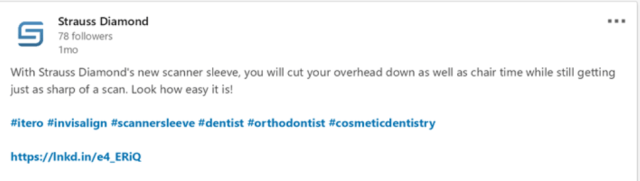
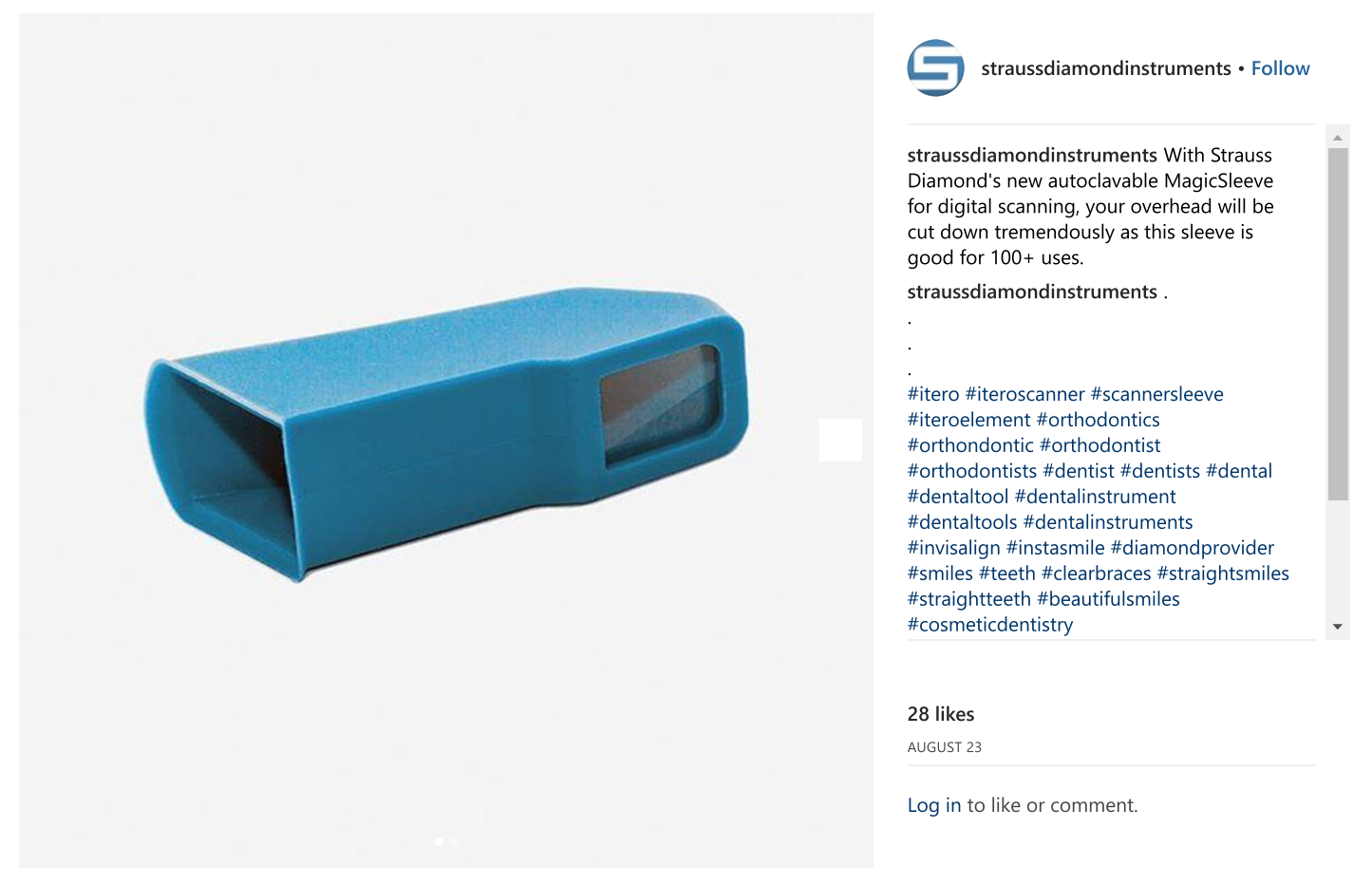
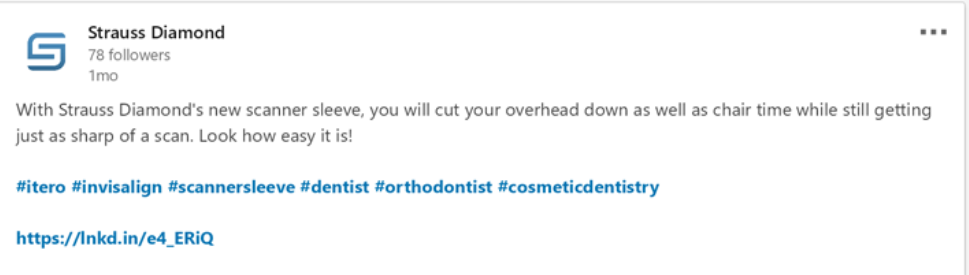
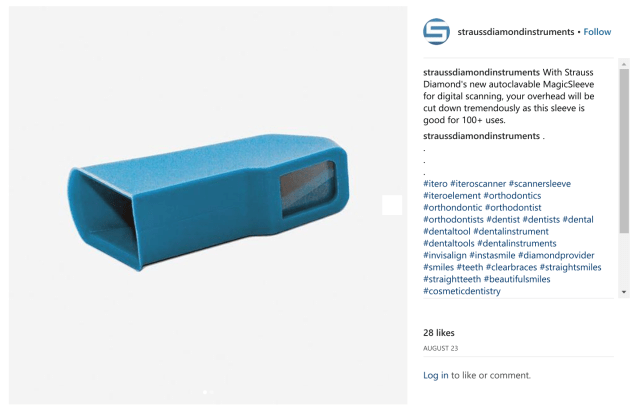
Three problems: (1) Hashtags containing Align’s marks.  For example, two pictures show the
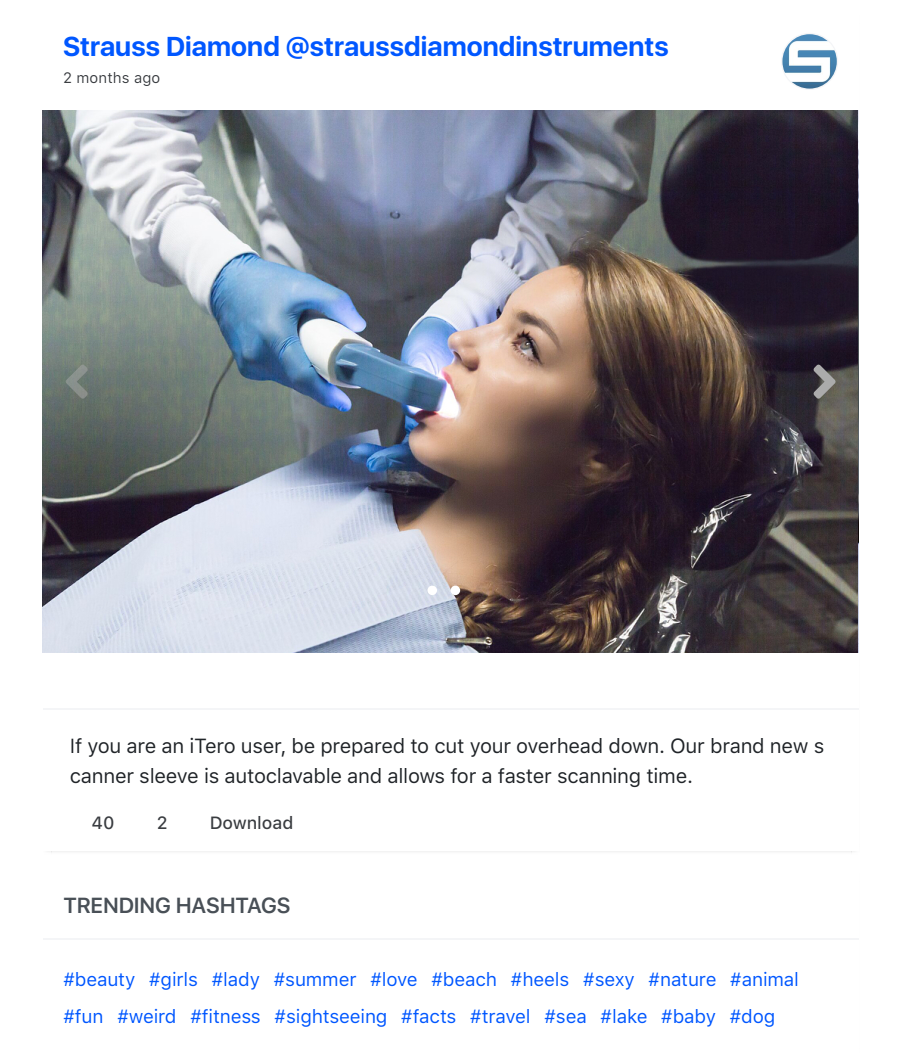
MagicSleeve in use with a patient. The text says, “If you are a digital scanner
user, be prepared to cut your overhead down. Our brand new MagicSleeve is
autoclavable and allows for a faster scanning time. Shop now ->
https://straussdiamond.com/product/scanner-sleeve/.” The third hashtag says
“#invisalign,” and the fifth says “#itero.”
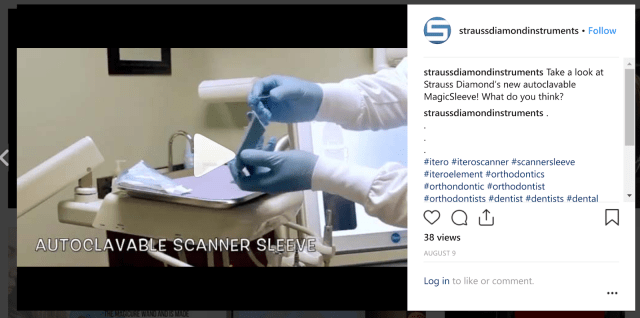
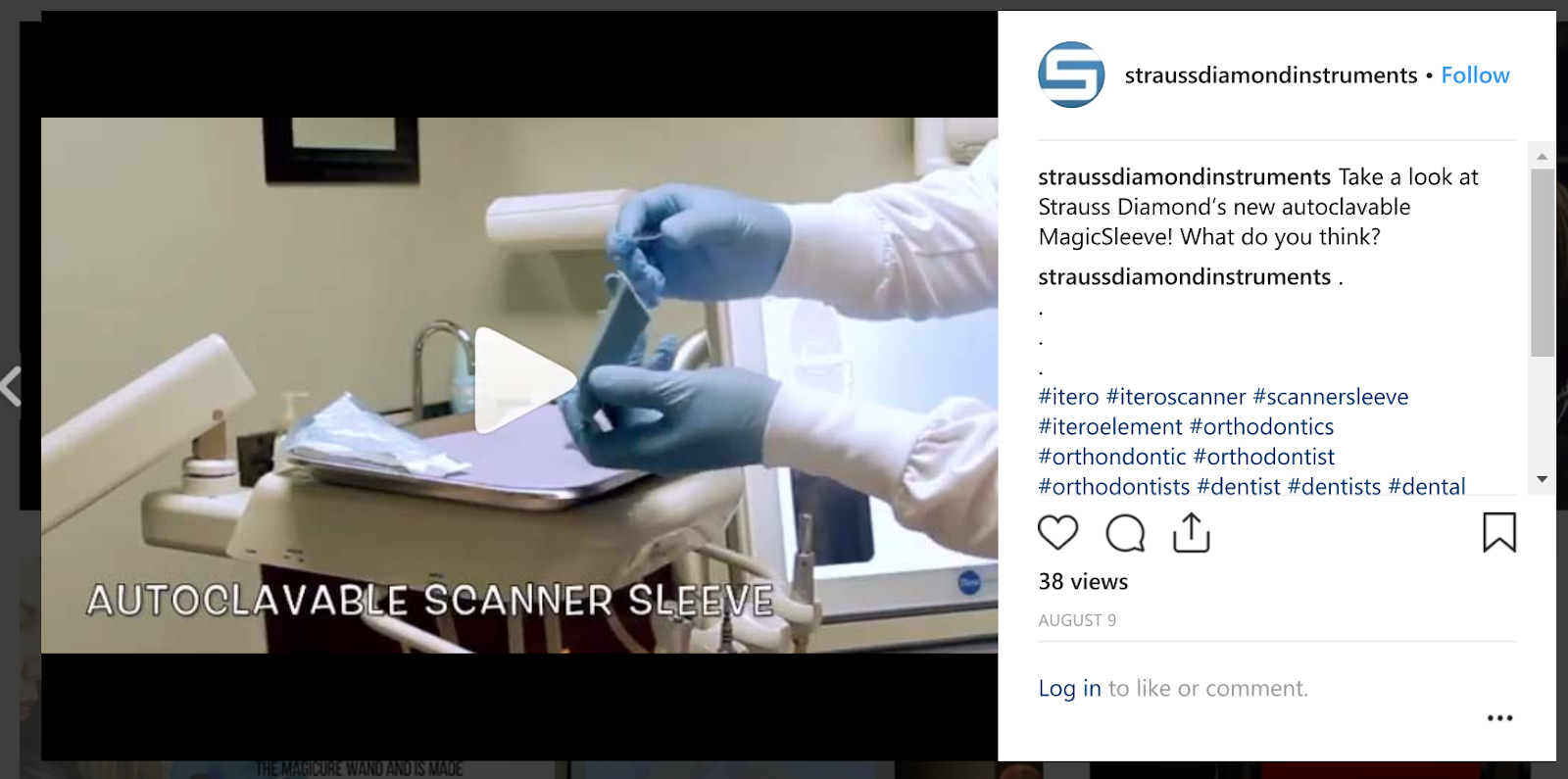
(2) One screenshot from a video says “Order Today.” To the
right is a picture of an Align iTero Element machine with a Strauss MagicSleeve
on the wand. A stylized image of a row of teeth is on the screen, and on the
upper left is an image of both rows of teeth, and on the bottom left is a
picture taken of someone’s mouth showing a couple of teeth. “[T]he machine
itself has the normal ‘iTero element’ logo in tiny letters on the front of it because
that’s how an iTero Element machine looks in real life.” Beneath the picture of
the machine is Strauss’s domain name. 
The problem is that the image of the iTero Element machine with the
stylized pictures on it “was actually created by Align, then copied by Strauss,
which superimposed an image of its MagicSleeve on top of the wand.”

 

screen shot with iTero image
iTero’s image
(3) False claims: Concededly false advertising of “25%
faster scanning time.” Allegedly false advertising that the MagicSleeve
produces scans that are just as sharp as the ones produced by using an iTero
Element sleeve.
The court found that the hashtags wasn’t nominative fair use
because in some cases “Strauss used the marks to refer to its own product,” and
“in all cases, Strauss used more of the marks than is reasonably necessary to
identify the product.”  The court
understood the hashtags to be references to Strauss’s own product, which doesn’t
make a lot of sense to me as a linguistic matter; hashtags do generally
contribute to one’s understanding of the topic under discussion.  But the court didn’t like the context. For
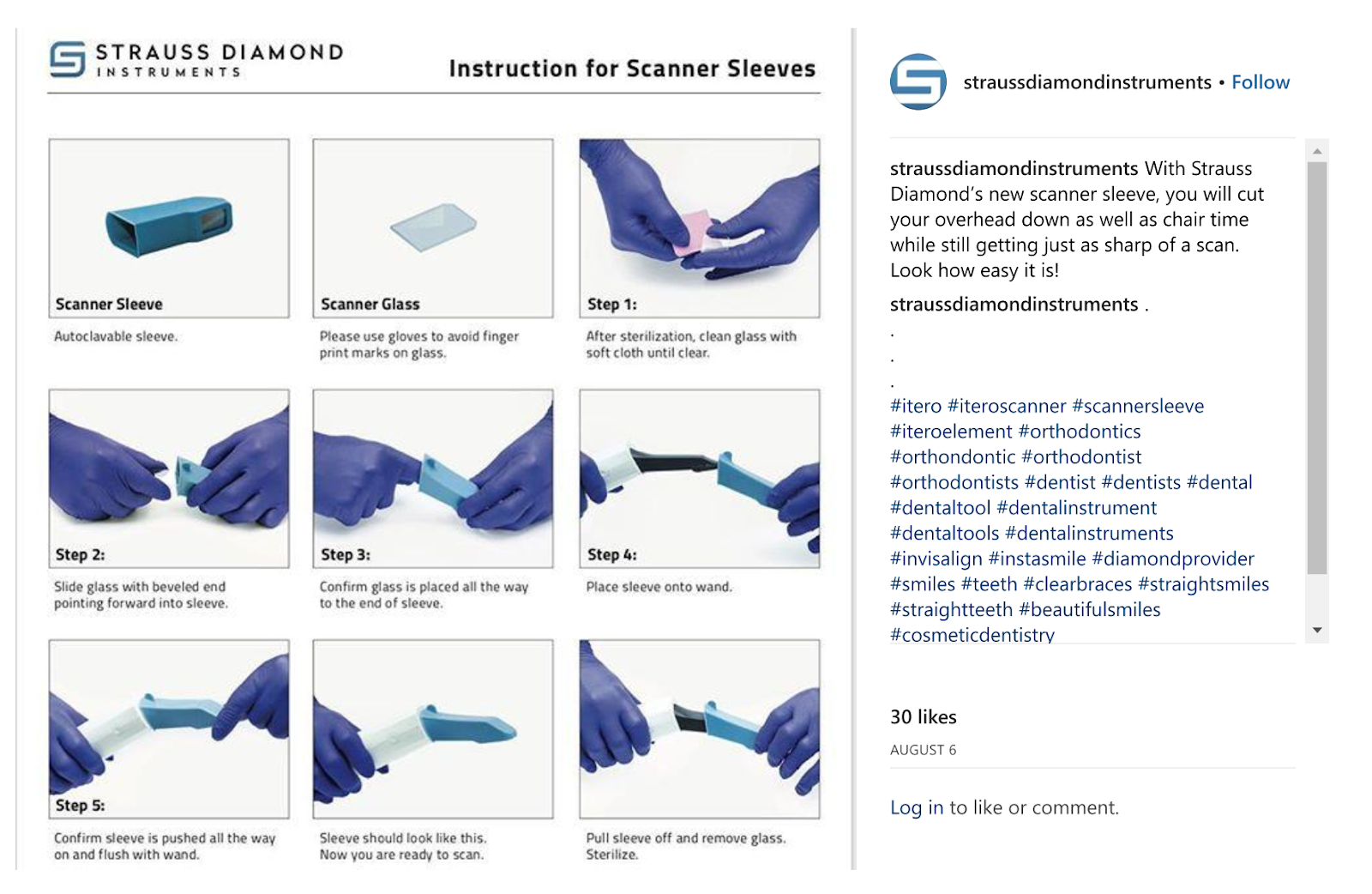
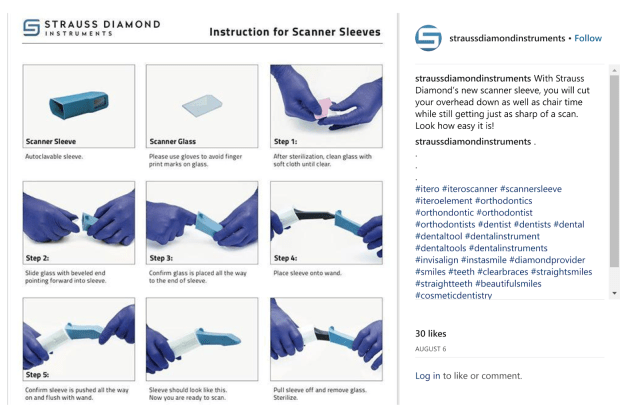
example, the illustrated nine-step instructions for using the MagicSleeve had several
hashtags listed, including #itero, #iteroscanner, #iteroelement and #invisalign,
along with #scannersleeve and #diamondprovider, and then hashtags about
dentistry (e.g., #dentist, #cosmeticdentistry) and attractive teeth (e.g.,
#straightsmiles, #beautifulsmiles). “These hashtags are all collectively being
used to promote and describe the MagicSleeve. It is not credible to view the
hashtags containing Align’s marks as referring to Align’s products (the
foundational assumption of nominative fair use) and the other hashtags as
referring to the MagicSleeve. They are all together references to the
MagicSleeve.”  Citation: Public Impact,
LLC v. Boston Consulting Group, Inc., 169 F. Supp. 3d 278 (D. Mass 2016) (use
of competitor’s mark in social media hashtag “likely” to confuse “even a
sophisticated consumer”).
What a mess.  Yes,
they’re references to something that can be done with the MagicSleeve—it can be
used with an iTero—but that doesn’t make them uses of the marks as marks for
Strauss, any more than the reference to “dentistry” is a trademark use of the
word dentistry.
Regardless, this was more use than necessary. The pictures
already show that the MagicSleeve is meant to be used on the wand of an iTero
scanner. “The hashtags themselves just indicate a vague association between the
term in the hashtag and the MagicSleeve. None of the hashtags are reasonably
necessary to identify Strauss’s product.” 
[Again, that’s not the test in the 9th Circuit, which is
whether you need to use the mark to identify the trademark owner/product once
you’ve decided to talk about it.]  Then,
bizarrely in context, the court says: “In fact, the hashtags do not perform an
identification function. For example, #straightsmiles and #beautifulsmiles are
not meant to identify the MagicSleeve but to imply that this product is
associated with having a beautiful or straight smile. Likewise, #dentist and
#cosmeticdentistry are too vague to serve as a useful identifier; rather, they
indicate that the MagicSleeve is associated with dentistry.”  Which seems true, but exactly why this isn’t
trademark use and why the court’s first reason was wrong.  But then:
In a similar fashion, the hashtags
with Align’s marks indicate an association with Align’s iTero and Invisalign
products. But they don’t identify the MagicSleeve – you can’t read the hashtags
and figure out that this product is the sleeve that goes on the wand of an
iTero scanner. All the reader can glean from the hashtags is an implied association.
OK.  If you replace “association”
with “subject matter,” this becomes somewhat more coherent, but I don’t
understand why the court ignores the rest of the post, which would explain why
and how the hashtags are being used.  This
reasoning does highlight just how often nominative fair use is really just a
quick and dirty confusion inquiry, with the court substituting its own judgment
for evidence about reasonable consumers.
What the court really wants is an unfair competition argument,
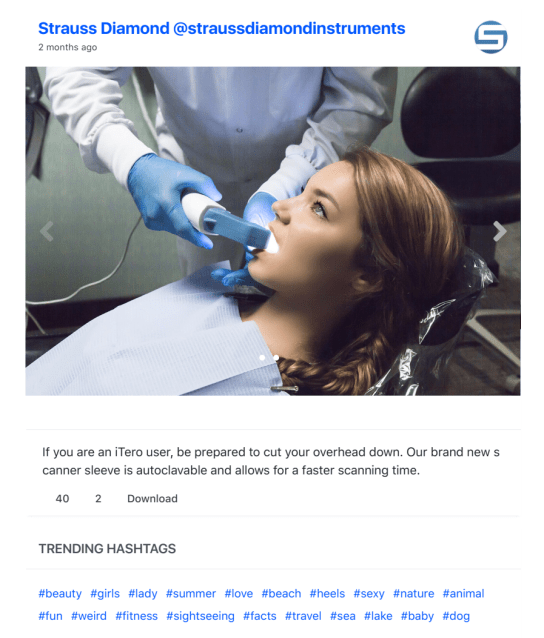
but it doesn’t really have much in the way of principles to get it.  The court described one image: a woman in a
dental chair who is having her mouth scanned by someone using an iTero scanner
with a MagicSleeve on the wand. “The textual sentences that use Align’s mark (‘If
you are an iTero user, be prepared to cut your overhead down. Our brand new
scanner sleeve is autoclavable and allows for faster scanning time.’) are a
classic case of nominative fair use.”  And
the hashtags #itero, #iteroscanner, #scannersleeve, #iteroelement and #orthodontics
were “less of a laundry list,” so that could in theory be a set of references
to Align’s products, references to Strauss’s, and reference to the overall product
category.
But it was still more than reasonably necessary to identify Strauss’s
product, because the hypothetical version of the ad without the hashtags was
just as good at identifying Strauss’s product [still the wrong test].  The identification came from the picture and
the textual sentences; “the use of the marks in the hashtags is never
reasonably necessary to identify the MagicSleeve. You would have to imagine a
pretty terrible ad for the hashtags to do any identifying – maybe just a picture
of the MagicSleeve with no illustration or text explaining what it is for,
leaving the viewer to wonder if he should put it on his finger to do the
dishes, wear it for protection when sewing, or what other use is contemplated.”
This at least clearly indicates the problem the court is
having: “too much” is not, as it more often has been in NFU cases, about using
the text mark and not the font/symbols in a discussion. Instead, as in the
early Playboy v. Welles case, the
problem is that Strauss is just repeating “itero” too often.  But hashtags aren’t wallpaper backgrounds:
they have a purpose both for the reader of the individual post (this is what
the post is about, if you had any doubts) and for searching.
But the court has thought of that!  Apparently NFU does not require that a competitor
is allowed to participate in hashtag searches. 
Although this is indeed a function of the hashtag, the court disagreed
that it was allowed by NFU; previous cases about metatags were not relevant
because metatags just work behind the scenes, whereas hashtags are visible to
consumers.  [So “necessary” here means “necessary
to physically speak the advertising message,” not “necessary to reach consumers.”] Anyway, many of these hashtags “are simply implausible as search
terms. Someone looking for information about how to get straight teeth might
search for ‘adult braces’ or ‘straight teeth,’ but it is unlikely they would
search for #beautifulsmiles or even #straightsmiles.”  Might they look for Invisalign?  If so, uses of those non-trademark terms seem not
particularly relevant.  Also, searches
aren’t the only thing hashtags are used for—trending/locally trending topics can
also be important.  Nonetheless, the
court concluded, the inclusion of #beautifulsmiles and “other implausible
search terms … confirms that the intended audience of the hashtags is, at least
in part, the viewer of the ad, implying association between the MagicSleeve and
the terms in the hashtags.”  [Again, the
court is equivocating about “association,” using the “talking about” meaning
with respect to the non-Align terms and “trademark meaning” for the Align
terms.]
Second, the iTero image was different. This was a reference to Align’s product. “This
is like a Volkswagen repair shop putting a picture of a Volkswagen (including
the VW logo on the car) in an ad to show what it repairs.”  The first and second prongs of nominative
fair use were satisfied—“the MagicSleeve is not readily identifiable without
some reference to an iTero scanner” [still the wrong test] and there’s no more
use than necessary because the only reason why the word “iTero” appears in the
ad is that Align stamped the word on the front of its iTero scanners. However, part
three is “the user must do nothing that would, in conjunction with the mark,
suggest sponsorship or endorsement by the trademark holder.” And a copy-paste
from Align’s website (with the MagicSleeve added on) was “something else”: “Align
created pictures for the screen of the scanner, so the overall image is distinctive.”  The use of the same distinctive image
suggests that the MagicSleeve is endorsed or authorized by Align. 
Note: That does not follow in the slightest.  The copyright analysis could well be
different (though that the actual teeth in the Strauss picture seem to be different, at least based on the quick searches I did), but the fact that Align made the picture doesn’t make the picture
distinctive as trade dress—indeed, as an image of the product design, it is
presumptively unprotected.  Without a
showing that the audience would recognize the picture as the same picture Align
uses, this reasoning is nonsense, but it’s at least nonsense that perhaps is
easier to avoid for future marketers. The court nearly says as much: Strauss
can “likely” put a MagicSleeve on an iTero scanner, take a picture of that, and
use that image in marketing.  
But the court has actually created a Dastar problem in its reasoning: “Align’s marketing people created
that image, and any reasonable observer would understand it was a picture created
for an ad. When it starts showing up in Strauss’s ads for the MagicSleeve, reasonable
people would infer sponsorship or endorsement by Align.”  This is just passing off without secondary
meaning, which doesn’t seem actionable after Dastar (consider Dastar’s
discussion of Wal-Mart).
With NFU out of the way, the court found likely confusion
using the ordinary multifactor test. 
Note how the reasoning on intent contradicts the court’s analysis of the
necessity of using a #trademark hashtag: When asked why Strauss “include[s] the
iTero, iTero Element, and Invisalign hashtags in its Instagram post,” Strauss’s
Vice President Lital Lizotte testified: “Most likely because it has a high
following.” This showed an intent to trade on Align’s goodwill—except that’s
also an intent to reach customers interested in Align products.
There was “some anecdotal evidence” of actual confusion. According
to Align, one dentist told an Align trainer that he “did not know that Align
did not approve of the use of Strauss Diamond’s MagicSleeves with Align’s iTero
system” and, in a second instance, that it was the trainer’s “understanding
that this dentist did not know that the MagicSleeves are not an Align sponsored
product.” [This is pretty weak tea even for association evidence: it’s a double negative rather than a claim that the dentists affirmatively thought there was an affiliation.] Another clinical trainer for Align declared her understanding that a
dentist who called Align to complain about the performance of an iTero Element
being used with a Strauss MagicSleeve believed the MagicSleeves “to be
Align-supported products.” Still, anecdotal evidence is entitled to little
weight; this factor was neutral.
Perhaps surprisingly, the cost of the products here was held
to be low/supporting a finding of confusion. 
The MagicSleeve is $360 for one pack (15 sleeves), or $24 a unit, a low
enough cost that “consumers are not expected to be taking great care in
analyzing the products’ packaging.”  Still, it’s for a dental practice, where the
customers should be sophisticated, making this factor neutral overall.
Result: likely confusion.  Here’s one question going forward: can another competitor use the same hashtags with text that makes clear that it’s an independent product not affiliated with Align?  What if it adds #independent #notaffiliatedwithalign?  Would that change the NFU analysis or the multifactor confusion analysis?
Counterfeiting: Not likely to succeed (though it is notable
that Align thought it worth claiming). First, as far as the court could tell,
none of Align’s registrations covered scanner sleeves. Second, “counterfeiting
is the ‘hard core’ or ‘first degree’ of trademark infringement that seeks to
trick the consumer into believing he or she is getting the genuine article,
rather than a ‘colorable imitation.’ ” There were substantial differences between
the parties’ sleeves in shape, color, and design.
False advertising: Strauss conceded that its 25% faster
claim was literally false.  As to “just
as sharp of a scan,” Align “submitted persuasive evidence that the MagicSleeve
will often produce a lower quality scan. The design of the MagicSleeve means
that the window is more likely to be out of place …. The complicated cleaning
instructions are likely to result in blurry screens. Align has submitted a
large number of customer complaints about the quality of the scans taken with
the MagicSleeve.” The court was persuaded that the MagicSleeve “often” results
in blurrier scans, but it didn’t know exactly how often.  It hadn’t been shown that “just as sharp of a
scan” was “always or even usually false.”
Irreparable harm: since dental professionals and patients
are likely to believe that the MagicSleeve is endorsed or approved by Align, “Strauss’s
continued use of Align’s marks will result in Align losing control over its
reputation and goodwill as a result.” 
This is irreparable harm. And Align showed that the MagicSleeve was
lower quality, which risked Align’s reputation if it was wrongly blamed for
that.
Perplexingly, the court found a higher risk of irreparable
harm because iTero is fanciful, and Invisalign is strong and famous, “so
Strauss’s use of them almost automatically tells a customer they refer to a
brand.” [Citing Qualitex, which is
about distinctiveness, not harm.] 
And 25% faster was a completely unjustified swipe at Align,
which would therefore suffer irreparable harm. 
[The court is standard in using intent to infer irreparability
(but even if we presume that intent to produce damage results in damage, why
would that be irreparable damage in
particular?); the two concepts lack much logical connection but certainly fit
an equitable conception of injunctive relief.]
The court declined Align’s request to enjoin sale of the
MagicSleeve, which was distinguishable from the particular ads at issue.  But a more limited injunction against the particular
conduct at issue wasn’t moot.

from Blogger http://bit.ly/2ZIHXCw

Posted in Uncategorized | Tagged | Leave a comment

competitor has standing to challenge use of certification mark

Savvy Rest, Inc. v. Sleeping Organic, LLC, 2019 WL 1607585, No.
18CV00030 W.D. Va. Apr. 15, 2019)
The parties compete in the market for mattresses and other
bedding products. Savvy Rest alleged that Sleeping Organic violated the Lanham
Act by falsely advertising that Sleeping Organic’s mattresses are free of
chemicals and certified to meet the requirements of the Global Organic Textile
Standard (GOTS). Sleeping Organic challenged standing and argued that “Savvy
Rest does not own the GOTS trademark nor have any organizational interest that
would provide standing for Savvy Rest to assert a claim for false advertising
from alleged misuse of the GOTS trademark or of misstatements regarding the
organic makeup of Sleeping Organic’s products.”
The court disagreed. There are a couple of pre-Lexmark cases suggesting the contrary,
but Savvy Rest satisfied Lexmark’s
standing test. It alleged that Sleeping Organic “can sell its falsely
advertised mattresses for much lower prices” because it “does not incur
expenses which are required to manufacture and sell … genuine GOTS Certified
Mattresses,” causing Savvy Rest to lose sales and to get a reputation for being
overpriced. Lost sales and damage to business reputation “are injuries to
precisely the sorts of commercial interests the Act protects.”
Finally, citing Belmora,
“the plain language of § 43(a) does not require that a plaintiff possess … a
trademark in U.S. commerce as an element of the cause of action,” which is true
but not super responsive to the
argument that the person who does own the trademark would be the proper plaintiff in a 43(a)(1)(B) case.
I don’t think this is the wrong result, but query whether the certifier
should be impleaded/how if at all its rights may be affected by this
litigation/what happens if the certifier is cool with defendant’s use.

from Blogger http://bit.ly/2URsQmG

Posted in Uncategorized | Tagged , , | Leave a comment

“prevailing price” regs not unduly vague, but commercial speech doctrine may still defeat them

People v. Superior Court, — Cal.Rptr.3d —-, 2019 WL
1615288, No. B292416 (Ct. App. Apr. 16, 2019)
The Los Angeles City Attorney asserted claims under
California consumer protection law against the real parties in interest,
including J.C. Penney, alleging that they sold products online by means of
misleading, deceptive or untrue statements about the former prices of those
products. The trial court found the statute void for vagueness as applied to
the parties; the court of appeals reverses, even though the price law at issue
applies to truthful as well as false commercial speech.
According to the complaints, real parties engaged in
misleading, deceptive, or false advertising by offering goods for sale online
at prices discounted from so-called “reference prices” that purported to
reflect real parties’ own former prices, but which did not do so. The complaints
asserted that each real party “deliberately and artificially sets the false
reference prices higher than its actual former sales prices so that customers
are deceived into believing that they are getting a bargain when purchasing
products.”
Section 17501 explains: “For the purpose of this article the
worth or value of anything advertised is the prevailing market price, wholesale
if the offer is at wholesale, retail if the offer is at retail, at the time of
publication of such advertisement in the locality wherein the advertisement is
published.” It then states: “No price shall be advertised as a former price of
any advertised thing, unless the alleged former price was the prevailing market
price as above defined within three months next immediately preceding the
publication of the advertisement or unless the date when the alleged former
price did prevail is clearly, exactly and conspicuously stated in the
advertisement.”  The court agreed with
the challengers that this governed both false and non-false speech—it was
additional to the other prohibition in the statute on false and misleading
speech—but that wasn’t the end of the story.
One note: the court thought that the existence of Section
17500 barring false and misleading advertising made clear that 17501 went
beyond falsity—but that’s not necessarily the case.  Many consumer protection laws list specific
examples of conduct that, through experience, have been shown to be predictably
deceptive, as well as having a catchall provision for the infinite variety of
possible falsities.  A key question is
whether the legislature can identify such practices in advance; I think the
legislature does have the power to do so and presume certain commercial
practices deceptive as a matter of law. The question, as always, is who gets to
decide.  Fake former prices seem to fit
very well into that model, but the court here determined that a considerable
number of “former price” claims would be truthful and nonmisleading if they
were truthful claims about the retailer’s
own former prices. “For example, if a retailer offered widely sold brands of
Halloween costumes, the prohibition would preclude the retailer from
advertising, ‘All Halloween costumes 50 percent off our former prices,’ on the
day after Halloween, unless those prices coincided with one of the two
requisite market prices.”
Viewed in context, the prohibition,
by its plain language, forbids any advertisement of the former price of an
“advertised thing” that does not express the market price information regarding
former worth or value, as specified in the statute. Simply put, the prohibition
bans any advertised claim regarding the former price of an item (1) unless the
advertised former price was “the prevailing market price as [ ] defined [in
section 17501] within the three months next immediately preceding the
publication of the advertisement” or (2) unless the advertised former price was
the prevailing market price—as defined in section 17501—on a clearly specified
date. So understood, the prohibition imposes standardized market-based meanings
on permissible former price claims, and proscribes all other former price
claims—including discount advertising that conveys the seller’s own former
price for an item, unless that advertised former price coincides with one of
the specified two market prices.
The City Attorney suggested an alternative interpretation—that
the retailer’s own former prices could provide the necessary “market price,”
but the court of appeals found that this interpretation “neither complies with
the canons of statutory interpretation nor restricts the prohibition to
nonprotected commercial speech” because it would regulate truthful “claims
regarding an item’s former market value (as based on the prices offered by
other sellers in the market) when that differed from the retailer’s own former
price.” [As noted, I’m skeptical of the latter argument; falsity and misleadingness
of course are separate standards.]
Under Village of Hoffman Estates v. Flipside, Hoffman
Estates, Inc., 455 U.S. 489 (1982), and Holder v. Humanitarian Law Project, 561
U.S. 1 (2010), “a facial challenge fails if the statute clearly applies to some
or all the challenger’s conduct.” That was the case here. “[T]he facial
challenge fails even if the statute’s impact on protected speech triggers a
higher standard for clarity, as the statute clearly applies to some of the
misconduct alleged in the complaints, and is not inherently unworkable or
devoid of guidance to retailers.” This also disposed of the as-applied
challenge for purposes of a demurrer.  As
Holder said, “[E]ven to the extent a
heightened vagueness standard applies, a plaintiff whose speech is clearly
proscribed cannot raise a successful vagueness claim under the Due Process
Clause of the Fifth Amendment for lack of notice.” And due to the limited constitutional
protection of commercial speech, the targets here couldn’t invoke the statute’s
impact on protected commercial speech, as per Hoffman Estates.  The court
concluded: “Here, the meager record permits no evaluation of the validity of
the section 17501 under the Central
Hudson
test. In view of the broad sweep of the prohibition contained in the
statute, we question whether an adequate justification exists for the
prohibition. Nonetheless, the record before us does not establish that the
requisite justification does not exist.”
The complaints asserted that the retailers offered goods for
sale online at prices purportedly discounted from so-called “reference prices”
that are “deliberately and artificially” stated to be higher than real parties’
actual former prices. Some of the goods were exclusive “in-house” goods, and others
were sold by competing retailers.  According
to an investigation, from 19.38 percent to 51.29 percent of the daily offerings
were never offered at (or above) the reference price; 48.65 percent to 88.08
percent of the daily offerings were offered at (or above) the reference price
for only 14 days or fewer; and 83.76 percent to 98.55 percent of the daily
offerings were offered at (or above) the reference price for only 30 days or
fewer. Each complaint specifically alleges that with respect to the in-house
goods, the retailer is the only possible “market” regarding those goods.
The retailers and their amici argued that the statutory
definition of “prevailing market price” was unworkable. Section 17501, which
provides that the “prevailing market price” is that which obtains “at the time
of publication of such advertisement in the locality wherein the advertisement
is published.” “The clear import of the definition is that a retailer, in
selecting the medium for the advertised item, determines the particular market
in which the prevailing market prices are to be identified. The relevant market
is the one that exists in the locality of consumers likely to see the
advertisement at the time it is published, and consists of the vendors then
competing to sell the advertised item to them.”
For exclusive in-house goods, the “advertised actual price
for an in-house item necessarily constitutes the item’s prevailing market price
at the time the actual price is advertised.” The statute identifies the
relevant market price as that for the “advertised thing,” so if it specifies a
precise item “by reference to name, brand, or other distinctive features, … the
market and therefore the market price is properly determined on the basis of
sales of that item only.” [Mark Lemley & Mark McKenna may be interested to
see that the court cites an antitrust case noting that when a seller’s product
is differentiated, seller has “a little pocket of monopoly power.”]
The retailers and amici argued that “locality” is
necessarily vague, and that the advent of the Internet has made its application
“even more question-begging.” Nope. The reference is to “consumers targeted by
the advertisement and the sellers competing to sell the item to them. So
understood, the Internet raises no special difficulty regarding the term, as it
is merely a medium that reaches a very large group of consumers.” And for
exclusive in-house goods, it doesn’t matter. 
The reference price would have to be calculated on a rolling basis, and
though it might be difficult to calculate, there wasn’t anything fatally vague
about it.
The retailers argued that the statute was void for vagueness
as applied to them because it didn’t resolve whether the actual prices charged
for in-house items in their brick-and-mortar stores could serve as the basis
for their online former price claims. But the factual allegations of the
complaints contradicted the retailers’ assertions about in-house pricces.
As to nonexclusive goods, the retailers’ own actual former
prices weren’t enough to establish the prevailing market price.  Even so, the complaint plausibly pled a claim
because it was reasonable to infer that, in competitive markets, the actual
prices offered by vendors selling the same item tend to converge on the market
price. Thus, the factual allegation that the retailers’ advertised former
prices were consistently higher than their actual prices “supports the inference
that those advertised prices were not the prevailing market prices during the
requisite three-month period.”

from Blogger http://bit.ly/2ZKJmZe

Posted in Uncategorized | Tagged , , , , | Leave a comment

class action settlement can’t surrender state agency/CFPB’s rights to recover

Consumer Protection Division v. Linton, 2019 WL 1770524, No.
2609 (Md. Ct. Spec. App. Apr. 22, 2019)
The court explains:
The class action settlement at issue
here involves vulnerable people who were poisoned by lead in their homes.
Before they ever saw television ads for Access Funding, LLC (“Access”), they
had the right to receive hundreds of thousands or millions of dollars over time
as damages for their injuries. When they responded to Access’s ad, they
received fraudulent and conflicted financial “advice,” and Access induced them
into agreeing to assign their revenue streams to Access for pennies on the
dollar in cash. Now, as a condition of a settlement meant to redress the fraud,
class members must agree to assign to Access their full rights to restitution,
all in exchange for a four percent lump-sum payment. This includes their rights
to restitution the Consumer Protection Division of the Office of the Maryland
Attorney General (the “Division”) and the United States Consumer Financial
Protection Bureau (the “Bureau”) might recover. The settlement also would
release Access and its affiliates and principals from liability for public
restitution claims.
Even if the court’s role wasn’t to see whether the
settlement was “a good deal,” this didn’t work. 
Although the settlement process was mostly fair, it interfered with the Division’s
and Bureau’s enforcement authority, and thus the approval was reversed.
Between 2013 and 2015, Access obtained judicial approval to
acquire 163 structured settlements from 100 victims, and obtained $33.8 million
in future payment rights (with a present value of approximately $25.5 million)
in exchange for $7.7 million in cash. Judicial approval for transfer of
structured settlement payments is required, and the court has to find that the
transferor “received independent professional advice concerning the proposed
transfer[.]”But an adviser is not “independent” if they are, among other
things, “affiliated with or compensated by the transferee[.]” Access referred its
potential clients to Charles Smith, a lawyer; in petitioning for approval of
the transfers, Access represented that Mr. Smith had provided the transferors
with independent professional advice. “In fact, Access had paid Mr. Smith for
each victim he ‘advised,’ more than $50,000 overall … and practiced law with
Access’s former attorney.”
The Division ultimately sued Access and its related
entities, Access’s executives, and Mr. Smith, alleging violations of the
Maryland Consumer Protection Act (MCPA) by failing to inform the victims that
it was affiliated with Mr. Smith and that Mr. Smith was not an independent
adviser, by converting future rights to payment into cash on grossly unfair
terms, and by misleading victims about their rights under Maryland law. Linton also
sued on behalf of 100 victims who sold their structured settlements, alleging negligence,
misrepresentation, fraud, constructive fraud, and civil conspiracy. The
settling parties proposed a settlement fund of $1.1 million, from which the class’s
attorneys would receive $330,000 in fees. The proposed settlement barred the class
from “receiving any benefits from any lawsuit or arbitration proceeding arising
out of or related to any of the Released Claims,” and compels the Class to
“irrevocably assign and transfer … any recovery based on the equitable
remedies of restitution, disgorgement of profits or damages obtained by [the
CFPB or the Division] for the benefit of each Settlement Class Member.”
Moreover, the settlement releases all of the Class’s claims against the Class
Action Defendants, as well as any claims against certain people involved in Access
(even though none of them was named in the suit).
The parties indicated that there was nothing much other than
a $1 million insurance policy for the class; counsel for Access stated that
Access and its related entities had “no assets” and were “basically insolvent.”
Counsel for Mr. Smith represented that he had only a “few thousand dollars”
other than the assets he held with his wife as tenants by the entireties.  Although one defendant might have had $5
million in assets, class counsel indicated that he had a strong defense to the
conspiracy asserted against him because he had provided legal advice in the
scope of his employment. The court declined to consider the financial resources
of three three executives who were not defendants in the class action, but the
court declined to do so.
In addition, class counsel argued that arbitration
requirements in the structured settlement transfer agreements would require class
members to arbitrate their claims individually and that litigating serial
claims would deplete Access’s declining limits insurance policy, making settlement
in the class’s best interest.  The trial court
ultimately agreed.
Nonetheless, the settlement interfered too much with the
Division and Bureau’s enforcement authority.  It “effectively preempted a major portion of
the pending claims.” Restitution and damages aren’t the same thing, “even if
the process of calculating them might (and often does) lead to the same result.
Damages are, well, damages, and compensate a party for their losses.
Restitution also, but primarily, seeks to prevent bad actors from being
enriched unjustly—an enforcement purpose properly commended to public
authorities, not private plaintiffs.” Requiring the plaintiffs to assign any
recovery from the Division/Bureau right back to the defendants “directly thwarts
the Division’s ability to combat unjust enrichment.”
This isn’t a great result, because Access’s declining-limits
insurance policy (which decreases as litigation costs mount) might be the only
concrete set of assets realistically available to fund a recovery. But the Division
and Bureau have to deal with this sort of question all the time, and the
settlement shouldn’t have included terms that “resolved or interfered with”
their enforcement authority.
A few minor points: the Division asked the court to require
the notice to inform prospective members that the settlement amount was
equivalent to only 4% of each prospective member’s loss. If the purpose of the
notice was objectivity, “language describing the extent of the Class’s
financial compromise would serve that purpose, even if it might dissuade
recipients from agreeing to the settlement.”  However, the majority didn’t resolve whether
the settlement was substantively fair; given what it did hold, the best
approach was to send it back for the parties to negotiate anew.  Still, a 96% discount on the value of claims
was “concern[ing],” as was the depth of the record on the financial fairness of
the settlement and the court’s decision not to consider whether any assets of
the non-defendant executives, who were getting releases from the settlement,
were available to fund the settlement. “The way Access treated its customers,
for its own benefit, provides ample reason to be skeptical of unsupported
representations it might make to the court about its finances. And yet despite
a months-long investigation and subpoena power, the Division could only express
skepticism, and couldn’t yet back it up.”
The dissent would have allowed the settlement and would have
held that releasing/assigning personal rights from public enforcement didn’t
sufficiently interfere with public enforcement authority to be barred. The
Division could still levy civil or criminal penalties.
Notably, a key reason the dissent would have held that the
settlement was substantively fair was the unfairness to which the victims had
already been subjected: they might well have been compelled to go to individual
arbitration rather than to litigate class claims because of the arbitration
provisions in the structured settlement transfer agreements. It’s a powerful
example of the knock-on effects of arbitration provisions in consumer fraud
cases.
The dissent also noted that Access apparently sold the
structured settlement rights, and if the transferees were bona fide purchasers,
the Division might well not be able to reclaim the rights as restitution.

from Blogger http://bit.ly/2UJ61l2

Posted in Uncategorized | Tagged , , , | Leave a comment

CLRA redress offer requiring waiver of claims can’t defeat consumer’s right to sue

Valdez v. Seidner-Miller, Inc., 33 Cal.App.5th 600 (2019)
Valdez alleged that Seidner violated the CLRA, the UCL, and
Civil Code section 16321 (requiring translation of certain contracts), and
committed fraud in connection with Seidner’s lease of a vehicle to Valdez and
his wife. The trial court ruled that Seidner made a timely and “appropriate”
offer to correct the alleged CLRA violations, barring Valdez’s claim under the
CLRA for damages and injunctive relief, as well as his other claims, because those
other claims were “inextricably intertwined” and based on the same conduct. The
court of appeals reversed; although the correction offer was timely, it wasn’t
appropriate because it conditioned an offer to remedy a violation of the CLRA
on Valdez waiving his right to injunctive relief and remedies under other
statutes and common law. “Neither can the business demand as part of its
correction offer that the consumer consent to additional settlement terms
unrelated to the compensation necessary to make the consumer whole.”
In 2015, Valdez sent Seidner a “notice of rescission and
demand for rectification” under the CLRA. Valdez and his wife had entered into
an agreement with Seidner to lease a 2014 Toyota Camry. “The negotiations were
conducted in Spanish, but Seidner did not provide Valdez and his wife a Spanish
translation of the lease agreement.” Although he wanted to buy and not lease,
he was told he lacked sufficient credit to do so, and that certain charges were
required by law.  When he returned to the
dealership approximately 10 months later, he learned he could not refinance the
car at the initial price.
The CLRA notice sought rescission of the transaction;
removal of the transaction from Valdez’s credit report; a refund of $1,500 for
the down payment, $4,626 for the monthly payments, and $1,500 for insurance;
and payment of $2,750 for attorney’s fees and costs. Seidner’s attorney
provided a draft settlement agreement denying all the allegations in Valdez’s
CLRA notice. Seidner agreed to pay off the outstanding loan balance, pay $5,126
to reimburse the down payment and monthly payments, and $2,750 for attorney’s
fees and costs within 10 days after surrender of the vehicle. The draft required
Valdez to return the vehicle “without damage or vandalism, save normal wear and
tear,” and allowed Seidner to void the settlement agreement if it determined
the vehicle was “in unacceptable condition.” It required confidentiality and contained
a release of all known and unknown claims and a covenant not to sue.
During negotiations, Valdez disclosed the vehicle had been
in an accident in October 2014 and the repair costs were approximately $3,300.
According to Seidner, the vehicle history report showed the vehicle was also in
an accident in 2015.  The parties nearly
came to an agreement, but Seidner requested inspection of the vehicle before it
would provide Valdez with the settlement funds. This was unacceptable to Valdez:
“There is no way this agreement can be based upon your client’s subjective
review of the car’s condition.” Seidner was prepared to remove the covenant not
to sue language and confidentiality provision, but not the requirement the
vehicle be inspected prior to release of the settlement funds. Valdez indicated
that he would agree to an inspection if Seidner paid the costs of his attorney
and expert to be present, but Seidner didn’t agree.
At least 30 days “prior to the commencement of an action for
damages” under the CLRA, the consumer must provide written notice “of the
particular alleged violations of Section 1770” and “[d]emand that the person
correct, repair, replace, or otherwise rectify the goods or services alleged to
be in violation of Section 1770.” Further, “no action for damages may be
maintained under Section 1780 if an appropriate correction, repair,
replacement, or other remedy is given, or agreed to be given within a
reasonable time, to the consumer within 30 days after receipt of the notice.” Seidner’s
offer was timely; it was sent 32 days after Seidner received the CLRA notice,
but day 30 was a Saturday and it was allowed to go to Monday.
However, by conditioning relief on release of claims not
subject to the CLRA’s prelitigation notice requirements and on compliance with
other settlement terms, including Seidner’s subjective approval of the
vehicle’s condition, the settlement offer wasn’t an appropriate correction
offer under the CLRA.
The offer’s broad release language and covenant not to sue
would have prohibited Valdez from asserting his section 1632, UCL, and fraud
claims and his claim for injunctive relief under the CLRA. “Yet Valdez had a
right to bring those claims without first providing notice under the CLRA.” Among
other things, Valdez sought injunctive relief prohibiting Seidner “from
entering into lease agreements without providing appropriate translations,
prior to execution, when negotiations are conducted primarily in a language
other than English ….” Since the draft settlement agreement did not provide
the requested injunctive relief, it wasn’t appropriate for Seidner to condition
its correction offer on release of Valdez’s claims for injunctive relief. A
“reasonable correction offer prevent[s] [the plaintiff] from maintaining a
cause of action for damages under the CLRA, but [does] not prevent [the
plaintiff] from pursuing remedies based on other statutory violations or common
law causes of action based on conduct under those laws.”
The court also pointed to Valdez’s claim under a fascinating
California law providing that “Any person engaged in a trade or business who
negotiates primarily in Spanish, Chinese, Tagalog, Vietnamese, or Korean,
orally or in writing, in the course of entering into [covered vehicle leases],
shall deliver to the other party to the contract or agreement and prior to the
execution thereof … a translation of every term and condition in that
contract or agreement ….” The statute’s goal was “to increase consumer
information and protections for the state’s sizable and growing Spanish-speaking
population.” It provides for rescission of the agreement as a remedy for a
violation. Seidner admitted that “a Spanish translation of the subject contact
was orally made to plaintiff before the plaintiff signed the document but inadvertently
no written translated document or written Spanish language contract was
provided to [Valdez].”
And there were also UCL and fraud claims. The court pointed
out that, if Valdez hadn’t added a CLRA claim, there’d be no notice/voluntary
correction issue.  It would be anomalous
to then hold that, once he added a CLRA claim, all those claims would be barred
by a correction offer.
Finally, Seidner’s correction offer “improperly allowed
Seidner unilaterally to void the proposed settlement agreement if it determined
after an inspection that the vehicle was in an unacceptable condition.”  Damage beyond normal wear and tear would
entitle Seidner to an offset for the damage. “But conditioning CLRA remedies on
Seidner’s subjective determination whether the vehicle was in an acceptable
condition rendered Seidner’s offer illusory.”
Seidner could have made an
appropriate correction offer had it offered simply to refund Valdez’s down
payment and monthly payments, pay off the outstanding loan balance, and pay
attorney’s fees and costs. Although Valdez would still have been able to pursue
his other claims, nothing would have prevented Seidner from attempting to
negotiate a separate settlement of those claims. But Seidner’s effort to exact
additional concessions from Valdez as part of a global settlement [didn’t
satisfy the] CLRA.

from Blogger http://bit.ly/2ZIPGR5

Posted in Uncategorized | Tagged , | Leave a comment

Cable service provider engaged in reverse passing off of DirecTV signal (and other bad acts)

Northeast Cable Televis., LLC v. DirecTV, LLC, 2019 WL
1767066, No. 18CV2559 (N.D. Ohio Apr. 22, 2019)
DirecTV’s satellite television service provides hundreds of
channels. For certain kinds of multiple-unit properties (usually a hotel or
motel, hospital, college dormitory, or individual office), DirecTV sometimes
provides service through a Satellite Master Antenna Television System”(SMATV). In
that case, the SMATV property owner or manager is the “customer.” DirecTV
charges monthly fees based on the type of property as well as the programming
ordered and the number of individual units with access to the programming. The
SMATV customer is prohibited from charging the individual viewers for DirecTV
programming, and from rebroadcasting, retransmitting, or reselling DirecTV
programming.  DirecTV sometimes
subcontracts with dealers, who may not themselves bill the properties for DirecTV
programming except in rare cases.
Northeast Cable’s principal Pezzenti represented that, in
2003, he was approached by a representative of an authorized DirecTV dealer, which
proposed an arrangement according to which Northeast Cable would transmit DirecTV
programming to 14 multi-unit properties in Ohio and pay the bills to DirecTV on
the properties’ behalf. Northeast Cable thus entered “service agreements” with
14 properties in which it charged a monthly fee in exchange for providing
necessary equipment, performing maintenance, and paying DirecTV’s programming
bill each month. On SMATV Viewing Agreements with DirecTV, Pezzenti or
Northeast Cable usually listed itself as the “authorized customer,” “general
manager,” or something similar.
Northeast Cable routinely bills about $4,300 to $4,500 per
month for one property, whereas DirecTV would have billed the properties at about
$1,400 to $1,600 per month if it had billed directly [maybe for the reported
number of units], and the greater expense seems to be the general rule. DirecTV
further alleged that Northeast Cable vastly underreported the number of units
receiving programming service at the SMATV properties, for example reporting 25
units when DirecTV’s own investigation uncovered 127 active units.  Further, in two cases, it broadcast DirecTV
programming from one SMATV property to another non-SMATV property.
Northeast Cable also allegedly held itself out as the SMATV
properties’ “cable television programming provider,” omitting any reference to DirecTV.
For example, one ad says, “Are you overpaying? Why pay double to watch the same
channels? Call Northeast Cable today! Ditch the dish and get the same channels
for half price.” Northeast Cable also distributed a “TV Channel Selection Guide,”
listing the channels available through Northeast Cable without any indication
that DirecTV was the true source of the programming. In letters to residents,
Northeast Cable described itself as “your cable television service provider.” [Seems
like a Dastar issue, testing the
difference between goods and services.]
Under 47 U.S.C. § 605(a), “[N]o person receiving, assisting
in receiving, transmitting, or assisting in transmitting, any interstate or
foreign communication by wire or radio shall divulge or publish the existence, contents,
substance, purport, effect, or meaning thereof, except through authorized
channels of transmission or reception…to any person other than the addressee,
his agent, or attorney….” “[A]n entity violates § 605(a) if it transmits a
television signal to viewers other than those intended by the sender, even if
that entity is authorized to transmit the signal to some other viewers.” That was
what was happening here.  47 U.S.C. §
553(a) further provides that “No person shall intercept or receive or assist in
intercepting or receiving any communications service offered over a cable
system, unless specifically authorized to do so by a cable operator or as may
otherwise be specifically authorized by law.” Ditto.
Under the Electronic Communications Privacy Act, 18 U.S.C. §
2511(1), “it is illegal to intentionally intercept electronic communications.” “Northeast
Cable acquired DirecTV’s programming signal by representing itself as a
legitimate SMATV customer even though it was not ‘the owner or manager of the
business entity.’” And here I breathe a partial sigh of relief, because even
though this is not good conduct, calling that “interception” seems to create
the same problem as broad interpretations of the CFAA: the court said that it
wasn’t clear that this misrepresentation was interception.  However, with respect to retransmitting the
signal from contractually covered to uncovered properties via microwave and
underground cable, the court viewed this as “patently” in violation of the
ECPA.  I don’t know why that’s interception
as opposed to reception by someone authorized to receive it and retransmission
in excess of that authorization, especially given the statutory sections above
already covering the problem, but then again this is not my field.  The cited case, Luis v. Zang, 833 F.3d 619 (6th
Cir. 2016), is about someone who shouldn’t have been receiving the transmission
in the first place (spyware).
Lanham Act false designation of origin: it’s reverse passing
off! “Until recently, SMATV property owners and managers understood Northeast
Cable to be their programming provider and were unaware (in some cases) that DirecTV
was at all involved in their programming…. The harm to DirecTV is apparent:
Northeast Cable’s deception deprives DirecTV of revenues and business
relationships it otherwise would likely enjoy.”
False advertising: it was false for Northeast Cable to hold
itself out as “your cable television service provider,” and to represent that
subscribers would “[d]itch the dish” when they “subscribe” to Northeast Cable,
because the programming with Northeast Cable came from DirecTV’s satellite dish
service. The court skipped over materiality and reiterated that “Northeast
Cable’s deception deprives DirecTV of revenues and business relationships it
otherwise would likely enjoy,” which is … not actually the false advertising liability
standard. 
Common-law fraud: Northeast Cable’s representation of itself
as the “customer,” specifically, as a “property owner or manager” in SMATV
Viewing Agreements with DirecTV; representations that most of its properties
had 20 to 25 units even though many of them had dozens or hundreds; and use of
signal from elsewhere to support new properties were fraudulent.
Tortious interference: “The properties had SMATV contracts
with DirecTV, whether they knew it or not.” Northeast Cable deliberately caused
those properties to breach their contracts with DirecTV by “encouraging and
instructing the properties to charge residents individually for their
television programming…. And but for Northeast Cable’s involvement, DirecTV
would likely have enjoyed greater revenues and better business relationships
with the SMATV properties.”  [This doesn’t
quite match up with the “Northeast Cable charged more than DirecTV would have”
statements above, but it could easily be the case that DirecTV would have
charged less per any given number of units.]
Unjust enrichment: that too.
Irreparable harm: This proceeding and the underlying
investigation has damaged Northeast Cable’s reputation.  Further, the “relationship” between Northeast
Cable and DirecTV is “going to end…once this litigation is over” and Northeast
Cable will cease doing business at that time. “In the meantime, absent an
injunction, DirecTV will be tied to a sinking ship. … As Northeast Cable’s
reputation suffers, so too will DirecTV’s reputation, not just with individual
viewers and property owners and managers, but also with authorized dealers and
content distributors.”  [I’m not so sure
that follows.  It’s pretty clear from all
this that DirecTV is not responsible for the hinky stuff, and it appears to
have communicated that to the property managers here; the customers, as the
court pointed out, didn’t even know they were getting DirecTV. The remaining
arguments are far more persuasive.]
Although revenue lost from fraud is ordinarily compensable
with money damages, “DirecTV understandably lacks confidence that all
properties and all units have now been accounted for and that all corresponding
damages will be recoverable down the road.” 
And DirecTV might have legal and regulatory exposure in the meantime: it
has contractual obligations to accurately compensate content providers
according to the total number of viewers, and possibly regulatory obligations
to maintain accurate records of its programming transmissions. “As long as DirecTV
continues to pay its content providers according to Northeast Cable’s
disorganized and deflated reports, it may be exposed to legal and regulatory
enforcement.”  Plus, Northeast Cable is
going out of business and the injury may be irreparable because it can’t pay damages.

from Blogger http://bit.ly/2UOssVR

Posted in Uncategorized | Tagged , , | Leave a comment

Allegations of patent infringement could be defamatory but not false advertising

GeigTech East Bay LLC v. Lutron Electron. Co., 2019 WL
1768965, No. 18 Civ. 5290 (CM) (S.D.N.Y. Apr. 4, 2019)
“What started as a garden-variety intellectual property
dispute has morphed into something less conventional.” GeigTech initially sued
Lutron, alleging that Lutron’s exposed roller windowshade product constituted patent
and trade dress infringement; GeigTech voluntarily dismissed its cause of
action for patent infringement after a preliminary injunction was denied.
Lutron then counterclaimed for defamation, false advertising, unfair
competition, and deceptive trade practices based on the patent allegations and
related public statements. Here, the court partially allows the counterclaims.
When GeigTech sued, it issued a mostly “unremarkable” press
release announcing the lawsuit recounting the causes of action alleged and
describing how Lutron’s product allegedly “copies” the “ ‘simply modern’ look”
of GiegTech’s “R Series” shading system. It included a quote from GeigTech’s
principal Geiger:
Our premium products have become
highly sought-after for both residential and commercial properties across the
country thanks to their unique design, simple aesthetic, and our reputation for
precise installation[.] It’s unfortunate that rather than investing the time,
effort, and resources necessary to innovate their own products, Lutron has
instead opted to poach our patented designs and intellectual property to try
and remain competitive in a segment of the market that we’ve cornered. Their
blatant infringement has left us no choice but to file this lawsuit to protect
our patented designs as we continue to focus on providing our customers with
the most innovative, highest quality window shading solutions out there.
After the patent claim was voluntarily dismissed, the court
ruled that GeigTech had stated a viable cause of action for trade dress
infringement but not for unjust enrichment; GeigTech issued another press
release touting the court’s decision not to dismiss the trade dress
infringement claim, without mentioning the unjust enrichment claim or the now-gone
patent claim, though that isn’t at issue here.
Lutron alleged that the first press release misrepresented
the nature of Lutron’s products and the company’s commercial activities. First,
Lutron alleged that, rather than copying without effort, it expended
substantial resources in designing its product in a distinctive fashion and
with a particular purpose. Second, it alleged that the patent claim was filed
and publicized in bad faith, because GeigTech knew and had reason to know that
Lutron’s product didn’t infringe and that the asserted patent claim was invalid
and unenforceable in light of undisclosed prior art.
GeigTech argued that the press release constituted a “fair
report” of an ongoing lawsuit and thus were privileged under both federal and
state law. There was no conflict of laws, so the court applied NY law.  The privilege didn’t provide immunity “for
one who embellishes, mischaracterizes the nature of a lawsuit, or speaks in a
manner that suggests more serious conduct than what is alleged – because, of
course, such speech would not constitute a substantially accurate reporting of a
judicial proceeding.” Nor can a party “take advantage of the privilege by
instituting a judicial proceeding alleging false and defamatory charges only to
then issue a press release publicizing those defamatory allegations.”
Also, the privilege didn’t apply to Lanham Act cases, since
it covers state law.  [There are plenty
of cases about Lanham Act claims based on allegedly false patent assertions—the
federal courts have created essentially the same immunity there based on
preclusion principles.]
But that didn’t matter, because the allegations overcame the
fair report privilege for purposes of a motion to dismiss by sufficiently
alleging that the lawsuit itself was a baseless way of getting false or
defamatory statements into circulation. In particular, GeigTech allegedly knew
that the Lutron product didn’t meet critical limitations of the asserted patent
claims that GeigTech was required to add during prosecution in order to obtain
its patent in the first place, as well as knowing of undisclosed prior art that
actually inspired GeigTech’s alleged invention. “These issues came to light when
Geigtech – after waiting nine months from the time the alleged infringement
began – filed suit and moved for a preliminary injunction. Despite seeking such
an extraordinary remedy in a patent case, Geigtech declined to perform the
basic step of construing its own patent.” That’s why it didn’t get a
preliminary injunction. “The deliberate institution of baseless litigation for
the purpose of fabricating a reporting privilege falls squarely within the
malicious filing exception” to the fair report privilege; the issue could not
be resolved on a motion to dismiss.
Nor was the press release purely non-actionable opinion.  Whether Lutron actually “invest[ed] the time,
effort and resources necessary to innovate their own products” as opposed to
“poach[ing]” Geigtech’s “patented designs” and engaging in “blatant patent
infringement” was “susceptible to proof by way of objectively verifiable facts.”
Whether the Lutron system “was the product of innovation or copying is a
question of fact, not a difference of opinion.” Although an average reader “might
account for Geiger’s bias, somewhat neutralizing the sting of his comments,” but
might also reasonably conclude “that Geiger, as president of GeigTech, is privy
to undisclosed and damning information, the details of which formed the basis
for [his] statements.”  The principal
question was whether Geiger actually held the belief he professed: that Lutron
was actually engaged in patent infringement. “Whether this is true presents a
question of fact, not of opinion.”
Geigtech did better on failure to state a claim, in
part.  Lutron did adequately plead
defamation. However, a press release about a patent suit isn’t “commercial
advertising or promotion.”  The court—staking
out what I think is a minority position—suggested that the press release wasn’t
even commercial speech, because it lacked the “usual trappings” of such
speech.  “Aside from summarizing how the
Palladiom Shading System purportedly violated Geigtech’s patent and trademarks,
the press release did not contain core commercial information, including price
and product information.” More persuasively, the court held that the press
release wasn’t “part of an organized campaign to penetrate the relevant market,”
which is a requirement for “commercial advertising or promotion” if not for
commercial speech as a broader category.  The “primary focus” of the press release “was
to draw attention to Geigtech’s lawsuit against Lutron, not to propose a
commercial transaction. … Importing Lanham Act liability to the facts of this
case, which concern public statements about pending litigation, would extend
the Act beyond the parameters contemplated by Congress.”  Back to commercial speech: characterizing the
press release as commercial speech would create “a chilling effect on the sort
of statements litigants can make about pending litigation.”  In a footnote, the court stated that a
complaint can’t form the basis of a Lanham Act claim, because a complaint isn’t
commercial speech. “It stands to reason, then, that a press release that does
nothing more than parrot the allegations of a complaint cannot also form the
basis for false advertising under the Lanham Act – at least not without other
earmarks of commercial speech being present, including the presence of a
broader advertisement campaign.” This also disposed of NY/South Carolina unfair
competition claims, whose elements “resemble the elements for proving false
advertising under the Lanham Act.” [This may be true for substantive liability,
but I don’t think it’s true for requiring “advertising or promotion.” State
laws tend to cover misrepresentations made to individuals even if there was no
larger campaign.  Given the court’s
conclusion on commercial speech, that might not matter here, though; the court
discusses South Carolina’s requirement of “an unfair or deceptive act[ ] or
practice[ ] in the conduct of any trade or commerce” and concludes that the
press release wasn’t an act of trade or commerce.]
Upshot: this is now a patent infringement case again; to
assess the truth of the factual assertion of infringement in the press release,
the parties were directed to exchange proposed claim constructions.

from Blogger http://bit.ly/2IM8gT0

Posted in Uncategorized | Tagged , , , | Leave a comment