Bringing a false advertising claim with unclean hands leads to fee award

Certified Nutraceuticals, Inc. v. Avicenna Nutraceutical,
LLC, 2018 WL 5840042, No. 16-cv-02810-BEN-BGS (S.D. Cal. Nov. 7, 2018)
The court awarded roughly $170,000 in fees in this Lanham
Act false advertising case because the plaintiff engaged in the same conduct
(falsely claiming that its product was patented) as its competitor in the
market for collagen products, and still sued the competitor. The court
previously granted summary judgment based on unclean hands; the briefing
“brought to light filings by Certified that seemingly misrepresented the
status” of one patent, leading the court to impose sanctions against Certified,
its CEO, and its counsel.  (Basically,
when Avicenna showed that Certified’s patent hadn’t issued before it advertised
its “patented” status, Certified claimed that it was referring to another
patent, but years before it had been enjoined from exercising that patent.)
Under Octane Fitness the
exceptionality inquiry for fees requires a court to consider “factors,
including frivolousness, motivation, objective reasonableness (both in the
factual and legal components of the case) and the need in particular
circumstances to advance considerations of compensation and deterrence.”
Frivolousness/unreasonability: “prior to filing its lawsuit,
Certified knew or should have known that its unclean hands barred its Lanham
Act claim and that it did not suffer any injury, barring its two state law
claims.”  As for the California state law
claims, Certified could only identify two customers it “lost” as a result of Avicenna’s
statements, and those two customers’ decisions weren’t based on Avicenna’s
false statements but on the customers’ beliefs in Avicenna’s product’s superior
quality and consistency.  Even under more
stringent older standards, there was no reasonable basis for bringing these
claims.  Nor would the court refuse to
award fees because Certified got Avicenna to stop making patent-related claims,
in that Avicenna’s misrepresentation of its product as “patented” happened only
twice, and Avicenna corrected both instances prior to Certified filing its
lawsuit.
Objective reasonableness of litigation: the sanctions order
provided the court’s basis for finding that litigation was conducted in an
objectively unreasonable manner. Moreover, Certified’s decision to file a
similar case in the district while the present case was pending additionally
demonstrated objective unreasonability; that case was voluntarily dismissed
after a motion to dismiss indicated that Certified didn’t own the second
patent.
Deterrence: Certified has a history of litigation, including
the lawsuit just mentioned (which targeted nearly a dozen competitors) and a
case in which  the California Court of
Appeal affirmed a sanctions award of $34,000 against Certified’s principal for
advancing frivolous arguments in a lawsuit against another competitor.
Certified also filed a second lawsuit alleging similar false advertising claims
against Avicenna, but had yet to serve Avicenna with the lawsuit.  The court found that this conduct was relevant
both for the Octane Fitness totality
of the circumstances test and for the deterrence factor. Also, Certified failed
to comply with the sanctions order by filing a notice that the sanctions were
paid within three days of payment, which had been part of the order.  “To say the least, Certified’s brazen
litigation tactics and utter disregard for this Court’s own order suggest a
lack of respect for the rule of law that should be deterred.”
Avicenna could only recover for fees related to its work on
the Lanham Act claim, not the two state law claims, but the claims here were “so
inextricably intertwined that even an estimated adjustment [for the state law
claims] would be meaningless.” They relied on the same factual allegations and
had many of the same elements.

from Blogger https://ift.tt/2RQYHTr

Posted in Uncategorized | Tagged , | Leave a comment

literal falsity still needs to be material, and court wants a survey or other direct evidence thereof

LivePerson, Inc. v. [24]7.AI, Inc., 2018 WL 5849025, No.
17-cv-01268-JST (N.D. Cal. Oct. 26, 2018)
LivePerson “provides online chat engagement services through
a digital platform that it sells to website operators.” That is, it helps
websites provide real-time text-based communications with website users
directly on the website. Its platform tries to identify when initiating a chat
with a particular user is most likely to produce a positive outcome, such as a
sale, using rules based on variables such as the user’s navigation history.
[24]7 provides customer service agents to businesses,
including customer service agents that participate in the type of online chats
initiated through LivePerson’s chat platform. In 2006-2007, the parties agreed
to market and provide services to mutual customers; at the time, [24]7 didn’t
have its own chat platform, while LivePerson offered a chat platform, but did
not have digital chat agents to staff that platform.  After the direct contractual relationship
ended, the two companies continued to provide their services to mutual
customers.
Then (curse your sudden but inevitable betrayal!) [24]7
introduced its own digital chat platform. It touted its platform, claiming that
it was the “first smart chat” platform. Three mutual customers switched to
using [24]7’s chat platform. Through these arrangements, [24]7 gained access to
the rules and data developed for the customers, which LivePerson claimed as
trade secrets in this action; the court denied summary judgment on the theory
that LivePerson used improper means. I’ll focus on the false advertising
claims.
The challenged statements touted [24]7 Assist as “the
industry’s first smart chat that uses prediction and real-time decisioning with
big data to drive customer experience,” “the first predictive, real-time
customer assistance solution for chat,” and the “world’s first smart chat
platform powered by prediction in real-time.”  The court declined to grant summary judgment
on puffery, but did on materiality.
This wasn’t puffery because the implication of [24]7’s
“first” claims was that LivePerson’s competing platform lacks some element of
smart or predictive technology, or at the very least, had a less reliable
version. Identifying whether the products possess certain technological
features was specific enough to avoid puffery. Even if “smart” and “predictive”
were vague in the abstract, in context,  [24]7’s statements introduced particular
features as “smart” or “predictive.” “A reasonable consumer could understand
[24]7’s ‘first’ statements as implying that other products available at the
time lacked these features.” That’s falsifiable.
However, materiality wasn’t so easy. The court declined to
presume materiality on the theory that [24]7’s statements were literally false;
materiality is a separate requirement.
LivePerson offered a declaration from its Vice President stating
that the claim of being “first” to develop a product is likely to influence
purchasing decisions because “older technology that has been in the market
longer is viewed as having had more time for refinement and development based
on data collected over the years.” But “untested, generalized assumptions that
a statement is likely to influence purchasing decisions” weren’t sufficient to
demonstrate materiality.  In the
continuing game of telephone courts have played with the relationship between
falsity and materiality, we now hear that materiality “is ‘typically’ proven
through consumer surveys,” which provide direct evidence of a statement’s
impact. [Voiceover: materiality is not typically proven through consumer
surveys. That’s not to say the rule can’t change–it may be changing through this process of doctrinal accretion–but materiality is quite often a matter of common sense where a claim is central to performance or related to health or safety, and that treatment makes plenty of sense.]
Here, there was no evidence of consumer reaction, and
evidence that they didn’t simply take [24]7’s statements at face value in
making purchasing decisions. The parties entering into multi-year contracts
between companies; for example, Sears conducted an extensive head-to-head test before
switching.

from Blogger https://ift.tt/2DBVJ29

Posted in Uncategorized | Tagged , | Leave a comment

False patent marking claim fails in cannabis case despite clear falsity/motive to crush competition: mostly it didn’t work

Kremerman v. Open Source Steel, LLC, 2018 WL 5785441, No.
C17-953-BAT (W.D. Wash. Nov. 5, 2018)
This case involved cannabis distillation equipment.
Kremerman sued OSS for design patent and trade dress infringement and related
claims. OSS counterclaimed for false patent marking, false advertising under
the Lanham Act, and violation of Washington’s Consumer Protection Act. After
some claims were dismissed, Kremerman filed a motion to voluntarily dismiss the
affirmative claims and submitted a terminal disclaimer to the PTO disclaiming
the remaining term of his patents. (The court also says this disclaimer
rendered his trade dress claims moot, which doesn’t seem right in itself.)  The court here dismisses the counterclaims.
OSS contends Kremerman claimed his distillation products
were patented when they were not and that he falsely disparaged OSS and its
owners with the intent to dissuade customers and suppliers from doing business
with OSS and to put OSS out of business.  Basically, OSS had a Chinese manufacturer
(along with some Kremerman suppliers) copy/reverse engineer the Kremerman
distillation heads, which Kremerman found out about on social media: I kind of
love that he found out by seeing an image of his distillation head on OSS’s
Instagram page. One supplier’s employee testified that OSS told him Kremerman
was a former employee of theirs and that OSS actually owned the rights in
Kremerman’s designs.
Kremerman allegedly claimed on his website that his products
were patented when there were merely pending applications, and in deposition he
testified that he told a supplier that he had patents when in fact, the patents
had not issued, because he felt he had to “protect himself.”  In addition, Kremerman allegedly claimed that
he was in litigation with OSS before he filed suit, also to discourage
others.  He made these kinds of claims in
statements both to suppliers and potential customers, e.g., “I have 2 patents
on distillation, and there is a reason why everyone tries to copy me!…Oh and
we are involved in a federal lawsuit for counterfeiting because of them.” 
The statements were written from Summit Industrial’s email
and posted on its webpage or were sent from Kremerman’s email and/or posted on
his “Jonathan von Braun” Facebook page (he used several names to promote his
products/communicate with customers and others in the industry). There was
evidence he promoted his products on Facebook account, even though he
maintained it was a private/friends-only acccount.
The court found that Kremerman’s statements specifically
representing that he had patents on the distillation heads even though no
patents issued until late December 2016 were clearly false as a matter of law. For
example, “THIS GLASSWARE IS PATENTED” “is something that could easily have been
proven false and is one that customers reading Summit Industrial’s webpage
would rely upon due to Kremerman’s presence in the industry.”
Did Kremerman act with an intent to deceive?  He testified that he corrected his website
when he was “alerted to it by his attorneys” and he came to understand he had
“mistakenly used the word ‘patented’ rather than ‘patent pending.’ ” He also
testified that he “did not understand the process…. I believed that when your
name is put on an application the patent is yours. …” One supplier testified
that Kremerman accurately informed him of the status of his patent applications
and, even though Kremerman referred to his products as “patented” in certain
communications, he did not believe Kremerman ever intended to mislead him. A
C&D letter sent and then posted on Kremerman’s webpage specifically stated
that Kremerman’s patent applications were filed and patents were pending.
Kremerman also testified that he did not understand the lawsuit process and was
“under the assumption that once you begin the process of suing someone, it is
the same thing whether or not you have filed in federal court.”
However, when he made the statements at issue, he knew he
did not have issued patents. Even if he failed to appreciate the difference
between pending patents and granted patents, he claimed he had “granted
patents” before he had filed any patent application. Nor did his alleged
failure to understand the difference preparing for a lawsuit and actually being
in a lawsuit explain his statement “I have 4 of my own patents, and I have
already won cases with my counterfeiters,” at a time when no lawsuits had been
filed and nothing had been won. He made other statements inconsistent with his
claims of lack of understanding, such as “I just released my third patent two
weeks ago. And my fourth patent is under final review.”
However, the false patent marking statute applies only to
“advertising,” not “promotion.” Thus, “the expression ‘uses in advertising’
cannot refer to any and all documents by which the word ‘patent’ is brought to
the attention of the public; it can only refer to use of the word ‘patent’ in
publications which are designed to promote the allegedly unpatented product,
namely, advertisements.” “Advertising” is defined as “the action of calling
something…to the attention of the public esp[ecially] by means of printed or
broadcast paid announcements.” Most of the statements at issue were in
one-on-one emails, not to the public, and not in paid announcements.
Still, there was a question of material fact about whether
statements on the website, or on the Facebook page, were “advertising,”
inasmuch as “it can hardly be disputed that companies (Kremerman’s included)
use their websites to serve the function of advertising by targeting a specific
market, trade, or class of customers seeking products in that marketplace.” But
the court was not willing to conclude that a single email was “advertising”
even when the relevant market was very small. 
 
Nonetheless, summary judgment against OSS was warranted
because on the issue of whether it suffered a competitive injury, which requires
“actual competitive harm.” OSS argued that direct competition allowed a general
presumption of a competitive injury, but it didn’t show that anything Kremerman
said “had a tendency to mislead consumers” [um, the false statements, which the
court deemed plausible to consumers because of Kremerman’s market position?]
and didn’t show loss of sales, goodwill or ability to market that was caused by
the false marking. “This causation is a necessary element of … 35 U.S.C. §
292.”
OSS’s claim that “fielding inquiries from customers
regarding the dispute with Kremerman has become a regular, and unfortunate,
part of OSS’s business” was insufficient. “A party claiming ‘loss of goodwill’
must offer evidence of (1) the original value of its goodwill and (2) the scope
and depth of the defendant’s harm to the plaintiff’s reputation.”  [Trademark owners might want to pay attention
to this idea.] Part one can be done, for example, by considering “a plaintiff’s
expenditures in building its reputation in order to estimate the harm to its
reputation after a defendant’s bad acts.” But there was no evidence that
fielding inquiries caused harm to OSS’s reputation in any appreciable manner.
Nor did OSS show lost business or profits, other than a
failed attempt to establish a business relationship with an equipment dealer with
whom Kremerman had an established relationship and to whom he said he didn’t
want them dealing with OSS because they were “crooks” and “counterfeiters.”
Though they began a relationship with OSS, the dealer soon told them, “As I
[sic] result of pending litigation [we] will be removing your account from our
active account base and suspending your account by end of business day.” However,
there was no evidence that the dealer made any decision based on false or misleading information provided
by Kremerman. Moreover, OSS acknowledged that it was able to secure an
alternative supplier of the relevant equipment and didn’t quantify whether it
made more or less money doing so.
Although a Lanham Act claim for injunctive relief may be
viable even in the absence of proof of damages, OSS didn’t initially ask for
injunctive relief, and such an “extraordinary” remedy wasn’t warranted, given
that the last challenged statements were from 2016 and there was no evidence of
a likely reoccurrence.
What about Lanham Act false advertising? “Courts may presume
consumer deception and reliance if the defendant made an intentionally false
statement regarding the defendants’ product, even if the statement entailed ‘little
overt reference to plaintiff or plaintiff’s product.’” And a court may presume
materiality for literally false statements. Here, the challenged statements
were: (1) Kremerman’s premature and false statements that he had patents and
was in a lawsuit against OSS; and (2) disparaging comments about OSS, its
products, and its founders, also made in the same media as (1), e.g., “Pile of
garbage counterfeit head”; “Boot the frauds. They are scammers”; “hide yo keys.
Oss. Only stolen sh*t”; “…buyers beware, this is counterfeit glass and low
quality….we have images of their glass imploding on customers as well as heads
in our hands that are known not to work”; “Not to mention the class action suit
building from other people they owe money to.” There were other comments about
the conduct of OSS’s business; Kremerman in deposition later said that he
“misspoke” about things like “We also have found out some dirt with
investigators that they do not pay fed tax, or collect it, or give receipts. So
the honest answer is they are f*cked. We filed a motion for a audit….”
Were these statements “commercial advertising or promotion”?
Statements contained in a few emails to prospective customers weren’t
“disseminated sufficiently to the relevant purchasing public”; there was no
evidence that the market was small enough for that to be the case. What about
the website/FB statements? They “arguably” reached a wider audience (and
several were explicitly false), they weren’t widespread ads, and there wasn’t
evidence about the size of the relevant market and their exposure to the
statements.
“And most importantly, there is no evidence that OSS has or
will suffer any injury from the false statements,” as the court discussed
above. This also doomed the Washington state unfair business practices claim.

from Blogger https://ift.tt/2RMQRKx

Posted in Uncategorized | Tagged , | Leave a comment

Wipe on, wipe off: after survey excluded, plaintiff wins jury verdict on false advertising windshield protector claim

Illinois Tool Works Inc. v. Rust-Oleum Corporation, 2018 WL
5810327, No. H-17-2084 (S.D. Tex. Jun. 21, 2018)

 ITW’s Rain-X and Rust-Oleum’s RainBrella water repellant product compete in the market for use on vehicle windshields. Rust-Oleum advertised that RainBrella lasted twice as long as Rain-X, as proved by use that lasted over 100 car washes.
The parties sought to exclude each other’s experts’
testimony.  ITW’s expert Berger offered a
survey to show consumer perception of Rust-Oleum’s “Last Over 100 Car Washes”
statement.  Respondents were qualified if
they: (1) were eighteen years of age or older; (2) owned or leased a personal
motor vehicle; and (3) had purchased in the past twelve months an automotive
product to maintain or enhance the exterior of their vehicle. The test group
was shown a static image of a modified RainBrella package from which the phrase
“Lasts 2X Longer” had been digitally removed and in a perspective in which only
certain portions of the package were viewable.
The test group was asked: “One of the claims on the package
is that it ‘lasts over 100 car washes.’ Do you see this in the ad?” If they said
yes, they were asked: “In terms of time (weeks, months, years), how long do you
believe that the RainBrella product will last?” The test group respondents were
given four answer choices: (1) between zero and fifty years; (2) between one
and eleven months; (3) between zero and four weeks; and (4) “Don’t Know.” The
average answer was 110.6 weeks. The respondents in the control group were shown
the same image used in the test group, but also without “Lasts Over 100 Car
Washes.” The average duration answer in that group was 19.8 weeks.
A survey validator fully screened seventy-seven of the 359
respondents with working numbers and found that thirty-seven of the
seventy-seven screened respondents didn’t recall taking the survey.
Rust-Oleum hired Akron Rubber Development Laboratory, a
third party independent laboratory facility, to test how long the RainBrella
and Rain-X products lasted on an automotive windshield. ARDL applied the
products to a clean windshield. ARDL mounted the windshield onto a test frame,
turned on a water spray, and ran the wiper blades. It continued, checking every
10,000 cycles, until water droplets no longer beaded on approximately 50% of
the wiper area. ARDL concluded that “RainBrella and its repellent properties
last on average, at least two times longer versus the leading competitor ….”
An in-house ITW test also sought to measure the
hydrophobicity (water repellency) of each product and concluded that RainBrella
did not last twice as long as Rain-X. Rust-Oleum retained a mechanical engineer
to review the parties’ test.
Rust-Oleum succeeded in excluding the survey.  First, the survey didn’t adequately replicate
market conditions because it omitted the statement “Lasts 2X Longer” from the
image of the RainBrella package, which was important to consumer’s perception.  [Interesting question why the control group
didn’t control for this difference—I can see arguments either way.] Second, the
universe was overinclusive, because it selected for people interested in
protecting their car’s exterior, not the windshield in particular.  Third, the 48% validation failure rate
strongly indicated the survey was unreliable.
The question form—suggestive of temporal terms, but not
leading—was relevant to the issue in the case and thus didn’t “greatly” affect
the survey’s reliability, nor did drawing respondents’ attention to specific language
on the package. Still, the other flaws rendered the survey “fundamentally
flawed and unreliable.”
ITW’s motion to exclude Rust-Oleum’s expert didn’t fare so
well.  Although Dr. Brani was not a
chemist and lacked experience testing hydrophobicity, he used lab coursework in
his teaching and worked at an independent law where he “routinely draft[ed]
scientifically based testing protocols and execute[d] this testing to provide
greater insight for various clients including insurance adjusters, attorneys,
manufacturers of products, and designers of products.”  Thus, his knowledge of and experience with
laboratory testing enabled him to assist the trier of fact here.
However, that was limited to his first set of opinions: conclusions
regarding generally accepted methods of scientific testing, including
qualitative and quantitative testing.  He
also offered conclusions regarding the reliability of the ARDL Test and the ITW
Test, and the ultimate conclusion that the ARDL Test substantiated Rust-Oleum’s
claim that RainBrella “Lasts 2X Longer.” 
At the Daubert hearing, he
indicated that he couldn’t testify as to whether the ARDL Test procedures were
superior to other test procedure, nullifying his written opinion that the ARDL
Test was implemented in a reliable way and the ITW Test was not. His final
conclusion that the ARDL test substantiated Rust-Oleum’s claim also conflicted with
his testimony that he could not opine as to the actual implementation or
execution of the ARDL Test, and Rust-Oleum’s counsel represented to the Court
that he wouldn’t be testifying as to whether the ARDL Test results are proper.
This discrepancy showed that his report’s conclusions on this point were
unreliable.

Illinois Tool Works Inc. v. Rust-Oleum Corporation, —
F.Supp.3d —-, 2018 WL 5810326, No. H-17-2084 (S.D. Tex. Oct. 30, 2018)
The jury found in Rain-X’s favor even without the survey.
Here, the court granted a permanent injunction. “The
potential for ongoing harm if a defendant continues to make similar false or
misleading statements and the likely impossibility of quantifying the extent of
harm suffered as a result of false or misleading statements weigh in favor of
finding irreparable injury.” There was testimony that ITW’s reputation and
brand were harmed as a result of the challenged claims, which supported a
finding of irreparable injury.  The
balance of hardships weighed in favor of an injunction, but not a recall; the
public interest in truthful advertising also supported an injunction.
The jury was instructed that “can award ITW the profits
Rust-Oleum earned as a result of its false advertising if [it] finds ITW has
shown by a preponderance of the evidence that Rust-Oleum benefited from its
false advertising” and that it “may award Rust-Oleum’s profits even if
Rust-Oleum’s costs exceed its profits.” The jury awarded profits in the amount
of $392,406, and also found Rust-Oleum “acted maliciously, fraudulently,
deliberately, or willfully.”
There was no direct evidence of sales diversion, which
weighed against a profit award, but there was a strong public interest in
making false advertising unprofitable and there was no unreasonable delay in
ITW asserting its rights. The court wouldn’t touch the jury award of profits.
The jury also awarded a bit over $925,000 for corrective
advertising. Rust-Oleum argued that ITW didn’t engage in pretrial corrective
advertising and there was no evidence ITW it would do so in the future. But
there was no evidence that it wouldn’t, and the evidence showed Rust-Oleum
spent $1,318,023 on advertising. Though the jury could award money for
corrective advertising, the size here was punitive, and instead awarded 25% of
Rust-Oleum’s ad expenditures, according to the principles of equity: a shade
under $330,000.

from Blogger https://ift.tt/2qCgoKX

Posted in Uncategorized | Tagged , , , , | Leave a comment

Wipe on, wipe off: after survey excluded, plaintiff wins jury verdict on false advertising windshield protector claim

Illinois Tool Works Inc. v. Rust-Oleum Corporation, 2018 WL
5810327, No. H-17-2084 (S.D. Tex. Jun. 21, 2018)

 ITW’s Rain-X and Rust-Oleum’s RainBrella water repellant product compete in the market for use on vehicle windshields. Rust-Oleum advertised that RainBrella lasted twice as long as Rain-X, as proved by use that lasted over 100 car washes.
The parties sought to exclude each other’s experts’
testimony.  ITW’s expert Berger offered a
survey to show consumer perception of Rust-Oleum’s “Last Over 100 Car Washes”
statement.  Respondents were qualified if
they: (1) were eighteen years of age or older; (2) owned or leased a personal
motor vehicle; and (3) had purchased in the past twelve months an automotive
product to maintain or enhance the exterior of their vehicle. The test group
was shown a static image of a modified RainBrella package from which the phrase
“Lasts 2X Longer” had been digitally removed and in a perspective in which only
certain portions of the package were viewable.
The test group was asked: “One of the claims on the package
is that it ‘lasts over 100 car washes.’ Do you see this in the ad?” If they said
yes, they were asked: “In terms of time (weeks, months, years), how long do you
believe that the RainBrella product will last?” The test group respondents were
given four answer choices: (1) between zero and fifty years; (2) between one
and eleven months; (3) between zero and four weeks; and (4) “Don’t Know.” The
average answer was 110.6 weeks. The respondents in the control group were shown
the same image used in the test group, but also without “Lasts Over 100 Car
Washes.” The average duration answer in that group was 19.8 weeks.
A survey validator fully screened seventy-seven of the 359
respondents with working numbers and found that thirty-seven of the
seventy-seven screened respondents didn’t recall taking the survey.
Rust-Oleum hired Akron Rubber Development Laboratory, a
third party independent laboratory facility, to test how long the RainBrella
and Rain-X products lasted on an automotive windshield. ARDL applied the
products to a clean windshield. ARDL mounted the windshield onto a test frame,
turned on a water spray, and ran the wiper blades. It continued, checking every
10,000 cycles, until water droplets no longer beaded on approximately 50% of
the wiper area. ARDL concluded that “RainBrella and its repellent properties
last on average, at least two times longer versus the leading competitor ….”
An in-house ITW test also sought to measure the
hydrophobicity (water repellency) of each product and concluded that RainBrella
did not last twice as long as Rain-X. Rust-Oleum retained a mechanical engineer
to review the parties’ test.
Rust-Oleum succeeded in excluding the survey.  First, the survey didn’t adequately replicate
market conditions because it omitted the statement “Lasts 2X Longer” from the
image of the RainBrella package, which was important to consumer’s perception.  [Interesting question why the control group
didn’t control for this difference—I can see arguments either way.] Second, the
universe was overinclusive, because it selected for people interested in
protecting their car’s exterior, not the windshield in particular.  Third, the 48% validation failure rate
strongly indicated the survey was unreliable.
The question form—suggestive of temporal terms, but not
leading—was relevant to the issue in the case and thus didn’t “greatly” affect
the survey’s reliability, nor did drawing respondents’ attention to specific language
on the package. Still, the other flaws rendered the survey “fundamentally
flawed and unreliable.”
ITW’s motion to exclude Rust-Oleum’s expert didn’t fare so
well.  Although Dr. Brani was not a
chemist and lacked experience testing hydrophobicity, he used lab coursework in
his teaching and worked at an independent law where he “routinely draft[ed]
scientifically based testing protocols and execute[d] this testing to provide
greater insight for various clients including insurance adjusters, attorneys,
manufacturers of products, and designers of products.”  Thus, his knowledge of and experience with
laboratory testing enabled him to assist the trier of fact here.
However, that was limited to his first set of opinions: conclusions
regarding generally accepted methods of scientific testing, including
qualitative and quantitative testing.  He
also offered conclusions regarding the reliability of the ARDL Test and the ITW
Test, and the ultimate conclusion that the ARDL Test substantiated Rust-Oleum’s
claim that RainBrella “Lasts 2X Longer.” 
At the Daubert hearing, he
indicated that he couldn’t testify as to whether the ARDL Test procedures were
superior to other test procedure, nullifying his written opinion that the ARDL
Test was implemented in a reliable way and the ITW Test was not. His final
conclusion that the ARDL test substantiated Rust-Oleum’s claim also conflicted with
his testimony that he could not opine as to the actual implementation or
execution of the ARDL Test, and Rust-Oleum’s counsel represented to the Court
that he wouldn’t be testifying as to whether the ARDL Test results are proper.
This discrepancy showed that his report’s conclusions on this point were
unreliable.

Illinois Tool Works Inc. v. Rust-Oleum Corporation, —
F.Supp.3d —-, 2018 WL 5810326, No. H-17-2084 (S.D. Tex. Oct. 30, 2018)
The jury found in Rain-X’s favor even without the survey.
Here, the court granted a permanent injunction. “The
potential for ongoing harm if a defendant continues to make similar false or
misleading statements and the likely impossibility of quantifying the extent of
harm suffered as a result of false or misleading statements weigh in favor of
finding irreparable injury.” There was testimony that ITW’s reputation and
brand were harmed as a result of the challenged claims, which supported a
finding of irreparable injury.  The
balance of hardships weighed in favor of an injunction, but not a recall; the
public interest in truthful advertising also supported an injunction.
The jury was instructed that “can award ITW the profits
Rust-Oleum earned as a result of its false advertising if [it] finds ITW has
shown by a preponderance of the evidence that Rust-Oleum benefited from its
false advertising” and that it “may award Rust-Oleum’s profits even if
Rust-Oleum’s costs exceed its profits.” The jury awarded profits in the amount
of $392,406, and also found Rust-Oleum “acted maliciously, fraudulently,
deliberately, or willfully.”
There was no direct evidence of sales diversion, which
weighed against a profit award, but there was a strong public interest in
making false advertising unprofitable and there was no unreasonable delay in
ITW asserting its rights. The court wouldn’t touch the jury award of profits.
The jury also awarded a bit over $925,000 for corrective
advertising. Rust-Oleum argued that ITW didn’t engage in pretrial corrective
advertising and there was no evidence ITW it would do so in the future. But
there was no evidence that it wouldn’t, and the evidence showed Rust-Oleum
spent $1,318,023 on advertising. Though the jury could award money for
corrective advertising, the size here was punitive, and instead awarded 25% of
Rust-Oleum’s ad expenditures, according to the principles of equity: a shade
under $330,000.

from Blogger https://ift.tt/2qCgoKX

Posted in Uncategorized | Tagged , , , , | Leave a comment

In which I appear as a sideshow (but ABC gets the right result on TM/(c) claim based on news report)

Manigault v. ABC Inc., 17-CV-7375 (KNF), 2018 WL 5818101
(S.D.N.Y. Oct. 10, 2018)
I show up in this opinion because I wrote a
blog post
and the pro se plaintiff decided that I was some sort of
publicist for ABC (I am not). Manigault sued ABC for trademark
infringement/dilution, false advertising, and copyright infringement for
running a news story displaying the logo of his software, KeyiCam, which takes
a picture of a key and displays the “biting code” for the key.  ABC here won summary judgment.
Relevant uncontested facts: the news report at issue “examined
a smartphone application for a key duplication service called KeyMe, explained
how KeyMe works and showed several tests performed to assess how well KeyMe
works with two positive and one negative result. The news report also showed
materials published by KeyMe.” The reporter stated: “KeyMe isn’t the only game
in town, though; there’s also Keys Duplicated and KeyiCam” and the report
showed a screenshot from each business’s website for about one second. A text
version included hyperlinks to the websites of each of the companies mentioned
in the news report.
“ABC’s brief use of the KeyiCam mark in its news report did
not suggest in any way that KeyiCam: (i) is affiliated, connected or associated
with ABC; (ii) originates from ABC; or (iii) is sponsored or approved by ABC.”
Likewise, there was no evidence that ABC engaged in materially misleading
consumer-oriented conduct or commercial speech, dooming the false advertising
claims. Nor was there dilution or tarnishment. The news report reported on
KeyMe; no reasonable finder of fact could conclude that ABC used the KeyiCam
logo “in an unwholesome or unsavory context likely to evoke unflattering
thoughts about” KeyiCam’s services. [And even if the news report had been
unflattering about KeyMe, it would be unconstitutional to bar nonfalse
unflattering statements!]
The challenged use was fair. News reporting “is specifically
exempted from copyright infringement by statute.”  Not exactly, but the court then quoted the
more accurate rule that “there is a strong presumption that factor one [of the
fair use factors] favors the defendant if the allegedly infringing work fits
the description of uses described in section 107.” Nature of the work was
neutral: creative, but already published. Amount: the extremely brief showing
was “reasonable and consistent with the news report’s purpose, which was to
inform viewers about the existence of key duplication services other than
KeyMe.” Market effect favored fair use becaue a news report does not compete
with and has no effect on any market for the KeyiCam logo.
And me?  I’m
just irrelevant to the issues here.

from Blogger https://ift.tt/2FgjpuF

Posted in Uncategorized | Tagged , | Leave a comment

Straight-up falsity can’t get preliminary injunction where lost sales can be calcuated

Vault Cargo Management, LLC v. Rhino U.S.A., Inc., No. 18-cv-01517-H-LL,
2018 WL 5809516 (S.D. Cal. Nov. 6, 2018)
The parties compete to sell products, including a variety of
vehicle straps. Rhino allegedly created the false impression that its products
are made in the United States, even though import records show that the
products are shipped from China. In response to a customer question on Amazon
Marketplace, Rhino said that its products are manufactured overseas, but Vault
also pled examples of Rhino explaining that its products are American made, “hundreds”
of examples of Rhino republishing, approving, or endorsing customer reviews
that state that its products are made in the United States; and one example of Rhino
answering a consumer question on Amazon.com explaining that its products are
made in Naperville, Illinois.
That looks pretty bad, but Vault didn’t show irreparable
harm for preliminary injunction purposes. 
Vault showed that its sales varied depending on Rhino’s market activity,
e.g., when Rhino began selling ratchet straps, Vault’s sales declined by 50
percent and when Rhino’s ratchet strap listing is not active, Vault’s ratchet
strap sales double. But those are “simply economic harms that may be recovered
in the ordinary course of litigation.” 
As to loss of goodwill and damage to reputation, Vault didn’t provide
enough evidence that Rhino would enjoy brand loyalty built on the false
statements even if Vault wins. A declaration from Vault’s CEO to this effect
was insufficient without further evidence/explanation. In addition, Vault
itself pled that there were “many different sellers of cargo and vehicle
recovery accessories, offering varying levels of product quality across a wide
array of price points[.]” There wasn’t enough evidence that customers concerned
with the manufacturing origins of a product wouldn’t instead choose to purchase
the product from one of the other “many different sellers” of similar products.

from Blogger https://ift.tt/2qCF85P

Posted in Uncategorized | Tagged , | Leave a comment

A watered-down finding of TM infringement: prevailing party gets $0 and no injunction, court tells it to go home

Evoqua Water Technologies LLC v. M.W. Watermark, LLC, No. 16-cv-14,
2018 WL 5784073 (W.D. Mich. Nov. 5, 2018)
Eric Goldman will probably appreciate the court’s takeaway
here: “Plaintiff and Defendants are not only business competitors, but also
stepchildren, in a way, fighting about the original business of a common
corporate ancestor, JWI, Inc. Maybe the original family connections help
explain why the parties appear locked in perpetual and mortal combat over what
seems to outside observers—including most importantly, the jury—to be of
limited economic value. In the Court’s view, both sides would be better served
by ending their litigation and re-focusing their competitive energies in the
marketplace.”
Evoqua sued Watermark for trademark infringement, false
advertising, and copyright infringement (the last of which went out on summary
judgment for failure to prove ownership). A jury held that Watermark was liable
for trademark infringement, which caused damages of $0, and that the
infringement was not willful; it also rejected the false advertising claim.
The parties compete in the de-watering business; they sell
equipment such as sludge dryers and filter presses that makes waste easier and
less expensive to manage. They also sell replacement parts for used de-watering
equipment made and sold by themselves or by other companies.
Evoqua claimed that Watermark infringed Evoqua’s J-Mate
trademark by selling sludge dryers named “DryMate” and by using the terms
“J-Mate” and “JMate” on Watermark’s website. Evoqua inherited the J-Mate mark
but its predecessor Siemens decided to “exit” the market for J-Mate sludge
dryers. Evoqua continued this plan and told its sales representatives about it.
As a result, Evoqua did not advertise or sell any J-Mate dryers in 2014 or
2015.
Watermark refurbished and sold used J-Mate dryers. Some of
its customers complained that they could no longer purchase a new J-Mate dryer,
so Watermark decided to develop and sell its own new sludge dryer that was
similar to the J-Mate. Since it hadn’t settled on a name, its sales
representatives used different names when pitching the dryer to customers; some
called it a “DryMark,” others called it a “DryMate,” and others simply referred
to it as a sludge dryer. Eventually, they settled on the name DryMate. Watermark
received only six orders for new sludge dryer using that name, and in 2016 it
changed the name to the “M.W. Watermark Continuous Sludge Dryer,” in response
to concerns raised by Evoqua. Only the first dryer shipped to the customer
under the DryMate label; the others shipped under the other name. Watermark
sold that first dryer at a loss.
Watermark also used the terms “J-Mate” and “JMate” on its
website in a few places, such as a blog post comparing the DryMate dryer to the
J-Mate dryer. Another page discussing the DryMate dryer was titled, “Is it time
to replace your sludge dryer?” and tagged with terms including J-Mate and
JMate. Despite the obvious utility to consumers of such references, Watermark
removed all references to J-Mate from its website before trial, in response to Evoqua’s
concerns.
Watermark also sold replacement parts for Evoqua equipment. That
equipment contains parts that are made by third-party manufacturers, such as a
filter pump made by Haskel. When Watermark acquired replacement parts from the
same third-party manufacturers who supplied the equivalent parts to Evoqua, Watermark
sold those parts as “OEM parts” for Evoqua equipment. Evoqua argued that this
was literally false and its employees expressed their opinions that, in the
de-watering industry, the “OEM” is the manufacturer and seller of the equipment
that uses the component parts, even though anyone can buy the same part
directly from the third-party manufacturer and then resell it, as Watermark did.  Watermark’s witness testified to the contrary,
and Evoqua own website advertised the sale of “OEM parts” for filter presses
made by other entities.
The court declined to disturb the trademark infringement
holding; the evidence allowed a reasonable jury to go either way. The finding
of no willfulness was also reasonable, given that even Evoqua’s own sales reps
thought that Evoqua was abandoning the business and directed customers
interested in a J-Mate sludge dryer to Watermark. Also, Watermark “had reason
to use J-Mate fairly and lawfully. It sold replacement parts for J-Mate dryers,
as well as refurbished J-Mate dryers. It also sold a sludge dryer that was
similar to the J-Mate dryer. The jury could have reasonably concluded that
Watermark intended to use the term J-Mate to fairly describe or compare its own
products and services, rather than to confuse customers.” Likewise, given the
cost and lead time of a sludge dryer purcase, the jury could reasonably have
found that customers were unlikely to be confused.  On the theory that DryMate infringed, the
jury could reasonably have found that this was unintentional because Watermark “decided
on this name through an informal process at a time when they believed Evoqua
was abandoning the dryer business” and avoided any use of the “J-” prefix that
is characteristic of Evoqua’s trademarks. Watermark’s discontinuance of its use
soon after hearing from Evoqua could also support lack of willfulness.
Likewise, it was reasonable to find no damge. There was no
concrete evidence of harm, and the jury wasn’t required to accept self-interested
testimony that Watermark’s actions harmed Evoqua’s business and goodwill. For the
use of DryMate, the jury could reasonably have found that Evoqua wasn’t
entitled to any disgorgement, which was its only damages theory. Evoqua claimed
it was entitled to Watermark’s gross revenue for all six dryers, but it was
reasonable to limit any disgorgement to Watermark’s profits (or lack thereof)
from the sale of the first sludge dryer, because that was the only dryer that
shipped to a customer with a DryMate label. Evoqua argued that it should
prevail on an initial interest confusion theory, but it presented no evidence
of IIC, and the core question is the same anyway, consumer confusion: “A
reasonable jury could conclude that customers ordering a sludge dryer would
take particular care, and would not be misled about its source after receiving
one with Watermark’s label on it.”
The false advertising claim “boiled down to a credibility
contest”; the jury’s choice of Watermark’s testimony was reasonable, especially
given Evoqua’s own uses of “OEM.”
Evoqua asked for the court to multiply the damages award
according to the principles of equity, but three times $0 is still $0, so the
statute does not permit enhancement here, even if equity supported an enhancement,
which it did not.  
What about a permanent injunction? Though the court quoted
old precedent that irreparable injury “ordinarily follows when a likelihood of
confusion or possible risk to reputation appears” from trademark infringement,
Watermark stopped using the term DryMate in 2016 and removed pages on its
website referring to J-Mate. The two-year gap in any questionable conduct
diminished the risk of future harm and obviated the need for an injunction to
remedy past harm. Evoqua argued that Watermark was a repeat offender; the Watermark
did enter into a settlement agreement and consent judgment with a predecessor
in 2003, in which it agreed not to use marks containing a “J-” prefix. But that
wasn’t the result of a court ruling; here too Watermark stopped the complained-of
conduct when Evoqua complained. Thus, the court saw no need for an injunction.
The balance of hardships also disfavored an injunction,
insofar as Evoqua sought to impose stringent restrictions on Watermark’s use of
Evoqua’s trademarks, even where such use would not be confusing because it
fairly describes products sold by Watermark, including replacement parts for
the J-Mate dryer and refurbished J-Mate dryers. Likewise, “[t]he public would
not be served by a judicial order hindering Watermark’s ability to fairly
compete with Evoqua in the marketplace.”
Watermark couldn’t get its fees for the copyright claim.
Although Evoqua failed to prove ownership of the copyrights, “its litigating
position was not objectively unreasonable.” It acquired some IP from the
previous owner of its business, even though it couldn’t show that it acquired
the particular assets necessary to bring its copyright claim, a question
resolved only after the court asked for further briefing. Nor was Evoqua’s motive
“wholly improper.” “By its own admission, Watermark obtained many materials
from former Siemens/Evoqua employees, and possessed a trove of manuals for
Evoqua products that Watermark copied, rebranded, and sold to its own
customers.” Even if Evoqua was in part seeking to squash a smaller competitor,
it wasn’t unreasonable to view this particular conduct as a concern: “Even if
Watermark is a mosquito to an Evoqua elephant, the elephant is entitled to swat
the mosquito when it tries to bite.”
Nor could Watermark get its fees on the false advertising
claim; the parties “simply disagreed about the definition of a term that could
mean different things in different contexts,” and Evoqua survived summary
judgment on the issue. Both sides presented only self-interested witnesses, not
objective expert testimony or evidence. Evoqua couldn’t provide evidence of
damages, but those aren’t always easy to prove, and so it wasn’t unreasonable
to pursue injunctive relief even without concrete evidence of monetary harm.
Nor did Evoqua’s asserted anti-competitive purpose justify a
fee shift.  Though Evoqua arguably made
overbroad discovery requests, there wasn’t evidence that this meaningfully
increased Watermark’s burden; it simply objected and didn’t comply. “There was
definitely some evidence at trial suggesting that Evoqua thought that
litigation was warranted simply because Evoqua could absorb the costs more
easily than Watermark. But even if true, this does not detract from the good
faith basis Evoqua had to pursue its claims.”

from Blogger https://ift.tt/2RIVBAN

Posted in Uncategorized | Tagged , , , | Leave a comment

Rally ’round the difference between valid and merely descriptive: 8th Circuit gives claimants much to ponder

Sturgis Motorcycle Rally, Inc. v. Rushmore Photo &
Gifts, Inc., — F.3d —-, 2018 WL 5726690 2018 WL 5726690, No. 17-1762, No.
17-1869, No. 17-2712, No. 17-2731 (8th Cir. Nov. 2, 2018)
The court says some very interesting things about descriptiveness, the legitimacy of non-trademark claimants’ use of descriptive terms for a well-known event, and the standard for finding infringement based only on visual inspection.
“Since 1938, a motorcycle rally has occurred almost every
August in and around the City of Sturgis, South Dakota…. In 1986, Tom Monahan,
a local artist and vendor, donated a composite mark for the rally to the
Sturgis Area Chamber of Commerce, which had recently accepted a central role in
promoting the rally ….” Next year, the Chamber began licensing the mark, which
included the shape of a circle horizontally bisected by two motorcycles and the
word “Sturgis.”  Other elements include
the words “Black Hills Motor Classic,” “Rally & Races Black Hills S.D.,” ten
stars, the head of a bird of prey in profile, six buffalo walking, and a couple
of feathers.  [Nothing exceeds like
excess!] The Chamber advertised that products displaying the mark could be
called “officially licensed.” The Chamber registered the mark in 1996 and, in
the 2000s, acquired two registered word marks from rally vendors: “Sturgis Bike
Week” and “Take the Ride to Sturgis.” Vendors have used many names to associate
their goods and services with the rally, which itself has been referred to by
many names, including just “Sturgis.”  “The
Sturgis motorcycle rally is now the largest such rally in the world, bringing
several hundred thousand people and many millions of dollars into the region
each year.” 
The Chamber’s marks are now licensed by plaintiff SMRI.  Read this description and guess what might
happen to SMRI’s most expansive claims: SMRI’s sales pitch is that profits from
the licensing support the City; the chamber “used that sales pitch for decades
to convince vendors to buy a license to display the Monahan mark on their
rally-related goods. Today, however, the licensing program seeks to control
virtually all rally-related merchandise, asserting that if a vendor wants to
sell an item using the geographic terms ‘Sturgis’ or ‘Black Hills’ in
conjunction with the rally, he must first apply for and receive a license from
SMRI that will cost him about eight percent of the wholesale price of each item
sold.”
Rushmore Photo & Gifts, Inc., a souvenir provider in Rapid
City, South Dakota, sold goods related to the rally, including some that it
used to advertise were “officially licensed” even though they were not. Many of
the products used the word “Sturgis” or the name “Sturgis Motor Classic.” In
2011, after it got a registration for the word mark “Sturgis” for goods and
services related to the rally, SMRI sued Rushmore and other defendants.
A jury returned a verdict in favor of SMRI, awarding it
$912,500 in damages, but the district court held that SMRI was estopped by
laches and acquiescence from recovering damages from the remaining defendants. It
also entered a permanent injunction and awarded SMRI costs, but not fees.
SMRI argued that Rushmore’s prior licensing of the Monahan
mark from the Chamber should estop it from challenging the validity of the
marks. But Rushmore licensed only the Monahan mark, not the terms whose
validity as marks it challenged. The license’s preamble claimed rights in “the
protected language ‘Black Hills Motor Classic’, ‘Sturgis Rally & Races’ and
‘Black Hills Motorcycle Rally & Races.’” But estoppel at most covers only
the mark that the licensee has agreed “to use,” and even then the assumption
that licensing recognizes validity is “problematic because there are many
reasons someone might seek to license a property the validity of which he
doubts: It may, for example, be more economically efficient to agree to a
license in the short term than to litigate the mark’s validity immediately.” (Citing
Campbell v. Acuff-Rose.) “It would be antithetical in any event to the
pro-competitive purposes of trademark law to allow a licensor to lay claim to
marks that its licensees have not used by inserting superfluous language into
its licensing agreements.”
The jury found that the defendants as a whole infringed five
of SMRI’s marks: its federally registered “Sturgis” and “Sturgis Bike Week”
word marks, its federally registered Monahan mark, and its unregistered
“Sturgis Motorcycle Rally” and “Sturgis Rally & Races” marks.  The Sturgis mark was registered under §2(f),
which operated as a concession that the mark wasn’t inherently distinctive; nor
was the registration incontestable.  The registration
provided a rebuttable presumption of validity, but not as against a purported
infringer who started to infringe before the registration date (2011); here
infringement was alleged at least as early as 2006.  The court of appeals thus found that there
was insufficient evidence to allow a reasonable jury to find that the Sturgis
mark was valid.
SMRI did not present any direct evidence of secondary
meaning such as consumer testimony and surveys. SMRI argued that it and the
Chamber had used the mark in relation to the rally since 1987; and that
consumers associate the mark with the rally, which the Chamber “hosted.” Many
of the historical uses to which SMRI pointed “cannot reasonably be viewed as
uses of the word as its mark.” SMRI presumed that any use of the word “Sturgis”
to refer to either the rally or the City of Sturgis was use as a mark. “But if
the word was being used descriptively (e.g., to refer to ‘Sturgis’ the city or ‘Sturgis’
the rally), it was not being used primarily to identify a specific source of
rally-related products and services.” SMRI’s own testimony was that it wasn’t
until around 2000 that the Chamber decided that Sturgis was the “magic” word behind
all its marks.  Given that fact, “we do
not see how the jury could reasonably infer from any earlier uses of the word ‘Sturgis’
that consumers had started to associate it with one of the many sources of ‘Sturgis’
goods and services existing at the time.”
SMRI pointed to use of the word “Sturgis” in its other
marks, including the Monahan and “Sturgis Bike Week” marks. But that was
apparently a descriptive component of those marks, referring to either the
rally or the city, not Sturgis the brand, and SMRI didn’t explain why consumers
would “view those uses of the word inside of another mark as a distinct mark.”
Nor could SMRI tack all uses of “Sturgis” on rally-related
goods or services by someone who subsequently became its licensee, as it tried
to do. For example, one vendor made yearly patches using “Sturgis” and the date
on his souvenirs since the late 1970s, but he didn’t take a license until 2001.
That license didn’t retroactively turn all of his pre-2001 uses into (1) uses as a mark or (2) uses as SMRI’s mark. “The very fact that McNenny
had independently used the word ‘Sturgis’ on his own rally-related goods for
decades indicates that consumers had no reason to think that the word’s presence
on such goods indicated that they all came from a single source.” Indeed, that
vendor’s reasons for taking a license for “Sturgis” showed why the jury couldn’t
infer validity from licensing. Like other vendors, including the primary
licensee, he said they were licensees “because they like giving back to their
community and selling customers on the idea that their purchases also give back
to it.  But in that case, “the jury had
no basis to infer from their licenses and sales that consumers associate SMRI’s
marks with a single source of rally-related goods and services.”
Though the Chamber’s then-president submitted an affidavit
in 2001 claiming “continuous and substantially exclusive” use of the mark “in
connection with the marketing and promotion of the Rally since … July 1, 1987,”
the evidence showed that he “purposely and categorically excluded from his
assessment relevant third-party uses of the mark” by defining only
Chamber-approved uses as uses in connection with the rally. This logic “was so
incoherent and self-serving that no reasonable jury could accept it. If there
were two shirts that said ‘Sturgis 2000,’ but only one of them was produced
through the Chamber, there were still two rally-related shirts displaying the
word ‘Sturgis.’”  Whether the unaffiliated
product was using “Sturgis” as a mark or descriptively, either way it prevented
the Chamber/SMRI from claiming substantially exclusive use.
Since the jury could not reasonably have found that the
Chamber/SMRI were substantially exclusive users of the “Sturgis” mark for the
rally or rally-related products and services, there was no way the jury could
have found that the mark had “become so associated in the public mind with [the
Chamber’s and SMRI’s] goods that the mark serves to identify the source of the
goods and to distinguish them from those of others.” Without evidence of the effect
on consumers, the jury could not have found secondary meaning on this record.
Nor was “Sturgis” distinctive because consumers associate it
with the rally. “Everyone could know of the rally as ‘Sturgis’ and find that
the City is now synonymous with the rally without also associating the word ‘Sturgis’
with only one of the many sources of rally-related products and services.”  [This is one of the points we made in our
Honey Badger amicus, too.  The Statue of
Liberty is famous; it’s not famous as a mark for something else.] Indeed, even
if the record had showed that SMRI had
a valid service mark for the word “Sturgis” in relation to the organizing and
conducting of the rally (which it did not), it would still have needed to show that
the word operated as its mark in other contexts. Owners of a mark “have no
right in gross.”   
As a result, the court reversed the jury’s finding of
dilution of the “Sturgis” mark and vacated its holding that the defendants
engaged in cybersquatting; this claim was submitted to the jury based in part
on the theory that “Sturgis” was a valid mark.
What about the unregistered marks “Sturgis Motorcycle Rally”
and “Sturgis Rally & Races”? They had the same problems of proof of
validity. The evidence indicated that these were names used to describe the
rally in the 70s, but that weighed against
validity as marks. “Evidence indicating that one of the marks had acquired
secondary meaning does not necessarily show that any other mark had acquired it
as well.” The ads in the record “rarely use the words in the unregistered marks
as a mark. They instead use ‘Sturgis Motorcycle Rally’ mostly to refer to the
rally itself and only use ‘Rally & Races’ as part of the Monahan mark, the
federal registration for which disclaims the exclusive right to use ‘Motor
Classic’ or ‘Rally & Races.’” Most of the products in the record likewise
didn’t use the purported marks as standalone marks, but rather as part of a
more elaborate name or mark. The jury could not reasonably infer from such uses
“that consumers had latched onto those words and now associate them primarily
with a specific source of rally-related goods and services.”  Nor was there any direct evidence of consumer
perception, and without that, the fact that these terms were common names for
the rally itself precluded protection. “If consumers view SMRI’s marks simply
as indicating ‘an association with’ the rally, then they are not viewing them as
identifying a specific ‘brand’ of rally-related things and thus are not viewing
them as a mark.” [This is an example of “association” which is not trademark
association—again the Statue of Liberty provides a good example for most goods
and services.]
At some point, SMRI/the Chamber used “Sturgis Motorcycle
Rally” and “Sturgis Rally & Races” on hangtags with ownership claims. At
some point, the Chamber also distributed shopping bags to vendors that told
consumers to “Look for the Tag!” But the evidence about the scope of these programs
was minimal, and didn’t indicate any effect on actual consumer perceptions.
Then, the court turned to SMRI’s six federal registrations
for “Sturgis Bike Week,” none of which were registered under 2(f); SMRI was
thus entitled to a presumption that the mark was valid even if the alleged
infringement began before the mark’s date of registration.  That seems weird and the defendants contested
it, but the registrations “constituted prima facie evidence of the mark’s
validity” and the evidence that “Sturgis Bike Week” was a common name for the
rally was not overwhelming. The evidence supported a finding that the first
registrant used the phrase as a mark for t-shirts for decades and ultimately assigned
it to SMRI. Nor did the defendants prove genericity so strongly that no
reasonable jury could refuse to accept that conclusion; at most they showed
descriptiveness.
The defendants accepted the validity of the Monahan
composite mark, but challenged the sufficiency of the evidence of
infringement/counterfeiting. It was certainly not the case that any uses of “Sturgis,”
“Sturgis Rally,” or “Sturgis Motor Classic” on a product could reasonably have
been found to infringe. The dominance of “Sturgis” in the marks/terms didn’t
make them all similar, especially given the descriptiveness of the word for the
rally. Only one product that did more was identified: a shot glass with the
words “Genuine Article-Accept No Substitutes” on the top, with “Quality” below on
the far left and “Brand” on the far right. In the middle was a broad horseshoe
on which “Sturgis Motor Classic™” is written in an arc. “Within the horseshoe
is a bird of prey facing right in three-quarter view in front of a billowing
U.S. flag on which ten stars can be seen. Under the bird and the flag, right
between the horseshoe’s heels, is a motorcycle. A feather-shaped leaf rises
next to each heel.” “1938” was under the motorcycle, and then “South Dakota.” The
bottom left said “Founder ‘Pappy’ Hoel,” and on its bottom right, “Oldest &
The Biggest.”
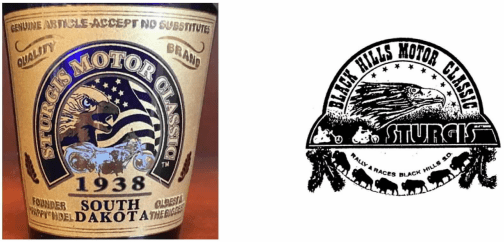
In some cases, “visual inspection, without any corroboration
from consumer surveys or examples of actual confusion,” can prove likelihood of
confusion: “If, for example, the purportedly infringing mark appears confusing
or deceptive on its face, and relevant consumers do not bring to their
purchasing decisions atypical or specialized knowledge, a visual inspection
might represent a bare-bones way of proving likely confusion. Otherwise, it would appear beyond the ken of
a jury to deduce from a visual examination that has not been informed by direct
evidence of consumer associations that a challenged use would likely confuse or
deceive the ordinary, prudent consumer
” (emphasis added).
Nonetheless, the jury found not just infringement, but willful
and intentional infringement. The definition used by the jury for “willful”
required “the conscious intent to benefit from the goodwill or reputation of SMRI’s
trademark.” This would also necessarily be intentional. And the evidence
supported the finding that the defendants’ infringement of the composite mark on
the shot glass was willful and intentional. The Monahan mark was widely used in
connection with the rally since the mid-1980s and some consider it, whether
rightly or wrongly, the “official” logo of the rally; Rushmore knew about the
mark, as evidenced by its 1999 license to use the mark for a year on postcards.
“The many similarities between the dominant design on the shot glass and the
longstanding Monahan mark also provided the jury with a reason to conclude that
Rushmore had consciously intended its glass to benefit from the goodwill that
consumers may associate with the Chamber’s and now SMRI’s civic-minded mission
statements.” Along with the image similarities, the use of the words “Genuine
Article-Accept No Substitutes” allowed the jury to infer that Rushmore
consciously intended consumers to confuse the dominant design on the glass with
the closely similar “official” Monahan mark.
Was this also counterfeiting? “A counterfeit is thus far
more similar to the registered mark than a mark that barely infringes it, and
so an infringing mark is not necessarily also a counterfeit.” The shotglass was
the only item infringing the Monahan mark, and (this will warm Mark McKenna’s
heart) nothing on it “could be reasonably viewed as substantially
indistinguishable from the Monahan mark.” The words on top were different, in different
fonts, and the images showed different animals in different configurations. The
differences were too obvious to allow the jury to find counterfeiting.
The court turned to the related claims for deceptive trade
practices, false advertising, and unfair competition. South Dakota allowed SMRI
to recover only actual damages suffered as a result of deceptive acts and
practices. The record clearly supported a finding of such actual damages,
because rom around 2006 to 2011 Rushmore advertised that its rally-related
goods were “Officially Licensed Sturgis,” and there was evidence that Rushmore put
that slogan on its products’ hangtags alongside the phrase, “Look For The
Tag!,” mimicking the Chamber’s ad campaign. Rushmore’s co-owner admitted that
their goods were neither official nor licensed, and that no one other than SMRI
and Rushmore had designated its rally-related products as officially licensed. At
least one person was misled: the manager of the apparel department at a local
Wal-Mart called SMRI’s licensing agent to ask whether Rushmore’s products were
actually “official Sturgis Motorcycle Rally products.” That was the first year
that the record showed Wal-Mart carrying Rushmore products, and the jury could
have inferred that SMRI lost those sales to Rushmore.
Nor did the invalidity of most of the marks above matter to
this conclusion, which didn’t depend on the validity of the marks.
However, after the jury’s verdict, the district court ruled
on defendants’ equitable defenses, finding that SMRI was estopped by laches and
by its acquiescence from recovering damages. SMRI argued that it had a Seventh
Amendment right to have a jury decide those defenses, but it didn’t.  SMRI also argued that the jury’s finding of
willful infringement constituted unclean hands, precluding equitable relief.  To bind the court’s equity powers, a jury’s
findings have to be on a common issue; otherwise the findings are merely
advisory.  But willfulness “is a
multifarious concept like causation or intent: The definition of willfulness
that the district court gave the jury was only one of the many that courts have
used.” The equitable and statutory definitions of willfulness can vary even
though they use the same word.  The
district court found that the defendants used “Sturgis” in the good faith
belief that SMRI’s “Sturgis” word mark was invalid. This isn’t necessarily in
conflict with the jury’s finding that the defendants’ use of the word was
willful in the sense that they had acted with “the conscious intent to benefit
from the goodwill or reputation” associated with that word. “A defendant … can
intend to benefit from the goodwill associated with a word—’Sturgis,’ for
example, as a fun and memorable motorcycle rally—without intending to infringe
a valid mark based on the word.” Thus, some courts have held that, when a party
“uses an intellectual property in the face of disputed title,” the party’s use of
it, if in good faith, does not constitute “willful infringement.”
Anyway, even if willfulness was a common issue, the district
court’s findings still might not have conflicted with the jury’s finding of willful
infringement of the Monahan mark and the “Sturgis Bike Week” mark. First, the
district court still has discretion over the application of the unclean hands
doctrine. For unclean hands, it “might not be sufficient that the wrongdoing
was willful if it was not also substantial to an appropriate degree…. Equity
demands flexibility and eschews mechanical rules.”  Second, though the district court largely
denied defendants’ motion for judgment as a matter of law, it later held that SMRI
did not carry “its burden of proving that [defendants] subjectively and
knowingly intended to use [their marks] for purpose of deriving benefit from
[SMRI’s] goodwill,” which might be a finding about the record.  Though the record supported the jury’s
finding that the defendants willfully infringed the Monahan mark, the court of
appeals didn’t opine on “Sturgis Bike Week.”
Remand was appropriate here, however, because the district
court’s order granting the equitable defenses relied in part on its findings
that Rushmore had sold rally-related products bearing the word “Sturgis” to
both the Chamber and its agents, so they knew about the conduct at issue. But
since rally-related products using the word “Sturgis” were not infringing (even
though SMRI argued that they were), it was no longer clear whether acquiescence
and laches would apply. On remand, if the district court still thought so, it
should clearly say which claims were covered (not just the Lanham Act claims)
and why.
The injunctive relief would also have to be revisited.  SMRI wanted the defendants enjoined from
selling anything that uses the word “Sturgis,” “including presumably a state
map,” but that’s not going to happen. Instead, a revised order would have to
account for the invalidations above. 

from Blogger https://ift.tt/2DvcFHg

Posted in Uncategorized | Tagged , | Leave a comment

Quite a specimen: trademark-filing firms’ legal battle continues, in part

LegalForce RAPC Worldwide P.C. v. Trademark Engine LLC, 2018
WL 5734621, No. 17-cv-07303-MMC (N.D. Cal. Oct. 31, 2018)
RAPC, a law firm, alleged that its competitor TME “operates
website TrademarkEngine.com to advertise, promote and provide trademark related
services” and used false or misleading statements in Google ads and on its
website, as well as engaging in the unauthorized practice of law, in violation
of the Lanham Act and Cal. Bus. & Prof. Code § 17200 et seq.
Two TME ads allegedly contained the word “professional,” which
allegedly was a misrepresentation that TME’s services were “lawful”; TME
allegedly violated customers’ privacy rights, submitted fraudulent specimens to
the PTO, and engaged in the unauthorized practice of law.  One ad, displayed in response to a search for
“trademark filing,” said “Let the Professionals File Your Trademark Today!” while
the website touted “Professional Preparation of your federal trademark
application.” The court found that this was puffery, without specific
actionable representations.
RAPC also alleged that TME misdescribed its “Identity
Protection Program.” TME’s website stated that when a trademark applicant
submits an application directly to the USPTO, the applicant’s “email and phone
number will be available for all to see,” including “[s]pammers, solicitors and
anyone else,” but that, for a monthly fee of $5, TME would provide its email
and phone number to the USPTO. TME argued that RAPC hadn’t shown injury from
these statements, but where there’s direct competition, “a misrepresentation
will give rise to a presumed commercial injury that is sufficient to establish
standing.” RAPC also pled falsity by alleging that, “regardless of whether a
customer purchased the $5/month privacy protection program or not, [TME] always
lists each of its customer’s contact information, including emails and phone
numbers, on [the] USPTO’s trademark application forms” and that such customer
information is “publically [sic] available on [the] USPTO’s website.” RAPC also
sufficiently pled proximate cause by alleging it “lost customers” to TME and
that its “market share” has “decline[d]” from “nearly 2.4%” to “approximately
1.8%,” and that it had to reduce its prices from “$499 to $199 and sometimes
lower to match the unfair competition of [TME].” This was enough at the
pleading stage.
§ 17200 prohibits any “unlawful, unfair or fraudulent
business act or practice.” RAPC alleged four kinds of practices. First,
violation of the right to privacy set forth in the California Constitution by “(1)
waiving clients’ rights to cancel the filing or refund the government fee; (2)
waiving clients’ rights to privacy by allowing their names, phone numbers, emails
and street addresses to be published publicly; and (3) permitting [the] USPTO
to make clients’ information available for public search on [the] USPTO’s
online databases and other databases.”  But RAPC failed to allege facts to support the
requisite finding that it lost money or property as a result of any of TME’s
clients having been deprived of their right of privacy. Nor did RAPC allege a
legally protected privacy interest in a client’s “right to cancel the filing or
refund the government fee” or “an egregious breach of social norms” in
disseminating information to the PTO.
Submission of fraudulent specimens to the PTO: Though
“knowingly and willfully” submitting a fraudulent specimen violates the law,
RAPC didn’t allege facts sufficient to support a finding of such intent.  
Unauthorized practice of law: A law firm plaintiff has
standing to contest this conduct if the firm “suffered losses in revenue and
asset value and was required to pay increased advertising costs specifically
because of the [allegedly unauthorized practice].” RAPC properly alleged these
losses and their causation, and the facts alleged, if proven, were sufficient
to support a finding that TME engaged in unauthorized practice of law under
California and Texas law.
Violation of PTO regulations for “practitioners”: RAPC
alleged violations of various PTO rules, but the complaint didn’t allege facts
to support a finding that the individual defendant, Crabtree, did so.
RAPC also alleged “unfair” and “unlawful” business practices
from the submission of fraudulent specimens and the unauthorized practice of
law. For competitor-plaintiffs, “unfair” means “conduct that threatens an
incipient violation of an antitrust law, or violates the policy or spirit of
one of those laws because its effects are comparable to or the same as a
violation of the law, or otherwise significantly threatens or harms
competition.” The allegedly unlawful acts here didn’t qualify.
RAPC was entitled to seek injunctive relief for its
remaining § 17200 claims, but not restitution—it never had an ownership
interest in defendants’ allegedly wrongfully acquired money.

from Blogger https://ift.tt/2RKt9yC

Posted in Uncategorized | Tagged , , | Leave a comment