Don’t send a trademark to do a copyright’s job, forestry edition

Munro v. Lucy Activewear, Inc., No. 16-4483 (8th Cir. Aug.
9, 2018)
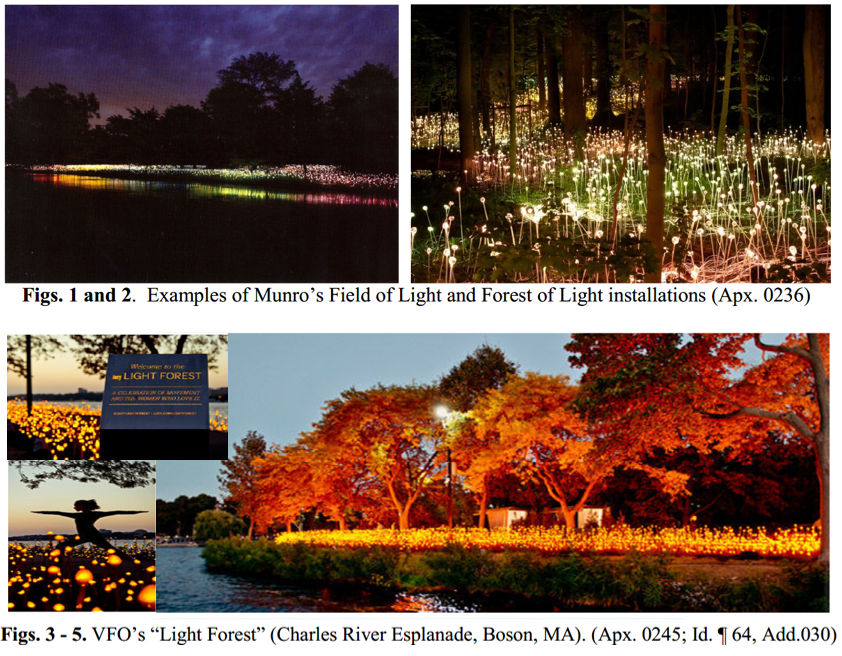
Munro is an artist best known for his works “Field of Light”
and “Forest of Light”—“large-scale, immersive, light-based installations, and
exhibitions.” Lucy allegedly proposed a Lucy advertising and promotional
campaign featuring Munro’s work.  Relying
on a promise of confidentiality, Munro allegedly shared additional information with
Lucy about his prior work and disclosed that he was in talks with public
officials in Boston about creating a public exhibition in the city. In October
2013, Lucy launched a light exhibition and advertising campaign for Lucy in
Boston. “Light Forest” was an interactive light installation that responded to
the participants’ movements. Munro sued for infringement of trademark and trade
dress and usurpation of a prospective business opportunity.

The trade dress claim failed because of Dastar (and Wal-Mart).  Munro’s allegation that Lucy created a
“knockoff” light installation that basically plagiarized his creative designs
sounded in copyright, not trademark. “Munro’s installation is not a ‘mark’ that
the Lanham Act was attempting to protect. Rather, the installation is the
product itself.”
Munro’s fraud claim failed because allegations that Lucy
didn’t keep its promises weren’t enough to make it plausible that Lucy didn’t
intend to keep those promises when it made them, as required for fraud. The
tortious interference claim was based on the theory that Lucy gave Boston an
alternative to his project in reproducing works similar to his sculptures, and was
therefore preempted by the Copyright Act.
Trademark infringement: this one survives, though for how
long is an open question.  Dastar didn’t bar the claim that Lucy’s
use of the name “Light Forest” was a confusingly similar and colorable
imitation of his “Forest of Light” and “Field of Light” trademarks. “[A]n
artist is considered the producer of the creative ideas of his work, but if the
artist also makes and sells his artwork himself, then he is considered the
producer of that good or service as well and is ‘able to assert a Lanham Act
claim for false designation of origin.’” Munro sufficiently alleged that he was
the producer and promoter of the underlying goods, which doesn’t quite get at
what the court of appeals described as the district court’s conclusion: that
Munro didn’t allege facts suggesting that the names served a source-identifying
function.  It’s not definitionally true
that, as the court of appeals concluded, “[b]ecause Munro produces these
installations, he is the ‘origin of goods’ or ‘source’ that the names identify,
which entitles him to bring an action under the Lanham Act.”  In addition, the names themselves must be
distinctive.  Given the underlying works,
the names here seem highly descriptive. 
That doesn’t rule out acquired distinctiveness, but I wonder about the
proof there.

from Blogger https://ift.tt/2odZHUQ

Posted in Uncategorized | Tagged , , , | Leave a comment

Reading list: copyright and AI

Jane C. Ginsburg and Luke Ali Budiardjo, Authors and
Machines
:
Machines, by providing the means of
mass production of works of authorship, engendered copyright law. Throughout history,
the emergence of new technologies tested the concept of authorship, and courts
in response endeavored to clarify copyright’s foundational principles. Today,
developments in computer science have created a new form of machine — the
“artificially intelligent” system apparently endowed with “computational
creativity” — that introduces challenging variations on the perennial question
of what makes one an “author” in copyright law: Is the creator of a generative
program automatically the author of the works her process begets, even if she
cannot anticipate the contents of those works? Does the user of the program
become the (or an) author of an output whose content the user has at least in
part defined? This article frames these and similar questionsthat generative
machines provoke as an opportunity to revisit the concept of copyright
authorship in general and to illuminate its murkier corners. This article
examines several fundamental relationships (between author and amanuensis,
between author and tool, and between author and co-author) as well as several
authorship anomalies (including the problem of “accidental” or “indeterminate”
authorship) to unearth the basic principles and latent ambiguities which have
nourished debates over the meaning of the “author” in copyright. We present an
overarching and internally consistent model of authorship based on two basic
pillars: a mental step (the conception of a work) and a physical step (the
execution of a work), and define the contours of these basic pillars to arrive
at a cohesive definition of authorship. We then apply the
conception-and-execution theory of authorship to reach a series of conclusions
about the question of machine “authorship.” We contend that even the most
technologically advanced machines of our era are little more than faithful
agents of the humans who design or use them. Asking whether a computer can be
an author therefore is the “wrong” question; the “right” question addresses how
to evaluate the authorial claims of the humans involved in either preparing or
using the machines that “create.” We argue that in many cases, either the
upstream human being who programs and trains a machine to produce an output, or
the downstream human being who requests the output, is sufficiently involved in
the conception and execution of the resulting work to claim authorship. But in
some instances, the contributions of the human designer and user will be too
attenuated from the work’s creation for either to qualify as “authors” —
leaving the work “authorless.”
As usual, Ginsburg (and her coauthor) do a wonderful,
careful job on the doctrinal implications, with bonus Le Petit Prince
examples.  I would probably draw the line
finding works to be authorless earlier than they would. In particular, I don’t think that
the essentially unpredictable and unpredicted outputs of generative computer programs would
be authored by the programmer; they should be deemed authorless as well. Betsy Rosenblatt’s project on “work” as a verb and not just a noun was helpful to my thinking here.

from Blogger https://ift.tt/2BRh9Ij

Posted in Uncategorized | Tagged , | Leave a comment

Another court is allergic to In re GNC’s flawed reasoning on falsity

Hobbs v. Gerber Prods. Co., 2018 WL 3861571, No. 17 CV 3534
(N.D. Ill. Aug. 14, 2018)
Say what you will about Seventh Circuit substance (and I
have), I like the crisp Seventh Circuit style, which seems to influence the
district court judges too. This case whips neatly through procedural aspects of
a fraud case, declining to dismiss Hobbs’ complaint that Gerber falsely
marketed its Good Start Gentle infant formula as reducing the risk that infants
would develop allergies to cow’s milk and decrease incidences of the most
common manifestation of such allergies, atopic dermatitis (eczema) and as
having FDA endorsement of these claims.
Among other things, Hobbs pointed to a “tamper-evident seal”
placed on the lid of a plastic container of GSG formula, which stated: “1 &
ONLY Routine Formula TO REDUCE RISK OF DEVELOPING ALLERGIES See Label Inside. ”
A TV ad allegedly included the statement: “But if you introduce formula, choose
the Gerber Good Start Comfort Proteins Advantage. It’s what makes Good Start
formula easy to digest and may also provide protective benefits for your baby.”
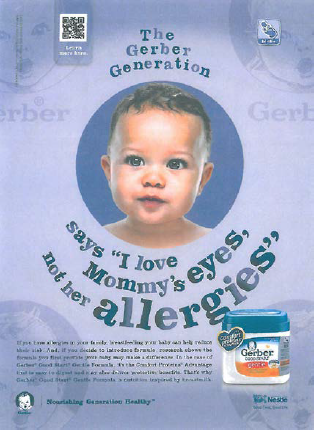
 Similarly, a magazine ad allegedly
stated: “If you have allergies in your family, breastfeeding your baby can help
reduce their risk. And, if you decide to introduce formula, research shows the
formula you first provide your baby may make a difference. In the case of
Gerber® Good Start® Gentle Formula, it’s the Comfort Proteins® Advantage that
is easy to digest and may also deliver protective benefits.”

Gerber has a history with the FDA on this.  After a lot of back and forth, the FDA
concluded in 2011 that “the current scientific evidence is appropriate for
considering the exercise of enforcement discretion with respect to a qualified
health claim concerning the relationship between 100% whey-protein partially
hydrolyzed infant formula and a reduced risk of atopic dermatitis for a
specific infant population who [sic] is fed such formula during a specific
period of time.” However, use of the term “emerging clinical research” was
misleading based on the limited research (4 studies) and the fact that the
reduced risk of atopic dermatitis was observed only when infants had the
formula during their first four months.
The FDA proposed several versions of a qualified health
claim, all of which are not positive when read with careful attention.  One set of approved statements used a
“statement-then-negation” formula that, though approved by the courts, is
particularly likely to be misunderstood or misremembered: “For healthy infants
who are not exclusively breastfed and who have a family history of allergy,
feeding a 100% Whey-Protein Partially Hydrolyzed infant formula from birth up
to 4 months of age instead of a formula containing intact cow’s milk proteins
may reduce the risk of developing atopic dermatitis throughout the 1st year of
life. FDA has concluded that the relationship between 100% Whey-Protein
Partially Hydrolyzed infant formulas and the reduced risk of atopic dermatitis
is uncertain, because there is little scientific evidence for the relationship.”
The FDA letter said that FDA would consider exercising its enforcement
discretion when all the relevant information from the approved statements was
present.
In 2014, the FDA issued a warning letter identifying
numerous ways in which the FDA deemed Gerber’s GSG to be misbranded and to
include misleading health claims that did not comply with the claims the FDA
had approved in 2011 and which restated claims about allergy reduction that the
FDA had rejected in 2006. Gerber responded to, discontinued some of its GSG
marketing (specifically, the “tamper-evident” sticker label) and the FDA closed
the matter in 2015.
Hobbs, however, alleged that “several compelling scientific
studies have concluded that partially hydrolyzed whey formula does not lower the
risk of developing allergies or allergic manifestations, including eczema,
during infancy…when compared with conventional formula.” She identified only
one such study.  Hobbs alleged violations
of the Illinois Consumer Fraud and Deceptive Business Practices Act (ICFA), breach
of express warranty, and common law fraudulent misrepresentation. 
Rule 9(b) applied, but the precise level of particularity
required depends on the case. The key is “to show, in detail, the nature of the
charge, so that vague and unsubstantiated accusations of fraud do not lead to
costly discovery and public obloquy.” [Y’know, under present conditions I feel
we ought to revisit this utilitarian justification for 9(b) and ask whether
accusations of fraud really are worse for reputation than other
accusations.  Thinking about various
political fraudsters and various political gropers/abusers, I don’t find the
empirical claim plausible. The mention of discovery is clearly more accurate,
but I do also wonder whether there are so many claims in which only the fraud
claim is what entitles the plaintiff to discovery.]
Hobbs alleged that she saw at least three specific ads, as
well as others, and that she relied on their shared misrepresentations. The
complaint didn’t specifically allege “where and when” Hobbs saw the ads or that
she saw them before she purchased Gerber products. But that was silly: the
complaint expressly alleged reliance, which was an allegation that she saw them
before she bought. Specific dates or the particular magazine she read for the
print ad weren’t required, at least here. 
The alleged marketing was broadly based and “essentially ubiquitous”;
this wasn’t a claim where the date was necessary to identify a single
putatively offending ad.
Gerber also invoked In re GNC Corp., 789 F.3d 505 (4th Cir.
2015) [boo!], to argue that Hobbs failed to state a claim, because she didn’t
allege that no reasonable scientist would agree with the health benefit ad, and
correctly found GNC’s analysis unpersuasive. Anyway, the claims in GNC were different. In GNC, the plaintiff alleged that the
evidence was equivocal; Hobbs didn’t equivocate, alleging that “[s]cientific
evidence concludes that ingesting infant formula made with partially hydrolyzed
whey protein does not reduce the risk of infants developing allergies.”  “Hobbs frames her claim not in terms of the
relative weight of the scientific evidence but on a factual assertion about
whether Gerber’s claims about GSG are true. ‘[T]he falsehood alleged by
Plaintiff is not that all experts agree that Defendant’s product lacks a health
benefit, but rather that the product in fact lacks that benefit.’”
Expert disagreement might create a disputed issue of fact,
but such disputes must be resolved in the nonmovant’s favor at the pleading
stage.  [So exactly right about the core GNC flaw.] Further on how wrong GNC is:
That two experts disagree at trial
about the truth or falsity of a statement does not, of course, preclude the
fact-finder from resolving the disputed fact question; no more should the
plaintiff’s acknowledgment of some competing expert opinion preclude her from
attempting to prove the fact at issue by conducting discovery and developing
the most persuasive argument possible to support her position as to the truth
or falsity of the disputed fact. Gerber cannot insulate its statements from
claims of falsity by locating a single expert who will endorse them; absolute
certainty is not the evidentiary benchmark in civil (or even criminal)
litigation. To prove that a statement by Gerber is false, Hobbs’s burden is
only to establish falsity by a preponderance of the evidence.
Even under 9(b), Hobbs’s burden was plausibility, not
probability. “In pleading her claim, the plaintiff’s burden is to allege facts
from which it is plausible to infer that the statement at issue is false, not
to allege that every expert in the world agrees that it is false or to
otherwise prove the statement’s actual falsity.”  Put another way: “That an expert believes that
GSG reduces allergies may, of course, be highly relevant evidence in GSG’s
favor, but it is not dispositive of that fact question, particularly where
competing opinions have also been introduced. Hobbs has met her burden to
plausibly allege that Gerber’s statements are false by also alleging facts that
make the inference of falsity plausible,” including the FDA’s conclusions.  Hobbs alleged enough factual detail to push her
allegations across “the line between possibility and plausibility.”
And furthermore (though it’s just gilding the lily), Hobbs
was arguing both falsity and misleadingness, and GNC didn’t bear on her misleadingness claim.
The court also reminded Gerber that 9(b)’s particularity
requirement applies to allegations of fraud, not allegations of damages. “Hobbs’
task in pleading damages is simply to plead facts that support a plausible
inference that she experienced an actual pecuniary loss as a result of Gerber’s
allegedly false statements.” Her claim that she wouldn’t have bought the
product/wouldn’t have paid as much for it absent the misrepresentation met that
standard.
ICFA exempts from liability conduct that is “specifically
authorized” by federal law, and Gerber argued that its marketing materials
complied with the claims the FDA agreed to tolerate in 2011.  Not only was this an affirmative defense that
didn’t need to be pled around. The complaint plainly and plausibly alleged that
Gerber did not comply with the limits given by the FDA “and, given the
specificity of the limited [qualified health claims] that the FDA approved, it
is difficult to fathom an argument to the contrary.” [Ouch, but seems
justified.] Even considering outside material, Gerber didn’t even try to
explain how the statements Hobbs identified complied with the FDA’s standards
or were otherwise authorized.
 

from Blogger https://ift.tt/2L8VT05

Posted in Uncategorized | Tagged , | Leave a comment

Court considers fake reviews not deceptive if they’re just puffery

Jive Commerce, LLC  v.
Wine Racks America, Inc., 2018 WL 3873675, No. 1:18-CV-49 TS-BCW (D. Utah Aug.
15, 2018)
The parties compete in the wine rack and wine cellar
industry. Jive’s principal Jason Miller was formerly employed by WRA. Miller
fell out with WRA’s owner, Jeffery Ogzewalla, and founded Vino Grotto.  Jive alleged various acts by WRA to harm its
business, such as using Jive’s Vino Grotto and Home Collector Series marks in search
engine ads to redirect consumers to WRA’s websites. WRA’s website allegedly
copies content, images, trade dress, and look and feel from Jive’s website. WRA
also allegedly contacted Jive’s vendors to persuade them not to work with Jive
and made defamatory comments about Jive/Miller. WRA also allegedly posted false
and deceptive positive reviews on the internet, and also forged photographs and
address information on their website “to create the illusion of legitimacy and
to hide the geographic origin of their goods.”
The court denied a preliminary injunction.
As for the false reviews, the court rejected the Lanham Act
claims because nothing in the content of the reviews left by WRA’s employees had
been shown to be false and much was puffery. 
E.g., an employee stating that he “found the 24 bottle table top wine
rack fit neatly in that space, arrived quickly, and was very sturdy” could well
have concluded these things.  [Arrived
quickly, though?  More significantly, the
court doesn’t give weight to the at least implicit misrepresentation—I would
say necessary implication—that the review is from a true counterparty, rather
than from a representative of the seller. The court treats only the statements
in the reviews and not the reviews themselves as possible statements of fact,
but “I am an independent customer” is also a factual statement and the FTC
would surely say it had been conveyed by the reviews.]
Likewise, the court wasn’t impressed that WRA listed its
mailing address as being in Bend, Oregon, even though it had Utah as the
returns address. The court accepted that WRA had a presence in both states, and
any confusion caused by altering an image of a building owned by WRA in Utah
(as happened on the website) hadn’t caused any demonstrated injury.
The parties disputed who was the copier and who the copied
as between the two websites, but the court lacked sufficient information to
determine priority.  Furthermore, the
court didn’t think the websites were all that similar, except for similarities
coming from the genre.
Trademark claims related to use of Jive’s marks in bidding
for keyword ads didn’t show likely confusion, per 1-800-Contacts. The ad in the moving papers was clearly marked as
an ad, and Jive’s website was directly below it.
Jive also made claims based on WRA’s sale of products under
the Home Collector Series mark during a time in which, WRA contended, Jive was
not using the mark. Some factors favored a finding of likely confusion, but
there was no evidence of actual confusion, consumers’ degree of care, and
strength of the mark (if any); WRA also ceased use of the mark, making
injunctive relief unnecessary.
Tortious interference/defamation: not enough evidence of
injury inflicted by improper means; many of the people to whom RWA spoke
apparently kept doing business with Jive or ceased doing business with it for
other reasons.  (Declarations from the
identified customers here helped RWA a lot.)
Belt and suspenders: allegations that “Defendants’ conduct
has eroded and threatens to further erode Plaintiff’s customer and vendor
goodwill”; their “actions threaten to further diminish the competitive value of
Plaintiff’s products in ways that could be difficult to measure”; and “there is
a substantial risk to Plaintiff of lost future profits, damage to its
reputation, and loss of goodwill and loss of competitive market position” were
all too conclusory to constitute irreparable harm.


from Blogger https://ift.tt/2nQT7DF

Posted in Uncategorized | Tagged , | Leave a comment

DC Circuit dodges incontestability, finds little-noticed statements immaterial in dueling desserts case

Paleteria La Michoacana, Inc. v. Productos Lacteos Tocumbo
S.A. de C.V., 2018 WL 3894587, No. 17-7075 (D.C. Cir. Aug. 10, 2018)
The facts are a mess, but basically PLM and Prolacto both
make paletas, Mexican frozen desserts, using nearly the same marks, “La
Michoacana” and an “Indian girl” design, which the district court found to be
descriptive because of their extensive use by unaffiliated entities in Mexico
for the same products.  [And here’s an
interesting point: the court finds that these terms are descriptive because of
their meaning in Mexico; trademark rights are territorial, but maybe meaning is
not so territorial, and finding non-trademark meaning from foreign uses doesn’t
create the same conflicts with territoriality as finding trademark meaning from
foreign uses.  The district court’s
reasoning makes sense for the same reason that the doctrine of foreign
equivalents does.]  Prolacto, a Mexican
corporation, was founded in 1992; PLM advertised its products with the
following statement or its equivalent: “La Michoacana is a family company
founded in Tocumbo, Michoacán in the 1940’s. Since then, we’ve continued to
make premium ice cream, fruit bars and drinks that give the flavor and
tradition of Mexico. Distinguish us by our logo.” However, this wasn’t true;
PLM was also a more recent market entrant. 
Nonetheless, the district court found that PLM was the senior user of
the marks in parts of the US (but upheld the cancellation of one of PLM’s marks
because of Prolacto’s prior US regional use) and thus that Prolacto had
infringed.
The court of appeals upheld the district court’s
rulings.  Without trademark status in the
US, Prolacto couldn’t make out a claim for false association based on PLM’s use
of “La Michoacana” (the record didn’t support a famous foreign marks argument).
The false advertising issue was more clear-cut, but still
not a winner for Prolacto, which didn’t prove materiality or injury.  Primarily, there was little evidence that consumers
even saw one of the allegedly false advertising statements, let alone that they
factored the statement into their purchase decisions.  A paletas expert testified that he had read
the “small print” on PLM’s paleta wrappers (which at certain times included the
challenged Tocumbo statement), but could not recall what it said; he was far
more attentive than the average consumer, so his lack of memory reinforced the
district court’s conclusion. Prolacto’s consumer survey also failed to show
injury because it only asked consumers to read and interpret the statement, but
didn’t test materiality or to “determine whether, for example, any consumers
would actually take the time to study PLM’s product packaging and read about
its purported history before deciding whether to make a purchase.” Thus,
evidence of injury was lacking.
In response to Prolacto’s appeal of the infringement finding
against it, the court stated that “PLM sufficiently established its ownership
by offering evidence of the marks’ registration. And because proof of
registration is prima facie evidence of ownership, we need not consider the
merits of Prolacto’s challenge to the marks’ ‘incontestability’ under 15 U.S.C.
§ 1065. Regardless of whether that ownership is incontestable, the evidence
does not rebut the presumption of PLM’s ownership.”  
And here’s where it gets weird: as
I wrote previously
, the district court relied on (erroneously
granted at PLM’s behest) incontestability to give PLM rights in the marks, and
then declined to reconsider because the challenge to incontestability came too
late.  However, the court of appeals
doesn’t rule on waiver.  Instead, it says
that even if the incontestability went away the ownership would stay because
the registration is prima facie evidence of ownership.  But that won’t work in this scenario, because the district court also found that the symbols at issue
were descriptive. That is, in the absence of secondary meaning, they aren’t owned.  The evidence here rebutted the prima facie
evidence of ownership by showing descriptiveness.  On these facts I can’t see how the court of appeals can claim that
ownership was unrebutted.  If the
relevant symbols had gained secondary meaning for PLM anywhere in the US when
the application/s matured into a registration, then I can see letting this
ruling stand, but frankly I’m confused by the underlying timeline so I don’t
know how the district court saw that part of the case.

from Blogger https://ift.tt/2OPitwS

Posted in Uncategorized | Tagged , , | Leave a comment

IPSC plenary

Tonya Evans, CryptoKitties,
Cryptography, and Copyright
Nonfungible digital
creativity, enabled by the ERC 721 standard on the Ethereum blockchain: verifiable,
indestructible digital scarcity.  NFTs
overcome failures of existing digital structure for creators by providing for ownership,
provenance, chain of title.  The
inability to distinguish master from copies currently harms demand/value.  Creator can participate in secondary market,
unlike current first sale situation.  Can
prevent forgery/theft unless the owner’s private key is compromised or
lost.  Securely distinct asset from a reproduction.
Sprigman: as I view
the CryptoKitty, it’s just pixels on the screen. Why can’t I just copy it? If
it’s valuable, it’s the picture they care about. Blockchain is valuable as a
speculation market, like tulips. The only difference here is you don’t get the
tulip. That’s interesting, but does this new thing prevent piracy?
A: On the NFT side
of things, where you look for provenance/uniqueness. If you just want the copy,
it might not matter. But blockchain can establish a record of ownership, assisting
in enforcement.
Sheff: proper
analogy then seems like fine art market. Scarcity is useful to increase prices.
W/r/t a digital image you can have anyway, which can be disaggregated from the
blockchain record, you’re just creating scarcity for its own sake/conspicuous/wasteful
consumption.
A: wholly digital
from the beginning; not a representation but the thing itself.
Q: what’s the
benefit of doing it this way?
A: decentralization;
censorship-resistant.
Deepa Varadarajan and
Joseph Fishman, Similar Secrets
Normative case for
necessary similarity b/t secrets given that employees can’t wipe their minds
between jobs. ©’s similarity framework makes some useful analytical moves. Like
© but not patent, trade secret scope isn’t defined ex ante by written
claims.  Trade secrets are easy to obtain
on the front end, leaving the difficult scope work to be done on the
infringement end.  (1) In terms of what
courts should be looking at, focus should be end that the D is actually
exploiting, not R&D along the way; (2) only material contributions should
be actionable; (3) only reasonably foreseeable uses should be actionable.
Shouldn’t affect core markets, but greater room for cumulative innovation in a
world of mobile talent.
Our focus is use
based misappropriation, not improper acquisition. Restatement says derivation
must be substantial, but very few courts explain how to do this. A number of
cases essentially ignore this in favor of a P-friendly conception of use in
which any aspect of any reliance on the secret in R&D is enough. Courts don’t
ask whether what was copied was the stuff that made the trade secret
protectable to begin with.
Ds shouldn’t need to
repeat known failures in their R&D. 
Courts should look for a material contribution from the P’s secret—not just
some benefit. Requires normative evaluation of whether the information D
exploited was important to making the secret protectable in the first place.
Contrast © which says copying isn’t enough; copying has to be significant/of
protectable elements. Today’s Ps can prevail even if they aren’t competing with
D; we think that competition in a relevant market should be required. Proximate
cause for unforeseen benefits instead of unforeseen harms.
Q: similarity to ©
isn’t a good thing b/c of lack of ex ante definition problems. Why not use
obviousness instead?  We know how to
worry about hindsight bias in patent better than in ©. Here’s what you knew,
here’s what you had reason to try/look for.
A: not all trade
secret eligible info is patentable. Very different definition of trade secret would
be required.
Lemley: the things
you’re drawing from © are not from substantial similarity; they’re from fair
use. Foreseeability etc. You are really saying trade secret should allow some
productive use/fair use. Might be harder to read that view into the statutory term
“use” though.
A: current actual
copying requirement looks like an actual copying Q in © shorn of the improper
appropriation next step.  Whether it’s
substantial similarity or fair use, that’s b/c substantial similarity has grown
to encompass so much more than it once did. The Q is still: are the two
products/activities similar enough to be liable.
Lemley: but you’ve
moved from intermediate copy to final copy, and the way we do that in © is fair
use.
A: doesn’t think
script/screenplay cases work that way [software cases do, Lemley notes w/o
disagreement]. [Script/screenplay cases are weird and probably also affected by
lingering questions not worth resolving about what constitutes a “work” and how
many different works are involved when you have multiple drafts.]
Kristelia Garcia
(and Justin McCrary), Reconceptualizing Copyright’s Term
Nielsen soundscan
data for music. Will suggest extrapolation to other commercial info goods like
books and movies, not to fine art. Findings best fit the average work—some of the
potential suggestions may overprotect some works and underprotect superstar
works. Random date-stratified sample of 1200 albums released b/t 2008 and 2017,
proportional to genres, w/physical and digital album sales/streaming.  Then looked at all songs w/in random sample
of 120 albums.
Unsurprisingly but
dramatically, lose 1/3 of sales volume w/in 2 months, ½ by 6 months, by less
than one year out 10% of initial volume. Songs decay more slowly. Album sales
drop to almost zero after less than a year, but songs have a somewhat longer
commercial life though nowhere near as long as current term.
Streaming: analysis
is more limited b/c data are limited; main streaming services didn’t make data
available until much later. 2016-2017 subset, sample size too small for
statistical significance—streaming results in far higher volume. Ave. streaming
volumes drop less rapidly than sales, as you’d think intuitively.
For typical music
production, rapid dropoff for sales.  Later
will look at genres and differences b/t blockbusters and others.
Implications: shorter
term? All info goods engage in windowing—single first, then album exclusive to
one service; similar in film (theaters, streaming, TV) and books. All of them
go quite quickly relative to the term. Also consistent w/winner take all
phenomena.  Albums are quickly hits or
not, like movies and books. Also consistent w/network effects.
Maybe duration isn’t
that important either way.  Perhaps this
is useful for countries still on the fence about Berne/duration. This might tell
them that extension isn’t efficient. Even adopts support for use it or lose it
standard a la Posner & Landes. Could also try other things like reversion
to the author [or limits on remedies].
Rothman: the spike
is probably related to ad campaigns—can you look at that for blockbusters?  Could you argue that precipitous dropoff
means that you need a really long term to recoup/make a living? Landes & Posner
argued about distribution rights & commercial difficulties/investment—but streaming
doesn’t have an additional cost, so far-out sales/revenue are opportunities for
artists to benefit many years later.
A: Germany has
something like this on the book side; if use it or lose it considered availability
on iTunes, then that’s easy/costless. We’d need some sort of marketing standard
to get some transfer back to authors.
Q: effect of illegal
copies?
A: usually available
through entire window and even before—so it’s hard to say but would buy an argument
that this mattered.
Sprigman: §115
licensing/Harry Fox—given the dropoff, Harry Fox issues affiliate licenses on
match, then processes, then pays out in arrears. So this may have implications
beyond term.
Q: Streaming curve
looks like a survival regression, with an uptick in song streaming at the end—the
stuff that persists and remains listenable/popular with everything else fallen
away.  [How much does the algorithm
affect this?  If it surfaces the same relatively
unpopular songs for every listener w/in a group, that might matter v. if it
randomizes w/in a group of equally unpopular similar songs.]
Rachel Sachs, Regulating
Intermediate Technologies
Health care tech
where we want to incentivize improvement of existing tech but we’ve set up the
system wrong. E.g., microbiome; pharma manufacturing (not much has changed over
the past 50 years, even though new drugs are being created—still using batch
manufacturing instead of continuous, for example, even though that could reduce
cost by up to 50% and even though batch mfg can lead to delays/shortages); genetic
testing. If we overregulate microbiome based therapies (which are unpatentable
but require FDA approval b/c treated like drugs) then we might not get the end
stage technology and never know what we’ve lost.  FDA knows its own regulations lock old
manufacturing in place, and even though companies can obtain patents on mfg
tech, the difficulty of enforcement is a disincentive.  Why did Myriad go differently, where the test
for breast cancer associated genes has become a lot better in specificity?  B/c in the early days it wasn’t regulated.
Need to discuss how
patent doctrines/sequential innovation literature interacts w/regulation from
FDA.  Designing best practices: public
investment in platform tech, calibrating regulation by stage at which the
research is, calibrating health insurer reimbursement by stage. Procedurally,
greater executive branch coordination and engagement w/regulated industry as
well as public.
We’ve hamstrung insurers
from calibrating reimbursement based on evidence of efficacy in
groups/subgroups.

from Blogger https://ift.tt/2B05BSz

Posted in Uncategorized | Tagged , , | Leave a comment

IPSC session 6

Session
6: Tort-Tinged IP
Ben Depoorter (and
Robert Walker), So Sue Me … Please! Reverse Nuisance in Intellectual Property
Law
Goldieblox case: filed
declaratory judgment against Beastie Boys. Getting sued can sometimes be a boon
and can bring a lot of useful attention. 
Publicity gains may outweigh the direct and indirect costs of
litigation, as with Goldieblox. Can be useful when the law is unpopular or the
enforcement is unpopular—trolling, infringement claims against highly transformative
uses, defendant has a sympathetic project. 
Another factor favoring: when you have an opportunity to withdraw/back
down/mitigate legal costs, and the costs of litigation are limited. If the P is
famous, exposure benefits.
There are (1) good
faith Ds, with defensible uses, where publicity is just a bonus.  Aereo tried, but at the end of the day if
they’d have won the publicity would have been enormous/built first mover
example. FindTheBest: D won and benefited with name recognition after being
challenged by patent troll. (2) Bad faith Ds where publicity is the
benefit.  He calls those reverse nuisance
lawsuits.  Coinye ICO tried that, though it
failed/the company was destroyed. 
Calculation includes whether the D will look bad in which case it tries to
keep the case out of the news.
This is a wealth transfer—subsidized
by P’s legal action. P may recoup some of the value in the settlement/court
award, but there can still be a net wealth transfer from P to D. 
Q: there are people
who say all publicity is good publicity, so they might behave subrationally
under your framework.
Eric Goldman: it’s
really hard to control publicity and how the narrative goes.  Waymo v. Uber—both complaint & response
were thoroughly vetted & PR people waged a war as an integral part of the
case strategy. That’s not new.
Q: there’s a viral group
for which IP (patent) is so awful that the P is always wrong.
Rosenblatt:
assumptions: (1) Ds both can and believe they can make reasonable predictions
about whether they’ll be seen as good guys; (2) Ds can make accurate and
reasonable predictions about whether they’ll be enjoined. They may think they’ll
be folk heroes, but still worry about getting enjoined and the business
destroyed.
A: we’re not claiming
this is happening/the system is being gamed, we’re trying to enhance
insights/predictability. Illustrations exist where people have tried to do this,
even w/o control over the narrative. May also affect the legal reasoning.
Lemley: Represented
Goldieblox in this case.  Push back on
idea that even if we can distinguish good from bad faith the bad are causing
social harm.  What normally happens when
well funded P faces poorly funded D is that the lawsuit quickly ends b/c D can’t
afford to fight. Even if D doesn’t have a good case, it is useful for people to
fight—we do get good law, mostly P friendly law; we might also expose ways in
which law & popular norms differ.  If
a bunch of people are upset that D is being sued, that’s valuable info about
the operation of the IP system.
A: added value of
another legal verdict when it’s settled precedent/an easy case is lower.  But our normative conception of, e.g., patent
trolls is exogenous.  Adding info is nice;
you could also model normative beliefs as endogenous, but that gets more difficult.
Miller: why is this
a wealth transfer and not a creation of value of thin air—getting attention.
Not like P was getting that attention before & it was transferred to them.
A: Kanye is paying
his lawyers so he faces costs, even though Coinye doesn’t have a good case. He’s
subsidizing the publicity benefits.
Lemley: we don’t
usually call that a wealth transfer.
Miller: subsidy is
better b/c there’s no one to one correspondence.
Mark McKenna (and Mark
Lemley), Unfair Disruption
This isn’t really a paper
about Aereo, but that’s an example: new tech often disrupts existing commercial
relationships/settled expectations/industries. Incumbents often reach for IP to
stop or slow the market disruption. That’s not obviously wrong. Some new tech
infringes, and sometimes the point of the IP right is to insulate against such
market disruption. But also inescapable that these cases are often really about
whether some new entrant, with a new piece of tech, should be entitled to disrupt/force
others into new business relationships. 
They’re really about unfair competition.
Parties reaching for
IP often claim that the proliferation of tech will be the end of the world—no more
new movies, music, etc.  Or Uber will
destroy longstanding entities. These predictions are universally wrong, at
least about social value—player piano didn’t destroy music, VCR didn’t destroy
music. But even if the world benefits, even if the industry benefits, even if
the existing players benefit, it’s often the case that particular parties will have
to change and they end up losers. Netflix killed Blockbuster, not movies.
Aereo is a good
example because no one thinks the opinion is coherent but we all understand the
bottom line: this smells like cable, and allowing it would disrupt all sorts of
expectation. We think courts should look at the issues independent of
disruption.  Market conditions are often
relevant to legal doctrine, though. 
Might look at whether there’s a way to differentiate cases in which the
incentives will survive even if the producers change.  Hardest cases: new tech disrupts in a way
w/significant social value but also risk of undermining incentives if
disruption uncompensated. Is there a situation where compensation is the right
solution—paying the losers off?
Lemley: this isn’t just
an IP problem—unjust enrichment and antitrust cases are also often about
whether the act of competition is unfair. Spotify and Napster both disrupt the
music industry but in different ways and we might care very much how the
disruption is done.  Antitrust: Microsoft
disrupted independent 3d party spellchecker industry when it added one of its
own, and that might be fine, but contrast that to its decision to add a web
browser to its platform in a way designed to prevent any other browser from becoming
a basis for a new platform. 
Miller: dissent in INS
v. IP suggests courts won’t be good at figuring this out.  Maybe you’re suggesting IP standing, like
antitrust standing—protecting innovation, not innovators, similar to competition,
like competitors.
A: we’re trying to
work out what’s an IP injury—not just market disruption, which might be what
causes IP injury, but what that is.
Van Houweling: Numerus
clausus doctrine—says there’s special danger in courts creating new property
rights as in INS v. AP. Could deal w/doctrinal vacuum—property, contract, tort
provide different doctrines and numerus clausus provides the strongest argument
that we shouldn’t create new rights.
Sprigman: mapping
antitrust onto innovation is interesting. A strategy that harms competition by
raising rivals’ costs of entry is unlawful; what about raising rivals’ costs in
IP?  Innovation does that all the time;
bicycle frames used to be made out of steel and are now exotic carbon, much harder
to make. That does raise the cost of innovation in that area, but it’s not a
harm to the market v. a harm to competitors. 
A: you can’t just
grab the analogy but you can take it as: is there a consonance b/t IP’s purposes
and the harm P has suffered.  If the
thing that injured you was not appropriation of invention/© work but innovation
of better system, that’s the equivalent where we’d want IP injury doctrine.
Rothman: determining
the empirics is a problem if you’re looking for real harm to innovation.
Sometimes you seem more normative; Aereo to her is about normative thinking, the
Court’s revulsion to Aereo’s design decisions.
A: it’s weird that
the thing that made the Court mad was that the defendant obeyed the law and
found the loophole.  If unfair
competition is a penumbra that lets Ps win when they don’t have a technical IP
violation, then that’s going to have a lot of consequences.  In tax, that’s just good tax planning.  [I pushed hard on tax evasion v. avoidance
analogy in Aereo—maybe there’s something to be learned from that; not clear
that there’s a good analogue to independent economic significance, maybe
something like independent creative significance?]
Q: we don’t know
whether player piano decreased the quality of piano music.
A: the problem we ID
is status quo bias, which is insanely ironic for an IP regime.
Sheff: might have to
do with the boundaries of the firm—content generation and content distribution.
One possibility is that certain disruptions disrupt business models but also make
it difficult for content generation and distribution to occur in separate
firms.  We’re seeing that now with Amazon
etc—distribution takes over content creation. 
Q: why are
sky-falling arguments so common before judges? Happens w/products liability, directors’
liability too.
A: we’re a
conservative, backward-looking profession. And it’s true that disruption
happens and judges don’t want to destroy the status quo, whether that’s current
music system or the VCRs everyone has in their home.
Judge wants to know
if s/he can see the future—if you can see the outside benefits/harms to other
parties, it’s easier to decide.
Betsy Rosenblatt, Verbing
Intellectual Property
Work, mark, and
design are verbs as well as nouns; invention is a thing people do as well as an
output. Yet IP doctrine uses them all almost entirely as static nouns, rather
than as actions. What would happen if IP thought of these words as identifying
processes?  Might frame each in its
context of progress, which demands a focus on movement not stagnation. Might
observe that looking at the stuff people create is only one way, not always the
best way, to look at creation and creative incentives. There’s a lot about this
in the literature for “work,” but not these other areas of IP.  Might look at literary theory/feminist
scholarship.
Deeply influenced by
law as discourse, not just as governance mechanism. Important to be aware of
law’s story about value; if law is hampering fairness/progress we can find out
and try to change it. © has some process considerations, such as fixation.  TM takes into account development w/secondary
meaning/Supplemental Register.  Patent
has changed recently in extent & ways in which it considers processes; now
really doesn’t consider the process of invention & reduction to practice,
esp. for new patents. In obviousness, derivation of inventions. But when
considering noun and verb of invention, we look hardest at the noun. We base
our analysis of inventiveness only on the structure of product and not on process
of making it.
This might make a
lot of sense, if we think the result is what matters.  But if we want to acknowledge that there may
be other progress promoting benefits from creation that aren’t the stuff that gets
created, we need more. Belonging, self-actualization.  Issues of distance b/t created thing and
those who created the thing—becomes a commodity rather than a living
thing.  Feminist theory: by making IP a
commodity we’re feminizing it in the Irigarian sense. Enslaving it rather than
allowing it a life of its own. Approaching creation as a process recenters
creators and users, as opposed to assignees. 
There can also be merit in using something someone else is made: if creation
is a process, it’s harder for me to stop you from engaging in a process than
from using a thing. Could ask what was added, not just what was taken, more
often.
Creators who are
concerned more w/process and what’s done w/their creations than with the
creations themselves—fine with reuse but only if something interesting is done
w/it. Yet that’s not how law looks at things doctrinally very often.
Not proposing more
rights to control actions, if that could even be done.
Sheff: tort
framework: what’s the damage in this reconceptualization? What could be
wrongful about using someone else’s work?
Q: which tense?  Past, present, future may make differences.  Noun=persistence across time. Action may
change more past/future.
Rothman: fundamental
misunderstandings about law that lead journalists to use © and TM as verb in
ways that are legally inaccurate—but maybe they are on to something.
A: those uses are
wrong from the law’s viewpoint, but that is a helpful point.
Van Houwelling: noun
is evidentiarily simpler. We do consider process in some ways, like fair use.
Maybe we do the easy version at the rights granting stage and the hard version
when a conflict develops. Consider this issue in the context of first sale/exhaustion—you
can use this noun, but you can’t go verbing it.

from Blogger https://ift.tt/2vxipuE

Posted in Uncategorized | Tagged , , , | Leave a comment

Preserve challenged ads/social media posts after receiving a C&D or risk sanctions

Nutrition
Distribution LLC v. Pep Research, LLC, No. 16CV2328-WQH(BLM), 2018 WL 3769162
 (S.D. Cal. Aug. 9, 2018) (magistrate judge)
A spoliation/false
advertising issue.  “While Defendants
produced some social media documents, the production did not include Facebook
or Twitter posts relating to the illicit products identified in the complaint.”
For a finding of spoliation, a party must show that “(1) the party with control
over the evidence had an obligation to preserve it at the time of destruction;
(2) the evidence was destroyed with a ‘culpable state of mind’; and (3) the
evidence was relevant to the party’s claim or defense.”
After plaintiff’s
demand letter and complaint, which identified the products and ads at issue, defendants
had an obligation to preserve relevant posts on their social media sites.  There was evidence of a culpable mental
state, where a deponent responded to a question about whether the deleted posts
had anything to do with this lawsuit, with “It’s possible. Actually, it was —
I think it had more to do with any copycat companies, law firms like yours
trying to file the same frivolous lawsuit.” When asked about deleting posts
related to marketing one of the products at issue, he responded, “I have the
right to do whatever I want to do with my Facebook account, regardless of a
lawsuit or not.” His declaration that no posts were deleted intentionally for
purposes of litigation/post-filing was inconsistent with his deposition
testimony and unsupported by evidence. Destruction after notice/negligence is
sufficent to be culpable.
Finally, the
evidence indicated that the deleted evidence was relevant to the claims as it
“include[d] advertisements, photos, marketing, and misleading statements at
issue in this action.” There was prejudice, because the plaintiff only has some
Facebook and Twitter posts, not all of them.  The appropriate sanction was an adverse
inference instruction that “the social media posts deleted were false
advertising of products that compete with Plaintiff.”  Monetary sanctions were unnecessary given such
an instruction.

from Blogger https://ift.tt/2AXFifO

Posted in Uncategorized | Tagged , | Leave a comment

IPSC session 5

Session 5: Copyright
Michael Carroll, The
Law of Musical Borrowing: A concept of © distinctiveness is implicit in how we
talk about substantial similarity.  Who
decides this? It’s supposed to be the consumer: ordinary observer/intended
audience. Both TM and © are trying to figure out what’s going on in the mind of
the consumers. Distinctiveness plays a role in how juries/cts conceive of the
work, and it becomes troublesome.  Similar
to Bohannon’s idea of © harm/© dilution and criticism of the Dr. Seuss case but
more basic/using TM distinctiveness as a reference point.
A coherent theory of
© infringement analysis: you have to flip the filtration step; start w/idea
that the author came to a world full of nonoriginal elements as preexisting
materials. Originality is when they take that mix and do something original to
the author; how do we know when they’ve done that? When we can distinguish what
they’ve done from the background. It’s a bit Lockean.  It’s the elements of the work the audience attributes
to the author.
If that’s about the
work in suit, then you compare the accused work and look for the same elements.  If there is similarity, then is it substantial?
This isn’t extrinsic/intrinsic, but it’s the decision framework we implicitly
offer when we tell a jury to compare. 
Postmodern: not what the author thinks the work is, but what the jury
thinks.
In music infringement,
there is a difference from other works. Value in popular works is in what’s
distinctive, and there can be distinctiveness w/o originality.  A distinctive/original voice, not just
someone who can sing on pitch.  A je ne
sais quoi, but highly desired. Data still can’t predict success—either there’s
something about the hook, or there’s payola. 
“Closing Time”: The distinctiveness comes from your hammered-in memory
even though the chord progression is common. 
James Brown’s scream at the opening of “I Feel Good”: distinctive, but
is it original expression?  No.  But from if value, then right perspective,
you’re definitely taking value from Brown’s recording.  6th Circuit/Bridgeport cases are
the worst offenders here.  Bridgeport v.
UMG: finds infringement in bow wow wow gimme yo gimme yay, Atomic Dog.  Blurred Lines case is the same thing, even
though the court excluded the sound recording from the evidence. 
Fishman’s proposal
is to judicially tailor scope of composition © to limit protection for
nonmelodic originality. Carroll prefers strengthening the role of limiting
doctrines, particularly idea/expression, scenes a faire, and de minimis
use.  This avoids over-attribution of
distinctiveness to nonmelodic elements of a composition.  He thinks Blurred Lines was troubling but an
outlier.  If we’re going to live in a
world of experts, experts will have to get better at describing scenes a faire
in particular to the court.
The kind of claim he
dislikes: the defendant repeated the same word/phrase I did and that’s
infringing.  In these cases, courts turn
out to prefer fair use (he’d prefer short words/phrases exclusion, de minimis
use, lack of substantial similarity in the whole work).  Jimmy Smith Rap case (jazz is the only real
music)/Last Poets (party and bullshit). 
Don’t even bother with the belt and suspenders!
Zahr Said: “distinctive”
does different thing in different places—misused in character cases all the
time; it can play a TM role.  Are you
stuck w/that word?  You identified a way
of defining originality w/more discipline. Jury instructions are doing that in
a pretty good way but using the word “original” which is confusing—can you find
something that’s not a term of art elsewhere? 
Using distinctiveness for infringement seems to be TM-like—in the bow
wow wow case, they’re protecting more of a TM interest than a © interest and
using “distinctive” entrenches that problem. 
[Differentiation?]
Justin Hughes,
Actors as Authors
Clearly, a number of
dramatic performances cross the threshold for copyrightability [or at least the
works in which they are fixed do].  Still,
this isn’t set in the case law, allowing Google
v. Garcia
arguments to be made about how actors aren’t authors unless they
have creative control over the script/performance (as Garcia allegedly did
not).  Hasn’t been squarely raised b/c of
WFH.
© Office compedium
lists 10 elements of a motion picture that may be sources of authorship, one of
which is performance: “the acting, speaking, singing, or dancing in a motion
picture.” Courts have occasionally recognize this in deciding other issues like
other authorial claimants and ROP claims/preemption of such claims by ©.
Performers really do
think they’re artists/creators.  So do
directors, except David Mamet.  Actors ad
lib a lot more than you think, including Bogart’s “Here’s looking at you, kid,”
DeNiro’s “You Talking to Me,” and Thor: Ragnarok [Also Wonder Woman’s great
scene b/t Diana and Steve in the boat]. 
Like jazz improv, where the fixation is occurring simultaneously. But
what do you do when there’s no ad libbing? 
Are you as comfortable finding copyrightable expression added to the script?  It may be the case that it needs to be viewed
as a zero-sum game.  Leeway given by
directors is much greater in AV works than it is in theater where there’s lots
of time for rehearsal.  Standard
challenge: joint authorship doesn’t mean equal shares are required given the
common law model.
Q: hard time
explaining why athletes are different.
A: don’t follow a
script, and are in a goal-oriented activity that is not a narrative activity;
maybe dancing is the closest. Improvisational dance v. baseball game—gut feeling
is there’s a difference, but Goldstein thinks no.
Samuelson: do the
contracts b/t motion picture cos and actors speak to this possibility of
authorship?
A: yes.
Beebe: © in public
persona, once fixed?  Kim Kardashian,
Barton Beebe, etc. seems like they could all make claims.
A: don’t need to
solve persona; that seems like style—you can © every performance w/o being able
to © persona. [That seems to finesse the problem of derivative works.]
Matt Sag: Clint
Eastwood—is he a coauthor of the film or the author of a little subwork?
A: there’s © in the
dailies, of which the motion picture is built. If financing stopped on the film
and all they had was boxes of dailies, those are subject to ©. Garcia could
more credibly have claimed joint authorship in the daily, then integrated into
the larger work. That raises other interesting problems. Not sure that answers
the Q.
Jim Gibson: you say
author, but you really mean source of original creative expression, given that
it might be a WFH. Sound engineers, record producers?
A: those are recognized
as authors—SoundExchange is paying them and the Music Modernization Act will
codify their right to payment.
Tim McFarlin, Tear
Down the Stairway? Copyright Injunctions and the Public Interest
Partial
contributions are of concern: if the contribution has audience appeal, perhaps
that bears on authorship. If audience impact is important to authorship, where
else might it affect doctrine?  Data-driven
authorship is an example, and audience’s role in IP infringement (Fromer/Lemley).  What about eBay and the public interest factor in injunctive relief?
Discussion of
suppressive motives & their relation to injunctions.
To what extent is
nature/genesis of derivative work relevant? Willfulness, percentage of infringing
content, whether it’s close to fair use. 
Gilden argues that a stronger injunctive remedy may lead to more fair
use findings, whereas courts may be more willing to find infringement if
injunctions are rare.  If they are rare,
do we get compulsory licensing case by case? If not, are we unfairly
advantaging artist/works with a track record like Hitchcock over ones with out?  Do we define the public interest in the same
way across different kinds of IP?
Q: stronger laches
doctrine?  Could play into remedy.
Rosenblatt: if you
focus on the audience, don’t you risk content discrimination/Bleistein
problems?
A: true: hard to
measure something’s classic status.
Rosenblatt: that’s
not relevant; just consider how long it’s been out.
Van Houweling: Tasini
raises concerns about recency—the articles might be recent but might still make
holes in the record if removed.
Said: Stairway to
Heaven is a weird example b/c credit was also at issue—Salinger v. Colting is a
more interesting example of an enjoined then unenjoined non-classic.  What kind of First Amendment stand do you
want to take?

from Blogger https://ift.tt/2vzmA9k

Posted in Uncategorized | Tagged , , | Leave a comment

IPSC session 4

Session 4: Old and
New Theories of IP

Shyam Balganesh, The Common Law of Copyright
Censorial copyright
claims: motivated by non economic, dignitary concerns, and the author/creator’s
principal objective is expurgatory—to prevent the work from circulating
publicly. These claims have existed from the origins of Anglo-American
copyright. We treat them as illegitimate b/c of incentives myopia. This exists
w/in the moral rights paradigm, the right of withdrawal/repentance right. In
one jurisdiction, author has to purchase copies at lowest available price.
During 1965 © revision study, they considered withdrawal right & said it
was absurd, though they were aware it existed. 
Pope v. Curl, 1741,
private letters published. Real theorizing in 1818, Gee v. Pritchard: analogous
to revenge porn, correspondence b/t husband & wife about illegitimate child.  © grants injunctive relief even though this
isn’t about encouragement of learning: legit interest and injunction
granted.  Similar in Prince Albert v.
Strange, 1849, sketches by Prince & Queen somehow acquired, again
injunction granted. Folsom v. Marsh discusses Gee & why letters should be
protected.  Woolsey v. Judd, NY 1855,
discusses interests beyond just works of literary merit that ought to be
protected. Clear recognition of necessary balancing: public interest; what if the
party to whom letter is directed needs to publish to vindicate himself;
etc.  Salinger v. Random House: an
account that builds on the early cases, very much a censorial claim. Michaels
v. Internet Ent. Gp., 1998, attempt to put it into terms of statute that is
facially neutral in terms of its theory. 
Doe v. Elam III, 2018, revenge porn case with $6 million award: © may be
an imperfect fit, but it has always played this role.
Not claiming that
these claims ought to flourish and blossom or extend into new domains. Recognizing
them as a distinct category allows us to grapple w/the underlying concerns that
accompany this category, the First Amendment primary among them. [It is not
clear to me that many people have missed this point under current doctrine, but
ok.]  Harm produced through expression:
can be copyright harm, or other harm, e.g., defamation.  W/in copyright harm, there are also
distinctions: appropriative harm (market or even non-market terms per
Drassinower); in situ reputational harm (integrity rights: the harm is to the
work, not to the individual in any other distinct way); and disseminative harm
(harm from public circulation of the work)—the harm is really 106(3) distribution.  The author’s inability to exercise the right
to exclude is seen as an infraction of the author’s autonomy.  The idea of right to exclude starts having
resonance w/in the censorial claims—overtone of Hegelian personality interests,
which has been misapplied in many other © situations. The conduit through which
Hegel conceives of authors rights comes through property.
There’s also an
authorship interest here. The connection b/t the creator and expressive work is
critical to these claims. Author’s personality/dignity. [But see Monge—what is
going on there? It is just as censorial/privacy-based.]  Distinct between 106A moral rights: the harm
isn’t in the work as such but through it—the dissemination of the work
is what generates the harm, not the existence of the work.  [How does that work with the attribution
right?]
Recognizing these as
distinct analytically allows us to better police them from a 1A perspective. We
might validly draw from other censorial claims: defamation, false light—no strict
liability; actual proof of harm needs to be shown for recovery, no presumptive
damages/punitive damages.  [How is this
different from saying © isn’t for these kinds of claims.] Could do this
directly or through expanded fair use—nature of the work could accommodate
this.
Joe Miller:
Reconceptualize Harper & Row through this lens. Congress’s modification of
the law post-Salinger about unpublished works arguably makes your approach harder
[I would say less persuasive].
A: yes: conflated
right of first publication and right of withdrawal. [Further discussion makes clear
that he doesn’t think there’s been conflation by Congress but rather what he
calls a partial recognition that the moral interest for unpublished works is
distinct from the moral interest for withdrawal, but I think he believed that
the availability of injunctive relief was sort of a withdrawal right, with
which I disagree.] Distribution & publication were replacement categories
from old acts.  Q is whether the same
interest carries over to published work, and he doesn’t think that
distinguishing published from unpublished makes sense.
Andrew Gilden:
Scientology case where guy tried to withdraw work in order to screw with
Scientology.  There’s an effort to
acknowledge the economics of withdrawal, but differently.
Q: constitutional
basis for the incentive theory, but not for this. Older English cases may be
interesting for common law history but that’s not necessarily what Art. I sec.
8 cl. 8 allows.
Uri Hacohen (and
Peter Menell), Unjust Endorsement: Tiger Woods endorsed Stanford Financial,
revealed as Ponzi scheme.  Advertiser’s
challenge is to overcome consumer skepticism. Distraction/stealth to overcome
resistance; also endorsers and other mechanisms.  Early endorsements were mostly in print.
Changes: scale;
people famous for being famous. Fake follower, reviews, likes, news.  Strategies have expanded online: distraction,
stealth, repetition, exploiting connections/children etc.  This is troubling, but regulation is
limited.  Norms remain of limited effect
and endorsers don’t seem constrained by norms; rather they’re competing for
income.  Other relevant considerations
include social surveillance, public health from overconsumption.
Deception is
easy.  Endorsement disclosures are
somewhat regulation. But there should be a private right of action/class action
remedy. Whistleblower immunity/rewards per SEC. 
Endorser liability should be seriously considered.  Disgorgement/punitives as remedies. Higher
standards for disclosures—for doctors, medical product manufacturers have to
disclose any payments or other transfers of value to physicians or teaching hospital.
Patients can see that, b/c doctors now fear to take drug money. If they take
money and don’t disclose, they risk public sanctions. Should have the same
disclosures for other endorsement relationships, available to consumers and IRS
and social media; FB and Instagram could use technological tools to ensure this
information surfaces.  Morality and
social industry norms need to change in this direction.  Anti-tobacco public service ads as a model:
funded from tobacco tax.
Jeremy Sheff: There’s
fair amount of evidence about ineffectiveness/counterproductivity of disclosure;
evidence of compliance will be misread as evidence of credibility, as in health
supplements market where consumers interpret the “not endorsed by the FDA”
statement as meaning “the FDA has checked this and allowed us to say this.”
[Also a licensing effect on disclosers.]
A: we are advocating
a registry. Consumers who want to look can. This is about cognitive limitations
around consumers; don’t say there’s no justification for trying to educate
consumers [fortunately that’s not what Sheff said]. We want to help consumers
understand that Captain Crunch isn’t their friend—kids have cognitive
limitations. [And the evidence is that those limitations are hard to overcome
with disclosure; it might be that a ban on cartoon endorsers for kids is the
best solution.] Tobacco campaigns have studied this issue extensively.  W/social media, we have to be especially
concerned w/how our brains are being influenced, and the FTC is overwhelmed
now.
Irina Manta: if
endorsers say something they know is incorrect, more people would be fine with
liability, as opposed to having duty to investigate on the part of the endorser.
A: Sure, duty to
investigate. Whether Stanford’s endorser knew or not, he got $8 million and a
lot of people invested in a Ponzi scheme. That money should go back into the
pot for victims; he was unjustly enriched. 
More punitive when they knew or should have known. But esp. for bankruptcy
we should look at moral responsibility and have him disgorge.  [I like it. 
Much more likely to have an effect on behavior than disclosure; it operates
on the incentives of the endorsers directly.]
Manta: there might
be a temporal element—if it was 10 years ago he endorsed, different.  Will be difficult to assess when they knew.
A: changing the
cultural environment.  If Beyonce takes
$50 million from Pepsi, she needs to accept her part in what Pepsi is doing. 
Irina Manta,
Explaining Criminal Sanctions in Intellectual Property Law
Common & civil
law are the usual/historical actors in IP; criminal sanctions have tended to
involve force, only more recently expanding to lots of nonforcebased harms. One
justification has been analogy to theft. 
Generally no danger to safety of owners, other harms of theft.  If not theft, what is IP infringement?
Perhaps vandalism—reduction rather than elimination of value; owner can sell/license;
in rare cases (Banksy) can increase value. Another analogy: trespass.  Criminal sanctions for IP are generally
higher than for vandalism offenses with the same value reduction. IP owners
should accept the limitations on the property analogy, which are that not all
property crimes cause the same kinds of harms and justify the same kinds of sanctions.
Why is there no
patent crime?  Litigation is very expensive,
and patent registrations are by far the hardest/most expensive to obtain and
confer greatest power to exclude. But: registrations are often invalidated;
patents are complex; willfulness is an issue. 
Purposeful patent infringement represents a very low percentage of
overall patent infringement; recent tech has had a much larger effect on ©/TM
infringement than on patents. Goods that are patented and pirated are often
already sold with counterfeit TM as well, so there’s no need there.  Thus the costs of criminal sanctions in
patents would be greater than in TM/© and the benefits lower. 
Daniel Hemel: SEC is
a good analogy—securities fraud is like counterfeiting.  FDCA violations: related to what you’re
saying about pharma—there’s separate criminal sanctions for that.
Q: given the differences
in actors, you might say more about criminalization against corporations v.
against individuals. For patents, you might talk more about the actual costs,
what a trial would look like [if there weren’t a plea], gov’t expertise v.
relevant private parties.
Peter Menell, The
Use and Misuse of Intellectual Property Kinship: IP isn’t a monolithic term—we spend
a lot of time dealing w/channeling doctrines; it’s a key role for cts even
though it’s often not spelled out in the doctrine itself.  Examples where it is: Idea/expression; useful
article; functionality.
Mistake introduced
by Sony v. Universal.  We ought to keep
in mind that patent and copyright are pretty different regimes, merely linked
sequentially in constitutional text. Design patent is much closer to © and
shouldn’t cover functional elements—this is a big mistake that needs to be
corrected.
Functional analysis
of IP kinship: utility patent is an only child. 
There may be some cousins (API copyright; design patent) but the point
is that this is a family with a single child. 
Don’t want other children treated the same—utility patent supremacy
principle.  But some of the other issues,
like tax, sure, it’s a family with lots of kids—w/r/t treating the asset of IP
similarly, sure.  Likewise bankruptcy.
Interpretive issues:
courts often fall back on historic kinship when it doesn’t work very well.  Sony: does patent’s blanket immunity for any
dual use tech make sense for ©?  He doesn’t
think so—there are too many differences b/t what they seek to promote (tech v.
art), whether complements provide systemic threats to the system, etc. 
Kirtsaeng: int’l
exhaustion.  Wiley wanted to say it had
the right to import under §602. 
Kirtsaeng: first sale means it’s lawfully made under this title (in
accordance w/the © Act).  Ginsburg’s
dissent is compelling, even if you agree with the Court’s normative
result.  Patent version of that case a
few years later: Roberts appeals to similarity of patents and ©, but doesn’t
attend to footnote about the differences b/t them and throws caution to the
wind. 
eBay: draws on © law, even though prior © cases always gave injunctions; prior
SCt cases like Tasini had just talked
about how you could deny them.  Then
people applied it to TM law.  We should
have been more contextual.  [I think this
is about anti-patent exceptionalism in the SCt, not about kinship—note that
this is the first time he’s mentioned TM since the first slide with a bunch of
other things that also aren’t mentioned. The remedies language in the statutes
are similar b/c that’s what federal remedies language tends to look like—see also
Winter, which TM and © courts have
also looked at but which is about environmental law.]
We use metaphors as
shortcuts b/c IP is hard and a lot of the statutes are terse and court-elaborated.  Our SCt doesn’t have consistent ways of
interpreting anything, so historic kinship can organize votes; Congress doesn’t
get around to fixing things.  This is
slopply, lazy, distorted, and path dependent.
We could learn a lot
from comparing and contrasting. Utility patent spends a lot of time on claim
construction. Should be more careful w/design patent. Let’s learn. Bratz
litigation: persuaded DCt to hold essentially a Markman hearing on ©.
Joe Miller: SCt
briefing: does it shed light on the degree to which the adversary process
invites thoughts in kinship terms or not?
A: this is how I get
research projects—look at the lawyers’ choice of argument. Sony made this
argument routine. SCt doesn’t want to learn this rich complexity. We should demand
more of our highest court. [But that’s not about eBay, is it, where the transfer to TM is in the lower courts?]
[My Qs] It’s also
about ROP—he talks about Saderup in the paper. 
[And I definitely think that Saderup is a terrible idea.  But it can’t be about a historic kinship
insofar as the connection b/t © and ROP was invented in Zacchini.]
Kristelia Garcia:
given the differences b/t music, books, etc. would you go so far as to say
there should be book copyright, music copyright, etc.?
A: we’re the scholars:
that’s our job where appropriate.

from Blogger https://ift.tt/2vWgBe1

Posted in Uncategorized | Tagged , , , | Leave a comment