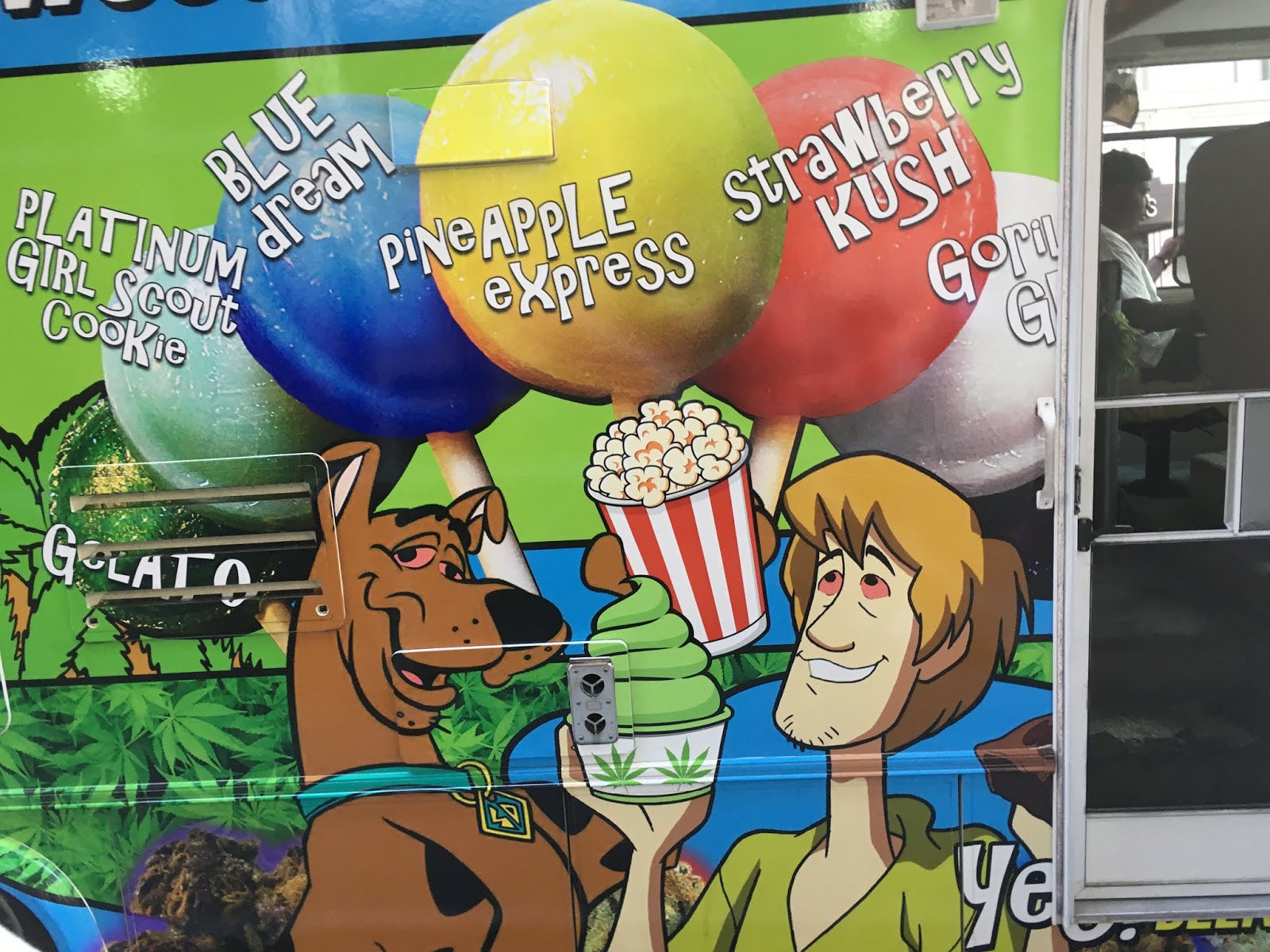
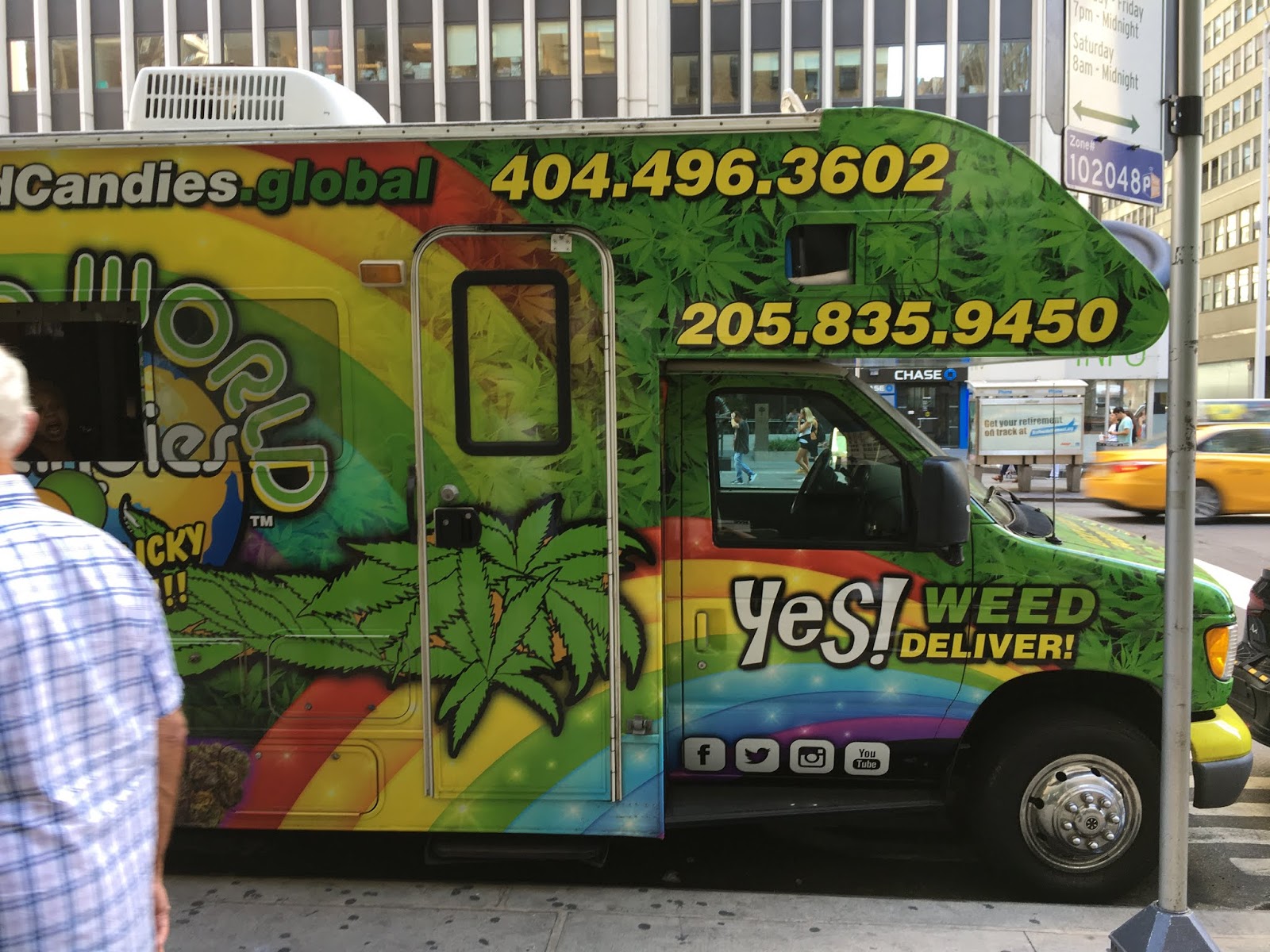
TM/False advertising issue of the day

Seen on the street in NYC; the candies have no marijuana content–they’re sold as “adult” candies, furthering the impression. My daughter also asked “Could the owners of Scooby Doo sue?” and then, because I have taught her well, corrected that to “Could the owners of Scooby Doo win?”

from Blogger https://ift.tt/2Lfyuex

Posted in Uncategorized | Tagged , | Leave a comment

False designation damages require proximate cause, dooming $250 million jury award

ZeniMax Media Inc. v. Oculus VR LLC, No. 14-cv-01849 (N.D.
Tex. Jun. 27, 2018)
After trial of this case, the jury returned a verdict,
finding in relevant part that defendants were liable for false designation of
origin, basically about the origins of Oculus’s technology with a lagniappe of
use of ZeniMax’s trademarks in a Kickstarter promotion. The jury awarded actual
damages of $250 million in total for the false designation of origin. The court
granted judgment as a matter of law because the record lacked legally
sufficient evidence of injury causation in that or any amount. [Pointing to
another part of Dastar’s practical
wisdom: it’s rare that false designation of origin of ideas makes a difference.
The court was sensitized to the Dastar
problem in that its analysis focuses on unauthorized use of ZeniMax’s marks,
but the trial theory, and thus the jury’s award, seems to have focused on
claiming credit for the technology. The mismatch between the allowable scope of
§1125 and the theory is likely part of what accounts for the lack of evidence
of damages.]
Under Lexmark,
damages must be proximately caused by the act of the false designation: “[A]
plaintiff suing under § 1125(a) ordinarily must show economic or reputational
injury flowing directly from the deception wrought by the defendant’s
[actions]. . . .”
Plaintiffs’ damages expert testified only as to damages
resulting from stolen trade secrets, not to reputational injury, or any defendant
gains from false designation. For reputational damages, ZeniMax cited the
testimony of Todd Hollenshead, former President of plaintiff id Software, that
he was “concerned” about “the use of preleased software in any public
demonstration that id Software was not controlling.” Without specifically
noting that the existence of a risk isn’t evidence that the risk to reputation
materialized, the court concluded that this wasn’t evidence of damage to
reputation based on false designation. ZeniMax also pointed to three other
items that supposedly showed reputational injury: (1) false representations
Oculus made in the press about“collaborat[ion]” when “there was no actual
affiliation between ZeniMax and Oculus”; (2) Oculus leading Mark Zuckerberg to
believe that Oculus, not ZeniMax, “was miles ahead of everyone else” as to
virtual reality technology; and (3) Zuckerberg’s testimony that ZeniMax “came
out of the woodwork” when the Facebook purchase was announced. These were “even
further from being evidence of reputational injury” than Hollenshead’s
testimony.
ZeniMax pointed to excerpts from the damages expert’s
testimony where he calculated a reasonable royalty for ZeniMax’s technology. But
none of this testimony referenced false designation, let alone how the damages
calculation he computed for trade secret violations also related to false
designation and any resulting injury to ZeniMax. Defendant Carmack also wrote an
email saying that “Oculus wouldn’t exist as a funded company if it weren’t for
[Plaintiffs’] involvement.” That didn’t provide evidence that defendants “were
massively and unjustly enriched” in relation to the false designation.
ZeniMax argued that defendants were unjustly enriched by
their act of false designation when Facebook bought Oculus for approximately $2
billion. [Unjust enrichment of this type isn’t damages—it’s a disgorgement
theory.]  Standing alone, the purchase
price was legally insufficient evidence to prove damages from false
designation. Facebook didn’t buy Oculus until 2014, almost two years after Oculus
used promotional items containing ZeniMax’s marks without authorization in a Kickstarter
video and investor materials. There was no causal evidence linking the two.
Even if there had been evidence of damages, plaintiffs
failed to show proximate cause between those damages and the unauthorized use
of their marks. Plaintiffs argued that the jury is vested with “broad latitude
to infer proximate cause.” However, there was no evidence that Facebook believed the parties were
somehow associated and that this led to the purchase. [Materiality as a proximate
cause requirement….] Also, “[t]he time and intervening facts between these
events alone makes the approximately $2 billion purchase price too remote to
have been the proximate result of Defendants’ acts of false designation.” During
those two years, millions of dollars were invested into Oculus by multiple
investors, and others invested substantial time and effort, taking the Oculus
Rift from a prototype device into a functioning device with market potential. That was the product that attracted
Facebook to acquire Oculus. “There was simply no evidence presented that the
purchase price Facebook paid for Oculus proves any of the harms against which
Section 1225 protects.”
The only other evidence arguably proving proximate cause of
harm flowing from the false designation was the money Oculus raised from
investors in direct connection with the use of the promotional materials
containing ZeniMax’s marks. However, there was no evidence about how much money
was actually generated from these specific efforts using ZeniMax’s marks
without permission. Also, the display of ZeniMax’s marks and the endorsement by
Carmack, who was employed by ZeniMax at that time, was “merely a minor portion
of the entire video.” By contrast, the video spent a substantial amount of time
discussing the invention and technological improvements of the Oculus Rift
without making any reference to ZeniMax or displaying of any of ZeniMax’s
marks. The video also contained references to and endorsements from other
companies and people in the industry unconnected to ZeniMax, such as USC’s MxR
Lab, Epic Games, Unity, and Valve. The unauthorized use of ZeniMax’s marks was
“diluted” by these endorsements of others as well as the support of ZeniMax’s
competitors.
Here’s the Dastar
hook: “The invention and technology of the Oculus Rift was a major issue in
dispute in this matter” but those issues “play no role in a proximate cause
analysis as to the false designation claims because the Lanham Act is intended
to protect from harm related to the improper use of a mark and not intended to
protect inventor’s rights.” The invention issues “add nothing to further a
finding of proximate cause of a harm related to the money raised by this
Kickstarter video.”

from Blogger https://ift.tt/2lLO2vf

Posted in Uncategorized | Tagged , , , | Leave a comment

the perils of default judgments against speech: showing up late can prove onerous

Lokosky v. Gass, No. 1 CA-SA 18-0101, 2018 WL 3150499 (Az.
Ct. App. Jun. 28, 2018)
Respondents (not Gass, who’s the judge, named for procedural
reasons) sued Lokosky for false advertising and related claims seeking to compel Lokosky to “remove from the
internet all material pertaining to Respondents and their business,” and
obtained a default judgment. Next, they compelled the transfer of ownership of Lokosky’s
website to themselves. Lokosky then applied for a restraining order seeking to
have ownership of her website returned to her and moved to vacate or set aside
the judgment. The superior court granted the TRO and ordered Lokosky to “remove
any and all material and/or references pertaining to each Plaintiff” on her
website and “refrain from publishing or republishing on the Internet any and
all materials and/or references pertaining to each Plaintiff.” Well, that’s
incredibly overbroad. Then:
In March 2017, the superior court
held the first day of an evidentiary hearing on Lokosky’s motion to vacate
judgment. During the month in between hearing days the superior court placed
both parties under an order forbidding the parties from engaging in speech regarding
each other, counsel, and the instant lawsuit. … In April 2017, the superior court held the second day
of the evidentiary hearing and vacated the default judgment against Lokosky. 
Lokosky filed a motion to dissolve the TRO because there was
no longer a default judgment to justify the restraint on her speech. In a
sequence of events that would have fit well in Jarndyce v. Jarndyce, the superior court declined to act, waiting
on the result of respondents’ pending appeal of the vacation of the default
judgment. So Lokosky filed a separate notice of appeal about the superior
court’s decision not to decide the motion to set aside the TRO; the court of
appeals determined that it lacked jurisdiction. Lokosky then requested that the
court of appeals dissolve the TRO by way of a filing in respondents’ appeal. The court of appeals denied the motion because the request was
more appropriately raised as a special action. Lokosky then filed a special
action petition, and finally her claim was heard on the merits. [Eugene Volokh
could use this as a cautionary tale about granting speech restraints in default
judgments. They can be very hard to reverse, as it turns out!]
The TRO was a prior restraint on speech and violated the
First Amendment. Before any TRO against future speech can issue, the court has
to determine that the future speech is unprotected by the First Amendment. “Although
the superior court indicated its intent to prevent the parties from engaging in
speech which might later increase their own liability in this litigation, the
record is devoid of any support for the notion that Lokosky’s speech is not
protected.” Respondents argued that they competed with Lokosky and that
her speech was commercial (allowing prior restraint). Even assuming that, her
speech hadn’t been determined to be misleading and thus couldn’t be restrained,
even temporarily.

from Blogger https://ift.tt/2tYayoq

Posted in Uncategorized | Tagged , | Leave a comment

search results labeled as results aren’t confusing

Carter v. Oath Holdings, Inc., No. 17-cv-07086-BLF (N.D.
Cal. Jun. 21, 2018)
Carter allegedly owns a trademark registration for “The
House of Figurine Sculptures.com.” Defendant is Yahoo!, which runs a search
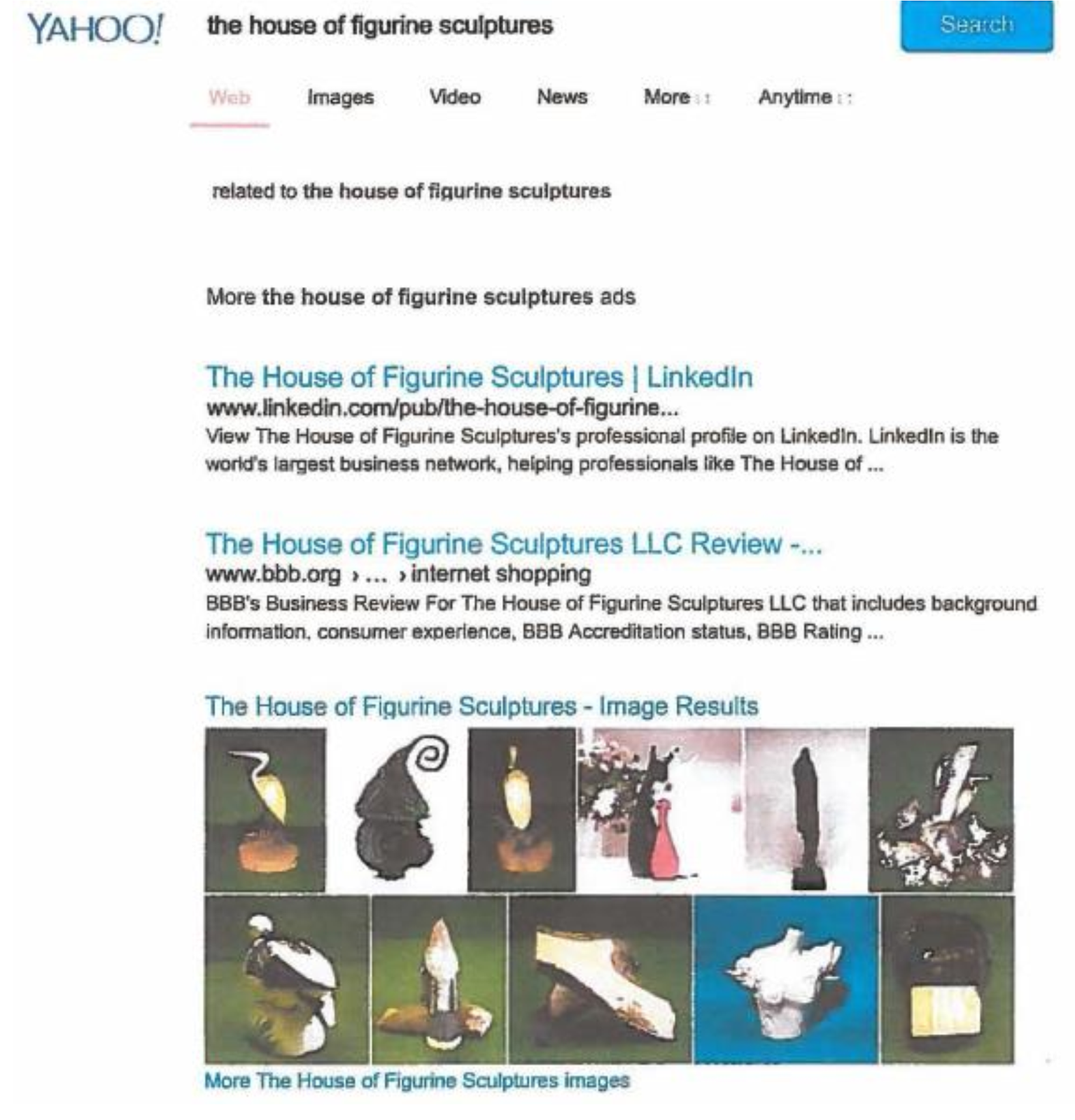
engine.  The complaint alleged that
Yahoo! uses “two active counterfeit marks identical to Plaintiff[’s] genuine
mark” titled “The House of Figurine Sculptures – Image Result” and “More The
House of Figurine Sculptures Images”:
Carter alleged that he has no connection to “those goods and
services sold” and that Yahoo!’s “counterfeit marks misrepresent [the]
designation of origin” of the goods and services. The court dismissed the
trademark infringement, false designation of origin, and counterfeiting claims.
First, the complaint failed to sufficiently plead “use” of the mark. “Courts
have held that an online provider does not ‘use’ a mark under the meaning of
the Lanham Act when its search engine returns a search result based on an input
of a consumer. As such, merely returning search results to purportedly display
a trademark does not show that Defendant is liable under the Lanham Act.”
Second, the complaint failed to sufficiently allege a
likelihood of confusion. Mere allegations that Yahoo!’s “counterfeit marks
misrepresent [the] designation of origin” and that their “counterfeit marks
[are] deceptive, confusing, and is likely to cause mistake on the part of [the]
consuming public” were conclusory and insufficient. [Note that if more plausible
facts were alleged leading up to this (e.g., that defendant was selling
identical goods/services in direct competition with plaintiff, using the same
mark), the very same allegations would not be treated as conclusory but as
plausible inferences from the other alleged facts.]

from Blogger https://ift.tt/2lQ2rXq

Posted in Uncategorized | Tagged | Leave a comment

Dr. Pepper gets an upset tummy: Court approves conjoint analysis/price premium model in ginger ale class action

Fitzhenry-Russell v. Dr. Pepper Snapple Group, Inc., 2018 WL
3126385, No. 17-cv-00564 (N.D. Cal. Jun. 26, 2018) (magistrate judge)
Canada Dry Ginger Ale allegedly deceived consumers with the
phrase “Made From Real Ginger” when, in fact, Canada Dry does not contain the
type of, or amount of, ginger consumers would expect (ginger root). Instead,
Canada Dry contains a ginger derivative, ginger oleoresin. Plaintiffs alleged
that Dr. Pepper was wrongfully able to charge a 4% price premium on Canada Dry
as a result. The court certified a class and rejected challenges to plaintiffs’
expert declarations in support of class certification on the usual California
claims.
Plaintiffs’ survey expert, Dr. Dennis, looked at consumer
understanding of “Made from Real Ginger” and materiality/price premiums. Respondents
were asked “what is your understanding of the statement ‘Made From Real Ginger’
on the Canada Dry Ginger Ale?” and provided options:
[1.] Ginger oil, which is extracted
from the ginger root using steam
[2.] Ginger root, which is part of
the ginger plant, not an extract
[3.] Ginger oleoresin, which is
extracted from the ginger root using a solvent
[4.] None of these
78.5% of California Canada Dry consumers answered that the
product was made from ginger root, while 4.8% of consumers picked ginger
oleoresin and 8.6% picked ginger oil. (The truth is oleoresin.)
Before answering the materiality question, respondents were
presented with the definitions of “ginger root” and “ginger oleoresin.” Ginger
oleoresin was defined almost as above, but with the additional information that
a solvent, such as ethanol, could be used to extract the ginger. In the survey,
92.4% of respondents preferred to purchase a version made with ginger root over
one made with oleoresin.
For the price premium survey, Dennis used a choice-based
conjoint survey, which asked respondents to express preferences by choosing
from a set of product profiles (i.e., choosing a product from a group of
products). The price premium survey was restricted to respondents who recently
purchased ginger ale, and presented respondents with mixes of six
attributes.  The results were fed into
Bayesian models that allegedly allowed Dennis to calculate a price premium from
“Made with Real Ginger” for the marginal consumer; he found a 4% price premium.
Plaintiffs’ expert Weir opined on whether it would be
possible to determine damages on a class-wide basis using common evidence, and provided
a framework for/estimate of damages to the California class. Weir multiplied
the total California sales of Canada Dry in the class period by 4% to calculate
damages, resulting in a figure of $10,778,477.
Dr. Pepper didn’t challenge the experts’ qualifications or
the reliability of their methods. 
Instead, it focused on the argument that Dennis didn’t properly apply
the methodologies behind his consumer understanding survey and price premium
analysis.
As to the consumer perception survey, “survey evidence
should be admitted as long as it is conducted according to accepted principles
and is relevant.” “[T]echnical inadequacies in a survey, including the format
of the questions or the manner in which it was taken, bear on the weight of the
evidence, not its admissibility.”  Dr.
Pepper pointed to its rebuttal expert’s “vastly different results” in his
replication survey of consumers. That expert recreated Dennis’s consumer
understanding survey, but changed the descriptors of ginger oil, ginger
oleoresin, and ginger root. But even where “simple language” was used to
describe ginger oil, ginger oleoresin, and ginger root, 40.59% of respondents
still believed “Made From Real Ginger” meant that Canada Dry was made using
“ginger root” as its ginger ingredient. “This is still a legally significant
percentage of people who would be misled.” 
The rebuttal expert also did a replication survey using “technical”
descriptors of ginger oil, ginger oleoresin, and ginger root, but this
different language proved the point that Dennis’s survey needed to go to a
fact-finder, who could determine if plaintiffs’ survey was unduly biased. “This
is because the replication survey using technical language seems to be designed
to confuse respondents, and encourage them to answer that they ‘don’t know’ or
are ‘unsure’ of what the ginger ingredient behind the ‘Made From Real Ginger’
claim is. After all, which layperson has ever heard of the ginger root powder
they purchase in stores being referred to as ‘triturated ginger’ [defined in
the survey as ‘a coarse powder obtained from the ginger root using a bleaching
process’]?”  [I agree that the “not an
extract” language in the original survey has some biasing potential; I also
wonder about the “not sure/don’t know” option—but at the same time “triturated
ginger” isn’t how I would think about ginger root powder either.]
The court found Dr. Pepper’s criticisms of the price premium
survey and simulator to be more substantive. 
Dr. Pepper argued that despite Dennis’s representation in his
declaration that his survey only contained six features or attributes— brand,
type, flavor, nutrition facts, description on front of the package, and
price—he instead used 11 factors, because the description on the front of the
Canada Dry packaging wasn’t one attribute but six: (1) “100% Natural Flavors,”
(2) “The Original Ginger Soda,” (3) “Barrel-Aged,” (4) “Made with/from Real
Ginger,” (5) “Caffeine Free,” and (6) “Since 1904/1873.” The more attributes in
a conjoint survey, “the higher risk that it simply becomes too complex for
respondents.” Also, it may be that the reason a person considered the descriptors
on the product packaging was because he or she thought the “100% Natural
Flavors” claim was important, rather than the “Made From Real Ginger” claim.  
Dennis’s reply declaration didn’t assuage the court’s
concerns: He argued that grouping the different product descriptions under one
attribute “likely led to a dilution of the respondents’ attention (in contrast
to showing only one product description for each product option), and therefore
reducing possible risk from focalism bias.” If he hadn’t included the four
product descriptions on the Canada Dry can on the price premium survey, the
survey would have been criticized on that basis. The court understood that, but
wasn’t convinced. Still, even if the survey overestimated the value consumers
placed on “Made From Real Ginger,” it wasn’t excludable excludable. Dr. Pepper could
attack it at trial.
Dr. Pepper argued that one of its other ginger ale products,
Schweppes, didn’t have the ginger claim, and it sold in stores at either the
same price or for less. Plaintiffs responded that legal authorities agree that using
a side-by-side comparison is “bunk.” The court agreed that as a matter of
common sense, such comparisons don’t account for any of the range of other
possible reasons for these products to be priced so similarly. Even the possibility
that another survey might have used side-by-side comparisons didn’t make this
survey excludable.
Most substantively, Dennis considered willingness to pay in
the conjoint survey, not a price premium; thus, Dr. Pepper argued, it couldn’t
calculate restitution, which is the difference between what consumers paid and
the true market price, which also takes into account supply-side factors.
However, the study used past market prices, which reflect supply factors. The
study can get insight into price premium by looking at the marginal consumer: the
one who is indifferent between buying and not buying the infringing product. That
consumer’s WTP is “equivalent to the price premium associated with the
infringing level of the attribute; this marginal consumer can be identified by
offering respondents a ‘no buy’ option.” 
The model asks “At what price in that actual market in which [defendant]
sold the offending products could [defendant] have sold the equivalent number
of products without the false claim(s)?” The marginal consumer’s WTP discloses
that price, tethered to the real market because the conjoint survey used actual
market-clearing prices as the basis for the prices in its survey and actual
competitor products.  Thus, the price
premium study satisfied Daubert.
After that, the class certification discussion was lengthy,
but largely foreordained.
Dr. Pepper argued that “Made From Real Ginger” couldn’t be
material to consumer decisions because there was no common understanding of the
term, as courts have ruled for “All Natural” and “100% Natural.” The court
found the challenged phrase to be far less vague; almost 80% of people thought
“Made From Real Ginger” meant that Canada Dry was made using ginger root. Plus,
Dr. Pepper’s internal documents showed that Dr. Pepper thought the “Made From
Real Ginger” claim was material. E.g., Dr. Pepper sought to capitalize on the
alleged health halo ginger products have to consumers by encouraging people to
believe that “Canada Dry Ginger Ale is a [carbonated soda drink] that fits into
your healthy lifestyle because it is made from real ginger.” When respondents were
asked their reasons for drinking Canada Dry five years later, the top five
reasons were: (1) “I trust and respect the Canada Dry Brand (28%)”, (2)
“Drinking Canada Dry makes me feel better by soothing my stomach (26%)”, (3)
“Canada Dry is easy to find in stores (26%)”, (4) “Canada Dry tastes good with
food (25%)”, and (5) “Canada Dry is made with real ginger (25%),” even though
previously lots of people hadn’t believed that ginger ale had real ginger.
Thus, “through its marketing, it orchestrated a change in consumer perceptions.”
Another document claimed that the “Made From Real Ginger” program “is working: –
New news – Strong POD and message relevant to target consumer – Consumer
awareness and brand equity increased – Purchase frequency and volume growth
escalated to +8.5%.” “Clearly, if a quarter of Canada Dry consumers were
listing the ginger claim as a top five reason why they bought the product, the
claim is material. Dr. Pepper cannot walk back evidence contained in its own
documents.”
The most interesting argument Dr. Pepper presented against
the price premium survey under predominance is that “it does not match
[plaintiffs’] theory of liability. The survey purports to calculate a price
premium associated with misleading consumers to believe the drink contains
powdered or chopped ginger, but it does not do so—it calculates the premium
associated with all possible meanings of the claim.” Canada Dry does contain
traces of real ginger, in the form of ginger oleoresin. But the complaint still
properly alleged that these traces weren’t “real ginger” as a reasonable
consumer would understand it and that the flavorings contained none of the
health benefits of real ginger. 
Plaintiff’s rebuttal expert reported that the concentration in parts per
million of 6-gingerol and 6-shaogal, which are ginger-derived compounds, in
Canada Dry was far below what a person would be able to detect when drinking
the ginger ale. Even if it is literally true that Canada Dry has ginger in it,
the ginger is not what a reasonable consumer would expect.
The worth of the “Made From Real Ginger” claim would only
matter in the future if a jury does find that the claim is misleading. Thus,
plaintiffs’ damages model fit the theory of the case.

from Blogger https://ift.tt/2lFzRb5

Posted in Uncategorized | Tagged , , , | Leave a comment

Direct competition + literally false advertising don’t equal standing without more

Brave Law Firm, LLC v. Truck Accident Lawyers Gp., Inc., No.
17-1156-EFM-GEB, 2018 WL 3122172 (D. Kan. Jun. 26, 2018)
Brave sued its personal injury law firm rivals (TALG) under
the Lanham Act and Kansas state law based on allegations of false and deceptive
advertising. The court ruled that Brave hadn’t sufficiently alleged
injury—furthering my suspicion that Lexmark
reasoning has made it easier to proceed against disparagement and harder to
proceed against false claims a defendant makes about itself, even though the
latter was the core of what the Lanham Act false advertising provisions tried
to cover.
Brave and TALG offer competing legal services in the same
geographic area. An example of the allegedly false advertising is an ad depicting
a woman holding a check with the words “$2.4 MILLION” displayed in bold text,
with a disclaimer stating, in part: “Amounts are gross recovery before fees and
expenses.” Brave alleged that this ad was false because the actual “gross
recovery” before fees and expenses was $387,018, or 16% of what was advertised.
The court found that Article III wasn’t satisfied. The
allegations of injury were conclusory, alleging mostly that the false
advertising was intentional. The court declined to apply a presumption of
injury to standing even if the advertising was literally false.  Brave failed to allege that it lost potential
clients to TALG, that it lost revenue from the false ads, or that TALG
strengthened its market position through the ads. The motion to dismiss on
standing was granted with leave to amend.
Because of the leave to amend, the court addressed zone of
interests/proximate causation under Lexmark
as well. As with standing, Brave failed to sufficiently allege injury to a
commercial interest in reputation or sales (zone of interests). Brave argued
that it was seeking injunctive relief, so it didn’t have to show injury. But
that’s not right. However, if Brave successfully amended to assert an injury to
a commercial interest in reputation or sales, the proximate cause test would
most likely be met, given that Brave’s scenario would fit into the “classic
Lanham Act false-advertising claim.”
Finally, Brave’s pleadings didn’t satisfy FRCP 9(b) in
identifying the when, where, and how: though it provided a screenshot of an alleged
ad, it didn’t allege when or how the ad was disseminated, or when/how (in terms
of medium) other ads were or who ran those or what those other ads specifically
said.

from Blogger https://ift.tt/2tLBg3B

Posted in Uncategorized | Tagged , | Leave a comment

false patent marking doesn’t presumptively cause injury even in 2-player market

John Bean Technologies Corp. v. Morris & Assoc., Inc.,
No. 15-CV-02211, 2018 WL 3039734 (W.D. Ark. Jun. 19, 2018)
JBT’s predecessor asserted Patent Act false marking claims,
Lanham Act false advertising claims, and various North Carolina and Arkansas State
law claims against Morris, its sole competitor in selling auger chillers to
poultry processors in the United States. An auger chiller takes chicken
carcasses in the middle stages of the butchering process and cools them to
prevent contamination.  Cold water runs
from the far end to the receiving end and the auger slowly rotates on a shaft,
driving the chickens against this current to the far end of the tank, where
they enter the next stage of the processing line. These are expensive and
durable machines; sales are therefore rare and lucrative.  
Morris uses vertical openings in the auger blades of its
chiller to increase the flow of water (a desirable feature) and advertised its
chiller as patented (the ’529 patent). JBT’s chiller also had openings for
water in the blades, though its didn’t run to the edge of the blade as Morris’s
did.
Morris’s website advertised that its auger chiller was
patented. It also included caricatures of the parties’ chillers (JBT’s
recognizable from the openings in the auger blades) and a statement that “In
other systems, water circulates only around the shaft and through a narrow gap
between the auger flights and the tank wall.” JBT alleged that the openings on
the caricature were disproportionately small compared to their size on an
actual JBT chiller, and that the image plus the statement about water flow in
“other systems” were literally false comparative ads.
The false marking claims failed because JBT couldn’t show
competitive injury, as is now required:
If an article that is within the
public domain is falsely marked, potential competitors may be dissuaded from
entering the same market. False marks may also deter scientific research when
an inventor sees a mark and decides to forego continued research to avoid possible
infringement. False marking can also cause unnecessary investment in design
around or costs incurred to analyze the validity or enforceability of a patent
whose number has been marked upon a product with which a competitor would like
to compete.
JBT argued that competitive injury necessarily occurred from
false marking in a two-player market because Morris’s auger chillers gained
value from being marked as patented, causing the value of JBT’s chillers to
decrease. In addition, JBT argued that its reputation and goodwill with a
customer were injured when the customer declined to purchase a JBT auger
chiller with openings because Morris’s auger chillers were marked as patented,
but subsequently asked JBT to retrofit the auger chiller with openings.
The two-player market supported a rebuttable presumption of
economic injury in false advertising cases where a two-player market
necessarily makes ads comparative. But such a presumption was inappropriate for
false marking, given that the Patent Act now affirmatively requires a plaintiff
to demonstrate competitive injury as part of a false marking claim.
The evidence about the one customer who wanted a retrofit
was just hearsay and speculation. (Even if it had been admissible, it tended to
show that Morris’s past patent litigation practices led to the request, not
false patent marking.)  Anyway, JBT made
that sale, and additional sales to that customer, meaning that there wasn’t
evidence of lost reputation or goodwill. 
(It seems like retrofitting was likely to be more costly than initially
manufacturing the auger with the openings, but I guess JBT didn’t say
that?)  There was no other evidence of
deterred market entry, deterred research, design-around investments, or costs
incurred to analyze the validity or enforceability of the marked patent.
Likewise, there was insufficient evidence of harm on the
false advertising claims. Again, even assuming the customer experience above
were admissible, there was no evidence the customer was affected by Morris’s
advertising.  The “two-player market”
principle created a rebuttable presumption of economic injury, but such
presumptions serve only “to control the result where there is an entire lack of
competent evidence.” When sufficient proof has been offered to rebut a
presumption, “it falls out of the case.” Even assuming that JBT was entitled to
the presumption of injury, Morris rebutted it: “Multiple deponents familiar
with selling auger chillers testified that whether equipment is advertised as
patented is all but meaningless to customers seeking to purchase.”  There was also evidence that customers do not
make equipment purchases based on websites. There was also evidence that Morris
didn’t hurt JBT’s reputation or goodwill, and that any relevant decline
happened because JBT’s predecessor was sold to JBT, whose sales remained strong
nonetheless. All this rebutted any presumption of injury and of irreparable
harm.
Morris won summary judgment on these claims; the coordinate state
claims also failed.

from Blogger https://ift.tt/2KqpWEt

Posted in Uncategorized | Tagged , | Leave a comment

Three little words make a fair use

Oyewole v. Ora, 291 F.Supp.3d 422 (S.D.N.Y. 2018)
This case grants a motion to dismiss on fair use grounds,
though it should have been on lack of substantial similarity in protected
expression.
Oyewole is a founding member of the spoken-word group The
Last Poets who created the song “When the Revolution Comes” in 1968. The song
warns of a coming revolution when “guns and rifles will be taking the place of
poems and essays,” with a back track of a drum beat and chants. Also: “When the
revolution comes/ Transit cops will be crushed by the trains after losing their
guns and blood will run through the streets of Harlem drowning anything without
substance.” At the end of the song, the performers chant, “When the revolution
comes (3x)/But until then you know and I know n*****s will party and bullshit
and party and bullshit and party and bullshit and party and bullshit and
party… Some might even die before the revolution comes” (ellipsis in
original). Oyewole indicated that the “sole purpose” of the lyrics is to
“challenge[ ] and encourage[ ] people to NOT waste time with ‘party and
bullshit,’ but to move towards success.”
In 1993, The Notorious B.I.G. released the song “Party and
Bullshit” celebrating his “hip hop lifestyle.” It begins: “I was a terror since
the public school era / Bathroom passes, cuttin’ classes, squeezing asses / …”
The chorus is: “Dumbing out, just me and my crew / Cause all we want to do
is… / Party… and bullshit, and… (9x)” (ellipses in original). In 2012,
Rita Ora released the pop song “How We Do (Party),” which begins, “And party
and bullshit / And party and bullshit / And party and bullshit / And party, and
party.” Further lyrics include “I get that drunk sex feeling/Yeah, when I’m
with you/So put your arms around me, baby/We’re tearing up the town/‘Cause
that’s just how we do.”  The opening
lines recur several times throughout the song. 
Oyewole alleged that the uses here “contrravened” the original purpose of
the phrase as used in “When the Revolution Comes,” which was to discourage
people from partaking in “party and bullshit.”
Understandably, the defendants maintained that “party and bullshit”
was not protectable, but, following a pattern I find somewhat depressing, the
court assumed otherwise and instead resolved the infringement issue as a matter
of fair use.  Both songs transformed the
purpose of the phrase “party and bullshit” “from one of condemnation to one of
glorification,” … “in neither secondary work does it evince criticism or
foreboding.” The Poets suggest that, as a result of the partying and bullshit,
“[s]ome might even die before the revolution comes.” The phrase is “an
expression of disgust and disappointment in those who are not readying
themselves for the revolution.”  Not so
for the accused songs, which embrace and exalt “party and bullshit” culture.
Even the complaint recognized this by accusing the songs of contradicting Oyewole’s
original purpose, which was to “encourage[e] people to NOT waste time with ‘party
and bullshit.’ ”
Nature of the work: creative, which weighs against fair use,
also published, which favors fair use.
Amount and substantiality of the portion used: one phrase. As
for substantiality, “although the background track’s cutting out when the Last
Poets chant ‘party and bullshit’ adds a level of gravity and importance to the
phrase, the expression is not critically important to the song’s message.
Instead, the song focuses on the upcoming revolution.”  [This seems like a pretty good reading, by
the way; I just think it’s detrimental to the robust analysis of copyrightability/substantial
similarity to do this as a matter of fair use.]
Market effect: transformativeness made market effect
unlikely. Given the character and purpose from the original work, the target
audiences were unlikely to be the same, and even if they were, the songs wouldn’t
substitute for the original. [Note no explicit consideration of derivative
markets, implicitly encompassed in the transformativeness discussion.]

from Blogger https://ift.tt/2sVIIJK

Posted in Uncategorized | Tagged , | Leave a comment

Second Circuit rejects falsity by necessary implication claim for UL certification

Board-Tech Electronic Co. v. Eaton Corporation, Cooper
Wiring Devices, Inc., — Fed.Appx. —-, 2018 WL 2901336, No. 17-3829-cv (2d
Cir. Jun. 11, 2018)
Board-Tech and Eaton compete in the market for decorative
light switches. Underwriters Laboratories (UL) is an independent entity that
tests, verifies, and endorses the safety of various electronic products; its
imprimatur is commercially necessary for light switches in the US.  UL licenses the “UL 20” certification mark to
products that meet its safety standards. Manufacturers must submit
“representative samples” of their product to UL; if the samples pass the tests,
UL authorizes the manufacturer to advertise and label its products as “UL 20”
compliant.
Eaton markets its light switches as UL 20 compliant. Board-Tech
alleged that its in-house engineers independently tested UL 20 compliance of
eight sets of six light switches and that each of the 48 light switch units
failed. Thus, it alleged false advertising, despite Eaton’s authorization from
UL to use “UL 20.” Board-Tech didn’t send its test results to UL, and UL has
taken no relevant action.
Board-Tech’s allegations couldn’t establish literal falsity,
because they didn’t negate the fact that the product was indeed certified by
UL.  Board-Tech argued falsity by
necessary implication: UL 20 certification necessarily implies that the product
purchased will hold up to the UL 20 standard.  But UL certification represents that a sampling
of products complied with UL standards when UL tested the products, not that
every single unit will perform the same way when tested by different entities. “To
satisfy literal falsity under a theory of necessary implication, Board-Tech
needs to allege sufficient facts to show that Underwriters Laboratories
considers Eaton’s products non-compliant—not just that someone else does…. Board-Tech’s
testing, absent additional indicia of non-compliance, does not render Eaton’s
use of the UL 20 mark literally false.”  This
contrasted to a previous case where the competitor’s product was altered and
found on retesting by UL to be non-compliant. 
In that case, “[h]olding [a product] out to be UL approved” after
materially changing it “constituted a false representation.” “Without any
indication that UL decertified the defendant’s product—or (perhaps) that the
defendant’s product had materially changed since certification—there would be
no plausible allegation of a false statement.” This has a Twiqbal twist: “To merit discovery into its competitor’s product
lines and tradecraft, Board-Tech must ‘raise a reasonable expectation that
discovery will reveal evidence’ tending to show UL would find Eaton’s products
non-compliant.”
[Query: would Volkswagen’s defeat devices for emissions
tests satisfy the court’s qualifications? 
I can see it argued either way. 
The problem is what it would mean for UL to “consider[]” (present tense)
products non-compliant.  Is it literally
false once you allege facts that, if true, would establish that no reasonable
entity could consider its standards satisfied? That seems to be one reading of
the “additional indicia” line. Or do you have to allege that the entity has
come to a decision on the matter? I think the court wants to preserve space for
the Volkswagen situation to be literally false by necessary implication, but it’s
a bit tricky to do! Certainly the VW product didn’t materially change since
certification; it just acquired that certification through falsehood.]
What about misleadingness? That requires extrinsic evidence,
and the complaint didn’t offer other than conclusory allegations that consumers
had been misled or confused.

from Blogger https://ift.tt/2LOuy4d

Posted in Uncategorized | Tagged | Leave a comment

Right of Publicity, Litigating the Claims

Litigating the Claims
Rick Kurnit: told the story of litigating the White case, in which the author of the
panel opinion didn’t know what a letter-turner was. Had to go to trial with a
jury, all of which regularly watched Wheel of Fortune.  Jury found that robot was Vanna White, and
that she was endorsing the TV being advertised. 
Awarded more on the Lanham Act claim than on the ROP claim.  What about parody?  Spent no time on that, parody wouldn’t help b/c
parody just means they’re the same [parity].
Panelists:        
Nathan Siegel, Davis Wright Tremaine LLP: Cultural trend
favoring celebrities, and willingness to view a celebrity’s “story” as quasi-property
of the celebrity. This has become pervasive, so more judges go into cases w/ a
presumption, almost incredible to 1A advocates, that people have a right to
control the marketing of their story. Cardtoons case: additional inducement for
achievement from ROP often inconsequential, b/c most personalities are
adequately compensated. Even w/o ROP, the rate of return in entertainment &
sports is high enough.  I agree, but that’s
not a shared sentiment today. People don’t seem bothered by a billionaire like
Michael Jordan winning $10 million for a congratulations taken out in Sports Illustrated.  Opposing speech interests are discounted more
often than 20 years ago.
Cultural backlash against the media. In this genre we’re
seeing a particular tendency to view sports/entertainment as fluffy and
avaricious.  Exploitative in some fundamental
sense. Not really worthy of deference in the same way as news & political
speech. Judges issuing the worst decisions in this area, such as trial court in
de Havilland, Porco, NCAA—relatively liberal judges. Feels like, in an era
where people feel the need to attest to their anti media bona fides, that’s one
way it happens on the liberal side.
Things to think about: temptation is to argue w/intellectual
abstractions, such as transformative use. Need to frame in appealing, common
sense way. Why does the breadth of the right not make sense?  Pitch it as a matter of control before the
fact. The cases always come up after the speech, so it looks like we’re arguing
over “why didn’t they get paid?” But the right is a right of personal control
before the fact, and that looks a lot different. Everyone shown in a clip could
control the right to broadcast the clip ever again. [This was an important point
in the FanDuel amicus that Mark McKenna & I recently wrote.] Rarely just
about the P; usually there’s a significant group of people involved who could
theoretically bring the same claims. How could every single person have an
individual right of control? [aka anti-commons property] If everyone had a
right to control how their image was going to be depicted in advance, that’s a
veto for everyone.  De Havilland isn’t
just about de Havilland. If you have two people feuding, should each one be
able to say “you can depict the feud as long as I win it”? Seems to be a notion
among some judges that docudramas are icky—neither fish nor fowl, taking
documentaries one step too far by quasi-fictionalizing them.  Just a modern TV version of historical
fiction, a genre that’s been around for 100 years. 
We should think of the 1A as the last resort, not the first
resort.  It’s an extremely defensive way
to frame the case. The 1A only comes into play if there is a right under state
law. So we are conceding that the states are saying that celebrities do have
that right, and we’re asking for special protection. That’s generally
unnecessary b/c most state cts w/common law or state laws didn’t intend to call
docudramas and sports programming into question, whether or not they put a
specific exemption in. Think first about pushing back on scope.  Copyright preemption is another potentially
successful argument.
Push back on the notion that this is an IP right.  Take all the Nobel prize winners for science
& ask what the value of their ROP and match that against the ROP of Al
Capone’s estate—the latter is more valuable, though he didn’t contribute
anything creative or useful. ROP doesn’t award effort, just fame.
In the long run, need to push that Zacchini wasn’t a ROP
case. Confusion in the case itself and subsequently.  It’s a common-law © case: broadcast rights of
event producers.  Not in the short run,
that’s the best chance to cut the legs out of this area.
David Schulz, Ballard Spahr LLP: what judges lack is clarity
about a structure for the theory: what is protected and why. Most judges think
they’re working w/in the law and want to do justice. Start to be very clear
about the structure we’re building and the societal interests at stake. Should
frame things in Rogers/Gugliemi terms: how we describe what’s
being challenged here. Is it something that can be fairly called public
discourse, news, entertainment—things intended to convey information—or is it an
effort to sell/advertise a product. Whichever world you’re in, 1A principles
differ but also state law principles differ.
Spahn: case in
which P alleged that a book about him was fiction despite being advertised as
fact; similar to Eastwood case in
California.  Can justify a claim under this
as a kind of “sham petition” claim—not really nonfiction as advertised.  Subsequent case law (Arrington) about using
pictures to illustrate articles: Is there a reasonable relationship b/t the
picture and the content?  If so, no claim.  Messenger case: girl sued for use of her
picture in an article about a letter writer who’d gotten drunk & had sex
w/men. Court agrees, but the P argued that it was more like Spahn—Court of Appeals doesn’t want to
say Spahn got it wrong so it adds bad
language to distinguish them; Spahn holds
that ROP applies to totally invented biography, as if that was a special
category, and was only trading on the persona, but then adds loose language:
Sec. 50 applies when an article purporting to be newsworthy is so
embellished/fictionalized that it can’t be said to fulfill the purpose of
newsworthiness.  Porco: movie about a young man who killed his father/tried to kill
his mother—sued b/c they used his real name and argued that he had a claim b/c it
was substantially fictionalized. 
Appellate court allowed that to proceed to discovery. Would be better to
start w/asking if something was for purposes of public discourse, not purposes
of trade; if so, no NY right. We know total fiction is protected, as is total
truth; there’s no sense and no predictability in saying that somewhere in the
middle there is a claim.
Annie Pell, NFL
Dryer case:
building a record on newsworthiness. Experts opining that NFL Films weren’t
ads.  Survey of consumers showing that
more than 90% saw these programs as sports/entertainment and not as
ads/infomercials. Marketing prof opined they weren’t ads—longer, no explicit
sales message, not paid spots, listed in TV Guides, won Emmys for TV and not
awards for ads. Branding and advertising are two very different things—enhancing
the value/brand was no different than the way in which a celebrity bio enhances
value of brand. Like pre-game and post-game shows, always treated like that by
networks. Sports marketing agent for ROP licensing who said they weren’t
recognized w/in the industry as ads or endorsements and that players don’t
expect compensation for these types of appearances.
How to deal w/handful of internal NFL docs produced in
discovery that Ps argued showed that the NFL’s intent was to build brand?  Value derived was as great as a big ad
budget.  Sports Illustrated described NFL
Films as a really effective propaganda arm. 
But they were so not b/c they proposed a commercial transaction but b/c
they were really good content.
Finally, distinguishing Facenda,
which 3d Cir found to be commercial speech: separate product references, countdown
to release of the game described in the “infomercial.”
Spiegel: Fictionalization doesn’t fit within Section 50/51,
but it’s hard to go before a court & say we have a right to fictionalize
(where a state, like NY, lacks a false light claim).  Easier to focus on disclaimers: show that it’s
based on a true story. As w/ Messenger, where defamation claim failed b/c the
letter was signed “Anonymous” and reasonable readers would not think that the
depicted model was the author of the letter; no reason to override that
conclusion w/a ROP claim.

from Blogger https://ift.tt/2JssEsd

Posted in Uncategorized | Tagged , , | Leave a comment