Coty Inc. v. Excell Brands, LLC, No. 15-CV-7029, 2017 WL
4155402 (S.D.N.Y. Sept. 18, 2017)
Coty and a number of other producers and distributors of well-known
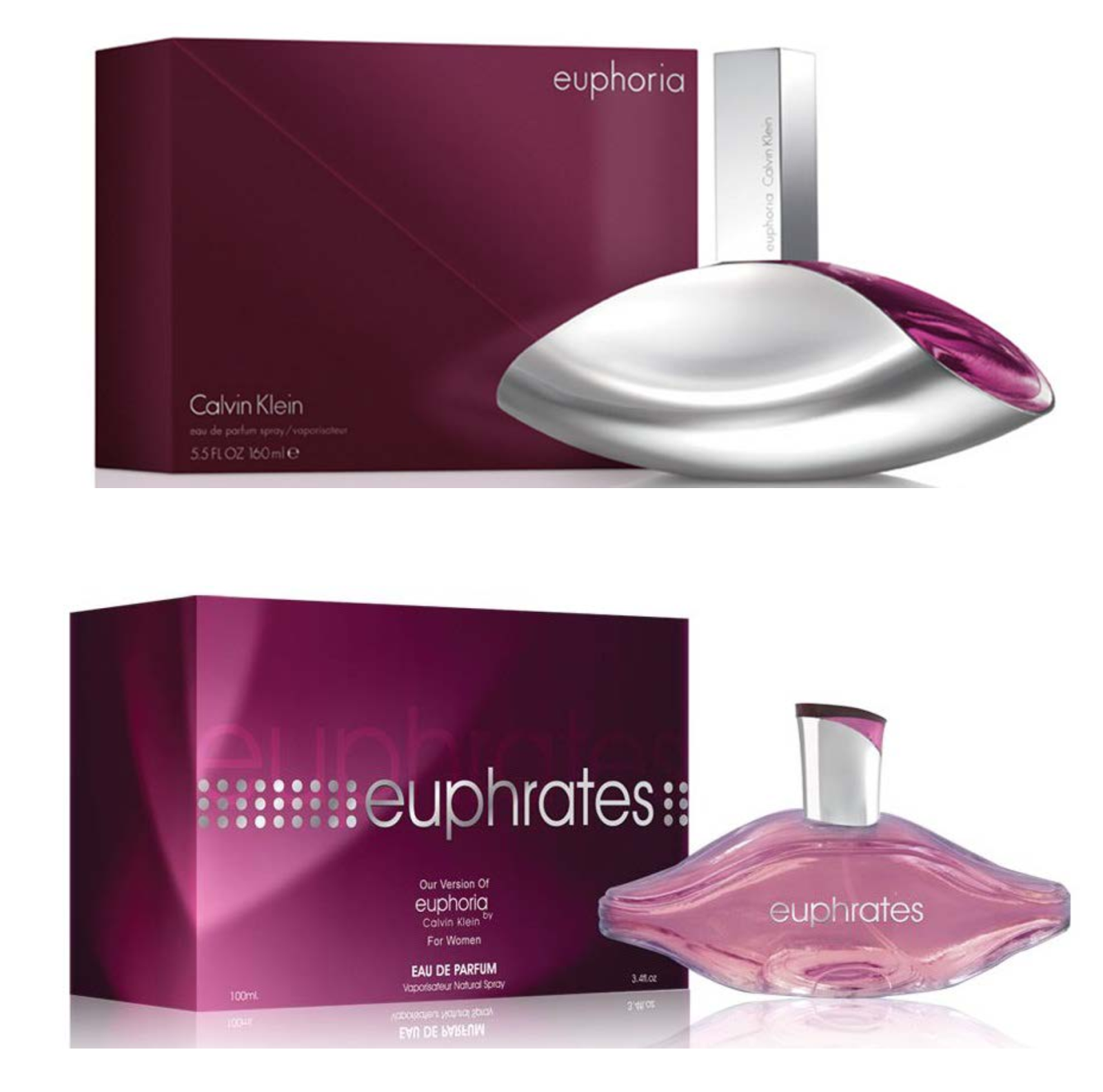
fragrances sued Excell, which produced cheap “versions” of Coty’s fragrances,
with similar names and “nearly identical packaging.” “Compounding matters,
Excell prominently included on its packaging Coty’s own marks, albeit under
words to the effect of “Our Version Of” in comparatively smaller text.” Guess what Judge Furman found as to
infringement and dilution after a bench trial? There was also false advertising, but not counterfeiting. Coty was entitled to
injunctive relief and to recover Excell’s profits, but not to enhanced damages,
and the case wasn’t “exceptional” for the purpose of attorney’s fees and
prejudgment interest.
 |
| back |
 |
| front |
To give some idea of the scope of Coty’s branding efforts, “between
2002 and 2015, Coty spent over $658 million advertising and promoting its
Calvin Klein fragrances, over $114 million advertising and promoting its Vera
Wang fragrances, over $14 million advertising and promoting its Lady Gaga
fragrances, and over $13 million advertising and promoting its Joop! fragrances.” Its net sales over that period for Calvin
Klein fragrances were over $2.2 billion, for its Vera Wang products over $296
million, for its Lady Gaga products over $28 million, and for its Joop! line
over $188 million. Some are successful enough to have subbrands, or “flankers” –Dark
Obsession, Eternity Aqua, CK One Shock, and CK Free Blue.
Excell sought to copy expensive fragrances in a way that
would be “understood by its customer base of ‘lower income, sometimes ethnic
customers.’ ” Excell then chose a product name to evoke the name of the
original fragrance. “Excell did not make any meaningful effort to replicate the
scent of Coty’s products. Instead, using only their own noses and reviews of
the original fragrances, Excell employees made broad recommendations to the
company’s supplier in India, which then manufactured the alternative fragrances
and packaging,” though Excell often supplied the original fragrance (or a
picture of the fragrance) it sought to emulate along with instructions on how
to emulate it. Excell also frequently made changes to the products so that the
packaging would more closely resemble Coty’s original branded fragrances.
Excell nonetheless lacked any meaningful quality assurance program.
On the front of each fragrance box at issue, Excell included
a legend stating that the fragrance was “Our Version Of” the relevant Coty
product. On the back was “Not Associated With The Makers Of,” followed by
reference to the relevant Coty product. But Coty’s marks were depicted more
prominently than the other text. “On the top of each box, in comparatively
smaller lettering, Excell included its own brand name: Diamond Collection
Luxurious Fragrances.”
Excell didn’t advertise or market directly to consumers, but
sold primarily to traditional retailers and discount chains, such as Kmart,
Dollar General, and Ross Stores, and its products were also available on Amazon
and eBay.
In 2015, several of Excell’s principals and employees were
indicted on money laundering and other offenses. Given the pending proceedings,
three such individuals invoked their privilege against self-incrimination in
these proceedings. Excell shut down its business operations and ceased selling
its fragrances in December 2016, unrelated to the present lawsuit.
The court rejected Excell’s laches defense. Laches is no defense against injunctive
relief when the defendant intended the infringement, which the court found to
be the case here. Also, Coty didn’t delay unreasonably; it sued in 2015, “well
within the applicable six-year statute of limitations” given that Excell was
founded in 2010. Further, Excell’s sales were relatively insignificant during
its first few years of operation and Excell’s marketing efforts to its
retailers were less focused on the Coty knockoffs during that time. Moreover, even if Excell could show
unreasonable delay, it didn’t show evidence of prejudice. By Excell’s own
admission, the filing of the lawsuit had no effect on its operations: it
continued to sell its knockoffs long after Coty filed suit, and was “winding
down” due to the pending criminal charges. “[A]ny conceivable prejudice was
mooted when Excell decided, for reasons unrelated to this case, to cease its
operations and stop using its brands.”
Unfortunately, the court decided that HOMME was suggestive
for cologne. It reasoned that, even if
the general consumer knows that “homme” means “man,” it still “requires
imagination, thought and perception to reach [the] conclusion” that HOMME is
not just a cologne, but a cologne targeting men. Of course, that’s not the
traditional framing of the conceptual distinctiveness inquiry, though courts
increasingly have (wrongly) changed their approach to this question; the PTO
would ask whether, knowing the mark and the goods, imagination is required to
connect the two. Cologne for men? Not so much.
This didn’t matter much here, given the secondary meaning of the marks.
The court also found that the packages and bottles were
product packaging, and thus capable of inherent distinctiveness as trade
dress. Excell argued that the bottles
were product design, an argument the court found no support for; I’d be more
sympathetic, since part of the point of these bottles is to have beautiful
things on one’s dresser, unlike soda or alcohol bottles. Again, though, Coty also showed secondary
meaning.
Similarity: “Excell’s products copy, with only slight
differences, the names, typefaces, packaging, design, coloring, and bottle
shapes of Coty’s fragrances,” and also include two exact replicas of Coty’s
house mark (e.g., Calvin Klein) and product mark (e.g., ETERNITY AQUA) as part
of the “Our Version Of” and “Not Associated With” legends. As the court noted, the City Girl and Love
Story fragrances were “[a]t the less infringing end” of the similarity
spectrum; the names evoked similar associations and the packages had notable
differences. By contrast, Excell’s OK
ROCK and SERENITY fragrances were “remarkably similar” to Coty’s CK SHOCK and
ETERNITY, in both name and trade dress. But even the “less infringing”
fragrances had significant similarities in color, shape, and layout. As a whole, each allegedly infringing product
was quite similar to its counterpart.
 |
| similar, but not shockingly so (though still infringing) |
 |
| way too similar |
 |
| see more below |
Excell argued that its “Our Version Of” and “Not Associated
With” disclaimers made clear that the company’s products weren’t associated
with Coty. But Coty’s marks were “significantly more prominent and accentuated
on Excell’s fragrances than both the supposedly disclamatory language … and
Excell’s own marks. In similar circumstances, courts have held that disclaimers
are not only ineffective, but actually cut against the allegedly infringing
party.” Based partly on the survey
evidence, the court found the same here.
Competitive proximity: price differences/retail channels had
“little or no bearing on post-sale confusion as to the source of the goods,”
and might even enhance the likelihood that a consumer would buy the accused
product, to obtain the same prestige for less money. Plus, the fragrance market is “somewhat fluid”
and some retailers have sold both parties’ fragrances, including K-mart, CVS,
Amazon, and eBay. Some Coty fragrances have been “diverted” and sold at CVS and
Dollar General, both of which sell Excell products. The price difference was “also largely immaterial” to initial interest
confusion; “most purchasers of fragrances in a retail setting are likely to
view the packaging before checking the price label.” Finally, the price difference wasn’t huge.
Actual confusion: because “evidence of intentional copying
gives rise to a presumption of actual confusion,” the burden was on Excell to
demonstrate a lack of confusion, which it failed to do. Excell’s own survey found that 19.5% of
respondents in an Internet survey identified Calvin Klein as the source of
Excell’s POSSESSION fragrance, and 15.1% identified Calvin Klein as the source
of Excell’s SERENITY fragrance. And this
survey was limited to people who had recently shopped at a discount store, flea
market, rummage sale, or bazaar, even though Excell’s products were marketed
more broadly. And the survey didn’t measure initial interest or post-sale
confusion. The survey was also flawed
because it allowed respondents to see all faces of the packaging at once. And there were coding errors: people coded as
not confused said things like, “What a bargain for a Calvin Klein product”;
“It’s made by Calvin Klein, I like it”; and “Just the fact that it was made by
Calvin Klein is worth the $4.99.”
Recoded, 25% of the respondents actually identified Calvin Klein as the
source of Excell’s POSSESSION and 20% identified Calvin Klein as the source of
Excell’s SERENITY.
Anyway, Coty’s survey was more reliable. Coty used an Eveready format, which is the
gold standard for cases involving strong marks.
Coty used a mall intercept survey of “people 18 years old and older who
ha[d] purchased a fragrance product for themselves, or for someone else, in the
past six months” and showed them versions of the Excell packages. Neither the
participants nor the interviewers were exposed as part of the survey to the
genuine Calvin Klein OBSESSION or ETERNITY fragrances; the expert concluded
that an average of 54% of the respondents misidentified the source of Excell’s
products as Calvin Klein.
Excell argued that the survey erred by not excluding
higher-end consumers to ensure that respondents were actual or potential
purchasers of Excell’s products, and the court noted some justice to the
argument. The relevant market was the
junior user’s customers. But there was
overlap, and it isn’t uncommon for higher-end fragrance companies, including
Coty, to create less expensive versions of their products — those “flankers” —
for sale at lower price points or in lower-end retail markets. Thus, the survey
still had probative value. Nor was the
survey flawed for failing to provide respondents with relevant sales channel
and price information about the products, which is in fact irrelevant to initial-interest
and post-sale confusion. It’s also true
that the survey only tested two fragrances, and the survey itself indicated that
the levels of consumer confusion would likely vary among the fragrances, with a
22% difference in confusion levels between the two Excell products tested. But the results were still relevant to the
other fragrances, given their shared “common and prominent features.”
There was no evidence of actual confusion. But that wasn’t
important: (1) the employees’ invocation of the Fifth Amendment limited Coty’s
ability to obtain evidence, meaning that it would be unfair to hold the absence
of evidence against Coty; (2) Coty and Excell are manufacturers and
distributors of fragrances, not retailers, “and thus less likely to hear
directly from a duped consumer”; (3) consumers are less likely to complain
about a relatively inexpensive product; and (4) the survey was good alternative
evidence.
Intent: The record was “replete” with evidence of bad faith.
Excell’s business model “involved little more than ‘capitalizing on plaintiff’s
reputation and goodwill.’” Excell then “meticulously mimicked the external
trappings of those fragrances and used Coty’s protected marks on its packaging
in a way that, even with the disclamatory language, could only have been
calculated to capitalize on Coty’s goodwill.” Excell kept going “in the face of
a slew of complaints from third-party brand owners,” and chose its business
model shortly after a company that used to employ various Excell employees
entered a Consent Judgment with Calvin Klein and other fragrance producers
about infringing alternatives to CK fragrances. Excell argued that Consent
Judgement indicated approval of the use of the “Our Version” phrase, but (among
other things) the consent judgment didn’t allow anyone to indiscriminately sell
“Our Version Of” fragrances, but merely reserved the parties’ rights with
respect to fragrances containing the “Our Version Of” legend that weren’t
“unlawful under the Lanham Act” and that weren’t “Counterfeit” or “Knock-Off”
products.
Excell noted that there is a difference between intending to
compete by imitating successful features and intending to deceive purchasers as
to source. This is true, “but Excell’s intent falls squarely in the latter
category. The company’s intent to deceive can be inferred from the remarkable
similarities between the fragrances’ trade dresses, the prominent use of Coty’s
legends on Excell’s products, and the uncanny resemblance between the fragrance
names chosen by Excell and Coty’s products.” Anyway, an intent to copy “creates
a presumption of an intent to deceive, unless there is evidence to the
contrary.” [Ugh—does that mean that house brands imitating national brands are
presumptively intentionally deceptive?]
Quality, the Second Circuit outlier factor: Favored Coty,
because Excell’s products are cheap and use synthetic oils, rather than the
natural oils used in Coty’s fragrances.
They don’t smell the same as Coty’s perfumes and colognes. Unlike Coty’s
fragrances, many of Excell’s Diamond Collection products were found to contain
DEHP, a potential carcinogen.
Consumer sophistication: As now-Justice Sotomayor wrote, “even
sophisticated buyers are not always careful buyers, and their very awareness of
status brand names and designs may make them more vulnerable to confusion.” Great
similarity, as here, reduces the ability of sophistication to resist
confusion. And “it could be argued” that
Excell’s target demographic, “lower income, sometimes ethnic customers” was likely
to be less sophisticated about the differences between and among fragrances and
more easily confused upon seeing Excell’s cheaper knockoffs. This factor was a
draw.
Excell argued that it was making nominative fair use of
Coty’s marks. But the Second Circuit
just held that nominative fair use isn’t a defense; it instead provides
additional factors to consider alongside the Polaroid factors. “[T]he
manner in which Excell displays Coty’s source identifiers belies its argument
that it is merely using the marks to inform consumers that it is not the
manufacturer of the original fragrance.” The fair use argument “would be on
firmer ground if it sold its fragrances in generic bottles and cartons, picked
fragrance names that were unrelated to any of Coty’s, included its disclaimers
without prominently displaying Coty’s typesetting or marks, and marketed its
own brand on the packaging in a noticeable manner.” But it didn’t do any of that.
Having found likely infringement, the court turned to trademark
dilution, federal for the registered Calvin Klein, Vera Wang, and Lady Gaga
marks, and New York law for the remaining marks. The court found dilution by blurring. Excell didn’t contest the fame of the Calvin
Klein, Vera Wang, and Lady Gaga marks. The the similarity between the marks as
well as the distinctiveness and degree of recognition of the plaintiff’s mark
favored Coty, as did Coty’s otherwise substantially exclusive use and Excell’s
intent to create an association. The
court apparently misread the sixth statutory factor, “actual association,” as
something like “truthful association,” finding that it favored Coty because
Excell had no “actual association” with Coty, but this really can’t have
mattered. The court found state law
blurring for the same reasons.
Tarnishment: Yep. “Excell uses inferior oils, employs cheaper packaging
components, lacks any quality assurance program, and produces fragrances with
potentially harmful ingredients.” The ongoing criminal case also arguably
risked tarnishment, but there was “no reason to believe that the average
consumer would know about the criminal charges, let alone link them to Coty.”
False advertising: yes.
“Our version of” was misleading.
Coty didn’t have to show literal falsity, because the words implied that
the products were “similar, if not equivalent.”
[If the surveys show that people aren’t reacting to the disclaimers by
understanding the difference, are they even reading the disclaimers, and can
there be material deception without reading?] The duality of contrast and equivalence was
inherent in the use of the word “version.”
“But Excell indisputably does not produce fragrances of a similar
quality to those of Coty; nor does it produce anything that could reasonably be
called a ‘version’ of Coty’s products.”
[This is consistent with caselaw indicating that, even if there are
possible ambiguities, when the defendant isn’t telling the truth under any of
the different possibilities, literal falsity may be found.] In context, along with the infringing
marks/packaging, the court found an intent to connote a false equivalence
(citing necessary implication cases).
Coty’s survey also found that 20% of respondents believed
the legend communicated the message that Excell’s fragrances were substantially
equivalent to Coty’s fragrances on formula and longevity of scent. Excell
criticized the survey for asking “closed-ended questions of whether the two
fragrances were ‘the same or different,’ rather than giving respondents the
option to indicate that the products were ‘similar.’ ” But participants were
asked a series of open-ended questions, including, “does the wording on these
two products communicate or imply anything to you” about whether certain
qualities of the products “are the same or different?” Participants then
responded using their own language and explained what the wording communicated
to them. Plus, surveys crafted to test comparative advertising claims sometimes
call for “a more defined option set,” even if closed-ended questions aren’t as
good. Excell’s survey also was
closed-ended, but added a third option, “similar.” This didn’t add clarity;
anyway, given the significant differences between the companies’ fragrances, the
Excell survey’s finding that “[a]pproximately two-thirds of consumers view[ed]
the Excell and Calvin Klein products to be ‘similar’ ” only strengthened the court’s
falsity conclusion.
Materiality: consumers “undoubtedly care about the quality
and longevity of their perfume or cologne.” Because it was a false comparative
ad, no further proof of likely injury was necessary.
Injunctive relief: with no mention of eBay, the court reasoned that likely confusion establishes
irreparable harm. Money alone couldn’t compensate for the company’s
unquantifiable “losses of reputation and goodwill and resulting loss of
customers.” The balance of hardships favored Coty, because Excell wasn’t
selling any products and was a newcomer to the market anyway. Coty’s request wasn’t moot, because Excell hadn’t
dissolved as of the time of trial. “Because
Excell could simply resume operations directly or indirectly — and because its
directors, officers, and employees have demonstrated such tendencies in the
past— Excell has not shown that it is ‘absolutely clear that [its] wrongful
conduct will not recur.’” Coty’s request
for injunctive relief was granted with respect to Excell and its “officers,
agents, servants, employees … [and] other persons who are in active concert
or participation” with them.
The court also awarded an accounting of profits. This equitable remedy requires courts to
consider “(1) the degree of certainty that the defendant benefited from the
unlawful conduct; (2) availability and adequacy of other remedies; (3) the role
of a particular defendant in effectuating the infringement; (4) plaintiff’s
laches; and (5) plaintiff’s unclean hands.” All of these factors favored Coty. Excell’s
business model depended on creating customer confusion, making it certain that
it benefited from the infringement. Excell’s sales of the accused fragrances
from July 2010 through April 2016 totaled a bit over $6.5 million, and it
didn’t submit reliable evidence of its costs, only spreadsheets with totals
that witnesses couldn’t adequately explain.
Thus, Coty was awarded all Excell’s revenue for the relevant time
periods.
Coty argued that it should get treble damages because its
marks were counterfeited. A counterfeit mark must be “substantially indistinguishable”
or “spurious,” which requires more than a mere similarity between the marks or
a “colorable imitation.” Excell’s
infringing products weren’t countefeits.
None used the exact same name, nor the same/“substantially
indistinguishable” combination of colors, designs, and shapes. Though Excell
did use Coty’s own marks as part of its disclaimers, the existence of those
disclaimers and Excell’s (admittedly less prominent) use of the Diamond
Collection mark on its bottles “creates enough of a contextual difference that
[Excell’s fragrances] cannot be considered counterfeits of [Coty’s].” The court was unwilling to conclude that
Excell was trying to trick buyers into thinking they were actually buying Coty
fragrances. [Note how much implicit
weight this gives to the IIC/post-sale confusion theories.]
The court refused to find the case “exceptional” for
fees/prejudgment interest purposes. “Exceptional cases” involve fraud, bad
faith, or willfulness, but bad faith isn’t an automatic entitlement to
attorneys’ fees or prejudgment interest.
Excell’s litigation conduct, “while certainly not commendable, falls
short of the ‘the sort of misconduct that supports an attorney fees award.’” Plus, Coty didn’t show that it suffered
“ascertainable damage”: “the fact is that, despite several years of competition
with Excell’s infringing products, Coty failed to produce demonstrable evidence
of actual confusion.” Plus, the outcome
of the case “was by no means a foregone conclusion,” especially as to
fragrances at the less infringing end of the “similarity spectrum.” Coty did get its costs, though.
from Blogger http://ift.tt/2wFSjZc