
First Circuit lifts injunction requiring D’s use of (R) for P’s mark

Arborjet, Inc. v. Rainbow Treecare Scientific Advancements,
Inc., — F.3d —-, 2015 WL 4366624, No. 14–23241 (1st Cir. July 16, 2015)
(Souter, J., sitting by designation)
 
The district court granted
a preliminary injunction based on a contractual violation, but denied one based
on trademark infringement
. 
Nonetheless, the injunction required more detailed labeling of the
defendant’s products, which led the court of appeals to partially reverse.
 
Arborjet makes TREE-age, an emamectin benzoate solution used
to protect trees from various pests.  Rainbow used to have an exclusive right to
distribute TREE-age, subject to a contract that provided, inter alia, that
Rainbow wouldn’t “engage in affairs intended to replicate” TREE-age.  After the agreement terminated, Rainbow began
selling ArborMectin, another emamectin benzoate combination meant to compete
directly with TREE-age.
 
The district court found that Arborjet could show likely
success on the contract claims; among other things, “Rainbow’s website
describes partnering with several institutions and companies to conduct
research studies regarding ArborMectin’s effectiveness,” at least one of which
“took place while Rainbow was … subject to the terms of the [sales agency
a]greement.”  The district court didn’t
abuse its discretion.  Though the EPA
listed a different company, Rotam, as the approved creator of ArborMectin, the
district court had evidence that Rainbow contributed to its creation. 
 
Rainbow argued that the ban on “replicat[ing]” TREE-age was
limited to exact copies, and ArborMectin differed from TREE-age in toxicity and
other details.  The district court
correctly considered the word “replicate” in the context of the entire
contract; Arborjet expressed its concern about guarding information that could
hurt it if disclosed to competitors.  “Accordingly,
the prohibition was probably aimed at preventing efforts by Rainbow to place
Arborjet at a competitive disadvantage, reflecting a concern broader than the
mere creation of an exact copy.” Plus, at the time the contract was entered
into, the active agent in TREE-age was apparently patented, so it seemed “highly
unlikely (albeit not impossible) that Arborjet would include a contractual
prohibition on exact copies only, as the patent laws already saw to that.”  Also, “common sense suggests that, if the
parties had an object as narrow as Rainbow claims, they would have written
clearer language specific to that aim.”
 
However, the injunction also ordered Rainbow to “properly attribute
Arborjet’s trademarks ‘Arborjet’ and ‘TREE-age’ by appending the ® symbol to
those marks and a footnote stating ‘Registered Trademark of Arborjet, Inc.’”
This requirement was improper, given the district court’s holding that Arborjet
wasn’t likely to succeed on the merits of its Lanham Act claims.  Nor was this requirement, as Arborjet argued,
merely giving effect to Rainbow’s binding stipulation in the course of the
proceedings.  Rainbow did make an offer
not to make future statements that ArborMectin was “improved TREE-age,” but
that stipulation related to the false advertising claim.  The preliminary injunction “probably” related
to the false designation claim; but even as to that, the district court didn’t
make a finding of likely success.  In any
event, the stipulation related to the phrase “improved TREE-age,” not to “attribution
of Arborjet trademarks across the board.” That part of the injunction was
vacated.
 
Comment: This result makes sense to me, though I think “improved
TREE-age” could pose a false designation of origin problem,
depending on how it was presented. 
Nonetheless, that is very different from leaving off an ®.  Rainbow’s concession seems wise, but I don’t
see how omitting the ® from an otherwise nonconfusing comparison could cause
any issues with consumers.  (We may see a
fair amount of speculation about consumers’ understanding of ® in the ongoing
§2(a) disparagement litigation, but I am unaware of any actual empirical
research about it.  Any leads would be
much appreciated!)

from Blogger http://ift.tt/1Ii1Epy
Posted in Uncategorized | Tagged , , | Leave a comment

Transformative work of the day, Miss Piggy edition

Miss Piggy sings Rihanna’s BBHMM.  You’re welcome.

from Blogger http://ift.tt/1VpvSL0

Posted in Uncategorized | Tagged , , | Leave a comment

First Circuit lifts injunction requiring D’s use of (R) for P’s mark

Arborjet, Inc. v. Rainbow Treecare Scientific Advancements, Inc., — F.3d —-, 2015 WL 4366624, No. 14–23241 (1st Cir. July 16, 2015) (Souter, J., sitting by designation)
 
The district court granted a preliminary injunction based on a contractual violation, but denied one based on trademark infringement.  Nonetheless, the injunction required more detailed labeling of the defendant’s products, which led the court of appeals to partially reverse.
 
Arborjet makes TREE-age, an emamectin benzoate solution used to protect trees from various pests.  Rainbow used to have an exclusive right to distribute TREE-age, subject to a contract that provided, inter alia, that Rainbow wouldn’t “engage in affairs intended to replicate” TREE-age.  After the agreement terminated, Rainbow began selling ArborMectin, another emamectin benzoate combination meant to compete directly with TREE-age.
 
The district court found that Arborjet could show likely success on the contract claims; among other things, “Rainbow’s website describes partnering with several institutions and companies to conduct research studies regarding ArborMectin’s effectiveness,” at least one of which “took place while Rainbow was … subject to the terms of the [sales agency a]greement.”  The district court didn’t abuse its discretion.  Though the EPA listed a different company, Rotam, as the approved creator of ArborMectin, the district court had evidence that Rainbow contributed to its creation. 
 
Rainbow argued that the ban on “replicat[ing]” TREE-age was limited to exact copies, and ArborMectin differed from TREE-age in toxicity and other details.  The district court correctly considered the word “replicate” in the context of the entire contract; Arborjet expressed its concern about guarding information that could hurt it if disclosed to competitors.  “Accordingly, the prohibition was probably aimed at preventing efforts by Rainbow to place Arborjet at a competitive disadvantage, reflecting a concern broader than the mere creation of an exact copy.” Plus, at the time the contract was entered into, the active agent in TREE-age was apparently patented, so it seemed “highly unlikely (albeit not impossible) that Arborjet would include a contractual prohibition on exact copies only, as the patent laws already saw to that.”  Also, “common sense suggests that, if the parties had an object as narrow as Rainbow claims, they would have written clearer language specific to that aim.”
 
However, the injunction also ordered Rainbow to “properly attribute Arborjet’s trademarks ‘Arborjet’ and ‘TREE-age’ by appending the ® symbol to those marks and a footnote stating ‘Registered Trademark of Arborjet, Inc.’” This requirement was improper, given the district court’s holding that Arborjet wasn’t likely to succeed on the merits of its Lanham Act claims.  Nor was this requirement, as Arborjet argued, merely giving effect to Rainbow’s binding stipulation in the course of the proceedings.  Rainbow did make an offer not to make future statements that ArborMectin was “improved TREE-age,” but that stipulation related to the false advertising claim.  The preliminary injunction “probably” related to the false designation claim; but even as to that, the district court didn’t make a finding of likely success.  In any event, the stipulation related to the phrase “improved TREE-age,” not to “attribution of Arborjet trademarks across the board.” That part of the injunction was vacated.
 
Comment: This result makes sense to me, though I think “improved TREE-age” could pose a false designation of origin problem, depending on how it was presented.  Nonetheless, that is very different from leaving off an ®.  Rainbow’s concession seems wise, but I don’t see how omitting the ® from an otherwise nonconfusing comparison could cause any issues with consumers.  (We may see a fair amount of speculation about consumers’ understanding of ® in the ongoing §2(a) disparagement litigation, but I am unaware of any actual empirical research about it.  Any leads would be much appreciated!)
Posted in contracts, http://schemas.google.com/blogger/2008/kind#post, trademark | Leave a comment

Transformative work of the day, Miss Piggy edition

Miss Piggy sings Rihanna’s BBHMM.  You’re welcome.

Posted in copyright, http://schemas.google.com/blogger/2008/kind#post | Leave a comment

What claims work when D allegedly drives P down in Google rank through copying?

Ryoo Dental, Inc. v. Han, 2015 WL 4208580, No. 15–308 (C.D.
Cal. Jul. 9, 2015)
 
Ryoo Dental, a dental practice, had a website to promote its
services, and allegedly spent considerable sums on “search engine optimization
fees, photographing, editing, and updating content and maintaining its
webpage.”  When Ryoo lost its first page
search ranking on Google (for what search term?), it hired an SEO firm, which told
Ryoo that Han, another dentist, had copied content from Ryoo’s site and put it
on his own site, leading Google’s algorithm to penalize Ryoo’s site.  (Sounds like a DMCA takedown might’ve been a
cheaper alternative to litigation, if SEO is the aim.)
 
Ryoo sued Han for copyright infringement and state-law
torts, all of which the court here dismissed as preempted.  The subject matter of the state-law claims,
the website, fell within the subject matter of copyright because it was a fixed
work of authorship.  (Which is why,
incidentally, saying that right of publicity claims based on distribution of fixed works don’t fall into copyright’s
subject matter doesn’t make sense to me.) 
So the only question was whether there were extra elements.
 
For conversion, no, because there was no allegedly
appropriated tangible property, just the reproduction of website content, “indisputably
intangible property.” Likewise for negligent interference with prospective
economic advantage, because the alleged disruption of business consisted of Han’s
alleged copying of Ryoo’s website.
 
False advertising and unfair competition received separate
treatment, but they were essentially reverse passing off rather than passing
off claims—Han wasn’t allegedly misrepresenting his services as Ryoo’s.  The court stated a rule that seems clearly Dastar-noncompliant: “‘Reverse passing
off’ claims are preempted unless the plaintiff alleges bodily appropriation and
seeks more than mere monetary damages,” neither of which are exceptions that
appear in Dastar.  But Han did neither, so his claims were
preempted anyway.
 
Claims for unjust enrichment failed because California has
no separate cause of action based on unjust enrichment, and such a claim would
be preempted anyway.  Ryoo argued that an
accounting was necessary to determine damages, but this too was preempted to
the extent related to the copyright claim, since “the Copyright Act already
affords [plaintiff] an adequate means by which to calculate damages.”
 

from Blogger http://ift.tt/1Myfq5n

Posted in Uncategorized | Tagged , , , | Leave a comment

New fair use app from New Media Rights

From New Media Rights:

New Media Rights spends quite a bit of time working directly
with filmmakers and online video creators on fair use related issues. And while
there are many amazing resources out there for filmmakers and online video
creators, we wanted to create something a bit different to help these creators
learn more about fair use.

Enter The
Fair Use App
. We filtered down our experiences working with filmmakers and
video creators to create an app that can help them better understand:

1.         When they
can reuse content.

2.         How their
choices affect a fair use argument.

3.         When it’s
time to talk to a lawyer about fair use.

While our web app isn’t quite as awesome as a tiny fair use
wizard that will give creators  all the
answers; it’s helpful tool to help them make better decisions about how to
reuse content.

You can check out our fair use app here! As this is version
1.0 of our app we’re especially looking for feedback on how we can make the app
even more helpful.

from Blogger http://ift.tt/1GqwwNf

Posted in Uncategorized | Tagged | Leave a comment

What claims work when D allegedly drives P down in Google rank through copying?

Ryoo Dental, Inc. v. Han, 2015 WL 4208580, No. 15–308 (C.D. Cal. Jul. 9, 2015)
 
Ryoo Dental, a dental practice, had a website to promote its services, and allegedly spent considerable sums on “search engine optimization fees, photographing, editing, and updating content and maintaining its webpage.”  When Ryoo lost its first page search ranking on Google (for what search term?), it hired an SEO firm, which told Ryoo that Han, another dentist, had copied content from Ryoo’s site and put it on his own site, leading Google’s algorithm to penalize Ryoo’s site.  (Sounds like a DMCA takedown might’ve been a cheaper alternative to litigation, if SEO is the aim.)
 
Ryoo sued Han for copyright infringement and state-law torts, all of which the court here dismissed as preempted.  The subject matter of the state-law claims, the website, fell within the subject matter of copyright because it was a fixed work of authorship.  (Which is why, incidentally, saying that right of publicity claims based on distribution of fixed works don’t fall into copyright’s subject matter doesn’t make sense to me.)  So the only question was whether there were extra elements.
 
For conversion, no, because there was no allegedly appropriated tangible property, just the reproduction of website content, “indisputably intangible property.” Likewise for negligent interference with prospective economic advantage, because the alleged disruption of business consisted of Han’s alleged copying of Ryoo’s website.
 
False advertising and unfair competition received separate treatment, but they were essentially reverse passing off rather than passing off claims—Han wasn’t allegedly misrepresenting his services as Ryoo’s.  The court stated a rule that seems clearly Dastar-noncompliant: “‘Reverse passing off’ claims are preempted unless the plaintiff alleges bodily appropriation and seeks more than mere monetary damages,” neither of which are exceptions that appear in Dastar.  But Han did neither, so his claims were preempted anyway.
 
Claims for unjust enrichment failed because California has no separate cause of action based on unjust enrichment, and such a claim would be preempted anyway.  Ryoo argued that an accounting was necessary to determine damages, but this too was preempted to the extent related to the copyright claim, since “the Copyright Act already affords [plaintiff] an adequate means by which to calculate damages.”
 
Posted in copyright, dastar, http://schemas.google.com/blogger/2008/kind#post, preemption | Leave a comment

New fair use app from New Media Rights

From New Media Rights:

New Media Rights spends quite a bit of time working directly with filmmakers and online video creators on fair use related issues. And while there are many amazing resources out there for filmmakers and online video creators, we wanted to create something a bit different to help these creators learn more about fair use.

Enter The Fair Use App. We filtered down our experiences working with filmmakers and video creators to create an app that can help them better understand:

1.         When they can reuse content.

2.         How their choices affect a fair use argument.

3.         When it’s time to talk to a lawyer about fair use.

While our web app isn’t quite as awesome as a tiny fair use wizard that will give creators  all the answers; it’s helpful tool to help them make better decisions about how to reuse content.

You can check out our fair use app here! As this is version 1.0 of our app we’re especially looking for feedback on how we can make the app even more helpful.
Posted in http://schemas.google.com/blogger/2008/kind#post | Leave a comment

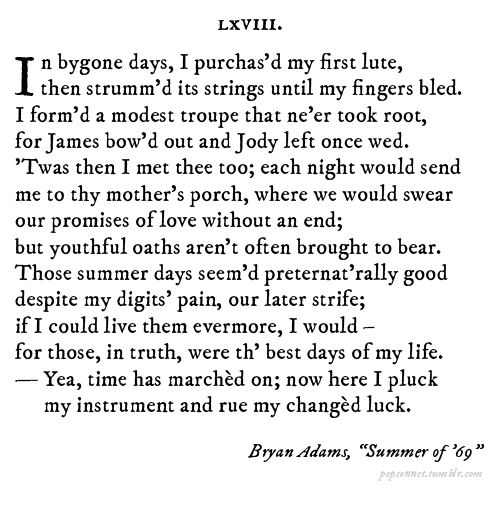
Transformative work of the day, Bryan Adams edition

Pop sonnets:

Substantial similarity?

from Blogger http://ift.tt/1ObzxGS

Posted in Uncategorized | Tagged , , | Leave a comment

Transformative work of the day, Bryan Adams edition

Pop sonnets:

Substantial similarity?
Posted in copyright, http://schemas.google.com/blogger/2008/kind#post | Leave a comment