IPSC, opening plenary

IPSC at DePaul
 
Opening Plenary Session
 
Tributes to Benjamin Liu & Greg Lastowka, much-missed colleagues who passed away in the last year.
 
Roberta Kwall, DePaul University College of Law
 
Changes in law school in last 15 years—rankings are more set.  Money is tight.  Teaching loads are increasing, not just numerically but in scope/areas other than IP.  Affects ability to do scholarship.  Schools may want us to work on the side: consistent w/ making our students practice ready.  How do we keep doing our scholarship?  Shari Motro, Scholarship Against Desire: authenticity in legal scholarship.  Not shooting from the hip, but doing the groundwork/getting an advanced degree if needed for the breadth of knowledge you want to have.  We won’t be judged in the future on the quantity of our work.  Need a safe, nurturing place to listen without planning a response; the wisdom of the group will go up.
The key to successful scholarship is the ability to reinvent oneself, like Madonna: true of scholarship venues as well as scholars.
 
Peter Yu, Texas A&M University School of Law
 
History: lots of schools were starting IP programs; one way to maintain leadership is to bring scholars together, and bring schools together as IPSC sponsors.  Importance of creating community despite costs.
 
Mark Lemley, Stanford Law School
 
Size of IP community has grown a lot. Dramatic expansion in subject matter from mostly ©—only 5 people have taught patent law longer than Mark L and Dan Burk.  Lateral expansion is good result: trade secret & design are newest additions.  Expansion in methodology, in particular empirical work. 
 
Not so good things: increasing divide into more polarized camps among scholars, not just practicing lawyers.  High protectionist group has their conferences and low protectionists have theirs; paying less attention to the other side, and that’s a worrisome thing.  Perhaps result of real world importance of what we do—people are looking for answers that support them and seek ideological scholarship.  But introduction of politics into IP scholarly community is worrying.  Also worrying: growing role of money. Resource constraints are important; but it’s also a function of the real world relevance/politics: some people would like to spend lots of money to get the answer they want.  That connection is becoming more clear.  You can have $ if you can demonstrate that patent holdup isn’t a problem in the telecom industry, or if you can show that intermediary liability is too great.  Politics + money isn’t good for society at large and it’s not good for the IP community.  Like the internet + anonymity: can really mess things up.
 
What is to be done?  IP community has long history of cohesiveness, talking to each other.  That makes us the envy of most other scholarly communities.  Robin Feldman & Lemley are working on a statement of principles for taking money for scholarship. 
 
Graeme Dinwoodie, University of Oxford Faculty of Law 
 
Mentoring of junior colleagues as an objective, pretty early on. Advancement of ideas/development of scholarly community.  Social interactions make inevitable professional disagreements an ordinary part of the interaction, rather than tense (cf. constitutional law) and encourages new members of the community to be willing to disagree.  New internationalism: international participants, access to international scholarship.  More scholarship is occurring pre-tenure, which is a good thing without a research-based doctoral agree. But many of the pretenure positions are short, and there’s tremendous pressure to present at IPSC as well as to produce law review articles.  Given vast amount of info, do you have to choose between reading, writing, and thinking?  Encourage younger colleagues to attend/participate w/out need to present and write; that may require deans to rethink allocation of travel funds.
 
Mike Madison: Publication styles tied to book chapters, journal articles, etc.  What’s changed?
 
Lemley: Definite move towards the blog post (heh), online/short/less footnoted article, which is in many respects a good thing; law reviews traditionally bloat from need to explain everything to second year law students. If you can assume a base of knowledge and get to the interesting point quickly, that’s great. But “don’t write long articles” is no better than “don’t write short” as a rule. New rule of no longer than 25,000 words privileges certain kinds of scholarship and not others.  How do we evaluate ideas in short/nontraditional forms?  Dennis Crouch has had big impact on patent scholarship, mostly by writing short summaries/items of interest to the academic world. Won’t today get hired at top school for that, which is a real issue.  It’s a move with substantial costs and substantial professional benefits.  We are breaking out of traditional molds in various respects—more peer reviewed journals; interdisciplinary publishing. But ways in which ideas are communicated through smaller quicker responses are not ways the legal academy is (yet) willing to recognize.
 
Kwall: Social media revolution has changed how we think and write in our daily lives.  But when you’re writing high impact scholarship, even if you’re going to be taking your article and spinning it to editorials [or amicus briefs!] those have to be based on the careful groundwork of your more thorough scholarship.  [For me, it goes both ways—having a series of blog posts on, say, Dastar, enables me to go back and identify trends/things that interest me theoretically.]  That can benefit your institution: being featured in media is in some ways better for reputational effect than just writing law review articles, but you can’t do media successfully without scholarship.
 
Dinwoodie: We’ve lost a little bit in having space to work through ideas; we need to be more pluralist about what’s good scholarship in methods, place of publication, etc. Should be less hesitation for young scholars to think about books than 15 years ago.  Online availability of chapters, at least, is making the ideas in a book capable of reaching more places than it was.
 
Yu: When he started, advice was to not write a book until you’ve been publishing for 10 years. The book he’d write now would be very different than the book he would have written starting out.  Think about what type of book you want to write—now he’s in a better position/more experienced.
 
Q about blogging: what’s the best way to avoid being taken over by trolls/have a productive conversation?  James Grimmelmann says blog in your own space.
 
Lemley: never read the comments.  Ironclad rule.  [Not so true of Livejournal, sigh.]  Discussion format has to be small group of repeat players whom you know.
Posted in blogging, http://schemas.google.com/blogger/2008/kind#post | Leave a comment

Presumption of injury saves Lanham Act monetary award

General Steel Domestic Sales, LLC v. Chumley, — Fed.Appx.
—-, 2015 WL 4591924, Nos. 14–1119, 14–1121 (10th Cir. July 31, 2015)
 
Chumley formerly worked for General Steel, then founded
Armstrong after an unfriendly parting. 
The parties compete to sell prefabricated steel buildings directly to
consumers.
 
That’s where the lies began. One
Internet posting purported to detail Armstrong’s community service efforts in
the Middle East, offering quotations from the company’s Vice President of
International Affairs, J.P. Remington, III. The problem? The charity didn’t
exist. Neither did Mr. Remington. And the false claims didn’t stop with phony
philanthropy: soon General Steel was in the crosshairs. Ads on Google, for
example, claimed that Armstrong sold “General Steel” buildings. It didn’t. The
company’s website claimed that Armstrong fabricates the steel it uses to
assemble its buildings. It doesn’t. And one ad on Armstrong’s website—entitled
“May the Best Building Win”—offered a side-by-side comparison of Armstrong’s
and General Steel’s products and claimed that General Steel provided consumers
with fewer options than, in truth, it did.
 
General Steel sued under the Lanham Act and the Colorado
Consumer Protection Act, and here we find out that presumptions matter. The
district court granted summary judgment on the state-law claims for failure to
show harm, but granted an injunction and disgorgement of profits on the Lanham
Act claims based on the statements that Armstrong fabricated its own steel;
that Armstrong offered “general steel” buildings for sale; and that General
Steel failed to offer pregalvanized steel or stainless fasteners for its
buildings. The court of appeals affirmed.
 
The court of appeals heartily agreed that the statements at
issue were literally false.  Steel
fabrication: Armstrong isn’t a steel manufacturer but purchases steel from
others and then assembles it into buildings. Armstrong argued that its
discussion of “each piece of steel we fabricate” was ambiguous, but it
wasn’t.  “General steel” buildings:
Armstrong didn’t sell its rival’s products. 
Armstrong again argued ambiguity (say that three times fast), reasoning
that its statement could also mean “Armstrong makes ‘general’ (i.e.,
all-purpose) steel buildings.” However, there was no credible evidence in the
record that the term “general steel” is used in the industry to describe steel
buildings sold by anyone else.  (Note
that we determine meaning here without resort to dictionaries or surveys!)  Meanwhile, Armstrong’s ads included
side-by-side comparisons between its products and those of General Steel, even
using General Steel’s logo and sometimes capitalizin “General Steel.” “In this
light, there’s just no doubt what Armstrong’s ads were talking about—or that
they were literally false.” 
 
And finally: Armstrong argued that its statements about providing
“pre-galvanized secondary framing” and “stainless steel fasteners” where
General Steel didn’t were literally true because Armstrong includes these items
unless the customer declines them, while General Steel doesn’t include them
unless the customer requests them. But Armstrong’s ads didn’t explain anything
like that, for example by comparing “standard” features.  Instead, they purported to compare available
features, and thus were literally false. 
The evidence at trial showed that both companies provided these features
at additional cost and that customers could choose whether to buy them.
 
Materiality: without deciding the appropriate burden or
standard, the court of appeals held that the third set of false statements was
“material under any conceivable standard,” using Armstrong’s own evidence at
trial that “steel fasteners and pregalvanized framing were important to
Armstrong’s brand, giving the company a competitive edge and improving the
quality of its buildings.”  The district
court found that both “general steel” and fabrication of steel went to the
products’ inherent qualities or characteristics and thus presumed materiality;
the court of appeals saw no reason to find error.
 
Injury: the district court found that the literal falsity
was willful and in side-by-side comparative advertising, and thus presumed injury
to General Steel.  Assuming, without
deciding, that this presumption was appropriate, Armstrong failed to show that
the presumption was unwarranted on the grounds that some of its false
statements weren’t made in comparative advertising.  True, they were all made on Armstrong’s
expressly comparative “May the Best Building Win” webpage. But Armstrong argued
that that two of the three statements were in small print after side-by-side
columnar comparisons between the two brands, which is like a separate ad.  The court of appeals was unimpressed.  It wasn’t willing to split a single webpage
in two.
 
Remedies: in calculating disgorgement of profits, the
district court used a burden-shifting framework: General Steel had to prove
Armstrong’s gross profits during the period of false advertising and Armstrong
had to prove what part of those profits wasn’t attributable to its false
advertising.  Armstrong didn’t produce
any such evidence.  The district court
used a procedure that fit well with the statute, which says: “In assessing
profits the plaintiff shall be required to prove defendant’s sales only;
defendant must prove all elements of cost or deduction claimed.”  The cases Armstrong cited said that, “unless
there is some proof that plaintiff lost sales or profits, or that defendant
gained them, the principles of equity do not warrant an award of defendant’s
profits.” “We don’t question the propriety of this principle, only its
relevance when it comes to determining not whether monetary relief should be
awarded but whether (as here) to employ the statutorily prescribed
burden-shifting procedure to ascertain its amount.”
 
General Steel cross-appealed on its state law consumer
protection claims.  The district court
granted summary judgment because General Steel didn’t have sufficient evidence
of harm.  Armstrong wasn’t required to
show lack of harm to win on summary judgment. 
The differing results on the two claims show the importance of
presumptions—but also highlight a continuing problem with state law/Lanham Act
interactions, which is that courts apply the same standards to both most of the
time and then randomly diverge, usually at the behest of the parties.

from Blogger http://ift.tt/1DpKUuH

Posted in Uncategorized | Tagged , , | Leave a comment

Presumption of injury saves Lanham Act monetary award

General Steel Domestic Sales, LLC v. Chumley, — Fed.Appx. —-, 2015 WL 4591924, Nos. 14–1119, 14–1121 (10th Cir. July 31, 2015)
 
Chumley formerly worked for General Steel, then founded Armstrong after an unfriendly parting.  The parties compete to sell prefabricated steel buildings directly to consumers.
 
That’s where the lies began. One Internet posting purported to detail Armstrong’s community service efforts in the Middle East, offering quotations from the company’s Vice President of International Affairs, J.P. Remington, III. The problem? The charity didn’t exist. Neither did Mr. Remington. And the false claims didn’t stop with phony philanthropy: soon General Steel was in the crosshairs. Ads on Google, for example, claimed that Armstrong sold “General Steel” buildings. It didn’t. The company’s website claimed that Armstrong fabricates the steel it uses to assemble its buildings. It doesn’t. And one ad on Armstrong’s website—entitled “May the Best Building Win”—offered a side-by-side comparison of Armstrong’s and General Steel’s products and claimed that General Steel provided consumers with fewer options than, in truth, it did.
 
General Steel sued under the Lanham Act and the Colorado Consumer Protection Act, and here we find out that presumptions matter. The district court granted summary judgment on the state-law claims for failure to show harm, but granted an injunction and disgorgement of profits on the Lanham Act claims based on the statements that Armstrong fabricated its own steel; that Armstrong offered “general steel” buildings for sale; and that General Steel failed to offer pregalvanized steel or stainless fasteners for its buildings. The court of appeals affirmed.
 
The court of appeals heartily agreed that the statements at issue were literally false.  Steel fabrication: Armstrong isn’t a steel manufacturer but purchases steel from others and then assembles it into buildings. Armstrong argued that its discussion of “each piece of steel we fabricate” was ambiguous, but it wasn’t.  “General steel” buildings: Armstrong didn’t sell its rival’s products.  Armstrong again argued ambiguity (say that three times fast), reasoning that its statement could also mean “Armstrong makes ‘general’ (i.e., all-purpose) steel buildings.” However, there was no credible evidence in the record that the term “general steel” is used in the industry to describe steel buildings sold by anyone else.  (Note that we determine meaning here without resort to dictionaries or surveys!)  Meanwhile, Armstrong’s ads included side-by-side comparisons between its products and those of General Steel, even using General Steel’s logo and sometimes capitalizin “General Steel.” “In this light, there’s just no doubt what Armstrong’s ads were talking about—or that they were literally false.” 
 
And finally: Armstrong argued that its statements about providing “pre-galvanized secondary framing” and “stainless steel fasteners” where General Steel didn’t were literally true because Armstrong includes these items unless the customer declines them, while General Steel doesn’t include them unless the customer requests them. But Armstrong’s ads didn’t explain anything like that, for example by comparing “standard” features.  Instead, they purported to compare available features, and thus were literally false.  The evidence at trial showed that both companies provided these features at additional cost and that customers could choose whether to buy them.
 
Materiality: without deciding the appropriate burden or standard, the court of appeals held that the third set of false statements was “material under any conceivable standard,” using Armstrong’s own evidence at trial that “steel fasteners and pregalvanized framing were important to Armstrong’s brand, giving the company a competitive edge and improving the quality of its buildings.”  The district court found that both “general steel” and fabrication of steel went to the products’ inherent qualities or characteristics and thus presumed materiality; the court of appeals saw no reason to find error.
 
Injury: the district court found that the literal falsity was willful and in side-by-side comparative advertising, and thus presumed injury to General Steel.  Assuming, without deciding, that this presumption was appropriate, Armstrong failed to show that the presumption was unwarranted on the grounds that some of its false statements weren’t made in comparative advertising.  True, they were all made on Armstrong’s expressly comparative “May the Best Building Win” webpage. But Armstrong argued that that two of the three statements were in small print after side-by-side columnar comparisons between the two brands, which is like a separate ad.  The court of appeals was unimpressed.  It wasn’t willing to split a single webpage in two.
 
Remedies: in calculating disgorgement of profits, the district court used a burden-shifting framework: General Steel had to prove Armstrong’s gross profits during the period of false advertising and Armstrong had to prove what part of those profits wasn’t attributable to its false advertising.  Armstrong didn’t produce any such evidence.  The district court used a procedure that fit well with the statute, which says: “In assessing profits the plaintiff shall be required to prove defendant’s sales only; defendant must prove all elements of cost or deduction claimed.”  The cases Armstrong cited said that, “unless there is some proof that plaintiff lost sales or profits, or that defendant gained them, the principles of equity do not warrant an award of defendant’s profits.” “We don’t question the propriety of this principle, only its relevance when it comes to determining not whether monetary relief should be awarded but whether (as here) to employ the statutorily prescribed burden-shifting procedure to ascertain its amount.”
 
General Steel cross-appealed on its state law consumer protection claims.  The district court granted summary judgment because General Steel didn’t have sufficient evidence of harm.  Armstrong wasn’t required to show lack of harm to win on summary judgment.  The differing results on the two claims show the importance of presumptions—but also highlight a continuing problem with state law/Lanham Act interactions, which is that courts apply the same standards to both most of the time and then randomly diverge, usually at the behest of the parties.
Posted in damages, http://schemas.google.com/blogger/2008/kind#post, remedies | Leave a comment

Photo finish: allegedly unauthorized (c) sublicensing isn’t false designation of origin

Photographic Illustrators Corp. v. Orgill, Inc., 2015 WL
4572296, No. 14-11818 (D. Mass. July 29, 2015)
 
PIC specializes in commercial photography.  It took photos of lighting fixtures
manufactured by nonparty OSI.  Defendants
Orgill and Farm & City Supply distribute OSI products.  PIC sued them for copyright infringement;
violation of the DMCA’s CMI provision, §1202, and false designation of
origin/false advertising.  Here the court
kicks out everything but some copyright infringement claims.
 
PIC licensed OSI to use photos of OSI products, with a
non-exclusive, worldwide license to use, sublicense, and permit use, except
that OSI couldn’t sublicense images “in exchange for valuable consideration such
as a fee (e.g., as stock photography).” The licensing agreement also provided:
“To the extent reasonably possible and practical, OSI shall … include a
copyright notice indicating PIC as the copyright owner and/or include proper
attribution indicating Paul Picone as the photographer for Images Used by OSI.”
 
Orgill is a wholesale distributor for OSI, and used product
images from “e-mail, Dropbox, OSI’s external website, or OSI’s internal web
server.” Whether Orgill knew about PIC’s license to OSI was disputed.  OSI conducted twice-yearly reviews of its
product images for five years and never challenged the way OSI images
appeared.  After PIC sued, OSI and Orgill
executed a confirmatory copyright sublicense agreement, effective nunc pro tunc
as of June 1, 2006.  The sublicensing
agreement also included a provision obligating Orgill to include and instruct
its sublicensees/dealers to include, “to the extent reasonably possible and
practical with respect to size, prominence, aesthetics, and Use, a copyright notice
indicating PIC as the copyright owner of the Images.”  It further covenanted not to remove any
copyright notice before distributing images.
 
Farm & City Supply is one of Orgill’s dealers: Orgill
uses an ecommerce platform that creates an online store, which dealers then
brand and publish with their own names. 
To do so, dealers pay a flat $750 setup fee and a monthly fee. Dealers
can get pictures from the platform, including the PIC images, but it’s disputed
whether these fees cover those pictures. 
Orgill also has a product information library on an FTP server, from
which dealers may download product images and other data after receiving a
secure login.  There’s no additional fee
for using the server. Farm & City got the images at issue both from the FTP
server and the ecommerce platform.
 
For a time, Farm & City placed a watermark reading
“farmandcitysupply” across the images appearing on its eBay storefront.
 
Defendants bore their burden of showing that OSI impliedly
licensed Orgill’s use of the images, given their longstanding business
practices and OSI’s repeated twice-yearly review of Orgill’s catalogues.  The remaining question was whether Orgill’s
use of the challenged images exceeded the scope of that license, because OSI
couldn’t give Orgill more rights than OSI itself had.  The PIC-OSI license barred sublicensing in
exchange for valuable consideration, and required attribution “[t]o the extent
reasonably possible and practical.” 
 
Disputed questions about the fee and attribution precluded
summary judgment on infringement. As to the fee, the fact that Orgill provided
free FTP access “does not diminish the fact that those images were available in
another forum only following an initial payment.” Orgill argued that the fee it
charged didn’t depend on how many images customers downloaded, or whether they
downloaded images at all, but the fact that Farm & City paid the fee to get
a bundle that included the images precluded summary judgment.  (I’m not entirely clear what legal standard
the factfinder is supposed to use to resolve the dispute.)
 
As for attribution, defendants argued that it would not have
been “reasonably possible and practical” to include attribution on the images,
because Orgill typically “crop[s]” product images “for tighter fit.”  The court wasn’t impressed.  Since the lawsuit, Orgill includes some
attribution on OSI images in the form of a “sidenote or footnote for images
appearing on websites and in catalogs.” “While it may not be practical for the
defendants to include PIC’s full-sized copyright notice, PIC need not
demonstrate as much to defeat a motion for summary judgment.” It was enough to
show that there was no attribution, but that defendants “have apparently been
able to include at least some attribution since learning of PIC’s copyright
interest in the images.”  There were also
factual issues about whether Orgill knew of PIC’s existence and its copyright
interest in the images before the lawsuit, which also precluded Orgill’s
innocent infringement defense. [I assume further proceedings will address
whether this breach of the license actually results in infringement, or just
breach.]
 
On innocent infringement, Orgill submitted evidence that it
had never heard of PIC until the onset of this lawsuit and that, at all
relevant times, it believed its use of the images was licensed.  But Orgill’s testimony contradicted the terms
of the sublicensing agreement, which purportedly codified the terms of a
pre-existing agreement between Orgill and OSI, and which included a covenant to
include “a copyright notice indicating PIC as the copyright owner of the
Images.” [Comment: Yikes!  The
confirmatory sublicense leaves Orgill worse off than it was with just an
implied license!]  “Orgill cannot have
its lightbulb and eat it, too – either it always knew that PIC existed and that
there were certain limitations on its use of the images, or else Orgill did not
then, and does not now, know of any such limitations.”  [Well, presumably it knows now. 
I understand that the confirmatory sublicense was poorly drafted, but
let’s get real—isn’t the most likely scenario that Orgill didn’t know that PIC
existed, but believed that OSI had the right to allow it to use the OSI images,
whatever their ultimate source?]
 
Farm & City, however, prevailed on its innocent
infringement defense, limiting its potential liability for statutory damages:
 
Farm & City submitted
undisputed evidence that it did not know PIC existed until this lawsuit was
filed, that it obtained all of the images at issue from Orgill free of copyright
markings, and that Orgill never advised it of any limitations on its use of the
images. Moreover, since Farm & City was not party to the sublicensing
agreement between OSI and Orgill, there is no indication whatsoever that it
might have been aware of its duty to attribute the images to PIC.
 
PIC also alleged violation of §1202’s prohibition on the
provision of false CMI. Farm & City allegedly violated 1202(a) by adding a
watermark reading “farmandcitysupply” to some images for use in its eBay storefront.
Further, PIC claimed that both defendants removed or altered PIC’s CMI in
violation of § 1202(b) before distributing the images.
 
Farm & City prevailed as a matter of law.  “Farm & City prevails as a matter of law
on this issue. To be liable for adding false CMI under § 1202(a), a defendant
must intend to ‘induce, enable, facilitate, or conceal infringement.’”  Undisputed testimony explained that the
watermark “allows whoever is buying the product to know that they’re buying it
from Farm & City Supply,” thus helping to “differentiate yourself from
other sellers” and “increase your sales and make money.”  PIC argued that this amounted to a claim of
authorship of the photos, but even if so, “Farm & City did not intend to
“induce, enable, facilitate, or conceal infringement,” since it did not know of
PIC’s existence until this lawsuit was filed and was unaware that it had any
attribution obligations.”
 
Nor did PIC submit evidence to support its claim of CMI
removal.  There was no evidence that
either defendant ever received images with
CMI; rather, the record indicated the contrary. 
PIC said that its photographer put PIC attribution with every image he
gave to OSI, thus justifying the inference that the defendants removed the CMI.
“Given the existence of a third party that has not been deposed and is
otherwise absent from the case, it would be too speculative to infer that
Orgill removed CMI,” and even more so with Farm & City.
 
PIC also alleged that Farm & City violated §43(a) by
putting the “farmandcitysupply” watermark on the images, constituting false
designation of origin and false advertising.
 
False designation of origin: No.  Dastar.  (I hope the court awards fees.  But it might not, because there are a few
cases out there that egregiously misread Dastar
and allow similar claims to proceed past a motion to dismiss, even though the
pixels/bytes produced by Farm & City were not the pixels/bytes/images
produced by PIC, which would be required for true reverse passing off under Dastar—Dastar directs our attention to the entity that produced the copy at issue (here Farm & City,
at least with the assistance of eBay), and not to the entity that produced the initial creative work subsequently
multiplied in copies
.)  PIC argued
that, by adding the watermark without otherwise changing the images, Farm &
City engaged in mere repackaging of the images and thus in reverse passing
off.  The court, despite its jarring
willingness to entertain PIC’s argument, ultimately disagreed.  Dastar says
that “origin of goods” refers to “the producer of the tangible goods that are
offered for sale.” Nothing in Dastar “suggests
that the Lanham Act provides a cause of action even where the misrepresentation
in question did not concern the source of a tangible good for sale to the
public.” 
 
The tangible good for sale here is OSI’s lightbulbs.  As Dastar
held, “[t]he consumer who buys a branded product does not automatically assume
that the brand-name company is the same entity that came up with the idea for
the product, or designed the product – and typically does not care whether it
is. The words of the Lanham Act should not be stretched to cover matters that
are typically of no consequence to consumers.” 
Similarly, customers on eBay want to buy lightbulbs, and aren’t
interested in the author of the product images. “There is no record evidence
that any consumer believed that Farm & City’s watermark indicated ownership
of the photographs that depicted the lightbulbs.”
 
False advertising: the court also joined the consensus that
plaintiffs can’t save a Dastar-barred
§43(a)(1)(A) merely by repleading the same facts under §43(a)(1)(B).   Authorship does not constitute part of the “nature,
characteristics, or qualities” of a good for sale.

from Blogger http://ift.tt/1MHEn1t

Posted in Uncategorized | Tagged , , , | Leave a comment

Photo finish: allegedly unauthorized (c) sublicensing isn’t false designation of origin

Photographic Illustrators Corp. v. Orgill, Inc., 2015 WL 4572296, No. 14-11818 (D. Mass. July 29, 2015)
 
PIC specializes in commercial photography.  It took photos of lighting fixtures manufactured by nonparty OSI.  Defendants Orgill and Farm & City Supply distribute OSI products.  PIC sued them for copyright infringement; violation of the DMCA’s CMI provision, §1202, and false designation of origin/false advertising.  Here the court kicks out everything but some copyright infringement claims.
 
PIC licensed OSI to use photos of OSI products, with a non-exclusive, worldwide license to use, sublicense, and permit use, except that OSI couldn’t sublicense images “in exchange for valuable consideration such as a fee (e.g., as stock photography).” The licensing agreement also provided: “To the extent reasonably possible and practical, OSI shall … include a copyright notice indicating PIC as the copyright owner and/or include proper attribution indicating Paul Picone as the photographer for Images Used by OSI.”
 
Orgill is a wholesale distributor for OSI, and used product images from “e-mail, Dropbox, OSI’s external website, or OSI’s internal web server.” Whether Orgill knew about PIC’s license to OSI was disputed.  OSI conducted twice-yearly reviews of its product images for five years and never challenged the way OSI images appeared.  After PIC sued, OSI and Orgill executed a confirmatory copyright sublicense agreement, effective nunc pro tunc as of June 1, 2006.  The sublicensing agreement also included a provision obligating Orgill to include and instruct its sublicensees/dealers to include, “to the extent reasonably possible and practical with respect to size, prominence, aesthetics, and Use, a copyright notice indicating PIC as the copyright owner of the Images.”  It further covenanted not to remove any copyright notice before distributing images.
 
Farm & City Supply is one of Orgill’s dealers: Orgill uses an ecommerce platform that creates an online store, which dealers then brand and publish with their own names.  To do so, dealers pay a flat $750 setup fee and a monthly fee. Dealers can get pictures from the platform, including the PIC images, but it’s disputed whether these fees cover those pictures.  Orgill also has a product information library on an FTP server, from which dealers may download product images and other data after receiving a secure login.  There’s no additional fee for using the server. Farm & City got the images at issue both from the FTP server and the ecommerce platform.
 
For a time, Farm & City placed a watermark reading “farmandcitysupply” across the images appearing on its eBay storefront.
 
Defendants bore their burden of showing that OSI impliedly licensed Orgill’s use of the images, given their longstanding business practices and OSI’s repeated twice-yearly review of Orgill’s catalogues.  The remaining question was whether Orgill’s use of the challenged images exceeded the scope of that license, because OSI couldn’t give Orgill more rights than OSI itself had.  The PIC-OSI license barred sublicensing in exchange for valuable consideration, and required attribution “[t]o the extent reasonably possible and practical.” 
 
Disputed questions about the fee and attribution precluded summary judgment on infringement. As to the fee, the fact that Orgill provided free FTP access “does not diminish the fact that those images were available in another forum only following an initial payment.” Orgill argued that the fee it charged didn’t depend on how many images customers downloaded, or whether they downloaded images at all, but the fact that Farm & City paid the fee to get a bundle that included the images precluded summary judgment.  (I’m not entirely clear what legal standard the factfinder is supposed to use to resolve the dispute.)
 
As for attribution, defendants argued that it would not have been “reasonably possible and practical” to include attribution on the images, because Orgill typically “crop[s]” product images “for tighter fit.”  The court wasn’t impressed.  Since the lawsuit, Orgill includes some attribution on OSI images in the form of a “sidenote or footnote for images appearing on websites and in catalogs.” “While it may not be practical for the defendants to include PIC’s full-sized copyright notice, PIC need not demonstrate as much to defeat a motion for summary judgment.” It was enough to show that there was no attribution, but that defendants “have apparently been able to include at least some attribution since learning of PIC’s copyright interest in the images.”  There were also factual issues about whether Orgill knew of PIC’s existence and its copyright interest in the images before the lawsuit, which also precluded Orgill’s innocent infringement defense. [I assume further proceedings will address whether this breach of the license actually results in infringement, or just breach.]
 
On innocent infringement, Orgill submitted evidence that it had never heard of PIC until the onset of this lawsuit and that, at all relevant times, it believed its use of the images was licensed.  But Orgill’s testimony contradicted the terms of the sublicensing agreement, which purportedly codified the terms of a pre-existing agreement between Orgill and OSI, and which included a covenant to include “a copyright notice indicating PIC as the copyright owner of the Images.” [Comment: Yikes!  The confirmatory sublicense leaves Orgill worse off than it was with just an implied license!]  “Orgill cannot have its lightbulb and eat it, too – either it always knew that PIC existed and that there were certain limitations on its use of the images, or else Orgill did not then, and does not now, know of any such limitations.”  [Well, presumably it knows now.  I understand that the confirmatory sublicense was poorly drafted, but let’s get real—isn’t the most likely scenario that Orgill didn’t know that PIC existed, but believed that OSI had the right to allow it to use the OSI images, whatever their ultimate source?]
 
Farm & City, however, prevailed on its innocent infringement defense, limiting its potential liability for statutory damages:
 
Farm & City submitted undisputed evidence that it did not know PIC existed until this lawsuit was filed, that it obtained all of the images at issue from Orgill free of copyright markings, and that Orgill never advised it of any limitations on its use of the images. Moreover, since Farm & City was not party to the sublicensing agreement between OSI and Orgill, there is no indication whatsoever that it might have been aware of its duty to attribute the images to PIC.
 
PIC also alleged violation of §1202’s prohibition on the provision of false CMI. Farm & City allegedly violated 1202(a) by adding a watermark reading “farmandcitysupply” to some images for use in its eBay storefront. Further, PIC claimed that both defendants removed or altered PIC’s CMI in violation of § 1202(b) before distributing the images.
 
Farm & City prevailed as a matter of law.  “Farm & City prevails as a matter of law on this issue. To be liable for adding false CMI under § 1202(a), a defendant must intend to ‘induce, enable, facilitate, or conceal infringement.’”  Undisputed testimony explained that the watermark “allows whoever is buying the product to know that they’re buying it from Farm & City Supply,” thus helping to “differentiate yourself from other sellers” and “increase your sales and make money.”  PIC argued that this amounted to a claim of authorship of the photos, but even if so, “Farm & City did not intend to “induce, enable, facilitate, or conceal infringement,” since it did not know of PIC’s existence until this lawsuit was filed and was unaware that it had any attribution obligations.”
 
Nor did PIC submit evidence to support its claim of CMI removal.  There was no evidence that either defendant ever received images withCMI; rather, the record indicated the contrary.  PIC said that its photographer put PIC attribution with every image he gave to OSI, thus justifying the inference that the defendants removed the CMI. “Given the existence of a third party that has not been deposed and is otherwise absent from the case, it would be too speculative to infer that Orgill removed CMI,” and even more so with Farm & City.
 
PIC also alleged that Farm & City violated §43(a) by putting the “farmandcitysupply” watermark on the images, constituting false designation of origin and false advertising.
 
False designation of origin: No.  Dastar.  (I hope the court awards fees.  But it might not, because there are a few cases out there that egregiously misread Dastarand allow similar claims to proceed past a motion to dismiss, even though the pixels/bytes produced by Farm & City were not the pixels/bytes/images produced by PIC, which would be required for true reverse passing off under Dastar—Dastar directs our attention to the entity that produced the copy at issue (here Farm & City, at least with the assistance of eBay), and not to the entity that produced the initial creative work subsequently multiplied in copies.)  PIC argued that, by adding the watermark without otherwise changing the images, Farm & City engaged in mere repackaging of the images and thus in reverse passing off.  The court, despite its jarring willingness to entertain PIC’s argument, ultimately disagreed.  Dastar says that “origin of goods” refers to “the producer of the tangible goods that are offered for sale.” Nothing in Dastar “suggests that the Lanham Act provides a cause of action even where the misrepresentation in question did not concern the source of a tangible good for sale to the public.” 
 
The tangible good for sale here is OSI’s lightbulbs.  As Dastarheld, “[t]he consumer who buys a branded product does not automatically assume that the brand-name company is the same entity that came up with the idea for the product, or designed the product – and typically does not care whether it is. The words of the Lanham Act should not be stretched to cover matters that are typically of no consequence to consumers.”  Similarly, customers on eBay want to buy lightbulbs, and aren’t interested in the author of the product images. “There is no record evidence that any consumer believed that Farm & City’s watermark indicated ownership of the photographs that depicted the lightbulbs.”
 
False advertising: the court also joined the consensus that plaintiffs can’t save a Dastar-barred §43(a)(1)(A) merely by repleading the same facts under §43(a)(1)(B).   Authorship does not constitute part of the “nature, characteristics, or qualities” of a good for sale.
Posted in cmi, dastar, http://schemas.google.com/blogger/2008/kind#post, trademark | Leave a comment

Plaintiff fails to hit one out of the park with false advertising claim as substitute for TM

Parks, LLC v. Tyson Foods, Inc., 2015 WL 4545408, No.
5:15–cv–00946 (E.D. Pa. July 28, 2015)
 
Parks sells sausage and other processed meats; its origin is
in the H.G. Parks Sausage Company, known for the first African–American–owned
company to be publicly traded on a U.S. stock exchange and for its radio and
television advertisements that contained “a distinctive plea in the voice of a
child for ‘more Parks’ sausages Mom.’”  In 1995, the Parks Sausage Co. declared
bankruptcy, and plaintiff Parks acquired its assets in 1996, ultimately
licensing Dietz & Watson to produce and sell Parks processed meat
products.  Parks also licensed the use of
the “Parks” name to Super Bakery Inc., which “specializes in nutrition-oriented
foods for schoolchildren and sells food products to the armed services.”
 

Tyson Foods bought Hillshire Brands Co. and thus acquired the
“Ball Park” trademark, which has been used to sell frankfurters for over fifty
years.  The Ball Park brand generates
over $500 million in sales, primarily from sales of Ball Park-branded hot dogs
but also in part from the sale of frozen, pre-cooked hamburger patties sold
under the Ball Park brand. Research conducted between 2012 and 2014 found that
over 90% of adults over the age of eighteen were familiar with the brand.
 

In 2014, Hillshire launched a new line of franks under the
name Park’s Finest, which Parks alleged constituted false advertising and
trademark infringement.  Park’s and
Finest are on separate lines of the package, with Hillshire’s Ball Park
trademark superimposed in the center. Radio and TV ads describe the product as
“Park’s Finest from Ball Park.” A cross-sectional view on the front package
also allegedly showed “what appears to be a sausage link,” rather than a
frankfurter. Thus, Parks argued, defendants “are marketing and selling their
product as PARK’S FINEST sausages.”
 
Parks sought a preliminary injunction, relying only on its
false advertising claim.
 
Why I love Lanham Act cases: now we learn a little about the
market for hot dogs, which is three-tiered. 
“At the bottom of the food chain” (heh) are meat hot dogs, primarily
consumed by children.  The intermediate
level has “beef hot dogs” such as Ball Park hot dogs.  At the top are “super premium hot dogs,”
which “tend[ ] to be beef hot dogs with additional benefits, whether that be
flavor, or simpler ingredient statements.” Super premium is the fastest growing
segment of the market, and includes brands such as Nathan’s Famous and Hebrew
National.
 
Park’s Finest targets this category.  Compared to a Ball Park-branded hot dog, a
Park’s Finest hot dog has “more seasoning, a coarser grind, [and] a bit more
snap to the exterior” as well as “a cleaner ingredient label” and “no added
preservatives” or nitrates. In choosing Park’s Finest as the name, Hillshire
desired to invoke its Ball Park brand but also to “communicate[ ] to consumers
that [Hillshire was] producing something different and better.” Hillshire
viewed Park’s Finest as  a “clear shorthand
version of Ball Park” that “convey[s] that this is Ball Park’s finest hot dog.”  Testing found that the name “evoked thoughts
among consumers of going to the ball park and that consumers linked PARK’S
FINEST to [Defendants’] BALL PARK brand.”  
 
The packaging was designed with the same objectives in mind
(differentiate but link, no pun intended, these hot dogs to the Ball Park
brand) and also to call attention to the product’s seasoning, flavors, and lack
of artificial preservatives. “When compared to cross-sectional views of the
inside of one of Defendants’ Ball Park-brand hot dogs and one of Defendants’
Hillshire smoked sausages, the [cross-sectional view of the] Park’s Finest hot
dog bears closer resemblance to a Hillshire smoked sausage than to a Ball Park
hot dog.” (When looking at actual sizes, however, the Park’s Finest frank has a
notably smaller diameter than a Hillshire smoked sausage.)  This appearance comes from the coarser grind
of meat and additional seasonings used in the Park’s Finest product.  But Hillshire didn’t want to sell the product
as sausage, because the hot dog market is so much bigger.  Thus, “uncured beef frankfurters” appears
prominently on the package.
 
Park’s Finest had the “biggest launch in the last four years
within the hot dog category.”  When he
first saw Park’s Finest, Patrick Caputo, an employee of Dietz & Watson and
Account Manager for the Parks Sausage Co., believed that the product consisted
of link sausages. Giuseppe Harris, an employee of Super Bakery and Marketing
Manager for Parks products, had a similar first impression.  One consumer contacted the Parks Sausage Co.’s
consumer telephone number “to complain about ‘Parks from Ball Park brand.’” Two
others complained to Caputo about the nitrate content of sausage products sold
under the Parks name, saying that TV commercials said that Parks sausages
didn’t contain nitrates. Caputo believed they were referring to the ads for
Park’s Finest, which do say that there are no nitrates.  However, Tyson’s VP and GM of the Ball Park
brand, didn’t learn of any instances of consumer confusion, though he was in a
position to do so.
 
The court found that the challenged statement wasn’t
literally false.  First, the court
determined that the meaning of Park’s Finest was ambiguous.  Parks argued that the only plausible meaning
of PARKS was Parks, so the name Park’s Finest meant that Ball Park was now
offering Parks’ “finest” products. 
Defendants responded that Park’s, in context, unambiguously referred to
the Ball Park brand.  While the
connection between Park’s Finest and Ball Park might not have been readily
apparent if Park’s Finest appeared in isolation, the context made that
connection, both on the package and in ads.
 
Parks argued that this connection was implausible because
the Ball Park trademark is associated with franks, not sausages, and that
defendants were marketing the Park’s Finest product as a sausage.  But that wasn’t true: they were marketing it
as a frank, and even if a customer mistakenly believed that Park’s Finest was a
sausage, or even were it a sausage, a consumer could still plausibly understand
that Park’s Finest, in context, referred to the Ball Park brand.  Even if there was currently no Ball
Park-sausage association, Hillshire “would effectively create that association
by integrating the Ball Park trademark into the Park’s Finest word mark.”  (Hillshire already sells about $100
million/year of beef patties under the Ball Park brand.) 
 
Thus, the name was not unambiguously false. But the court
declined to find that this was one of the rare cases in which a claim is so
unambiguously true that no further factfinding was required, rejecting
defendants’ argument that Park’s Finest unambiguously referred to Ball Park. In
defendants’ own survey, out of 200 survey respondents, 26 of them (13%)
identified “Parks” or “Park’s” as the company responsible for making the
product.  Another 41 respondents (21%)
responded that they “did not know” which company made it, and 23 respondents
(12%) responded that it was made by a company other than “Ball Park,” “Parks,”
or “Park’s.” 116 respondents (58%) identified “Ball Park” as the responsible
party.  Because respondents could give
multiple answers, between 81-90 respondents, or 40.5-45% of the sample, failed
to identify “Ball Park” as the source, making Park’s Finest not unambiguously a
reference to Ball Park.
 
However, whether Park’s Finest misrepresented the nature,
quality, or characteristics of the franks depended on whether consumers who
didn’t get the Ball Park connection would be deceived into believing that the
franks were plaintiff’s “finest.”  (There
was no other identified third party who might be referenced.)  Consumers’ failure to understand an
association between Park’s Finest and Ball Park wasn’t enough to show
misleadingness; in the absence of some further connection, “the name would
contain little to no meaning at all, other than the meaning the name derives
from its association with the product.” 
A seller is free to pick a trade name with no inherent connection to
itself, as long as that name isn’t infringing or otherwise deceptive.  Indeed, the court commented, it was
questionable whether “a consumer’s mere failure to appreciate the relationship
between the Park’s Finest name and the Ball Park brand—if determined to be in
some way deceptive—would relate to the ‘the nature, characteristics, qualities,
or geographic origin’ of the frankfurters.”
 
The false advertising claim “effectively collapses into an
inquiry into whether consumer surveys or other evidence show that a substantial
number of consumers would associate the Park’s Finest name with Plaintiff’s ‘Parks’
name.”  This meant a “substantial
overlap” between the §43(a)(1)(A) and (a)(1)(B) claims (a prior registration
was allowed to lapse, which is the source of much of Parks’ woes here), and the
court thus seemed skeptical that this was an appropriate use of §43(a)(1)(B),
though it gave Parks the benefit of the doubt even though false advertising
supposedly didn’t require Parks to show secondary meaning. (Which is, by the
way, one very good reason to channel trademark claims into §43(a)(1)(A), since
we spend a lot of energy preventing people who can’t show that they have valid
marks from suppressing the use of similar terms.  Query, however, whether there can be
materiality without secondary meaning.) 
Anyhow, Parks also made some false advertising-ish allegations, in that
they claimed that was false to designate Park’s Finest as the “finest” of the
Parks products, suggesting that other Parks products were less fine.
 
However, Parks did not produce a survey, only the statements
of Caputo and Harris, employees of Parks licensees.  Their declarations were insufficient to show
likely deception. Even assuming that the statements of the three consumers Caputo
mentioned supported a finding of likely confusion, the reactions of three
consumers couldn’t be extrapolated to find likely deception of a substantial
number of consumers. Nor did Harris and Caputo’s opinions that there would be
confusion add any support, given their connections with Parks. Not only was
their testimony self-serving, but also, as people who were intimately familiar
with Parks, “their perspectives are not representative of the perspectives of
consumers who may encounter the Park’s Finest product.”
 
Meanwhile, defendants did conduct a survey.  Only 13% of respondents identified “Parks” or
a variant thereof as the company that made Park’s Finest.  But a consumer’s identification of the name
“Parks” is different from a consumer’s identification of Parks, and respondents
were subsequently asked whether they’d previously heard of the company they
identified as the source.  Only 4% of the
sample said yes, and an additional 1.5% were unsure.  When the 4% were asked to name other products
made by the company they named, only one was able to identify any of Parks’
products.
 
Parks objected that its reverse confusion theory meant that
defendants surveyed the wrong universe, but that didn’t help given that their
theory here was one of false advertising. 
A survey limited to people who “had purchased hot dogs at a grocery or
convenience store in the past six months and expected to do so again in the
next six months” and who were also required to have “purchased 100% beef hot
dogs in the past six months,” was “a proper attempt to limit participation in
the survey to the persons to whom Defendants’ statements are addressed.”  Other alleged flaws in the survey also didn’t
significantly undermine it.  (For
example, Parks argued that the survey was leading because it called the
products “hot dogs” and not sausages, but the package clearly says
“frankfurters.”  Also, the court didn’t
buy Parks’ argument that the potential for deception depended on the type of
processed meat product the consumer believed Park’s Finest to be, in the
absence of evidence, especially given that Super Bakery does use the Parks name
to sell other kinds of meat.  While this
argument wasn’t devoid of merit, it just wasn’t sufficient to reject the survey.)  Regardless of any flaws, Parks failed to meet
its burden to show likely deception.

from Blogger http://ift.tt/1JHiFbQ

Posted in Uncategorized | Tagged , | Leave a comment

Plaintiff fails to hit one out of the park with false advertising claim as substitute for TM

Parks, LLC v. Tyson Foods, Inc., 2015 WL 4545408, No. 5:15–cv–00946 (E.D. Pa. July 28, 2015)
 
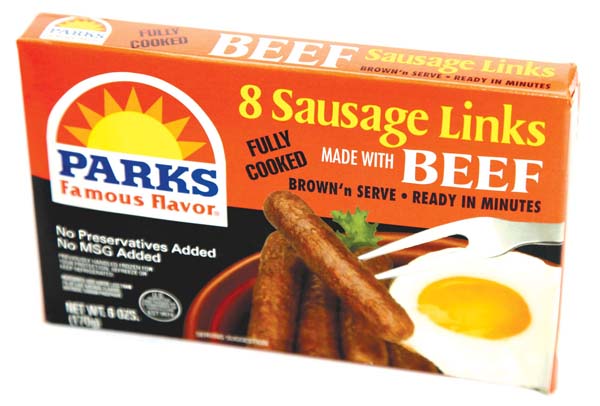
Parks sells sausage and other processed meats; its origin is in the H.G. Parks Sausage Company, known for the first African–American–owned company to be publicly traded on a U.S. stock exchange and for its radio and television advertisements that contained “a distinctive plea in the voice of a child for ‘more Parks’ sausages Mom.’”  In 1995, the Parks Sausage Co. declared bankruptcy, and plaintiff Parks acquired its assets in 1996, ultimately licensing Dietz & Watson to produce and sell Parks processed meat products.  Parks also licensed the use of the “Parks” name to Super Bakery Inc., which “specializes in nutrition-oriented foods for schoolchildren and sells food products to the armed services.”
 

Tyson Foods bought Hillshire Brands Co. and thus acquired the “Ball Park” trademark, which has been used to sell frankfurters for over fifty years.  The Ball Park brand generates over $500 million in sales, primarily from sales of Ball Park-branded hot dogs but also in part from the sale of frozen, pre-cooked hamburger patties sold under the Ball Park brand. Research conducted between 2012 and 2014 found that over 90% of adults over the age of eighteen were familiar with the brand.
 

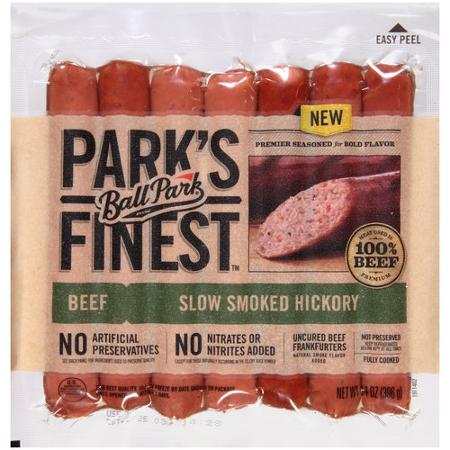
In 2014, Hillshire launched a new line of franks under the name Park’s Finest, which Parks alleged constituted false advertising and trademark infringement.  Park’s and Finest are on separate lines of the package, with Hillshire’s Ball Park trademark superimposed in the center. Radio and TV ads describe the product as “Park’s Finest from Ball Park.” A cross-sectional view on the front package also allegedly showed “what appears to be a sausage link,” rather than a frankfurter. Thus, Parks argued, defendants “are marketing and selling their product as PARK’S FINEST sausages.”
 
Parks sought a preliminary injunction, relying only on its false advertising claim.
 
Why I love Lanham Act cases: now we learn a little about the market for hot dogs, which is three-tiered.  “At the bottom of the food chain” (heh) are meat hot dogs, primarily consumed by children.  The intermediate level has “beef hot dogs” such as Ball Park hot dogs.  At the top are “super premium hot dogs,” which “tend[ ] to be beef hot dogs with additional benefits, whether that be flavor, or simpler ingredient statements.” Super premium is the fastest growing segment of the market, and includes brands such as Nathan’s Famous and Hebrew National.
 
Park’s Finest targets this category.  Compared to a Ball Park-branded hot dog, a Park’s Finest hot dog has “more seasoning, a coarser grind, [and] a bit more snap to the exterior” as well as “a cleaner ingredient label” and “no added preservatives” or nitrates. In choosing Park’s Finest as the name, Hillshire desired to invoke its Ball Park brand but also to “communicate[ ] to consumers that [Hillshire was] producing something different and better.” Hillshire viewed Park’s Finest as  a “clear shorthand version of Ball Park” that “convey[s] that this is Ball Park’s finest hot dog.”  Testing found that the name “evoked thoughts among consumers of going to the ball park and that consumers linked PARK’S FINEST to [Defendants’] BALL PARK brand.”  
 
The packaging was designed with the same objectives in mind (differentiate but link, no pun intended, these hot dogs to the Ball Park brand) and also to call attention to the product’s seasoning, flavors, and lack of artificial preservatives. “When compared to cross-sectional views of the inside of one of Defendants’ Ball Park-brand hot dogs and one of Defendants’ Hillshire smoked sausages, the [cross-sectional view of the] Park’s Finest hot dog bears closer resemblance to a Hillshire smoked sausage than to a Ball Park hot dog.” (When looking at actual sizes, however, the Park’s Finest frank has a notably smaller diameter than a Hillshire smoked sausage.)  This appearance comes from the coarser grind of meat and additional seasonings used in the Park’s Finest product.  But Hillshire didn’t want to sell the product as sausage, because the hot dog market is so much bigger.  Thus, “uncured beef frankfurters” appears prominently on the package.
 
Park’s Finest had the “biggest launch in the last four years within the hot dog category.”  When he first saw Park’s Finest, Patrick Caputo, an employee of Dietz & Watson and Account Manager for the Parks Sausage Co., believed that the product consisted of link sausages. Giuseppe Harris, an employee of Super Bakery and Marketing Manager for Parks products, had a similar first impression.  One consumer contacted the Parks Sausage Co.’s consumer telephone number “to complain about ‘Parks from Ball Park brand.’” Two others complained to Caputo about the nitrate content of sausage products sold under the Parks name, saying that TV commercials said that Parks sausages didn’t contain nitrates. Caputo believed they were referring to the ads for Park’s Finest, which do say that there are no nitrates.  However, Tyson’s VP and GM of the Ball Park brand, didn’t learn of any instances of consumer confusion, though he was in a position to do so.
 
The court found that the challenged statement wasn’t literally false.  First, the court determined that the meaning of Park’s Finest was ambiguous.  Parks argued that the only plausible meaning of PARKS was Parks, so the name Park’s Finest meant that Ball Park was now offering Parks’ “finest” products.  Defendants responded that Park’s, in context, unambiguously referred to the Ball Park brand.  While the connection between Park’s Finest and Ball Park might not have been readily apparent if Park’s Finest appeared in isolation, the context made that connection, both on the package and in ads.
 
Parks argued that this connection was implausible because the Ball Park trademark is associated with franks, not sausages, and that defendants were marketing the Park’s Finest product as a sausage.  But that wasn’t true: they were marketing it as a frank, and even if a customer mistakenly believed that Park’s Finest was a sausage, or even were it a sausage, a consumer could still plausibly understand that Park’s Finest, in context, referred to the Ball Park brand.  Even if there was currently no Ball Park-sausage association, Hillshire “would effectively create that association by integrating the Ball Park trademark into the Park’s Finest word mark.”  (Hillshire already sells about $100 million/year of beef patties under the Ball Park brand.) 
 
Thus, the name was not unambiguously false. But the court declined to find that this was one of the rare cases in which a claim is so unambiguously true that no further factfinding was required, rejecting defendants’ argument that Park’s Finest unambiguously referred to Ball Park. In defendants’ own survey, out of 200 survey respondents, 26 of them (13%) identified “Parks” or “Park’s” as the company responsible for making the product.  Another 41 respondents (21%) responded that they “did not know” which company made it, and 23 respondents (12%) responded that it was made by a company other than “Ball Park,” “Parks,” or “Park’s.” 116 respondents (58%) identified “Ball Park” as the responsible party.  Because respondents could give multiple answers, between 81-90 respondents, or 40.5-45% of the sample, failed to identify “Ball Park” as the source, making Park’s Finest not unambiguously a reference to Ball Park.
 
However, whether Park’s Finest misrepresented the nature, quality, or characteristics of the franks depended on whether consumers who didn’t get the Ball Park connection would be deceived into believing that the franks were plaintiff’s “finest.”  (There was no other identified third party who might be referenced.)  Consumers’ failure to understand an association between Park’s Finest and Ball Park wasn’t enough to show misleadingness; in the absence of some further connection, “the name would contain little to no meaning at all, other than the meaning the name derives from its association with the product.”  A seller is free to pick a trade name with no inherent connection to itself, as long as that name isn’t infringing or otherwise deceptive.  Indeed, the court commented, it was questionable whether “a consumer’s mere failure to appreciate the relationship between the Park’s Finest name and the Ball Park brand—if determined to be in some way deceptive—would relate to the ‘the nature, characteristics, qualities, or geographic origin’ of the frankfurters.”
 
The false advertising claim “effectively collapses into an inquiry into whether consumer surveys or other evidence show that a substantial number of consumers would associate the Park’s Finest name with Plaintiff’s ‘Parks’ name.”  This meant a “substantial overlap” between the §43(a)(1)(A) and (a)(1)(B) claims (a prior registration was allowed to lapse, which is the source of much of Parks’ woes here), and the court thus seemed skeptical that this was an appropriate use of §43(a)(1)(B), though it gave Parks the benefit of the doubt even though false advertising supposedly didn’t require Parks to show secondary meaning. (Which is, by the way, one very good reason to channel trademark claims into §43(a)(1)(A), since we spend a lot of energy preventing people who can’t show that they have valid marks from suppressing the use of similar terms.  Query, however, whether there can be materiality without secondary meaning.)  Anyhow, Parks also made some false advertising-ish allegations, in that they claimed that was false to designate Park’s Finest as the “finest” of the Parks products, suggesting that other Parks products were less fine.
 
However, Parks did not produce a survey, only the statements of Caputo and Harris, employees of Parks licensees.  Their declarations were insufficient to show likely deception. Even assuming that the statements of the three consumers Caputo mentioned supported a finding of likely confusion, the reactions of three consumers couldn’t be extrapolated to find likely deception of a substantial number of consumers. Nor did Harris and Caputo’s opinions that there would be confusion add any support, given their connections with Parks. Not only was their testimony self-serving, but also, as people who were intimately familiar with Parks, “their perspectives are not representative of the perspectives of consumers who may encounter the Park’s Finest product.”
 
Meanwhile, defendants did conduct a survey.  Only 13% of respondents identified “Parks” or a variant thereof as the company that made Park’s Finest.  But a consumer’s identification of the name “Parks” is different from a consumer’s identification of Parks, and respondents were subsequently asked whether they’d previously heard of the company they identified as the source.  Only 4% of the sample said yes, and an additional 1.5% were unsure.  When the 4% were asked to name other products made by the company they named, only one was able to identify any of Parks’ products.
 
Parks objected that its reverse confusion theory meant that defendants surveyed the wrong universe, but that didn’t help given that their theory here was one of false advertising.  A survey limited to people who “had purchased hot dogs at a grocery or convenience store in the past six months and expected to do so again in the next six months” and who were also required to have “purchased 100% beef hot dogs in the past six months,” was “a proper attempt to limit participation in the survey to the persons to whom Defendants’ statements are addressed.”  Other alleged flaws in the survey also didn’t significantly undermine it.  (For example, Parks argued that the survey was leading because it called the products “hot dogs” and not sausages, but the package clearly says “frankfurters.”  Also, the court didn’t buy Parks’ argument that the potential for deception depended on the type of processed meat product the consumer believed Park’s Finest to be, in the absence of evidence, especially given that Super Bakery does use the Parks name to sell other kinds of meat.  While this argument wasn’t devoid of merit, it just wasn’t sufficient to reject the survey.)  Regardless of any flaws, Parks failed to meet its burden to show likely deception.
Posted in http://schemas.google.com/blogger/2008/kind#post, trademark | Leave a comment

No silver bullet for innovator in bullion market

Provident Precious Metals, LLC v. Northwest Territorial
Mint, LLC, 2015 WL 4522923, No. 3:13–CV–02942 (N.D. Tex. July 27, 2015)
 
Interesting TM/copyright case that straddles the boundaries
of so-called aesthetic and “utilitarian” functionality: is the accuracy of a
replica product a matter of utilitarian or aesthetic functionality?  Does it make any difference?
 
Provident sued NWTM seeking a declaratory judgment of invalidity
and non-infringement of NWTM’s alleged copyrights, trademarks, and trade dress
rights; NWTM made the counterclaims you’d expect. Provident and NWTM make
precious metals in the shape of famous types of ammunition (“replica bullets”).
[Slackjawed wonder/gender analysis of this market omitted]
 
NWTM first conceived of the idea of using silver bullion to
copy famous ammunition into sizes that would easily convert to weights in even
troy ounces in 2008.  NWTM therefore measured
sample ammunition with a digital caliper and micrometer, viewed pictures of
sample bullets on the Internet, and consulted published industry standards for
ammunition dimensions. NWTM also bought hundreds of different ammunition
rounds, focusing on popular shapes and sizes, and sought to recreate bullets at
volumes that approximated even weights. NWTM altered the dimensions of the
original .45 round it chose to match the desired bullion weight, but still
sought to appeal to a “gun person, or anyone buying bullion.” NWTM ultimately
resorted to CAD software to make the code used by its manufacturing machines.
 
According to the designer, once the bullet was “machined,”
it would be weighed, and if it “weigh[ed] right they wouldn’t adjust it to meet
[the particular dimension].”  The weight
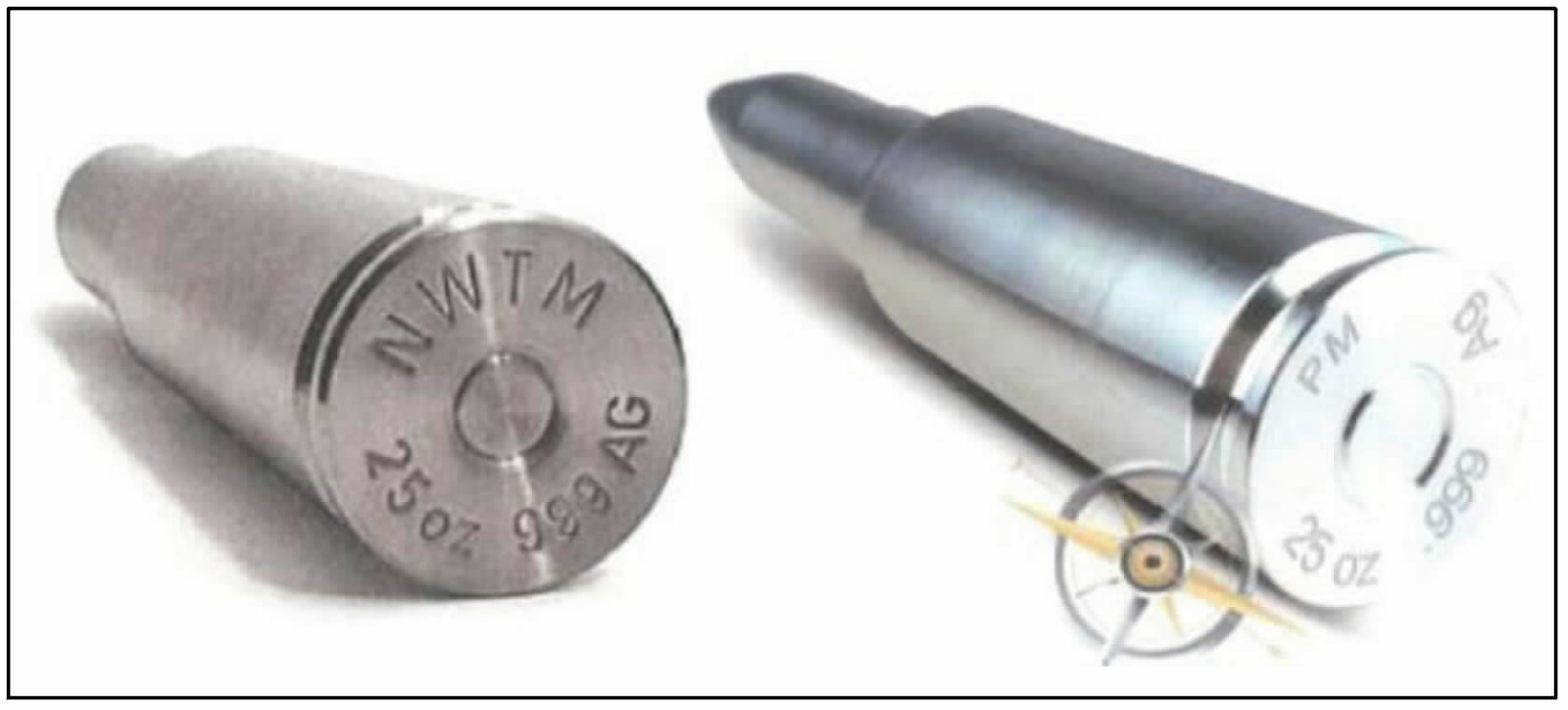
dictated the form.  NWTM stamped the base
of each bullet with a “head stamp” containing certain information, including
the product’s metal designation (silver, or “Ag”), source (NWTM), weight, and
purity. “The format of the head stamp intentionally resembled the format of
head stamps on actual ammunition, and was intended to convey that the replica
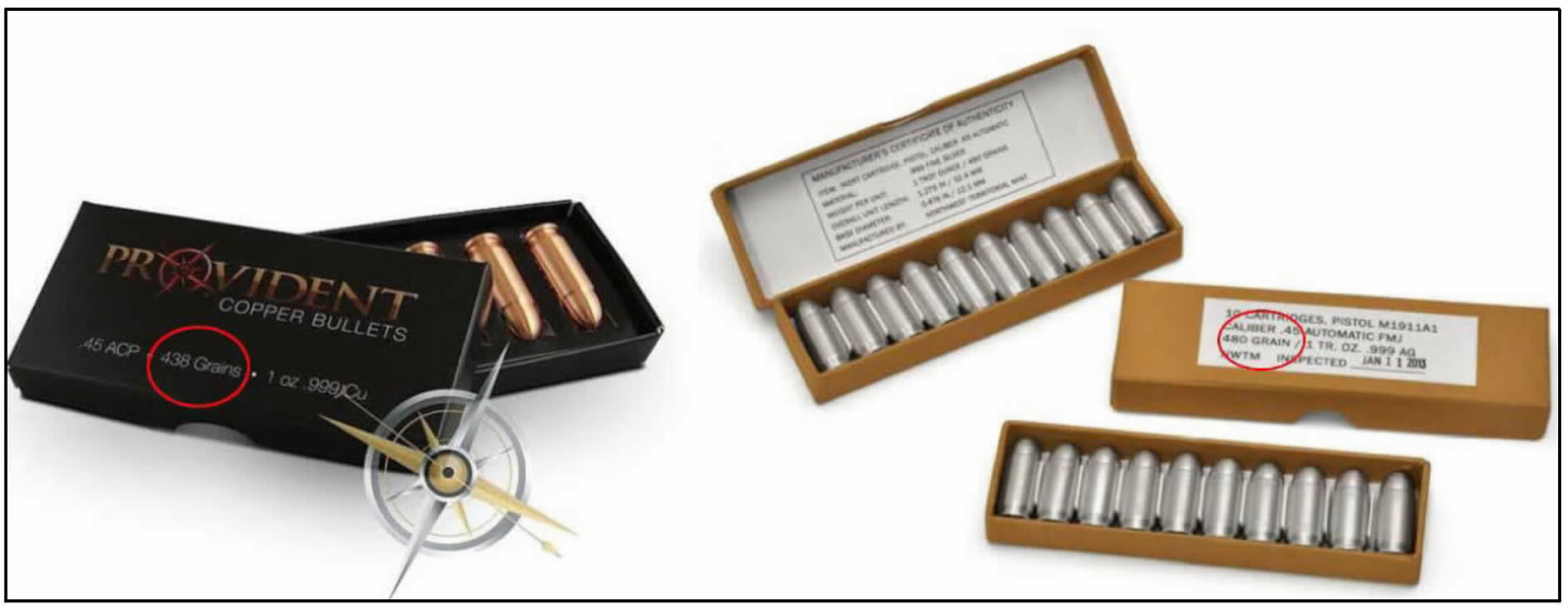
bullet ‘has intrinsical [sic] value,’ similar to money.”  NWTM sells its replica bullets in boxes or
bags designed to “evoke the feeling of military surplus ammunition,” and to
“best present the product to a military customer, to evoke the military
design.”  It advertised its replica
bullets, which went on sale in January 2013, as “virtually identical to their
ammunition counterparts,” claiming for example that one bullet “faithfully
duplicates the famed .50 BM so well-known to military personnel and weapon
enthusiasts,” that its silver 7.62 NATO (.308) is a “near exact, non-firing
replica,” and so on.
 

Provident claimed to have come up with the replica bullet
idea independently of NWTM, but whatever. 
It too used CAD and minor adjustments to achieve the desired
weight.  Provident instructed its
manufacturer to make the head stamp look as similar to live ammunition as
possible, and to include the weight, purity, composition, and “PM,” Provident’s
“mint mark.” Both parties used Tahoma font, with Provident contending that this
was the font that looked closest to real ammunition.  Provident designed its packaging to “look
like an ammo box,” and began selling copper replicas in 2013, with silver
arriving in November.
 

NWTM filed three related trademark applications. In January
2013, it filed an ITU application for “SILVER BULLET BULLION,” for use in
association with “[p]recious metals, namely, gold and silver bullion,” “BULLION”
disclaimed.  This was published for
opposition in June 2013, and Provident duly opposed; PTO proceedings have been
suspended pending the outcome of this suit. 
(B&B and ITUs really don’t
fit together, do they?)
 
In August 2013, NWTM filed another ITU application for
“BULLET BULLION,” for use in association with “[p]recious metals, namely gold
and silver bullion.”  The PTO issued an
office action refusing to register the mark as merely descriptive; the
application has been suspended pending final disposition of a prior application
filed by a third party, but the examiner rejected NWTM’s argument that the term
wasn’t descriptive.
 
In March 2014, NWTM filed another “COPPER BULLET BULLION,” which
Provident opposed after it was published for opposition.
 
In June 2014, NWTM filed five copyright applications for its
five types of silver replica bullets, listing them as “sculptures.”  The Copyright Office denied registration because
the new material did “not contain a sufficient amount of original authorship.”  
 
The court turned first to trademark.  Under governing precedent, “the concept of
descriptiveness must be construed rather broadly.”  If imagination is required to connect the term
to the product, it’s suggestive; if the term conveys information about the
product, it’s descriptive. 
Alternatively, courts ask “whether others in the same business would
generally need the word to adequately describe their product or service.”
 
All three claimed word marks, SILVER BULLET BULLION (SBB),
COPPER BULLET BULLION (CBB), and BULLET BULLION (BB), weredescriptive, because
they immediately conveyed the “characteristics, qualities, and ingredients of
NWTM’s replica bullets without requiring the consumer to make any mental leap.”  Bullion is a generic term for precious metals
in mass/in bars or ingots.  Though copper
isn’t conventionally understood as bullion, the price increases of the last few
years, it was reasonable to define “bullion” broadly enough to include copper;
Merriam-Webster defined “bullion” as “metal in the mass.”
 
NWTM argued that the terms were meaningless prior to the
existence of its replica bullets, and consumers might have thought of images of
bars or coins with bullet-related art on them. 
Plus, the SBB and CBB marks had been published for opposition.  But publication for opposition entitles NWTM
to no presumption (only actual registration does).  Second, the descriptiveness test isn’t
applied in the abstract: it’s applied to these products, which are replica
bullets.  The metal words describe the
material of the replica, and “bullet” describes the shape.  In the alternative, competitors would “almost
certainly” need to use the words in the marks to describe their products.  (I understand why the court didn’t go this
far, but silver, copper, and bullet at least are generic.)  “There are simply a limited variety of
descriptors that can be used to describe products of this sort, and granting
NWTM the trademarks it seeks would effectively preclude potential competitors
from marketing goods with the terms ‘bullet’ or ‘bullion.’ NWTM has simply not
addressed how its competitors could describe their products without using the
terms employed in NWTM’s SBB, CBB, and BB marks.”
 
NWTM couldn’t show secondary meaning. “The burden to
establish secondary meaning is substantial and requires a high degree of proof.”  NWTM didn’t produce any evidence of secondary
meaning, and, “in a borderline case where it is not at all obvious that a
designation has been used as a mark, survey evidence may be necessary to prove
trademark perception.”  NWTM argued that
it lacked survey evidence “because NWTM’s customers tend to buy bullion as a
hedge against what they see as the U.S. government’s failing monetary policy,
and those same customers would be skeptical of a phone call inquiring about the
manufacturer of the bullion products they own.” 
Nonetheless, the burden of proof was still on NWTM.
 
NWTM also sought to protect its alleged trade dress,
described as a bullion piece of silver or copper that:
(1) has a head stamp with a central
circular groove (which suggests the primer cap for a real bullet), surrounded
by the following information in a circular pattern towards the outer edge of
the base of the bullion piece:
(a) metal designation such as “Ag”
or “Cu”;
(b) indication of purity;
(c) a weight; and
(d) abbreviation for the company
name;
(2) is sold in packaging that
evokes a military or gun enthusiast feel by including:
(a) a caliber designation that is
suggested by the general shape of the bullion piece (i.e., .45 ACP, 7.62 NATO
(or .308), .50 BMG, or 20 MM, or 12 gauge for shotgun shell);
(b) a designation of “grains”
associated with gun powder of the bullet, giving an indication of the power of
the associated real bullet type; and
(c) is sold in boxes in rows that
evoke the feeling of a real box of ammunition, or in a plastic bag container
with the same information in (a) and (b); and
(3) while not being an exact copy
or “replica” of a real bullet, has the shape of the bullion piece that evokes
the feeling of such a bullet. [NB: if you have to describe your trade dress as
evoking a feeling, you are probably in trouble.]
 
The head stamp was functional.  It identified the weight, composition,
purity, and source of the bullion used to make the replica bullet, as is
apparently standard practice for bullion products. NWTM argued that the
information could be located anywhere on the bullion piece, and that the
combination of elements—head stamp, shape, and packaging—had a consistent look
that was inherently distinctive.  Nope. 
 
[T]he features that comprise the
head stamp, and the head stamp considered as a whole, were designed to emulate
the head stamp on actual ammunition, and therefore, are “essential to the use
or purpose” and “affect the cost or quality” of the head stamp. NWTM sought to
establish a link with military service members, veterans, and gun enthusiasts.
Thus, the head stamp is functional because it emulates actual ammunition, which
would give NWTM a non-reputation-related advantage over its competitors,
particularly in appealing to military service members and gun enthusiasts, who
would very likely perceive head stamps that did not resemble actual ammunition
as being of lesser quality.
 
The head stamp was also not inherently distinctive.  (Although the court didn’t mention this, it
can’t possibly be under Wal-Mart:
it’s product design, not product packaging.)  Each of its features emulated the head stamp
on actual ammunition—it used a standard font, and the circular groove on the
base simulated the primer of actual ammunition. If it created a distinctive,
consistent look, “that look is that of actual ammunition.” Putting the
information elsewhere on the bullet “would undermine the theme and purpose of
NWTM’s replica bullets—emulating actual ammunition.”  None of the elements were suggestive,
arbitrary, or fanciful, either individually or taken together.
 

Packaging: NWTM’s packaging referenced the caliber of
ammunition and the grain count, which made the packaging resemble, and “evoke[d]
the feel of,” real ammunition boxes. This too was functional, because it served
to remind consumers of an actual ammunition box, “and allowing it to do so with
trade dress protection would put NWTM’s competitors at a significant
non-reputation-related disadvantage.”  Even if the packaging were distinctive and
nonfunctional, there would be no confusion, as a matter of law. Provident
prominently featured its name on the outside of its boxes, and the text on its
packaging was inscribed directly on the top of the boxes. NWTM’s boxes had text
inscribed on a label on the outside cover that included many of the descriptive
features included on the head stamp, with NWTM inconspicuously included on the
bottom left corner of the label. There was no “meaningful” evidence supporting a
likelihood of confusion other than the general similarity of shape.
 
Bullet shape: this was unprotectable as lacking
distinctiveness.  Any differences between
NWTM’s products and actual ammunition were imperceptible to actual consumers,
and were also functional. Changes in dimension and weight were designed to make
products that weighed in even troy ounces, in part in order to give them
intrinsic value as a financial investment—“the weight dictated the form,”
according to NWTM’s designer. 
 
NWTM argued that the combination of these functional,
nondistinctive features were distinctive in their “total impression.”  The court wasn’t persuaded.  “[T]he overall impression of the elements,
each of which has only trivial differences with the features of actual
ammunition, serves to identify NWTM’s product as a bullet.”
 
Even if the trade dress were nonfunctional, NWTM failed to
show secondary meaning. NWTM argued that it heavily promoted the new product;
that it sold over 191,000 pieces of SBB and CBB through June 2014; that it had
100% of the market share for silver bullet bullion from January to October
2013; that Provident copied NWTM; that, according to NWTM’s CEO, at least four
customers contacted him to ask whether Provident’s products were in fact
manufactured by NWTM, and a customer expressed confusion on Provident’s
Facebook page; and a video on the “Salivate Metal” YouTube channel featured a
reviewer pondering whether the real manufacturer of Provident’s product was
actually NWTM.
 
Even if all of this unambiguously weighed in NWTM’s favor,
there was still no empirical evidence of secondary meaning.  There was no admissible consumer testimony or
survey evidence; its customers’ posited unwillingness to be surveyed again
didn’t relieve it from its burden, “particularly given that its customers
constitute a unique demographic.”  (That’s
one way to put it.)  The time of use
weighed against NWTM—other cases have found 3½ years of exclusivity to be
“relatively brief,” while NWTM had 10 months. 
While the substantial amount of NWTM’s sales would weigh in its favor,
that wasn’t enough.  NWTM claimed that
its marketing was successful but provided no evidence on the amount it spent
marketing the trade dress.
 
Turning to copyright:  “A mere reproduction of a work in a different
medium does not constitute a sufficient variation to meet the originality
threshold for copyright protection.” See L. Batlin & Son, Inc. v. Snyder,
536 F.2d 486, 491 (2d Cir.1976).  NWTM
argued that its replica bullets were original because they didn’t correspond to
actual ammunition, sometimes varying in dimension by a quarter of an inch or
more. NWTM argued that it was an innovator and that there was significant
creative effort that went into making the product, including testing, trial and
error, and the creation of numerous prototypes between 2008 and 2012.
 
No again.  Any
differences between the replica bullets and actual ammunition were trivial or
functional: (1) the composition, i.e., silver or copper (functional); (2) the
dimensions (imperceptible and functional in order to make a bullet in even troy
ounces); (3) the shape (functional); and (4) the weight (functional).  Even were that not so, merger would still
apply: the expression of a bullet in bullion couldn’t be separated from the
idea. “[T]he only way NWTM can express a .45 ACP design is to replicate it, and
if NWTM were to make significant variations in its replica, the product would
no longer be identifiable as a .45 ACP design.”
 
NWTM argued that Provident engaged in false
advertising/unfair competition by claiming to have its own mint, allowing it to
minimize manufacturing costs and pass on savings to consumers. But NWTM failed
to timely identify false advertising as the foundation for its unfair
competition claim, which it earlier said was based on trademark
infringement.  Also, without copyright
and trademark claims, there were no actionable unjust enrichment claims.

from Blogger http://ift.tt/1MXl2Gs

Posted in Uncategorized | Tagged , | Leave a comment

No silver bullet for innovator in bullion market

Provident Precious Metals, LLC v. Northwest Territorial Mint, LLC, 2015 WL 4522923, No. 3:13–CV–02942 (N.D. Tex. July 27, 2015)
 
Interesting TM/copyright case that straddles the boundaries of so-called aesthetic and “utilitarian” functionality: is the accuracy of a replica product a matter of utilitarian or aesthetic functionality?  Does it make any difference?
 
Provident sued NWTM seeking a declaratory judgment of invalidity and non-infringement of NWTM’s alleged copyrights, trademarks, and trade dress rights; NWTM made the counterclaims you’d expect. Provident and NWTM make precious metals in the shape of famous types of ammunition (“replica bullets”). [Slackjawed wonder/gender analysis of this market omitted]
 
NWTM first conceived of the idea of using silver bullion to copy famous ammunition into sizes that would easily convert to weights in even troy ounces in 2008.  NWTM therefore measured sample ammunition with a digital caliper and micrometer, viewed pictures of sample bullets on the Internet, and consulted published industry standards for ammunition dimensions. NWTM also bought hundreds of different ammunition rounds, focusing on popular shapes and sizes, and sought to recreate bullets at volumes that approximated even weights. NWTM altered the dimensions of the original .45 round it chose to match the desired bullion weight, but still sought to appeal to a “gun person, or anyone buying bullion.” NWTM ultimately resorted to CAD software to make the code used by its manufacturing machines.
 
According to the designer, once the bullet was “machined,” it would be weighed, and if it “weigh[ed] right they wouldn’t adjust it to meet [the particular dimension].”  The weight dictated the form.  NWTM stamped the base of each bullet with a “head stamp” containing certain information, including the product’s metal designation (silver, or “Ag”), source (NWTM), weight, and purity. “The format of the head stamp intentionally resembled the format of head stamps on actual ammunition, and was intended to convey that the replica bullet ‘has intrinsical [sic] value,’ similar to money.”  NWTM sells its replica bullets in boxes or bags designed to “evoke the feeling of military surplus ammunition,” and to “best present the product to a military customer, to evoke the military design.”  It advertised its replica bullets, which went on sale in January 2013, as “virtually identical to their ammunition counterparts,” claiming for example that one bullet “faithfully duplicates the famed .50 BM so well-known to military personnel and weapon enthusiasts,” that its silver 7.62 NATO (.308) is a “near exact, non-firing replica,” and so on.
 

Provident claimed to have come up with the replica bullet idea independently of NWTM, but whatever.  It too used CAD and minor adjustments to achieve the desired weight.  Provident instructed its manufacturer to make the head stamp look as similar to live ammunition as possible, and to include the weight, purity, composition, and “PM,” Provident’s “mint mark.” Both parties used Tahoma font, with Provident contending that this was the font that looked closest to real ammunition.  Provident designed its packaging to “look like an ammo box,” and began selling copper replicas in 2013, with silver arriving in November.
 

NWTM filed three related trademark applications. In January 2013, it filed an ITU application for “SILVER BULLET BULLION,” for use in association with “[p]recious metals, namely, gold and silver bullion,” “BULLION” disclaimed.  This was published for opposition in June 2013, and Provident duly opposed; PTO proceedings have been suspended pending the outcome of this suit.  (B&B and ITUs really don’t fit together, do they?)
 
In August 2013, NWTM filed another ITU application for “BULLET BULLION,” for use in association with “[p]recious metals, namely gold and silver bullion.”  The PTO issued an office action refusing to register the mark as merely descriptive; the application has been suspended pending final disposition of a prior application filed by a third party, but the examiner rejected NWTM’s argument that the term wasn’t descriptive.
 
In March 2014, NWTM filed another “COPPER BULLET BULLION,” which Provident opposed after it was published for opposition.
 
In June 2014, NWTM filed five copyright applications for its five types of silver replica bullets, listing them as “sculptures.”  The Copyright Office denied registration because the new material did “not contain a sufficient amount of original authorship.”  
 
The court turned first to trademark.  Under governing precedent, “the concept of descriptiveness must be construed rather broadly.”  If imagination is required to connect the term to the product, it’s suggestive; if the term conveys information about the product, it’s descriptive.  Alternatively, courts ask “whether others in the same business would generally need the word to adequately describe their product or service.”
 
All three claimed word marks, SILVER BULLET BULLION (SBB), COPPER BULLET BULLION (CBB), and BULLET BULLION (BB), weredescriptive, because they immediately conveyed the “characteristics, qualities, and ingredients of NWTM’s replica bullets without requiring the consumer to make any mental leap.”  Bullion is a generic term for precious metals in mass/in bars or ingots.  Though copper isn’t conventionally understood as bullion, the price increases of the last few years, it was reasonable to define “bullion” broadly enough to include copper; Merriam-Webster defined “bullion” as “metal in the mass.”
 
NWTM argued that the terms were meaningless prior to the existence of its replica bullets, and consumers might have thought of images of bars or coins with bullet-related art on them.  Plus, the SBB and CBB marks had been published for opposition.  But publication for opposition entitles NWTM to no presumption (only actual registration does).  Second, the descriptiveness test isn’t applied in the abstract: it’s applied to these products, which are replica bullets.  The metal words describe the material of the replica, and “bullet” describes the shape.  In the alternative, competitors would “almost certainly” need to use the words in the marks to describe their products.  (I understand why the court didn’t go this far, but silver, copper, and bullet at least are generic.)  “There are simply a limited variety of descriptors that can be used to describe products of this sort, and granting NWTM the trademarks it seeks would effectively preclude potential competitors from marketing goods with the terms ‘bullet’ or ‘bullion.’ NWTM has simply not addressed how its competitors could describe their products without using the terms employed in NWTM’s SBB, CBB, and BB marks.”
 
NWTM couldn’t show secondary meaning. “The burden to establish secondary meaning is substantial and requires a high degree of proof.”  NWTM didn’t produce any evidence of secondary meaning, and, “in a borderline case where it is not at all obvious that a designation has been used as a mark, survey evidence may be necessary to prove trademark perception.”  NWTM argued that it lacked survey evidence “because NWTM’s customers tend to buy bullion as a hedge against what they see as the U.S. government’s failing monetary policy, and those same customers would be skeptical of a phone call inquiring about the manufacturer of the bullion products they own.”  Nonetheless, the burden of proof was still on NWTM.
 
NWTM also sought to protect its alleged trade dress, described as a bullion piece of silver or copper that:
(1) has a head stamp with a central circular groove (which suggests the primer cap for a real bullet), surrounded by the following information in a circular pattern towards the outer edge of the base of the bullion piece:
(a) metal designation such as “Ag” or “Cu”;
(b) indication of purity;
(c) a weight; and
(d) abbreviation for the company name;
(2) is sold in packaging that evokes a military or gun enthusiast feel by including:
(a) a caliber designation that is suggested by the general shape of the bullion piece (i.e., .45 ACP, 7.62 NATO (or .308), .50 BMG, or 20 MM, or 12 gauge for shotgun shell);
(b) a designation of “grains” associated with gun powder of the bullet, giving an indication of the power of the associated real bullet type; and
(c) is sold in boxes in rows that evoke the feeling of a real box of ammunition, or in a plastic bag container with the same information in (a) and (b); and
(3) while not being an exact copy or “replica” of a real bullet, has the shape of the bullion piece that evokes the feeling of such a bullet. [NB: if you have to describe your trade dress as evoking a feeling, you are probably in trouble.]
 
The head stamp was functional.  It identified the weight, composition, purity, and source of the bullion used to make the replica bullet, as is apparently standard practice for bullion products. NWTM argued that the information could be located anywhere on the bullion piece, and that the combination of elements—head stamp, shape, and packaging—had a consistent look that was inherently distinctive.  Nope. 
 
[T]he features that comprise the head stamp, and the head stamp considered as a whole, were designed to emulate the head stamp on actual ammunition, and therefore, are “essential to the use or purpose” and “affect the cost or quality” of the head stamp. NWTM sought to establish a link with military service members, veterans, and gun enthusiasts. Thus, the head stamp is functional because it emulates actual ammunition, which would give NWTM a non-reputation-related advantage over its competitors, particularly in appealing to military service members and gun enthusiasts, who would very likely perceive head stamps that did not resemble actual ammunition as being of lesser quality.
 
The head stamp was also not inherently distinctive.  (Although the court didn’t mention this, it can’t possibly be under Wal-Mart: it’s product design, not product packaging.)  Each of its features emulated the head stamp on actual ammunition—it used a standard font, and the circular groove on the base simulated the primer of actual ammunition. If it created a distinctive, consistent look, “that look is that of actual ammunition.” Putting the information elsewhere on the bullet “would undermine the theme and purpose of NWTM’s replica bullets—emulating actual ammunition.”  None of the elements were suggestive, arbitrary, or fanciful, either individually or taken together.
 

Packaging: NWTM’s packaging referenced the caliber of ammunition and the grain count, which made the packaging resemble, and “evoke[d] the feel of,” real ammunition boxes. This too was functional, because it served to remind consumers of an actual ammunition box, “and allowing it to do so with trade dress protection would put NWTM’s competitors at a significant non-reputation-related disadvantage.”  Even if the packaging were distinctive and nonfunctional, there would be no confusion, as a matter of law. Provident prominently featured its name on the outside of its boxes, and the text on its packaging was inscribed directly on the top of the boxes. NWTM’s boxes had text inscribed on a label on the outside cover that included many of the descriptive features included on the head stamp, with NWTM inconspicuously included on the bottom left corner of the label. There was no “meaningful” evidence supporting a likelihood of confusion other than the general similarity of shape.
 
Bullet shape: this was unprotectable as lacking distinctiveness.  Any differences between NWTM’s products and actual ammunition were imperceptible to actual consumers, and were also functional. Changes in dimension and weight were designed to make products that weighed in even troy ounces, in part in order to give them intrinsic value as a financial investment—“the weight dictated the form,” according to NWTM’s designer. 
 
NWTM argued that the combination of these functional, nondistinctive features were distinctive in their “total impression.”  The court wasn’t persuaded.  “[T]he overall impression of the elements, each of which has only trivial differences with the features of actual ammunition, serves to identify NWTM’s product as a bullet.”
 
Even if the trade dress were nonfunctional, NWTM failed to show secondary meaning. NWTM argued that it heavily promoted the new product; that it sold over 191,000 pieces of SBB and CBB through June 2014; that it had 100% of the market share for silver bullet bullion from January to October 2013; that Provident copied NWTM; that, according to NWTM’s CEO, at least four customers contacted him to ask whether Provident’s products were in fact manufactured by NWTM, and a customer expressed confusion on Provident’s Facebook page; and a video on the “Salivate Metal” YouTube channel featured a reviewer pondering whether the real manufacturer of Provident’s product was actually NWTM.
 
Even if all of this unambiguously weighed in NWTM’s favor, there was still no empirical evidence of secondary meaning.  There was no admissible consumer testimony or survey evidence; its customers’ posited unwillingness to be surveyed again didn’t relieve it from its burden, “particularly given that its customers constitute a unique demographic.”  (That’s one way to put it.)  The time of use weighed against NWTM—other cases have found 3½ years of exclusivity to be “relatively brief,” while NWTM had 10 months.  While the substantial amount of NWTM’s sales would weigh in its favor, that wasn’t enough.  NWTM claimed that its marketing was successful but provided no evidence on the amount it spent marketing the trade dress.
 
Turning to copyright:  “A mere reproduction of a work in a different medium does not constitute a sufficient variation to meet the originality threshold for copyright protection.” See L. Batlin & Son, Inc. v. Snyder, 536 F.2d 486, 491 (2d Cir.1976).  NWTM argued that its replica bullets were original because they didn’t correspond to actual ammunition, sometimes varying in dimension by a quarter of an inch or more. NWTM argued that it was an innovator and that there was significant creative effort that went into making the product, including testing, trial and error, and the creation of numerous prototypes between 2008 and 2012.
 
No again.  Any differences between the replica bullets and actual ammunition were trivial or functional: (1) the composition, i.e., silver or copper (functional); (2) the dimensions (imperceptible and functional in order to make a bullet in even troy ounces); (3) the shape (functional); and (4) the weight (functional).  Even were that not so, merger would still apply: the expression of a bullet in bullion couldn’t be separated from the idea. “[T]he only way NWTM can express a .45 ACP design is to replicate it, and if NWTM were to make significant variations in its replica, the product would no longer be identifiable as a .45 ACP design.”
 
NWTM argued that Provident engaged in false advertising/unfair competition by claiming to have its own mint, allowing it to minimize manufacturing costs and pass on savings to consumers. But NWTM failed to timely identify false advertising as the foundation for its unfair competition claim, which it earlier said was based on trademark infringement.  Also, without copyright and trademark claims, there were no actionable unjust enrichment claims.
Posted in http://schemas.google.com/blogger/2008/kind#post, trademark | Leave a comment

Amicus supporting rehearing in MTM v. Amazon

IP Professors, with excellent assistance from Cathy Gellis.

from Blogger http://ift.tt/1IbyIKz

Posted in Uncategorized | Tagged , | Leave a comment