Seventh Trademark Scholars Roundtable: The Construction of the Consumer in Trade Mark Law
Session 1: Roles for the Consumer in Trade Mark Law
What role does the “consumer” (whether “average” or “reasonable” or otherwise) play in trade mark law? Does consideration of the consumer simply help explain trademark law at some general level? Is the consumer useful merely to help legislators or policymakers shape the direction of trademark law? Is consideration of the consumer useful purposively to help determine outcomes in particular cases? Or is the trope of the consumer largely counterproductive? How should the answers to these questions inform doctrine? Are some doctrines more suited for analysis through the lens of the consumer than others? Importantly, are there trade mark doctrines where the consumer should have no (or only a limited) role in determining outcomes? If so, why, and what are they?
Introduction: Jennifer Davis: Continuity and change with the average consumer in European law. Continuity: there’s a continuous question about the average consumer’s identity and role. Change: Many will accept that the average consumer originally came via consumer protection law through classical economics: utility-maximizing rational actor. The law itself, EU Directive, also has a basis in neoclassical economics, most importantly so in the fact that any TM can be registered as long as it is acting as a TM. These include marks that are purely descriptive in their startup; shapes; marks in limited supply such as colors. Key that the question of whether the mark can be registered comes down to whether or not the average consumer sees it as distinctive. Confusing similarity also comes down to the average consumer. Confusion inquiry also goes back to whether court thinks average consumer will perceive marks as particularly distinctive. It’s the perceived views of the average consumer that delimit the amount of protection the EU will give to the mark. If TM is property, it is property defined by the supposed perceptions of the average consumer.
So what about when we aren’t talking about market efficiency but free riding or tarnishment? Even here, law looks for average consumer. ECJ has determined that tarnishment, dilution, free riding require the average consumer to make a link between the two marks at issue, as a way of delimiting extent of protection.
Change: It was not ever thus everywhere before the TM directive. Whether or not TM received protection was seen as balancing act between TM owner, consumer, and competitors. Use perceived views of consumer to determine distinctiveness and confusion, but felt free to override consumer perception if in the public interest to do so. Huge change from that. Descriptive signs; colors; shapes; slogans: example is Kit-Kat/Have a Break. 1983 applied to register Have a Break as separate TM, though used with Kit-Kat name always. Court said it was irrelevant whether it was distinctive; it’s a term other traders might wish to use/it’s not used as a TM and thus can’t be registered. After the TM directive, went to CJEU, which said that a sign always used with a mark could be registered; never asked the question of public interest in leaving phrase free. Only question was whether average consumer saw it as distinctive.
Free market principles of TM directive: sometimes courts have tried to get around this by saying, for example, that average consumer is less likely to see shapes or colors as TM and registration is therefore resisted absent use. Similar use of average consumer to limit scope of dilution. CJEU has looked at the functions of the mark, not just the origin function but investment, advertising, communication function—tried to reinject interest of competitors as well as consumers, by the back door. Are we happy for the courts to use their own judgments as they used to before? Remember competitors who may get lost if we only talk about average consumers.
Barton Beebe: Questions about consumers—very difficult to focus on one area without crossing over into others. What the average consumer is; consumer as subject v. object of TM law. Consumer as limiting restraint on TM law v. consumer as alibi for expansion of TM. Consumer as gauge of effective competition policy. Consumer as political/liberal subject.
Who is the agent in TM law? Who is the active force, the subject, the thing engaging in self-initiated conduct? More appealing to think of modern TM law as: the subject is the TM, searching for consumers. We are trying to restore the human/the consumer: language is consumers constructing TM, not TM constructing consumers. Not commodities floating around.
Europeans talked so much about average consumer, who speaks 24 languages—we know the consumer is not the moron in a hurry. More sophisticated: not an illiterate or abnormallystupid or ignorant. Canadian case: relevant consumers would not be confused into purchasing the wrong nuclear reactor. That Homer Simpson might be confused is irrelevant.
Subject v. object: is TM law descriptive or normative? Is consumer the empirical anchor, measure of all things such as distinctiveness or confusion? Or is the consumer the object of TM law, who law tries to form or inform? Raise consumer sophistication or allow it to decline? Maybe TM shouldn’t be as descriptive as it is in the US, where we like surveys. Maybe we should accept some degree of confusion to achieve some other purpose. Consumer as endogenous, not exogenous; and changeable by TM law. Underneath this is the Q of circularity: is it true that the consumer internalizes implications of various TM cases, such as US Boston Hockey case or Arsenal in UK/Europe: consumers are trained to think that association is only allowed under licensing terms. But is that true? Does law have that much effect on consumer perception?
Orthogonal to this: is the consumer essentially just a source or target of general policy, and not any outcome under doctrine? Dilution: does consumer perception matter? Schecter would have preferred not, that it be an entirely grammatical/formal/linguistic theory that would never ask about whether consumers perceived an association.
TM scholarship: consumer as restraint on TM v. alibi for expansion—raised in readings. US: shift away from property concept of late 19thc. towards a consumer protection justification arguably licensed a massive expansion. Consumer is less a delimiter in US scholarship than the licensor of expansion, b/c consumer perception is malleable when you have good counsel. Also raises Q of materiality—seen as way to limit TM rights in the US, in tradition of American false advertising law. Is confusion material to decision to purchase? If not, won’t enjoin—but courts haven’t accepted it (largely).
Consumers and competition: one likes to dream of a shift in US law towards a competition focus. TM isn’t about minimizing search costs, but facilitating effective/socially optimal levels of competitions. TM restrictionists see competition as a way to find a limiting principle not based on vagaries of consumer protection. We should ask how the consumer would interact w/ TM as competition policy as compared to consumer protection policy.
Consumers and politics: consumers are citizens. Average consumer = average citizen. If we ascribe some degree of sophistication to them, these people are mostly voters, so that’s the liberal subject. We shouldn’t just think about competition policy but political ideology: how we conceive of subject of modern marketplace/political systems. Jennifer Davis: class consciousness among judges in English law of 19th c.—consumers were like servants; judges distinguished among classes of people. Today, instead, distinguish among classes of goods—looking at the commodity instead.
Primary Discussant: Lionel Bently: Impact of registration on freedoms of other traders was much more central to pre-harmonized regimes. If trader would have a legitimate reason, without improper motive, to use a particular sign, then another trader should not get a registration/monopoly—geographical marks, etc. So trader is another actor we could consider building a TM regime around.
Trademark Directive/int’l legislation: term consumer isn’t present; it’s the “public” who is protected against likely confusion. Public is another concept around which we might build TM. What is at stake in the collapse of the public into the consumer? Perhaps this notion of the citizen might be an alternative.
Weird things that go on in our use of “consumer” and in the assumptions that it causes us to carry with it. Normally when we talk about consumer protection we’re concerned w/ a particular category of consumers regarded as vulnerable: lack the same level of info as businesses in the marketplace. Protection overcomes those perceived problems. In TM law that’s not the same consumer at all—the purchaser of nuclear reactors as well as of sweets. But he’s concerned that we carry with us a different set of assumptions about chief characteristics of consumer—relative stupidity and vulnerability.
Distinction between consumer and citizen: Discomfort w/how Qs of inherent distinctiveness are assessed b/c starting point is that we are looking at signs that might qualify as TMs. ECJ tends to say that when you’re assessing whether something is devoid of distinctive character/unregistrable, you use the POV of the consumer, and descriptive things are likely descriptive v. distinctive. But things that aren’t explicable to consumers are just assumed to be fodder for the TM system. Any attribute of a product that can’t be explained immediately has the capacity to be a TM. That’s just weird. That’s not how I look at the world—that anything I can’t understand is a TM. So why should European TM law assume that the person who is looking at the world is only using one spectrum?
Stacey Dogan: Relationship between search costs & consumers & competition: reflect on the literature/case law that suggests that reducing search costs in itself is the goal of TM. Appropriate use of search costs is not as goal in itself, but reducing search costs to promote competition. Better information in markets should promote reduction in search costs, but if you inhibit competition by granting rights you shouldn’t grant those rights.
Annette Kur: ECJ uses public interest concept, but divides it into public interest of consumer in identifying products; public interests of competitors to be able to use things they want to keep available. Slashed in two. It should be one concept. Cardinal mistake: not allowing you to look into the second prong except for descriptive signs. Needs to be in measurement of scope of protection granted, which was thrown out in Adidas where they said that part two of public interest was irrelevant in determining scope of mark.
Competition also has a connection to the perception of those who operate in the market. These people don’t function in the way we picture the mind of the consumer to function. It’s not (just) about diminished search costs. We need to know much more about what’s happening in the impact of TM on consumers’ minds. When people decide whether to buy, what’s going on?
RT: For Dogan: I saw a very subtle equivocation there: if you really believe that search costs is only a means toward the competitive end, shouldn’t you in each case balance the decrease in search costs from granting TM protection to a design with secondary meaning with the increase in monopoly profits in cases in which the design also has functionality? Sometimes mild functionality might not overwhelm the search cost benefit of protection as TM, unless you’ve already created a hierarchy of things that help competition. (ETA: Bob Bone discusses this issue; he believes in general rules though I understand him to want more inquiry into the balance of functionality and distinctiveness.)
Another possibility: the subtle influence of language. Use of “the legislator” in Europe as indicating a more plausible bearer of intent than the US “the legislature” where the criticism that the legislature as a body does not regularly have a coherent or consistent intent has of late been extremely influential, as we saw in the recent health care case. Use of the “average consumer” may have similar effects in smushing down the variation that we know exists—we want to see more understanding of variation and the common lack of coherent consumer “intent” or “belief” in the way the law assumes. So maybe we should always be talking about consumers!
Dev Gangjee: you have to have an abstract concept, and that interacts with nationality. Can we set up a pre-large national registration system understanding of consumers? How do courts initially/historically treat the task of figuring out what large groups of consumers are likely to think? Property plus scale may force us to reach for an abstraction.
Ilanah Simon-Phima: Everybody in European law talks a lot about the average consumer, but nobody does anything about him or her. Nontraditional marks: our average consumer has stock reactions. That may or may not be correct, but it’s a cut and paste job: from sound to color etc. This is an excuse. Blame things you don’t want to register on the consumer. Maybe rejection on relative grounds is doing something similar—Community TMs, courts take great pains to define average consumer in detail, but do nothing with it. Paragraph about what the average consumer is, and then the court doesn’t come back to it in the rest of the judgment.
Dirk Visser: agrees, the courts don’t like these TMs and then just create a consumer who doesn’t recognize them. Normatively he agrees, but they’re dressing up a normative decision in a factual way.
Robin Jacob: No, they’re right! Consumers are much more straightforward than this discussion says. Consumers recognize smells but don’t think they’re TMs. They love or hate smells/tastes, but not as TMs. The ECJ has used the right tool: ordinary people don’t go by this to make buying decisions—buy because they like, not b/c it comes from a particular brand.
Graeme Dinwoodie: If in fact you were wrong, why not say it like that? Why dress it up as empirical.
Jacob: we can do that too.
Visser: We should do that to recognize the public interest in continued freedom.
Martin Senftleben: should we care that much about what we call the consumer/public at all? In practice, there may not be much difference. There are easy cases: Coca-Cola is a well-known mark, which you could know without any survey. In practice, three surveys say yes and three say no depending on how the questions are designed and analyzed. “Consumer” is just an argumentation tool. Asking who this consumer is overstretches the whole concept.
Marco Ricolfi: A number of provisions in TM law refer to the public. (RT: Then consistent judicial and academic resort to “consumer” is at least psychologically revealing!) Underline that this is the case with immoral signs. Public bears the cost of the immoral sign.
Freedom of movement of goods across national borders/unitary system is an important value that also needs to be accounted for.
Beebe: What the implications are of speaking in plural versus singular of consumers? He saw a European fascination w/average consumer as individual: fictional character, asked whether this individual is confused. US law speaks much more of populations of consumers; bell curve of sophistication. We might look at a mean, but we ask what proportion of this bell curve is confused.
Individual rhetoric = licensed to speak more normatively about what this person should think. Americans with their bell curves are more prone to think of what people actually do think. Thatcherite slogan: there is no such thing as society. This invariably creates a political effect.
Compelling idea: reasonable consumer is more rule-like than standard-like, from Laura Heymann’s article.
Davis: what we think competition is differs across time. Average consumer fits w/neoliberal idea of avoiding as much market regulation as you can. Underlies current TM law. Given US as archetypal neoclassical economics, it’s interesting that there’s been more resistance to the individual consumer in the US. Why?
Austin: are we defining the middle through extreme cases? What if we stripped the consumer out of the discourse and looked at judicial calibration of competition in individual cases? Would we think that the courts were capable of getting that right? Consumer as tool of perceived judicial restraint. Forensic realities of individual cases: inability to get the kind of data that would allow us to look at true consumer perception. Plea for a workable approach to these kinds of questions. Fast-moving case law.
David Llewellyn: use of the word consumer is like success of the word “piracy” by © lobbies. Once you choose “consumer” you do put things into a particular box.
Mike Grynberg: Use of the consumer as an argumentative tool: dependent on one’s larger views of TM policy. How much can consumer concept constrain the courts or constrain theorists? Not much, except for the idea of consumer as construct v. consumers generally. Some conceptions of consumers are easier to administer from a judicial perspective than others. Some constructs may be more susceptible to racism/sexism than others. What can we do to go beyond our policy priors?
Robin Jacob: Consumer is notat the heart of contemporary TM law; that’s ownership. No consumer oriented favoring system would have decided L’Orealwhere consumers wouldn’t have cared. There’s a difference in TMs directed at hoi polloi and TMs directed upmarket—luxury/prestige brands get greater protection from the courts, even if the public wouldn’t endorse that.
Annette Kur: L’Oreal had to come out that way b/c of the comparative advertising directive. That directive prohibits presenting something as a replica. That’s not consumer protection; smuggled in by the French perfumers. TM law is not necessarily going straight towards expansion of protection.
Robert Burrell: L’Oreal: you can’t say it’s not TM law; it may not have started that way but it is TM law now. To say it’s an imitation—I didn’t think it was a replica. (Sir Jacob didn’t think so either.) Idea that ECJ is bound by legislative intent in TM is great, but “goods that are not similar” is not easy to be bound by.
Kur: L’Oreal says it’s for the national judge to decide effects on the TM function.
Heymann: language we use at least suggests a methodology—“average” suggests empirical/range as opposed to “reasonable” which suggests more normative.
TMs as communication from consumer to consumer: communicative function of a particular mark is often that way. Prescriptive/descriptive debate happens in linguistics generally.
Observation effect: much of what we talk about comes about through litigation. Asking the question in a survey changes the answer you’re likely to get, even in a descriptive mode. Thus move to corpus analysis etc. is a better way to figure out communicative function separate from/prior to litigation and its artificiality.
RT: Barton Beebe: The US focus on the bell curve also helps us make more sense of a descriptive fair use defense than perhaps is possible in Europe—what Annette Kur has discussed here as the scope of rights once granted, we would often call descriptive fair use or even non-TM use as in the YSL v. Louboutin case. Heymann says the use of “average” suggests empirical inquiry: Interestingly we are happy to be normative in describing average consumer (note modification in European cases to average reasonably prudent consumer) and descriptive in identifying the reasonable consumer—if lots of consumers do it it’s probably reasonable. (Why US is different: Some speculation: Same basic philosophy, different implementation. More openness to separating equilibria among consumers? Readier acceptance of behavioralism? More openness to preferences as exogenous/it’s ok to like Cheetos, as something that comes from within the consumer as opposed to from an investment by the producer? Empirical evidence about marketing in general and how it works—might be a response to Graeme Austin’s concern of how much evidence we can really expect to have.)
Consumer protection: is it just lower prices? Why isn’t consumer protection also defending quality and class distinction? There is a strain of argument, at least historically, that it’s bad for consumers to have cheap, degraded versions available to them—replica perfumes, or bread that’s full of preservatives and not freshly made. That seems like protection to the people who advocate for it.
Mid-point summary:
William McGeveran: Themes: (1) Consumer as heuristic, device to get to something else, “coping mechanism” (Gangjee).
That helps explain some of what we see.
“Consumer” as servant to TM’s larger goals. Extent to which public interest ought to be set aside in doing a consumer analysis.
Is public interest extrinsic to that heuristic?
Clearly the heuristic is designed improperly if it’s not serving the goals it’s meant to be serving: the reason to use the heuristic is to get to the ultimate goal. Search costs as mid-level principle, means to an end of competition goals.
Article w/McKenna: “
Confusion Isn’t Everything”: confusion is a heuristic in itself for the larger goals of the TM system; could have called it “The Consumer Isn’t Everything.” We could add to the heuristic, or substitute a different heuristic in specific cases. The stakes are high because the concept is so much used, but we should remind judges and ourselves that it’s just a device.
(2) Registration: are some doctrines more suited for use of consumers than others? Consumers’ role in registration and judging infringement. At least in American structure, infringement inquiry is more likely to be time-sensitive than registration inquiry. As an American, I’m not that bothered by how consumer is used in registration because that can be sorted out later, though B&B may change that. There’s still room for defenses like descriptive fair use/other phase 2/infringement limits. Maybe that’s not as true in regimes where registration is more important.
(3) Totalized consumer: the public/consumers v. a consumer (singular).
How much it was ever possible to find “the” consumer even before scale/crossing national borders. Heymann on the reasonable consumer: even a supposedly monolingual jurisdiction is not monolingual in ways that can be very important to TM law (also cultural references).
Shift of degree rather than kind to look at multinational environment—can no longer be swept under rug.
Finally,
Mike Grynberg’s important piece on consumers who are not confused: unfair fight where registrant gets to fight on behalf of consumers, where defendants should be more often allowed to fight on behalf of nonconfused consumers whose interests are furthered by being able to use defendant’s mark as a mark.
“An average consumer” picks sides in a way that might be troubling.
Dirk Visser: Is the consumer part of “the people” on whose behalf policy is supposed to be made? It is very dangerous to go direct to consumers v. representation. Famous TMs have broader protection—but sometimes fame makes it easier for consumers to distinguish differences. This reasoning threatens the whole edifice, though, so its occasional appearance in European cases is suppressed. Idea: Unfair to give less protection to famous TM. (RT: This idea of “less” protection is a signal that we aren’t using the consumer to measure protection as we often claim: if confusion and dilution were really defined by reference to consumer reaction, then consumers who were capable of distinguishing fine differences would provide the famous mark with exactly as much protection as other marks: protection from confusion (and perhaps dilution) which in theory defines the scope of the right. This claim that we can’t “narrow” protection for strong marks means that we are defining scope in some other way than confusion—relative distinctiveness, as Barton Beebe has written.)
Public opinion surveys are always manipulated and judges know that. They only like it if it’s parallel with their own opinions. We’d rather have an impartial judge who’s familiar with TM law decide, rather than people who can’t be controlled.
If it’s a descriptive term, we don’t allow traders to monopolize a term because others may need to use it. Hard to explain to students how secondary meaning through spending a lot of money can be allowed to change that. Maybe: if other competitors allow you the time to acquire secondary meaning, the need to keep the sign free was not as great, otherwise they would have jumped in. He’s not convinced, but at least that’s some kind of argument.
Same reasoning should apply to nontraditional TMs. European judges don’t like them, especially not shape marks—children’s chair. Have said that the level of distinctiveness is the same for all marks, but also that it’s harder to get over the threshold for nontraditional marks, which sounds ridiculous to an outsider since both those things can’t be true. We should simply ban nontraditional TMs. One problem: If we did so, it would go underground and pop up somewhere else under the guise of competition law. This happens with things like perfume. Also hyperlinking: if © doesn’t forbid it, they’ll try to use unfair competition law. Some will say fine, then it’s judged case by case. But in a marketplace that might end up the same way (given risk tolerances). TM = perpetual protection, so that’s a very important policy distinction.
Martin Senftleben: How can we find out what the consumer really is or wants? We are already making a normative assumption by combining consumer w/other words like confusion or protection—already paternalistic. We’d need to say something about consumer without that, which gets philosophical: need a conception of good/better life.
Austin?: but that might be a bit too hard. Heymann claims that language matters: ordinary/reasonable/prudent/average—but those terms are manipulated. Does calibration of those differences really make a difference to the stories we tell about what’s happened in the market? Skeptical that we can make the different terms make a difference.
David Llewellyn: One big problem is that judges don’t think about consequences of registration at the infringement level. Practicing for years: people abuse registered TMs. Always write a letter and expect people to give in even though you know you’re overreaching. Allowing these very valuable rights so easily is abused in the real world. On nontraditional TMs: Visser asks whether it’s better to keep it in the system than allowing passing off. Whirlpool case is classic example of unregistrable mark made registrable by adding a word that wasn’t really visible in use; that then got a reputation by being sold; then was used to repress competition.
Visser: agrees that kicking them out would create fewer problems. Registration = impresses other people and builds on itself.
Kur: there was a time in Germany when German Patent Office was concerned about registering too much because of potential misuse: “need to keep free.” A terrible time for lawyers! Repercussions on Court of Justice: strong repulsion against any “need to keep free” echoed what happened in Germany with overuse of that term—a pendulum swinging too far.
Kim Weatherall: Giving courts permission to override quantitative evidence may be a good thing.
Marco Ricolfi: significant portion of the population? Tension b/t notion of average consumer and notion of significant portion. How do we think about this? Can we divide some issues that should be more normative while others should be empirical?
Senftleben: Internet surveys: very cheap ($1000 €) and quick! May not replicate market conditions, an available criticism, but easy to run. Just a starting point.
Ricolfi: the tribunal can say it’s not reliable.
Senftleben: yes, there is always a reason to get rid of a survey for not replicating market conditions, time of day, subject population. But internet survey is fast and cheap.
Kur: There is a strong, established place for surveys in Europe w/r/t acquired distinctiveness, but not likely confusion where surveys are rarely accepted, strongly impacted by normative considerations. (RT: would like to hear more on what those are.) Survey never tells you exactly the answer on acquired distinctiveness; needs to be weighed.
Weatherall: UK and Australia as well: active distinction: reputation surveys are fine, but not confusion.
Ohly: even in unfair competition law, there are very few cases in Germany relying on surveys.
Andrew Griffiths: consumers as subjects v. objects. As objects: in a market economy, they provide the focal point for attracting demand. Allows people to choose on some basis signified by the TM: accountability. Then we can ask: accountability for what? Usually quality. Mechanism for channeling demand. Consumers are people engaging with the market economy. Vast areas of life previously outside the realm of the consumer have been brought in.
TMs and brands are implicated in 2 huge developments: (1) reorganization of production, much outsourcing. Weightless corporations—retailers, marketing firms. Consumers have no conception of who produces the products they buy, only of the brand. Huge space between production and consumption. (2) Rise of consumerism/consumer capitalism: huge amount of product differentiation. Consumers, for better or worse, attach value to differentiation/emotional benefits. Need for greater levels of sophistication in a market economy. Chinese registration system: student says that consumers are confused about whether registration represents government endorsement. Led to need to restrict advertising. People haven’t been programmed as consumers to recognize branding/TM for what they are.
Accountability: Traditionally it was accountability for quality. Search costs arguments rest on that. But it can include other things: behavior—corporate social responsibility; supply chains. (RT: A way of reestablishing the link from production to consumption? Perhaps only an imaginary one? A Marxist might identify a human longing for a relation to production.) Link consumer to citizen—things that we once expected people to react to politically, we now expect them to react to as consumers. (Which has huge resonances w/gay rights in the US, in many ways, from Chik-Fil-A consumption/boycotting as political expression to the move for “religious freedom” in commercial transactions like employing people and providing services to people.)
Gangjee: One way transmissions, left up to TM owner: even in certification marks, there is no accountability to the consumer if the standards are violated. Projection, not conversation.
Acquired distinctiveness: pre-litigation surveys. Surveys cause bias; uncertainty/interference w/sample; expense. But if pre-litigation surveys are palatable as RT suggested, then that mediated reality is ok—judges might be more accepting of them. But how would judges react when the surveys contradict their reactions?
Davis: People have gone from “riders” on a train to “consumers” of train services—depoliticized; takes place of engaged participation.
Senftleben: Contra Gangjee: large TM owners are worried about what consumers say on Twitter—much more so than about minor litigation.
Taking wrong action against TM parody can cause Twitterstorm that harms the brand/the stock.
Bad publicity has always been possible but can escalate suddenly. Consumer may decide it’s wrong to take action against a certain kind of TM parody, and that’s working.
Reaction against
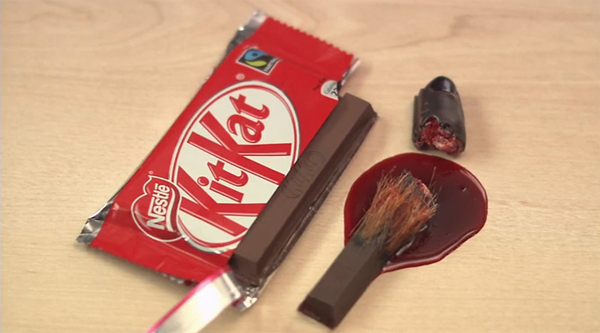
Kit Kat using palm oil/destroying the forest—a parody in which a consumer bit into a Kit Kat and blood came out of it—but acting against it would cause even more negative attention.
 |
| Greenpeace bleeding Kit Kat ad |
Ricolfi: surveys may be suppressed if unfavorable, as with pharmacos that only report favorable results. This is still an important practical question.
Mike Grynberg: Gets to whether we’re talking about the consumer or the public. The consumer is a Swiss Army knife, used to define a lot of aspects of TM. We need a construction of “consumer,” and certain incarnations are workable. Average/reasonable consumer can work for confusion at the point of sale, but it’s too narrow when thinking about overarching policy issues of competition, free expression. Judges are boundedly rational, though, and it’s hard to think outside of that construction to broader concerns.
Bill McGeveran: We could say: we have a question about TM. Should we look at consumer reaction or at something else? The American system will go ahead and recognize TM rights in lots of nontraditional TMs, and worry downstream about exempting certain kinds of uses. European system may categorically reject some kinds of symbols. Where we deploy the consumer is a distinct Q from who that consumer is once the decision is made to deploy her. Sometimes we may simply reject asking the consumer. (RT: Though it’s super hard for judges to avoid the impulse to say “and the consumer isn’t likely to be confused anyway,” e.g. in cases like Rogers v. Grimaldiwhere there are empirical claims alongside the normative ones.)
Graeme Dinwoodie: are there some doctrines that are inappropriate for using consumers in the first instance? Goods w/which the mark is likely to be used, or goods we’re comfortable giving rights in for a 5 year period to the TM applicant? Q of whether a mark is identical for purposes of double identity—does that address consumer perception? One court said yes, and that the consumer should know that if they find it identical then there will be infringement w/o confusion: but why put that in the consumer lens? My sense is that it’s more likely to be inappropriate to invoke the consumer at the registration context.
McGeveran: Functionality in the US.
Jennifer Davis: aren’t Europeans more likely to take the consumer into account in registration, opposite to what Dinwoodie wants?
Dinwoodie: yes for acquired distinctiveness, maybe not elsewhere.
Stacey Dogan: Traffix/functionality deals w/ policy issues not endogenous to TM law. Even though the SCt in Dastar purported to make claims about consumer expectations, it was really about the right to copy after a work enters the public domain. Societal interests distinct from market based transactions that sometimes ought to be taken into account. Bizarre blending of rationales, but deference to ©’s public domain was institutional deference.
McGeveran: speech concerns in the US, Rogers v. Grimaldi, explicitly recognizes that we wouldn’t care about confusion if the factors were met.
Jessica Litman: Not sure whether this is a shift as opposed to a pendulum, but in past 10 years we’ve seen a backing off from normative considerations to override our sense of empirically what the consumer is about. Example: scandalousness. At one time, the TTAB would just look at the mark and say it’s scandalous. Redskins: lots of empirical evidence, and resistance to taking seriously what it showed; but now it seems pretty likely that the Fed. Cir. will say it’s unconstitutional to have that bar in the statute at all; if consumers perceive it as a mark, it’s a mark, and the gov’t lacks any interest in saying that’s inappropriate. Looks like a retreat from a notion that the public interest has some say in what can be a TM separate from what consumers perceive.
Dirk Visser: Fact that © ends is something the public doesn’t understand. Come to believe that everything is licensed (except parody), and the artificial limitation of time is not internalized by them. They could accept it if told, but they wouldn’t have an opinion on it and would assume you need a license for any character T-shirt, whether or not the character was in the public domain.
Barton Beebe: Functionality and genericism (a version of functionality), where courts look to dictionaries; the test can be much more formal than consumer focused, though surveys are also used. Dastar. Dead presidents: bar on registering name until widow/widower dies. And the issue of GIs. Even though Americans consider “champagne” generic, the US is going to try to phase it out: imposing on democratic society a hierarchical system, b/c we agreed with the French. (RT: Should that violate the First Amendment?) Also the US right of publicity. Fed court says confusion doesn’t matter; therefore Rogers v. Grimaldi also doesn’t apply b/c right of publicity is about misappropriation.
Compare PHOSITA, or more discerning observer in copyright law. Anchor of © is the reader/audience—interesting to consider comparisons.
Eveready survey: do you think the D needed permission from the P for this use? Legal question but we ask it of consumers and courts accept that.
Ansgar Ohly: do/should we consider the consumer in questions of use as a trademark? ECJ: TM use is being dissolved and collapsed into the normative “functions” of a TM theory. Moving away from investigating what consumer actually thinks.
Acquired distinctiveness: Q arises whether this finding can be corrected by public policy concerns; clash between German and European approaches. German: more public policy concerns = higher distinctiveness required. ECJ has rejected this time and again; reluctant to get into fact specific investigations of what consumers think, perhaps b/c it’s only in charge of the law.
Always market integration is in the back of the mind of the ECJ so the image of the normative European consumer may be a more important referent for them.
Kur: but they still insist all these questions are questions of fact that they then hand back to the national courts: a real contradiction.