two “kills 99.9% of germs” cases, divergent results

Mier
v. CVS Pharmacy, Inc., 2021 WL 1559367, No. SA CV 20-01979-DOC-ADS (C.D. Cal.
Mar. 22, 2021)

Another
pandemic case, this one alleging that CVS’s Advanced Formula Hand Sanitizer
misleads consumers by representing that it kills 99.99% of germs. The front
label read “Kills 99.99% of Germs*.” The asterisk referred to language on the
back label: “*Effective at eliminating 99.99% of many common harmful germs and
bacteria in as little as 15 seconds.” Mier alleged that many types of germs are
not killed by alcohol-based hand sanitizers and that no scientific evidence
supports the claim that alcohol-based hand sanitizers kill 99.99% of all germs.

He
properly alleged an injury in fact, and plausibly alleged misleadingness. This
was not a lack of substantiation claim: Mier alleged the existence of scientific
studies that show that hand sanitizer doesn’t kill 99.99% of all germs, that
certain types of bacteria are becoming alcohol-resistant, and that
alcohol-based hand sanitizers do not kill many non-enveloped viruses, bacterial
spores, and protozoan cysts.

But
would a reasonable consumer, reading the labels as a whole, interpret them to
mean that the product “kill[s] every conceivable disease-causing microorganism”?
The back label couldn’t, for purposes of a motion to dismiss, take away the
alleged falsity of the front. “If anything, as the Plaintiff suggests, the
mention of the Product’s speed and efficiency on the back label may be read as
an additional claim, having the effect of reassuring a consumer of the
Product’s efficacy.” Anyway, reasonable consumers aren’t required to look for
corrections to the front in small print on the back.

There
was also no preemption by the FDCA, despite a lot of regulation of
antimicrobial products. Nothing about the case required interpretation of
federal law or regulation.

Under Sonner,
Mier could seek equitable relief under FAL and UCL to the extent that his
claims are premised on alleged future harm.

Souter v. Edgewell Personal Care Company, — F.Supp.3d —-,
2021 WL 3892670, No. 20-CV-1486 TWR (BLM) (S.D. Cal. Jun. 7, 2021)

Plaintiff alleged that advertising for Wet Ones
misrepresented that the hand wipes kill 99.99 percent of germs and that the
hand wipes are “hypoallergenic” and gentle.” The court dismissed the claims.

For the efficacy representations, plaintiff alleged that the
active ingredient in these hand wipes, benzalkonium chloride, is ineffective
against certain viruses, bacteria, and spores, which comprise more than 0.01
percent of germs and can cause serious diseases. “Some of those diseases
include polio, norovirus, human papillomavirus, picornavirus, crypotosporidium,
and C. difficile,” as well as COVID-19. For the skin safety representations,
plaintiff alleged that the hand wipes contained ingredients that are “known
allergens or skin irritants.”

The court first got rid of defendants’ dumb argument against
standing: that Souter never got sick or suffered skin damage due to the hand
wipes, which of course is not required for constitutional or statutory standing
under the usual California statutes. Likewise, Rule 9(b) was satisfied.

However, the allegations didn’t plausibly plead that a
reasonable consumer would be misled.

Efficacy:

No reasonable consumer would
believe that a hand wipe advertised to kill 99.99 percent of germs would be
effective against the bacteria and viruses that Plaintiff names. For example,
Plaintiff does not explain how or why a reasonable consumer would take a hand
wipe’s representation that it kills 99.99 percent of germs to mean that it
would also be effective against HPV, a sexually transmitted disease, or the
norovirus and polyomavirus, which are food-borne illnesses. It also seems
implausible that a reasonable consumer would believe that a hand wipe would be
effective against polio, a virus that has not had an active case in the United
States since 1979. … If anything, a reasonable consumer would likely suspect
that a hand wipe would be effective against bacteria often found on hands, and
Plaintiff has not alleged how likely these strains of bacteria appear on hands.

Skin safety:

No reasonable consumer would read
“hypoallergenic” and “gentle” to mean that it is completely free of ingredients
that can cause an allergic reaction. … And what is more, a reasonable consumer
may not even think those words suggest anything about the hand wipes’
ingredients as opposed to the hand wipes’ performance. In other words, a
reasonable consumer may take “hypoallergenic” and “gentle” to mean something
about the effect of the hand wipes when applied on the skin—i.e., that it would
not cause skin irritation and be smooth and gentle—regardless of its
ingredients, such as whether they contain skin irritants. Either way,
“hypoallergenic” and “gentle” do not suggest anything about how the hand wipes
may affect the central nervous system, lungs, eyes, kidneys, or the liver, as
Plaintiff argues here.

However, there was no preemption, and the doctrine of
primary jurisdiction didn’t warrant avoiding a decision. As to the latter,
misleadingness is “not a technical area in which the FDA [has] greater
technical expertise than the courts.” As to preemption, the plaintiff wasn’t
asking the court to impose additional labeling requirements, but challenging
the present label as misleading.

from Blogger https://ift.tt/3hD8JH1
Posted in Uncategorized | Tagged , , , | Leave a comment

LinkedIn posts weren’t commercial advertising or promotion for pediatric orthopedics

Orthopediatrics Corp. v. Wishbone Medical, Inc., No.
3:20-CV-929 JD, 2021 WL 3887243 (N.D. Ind. Aug. 31, 2021)

Plaintiffs “have an interest in a patented computer program
that allows medical professionals to more easily determine the correct way to
position bones for optimal healing after orthopedic procedures.” They alleged
that defendants copied the program and infringed the patent, as well as engaged
in a smear campaign against plaintiffs in an effort to steal market share in
the pediatric orthopedic industry. I’m only going to discuss the false
advertising aspects.

There is an ongoing, separate litigation about ownership of
the relevant patent; plaintiffs alleged that the two inventors assigned the
patent to plaintiff Orthex. Defendants allege that one inventor was
contractually bound to disclose and assign to a separate entity any patent he
received related to his work on the idea. There was ongoing litigation in
Florida in which that entity, IMED, was suing the inventor and two of the
instant plaintiffs over the alleged breach.

Plaintiffs alleged that Wishbone employees—including a
former OrthoPediatrics employee—engaged in a smear campaign mostly on FB and
LinkedIn, including by sharing “articles and reports on the ongoing Florida
state court case and another Indiana state court case OrthoPediatrics brought
against Wishbone and a former employee.” When one employee shared an article
about the Indiana state court litigation, Wishbone’s COO/Secretray/Treasurer
commented on the post “suggesting that OrthoPediatrics was following former
employees in an effort to ruin their lives.” The poster added a comment of his
own stating “[t]he only way [OrthoPediatrics] can compete is to constantly
harass us with lawsuits. It is sad.” In another comment, he stated that
OrthoPediatrics had been bullying Wishbone for years and that the company was
engaged in “evil behavior.” And in another LinkedIn post, he wrote comments
that were supportive of the claim that OrthoPediatrics had stolen the patent
and suggested that OrthoPediatrics’ actions in doing so were “just the tip of
the iceberg.”

First, the court found that the litigation privilege—if it
applied to the various claims at issue—would not cover these statements, which
were too remote from actual litigation. Social media posts “sharing articles
about the state cases and by offering their own, often negative, statements as
to what the litigation says about OrthoPediatrics as a company” would not be
covered, nor would the other communications alleged in the complaint (an email
saying the employee’s “goal with litigation was to put pressure on
OrthoPediatrics’s stock price” and “very general allegations” that Wishbone
contacted current and potential OrthoPediatrics customers to spread
misinformation):

The Defendants have not presented,
and the Court has not found, any case that has extended the litigation
privilege to statements like those at issue here, which at best have a barely
tangential connection to the actual proceedings of the ongoing litigation.
Additionally, there is no evidence that protecting these social media posts and
other communications, even those that are arguably commenting on the ongoing
litigation, would serve the recognized purpose of the privilege to protect free
expression that is integral to the judicial system’s functioning.

Lanham Act claim: Were these alleged statements commercial
advertising or promotion? The answer depends on industry practice. “There is
also no requirement that the communication be broadly distributed to the
public, just that there be some public dissemination as opposed to, for
example, simply person-to-person correspondence.” Although the Seventh Circuit
hasn’t adopted Gordon & Breach, the court looked to that test for
guidance as well. Taken together, the complaint didn’t plausibly allege
commercial advertising or promotion.

First, the court wasn’t convinced that the social media
posts or other alleged statements were commercial speech. (This seems
dodgy—they have the usual obvious economic interest of competitors.) The
statements didn’t themselves propose a commercial transaction. They didn’t
advertise any alternative or promote a specific product. Although one could “infer
a possible economic motivation for a subset of the social media posts,” there
was “no evidence to suggest that the posts were broadly disseminated to consumers
or that they had any economic impact.”

More persuasively, even if this was commercial speech,
plaintiffs failed to plead facts showing that the statements were made to
influence consumers or were disseminated to the relevant purchasing public
within the pediatric orthopedic industry. Plaintiffs never alleged that “social
media is a place where potential customers in the pediatric orthopedics space
go to receive information about companies and products.”

And finally, plaintiffs didn’t adequately allege
materiality. Vague allegations of reputational harm didn’t make clear that the
reputational harm was in the eyes of consumers or that the communications
actually translated to any lost sales or other economic harm.

Defamation: Plaintiffs failed to allege malice, even in a
conclusory way.

from Blogger https://ift.tt/2XkEXjB

Posted in Uncategorized | Tagged | Leave a comment

Weight Watchers’ pandemic termination of in-person services didn’t violate consumer protection law

Quintanilla v. WW Int’l, Inc., 2021 WL 2077935, No. 20 Civ.
6261 (PAE) (S.D.N.Y. May 24, 2021)

Weight Watchers shut down in-person services due to the
pandemic. Quintanilla alleged that WW’s cancellation of in-person services, and
transition of its workshop services online, without issuing refunds or any
reduction in membership fees, violated the usual California consumer-protection
statutes and constituted breach of contract, unjust enrichment, and money had
and received.

WW offered three types of subscription-based memberships:
(1) the Digital Membership, which provided access only to WW’s website and app;
(2) the Workshop + Digital Membership, which added weekly in-person group
workshops led by a WW coach; and (3) the Personal Coaching + Digital
Membership, which added one-on-one personal coaching.

Quintanilla alleged that she chose the Workshop + Digital
Membership “in part, because she wanted to participate in the weekly in-person
support meetings.” WW’s T&C state that “[i]n [WW]’s sole discretion and
without prior notice or liability, we may discontinue or modify any aspect of
the Offerings.”

While Quintanilla had standing to claim damages, she lacked
standing to seek injunctive relief. Her continued subscription couldn’t
manufacture standing now that she knew the truth. She “ ‘will not again be
under the illusion’ that WW would maintain in-person workshops, else sua sponte
reduce prices or issue refunds, during this, or a future, pandemic.”

California consumer protection claims: WW argued that no
reasonable consumer would have taken any statements by WW about its in-person
workshops to mean that “WW would never, even faced with a once-in-a-century
pandemic, modify the in-person aspect of those workshops,” especially given its
terms of service. 

The court agreed with WW. “[N]o reasonable consumer could
have understood such representations to mean that WW promised to keep offering
such services even in the face of a deadly pandemic, and in defiance of
dictates of the civil authorities.”  The
terms of service bolstered this conclusion, reserving the right to modify
services, and would have disabused a reasonable consumer who’d believed otherwise.
(Are reasonable consumers required to read the entire terms of service?) The
T&C also allowed Quintanilla to cancel her membership and seek a refund in
the event of, inter alia, “a Workshop closure.” But she didn’t do so, and WW’s
failure to sua sponte issue a refund was not wrongful.

The breach of contract claim
also failed “for the straightforward reason that her contract with WW does not
mention, let alone promise, in-person workshops.”

from Blogger https://ift.tt/2Z1eKH9

Posted in Uncategorized | Tagged , | Leave a comment

acrimony among right-wing pundits isn’t commercial advertising or promotion

Corsi v. InfoWars, LLC, 2021 WL 2115272, No. A-20-CV-298-LY
(W.D. Tex. May 25, 2021) (R&R)

This is a defamation case with a Lanham Act chunk. The
parties are various right-wing public figures. Plaintiffs alleged that, in
InfoWars videos, Alex Jones made false claims that Corsi “seemed to be
extremely mentally degraded to the point of … dementia,” had a stroke, and
does not tell the truth, and Roger Stone falsely stated that Corsi was fired
from a prior job, is an alcoholic, often lies, is willing to perjure himself,
and is a “deep state” operative and a “fraud” who seeks to make political
conservatives look bad. Stone also allegedly attacked plaintiff Larry Klayman’s
reputation, stating that Klayman “could be the single worst lawyer in America,”
has “never actually won a courtroom victory in his life,” and is an “idiot” and
an “egomaniac.”

Plaintiffs alleged that they were competitors of defendants
“as conservative media personalities, broadcasters, authors and columnists on
social media and elsewhere.”

Dealing only with the Lanham Act claims: Plaintiffs’ alleged
injuries didn’t fall within the Lanham Act’s zone of interests. As other courts
have held, “[t]he mere fact that the parties may compete in the marketplace of
ideas is not sufficient to invoke the Lanham Act.” This was not commercial
advertising or promotion, but rather “expressions of opinions as commentary
during a radio show.” (Is failure of the defendant to engage in commercial
advertising or promotion really the same thing as failure of the plaintiff to
allege that it falls within the statute’s zone of interests? Doesn’t matter a
lot, but the court does seem to conflate them.)

from Blogger https://ift.tt/3Ely95B

Posted in Uncategorized | Tagged | Leave a comment

legal memo to existing customers wasn’t “commercial advertising or promotion”

IHS
Global Ltd. v. Trade Data Monitor, LLC, 2021 WL 2134909, No. 2:18-cv-01025-DCN
(D.S.C. May 21, 2021)

A
trade secret/similar case in which IHS owns a database called Global Trade
Atlas, which it acquired from the people who founded defendants, and you can
basically guess what happened next.

The
false advertising counterclaim arose from a legal memo that IHS sent to
customers who had been contacted by two people on behalf of defendant TDM:

We
understand that you have been contacted by Trade Data Monitor offering an
equivalent service to the Global Trade Atlas. As you may be aware TDM is a
business owned by an individual who sold the GTI business (including the GTA)
to IHS, and TDM also employs a number of former colleagues of IHS [ ]. I’d like
to make you aware that for a number of reasons we have commenced proceedings
against TDM to protect our proprietary and other rights. Notwithstanding any
proceedings we bring against TDM, we remain committed to support you and all of
our GTA customers and to the long-term development of the Global Trade Atlas.

This
wasn’t “commercial advertising or promotion” because, first, it was sent to
only 9 customers, less than 1% of customers, and communicating with “such a
minuscule subset of the relevant market can hardly comprise a ‘sufficient[ ]
disseminat[ion] to the relevant purchasing public.’” Second, the memo was not
“part of an organized campaign to penetrate the relevant market.” It was “a
responsive communication to existing customers” rather than “an active
advertisement intended to penetrate a market.”

Nor
did the memo breach the nondisparagement clause in the parties’ contract. It
didn’t “unjustly discredit” the principal or “detract” from his reputation; it
didn’t even say that defendants violated the law or breached a contract.

from Blogger https://ift.tt/396I6FQ

Posted in Uncategorized | Tagged | Leave a comment

Peloton’s innovation claims were puffery, but music ads were a problem

Peloton
Interactive, Inc. v. Icon Health & Fitness, Inc., 2021 WL 2188219, No.
20-662-RGA (D. Del. May 28, 2021)

The
parties “compete in the at-home fitness market and offer products that allow
consumers to attend live and on-demand fitness classes from home.” They’re
fighting over cross-allegations of patent infringement, violation of state
deceptive trade practices acts, and violations of the Lanham Act. I’m only
addressing ICON’s counterclaims for false advertising, not the patent part of
the ruling.

ICON
counterclaimed that Peloton has made false claims in advertisements regarding
its status as an innovator and as a tech company, e.g., that it was a “very
hardcore technology company. We make a tablet computer better than apple … We
are as hardcore of a tech shop as anything in NYC right now.” Peloton also
stated that was Bike is the “first of its kind.” ICON said this was false
advertising, particularly because Peloton licensed the relevant technology from
ICON. “Innovator” and “hardcore technology company” were non-actionable puffery.
So was “first of its kind,” apparently for vagueness/bluster reasons.

ICON
also challenged statements by Peloton’s CEO implying that Peloton has no
competitors, such as “Nobody else provides them, so we’re kind of a category of
one.” These too were broad, generalized claims of superiority without any
reference to a specific product or characteristic.

Finally,
ICON alleged that Peloton engaged in a misleading, bait and switch advertising
scheme with respect to the availability of music on its platform. Though none
of the cited ads referenced any artist or song in particular, the court
understood ICON to be alleging “that the playlists linked in the Instagram
posts contained music that Peloton lacked a license to or soon removed from its
platform.” Peloton rejoined that its challenged Instagram posts “advertise only
the availability of Peloton’s playlist feature.” 
These
claims did survive. “Telling consumers that they can ‘find the perfect tunes
for [their] on demand ride[s]’ and ‘see the artists and songs powering your
on-demand rides’ and linking to specific playlists reasonably suggests that the
songs contained in the playlists are available on Peloton’s platform.”

State-law
claims were treated similarly.

from Blogger https://ift.tt/396I00W

Posted in Uncategorized | Tagged , | Leave a comment

gold buyer’s “up to 90%” payment claims were plausibly misleading

Express
Gold Cash, Inc. v. Beyond 79, LLC, 2020 WL 9848431, No. 18-CV-00837 EAW
(W.D.N.Y. Dec. 15, 2020)

Previous opinion. 
The parties compete in the market for buying gold from ordinary people.

In
2010, the Today Show—a morning television show aired on the NBC network—aired a
segment in which it mailed a single item of gold to ten different mail-in
precious metals dealers and compared the prices offered. The Today Show
received the highest offer from Defendant, which offered 90% of market value.
From 2011 to the present, Defendant has published various advertisements
stating that it is ranked or rated “#1” by the Today Show.

Previously,
some false advertising claims were dismissed, but claims “based on the Today
Show-related advertising” were sufficiently pled. Plaintiff sought to amend the complaint, omitting, inter alia, claims
regarding “latest payouts” stock photographs but adding allegations that
defendant “deceives customers by falsely advertising on its website that it
offers the ‘highest payouts in the industry’ and ‘will pay you … up to 90%
for your precious metals.’ ” It sought to add additional allegations about
customer reviews and test transactions, and about how defendant’s business
operations materially changed since 2010.

Proposed
new claims regarding defendant’s statements that it pays “up to 90%” of the
value of gold and has the “highest payouts in the industry” were not futile. Plaintiff
detailed three test transactions in which the potential sellers were initially
offered 33-53% of the value of their gold items, only receiving final offers of
up to 87% of the items’ value after a series of negotiations in which the defendant
was unresponsive and gave false information. While the proposed complaint
didn’t plausibly allege literal falsity—it didn’t show that defendant never
pays 90% and it didn’t provide context on standard payouts in the industry—it
did plausibly allege misleading advertising. That’s a question of fact.
Further, the plaintiff identified “specific customer reviews that evidence
confusion regarding the prices paid by Defendant, including reviews stating ‘[Defendant]
should do what they advertise and pay 90% of what the gold/jewelry is worth,’”
etc. These specific factual allegations were sufficient to make it plausible
that consumers were confused or misled.

The
defendant argued that these allegations improperly to hold it liable for
“statements made directly to individual consumers.” True, wide dissemination is
required for commercial advertising or promotion, but the ads challenged here
were statements on defendant’s public webpage and otherwise disseminated to the
public; individual consumers’ complaints were evidence of those statements’
effects.

Nor
was the court persuaded that “highest payouts in the industry” were mere
puffery or opinion. Particularly when coupled with the specific assertion that
such payouts were up to 90% of an item’s value, that wasn’t vague or
unbelievable.

from Blogger https://ift.tt/3AcA1vh

Posted in Uncategorized | Tagged | Leave a comment

student social media use of school colors/logo not plausibly confusing

Arizona Board of Regents v. Doe, 2021 WL 3684116, No.
CV-20-01638-PHX-DWL (D. Ariz. Aug. 18, 2021)

Doe, a real asshole (“deeply unsympathetic,” to use the
court’s terms), advertised “ASU Covid Parties” on a similarly-named Instagram
account and spewed a lot of bile as well as, in its first post, using ASU’s
colors. The Board sued Doe for trademark infringement and related claims; Doe
defaulted. Nonetheless, the court—correctly—refused to allow the Board to expand
trademark and false advertising law to this conduct. The only evidence of
actual confusion was a tweet: “#ASU having COVID parties and claiming it’s a
hoax? I am stopping my alumni [membership] and removing my alumni sticker from
my car and sending back my ASU alumni plate. I am embarrassed to be associated
with thus [sic] ignorant behavior.”

Interestingly, Instagram allegedly refused a TM takedown
request because “the reported party appears to be using your trademark to refer
to or comment on your goods and services,” despite persistence by ASU’s outside
counsel.  However, when the Board sued
and moved for a TRO, Facebook agreed to disable the “asu_covid.parties” account
and prevent the accountholder from creating new accounts, so the Board agreed
to dismiss it as a defendant.

All of ASU’s claims required likely confusion or deception.
That just wouldn’t happen to a reasonably prudent consumer. Only one post, the
first, used ASU’s distinctive maroon and gold colors and ASU’s logo, and the
surrounding context would prevent likely confusion. The accountholder posted
the first two comments in the thread, the second of which was: “Those of you
coming back to Phoenix. We about to get fucking lit.” “Although it is not
uncommon for universities to attempt to appeal to students by imitating their
vernacular, no university would drop the f-bomb in an official party
invitation,” and a reasonable consumer would not have thought ASU was inviting
them to get drunk. “Many of the subsequent messages from the ‘asu_covid.parties’
account affirmatively criticized—often in profane and vulgar terms—ASU’s
leadership and official policies. … Many things can be said about these
offensive and outrageous statements, but it is not plausible (to put it mildly)
that a reasonably prudent consumer would believe ASU was the source or origin
of them.”

Although the one tweet called out “#ASU,” it wasn’t clear
from the “haphazardly worded tweet” whether this individual was actually
confused or simply disgusted that ASU students were sponsoring COVID parties.
Even assuming that 0.0002% of the alumni base believed that the profanity-laden
posts were actually coming from ASU, that didn’t show confusion. “Tellingly,
the comments to the posts suggest that readers believed the ‘asu_covid.parties’
account belonged to a student or group of students, not the university.” And
Doe “expressly identified himself as a community advisor (i.e., student) and
railed against ASU’s administration and official policies.”

Even if other factors like strength of the mark and
similarity of marketing channels favored the Board, “the remaining Sleekcraft
factors are unimportant” in a case, such as this one, where “no rational trier
of fact could find that a reasonably prudent consumer…would likely be
confused.”

What about initial interest confusion? It didn’t apply
because even the initial post using maroon and gold  “was too crude and profane to create initial
confusion as to its source and origin.” But, “[m]ore broadly, it cannot be the
case that every social media post written by a college student that happens to
use the school’s colors and/or logo in the post, and identifies the school’s
location as the location of the poster, creates initial interest confusion and
qualifies as an actionable trademark violation.”

State trademark dilution: the court, somewhat
disappointingly, declined to exercise jurisdiction over the claim rather than
resolving it.

from Blogger https://ift.tt/3hPIsFN

Posted in Uncategorized | Tagged , | Leave a comment

infant/child painkiller case dismissed as preempted

Youngblood v. CVS Pharmacy, 2021 WL 3700256, No.
2:20-cv-06251-MCS-MRW (C.D. Cal. Aug. 17, 2021)

Another infant/children acetaminophen consumer protection
case. This one dismisses the claims as completely preempted by the FTCA.

Plaintiffs argued that their claims are consistent with the
FDCA and FDA regulations because of the federal prohibitions on false or
misleading labeling. However, a Tentative Final Monograph (TFM) issued by the
FDA in 1988 and rendered a final administrative order under the FDCA in 2020
was more specific. TFM prescribes labeling requirements for over-the-counter
analgesics for children, including acetaminophen. It directs that products for
children between two and 12 years of age be labeled “for Children,” bear
specific warnings for that age group, and provide specific dosing instructions
for different age ranges. Products for “[c]hildren under 2 years” must bear the
instruction “[c]onsult a doctor.” A drug complying with the TFM and general
labeling regulations “is generally recognized as safe and effective and is not
misbranded.”

One recent case with the same theory rejected preemption on
the same grounds, while another found preemption. The court here found that the
plaintiffs’ theory sought to do more than bring the packaging at issue in line
with federal requirements. Plaintiffs complained that the infants’ product,
which is labeled for children between two and three years of age, “does not
state that it is … the same medicine contained in the Children’s Product.”
They sought “clear disclosures that there is no pharmacological distinction
between ‘Infant’s Product’ and ‘Children’s Product’ and that the two products
can be used interchangeably in a manner that is safe to infants and children
alike.” They didn’t explain how these requirements were identical to the
requirements of the 1988 TFM. A win for them would penalize CVS for not making
“representations beyond what the 1988 TFM requires for children’s acetaminophen
products.”

from Blogger https://ift.tt/2VAHyoq

Posted in Uncategorized | Tagged , , , | Leave a comment

two Zillow false advertising cases, divergent outcomes

REX – Real Estate Exchange Inc. v. Zillow Inc., No. C21-312
TSZ, 2021 WL 3930694 (W.D. Wash. Sept. 2, 2021)

Rex sued Zillow and the National Association of Realtors for
antitrust and false advertising violations. Surprisingly, the antitrust claims
survive, as do false advertising claims agains Zillow.

NAR “is the nation’s largest trade association for real
estate professionals.” Membership includes multiple listings services (MLSs).
NAR’s optional Segregation Rule requires members’ listings obtained through
MLSs internet data exchange feeds to be “displayed separately from
listings obtained from other sources.” NAR also adopted a mandatory rule that
requires a seller’s agent to include in any MLS listing a predetermined offer
of commission to a buyer’s agent, thereby prohibiting any party from later
modifying that commission. “NAR’s members allegedly encourage their customers
to offer high commissions for buyers’ agents, resulting in historically high,
static commissions throughout the United States, with total commissions
averaging about 5.5 percent of a home’s sale price.”

REX is a licensed broker that employs licensed real estate
agents across the nation, but it is not a member of NAR or any MLS and thus has
not agreed to comply with any of NAR’s rules. Home sellers who choose REX’s
services can negotiate a buyer agent commission, and thus pay a total average
commission of 3.3 percent of a home’s sale price. REX lists its customers’
homes on various real estate aggregator websites, including two of Zillow’s
websites, Zillow.com and Trulia.com, the first and fourth most visited real
estate aggregator sites in the US. REX’s listings were historically displayed
on Zillow’s primary search page alongside the listings of MLS participants.

But then “the growth and substantial inventory of
Zillow-owned homes placed Zillow in a new position: Instead of focusing on
being an open access point for consumers to display and access residential real
estate listings, Zillow’s interests turned to its own substantial home
inventory.” In late 2020, Zillow announced that it would join forces with NAR
and several MLSs, publicly committing that “all Zillow-owned homes will be
listed on the MLSs with commissions paid to agents representing buyers.” NAR’s mandatory
Buyer Agent Commission Rule is allegedly the “paramount reason that real estate
commissions are two to three times higher in the United States than in
comparable international markets.” Zillow also announced that it would begin to
use MLS data feeds to populate its websites.

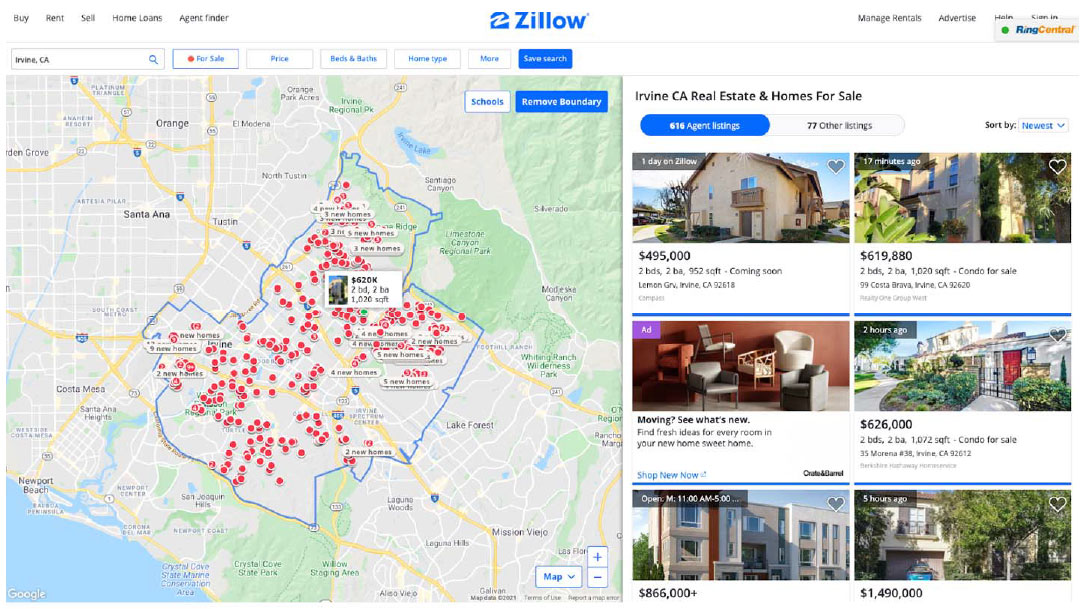
Zillow’s redesigned website, complying with NAR guidelines,
created a separate page or tab, called “Other listings,” that is concealed
behind the primary results page or tab, called “Agent listings.” As a result, consumers see only a portion of available homes
at a time. Even though REX’s customers’ homes are all listed by licensed real
estate agents, its lisitngs are now in “Other listings” rather than “Agent
listings.” REX alleged that this was deceptive and harmful, and resulted in
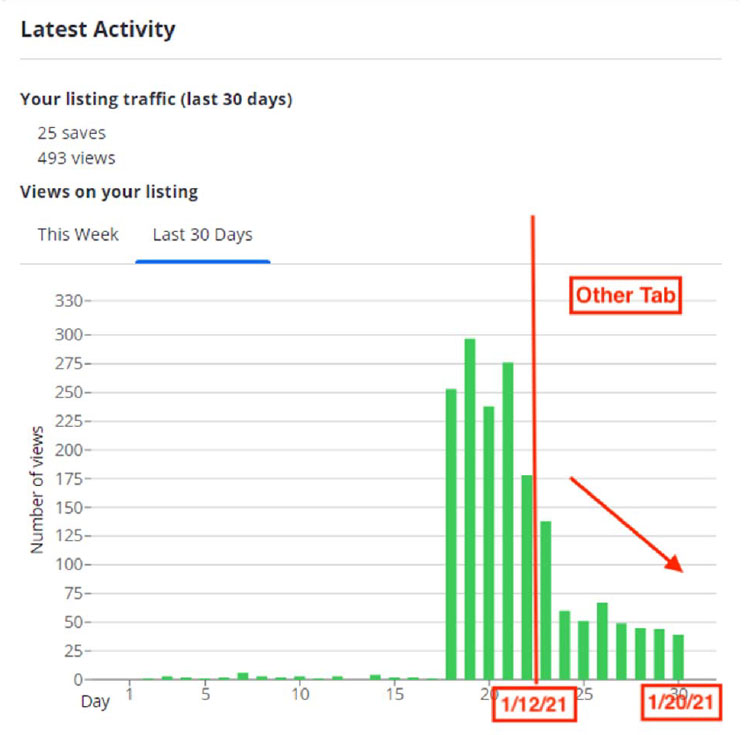
views plummeting on Zillow’s websites, causing “a corresponding drop in sales
and…lost brokerage service revenues to” REX.

redesigned tab; “other listings” in gray, top right

views after the change

The court found that the antitrust claims were sufficiently
well pled.

Lanham Act claim: Was this commercial advertising or
promotion? The key question was the Gordon & Breach element asking
whether the challenged commercial speech was “for the purpose of influencing
consumers to buy defendant’s goods or services,” a requirement not affected by Lexmark.

The complaint alleged that Zillow joined the NAR and MLSs to
promote its inventory of Zillow-owned homes. It then changed its websites to
comply with the new MLS rules and insulate MLS brokers from competition. The
allegations that Zillow adopted the misleading labeling system “for the purpose
of influencing its customers to use the Zillow Offers business, as well as the
services of other MLS agents, by concealing or discouraging the services of
non-MLS agents like Plaintiff,” were sufficient.

However, REX failed to state a Lanham Act claim against NAR.
“There are no other allegations explaining what NAR did to design or encourage
this particular labeling system on Zillow’s websites, let alone when, where,
and how NAR did it.”

So too with the Washington Consumer Protection Act claims.
Zillow argued that its conduct was “reasonable in relation to the development
and preservation of [its] business.” That was a factual issue inappropriate for
a motion to dismiss, even if such a business purpose defense was available. But
NAR got off the hook for the same reasons as with the Lanham Act claim. 

Picket Fence Preview, Inc. v. Zillow, Inc., No.
2:21-cv-00012, 2021 WL 3680717 (D. Vt. Aug. 19, 2021)

Picket Fence, which publishes listings for homes that are
for-sale-by-owner (FSBO), alleged that Zillow’s policy of providing free online
listings for FSBO homes violated the Vermont Consumer Protection Act and the
Lanham Act and constituted state law unfair competition. The court dismissed
the claims.

“A major incentive for homeowners to advertise with
[Plaintiff] is reaching potential buyers directly through [Plaintiff’s]
publications and avoiding a 6-8% real estate commission” that is typically paid
to real estate agents and brokers. When an FSBO seller lists real property on
Zillow, potential buyers see “Contact Agent” prominently displayed. Agents can
allegedly pay to get their name on the listing or to be the only contact for a
listing. The “Get More Information” tab lists the contact information for
“Premier Agents” first “and the owner is listed at the bottom of the list.”
Zillow allegedly makes it difficult or impossible to contact the owner.

This is allegedly a bait and switch; FSBO sellers “may lose
potential sales” from these listings “because Premier Agents may redirect
potential purchasers to other properties if the [FSBO seller] is not willing to
share a commission with the Premier Agent” or if another property would provide
the Premier Agent with “a better commission.” While Zillow “claims that it is
offering a service for free, [ ] in reality [it] is charging the Premier Agents
so they can advertise on the website of those free ads and receive hijacked
inquiries from deceived buyers.”

Picket Fence, which charges for FSBO listings, allegedly
lost a lot of business to Zillow, and was one of the few remaining FSBO
publications to survive Zillow.

First, Picket Fence lacked standing to sue on behalf of FSBO
sellers.  And it couldn’t sue under the
VCPA because it wasn’t a consumer. Nor could it bring a predatory pricing claim
because it didn’t allege that the free listings weren’t free or below cost, or
that there was a dangerous probability that Zillow would raise prices once competitors
were driven from the market.

Lanham Act claim: Lexmark standing existed, but deception
wasn’t plausibly pled. Picket Fence argued that Zillow misleadingly failed to
“disclose that interested shoppers would be directed to Premier Agents.”
However, since 2017, Defendant’s website has included a disclaimer stating that
“[b]y pressing Contact, [potential buyers] agree that Zillow Group and its
affiliates, and real estate professionals may call/text [potential buyers]
about [their] inquiry.” And Picket Fence failed to identify any representation
that any sales would be “commission free” or any promise that a real estate
agent would not be involved in a subsequent sale. “An FSBO seller remains free
to refuse to deal with a real estate agent and free to refuse to pay a real
estate agent’s commission even if it uses Defendant’s website. Defendant’s
listing focuses only on a preliminary step in a real estate transaction with no
promise as to what happens thereafter. Stated differently, a customer who is
promised a free listing is not promised a commission free sale either directly
or by implication.”

from Blogger https://ift.tt/3npCLBX

Posted in Uncategorized | Tagged , , | Leave a comment