Cal. statutory false advertising isn’t fraud and individual reliance isn’t necessary

Peviani v. Arbors at California Oaks Property Owner, LLC, 2021
WL 1264423, E073950, — Cal.Rptr.3d —- (Ct. App. 2021)

Plaintiffs sought to represent a putative class, bringing
claims against a landlord for (1) false advertising; (2) breach of the implied
warranty of habitability; (3) nuisance; (4) breach of the implied covenant of
good faith and fair dealing; (5) bad faith retention of security deposits; and
(6) unfair competition. The court of appeals held that the trial court erred by
denying certification.

Plaintiffs alleged, inter alia, that defendants’ ads falsely
depicted renovated interiors, “quality plush carpeting,” “sparkling swimming
pools,” heated spas, cabanas and lounges, a tennis/basketball court, a fitness
center, a rock climbing wall, a community game room, a Wi-Fi café, barbeque
grills, a picnic area, a dog park, a playground, a garden, a carwash area, central
heating and air conditioning, assigned covered parking, a 48-hour maintenance
commitment, granite countertops, hardwood floors, full size washers and dryers
in the apartments, controlled access to the property, and a smoke-free
property.

However, the apartments were not newly renovated and
carpeting was not plush. For example, one set of renters “had mushrooms growing
out of their carpet.” Plaintiffs alleged “the fitness equipment was dirty and
broken; the swimming pools were dirty and diseased; the hot tubs were green
with algae; the assigned parking rules were not enforced; the 48-hour
maintenance promise was not kept; there was violence, crime, and drug use in
the area of the barbecues, playground, and dog park; the property was not
smoke-free; and the water connection in the carwash area was non-functioning.”

Defendants argued that common questions didn’t predominate
for false advertising. “For example, Peviani claimed her apartment had rust
stains on the countertop, Judy claimed there was a mushroom growing out of her
carpet, Lubbock asserted his toilet was broken, and Caicedo-Valdez claimed
there was a stain on the bathroom vanity.” The trial court reasoned that
putative class members learned of the property in different ways: “some read
defendants’ website, some toured the property, some read a brochure, and some
drove by the property.” It reasoned: “One class member’s a claim [sic] might be
based upon an oral representation while another’s might be based upon something
stated in a brochure. And the representations could be about different
amenities or services.” There were too many alleged misrepresentations—each one
would have to be assessed for factuality, materiality, and reasonable reliance.

The court of appeals reversed. Statutory false advertising
is not common law fraud. It does not require literal falsity, knowing falsity, reasonable
reliance, or even damages (since restitution and injunctive relief are the only
available remedies). The standard is objective: that “members of the public are
likely to be deceived.” Likewise, materiality is assessed objectively: if a reasonable
person would attach importance to the falsity or omission. The trial court
conflated false advertising with fraud; there was no need for individualized
reliance inquiries, and the trial court failed to discuss the reasonable person
standard, which is relevant to deception and materiality.

This error also infected the habitability/nuisance claims,
which were based on the common areas (allegedly full of dog feces, trash, and
pests) and could thus be assessed as a common question. Because the unfair
competition claims didn’t get separate analysis, the court of appeals also sent
those back.

from Blogger https://ift.tt/3gAMtxb

Posted in Uncategorized | Tagged , , , | Leave a comment

false designation claim doesn’t require distinctiveness, court wrongly holds

Simpson Strong-Tie Company Inc. v. MiTek Inc., 2021 WL
1253803, No. 20-cv-06957-VKD (N.D. Cal. Apr. 5, 2021)

The plaintiff benefits from very generous treatment of its false
designation and copyright claims, in the process stripping false designation of anything other than a prohibition on copying/vitiating both Wal-Mart and Dastar.

Simpson sells structural connectors for use in building
construction. Each product has an individual alphanumeric product name including
a “part name” consisting of a letter or combination of letters designating the
product line, and a “model number” consisting of additional numbers and letters
appended to the part name to distinguish between various models of a particular
part with different attributes. Its Wood Construction Connectors Catalog
contains an alphabetical product index and various charts specifying various
attributes of Simpson’s products, listed by product names. It registered
copyirghts in its catalog and supplements.

Simpson alleged that MiTek’s products were “knock-offs or
close copies” of Simpson’s products that are not equivalent to or substitutes
for Simpson’s products due to the patented nature of some of Simpson’s
technology. MiTek’s 2020 Catalog allegedly uses Simpson product names as a
basis for MiTek’s own product names and includes an alphabetical reference
index using Simpson product names as reference numbers, deceiving consumers
into believing that the companies’ products are equivalent and interchangeable
when they are not, or that MiTek’s products are actually Simpson’s products.

MiTek argued that a product name cannot be proven true or
false, but the court agreed that Simpson had sufficiently pled that placing the
parties’ products next to each other in this way created a false impression
that the parties’ products are “equivalent or otherwise interchangeable.”

Passing off: MiTek argued that Simpson didn’t plead inherent
or acquired distinctiveness, and Simpson responded that the Lanham Act protects
even generic marks from “false designation of origin.” [You know it’s going to
be bad when a court says “generic marks,” a noncategory.] The court agreed! It
was enough to allege that (1) MiTek’s use of Simpson product names as MiTek’s
own product names falsely identifies MiTek products as Simpson products, and
(2) MiTek’s use of Simpson’s product names as reference numbers for MiTek’s own
products in MiTek sales and marketing literature creates a false impression
that MiTek’s products are in some way connected to or associated with Simpson. Comment: this is entirely junk reasoning, since there can be no false identification without distinctiveness (that is, identification)–the genericity cases require “de facto secondary meaning” in the absence of legally protectable secondary meaning, and they also limit the available remedies to clear disclosure. 

Copyright infringement: MiTek argued that the portions of
the catalog it allegedly copied—Simpson product names and the alphabetical
index of Simpson products—were not protectable. Although originality is a
question of fact, sometimes you can just look at the accused and accusing work.
Though there were “serious questions” about the originality of the product
names and alphabetical index, it wanted a fuller record before saying that the names
and alphabetical index weren’t sufficiently original as a matter of law.

The state law claims also survived; as a competitor, Simpson
didn’t have to plead its own reliance under the UCL.

from Blogger https://ift.tt/3znwFF4

Posted in Uncategorized | Tagged , , , | Leave a comment

pharma database isn’t commercial speech about listed products

Alfasigma USA, Inc. v. First Databank, Inc., 2021 WL 930453,
No. 18-cv-06924-HSG (N.D. Cal. Mar. 11, 2021)

Previous
opinion.
Alfasigma makes medical foods, which are allegedly not properly
described as OTC. It sued First Databank for coding implemented in the latter’s
pharmaceutical database:

Historically, the “class value”
field in the MedKnowledge database indicated whether manufacturers identified
their products as prescription-only. Code “F” identified product labels that
indicated a prescription was required, and “O” identified when the product
label did not contain any dispensing limitations. Plaintiff alleges that
subscribers “universally understand[ ] that a product designated ‘O’ is an
[over-the-counter (“OTC”) ] drug, available over-the-counter and without
physician supervision.”

Although Alfasigma’s products were historically designated
as F, First Databank reclassified them as O.

This allegedly falsely represented that they were available
OTC, “when in fact they are available by prescription, and should not be taken
by a patient without physician supervision.” Then First Databank created a new
class value, Q. Q was to be for “Products that are neither drugs nor devices,
such as dietary supplements (including prenatal and other vitamins), medical
foods, herbal preparations, and bulk flavorings or colorants.” This was allegedly
still false and misleading, and First Databank allegedly falsely advertised
that it “compile[s]” the relevant information in its database and for its
coding determinations from the FDA and from manufacturers, such as Alfasigma.

Alfasigma sued for false advertising and contributory false
advertising under the Lanham Act and related state law claims. Previously, the
court denied First Databank’s anti-SLAPP motion because Alfasigma had shown a
reasonable probability of success on the merits of its state law claims, but
had not plausibly alleged that the coding changes were made for the purpose of
influencing subscribers to purchase First Databank’s own products or services,
as required under the Lanham Act. Alfasigma amended its complaint.

The 9th Circuit applies the motion to strike and
attorneys’ fees provisions of the anti-SLAPP statute to state law claims in
federal cases because there is no “direct collision with the Federal Rules,” but
the court still expressed the concern that this interpretation of the statute
“vastly understates the disruption when federal courts apply the California
anti-SLAPP statute,” particularly as it interacts with Rule 12 and its
plausibility standard.

Alfasigma continued to allege that the recoding decisions
were false and misleading, and that First Databank misrepresented that the FDA
and manufacturers were the source of the information in the database.

Previously, the court found that Alfasigma sufficiently alleged
that the database constituted commercial speech for purposes of surviving the
motion to strike, but (1) now there are additional allegations, and (2) Ariix,
LLC v. NutriSearch Corp., 985 F.3d 1107 (9th Cir. 2021), provided further
guidance, so the law of the case did not control.

The database provides information about third-party
pharmaceutical products, not First Databank’s own products. Other third parties
then use this information to determine which products to prescribe and
dispense, and to decide whether to reimburse for these pharmaceutical products.
This isn’t a traditional ad; representations about the database may be ads, but
that doesn’t make the database itself an ad. There were product references in the
database, but that didn’t establish that it was commercial speech, so the court
turned to defendant’s motivation for the speech.  Alfasigma alleged that it was commercial
because (1) “pharmaceutical product manufacturers and distributers have…come
to rely on [the] database as a crucial promotional channel for their products”;
(2) the database is directed toward third parties “to influence their decisions
whether to prescribe, purchase, dispense and/or pay for” Plaintiff’s products;
and (3) Defendant collaborates with its subscribers in making changes to the
database.

Alfasigma persuasively alleged that the database is critical
to the billion-dollar pharmaceutical industry. “These allegations, however,
only underscore that third parties—not Defendant—use the information contained
in the database as part of their own commercial transactions.” First Databank
didn’t make any of these economic decisions itself. Alfasigma maintained that
First Databank’s editorial decisions in maintaining and updating the database were
driven by subscribers’ feedback, and that Defendant “generates revenue by
selling subscriptions to MedKnowledge.” First Databank allegedly decided to
change the class value of Alfasigma’s products at least “[i]n part to satisfy
the preferences of certain customers….” But a profit motive didn’t
distinguish First Databank from a newspaper.

Ariix, which found that a guide to supplements was
commercial speech, emphasized that its decision was “a narrow one that is tied
specifically to the troubling allegations in this case,” involving payments to
the CEO for better reviews and similar pay-to-play allegations making the guide
a disguised ad rather than true editorial content. Here, by contrast, there was
no allegedly hidden financial arrangement; First Databank just made more money
from more sales. Alfasigma argued that many pharmacy benefit manager customers
preferred to have products O-rated so they didn’t have to reimburse patients
for their costs, so at least some subscribers wanted medical foods recoded. But
which products were covered by which insurance wasn’t within First Databank’s
control, nor did Alfasigma allege that it was compensated more based on whether
specific claims were paid or denied. Under Alfasigma’s logic, “any speech could
be commercial if eventually relied on by third-party actors who conduct
business.” That was too extensive, so the claims all failed.

Even if the database were commercial speech, the
coding-based Lanham Act claims independently failed for want of “commercial
advertising and promotion.” After Lexmark, the test seems to be: “(1)
commercial speech, (2) for the purpose of influencing consumers to buy
defendant’s goods or services, and (3) that is sufficiently disseminated to the
relevant purchasing public.” The failure here was on (2): Alfasigma didn’t
plausibly allege that the database was created for the purpose of influencing
consumers to buy First Databank’s goods or services. The court saw an
inconsistency in Alfasigma’s theory that sounds more like heterogeneity to me:
while some subscribers would benefit financially if the coding changed,
Alfasigma alleged that other subscribers were confused, and “did not know that
[Plaintiff’s] recoding was a commercial decision intended to enhance the
profits of PBM and insurance company customers, rather than based on
information from the FDA or [Plaintiff].” The FDA’s medical director even
“expressed concern” that “patients…are losing or have lost insurance coverage
for their products marketed as medical foods” because “their insurance
providers belie[ve] that the products are over-the-counter (OTC) drugs….”

The allegation that First Databank inaccurately changed its
coding to promote its own services wasn’t plausible given that, as Alfasigma acknowledged,
“[i]t is important for [Defendant’s] customers that the compendia services and
products they purchase be accurate.” Confusing subscribers and providing them
with false information that was later challenged by the FDA itself wouldn’t plausibly
promote First Databank’s own products or services. Anyway, “[a]ny publication
would be deemed an advertisement if the defendant had an interest in
encouraging others to purchase it,” so that definition is too broad. Ariix
suggested that something like an agency relationship would be vital, and there
was no indication here that there was such a relationship with the PBMs or other
financial stake in specific sales of a product. “The database does not list any
of Defendant’s own products or additional services. Rather, the database itself
is Defendant’s product.”

Contributory false advertising: First Databank’s representations
allegedly induced its subscribers to falsely advertise that Alfasigma’s
products were “OTC drugs.” “It is unclear in this Circuit if contributory false
advertising can apply to non-commercial speech in any context because the
Lanham Act, as a whole, applies only to commercial speech.” Anyway, because the
database wasn’t commercial speech, this claim also failed; it also failed because
Alfasigma didn’t allege that First Databank knowingly or intentionally induced,
or materially participated in, its subscribers’ alleged false advertising. To
the contrary, Alfasigma alleged how PBMs and insurers have their own incentives
to code its products as “O” and to refuse coverage.

Information source allegations: Rule 9(b) applied because
Alfasigma alleged that the false statements were knowing or intentional. And
the complaint failed to meet the heightened pleading standard because it was “devoid
of specifics about when and where the alleged ‘source’ misstatements were made.”
It wasn’t enough to identify some specific statements like brochures that told
manufacturers, “You tell us. We tell the world,” and undated statements that it
made the changes to be “in alignment with [ ] FDA standards.”

from Blogger https://ift.tt/2WrFqiM

Posted in Uncategorized | Tagged , | Leave a comment

“implied gov’t approval” claims don’t work

ImPACT Applications, Inc. v. Concussion Management, LLC, 2021
WL 978823, No. GJH-19-3108 (D. Md. Mar. 16, 2021)

ImPACT provides training and software, including a proprietary
evaluation system. Immediate Post-concussion Assessment and Cognitive Testing “provides
a neurocognitive test battery that offers healthcare professionals objective
measures of neurocognitive functioning.” Healthcare professionals, including in
schools, teams, and the military, use it to aid assessment and management of
concussions in individuals between the ages of 12 and 59. ImPACT Pediatric is
for patients ages 5-11. They are “the only software-based neurocognitive tests
that have been cleared and designated … as Class II medical devices for use as
an aid in the assessment and management of concussions.”

XLNTbrain seeks to “assess[] neurological activity in
athletes in order to enhance their performance,”  and sells its products to schools, medical professionals,
and sports teams in direct competition with ImPACT.

There are 1.6 to 3.8 million concussions in sports and
recreational activities annually. Traumatic brain injuries account for more
than 2 million emergency room visits per year in the US and contribute to the
deaths of more than 50,000 Americans. In 2019, the FDA issued a safety
communication
, recommending that “people who may be tested for a head
injury, parents and caregivers of people who may be tested, coaches and
athletic administrators, sports medicine specialists and athletic trainers, and
health care providers who assess or diagnose head injuries” should “use only
cleared or approved medical devices to help assess or diagnose a head injury,
including a concussion.” It warned that uncleared products marketed for “assessment,
diagnosis, or management of a head injury, including concussion” violate the
law.

While ImPACT’s products are on the FDA’s list of approved
medical devises for assessing head injury, XLNTbrain’s products are not.

Nonetheless, it allegedly falsely advertised with claims
such as:

• XLNTbrain offers “The First Complete Online Concussion
Test and Management Program for All Sports and Levels.”

• “[C]linical-caliber post-concussion evaluations to monitor
severity and the recovery progress.”

• “XLNTbrain Sport provides clinical-caliber concussion care
giving subscribers a complete solution that’s easy to use, affordable and adds
a ‘virtual neurologist’ for the team.”

• “XLNTbrain offers a complete feature set when compared to
other solutions.”

• XLNTbrain “helps answer the most common question, ‘when
can I play again?’ Dr. Kerasidis created a tool that guides the decision-making
process, giving all-involved individuals a recovery care plan that includes
daily monitoring of symptoms, progressive physical and cognitive exertion
exercises and a timeline to safely return to gameplay.”

Perhaps surprisingly given the seriousness of the claims,
the court found that ImPACT didn’t allege any actionable statements. It grouped
the statements into three categories: (1) false implications of FDA approval;
(2) misleading suggestions that XLNTbrain products possess the qualities of
FDA-approved devices; and (3) statements of superiority. But these were “exactly
the type of claims that are non-actionable under the Lanham Act.”

Courts do not recognize implied government approval
claims in the absence of explicit claims. ImPACT didn’t identify anything
explicit about FDA review or approval in the statements. The Lanham Act can’t be
used to enforce the FDCA.

What about suggestions that XLNTbrain’s products have
qualities that only exist in medical devices cleared by the FDA in providing
screening, return-to-play assessments, diagnosis, and care? Unfortunately,
ImPACT failed to specify what qualities unapproved products can’t have. “Is it
impossible for XLNTbrain’s post-concussion evaluations to be clinical-caliber?
Can only FDA-approved devices provide a Daily Symptom Checklist?” The court
didn’t see why an unapproved product could have the qualities of an
FDA-approved device, especially since ImPACT admitted that FDA approval wasn’t
necessary to compete in the parties’ field. The court could not interpret and
apply the FDCA as part of a Lanham Act case.

Finally, the statements of superiority, e.g. “Beyond
Baseline Concussion Tests” and “The First Complete Online Concussion Test and
Management Program for All Sports and Levels,” weren’t sufficiently alleged to
be false. ImPACT didn’t allege that XLNTbrain wasn’t “beyond” baseline
testing, or that it wasn’t complete. Instead, the argument was that these
statements necessarily implied superiority to ImPACT, which couldn’t be true
because the latter was FDA-cleared. The court didn’t think that followed. “Moreover,
XLNTbrain has not been denied approval by the FDA—rather it never sought
approval—so the FDA has not declared XLNTbrain inferior in some measurable way.”
Also, it was likely that these statements were puffery.

State-law claims therefore failed too.

from Blogger https://ift.tt/3zcHl9D

Posted in Uncategorized | Tagged , | Leave a comment

“non-toxic” plausibly means “not harmful to people, animals, or environment”

In re S.C. Johnson & Son, Inc. Windex Non-Toxic Litig.,
2021 WL 3191733, No. 20-cv-03184-HSG (N.D. Cal. Jul. 28, 2021)

Plaintiffs alleged that SCJ used false and misleading labels
that certain of its Windex products have a “non-toxic formula.” The products
allegedly contain ingredients that are toxic to humans, animals, and/or the
environment: they can allegedly cause “severe ocular irritation,” “skin and eye
irritation,” “damage to certain plants and seedlings,” “conjunctivitis and
corneal damage,” “headaches,” “breathing difficulties,” “erythema,
desquamation, and drying of the skin,” and “fissuring.” They brought the usual
California claims.

The court determined that the products were similar enough
to be grouped together despite having some varying ingredients, and that
plaintiffs had standing for injunctive relief. Factual issues about what counts
as toxic—and whether, as the FTC says, a product could be labeled non-toxic if
it had small amounts of an ingredient at a level that is not harmful to humans
or the environment—were not for the motion to dismiss stage.

The key question is whether a reasonable consumer would be
misled by the term “non-toxic” into thinking that the Products “[do] not pose
any risks to humans or the environment, including household pets.” SCJ relied
on a definition of “toxic” from the Merriam-Webster Dictionary, and contends
that it “means that a substance is ‘poisonous’ or ‘capable of causing death or
serious debilitation.’ ” And the FTC’s Green Guides explain that:

[T]here is no allowance for “de minimis” or “trace”
toxicity. However, a non-toxic product could contain a toxic substance at a
level that is not harmful to humans or the environment. For example, apple
seeds contain cyanide. Although a marketer could not claim that cyanide itself
is non-toxic, the amount in an apple is so low that it is not harmful to humans
or the environment, and so the marketer could claim the apple is non-toxic.

Plaintiffs responded that even the Merriam-Webster
Dictionary offers an alternative definition of toxic, defined as “harmful.”
They argued that a reasonable consumer could believe that “non-toxic” means
“not posing a risk of harm.” And the Green Guides say:

A non-toxic claim likely conveys that a product, package, or
service is non-toxic both for humans and for the environment generally.
Therefore, marketers making non-toxic claims should have competent and reliable
scientific evidence that the product, package, or service is non-toxic for
humans and for the environment or should clearly and prominently qualify their
claims to avoid deception.

As it happens, the NAD evaluated one of the products at issue
in this case—Windex Vinegar Non-Toxic Formula Product—and recommended that SCJ
“discontinue the claim ‘non-toxic’ on the package.” It found that non-toxic, as
used on the product, “reasonably conveys a message that the product will not
harm people (including small children), common pets, or the environment.”
“Importantly, NAD noted that a reasonable consumer’s understanding of the
concept of ‘will not harm’ is not limited to death, but also various types of
temporary physical illness, such as vomiting, rash, and gastrointestinal
upset.” SCJ appealed to the National Advertising Review Board, which upheld the
decision and “express[ed] concern that an unqualified non-toxic claim will lead
reasonable consumers to conclude not only that a misused cleaning product does
not pose a risk of death or serious consequences, but also that product misuse
poses no health risks, even those that are not severe or are more transient in
nature.”

Likewise, the Environmental Working Group  considered two of the products at issue in
this case—Windex Ammonia-Free Non-Toxic Formula and Windex Original Non-Toxic
Formula—and determined that the former was “[c]orrosive” and “[m]ay contain
ingredients with potential for respiratory effects; chronic aquatic toxicity;
[and] developmental/endocrine/reproductive effects” while the latter “[m]ay
contain ingredients with potential for acute aquatic toxicity; respiratory
effects; skin irritation/allergies/damage.” Thus, this wasn’t plaintiffs’
idiosyncratic “personal understanding of non-toxic.”

from Blogger https://ift.tt/3Ba7F4F

Posted in Uncategorized | Tagged , , , | Leave a comment

slack fill can be misleading despite numbers on box

Maisel v. Tootsie Roll Indus., LLC, 2021 WL 3185443, No.
20-cv-05204-SK (N.D. Cal. Jul. 27, 2021)

Courts have divided on the reasonability of being deceived
by alleged slack-fill violations when box contents/weight are clearly marked.
This court sided with the consumer for purposes of a motion to dismiss:

[A] reasonable consumer might not
necessarily comprehend the differential between the size of the box and the
amount of the candy contained inside, even with that amount listed numerically.
The size of the box suggests something to the average person that a recitation
of numbers might not be sufficient to overcome; the common experience of
opening up an expensive box of movie theater candy to reveal a paltry few
pieces inside speaks to that fact.

 Tell us how you really feel!

from Blogger https://ift.tt/38fdzFg

Posted in Uncategorized | Tagged , | Leave a comment

TM choice of law: P’s primary place of business determines which state’s law applies

Lontex
Corp. v. Nike, Inc., 2021 WL 3170600, No. 18-5623 (E.D. Pa. Jul. 27, 2021)

A
rare choice of law opinion involving competitors. This is a trademark
infringement claim but Lontex asserted claims under various state unfair trade
practices law. The court declined to allow it to do that and confined it to the
law of Pennsylvania, whose UTPCPL does not grant competitors standing. Thus,
Lontex was left with only common-law and federal trademark claims.

Following
the Restatement of Conflicts, courts consider: “the place where the injury
occurred; the place where the conduct causing the injury occurred; the
domicile, residence, nationality, place of incorporation and place of business
of the parties; and the place where the relationship, if any, between the
parties is centered.” Place of the injury is most important where “the injury
occurred in a single, clearly ascertainable, state” and less important where
“there may be little reason in logic or persuasiveness to say that one state
rather than another is the place of injury, or when…injury has occurred in
two or more states.” With respect to unfair competition specifically, it notes:

The effect of the loss, which is pecuniary in its nature,
will normally be felt most severely at the plaintiff’s headquarters or
principal place of business. But this place may have only a slight relationship
to the defendant’s activities and to the plaintiff’s loss of customers or
trade. The situation is essentially the same when misappropriation of the plaintiff’s
trade values is involved, except that the plaintiff may have suffered no
pecuniary loss but the defendant rather may have obtained an unfair profit. For
all these reasons, the place of injury does not play so important a role for
choice-of-law purposes in the case of false advertising and the
misappropriation of trade values as in the case of other kinds of torts.
Instead, the principal location of the defendant’s conduct is the contact that
will usually be given the greatest weight in determining the state whose local
law determines the rights and liabilities that arise from false advertising and
the misappropriation of trade values.

As
for the third factor, the plaintiff’s “principal place of business[] is the
single most important contact for determining the state of the applicable law
as to most issues in situations involving the multistate publication of matter
that…causes him financial injury.”

There
was a true conflict between the states’ unfair competition statutes because
other states did grant competitors standing.

Here,
the plaintiff’s principal place of business was the key, and that was
Pennsylvania.  Lontext argued that
“Illinois was the single state in which Lontex had the most pre-infringement
unit sales…but fell back to fourth place in the infringement period when Nike
flooded the Illinois market.” But that was no matter. “In a trademark
infringement case such as this, every state in which both parties do business
may have some relationship to the issues. There is evidence in this case that
the allegedly infringing products were sold in all 50 states.”

from Blogger https://ift.tt/3DaTsGC

Posted in Uncategorized | Tagged , | Leave a comment

“Natural” trade name can mislead consumers, court holds

Early
v. Henry Thayer Co., 2021 WL 3089025, No. 4:20-CV-1678 RLW (E.D. Mo. Jul. 22,
2021)

Thayer
markets THAYERS Natural Remedies, which are sold in drug stores, grocery
stores, and other retail stores nationwide. Early sued Thayer for violations of
the Missouri Merchandising Practices Act, breach of express warranty, and for unjust
enrichment for misleading consumers into believing its products are natural and
do not contain synthetic ingredients.

After
other holdings, such as finding no FDCA preemption, the court turned to Thayer’s
argument that its trade name couldn’t be an express warranty. Trade names, Thayer
argued, “only ‘communicate[ ] that any product bearing said trademark is
authentic.’ ”

But
there were factual issues about the trade name: the ® only appeared after THAYERS,
not after “Natural Remedies.” Still, Thayer argued, it was part of a
registration it had, albeit a disclaimed part. [Which really should answer the question:
it’s not a protectable part of the trade name as such.] But anyway, the court
declined to find any rule that a trade name can’t create an express
warranty.  “The Court does not agree that
authenticity is the only message a trade name can convey. As other courts have
found, it is not unreasonable for consumers to attach meaning to the names of
products, particularly when descriptive words are part of the name.” Seems
right, especially after Tam and Matal!

However,
the court dismissed any claims based on Thayer’s online statements because the plaintiff
didn’t allege that she was personally exposed to or relied on those statements.

The
court also found that listing ingredients on the side panel wasn’t enough to
avoid misleadingness for purposes of a motion to dismiss, and that the
plaintiff alleged a sufficient risk of future harm to allow her claim for injunctive
relief.  

from Blogger https://ift.tt/3mr7MVp

Posted in Uncategorized | Tagged , , , | Leave a comment

selling infant & child pain reliever in different boxes (& prices) wasn’t plausibly misleading

Eldmann v. Walgreen Co. 2021 WL 764121, No.
5:20-cv-04805-EJD (N.D. Cal. Feb. 26, 2021)

Eldmann argued that Walgreens falsely marketed its Infants’
Pain & Fever product in contrast to its Children’s Pain & Fever
Acetaminophen product. Infant products used to contain 80 mg of acetamiophen per
mL, whereas children’s product contained 160 mg per 5 mL. An industry-wide
effort to prevent accidental infant overdoses changed the concentration to be 160
mg per 5 mL uniformly. Thus, both products now have the same concentration,
display age ranges of 2-3 years and 2-11 years respectively, and are otherwise
distinguished by dosing mechanism: syringe for infants, cup for children’s.
Consumers were allegedly injured because “the Infants’ Product can cost almost
four times as much per ounce than the Children’s Product, despite being
identical medicines.” Eidmann brought the usual California claims.

The court found no plausible deception. The front label (and
the highlighted “drug facts” information on the back) showed that they had the
same composition. They had different dosage devices, but that didn’t plausibly
suggest different formulations, given the front-label representation. The
infant product instructs consumers to “use only with enclosed syringe,” and the
side said that the “enclosed syringe [is] specifically designed for use with
this product.” “Thus, the infant-specific branding is less suggestive of a
formulation specially designed for infants, as Eidmann alleges, rather it more
reasonably pertains to the infant-specific dosing mechanism included to
administer the product.”

Also, the overlapping age ranges would allow a consumer to “readily
compare the products and find not only that they contain the same acetaminophen
concentration, but also that they can be used by children of identical ages.”
Plus, the images were cartoon-like illustrations, not photos. “It is hard to
imagine that a reasonable consumer would believe the medicine is specially
formulated for infants based on an illustration, especially one so
simplistically one-dimensional as the one on the Infants’ Product.”

While some cases have come out this way, other courts have
found deception plausible in similar circumstances, but the court relied on the
fronts of these particular products.

There was, likewise, no fraudulent omission claim on these
facts.

from Blogger https://ift.tt/3B9OBDG

Posted in Uncategorized | Tagged , | Leave a comment

DMCA gives Walmart only a gleam of light in sculpture infringement case

Russell v. Walmart Inc., No. CV 19-5495-MWF (JCx), 2020 WL
9073046 (C.D. Cal. Oct. 16, 2020)

Russell owns registered copyrights in certain photos of
sculptures that appeared on Walmart’s marketplace. Previously, the court found
that all of Walmart’s affirmative defenses failed as a matter of law, except its
DMCA defense, which remains for trial. There were genuine disputes of material
fact as to whether Walmart was responsible for posting the photographs on the
Walmart Marketplace. [What is being infringed here: the photos or the
sculptures? Since the court concluded she owned both, that doesn’t matter for
liability; it could matter a lot for damages and whether the DMCA applies, but
the court seems uninterested.] [Looking back on previous orders in the case, it
does not seem that Walmart got the right witness for its DMCA defense; she didn’t
seem to have detailed personal knowledge of any DMCA policy, and more generally
Walmart may be running behind Amazon in dealing with third-party seller
misbehavior on its platform, despite the fact that Amazon is taking all the
heat for this kind of thing.]

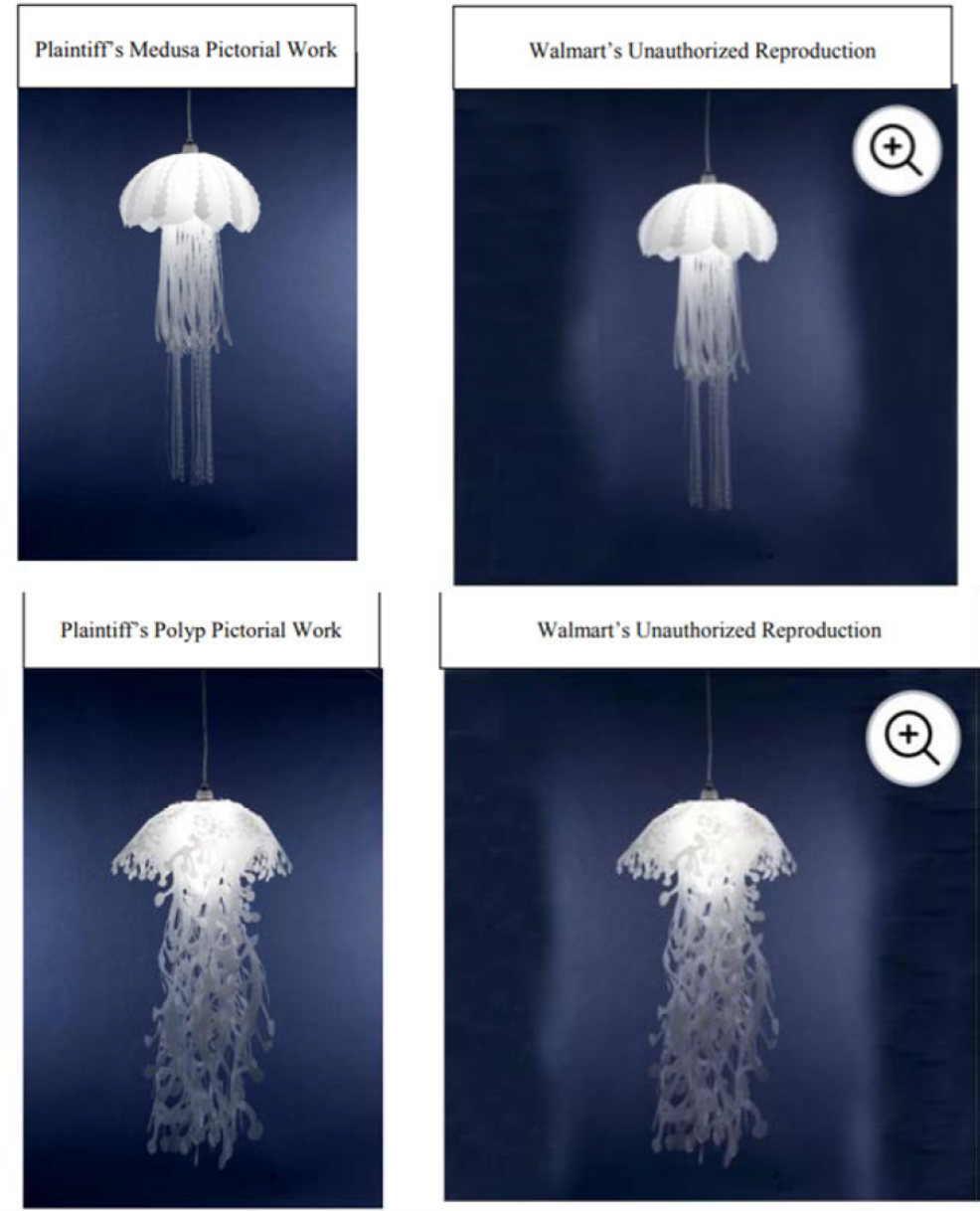
Russell created four sculptural works: “Medusa,” “Polyp,”
“Hydra,” and “Ophelia”; there was a dispute about whether the sculptures
resemble or embody natural aspects of real-life jellyfish and whether Russell intentionally
designed them to look like freshwater jellyfish. Medusa seems to be the key one;
Walmart argued that the sculpture’s “sole intrinsic function is providing
light,” while Russell responded that the sculptures are works of art, “not
simply light fixtures.”

the pictures and lights in suit

The key facts around Walmart’s responsibility for
marketplace sellers have been redacted from the opinion, so it’s impossible to
tell what’s going on there. Discussions about whether the accused product was a
“poor quality replica” also include redactions, as do the discussion of
damages. “In sum, the parties do not agree on much,” but the public can have no
idea of where they diverge.

The court here concluded that there were disputed issues of
material fact on substantial similarity (and excluded a proposed expert report
from Mark McKenna). The Medusa lamp was separable from its lightbulb, so the
useful articles doctrine didn’t diminish the protection granted by copyright.
Nor was it “so lifelike in its resemblance of a jellyfish that it lacks
copyright protection.”

Though the Medusa sculpture may
borrow certain elements from jellyfish in nature, it does not appear, and was
not intended to appear, like a lifelike jellyfish. The sculpture is not held in
a glass container intended to mimic a jellyfish’s natural habitat like the
sculpture in Satava; it is oversized and hangs from the ceiling on a string connected
to the center of the sculpture. [Not sure why this fact in particular matters
to whether it’s taken from life, though the rest seems relevant.] The top piece
of the sculpture is constructed of overlapping sections of fabric, differing
significantly from the large bulbous head of an actual jellyfish. Tendrils of
varying length and patterned textures flow from the center of the sculpture,
unlike the largely uniform tentacles of an actual jellyfish.

In other words, Plaintiff’s
sculpture is “stylized and not lifelike.” Because of the “gazillions of ways to
combine” jellyfish-like elements to create a stylized, jellyfish-inspired work
of art, Plaintiff’s stylized sculpture is entitled to broad copyright
protection.

Substantial similarity: Russell argued that substantial similarity
wasn’t the appropriate test in cases involving direct copying [very wrong], but
even if that test did apply, there were genuine issues of material fact. “[T]he
lamps are the same color, have three distinct sections, have a circular top
piece constructed out of overlapping panels with curved sides and scalloped
edges, have a center part that is thicker than the bottom part, and have two
sets of long, thin tendrils with two different patterns.” A reasonable jury
could find substantial similarity.

Willful infringement: This requires actual awareness of the
infringing activity or reckless disregard/willful blindness. The photographs
posted on Walmart’s marketplace were strikingly similar to Russell’s
copyrighted pictorial works, but there was a genuine dispute of material fact
on whether Walmart was responsible for posting them, which precluded summary
judgment in Walmart’s favor on willfulness. Walmart argued something else
redacted, but those allegations were “hotly disputed,” and anyway “Plaintiff
produced evidence showing that although Walmart had [redacted]. And in November
2018, [redacted] Walmart claims that [redacted].Walmart also knew that
[redacted],” creating an inference of willful blindness/reckless disregard.
Comment: This is not law. How is anyone to use this decision to guide their
conduct with an understanding of what constitutes willful blindness or reckless
disregard?

Russell could also cover profits attributable to the
infringement, and some sort of dispute about that is redacted.

Lanham Act/unfair competition claims.  Again, there was a genuine issue of fact about
Walmart’s responsibility for the posting. Apparently on the premise that the
posting was literally false about something, if Russell proved Walmart’s
responsibility, “actual deception and materiality will be presumed.” Her damage
expert calculated that the false listings cost her thousands of dollars in lost
profits and harm to her goodwill and reputation. Not clear how she worked around Dastar.

from Blogger https://ift.tt/3zdHcCT

Posted in Uncategorized | Tagged , , | Leave a comment