T-shirts as noncommercial speech (and an issue-spotter fact pattern)

Cornette v. Graver, 2020 WL 4059589, No. 19-cv-219 (W.D. Pa.
Jul. 20, 2020)

Cornette is a professional wrestling commentator and “personality”
who sued defendants for infringing his trademark rights and right of publicity
by selling disparaging t-shirts bearing his name and likeness. The court denied
a TRO on First Amendment and related grounds.  

Among other things, Cornette currently hosts two popular
wrestling-themed podcasts. His podcast videos on YouTube use “thumbnail images
that depict people he discusses in each segment,” and he doesn’t seek
permission from those people first.  He
sells merchandise on his website, including t-shirt sales in 2019 of
approximately $40,000 (about 15% of merchandise revenue). One such shirt uses
Cornette’s catchphrase or personal motto: “Thank you, Fuck you, Bye.”

Graver is a professional wrestler and tattoo artist, who
wrestles under the ring name of “G-Raver.”  He does “deathmatch” wrestling, which involves
“hitting each other with improvised weapons, such as light tubes, barbed wire,
thumbtacks, panes of glass, and weed whackers, among other things; Graver’s
signature weapons are tattoo needles.” Blood and injury routinely accompany
such matches. Cornette is a vocal opponent of
deathmatch wrestling because of the risk of injury to imitators.

In one video that Cornette retweeted, “Graver lacerated an
artery in his arm and nearly bled to death as a result of his injury.” Cornette
commented, inter alia, that “if fans were lucky[, the organizers] probably
stopped the show so everyone could watch [Graver] bleed out.” Graver objected.
Cornette replied that Graver and his opponent were both “stupid dumb fucks
doing something stupid [you] shouldn’t have been doing.” Cornette then dubbed
Graver “Grover”—a reference to the Sesame Street character—created a thumbnail
of Graver as Grover for his podcast videos, and used the thumbnail for an
animated game of Whack-A-Mole.

Graver then used the
Indy Connection, “a counterculture e-commerce store that sells merchandise such
as t-shirts, key chains, dolls, stickers, and other similar items for the
wrestling and entertainment industries,” where he has a storefront, to respond. One of his friends got a graphic artist, Shaygan, to create “parody” or
“caricature” images of Cornette with his “mouth and eyes crossed out in red and
[with] tattoo needles sticking out of his head.” The T-shirt added “Fuck Jim
Cornette” around the image, and there were some other modifications (we will
mainly discuss the FJC shirt; there’s also a shirt known as the MF shirt); the
artist didn’t like the modifications and there was a falling-out. The artist then
executed a contract with Cornette granting Cornette a nonexclusive license to
use the images he created. [Further details omitted, but would definitely add issue spotting detail.]

Individual defendant Lombardo (who also played a role in
some of the events above) added another shirt, which “removed the tattoo
needles, duct tape, Xs, and blood, replaced them with clown makeup, stubble,
and a prop red, ball nose — depicting Cornette as a clown—and added the word ‘Clownette.’”
He did this because he “believed that the dispute between Graver, The Indy
Connection, and Cornette was ‘just so asinine, it had become a circus upon
itself, [so] now [it was] just time to bring in the clowns’” and he believed
that Cornette was a clown. 
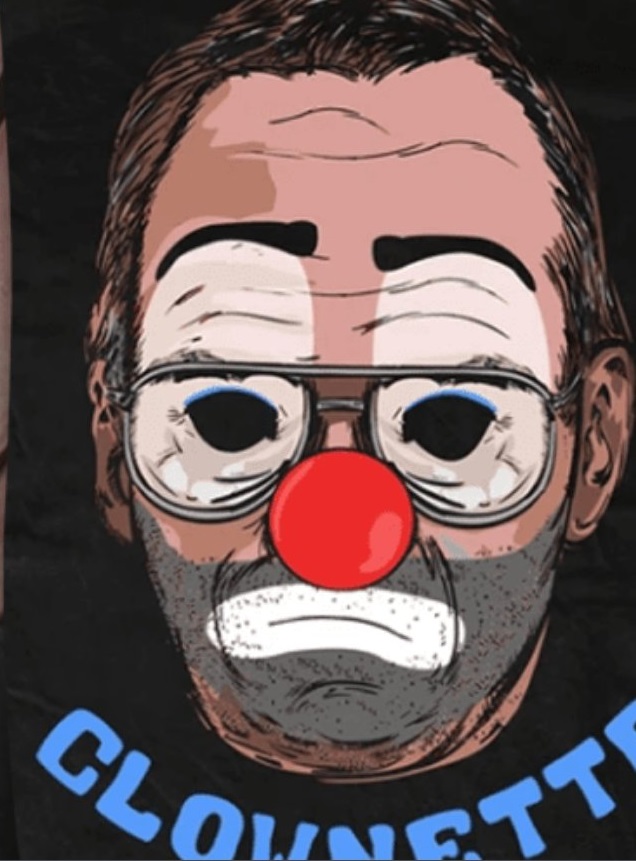
Lombardo also registered the domain name http://www.fuckjimcornette.com and used it to redirect to the page on which the Indy Connection sold the FJC
shirt. The Indy Connection filed an application for a trademark on the
phrase “Fuck Jim Cornette,” to be used for clothing. The PTO rejected the application and the Indy Connection
abandoned it. “Lombardo never approached Cornette or Cornette’s counsel with an
offer to sell the domain name …, nor did Lombardo
intend to register the domain name in an effort to hold it hostage over
Cornette.”

After the FJC shirt had been available for a day or two,
Cornette objected to Shopify, which hosts The Indy Connection, that the shirt
was an unauthorized use of his name and likeness and Shopify removed the (page
offering the) shirt. The Indy Connection tried again, describing the FJC Shirt as
a “Plain Black Tee”; though the image was a plain black t-shirt, any purchasers
would receive the FJC Shirt. Cornette again complained and Shopify again
removed the page.

Cornette then (before receiving the license from Shaygan)
began selling copies of the FJC shirt on his own website because “if somebody
is going to be selling a shirt with my name and face on it, and money is going
somewhere, it should come to me and/or a good cause” because he “couldn’t
really sell it as a serious piece of merchandise.” You might think this could
in theory be important to the confusion analysis, but the court (rightly)
doesn’t care. Many years ago, I wrote (with Bruce
Keller) about this scenario
; just as with copyright, a trademark owner
can’t increase its rights by creating its own critical/parodic merchandise.

After Cornette sued, The Indy Connection issued a press
release detailing its version of the events leading up to the lawsuit and
stating that it had released the FJC and MF shirts to depict an “alternative
commentary” on Cornette’s dispute with Graver. It then began selling the
Clownette shirt; if potential purchasers accessed http://www.clownette.com, they’d get
redirected to the Indy Connection site. The Indy Connection made approximately
$1,500 in profit from sales of the shirts. At least 32 websites currently offer
knockoff versions.

The Indy Connection didn’t engage in active marketing of the
shirts; didn’t intend to market to Cornette’s fans but to fans of deathmatch
wrestling; and “actively did not want Cornette’s fans to purchase the Shirts.”
There was no evidence of confusion about origin or endorsement in the record. Cornette
also had no evidence of sales diversion.

Trademark infringement: Cornette has no registration for his
name, “Clownette,” or “Fuck Jim Cornette,” so he proceeded under §43(a)(1)(A)
(and state trademark law, of which no more need be said).

Despite the fact that courts regularly apply the trademark
provisions of the Lanham Act to religious orders, and occasionally to political
parties (United We Stand), precedent outside those cases often maintains
that “the Lanham Act regulates only commercial speech.” The court here thus
decided that its first task was to determine whether the challenged activity
was commercial speech.

First, the shirts are speech because they convey a message.
(The better question isn’t whether the shirts are speech, but whether the cause
of action is one that regulates speech. If a Pennsylvania regulator found that
the shirts—or even the ink used to print the images on the shirts—were
impregnated with a carcinogenic chemical and sought to remove them from the
market, it would be completely irrelevant that the shirts bore speech.
Trademark law inherently regulates speech because it targets the communicative
meaning of symbols, not their noncommunicative effects in the world.)

But the shirts weren’t commercial speech, that is, “speech
that does no more than propose a commercial transaction”—roughly speaking, an
ad.  Cornette argued that (1) Graver was
selling products, (2) advertising them, and (3) had an economic motivation for
the speech, but that was wordplay. An ad touts a product other than itself; the
shirts didn’t but were instead the product being sold, like a subscription to
the New York Times.

Unfortunately, instead of saying this clearly, the court
reasoned that the key problem was that Graver lacked an economic motive for
selling the shirts. “[T]o have an economic motivation for purposes of
commercial speech, the speaker must speak substantially from economic
motivation…. Speech that is primarily motivated by political, religious, or
ideological convictions, although it may benefit the speaker economically, may
not meet the economic motivation factor, and therefore not be considered
commercial speech.” Although Graver made about $200 from the shirts, “Cornette
has not shown that it was likely the primary, or even a substantial, factor
motivating those actions.”

Especially in an age of (1) corporate personhood and (2)
judicial direction not to question the sincerity of belief, this is an
unworkable and dangerous standard; the “is the speech advertising something
other than the speech itself” standard does the necessary work better. (Indeed,
the adverbs tell you that something very squishy is going on: “substantially”
from economic motivation and “primarily” noneconomic aren’t even opposites.) The
example the court borrowed from the Fifth Circuit illustrates the problem quite
well:

[A] woman operates a record store
selling Christian rock music and tells her customers that they should buy
Christian rock music because other forms of rock music are satanic.  Whether the Lanham Act applies to her conduct
depends on her motivation: if she opened the bookstore because of a sincere
religious belief that Christian rock must be made available to combat the evils
of other rock music, the speech is likely noncommercial. Conversely, if she is
agnostic and opened the store after taking a business class that informed her
that a properly set up Christian rock store can be very profitable, the speech
is likely commercial and therefore subject to the Lanham Act.

That’s ridiculous. The constraints on regulating her speech
should come from falsity and materiality—a claim about satanic origins is not
falsifiable. Not only does this example turn on religious “sincerity,” which
the Supreme Court is probably right that we should not generally question, it
also creates discrimination based on religious belief—the believer gets to say
things in the marketplace, with commercial effect, that the nonbeliever
doesn’t. If a pizza place opens up and says “we’re better than the pedophile
pizza place down the block,” its owners’ sincere belief in Qanon should have
nothing to do with whether they’ve violated the Lanham Act.

Obviously, the bad reasoning didn’t start with this court,
but it’s distressing to see the reasoning here when it’s so unnecessary to the
result.

As for the Indy Connection, it made about $1500, but the
initial sale was to raise funds for Graver’s recovery, which was “arguably” an
economic motivation, but “raising money for a good cause is not a traditional ‘economic
motivation.’”

The court also said that the shirts didn’t refer to a
specific product but instead expressed messages about Cornette. There’s a
metaphysical issue here—trademark/right of publicity law is often willing to
recognize a persona as a product or service that can be monetized—but that
perhaps suggests the error of commoditizing a persona rather than a flaw in the
commercial speech analysis. The record was “replete” with testimony that the shirts were
intended to parody Cornette’s views.

As for Graver’s social media promotions of the shirts, this “was
a natural method of getting word out about the message the Shirts conveyed;
although that motivation may be economic also, Cornette has failed to show that
it is likely that G-Raver promoted the Shirts substantially for economic
reasons.” [Would have been better to apply the general rule that truthfully advertising First Amendment-protected content inherits the content’s protection.] 

Because this was noncommercial speech, there was no likely
success on the merits.

The court also did a traditional belt-and-suspenders:
confusion wasn’t likely, even assuming that Cornette owned a valid mark in his
name (or likeness; the court doesn’t have to get into the substantially more
complicated question of whether Cornette could own a mark in any depiction of
his face, see ETW v. Jireh). Dissimilarity was important. “Although
G-Raver has used Cornette’s name and likeness, no consumer is likely to get the
same overall impression from either: (1) a t-shirt with Cornette depicted as a
clown—and called ‘Clownette;’ or (2) bloodied, gagged, and with tattoo needles
in his forehead—with the words ‘Fuck Jim Cornette’ surrounding his image —as
they would from a t-shirt with Cornette’s face or his face and the words ‘Thank
you, Fuck you, Bye.’” So too with http://www.fuckjimcornette.com or http://www.clownette.com versus
http://www.jimcornette.com.

Both “fuck” and “clown” were terms of contempt. Even though
Cornette himself sold copies of the FJC shirt, that didn’t make it likely that
consumers would see the shirt or the URL “and assume that Cornette endorses a
t-shirt or website that expresses contempt for himself, or that Cornette is the
source of such a website or t-shirt.” 
For the same reasons, the court found that the products themselves were
not highly related, which is a bit unusual.

Intent: intent to copy is not bad, only intent to confuse by
copying. This and the lack of confusion evidence weighed for Graver, as did the
intended audience. “Although both parties target their merchandise to wrestling
fans, the record evidence demonstrates that they each target different sectors
of the professional wrestling fandom.”

Trademark dilution: no. No commercial speech. Also, no fame.
It was not enough to show a 40 year history in pro wrestling, 1.7 million
podcast downloads and 100,000 to 125,000 YouTube views each month, and 160,000
followers on Twitter, without evidence about reach among the general American
public.

There was also no blurring because of lack of similarity,
lack of intent to associate (“G-Raver, although intending to reference Cornette
in creating the Shirts, had no desire to be associated with him.”), and lack of
actual association.  There was no
tarnishment because tarnishment has to arise from “similarity” to the famous
mark, and here the use was dissimilar.

ACPA: No. There was no bad faith. Defendants believed they
were making a lawful parody; they were engaged in noncommercial speech. There
was no evidence they intended to divert consumers via likely confusion, or to
sell the domain names to Cornette.

Right of publicity: 
Pennsylvania law bars “the unauthorized use of the name or likeness of a
person for commercial or advertising purposes when that name or likeness has
commercial value.” Under the statute, a “commercial or advertising purpose” is
the public use of a person’s name or likeness “on or in connection with”
selling or offering a product for sale, to promote or advertise products, or
for fundraising. But if the use is through a “communications medium,” it is not
a violation when: (1) the person appears as a member of the public and is not
named or identified; (2) the use is associated with a news report; (3) the use
is an expressive work; (4) the use is an original work of fine art; (5) the use
is associated with announcing or promoting a news report, expressive work, or
work of fine art; or (6) the use is associated with identifying the person as
the creator of a work. [Pause for standard agonized reminder that ads are
expressive works, according to both First Amendment and copyright law.]

Under the statute, a “communications medium” includes, but
is not limited to, newspapers, magazines, books, billboards, telephone, radio
and television broadcasts, digital communications networks, audiovisual works,
and global communications networks. [Query: what violation of the right of
publicity could occur without use of a communications medium? Which one of the
listed exceptiosn could occur without the use of a communications medium? The
presence of this unnecessary verbiage signals that weird epicycles are
necessary to make the right of publicity seem constitutionally ok.]

While Cornette was likely to be able to show that his name
and likeness had commercial value, the challenged uses (just the shirts, not
the social media) fell within the statutory exceptions. “Cornette’s name and
likeness both appear on the Shirts, which are a product, and G-Raver’s use
facially falls under [the law’s] scope because Cornette’s name and likeness are
‘on … a product.’” But the shirts were expressive works and the use was
through a communications medium.

Pennsylvania law defines an “expressive work” as a
“literary, dramatic, fictional, historical, audiovisual, or musical work
regardless of the communications medium by which it is exhibited, displayed,
performed, or transmitted, other than when used for a commercial or advertising
purpose.” Although shirts weren’t listed, they were still included in the
exception. [It would be better to say that images/pictorial works are covered,
not “shirts,” though I have to say I’d be surprised if the omission of
pictorial works wasn’t intentional.]

According to Mr. Justice Merriam-Webster, a “work” is
“something produced or accomplished by effort, exertion, or exercise of skill,”
or “something produced by the exercise of creative talent or expenditure of
creative effort.” The shirts “and the images used in their creation” were
“works” under this definition. And they were expressive. “[O]n closer
inspection” these were “fictional” works because fiction is “something invented
by the imagination,” and the image of a bloodied and gagged Cornette, with
tattoo needles sticking out of his forehead was “invented by [Graver’s]
imagination” as a way to get back at Cornette for his comments about Graver, as
was Lombardo’s vision of Cornette as a clown. [So I guess images that read as
realistic are not covered by the exception, which is a hell of a content-based
exception.]

And the shirts are a “communications medium” because the law
“contemplates exceptions from liability for right of publicity violations when
the use of the plaintiff’s name or likeness communicates a message. Clothing is
often used to convey a message, such as when protesting government policy, and
the First Amendment protects this expression.” Indeed, it would be nonsensical
to exclude shirts, because then “had G-Raver taken out a full-page
advertisement in a newspaper with the images used for any of the Shirts, they
would not have violated Cornette’s right of publicity, but the use of t-shirts
would be prohibited.”

Even if the statutory exception didn’t exist, the shirts
would be protected by the First Amendment as transformative use that don’t
merely supersede shirts with Cornette’s face on them.

And finally, Cornette failed to show irreparable harm.
There’s no presumption of irreparable harm in Lanham Act cases, or right of
publicity claims. Nor can a plaintiff establish irreparable harm on the basis
of “bald and conclusory statements.” Harm to reputation may be irreparable, but
still has to be shown. Cornette argued that the absence of an injunction would
lead to a free-for-all on his name and likeness, but only within the First
Amendment’s protections. “Any harm caused to Cornette’s brand through parodies
or satires that fall within the First Amendment are not harms the legal system
can address.”

Cornette’s sale of knockoff FJC shirts did finally come in:
“If the Shirts were so objectionable to Cornette, he likely would not have sold
them on his website, and the fact that he did also indicates that the balance
of the equities weighs against an injunction.” And the public interest in free
expression outweighed the public interest in protection of trademarks and the
right of publicity, “particularly when the party aggrieved by alleged
infringement has failed to show a likelihood of success on the merits or that
irreparable harm is likely.”

from Blogger https://ift.tt/3hb6PKK
Posted in Uncategorized | Tagged , , | Leave a comment

inhaler marketing is partly deceptive; P not required to resurvey revised material

GlaxoSmithKline LLC v. Boehringer Ingelheim Pharms., Inc., 2020
WL 5258317, No. 19-5321 (E.D. Pa. Sept. 3, 2020)

GSK partially succeeded and partially failed to
preliminarily enjoin some of BI’s marketing in this case involving claims about
different inhalers. Of broader note: when GSK proved that an earlier version of
the marketing campaign included false claims, the court was willing to enjoin
similar statements in the revised campaign, to protect GSK from whack-a-mole.

Chronic Obstructive Pulmonary Disease (COPD) causes
obstructed airflow from the lungs. It’s the third-leading cause of death by
disease in the US, and there’s a huge market for medications to manage its
symptoms is huge ($24.3 billion globally by 2026). Most COPD medications are
delivered by inhalers: (1) Metered dose inhalers (MDIs), which release aerosol
when pressed; since the patient must inhale coordinated with the spray, they
can be difficult to use. (2) Dry powder inhalers (DPIs), which use medication
combined with dry inactive carrier particles; all that is required to use them
is inhalation, which separates the medication from the carrier particles and
delivers the medication to the lungs. Both parties offer DPIs. (3) Slow mist
inhalers (SMIs), which use spring power to generate low velocity mist into the
mouth; they require some coordination, but less than an MDI. BI makes the only
SMI on the market in the US.

To promote its SMI, BI needed to convince doctors to use it
instead of DPIs. Its solution was to focus on COPD patients’ peak inspiratory
flow (PIF or PIFR) which is measured in liters per minute (L/min). The premise of
BI’s current campaign is that a COPD patient’s ability to separate the
medication from the dry powder carriers depends on that patient’s ability to
inhale with sufficient force. BI labeled this the “COPD Paradox”: although DPIs
have an “optimal PIF” of 60 L/min, many COPD patients have “suboptimal PIF” of
less than 60 L/min. By contrast, because SMIs do not require forceful
inhalation, BI’s marketing suggests that doctors should prescribe its SMI for
patients with low PIF.

“At its base, this case comes down to whether BI has
scientific support for its various statements about PIF and DPIs.” Since this
was a “tests prove” case involving claims of empirical proof, GSK could prevail
either by showing that “the tests were not sufficiently reliable to permit a
conclusion that the product is superior” or “that the tests did not establish
the proposition for which they were cited.”

Basically, there was scientific support for the basic idea
that the optimal PIF for most DPIs was >60 L/min, that low PIF is common in
COPD patients, and (more tenuously) that patients who couldn’t achieve that
could benefit from an alternative inhaler (apparently because there was
evidence of a correlation between low PIF and worse clinical outcomes). GSK
argued that there was no clinical evidence establishing a link between low PIF
and clinical efficacy of COPD medication. But BI “consistently” acknowledged
this lack of established correlation in its marketing materials.  So there was no literal falsity here. So too
with related statements; the court noted that they were directed to doctors and
appropriately qualified.

Also, this weird marketing was not false: a box labeled “Dry
Powder Inhaler” that also bore a disclaimer stating “WARNING: Suboptimal
Inhaler Included.” Inside the box was … “a plastic figurine of a COPD patient,
as well as a BI marketing pamphlet.” BI argued that the “suboptimal” reference
was to the patient, not to the DPI, and the court agreed that, while the
outside of the box alone potentially conveyed the false message that DPIs are
suboptimal, the ad as a whole conveyed that many COPD patients are suboptimal
inhalers and was thus not literally false. “Upon opening the box and seeing the
figurine, and as there is no DPI in the box, physicians likely will understand
the intended message. As BI sales representatives were instructed to ‘[p]ut the
box in the customer’s hands,’ it is unlikely that physicians will fail to open
the box.” Referring to a patient, instead of the patient’s breathing, as
suboptimal seems dehumanizing to me, but that’s not the cause of action.

GSK did show a likelihood that “[t]he efficacy of aerosol
deposition in the lungs is dependent upon the peak inspiratory flow rate (PIFR)
of the patient” was false. GSK’s evidence was that “studies have shown that a
lung deposition of as little as 10% of an emitted dose of COPD medication can
effectively treat a patient.” Thus, while BI had support for the claim that patients
with a low PIF would receive less COPD medication from a DPI, BI didn’t
support that they wouldn’t receive enough medication.

Misleadingness: GSK only provided evidence of deception for one
document, a visual aid. While surveys aren’t always required, “[c]onsidering
the complexity of the science, the sophistication of the targeted physicians,
and BI’s efforts to toe the line and only state what its cited studies support,
the Court cannot conclude that BI’s statements are misleading based only on the
marketing materials themselves.”

GSK provided a survey that showed a since-changed “COPD
Paradox” visual aid. Its expert coded 51% of the respondents’ answers as
stating that BI’s messaging conveyed that “COPD patients with suboptimal PIF
don’t get sufficient benefit from their inhalers.” In response to the question:
“What, if anything, does material convey or suggest about use of certain dry
DPIs for COPD patients with suboptimal peak inspiratory flow (PIF)?” 34% of the
responses were coded as stating that “[e]fficacy of DPI medications may be
compromised/insufficient for some patients with low/reduced PIF.” Thus, a
substantial number of physicians were deceived into believing that DPIs do not
work for COPD patients with suboptimal PIF. BI quibbled with the coding but
even excluding the disputed responses gave a deception rate of well over 15%.

BI argued that the survey was irrelevant because it used a
now-expired ad, not the current visual aid. But the old visual aid was “substantially
similar” to the current one. As BI’s Director of Respiratory Marketing stated
in a memo sent to the sales team, “[d]on’t worry, the new assets are very
similar to the old assets in terms of the overall story content and message
flow. You will see immediately that the changes are relatively minor…[w]e are
very confident that these new assets will help you continue to tell the core
story….” The court credited the conclusion of GSK’s expert, “the only
marketing expert whose opinion has been presented to the Court,” that “[o]ne
would not need to survey each and every iteration to reach the conclusion that
the message was communicated in prior pieces, and that it continues to be
communicated now.” The court pointed out, for example, that “MORE THAN HALF of
COPD patients can have suboptimal peak inspiratory flow (PIF)” evolved to “MANY
COPD patients can have suboptimal peak inspiratory flow (PIF).” The first
visual aid stated that “[y]our patients live with damaged lungs and many cannot
forcefully inhale…yet…[m]any COPD inhalers may require your patients to
forcefully inhale,” while the current one says “[m]any patients with COPD
cannot forcefully inhale because they live with damaged lungs…yet…[a]ll dry
powder inhalers (DPIs) require patients to forcefully inhale to optimally
activate.”

Takeaway: the survey was “comprehensive and compelling. BI
cannot dodge the legal consequences of that survey by making superficial tweaks
to its marketing materials, turning Lanham Act litigation into a never-ending
shell game.”

BI didn’t contest materiality (or interstate commerce or
likely injury to GSK).

Irreparable harm: Harm to reputation or goodwill can
constitute irreparable injury because it is “virtually impossible to quantify
in terms of monetary damages.” BI argued that GSK’s claim was belied by its
17-month delay in seeking injunctive relief and by data showing no competitive
harm.

Delay “may be excused where the party seeking a preliminary
injunction delays only in the reasonable belief that negotiations may resolve
the dispute.” GSK learned about BI’s marketing campaign in the summer of 2018. It
then convened an internal team to assess BI’s campaign. In September 2018, it
sent an objection letter to BI, which led to an exchange of letters that lasted
through June 2019. “Significantly, in response to GSK’s complaints, BI revised
some of its marketing materials.” In November 2019, GSK’s survey expert
submitted her report, and GSK sued and requested injunctive relief.  GSK’s conduct, “which entailed an initial
resort to a consensual resolution of the controversy” and then waiting to
obtain evidence necessary to support its claim, “did not constitute
unreasonable delay.”

Harm: It was undisputed that GSK’s market share hadn’t
shrunk. But the irreparable harm was “long-term goodwill and reputation.”  GSK’s expert explained:  “[p]harmaceutical marketing is given structure
by campaigns that unfold over a period of years to advance a particular
strategy…[i]t takes time to make a case.” Here, because “virtually none of
the physicians in practice today have been trained in their medical education
to rely on PIF (or to think about PIF at all), it will take time, repetition,
and iteration to prime the marketplace for behavior change.” She further declared:
“[w]ith repeated exposure over time [to BI’s marketing campaign], innuendo and
suggestion are likely to take firm shape in physicians’ minds” and “physicians
can often be persuaded to act on speculation so long as they don’t feel they
are putting patients are risk.” This was especially likely here because COPD is
a “leading cause of death, but there have been no dramatic advances in
treatment therapy for years.” The survey also showed that, even though GSK’s
market share had yet to erode, the campaign was damaging GSK’s DPIs’ reputation
and goodwill. GSK sales representatives also reported that multiple hospitals
are now “testing PIF and if below 60, they are switching patients off of [GSK]
products.” GSK’s expert stated that “[t]he equity drained away through brand
reputation risk may never be recovered. It will be hard for physicians to
‘unhear’ these ideas once heard because the burden of definitively disproving
(or proving) them is too onerous for any company with a stake in this market to
entertain.”

GSK wasn’t required to wait until it lost market share,
which would be too late.

The public interest favored enjoining false or misleading
health-related statements, as BI was allowed to continue to truthfully
advertise the state of the evidence. (I wonder how easy that will be, given
that the problem is misleadingness; disclaimers alone won’t necessarily fix
that even if they avoid falsity.)

The court also ordered a $5 million bond.

from Blogger https://ift.tt/3jWkQgZ

Posted in Uncategorized | Tagged , | Leave a comment

another advertiser’s Google click fraud suit is revived

Singh v. Google LLC, 2020 WL 5202081, — Fed.Appx. —-,
2020 WL 5202081 (9th Cir. Sept. 1, 2020)

The court of appeals reverses the dismissal of Singh’s
California FAL/UCL claims against Google for allegedly charging for fraudulent
clicks despite its promises. While the district court found that Singh lacked
statutory standing, the economic injury requirement “demands no more than the
corresponding requirement under Article III of the U.S. Constitution.” It was
sufficient for Singh to allege that he purchased some number of clicks from
Google via its AdWords program; that Google misrepresented the general efficacy
of its fraudulent click filters; and that he would not have purchased clicks
but for his reliance on the allegedly erroneous fraud filter rate. Indeed,
Singh alleged that he hired a company to analyze some of his ad campaigns,
which showed that Google’s filters caught fewer fraudulent clicks than
advertised, and that numerous studies prior to 2016 on third-party ad campaigns
found that Google’s filters did not catch as many fraudulent clicks as Google
advertised. “At the pleading stage these allegations together are sufficient to
draw the reasonable inference that Singh’s ad campaigns prior to 2016 similarly
suffered higher-than-advertised rates of fraudulent clicks not caught by
Google’s filters, and that he accordingly paid for more fraudulent clicks than
Google advertised he would.”

Google also argued that its AdWords Agreement expressly
precluded Singh’s claims, but the court of appeals agreed with the district
court that a reasonable jury could find that Singh was reasonable in relying on
Google’s extra-contractual statements about the general effectiveness of its
click filter system, notwithstanding the “no guarantee” provision in the
AdWords Agreement.


from Blogger https://ift.tt/3m2nQdK

Posted in Uncategorized | Tagged , , , | Leave a comment

Tiffany’s blues: Costco gets a trial on sales of “Tiffany” rings with Tiffany setting

Tiffany & Co. v. Costco Wholesale Corp., Nos.
17-2798-cv, 19-338, 19-404, 2020 WL 4743020, — F.3d – (2d Cir. Aug. 17, 2020)

The district court found that Costco’s sales of otherwise
unbranded diamond engagement rings with the solitaire setting known as a
Tiffany setting, identified by point-of-sale signs containing the word “Tiffany,”
constituted infringement and counterfeiting. It awarded Tiffany trebled
profits, prejudgment interest, and punitive damages (under NY law) totaling over $21
million. The court of appeals held that summary judgment should not have been
granted to Tiffany on liability and remanded for trial, including on Costco’s
descriptive fair use defense.

Of note: (1) “Use as a mark” continues its wild and not
particularly coherent ride in the US. It’s not a requirement for infringement
liability in the Second Circuit but it is, we learn, a requirement for
counterfeiting liability. (2) Consistent with Booking.com, the court isn’t
particularly interested in the difference between generic and descriptive—among
other things, the court indicates that generic use can constitute descriptive
fair use. This makes sense given the justification for the defense (as well as
the historic use “common descriptive name” to identify generic terms). (3) But
on the flipside, the court seems relatively uninterested in what I would have
thought was the very important fact that, according to the facts recited, there
is no other name
to identify the setting at issue other than “Tiffany
setting.” Even so, the court indicates that there could be infringement if
consumers are confused. (4) Relatedly, the court’s suggestion at the end of its
fair use discussion that the descriptive fair use defense could fail if consumers
are confused seems inconsistent with KP Permanent. Descriptive fair use, in its
current form, supposedly weighs something else against likely confusion—perhaps
whether the competitor is objectively behaving reasonably given the descriptiveness
of the term at issue, even if an ordinarily sufficient number of consumers are
confused.

Some other relevant facts: Tiffany has a number of relevant trademark
registrations. Costco used “Tiffany” only in connection with rings with Tiffany
settings; it sold several other styles identified by similar point-of-sale
signs, each of which indicated the name of the corresponding ring’s setting style
and none of which used the word “Tiffany.” Also:

At some point in the late
nineteenth century, Charles Lewis Tiffany developed and sold an engagement ring
incorporating a particular style of six-prong diamond setting. Since that time,
numerous advertisements, dictionaries, trade publications, and other documents
have referred to diamond settings reminiscent of that style as “Tiffany
settings.”

Costco used small, white point-of-sale signs that displayed information
about the rings “(ostensibly including setting style)” in uniform black text,
along with their prices in larger, bold text. “In general format, but not necessarily
in size, these signs resembled other point-of-sale signs that identified virtually
all items for sale throughout Costco stores.” Costco argued that it copied
these signs directly from descriptions supplied by its vendors. Its signs for
rings with a Tiffany setting “at times identified the ring setting using the
phrases ‘Tiffany setting,’ ‘Tiffany set,’ or ‘Tiffany style,’ and at other
times used only the word ‘Tiffany’ for that purpose,” and it “apparently
identified other setting styles in a similarly variable manner.” Tiffany purported
to challenge only the “Tiffany”-only uses, not those with “style,” “set,” or “setting.”

When Tiffany objected, Costco said that, within one week, it
voluntarily removed all uses of the word “Tiffany” from the signs in its
jewelry display cases. After Tiffany sued, Costco also sent a letter to all
customers who had purchased engagement rings with Tiffany settings to alert
them that Tiffany had sued. It explained that Costco’s point-of-sale signs had
“used the word ‘Tiffany’ to indicate that [the associated] ring had a
Tiffany-style pronged setting,” asserted that Costco “do[es] not believe [its]
signs were inaccurate,” and reminded buyers that they could return their rings
for a full refund at any time under Costco’s existing return policy. “Approximately
1.3% of customers who received this letter returned their rings to Costco.”

Infringement: A reasonable jury could find for Costco; the
district court erred in finding otherwise, based on three factors. [Footnote on
the multifactor test: “similarity of marks” is shorthand as defendant need not
use a term “as a mark,” that is, “as a symbol to attract public attention,” to
infringe.] The summary judgment standard is the same for trademark as for
anything else, and also “insofar as the determination of whether one of the
Polaroid factors favors one party or another involves a legal judgment—which it
often does—we must review that determination de novo.” Thus, “in the majority
of cases, we should review de novo both a district court’s determinations as to
each Polaroid factor and its ultimate balancing of those factors.”

The key factors: (1) Actual confusion. The district court
relied on (a) the deposition testimony of six Costco customers, each of whom
alleged that he or she was confused by Costco’s point-of-sale signs and (b) Dr.
Jacob Jacoby’s survey, which surveyed 944 people, 606 of whom identified
themselves as Costco patrons who thought that “they [or their significant
other] would consider buying a diamond engagement ring at Costco that cost at
least $2,500.” Of the 606, each of whom was shown a photo of a diamond
engagement ring alongside one of Costco’s point-of-sale signs, either in
isolation or after seeing photos of other branded items sold by Costco—“more
than two out of five … were likely confused into believing that Tiffany &
Co. was the source of the rings.” The district court found this evidence
unrebutted, but that was error.

First, Costco argued that 6 out of the 3,349 customers who
purchased Tiffany-set rings at Costco during the relevant period was only de
minimis evidence, and it submitted a report from its own expert, Dr. Russel S.
Winer, criticizing Dr. Jacoby’s survey methodology and results. Costco’s expert
opined that Jacoby should have targeted only customers with a “present purchase
interest in buying a diamond ring,” and that the survey respondents “could not
have been a group whose perceptions provided any valid or reliable predictor of
past or future Costco diamond ring purchaser beliefs.” In addition, he
contended that the survey was fatally flawed due to “artificial, contrived and
biasing” stimuli that “ignore[d] the reality of the customer purchase process.”
Rather than showing survey responders a point-of-sale sign as it would have
appeared to customers—in a display case surrounded by other rings identified by
“other tags …, some of which would have other setting and style types
indicated”—Jacoby’s survey showed them only a single ring and sign in
isolation. Indeed, Costco’s expert argued that, though both images (one with
only a single point-of-sale sign and the other with a small section of a Costco
display case) provided insufficient context, the relatively lower confusion
among respondents who saw the latter was “striking.” A jury was entitled to
consider “how the percentage [of customers identifying ‘Tiffany’ as a
descriptive word rather than a brand] might have changed had the context
provided been comparable to the real world experience.”

In addition—comment: highly relevant given the live dispute
over the genericness of “Tiffany” for the name of the setting—Costco’s expert
contended that the screening questions, which required responders to sort words
into brand names and descriptive words, “trained” those responders to “bias[ ]
the responses in favor of selecting Tiffany as a brand identifier.” To the
extent that this nudged the numbers upward, that’s relevant also to the
descriptive fair use defense, as KP Permanent says that the amount of confusion
can be relevant.

Costco’s evidence was sufficient to raise a question on actual
confusion. The district court had reasoned that Winer’s criticisms went to
weight rather than admissibility, and that he didn’t perform his own survey.
But the weight to be given to a particular piece of evidence “can be determinative
of whether the moving party is entitled to summary judgment or whether a jury
could find a material fact favorable to the non-moving party.” A reasonable
jury could find that Tiffany failed to present sufficiently persuasive evidence
to meet its burden.

(2) Good faith: The question is whether the defendant attempted
“to exploit the good will and reputation of a senior user by adopting the mark
with the intent to sow confusion between the two companies’ products.” Although
“where the allegedly infringing mark is identical to the registered mark, and
its use began subsequent to the plaintiff’s trade-mark registration, the
defendant must carry the burden of explanation and persuasion,” it is still the
case that “[p]rior knowledge of a senior user’s trade mark does not necessarily
give rise to an inference of bad faith and may [actually] be consistent with
good faith.” Indeed, “the intent to compete by imitating the successful
features of another’s product is vastly different from the intent to deceive
purchasers as to the source of [one’s own] product.” And “subjective issues
such as good faith are singularly inappropriate for determination on summary
judgment.”

The district court concluded that “no rational finder of
fact could conclude that Costco acted in good faith in adopting the Tiffany
mark.” The evidence it cited included an email from a Costco employee
indicating that Costco’s jewelry boxes should have a more “Tiffany or upscale
look”; the deposition testimony of a Costco inventory control specialist who
acknowledged that she took no action in response to two emails ostensibly
indicating customer and employee confusion over the source of Costco’s rings;
and photographs and emails that suggest efforts by Costco to “copy Tiffany’s
designs by making references to Tiffany designs and sharing links to Tiffany’s
website [in communications with vendors].”

Both Tiffany and Costco also pointed to a customer email
asking whether the word “Tiffany” on the label referred to the “Tiffany setting
or Tiffany brand.” It was consistent with good faith that a Costco employee
responded to the customer’s email that “[i]t means Tiffany setting.” And
importantly, “the jury could also consider this email as evidence of an absence
of actual customer confusion,” since inquiries about a potential relationship
are not actual confusion and arguably show lack of confusion.

Costco’s contrary evidence indicated that it had never
attempted to adopt the Tiffany mark; that its signs actually used the word
“Tiffany” as a brand-independent description of a particular style of diamond
setting; and that those signs merely reflected information provided by its own
suppliers.

The district court thought that no reasonable jury could
believe Costco, but the court of appeals disagreed. “We have consistently
recognized that intent to copy a product’s useful, nonprotected attributes should
not be equated automatically with an intent to deceive. Therefore, Costco’s
admitted intent to sell jewelry that looks like Tiffany’s—as opposed to an intent
to have its jewelry pass as Tiffany’s—cannot be enough to justify a finding
that Costco acted in bad faith.” There was “substantial” evidence favoring Costco,
including declarations from a diamond buyer and an assistant general
merchandise manager affirming that Costco inventory control personnel took the
term “Tiffany” directly from vendor descriptions, that the representatives
understood Tiffany as a “generic style name,” and that indeed it was “the only
name … used to denote [that] type of pronged setting.” There was supporting
evidence that the term “Tiffany” “has been used as a generic descriptor—both
explicitly in conjunction with a word like “setting” and implicitly by
itself—in thousands of advertisements, dictionaries, trade publications, and
other public documents since the late 1800s.”

Costco also provided evidence that its rings were not
branded with Tiffany’s mark (and indeed were branded with its supplier R.B.
Diamond’s logo instead); that the rings came in “unbranded containers bearing
no resemblance to Tiffany’s distinctive robin’s-egg blue packaging”; that
buyers received Costco-branded receipts, appraisal forms, and other sales
documents; and that Costco’s return policy permitted customers to return their
rings any time after purchase. A reasonable jury could conclude that Costco’s that
signs “were the product of a good-faith attempt to communicate to its customers
the setting style of certain rings that it sold.” A jury could also infer good
faith from Costco’s voluntary cessation and communications to purchasers.

Tiffany’s only rejoinder was that, after Costco voluntarily
stopped using the name “Tiffany,” it was still able to describe those rings’
settings as “Solitaire.” “But ‘Solitaire,’ which describes any single gem in a
simple setting, is undeniably a less descriptive term than ‘Tiffany,’ which
ostensibly describes a specific type of six-prong setting.” If a seller claimed
rights in “spoon” for a spoon, we wouldn’t think it sufficed to allow other
sellers to advertise their “utensils.”

(3) Consumer sophistication: Although sophistication may
usually be proven by direct evidence, including expert opinions or surveys, “in
some cases a court is entitled to reach a conclusion about consumer
sophistication based solely on the nature of the product or its price.” Jacoby’s
study assumed that respondents who said they “would consider buying a diamond
engagement ring at Costco” were representative of relevant customers, and
Tiffany offered no other evidence. Costco’s expert countered that the purchase
of an engagement ring is a “high involvement” transaction, and that actual
purchasers—as opposed to those who merely “would consider buying an engagement
ring”—possess substantial “subject matter knowledge and familiarity with the
relevant vocabulary.”

The district court nevertheless found no factual question,
as Costco’s evidence only went to the weight of Tiffany’s evidence and wasn’t
affirmative evidence of consumer sophistication. This wrongly shifted the
burden to Costco on Tiffany’s motion for summary judgment in its favor, and ignored
Costco’s evidence in the form of its expert’s declaration. “A jury could
reasonably conclude, by crediting Costco’s evidence and rejecting Tiffany’s,
that the relevant population of consumers would be sufficiently attentive and
discriminating as to recognize that Tiffany had nothing to do with Costco’s
diamond engagement rings.”

Overall, a jury could reasonably conclude that the relevant
consumers would know, or learn, that “Tiffany” describes a style of setting not
unique to rings manufactured by Tiffany, and recognize that Costco used the
term only in that descriptive sense. “Such consumers may also be distinctly
capable of recognizing that Costco’s rings were not manufactured by
Tiffany—based, for example, on their price, place of purchase, packaging, or
paperwork—and consequently be particularly unlikely to be confused by any
aspect of Costco’s point-of-sale signs,” especially given that they’d see “a
jewelry case full of other unbranded rings, each identified by a sign
indicating its own setting type in a similar or identical way.” Although there
was clearly a “potential for confusion” inherent in the public association
between the Tiffany brand and high-quality engagement rings, that wasn’t
enough. In light of Costco’s evidence, as well as “Tiffany’s failure to
demonstrate that actual purchasers would not recognize the word ‘Tiffany’ as
denoting a commonly used setting style,” summary judgment for Tiffany was
improper.

In addition (maybe), Costco was entitled to reach a jury on
its descriptive fair use defense “even where the challenged material is likely
to cause some confusion.” By “some” the court means “some otherwise actionable,”
otherwise KP Permanent would be pointless.

The district court’s good faith finding above led it to
reject Costco’s defense on the good faith prong; this was now reversed, and
Costco also raised factual issues on the other elements.

(1) Use as a mark: Use as a mark means use “as a symbol to
attract public attention,” or “to identify and distinguish … goods [or
services] … and to indicate [their] source.” Relevant factors include: whether
the challenged material appeared on the product “itself, on its packaging, or
in any other advertising or promotional materials related to [the] product,”
and the degree to which “defendants were trying to create, through repetition
… a[n] association between [themselves] and the [mark].”

A reasonable jury could find no use as a mark. “Tiffany’s
own evidence indicates that Costco typically identifies the trademark
associated with its branded products as the first word on the product label,” including
when it did sell genuine Tiffany merchandise, whereas Costco produced hundreds
of examples of signs for its engagement rings, “none of which began with the
word ‘Tiffany’ or any other brand name.” Instead, it used the word “in the
exact same manner (including typeface, size, color, and relative location on
the signs) that it displayed setting information for other engagement rings.” “Tiffany”
didn’t appear on any of its rings or ring packaging, and that the rings
actually bore the logo of a different manufacturer.

(2) Descriptive use: This includes “words that describe a
characteristic of the goods[ ] such as size or quality,” and also “words or images
that more abstractly identify some information about the goods in question.” A
jury could reasonably credit Costco’s evidence that “Tiffany” has a descriptive
meaning independent of Tiffany’s brand and that Costco “intended to and did
invoke that meaning when it created its point-of-sale signs.”

Tiffany argued that this result would be absurd because Tiffany
is a valid mark for jewelry, and that the court shouldn’t allow “Tiffany” to be
a source identifier for rings of other styles, but a descriptive term for rings
in the so-called “Tiffany” style. But that’s not absurd; it’s inherent in the
idea that a descriptive term can be a trademark. It’s black-letter law that
“the public’s right to use descriptive words or images in good faith in their
ordinary descriptive sense must prevail over the exclusivity claims of the
trademark owner.” It doesn’t matter that Tiffany the company and the Tiffany setting
derive their names from a common source; nor did it matter that “Tiffany” didn’t
“inherently” describe the setting. For whatever reason, Tiffany didn’t stop “Tiffany
setting” from becoming a well-known term [here again I note that the court doesn’t
seem particularly concerned that there doesn’t appear to be another name for the
setting, which I think is a pretty important issue]. “Indeed, the fact that
Tiffany does not here challenge Costco’s use of the phrase ‘Tiffany set’ or ‘Tiffany
setting’ may signal an implicit recognition that some uses of its protected
mark are indeed descriptive.”

In conclusion, however, the court suggests that the ultimate
question is whether the descriptive use worked to avoid confusion—which seems
inconsistent with KP Permanent: “To be sure, a reasonable jury could
also reject Costco’s evidence and find that customers would not recognize
the word ‘Tiffany’ as descriptive even with the context Costco provided”
(emphasis added).

The counterfeiting claim also had to be reversed and sent to
the jury. In a footnote, the court indicated that if there was no use as a mark,
there “likely” could be no counterfeiting even in the presence of infringement
liability, since a non-mark use cannot be a “spurious mark.”  “We fail to see how a term can be a ‘fake’
mark if it is not actually used as a mark, or how a term can ‘deceptively
suggest an erroneous origin’ if it is not used as a means to indicate origin in
the first place,” even though terms not used as marks can still generate
confusion as to “affiliation, connection, … association[,] … sponsorship or
approval,” and thus constitute trademark infringement [court’s rather puzzling citation
to §43(a)(1)(B) as a source of trademark infringement liability omitted]. “But
because terms not used as marks are not ‘spurious,’ they cannot, as a matter of
law, be counterfeit.”

The court declined to reach whether punitive damages under NY
law would be available to Tiffany if it prevailed.

from Blogger https://ift.tt/2FGFov7

Posted in Uncategorized | Tagged | Leave a comment

Harm story fails where deceived doctors’ choices wouldn’t have mattered

Quidel Corp. v. Siemens Medical Solutions USA, Inc., No.
16-cv-3059-BAS-AGS, 2020 WL 4747724 (S.D. Cal. Aug. 17, 2020)

Previously, the
court ruled that alleged misrepresentations, even if false, didn’t affect testing
labs’ choice of which of the parties’ tests to offer, but reserved judgment on
whether they affected physicians’ choices
. Here, the court grants summary
judgment, finding that any falsity could not have caused cognizable harm
because of the ways that physicians order tests.

The parties produce competing assays (blood tests) used for
measuring thyroid stimulating immunoglobins, which can aid in the detection of
Graves’ disease. There are two relevant types of assays available: (1) TSH
receptor antibody (TRAb) assays, which detect both stimulating and blocking
thyroid immunoglobins (TSI and TBI) and which are therefore apparently less
useful and (2) TSI only assays. In Quidel’s opinion, Siemens’s product doesn’t
distinguish between stimulating or blocking antibodies, but it was advertised
as a TSI only assay.

Physicians order tests from labs for their patients, and labs
carry one “TSI only” test at a time. Physicians’ deference to labs, versus
picking a lab because it carries a specific test, apparently varies. Labs pay Quidel
and Siemens for the tests. If a doctor requests a test from a lab without
specifying, and relies instead on the lab to picks, Quidel couldn’t be damaged
by the lab’s use of the Siemens test because, as the court already ruled, the
lab did not rely on any allegedly false advertising to cause it to carry the
Siemens test. If the doctor wanted Quidel’s product but used Siemens’s because
the lab only carried the latter, again Quidel wouldn’t have been damaged by the
false advertising. And if the doctor would only use Quidel’s product and picks
labs with that in mind, again there’s no damage.

Quidel argued that there were doctors who wanted to use
Siemens’s product because of its allegedly false advertising, and who thus
chose a Siemens-using lab. But the court found that “Quidel cannot claim that
its damages are caused by the lab carrying the product which in turn leads to
the physicians ordering the product from the lab.” But: if there are doctors
who did pick Siemens over Quidel, why wouldn’t that be harm causation from the allegedly
false advertising even if the labs were waiting to supply them? The court
responds: this is a previously undisclosed damages theory. Quidel originally claimed
damages based on the labs’ switching tests, not any doctors. Quidel’s
damages expert didn’t  consider the
actions of individual physicians in his damages evaluation. This wasn’t a
harmless omission, since it deprived Siemens of the chance to develop
information about individual doctors. And even if the theory had been adequately
disclosed, it didn’t have supporting evidence that doctors were influenced or
that labs consider physician preference in determining which test to carry.

Quidel argued that it did have evidence that individual
clinicians were misled: Siemens and labs received inquiries from clinicians
regarding whether the Siemens product could differentiate between TSI and TBI,
and they didn’t disclose the (alleged) truth. But that still wasn’t proof that
the doctors acted on what the labs did or didn’t say.  

Quidel’s evidence of its corrective advertising expenses
were also insufficient because Quidel had to show it suffered likely injury
before it could claim corrective advertising damages. “If the false statements
have no material impact, there is nothing to correct.”

Nor would the court presume injury because of the parties’
direct competition plus a likelihood of deception from comparative advertising,
as the Ninth Circuit has said can be done. The challenged advertising didn’t
compare the parties’ products; instead, it continually contrasted Siemens’
product with TRAb assays. The market isn’t a two-player market. Without comparative
advertising, “injury to a particular competitor may be a small fraction of the
defendant’s sales, profits, or advertising expenses.” In such cases, “actual
evidence of some injury resulting from the deception is an essential element of
the plaintiff’s case.” Here, “[i]f TSI only assays are substantially better than
TRAb assays, as both parties claim, then Siemens could be making sales to those
who used to use TRAb assays but switched over to using [its product].”

No presumption of injury. Also, no injunctive relief: though
proof of “injury” wasn’t required for injunctive relief, “irreparable harm” was.
And Quidel’s only claimed harm was monetary: lost sales.

from Blogger https://ift.tt/2QkRfRz

Posted in Uncategorized | Tagged | Leave a comment

Second Circuit finds conflict preemption of publicity rts for unauthorized music sample

Jackson v. Roberts, No. 19-480 (2d Cir. Aug. 19, 2020)

Judge Leval, kindly citing my work as well as
that of other scholars, finds a right of publicity claim against a remix album
preempted by the Copyright Act/Supremacy Clause through implied (conflict)
preemption, as well as by §301. Unsurprisingly, I think the conflict preemption
ruling is correct.

Jackson (p/k/a 50 Cent) sued Roberts (p/k/a Rick
Ross) for sampling a well-known 50 Cent song to which he did not own the
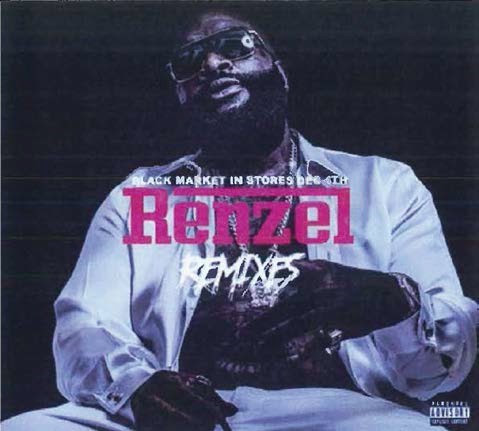
copyright, “In Da Club,” on a mix tape, Renzel Remixes, “which Roberts released for free in 2015, in advance of Roberts’s
then-upcoming commercial album, Black Market.” Jackson alleged that Roberts’s
use of Jackson’s voice performing “In Da Club,” as well as of Jackson’s stage
name in the track title identifying that song, violated his right of publicity
under Connecticut common law.

Some background:

In the hip-hop world, a “mixtape” —
unlike a commercial album — is an album of material generally produced by a
recording artist for free distribution to fans. As both Jackson and Roberts
agree, it is common for hip-hop mixtapes to include “remixes,” often consisting
of new vocal recordings by the releasing artist, combined with samples of songs
by other artists who are identified by name. And as both Jackson and Roberts
agree, many hip-hop artists (including Jackson himself) have created mixtapes
that included samples of recordings of other artists without obtaining
permission from either the recording artist or the copyright holder of the work
sampled. Some (but not all) mixtapes are released for free in advance of an
upcoming commercial album by the same artist and include material that promotes
the upcoming release.

Roberts’s Renzel Remixes mixtape is
a compilation of 26 remixes in which Roberts performs his own new lyrics over
audio samples of popular songs by well-known recording artists. For 11 remixes,
the track list identifies 18 original recording artists associated with the
samples, including, for example, “Hello (Feat. Adele),” “Bill Gates (Feat. Lil
Wayne),” and “In Da Club (Ft. 50 Cent).” 
The “In Da Club (Ft. 50 Cent)” track consists of Roberts rapping over
the original instrumental track of Jackson’s song, followed by a roughly
thirty-second sample of Jackson singing his refrain from the original “In Da
Club” recording, reproduced without alteration. Roberts did not obtain or
request permission from Shady/Aftermath or from Jackson to include those in his
mixtape, or to use Jackson’s stage name.

“In Da Club (Ft. 50 Cent)” remix included several references
to Roberts’s then-upcoming commercial album, Black Market: “Only on the Black
Market, December 4th / The Album is out.” The cover art for the mixtape
included a reference in small white typeface to Black Market and its release
date. 

The district court dismissed the claim because, under his Recording Agreement, Jackson “surrendered his rights to the use of his name, performance and likeness associated with the master recording of ‘In Da Club’ in connection with the advertising and marketing of ‘Phonograph Records’” and because it was preempted.The court of appeals disagreed with the contractual
reasoning. The contractual grant ended in 2014, before the remix was released.
Preemption still barred the claim.

“[P]rominent copyright scholars have suggested that implied
preemption may bar a right of publicity claim where the claim does not further
a distinct state interest, such as preventing ‘consumer deception,’ protecting
privacy, or safeguarding against reputational harms.” (Citations: Rebecca
Tushnet, Raising
Walls Against Overlapping Rights: Preemption and the Right of Publicity
, 92
Notre Dame L. Rev. 1539, 1545–48 (2017); Nimmer; Jennifer Rothman; and Guy Rub.)
 The court of appeals agreed that right
of publicity claims were preempted when they “would impair the ability of a
copyright holder or licensee to exploit the rights guaranteed under the
Copyright Act, or in some way interfere with the proper functioning of the
copyright system.” However, not all interferences with any possible
exploitation justify preemption, at least where the state is furthering “sufficiently
substantial state interests, such as protecting a person’s privacy,
compensating for fraud or defamation, or regulating unauthorized use of its
citizens’ personas.” For example, an anti-paparazzi statute protecting citizens
“from unreasonable intrusions on personal privacy,” could have the “collateral
effect of precluding the defendant from exploiting a photograph that falls within
the subject matter of federal copyright law” without preemption, and a ban on
falsity could likewise interfere with the exploitation of literary works
containing falsehoods.

Bonito Boats instructs that analysis of
implied preemption depends on whether the state law claim furthers substantial
state law interests that are distinct from the interests served by the federal
law which may preempt the claim. The standard: “when a person undertakes to
exert control over a work within the subject matter of the Copyright Act under
a mechanism different from the one instituted by the law of copyright (i.e., a
state law claim), implied preemption may bar the claim unless the state-
created right vindicates a substantial state law interest, i.e. an ‘interest[]
outside the sphere of congressional concern in the [copyright] laws.’” [Andrew
Gilden and others might find something to say here about the implicit suggestion that
privacy is outside the sphere of congressional concern in copyright. But
perhaps the court is better read as saying that some kinds of privacy
claims are outside the sphere of congressional concern—unauthorized subject claims,
not creator claims.]

Some right of publicity claims will therefore avoid preemption:
those that target false endorsements, because the “state’s interest in
protecting its consumers from deception in the commercial marketplace is
clearly both substantial and distinct from the interest in ‘grant[ing]
valuable, enforceable rights to authors . . . to afford greater encouragement
to the production of literary (or artistic) works of lasting benefit to the
world’” (citing me). So too with “right of publicity claims that vindicate
privacy or reputational interests, or those that would prohibit the sale of
goods whose value to consumers consists predominantly of the unauthorized
exploitation of a person’s valuable persona,” since that too “vindicate[s]
substantial state law interests that have little relation to the interests of a
copyright holder to exclusive control over works of authorship.” [Ugh; not
citing me, unsurprisingly, and not explaining what those substantial state
interests are or how they can be detached from the interests of the author who
created the relevant representation.] “The more substantial the state law
interest involved in the suit, the stronger the case to allow that right to
exist side-by-side with the copyright interest, notwithstanding its capacity to
interfere, even substantially, with the enjoyment of the copyright” (back to citing
me for allowing state “protection of consumers, reputation, or privacy”).

However, “the less substantial the state law rights invoked,
or the more the invocation of the state right amounts to little more than
camouflage for an attempt to exercise control over the exploitation of a
copyright, the more likely that courts will find the state law claim to be
preempted.”

So, does this lawsuit assert “a sufficiently substantial
state interest, distinct from the interests underlying federal copyright law,
to evade preemption”?  The court first
expressed doubt as to whether Connecticut really meant to prohibit “mere use” of
Jackson’s name to identify him as the artist of the song Roberts samples, and the
use of the sound of Jackson’s voice, “which is inevitable in sampling Jackson’s
performance of his song,” without permission. However, “Jackson’s claim may
just barely fall within the boundaries of Connecticut’s right of publicity as
Roberts undoubtedly believed it was to his personal benefit to include the
references to Jackson in his mixtape.”

Despite that, the court found that the lawsuit didn’t seek
to vindicate any substantial state interests distinct from those furthered by
the copyright law. There was no use of Jackson’s name or persona “in a manner
that falsely implied Jackson’s endorsement of Roberts, his mixtape, or his
forthcoming album, nor in a manner that would induce fans to acquire or pay
heed to the mixtape merely because it included Jackson’s name and a sound that
could be identified as his voice.” The court relied on (1) the absence of any
explicit endorsement statement; (2) evidence “that it is common practice in the
hip-hop industry for artists to use copyrighted samples in mixtapes without the
permission of the copyright holders or performers of the sampled works (and to
reference the relevant performers by name in track titles),” and (3) the “context”
of Roberts’s use.

Comment: not that I disagree, but it’s pretty interesting
how a mini-confusion inquiry works here without much in the way of factfinding.
(2) is particularly notable because that has nothing to do with actual consumer
perception—though it might help to the extent that one views the “reasonable”
consumer as a normative construct.

The use of Jackson’s voice and the “small discreet notation
that correctly identifies Jackson as the artist of the sample played” thus didn’t
violate any substantial state law publicity interest. Instead, “the predominant
focus of Jackson’s claim is Roberts’s unauthorized use of a copyrighted sound
recording that Jackson has no legal right to control.”

On the other side of the balance, there was a potential for
interference with “the dissemination of works within the subject matter of
copyright and the operation of the federal copyright system.” First, many
protected works of authorship involve depictions of or appearances by real
people; if those in themselves could support a publicity rights claim, “the
potential for impairment of the ability of copyright holders and licensees to
exploit the rights conferred by the Copyright Act is obvious and substantial.”

Although the contract could have protected Jackson’s label
from impairment of its interest in fully exploiting the work, that wasn’t
enough to protect either licensees (if the label somehow failed to transfer its
rights) or fair users. Although many statutory rights of publicity have
specific exceptions for “types of uses that might qualify as fair use,” and
although the First Amendment might provide protection even in the absence of
such exceptions, “the potential for conflict would persist in many instances.”
Likewise, “a state law that would impose liability on a defendant for use of a
public domain work, on the sole basis that the plaintiff is depicted in that
work,” would interfere with the federal policy of free copying of public domain
works (cf. Dastar).

Here, a creator and performer of a work within the subject
matter of copyright, who owned no copyright interest in the work, was
nonetheless trying to control its distribution in defiance of the exclusive
right of the copyright owner to exercise such control. True, under the
contract, Jackson’s approval was also required for sampling; thus Roberts
was “presumably” liable for copyright infringement to the label, and Jackson
might have a right to compel the label to sue Roberts or to seek damages for
the label’s failure to protect his right to royalties. Nonetheless, Jackson had
no legal right to directly go after Roberts, and his attempt to do so “under
the disguise of a right of publicity claim” was in derogation of the label’s exclusive
right to enforce the copyright. And the label might have had good reason to
tolerate the use to enhance the song’s commercial value; as the copyright
owner, its exclusive right included “the right to decide whether to tolerate an
infringement.”

Although implied preemption usually protects a defendant who’s
lawfully reproducing or publishing a work, the policy considerations justifying
the doctrine of implied preemption nonetheless applied here.

Just in case, the court also found § 301 preemption. I tend
to find §301 reasoning in what’s really a conflict preemption case to be
tortured; I’ll just focus on what the court additionally says about consumer
confusion. Specifically, claims based on the use of an image/representation of
a person embodied in a copyrighted work are not preempted where the use is “in
a manner that appears to communicate a message that the plaintiff endorses the
defendant’s service or product (other than the copyrighted work in which the
plaintiff appears).” In a footnote, the court highlights the “important
difference” between conveying that the plaintiff consented to appear in or was
voluntarily associated with a work and conveying that the plaintiff endorsed “an
entirely separate product or service.” The former implication—of the plaintiff’s consent
to appear in the work and “to some extent” endorsement of the work itself— is “immaterial” here.

So, in Downing v. Abercrombie & Fitch, 265 F.3d 994 (9th
Cir. 2001), a publicity rights claim wasn’t preempted where Abercrombie had
“create[d] t-shirts[] exactly like those worn by the [plaintiffs] in the photograph”
and “advertised those t-shirts alongside the photograph of the similarly clad
plaintiffs, thus conveying a false implication that the plaintiffs were wearing
Abercrombie shirts and represented Abercrombie as brand ambassadors.” Permission
from the copyright holder was insufficient to justify preemption because the
gravamen of the claim was “the defendant’s usurpation of the plaintiff’s
identity to sell a product or service with which the plaintiff has no relevant
connection.”

This particularly tortured sentence (citations and footnotes
omitted) shows both why I don’t think §301 works here and why the right of
publicity lacks intelligible boundaries:

In our view, the pertinent
distinction for [whether a claim is within the subject matter of copyright] is whether, on the one hand, the defendant’s use
of a work involving the plaintiff’s likeness seeks advantage for the defendant
on the basis of the plaintiff’s identity — as where the plaintiff is identified
in a manner that implies the plaintiff’s endorsement, sponsorship, or approval
(or in some cases the plaintiff’s disapproval or rejection) of the defendant or
its product, or holds opinions favored (or disfavored) by the defendant, or
where (as with baseball cards) the value of what the defendant distributes lies
in its reference to the identity of the plaintiff shown — what might be called
“identity emphasis,” which argues against preemption — or whether, on the other
hand, the advantage sought by the defendant flows from the reproduction or
dissemination of the work itself (as opposed to the persona of the plaintiff),
which argues in favor of preemption.

In a footnote, the court rejects “commercial advantage” as
an extra element, as both too broad and too narrow. In particular, “a plaintiff
should legitimately be entitled to claim the right of publicity where the
defendant appropriates the plaintiff’s persona to advance a non-commercial
cause, as by falsely representing that the plaintiff supports a political
candidate or a controversial cause.” [This could well be an example of how decisions
that purport to limit a claim can lay the foundations for its expansion. Under
ordinary, non-IP First Amendment precedents, a false claim of political
endorsement could easily fail based on the Supreme Court’s solicitude for noncommercial
falsehoods, so the court here is, unnecessarily, assuming a very broad scope
for publicity rights.]

And the court explains “identity emphasis” as covering, in
addition to the positive value of identity, “depicting an unpopular plaintiff
in a manner suggesting that person’s dislike of the defendant or its product,
or using the plaintiff’s identity in a negative way to generate interest in the
defendant or the defendant’s work.” 

The preemption question is whether the defendant is seeking “advantage through identity emphasis” or whether the plaintiff is seeking “control of the [copyrighted] work itself.” “In other words, the more the defendant has
used a copyrighted work for its own value, as opposed to using it to exploit
the depicted plaintiff’s identity, the more the right of publicity claim
brought by someone depicted in the work can be considered a disguised effort to
control the dissemination of the work.” 

Comment: (1) This of course has nothing to do with the subject matter of copyright or extra elements; it is conflict preemption analysis in a 301 hat. (2) Unfortunately, this formulation suffers from the usual
deficiencies of attempts to distinguish the dancer from the dance for publicity
rights purposes: where the works are valuable because they depict a well-known
person—nobody wants a biography of me!—they are used for both their own value and
to exploit the depicted person. That is the basic stuff of ordinary news
reporting and nonfiction. Courts just announce that a news photo of Chris Pine,
or AOC, is used “for its own value” while a drawing of the Three Stooges is
used to exploit their identity.

Which brings us back to deception: “a crucial issue in determining whether Jackson’s right of publicity
claim is subject to preemption depends on whether Roberts’s use of Jackson’s
stage name and the ‘In Da Club’ sample could reasonably be construed by the
intended audience as a false implication of Jackson’s endorsement or
sponsorship of Roberts or his product.” [Among the questions this raises for me:
suppose that such a claim survives a motion to dismiss, but on summary judgment
or after trial the relevant factfinder finds no likelihood of confusion. Is the
claim then preempted?]

Footnote: false endorsement/sponsorship isn’t required to
survive preemption, as long as “the defendant has otherwise exploited the
plaintiff’s identity to gain an advantage,” e.g. by making a poster of the plaintiff,
but Jackson was arguing false endorsement as his sole reason to avoid
preemption here.

Here, Roberts offered “evidence that, in the hip-hop industry,
it is common practice for artists to sample each other’s work without
permission, and to credit the artists they sample on mixtapes without authorization,
with designation (e.g., a ‘ft.’ line) in a track title.” Jackson himself has
done this. “[T]his evidence powerfully supports the conclusion that, in the
hip-hop world, the mere use, without more, of a sample from a well-known song,
with acknowledgment of the identity of the sampled artist, does not communicate
to the relevant audience that the sampled artist has endorsed or sponsored the
sampling artist’s work.” Instead, “Roberts is expressing himself as an artist
by his choice of sampled works, without implying that the artists so depicted
have lent their personas to the promotion of his album.” And the song was so
well known “that it could not possibly be understood to be material Jackson
created specifically for inclusion in the mixtape”; also, the album sampled
from at least 26 artists and identified 18. “It would be unreasonable for a
listener to conclude, simply based on Roberts’s use of these samples and his
references to those artists’ stage names, that each of these well-known artists
— including Adele, Nas, Snoop Dogg, Kendrick Lamar, and Lil Wayne — endorsed or
sponsored Roberts’s free mixtape.”

The court distinguished other cases in which use of a
plaintiff’s image or persona could communicate endorsement or sponsorship, such
as Downing, which involved what was essentially a clothing catalog. In Toney
v. L’Oreal
, the defendant used the model’s photo in magazine ads and on
packaging “in a context that suggested that the plaintiff had used the product
and intended to be seen as endorsing the defendant’s product.” [I will note
that the FTC, with all the attention it’s given to endorsement, doesn’t think
that a model’s appearance is ordinarily perceived as an endorsement; instead
the FTC expects that viewers will perceive the model as doing a job.] Here,
there was “no such contextual implication of endorsement. … Jackson does not
appear on the cover of the mixtape, nor do any of Roberts’s lyrics refer to
Jackson, nor is the “In Da Club” sample used in a manner that could mislead
listeners into believing that it was new material that Jackson had created
specifically for inclusion in Roberts’s mixtape.” His music and his stage name
were used in the same manner as the other artist’s.

Even without direct evidence about consumer perception, the
absence of an explicit message, the evidence of standard mixtape practice, and
the large number of sampled/identified artists “compel[led] the conclusion that
there is no substantial likelihood that the audience could reasonably construe
Roberts’s use of the ‘In Da Club’ sample, credited to Jackson, as a suggestion
that Jackson had endorsed Roberts, his mixtape, or his upcoming commercial
album.” Thus, the gravamen of the claim was not use of his identity but use of
the work itself.

To avoid §301 preemption, Jackson argued that stage names
are not “works of authorship” that “come within the subject matter of copyright.”
But implied preemption took care of this regardless, since Roberts used Jackson’s
stage name to accurately identify him as the performer of one of the works he
sampled. Allowing such a claim “would impermissibly interfere with the
administration of the federal copyright system by placing a substantial barrier
between copyright holders and the full exploitation of their works.” Also, a
state right of publicity prohibiting the use of an author or performer’s name
to accurately describe a work “could further interfere with permitted uses of
that work by individuals other than the rightsholder or licensee — such as an
art critic, teacher, news reporter or parodist, exercising the right to make
fair use of a copyrighted work.” The court did, however, caution that “a different right of publicity claim based on the
use of a name in a misleading manner may invoke a significant state interest in
protecting against unauthorized exploitations of a person’s name so that it
would escape implied preemption (citing Cher v. Forum Int’l, Ltd., 692 F.2d 634
(9th Cir. 1982) (while a magazine that purchased a journalist’s interview with
Cher and published it was entitled to tell its readers that it was publishing
the interview, a different magazine violated her right of publicity because its
marketing copy implied Cher’s endorsement of the magazine)).

from Blogger https://ift.tt/3l5Q8mZ

Posted in Uncategorized | Tagged , , | Leave a comment

IPSC Panel 15 – Trademark Law II

Trademark Fame and Corpus Linguistics, Jake Linford, FSU
College of Law and Kyra Nelson, Independent

Dilution protects famous marks as if they were monosemous:
having same source meaning no matter what goods/services applied to. Proposal:
use data about TM use from large corpora to better ensure that fame is properly
granted and perhaps reduce the costs of finding fame/decrease reliance on
things like sales numbers. Famous=unique commercial signifier (consistent with
Schecter’s original formulation) and widely recognized (household name). Different
databases with different sources, date ranges, numbers of words. Could use
these databases to measure recognition via frequency of appearance in corpus
and to measure level of singularity. [That’s measuring production not
recognition, which is probably worth distinguishing.]

Question: can we set a threshold for appearaances?

Diachronic changes/change over time: could a mark lose fame
the same way it loses distinctiveness? What are the words that appear more
frequently than you’d expect next to this word, and do they point to singular
meanings or multiple meanings?

Looked at frequency in database, compared to litigated
cases. Lots of marks held not famous are relatively not frequent: Buck Rogers,
Blue Man Group, Field of Screams. Some high frequency marks are found famous:
Microsoft is an outlier [that is likely because the corpus draws from articles
that mention using Excel or another Microsoft product that does the work]. But there
are also ones with mismatches. Was this FTDA problem only? FTDA cases do have
slightly lower mean frequency v. TDRA, but not statistically significant. One
per million is relatively high frequency so that could be a frequency, but leaves
out Citibank, Tylenol, Rolex, and Victoria’s Secret.  Nearly 2/3 of marks found famous are at 0.83
per million, so maybe that’s right. Non famous .042/million. 3 standard
deviations above mean is .375 per million. Hotmail also changes in frequency a
lot over time.

Collocation: Microsoft’s adjacent terms all point to Microsoft
the entity (or its competitors).

What about Coach? Collacates in top 20 are all sports terms.
Apple: all the brand use is computer-related but all the non brand use is much
bigger and is apple/fruit. What’s the best treatment?

Could we do a better job predicting how cases should go?
Choose Your Own Adventure: court seems to presume CYOA famous. In 1979, when
first book comes out, only one hit. .06 frequency, highest .12 over time, never
gets there. Concordance: some TM use, some not.

Mark Lemley: useful tool, but separate utility of tool from
the particular vision of dilution which might not be widely accepted. Could be
valuable even if you don’t need singularity.

Mark McKenna: singularity might not be about fame, but it is
about dilutability: if the mark isn’t singular, it’s already diluted. Also,
does frequency really correlate with fame? It’s not surprising that “coach”
would have a lot of non-brand use b/c it’s an English word. Are you really
measuring anything other than fancifulness?

A: Panavision is distinctive, but not famous: that’s why
frequency matters. Apple is the question: does Apple swamp commercial
terminology and (more importantly) should that commercial dominance matter?
Jeanne Fromer: need to have an explicit methodology for measuring fame for
nonfanciful marks. Recognition and production are distinct: apple might be easily
recognized as a fruit without a lot of use in the corpus. So we need better definitions.

A: is the concern overcounting or undercounting famous
marks?

Fromer: probably both! It has to have frequency for you to
care, but if there’s any mention of a non brand appearance, how does that
factor in? Develop a methodology at the outset=very helpful.

Lisa Ramsey: agrees re fanciful or even suggestive marks
(Microsoft) & separate analysis of those from what’s not in the dictionary.

Barton Beebe: exciting idea. Hand coding can account for nonmark
use but you should feature that in the intro/discussion.

A: note that Hotmail looks very strong in one year—the corpus
doesn’t always give you a snapshot over time and databases vary. Another
concern: scholars seem to assume that a judge can be turned loose w/ this toolkit
and reach right answers, and that might not be true. This could just be a tool
to stick a number on an intuition, like with stampeding the factors.

RT: non word marks: it matters that the corpus is for words!
Bigger picture: there is a hierarchy of goodness of marks; word marks are
better at doing the things we want done with fewer side effects and we should
start admitting it more readily. [Alt take: we maximize what we can measure and
reliance on the corpus will make it harder for us to think about what
non-word-mark fame would look like. That could be good or bad!]

Ramsey: does the corpus distinguish b/t contexts where brand
use is more likely (casual discussions) v. where it’s not (academic journal
articles)?

Fandom is Nonexcludable, Betsy Rosenblatt, University of
Tulsa School of Law

Warner sued Potterhead running club, which raises money for
charity by having runners run on their own. “We solemnly swear that we are up
to no good.” WB claims: Ds designed merch & business model to appeal to and
attract fans of the HP franchise, but that’s a privilege reserved to WB and its
licensees.  But that’s not the law: New
Kids on the Block says you can raise money by appealing to fans. There are other
limitations as well, including the First Amendment.

Defenses tend to break down over things that look like “use
as a mark”: Potterheads name, Packers Fan podcast. Names identify source of
group/its goods or services and describe relationship to underlying object of
fannish attention. They are descriptive in her categorization b/c they are
referring descriptively to what they’re fans of rather in a TM sense to the
creator of that underlying work.

Claims against fan organizations look like irrational
overclaims, but that’s not a helpful argument. Even when there’s competition w/
the “authorized” user, there is no economic benefit in allowing control over
these kinds of descriptive uses. Fanmarks have characteristics of aesthetic
functionality: a non reputation related value. Anti-monopoly principles: you
get shoddy fan goods instead of really nice ones.

Ramsey: use as a mark by the plaintiff? False association as
a countervailing risk.

A: Among other things we’re willing to tolerate risks of
confusion in Rogers, nominative fair use, descriptive fair use, other contexts;
we should be willing to tolerate some risks here.

Jessica Litman: need a pretty crisp definition of fan
activity/fanworks, or any number of competitors will be able to claim to fit.

A: not distinguishing fan from non fan, but distinguishing
referential mark from that which refers to the producer of the underlying work
in a Dastar sense.

Linford: people are raising money and that seems nice, but
how do we distinguish that from a universal 5K run? We are in a place where there
is a presumption of licensing for runs & theme parks. Not persuaded yet
that New Kids will get you there.

A: agree, which is why she’s developing the argument.

Linford: but why is referential not indicating source/sponsorship?
Can you say something about grassroots/astroturf, is that what we care about?

A: reference is to a type of good not to a source. We shouldn’t
be calibrating rights based on maximizing TM owner wealthy; these are positive
spillovers.

Elizabeth Townsend Gard: is this a commercial/noncommercial
distinction?

A: Not necessarily.

Lisa Macklem: Concerned about people taking advantage of
fans/feeding at the trough?

A: think it doesn’t matter b/c we still get the benefits [that
happens all the time in traditional expressive media: biographies or magazine
articles taking advantage of something popular, and we think that’s a good
thing].

Lemley: very easy to say that money changes everything. And
very easy to find money somewhere in a transaction, especially online. So you
will have to go broad.

A: doesn’t care whether people make money. Under her
standard: Why can’t someone just call themselves Warner Brothers & make movies?
Because she’s basing this on a genericism [I’d say functionality] and
referential use framework, we can use the same framework we use for house
brands.

Certification (and) Marks – Understanding Usage and
Practices Among Standards Organizations, Brad Biddle, Arizona State University,
Jorge Contreras, University of Utah, and Vigdis Bronder, Biddle Law

Would expect to find certification marks going along
w/standards orgs. Just 17K of 36 million TM registrations are certification
marks, but hard to distinguish ICT standard setting organizations from others.

Findings: testing and certification is an important activity
for SSOs, though some large organizations don’t do the testing. Over 60% did do
their own testing, and most had an associated logo. Use traditional TMs much
more than certification marks. In 94 different organizations: 122 certifications
across 9 jurisdictions, but that’s just 2% of their marks. Why? Initial registration
is challenging; providing a copy of the specification; more flexibility and
control over use of a traditional TM; tend to have sophisticated licensing
programs. Certification marks can’t be used by certifying entity, and as a
pragmatic matter most orgs had similarity b/t mark and organization name. International
issues. Implications: conventional wisdom doesn’t seem to match real world
practice. Is this a misuse of marks, dodging the consumer protective elements
of certification marks? For policymakers, clear that certification marks aren’t
using them as intended. For reformers, tightening rules for certification marks
won’t matter if most certification happens outside certification mark system:
would have to focus on the process of certification instead.

Margaret Chon: TM too are supposed to be about quality, and
your findings reinforce that.

Jorge Contreras: practically it seems harder for
certification mark user to police use

Vigdis Bronder: no certification cancellations we found;
even organizations that had no formal licensing structure for a long time were
fine.

Chon: was revenue stream an issue?

A: interviewees were practitioners who might not know and
probably would not have said. The people who run these orgs aren’t lawyers and
don’t have in house counsel. Figuring out who has the info is tricky.

Rosenblatt: should we let people use non-certification marks
in this way? Part of her issue with fandom marks is that there’s a similar
blurring.

A: it seems there’s some need that the certification mark
isn’t fulfilling.

Rosenblatt: but maybe that’s a bad need, like discrimination
or self-dealing for oneself.

A: doesn’t think most of these orgs are being nefarious.
International treatment issues are huge and they’re trying to be global
organizations. Even trying to file certification marks in other countries can
be very difficult w/different rules.

Bronder: since interoperability and sometimes even safety is
a priority, it’s a different scenario than w/t shirts.

Ed Timberlake: are there new data you were able to get?

Biddle: did a mini project before w/USPTO and it was
enormous amount of work. TMNow is really great. Could just go in and scarf up huge
amount of data. Different than using USPTO data. Can find countries and
classes.

Contreras: international data are also there and usable,
which is great.

Barton: Do European perspectives change depending on tech
sector? Might be different in how they treat agriculture versus tech where they
might not diverge as much. Alexandra Mogyoros: Work on pseudo-certification
marks
: connect w/her. Antitrust/competition law issues, also in Fromer’s
work.

A: yes there are nefarious actors, also non-nefarious actors
doing good work.

Contreras: so many different organizations independently
decided not to use certification marks. Doesn’t seem to be law firm driven/coordinated.

RT: Say more about international issues. Sounds a bit like
they’re using trademarks just b/c it’s easier, which is not meaningless but
suggests different policy levers.

Biddle: yes, there’s a global system for managing TM, but
not for certification marks; only a handful of countries have such a regime,
sometimes you have to show gov’t authorization. Can be expensive and even
impossible in some jurisdictions. Even if you assumed that away, there are
still relevant aspects, like discrimination. Do they have good reasons to
discriminate that are policed via antitrust and not via certification marks?

Jessica Silbey: motivation—why one instead of the other—can be
very hard to find in these studies. One possibility: catalog possible reasons
and evaluate. Or focus instead on repercussions.

Chon: Jeffrey Bell’s book discusses breach of implied
warranty from certification – maybe TM doesn’t raise that issue.

Biddle: many orgs call what they do certification, but a
handful were very intentional about avoiding that word explicitly for that
reason.

Portmanteaumarks, Brian L. Frye, University of Kentucky
College of Law

Popular marks b/c they combine novelty (distinctiveness?)
and familiar meaning. Looking for a framework for when they should be treated
as distinctive v. descriptive/generic. Can mush words together, combine w/o blending
syllables (brunch), combine w/blending (smog), orthographic/puns where there’s
a homophonic element (shampagne); etc. May not help much w/evaluating
distinctiveness but can be useful.

Framing: some portmanteau words are good, easily
intelligible, and improve on existing words, thus enter the vernacular. [Is
this distinguishable from embiggen?] Bad ones sound awkward/fail to convey
information. Brunch is good, lunchfast and linner are not.

TMEP: portmanteau is subset of unitary mark, which is a combination
of unregistrable terms that has the potential to be registrable. Compounds. Telescoped
mark: closer to portmanteau, with blending.

Concept: failure to function. A good portmanteau creates a new
word and thus should be generic. A bad one does not. Telling the difference:
scores using a linguist’s test for predicting whether newly generated words are
likely to become real words in a language. Formalized heuristic: Frequency of
use; unobtrusiveness (does it feel natural or awkward); diversity of
users/situations; generation of other forms/meanings; endurance of the concept.
Each factor is scored 0-2 and if sum is 8 or higher, word is likely succes. 5-7
chance of success; less than 5 almost certain to fail. May not be directly
portable to this situation but could be useful in helping think.

Linford: is this test really predictive? It seems post-use,
which will have limited use to the PTO if the application comes early in the
life of the new word. Work on sound symbolism may also help.

A: test is trying to predict whether a current word will
survive, but needs tweaking.

Ramsey: consider genericide: what’s the process for a word or
its components? Does it matter whether the initial components are clearly
generic? Doctrine of foreign equivalents comparison: how likely are people to
combine these words?

Rosenblatt: maybe we don’t care at all about portmanteau
status, only about function: how does brunch function in language? The test you
offer might work for all words.

A: does think that different words might need different
analysis, but not fully committed to that. With spork, alternatives were
offered, but they never worked well/caught on. Says there’s something special
about that particular kind of combination.

Fromer: thinks these are a fruitful source of (claimed)
marks to focus on. Consider the whole spectrum: could the word be descriptive
even if not generic? There is some work on this in AI: working to take concepts
and words and find best portmanteaus.

McKenna: similar question about categorization: how much do
we want new categories that feed into or separate from Abercrombie? Takes Booking.com
to be a statement that we will ask only one question about genericness:
consumer meaning. The paper doesn’t have to be descriptive, but curious about
the broader utility of subcategorization. Maybe easier to get purchase on that
in registration than infringement, since TMEP is full of rules of thumb.

Lemley: it’s not right to say good = unprotectable/bad=protectable,
though there might be some correlation; what do consumers think about it? To
him the interesting placement is between descriptive and suggestive. You can
see the etymology (if the new word is good enough) and then the question is how
do you think about it. Also, everything here seems plausibly true of any
combination of words put together to generate a new concept, e.g., Pretzel
Crisps.

Sarnoff: neologisms can’t be generic until received into
language [I am not sure this is true: any new invention will need a generic identification].
Time sequence is key.

A: trying to distinguish b/t way in which portmanteau is new
and way in which other words are new words. How novelty works.

RT: we unfortunately have seen some conflation in TM b/t ©
concepts and TM concepts and this area could be a way to explore that. Compare
the treatment given to HONEY BADGER DON’T CARE where the court conflated the
creator’s authorship interests w/his TM interests v. LETTUCE TURNIP THE BEET,
where at least at the district court level it may have been relevant that there
was evidence that the TM claimant didn’t “invent” the pun.

from Blogger https://ift.tt/2CMzhV2

Posted in Uncategorized | Tagged , | Leave a comment

suit against laser-bearing baseball hat (for hair regrowth) proceeds

 Cooper v. Curallux LLC, 2020 WL 4732193, No. 20-cv-02455-PJH
(N.D. Cal. Aug. 14, 2020)

Curallux makes “baseball-style hats with lasers in them” and
advertises them as hair regrowth products that are “without side effects” and
“physician recommended.” Cooper brought the usual California claims. She
alleged that her side effects included itchy scalp, dry scalp, dandruff,
headaches, and dizziness. She further alleged that scientific studies and
experts in the field of hair restoration have identified several side effects
associated with the use of low level laser therapy for hair loss. Although
Curallux relied on eight physicians to endorse the products, Coopoer alleged
that these physicians have a financial incentive to make the purported
recommendations, while a reasonable consumer would interpret “physician
recommended” to mean a physician without financial incentives.

The court denied a motion to dismiss.

Defendant argued that these were mere lack of substantiation
claims, for which there is no private cause of action in California. Not so. A
false advertising claim is one in which the claim has “actually been
disproved,” such that “the plaintiff can point to evidence that directly
conflicts with the claim.”

For “without side effects,” Cooper alleged the existence of
side effects, confirmed by “[s]cientific studies and experts in the field of
hair restoration,” citing a study published in the medical journal Lasers in
Medical Science. This was a falsity claim, not a “there’s no evidence one way
or another” claim, which would be a substantiation claim.

Curallux tried to distinguish the study as not actually
discussing its specific product.  But
“[t]he technology (low level light treatment/therapy) and the goal (hair
growth) is the same in both the study and defendant’s products.” Although the
study didn’t list all the side effects alleged in the complaint, it did list
itchy scalp. Curallux posited that the helmet in the study might have caused
the side effects versus a hat by creating a warmer environment/higher humidity
on the scalp, and the study’s authors acknowledged this possibility, including
the itchy scalp reported in the control group. The court thought this was a
close case, but on a motion to dismiss plaintiff statted a claim.

“Physician recommended”: This was a misleadingness claim,
not a substantiation claim. Cooper agreed that physicians recommended the
product, but Curallux failed to disclose their biases. Curallux argued that she
was really saying that it had no basis to make its statement because the
physicians were biased, but the court didn’t agree, and I note that such
reasoning would make every falsity claim into a “lack of substantiation” claim;
as the court noted above, some claims are unsubstantiated because they are
false or misleading, and consumers can challenge such claims.

Warranty claims also survived.

Curallux tried to strike Cooper’s request for attorneys’
fees because the FTC already investigated Curallux and required Curallux to
change its advertising from “no side effects” to “no adverse side effects” and
“recommended by physicians” to “recommended by physicians within Capillus’
network.” Curallux argued that California Code of Civil Procedure § 1021.5
requires a plaintiff to demonstrate that he or she actually motivated a
defendant to change its advertising in order to recover attorneys’ fees. But
under the CLRA, Civil Code § 1780(e), a plaintiff prevailing in litigation
shall be awarded costs and attorneys’ fees; because she stated a claim, her
request for fees survived, though defendant could raise the issue later.

So too with the request for injunctive relief: “It is not
clear to the court that the FTC remedial action agreed to by defendant is
coextensive with plaintiff’s requested injunction.”

from Blogger https://ift.tt/2Ej0P4E

Posted in Uncategorized | Tagged , | Leave a comment

using picture of competitor’s product as reverse passing off

John Bean Tech. Corp. v. B GSE Gp., LLC, 2020 WL 4698984, No.
1:17-cv-142-RJS-DAO (D. Utah Aug. 13, 2020)

Plaintiff JBT “is a major player in the aviation industry
for ground support equipment,” used to maintain aircraft, including preconditioned
air (PC Air) units that cool aircraft and ground power units (GPUs) that power
this equipment. JBT sought to enter the niche market to supply ground support
equipment—primarily PC Air units and GPUs—for the F-35 fighter, which usually
required specialized equipment. “To help it through the bidding process and to
win these government contracts, JBT hired Defendant Bryan Bullerdick.
Bullerdick left JBT after about three years, however, to become the head and
majority shareholder of Defendant B GSE Group, LLC (BGSE),” which initially
acted as JBT’s designated distributor. However, “Bullerdick began representing
to industry contacts, primarily contractors and sub-contractors, that BGSE was
the designer of several of JBT’s products and that JBT was merely the
manufacturer of BGSE’s designs…. BGSE later began competing directly with JBT
to win F-35 projects by supplying products manufactured by [competitor] Twist
and others.”

I won’t discuss the trade secret/contract claims you can
imagine from this situation; JBT also sued for unfair competition, trademark infringement,
and false advertising under the Lanham Act. Defendants counterclaimed for,
inter alia, tortious interference, negligent misrepresentation, and defamation,
primarily relating to JBT’s efforts to inform industry contacts of its lawsuit
against BGSE and Bullerdick. Here, JBT won summary judgment on some of its
claims, including trade secret, trademark, and breach of contract, and kicked
out some of the counterclaims, while defendants got summary judgment on the
false advertising/defamation claim against them, and the rest was left for
trial.

From 2015 to 2017, BGSE independently submitted several bids
to sub-contractors to supply PC Air units or GPU systems (or both) for F-35
maintenance hangars. In many, “BGSE included JBT documents and pictures of JBT
products but with JBT identifiers removed and replaced with BGSE identifiers.”
For example, these two images are the same, but the second image was used in a
BGSE submission with its logo superimposed over JBT’s (though I’m assuming the image quality is better in the original; otherwise I don’t see how anyone could tell):

Bullerdick represented to several contractors that, although
JBT manufactured BGSE’s PC Air unit and GPU products, BGSE was the creator and
owner of the designs, e.g.,

[BGSE] initially brought our
designs for JBT AeroTech to build. They built the power and air for us up until
last summer…. We began to shar[e] BGSE designs with Twist last summer in
confidence. For 8 months now we have worked with Twist engineers quietly …
The product made for BGSE with BGSE technology is call[ed] “Cool Jet.” It is
not available anywhere else.”

And:

JBT AeroTech builds 270VDC and CAS
as a licensee of BGSE Group design specifications. The agreement has expired
and JBT is not making the design supplied previously under BGSE licensee
agreement at this time…. Solution … Replace JBT with BGSE Group since BGSE
Group is the designer and owner of the technology.

BGSE also created a brochure that contained excerpts of
original JBT documents, with JBT identifying information removed and replaced
with BGSE identifiers, and another that claimed that “All projects completed on
this list have installed, commissioned and working 100% BGSE Group designs”
with a technical specification substantially copied from JBT and two pictures
of JBT HPCF 3000 PC Air units with BGSE logos superimposed on them.

After JBT sued, it sent the complaint and a cover letter to
some of the parties’ mutual industry contacts. The cover letter reaffirmed that
all JBT equipment sold through BGSE was designed and developed solely by JBT,
and made some related statements.

False designation of origin: This was a reverse passing off
claim, contending that defendants sold their products—competitor Twist’s PC Air
units—by creating a false link with JBT’s products, by incorporating doctored
JBT documents into bid proposals. (I don’t think the “false link” part is
actually reverse passing off, stated that way—it’s false association.) But what
was allegedly reverse passed off? Given Dastar, if the argument is that the bid proposals were reverse
passed off, that fails. But the relevant goods were the equipment promoted by
BGSE, which are tangible.

Arguing that they
never actually sold any repackaged JBT products, defendants argued that Dastar
precluded the claim, because Twist was the origin of the units BGSE ultimately
supplied.

The court rejected this argument, relying on a Fourth
Circuit case, Universal Furniture International, Inc. v. Collezione Europa USA,
Inc., 618 F.3d 417 (4th Cir. 2010), which upheld a false designation of origin
claim even though the defendant never sold any of the plaintiff’s products as
if they were produced by the defendant. The defendant sold cheaper versions of
two of the plaintiff’s most popular furniture lines, and at one point displayed
in its showroom some of the plaintiff’s actual pieces. “Because [the defendant]
displayed actual pieces from [the plaintiff’s furniture line] and marketed them
as belonging to [the defendant’s] 20200 collection, [the defendant] falsely
designated the origin of such furniture.” That was the case here too. JBT was
the producer of the tangible goods Defendants were offering for sale in the
documents, including the document that provided information for a nonexistent
BGSE product that was copied from a JBT specification/manual. “Thus, although
BGSE represented that it was offering for sale a BGSE product to be
manufactured by Twist, the substance of the submittal revealed the product
being offered for sale was actually produced by JBT.” [Comment: that’s really
false advertising: they delivered a product other than that which was
advertised, but the product delivered was from Twist/BGSE. This matters because
calling it false designation of origin relieves plaintiff of the burden of
showing materiality. The court doesn’t discuss Bretford
Mfg. v. Smith Sys
., 419 F.3d 576 (7th Cir. 2005), which held to the
contrary that advertising a prototype made with another company’s parts, but
delivering a product made by the advertiser, was not false designation per Dastar.]

The court then found that confusion was inherently likely
from the false designation of origin. “[A] party’s attempt to pass off another
party’s product as its own satisfies the confusion requirement of the Lanham
Act for an obvious reason—it represents a direct attempt to confuse a consumer
about the origin of a product.” And BGSE’s conduct harmed JBT because it “prevented
JBT from reaping both the financial and reputational rewards associated with
its products,” given that “Defendants often were able to fulfill the
requirements of the bids they won only by representing a product JBT produced”
and lacked their own, non-JBT, requirement-compliant products. JBT thus “lost
contracts on which it would have otherwise been the supplier.”

False advertising: JBT’s separate false advertising claim principally
relied on four promotional documents whose alleged falsities were (1) inclusion
of excerpts of two JBT product manuals and two engineering documents stripped
of JBT identifiers and replaced with BGSE’s logo; (2) a statement that “[t]he
following F 35 specific projects all have BGSE Group Equipment. All projects
completed on this list have installed, commissioned and working 100% BGSE Group
Designs”; (3) a similar statement in another letter that “These are BGSE Group
Designs. We produce the bill of material and design and pay for the
certifications”; and (4) a statement claiming BGSE brought its designs and
expertise to JBT to make “second generation” PC Air units.

Defendants argued that JBT endorsed these arguments with a
presentation slide stating, “Together JBT and BGSE have developed, marketed,
and tested power conversion, PC Air, and Aircraft Air Start products for the
21st century warfighters’ needs.” That slide expressed only general sentiments
about working together—it wasn’t an official endorsement by JBT of BGSE’s role
in developing any specific products. And even if BGSE might have contributed to
the development of some of JBT’s products, it was undisputed that JBT designed
and built one key piece of equipment, the one to which BGSE affixed its logo in
the altered picture. That was literally false, and (2) and (3) were at least
ambiguous but misleading (though the court didn’t require evidence of consumer
deception in finding that there was no factual issue precluding summary
judgment here).

However, showing the utility for plaintiffs of moving claims
into §43(a)(1)(A) where possible, JBT didn’t show that the false statements
constituted “commercial advertising or promotion.” Neither party submitted
evidence from which the court could determine the size of the relevant market.

JBT argued that the relevant purchasing public was
exceptionally narrow, limited to the design firms, the contractors working with
the military, and the military itself, and the court was willing to make that
inference, but “it remains unclear to the court how small is small.” The court
had no idea how many design firms and contractors are hired per hangar or in
the overall market, and “the court cannot on its own come up with the
appropriate denominator to evaluate the extent of Defendants’ dissemination.”
While the arguments here could’ve worked to defeat a motion to dismiss, this
was a summary judgment motion where JBT needed to point to evidence in its
favor.

JBT cited evidence that BGSE sent a promotional email to 38
individuals involved with F-35 maintenance hangars at military bases, and
argued that this was a good reference point. But one instance “does not
establish that those recipients comprise the entirety—or even a rough
approximation—of the relevant market,” since there were many plausible reasons
to target a subset.  “Ultimately, the
record provides the court no meaningful way to extrapolate the relevant market
from the email.” Summary judgment for defendants.

Trademark infringement based on BGSE’s use of JBT’s
trademarks on BGSE’s website and incorporating them into the website’s metatags
(ugh):  The parties gave no help to the
court on the multifactor test; JBT argued initial interest confusion. The court
rejected older, out of circuit case law “suggesting it is enough to show
initial interest confusion where the defendant has used the plaintiff’s
trademarks in the metatags of the defendant’s website.” Although similarity and
intent weighed in JBT’s favor, there was no evidence of actual confusion, and “weighing
perhaps heaviest against likelihood of confusion is the fifth factor, the
degree of care likely to be exercised by purchasers.… Contractors do not
casually place PC Air units and GPUs into their digital shopping carts” and
indeed don’t seem to buy them via websites at all. However, the court still found a
fact issue for the jury because “JBT submitted evidence Defendants used its
trademarks exactly and did so with the intent to lure customers away from JBT,”
and degree of similarity is the most important factor (sadly, no discussion of
how that works in the comparative advertising context).

Defamation against JBT: Failed for lack of evidence of
damages. JBT argued that damages could be presumed; under the relevant state
law defamation per se was: “(1) charge of criminal conduct, (2) charge of a
loathsome disease, (3) charge of conduct that is incompatible with the exercise
of a lawful business, trade, profession, or office; and (4) charge of the
unchastity of a woman.” [That last should be eliminated; it is ridiculous to
have it in the standard list. No court would today say, as courts even half a
century ago might have, that a false accusation of nonwhite heritage is
defamatory per se or keep that on a standard list; what justification is there for this persistent sexism? Cf.
Samuel Brenner, ‘Negro Blood In His Veins’: The Development and Disappearance
of the Doctrine of Defamation Per Se by Racial Misidentification in the
American South, 50 Santa Clara L. Rev. 333 (2010) (discussing defamation per se
by racial misidentification).]

JBT highlighted statements such as “You have to remember
[JBT was] our supplier and BGSE experience they steal very easily  … What JBT can’t come up with themselves they lie and steel [sic]
and just recently in Israel they told the customer they would buy and resell
USS PITs. A complete lie but they said this so they could fool the customer
into the order and then build themselves….” The court found that some of the
statements looked defamatory, but also they were “rhetorical hyperbole.”
Bullerdick’s allegations of JBT lying and stealing thus didn’t actually accuse
JBT of unlawful conduct. “At bottom, though inappropriate, Defendants’
statements are not of such common notoriety or unmistakably injurious to
relieve JBT of its burden to prove it was damaged.” Because JBT lacked evidence
of special damages, defendants got summary judgment.

Tortious interference claims based on specific projects
would go to the jury because of disputed issues of fact on whether JBT (which
claimed it was the sole compliant supplier) would’ve gotten the contracts
without defendants’ fraudulent conduct.

Defendants’ counterclaims: negligent misrepresentation claims
based on JBT’s statements that it would (1) enter into a renewed distribution
agreement with them and assist them on a bid failed because JBT owed them no
duty of care at the time.

Defamation in the cover letter publicizing the suit:
Statements that defendants weren’t authorized to sell JBT equipment didn’t rise
to the level of defamation, even if they caused confusion. Tortious
interference likewise failed for want of an improper means of interference.

Unfair/deceptive trade practices under North Carolina law
based on the cover letter: This required that (1) the defendant committed an
unfair or deceptive act or practice, (2) the action in question was in or
affecting commerce, and (3) the act proximately caused injury to the
plaintiff.” This cause of action is broader than the traditional common law; proof
of actual deception is not required as long as “an act or practice possessed
the tendency or capacity to mislead, or created the likelihood of deception.”  Further, “[n]either the actor’s intent nor
good faith are relevant.” The cover letter qualified as deceptive based on the
statements that the parties’ distribution agreement was terminated in early
2013, that JBT would only support sales that were in process at that time, and
that JBT was the sole support contact. The first statement was untrue because JBT
accepted multiple sales after early 2013 that it knew about, authorized, and
supported. Likewise, JBT was not the “sole” support contact, despite the
implication that BGSE was unauthorized to provide support. Defendants would
face an “uphill battle” showing that these “relatively benign misstatements”
proximately caused injuries, but JBT didn’t contest that aspect of the claim in
its motion for summary judgment.

from Blogger https://ift.tt/325PHjR

Posted in Uncategorized | Tagged , , , | Leave a comment

deceptive resort fee case against Marriott survives

Hall v. Marriott Int’l, Inc., No. 19-CV-1715 JLS (AHG), 2020
WL 4727069 (S.D. Cal. Aug. 14, 2020)

A class action against Marriott for deceptive “resort” and
other added fees that make the total price of a hotel room impossible to
determine/compare with other prices until late in the transaction (at best)
proceeds. Marriott advertises its available rooms and daily room rates online
through its own website and the websites of third-party online travel agencies
(OTAs), such as Priceline and Expedia.

On its own site, search results by destination and date list
various hotels and rooms with matching availability, but the quoted daily room
rate for each hotel doesn’t include or mention the mandatory resort fee a
consumer must pay.

Once a consumer selects an option, another webpage lists
available rooms with daily rates. This time there’s a light blue box at the top
of the page with blue bold font that states that a “daily destination amenity
fee will be added to the room rate,” followed by the hours for the property’s
concierge lounge. If a consumer selects a specific room, there is a “USD
subtotal” for the reservation consisting of the “USD/Night” added to “USD Taxes
and Fees.” Although there’s a stopwatch graphic ticking that allegedly
encourages consumers to complete their reservation quickly, if the consumer
clicks the “Summary of Charges” menu, they get summary breaking down the
overall costs of the reservation by room rate, “Destination Amenity Fee,” and
“Estimated government taxes and fees.” In smaller and lighter-colored font, the
page displays “Additional Charges,” including on-site parking and valet parking
fees.
At some properties, there’s no amenity fee, and the “USD Taxes and Fees”
consists solely of government taxes and fees. This is allegedly misleading
because Marriott “USD Taxes and Fees” to represent one component of the hotel
room charge, regardless of whether the “USD Taxes and Fees” includes an amenity
fee or not. Plaintiff also alleged that the website was misleading because of
inconsistent representations regarding what amenities are covered by the
amenity fee or are offered complimentary. For example, a hotel may indicate
that the amenity fee “includes high speed Internet/resort equipment
rentals/fitness classes and more” and simultaneously advertise that fitness
classes are “[c]omplimentary” and that the “[f]itness center is free of charge
for hotel guests.”

Marriott also allegedly misleadingly fails to include resort
fees in the rates advertised by OTAs. On Expedia, for example, the quoted room
rate does not include or mention any resort or amenity fee. When a consumer
clicks “Select your room,” Expedia directs the consumer to another page
containing the same quoted room rate. Selecting the quoted price then directs
the consumer to yet another page that fails to display a resort or amenity fee.
Instead, the page includes only the discounted bargain price and the “Taxes and
Fees,” indicating that there is a “Mandatory property fee: Collected by
property” with a link to “Details.” Only by clicking on “Details” does the
consumer learn the amount of the resort fee and what it claims to include.
Nonetheless, Expedia may advertise that a room includes “Free WiFi,” while
simultaneously indicating that the “Resort fee” includes “Internet access.”
Expedia also allegedly encourages consumers to complete a booking by displaying
stopwatches indicating how many other people are viewing the property and how
many of that room type are still available.

Plaintiff brought the usual California claims, alleging
deceptiveness because: (1) Marriott doesn’t include mandatory resort fees in
initially advertised room rates; (2) Marriott doesn’t break out the cost of
mandatory resort fees when later listing the summary of charges for a hotel
room; (3) Marriott includes mandatory resort fees within the broader heading of
“taxes and fees,” which leads consumers to believe the resort fees are
government-imposed charges; (4) Marriott doesn’t inform consumers of the
services included in the resort fee; (5) Marriott falsely states that certain
amenities are complimentary when it later describes them as covered by the
resort fee; and (6) Marriott provides such pricing information to consumers in
an inconsistent manner across different hotels, compounding the confusion.

The court rejected Marriott’s argument that the plaintiff
couldn’t challenge statements made on third-party OTAs because he himself did
not rely on any OTA websites when booking a Marriott hotel room, but he was an
acceptable representative plaintiff for the allegedly consistent false
advertising, “regardless of whether those prices were displayed directly on Defendant’s
website or indirectly on third-party OTAs’ websites.” This was a question for
the certification stage.

He also sufficiently alleged an injury even though he was aware
of the total amount he paid, including the resort fee.  He alleged that he “paid hotel charges that
were not as advertised,” and paid a higher price than he would have “in the
absence of Defendant’s misrepresentations and omissions.” In Hinojos v. Kohl’s
Corporation, 718 F.3d 1098 (9th Cir.), as amended on denial of reh’g and reh’g
en banc (July 8, 2013), even when the consumer knew how much he’d pay for
allegedly falsely advertised “discounted” merchandise, the court found that the
plaintiff stated a claim because “regular” price matters to consumers even when
they’re receiving discounts.  “[A]lthough
Plaintiff may have known the full amount of money he would be charged for his
hotel room, the room’s regular or baseline price matters, and the inclusion or
omission of resort fees affects that consumer valuation.”

For similar reasons, he had standing to seek injunctive
relief. The Ninth Circuit has already held that, “[i]n some cases, the threat
of future harm may be the consumer’s plausible allegations that she will be
unable to rely on the product’s advertising or labeling in the future, and so
will not purchase the product although she would like to.” Here, the plaintiff
alleged that, “[u]ntil Marriott changes its practices, Plaintiff will be unable
to determine what his true hotel charges will be and what a specific fee covers,
as some Marriott hotels do not disclose what is and is not included in which
fees, and other Marriott hotels state that an amenity is both complimentary
when it in fact is being charged for in a fee.”

And he sufficiently alleged misleadingness: (1) Marriott allegedly
omits the resort fee from its initial advertised price, luring customers in
with an artificially low advertised rate; (2) by combining the resort fee with
taxes under the heading “Taxes and Fees,” Marriott misleads consumers into
believing that the additional fees are government-imposed (which, among other
things, suggests that consumers couldn’t avoid them by choosing a different
hotel); and (3) Marriott misleads consumers by representing that the resort fee
covers certain amenities that are advertised as complimentary or by
representing that the resort fee covers certain expenses that are charged
separately.

Marriott argued that, because the consumer is twice informed
of the resort fee before committing to a reservation, “no reasonable consumer
would believe Marriott does not charge a $30 resort fee above and beyond the
$369 rate for the room at the Marriott Marquis San Diego.” And the countdown
clock, it argued, “is not deceptive,” but rather “put[s the consumer] on notice
that the rate is subject to change if booking is delayed.”

But that wasn’t the alleged misleadingness. Bait and switch
was the problem. [And really why regulators should take action, given the
barriers to consumer class actions here.] On a motion to dismiss, the court
wasn’t going to conclude as a matter of law that the alleged failure to
disclose the resort fee until a consumer is invested in the booking process wouldn’t
deceive a reasonable consumer.

So too with the alleged concealment of the resort fee in
“Taxes and Fees.” “Although this theory is the weakest of Plaintiff’s alleged
misrepresentations, the Court is not prepared to conclude at this stage as a
matter of law that no reasonable consumer would be misled.”

Failure to disclose covered amenities: The alleged
misleadingness was the representation that certain amenities are offered
“complimentary,” whereas the consumer is really paying for them through the
resort fee. This theory also survived the motion to dismiss.

Reliance was also sufficiently alleged at this stage.

Finally, Marriott argued that hotel rooms were neither
“goods” nor “services” covered by the CLRA.  Fairbanks v. Superior Court, 46 Cal. 4th 56
(Cal. 2009), held that insurance was not a good or service under the CLRA
because the California Legislature deliberately excluded “insurance” from the
statutory definition of services that had appeared in the National Consumer
Act, on which the CLRA was modeled. But that case didn’t establish that hotel
rooms and related amenities were not covered by the CLRA.

from Blogger https://ift.tt/3az8sjL

Posted in Uncategorized | Tagged , , | Leave a comment