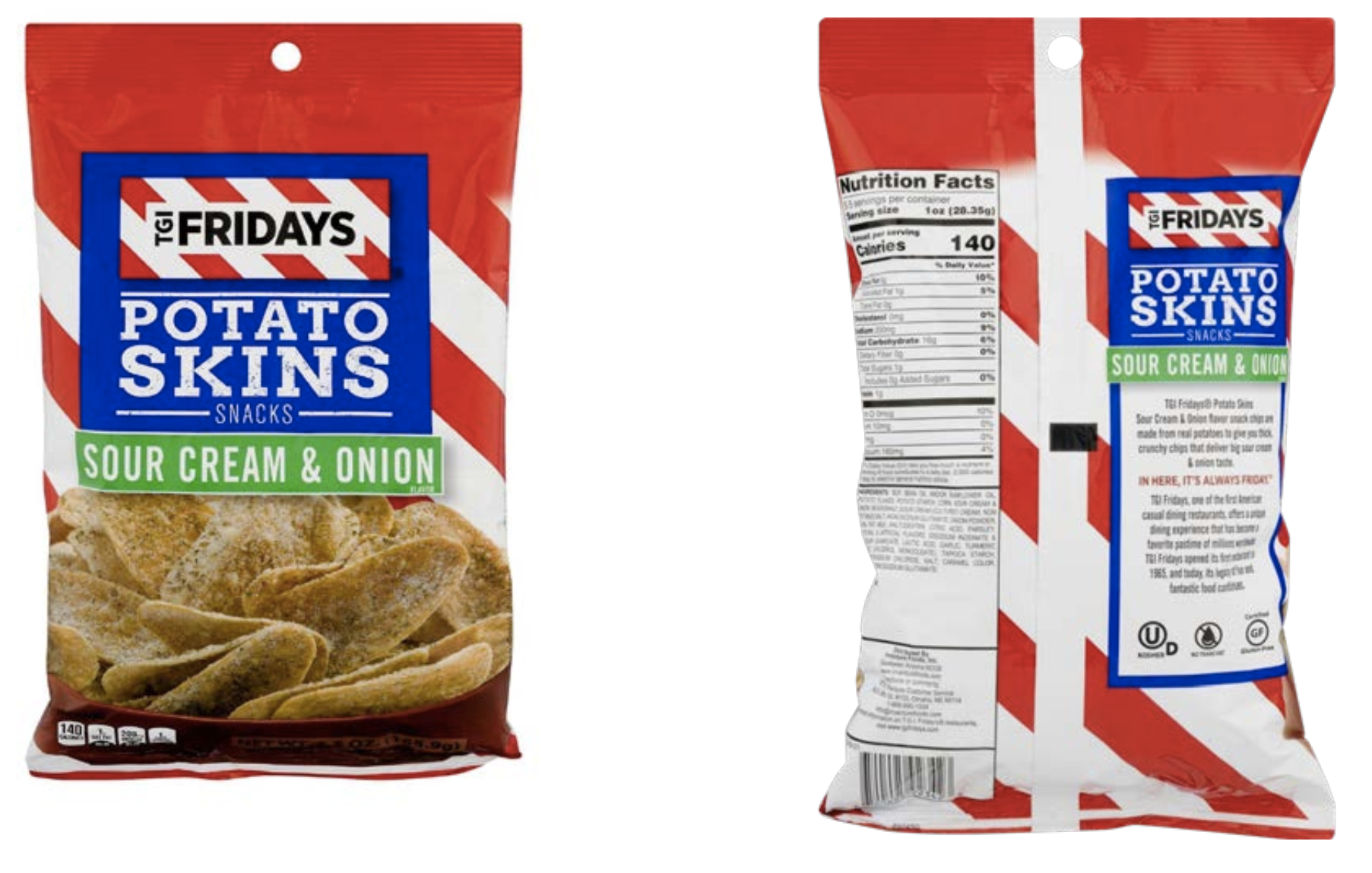
TGI Fridays Potato Skins Snacks may deceive as to potato skin presence, but TGIF isn’t liable

Troncoso v. TGI
Friday’s Inc., 2020 WL 3051020 (S.D.N.Y. Jun. 8, 2020)
 

Troncoso purchased a
bag of snack chips labeled “TGI Fridays Potato Skins Snacks,” mistakenly believing
the chips to contain real potato skins given that the restaurant chain TGI
Fridays sells a Potato Skins appetizer that includes the flesh and peel of the
potato.


After holding that Troncoso lacked standing to pursue
injunctive relief, the court accepted as plausible one theory of falsity under  GBL §§
349 and 350: that the product falsely represented that it included actual
potato skins.
 

Troncoso did not
plausibly plead that a reasonable consumer could believe that the snack chips
would taste identical to or would actually be identical to the TGIF Potato
Skins appetizer. “No reasonable consumer would believe that the snack chips,
shelf-stable and sold at room temperature in gas stations, would be identical
in taste or substance to an appetizer, prepared with perishable dairy products
and served hot in a restaurant.” Nor did she plausibly allege that the taste
didn’t “resemble” that of the appetizer, or that only a product containing
potato peels could in any way replicate the taste of the appetizer. 
 

Nor did she
plausibly plead that a reasonable consumer could believe that the snack chips
would contain thick slices of potato skins, given the picture on the front of
the snack chips’ packaging.
 

However, it was
plausible that a reasonable consumer could be deceived about whether the
products included potato peels. Troncoso also alleged falsity, in that she
alleged that the only potato-based ingredients in the snack chips are potato
starch and potato flakes, and that those ingredients are made from peeled
potatoes (citing outside sources, including a video with an interview with the
plant manager about how the chips were made that didn’t mention potato peels;
while there was no explicit statement of “no potato peels,” it helped make
falsity plausible and not just possible).
 

Defendants argued
that Troncoso couldn’t plausibly plead that she was misled into believing that
the snack chips were nutritious because they contained potato peels. But that
wasn’t her argument; she did allege that potato peels have extra nutrients, but
that was her argument for materiality/the existence of a price premium, which
defendants didn’t dispute on this motion. And the nutritional panel didn’t
dispel any confusion because she alleged that potato peels have certain
minerals not present in potato flesh, such as niacin, and niacin levels are not
reported on the nutritional panel.
 

More generally, the
ingredients list wouldn’t dispel any misimpression based on the label. “A
reasonable consumer would not understand that potato starch and potato flakes
could not contain potato peels, and thus would not believe that the list of
ingredients reversed the label’s representation that the product contains
potato peels.” This is an implementation of the general principle that
consumers aren’t required to be experts on the components or characteristics of
every product they buy.
 

However, defendants
Utz and TGIF left the case. Utz got out because it was just the corporate
parent and Troncoso didn’t sufficiently justify piercing the corporate veil.
 

TGIF got out because
of the solicitude the law has for trademark licensors. “TGIF may be liable for
that misleading labeling under GBL §§ 349 and 350 and principles of common-law
fraud only if it engaged in making the misleading labeling.” Troncoso alleged
that TGIF had “control over the marketing of the” snack chips. But the
allegation of licensing “does not suggest that TGIF was involved in any aspects
of the labeling beyond its own trademark, which Plaintiff does not allege is
misleading,” and Troncoso’s allegations of control were conclusory.
 

Question for the
audience: Suppose the plaintiff alleges the following: (1) Sophisticated
trademark licensors are aware of the risks of naked licensing, and thus they
both provide for control over the quality of the goods and their marketing and
actually exercise that control so as not to risk losing control of the
trademark, following standard industry practices. (2) Defendant is a
sophisticated licensor (perhaps with statements from corporate reports or
something like “ ‘
Our approach to licensing is as important and
strategic as any other aspect of our marketing efforts,’ said Trey Hall, senior
vice president and chief marketing officer for T.G.I. Friday’s.
”). Should this suffice to make sufficient
control plausible?


from Blogger https://ift.tt/2Y0WP0t

Posted in Uncategorized | Tagged , | Leave a comment

misrepresentation of origin was not material and thus not false advertising

Boshnack v. Widow
Jane Distilleries LLC, 2020 WL 3000358, No. 19cv8812 (DLC) (S.D.N.Y. Jun. 4,
2020)
 

In trademark cases,
courts don’t require any materiality showing. That matters. Materiality here
defeats the only plausibly pled falsities about Widow Jane’s whiskey, which
were about its origin. Before the Widow Jane label updated during 2018, it said:
(1) “Kentucky Bourbon Whiskey Aged 7 Years In American Oak” and (2) “Pure
Limestone Mineral Water From the Widow Jane Mine – Rosendale, NY.”


The Widow Jane using
this label was distilled in Kentucky, using water from Kentucky. The limestone
mineral water was added to Widow Jane after the Kentucky bourbon arrived in New
York for bottling. Boshnack alleged that limestone water has “unique properties
which makes it ideal for distillation” but that adding limestone water to
bourbon after distillation is “meaningless and inconsequential.” Also, the
limestone water used in Widow Jane does not actually come from the Widow Jane
Mine, just from a source nearby.

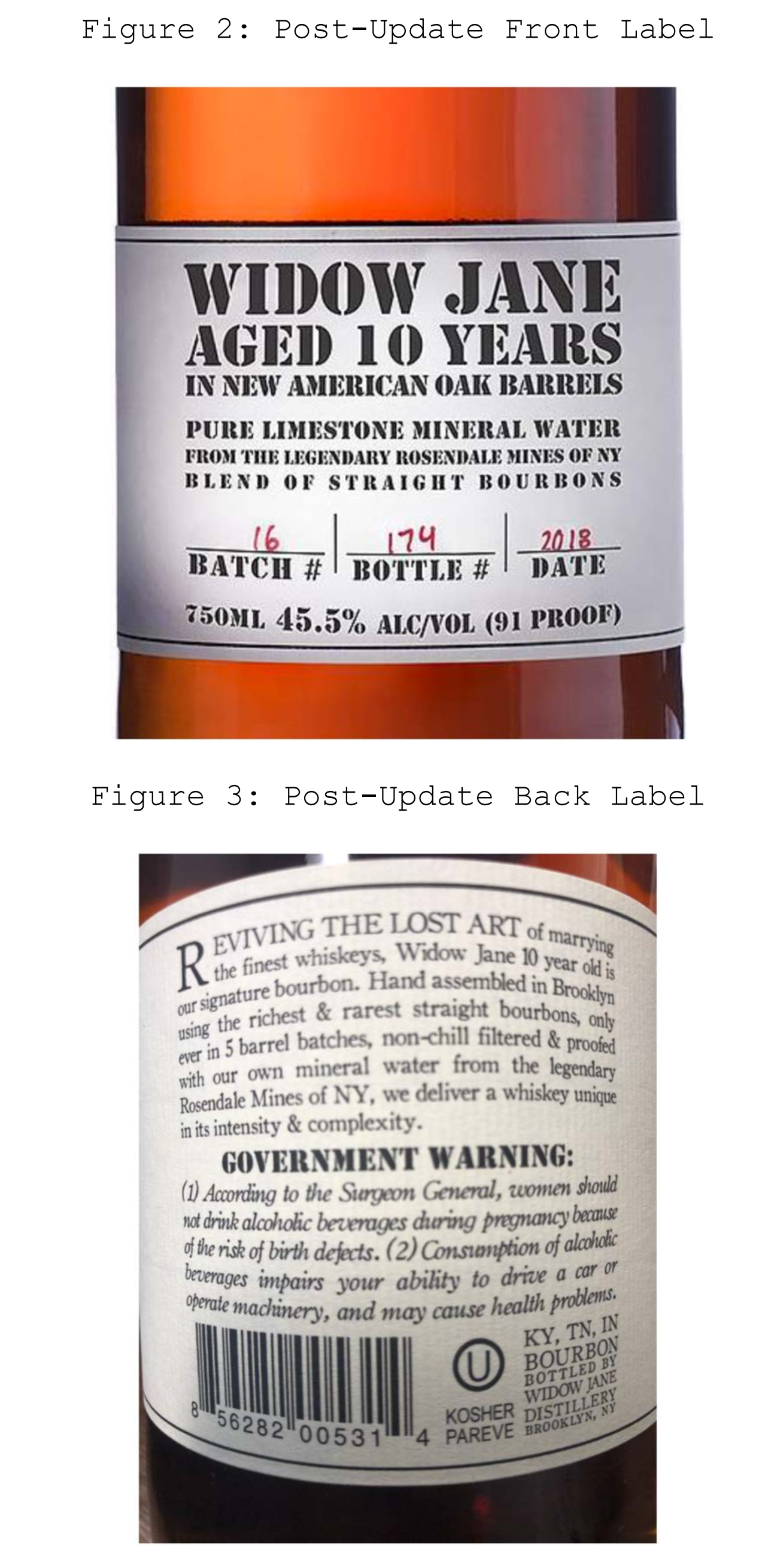
After the 2018
update, the Widow Jane labels contained the following relevant phrases: (1)
“Pure Limestone Mineral Water From the Legendary Rosendale Mines of NY,” (2)
“Hand assembled in Brooklyn using the richest and rarest straight bourbons …
non-chill filtered & proofed with our own mineral water from the legendary
Rosendale Mines of NY,” and (3) “KY, TN, IN Bourbon Bottled by Widow Jane
Distillery Brooklyn, NY.” 

Boshnack allegedly
bought a pre-update bottle of Widow Jane in January 2018 for approximately $85.

The court concluded
that he didn’t plausibly allege deceptiveness to a reasonable consumer. The
labels didn’t misleadingly suggest NY distillation: The pre-update label
described Widow Jane as “Kentucky Bourbon Whiskey,” so a reasonable consumer wouldn’t
conclude that it had been distilled in New York. 

As for
misleadingness about the manner in which limestone water was used, the label
didn’t assert that it was used in distillation, and the whiskey did contain
limestone water. (That doesn’t really get to the misleadingness alleged about
the utility of distilling v. proofing with limestone water, though.)
 

As for the
pre-update reference to “Water From the Widow Jane Mine” was misleading, it
wasn’t material. The complaint didn’t explain why anyone would care, especially
since the complaint alleged that adding post-distillation limestone water was “meaningless
and inconsequential.” Plus, the whiskey allegedly continued to be sold at a
significant price premium even under the post-update labels, and those labels
used the unchallenged phrase “from the legendary Rosendale mines of NY.” “This
suggests that removal of the indication that the water came from the Widow Jane
Mine was not material to the bourbon-consuming public.”


from Blogger https://ift.tt/3h4K0tj

Posted in Uncategorized | Tagged , | Leave a comment

NOCI to eBay protected against tortious interference claim by Noerr-Pennington, but defamation survives

Verbena Products LLC
v. Pierre Fabre Dermo-Cosmetique USA, Inc., 2020 WL 2988587, No.
19-23616-Civ-Scola (S.D. Fla. Feb. 28, 2020)
 

Verbena (aka Beautyvice)
sells cosmetic and beauty care products on eBay. Defendant Yellow Brand “is a
leading global provider of online anti-counterfeiting services,” while
defendant PFDC “sells high quality pharmaceutical and dermocosmetics products
around the world, including hair care products under the trademarks RENE
FURTERER and PIERRE FABRE.” PFDA sent a notice to eBay accusing Beautyvice of
selling counterfeit products, and, as a result, eBay removed Beautyvice’s
accused listings. These were, however, allegedly legitimate Rene Furterer
products that Beautyvice lawfully purchased and re-sold. Beautyvice submitted a
counter notice, but eBay told Beautyvice to resolve this matter directly with
the rights owner.
 

Beautyvice contacted
PFDC and received first a form email and then no other reply; eBay had not restored
the listings at the time of suit.
 

Lanham Act false advertising:
a “single, private communication with eBay” wasn’t commercial advertising or
promotion, even though the effect was to limit the dissemination of Beautyvice’s
own advertising. Unfair competition under Florida common law and FDUTPA claims
failed for the same reason.
 

Noerr-Pennington: this doctrine protects First Amendment
“petitioning of the government from claims brought under federal and state laws
including … common-law tortious interference with contractual relations.” But
it doesn’t preclude defamation liability. Noerr-Pennington extends to acts
reasonably attendant to litigation, such as demand letters, but not to sham
lawsuits. A sham lawsuit is, first, objectively baseless, and second, brought in
the subjective belief “that the process of the suit itself would further an illegal
objective. Baselessness is a difficult
showing, and Beautyvice didn’t show that the demand letter was “objectively
baseless.”  (It seems to me the court has
skipped a separate, important step: is a notice of claimed infringement (NOCI)
to eBay under eBay’s procedures equivalent to a “demand letter”? It doesn’t actually threaten
litigation against anyone, if I understand the NOCI process. That doesn’t mean
that the relatively novel NOCI should not be treated like a demand
letter for Noerr-Pennington purposes, but it does seem to me to require
a distinct analysis, especially since the related §512(f) isn’t subject to Noerr-Pennington
as far as I am aware.)
 

Anyway, tortious
interference claims were kicked out, but not defamation claims.

from Blogger https://ift.tt/3dDPqtc

Posted in Uncategorized | Tagged , , , , | Leave a comment

Rule 9(b) applies to false advertising Lanham Act claims against SmileDirect

Ciccio v.
SmileDirectClub, LLC, 2020 WL 2850146, No. 19-cv-00845 (M.D. Tenn. Jun. 2,
2020)

SmileDirect sells plastic
aligners for orthodontic use. Its SmileDirect program uses teledentistry as an
alternative to conventional orthodontic care. The American Dental Association
filed a complaint with the FTC alleging that SmileDirect has made “numerous
false and misleading claims…to fraudulently entice customers to purchase its
products and services”; it and its state affiliates also filed complaints with
the FDA and with state licensing authorities. SmileDirect argued that this is
an anticompetitive campaign. 

The initial
complaint was filed by a SmileDirect customer, Nigohosian, and three
orthodontists, pleading eight counts under various common law and statutory
theories of false advertising, consumer protection, and fraud. Nighosian accepted
an online contract requiring arbitration by the AAA for everything except “claims
within the jurisdiction of Small Claims Court.” The court initially ruled that
the threshold issue of arbitrability for her should be decided, in the first
instance, through the arbitration process; the consumers (including later-added
ones who the court indicated but did not rule would also be bound by this
holding) voluntarily dismissed their claims.
 

While various
defense motions were pending, one of the consumers filed a Demand for
Arbitration with the AAA, and AAA sent the attorneys involved a letter
informing them that the AAA’s “Healthcare Due Process Protocol” dictates that
the AAA “may only proceed forward on arbitration matters arising out of
healthcare treatment agreements if the parties agree to binding forms of
dispute resolution after a dispute arises.” In light of this determination of
nonarbitrability, two of the consumers sought to rejoin the case here, even
though this decision was made “administratively, not by an arbitrator,” and
involved only one plaintiff.
 

Defendants argued
that, though the arbitration clauses require the parties to abide by AAA rules,
they do not require them to rely on the AAA itself to arbitrate, so the plaintiffs
must seek out an alternative venue. The AAA, by policy, “will no longer accept
the administration of cases involving individual patients without a
post-dispute agreement to arbitrate.” However it will “administer disputes
between patients and healthcare providers to the extent a court order directs
such a dispute to arbitration where the parties’ agreement provided for the
AAA’s rules or administration.” Courts have split on the effects of this policy.
As to the possibility of another abitrator, the plaintiffs pointed out that the
AAA’s own Consumer Arbitration Rules provide that, “[w]hen parties have
provided for the AAA’s rules or AAA administration as part of their consumer
agreement, they shall be deemed to have agreed that the application of the
AAA’s rules and AAA administration of the consumer arbitration shall be an
essential term of their consumer agreement.” The Rules also say that, if the AAA
declines to administer an arbitration, “either party may choose to submit its
dispute to the appropriate court for resolution.” Courts that nonetheless
required arbitration in similar situations did not appear to have relied on the
content of the AAA rules as a whole, but merely on the relevant arbitration
provisions and the Healthcare Policy in isolation. Thus, the consumer who
received the letter showed that he was free to go to court.
 

However, it was “colorable”
that the AAA would accept Nigohosian’s claim pursuant to the court’s earlier
order, based on an exception in the Healthcare Policy Statement for directly
court-ordered arbitration, so she had to try, even though an earlier arbitration
request involving another potential plaintiff had been rejected by AAA. But she
could rejoin the case, subject to a stay, while arbitration proceeds/the AAA
decides if it’s arbitrable—the court explicitly said that its prior references
to “the arbitrator” did not preclude arbitrability review by the AAA’s
non-arbitrator personnel; reading the order as a requirement to have the AAA
arbitrate would rewrite the AAA’s rules, to which the parties agreed.
 

Lanham Act claims by
orthodontists: First, the court decided that Rule 9(b) applied to Lanham Act
false advertising claims. Somehow courts never do this with Lanham Act §43(a)(1)(A)
claims. Plaintiffs argued that “a strict application of Rule 9(b) [would be]
unnecessary, unworkable, or unfair” in that, e.g., “advertisements are
frequently disseminated over and over, sometimes through multiple channels,”
and “ ‘[w]here the allegedly misleading advertising has occurred over a long
period of time, it would be unreasonable and contrary to the Sixth Circuit’s
liberal construction of Rule 9(b) to require Plaintiff to identify the exact
day, hour or place of every advertisement which made the allegedly misleading
statements.’” And in a Lanham Act claim, “the plaintiff, typically a
competitor, is unlikely to have been the actual intended recipient of the
relevant communications. It makes less sense, therefore, to impose on the
plaintiff a heightened responsibility in describing what was said—a fact about
which he, unlike a defrauded person, would have no special knowledge.”
 

But “at least some
of the purposes of Rule 9(b) are clearly implicated in the false advertising
context,” such as protecting a defendant from unwarranted damage to its
reputation (even though intent isn’t required, as it is not for trademark
infringement). And Rule 9(b) is supposed to “discourage[ ] ‘fishing expeditions
and strike suits’ [that] appear more likely to consume a defendant’s resources
than to reveal evidence[ ] of wrongdoing.” Allegedly false advertising about
quality “could open up discovery into every aspect of the product. If the
plaintiff is required to specifically identify the difference between the
advertised features and the product itself, discovery can be narrowed.”
 

However, the court
cautioned that adequately pleading false advertising didn’t require pleading
fraud with particularity; the elements of the claim controlled. And even under
Rule 9(b), what constitutes particularity depends on what’s necessary to
provide sufficient notice.
 

Commercial
advertising or promotion: Plaintiffs alleged a lot of it: SmileDirect allegedly
engaged in an “omni-channel approach to marketing, using billboards (including
in Times Square and the NYC Subway), Google, Facebook, Instagram, and other
social media platforms,” as well as having “purchased advertising time during
televised national sporting events, such as college football games.” The
complaint quoted some verbatim, and also identified as another example a blog
post from SmileDirect’s “Grin Life” blog. The court didn’t require “specific
dates and times” for the “omni-channel” marketing given the “sustained,
repeated communications.” In cases involving numerous false statements, a
plaintiff can satisfy Rule 9(b) by describing the allegedly false scheme and
providing “representative” examples, rather than listing every wrongful act.

Falsity/misleadingness:
Claims that SmileDirect’s customers were highly satisfied “may ultimately turn
out to be the type of vague puffery that cannot support statutory liability,”
but there were other more concrete and specific claims, e.g., the claim that
“[a]n individual who is requesting treatment by using SmileDirectClub’s
aligners is receiving the same level of care from a treating
dentist-orthodontist as an individual visiting a traditional orthodontist or
dentist for treatment.” Plaintiffs pled specific ways in which SmileDirect’s
internet-based teledentistry system allegedly “falls far below the level of
care involved in a traditional dental setting, particularly with regard to the
limited diagnostic tools available in the SmileDirect setting and the
comparatively lesser role played by dentists rather than non-dentist support
personnel.” Whether “level of care” was sufficiently definite to be factual
could not be decided on a motion to dismiss. 

In addition, SmileDirect
allegedly advertised that SmileDirect’s plastic aligners work “three times
faster than braces.” This suggested that aligners perform a comparable service
to traditional braces, which plaintiffs alleged was false. SmileDirect also
allegedly misrepresented its return policy through its “Smile Guarantee”
policy, leading customers to believe that joining the SmileDirect Program
entailed less financial risk than it did. These too were fact questions, and adequately
alleged to be material. “When choosing between competitive services, the degree
to which one service actually offers an adequate substitute for the other is an
obviously important consideration. Overall cost is also an important consideration,
and whether one will be able to get a refund is a component of determining the
range of potential costs.”
 

Finally, each individual
orthodontist plaintiffs specifically alleged that his volume of business was
reduced by the diversion of patients to SmileDirect. “Although the defendants
fault the plaintiffs for failing to allege more facts that would support the
conclusion that specific patients chose SmileDirect over them, it is difficult
to imagine how an orthodontist could reasonably be expected to know the
identities of the patients who merely considered him before going elsewhere. If
anyone other than the patients would have that information, it seems more
likely that it would be SmileDirect.”
 

Tennessee Consumer Protection
Act: The Tennessee Supreme Court has held that non-consumers can sue under the
law if they suffer relevant harm from the violation of the law, and the
orthodontists alleged lost money or property in the form of lost business, so the
orthodontists’ TCPA claims could proceed. The TCPA also doesn’t allow private
class actions for damages, but the statute indicated that injunctive and
declaratory relief for a class was possible.
 

Florida Deceptive
and Unfair Trade Practices Act: FDUTPA doesn’t allow consequential damages. So
are lost profits consequential or actual damages under the statute? The Florida
state courts haven’t resolved the question, and Florida federal district courts
have disagreed. The court’s Erie guess here was that Florida would
consider a competitor’s lost profits to be actual damages under FDUTPA, which
provides that it shall be “construed liberally to promote” its purposes, and whose
private cause of action, like the TCPA’s, “does appear to contemplate a broad
range of potential plaintiffs. Indeed, the FDUTPA was explicitly amended to
make clear that it allowed claims by parties other than individual consumers,
which supports the inference that it must permit the kinds of damages that
non-consumer plaintiffs are likely to suffer.”
 

New York General
Business Law §§ 349 and 350-A: Could also proceed because the NY orthodontist
plaintiff’s injuries weren’t derivative of the injuries suffered by SmileDirect
customers. “The injuries suffered by consumers may have been caused by the same
allegedly illegal marketing that caused the orthodontists to lose business, but
one injury was not created by the other.”

from Blogger https://ift.tt/2AG2L5C

Posted in Uncategorized | Tagged , | Leave a comment

overstatement of claims in patent case/potential customer liability could be false advertising

Shure Inc. v. ClearOne,
Inc., 2020 WL 2839294, No. 19-1343-RGA-CJB (D. Del. Jun. 1, 2020) (magistrate
R&R)
 

Skipping substantive
design patent stuff (sorry, Sarah Burstein). The parties compete in the installed
audio-conferencing market and have a history of litigation, including
accusations that Shure infringed ClearOne patents. The court in that case
denied a preliminary injunction on one patent and granted it on another.
ClearOne also filed a separate suit against Shure.
 

Shure then sued here
for infringement of another patent, as well as federal false advertising,
Delaware Deceptive Trade Practices Act, unfair competition, tortious
interference claims based on ClearOne’s alleged marketplace misconduct; Shure
then added claims based on a newly granted design patent.
 

Shure alleged that
ClearOne made various false or misleading statements (including statements made
by its Regional Sales Manager Schnibbe and its Senior Vice President of Finance
Narayanan to customers, installers and integrators regarding the status or
impact of litigation between the parties, including the impact of the
preliminary injunction.
 

First, were these
compulsory counterclaims of the other (Illinois-based) litigation? No. Shure’s
non-patent claims allege that ClearOne falsely advertised regarding the
“availability, legitimacy, and viability of Shure’s MXA910 product based on the
ongoing litigation between the parties.” But those statements related to
rulings in the earlier Illinois case and a separate IPR proceeding, not to the
more recent Illinois case. Even if Shure is ultimately found to have infringed
the patent at issue in the more recent Illinois case, that wouldn’t affect
whether Shure’s statements about earlier litigations were misleading and/or
harmed Shure at the time that they were made. And as to Shure’s patent
infringemetn claim, it did involve similar conferencing and array microphone
technologies as the previous patent case and implicated the same products, in
the sense that ClearOne’s accused product here practices the patent ClearOne
asserted and that Shure is asserting damages tied to sales of its own
accused-in-Illinois product. But that wasn’t enough given the different patents
in suit.
 

False advertising: The
claim was sufficiently pled under Rule 8. Shure alleged that “[s]ince at least
March 2019” Schnibbe made false and misleading statements about the
availability, legitimacy and viability of Shure’s MXA910 product in connection
with the ongoing litigation between the parties to “more than a dozen
installers and integrators” of Shure’s conferencing equipment. They include
“that Shure’s MXA910 has been found to infringe ClearOne’s patents, that two
separate court rulings found that the MXA910 infringed ClearOne’s patents, that
such rulings were ‘unanimous,’ that ClearOne had ‘won’ its lawsuit against
Shure, that the MXA910 will soon be unavailable, that Shure will soon have to
stop selling the MXA910, that Shure was then unable to sell MXA910 products,
and that integrators, installers, and/or end users will need to tear or rip out
existing installations of the MXA910.” Alleging this, and that these statements
were “intentionally misleading and were made in bad faith, and with the intent
to induce customers to refrain from purchasing MXA910 products,” was sufficient
to provide proper notice, even if Shure didn’t name a specific customer to whom
the statements were made. And Shure explained why such statements were
allegedly false: because they wrongly suggest that, in light of the state of
the legal proceedings at issue, there is no permissible non-infringing use of
the MXA910 product or that the MXA910 will no longer be available in any form.

Commercial
advertising or promotion: under the alleged circumstances, statements by one
person to more than a dozen customers were plausibly “part of an organized
campaign to penetrate the relevant market.” 

Bad faith: because
of the interaction with patent law, false statements about patent rights have
to be in bad faith to be actionable under the Lanham Act. Shure alleged why the
statements were false, which was sufficient to allege bad faith at this stage.

ClearOne argued that
its statements were non-actionable opinion, but they could be “verifiably false
statements of fact.” It wasn’t opinion to say that (1) Shure’s product had been
“found to infringe” ClearOne’s patents; (2) that two court rulings came to that
conclusion and were “unanimous”; (3) that ClearOne had “won” its lawsuit
against Shure; and (4) that the the product would soon be “unavailable” or that
Shure could not sell them or that Shure’s customers would need to rip out
existing installations. These were plausibly clearly untrue, in light of the
then-current state of the 2017 Illinois case and the IPR proceeding involving one
patent (in which there was then no final determination of infringement, nor any
order affecting sale or use).

Because Shure pled
literal falsity, it was entitled to a presumption of actual deception. 

As for the state law
claim, the DTPA actually has a “lower burden of proof than the Lanham Act”
because “a complainant need not prove competition between the parties or actual
confusion or misunderstanding” to prevail in an action under the DTPA. Because
at least the allegations about Narayanan’s letter satisfied the pleading
requirements, the claim should survive. (The statements were very similar to
the statements discussed above; for example, the letter said that third party
installers and integrators were likely infringing ClearOne’s patent by
installing Shure’s product “in a drop-ceiling mounting configuration,” but this
was allegedly false because some such configurations were noninfringing; it
also allegedly misleadingly suggested that Shure customers could be held
personally liable via the 2017 case, when that could not happen; etc.)

 The magistrate also
recommended that tortious interference and unfair competition claims should
survive.

from Blogger https://ift.tt/3eVFjAk

Posted in Uncategorized | Tagged , , | Leave a comment

Just stocking a falsely advertised product isn’t enough for contributory liability

In re Outlaw
Laboratory, LLP, 2020 WL 2797425, No. 18-CV-0840-GPC (S.D. Cal. May 29, 2020)
 

Plaintiff makes male
enhancement products, allegedly in compliance with the DHSEA. It sued 51
convenience and liquor stores in the San Diego, California area; 23 of those
defendants have been terminated, 20 are actively litigating, and eight haven’t
appeared/answered. The defendants allegedly sold falsely advertised male
enhancement products containing undisclosed pharmaceuticals; some of the
accused products contain hidden ingredients including sildenafil, the
consumption of which can cause “life-threatening hypotension” and greatly
“increase[s] the risk of heart attack,” among other effects.
 

The court applied
issue preclusion to Outlaw’s argument for direct liability for the retailers
under the Lanham Act, based on past litigation. Outlaw’s only allegations about
the stores were that they sold the products, not that they advertised or
marketed them beyond placing them on their shelves. Failing to disclose the bad
ingredients was not itself actionable under the Lanham Act.
 

Contributory
liability under the Lanham Act is a cognizable theory, but wasn’t plausibly
pled here. After all, courts accept contributory liability in §43(a)(1)(A)
cases, and such claims arise from clauses that are “subpart[s] of a single
statutory provision,” “share the same introductory clause,” “were motivated by
a unitary purpose” to prohibit unfair competition, and are rooted in tort law
(which, of course, permits contributory liability). POM Wonderful even recognized
that, of these two provisions, false advertising is “the broader remedy.”
 

The leading case,
from the Eleventh Circuit, requires a showing that (1) there was direct false
advertising, and (2) “the defendant contributed to that conduct either by
knowingly inducing or causing the conduct, or by materially participating in
it.” Duty Free Americas, Inc. v. Estee Lauder Companies, Inc., 797 F.3d 1248,
1277 (11th Cir. 2015). In other words, the plaintiff “must allege that the
defendant…intended to participate in or actually knew about the false
advertising” and “that the defendant actively and materially furthered the
unlawful conduct—either by inducing it, causing it, or in some other way
working to bring it about.” (Note that “material participation” in the initial
description looked like it did not require knowledge, but apparently not.)
Outlaw didn’t properly allege the required elements with specificity.
 

Among other things,
the complaint lacked allegations that the stores “actively and materially
furthered the unlawful conduct.” For example, there were no allegations that
they “controlled,” “monitored,” or even “encouraged” the false advertising. There
was no reference to “a clear contractual power” to stop the false advertising,
or any extensive communications with the unknown third parties who supplied the
products “regarding the false advertising.” Even allegations of knowledge were
unspecific, as if general FDA announcements put the stores on notice.
 

Outlaw’s allegations
also failed if the court applied the standard of ADT Sec. Servs., Inc. v. Sec.
One Int’l, Inc., No. 11-CV-05149-YGR, 2012 WL 4068632, at *3 (N.D. Cal. Sept.
14, 2012): contributory liability can arise if the defendant “(1) intentionally
induced the primary Lanham Act violation; or (2) continued to supply an
infringing product to an infringer with knowledge that the infringer is
mislabeling the particular product supplied.” Since we don’t know who the
primary violator is, we can’t tell that they were “induced” by the stores.
 

California’s FAL:
also failed. Outlaw lacked standing because it didn’t rely on the
misrepresentations. The majority approach requires the plaintiff to have lost
money or property in reliance on the misrepresentations, not merely because
other people relied on the misrepresentations, as was alleged here. Also, as
with the Lanham Act claims, the stores weren’t personally responsible for the false
advertising, and “[a] defendant’s liability must be based on his personal
‘participation in the unlawful practices’ and ‘unbridled control’ over the
practices that are found to violate section 17200 or 17500.” (Citing Emery v.
Visa International Service Ass’n, 95 Cal. App. 4th 952, 960 (2002).) And there’s
no vicarious liability under California consumer protection laws. Nor is there
a duty to investigate and disclose the falsity on the packaging.
 

Also, “remedies for
individuals under the FAL are limited to restitution and injunctive relief.”  There was nothing to restore to Outlaw; an
injunction was permissible, but only if the claims had been properly alleged.
 

UCL fraudulent/unlawful:
Again, putting a falsely advertised product on a shelf is not itself “fraudulent”
in the absence of acts to adopt and further the false advertising. (Citing
Dorfman v. Nutramax Labs., Inc., No. 13-CV0873-WQH, 2013 WL 5353043, at *14
(S.D. Cal. Sept. 23, 2013) (finding retailer defendant could be liable under
the UCL where the defendant sold the products in their stores, entered into
sales agreements with the manufacturer, provided pictures of the deceptive
packaging, and made statements on their website with misleading labeling).) And
again Outlaw lacked standing.
 

Unlawful: Outlaw
alleged that it was unlawful to sell pharmaceuticals without a prescription,
but didn’t identify any particular section of any statute that was violated, so
it still failed to state a claim.

from Blogger https://ift.tt/2U6iRMC

Posted in Uncategorized | Tagged , , , , | Leave a comment

“Belgium 1926” label on chocolate plausibly indicates current Belgian origin

Hesse v. Godiva
Chocolatier, Inc., 2020 WL 2793014 No. 19-cv-972 (AJN) (S.D.N.Y. May 29, 2020)
 

The forgiving plausibility
standard allows consumer protection claims about Godiva’s use of “Belgium 1926”
on its American-made chocolates to continue. The court points out that,
although “founded in Belgium in 1926 but not still there” might be a plausible
interpretation, “founded in Belgium in 1926 and still there” is at least as
plausible if not more so. Other moments of note: (1) injunctive standing
lacking because plaintiffs now know the truth and future desire to buy properly
labeled chocolate isn’t concrete enough; (2) Godiva raises a First Amendment defense
to this garden-variety consumer protection claim. Expect more of this even
though the court disposes it in a footnote as putting the cart before the
horse: if this is misleading commercial speech, it’s not protected by the First
Amendment.


example of challenged packaging

Godiva puts “Belgium
1926” “prominently … on the front packaging of all the Godiva chocolates.”
Amended Complaint, and “across its entire marketing campaign, such as on its
Godiva storefronts, supermarket display stands, and print and social media
advertising,” but made all its chocolates in Reading, Pennsylvania during the
relevant time period. Plaintiffs alleged that “Belgium is widely understood and
recognized as producing among the highest quality chocolates in the world” and that
American chocolate differs in taste from that produced in Belgium, due “to the
use of different butters, creams, and alcohol.”
 

Article III standing
for injunctive relief: the court reasoned that plaintiffs’ injury was “hypothetical—if
they choose to purchase Godiva’s products in the future, then they may be
harmed.” But isn’t the injury the ongoing lack of ability to rely on the label?
That doesn’t require a choice to buy Godiva; it’s about interference with the decisional
environment. But anyway, plaintiffs know the truth so they couldn’t be harmed
by the continued representation of Belgian origin. (Again, the 9th Circuit
pointed out that products can change, so that doesn’t necessarily mean that
they never face Godiva-related choices again.)

New York General
Business Law the usual California statutory claims survived. The reasonable
consumer applied to all these claims. Godiva claimed that its statement was “unambiguous
and historically accurate message” about the founding, but “an equally, if not
more, plausible inference is that the phrase represents both the provenance of
the company—Belgium, in 1926—and a representation that its chocolates continue
to be manufactured there.” Godiva relied on a trademark registration, several
pages on Godiva’s website, and a CBS News article stating that Godiva’s
chocolates are manufactured in Pennsylvania. “Godiva asks the Court to draw an
inference in its favor: that because these documents were public record,
reasonable consumers were aware of where its manufacturing occurs. That
inference is couched in assumptions—that everything in the public record is
universal knowledge and that, even if this information was widely disseminated,
Godiva’s label could not lead a reasonable consumer astray, to name a few.” Not
on a motion to dismiss! 

This is especially
true because reasonableness takes the entire context of product labeling into
account. Part of the “mosaic” was that “some of Godiva’s packaging and
social-media advertising describe its chocolates as Belgian. The front
packaging of one of its boxes, for example, contains the phrase “ASSORTED
BELGIAN CHOCOLATE CARAMELS,” and its social-media advertising states “Delicious
Belgian chocolates brought to you …” Those facts bolstered the conclusion
that a reasonable consumer could conclude that its chocolates are manufactured
in Belgium. The court distinguished other cases “where the label in question
expressly disclaims its actual origin—which is not the case here.” Though
disclosures aren’t always curative, “the absence of a disclosure counsels
strongly against Godiva’s argument.”  Fundamentally, “it is reasonable that a
consumer would view a label touting the location and year of a company’s
founding as representing the products’ continued place of production,” even if reasonable
consumers would not think that individual chocolates were produced in 1926.
 

Most of the warranty
claims also survived, but common-law fraud, intentional misrepresentation, and
negligent misrepresentation did not.

from Blogger https://ift.tt/36TZBqZ

Posted in Uncategorized | Tagged , | Leave a comment

“truly tiny” disclaimer at bottom of website didn’t prevent factual issue on misleadingness

Lemberg Law, LLC v. eGeneration
Marketing, Inc., 2020 WL 2813177, No. 18-cv-570 (CSH) (D. Conn. May 29, 2020)

Lemberg sued eGeneration
for running stopcollections.org, a site engaged in “matching lawyers who focus
their practice on filing claims under the federal Fair Debt Collection
Practices Act (“FDCPA”) with consumers who are interested in engaging a lawyer
for assistance with such a claim.” Lemberg is a Connecticut consumer law firm that
represents clients in FDCPA cases. eGeneration isn’t a law firm, but allegedly
“holds itself out” as a provider of legal services for FDCPA claims.” Its site
“offers ‘100% free legal consultation’ relating to debt collectors and
harassment” its advertising was allegedly “specifically designed to deceive and
mislead consumers into believing that Defendants are lawyers and/or are
providing legal services in relation to FDCPA claims.” Lemberg sued for
violation of the Lanham Act and the Connecticut Unfair Trade Practices Act (CUTPA).
The court allowed the claims to proceed, but required Lemberg to get a separate
lawyer for trial rather than representing itself. 

Defendants argued
that their site’s “plain-language statements” expressly disclosed that “Website
operators are not lawyers and the Website connects users with independent
lawyers who provide free consultations.”
 

Along with the facts
above, Lemberg alleged that
 

• “When a consumer
searches for “debt harassment” on http://www.google.com, a paid ad for Defendants’
Website appears above any other search results, advertising ‘Debt Collection
Harassment Speak With A Lawyer Free.’ ”

• Defendants
advertise their Website in a Google paid ad which states “Harassment From Bill
Collectors Contact Our Debt Lawyers Now … Get up to $1,000 per violation. ….”

• Consumers can
submit a request for consultation without scrolling below the fold at the
bottom of the page. However, scrolling will reveal the bold print “FDCPA legal
representation is completely free regardless of whether you win or lose your
case.” Moreover, “[t]he burden of payment to the attorney will fall on the debt
collector if they [sic] are found guilty of a violation.”

• The bottom of the
website says: “Connect with a Lawyer.”

• The very bottom of
the website has the sole and “inconspicuous disclaimer” – “in a font size that
is significantly smaller than the rest of the text on the Website” – that
“Stopcollections.org is not a lawyer or a law firm,” and “not an attorney
referral service.” Rather, “[i]t is an advertising service paid for by the
lawyers and advocates whose names are provided in response to user requests.”
 

Lemberg alleged that
the site headline and the Google ad headline, “Contact Our Debt Lawyers Now,”
intentionally “lure[ ] a prospective customer into believing that he/she is
dealing with a law firm when that is not in fact the case.” The photo on the
front page of “a man and a woman in professional attire [i.e., business suits]
further impresses upon the visitor that the website belongs to a law firm
licensed to offer legal advice.”
 

Further, Lemberg
alleged that defendants were violating state rules on lawyer advertising, and
solicited Lemberg to become a recipient of eGeneration’s “lead generation
services.”
 

Defendants argued
that “a Lanham Act false advertising claim fails when an advertisement’s
truthful language, including that contained in a disclaimer, dispels any
misimpression it is alleged to give.” They relied on Pernod Ricard USA, LLC v.
Bacardi U.S.A., Inc., 653 F.3d 241 (3d Cir. 2011), for the propositions that (1)
“unambiguous plain language can warrant disposing of a false advertising claim
as a matter of law” and (2) “explicit clarifying language can be dispositive as
to whether an advertisement is ‘misleading’ under Section 43(a)(1).” They
argued that their site stated “in no uncertain terms” that EMI “is not a lawyer
or law firm” and that “interested users are contacted by ‘an independent lawyer
or advocate’ to evaluate their potential FDCPA claims,” so it could not mislead
a reasonable consumer.
 

Defendants also
relied on Forschner Group, Inc. v. Arrow Trading Co., Inc., 30 F.3d 348 (2d
Cir. 1994), which overturned a district court finding that the use of the
phrase “Swiss Army knife” in connection with its poorly-crafted
Chinese-manufactured knife was false advertising. Despite a consumer survey
showing deception, the Second Circuit relied on the fact that the main blade of
the knives was marked “STAINLESS/CHINA” and the packaging expressly stated,
“Made in China.”
 

Defendants argued that
“truthful disclaimers and explanations on the Website cannot be disregarded
because of their placement or font size,” so whether they were conspicuous or
not didn’t matter. Anyway, it’s fine to make consumers scroll down and to use
fine print/the bottom of pages.  
 

The court was not
particularly impressed. As prior cases have said, a “disclaimer or
contradictory claim placed in an ad will not remedy an ad, which is misleading,
per se.” Also, “a footnote or disclaimer that purports to change the apparent
meaning of the claims and render them literally truthful, but which is so
inconspicuously located or in such fine print that readers tend to overlook it,
will not remedy the misleading nature of the claims.”
 

Pernod Ricard was distinguishable on the facts (and
nonbinding). The front label clearly stated that it was a “Puerto Rican Rum,”
and the “Havana Club rum” actually “ha[d] a Cuban heritage and, therefore,
depicting such a heritage [was] not deceptive.” The “ambiguity” here was
greater, creating a factual dispute that couldn’t be resolved on a motion to dismiss.
“While a disclaimer may be so plain, clear and conspicuous as to bar a claim as
a matter of law, this is not [always] the case.” As the court summarized, the
case law, “[t]o be effective, a disclaimer must be sufficiently bold and clear
to dispel any conflicting false conclusions.”

Here, it would be
reasonable for a consumer, noting the large headline toward the bottom of the
page, “Connect with a Lawyer,” to overlook the significantly smaller disclaimer
in tiny font at the very bottom of the page that the site “is not a lawyer or
law firm” and “not an attorney referral service.” Indeed, it was plausible that
“even if a consumer read the disclaimer, he or she might become confused by the
instruction, ‘[t]o find out the attorney or advocate in your area who is
responsible for the advertisement, click here’” and think that they were revealing
the names of the attorneys who own the website because they are “responsible
for the advertisement.” 

The court also noted
that the link at the top of the site to the privacy policy and disclaimer was
in “truly tiny font” in contrast with the bold opportunity to “Get Started” in
obtaining an FDCPA attorney. “[A] reasonable consumer, plagued by debt
collectors and eager to ‘Get Help,’ might fail to click on that tiny link,
which is arguably not noticeable in that it is printed in white ink against a
navy blue background.”
 

Thus, both because
of the minimal visibility of the disclaimer here and because there was no
arguably true alternate interpretation (the site is not really owned by
lawyers and has no “lawyer heritage”) justifying tolerance for the message, Pernod
Ricard
was distinguishable. The court pointed out that Pernod Ricard
expressly declined to resolve what would happen if the statement of geographic
origin was in “fine print.”
 

Likewise, whether
the photo of a man and woman dressed in “professional attire” appeared to be
lawyers in the absence of briefcases, books, legal pads, etc., that was also a
question of fact to be considered in the overall context of the site. The
website says in bold print, “Connect with a Lawyer.” Moreover, directly next to
the image, it says, “Receive a 100% FREE legal consultation.” There was no
explicit label to the contrary.
 

CUTPA bars “unfair
or deceptive acts or practices in the conduct of any trade or commerce.” Along
with the Lanham Act allegations, Lemberg alleged that Section 7.2 of the
Connecticut Rules of Professional Conduct mandates that any advertisement for
legal services “shall include the name of at least one lawyer admitted in
Connecticut responsible for [the ad’s] contents” and that “soliciting cases for
third party attorneys” was illegal under state law and thus “unfair.”
 

Unfairness considers
“(1) [w]hether the practice, without necessarily having been previously
considered unlawful, offends public policy as it has been established by statutes,
the common law, or otherwise—in other words, is it within at least the penumbra
of some common law, statutory or other established concept of unfairness; (2)
whether it is immoral, unethical, oppressive or unscrupulous; [and] (3) whether
it causes substantial injury to consumers, [competitors or other
businesspersons].” The Connecticut Supreme Court has expressly held that
entrepreneurial aspects of the practice of law, such as attorney advertising,
fall well within scope of CUTPA.
 

Given the Lanham Act
discussion above, confusion was properly alleged.
 

Defendants argued purported
violations of the Connecticut Rules of Professional Conduct couldn’t form the predicate
of any cause of action, including under CUTPA. But the claim here was based on more
than such a violation; the parties agreed that defendants weren’t attorneys and
couldn’t be personally subject to those Rules. Mere references to the Rules
didn’t take the CUTPA claim out of the court’s jurisdiction. L
emberg also referred
to Connecticut and similar state laws that prohibit one “not admitted as an
attorney in this state” from soliciting another person to “cause an action for
damages to be instituted” in return for compensation from that person or his
attorney. This at least showed conduct that might be viewed as offending public
policy – falling “within at least the penumbra of … [an] established concept
of unfairness.”

However, given the
need to preserve the integrity of the trial process, Lemberg Law would need to
find separate counsel for trial. “This will allow Lemberg Law to have the
benefit of Attorney Lemberg’s litigation skills and diligence in the
preliminary phases of the case, but prevent the potential taint of him acting
as both advocate and witness at trial.”


from Blogger https://ift.tt/2ZXlnsu

Posted in Uncategorized | Tagged | Leave a comment

Copyright preempts/Dastar precludes lawsuit based on Fortnite’s copying of a dance move

Brantley v. Epic
Games, Inc., No. v. 19-cv-594-PWG (D. Md. May 29, 2020)
 

Plaintiffs Brantley
and Nickens alleged that in 2016 they created, named, and popularized a dance
move, which they titled the “Running Man,” and which subsequently went viral on
social media. (In part this came after a live performance of the dance by
Brantley and Nickens on the Ellen DeGeneres Show, during which two high school
students from New Jersey, Kevin Vincent and Jeremiah Hall, were credited with
creating the dance; Brantley and Nickens stated later in the segment that they
copied the dance from a video that they saw on Instragram.) They alleged that
the “Running Man” has become synonymous with them. 
 

Epic makes the
Fortnite video game franchise, allegedly popular not just because of gameplay but
also because of the incorporation and popularity of in-game emotes, moves that
express the player’s emotions in the game. In 2018, Epic introduce a new emote,
the “Running Man,” which cost about $5.
 

Plaintiffs sued for invasion
of the right of privacy/publicity, unfair competition, unjust enrichment,
trademark infringement, trademark dilution, and false designation of origin.
Finding all the claims either copyright-preempted or inapposite, the court
dismissed the complaint.
 

Common-law privacy,
unfair competition, and unjust enrichment were preempted. First, the Running
Man dance was within the subject matter of copyright, since copyright covers
choreographic works. The court noted that “the scope of copyright preemption is
broader than the scope of copyright protection”; an unprotectable social dance
step that was insufficiently extensive to constitute a chorographic work is,
like an unprotectable idea, still within the subject matter of copyright. The
court thought it a “closer question” than in previous cases whether the Running
Man could be copyrightable, but in any event it was “somewhere on the continuum
between copyrightable choreography and uncopyrightable dance,” and that was all
the court needed to know for preemption purposes.
 

Second, the rights
asserted were, under these circumstances, equivalent to the rights granted by
copyright. Unfair competition via misappropriation is regularly preempted; unjust
enrichment too where there are no elements other than reproduction,
performance, distribution, or display constituting the alleged violative
conduct.
 

Privacy/publicity: Plaintiffs
argued that misappropriation of identity/likeness constituted an extra element.
But just because ROP claims are sometimes not preempted does not mean they are
never preempted. The question is whether plaintiffs were claiming something “qualitatively
different” than the rights protected by the Copyright Act. Here, they were not:
their claims were based on alleged copying of the Running Man dance, squarely
within the scope of the Copyright Act. The court did not accept that the dance
was plaintiffs’ “likeness.”

Lanham Act/common
law trademark claims: Dastar!  Plaintiffs
alleged that Epic’s use of the Running Man “has caused and will continue to
cause confusion and mistake by leading the public to erroneously associate the
Emote offered by Epic with the Running Man, as executed and associated with
Plaintiffs, as exemplified in their online video.”

Dastar instructs that causes of action under §
43(a) of the Lanham Act based on misappropriation and confusion can proceed
only where there is confusion as to “the producer of the [] product sold in the
marketplace” not the “person or entity that originated the ideas or
communications that ‘goods [or services]’ embody or contain.”  This was a claim based on copying ideas or
concepts, not based on source confusion. As a previous emote case held, the
complaint didn’t plausibly allege that there was confusion over who produced
the emote. At most, the complaint alleged only confusion over who came up with
the move, which is not Lanham Act confusion.
 

Separately,
plaintiffs failed to allege that the Running Man was a valid mark identifying a
good or service. “[A]s a general rule images and likenesses do not function as
trademarks” (citing ETW Corp. v. Jireh Publ’g, 322 F. 3d 915, 922-923 (6th Cir.
2003)). And plaintiffs didn’t adequately allege how the Running Man dance was
used to identify a unique good or service. It could not be a trademark for
itself.
 

False endorsement
theory: plaintiffs alleged that Epic “creat[ed] the false impression that
Plaintiffs endorsed Fortnite.” The court pointed out that several courts have
dismissed similar claims using Dastar—if all you had to do to avoid Dastar
was to plead false endorsement, the case would be a dead letter and the
conflict with copyright law would reignite, at least for accused “communicative
products.” However, the previous emote case didn’t rely on Dastar,
distinguishing endorsement as distinct from authorship or origin. Here, the
allegations didn’t support such a distinction: plaintiffs’ allegations of false
endorsement were based solely on copying the Running Man dance. “”A false
endorsement claim based on these allegations would lead to the type of conflict
between the Lanham Act and the copyright law that the Supreme Court sought to
avoid in Dastar.”

from Blogger https://ift.tt/3gFerWZ

Posted in Uncategorized | Tagged , , , , | Leave a comment

turnabout is fair play: undisclosed sponsorship of “objective” report could be misleading; overstatement of court holding could be defamatory

Pegasystems, Inc. v.
Appian Corp., 2020 WL 2616280, No. 19-11461-PBS (D. Mass. May 22, 2020)

Pegasystems
sued Appian
for allegedly falsely touting a paid for report as independent;
now the court deals with Appian’s counterclaims for false advertising under the
Lanham Act and Mass. Gen. Laws ch. 93A; commercial disparagement; and
defamation, in connection with four separate fact patterns, granting Pegasystems’
motion to dismiss in part and denying it in part. 

(1) In March 2011,
Pegasystems posted “Pega BPM System z Benchmark Test Results” on its site, providing
the results of testing done in collaboration with IBM to determine if
Pegasystems’ platform could be “effectively deployed across an entire corporate
enterprise … with a servicing population of approximately 10,000 users.” The
paper concluded that Pegasystems “met or exceeded all performance goals” for
the testing. But the testing employed the IBM System z processor, “a
$26-million machine — the highest-end and most expensive mainframe IBM sold in
its class at the time.” Appian alleged that “extremely few (if any) Pegasystems
customers would ever be using such a powerful supercomputer to run Pegasystems’
software” and that the paper was currently misleading because the testing was
performed on a long-discontinued version of Pegasystems’ platform.
 

But this was not
misleading because the fact that the test used “a computer too expensive for
most businesses to afford,” was “obvious” from the paper’s title and from the
website’s description: Anyone would immediately know that the System z
processor was used to conduct the test.  “Particularly
given the technically savvy consumer base for the products at issue, a
limitation contained in the title of the paper cannot give rise to a Lanham Act
false advertising claim.” Likewise, the fact that the Pegasystems version that
had been tested had long been discontinued didn’t amount to
falsity/misleadingness, since any reader would see that the paper was published
in 2011 and could take that date into account.
 

(2) At Pegasystems’ 2019
annual conference PegaWorld, attended by over 6,000 people, Pegasystems
allegedly made “false statements … designed to exaggerate narrow claims
regarding Pegasystems’ products by third parties and to present them as
statements relating to broader areas of wider relevance to customers,” which
are still available on video on Pegasystems’ website, included: Stating that
Pegasystems has “40,000+ certified professionals globally” when that number
included professionals whose certification had expired or whose certification
was for an older version of Pegasystems’ software; and stating that Pegasystems
“get[s] accolades from analysts” while displaying four charts, three of which
Appian alleges were “falsely and misleadingly captioned.”
 

Appian alleged that
the second chart was labeled “Digital Process Automation” but
came from a report on “Software For Digital Process Automation For Deep
Deployments”; the third was labeled “Real-Time Decisions & AI” but came
from a report on “Real-Time Interaction Management”; and the fourth was labeled
“End-to-End Work Management” but came from a report on “Intelligent Business
Process Management.”
 

These changes to the
graph titles were not plausibly material to “the sophisticated consumers who
purchase business process management software.” So too with Pegasystems’
statement that it has “40,000+ certified professionals globally” when some of
them have lapsed certificates or certificates for obsolete versions of
Pegasystems. “It is implausible that the precise number of currently certified
professionals, as conveyed in passing on a presentation slide, would be
material to a consumer.”
 

(3) In 2014, Jim
Sinur published a six-page paper on Pegasystems’ website titled “Appian and
Pegasystems – Head to Head Comparison”; it was removed in January 2019. The
paper describes Sinur as “an author and independent thought leader in applying
business process management (BPM) to innovative and intelligent business
operations (IBO)” and refers to his prior experience at Gartner, a global
research and advisory firm. “The paper does not explain its objective or
methodology, beyond one reference to what Sinur ‘saw’ ‘[w]hile at Gartner.’”
The final summary says: “If you are picking one over the other, you need to
look at the nature of the processes you will attempt over time. If they are
strategic, pick Pega. If you happen to own both tools, use Appian for tactical
standalone processes that will not grow in performance needs and use Pega for
strategic and wide impact processes.” That same year, a Pegasystems executive tweeted
a link to the paper along with text reading, “Great comparison of @pega vs
@appian via @JimSinur shows why our technology is better business software,” and
a blog post by an Appian competitor, Bizagi, called the paper “a tongue-lashing
from an industry analyst and thought leader, Jim Sinur” and noted that “[t]he
report claims to ‘look objectively at the strengths and weaknesses of both
vendors.’ ”
 

Appian alleged that
the Sinur Paper was commissioned by Pegasystems and that Pegasystems
“influenced its content,” though it nowhere disclosed a commission.
 

Was this claim
untimely? For the Lanham Act claim, the most analogous statute of limitations was
the four-year period under Chapter 93A. The laches period starts to run when
“the plaintiff knew or should have known” of the defendant’s wrongful conduct. That’s
hard to figure out on a motion to dismiss, and this one was no exception. For
commercial disparagement and Chapter 93A, the limitation periods were three and
four years, respectively. Under Massachusetts law, “a cause of action … does
not accrue until the plaintiff knew, or in the exercise of reasonable diligence
should have known of the factual basis for his cause of action.” Appian alleged
that it was unable to learn the factual basis for its claim until the discovery
in this case; that was plausible on a motion to dismiss.
 

Falsity: “[T]he
presentation of a commissioned paper as the analysis of a neutral third party
is at least misleading,” and Appian plausibly alleged this, such as in Pegasystems’
description of Sinur as an “independent thought leader.” Were consumers deceived?
Given that a competitor described the Sinur Paper as a “tongue-lashing from an
industry analyst and thought leader” who sought to “look objectively” at the
two platforms, it was reasonable to assume that customers also thought Sinur
was objective. Commercial disparagement claims also survived even without any
allegations of skewed data beyond the representation of objectivity.
 

(4) Finally, soon
after the court denied Appian’s motion to dismiss (linked above), a Pegasystems
executive published a post on LinkedIn that read, “We all encounter examples of
business ethics we find questionable … patent trolls, paid content promoted
as ‘unbiased truth,’ and sometimes just blatant lies. I’m proud to work for a
company that is not afraid to undertake the unpleasant action of litigating
against those whose actions we believe are unlawful and unethical. If you’re
thinking about Appian, you should read this first …” The LinkedIn post shared
a link to a post by the Boston-area community news blog Universal Hub, which discussed
this Court’s motion-to-dismiss decision and wrote that “Pegasystems … [had]
shown enough proof” of its claims against Appian to “make its case to a jury.” Seven
other Pegasystems employees on LinkedIn reposted or “echoed” this post.
 

Defamation: Here,
calling Appian’s business practice “unethical” was a protected opinion since
ethical standards can vary. But accusing another party of being a “liar” has
generally been held to be defamatory. Although the LinkedIn Post ostensibly
relied on the court’s prior opinion, that opinion arguably does not support
that Appian told “blatant lies.” As to scienter, the post’s author had access
to the opinion and would have known that the opinion did not support an
accusation that Appian told “blatant lies.” Appian wasn’t required to plead
special damages because the LinkedIn Post’s statements are “actionable without
proof of economic loss” as “statements that may prejudice the plaintiff’s
profession or business.” Thus, the defamation claim was properly alleged.

Lanham Act and
Chapter 93A: Was this “commercial advertising or promotion”? Though the
LinkedIn post didn’t directly advertise Pegasystems’ products, it was “made
with the intent of influencing potential customers to purchase [Pegasystems’]
goods or services” over those of Appian, and targeted readers who were
“thinking about Appian” as a vendor, so it was commercial advertising. And the
falsity element was properly pled, see above.

from Blogger https://ift.tt/3gDQNdt

Posted in Uncategorized | Tagged , | Leave a comment