DOJ 230 workshop

Section 230 – Nurturing Innovation or Fostering
Unaccountability? DOJ Workshop
These are copied from my handwritten notes, so will likely
be terser than usual.
Introduction of the Attorney General
The Honorable Christopher Wray, Director, Federal Bureau of
Investigation
Tech is critical for law enforcement. Tech facilitates speech
& enriches lives & poses serious dangers. As our use increases, so does
criminals’. Extremists, drugs, child solicitation. Like much infrastructure,
the internet is largely in private hands, leaving vital public safety in their
hands. Will they guard elections against foreign influence? [I’m
not optimistic
.] Will they identify child victims? Can have entrepreneurial
internet and safety.
Welcome
The Honorable William P. Barr, Attorney General
DOJ’s interest came out of review of market leading online
platforms. Antitrust is critical, but not all concerns raised fall within
antitrust. Need for enforcement to keep up with changing tech. Internet changed
since 1996, when immunity was seen as nurturing nascent tech. Not underdog
upstarts any more; 230’s immunity may no longer be necessary in current form.
Platform size has left consumers with fewer options: relevant for safety and
for those whose speech has been banned [because the platforms deem it unsafe].
Big platforms often mondetize through targeted ads, creating financial incentives
for distribution rather than for what’s best for users. 230 immunity is also
implicated by concentration. Substance has also changed. Platforms have
sophisticated algorithms, moderation. Blurs line between hosting and promoting.
No one—including drafters—could have imagined, and courts have stretched 230 beyond
its intent and purpose, beyond defamation to product sales to terrorism to
child exploitation, even when sites solicited illegal content, shared in its
proceeds, or helped perpetrators hide. 
Also matters that the rest of the CDA was struck down: unbalanced regime
of immunity without corresponding protection for minors on the internet.  Not here to advocate a position, just
concerned and looking to discuss. [Said w/a straight face, if you’re
wondering.]
(1) Civil tort law can be important to law enforcement,
which is necessarily limited. Civil liability produces industry wide pressure
and incentives. Congress, in Antiterrorism Act, provided for civil redress on
top of criminal. Judicial construction diminished the reach of this tool. (2) Broad
immunity is a challenge for FBI in civil envorcement that doesn’t raise same concerns
as mass tort liability. Questionable whether 230 should apply to the federal
gov’t [civilly]. (3) Lawless spaces online: cocnerned that services can block
access to law enforcement and prevent victims from civil recoverly, with no
legal recourse. Purposely blind themselves and law enforcement to illegal conduct=no
incentives for safety for children. Goal of firms is profit, goal of gov’t is to
protect society. Free market is good for prices, but gov’t must act for good of
society at large. We must shape incentives for companies to shape a safer environment.
Question whether incentives need to be recalibrated, though must recognized 230’s
benefits too.
Panel 1: Litigating Section 230
The history, evolution, and current application of Section
230 in private litigation.  
Moderator: Claire McCusker Murray, Principal Deputy
Associate Attorney General
Q: History?
Professor Jeff Kosseff, United States Naval Academy: Disclaimer:
views are his own. Misinformation in debate over lack of factual record.
Development out of bookstore cases prosecuted for distributing obscene
material. SCt said that ordinance can’t be strict liability, but didn’t clearly
establish what the scienter standard could be. Reason to know standard existed
in lower courts. Worked for 30 years or so until early online services.
Compuserve found not liable because did little monitoring; Prodigy was found
liable because it moderated other content. Perverse incentive not to moderate;
concern that children would access porn. 
Early on it wasn’t clear whether distributor liability would still be
available after 230 or whether distributor liability was a special flavor of
publisher liability.
Patrick Carome, Partner, WilmerHale: Zeran was a garden variety
230 case, buit it was the first. Zeran was the subject of a cruel hoax. Zeran’s
theory: negligence/his communications put AOL on notice. Ruling: distributor
liability is a subset of publisher liability. Absent 230, 1A would be the main
defense. Platforms would still probably win most cases. Smith v. California:
free of liability absent specific knowledge of content, which would create
strong incentive to avoid becoming aware of problems. W/o 230 platforms would
be discouraged from self-moderation and they’d respond to heckler’s veto; would
not have successful, vibrant internet. Would discourage new entrants; need it
for new companies to get off ground.
Professor Benjamin Zipursky, Fordham University School of Law:
Zeran itself ok, subsequent decisions too far. American system: normally dealing
with state tort law, not just defamation, before we go to 230/1A. Common law of
torts, not just negligence, disginguishes bringing about harm from not stopping
others from harming. Misfeasance/nonfeasance distinction. But for causation is
not enough. For defamation, publication is normally an act. NYT prints copies.
Failing to force person to leave party before he commits slander is not
slander. Failing to throw out copies of the NYT is not defamation.
But there are exceptions: schools, landlords, mall owners
have been held liable for nonfeasance. Far less clear that common law of libel
has those exceptions as general negligence does, and not clear that they
survived NYT v. Sullivan if it does.  There
are a few cases/it’s a teeny part of the law. Owner of wall (bathroom stall) on
which defamatory message is placed may have duty to remove it. No court willing
to say that a wire carrier like AT&T can be treated as publisher, even with
notice. Not inconsistent with Kosseff’s account, but different.
In 90s, scholars began to speculate re: internet. Tort
scholars/cts were skeptical of the inaction/action distinction and interested
in extending liability to deep pockets. Unsurprising to see expansion in
liability; even dicta in Compuserve said online libraries might be liable with
notice. Prodigy drew on these theories of negligence to find duty to act; one
who’s undertaken to protect has such a duty because it is then not just nonfeasance.
Internet industry sensibly went to DC for help so they could continue to
screen.
Punchline: state legislatures across the country faced an
analogous problem with negligence for decades. Misfeasance/nonfeasance
distinction tells people that strangers have no duty to rescue. But if you
undertake to stop and then things go badly, law imposes liability. Every state
legislature has rejected those incentives by creating Good Samaritan laws.  CDA 230 is also a Good Samaritan law.
[Zipursky’s account helped me see something that was
previously not as evident to me: The Good Samaritan-relevant behavior of a platform
is meaningfully different from the targets of those laws about physical injury
liability, because it is general rather than specific. Based on the Yahoo case,
we know that making a specific promise to a user is still enforceable despite
230; the argument for negligence/design liability was not “you stopped to help
me and then hurt me,” but “you stopped to help others and not me, proving that you
also should have stopped to help me”/ “you were capable of ordering your activities
so that you could have stopped to help me but you didn’t.” Good Samaritan
protection wasn’t necessary to protect helpful passersby from the latter
scenarios because passersby didn’t encounter so many of those situations as to
form a pattern, and victims just wouldn’t have had access to that information
about prior behavior/policies around rescue, even if it existed. In this
context, Good Samaritan and product design considerations are not
distinguishable.]
(c)(2) isn’t actually bothering most people [just you wait];
(c)(1) does. Problem is that there was no baseline for liability for platforms,
no clear rule about what happens if you own the virtual wall.  Implications: (1) Zeran is correctly decided.
(2) This isn’t really an immunity. (3) If a platform actually says it likes a
comment, that’s an affirmative act to project something and there should be a
distinction. The rejection of active/passive was a mistake.  [Which means that having something in search
results at all should lead to liability?] 
(4) This was mostly about defamation, not clear how rest of common law should
be applied/what state tort law could do: 230 cut off development of common law.
Carrie Goldberg, Owner, C. A. Goldberg, PLLC: Current scope
limitless. Zeran interpreted 230 extravagantly—eaten tort law. Case she brought
against Grindr, man victimized by ex’s impersonation—thousands of men sent to
his home/job because of Grindr. Flagged the account for Grindr 50 times.
Services just aren’t moderating—they see 230 as a pass to take no action. Also
goes past publication. We sued for injunction/product liability; if they couldn’t
stop an abusive user from using the app for meetings that use geolocation, then
it’s a dangerous product. Foreseeable that product would be used by predators. Grindr
said it didn’t have tech to exclude users. Big issue: judge plays computer
scientist on MTD.
Annie McAdams, Founder, Annie McAdams PC: Lead counsel in
cases in multiple states on product liability claims. Our cases have horrible
facts. Got involved in sex trafficking investigation. Tech plays a role: meet
trafficker on social media, was sold on website, sometimes even on social
media. “Good Samaritan” sites process their credit cards, help them reach out.
Sued FB, IG; still pending in Harris County. Sued FB in another state court.
Still fighting about Zeran.  FB doesn’t
want to talk about FOSTA/SESTA. Law has been pulled away from defamation using
languages from a few cases to support theories about “publisher.”  Knowingly facilitating/refusing to take down
harassing content. Waiting on Ct of Appeals in Texas; Tex SCt ruled in their
favor about staying the case. Courts are embracing our interpretation of Zeran.
Saleforce case in Texas was consolidated in California; in process of appealing
in California.
If Congress wanted immunity, could have said torts generally,
not publisher, which is from defamation law not from Good Samaritan law.
Jane Doe v. Mailchimp: pending in Atlanta federal court. We
were excited to see DOJ seize Backpage but another US company assisted a
Backpage clone in Amsterdam.
Carone: Complaint on expansion beyond defamation is mistaken:
Congress intended breadth. Didn’t say defamation; wrote specific exceptions
about IP etc that wouldn’t have been necessary if it had been a defamation law.
Needs to be broad to avoid heckler’s veto/deterrent to responsible self-regulation.
Problem here is extraordinary volume of content. Kozinski talked about saving platform
from 10,000 duck bites; almost all these cases would fail under normal law.
Terrorism Act cases for example: no causation, actually decided on that ground
and not on 230.  Victims of terrorism are
victims, but not victims of platforms. 
Not speaking for clients, but sees immense efforts to deal with
problematic content. Google has over 10,000 eomployees. FB is moderating even
more but will always be imperfect b/c volume is far more than firehose. Need
incentives and policies that leave space for responsible moderation and not
destruction by duck bites. 230 does make it easy to win cases that would
ultimately be won, but only more expensively. 
230 puts focus on wrongdoers in Goldberg’s case: the ex is the person
who needs to be jailed.
Kosseff: based on research with members, staffers, industry,
civil liberties groups: they knew it was going to be broad. No evidence it was limited
to defamation. 2d case argued was over a child porn video marketed on AOL. Some
of this discussion: “platforms” is often shorthand for YT, FB, Twitter, but
many other platforms are smaller and differently moderated. Changes are easier
for big companies to comply with; they can influence legislation so that (only)
they can comply.
Zipursky: Even though publisher or speaker suggests basic
concern with libel, agrees with K that it’s not realistic to understand 230 as
purely about defamation. Compromise? Our tort law generally doesn’t want to
impose huge liability on those who could do more to protect but don’t, even on
big companies. But not willing to throw up hands at outliers—something to protect
against physical injury. [But who, and how? Hindsight is always 20-20 but most
of the people who sound bad online are false positives.  It’s easy to say “stop this one guy from creating
an account” but you can’t do that without filtering all accounts.]
Q: what changes do you see in tech and how does that change
statutory terms?
McAdams: broad statements about impossibility of moderation,
10,000 duck bites—there’s no data supporting this not paid for by big tech. Who
should be responsible for public health crisis? Traffickers and johns can be
sent to jail, but what about companies that knowingly benefit from this
behavior? May not need much legislative change given her cases. [Big lawyer
energy! Clearly a very effective trial lawyer; I mean that completely sincerely
while disagreeing vigorously with her factual claims about the ease of moderation/costs
of litigation for small platforms and her substantive arguments.]
Goldberg: Criminal justice system is a monopoly. It’s tort
that empowers individuals to get justice for harm caused. When platform
facilitates 1200 men to come & harass and platform does nothing, that’s an
access to justice issue. Not about speech, but about conduct. It’s gone too
far. Need injunctive relief for emergencies. Limit 230 to publication torts
like obscenity and defamation.  Needs to
be affirmative defense. Plaintiffs need to be able to sue when companies violate
their own TOS. Grindr said it could exclude users but didn’t have the
tech.  Exception for federal crimes is a
misnomer: these companies don’t get criminally prosecuted.
Carome: 230 isn’t just for big tech. 1000s of websites
couldn’t exist. If you want to lock in incumbents, strip 230 away. What’s allowed
on street corners is everything 1A allows: a lot of awful stuff. Platforms
screen a lot of that out. 230 provides freedom to do that.
Zipursky: caution required. Don’t go too crazy about
liability. Don’t abandon possibility of better middle path.
Kosseff: 230 was for user empowerment, market based
decisions about moderation. Is that working? If not, what is the alternative?
Too much, too little moderation: how do we get consensus? Is there a better
system?

from Blogger https://ift.tt/2HPIhrr
Posted in Uncategorized | Tagged , | Leave a comment

They chose unwisely: court blows another hole in Rogers by refusing to say that explicit means explicit

Chooseco LLC v. Netflix, Inc., No. 2:19-cv-08 (D. Vt. Feb.
11, 2020)
Explicit doesn’t mean explicit in yet another sign of the
pressure the Rogers test is under. 
Chooseco sued Netflix for infringement (etc.) of its rights in Choose
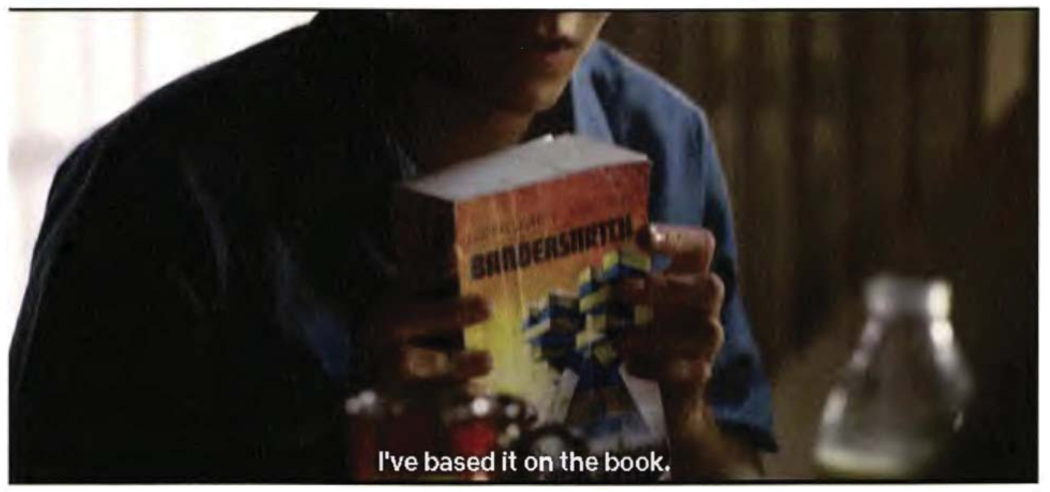
Your Own Adventure in the dialogue (!!) of its film Black Mirror: Bandersnatch.
Chooseco’s registration covers various types of media
including books and movies. Netflix’s Bandersnatch “is an interactive film that
employs a branching narrative technique allowing its viewers to make choices
that affect the ‘plot and ending of the film.’” You know there’s a problem when
the opinion says “[t]he pivotal scene at issue in this litigation occurs near
the beginning of the film.”  The main character
is trying to develop his own videogame based on a book also called Bandersnatch.
His father remarks that Jerome F. Davies, the author of the fictitious book in
the film, must not be a very good writer because Butler keeps “flicking
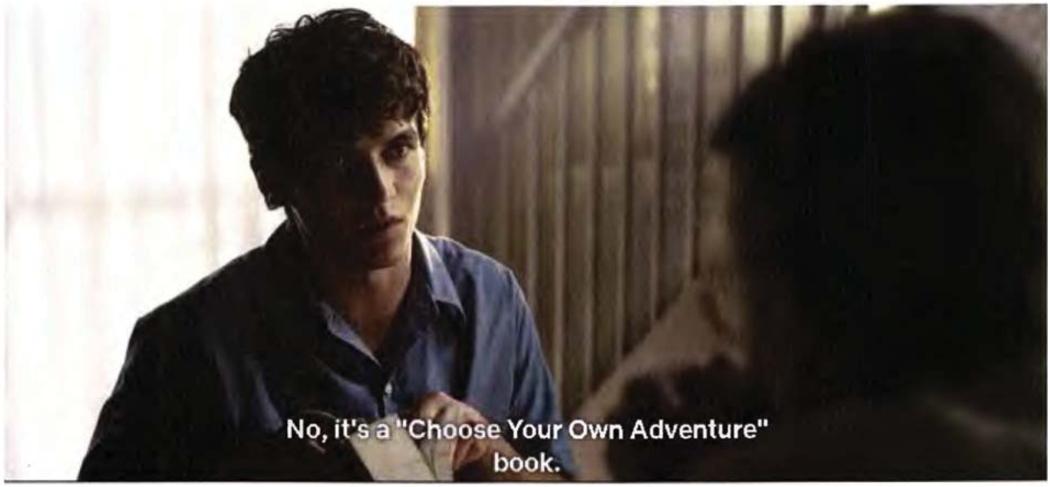
backwards and forwards.” The character responds: “No, it’s a ‘Choose Your Own
Adventure’ book. You decide what your character does.” “Of note, the subtitles
for the film couch the phrase in quotation marks and capitalize the first
letter of each word,” allegedly provided by Netflix.

The complaint alleged that Netflix promoted Bandersnatch with
a similar trade dress as that used by CHOOSE YOUR OWN ADVENTURE books in
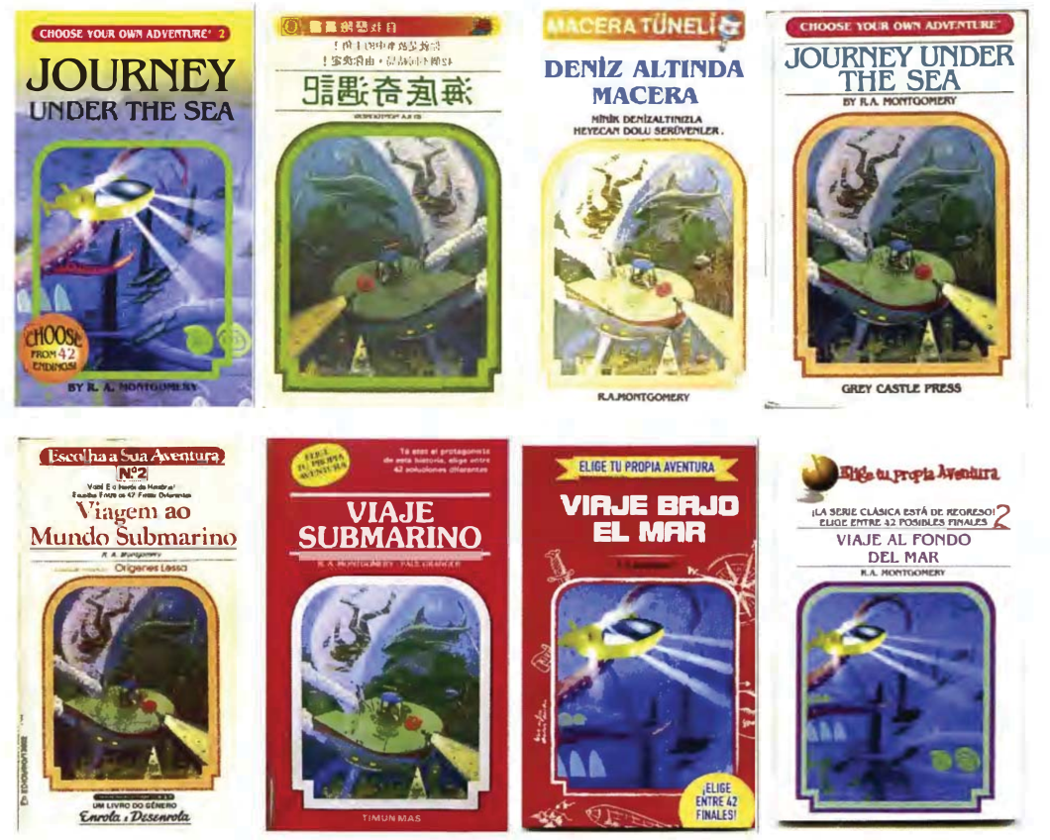
multiple marketing campaigns. Chooseco is claiming the “rounded double frame”
as a trade dress. (Its exemplar seems to have a problem in that most of those
look like foreign, not US versions, on which you couldn’t base a US trademark
claim, but good news for Chooseco: the court doesn’t care.)

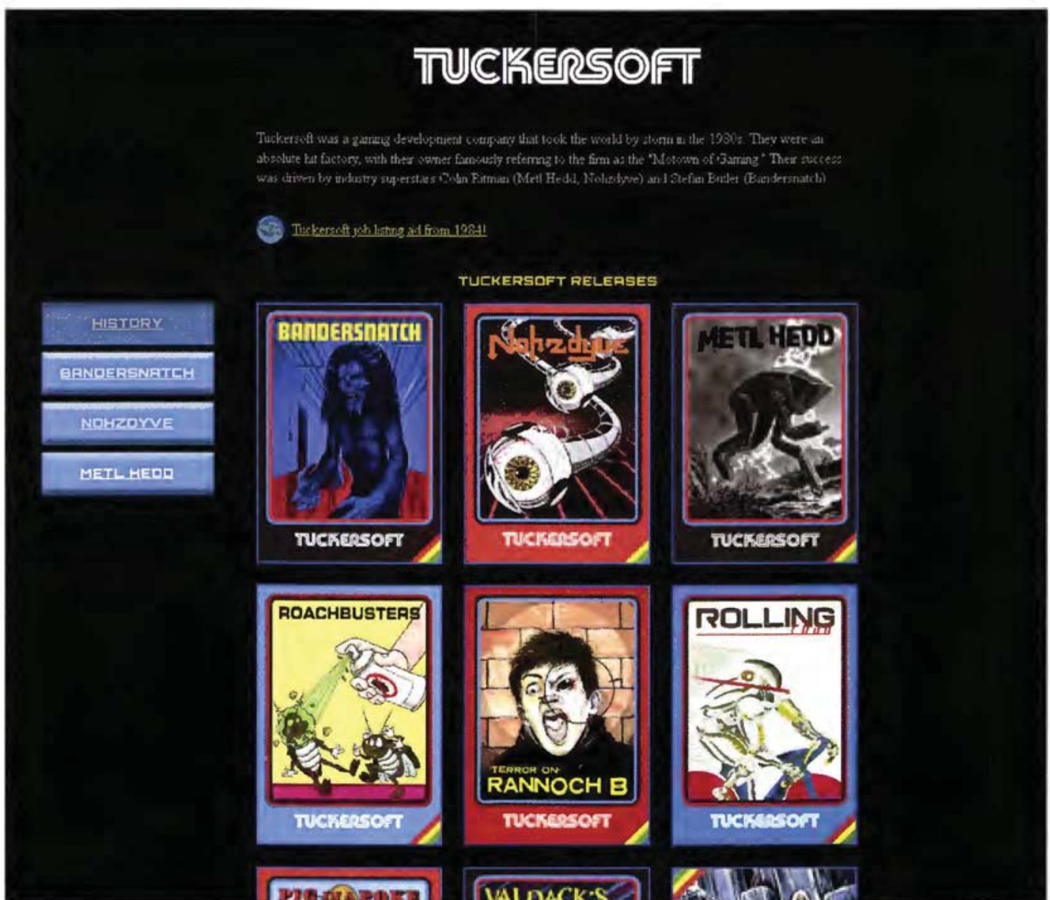
Thus, the complaint alleges, Netflix created a website for
Tuckersoft, the fictional videogame company where the main character developed
his videogame, displaying multiple fictional videogame covers that have a
“double rounded border element,” a few of which also appear in the film itself.

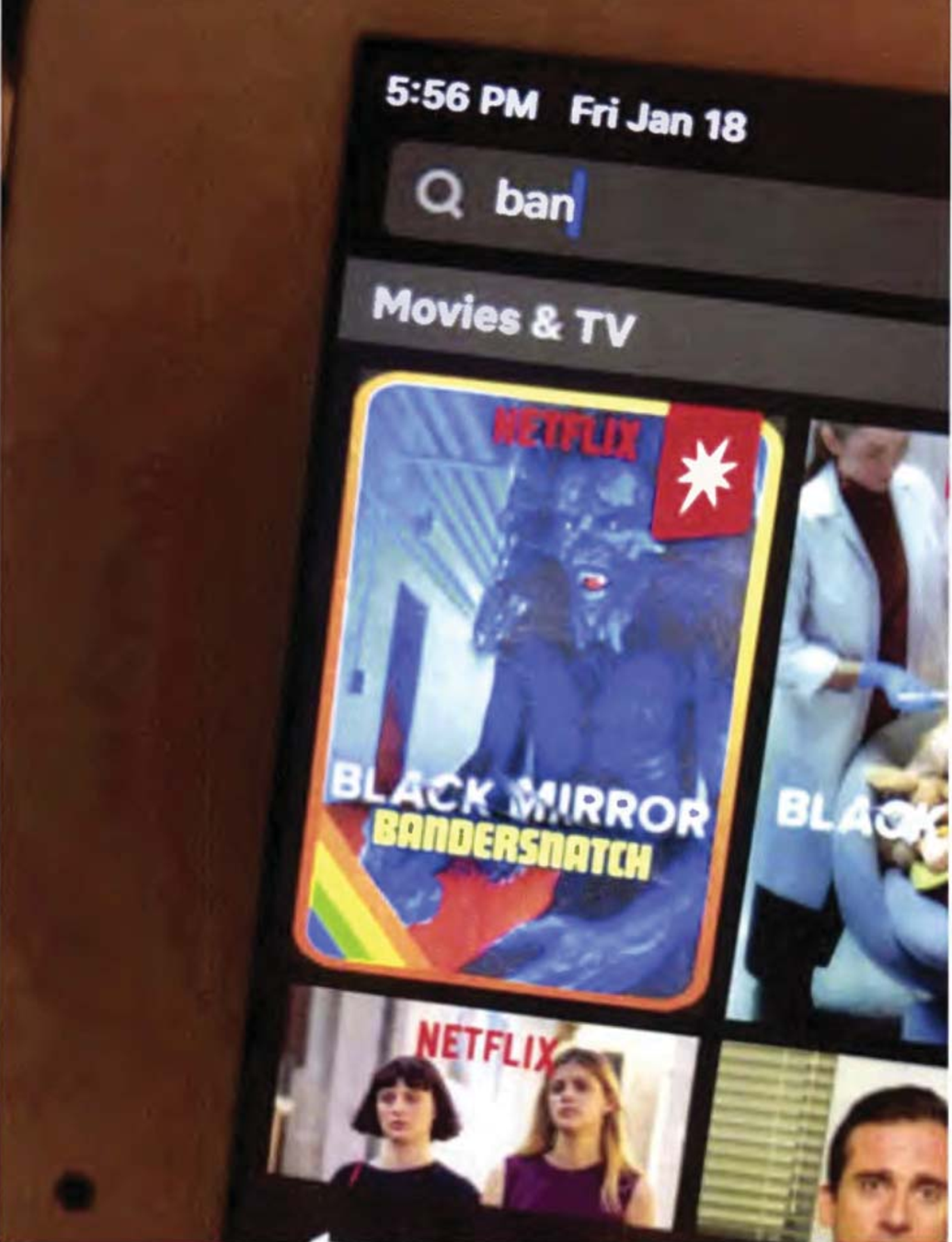
Netflix also allegedly used images of the videogame covers
while promoting Bandersnatch in the United Kingdom, and used the cover for the
Bandersnatch videogame as one of a few thumbnails for the film on its website.
Chooseco argued that Bandersnatch wasn’t a purely artistic
work, but was also a data collecting device for Netflix, and that “Netflix may
have sold product placement opportunities as a form of advertisement, which
would also suggest the film is not purely artistic.” This argument, at least,
fails. You get to sell art for money and it’s still art.  Furthermore, the use had artistic relevance. “Choose
Your Own Adventure” had artistic relevance “because it connects the narrative
techniques used by the book, the videogame, and the film itself.” It was also
relevant because the viewer’s control over the protagonist “parallel[ed] the
ways technology controls modern day life,” so the reference “anchors the
fractalized interactive narrative structure that comprises the film’s
overarching theme.” And further, “the mental imagery associated with the book
series promotes the retro, 1980s aesthetic Bandersnatch seeks to elicit.” Chooseco
suggested alternative phrases that Netflix could have used, but that’s not the
right analysis.
So, was the use explicitly misleading? The court proceeds to
reinterpret “explicitly” to mean not explicitly, quoting subsequent cases that
don’t apply Rogers that say that the relevant question is whether the
use “‘induces members of the public to believe [the work] was prepared or
otherwise authorized’ by the plaintiff.” Louis Vuitton, 868 F. Supp. 2d at 179
(quoting Twin Peaks Prods., Inc v. Publ’ns Int’l Ltd., 996 F.2d 1366, 1379 (2d
Cir. 1993)) (a title v. title and thus a non-Rogers case, because in the
Second Circuit Rogers doesn’t apply to title v. title claims; the court
also quotes Cliffs Notes, Inc. v. Bantam Doubleplay Dell Publ’g. Group, Inc.,
886 F.2d 490, 495 (2d Cir. 1989), another non-Rogers title v. title case).
 

Then the court says that likely confusion must be “particularly compelling” to
outweigh the First Amendment interests at stake, and that “the deception or
confusion must be relatively obvious and express, not subtle or implied”
(quoting McCarthy, and then the odious Gordon v. Drape Creative, Inc., 909 F.3d
257 (9th Cir. 2018)). The court acknowledges that, “[n]ot surprisingly, in most
cases in which a disputed mark was used in the content rather than the title of
an expressive work . . . the results favored the alleged infringer, on the
basis that the use was not explicitly misleading.” Michael A. Rosenhouse,
Annotation, Protection of Artistic Expression from Lanham Act Claims Under
Rogers v.
Grimaldi, 875 F.2d 994 (2d Cir. 1989), 22 A.L.R. Fed. 3d
Art. 4 (2017).
Nonetheless, Netflix doesn’t win its motion to dismiss,
because Chooseco “sufficiently alleged that consumers associate its mark with
interactive books and that the mark covers other forms of interactive media,
including films.” The protagonist in Bandersnatch “explicitly” stated that the
fictitious book at the center of the film’s plot was “a Choose Your Own
Adventure” book.  [That’s not the same thing
as explicitly, extradiegetically stating there’s a connection with the film—the
court considers the Fortres Grand case to be almost on all fours, but
there Catwoman “explicitly” says that the program she’s after is called “Clean
Slate.”]  Also, the book, the videogame,
and the film itself “all employ the same type of interactivity as Chooseco’s
products.” The similarity between the parties’ products increases the
likelihood of consumer confusion. [Citing Gordon v. Drape, so you can
see the kind of damage it’s doing.]  And
Bandersnatch “was set in an era when Chooseco’s books were popular—potentially
amplifying the association between the film and Chooseco in the minds of
consumers.”  And Netflix allegedly used a
similar trade dress for the film and its promotion; though the court didn’t
think this was “particularly strong,” it “adds to a context which may create
confusion.” How any of this is “explicit” is left as an exercise for the
reader. Implied or contextual confusion is not explicit falsehood.
The court decided to allow discovery.  Question: Discovery about what?  What evidence is relevant to whether the film
is “explicitly” misleading about its connection with Chooseco?
Unsurprisingly, Netflix’s descriptive fair use defense was also
not amenable to a motion to dismiss. Here, the character in Bandersnatch held
up a book and stated, “it’s a ‘Choose Your Own Adventure Book.’”  “The physical characteristics and context of
the use demonstrate that it is at least plausible Netflix used the term to
attract public attention by associating the film with Chooseco’s book series.”
There were allegations that Netflix knew of the mark and used the mark to
market for a different program until Chooseco sent a cease and desist letter. That
could support “a reasonable inference that Netflix intended to trade on the good
will of Chooseco’s brand,” as could intentional copying of “aspects”
[protectable aspects?] of Chooseco’s trade dress.  And Netflix could have used numerous other
phrases to describe the fictitious book’s interactive narrative technique,
making bad faith plausible.
That holding makes sense, given the doctrine.  But worse is to come.  Netflix argued, quite correctly, that
dilution requires (1) that the defendant use the term as a mark for its own
goods or services, and (2) commercial speech, which the film is not. The court
rejects both arguments.
The court quoted the federal definition of dilution by
tarnishment as an “association arising from the similarity between a mark or
trade name
and a famous mark that harms the reputation of the famous mark,”
but didn’t explain why Netflix was plausibly using the term as a mark, as opposed
to using it to label the book in the film. Netflix correctly pointed out that “[t]he
Second Circuit does not recognize an action for dilution where the defendant
uses the plaintiff’s mark not to denote the defendant’s good or services, but
rather to identify goods or services as those of the plaintiff,” but the court thought
that didn’t apply here because Netflix used the mark to refer to a fictitious
book.  But the important part here is
the first half: it wasn’t using Choose Your Own Adventure to brand its own
goods or services; it was using it as part of a fictional work.  The implication—and it is not a good one—is that
if, in my work of fiction, my character disparages a Choose Your Own Adventure
book that doesn’t actually exist, I may have tarnished the CYOA mark. This is defamation
without any of the limits on defamation that the First Amendment has imposed.
Nonetheless, the court found that “Netflix’s use of Chooseco’s mark implicates
the core purposes of the anti-dilution provision” (citing Hormel, which
is not a federal dilution case and which has been treated as superseded by
federal dilution law, see Tiffany v. eBay).  
Netflix then, correctly, pointed out that “the Lanham Act
expressly exempts dilution claims based on a ‘noncommercial use of a mark’ of
the type at issue here.” Despite the fact that in discussing Rogers the
court correctly noted that profit-motivated speech is often noncommercial and Bandersnatch
is noncommercial speech, the court still stated that “Netflix’s use of
Chooseco’s mark
may qualify as commercial speech” (emphasis added), which
is not the test. And it so reasoned because Chooseco’s complaint alleged that “Netflix’s
motivations in including its mark in the film were purely economic,” that
Chooseco’s product is popular, and that Netflix used “elements” [protectable
elements?] of Chooseco’s trade dress in promotion and marketing.  More discovery!

from Blogger https://ift.tt/3bPrgLL

Posted in Uncategorized | Tagged , | Leave a comment

Even in default, damages must still be shown

NITV Fed. Servs., LLC v. Dektor Corp., 2019 WL 7899731 No.
18-80994-Civ-Brannon (S.D. Fla. Dec. 16, 2019)
This is a default judgment, but it still has interesting
bits. The parties compete to sell truth verification technology, which will
become ironic. NTIV sued Dektor and its principal Herring for false advertising/product
disparagement/defamation/tortious interference. Bankruptcy stayed the proceedings,
and later the court ruled that Herring deliberately deprived NITV of
discoverable evidence, such that the extraordinary sanction of default was
warranted.  In contesting NITV’s
multimillion-dollar damage claims, Herring largely contended that NITV’s lie
detector was “a fake or fraud” and that NITV was blaming Herring for its own problems.
Facts (based on the allegations): NITV makes a patented
Computer Voice Stress Analyzer that is “the most widely used truth verification
tool in the United States law enforcement community,” used by approximately
2,000 local, state, federal, and international law enforcement agencies.  An older company, Dektor, patented a “Psychological
Stress Evaluator,” but went out of business; defendant Dektor is unrelated. Defendant
Dektor reverse-engineered the older product and began selling its own “PSE”
voice stress analyzer product while capitalizing on the name and history of the
original Dektor, including by claiming that “[s]ince 1969, all PSE models
[detect stuff]… Thousands of various PSE models have been sold worldwide for 45
years. For 50 years, PSE has been known worldwide because PSE constantly proves
it is the most superior system for truth verification. Only the Dektor system
has proven it is the real technology for Voice Stress Analysis.”
Dektor also disparaged NITV on its website, in emails to law
enforcement agencies, telephone calls, and professional speaking engagements,
including by stating that NITV’s products were proven unreliable/no more
reliable than a coin toss and disparaging NITV’s founder. Herring contacted the
Dallas Crimes Against Children’s conference and got NITV disinvited (even
though it had already paid to attend) by making false claims, such as that an
employee scheduled to speak at the conference had been dishonorably fired from
his prior position as a sex crimes investigator when in reality that employee
retired.
The court found NITV’s witness on damage credible, including
a recent incident where one sheriff’s department told the NITV marketing person
(not the witness) that, due to information received from Dektor, they were
discontinuing purchases of CVSA systems (to avoid hearsay on hearsay, I think
the marketing person should’ve been on the stand, but it’s been a long time
since civil procedure and maybe you can do that with a default?).
Anyway, the well-pled facts entitled NITV to victory on its
Lanham Act and FDUTPA claims, as well as business defamation/disparagement and
tortious interference. NITV was entitled to a permanent injunction and damages,
the latter of which required a legitimate basis.  NITV sought nearly $6 million in damages, trebled
for willfulness. The court declined to go so far. NITV had upped its demands
from $1.3 million to $6 million within less than a year, and the numbers were speculative.  NITV suggested that 10-15% of existing/prospective
customers would choose not to buy from NITV because of defendants’ conduct, but
the court didn’t see a basis for this.
And then a puzzling bit: “Although Mr. Herring and Dektor
pointed out alleged defects and disseminated materially false information about
Plaintiff’s product to existing and prospective customers who would not have
heard of any issues, other customers may have learned of these items by their
own searches. In the internet age, it is fair to say that clients buying truth
verification technology will check that technology on the internet.” I say
puzzling because if customers did their own searches and found false stuff planted
by defendants, defendants are still causally responsible.  But if customers also would have found
non-false stuff, or even false stuff for which defendants were not responsible,
that might also lead them to question their purchases, then the court’s hesitance
makes more sense.
The court found the testimony about that one sheriff’s
office to be “reliable hearsay,” as well as the lost conference attendance,
totalling about $50 thousand. The court didn’t agree that Herring was the only
reason that the state of Texas didn’t change its polygraph-only laws to allow
the use of NITV’s technology. The court accepted that at least ten customers had
been lost, for base damages of nearly $425,000 total. It then doubled the
damages, based on the intentional false advertising, to nearly $850,000.
Giving some sense of what’s been going on, the permanent
injunction prohibited any false or disparaging statement including “any
statement comparing or equating Plaintiff, its product, or its employees to the
German Nazi party or Joseph Goebbels specifically.”  Although the court didn’t make specific findings
about how this harmed NITV, the court also enjoined representations or
suggestions that Dektor had any relationship or affiliation to old Dektor/had
been in business since 1969/sold a product related to old Dektor’s product, etc.

from Blogger https://ift.tt/2V1QTD9

Posted in Uncategorized | Tagged , , | Leave a comment

No Lanham Act causation in another timeshare exit case

Westgate Resorts, Ltd. v. Reed Hein & Assoc., LLC, 2020
WL 674108, No: 6:18-cv-1088-Orl-31DCI (M.D. Fla. Feb. 11, 2020)
Yay, another time share exit opinion. As relevant here, the
court rejected the timeshare company’s Lanham Act claim because the allegedly false
advertising didn’t proximately cause the asserted harm (people stopping paying
their timeshare obligations). The identified false advertising statements included
that timeshare owners can exit their contracts for any reason; that defendant TET
has a 100 percent success rate; and that TET provides a money back guarantee. But
none of the identified statements “direct (or can reasonably be construed to
direct) timeshare owners to stop making payments.” Westgate didn’t argue that
the ads harmed its reputation, and it didn’t show proximate cause for the harm
it did allege.

from Blogger https://ift.tt/2SSJLX7

Posted in Uncategorized | Tagged , | 1 Comment

“Kids” in product name represents that product is safe for children to use

Mirza v. Ignite USA, LLC, 2020 WL 704791, No. 19 C 5836
(N.D. Ill. Feb. 12, 2020)
Ignite sells reusable beverage containers, coffee mugs,
water bottles, and kids’ cups under the Contigo brand name. Plaintiffs bought Contigo
Kids Cleanable Water Bottles. At some point thereafter, the bottles’ clear
silicone spout detached, posing a choking hazard to plaintiffs’ children. Ignite
issued a recall, offering to replace the lid on the water bottles but not any
monetary relief.
  
Plaintiffs alleged that they relied and understood the name
on the water bottles’ packaging, “Contigo Kids,” to represent that the bottles
were safe for children to use, and that naming the water bottles “Contigo Kids”
was false and deceptive in violation of several consumer protection laws.
The plaintiffs adequately alleged that they paid more for
the water bottles than they would otherwise pay for a dangerous and defectively
designed product, and that the recall didn’t provide minimal notice to class
members or adequately compensate for the lost use of the product while a
replacement lid was processed. The recall/free replacement didn’t obviate the
Article III injuries here. A financial injury creates standing, and plaintiffs
didn’t participate in the recall and thus didn’t get a product worth what they
paid for it.
NY breach of implied warranty claims failed for want of
privity; the exception for harmful products didn’t apply because plaintiffs
weren’t alleging that they’d been physically harmed, only that they paid too
much. NY unjust enrichment failed as duplicative of claims under New York’s GBL
§§ 349 and 350, though Pennsylvania unjust enrichment claims survived.
Ignite argued that there was no Pennsylvania UTPCPL violation
because, among other things, “Contigo Kids” wasn’t an actionable
misrepresentation, and that no reasonable consumer would read the name to imply
that the product was free from defect. The court disagreed.  Somewhat mushing causes of action together,
the court appeared to consider only whether the name could be false (not
misleading). But it doesn’t matter: plaintiffs sufficiently alleged a false
representation as to a product’s characteristic, quality, or standard, as required:
The name “Contigo Kids” signals to
consumers that the water bottles are designed for children. One would expect
products made for children, at the very least, to be free from defects that
would pose a choking hazard given the frequency of choking incidents for this
age group. Absent a warning to the contrary, the presence of the term “Kids” on
the label misleads consumers into believing that the product is safe for
children. And contrary to Ignite’s argument, “[a] ‘literally false’ message may
be either explicit or ‘conveyed by necessary implication when, considering the
advertisement in its entirety, the audience would recognize the claim as
readily as if it had been explicitly stated.’ ”
… The name signals that the water
bottles were made for children, and a necessary implication of products made
for children is that they are safe for their use. Accordingly, a reasonable
consumer looking for water bottles for her children could be reasonably misled
by the product’s name.
[Note: consumer protection law hasn’t historically made, and
really shouldn’t make, the Lanham Act’s false/misleading distinction, making reference
to falsity by necessary implication unnecessary here. The plaintiffs sufficiently
pled falsity or misleadingness.]
The same analysis also applied to NY GBL §349 and §350
claims, though fraudulent omission claims failed for failure to allege
knowledge of the defect at the time of sale.

from Blogger https://ift.tt/2vJKS3v

Posted in Uncategorized | Tagged , | Leave a comment

false advertising as compulsory counterclaim

Creative Impact Inc. v. MGA Entertainment, Inc., 2019 WL
7906430, No. CV 19-07009 AG (ASx) (C.D. Cal. Nov. 4, 2019)
The parties compete in the toy business. Creative Impact
makes 5 Surprise, while MGA makes a similar toy called L.O.L. Surprise! In July
2019, MGA sued plaintiff Zuru in California state court alleging state law trade
dress and trademark infringement claims.

Six days later, MGA’s CEO posted several messages on
LinkedIn, such as, “ZURU Toy Company #Thieves of the Year of others #IP. Just
look at the pictures. WHY are retailers supporting these thieves? I don’t get
it.” Plaintiffs then sued for false advertising under the Lanham Act and other claims
based on these posts, as well as on the IP issues in the state court dispute.
Under the circumstances, the Lanham Act claim was a compulsory
counterclaim in the earlier-filed state court action.  Under California law, a “related” cause of
action has to be alleged in a cross-complaint. A claim is “related” if it
“arises out of the same transaction, occurrence, or series of transactions or
occurrences” as the claims asserted in the earlier-filed complaint; this is to
be “liberally construed” to accomplish the statute’s purpose “of avoiding a
multiplicity of actions” through “piecemeal” litigation.
Here, the thrust of the state court complaint was that plaintiffs’
5 Surprise toys infringe MGA’s trademark and trade dress in L.O.L. Surprise! Toys.
The false advertising claim was “logically interrelated” because it was based
on statements that “reiterate the core allegations of Defendant’s state court
complaint—namely, that Plaintiffs are infringing on Defendant’s trademark and
trade dress rights.” There were some additional relevant facts, but perfect
factual overlap isn’t necessary. The Lanham Act claim “shares enough of a
logical relationship with Defendant’s state law claims to be considered part of
the same series of transactions or occurrences,” especially given the proximity
in time between the state court suit and the statements and given that Creative
can only win its false advertising claim by also defeating MGA’s infringement
claim; otherwise the challenged statements aren’t false. That legal
relationship speaks directly to the purpose of avoiding piecemeal litigation.
The presence of an additional plaintiff didn’t help in these
circumstances, where the two plaintiffs were part of the same group of companies
and constitute a single larger entity together. Fortunately for plaintiffs,
they probably can still add a counterclaim, given California’s liberal approach
to amending to add compulsory counterclaims.

from Blogger https://ift.tt/2uW6o4W

Posted in Uncategorized | Tagged , | Leave a comment

when you buy a business whose mark is the owner’s photo, make sure you get all the rights

Minott v. Wichita Water Conditioning, Inc., No.
18-cv-01656-MSK-SKC, 2020 WL 616359 (D. Colo. Feb. 7, 2020)
Minott used to own Fluid, which operated a water
conditioning business under the trade name Chuck, The Water Man. Fluid made
extensive use of a photograph of Minott’s face as “a sort of logo,” displaying
it prominently in its promotional materials, on billboards, on the side of
trucks, on customer-facing equipment, and so on. In 2016 defendant WWC bought
Fluid, including “all of [Fluid’s] right, title and interest in and to the assets
owned by [Fluid] and used in connection with [the Chuck business]” and
specifically including all “trade names (including ‘Chuck, the Water Man’)
[and] trademarks” held by Fluid.
Minott alleged that during negotiations over the Asset
Purchase Agreement, he explained to WWC that Fluid held only a license to use
the photo of his face, not ownership of that likeness, and that therefore, “use
of my personal likeness was not included in Fluid’s” assets. He offered a
one-year license for a separate payment of $100,000, which WWC allegedly
rejected. “Notwithstanding that discussion, the Asset Purchase Agreement
contained no language excluding Mr. Minott’s likeness – to the extent it was
used as a trademark – from the terms of the sale.”
WWC eventually merged Chuck with its Culligan brand (e.g.
referring to the business as “Chuck’s Culligan” or “Chuck the Culligan Man”). In
2017, WWC prepared a promotional image that used the photo of. Minott’s face,
edited onto the body of another model (who wore a Culligan-branded shirt),
alongside the statement “Chuck The Water Man is now Chuck The CULLIGAN Man.”
WWC sent a version of the image to Minott and “invited comment,” and Minott responded,
“unless [you’re] hiring me as a professional model (very expensive) NO…Our
discussion was a verbal chat. We discussed that you could use that one picture
of my face as the logo for one year from acquisition date…You dismissed those
discussions without conclusion…I do appreciate you asking and I like the fact
that you see value in my name & face being attached to the company, but
NO.”
Nonetheless, and perhaps as a result of a slip-up, WWC sent
out a series of mailers to its customers, using the photo of Mr. Minott’s face
(and the model’s body). In response to Minott’s complaint, WWC responded that
it had instructed its marketing vendor to “change all future mailers to not use
your picture,” but also advised that “there may be some [existing mailers] in
the system to be mailed but it has been changed.” The relevant employee also
e-mailed WWC’s marketing vendor to determine how many mailers featuring Minott
had already been printed; since the December mailers had been printed, he
instructed the vendor to “leave it.”
Minott sued for misappropriation of likeness under Colorado
common law, false endorsement under the Lanham Act, and deceptive advertising
under in violation of the Colorado Consumer Protection Act.
WWC argued, among other things, that (1) the photo was a
trademark that was transferred, (2) the mailers lacked an effect on interstate
commerce so there was no Lanham Act claim, (3) because of the noncompete Minott
signed, he couldn’t experience cognizable harm from the mailers, and (4) there
was no evidence of deceptiveness.
Misappropriation: consent is an affirmative defense; WWC has
the burden of proof. Here, this requires proof that: (i) Minott, by words or
conduct, led WWC reasonably to believe that he had authorized WWC to make use
of his photograph as a trademark; and (ii) WWC acted in a manner and for a
purpose to which Minott agreed. It’s true that Fluid established a use of
Minott’s photograph as a trademark, but that didn’t “overcome all other
intellectual property rights that might attach” to the photo.  [I think it’s pretty sharp dealing, at best,
on these facts where he’s also the owner of the company doing the transfer of
rights. But:] Minott testified that Fluid never owned the image and was only a
licensee, and the record didn’t disclose the terms of the license. “WWC
acquired nothing more than Fluid had. WWC did not acquire rights to the
photograph itself, nor the right to depict Mr. Minott’s likeness.”  If anyone wants to use a photo as a mark, they
have to be sure that neither copyright nor the right of publicity preclude such
use. There was at least a disputed issue of fact on whether there was a terminable-at-will
license (apparently both for the copyright and for the right of publicity) that
was terminated on transfer of Fluid. There was also at least a disputed issue
whether Minott specifically told WWC at the time of the purchase that Fluid
didn’t own rights to his likeness. Likewise, WWC failed to establish that its
use was consistent with the scope of any consent that WWC reasonably believed
Minott had given, given the parties’ emails.
JA Apparel Corp. v. Abboud, 682 F. Supp. 2d 294 (S.D.N.Y.
2010), was not to the contrary. There, Abboud was a party to the sale of his clothing
business and its trademarks; here, Minott was not a party to the Fluid-WWC
transaction.
False endorsement under the Lanham Act:  The rare lack of use in interstate commerce! It
was undisputed that Chuck’s only provided service in Colorado. Minott didn’t
claim to have trademark rights extending outside of Colorado, so there was no
effect on interstate commerce that way. Though WWC itself operated interestate,
“the record is so scant as to how WWC’s mailers here may have advanced WWC’s
business interests outside of Colorado as to preclude a finding of an effect on
interstate commerce simply because WWC has interstate operations.”
In terms of interstate effects, Minott argued only that, of
the roughly 3,600 relevant mailers WWC sent out, 9 went to addresses in
Wyoming, South Dakota, or New Jersey. That wasn’t a “substantial” effect on
interstate commerce. The recipients were “current customers” according to its
billing software, and, given the geographic limits of service provision, the record
suggests that out-of-state addresses were unintentional, erroneous, or forwarding
addresses for final bills. “Given the minimal number of advertisements
involved, and the clear indication that any stray mailings leaving Colorado
were inadvertent oversights, the Court concludes that Mr. Minott has not come
forward with evidence indicating that any false endorsements perpetrated by WWC
occurred in interstate commerce.”
CCPA deceptive advertising: even assuming deception in the
course of WWC’s business with an impact on the public, as required by state
law, Minott failed to show the requisite injury. He was neither a deceived
consumer nor a current competitor.
It was speculative to allege only a belief that his
reputation has been harmed and that this harm may manifest when the noncompete
expires in mid-2021, at which point he intends to return to Colorado and start
another water conditioning business. He cited Yelp reviews, but even putting
aside “substantial hearsay concerns as to whether such reviews are admissible
as proof of the reviewer’s perception” of Minott, several of those made clear
they were aware of and distinguished between the Minott iteration and WWC’s
version, while other bad reviews related to the period Minott himself ran the
business. Thus, the Yelp reviews could not show harm to his reputation resulting
from WWC suggesting his affiliation with or endorsement of WWC.
Among other things, there was no evidence that the mailers caused
harm to his reputation; there was no evidence that disgruntled WWC customers
contacted him, or that surveys showed lost respect for “Chuck, the Water Man.”
And his future plans merely highlighted the lack of present injury. Further, he
testified that he didn’t intend to solicit past customers, which meant his
prior reputation would be irrelevant. 

from Blogger https://ift.tt/37xlJ97

Posted in Uncategorized | Tagged , , , , | Leave a comment

DMCA at 22: my notes from the Senate hearing

Senate Judiciary Committee, Intellectual Property
Subcommittee, The
Digital Millennium Copyright Act at 22: What is it, why was it enacted, and
where are we now
(archived video; apparently you have to wait 13 minutes
before the hearing actually starts, though)
Sen. Tillis: DMCA was passed when Chumbawumba and Myspace
were popular. Time to hear about modernization. Protection was given to new
platforms in exchange for quick removal. Almost everything has changed in 22
years. Goal: introduce reform bill w/bicameral, bipartisan consensus. Top
priority for him. Today: background and level-setitng.
Panel I
The Honorable Edward J. Damich, Senior Judge, United States
Court of Federal Claims
Damich was chief IP counsel for Senate Judiciary at the
time; not providing views of judiciary but recollections as staffer. Internet
just coming into its own: 36 million web users in 1996. Highlights: (1) ISP liability
for users’ infringement, (2) TPMs were key issues. Sen. Hatch didn’t want to
disturb common law of secondary infringement; wanted to focus on practical reality
of internet at the time: email, system caching. Hosting required more care: notice
& takedown or actual knowledge requried action. Middle ground b/t duty to monitor
and actual knowledge: red flag provision. ISPs should not ignore clear indications
of infringement however discovered & should cooperate w/copyright owners.
Anticircumvention: controlling access was becoming more important than making
copies. Exceptions included periodic rulemaking for temporary exemptions.
Mr. Jonathan Band, Owner, Jonathan Band PLLC
TPM control appeared in EU Software Directive. Problem:
legitimate reasons to unlock TPMs, including for interoperability; he worked on
exceptions. Safe harbors for basic online functions: Yahoo provided the
then-leading directory, but arguably fell outside the info location tool safe
harbor, so negotiated legislative report language to make clear that it was
covered. Database protection was also proposed by the DMCA House version,
fortunately failed. DRM and safe harbors were a compromise: you can’t consider
the effectiveness and fairness of either in isolation. Each industry believes
its own section was successful; each title includes internal compromise, but that
was a grand bargain between each one. Congress made policy choices w/open eyes
and courts have generally complied with Congressional intent. Note also term
extension at the same time: windfall to © owners.
Mr. Robert S. Schwartz, Partner, Constantine Cannon
Road began in 1981 with 9th Circuit’s ruling against VCRs.
Even after the SCt overturned that, content industry proposed levies on tech.
Consumer groups formed home recording rights organization. Negotiated serial
copy management system designed to prevent impact on general computers—AHRA—which
became a dead letter quickly. Computers have to be covered, so there was a copy
protection working group.  Bad experience
with mandatesàTPM
provisions. Should have tied circumvention to copyright infringement; should be
limited to expressive uses and allow for uses like vehicle repair. Trafficking
provisions inhibit fair use and vehicle repair. Even with an exemption, user
can’t get lawfully produced software to take advantage of exemption b/c of
trafficking provisions.
Mr. Steve Metalitz, Partner, Mitchell, Silberberg &
Knupp LLP
Speaking in personal capacity though represented © industries
in negotiations. Implementing WIPO digital treaties: 1201 was for that. On the
whole, remarkably successful: lots of access to content, due in large part to
TPMs [now wait until he tells you about what the creative environment is like
due to 512]—allowed creation of marketplace, not thieves’ bazaar. Congress got
this right.  512 was a different story:
politically necessary, not necessary for treaty compliance. Telcos wanted
payback for the IP carveout in 230. Copyright owners didn’t need or want 512.
Goal: provide incentives for © owners and services to work together.
Infringement is pervasive and so are infringement-based business models. Close
to blanket immunity for OSPs if they take relatively minimal steps out of scale
with the infringement problem; can base their business models on infringement.
Dominant online businesses have to shoulder responsibility for bad behavior,
including IP theft. Increased volume of infringement, increased velocity, need
for voluntary arrangements that haven’t yet materialized.
Sen. Coons: This is the most active subcommittee of
Judiciary. Core © industries add $1 trillion to GDP. [And core OSP industries?]  Google didn’t exist in 1992. Digital piracy
has exploded. Unauthorized copies are just a click away. [Yep, 1201 totally
worked.] Digital video piracy costs $29 billion/year and 250,000 jobs.
Tillis: what areas are most contentious? Given where we are
now, is there opportunity to bridge the gap with modernization?
Damich: Ethically can’t give opinions on future legislation.
Tillis: root causes of differences?
Damich: did try to compromise on 512 & 1201. Hatch broke
impasse: made sure there was a core group of stakeholders then a larger group
of interested parties like libraries, reverse engineering researchers, law
enforcement were allowed to comment.
Band: 1201, 512, databases all happening together. Most of
the focus was probably on safe harbors b/c players were bigger on both sides:
telcos v. big content providers. Hard to get focus on 1201/databases. Hard to
get researchers to believe 1201 would happen: encryption researchers insisted Congress
would never do anything so stupid. More people are familiar now with 1201 and
auto repair type problems.
Schwartz: Home Recording Rights Coalition was included up to
a point, then excluded from negotiations. We were considered too tough to make
a final deal with. Sen. Ashcroft worked with us to work on legislative history.
Didn’t anticipate that at most recent triennial rulemaking we’d be there on
behalf of farming bureaus. With short growing seasons + distant repair
facilities run by manufacturers, a software-dependent equipment breakdown means
a waiting list for authorized repair, while independents would do it if they
could. It’s not trafficking to obtain and use software; the Copyright Office
has gone as far as it thinks it can go in allowing repairers to act on behalf
of owners but still needs guidance on trafficking.
Metalitz: also surprised to represent auto manufacturers at
the triennial rulemaking. 1201 speaks in very general terms of all TPMs. Stood
the test of time better than 512, which depended on the tech of the time. Storage
at the direction of the user was straightforward at the time. Other functions
were added: indexing, highlighting content for users. [This is ahistorical,
albeit algorithmic discovery was in its infancy; indexing and highlighting were
definitely known at the time.] Unfortunately courts said this was all ok but
that wasn’t intended. Legislation in general terms (except for the exceptions
in 1201, which are good) last longer v. tech-specific 512.
Panel II
Professor Sandra Aistars, Clinical Professor Senior Scholar
and Director Copyright Research & Policy, Center for the Protection of IP, Antonin
Scalia Law School, George Mason University
Informed by clients’ epxerience but views are her own. 512
hasn’t helped creators; the bargain Congress expected was not achieved. Twin
goals of quick removal and support for innovation. No blind eye to infringement—red
flag provisions have been misinterpreted and eviscerated, especially in 2d and
9th Circuits [those hotbeds of hostility to the © industries]. Perfect 10 v.
CCBill—“illegal/stolen” label wasn’t a red flag [to credit card
processors].  Viacom v. YouTube limited
obligation to knowledge of specific infringing activity, and UMG v. Shelter
Capital agreed. Capitol Records v. Vimeo: red flag not triggered by full length
copies of © works, even when leaders winkingly encouraged infringement. Notice
and takedown alone isn’t enough. Representative list requirement isn’t enforced.
Works with artists and small businesses; even trained and coached, students
found removal frustrating and time consuming; searches led to phishing sites
[note that this is already illegal; these sites aren’t likely to be complying
with the DMCA and it has yet to be explained to me why they’d comply with
DMCA-Plus.] CASE Act would allow recipients of bad notices to sue in small
claims court.  Cox is a good case: they
failed to enforce even a toothless repeat infringer policy.
Professor Rebecca Tushnet, Frank Stanton Professor of the
First Amendment, Harvard Law School
I would like to start with some perhaps surprising numbers
that illustrate what §512 has meant for creativity and innovation online.  I work with a nonprofit, the Organization for
Transformative Works (OTW), that doesn’t have a single paid employee. With a
budget of under $400,000 per year, it operates a website for user-generated
content that currently has over four million creative works from over a million
registered users. Those millions of works attract 1.12 billion page views per
month. That’s more than double what it was only three years ago, and rapid
growth continues. Last year we were honored by the World Science Fiction
Society with a Hugo Award for our service to the global community of fans.
Despite the large numbers of works posted on our site, we
get less than one DMCA notice per month. Most of those notices are invalid,
such as attempts to claim rights in a title or name. At the cost of significant
amounts of volunteer lawyer time—something very few services can afford—we
carefully review each notice and explain to the senders of the invalid notices
why their claim is mistaken. Unfortunately, our experiences with mistaken and
abusive notices designed to suppress noninfringing and critical speech are
common among service providers.
Empirical research reveals that most of the internet service
providers who rely on §512 are like us: Most service providers receive
relatively few notices and handle them individually. Only a few entities receive
millions of notices. While market pressures and business decisions have led a
few large sites like YouTube to rely on automated systems and sometimes on
filters, it is important not to treat YouTube as a model for the internet at
large. If we did, the only online service to survive would be YouTube.
If there is one message I would ask the members of the
Committee to take away today, it is that most beneficiaries of §512 are not
like Google or Facebook. Big or small, most sites that use §512 don’t need and
couldn’t survive a requirement to use technologically complex mechanisms to
filter out the relatively rare infringements.
There are serious problems of market concentration in the
content and telecommunications industries, and §512 has been vital to preserving
the competition that exists. If Congress changes §512 to target Google and
Facebook, or because of rogue overseas sites that already ignore the law, it
will ensure that only Facebook, Google and pirate sites survive, making the
problem of market concentration even worse without protecting creators. A
mandate for filtering, whether called “staydown” or something else, would
destroy the small and medium entities that are vital to innovation, creativity,
and competition on the internet.
The system is by no means perfect—there remain persistent
problems with invalid takedown notices used to extort creators or suppress
political speech—but, like democracy, it’s better than the alternatives that
have been tried.  The numbers of
independent creators and the amount of money spent on legitimate content are
growing every year. Changes to §512 would be likely to make things much worse.
My written testimony addresses some other specific issues,
including section 1201. Section 1201 is broken: it is mostly used to suppress
competition rather than protect copyrighted works from infringement. It would
benefit from requiring a nexus between circumvention and copyright
infringement. Otherwise it will continue to be used to prevent diabetics from
getting information from their own medical devices and researchers from
investigating security vulnerabilities in voting machines.
Professor Jessica Litman, John F. Nickoll Professor of Law, University
of Michigan Law School
Three points: (1) In 22 years since DMCA, anticircumvention
hasn’t lived up to its promise. Immense symbolic value, not effective v. piracy.
No additional deterrent to people who are already infringing. DRM is not
impregnable and it is buggy—prevents licensed uses. Americans believe that if
they buy a copy, they should get to use it. If they need to repair it, they
often try to find fixes and usually succeed. Circumvention tools are widely available.
Meanwhile, businesses that embed software have harmed aftermarket parts and independent
repair. It’s unreasonable to tell a farmer who wants to repair a tractor to
petition the Librarian of Congress for permission to do so. That has nothing to
do with © piracy.
(2) 512 safe harbor tradeoff worked well for longer than we
had any right to expect. Courts have been good at interpreting it. Principal
weakness: imagined human judgment applied in good faith to send and receive
notices. That didn’t scale for large © owners and [some] large services.  Automated solutions are buggy with false
positives/wrongness. Larger © owners and services have negotiated private
deals, but smaller services without the ability to strike private deals still
find 512 essential.
(3) © owners complain about “value gap” based on market
power of ISPs leading to lower license fees. I get why © owners are upset, but
this is a bargaining power/competition problem, not a © problem. Antitrust
would be a better solution.
Professor Mark F. Schultz, Goodyear Tire & Rubber
Company Chair in Intellectual Property Law Director, Intellectual Property and
Technology Law Program, University of Akron School of Law
Good intentions—sought to shield infant industry, which is
grown up now into world’s most wealthy and powerful businesses; outdated
assumptions. Courts narrowed service providers’ responsibility too much.
Congress assumed ISPs would be indifferent to infringement, not supportive of
it. Infringement notices in billions, files spread fast. Not just one upload,
nonstop uploading by many users. Finding one copy is worthless. Many online
services profit from availability of infringing material. [I always wish they’d
name names. Lots of services that did profit in this way have been sued out of
existence, and also Veoh, which didn’t; who exactly do they think, other
than Google, is an illegitimate business that survives only because the DMCA
doesn’t have a filtering mandate?]  Courts
have excused businesses from many duties intended by the DMCA even where they
knew of and profited from infringement—not what laypeople would call knowledge.
Red flag now meaningless. [This is the specific knowledge/general knowledge
distinction: general knowledge that infringement is most likely occurring on
your platform is not red flag knowledge. 
I wonder whether he thinks the University of Akron has red flag
knowledge, defined as he would like to redefine it.]
Solutions: (1) amend 512 to require notice and styadown. (2)
Revise to define willful blindness; not encouraged to ignore infringement.
Sen. Tillis: What did you learn from panel 1?
Schultz: Metalitz is right: red flags.
Litman: 512(m) explicitly relieved sites of a duty to
monitor; that was a good idea; courts have been really careful to limit
knowledge so as not to interfere with 512(m).
RT: These red flag claims are not right. Viacom seeded YT
with apparently leaked footage; what counts as red flag knowledge is
appropriately determined case by case. 
On the volume of infringement: Almost all the sites you’ve heard of,
including Wikipedia and Amazon Kindle/digital, have very few problems with
actual infringement. Most can’t afford and don’t need filtering.
Aistars: 1201 engendered cross industry cooperation; worked
w/entertainment and computer industry to not burden consumers and build new
businesses. 512 didn’t engender affordable tech to filter works before they
were uploaded. Court decisions around 1201 have hewed to parties’ expectations.
We didn’t expect printer cartridges and courts didn’t apply 1201 to them.
Lacked same luck for 512.
Sen. Leahy: Success reflected a years long bipartisan
process. To RT: is it working?
RT: Yes: Most sites don’t have problems.  Google receives billions of notices, but it
is doing a lot/used to get other sites not searched.
Coons: Does 512 discourage sites from gaining knowledge?
RT: No, it encourages them to monitor for other bad things
like terrorist content without fear that if they see something else they’ll be
liable for infringement.
Litman: also encourages monitoring for ©: if they catch one
infringement, 512 means they can’t be held liable for the ones they missed.
Coons for Schultz: is burden on rightsholders to police
fair?
A: should be shared burden. YT had scroll showing one Comedy
Central clip after another on homepage. Knows content owner objects; that’s
wrong.
For Aistars: repeat infringers/whack a mole?
A: (1) isn’t a shared burden to find infringement; (2) there
has been some success against ISPs that don’t implement their own extremely
lenient policies, but that’s not much of a victory—14 notifications before
action is taken, and customer can just start again; sets us up for bad actors
trampling small businesses. Have to decide on creating v. sitting at home
searching for infringement.
Coons: working together on voluntary measures?
Aistars: STMs are supposed to be accommodated, but there’s
no process to ID tech though many could qualify, like Audible Magic. For a # of
years, relatively inexpensive [$10,000/month for small websites, yay]. 1201
worked b/c there were incentives for cross industry cooperation. 512=no
incentives for anyone. No requirement to work together.
Coons: are there easy modernizations to improve balance?
Aistars: red flag.
RT: (1) apply antitrust to © and telecom. (2) 1201
infringement nexus.
Litman: narrowing 1201 would help. 512: these are computers,
they aren’t as smart as us. They don’t recognize what humans would. Can’t tell
who uploaded content. Can’t simply assume that online services perceive as
humans do.
Schultz: red flag. Willful blindness isn’t just computers;
Vimeo says employees can interact w/famous content, but b/c they’re not ©
experts, can’t hold them to objective knowledge. Every layperson knows where to
go to get infringing content. [Is it Vimeo?]
Sen. Tillis: What are decisions that are problematic?
Aistars: See her testimony: Perfect 10 v. CCBill, Viacom,
UMG v. Shelter Capital, Capital Records v. Vimeo.
RT: those cases were rightly decided. Perfect 10 was
specific to sexual content, Viacom had those “leaked” uploads.  The alternative, filtering via staydown is
terrible. Google spent $60 million [correction:
now $100 million
] on a system that is 60% effective according to the major
labels who use it, and we’re better at ID’ing music than at other types of
works.
Litman: dislikes some results. In Cox, they lost the safe
harbor for not terminating users, which could be right, but Cox was receiving automated
takedown notices with thousands of dollar-demanding settlement letters
attached. They wrote back refusing to forward the settlement letters. The court
considered these to be notices that Cox ignored.
Schultz: dislikes same cases as Aistars. The understanding
of what constitutes knowledge defies common sense/most other areas of law.
Staydown should only occur after notice. [I don’t know why
people think this is an argument in favor of filtering. The primary problem
with filtering is not that there’s no list, it’s the expensive and error-prone apparatus
of filtering that most sites can’t afford and don’t need. It’s as if the police
came to every business on Main Street and said, we’ll be sending you a list of our
10 most wanted, and if you don’t employ facial recognition at each entrance to
catch them you’ll be breaking the law, but don’t worry, it won’t be burdensome
because we’ll send you the pictures.] 
Affordable filters exist but there’s no market demand; if there were a
duty we’d see more systems [magic, or Audible Magic?]. Congress can make
exceptions.
Tillis: infringement online is big; number of notices is
difficult for new entrants [again, this is not true in the way he thinks—most entrants
don’t get big numbers of notices, but quality screening can be a big deal]. Neither
is wrong but the DMCA is not working in every case.

from Blogger https://ift.tt/2vuHRE7

Posted in Uncategorized | Tagged | Leave a comment

False advertising of flanges leads to rare recall and some disgorgement


Followup on the multimillion-dollar verdict in this false advertising case. A jury found that defendants
falsely advertised their carbon steel flanges as being normalized and/or in compliance with ASTM A105, A961, and A941. “Normalizing a carbon steel flange improves the physical properties of the flange. … [This] is important, as flanges can be used in extreme high-temperature, high-pressure, corrosive environments.” Customers expect flanges marked “A105N” to be normalized in accordance with ASTM standards, but “have no easy, non-destructive, means of verifying whether or not the flange was actually heat treated.”
Still, “[n]ot all ASTM A105N flanges or flange manufacturers are created equally.” A hotly disputed issue at trial was whether the parties actually compete: plaintiffs are domestic manufacturers, and Ulma sells only foreign-made flanges.  “[D]omestic flanges are considered by some to be superior to foreign flanges and command a price premium. Indeed, testimony suggested that certain companies would not accept foreign flanges and that distributors would therefore stock foreign and domestic flanges separately so as not to commingle the flanges—in order to comply with the domestic-only orders. Other consumers do not care about a flange’s origin and still others prefer foreign made.” Thus, Ulma argued that its false advertising hadn’t harmed Boltex.  Boltex contended that “many buyers—including pipeline companies—would accept both foreign and domestic flanges interchangeably for many jobs,” though it conceded that they weren’t head to head competitors in all markets.
Plaintiffs’ damages expert calculated Boltex’s damages by determining the hypothetical share of the market that they would have occupied if Ulma wasn’t a market participant. Defendants’ damages expert argued that there was no overlap between the two markets and showed that Boltex made virtually no sales to Ulma’s five customers (almost 85% of their sales), though the numbers changed once one considered Ulma’s top ten customers. The overlap was thus both “evident” and “somewhat small.”
The jury chose a middle ground, awarding $650,000 in damages to Boltex for the six years covered by the lawsuit, and $300,000 in damages to co-plaintiff Weldbend, much lower than the millions sought by plaintiffs. The court agreed that this was appropriate.
Although at least 95% of Ulma’s “A105” flanges weren’t normalized in compliance with ASTM A105, as they explicitly represented, Ulma argued that they were normalized according to Ulma’s “in-line normalization process.” The court declined to rule on “the chemical soundness of this process.” Ulma falsely advertised ASTM A105 normalization, and that’s that. 
This false advertising included a 2017 letter to customers sent the month that suit was filed, accusing Boltex of lying about the mislabeling and falsely reiterating that they did normalize their flanges in compliance with ASTM standards. Only in late 2018/early 2019 did Ulma admit to customers that it used two processes, and at trial Ulma just said it should have been more accurate. “These facts clearly influenced the jury with regard to their award of punitive damages and finding that disgorgement was appropriate.” The court agreed on its relevance.
The jury found that Boltex had lost profits of $250,000 from May 5, 2013 to May 4, 2015 and $400,000 from May 5, 2015 to May 31, 2019 [the dates are important because of a dispute about the limitations period for Lanham Act claims; the court chose four years] and that Weldbend had lost profits of $100,000 from May 5, 2013 to May 4, 2015 and $200,000 from May 5, 2015 to May 31, 2019. Under Texas law, they awarded punitive damages of $2 million to each plaintiff. The jury found that Ulma should disgorge $26 million from May 5, 2013 to May 31, 2019. This result was supported by the evidence, except that the amount of disgorgement was too high.
Disgorgement requires a court to consider: (1) whether the defendant had the intent to confuse or deceive, (2) whether sales have been diverted, (3) the adequacy of other remedies, (4) any unreasonable delay by the plaintiff in asserting his rights, (5) the public interest in making the misconduct unprofitable, and (6) whether it is a case of palming off. These are nonexclusive factors where equity would consider others. The jury was instructed on these factors, and made a reasonable finding, especially given that factors (1) and (5) soundly weighed in plaintiffs’ favor. The public interest was also significantly served by disgorgement because determining whether normalization had occurred can’t be checked without a test that destroys the product, making false advertising difficult to detect and requiring buyers to rely on the labeling (which includes purported test results). In addition, the false advertising here “relates to the integrity of pipelines carrying oil and gas,” and a crack “could result in leaks that severely harm the environment or cause damage to life or property.”  There was also some evidence of sales diversion, and other remedies were inadquate— “even the pursuit of this action did not dissuade the Defendants, considering they sent out the 2017 letter again falsely advertising that their products were ASTM compliant.” As to delay, “while this conduct had been ongoing for some time, the Plaintiffs moved promptly once they could confirm the misconduct by testing Defendants’ products.”
In assessing the appropriate amount, the court wanted to avoid over-compensation by awarding both damages for plaintiffs’ lost profits on diverted sales and the profits made by the infringer. Instead of the entire amount awarded by the jury, the court used plaintiffs’ expert’s numbers and awarded each plaintiff a percentage of Ulma’s profit commensurate with their respective market shares. For Boltex, who held a 11.6% market share, the Court added $3,016,000 in disgorgement. For Weldbend, who held a 10.4% market share, the Court added $2,704,000.
Plaintiffs sought reconsideration, citing a “plethora of cases holding that a court may award disgorgement even where a diversion of sales is not shown,” though those were TM cases. They also argued that it would be inequitable to allow any windfall to go to Ulma, which engaged in false advertising.  Comment: really the money should go to the absent market participants, but they aren’t in the case and, while they can probably use offensive collateral estoppel against Ulma on liability, they may face a very different limitations period. Deceived consumers who used non-normalized flanges and now may face a variety of consequences, regulatory and otherwise, may also have their own claims.
Anyway, the court declined to change its mind:
In trademark infringement cases, there is only one party that has been injured—the owner of the trademark. Where a trademark infringer enters into a market within the penumbra of a trademark holder’s business, but that the holder has not yet entered, there may be an injury without any actual lost sales. In those situations, disgorgement is necessary to remedy the harm that will not be covered by an award of lost profits. Further, awarding all of the disgorged profits to the trademark owner is not a windfall as the owner is the only one damaged (setting aside the theoretical damages to consumers).
In this false advertising case, “the harm the Lanham Act addresses is one shared by all competitors in the market—the encroachment on the ability to compete in a fair market.” Only a disgorgement award shared between all competitors in the market would serve the Lanham Act’s purpose of “achiev[ing] equity between or among the parties.” Here, the two companies weren’t even major Ulna competitors. The jury’s estimate of Ulma’s profits from its false advertising was reasonable, but that profit was gained at all competitors’ expense. A proportional share award was equitable as between defendants and these plaintiffs.
This wasn’t an exceptional case, given the hotly contested question of whether plaintiffs were even injured, and, “in a sister case filed against a different defendant, another court (obviously with a different record) actually granted summary judgment for the defendants due to a failure by Plaintiffs to show that they had been injured as a result of the alleged false advertisements.” See Boltex Manuf. Co., LP v. Galperti, Inc., H-17-1439, 2019 WL 2568338 (S.D. Tex. June 21, 2019). The intentionally false advertising, continued after the filing of suit, did not change this conclusion. Those actions justified punitive damages [which the court required plaintiffs to disclaim to get federal remedies] and disgorgement [which the court shrank], but not fees; the court noted that the jury cut the requested actual damages by 95%.
Plaintiffs argued that they should be allowed to recover state punitive damages in addition to Lanham Act damages, because that wasn’t double counting of, e.g., actual damages. Fifth Circuit precedent says that “picking and choosing from damage elements arising under different theories … is impermissible under Texas law.” [This necessarily implies that Texas common law doesn’t allow recovery of lost profits, disgorgement, and costs, though I haven’t followed all the arguments in the case.]  Given plaintiffs’ preference for the largest possible award, the court awarded over $3.7 million to Boltex and a bit over $3 million to Weldbend under the Lanham Act (including costs).  The court noted that Texas’s cap on punitive damages to twice actual damages meant that Boltex could only have gotten $800,000 and Weldbend $400,000 given the jury’s awards of actual damages.
Boltex Manufacturing Co. v. Ulma Piping USA Corp., 2020 WL 605321, No. 4:17-CV-01400 (S.D. Tex. Feb. 7, 2020)
Also, the court granted a permanent injunction. Ulma persisted in false advertising even after suit was filed, and that false advertising caused pecuniary harm, but if it continues those damages may be impossible to quantify, and potentially lost customers qualify as irreparable harm. (Interestingly, at least if market participation is pretty stable, this might be a rare case where the market is capable of penalizing Ulma. I know I wouldn’t want to take any risks on whether Ulma was really normalizing its “normalized” flanges, and I would also wonder what other private definitions of industry standard terms it had been using.)  The court calls lost market share “non-monetary damages” for purposes of finding irreparable injury, which seems weird, but that’s because we have no coherent concept of goodwill in Lanham Act law. It’s not non-monetary, but it can be hard to measure.

The court also granted a rare recall order, given the potential consequences of using a non-normalized flange: However, Ulma could avoid recalling those flanges if they “relabel/rebrand or otherwise redesignate (by some means that is either actually on the flange or accompanies the flange in question) those flanges so that they accurately reflect that they have not been normalized and are not compliant with the standards set out in ASTM A105.” The one untaken safety measure is informing the customers who actually bought the non-ASTM normalized flanges that the flanges weren’t in fact ASTM normalized.

from Blogger https://ift.tt/31RM7JW

Posted in Uncategorized | Tagged , | Leave a comment

WIPIP 2020, Day 2 panel 4

Panel 4: Copyright
Stephanie Bair, Copyright’s Hidden Costs
We’ve used the creativity literature to examine the benefits side of ©, but not necessarily the costs. The benefits of engaging in creative pursuits/having creative skills: being good at problem finding, being good at problem solving, being able to balance convergent and divergent thinking. These are talents but also skills that can benefit from exercise and practice. People who score higher on creativity measures enjoy a range of surprising life benefits, including better relationships, more relationship satisfaction, better ability to handle life challenges big & small, and even lower suicide rates/lower rates of suicide ideation. When you have creative skills, you employ that not just when you’re writing a book or working on a song, but when your partner does something surprising.
Downstream creative activities like home produced YT video using other music; fan fiction; Baby Yoda memes: if fair use is more available to you if you are a celebrity than if you are not, that has implications. Suppression of activities might be more costly than we previously thought b/c these are the types of activities that give people the opportunity to be creative in everyday life, work their creative muscles.
Q: is this lumpily distributed? Are some people just creative in only one domain and not in others? If so, should that inform IP?
A: not thinking yet about doctrine, though for fair use it doesn’t matter what the subject matter is.
Ochoa: benefits of ©: not really about incentivizing creation, but about incentivizing distribution: publishers want exclusivity. Similarly on the cost side, © isn’t inhibiting everyday activities but it is inhibiting commercialization/distribution of these products b/c people are doing these things every day by and large despite the law/b/c of tolerated use; © isn’t costing us creation but it is costing us distribution.
A: that is relevant b/c creation is at the heart of what she’s doing, not distribution.
Charles Duan: similar to The Cathedral and the Bazaar, two different models for developing software.
RT: OTW NTIA report on the benefits at issue—and it is clear that creating a community has huge positive effects; distribution does matter a lot.
Rub: agrees w/ Ochoa, but chilling might be an issue. Also questions of limits on access to source material.
Ochoa: chilling effects come from C&D [or Content ID/DMCA].
Amanda Reid, Social Utility of Music: A Case for a Copyright Exemption for Therapeutic Uses
High transaction costs, low revenues, high benefits: matches the case for other statutory carveouts like face to face teaching. Long history of using music to heal and soothe, likely related to innate properties of musicality; no culture so far found lacks music.  Can help people bypass injured areas of the brain.
Can use song choice & lyric analysis for therapy; can help preterm infants learn to feed by helping them suck in rhythm; improvisation and singalong can be therapeutic; so can song transformation/changing the words to make them more meaningful personally; music legacy and collage to help deal with the end of life: being able to leave behind an artifact is important. Teenager w/inoperable concert wanted to sing Rudolph, the Red Nosed Reindeer for her family—mad scramble for a license, but music therapist served as gatekeeper telling family not to create this artifact w/o a license.  The music licensors are a nightmare for therapeutic purposes, e.g. they may want to hand out sheet music or create a mix tape or change the lyrics—all of these are different rights holders. ASCAP license won’t suffice.
Music therapy has prosocial functional use. Fair use is too unpredictable/ad hoc.
Eric Goldman: the paper is the foundation of advocacy, and it justifies that additional work.
A: heavy responsibility to do no damage, not put it under the microscope for rights holders.
Ramsey: they will oppose. Consider a compulsory license with a small payment?
A: it’s just not much money, in line with the existing exemptions, and even small payment is a big hurdle.
Q: would you reduce the incentive to create therapeutic music?
A: those rhythms are for the nutritive sucking, it’s not an expressive creation. No diminution of creation.
Q: but you can buy relaxation music on iTunes. What about that?
A: will consider. Biggest barrier is establishing a limiting principle: a therapeutic relationship with a therapist who has a health goal. Can discuss licensing/credentialling. Not just music that makes a person happy.
Q: what do you think the hard cases are? Can Dr. Phil create a mix tape for everyone?
A: no, it has to be individualized. Sometimes a particular song reminds a person of an incident they’re working through. Therapists are worried they’re going to get in trouble—if it becomes known what they’re doing. They hear about schools getting C&D letters; they don’t feel they can rely on fair use.
Q: could a hospital then have a music therapist on staff?
A: yes, that seems right.
Ochoa: why are these people so risk averse?
A: they do, they just hope they don’t get caught. Statutory damages are scary.
Q: then we need to change the perception. Recent issue with Disney billing a PTA: there was a huge backlash. Maybe you really need to attack the fear. Music industry is likely to try to reduce any statutory exemption to a useless, dead letter. An exemption that’s too narrow may be less effective than teaching people to stop worrying.
A: even an exemption creates a bit of a bubble around it.
Q: sure [though fair use should do that too].
Duan: it’s a useful finding that the therapists are scared, in itself.
Rub: if they don’t trust fair use, why would they trust the kind of highly limited, technical provision that is likely to result from legislative bargaining?
A: Good question. context: heavy regulation, such as HIPAA—they’re wound tight for good reasons related to the regulation in general. Hospitals sometimes get nastygrams from ASCAP.
Q: good place for best practices.
A: doesn’t help risk aversion.
Q: yes, it does—that’s what they’re for—the documentarians have found best practices workable.
Q: as a non © person, it seems weird that we say “let’s have all these laws, but people should just ignore them.”
A: fair use isn’t an infringement.
Q: but lack of clarity means we’re not really sure. In patent law we don’t really care if a single person is doing something, but in © every act of an ordinary person implicates © law and we have a nebulous doctrine.
Bridy: are these even public performances, in therapy?
A: no, they aren’t. But there may be exceptions, such as a cabaret performance for special needs children organized by a therapist.

from Blogger https://ift.tt/38ebUyk

Posted in Uncategorized | Tagged , , , | Leave a comment