IPSC: Copyright History

Bruce Boyden, Marquette University Law School
Substantial Similarity, from Equity to Legal Process
Multistep tests as recent inventions. Test for infringement
was created in a very different legal environment and many of its current
problems stem from the fact that the environment is quite different today.  Arnstein: copying in fact + wrongful appropriation
(aka substantial similarity). Trial court can determine copying in fact, but
jury mostly has to determine wrongful appropriation.  Many have criticized incomplete separation of
copying and infringement.
Arnstein was attempt to bring order to disjointed set of
opinions for deciding infringement in the Second Circuit, which was deciding
the vast majority of © cases.  New flood
of nonliteral infringement cases based on new tech/media. One test: was the sequence
of events the same; another test: whether ordinary audience would recognize accused
work as having been taken from the other. Arnstein combines these two.  There’s a dissent saying that there wasn’t a
two part test in previous cases, which is true. 
You get copying in fact out of the sequence of events test, and wrongful
appropriation from the audience test. Judge Frank is skeptical of the jury, but
more skeptical of judges, especially in ©. Opinion is written to send stuff to
the jury. Why does Learned Hand sign on? He’s not a judicial skeptic. Jury
trials were rare at time; they were almost always equity cases that had no
right to a jury and that were seeking injunctions.  Hand’s concern was that judges were deciding
cases based on prepared synopses by the parties; he wanted to make sure that
courts were first deciding whether actual copying had occurred before
evaluating infringement.
Arnstein was pretty much ignored through the 1950s; not
cited by other Second Circuit cases; regarded as a test for music infringement.
Generational turnover in judges; shift comes in 1960s. Consistent w/shift to Legal
Process. 3 key values: Institutional settlement: each institution has its role,
including trial court v. court of appeals.  Suspicion of standardless discretion used to achieve
policy as close to totalitarianism. “Reasoned elaboration”: judges should
explain their decisions and give basis for reviewing that decision. 5 years
after Hand dies, 2d Cir adopts Arnstein as the general infringement test, explaining
that it’s copying plus substantial similarity. That’s not a normative search
for wrongfulness, but for whether the average observer would recognize the
appropriation from the © work. But that looks a lot like the test for copying
in fact, which seems to get rid of “substantial” too, in theory if not in
fact.  Where did they get this idea?
Probably from Nimmer’s reading of Arnstein, his first © treatise in 1963, which
read improper out almost entirely.  He
told the 9th Circuit this was the test too in Sid & Marty
Krofft. 
Increasing rationalization in the courts: opinions get much
longer in the 1980s as courts work through each doctrine/subdoctrine in detail.
Courts become more attentive to the trial/appellate distinction.  Alan Latman writes an article; Second Circuit
becomes aware that Arnstein was supposed to have two parts.  Laureyssens v. Idea Group, 1992, “restate” or
really change everything and go back to its original formulation of copying
plus wrongful appropriation. But resurrecting Arnstein in this area, with
suspicion of judicial discretion and trial/appellate divide, leads to the issue
of uncopyrightable elements being entirely dropped from the analysis.  How do you do substantial similarity when
there are uncopyrightable elements? Maybe a more discerning inquiry? No, total
concept and feel.  There’s also a big
shift to jury trials. © lawyers had continued to request bench trials until the
late 90s. Hard as it might be for judges to both filter out uncopyrightable material
and measure total concept and feel, it’s much harder for juries.  Jury instruction in Blurred Lines case:
terrible; didn’t define substantial similarity.
No complete solutions, but jury can’t do better unless it
has better instructions, and juries need to be brought under control.  Nguyen’s dissent in Blurred Lines: we should
do more deciding issues as a matter of law, even after a jury trial, though
majority correctly points out that they don’t do that in © cases (or other
cases) now.
Buccafusco: some old cases in the 20s: courts do copying in
fact, then move into fair use—the two step inquiry existed as
access/similarity, but after that direct move into fair use. 
A: that’s one way to do it. 
[I don’t like this when it happens in cases that should be lack of
substantial similarity cases, but I guess you could lean in more heavily to
fair use, though many think it’s overstuffed.]
Carys Craig: sounds like an English case. Unconscious
copying case, but the point is: access is required no matter how similar the
works are; otherwise it’s just coincidence.
Q: Zahr Said has been thinking about jury instructions.  Juries are better representatives of the
public than judges.  Wants to make them
simpler.
A: Simpler may be inconsistent with what he wants, which is
more detailed.
Rebecca Curtin: why the change in jury trials?
A: no clear answer; may be that until the 90s there was a
stable © bar; after that you get Silicon Valley lawyers and other players.  [I suspect it’s plaintiff-driven though I’d
be interested in the data; it may have something to do with the increasing idea
that creativity is behind most value generated.]
Yvette Liebsman: rather take chances with uninformed jury?  Judges now have access to Westlaw and word
processing (which also helps explain their opinions getting longer).
Rebecca Curtin, Suffolk University Law School
Locke’s (Own) Literary Property
May 1689, Locke negotiated a contract for Essay Concerning
Human Understanding.  At age 56, he’d
published little, and less under his own name. 
He’d just returned to England from exile in Holland after death of his
patron; his anxieties over close brush w/prosecution for treason by James II.
His correspondence had been full of initials and other workarounds to shield
his opinions. Publishing in England must have required a significant shift. Complained
about how hard it is to wait for the press, to deal w/the whole process. Writing
and publishing are not the same thing. Nonetheless, w/in a year of his return,
3 major works appear in print, Treatises of Gov’t, Letter Concerning Toleration,
but only the Essay was signed. Locke destroyed the correspondence relating to
the first two.  Only the documents around
the Essay survive. Emerging sense of authorial rights; case study in how
sophisticated author of the day who knew theory and also practice managed “literary
property.”  Not a full record, but still an
antidote to canonizing authors as if they didn’t have any engagement with the
real market for their work (e.g., Lord Camden’s speech in Donaldson v. Becket,
where he says it wasn’t for “gain that Bacon, Newton, Milton, Locke instructed
and delighted the world; it would be unworthy for such men to traffic with a
dirty bookseller…”).
His entry point into the Licensing Act debate is about the
ownership of literary property: care for book buyers as well as book sellers:
the effects of perpetual © on buyers.  Avoid
fairer and more correct editions; ignorant and lazy booksellers benefit
(despite not having labored). He that prints them best deserves best and should
have the sale of them. Focus on printing privileges, but the same concerns
arise from perpetual © on the Stationers Register.  Discusses both censorship and need for monopoly
termination after 50 years, as well as the problem of titles that lie dormant,
leading many good books to be lost.  What
about authors who write and sell copies to booksellers? He’s keeping in mind
that living authors want to get paid—that’s different, but it’s absurd that any
person should have title to Livy’s works. 
Suggests death of the author/first printing + 50 or 70 years.
Commenting on a draft bill requiring permission to print the
name of any person as author or publisher: he says: to secure the author’s property,
that will do, joined with (1) a term of protection for the author to have the right
to authorize additional publication, apparently conditioned on author/publisher
taking on credit/liability for the initial work, or (2) deposit of copies w/specific
libraries that confers a privilege of reprinting/publishing book for a term of
years (an opt in regime).
Locke’s contract for the Essay is a pretty standard contract.
Very specific: narrowly defines what bookseller can do, specifying good paper
and size of a comparator book that was well-done, which was a common.  Printer is required to print at least 4
sheets a week—he’s learned from past frustration to control how printing
happens.  Paid 10 shilling/sheet,
counting what’s on a sheet as a specific book comparator counted.  10 shillings/sheet was not real money to him,
so Camden wasn’t wrong about his motivations; the money was desired to make the
printer take care with every page.  Locke
learned for later editions that he’d transferred full right and title and it
passed through bankruptcy to other printers. 
Later contracts: copyright returned to Locke after first edition was
published. Opposite of common form of receipts of the day, which typically said
that the publisher got sole right & title of the complete copy. 
Another contract: 5 pounds for every impression of a book
and 10 shilling per sheet for all additions; not to exceed 1400 books; 24 books
bound copies provided to him.  Covenants
not to dispose of right or title to work w/o his consent—so there’s a transfer,
but a certain amount of remaining control. 
He limits the claims of his estate, which is interesting in light of his
discussion of the deleterious effects of perpetual ©.
Betsy Rosenblatt: what presumptions would have surrounded
these contracts? We now expect a contract to leave silent what is presumed, but
some of these contracts say this is a transfer and others say this isn’t a
transfer. 
A: expectations of publisher were certainly to get
title.  She isn’t sure that Locke
understood that consequence about control of reprints. Publisher did ask him to
do a deal on the second edition of the Essay with additions; a blurring of the
lines about whether permission was required for a second edition, but on the
Stationers rules probably not if nothing new from Locke was added.
Boyden: is Locke anticipating exclusive rights in author, or
limiting rights of printers?
A: His best known writing is the latter, but comments on a
draft bill propose to secure property in the copy for the author.
Craig: why do we care what Locke thinks about his contracts
or about the licensing law?  It’s the
theory that matters.  What he did in his
contracts is neither here nor there unless you use it to modify/discredit the
theory as applied to authorship.
A: history for history’s sake is a fine thing! 

from Blogger https://ift.tt/2KqEPG0

Posted in Uncategorized | Tagged , | Leave a comment

IPSC: Trademark Doctrine

Jorge Contreras, University of Utah SJ Quinney College of
Law
Sui-Genericide
1940s: Proprietary Ass’n & AMA opposed foreign
registrations of common drug names (ANTACID, VITAMIN, etc.). Late 40s-80s: DOC
generic word program: words submitted by firms to INTA’s predecessor, then to Dep’t
of Commerce, which would protest to foreign gov’ts.  Successes: elastic, satin, tractor, bacon,
etc.
Today drug naming is fairly systematized: proprietary name,
common name, chemical name. Perhaps surprising: There’s no formal deference at
PTO to int’l bodies and their naming of generics: WHO int’l nonproprietary
names & US adopted names council. There are a couple of other bodies that
do this: pesticide common names; synthetic fibers used for garment content
labels (FTC; done by committees including chemists coming up w/names).  Technical standards: USB as the common
generic term for a computer port used to connect various devices, according to
the USB Interoperability Forum.  W3C
designated terms as generic: ACSS, CSS, DOM, DSig, HTML, HTTP, JEP, MathML,
Metadata, PICS, PICSRules, RDF, SMIL, SVG, WebFonts, XENC, XHTLM, XML, XMLDSIG
and XSL.
Why have generic terms? Firm-level benefits: baseline for
entire industry; protection against competitor capture; enables brand names to
be simpler/more distinctive; enables competition among brands.  Market benefits: consumer info; comparison
shopping; less consumer confusion; enables generic competition.
Today, genericism is determined in adversarial proceedings:
examination; opposition; cancellation. 
Legal effect of unilateral declarations? 
Self-serving: deserve little credence. May bind the promisor, but not
outsiders.  But should we give more
deference to standards bodies?  It’s
possible to dedicate research to the public to make results unpatentable. It’s
possible to abandon ©. But a TM-able symbol may not have protection against
being scooped out of the public domain. Should we create such a framework?
Proposal: alert examiner to consensus lists developed
through industry bodies w/due process, right to contest. Should be a rebuttable
presumption of genericism.  So too
w/litigation/cancellation.
Mark McKenna: is there a big problem here?
A: there are a few, like USB House.  Relying on courts is costly. 
Deborah Gerhardt: Office Actions could help you isolate the
problem.  Curious to see what kind of
evidence the examiner is citing.  She’s
seen citations of use in patent names; unit of food in nutrition label.
Justin Hughes: the PTO doesn’t need to worry about
prescription drugs b/c the FDA will do it for them.  Would worry about Linux people using this proposed
structure on Windows.
Michael Grynberg, DePaul University College of Law
Living with the Merchandising Right
Hates it too, but it’s not going anywhere: protecting the
mark as the most desirable feature of the product; source designation functions
are either irrelevant or distinctly less important.  Boston Hockey: protection of the feature qua
feature; likely confusion exists because people recognize it. Later cases claim
that merchandising is an application of confusion over source/sponsorship, but
if you read them there’s still a presumption of ownership/rewarding people who
create valuable things. 
Familiar critiques/responses to those critiques: it’s not
confusing about source (but courts see approval/sponsorship confusion); it’s
functional (but courts don’t like aesthetic functionality); etc.  Judicial intuitions support this right; they
don’t like free riding even if there’s no there there philosophically.  Matthew Kugler study: consumers don’t care for
themselves but think there’s a moral component/desert.  In TM class, he starts at the beginning of class
asking about merchandising rights (McD’s T-shirts w/logo) and asks again at the
end; almost 100% believe in the merchandising right at the beginning of class
and almost 100% believe at the end of the term.
Fine, but the merchandising right destabilizes infringement
more generally. Different factors are emphasized than in typical source
confusion cases, like heavy weight given to D’s intent (Smack Apparel) and the
idea that free riding is probative of confusion. Downplaying of distinguishing
content like disclaimers in Automotive Gold. Danger is feedback to general
infringement analysis.  Another potential
issue: copyright overlap. Honey Badger case (sigh)—copying Gordon’s expression,
not his “mark.”  Merchandise claim
pressures Dastar policy, protects Gordon as the “origin” of the theme
that Honey Badger don’t care.  Similarly,
exacerbates tension on First Amendment interests b/c we have a merchandising
claim at work—Court’s intuition that he should win does real damage to Rogers
by finding the use artistically relevant, but also finding that b/c we’re in
the same (merchandising) market, it might be explicitly misleading even though
the defendant isn’t doing anything explicitly misleading.
Porous markets: Excelled Sheepskin v. Oregon Brewing Co.
Brewer used ROGUE mark for promotional clothing; Leval finds that this
promotional use gives it priority over clothes maker in department and clothing
stores. Leverages priority into market you weren’t intending to enter/were entering
for merchandising only; exacerbates mark depletion issues. 
TM holder free riding/trolling: pressure on mark
exclusions/defenses.  How we deal with
the free rider being the TM owner—Packman v. Chicago Tribune, where there’s a
TM registration for JOY OF SIX and the person who gets this registration sends
letters to newspapers suggesting they use it; Chicago Tribune uses it on a
headline and merchandises its own front pages, and the troll emerges and tries
to sue.  Intuitively, we know that
Packman should and must use. The question is why.  The court goes to classic nominative fair
use.  YMMV, but that’s not the easiest
fit in this situation.  It’s not describing
the CT’s own goods/services, but the fair use analysis focuses on P’s lack of
secondary meaning. This is true but not evidently part of the analysis—reflects
court’s strong sense that Ps are the free riders here.  But it makes it more difficult for Ds who don’t
fit the perfect model.  Oprah Winfrey’s
O: Own Your Power events.  Louboutinish
move that ends up resolving the case in favor of Winfrey: there’s not a real
mark here.
This situation also adds to pressure on §2 exclusions. 
Is there a role for a formal right, akin to ACPA?  Channeling cases into set doctrinal
moves?  Tailored test for approval
confusion to be evaluated in the merchandising context?
What’s in it for us? 
Protect TM doctrine/simplify the analysis.  E.g., use confusing similarity in merchandising
cases, limit spillover.  Raise standard
for protection: require substantial acquired distinctiveness to limit P free
riding.  Address market overlaps: define
merchandise market as distinct, reduce congestion pressure.  Also have to handle defenses.
Betsy Rosenblatt: worried that this would just end up creating
two overlapping merchandising rights and making it worse.
A: it’s a risk. Brookfield was really horrible and then the
9th Circuit ended up moving back. 
In part ACPA changed that, creating space for Tabari/nominative fair use
[hunh, but all the Brookfield spillover was really in keyword ads which is
where the change really ended up happening; hard to attribute that judicial
learning to ACPA]
Gerhardt: use as a mark is what’s screwing stuff up. If that
weren’t an eliminating factor for descriptive fair use, then these cases would
be a ton easier; they didn’t intend to use Own Your Power as a mark.
A: worries that goes too far—gets rid of reverse confusion
as a doctrine. [but does it? Big O Tires would still exist]
Jennifer Rothman: if we embrace the merchandising right, can
we adopt the perspective of those who feel the moral pull to figure out what
the internal limits on that would be that would accord with judicial
intuitions? 
A: enhanced distinctiveness requirement would be a place for
that intuition about desert to play a formal role.
RT: what’s your evidence of spillover? How do you define
merchandise? Proposal sounds a bit like double identity, but note that ACPA
doesn’t manage to be formalist—it considers bad intent, website content.  Why not require substantial acquired
distinctiveness for most if not all stuff put on merchandise?  Cf. Lisa Ramsey’s proposals to increase the
distinctiveness bars by a lot.
Laura A. Heymann, William & Mary Law School
Trademark Law and the Strategic Consumer
Courts are often rather blanket in their treatment of
consumers.  Knockoff perfume case: court
quotes from the papers in saying that could be argued that D’s target
demographic, lower-income, sometimes ethnic consumers are less sophisticated
and more easily confused, while a skincare case discusses older, educated
consumers are less likely to be confused. The underlying message is
blaming/shaming. These intuitions aren’t true in many cases: those w/fewer
financial resources can make more careful decisions even w/r/t lower cost items,
while those w/more may pay less attention. Hard for most judges to imagine what
it’s like not to have a car; not to have reliable internet access.  Also should think about how communications
policy shapes what kind of phones we can buy, etc.  No group is monolithic, of course.
Paper: asks courts to pay more attention to socioeconomic
class, intersection w/education, and strategies of consumers in purchasing in
ways that influence the infringement analysis. 
If we did that, we might see that LOC analysis assesses the overall
buying experience.  The term “sophistication
of the buyer” is just not an apt term and has had some bad effects.  It’s really about motivation to pay
attention/level of attention in a transaction. 
Thinking about purchasers in dollar stores: their exposure to brands and
number of brands may be different; thinking about purchasers who are likely to
access the internet through their phones. Not aware of any cases that ask how
something looks on a phone v. how it looks on a computer.  Cognitive processing, literacy levels
interact and matter. If a word is represented more as a visual unit than a lexical
one in memory, that might affect how similarity should be analyzed. Encoding
for low-literacy consumers can be very specific—even small changes/clutter may
change how it’s coded.  Study: Lower-SES
parents: food can serve as a symbolic antidote to deprivation: branded food
products can communicate love and support as well as dignity where larger
purchases are unaffordable. Higher SES parents, by contrast, use denial of
child’s request for branded item to teach delayed gratification and to show
good parenting techniques.  This interacts
w/time/attention given to the purchase.
Post-sale confusion: should think about the ways in which
access to goods that resemble high-status goods can be a way of accessing
things like jobs, not just group membership—can signal trustworthiness.
High-SES consumers often prefer more subtle, hidden marks: conveys association
with a smaller group.  Other groups have
a higher need to demonstrate outwardly the ability to conform. Tressie McMillam
Cotton has written eloquently on this.
Implications: lack of monolithic consumers makes things more
complicated; might point in different directions. IIC may even matter more for
consumers w/fewer opportunities to correct; post-sale confusion might be less
important.  TM can be a way of preserving
dignity for a family.  Respect individual
autonomy but also protect consumers w/fewer resources.
Q: you’ve convinced me that this factor is bullshit, except
for people who specialize in buying a particular thing or for really really
high priced items like cars; everything else is too complicated to
realistically weigh.  Ann Bartow has said
similar things.
McKenna: is your payoff at the retail level or wholesale in
terms of thinking of the structure of TM law—hard to imagine lawyers invoking
SES successfully.
[Variation in consumers, including attention and preference for
cognition, is true but how important is it for this part of the doctrine to
acknowledge if the standard for likely confusion is probabalistic? Even if there’s
some other set of consumers who are actively benefited by the challenged
behavior, that might be better taken into account separately. [FTC disclosure guides
have an extensive section on how something looks on a phone!]
Rosenblatt: Maybe the factor should matter more for
social justice purposes.
Alexandra Mogyoros, University of Oxford, St. Peter’s
College
Pseudo-Certification Marks
Mark politicization: Absolut’s homepage looks like it’s a UN
member and asks you to join its movement, which means sending you emails about
sustainable cocktails.  UK: certification
marks is not about source identification but about certifying that goods/services
are certified by the proprietor of the mark in respect of some characteristic.  Her interest is marks that are registered as
TM, but appear to be performing “certifying function”—generally a credence
attribute about goods/services.
Fairtrade Foundation: It is third-party owned, so they have
their own standards.  Cocoa Life: again
looks like a certification mark, existing next to other brands, but its
function is proprietary: wholly owned by Mondelez and used only on its
products, but looks third-party.  B Corp
Certified: owned by a nonprofit; certifies the using corporation’s own organization
form. 
TM owners fear lack of power/control: you can’t use it
yourself if you own a certification mark (limited exception in Australia).  Potential anticompetitive effects (Jeanne Fromer’s
article
).  Requires more registry
oversight, but that may just be a rubber stamp in practice, but lawyers still
worry about it.
Is there something about certification marks that is
unfavorable to owners? Maggie Chon has been skeptical about incentives to
maintain a mark you can’t yourself use and that you can only license (and you
may be subject to nondiscrimination measures).
McKenna: what are the consequences/costs of confusing the
two? Standard TM theory would tell you the certification of characteristics of
a product is part of what we get out of many TMs. So components of
certification are embedded in TMs but the opposite is not true (source
identification).  They’re also pretty
vulnerable to not being valid as TMs because they don’t signify source. 
Heymann: self-certification is part of the confusion. Why do
consumers rely on Good Housekeeping? 
[RT: (1) part of what you’re doing seems like a subset of
the issue of preferences for processes (great article by Doug Kysar)—from
what it sounds like including your initial discussion of Absolut, it’s not so
much that you’re worried about certification but about certification of
features that are more abstract than other previous certifications like geographic
origin.  But if those things matter to
consumers, why isn’t that a legitimate way for participants to distinguish
themselves?  (2) Cocoa Life: one of these
things is not like the others—it seems different because of the misleading
appearance of independence.  Why not use false
advertising law?  There are some cases on
self-certification as false advertising. SC
Johnson greenlist case
. (3) relevance of competition in the market for e.g.
green certification—incentives may be very different if you’re competing
w/other certifiers. Which raises the issue of greenwashing which I didn’t see
in the paper but might be a place to go: maybe there shouldn’t be very many certification
marks.
Zahr Said: Craft beer might be a good example: 2017
certification exists. Arose partly b/c of fear that major brands were calling
themselve craft beer and weren’t.
McGeveran: the product being marketed is the endorsement of
some entity.  If that is a legit way of
thinking about it, then what are the implications?  Maybe they are housed comfortably as TMs,
just for a different product. 
Greenwashing: is the attention cost of clutter also relevant?

from Blogger https://ift.tt/31w8FhT

Posted in Uncategorized | Tagged , | Leave a comment

IPSC: Fair Use

Matthew Sag, Loyola University Chicago School of Law
The Missing Theoretical Foundation of Transformative Use
Campbell v. Acuff Rose had lots of changes to the work and
explicit critical stance v. original—the only reason the Sixth Circuit held not
fair use was the prejudices of old white men. But then things get interesting. Cases
w/no textual transformation at all—image search, plagiarism detection,
HathiTrust. Some people start saying transformative use has gone too far; we
need to jettison the whole thing. Doesn’t agree, but thinks that Campbell and
Judge Leval’s foundational essay leave open important questions. There’s no
theory of what transformative use should mean. There’s a good argument for why
we need it but no argument for what its contours are. This is particularly
problematic when we need to figure out how much change is enough and what kind
of changes are enough—how to distinguish transformative works from derivative
works.
What’s the theory? Leval: transformative use furthers
copyright’s utilitarian objectives by balancing authorial incentives with
freedom to generate new meanings from existing works.  Souter says basically the same.  But this is really a why, not a what.  Utilitarianism is a goal, not a decision rule
in individual cases (except for perhaps the most obvious like Campbell).
Bespoke cost benefit analysis in every case can’t be done: judges lack the info
and the skills. Even if they could, that’s not a good idea b/c litigated cases
don’t just resolve conflict b/t the parties; they’re supposed to tell us how to
shape our future actions, and if it’s individualized CBA then there’s functionally
no precedent because of changes in markets, individuals. Also, why use this
lever to optimize © rather than the other possible levers?
Leval wasn’t himself suggesting individual CBA; that’s not
the critique.  It’s useful to understand
why fair use can’t work this way to see that the utilitarian imperative doesn’t
explain much—Leval is interested in broad categorical rules too.
His friendly amendment: fair use should work in harmony with
©’s utilitarian objectives, but also with its means.  But then: is there a deeper structure to ©
law other than interest group negotiation? 
You can’t posit a single theory of © that explains every detail of the
Act, but there is a deeper, more fundamental theory, and part of our obligation
as scholars is to try to figure that out.
What makes something copyrightable, what determines
authorship attribution, what determines whether infringement occurred in
substantial similarity cases: all of these show a concern with not the
technical act of copying but the communication of original expression to the
public. Screenplay cases: courts say that they don’t care about intermediate
drafts if the final work wasn’t substantially similar.  In Tasini: court doesn’t care how the
database works, only how it appears to the public. Primary purpose of fair use
is to allow technical acts of copying in ways that don’t interfere with the author’s
interest in communication of original expression to the public.
Nonexpressive uses like big data mining don’t communicate
original expression to the public and obviously don’t interfere with the author’s
interest.  Well-supported by HathiTrust
and Google Books. Expressive uses: the same explanation, essentially:
transformative if content/purpose change is sufficient that they pose no real
threat of substituting for the author’s own communication of her original
expression to the public.
Thus, we have to ask what was the new author’s purpose?  Was the amount reasonable in light of that
purpose?  Is expressive substitution
likely?  The factors are not independent:
factor 4 (factor two is omitted b/c it’s meaningless) depends a lot on factors
1 and 3.  Not a question of complements
and substitutes in product markets.  Look
for uses that are beyond/outside the intrinsic purpose of the work. Commentary
on the original clearly satisfies, subject to amount reasonable in context; debate
will be over whether there is commentary. Otherwise new expressive uses are not
likely to be transformative, unless radical transformation essentially negates
substantial similarity.  He thinks many
of these fair use cases should be “no substantial similarity” cases.
Q: Your proposal could get rid of classist stuff that appears
in some of the cases about the original author v. the famous appropriator.
A: does think that courts may get star-struck, as in the
Green Day case. [The likelihood that Article III judges thought that Green Day were
worthy celebrities seems to me to be low, though I make no such statements
about their attitude towards the lawyers for the parties.]
RT: This presentation confirms my sense that complaints about
Google Books are best at destabilizing support for cases like Cariou, a
completely different set of cases—it’s just easier to argue about whethercontent transformation is enough than to argue that the purpose is the same for big data than for individual works. But are you just moving the uncertainty
around by stuffing it into “sufficient change to pose no real threat”? Dorling
Kindersley/I think you will be forced to determine the original author’s purpose
as a matter of law v. matter of fact, like contracts.
A: He thinks he’s reducing uncertainty but also that DK is
the kind of case that should always have to go to a jury [which doesn’t sound uncertainty
reducing to me].
Q: 2d Cir treated Sony as a transformative use case: was that
right?
A: He isn’t saying that transformative use + nonexpressive
use are the sum total; other things can also be fair use. Everything the Second
Circuit said about transformativeness in TVEyes was garbage, though.
Mehtab Khan, UC Berkeley School of Law
Fair Use and Educational Uses: Commercial Endeavors for
Public Interest
Interested in intermediary uses.  Intermediaries have been important in pushing
boundaries of fair use. Open access/Creative Commons; controlled digital
lending by the Internet Archive; mass digitizaiton under Google Books and
HathiTrust.  The threshold set by those
cases isn’t achievable by individual users, though: it’s not possible for an
individual to create a database and then ask a court to find that’s fair use.
Thus, we need to rethink relationship b/t intermediary and end user. Tiered
approach: look at what the end user is doing with the copy, not just at what
the commercial intermediary is doing.
TVEyes criticism: licensing as a barrier to public interest
(note that Fox would delete certain clips that ended up not furthering the Fox
narrative, so there was no access to them even through licensing).  Court should have considered users’ (lack of)
other options due to Fox licensing practices, not just that TVEyes was a
commercially successful endeavor.  Great
Minds v. FedEx: there might be some commercial activity involved in an ultimately
noncommercial use, so a copying company could make money if the end user was
noncommercial (for purposes of a CC noncommercial license).  Implications beyond the US: India Delhi High
Court case finding that textbooks are necessary for public education.
Betsy Rosenblatt: fits w/in larger issue of how we treat
commerciality generally. Is the initial owner making commercial use?  Is the intermediary?  Is the end user?  If you push it all the way to the end, do you
gobble up all of ©? 
A: not black and white, especially w/digital technologies.
Rub: if the end user has money, why shouldn’t the © owner
have a claim on it? At least that’s the reasoning.
A: if they make money the should have to show transformative
fair use. But sometimes the commercial activity arises along the line.
RT: Agree w/ Rosenblatt–when I watch a movie for pleasure,
I’m making a noncommercial use. Probably not enough!  Another place to look is Canada’s UGC exemption—even
though it’s called the YouTube exception in public discussions, equivocation
about what noncommerciality means when an intermediary is involved makes the
provision itself very hard to parse.
Cathay Y. N. Smith, University of Montana Blewett School of
Law
Political Fair Use
Peterman v. RNC: photo of candidate appeared in attack ad on
candidate: lost on sj on fair use grounds. There haven’t been many fully
litigated cases, but once the court determines a secondary use was political,
the court’s balancing of the factors changes. Similar to what happens when a
court determines that a work was a parody. Makes it easier to find fair use, in
political as well as parody cases.  Factor
two (Sag’s nonfactor) seems to be key: if the original work at issue was
politically related, e.g. a headshot taken for a campaign ad, the court is more
likely to find fair use. Affects other factors, e.g., market harm: if you made
a photo for one campaign, you’re unlikely to authorize use by the other side. If
the original work was unrelated to politics, such as an engagement photo or a
song, the political use leans away from fair use.  This seems to trump even new meaning added by
the new use. Courts seem interested in moral rights arguments in here, but find
market harm.
Questions: how broadly should this project define “political”?
How far into the con law abyss should it go? 
How should we think about moral rights/dignity rights concerns? Does it
deserve treatment alongside false endorsement/Lanham Act type concerns?
Rosenblatt: European students in particular often are
surprised that the original author’s objection makes it more likely to be a
fair use (both b/c of factor one, reuse in unapproved ways/unapproved changes,
and because of factor four—there’s no market b/c author would never allow such
a market).
Jennifer Rothman: is this really about moral rights? These
authors are objecting not b/c they want to be paid but b/c they object to the
underlying politics. That fits into a story told in recent papers by Shyam
Balganesh about “censorial” copyright/privacy interests, or Andrew Gilden’s
work on nonmarket harms. You could fit this story into those stories and think
about nonmarket functions of © law. Something more empirical might ask: is
something funky going on with these political © cases in that it makes factor
two matter? You could do case counting.   Not sure you can fully extricate Lanham Act/RoP
claims b/c they indicate what’s really at stake when brought alongside ©.
Q: lawsuits as performative: showing the world that you don’t
endorse this—though that strategy is more effective for musicians than for
photographers.
Roberta Kwall: there are other categories that are similar,
like religious uses. Religion and politics go together; related dignity based
harms.  USCO’s recent report on moral
rights gave no indication that it’s concerned about objectionable contextual
uses—a gap in our law. [Or, you know, a distinctive First Amendment tradition.]
Q: is an underlying work ever not political?  Artists are political.  [In some ways this is the standard question
of transformativeness/criticism—every work has its politics, but the
interaction of that politics with the challenged use may not be that obvious or
direct.]
Gilden: distinction in what motivated the initial work is
really interesting—© misuse may come into this. But should © care about what
motivated the initial work?
A: also shows the flexibility of fair use—changes the normal
operation as soon as you find a political work. 
[I’m not sure this is the right characterization. The presentation
itself said that it’s exactly what happens when you find a parody—or, these
days, a transformative use in general.]
Christopher Yoo, University of Pennsylvania Law School
The Transformation of Transformative Use: The Infiltration
of Functionality into Copyright
Original formulation of Leval/Campbell assumed that new
material would be added as well as a different purpose.  The Google Books type cases take away the
requirement of adding new content. Reformulate Campbell to make that possible;
not a big deal b/c that’s how interpretation works. The 9th Circuit introduced
utility/functionality as a defining feature of fair use, but that’s more a
patent idea. Purpose is now overdrawn. 
General sense that fair use protects valuable uses. Is that factually
true?  Is boiling transformative use down
to a single purpose a good idea?
Kelly v. Arriba Soft/Perfect 10 ask whether the use benefits
the public. That’s an incomplete question: fair use isn’t required just b/c
there’s a public benefit.  Hathitrust
rejects value and utility as a basis for transformativeness—not enough to
provide more access to the work for, e.g., disability access.  Focus is on whether use has a different
purpose, and snippet view has different purpose and provides access to
different information about the works and not the works themselves.  Leval says don’t take transformative
literally—a translation is a derivative work. 
The fact that a collateral tech will make works more accessible is not
properly a © consideration.  And we
shouldn’t assume that you won’t get the use if it’s not fair use.  In the original Google Books settlement,
Google was going to pay—so you could have gotten the Google Books settlement
[if class action doctrine were completely different than it is].
Requiring new content would be a better idea.  Authors have incentives to license for other
purposes. Fair use requires an explanation for why authors won’t license; fair
use when authors have incentives to license is just a wealth transfer, not a
legitimate use for fair use.  Private ordering
should be preferred. 
Precedent: contributory infringement has obscured things
like the influence of Sony, which is about who made the copy [though also and
pretty famously it is about fair use].  We
have precedents for this idea in trademark—permitting references to names,
titles.  You have to be able to refer to
works by their titles in order to have meaningful discourse.  That could count as a nonexpressive use.
RT: Your argument is that you could have gotten the Google
Books settlement but that’s only true if class action doctrine were completely
different than it is, but it’s not different. Also [and not unrelatedly] class
action settlement is not private ordering! 
It’s extended collective licensing which is just a different kind of
wealth transfer, and notably not to authors in many circumstanes.
[Boiling down fair use to one purpose is not how I read the
big data cases; the Perfect 10 circuit is the Green Day/Jersey Boys circuit;
they don’t seem super committed to a single purpose for fair use.]
TVEyes: there was evidence that Fox discriminated politically
in what clips it made available for licensing and in its licensing terms—you couldn’t
criticize.  That is characteristic of supposedly
blanket licensing schemes.  Is that ok?
A: The revealed preference of Google was willingness to
pay.  [But there was no one they could legally
pay in the absence of extended collective licensing, which is not private
ordering.]
Boiling down fair use: yeah, but that language has been
influential.
Blanket licensing: we are seeing one-off licensing, showing
the existence of a market.  [A market for
what, though? For licensing that supports Fox political positions?]
Sag: the settlement was not on fair use; the settlement also
allowed Google to sell books. You can’t use the settlement the way you are.  Also doesn’t deal w/concerns of people w/o
Google’s cash, like HathiTrust or other text miners.  (Plagiarism detection.)
A: one actor can monetize something, another can’t—the question
is whether Google should transfer some of the value it’s creating to others
[something about property rights].
Holdout is a normal part of property rights.  But there has to be a framing about why the
system isn’t working; if you gave people full entitlements, they still have
high powered incentives to contract.
Buccafusco: the claim is that © doesn’t extend legitimate
rights to control nonexpressive uses like big data uses. What is your answer to
that?
A: copyright owners desire monetization.  [Well, I too would like a million dollars.]  Perfect 10 is outrageous in folding factor
four into factor one analysis.

from Blogger https://ift.tt/2Ma5Dfv

Posted in Uncategorized | Tagged , | Leave a comment

on 12(b)(6), court holds that “blockchain” could be distinctive for one co’s digital wallets

Blockchain Luxembourg S.A. v. Paymium, SAS, No. 18 Civ. 8612
(GBD) (S.D.N.Y. Aug. 7, 2019)
The Second Circuit really doesn’t want to kick out trademark
claims early.  I can easily imagine a
court in the Seventh Circuit using the flexibility offered by Twiqbal and
its own common sense to kick out these trademark claims, based in significant
part on claimed rights in “blockchain” for … you guessed it.
Plaintiff BLK sued Paymium for trademark infringement,
unfair competition, and false advertising under the Lanham Act, along with New
York state law claims for deceptive acts and practices, false advertising,
injury to business reputation, and dilution, and New York state common law
claims for unfair competition and misappropriation. Almost everything survived.
BLK purports to be “one of the world’s leading providers of
digital currency services.” It claims to own rights to five word marks: (1)
BLOCKCHAIN (first use 2011), (2) BLOCKCHAIN.INFO (2011), (3) BLOCKCHAIN.COM
(2013), (4) BLOCKCHAIN MERCHANT (2012), and (5) BLOCKCHAIN PRINCIPAL STRATEGIES
(2018) for varying combinations of digital wallet services, mobile application
services, website services, and suite services [involving blockchain]. It also
has a registered design + word mark that disclaims “blockchain” (first use 2017;
color not claimed as a feature).
When it applied to register BLOCKCHAIN COMPASS FUND and
BLOCKCHAIN ASCENT FUND, it received office actions requiring disclaimer of
“blockchain” as merely descriptive, and it added the required disclaimers.
 

logo as used

registration (color not claimed as a feature)

BLK claims to be “the most popular digital wallet in the
world and the United States” with “more than 32 million BLOCKCHAIN-branded wallets
in 140 countries around the globe, including more than 4.5 million wallets in
the United States alone.”
In 2018, Paymium announced that “it would launch
http://www.blockchain.io as a new platform for its digital currency services and that
it would provide those services not under its prior brands, but under the mark BLOCKCHAIN.IO”
and a design mark incorporating the word. It launched an initial coin offering in
September 2018.  BLK alleged likely
consumer confusion.

At this stage, the court refused to find that the alleged
marks were inherently descriptive. 
Disclaimer of the term at the PTO doesn’t bar an argument that the term
is, or has become, distinctive of the plaintiff’s marks. And anyway even
disclaimed terms have to be considered in a likely confusion analysis. Although
BLK’s complaint states that blockchain describes “the technology underlying cryptocurrencies,
such as bitcoin, and used for virtually limitless other applications and by
many industries,” it also alleged that “digital currency is only a small subset”
of the products supported by blockchain technology.  [But so what? 
“Red” is descriptive of a variety of products, from lipstick to cab
companies; it’s descriptive when it’s used to describe.  Although it’s true that courts have suggested
otherwise, it’s fundamentally inconsistent with Abercrombie to think
that terms are only descriptive if they uniquely describe the
goods/services at issue.]  It was
sufficient to allege that the Blockchain marks were “inherently distinctive
and/or have acquired distinctiveness for the [BLK] Products.” Likewise, though
defendants argued that BLK didn’t sufficiently allege secondary meaning, that’s
a fact-intensive inquiry that requires a robust evidentiary record.  [Instead of just being wrong like the
previous reasoning, this is a matter of how you think about Twiqbal.  Facially implausible claims—like claims to
own the term “blockchain” for digital wallets, which is how everyone knows about
blockchain even if it has other possible applications—reasonably require
greater factual specificity in pleading to make them plausible. When it comes
to product design trade dress, for example, many (not all) courts require more
specifics than just pleading acquired distinctiveness.]
Here, it was enough to allege provision of digital wallet
and website services since 2011, mobile app services since 2012, and suite
services since 2018, along with strong sales of its digital wallets under the marks,
half a million wallets sold in December 2017 and more than one million wallets
sold prior to February 2018. BLK also attached numerous examples of unsolicited
publicity for its products as early as October 2014. These allegations plausibly
established secondary meaning.
Defendants argued that, in the context of blockchain—where
many third parties also use the term to describe similar products—the
allegations were implausible. But this was a factual dispute unsuited for a
motion to dismiss. [Query whether given the third-party uses, if the claims
ultimately fail a fee shift should be warranted given the extremity of claiming
to own “blockchain” for digital wallets. But with precedent like the My Other
Bag case in the Second Circuit, that will be a hard sell.]
Unsurprisingly, BLK also adequately alleged that its design
+ word mark and the Blockchain.IO design + word mark were confusingly similar,
especially given that no single factor is dispositive in the multifactor
confusion test. BLK alleged that “[t]he BLOCKCHAIN.IO Design Mark mimics the
BLOCKCHAIN Design Mark” because both Design Marks are “made up of smaller
geometric shapes” and “are followed by the Blockchain name in dark blue.” “Given
the similar design elements, it cannot be determined that, as a matter of law,
the marks are so dissimilar that there is absolutely no possibility of
confusion.” [As far as I can see, the marks are made up of smaller geometric
shapes in the same way that words are made up of letters, similarity-wise.]
Two of the allegedly false advertising statements were
non-actionable because not false. The allegedly false advertising was that
Paymium claimed that (1) “it has been operating hack-free since 2013,” (2)
“[a]t Blockchain.io, we are using a combination of centralized and
decentralized features to make atomic swaps simpler, easier, and more efficient
to use,” and (3) “[it is] pleased to announce [its] filing has been accepted
and [it is] now registered with the SEC!” The alleged consumer harm was that
“Paymium has a history of being negligent with consumer information and
security protocols. As a result, its services have been subject to major
hackings and thefts.”
BLK alleged that “hack-free since 2013” was literally false
because Paymium “was hacked several times in 2013,” and thus Paymium was hacked
after midnight, Dec. 31, 2012. But Paymium didn’t specify the exact day or
month of its last hacking incident, and it was equally reasonable to read the
claim as meaning that Paymium hadn’t been hacked since before midnight on
December 31, 2013. Nor did it misleadingly imply that “Paymium has had no
hacking incidents whatsoever since it became operational in 2011.” “This
interpretation is nonsensical because the words ‘since 2013’ cannot mean ‘never’
or ‘since 2011.’” The statement was thus, as a matter of law, not impliedly
false.  [The court skips over the middle
option, apparently because BLK didn’t argue it—if a reasonable consumer could
believe that the claim was based on an Dec. 31, 2012 end date for hacking incidents,
the statement could be impliedly false. 
I have no idea what a reasonable consumer would believe, though I would
probably incline to the “none since midnight on Dec. 31, 2013” interpretation.
And a survey to figure out the truth might have a Mead Johnson problem
about the meaning of “since 2013,” though Mead Johnson isn’t binding on
the SDNY and hasn’t been relied on as persuasive authority in the Second
Circuit as far as I recall.]
Likewise, “[a]t Blockchain.io, we are using a combination of
centralized and decentralized features to make atomic swaps simpler, easier,
and more efficient to use,” was allegedly literally false because “Paymium does
not offer atomic swaps because they are not yet a viable technology.” But,
although, one reasonable interpretation was that Paymium already has the atomic
swaps technology, “an equally reasonable and more literal interpretation is
that Paymium is in the process of developing atomic swaps technology that is
simpler, easier, and more efficient.” It couldn’t be literally false,
especially as the sentences surrounding that statement were “explicitly and
unmistakably forward-looking as they state that users of [Paymium’s] exchange ‘will
be able to use atomic swaps’ and the exchange ‘order book will be centralized.”
However, BLK sufficiently pled that Paymium’s statement that
“[its] filing has been accepted and [it is] now registered with the SEC!” was
false because Paymium simply filed a Form D with the SEC, and “[t]he filing of
a Form D does not mean that a security is ‘registered’ or that it has been in
any way scrutinized or approved by the SEC.” The court found that this
statement was sufficiently pled to be “commercial advertising or promotion.”
BLK alleged that the statement was “designed to promote Paymiurn’s services as
more transparent and secure than those of its competitors,” thus influencing
potential purchasers, and alleged that it was widely disseminated online,
including on Paymium’s Twitter account and Telegram chat.  
Further, BLK plausibly alleged injury/proximate cause. According
to BLK, its products “are of the utmost quality and enjoy a strong reputation
for their security, safety, and reliability,” whereas “Paymium has a reputation
of offering unstable, unreliable, and unsafe products.” BLK alleged that “[d]ue
to Paymium’s bad acts, consumers already have actually confused the source of
Paymium ‘s products offered under the [BLOCKCHAIN.IO Marks] with the [BLK’s]
Products offered under the BLOCKCHAIN Marks,” harming its reputation and diverting
investors who might otherwise have bought its products.  Um. 
That is definitely a decently pled trademark infringement proximate
cause analysis.  It is not a decently
pled false advertising proximate cause analysis, which would address the
question: how did the SEC statement proximately cause harm to BLK?
The NY GBL §§349, 360-L claims also survived; though §349
requires consumer harm beyond that inherent in trademark infringement, that
requirement was satisfied by alleging that Paymium’s products were inferior
because Paymium has a long “history of being negligent with consumer information
and security protocols. As a result, its services have been subject to major
hackings and thefts.”  §360-L is state
dilution, which doesn’t require fame, so the claim survived.  For similar reasons, common law
misappropriation and unfair competition claims survived—these require bad
faith, but BLK adequately alleged that Paymium willingly and knowingly adopted
the BLOCKCHAIN.IO marks “in a bad faith effort to mask its long history of
security issues by unfairly usurping BLK’s acquired goodwill in its BLOCKCHAIN Marks.”
As Bloomberg’s Matt Levine says almost every day, blockchain blockchain
blockchain.

from Blogger https://ift.tt/2YUAP4r

Posted in Uncategorized | Tagged , , , | Leave a comment

storage container promise of “optimal environment” to keep produce fresh isn’t puffery

Zearfoss v. Rubbermaid, Inc., 2019 WL 2902495, No. 18-cv-06392-AB
(ASx) (C.D. Cal. Apr. 18, 2019)
Rubbermaid sells a line of food storage containers called
FreshWorks Produce Saver Products, advertising on the outside packaging in
large bold print “Keeps Produce Fresh Up to 80% LONGER.*” The container
displays an assortment of produce including leafy green vegetables,
strawberries, and blueberries. The fine print disclaimer in “faint and small
typeface” on the bottom center of the label says, “Based on strawberries in
FreshWorksTM containers vs. store packaging.” The package also says: “FreshVentTM
patented membrane naturally regulates the flow of O2 and CO2 to create the
optimal environment so your produce stays farm fresh.” Some products also compare
moldy and rotten-looking strawberries, purportedly contained in store-brand
packaging, with pristine fresh-looking strawberries, purportedly stored in
Rubbermaid containers, for 21 days.

From ad on YouTube

Plaintiffs alleged that, in fact, the products are no better
than store packaging.  Rubbermaid’s “up
to 80%” claim was allegedly based on its undisclosed standard that, when up to
49% of the strawberries in a container are moldy, spotted, or indented, they
are no longer fresh. NAD allegedly raised substantial questions about Rubbermaid’s
methodology and concerns over whether consumers would agree that 49% rotten was
the standard.  A Consumer Reports test
also allegedly found that the Rubbermaid products performed worse than store
packaging and another product at keeping raspberries fresh. In addition, despite
Rubbermaid’s admission that “there is no single environment that will be the
perfect storage environment for all types of produce[,]” it allegedly continued
to make the optimal environment claim.  Plaintiffs
brought assorted consumer protection claims; this is an evaluation of the
amended complaint.
In dismissing the original complaint, the court expressed
concern with the absence of any metric to measure freshness. This time,
plaintiffs pled that they determined freshness by observing the color,
appearance, texture, and smell of the produce, that they promptly transferred
produce from store containers to the products, and that the products performed
on par with store packaging. Rubbermaid said that wasn’t enough; the court
thought it was.  “[T]he external
appearance of the produce, its smell, and its edibility” was a reasonable
measure of freshness, especially given that Rubbermaid uses a similar metric in
its own ads, which depict a shriveling, molding, and dulling strawberry next to
a robust, firm, and bright red strawberry. “Above the comparison is the telling
sentence: ‘Keeps produce fresh up to 80% longer* – a difference you can see.’” Using
not only the same visual cues Rubbermaid relied on but also olfactory cues was
sufficient.
Rubbermaid argued that “up to” couldn’t be deceptive to a reasonable
consumer, since any reasonable consumer would be on notice that their results
may fall short of the maximum performance. But in Maloney v. Verizon Internet
Servs., Inc., No. CV 08-1885-SGL (AGRx), 2009 WL 8129871 (C.D. Cal. Oct. 4,
2009), which accepted a similar argument about ads for internet speed “up to 3
Mbps,” defendants’ TOS explained that bandwidth would vary depending on listed
customer-specific factors, which Rubbermaid’s ads didn’t.  “Plaintiffs do not allege that they expected
each item of produce to stay fresh 80% longer on each use of the Products,
rather Plaintiffs allege that it was reasonable for them to expect some produce
on some occasions would remain fresh longer than they would have in the store
packaging. Plaintiffs allege this was not the case.”  That was reasonable.
Rubbermaid argued that “optimal environment” was puffery. The
court disagreed. The packages claimed that a “[p]atented membrane” regulates
the flow of O2 and CO2 “to create the optimal environment so [consumers’] produce
stays farm fresh.” Though courts have rejected language similar to “optimal” as
mere puffery, reasonable consumers could plausibly receive a specific message
here, given the reference to the use of a scientific method “to determine how
best to ‘naturally regulate’ the flow of natural gasses for produce.”  [It does indeed seem like the kind of thing
that people involved in perishable food storage/sales would study and try to control,
rather than leaving it up to chance; since it seems reasonable to laypeople
that this situation could be scientifically studied, a claim of success shouldn’t
be mere puffery.]  However, the “up to
80% longer” and “optimal environment” claims couldn’t support breach of
warranty claims; they didn’t have enough of a “concrete, discernable meaning”
and there was no allegation that the products were bought for a particular
purpose more specific than produce storage.
In addition, Rubbermaid had no independent obligation to
disclose its 49% rotten testing standard to the consuming public.

from Blogger https://ift.tt/2ZJ773F

Posted in Uncategorized | Tagged | Leave a comment

Statement that advertiser is “2.0” version of competitor is puffery

GeoMetWatch Corp. v. Hall, 2019 WL 3537297, No. 1:14-cv-60
(D. Utah Aug. 2, 2019)
GeoMet and Advanced Weather Systems Foundation (AWSF) negotiated
to create a joint venture for the purpose of constructing and deploying a
satellite-hosted weather sensor system and commercially exploiting the data
derived therefrom, but the incipient agreement collapsed. Defendant Tempus, and
associated individuals and entities, allegedly colluded with AWSF and others to
deprive GeoMet of its business opportunity. The court here gets rid of a false advertising claim.
The alleged falsities included: (1) In response to a question
from a representative of a prominent American defense contractor about whether
Tempus would be “assum[ing] the role of [GeoMet]” in the STORM project, Alan
Hall (an owner of Tempus) stated that “yes we are replacing the roles and
duties of [GeoMet]. We will own and manage the relationships of all entities in
the consortium.” Copies were sent to representatives of AWSF—the putative
manufacturer of the proposed sensor.  The
court thought it wasn’t clear that a statement to a single defense contractor could
be “commercial advertising or promotion” in the absence of facts about how many
entities were in the relevant market. 
But even setting that side, with the arguable exception of the statement
“we are replacing the roles and duties of [GeoMet],” “the statements are all
clearly forward-looking” and weren’t literally false: the court found that
Tempus had a plan to do these things. 
And they couldn’t be misleading to a reasonable business development
executive at a multi-billion-dollar defense contractor, who “would not
interpret these statements of future intent as ‘representations of fact.’” As
for “replacing the roles and duties,” that indicated an ongoing activity, which
was true—Tempus was preparing to do this.
Emails among Tempus- and AWSF-associated people also couldn’t
ground a Lanham Act claim. Statements to co-venturers aren’t “commercial
advertising or promotion.” 
GeoMet challenged Tempus’s website representations that it “designs,
manufactures and operates environmental and weather monitoring instruments,
known as STORM … on a global scale…. From our sensors we gather the most
sophisticated weather data ever produced and sell it to sovereign governments
and commercial entities.” When this was published on the website, Tempus allegedly
“had no means of gathering, producing, [or] selling weather data.”  This was thus a literally false
statement.  But there was no evidence
that this false statement ever confused anyone. 
Although Tempus proved that, at the relevant time, “some individuals in
the aerospace defense contractor space were confused about whether GeoMet or
Tempus would be partnering with AWSF to construct and launch STORM, this
confusion is wholly disconnected from Tempus’s false statement that, in April
of 2014, Tempus had the ability to gather and sell weather data derived from an
operational STORM sensor.”
In a demonstration of how much more rigorous false
advertising doctrine is than trademark doctrine, statements that Tempus was “GeoMetWatch
2.0” were also not actionable. Given that the statement was made to a member of
Congress—and Mark
Twain’s quip on that topic notwithstanding
—it wasn’t false or misleading.
It didn’t convey the message that Tempus was literally “GeoMetWatch 2.0.” “Rather,
any reasonable person—and certainly any reasonable member of the defense,
satellite, or meteorological industries—would interpret this statement to mean
that Tempus was a newer, better version of GeoMetWatch. In other words, this
statement was mere puffery ….”  GeoMet
argued that the statement falsely implied that GeoMet was out of the venture,
but it didn’t; to the extent that the statement indicated that GeoMet couldn’t
compete with Tempus, “that implication is likely to have been expressed and
received as mere puffery.”

from Blogger https://ift.tt/2YQ5TX4

Posted in Uncategorized | Tagged | Leave a comment

pharma databases as commercial speech? court says maybe

Alfasigma USA, Inc. v. First Databank, Inc., 2019 WL 3532844,
No. 18-cv-06924-HSG (N.D. Cal. Aug. 2, 2019)
Alfasigma sued First Databank for state and federal false
advertising after it re-classified Alfasigma medical food products from Class F
(prescription) to Class O (over-the-counter) in its widely-used MedKnowledge
database. First Databank moved to strike under California’s anti-SLAPP statute
and to dismiss; it failed in the first but was partially successful in the
second.
Federal law defines a medical food as “a food which is
formulated to be consumed or administered enterally under the supervision of a
physician and which is intended for the specific dietary management of a
disease or condition for which distinctive nutritional requirements, based on
recognized scientific principles, are established by medical evaluation.” Alfasigma
markets its medical foods “directly to physicians.”
MedKnowledge is the largest and most widely used drug database,
and insurers rely on it to decide which products to cover.  It uses F and O codes to divide the products
in its database between Rx and OTC.  Subscribers
allegedly “universally understand[ ] that a product designated ‘O’ is an OTC
drug, available over-the-counter and without physician supervision.” The
Alfasigma Products were allegedly “historically and correctly” designated as
F-Class, meaning that “their cost was often covered by insurance plans that
limit coverage to prescription products,” which improved usage and compliance.
In 2016, First Databank reclassified the Alfasigma products
to Class O, allegedly “falsely representing that these products are available
OTC, when in fact they are available by prescription, and should not be taken
by a patient without physician supervision.” First Databank claimed that it
moved the Alfasigma Products from the F-Class to the O-Class to be “in alignment
with [ ] FDA standards.” But this was allegedly not based on any FDA request or
advice, and the FDA’s Medical Director for the Infant Formula and Medical Foods
Staff allegedly told it that “[m]edical foods are not OTC drugs” and that its “misinterpretation
of FDA’s position and policies on medical foods” was leading to patients losing
insurance coverage because “their insurance providers belie[ve] that the
[Alfasigma Products] are over-the-counter (OTC) drugs.” The reclassification
allegedly caused confusion in the marketplace, including causing physicians to
stop prescribing the products and pharmacies to not stock them.
In 2018, First Databank announced that it was creating a new
Q-Class for the MedKnowledge database, in order to “distinguish” medical foods “from
over-the-counter drugs and devices.” Class Q will include products “that are
neither drugs nor devices, such as dietary supplements (including prenatal and
other vitamins), medical foods, herbal preparations, and bulk flavorings or
colorants.” But Alfasigma argued that “[n]one of these products are regulated
as medical foods, and none of them carry a federal requirement that they be
used under physician supervision.” It thus alleged that putting its foods into
the Q-Class “will cause further confusion among physicians and other
prescribers, pharmaceutical wholesalers and distributors, pharmacies,
pharmacists, and insurers, to Alfasigma’s continuing injury.” [This allegation reads
like it involves some fancy footwork: is there really a “federal requirement”
in the sense that one violates the law by providing medical foods to someone
who is not currently under physician supervision?  How would one even check that this was so?]
Anti-SLAPP law: First Databank’s reclassification was a
speech act about matters in the public interest within the scope of the
anti-SLAPP statute. To survive an anti-SLAPP motion, the plaintiff must “show a
reasonable probability of prevailing in its claims,” and “the trial court does
not weigh the evidence or determine questions of credibility; instead the court
accepts as true all of the evidence favorable to the plaintiff.”
First Databank argued that the information in its database was
pure noncommercial speech and thus outside the scope of the UCL/FAL and unfair
competition common law.  But the database
was at “the heart of every pharmacist claims processing system,” and was in
fact designed and marketed to be that vital to reimbursement. First Databank
cited Dex Media West, Inc. v. City of Seattle, 696 F.3d 952 (9th Cir. 2012), in
which the Ninth Circuit held that “telephone listings and community information
contained in [a yellow pages phone book directory] constitute noncommercial
speech.” The court thought that case was sufficiently different in procedural
(and perhaps factual) posture. Nor was the database equivalent to consumer-posted
reviews. Alfasigma’s allegations, including that First Databank customers “rely
on the information drug databases provide to make decisions about which
products to prescribe, purchase, dispense, and reimburse,” created a reasonable
probability that Alfasigma would be able to show that First Databank engaged in
commercial speech. [I’m not sure that the argument that the audience uses the
speech for self-regarding commercial purposes makes the speech itself
commercial—the question of whose motives need to be commercial here is
an interesting one.]
Alfasigma also adequately alleged falsity. Misleadingness:
First Databank argued that its database was entirely accurate: “the ‘O’ Class
value explicitly includes medical foods” because “the products do not require a
prescription under federal law.” But Alfasigma sufficiently pled that
MedKnowledge database subscribers “universally understand[ ] that a product
designated ‘O’ is an OTC drug, available over-the-counter and without physician
supervision,” making the classification of the Alfasigma products as OTC drugs false
or misleading.  [This suggests that the
previous classification was also false, albeit not harmful to Alfasigma.] “Even
if First Databank has redefined Class O to expressly include medical foods, the
understanding and expectations of its subscribers based on an earlier, stable
definition may override a subtle definitional change, particularly when
Alfasigma has pled that consumers are confused.”
Alfasigma also argued that First Databank misled its
subscribers when it claimed that “the source of its information” about the
classes was Alfasigma and the FDA. “Taken at face value, the FDA’s statements,
as relayed by Alfasigma, tend to support Alfasigma’s inference that First
Databank could not be telling the truth when it said that it decided to
reclassify the Products based on information received from the FDA.” [Though
harm causation might be a problem here; the reclassification itself, and not
its source, seems like the key issue .]
Motion to dismiss: as above, commercial speech was
sufficiently pled.  But not “commercial
advertising and promotion.” The Ninth Circuit uses the Gordon & Breach
test (though the court indicated its approval of the consensus that Lexmark
deleted the competition prong).  Alfasigma
didn’t plausibly allege that First Databank’s representations were made “for
the purpose of influencing customers to purchase” First Databank’s services. Influincing
decisions that consumers made to buy Alfasigma’s goods wasn’t
enough.  Alfasigma argued at oral
argument that the second alleged falsity—claiming data came from the FDA—was made
to encourage consumers to buy subscriptions, but the complaint didn’t allege
that with respect to the false advertising causes of action. Alfasigma was
given leave to amend. 
Note: state law claims survived, as did what the court
described as “false description” claims under the Lanham Act, though I don’t
see the basis for a §43(a)(1)(A) unfair competition claim here.  It might mean just theory two of the falsity
claims? 

from Blogger https://ift.tt/2ZM1py2

Posted in Uncategorized | Tagged , | Leave a comment

7th Cir: descriptive component of distinctive slogan can be descriptive fair use

SportFuel, Inc. v. PepsiCo., Inc., No. 18‐3010 (7th Cir.
Aug. 2, 2019)
SportFuel, which among other things sells dietary
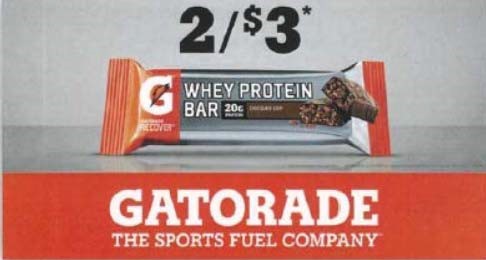
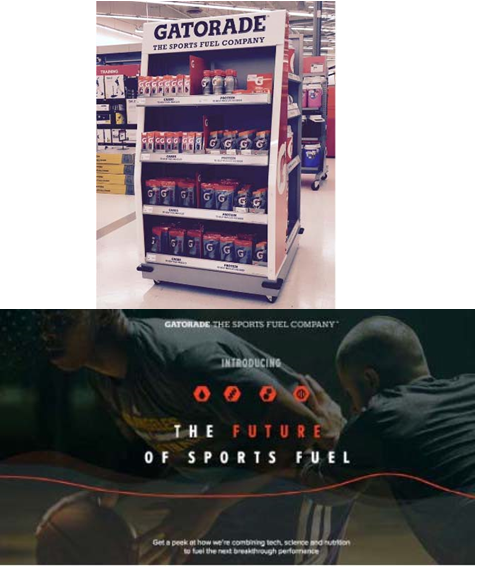
supplements, sued Gatorade after Gatorade rebranded itself with the slogan, “Gatorade
The Sports Fuel Company.” The court of appeals affirmed a finding of
descriptive fair use. SportFuel has an incontestable registration for “SportFuel”
for “food nutrition consultation, nutrition counseling, and providing
information about dietary supplements and nutrition” and a registration for “goods
and services related to dietary supplements and sports drinks enhanced with
vitamins.”
“In addition to its traditional sports drinks, Gatorade now
customizes its sports drink line by selling formulas that are tailored to the
nutritional needs of individual professional athletes,” and sells other sports
nutrition products. “It began to publicly describe its products as sports fuels
in 2013” and registered “Gatorade The Sports Fuel Company” in 2016, with “The
Sports Fuel Company” disclaimed after the PTO said that was merely descriptive.
(1) Was the use other than as a mark?  SportFuel argued that Gatorade used the
slogan as an “attention getting symbol,” it placed a trademark symbol after the
slogan, and it sought to register the slogan. 
“[M]ultiple factors” are relevant to whether there was use as a
mark.  “Gatorade is Thirst Aid” was found
to be a slogan in an earlier case where Gatorade featured the term “Thirst Aid”
even more prominently on its product packaging than the Gatorade mark, and where
the term rhymed with Gatorade and was used as an “attention‐getting symbol.” The
visuals here didn’t support the claim of use as a source indicator.  Gatorade’s word mark and G Bolt logo were
more prominent, and “Gatorade rarely uses the term ‘Sports Fuel’ directly on
product packaging, except for where the company labeled a ‘Sports Fuel Drink’ with
the term. Instead, it primarily features the slogan on in‐store displays and
other advertisements—appearing almost as a subtitle to the house mark.” Also, “Sports
Fuel” “lacks the catchy, rhyming play‐on‐words at issue in Quaker Oats. Nothing
about Gatorade’s use in this context suggests that consumers would view ‘Sports
Fuel’ as a source indicator.”  [I have to admit, I don’t get why the difference should matter to the descriptive fair use analysis.  Gatorade wasn’t trying to replace its Gatorade mark with “Thirst Aid”; instead it was trying to create a catchy overall slogan that paired the two.  I think this may boil down to how source-y and distinct from the unadorned Gatorade mark the two slogans seemed to the court, but why? The distinctive weakness of Seventh Circuit opinions is that they list facts that seem like they might matter, but don’t tell you how to identify a principle that will help decide cases with different facts.]

Nor did use of the TM symbol or the registration change the
result. The slogan included Gatorade’s trademark-protected Gatorade mark, and Gatorade
specifically disclaimed “The Sports Fuel Company”; the PTO specifically told
Gatorade that “Sports Fuel” was descriptive. Gatorade’s chief marketing officer
stated in his deposition that he viewed the whole phrase as the mark.  [So, use of a descriptive term within an
overall nondescriptive mark can be nontrademark use.]
(2) Was the use descriptive, rather than suggestive?  Yes. “Descriptive phrases refer to a
characteristic of the product. But they need not be common phrases.” Both
market use and the imagination test supported this conclusion.  “First, producers of nutritional products for
athletes regularly invoke the ‘Sports Fuel’ terminology to describe the
products they sell.”  Second, no mental
leap was required to deduce that the company is really selling athletic
nutrition products. SportFuel argued that Gatorade’s consumers were mostly not
high‐performance athletes, but that didn’t mean the products weren’t designed
for athletes. “Just as the pervasive use of yoga pants and other activewear as
casual clothing does not change the athletic characteristics of those products,
the fact that Gatorade sells more sports drinks to average joes who limit their
rigorous exercise to lawn mowing does not change the athletic characteristics
of Gatorade’s products.”
(3) Was the use fair and in good faith?  The key here is subjective purpose, which is
an interesting thing for the Seventh Circuit in particular to focus on. SportFuel’s
evidence of subjective bad faith was: (1) Gatorade’s knowledge of the mark
because of a previous working relationship a SportFuel principal; (2) continued
use of the term after SportFuel sued; (3) Gatorade didn’t account in detail for
how it came up with the slogan; (4) Gatorade’s purported bad blood with the SportFuel
principal, “suggesting that Gatorade adopted the new slogan to settle an old
score.”
Knowledge of the plaintiff’s mark, without other evidence of
subjective bad faith, is insufficient, as is continued use of a term after suit
is filed, since intentional use of a term one has every right to use is not bad
faith.  Nor was SportFuel entitled to an
adverse inference based on the argument that Gatorade produced no documentation
related to high-level approval of the slogan, which must have occurred—speculation
isn’t enough on summary judgment.  Maybe
SportFuel could have pursued this argument further in discovery, but it didn’t,
and it was too late.  Likewise, there
wasn’t evidence that the falling out with SportFuel’s principal related to the
adoption of the slogan. Her relationship with Gatorade ended more than a decade
before the alleged infringement began. “And the idea that a new slogan for a
nation‐wide rebranding campaign and stale antipathy towards [her] are connected
is facially incredible when otherwise unsupported by the record.”
In addition, SportFuel argued that Gatorade acted in bad
faith by not taking the risk of reverse confusion into account.  But “intent is largely irrelevant in reverse
confusion cases because ‘the defendant by definition is not palming off or
otherwise attempting to create confusion as to the source of his product.’” Anyway,
Gatorade provided evidence of its intent: “it adopted the slogan to reflect its
various types of sports fuel products.”  Not
thinking of SportFuel’s interests isn’t bad faith.
Nor was it bad faith to incorporate a descriptive term into
a slogan that, as a whole, functioned as a mark (at least when the whole
included Gatorade’s core mark). Gatorade produced evidence of fairness and good
faith: its stated purpose was to describe its business/products better, and its
evidence showed that “the company and its employees view themselves as
producers of sports fuels.” [Such a weird formulation, no pun intended: how can
the company have a mental state distinct from that of its employees?]

from Blogger https://ift.tt/2YSmEkj

Posted in Uncategorized | Tagged | Leave a comment

London sights for TM aficionados

Pictures taken while traveling. The geographic attractiveness of the “American” carwash is enhanced by the slogan “The Cadillac of London car washes.”

Adidas/marijuana leaf in center.

from Blogger https://ift.tt/2YEtYQH

Posted in Uncategorized | Tagged | Leave a comment

false advertising trolling, consumer protection, or both

I wrote about a couple
of cases filed by a supplement maker, Outlaw
, against retailers that sold
allegedly unlawful “male enhancement” supplements that the FDA has issued
warnings on—sometimes the “supplements” illegally contain pharmaceuticals like sildenafil
(active ingredient in Viagra).  Vice made
a short
film about the cases
, highly sympathetic to the small business defendants.  My reaction is decidedly more mixed.  On the one hand, Outlaw’s tactics suggest a
kind of false advertising trolling—threatening a lot of small businesses and
trying to get payouts from them.  On the
other, Outlaw points out that the manufacturers of these supplements are shady
and hard to find, meaning that it’s not particularly easy to go after them
(and, not for nothing, that the retailers are themselves being rather careless
about what they stock—carrying Tiger Male Enhancement pills is really not the
same thing as carrying Diet Coke).  The
film points out that these products are often made with identical packaging but
filled with different substances by different people, so sometimes you get sildenafil
and sometimes you get random non-drug substances.  This certainly does make it difficult to show
that the stuff sold at any given bodega had pharmaceuticals in it, but at the
same time it makes the falsity of the advertising, and the danger to consumers,
even more clear.  Ultimately, it’s far
easier to conclude that Outlaw’s enforcement model is a bad one than that these
small businesses should be left alone to sell whatever they can get consumers to
buy.

from Blogger https://ift.tt/2ZuBZVj

Posted in Uncategorized | Tagged , , , , | Leave a comment