Lysol can’t quickly clean up this mess of anti-Clorox ads

Clorox Co. v. Reckitt Benckiser Gp. PLC, 2019 WL 3068322, No.
19-cv-01452-EMC (N.D. Cal. Jul. 12, 2019)
Clorox sued Reckitt for false advertising of its Lysol cleaning products under the Lanham Act and California’s UCL/FAL. The court found
tiny parts of the complaint insufficiently pled but kept most of the claims
intact.
First, the court determined that Rule 9(b) applied to the
false advertising claim, as to the California claims, because intentional
misrepresentation was alleged.
Next, Reckitt argued that all Clorox’s misleadingness claims
failed because the complaint didn’t allege specific facts proving significant
consumer deception.  But proof is for
summary judgment/trial, not the pleadings. “[A]t the pleading stage the
plaintiff need only allege specific misleading statements and explain why they
are misleading in accordance with Rule 9(b).”
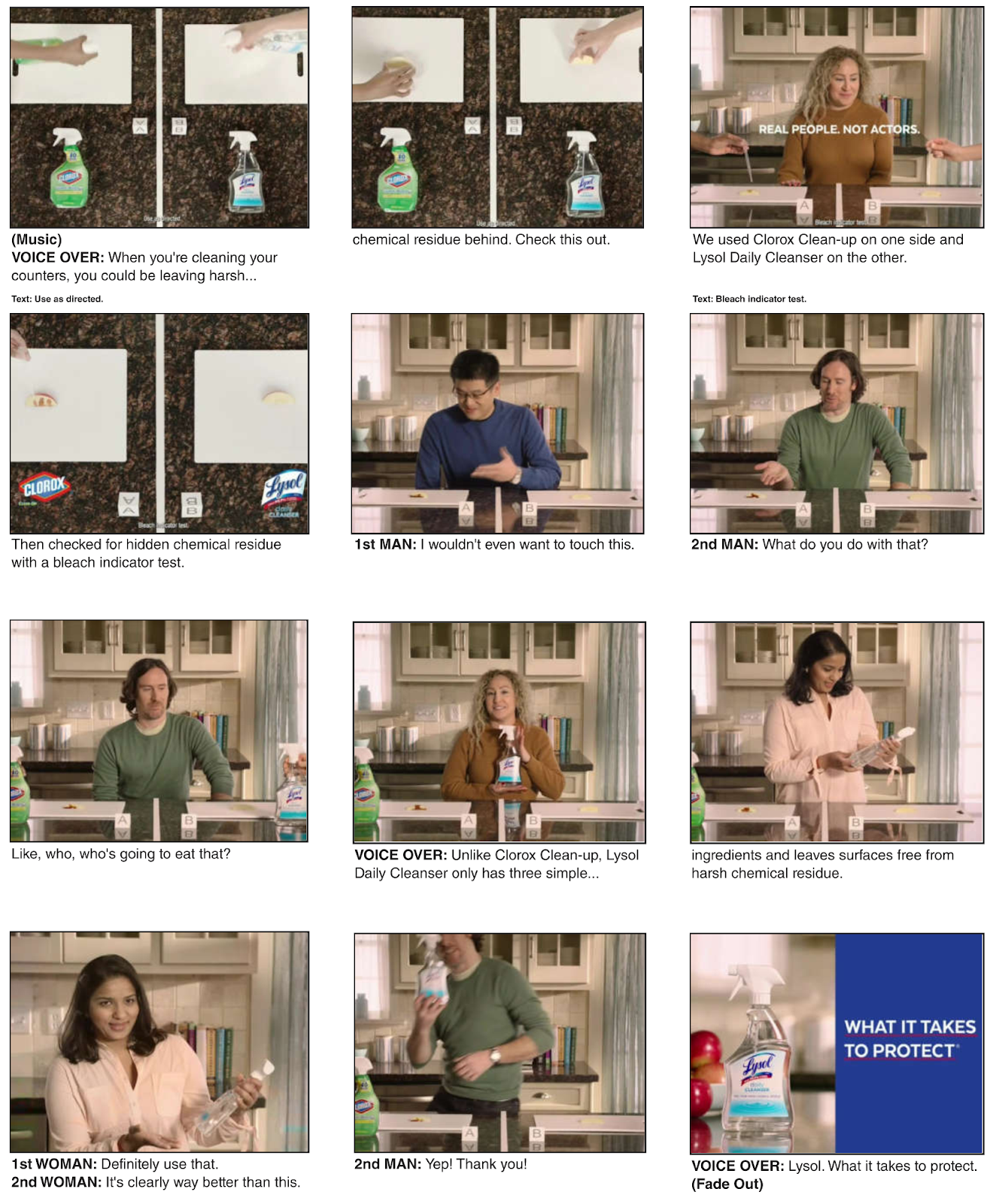
On to specifics: Ads: (1)“Bleach Indicator Test” depicting a
side-by-side test of Clorox Clean Up and Lysol Daily Cleanser.. One cutting
board is first cleaned with Clorox Clean Up and another cleaned with Lysol
Daily Cleanser, then an apple slice is placed on each cutting board; the former
turns brown and the latter doesn’t. Four individuals labeled as “real people”
negatively react to the browned apple, e.g., “I wouldn’t even want to touch
this.” Voice-over: “unlike Clorox Clean Up, Lysol Daily Cleanser has only three
simple ingredients and leaves surfaces free from harsh chemical residue.” A
similar ad used a “bleach indicator test” instead.

This was sufficiently alleged to be false for three reasons:
(1) It plausibly necessarily implied that Clorox Clean Up was unsuitable or
unsafe for use in kitchens, even though the EPA has in fact deemed the product
safe for kitchen use. “[A]n advertisement can be literally false where it
necessarily implies to customers that a product is unsafe to consume.” Given
the images of food turned brown and people recoiling in disgust, it was reasonable
to infer falsity by necessary implication. 
(2) It plausibly falsely indicated that the result of the
test depicted—that Lysol Daily Cleanser apparently leaves no residue that would
affect an apple slice—was inaccurate. According to Clorox, Lysol Daily Cleanser
contains hypochlorous acid, “a form of bleach,” so a “properly chosen and
calibrated ‘bleach indicator test’ would detect the residue left by Reckitt’s
product,” but Reckitt’s chosen test was deliberately designed not to do so. A “tests
prove” claim is false where the tests “are not sufficiently reliable to permit
one to conclude with reasonable certainty that they established the claim
made.” Clorox plausibly alleged that Reckitt’s test is not sufficiently
reliable to permit one to conclude with reasonable certainty that Lysol Daily
Cleanser leaves no bleach residue.  (Note
the elision of the key question here: what exactly does the ad claim that “tests
prove”?  The ad doesn’t explicitly say
there’s bleach on one slice and not on the other.)
(3) It was literally false because it necessarily implied
that Lysol Daily Cleanser and Clorox Clean Up are comparable products but that
the Clorox product leaves a harsh residue. But they have different formulations
and purposes. “Although usable in kitchens, Clorox Clean Up is a heavier duty
product than Lysol Daily Cleanser” with stronger ingredients not for everyday
use, so attempts to “position Lysol Daily Cleanser as a ‘simpler’ or ‘less
harsh’ substitute for CCU misrepresents the facts and deceives customers.”  [Gotta admit, less harsh sounds true but also
necessarily misleadingly comparative, given the background expectation that a
thing will be compared with a thing in its class, e.g., what are the harshest daily
cleaners? Clorox alleged that it did market an actually competing product,
which makes the misinterpretation even more likely.] LDC couldn’t be substituted
for CCU because the former was much more diluted and lacked a surfactant/detergent
for intensive cleaning. [This seems eminently correct as to indications but possibly
not descriptively true—I might want to know how many consumers are unaware of
the difference.] Apples-to-oranges comparisons can be literally false by
necessary implication “where non-comparable products are portrayed as otherwise
equivalent (except for the superior or inferior aspect being illustrated in the
advertisement).” Thus, “plaintiffs can establish literal falsity under the
Lanham Act by alleging that two products portrayed as comparable in an
advertisement are not actually comparable – that the advertisement omits
differences which would have been material to recipients.”  Clorox sufficiently alleged lack of comparability,
especially given the availability of a closer Clorox comparator.
Reckitt argued that Clorox Clean Up was in fact comparable
to Lysol Daily Cleanser because the EPA has approved the Clorox Clean Up as
“Gentle & Powerful Enough for Daily Use,” but there was no authority
holding that the EPA’s categorization of products makes those products
comparable for Lanham Act purposes. Anyway, this was a factual dispute.
(2) “Spray Away” ads showing an image of Clorox Clean Up and
its list of ingredients being sprayed and wiped away with Lysol Daily Cleanser.
The ad then flashes banners stating: “Lysol Daily Cleanser[;] Only 3
ingredients,” “Kills 99.9% of germs (when used as directed),” and “No harsh
chemical residue.” A Facebook ad juxtaposes the safety warnings of Clorox Clean
Up and Lysol Daily Cleanser and concludes with the same statement.  Also sufficiently alleged falsity.
First, this was another plausibly apples-to-oranges
comparison of LDC with CCU. Second, the Facebook ad juxtaposing the safety
warnings was plausibly likely to mislead consumers because it suggests that the
Lysol product is “simpler” and has “fewer safety risks” and “impugns the safety
of CCU by suggesting that consumers should shy away from products that require
cautionary disclosures.” Clorox also alleged that the active ingredient in the
Lysol product, hypochlorous acid, was no gentler than the bleach in Clorox
Clean Up.
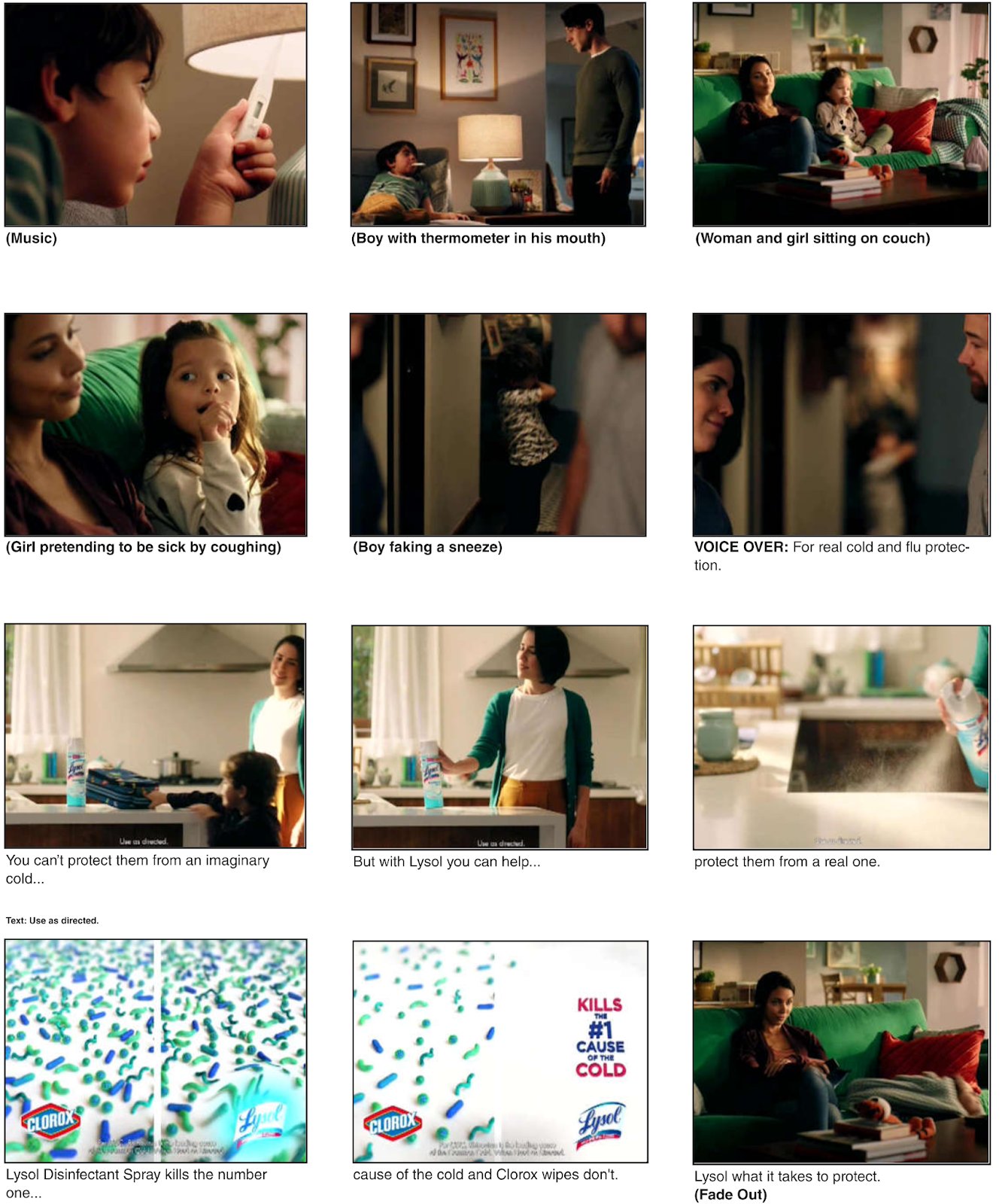
 (3) “Fake It,” “Game
Over,” and “Spray Away” ads: the first said that Lysol could “help protect”
children from colds then showed a split screen with the Clorox and Lysol
symbols on either side, and “germs” on both sides of the screen; the germs on
the Lysol side of the screen disappear while those on the Clorox side remain.
An announcer states, “Lysol Disinfectant Spray kills the number one cause of
the cold and Clorox Wipes don’t.” Reckitt eventually added in “minuscule type”
that the comparison was between Clorox Disinfecting Wipes and Lysol
Disinfecting Spray. Two other ads had the same factual claims, presented differently
(in one, a container of Clorox Disinfecting Wipes is sprayed off the screen by
Lysol Spray).
Plausibly alleged to be literally false by necessary
implication. Clorox again alleged an apples-to-oranges comparison of Clorox’s
“pre-moistened, anti-microbial wipes that consumers use to clean and disinfect
surfaces throughout the home” to a Lysol product in a different category with different
usage instructions. Wipes are allegedly formulated to target different germs
than disinfecting sprays. “The key difference is between wipes and sprays, not
Clorox and Lysol.” Again, Clorox alleged that more comparable products were
available—both parties’ sprays (neither of which are approved for rhinovirus)
or their wipes (both of which are).
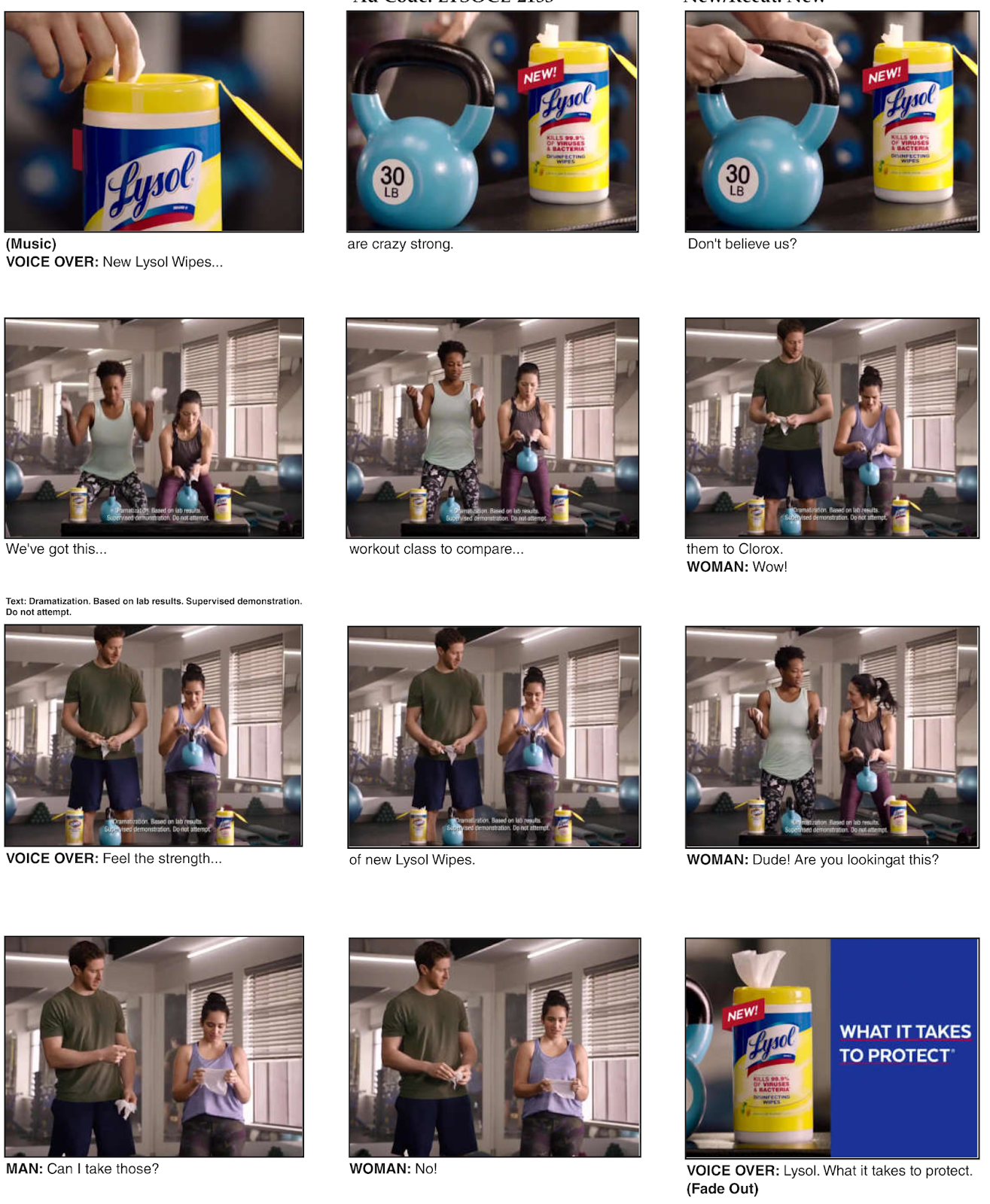
(4) “Strength Test” ads: Employed to pick up kettlebell
weights, the Clorox wipe rips immediately while the Lysol wipes holds the
weight for several seconds. A disclaimer states, “Dramatization. Based on lab
results. Supervised demonstration. Do not attempt.” A Facebook ad said, “Lysol
wipes are stronger than competition” and depicted a Lysol wipe intact next to a
torn “competitive” wipe that “appears below a version of the famous Clorox
chevron, in which the Clorox brand name has been replaced with the words ‘vs
leading competitor.’ ”

Clorox’s claim that the ad falsely insinuates that Lysol
wipes are “of higher quality, are more durable, and are more resistant to
tearing during use than Clorox wipes” failed because Clorox didn’t allege that Lysol
wipes are not of higher quality, more durable, and more resistant to
tearing than Clorox. [Technically, it should be enough to allege that they are
of equal quality—one might even hedge and allege that Clorox wipes are
of at least equal quality to Lysol’s.] It wasn’t enough to allege that
the Clorox wipes are unlikely to rip under typical use conditions.
However, the court was more receptive to the allegation that
the “strength test” conducted in the advertisement was unreliable and therefore
literally false. Clorox alleged that the test “is not capable of replication,
because neither product is actually long enough to serve as a ‘handle’ when
holding a kettlebell weight,” and thus it wasn’t “sufficiently reliable to permit
one to conclude with reasonable certainty that [it] established the claim made.”
This was more than the insufficient allegation “there was simply no way a valid
test would show” results supporting an advertising claim.
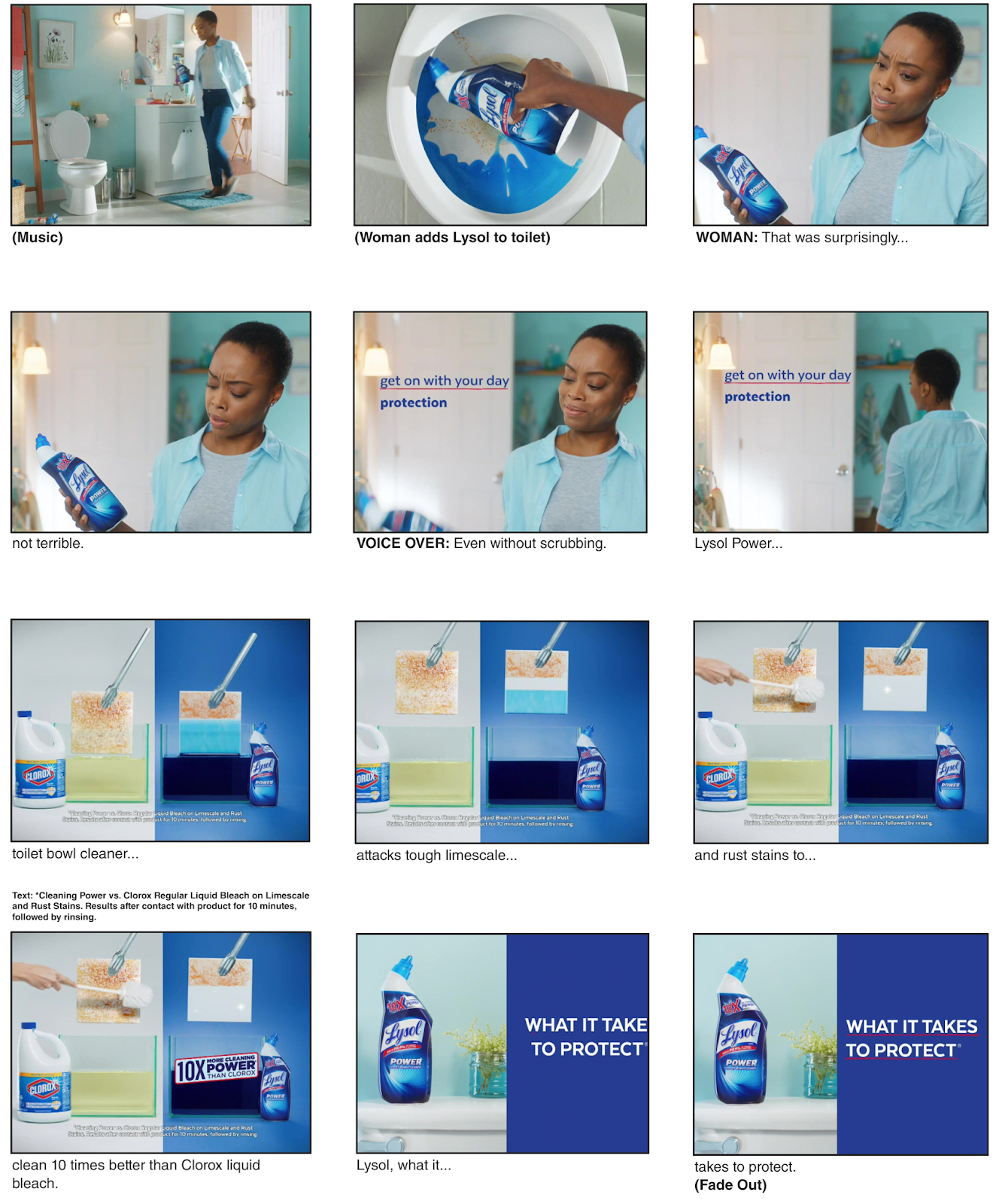
(5) “No Scrubbing” ads: for example, a woman squirts Lysol
Power Toilet Bowl Cleaner into a toilet and flushes; the toilet bowl instantly
becomes clean without the use of a brush. The ad then depicts the unfavorable
results of a side-by-side efficacy test comparing Lysol Power Toilet Bowl
Cleaner and Clorox Regular Liquid Bleach. A small disclaimer states, “Cleaning
Power vs. Clorox Regular Liquid Bleach on limescale and rust stains. Results
after contact with product for 10 minutes, followed by rinsing.” A small banner
states, “10X more cleaning power than Clorox.” 
In another similar ad, a tiny disclaimer states that the results involve
Lysol Power Toilet Bowl Cleaner and Clorox Toilet Bowl Cleaner Clinging Bleach
Gel, but that’s is a distinct product from the “Clorox Toilet Bowl Cleaner with
Bleach” product referenced in the voice-over. 
The “10X More Cleaning Power than Bleach” claim also appears in stores.

Clorox pled falsity: (1) Again, apples-to-oranges: Clorox
alleged that the formulation and purpose of the two products differ.  [I just love what you learn about the world
in false advertising cases.]  Acid-based
cleaners, such as Lysol Power Toilet Bowl Cleaner, are more effective against
mineral-based deposits (like rust and limescale), whereas Clorox’s bleach-based
Clorox Toilet Bowl Cleaner is more effective at removing organic stains (like
mildew and mold). Again, the parties allegedly marketed more directly competing
products. Again, Reckitt’s argument that the EPA approved both for use on
mineral-based deposits wasn’t sufficient.
Reckitt argued that it added a “disclaimer expressly
stat[ing] that the purported advantage relates only to rust and limescale and
not to organic matter.” Clorox alleged that the disclaimers were “nearly
illegible” and “minuscule” and thus plausibly useless.
Second, Clorox plausibly alleged misleadingness: “[t]hrough
its depiction of a woman using a single squirt of the product to render her
toilet immaculate,…[the ad indicates that] the Lysol product works instantly
to removal all deposits from toilets.” First, “the product requires at least 10
minutes to remove some toilet bowl stains,” and second, it’s not [as] good at
organic deposits, so it “cannot render toilets immaculate in seconds, as
depicted in Reckitt’s advertising.”

Third, Clorox plausibly alleged that the claim “10X more
cleaning power than Clorox” was literally false because Lysol products
generally do not have a performance advantage over Clorox. Compared apples to
apples, the Lysol product allegedly didn’t have an advantage in removing
limescale and rust because they contain the same active ingredient, glycolic
acid. So too with the claim “10X More Cleaning Power than Bleach,” because a
reasonable consumer would likely believe that the comparison is in fact with
its leading competitor, Clorox.

(6) Noncomparative ads: claims included: kills “99.9% of
germs”; “kills over 100 illnesses causing germs” and a disclaimer that “Lysol
Disinfecting Spray kills germs on hard surfaces when used as directed.”  One ad was ambiguous as to whether the ad was
claiming that both touted products could
kill over 100 illness-causing germs, or whether they can do
so together.  But it was plausible that
it misleadingly implied that either product alone would be enough. Another ad
claimed that Lysol Daily Cleanser kills “99.9% of germs” and the visual showed
an actor spraying and immediately wiping the surface, whereas the EPA-approved
use instructions on the label requires ten minutes of contact with a treated
surface to achieve its disinfectant effect. That was plausibly misleading,
though it wasn’t a comparison to Clorox.
Materiality: the court quoted precedent that materiality “is
‘typically’ proven through consumer surveys,” even though that is empirically
false (this is a problem for the courts of appeal; the court here notes but
does not give a reason for the shift in judicial treatment of materiality over
time, from presuming materiality for literal falsity—often a matter of common
sense—to a seemingly rigid insistence on separate evidence no matter what).
Restoring some flexibility, a plaintiff can also establish materiality by
showing that “the defendants misrepresented an inherent quality or
characteristic of the product.” Clorox plausibly alleged that Reckitt’s
advertisements attack Clorox products’ efficacy, safety, and durability. These
were inherent qualities and characteristics of cleaning products, and would
likely influence the purchasing decision of a consumer.
Injury: Clorox alleged direct diversion of sales and damage
to its goodwill.  Reckitt argued that
wasn’t enough, but for a competitor who’d been directly attacked it definitely
was. In Vincent v. Utah Plastic Surgery Soc., 621 F. App’x 546 (10th Cir.
2015), the Tenth Circuit required the plaintiff to make some showing of “how
much Plaintiff’s profits have decreased since Defendants began their advertising
campaign,” to “quantif[y] or estimate the decreased in goodwill,” or to
“quantify the number of potential customers who allegedly have been lost
because of Defendant’s statements,” but the court wasn’t going to do that in
the Ninth Circuit.
UCL/FAL: Reckitt argued that Clorox needed to allege its own
reliance on Reckitt’s ads to state UCL/FAL claims.  That’s true for the FAL and UCL “unlawful,”
but not for UCL “unfair.”  Also, whether
the ads would deceive reasonable consumers was a fact question, as it usually
is.

from Blogger https://ift.tt/2GkHZZg

Posted in Uncategorized | Tagged | Leave a comment

Monster Energy can’t show falsity, can show tortious interference (but not irreparable injury)

The court denied a preliminary injunction on Monster’s claim
that Vital falsely advertised its “Super Creatine” as “creatine,” because there
wasn’t sufficient evidence that the two were distinct (in meaning or more
significantly in function), and on tortious interference for lack of a showing
of irreparable harm.
Monster argued that using “creatine” on the labels of
Vital’s energy drink BANG (as part of a promise of “Creatine, Caffeine, CoQ10,
& BCAAs”) was literally false, because BANG does not contain creatine, and
that “Super Creatine” was impliedly false because BANG actually contains an
entirely different molecule, creatyl-L-leucine.
Monster’s expert tested four cans and found no creatine, or
only trace amounts, in the products. 
Vital’s principal also made public statements that the products didn’t
contain “regular creatine.” The expert’s declaration stated that “Super
Creatine,” Vital’s term for creatyl-L-leucine, was a “chemically synthesized
compound” which is created from the linking of two distinct amino acids,
creatine and leucine, with properties “distinct from [those of] the constituent
amino acids.”
The court found Monster’s definition of “creatine” to be
“overly narrow,” since its own cited evidence established that “[m]any forms of
creatine exist in the marketplace,” including formulations combining creatine
with other amino acids. Monster also argued that creatyl-L-leucine does not
provide any of the benefits of creatine, but its evidence did not establish that
fact; it supported “only the more general conclusion that the chemical and
physical properties of a new substance formed from the combination of two amino
acids differs from their constituent parts.” Monster’s cited scientific journal
articles didn’t discuss creatyl-L-leucine, “but both state that at least some
of common creatine compounds provide similar or superior effects to those
provided by creatine alone.”  The burden
of proof was on Monster, and it did not meet that burden.
Monster also argued that BANG doesn’t contain enough Super
Creatine to provide the benefits that VPX promises consumers. But testing only
four cans of a single flavor of BANG purchased from the same retail store in
Southern California wasn’t enough to conclude that the results were
representative of BANG products generally. “The Court will not order a
nationwide recall on the basis of such a limited sample size.”
Intentional interference with
contractual relations: Monster showed that it had valid contracts for specific
amounts of in-store shelf and/or cooler space with retailers across the
country, and also showed that Vital disrupted those agreements, leading to BANG
products being stocked in Monster’s contracted-for retail shelving space in
retail locations across the country. 
This wasn’t a matter of “wayward cans,” given the scope and duration of
the problem and documented statements from Vital’s leadership. One former Vital
account manager declared that district and regional managers directed him to
use “guerilla tactics” and “be aggressive” in order to obtain shelf and cooler
space for BANG at retail stores. “They made specific demands about the location
in which BANG should be placed … and instructed [him] to document the space he
acquired with photographs,” though he knew that competitors had contracts with
retailers about placement. There was also evidence that placement contracts
were industry custom, and that Vital’s principal made Instagram posts showing
intent, such as one that shows an image of a VPX products placed in front of
Monster products accompanied by the text “When in doubt block them out. In life
when they tell you there’s no shelf space – make your own shelf space! When
multibillion-dollar competitors pay for space retaliate with a vengeance,” and
another which states that VPX will “not placate to [a retailer’s] tomfoolery
and rigged system of paying for shelf space.”

Defendants argued
that Monster failed to show that Vital or its agents had knowledge of the
existence of the specific shelving-space contracts between Monster and its
retailers with which they interfered. The evidence was to the contrary,
including public statements made by the principal which object to the industry
practice of paying for shelf space and state his intention to “make [his] own shelf
space” and “retaliate” against competitors who pay for space. [Ah, clients and
their social media.] “In light of the extent of this practice, Plaintiff need
not demonstrate specific knowledge of each contract in question in order to
demonstrate a likelihood of success on the merits.”  Likewise, the evidence showed that the
“wayward” cans in Monster’s shelving space were likely the result of defendants’
intentional conduct.
But there was very
little evidence of damages. While it may be the case that BANG’s sales growth
has been “fueled by VPX’s theft of Monster’s shelf and cooler space,” Monster
didn’t have good evidence backing this up. 
There was no evidence connecting contractual interference with “the loss
of customer goodwill, the loss of market share, or the loss of profits,” making
harm speculative at this stage. So too with irreparable harm.

from Blogger https://ift.tt/2YZxB09

Posted in Uncategorized | Tagged , , | Leave a comment

TrueCar’s false claims not subject to car dealers’ challenge without evidence of injury

Dependable Sales & Service, Inc. v. Truecar, Inc., 2019
WL 3067115, No. 15-cv-1742 (PKC) (S.D.N.Y. Jul. 12, 2019)
Lots
of prior
rulings
about various aspects of this false advertising claim in the general field of
auto sales.
TrueCar successfully moved for partial reconsideration of
the previous summary judgment decision holding that the plaintiffs, 108
automobile dealerships, failed to come forward with evidence of economic or
reputational injury from TrueCar’s advertising. They weren’t direct competitors
and TrueCar’s false advertisements did not make comparative claims, so
plaintiffs weren’t entitled to a presumption of injury. Now, the court
concluded that without evidence of some injury, disgorgement wasn’t available as
a remedy, despite evidence of TrueCar’s willful Lanham Act violations.
There is authority in the Second Circuit for allowing
disgorgement to advance the interest of deterrence, even where the plaintiff
has not demonstrated injury. However, that line of cases “arose in the
trademark and trade dress arena.” It’s worth noting that the statutory language
doesn’t make this distinction; Lexmark is an interpretation of the
overall structure of Lanham Act liability. 
“More recently, in a false-advertising case, the Second Circuit observed
that ‘[o]ur precedent permits a district court to award a defendant’s full
profits based solely on deterrence,’” Merck Eprova AG v. Gnosis S.p.A., 760
F.3d 247, 262 (2d Cir. 2014), but that was a case of obvious direct competition.
Unfortunately, the court went on to say that “[t]here are important
differences in the elements of a trademark claim and a false advertising claim,
as well as in the interests at stake…. In a trademark case, a plaintiff may be
harmed by virtue of losing exclusive control over its own mark…. The
unauthorized use of a mark ‘invariably threatens injury to the economic value
of the goodwill and reputation” associated with the mark.’ … Even where a
trademark plaintiff cannot point to lost sales, it may still be harmed by ‘a
loss of control … over how the public perceives’ its goods or services.” 
As readers of this post likely know, this assumption is both
(1) unsound in a number of situations, particularly outside classic source
confusion, and (2) increasingly vulnerable post-eBay and Winter,
now that courts have given renewed attention to plaintiffs’ harm stories.  Of course, it would be reasonable to respond
that even without a presumption of irreparable harm, a presumption of harm
is still justified … but the lost control language is very tightly tied to the
discourse of irreparability.  As a few
cases (mostly in the 9th Circuit) have recognized, the existence of
some unquantified risk of harm (“may still be harmed”) is not the same
thing as the likelihood that the harm will materialize.  Perhaps the standard for disgorgement ought
to cover any [reasonable? theoretical? plausible? nontrivial? you see the
difficulty] risk whether likely or not—I suspect that the level of willfulness
might interact with one’s opinion on the matter.
Anyway, in a trademark case, the Second Circuit concluded
that the district court should have ordered disgorgement solely to deter
willful infringement because the “deliberate[ ] and fraudulent[ ]” infringement
of plaintiff’s mark warranted disgorgement of defendant’s full profits, even though
plaintiff did not demonstrate lost sales, consumer confusion or damage to good
will. Defendant’s “callous disregard for the rights of a competitor” was
sufficient. [As opposed to callous disregard for consumers and competition in
general through willful false advertising—note too that trademark infringement
in a non-sales substitution case wouldn’t come under this reasoning if we take
“competitor” seriously, which would actually be a decent way of reconciling the
cases.] But a false advertising plaintiff must show injury “by way of
lost sales or damage to business reputation,” though a presumption of injury
can arise from falsity about a direct competitor.  [The real problem here is that the trademark
cases cited largely predate, and definitely have have not actually analyzed, Lexmark
and its statutory interpretation. I’m not saying the court is definitely wrong
in its holding here—though I might have gone the other way—but I am saying that
the efforts to distinguish trademark law are not successful.]
Ultimately, the court reasoned, “[i]t may seem anomalous
that a false advertiser in need of deterrence can escape the disgorgement of
profits when there are plaintiffs that are eager and willing to pursue that
remedy,” but the plaintiffs here didn’t show injury. A differently situated
plaintiff [would it have to be an entity that used TrueCar’s business model of
contracting with different dealers and offering discounts? It’s not obvious why
the false advertising here would’ve hurt them either] might have damages
that are small or difficult to establish, and for them disgorgement would be an
ideal remedy. Consumer class actions [unless consumers signed arbitration
agreements] or the FTC/state AGs are other options for punishing willful false
advertising.  
The court declined to exercise supplemental jurisdiction
over the remaining state law claims.

from Blogger https://ift.tt/2GlyYPy

Posted in Uncategorized | Tagged , | Leave a comment

Reading list: the dark side of meme culture

I realized that many of the young
reporters who initially helped amplify the white nationalist “alt right” by
pointing and laughing at them, had all come up in and around internet
culture-type circles. They may not have been trolls themselves, but their
familiarity with trolling subculture, and experience with precisely the kind of
discordant swirl featured in the aforementioned early-2000s image dump,
perfectly prepped them for pro-Trump shitposting. They knew what this was. This
was just trolls being trolls. This was just 4chan being 4chan. This was just
the internet. Those Swastikas didn’t mean anything. They recognized the
clothes the wolf was wearing, I argued, and so they didn’t recognize the wolf.
This was how the wolf operated: by
exploiting the fact that so many (white) people have been trained not to take
the things that happen on the internet very seriously. They operated by laundering
hate into the mainstream through “ironically” racist memes, then using all that
laughter as a radicalization and recruitment tool.

from Blogger https://ift.tt/2Z3rWXc

Posted in Uncategorized | Tagged | Leave a comment

Imaginative makeup color names as descriptive fair use

Hard Candy, LLC v. Anastasia Beverly Hills, Inc., 921 F.3d
1343 (11th Cir. 2019)
Hard Candy sued Anastasia, a competitor in the cosmetics
industry, for infringement based on one of Anastasia’s “Glow Kits,” flip-open
makeup palettes containing four different shades of facial highlighter.  The Gleam Glow Kit included the words “hard
candy” in capital letters on the back and inside of the package to designate a
peach-pink shade of makeup. “Anastasia says that it chose this name because the
product had a ‘shimmer’ that reminded the developer of candies that her
grandmother gave her when she was young.” “Hard candy” appeared in marketing
materials and social media posts, as well as on the product itself.
 

front and back of kit

interior

Hard Candy sought “every remedy permitted by the Lanham Act
besides actual damages — that is, it asked for an injunction to prevent future
infringement, an accounting and the disgorgement of profits that the defendant
made from the allegedly infringing goods, and declaratory relief, along with
fees and costs.” The district court denied it a jury trial, held a bench trial,
and found no likely confusion/descriptive fair use, and the court of appeals
affirmed.
There was no Seventh Amendment right to a jury trial.  Hard Candy argued that it should have gotten
a jury because it was seeking to recover Anastasia’s profits as a “proxy” for
the damages it suffered due to infringement. Doesn’t matter; disgorgement is
still an equitable remedy and doesn’t entitle the claimant to a jury trial.
The standard of review of the confusion finding after a
bench trial was for clear error.  Factors
that favored Hard Candy: product similarity, trade channel/customer/advertising
similarity, and strength of mark (arbitrary and therefore strong). Note that “Hard
Candy” was arbitrary for cosmetics generally—or at least, could be used in
arbitrary fashion.  Factors that favored
Anastasia: dissimilarity of marks/uses and lack of evidence of actual
confusion.  The court also found no
intent to infringe.
Hard Candy argued that the district court erred by finding
that the “similarity of mark” factor favored Anastasia, since the words were
identical. But it’s the overall impression that matters, and “formally”
identical use of the same letters wasn’t enough. The manner of use matters
too.  In the Gleam Glow Kit, the words HARD
CANDY” appeared only on the back and inside of the kit, “nam[ing] one shade of
a product that is otherwise clearly and prominently featured as an Anastasia
Beverly Hills mark.”  It was not clear
error to weigh descriptive use, or lack of use as a mark, as favoring
Anastasia.  [Despite what the Supreme
Court said, this case highlights—no pun intended—that descriptive use just
doesn’t work any more as a separate defense. 
On the flip side, even if we’ve abandoned use as a mark as an
independent limit on infringement, that doesn’t mean it’s not relevant to
whether confusion is likely.]  Mark
placement, size, and use to identify a specific part of the product are
definitely relevant to a similarity analysis.
Finally also argued that the district court placed too much
weight on the lack of a showing of actual confusion. But, “[i]f consumers have
been exposed to two allegedly similar trademarks in the marketplace for an
adequate period of time and no actual confusion is detected either by survey or
in actual reported instances of confusion, that can be powerful indication that
the junior trademark does not cause a meaningful likelihood of confusion.” Here,
Anastasia sold almost 250,000 Gleam Glow Kits; the product was touted on social
media accounts with millions of followers. 
“In this case, there was enough opportunity for confusion to make the
absence of any evidence significant. … [H]undreds of thousands of cosmetics
consumers purchased the allegedly infringing kit, several times more likely saw
it on store shelves or online, and still there is no evidence that anyone,
anywhere, was ever confused about whether Anastasia or Hard Candy was
responsible for the product.” At a minimum, there was no clear error in
weighing this in favor of Anastasia.
Anyway, Anastasia established descriptive fair use. The
court of appeals endorsed the view that “it is not necessary that a descriptive
term depict the [product] itself, but only that the term refer to a
characteristic of the [product].”  And
here’s an interesting bit that the court of appeals doesn’t even seem to
notice: the use of Hard Candy as the name of the cosmetics brand was arbitrary,
but the use of “hard candy” as the name of a specific color was descriptive.  I think this is the right result (though I
might’ve called the brand name suggestive), but this case is pretty good evidence
that manner of use matters a lot to whether something seems “inherently” to be
a trademark. See also Thomas R. Lee, Eric D. DeRosia & Glenn L.
Christensen, An
Empirical and Consumer Psychology Analysis of Trademark Distinctiveness
, 41
ARIZ. ST. L.J. 1033 (2009). 
Hard Candy argued that Anastasia’s use wasn’t descriptive,
and that the district court disregarded “the central requirement” of consumer
perception of the use.  But the district
court did consider how a hypothetical consumer would perceive the use, considering
“the overall context; the lettering, the type, the style, the size, [and] the
visual placement” of the words on the product. 
Anastasia also introduced evidence that cosmetics companies regularly
describe shades with words that are not literal color descriptions, like the
other three shades in the kit named “Starburst,” “Mimosa,” and “Crushed
Pearl.”  This common practice was
relevant to reasonable consumers’ perceptions of the use, not just to Anastasia’s
subjective intent.  And no evidence of
actual consumer perception is required to use the defense.

from Blogger https://ift.tt/2LfLcgP

Posted in Uncategorized | Tagged , | 2 Comments

When © trips courts up: Lack of access to standards makes false ad claim impossible to resolve

Wing Enterprises, Inc. v. Tricam Industries, Inc., 2019 WL
2994465, No. 17-cv-1769 (ECT/ECW) (D. Minn. Jul. 9, 2019)
This false advertising case about multi-position ladders turns
out to involve an important copyright issue that the Supreme Court has taken
up: when a standard is incorporated into law, should it be readily accessible
to the public? Because an older ANSI standard incorporated into OSHA isn’t
available to the court, the court can’t resolve whether failure to meet the current
ANSI standard also violates OSHA. This matters because the defendant advertised
ANSI/OSHA compliance, but plaintiff’s evidence went to whether there was
compliance with current ANSI.
The thrust of the federal and state false advertising claims
claims is that Tricam represented that its Gorilla Ladders comply with ANSI ASC
A14.2, a voluntary industry standard for portable metal ladders that was
developed by the American Ladder Institute, but in fact the rungs of its
ladders are not sufficiently deep all the way across to satisfy that standard
as Wing understands it.  The label
affixed to each ladder has an oval icon that says: “manufacturer certifies
conformance to OSHA ANSI A14.2 code for metal ladders” and there were similar
representations elsewhere.
The court admitted one expert on ANSI conformance and
excluded an expert report on materiality, the latter because of the access-to-code
problem.  Wing’s survey expert, Hal
Poret, conducted materiality surveys: a labeling survey, intended to measure
consumer reaction to the allegedly false statement on the label, and an
importance survey, intended to assess the importance to consumers of compliance
with industry safety standards in general. First, the court rejected the
argument that the labeling survey was unreliable because it failed to replicate
market conditions; it highlighted the label and demanded consumers spend a certain
amount of time looking at it, which might not happen on the retail floor.  “These might be fair points if the survey had
been intended to test what message the statements conveyed (as relevant to the
falsity element), or whether consumer confusion existed in a trademark case.”
But for a materiality study, how the consumers would see the image in the store
didn’t affect its relevance, although a jury could weigh divergence from the
retail context in its considerations.
The real problem is that Poret’s surveys tested ANSI and
OSHA conformance together by eliminating the entire challenged label (and his
importance survey referred only to conformance to unspecified “industry safety
standards,” not specifically to ANSI); Wing didn’t show that either a combined
OSHA/ANSI statement or industry safety standards writ large was relevant to the
issues a jury would need to decide in this litigation.
Wing argued that OSHA uses ANSI standards, so that a
violation of ANSI is necessarily a violation of OSHA.  And here’s where the access part comes
in.  OSHA regulations provide that
mandatory provisions (“shall” provisions) of standards incorporated by
reference are adopted as mandatory under OSHA and “have the same force and
effect” whether they are issued by federal agencies or by nongovernmental
organizations. Here, OSHA regulations incorporate by reference “ANSI A14.2-56
Safety Code for Portable Metal Ladders, Supplemented by ANSI A14.2a-77.”
Those last two digits are apparently pre-2000 year codes.  Wing didn’t identify how -56 and -77
differed/overlapped with the 2007 version of ANSI A14.2 the parties were apparently
working from in this case.  OSHA
regulations, in fact, incorporate by reference different versions of ANSI
A14.2. “For example, one regulation that pertains to the construction industry
incorporates the 1982 version; another, pertaining to shipyards, incorporates
the 1972 version; and others, relating to marine terminals and longshoring,
incorporate the 1990 version.”  Wing didn’t
confirm whether there was any relevant variation, and “[e]ven if the Court were
inclined to do that legwork on Wing’s behalf, the Court cannot independently
verify the extent to which the 1956 version explicitly mentioned in the
regulations overlaps, if at all, with the 2007 version before the Court by
referencing publicly available sources because the ANSI standards are not
reproduced in the Code of Federal Regulations and are instead behind a paywall
or available for in-person review in another state.” [Apparently the “state” is
DC, at the National Archives.]  Testimony
from Tricam witnesses was not sufficient to reach the legal conclusion that failure
to meet the current ANSI standard, in the manner identified, would also be
failure to meet the older standards that actually have the force of law.
Because Poret’s label survey was premised on the assumption
that ANSI falsity meant OSHA falsity, it couldn’t test ANSI falsity alone and
was not admissible. Likewise, his importance survey tested “[c]ompliance with
industry safety standards” in general, but given the multiple sources of
industry safety standards and the evidence in this case, that wasn’t relevant—“What
happens if, as contemplated above, a ladder that fails to conform to the 2007
version of ANSI nonetheless does meet the requirements of one or more OSHA
regulations that incorporate an older version of that standard?”
Without the survey, Wing couldn’t show materiality and
summary judgment was warranted. It argued that it could show materiality by
showing that “the false or misleading statement relates to an ‘inherent quality
or characteristic’ of the product,” and that “questions of safety and efficacy
are likely to satisfy automatically the materiality prong.” But the Eighth
Circuit has not endorsed the “inherent quality or characteristic” method of
showing materiality. And here, without further evidence on ANSI variation, “the
most Wing could show is a technical noncompliance with one of multiple
potentially applicable safety standards. That is not a compelling context in
which to adopt a new approach to showing materiality.”
Nor was the following adequate: (1) testimony from a
high-level Wing executive that, in his opinion, compliance statements on Home
Depot’s website are “important, otherwise, I don’t believe Home Depot would put
it on the website,” (2) testimony by Tricam’s president that an
ANSI-certification statement on Home Depot’s website “could be” helpful in
differentiating Tricam’s products from hypothetical competing ladders that do
not purport to conform to ANSI, and suggesting that an ANSI-certification
statement on the product label might be something a professional might want for
purposes of OSHA inspections of a job site, and (3) testimony from the chairman
of the ANSI labeling committee that “[i]t’s possible” that an ANSI-compliance
statement would help a consumer choose a ladder. But these statements were all
speculative on their face, and in each case the testimony was qualified by
reference to the speaker’s lack of direct knowledge about consumer behavior.

from Blogger https://ift.tt/2JA7qH4

Posted in Uncategorized | Tagged , | Leave a comment

Competitor’s false advertising case against MLM income claims can proceed

Youngevity Int’l v. Smith, No. 16-CV-704-BTM-JLB, 2019 WL
2918161 (S.D. Cal. Jul. 5, 2019)
This Lanham Act case involves, among other things, alleged
misrepresentations relating to the MLM aspects of defendants’ business pitched
to potential “affiliates.” 
First, defendants argued that plaintiffs failed to establish
any damages, justifying summary judgment. But there was some evidence of
decreased Youngevity sales during defendants’ false advertising and an expert
willing to link that with defendants’ sales generated by ex-Youngevity distributors;
also, “an inability to show actual damages does not alone preclude a recovery
under section 1117 [of the Lanham Act],” and plaintiffs were also seeking
injunctive relief. 
Second, defendants argued that they couldn’t be held liable
for statements made by their distributors. There was sufficient evidence for a
jury to find that these people (known as Wakaya Ambassadors) were agents for
Lanham Act purposes, making defendants vicariously liable.  Their classification as independent
contractors in Wakaya’s own Policies and Procedures wasn’t enough to avoid a
material issue of fact.  Moreover, defendants
didn’t dispute that the Ambassadors “engaged in the allegedly false advertising
for the purpose of attracting distributors and increasing sales,” squarely
within the scope of their roles. And defendants reserve the right to terminate Ambassadors’
accounts for unapproved conduct. That was enough to go to the jury.
The false advertising claims included allegedly false claims
about the potential income of a typical Wakaya distributor, e.g., Wakaya
Ambassadors can earn “$6,200 bucks residually in the next three to six months” and
“[w]e plan to build several leaders to 10K a month in the next 6 months.” [Ugh.
It’s so clear that the US lacks sufficient protections against pyramid schemes.
We shouldn’t be relying on competitors to do this, especially not competitors
that are themselves
MLMs with their own dubious claims
.] 
One individual defendant (Vaughn) claimed, on behalf of the company, that “when—you
get a thousand people joining [Wakaya] a day, that’s $85,000 in a day. If you
wanna do it in a week, that’s $85,000 in a week. [Etc.]”  Smith, Wakaya’s owner, observed in deposition
that the statement is “inaccurate” because “it claims that Wakaya Perfection
pays income for the joining of new people, for new people joining the
organization.” Smith also testified that he could not recall any distributor in
Wakaya ever making $85,000 in a month and that Vaughn himself does not make
$8,500 in a week based on his work as a Wakaya distributor. There was evidence
that Vaughn repeatedly asserted that Wakaya Ambassadors could earn a million
dollars in their first year. Smith himself stated, “I’m telling you right now
you’re going to earn a lot of money….[T]he amount[s] of money you’re going to
earn in this program…right now you won’t even be able to imagine. They’re
almost incalculable.” There was evidence that other Wakaya distributors also made
false statements: one claimed that he was making up to $1700 in one day, then testified
that, in fact, he made less than $550 in any single month. Expert evidence
showed that, in reality, about 1% of Wakaya’s active associates earn $1000 per
month in commissions and less than 3% even earn $500 per month.  There was [at a minimum] a genuine issue of material fact on falsity.
Defendants argued that these claims didn’t relate to Lanham
Act-covered “commercial activities,” but of course they did. As the Tenth
Circuit has said, “[i]t is [ ] apparent, in the context of the Act’s broad
purpose of proscribing unfair competition and the 1988 amendment of § 43(a),
that Congress did not intend to narrowly limit the term ‘commercial activities,’
but rather intended to encompass those activities which do not solely involve
the provision of services or the production of goods. Proctor & Gamble Co.
v. Haugen, 222 F.3d 1262 (10th Cir. 2000). Here, “[a]ttracting distributors is
at the core of Defendants’ business model and is a practice with a substantial
impact affecting commerce.”
The income claims here were literally false, either on their
face or by necessary implication; materiality and misleadingness could be
presumed:
The claims are specific, conclusive
assertions that a Wakaya distributor will make at least the income that in
reality, only 1% of distributors make. Even Defendant Smith’s statement, while
not stating a particular dollar value, implies that earning a large amount of
income as a Wakaya distributor is an inevitability. Moreover, because the
claims are highly specific and present the likelihood of earning unrealistic
amounts of money as a foregone conclusion when becoming a Wakaya distributor,
the income claims are far outside the scope of mere puffery or opinion.
The relevant consumers were “anyone who might be convinced
to become a Wakaya Ambassador based on claims of earning potential above a
certain threshold,” and the relevant purchasing decision was to become an
Ambassador—which after all, is how defendants make their money.
However, Youngevity’s [rather chutzpadik] argument that
Wakaya is an unlawful pyramid scheme was not separately actionable under the
Lanham Act, even if operating a pyramid scheme fraud under federal antifraud law. False income claims
alone didn’t show that the “rewards” or income that Wakaya Ambassadors received
were unrelated to the sale of Wakaya products.
Another alleged falsehood involved the role of alleged
billionaire/Fiji Water founder David Gilmour, who Wakaya advertising touted as the
founder, owner, and CEO.  The ownership/CEO
claims were concededly literally false, and the depositions indicated that
Smith was the founder.  Yet “Defendants
persist in claiming that Mr. Gilmour founded Wakaya Perfection,” including by
claiming that he was an investor (though apparently not in the company itself,
but in the island named Wakaya from which some Wakaya ingredients come). The
court found that Wakaya’s [implausible] colloquial or symbolic use of “founder” “to
refer to one who acts as a kind of figurehead of a venture or project” could be
literally false, and there was also evidence that it was likely to mislead
consumers, making summary judgment for defendants inappropriate.
However, Youngevity’s claim that Wakaya and its Ambassadors
made false claims about the status of Youngevity’s finances failed for want of
sufficient evidence; one email written as personal correspondence between
associates wasn’t enough to be commercial advertising or promotion.  Two other emails didn’t themselves make
negative statements “but rather discuss disparaging communication that the
authors allegedly heard about or were on the receiving end of,” which also
failed to show sufficient dissemination.
One social media post by “Dave and Barb Pitcock with Wakaya”
“certainly disparages Youngevity” but didn’t falsely advertise Youngevity’s
financial status. Instead, it described issues the Pitcocks claim they
experienced with Youngevity and attempts to explain Youngevity’s alleged
behavior by stating, “perhaps [Youngevity] desperately need[s] money.” “While
the post does operate to promote Wakaya, it is personal in nature as griping by
disgruntled former employees and does not amount to an advertisement about
Youngevity’s finances.”
Finally, a former distributor declared that, “[A]fter I
joined Wakaya, Barb Pitcock told me in approximately June 2016 on the telephone
that Youngevity was struggling financially and would go out of business.” But
the distributor had already ended her involvement with Youngevity and became a
Wakaya distributor, so that wasn’t a commercial advertisement.
False claims of the origin of Wakaya products: Wakaya’s
YouTube page claimed that “Wakaya Perfection is a suite of wellness products by
David H. Gilmour, the founder of Fiji water. The uniquely organic products are
hand cultivated on the pristine island of Wakaya and made of 100 percent
certified organic ginger powder and Dilo oil.” 
Smith testified that while this description was accurate when it was
first written, it became “untrue” or “not fully accurate” after Wakaya
Perfection, LLC acquired the YouTube page and introduced products that included
ingredients not sourced from the island of Wakaya. This was enough to create a genuine
issue of material fact on literal falsity.
False advertising with respect to safety and health benefits:
Wakaya claims that its clay product has “well known benefits,” “may remove
toxins from the body,” and is “known” to “neutralize and balance acidic
conditions,” “relieve digestion,” and “boost the immune system,” among other
benefits. Youngevity’s expert reports that “[t]here is no scientific evidence
that would support any therapeutic effects or claims of the consumption of
bentonite clays” and that the clay may pose a health hazard because “use of
unapproved chelating agents is dangerous and pose a serious risk to human
health” and because those who consume the clay may be exposed to unsafe levels
of lead and arsenic. This was enough to create a genuine issue of material
fact.
Wakaya also advertised that its turmeric product contains
six times more curcumin (5.96%) that traditional turmeric (0.92%), but
Youngevity’s expert reports identified 2.45% and 3.10% instead via testing,
creating a triable issue of fact.  In
addition, the only quantitative data supporting the claim to have “a whopping
five times more curcumin, the therapeutic agent in turmeric, above all
conventional turmeric powders” was based on a test comparing Wakaya’s product
with one other brand. Youngevity’s expert tested five other products with
ranges from 1.72% to 3.92%.  Wakaya’s
rebuttal expert opined that, because levels of organic compounds naturally vary
in spices, test results of the percentage of certain compounds in products will
also vary, so the testing wasn’t definitive; Wakaya argued that its claims were
therefore at best unsubstantiated. [I disagree with this interpretation. There
are two facts in evidence, not just one: (1) the percentage in the sample it
tested, and (2) that there’s variation, whose range/average deviation is not
established—the best understanding of the truth, based on those two facts, is
that there is not the claimed percentage in the other lots being sold.  Part of this is an attempt to create epistemological
uncertainty: how do we know what’s in any given bottle of a supplement, really?
I think the best answer is that you shouldn’t advertise consistency if your own
claim is that there’s variation.] 
Anyway, the court agreed that the claims were unsubstantiated, but maybe
they weren’t false, so Youngevity didn’t get summary judgment on falsity here.
Youngevity also didn’t create a genuine dispute on weight loss:
“while the evidence includes testimonials of weight loss during specific
periods of time, no promotions or advertising presented by Youngevity promise
that users would or will lose weight.” 
It’s notable that the FTC would consider these claims to promise that
these claims are representative and thus they’d be at least implicitly false,
e.g., “So far 100% of People have lost weight on our #Keto #BulaFIT Program” and
“While we can’t say that 100% of the people will get results, so far we do have
20 out of 20 that have lost weight.” But Youngevity’s expert report just opined
that the claim was “unrealistic, unsubstantiated, and very misleading,” which
wasn’t enough under the Lanham Act. 
Among other things, the ad claimed weight loss, not that the weight loss
would be maintained for any period, and “[c]laims about weight loss are not
inherently misleading just because they fail to include data about weight loss
maintenance.”

from Blogger https://ift.tt/32gyOSY

Posted in Uncategorized | Tagged , | Leave a comment

Rogers still mostly works in 9th Circuit, despite Honey Badger’s best efforts

Caiz v. Roberts, — F.Supp.3d —-, 2019 WL 1755421 (C.D.
Cal. Apr. 17, 2019)
In Gordon v. Drape Creative, 909 F.3d 257 (9th Cir.
2018), the Honey Badger case, the Ninth Circuit began a process that could make
Rogers v. Grimaldi as reticulated and difficult as nominative fair use
has often become.  Fortunately, the court
here sees past the FUD enabled by Gordon and finds that the use of
“Mastermind” in connection with rap music is protected by Rogers.
Caiz has a registration for MASTERMIND for for audio and
video recordings featuring music (applied 2005, issued 2013).  Roberts is a hip-hop artist known as Rick
Ross (who also, incidentally (?), won a First Amendment defense over his use of
that name). Rick Ross released an album entitled “Mastermind,” went on a
“Mastermind” tour, and allegedly adopted the persona of “Mastermind.” After the
court of appeals reversed the district court’s initial finding that the
registration was invalid for descriptiveness, the case returned for further
proceedings on the infringement and related claims.
Once a defendant shows that its challenged use is part of “an
expressive [nonadvertising] work protected by the First Amendment,” the burden
then shifts to the plaintiff claiming infringement, who must show “that the
mark is either not artistically relevant to the underlying work or explicitly
misleading as to the source or content of the work.”  “If the plaintiff satisfies both elements, it
still must prove that its trademark has been infringed by showing that the
defendant’s use of the mark is likely to cause confusion.” 
Caiz argued that Rogers doesn’t apply to reverse confusion
claims, relying on Masters Software, Inc. v. Discovery Communs., Inc., 725 F.
Supp. 2d 1294 (W.D. Wash. 2010), which so held because it reasoned that Rogers
required a referential use.  Since the Empire
case rejected that underlying rationale, Rogers applied. Twentieth
Century Fox TV v. Empire Distrib., Inc., 875 F.3d 1192 (9th Cir. 2017).
The uses here were in connection with artistic works, so Rogers
applied. “Minimal” artistic relevance is enough.  Six of the nineteen songs on the album make
direct use of “mastermind” in the lyrics, and one song referenced the overall
album itself by its title (“Mastermind, my 6th LP. Can’t believe we did it.
Man, I thank everybody that played a part of this.”), all of which linked the
title to its contents.  Plus, there was
[completely unnecessary] evidence that other people use “mastermind” as “part
of a larger, abstract theme used by artists in hip-hop claiming to be
masterminds of music.”  That was enough.
But was the use “explicitly” misleading? Here, courtesy of Gordon,
we descend into a theoretical wasteland in which the implicit can in theory be
explicit.  Caiz argued that the title of
the album was explicitly misleading as to source because Caiz had a
registration for musical recordings.  The
use of “Mastermind,” Caiz argued, was an explicit reference to him and thus
misleading.  As the court noted, the
usual rule is that “mere use of a trademark alone cannot suffice to make such
use explicitly misleading,” but “each time it made that observation, the junior
user had employed the mark in a different context than the senior user.”  [Gordon says this, but of course Rogers
derives from a case in which Ginger Rogers, movie star, sued over use of her
name in a movie; the Ninth Circuit rejected the Second Circuit’s exclusion of
title-v-title disputes from Rogers, but Gordon allows the same
argument to be resurrected in much broader, and worse, form.] Under Gordon,
“identical usage” could be [but is not always as a matter of law] explicitly
misleading.
Gordon added a mini-transformativeness inquiry
into explicit misleadingness.  For
“identical usage,” it’s now relevant how much creativity the junior user has
added.  Worries over confusion are
limited “when the mark is used as only one component of a junior user’s larger
expressive creation, such that the use of the mark at most ‘implicitly
suggest[s]’ that the product is associated with the mark’s owner.”  By contrast, the use of a mark “as the
centerpiece of an expressive work itself, unadorned with any artistic
contribution by the junior user,” may qualify as explicitly misleading. 
In contrast to the use in Gordon, where the allegedly
source-indicating catchphrase was being used as the “centerpiece” of greeting
cards [and thus not as a mark, sigh], Roberts used “Mastermind” as one album
title out of six albums throughout his career, where he was established as Rick
Ross.  “Mastermind” appeared nine times
in the lyrics across nineteen tracks, and it was used “through” Roberts’ own
artistic expression.  [This discussion
really highlights the ©/TM mashup Gordon achieved.  Of course, neither party created the word
“mastermind.”  The only way to use the
word creatively is to use it.  Gordon
was worried about the creativity behind “Honey Badger Don’t Care” and used TM
to give the plaintiff a quasi-copyright in a short phrase; that concern is
obviously irrelevant here, as it should have been in Gordon.]  The marketing of “Mastermind” the album
attached Rick Ross’s persona and history to it. For example, https://ift.tt/1hMjmEn,
is titled “Rick Ross The Boss” and introduces him as “Rick Ross AKA Ricky Rozay
AKA the Boss AKA The Mastermind.” “In short, Plaintiff’s music lists the artist
as ‘Mastermind,’ while Defendants titled one of Roberts’ albums and tours ‘Mastermind,’
while retaining some sort of reference to “Rick Ross” as the artist and
incorporating Roberts’ own artistic expression.”  [There are two argumentative threads here:
the first one, forced by Gordon, is weird and about the fact that the
album has songs in it and is thus more than Roberts just repeating the word
“mastermind,” though that would also be a creative, albeit more boring, work
protected by copyright.  The second,
which goes more to the original Rogers title-v-title exception, is that
the uses aren’t in fact the same. Thus the premise of Gordon isn’t even
satisfied here and we don’t need all this handwaving about creativity.]
Caiz had no evidence that the use was “explicitly” or even
“implicitly” misleading, only a declaration stating that his fans and fans of
Rick Ross started asking him if a new album was coming out, “misleadingly
thinking Defendant’s album was [his].” That wasn’t enough to avoid summary
judgment.  There was no evidence of any
explicit statements of association etc. by defendants (citing Novalogic, Inc.
v. Activision Blizzard, 41 F. Supp. 3d 885, 901 (C.D. Cal. 2013) (“To be
‘explicitly misleading,’ a defendant’s work must make some affirmative
statement of the plaintiff’s sponsorship or endorsement, beyond the mere use of
the plaintiff’s name or other characteristic.”)).
It was not enough to argue that the use was explicitly
misleading because reverse confusion was likely. Likelihood of confusion
analysis isn’t part of Rogers prong two; indeed, avoiding a fullscale
likely confusion analysis is the point of Rogers and the only thing that
makes it protective of First Amendment interests rather than an additional
overlay on a complex and fact-intensive balancing test.  Under Gordon, only after lack of
artistic relevance or explicit misleadingess has been shown is a likely
confusion analysis appropriate.
Finally, Caiz argued that even if Rogers protected
the album name, it didn’t protect use of the term for the tour name or for Roberts’
persona in interviews and other live performances. But these were protected “extensions
of the use of the mark in an effort to advertise and market the ‘Mastermind’
album,” just as in Empire appearances by cast members, radio play,
online advertising, and live events were protected advertising for the
expressive work.
The sensible reasoning of this opinion does a lot to
indicate that, though Gordon was badly reasoned, it has limited
application outside of the scenario in which the defendant basically just
reproduces the plaintiff’s mark on the goods for which the plaintiff claims a
mark.

from Blogger https://ift.tt/2YIrQnG

Posted in Uncategorized | Tagged , | Leave a comment

Amazon strictly liable for product defect but 230 preempts failure to warn claim

Oberdorf v. Amazon.com Inc., No. 18-1041 (3d Cir. Jul. 3,
2019)
Oberdorf was injured by a retractable dog leash “sold” by
Amazon on behalf of a third-party vendor, who shipped the leash directly to
Oberdorf. The district court found that, under Pennsylvania law, Amazon was not
a “seller” who could be strictly liable for Oberdorf’s injuries, and that the
CDA barred her claims.  The court of
appeals reversed the first finding and partially reversed the second.
As one might expect, the Amazon contract with vendors allows
Amazon almost total control of the relationship between the parties.  The vendor chooses the products it sells and provides Amazon with a product description, digital
images, shipping and handling options, and other information it requests.
Amazon has sole control over the content, appearance, design, functionality,
and all other aspects of its website. The vendor can choose the price, but can’t
charge more on Amazon than in other sales channels.  [Hmm. 
I can think of at least one wooden jigsaw puzzle vendor that seems not
to follow this rule, but perhaps it’s actually some hidden-to-me arbitrage by a
third party.] Vendors must communicate through the Amazon platform. When there’s
a purchase, Amazon collects the payment and requires the vendor to send Amazon
shipping information for each order. Of course, it also charges commissions and
fees, and is the vendor’s agent for purposes of payments and refunds.  Amazon can, among other things, require
vendors to stop or cancel orders of any product. It further requires that its
vendors release it and agree to indemnify, defend, and hold it harmless against
any claim, loss, damage, settlement, cost, expense, or other liability.
In Pennsylvania, strict products liability is limited to “sellers.”  The Pennsylvania Supreme Court identified
four relevant factors in identifying a “seller”:
(1)       Whether
the actor is the “only member of the marketing chain available to the  injured plaintiff for redress”;
(2)       Whether
“imposition of strict liability upon the [actor] serves as an incentive to
safety”;
(3)       Whether
the actor is “in a better position than the consumer to prevent the circulation
of defective products”; and
(4)       Whether
“[t]he [actor] can distribute the cost of compensating for injuries resulting
from defects by charging for it in his business, i.e., by adjustment of the
rental terms.”
Under this test, Amazon is a “seller.”  First, Amazon isn’t like a brick-and-mortar
auctioneer.  Even though every item on
Amazon’s website can be traced to a third-party vendor, the only way to
communicate with customers is through Amazon. “This enables third-party vendors
to conceal themselves from the customer, leaving customers injured by defective
products with no direct recourse to the third-party vendor. There are numerous
cases in which neither Amazon nor the party injured by a defective product,
sold by Amazon.com, were able to locate the product’s third-party vendor or
manufacturer.”  Amazon’s VP of Marketing
Business “admitted that Amazon generally takes no precautions to ensure that
third-party vendors are in good standing under the laws of the country in which
their business is registered. In addition, Amazon had no vetting process in
place to ensure, for example, that third-party vendors were amenable to legal
process.  After Oberdorf was injured by
the defective leash, neither she nor Amazon was able to locate
The Furry Gang [the vendor].”  For
compensation, it’s Amazon or nothing, weighing in favor of strict liability.
The dissent argued that “[t]o assign liability for no reason
other than the ability to pay damages is inconsistent with our jurisprudence,” but
it wasn’t just ability to pay that was Amazon’s problem.  “Amazon fails to vet third-party vendors for
amenability to legal process. The first factor weighs in favor of strict
liability not because The Furry Gang cannot be located and/or may be insolvent,
but rather because Amazon enables third-party vendors such as The Furry Gang to
structure and/or conceal themselves from liability altogether.”
Second, whether “imposition of strict liability upon the
[actor would] serve[] as an incentive to safety”: Imposing strict liability on
an auction house wouldn’t help because an auction house doesn’t design or make
any particular product; Amazon too argued that it didn’t have any relationship
with designers or manufacturers.  However,
though Amazon didn’t directly control design and manufacture, it exerted “substantial
control” over third-party vendors by virtue of its comprehensive,
discretion-allocating agreement with them. “Amazon is fully capable, in its
sole discretion, of removing unsafe products from its website. Imposing strict
liability upon Amazon would be an incentive to do so.”
The dissent argued that this holding imposes a fundamentally
new business model on Amazon because it presently “does not undertake to curate
its selection of products, nor generally to police them for
dangerousness.”  Echoing what I tell my
students (there is no divine entitlement to a specific business model), the
court said that Pennsylvania law does not shield a company from strict
liability just because it chose a business model that fails to prioritize
consumer safety. “The dissent’s reasoning would give an incentive to companies
to design business models, like that of Amazon, that do nothing to protect
consumers from defective products.”
Third, whether Amazon is “in a better position than the
consumer to prevent the circulation of defective products.”  An auctioneer lacks an ongoing relationship
with a manufacturer, and financing agencies perform only a “tangential” role in
the sales process and ordinarily lacks a “continuity of transactions that would
provide a basis for indirect influence over the condition and the safety of the
product.” Here, by contrast, “while Amazon may at times lack continuous
relationships with a third-party vendor, the potential for continuing sales
encourages an on-going relationship between Amazon and the third-party vendors.”  In addition, “Amazon is uniquely positioned
to receive reports of defective products, which in turn can lead to such
products being removed from circulation.” 
Amazon’s website is the “public-facing forum” for listed products; it
collects customer feedback.  Third-party
vendors are ill-equipped to do this precisely because Amazon controls the
channels of communication
.
The dissent argued that Amazon wasn’t better positioned than
customers (!) to encourage product safety. But even the dissent noted one
aspect of Amazon’s power relative to the consumers: Amazon, but not consumers,
can eject sellers from the platform. “Imposing strict liability on Amazon will
ensure that the company uses this relative position of power to eject sellers
who have been determined to be selling defective goods.”
Fourth, whether Amazon can distribute the cost of
compensating for injuries resulting from defects: Actually, it already has
provided for indemnification in its agreements. And it can adjust the
commission-based fees that it charges to third-party vendors “based on the risk
that the third-party vendor presents.” By contrast, “Amazon’s customers are
particularly vulnerable in situations like the present case. Neither the
Oberdorfs nor Amazon has been able to locate the third-party vendor, The Furry
Gang. Conversely, had there been an incentive for Amazon to keep track of its
third-party vendors, it might have done so.”
This result was also consistent with other Pennsylvania
cases, which established that a “seller” need never take title to or possession
of the products at issue to be strictly liable. Amazon also argued that it wasn’t
a sales agent because it works on behalf of numerous third-party vendors, not a
single seller or manufacturer; this is not the law.
CDA §230: Bars some, but not all, of the claims. “The
question that we must answer is ‘Would such an addition to the content be part
of the editorial function of the Amazon website?’”  Not all of the claims were precluded.  “Amazon’s involvement in transactions extends
beyond a mere editorial function; it plays a large role in the actual sales
process. … Therefore, to the extent that Oberdorf’s negligence and strict
liability claims rely on Amazon’s role as an actor in the sales process, they
are not barred by the CDA. However, to the extent that  Oberdorf allged that Amazon failed to provide
or to edit adequate warnings regarding the use of the dog collar, that activity
fell within its editorial function. “That is, Amazon failed to add necessary
information to content of the website.” 
Such failure to warn claims were barred by the CDA. But the district
court didn’t parse the claims to distinguish between “failure to warn” claims
and claims premised on other actions or failures in the sales or distribution
processes, so remand was required.
Judge Scirica dissented on the Pennsylvania law issue, but
concurred in the “thoughtful” CDA analysis.

from Blogger https://ift.tt/2JmRhFS

Posted in Uncategorized | Tagged | Leave a comment

Warhol wins on fair use of photo (but should’ve won on substantial similarity)

Andy Warhol Foundation for the Visual Arts, Inc. v.
Goldsmith, No. 17-cv-2532 (JGK) (S.D.N.Y. Jul. 1, 2019)
In some sense, this fair use case is a foregone conclusion;
even the terrible Saderup decision made an exception for Andy Warhol,
because we all know that his touch (filtered through the actual human touch of
assistants) confers new meaning and value on an artwork.  The other thing this case illustrates is that
courts are more comfortable with fair use than they are with a true
infringement inquiry (did the defendant copy too much protected material from
the plaintiff?) when the real problem with the claim is that the defendant
copied without taking very much, if any, protected material.  The third factor analysis here even
implicitly admits that the plaintiff hasn’t identified any expression
that was taken from her photograph of Prince. 
If we were really concerned that transformativeness has gone too far—I’m
not, but I also think we should be serious about requiring substantial
appropriation of protected expression—then one way to deal with that problem
would be to take infringement more seriously rather than using fair use as a
clean-up tool.  The finding of
transformativeness here is in part the flip side of the lack of copying of
protected expression: Warhol’s prints were readily able to bear new meaning and message
because the expression in the original photo had been abstracted away, not
because of a Sherrie Levine-style appropriation.

Anyhow, “Lynn Goldsmith is a photographer who has
photographed numerous rock, jazz, and R&B performers,” and her work “centers
on helping others formulate their identities, which she aims to capture and
reveal through her photography.”  She
uses both interpersonal techniques to establish rapport and photographic
techniques with respect to lighting, camera position, and other elements to
capture her subjects’ “true selves.” She photographed Prince in her studio on
assignment from Newsweek in 1981. He arrived wearing makeup, and she applied
more “to connect with Prince physically and in recognition of her feeling
[that] Prince was in touch with the female part of himself” while also being “very
much male.” He was photographed in his own clothes, except for a black sash
that he picked from Goldsmith’s clothing room and wore around his neck. Goldsmith
decided to use a plain white background and lit the shoot in a way that
emphasized Prince’s “chiseled bone structure.” Goldsmith believed that the
photographs from her shoot with Prince show that he is “not a comfortable
person” and that he is a “vulnerable human being.”
 

1984 Vanity Fair portrait
In 1984, Vanity Fair licensed one of these studio portraits
for use as an artist’s reference. Goldsmith’s photography agency submitted the
photo; Goldsmith herself did not know at the time that the photograph had been
licensed for use as an artist’s reference. Vanity Fair commissioned Warhol to
create an illustration of Prince for an article titled “Purple Fame,” which
stated that it featured “a special portrait for Vanity Fair by ANDY WARHOL.”
The credit included: “source photograph © 1984 by Lynn Goldsmith/LGI.” Warhol then
created the “Prince Series,” comprised of sixteen distinct works: twelve
silkscreens, two screen prints on paper, and two drawings. Although Goldsmith
alleged that Warhol bodily copied her photo as part of his creation process,
defendant AWF didn’t concede this and it doesn’t matter, because any exact
reproduction occurred 40 years ago, well beyond the limitations period.
color version of one of the images
 

Goldsmith first learned that Warhol created the Prince
illustration for Vanity Fair after Prince’s death, when it republished the
image online; initially, she told AWF that use infringed one of her colored
Prince portraits but, after further comparison, identified instead the black
and white photo at issue in this case. She then registered the photo as an
unpublished work. AWF makes the Prince Series available for licensing to third
parties for use in books, magazines, newspapers, and for other merchandizing
purposes. Goldsmith licenses single images of her photography, and has issued
10 or 11 licenses for other photos of Prince in concert and at other venues,
but hasn’t editioned or sold any prints of the photo here; she intends to start
in the future, when prices will be higher. In 2004, she sold a fine-art print
of Prince that she created in 1993 to a private collector who also owns three
Warhol works of art.
Fair use factor one: the Prince Series is commercial, but
public exhibition of art is in the public interest. Anyway, transformativeness
trumps commerciality. The question is whether new meaning/message may
reasonably be perceived and the answer is yes. 
Goldsmith focused on revealing identity, and her photo illustrated that
Prince was “not a comfortable person” and that he is a “vulnerable human being.”
Warhol’s Prince Series, in
contrast, can reasonably be perceived to reflect the opposite. In all but one
of the works, Prince’s torso is removed and his face and a small portion of his
neckline are brought to the forefront. The details of Prince’s bone structure
that appear crisply in the photograph, which Goldsmith sought to emphasize, are
softened in several of the Prince Series works and outlined or shaded in the
others. Prince appears as a flat, two-dimensional figure in Warhol’s works,
rather than the detailed, three-dimensional being in Goldsmith’s photograph.
Moreover, many of Warhol’s Prince Series works contain loud, unnatural colors,
in stark contrast with the black-and-white original photograph. And Warhol’s
few colorless works appear as rough sketches in which Prince’s expression is
almost entirely lost from the original.
These alterations result in an
aesthetic and character different from the original. The Prince Series works
can reasonably be perceived to have transformed Prince from a vulnerable,
uncomfortable person to an iconic, larger-than-life figure. The humanity Prince
embodies in Goldsmith’s photograph is gone. Moreover, each Prince Series work
is immediately recognizable as a “Warhol” rather than as a photograph of Prince
– in the same way that Warhol’s famous representations of Marilyn Monroe and
Mao are recognizable as “Warhols,” not as realistic photographs of those
persons.
One could reasonably object to the last sentence as carving
out an Andy Warhol exception, but the rest of it is hard to dispute (and
provides some reason to think that Warholization is transformative, albeit not
a tactic limited to Warhol himself).
Factor two: unpublished status would ordinarily weigh in
Goldsmith’s favor, but “the reasons unpublished works enjoy additional
protection against fair use – including respect for the author’s choices of
when to make a work public and whether to withhold a work to shore up demand –
carry little force in this case, where Goldsmith’s photography agency licensed
the photograph for use as an artist’s reference.” Anyway, factor two is of
limited relevance for transformative works. Favors neither party.
Factor three: Goldsmith argued that the Prince Series works
contain the essence of the entire Goldsmith Prince photo.  Her best argument for this was apparently
that Vanity Fair told him to use the photo, and thus must have required that he
include the expression in the photo.  The
court compared this case to the Seventh Circuit case of Kienitz v. Sconnie
Nation LLC, and helpfully included the relevant images in the opinion to show
why the comparison was apt. The Kienitz court, while—as the district
court here specifically noted—criticizing Cariou, found fair use,
placing particular emphasis on the third factor. The Warholization-like process
employed “removed so much of the original that, as with the Cheshire Cat, only
the smile remains,” even though it weighed against the defendants the claim
that they didn’t need to use that particular photo “when so many noncopyrighted
[sigh] alternatives (including snapshots they could have taken themselves) were
available.” Here, by contrast, Warhol was required to use the photo.
 

Kienitz images
This case was Kienitz plus Cariou: Though the
Goldsmith photo had protectable elements, which could include “posing the
subjects, lighting, angle, selection of film and camera, evoking the desired
expression, and almost any other variant involved,” “these creative elements
are almost entirely absent from the Prince Series works.”  The cropping was different; Goldsmith’s photo
included much of Prince’s torso.  The
Prince Series softens, shades, or traces over the sharp contours of Prince’s
face that Goldsmith emphasized in her photo. The 3D effect of the photo, produced
by the background and lighting that Goldsmith chose, was replaced by “a flat,
two-dimensional and mask-like figure of Prince’s head,” and mostly on a loudly
colored background; the Warhol works that were in black and white “especially
crude and the creative features of the Goldsmith Prince Photograph are
especially absent.”  Here you see the
flip side of transformativeness in the factor three analysis: “Ultimately,
Warhol’s alterations wash away the vulnerability and humanity Prince expresses
in Goldsmith’s photograph and Warhol instead presents Prince as a
larger-than-life icon.”
The pose and angle of Prince’s head were copied, but “such a
pose cannot be copyrighted” because copyright law “protect[s] only plaintiff’s
particular photographic expression of [a] pose[] and not the underlying ideas
therefor.” Several non-Goldsmith photographs also captured Prince in a similar
pose, “indicating that the pose is not particularly original.” The distinctive
way in which Goldsmith presented Prince’s uncopyrightable facial features was
absent from the Warhol works, which each contained “little, if any, of the copyrightable
elements” of Goldsmith’s photo (which is why this should be a non-substantial similarity case).  Heavily favors fair use.
Factor four: Goldsmith argued that the Prince Series harmed
her licensing markets, which overlap with AWF’s licensing markets.” Her evidence
didn’t show market substitution. 
Although her photos and Warhol’s works have appeared in magazines and on
album covers, “this does not suggest that a magazine or record company would
license a transformative Warhol work in lieu of a realistic Goldsmith
photograph.”  The licensing market for
Warhol prints is for Warhols, not for portrait photos like Goldsmith’s. One
collector who owned three of Warhol’s works of art also bought a fine-art print
of Prince from her. “But as AWF persuasively argues, this does not suggest that
the collector bought the works for the same reason, perceives the works
similarly, or believes the works are substitutes for each other (the fact that
the collector owns both of them suggests the opposite).” The court declined to
rely on AWF’s expert report or on one of its fact witnesses on the market, and
didn’t rule on excluding Goldsmith’s expert; even taking his opinions into
account on licensing, the fourth factor favored AWF. “The evidence shows that
the Prince Series works are not market substitutes that have harmed – or have
the potential to harm Goldsmith.” And we’re done.

from Blogger https://ift.tt/2LDyRT6

Posted in Uncategorized | Tagged | Leave a comment